The ‘Dogbnb’ Wars Escalate: Rover Raises $3.4M in Round Led By Madrona

Screen Shot 2012-04-09 at 5.41.30 AM

Finding a place for your pooch while you’re away should be getting easier. Rover, a Seattle-based startup that is trying to disrupt the kennel market, said it has raised $3.4 million in a round led by Madrona Venture Group. It’s one of several startups that are vying to be the online marketplace for pet owners that need a sitter or a place for their dogs to stay when they’re out of town.

“This addresses a real, concrete problem,” said the company’s chief executive Aaron Easterly. “There are more dog-owning households than households with children in the U.S.”

Easterly said that kennels or pet hotels are often too pricey to be reasonable. It can range from being about $30 a night to upwards of $80 or 90 at higher-end places. Plus, they might charge extra for walks or playing fetch.

“It’s a pretty wild scenario, but you could end up paying $100 per night. The existing commercial solutions fail 90 percent of the market,” Easterly said. “Then there’s this untapped skilled labor force that loves to do this.”

Madrona was an easy pick to lead Rover’s round because of the company’s unusual history. The idea for the startup actually came from a Madrona managing director, Greg Gottesman, during a Seattle Startup Weekend after he had a terrible experience with a commercial kennel. Gottesman later found Easterly, a former general manager of network strategy and monetization at Microsoft, to run the company. CrunchFund is also participating in the round.

With the funding, Rover plans to roll out to more locations. The company already has a presence in 500 cities and has about 10,000 active members. Rover partners closely with dog care professional organizations to find qualified sitters. Rover’s revenue share starts at 15 percent, but it can go lower to about 3 percent.

“We filter and vet base all of the sitters,” Easterly said. “Only a minority of people who want to become sitters actually get displayed and put on the site.”

Rover faces competition from companies like DogVacay out of Los Angeles, but Easterly is mostly concerned about the bigger market out there and getting pet owners to consider more than just using kennels or their neighbors and friends.


With New Monthly Grooming Kits For Men, Birchbox Isn’t Just For The Ladies Anymore

birchbox-men

Birchbox, the New York-based startup that racked up more than 100,000 subscribers for its monthly kits of beauty products, is now aiming for a certain well-styled gentleman.

The company is launching Birchbox Man, which will deliver a box of grooming and lifestyle products for $20 per month to a customer’s doorstep. It might include four to five picks per month with samples like high-end shave gel, deodorant and skincare products from brands like Billy Jealousy, Costume National, Kérastase and Kiehl’s. Then there are lifestyle products that might include headphones or socks.

“It’s not as obvious the we would go for men,” said Katia Beauchamp, one of the company’s co-founders. “When we launched Birchbox, we would have never guessed that this would be the next vertical.”

But when the Accel-backed company did a test run with a $45 limited edition Birchbox for men last fall, they ended up with thousands of prospective customers on a mailing list. That gave them a sign that they should consider launching a full monthly product geared at men.

“The prestige men’s grooming category is a smaller total market, but it is experiencing some of the fastest growth,” Beauchamp said. “We’re really exploring this idea of discovery retail. Customers love discovering new products or brands, whether they’re men or women. A Birchbox is a surprise and hopefully, it pushes you into things that could be fun.”

Birchbox has rounded up more than 100,000 subscribers who pay $10 a month to receive a box of beauty samples. (That’s an annualized runrate of at least $12 million if you’re doing the math and Birchbox is growing at 20 percent month over month.) But Birchbox also earns revenue from its online store. About 40 percent of the company’s subscribers go on to purchase full-sized products from the company within their first year.

“The e-commerce store is a substantial and growing piece of business,” Beauchamp said.

Could this double Birchbox’s subscriber base? Perhaps not for awhile, as Beauchamp said the overall size of the men’s market is smaller. But the higher price point at $20 could make up for this.

Birchbox has raised $11.9 million to date in two rounds led by Accel Partners and First Round Capital. It’s attracted a whole host of copycats for other target markets like Wittlebee for children and Lollihop for healthy snacks.


Here’s Lenovo’s Latest Android Tablet, The 9.7-inch IdeaTab S2109

Lenovo is keeping the Ice Cream Sandwich social rocking with its upcoming IdeaTab S2109. Inside the sleek 8.9mm thick casing is a 9.7-inch 4:3 IPS LCD with a 1.3MP camera sunk into the bezel. Four speakers reside on the backside, which Lenovo claims will help with bass reproduction, therefore capable of producing a richer sound. There’s also a microUSB port, microHDMI, and a microSD card slot for connectivity options.

Lenovo has yet to reveal the rest of the tablet’s pertinent information: processor type or speed, release date, price point, and target markets. However, when the tablet does hit the market, it will further strengthen Lenovo’s already-strong tablet lineup and likely replace the original IdeaPad Tablet K1.

Out of the major Android tablet market, Lenovo has been the most consistent with its offering. Lenovo’s tablets have always been priced well and featured enough standout features to make them a bit special in the crowded Android market. The S2109 will hopefully follow the same path.


SEC Filing: Chris Sacca Raising $25M For New Fund, Lowercase Spur

lowercase-capital-1

Investor Chris Sacca is raising as much as $25 million for his new fund, Lowercase Spur, according to a new SEC filing. He’s been working on it for at least a little while — Bloomberg BusinessWeek heard he was working on it a month ago, with the plan being that Spur would invest in startups over the next ten years. It was unclear how large the fund would be at the time.

Sacca raised nearly $50 million in 2010 for Lowercase Capital, and operates a number of funds. Lowercase I appears to invest early-stage startups, and Sacca operates another $1 billion fund that buys secondary market shares of companies such as Twitter and Facebook.

There are also two funds are jointly run with New York-based investors, and are focused on taking large public companies private in Hollywood, transportation and wireless. A fifth fund buys founder shares of early stage companies under the Lowercase brand

According to the Bloomberg report from March, Sacca’s first fund Lowercase I, is worth 5.3 times its original value and has returned all capital to the limited partners. The newest fund, Lowercase Spur, is being used partly to invest additional dollars in companies which were funded via Lowercase I.

Sacca’s previous investments include Uber, Dotcloud, Gumroad, Liftopia, Milk, SimpleGeo, Fanbridge, DailyBooth, Posterous and Stickybits.

We’ve contacted Sacca and will update if he comments.


Woopra’s New Dashboard Lets Publishers See Exactly Who’s Visiting Their Site

Woopra New Dashboard

When you hear the phrase “real-time analytics” you probably think of Chartbeat (at least I do), but it’s not the only company in the field. In fact, a Lebanese startup called Woopra has been offering its own real-time services since 2008. And you may be hearing more about it soon — it recently opened an office in San Francisco, and today it’s launching version 5.0 of its service.

Founder and CEO Elie Khoury demonstrated the new version for me about a week ago. The change should be immediately obvious to Woopra users, since the Live Dashboard has been completely redesigned. Beyond looking a bit cooler, the new layout has an additional benefit: The entire dashboard now fits in a single window. That means you can see all of the data that Woopra deems most essential without having to scroll down — a seemingly minor change that could end up making life easier for people who leave Woopra open all the time or check the dashboard many times throughout the day.

One of Khoury’s big goals is to help customers understand not just how many people are visiting their site, but who those visitors are. So Woopra includes the ability to create custom “labels” for different visitor segments — for example, you can create a label for paying members, and another for people visiting from Facebook. The new Dashboard incorporates the Label feature, allowing customers to see the number of visitors from each Label who are on the site. Then they can drill down into a specific category to see basic information (like geographic location, Web browser, and time on site) about each and every visitor.

The service doesn’t just hose customers with data — as they’re looking at the numbers, customers can interact with their visitors directly. If they spot a promising customer on the site, they can start a live chat right away. They can also create automated actions that target a specific visitor segment, say delivering a special message or offer to everyone visiting from San Francisco, or for everyone visiting the site for the 10th time. Khoury says this is one of the biggest requests from customers — features that “turn the data into action.”


AOL Sells 800 Patents For $1.1 Billion To Microsoft [Memo To Staff]

images (5)

This just in: one chapter of AOL’s patent journey is coming to an end. The company is selling 800 patents to Microsoft for just north of $1 billion: $1.056 billion in cash to be exact.

Tim Armstrong, the CEO of AOL (which owns TechCrunch), says that the company will continue to hold on to about 300 patents and patent applications after the sale. These span “core and strategic technologies” around advertising, search and content generation, he noted in a memo to employees. [Full memo below the break.]

The sale to Microsoft came after a “competitive auction process” the company noted in a statement. It also includes the sale of the stock of an AOL subsidiary (unspecified which in the statement) “upon which AOL expects to record a capital loss for tax purposes and as a result, cash taxes in connection with the sale should be immaterial.”

AOL also said it “expects to utilize approximately $40 million of its existing deferred tax assets, representing approximately 20 percent of its total deferred tax assets, to offset any ordinary income taxes resulting from the license of its remaining patent portfolio.” We have reached out to try to get more specifics on the subsidiary and so licensee information for the remaining patents.

The sale is expected to be completed by the end of 2012.

The patent sale marks the end to a lot of speculation around what AOL would do with its patent trove. There had been pressure from shareholders, led by Starboard Value, to realize some of the value from those patents, starting last year, when investors began to grumble that the company was not focused enough on what it could be doing to make more money, and not monetizing fast enough on its growing media portfolio (of which TC is a part…).

The patents also came into question in March with the news that Yahoo was suing Facebook over several patent infringements.

Given that AOL’s portfolio also stretches into similar areas of social media and information organization, there were questions of whether AOL would also follow suit in a march to the courts — another route to realizing value from those patents.

The portfolio sold today patents related to advertising, search, content generation/management, social networking, mapping, multimedia/streaming and security, among other things. AOL has also received a perpetual license for all the patents as part of the deal, Armstrong said in his memo.

The sale not only neutralizes the possibility of AOL using those patents in a litigious way against Facebook (or others as the case may be), but it may also mean that Facebook is out of infringement hot water, as far as those patents are concerned: Microsoft became a shareholder in the company when it bought a 1.6 percent stake of Facebook back in 2007 for $240 million.

The question of what Microsoft intends to do with these patents is the next big question. Among the patents are several related to mobile and internet messaging (via AOL’s acquisition of ICQ). Others cover areas like location-based services and personalized content delivery. The most patents of all, however, come in the generic category of “online communications”, according to analysis from Envision IP.

The full memo:

As we continue to execute on our strategy of building premium brands, services, and advertising into world-class businesses, we also continue to unlock value in our assets that make the company stronger and show meaningful gains for AOL employees and shareholders.  Today, I’m excited to share that we achieved another critical milestone in our growth trajectory.

This morning, we announced that we’ve agreed to sell 800 of our patents and their related applications to Microsoft for $1.056 billion in cash. Most importantly, for the future growth trajectory and innovation for our business, we will continue to hold a significant patent portfolio of over 300 patents and patent applications spanning core and strategic technologies, including advertising, search, content generation/management, social networking, mapping, multimedia/streaming and security among others. AOL also received a perpetual license to the patents being sold to Microsoft, which allows us to continue to innovate and drive strategic growth across all areas of our business.

This process of unlocking the value of our patent portfolio, that we began last fall, is a significant example of focusing our time and energy around strengthening our company’s balance sheet and unlocking value for our shareholders. Most importantly, this is another step forward for the comeback of AOL and allows us to remain laser-focused on our strategy and future growth. As always, we know that our growth will be driven by the successful execution against our strategy and we will continue to take aggressive steps to move the company forward.

Huge thanks to the teams that worked tirelessly during this intense process – their world-class effort resulted in a big win for our company. The AOL Board of Directors, Legal, Finance and Tax teams, and our outside advisors were super-stars. We are a partnership company and our team stayed together every step of the way and performed at the top of their game.

Additionally, we worked with a great Microsoft team on this deal – they were organized, professional and smart. When I spoke to Steve Ballmer over the weekend I commended him on his team and how great they were to work with in this process.

We will be holding a global employee call on Wednesday at 11am ET to talk about the news we have announced today in detail, as well as discuss our company goals for Q2, top box priorities and hear updates from our leadership team on progress we are already making in Q2. We’re already seeing strong momentum this quarter on our focus areas. Details for the call will be posted to the Inside, and please bring your questions as we’ll have time for Q&A.

Time to get back to the core business – delighting consumers and customers.  We are starting Q2 off with a major win.  Let’s keep it going and nail all of our Q2 goals – looking forward to reviewing with all of you on Wednesday on our global call.

Go AOL – TA


The Beetle’s Back

<< Previous
|
Next >>


Baby You Can Drive My Car

<< Previous
|
Next >>

The car that started out on Ferdinand Porsche’s drawing board in the 1930s went on to become a car just about anybody would drive — until it was reborn in the 1990s.

The original, iconic Volkswagen Beetle of the 1960s was a cool, hip, economical and fun means of getting around. It more or less single-handedly popularized small cars. Even VW’s ad campaigns revolutionized Madison Avenue in ways Don Draper wouldn’t have seen coming. In the era of bigger is better, chrome is king and power is everything, Volkswagen made it cool to be different. It was fun to be small, slow and cheap to own.

The Beetle spent a few decades on hiatus (at least here in the U.S.), before being reborn in 1998. And while the New Beetle for the new millennium looked familiar, it was really only appreciated by those with two X chromosomes.

Now, Volkswagen is rebooting the Beetle yet again. With the new campaign, the company has a big challenge on its hands. Sales of the new Beetle have been good, despite the lack of a major update since its introduction in 1998. But now Volkswagen wants to sell the latest Beetle to the other half of the population. And if you’re willing to forget about the last gen’s flower holder, VW may be able to pull it off.

Unlike its predecessor’s triple bubble shape, this Beetle is more similar to the original in profile, albeit slightly bigger.

Our middle-of-the-range tester came equipped with the 170 horsepower, 2.5-liter four-cylinder engine that provides more than enough acceleration for commute duty. If you do want more, it’s there for the taking, with a 200 horsepower turbocharged version available. Underpinned by the popular and carefully crafted VW Golf, the Beetle is a decent handler, and unlike other small front-wheel-drive cars, understeer doesn’t make an appearance until you’re exceeding reasonable cornering speeds. And with a firm but comfortable suspension, you can take a few corners on the faster side when you feel the urge.

Had this been the car that was reintroduced in the ’90s, VW might have been able to avoid the reputation it’s acquired over the past 15 years. Unlike its predecessor’s triple bubble shape, this Beetle is more similar to the original in profile, albeit slightly bigger. The hood sticks out somewhat unusually, and the lines from the roof to the rear bumper follow the same continuous curve of its iconic grandparent.

Inside there is more than enough room in the front seats for anybody over six feet tall, and while the back seats aren’t as roomy, there’s enough space for two adults on a shorter trip, or a longer trip if they’re not whiners. The flat-bottomed steering wheel has all the usual redundant controls for radio, Bluetooth phone, cruise control and the trip computer. The switchgear is simple and straight forward, including the GPS navigation system which takes only seconds to figure out for anybody who doesn’t have a blinking “12:00″ on their microwave.

The Beetle isn’t equipped as a luxury car, and there are some components inside that are decidedly plastic. But the painted dash and top of the door matches the exterior and conveys a utilitarian touch to avoid more plastic than necessary. The doors are perhaps a bit out of proportion for the car, at least in weight. They do take a good hefty push to open if you’re parked on a slope and need to get out on the uphill side.

On a shortish 180 mile road trip, the Beetle was plenty comfortable to drive. It’s not whisper-quiet, but that has more to do with aerodynamics than poor sound isolation. Fuel economy is good, but not great by today’s quickly rising standards. Official mileage stands at 22 mpg in the city and 29 on the freeway for the 2.5 liter with the automatic transmission. On an easy-going trip with a soft foot on the pedal, our Beetle managed a little over 30 mpg. Could be worse, but could be a lot better.

The question remains: What is at the top of the list to attract drivers to the 2012 Beetle?

Had you been stranded on an island for the past 15 years, you’d likely think the current Beetle is a great tribute to the original. And perhaps a little nostalgia and the desire for a reasonably economical, even sporty car would have you ordering one. But unless you’re really attracted to the style of the original icon, the VW Golf is the better choice. It pretty much gives you the same car with four doors and more room for anything you want to bring with you.

WIRED A solid nod to the original with the exterior lines to match. Performance is enough to make you smile and forget about the previous version, even without the 200-hp turbo option.

TIRED The two heavy doors limit access to the back seats. Smallish trunk. Not being well into the 30s on the fuel economy seems so last decade, but a diesel version is on the way for those looking for more MPGs.

All photos: Courtesy Volkswagon of America

Head for the Hills

The Sutro. Photo by Ariel Zambelich/Wired

If you’re a city person who uses a heavily customized steel road bike as your primary mode of transportation, you’re a freak.

I know this because I am one of you. My emotional attachment to my bicycle is one of unhealthy intensity. The bike I ride every day is not just some inanimate object. It’s a close personal friend, a life partner. I coddle it, care for it, tell it stories.

Though my bond with my bike is strong (I call her Goldie), I do occasionally get the wandering eye. I’m not above openly ogling all the gleaming, powder-coated specimens locked up outside the coffee shops, artisanal salt boutiques and bespoke scarf manufactories in my disturbingly hip neighborhood.

So I suppose Goldie would be jealous if she knew I just spent an entire week shacked up with this hot new thing, a young beauty named Sutro.

The Sutro is the latest city bike from San Francisco’s Mission Bicycle Company. For the past few years, the small shop has built its business offering custom builds — the company adds whatever components you want to its stock design, a frameset called the Valencia. It’s a track-style bike, so it’s almost always sold with a single-speed or fixed-gear drivetrain.

Mission Bicycle wanted to offer a more versatile bike, something built to handle a wider array of gearing options.

As popular as the Valencia frame has been, the folks at Mission Bicycle wanted to offer a more versatile bike, something built to handle a wider array of gearing options. So instead of taking a single-speed bike and squeezing a multi-gear hub into it, the company’s designers crafted a new frame specifically to use internal-gear drivetrains.

And so the Sutro was born. The name comes from Mount Sutro, one of San Francisco’s famous “seven hills,” which sits in the middle of the city like a beacon. A fitting name to give a machine made for the steeper stuff.

Mission Bicycle launched a Kickstarter campaign to get the design into production, taking pre-orders at $1,234 each. The frameset alone is also offered for $350. The Kickstarter drive ends on Monday, Apr. 9, and it’s already well past its goal. The first round of bikes are expected to ship some time in June.

Like the Valencia, the Sutro is crafted from 4130 chromoly steel. But the Sutro has a wider spacing between the rear dropouts — 132.5mm instead of the Valencia’s 120mm. The extra width allows it to accommodate a number of internal-geared hubs like an 8-speed or 11-speed Shimano Alfine. It will even take a 14-speed Rohloff or one of the new Di2 internal-gear hubs if you want.

The Sutro’s design uses internal cable routing, reducing the clutter of the additional cabling and keeping the lines handsome and tidy. One other change on the smaller size frames (50 and 53cm): the seat tube angle is slightly steeper than the Valencia, and the top tube has been lengthened by 1mm to eliminate toe overlap.

The saddle. Photo by Ariel Zambelich/Wired

The Great, Bright-Blue Hope

The Nokia Lumia 900. Photo: Ariel Zambelich/Wired

The Lumia 900 is not a specced-out superphone for the early adopters. The dominating forces in the mobile hardware race — Apple, HTC, Motorola, Samsung — have got that area covered, with beefy handsets offering the fastest processors, the highest resolutions and all the other things that matter to the top echelon of consumers.

Microsoft and Nokia have decided (wisely, one could argue), to focus their Windows Phone endeavors on a different audience — the booming ranks of first-time smartphone buyers just entering the market, and the millions of us looking for a solid smartphone at a budget-friendly price.

Whether or not the duo’s strategic move pays off is still a big question. I wouldn’t doubt that every exec at Nokia and everyone in Microsoft’s mobile division are sitting at their desks right now, biting their nails as reviews and order numbers roll in. Windows Phone needs a hit — a big hit — in the U.S. if it’s ever going to crawl out of the dismal “other” category of smartphone market-share charts.

The good news is that the Lumia 900 may just be the phone to turn things around. It’s a beautiful phone with a big screen that runs on AT&T’s fast 4G LTE network. It has a lively, user-friendly operating system. And it’s only $100 with a 2-year AT&T contract, a price that betters other flagship handsets by at least half.

I’ve never handled a Windows Phone Mango device that wasn’t pleasantly zippy and responsive, and the Lumia 900 is no exception.

All curves and polish, the 900 has plenty of curb appeal. This isn’t a phone for someone who wants to blend into the crowd, at least in the eye-popping cyan hue of our test unit (it also comes in black and white). The 900 shares the same bold polycarbonate shell as its smaller cousin the Lumia 800, but in a larger 4.3-inch package. My only design quibble is the flat raised screen of the 900 isn’t quite as elegant as the slightly rounded glass on the 800.

On the top of the device is a headphone jack and microUSB port — Nokia has ditched the 800′s bothersome mechanical flap that covered the charging port. Along one side of the device is a silver volume rocker, power button and camera shutter, and a speaker grate hides out along the bottom of the device.

The bright 800×480 AMOLED screen isn’t as pixel-packed as a Retina display or one of Samsung’s stunners. The only time the Nokia 900′s resolution really showed its weakness was in watching streaming video. Although videos are watchable, colors are visibly blocky and details aren’t crisp — it’s definitely not HD-quality.

The 8-megapixel camera (topped by a Carl Zeiss lens) on the rear of the device takes pretty great shots in bright light, on par with similarly specced shooters we’ve reviewed. Performance in low light, however, was less admirable. Shooting pictures in mixed light or in twilight without the dual LED flash caused a large amount of striated noise to show up in the pictures.

Since both iOS and Android have photo apps filled with filters in their app stores (and since both now have Instagram), the lack of built-in filter offerings on the handset is a noticeable weakness. The camera app does, however, offer a number of customizable settings, including night mode and sports mode (and other scene settings), as well as adjustable exposure, white balance and ISO.

But my dissatisfaction with the software experience largely ends with the camera. I’ve never handled a Windows Phone Mango device that wasn’t pleasantly zippy and responsive, and the Lumia 900 is no exception. The phone’s 1.4GHz processor keeps games and videos humming, and the system doesn’t seem to be slowed by multi-tasking apps. For those unfamiliar with the OS, it’s extraordinarily polished, with subtle animations at every turn: things like text folding into or away from the screen when you tap a link or navigate to different feature, or a springy physicality when you flick to the end of the app listing.

Photo: Ariel Zambelich/Wired

Brain Activity

Though teens are the target audience, Thames & Kosmos’ science kits are advanced enough for adults. Photo by Jon Snyder/Wired

I was wandering the aisles of the Bay Area’s largest rummage sale not long ago when I came across a thing of beauty: an ancient but extremely well-kept kids’ science experiment kit.

It must have been around 40 years old. The large wooden box’s double doors opened to reveal a full-size metal microscope, glass slides and a slew of toxic chemicals that would never make it into the hands of our precious modern-day youngsters. As cool as it was, it made me sad — science kits just aren’t as awesome anymore.

That’s not to say they aren’t prevalent. A cursory Google search will prove there are more “experiment” kits out there than you can count. For the most part they’re targeted to the very young; most manufacturers expect children as young as six years old to play with them. Many of them are also specific to different genders. And while I’m sure little girls would love to concoct their own lipstick, and little boys want to look at their boogers close up, there aren’t many science lessons in there. At least, not the kind of lesson our parents were learning when they accidentally burned holes in their carpets. (Don’t even get me started on the Magic Science kit, which lets you “cast spells” to change the colors of liquids, or the one that shows Einstein pulling a rabbit out of a hat on the box. Shudder.)

But all hope is not lost. One company in particular still carries a torch for the good old days of corrosive compounds, piercing audio tones and home explosions. Thames & Kosmos makes 60 different science kits targeted at kids ages 5 to 12, covering topics like ignition, electricity, biology, physics and, of course, chemistry. The experiments for older kids are so good, I’d even recommend them for adults.

[Thames & Kosmos kits] are well-made, extremely thorough, and clearly created by people who care about entertainment as much as education.

Every kit comes with an extensive manual that thoroughly outlines how to complete a series of experiments. You follow it chronologically, learning a new concept with each new experiment as you go, and, with several of the kits, eventually end with one big experiment to finish things off.

The Crystals, Rocks and Minerals kit ($50), for example, has you grow several different small crystals using various minerals (like potassium aluminum sulfate, copper sulfate, and potassium hexacyanoferrate). Once you’ve grown some “seed crystals,” you use them to grow a large, balloon-sized geode, which you get to crack open with a hammer. All the while, you learn about geology and the formation of the Earth.

Much more complex is T&K’s Electronics Workshop #1 ($100), which comes with a console to which you add transistors, resistors, capacitors, circuits and wires in different combinations. You start off simply, learning how to light a few LEDs. Eventually, you finish off the kit with a fully functioning medium-wave radio.

The crowning achievement, however, is the CHEM C3000 chemistry experiment kit ($250). With 333 experiments, this kit is a massive undertaking — the accompanying manual can be more accurately called a book. There are 29 sets of experiments, each focusing on a different chemical like ammonia, hydrogen peroxide and carbonic acid, or general topics like combustion, acids and chemical bonds. The kit comes with a slew of real lab tools: test tubes, a graduated cylinder and an Erlenmeyer flask, not to mention some nasty chemicals and a phone number for poison control.

Granted, not all of T&K’s kits are as fun as these three. The company’s Genetics kit ($35) is really just a series of worksheets, ultimately more textbook than experiment.

Also, because the company has to make its experiments understandable to youngsters, some of the writing can be trying for adults (the electronics workshop is hosted by Professor Armstrong who interjects experiment instructions with cute comments like: “No problem. I’m always welcome to visit Captain Fancyfree.”)

That said, the Thames & Kosmos kits are great fun — with or without kids. They are well made, extremely thorough, and clearly created by people who care about entertainment as much as education. Sure, they’re not as stunning as that 40-year-old chemistry set, but they are without question a beacon of light in what it is otherwise a bleak, sad sector of toys.

WIRED A wide variety of kits cover dozens of subjects. Great as study aids for students, as well as just getting kids interested in the first place. More complex kits are great for adults, too. Writing is easy to understand. Uses real equipment. The best kits are structured with a final goal, so you’ll want to complete all the experiments.

TIRED Writing is too simple and cutesy at times. Some kits are more homework than hands-on. The more expensive the kit, the more fun it is — the most interesting kits are well over $100.


That Whole “Shoulder-Surfing Facebook Accounts At Job Interviews” Thing? It’s Probably Not Really Happening

imgres

I think the folk tale of employers asking to see a candidate’s Facebook account was apocryphal at best, but it seems like it’s even being debunked in HR circles. Andy Lester a blogger on high-tech career-hunting, has noted that the tale, which surfaced in an AP story a few weeks ago, has been picked up as an example of the horrible state of hiring in this country. Pundits have opined, ink has been spilled, and now interviewees are ready to go into future places of work full of righteous indignation, just waiting for the mention of Facebook. But for the most part it’s an urban legend.

First, most social media accounts are an open book in the first place. I suspect potential recruiters pop over to Google to look up potential hires and I expect the reverse is true. The idea that a recruiter is interested in seeing you drunk at a party is far-fetched (unless you’re working at a place that you probably wouldn’t want to work at anyway) and a healthy social media presence isn’t much of a hindrance anymore.

Lester writes:

Is it plausible that this practice is widespread, and getting moreso? Sure, it’s plausible. Our privacy erodes every day, and millions of us do it through Facebook willingly. The story has the feel of truthiness. Doesn’t it just seem like the thing that Big Business would do to us? We already piss in cups to prove that we’re drug-free so that we can come in and shuffle paper.

Generally it feels like employers are in the cat-bird seat and can basically make us do anything they ask. I don’t think that’s true. Hiring is up and good folks in the tech sector are as sought-after as they were before the crash. Management candidates may have to pee into a cup in order to control cash at a company, but I doubt Facebook usage is a very good metric for hiring in any case.

Besides, shouldn’t you have two social media presences, one professional and one private? And why are you posting drunk pics of yourself in the first place? In many cases it’s a buyers market out there and job seekers, alongside the usual concerns with buying a new suit and printing out a resume, have to be well aware of the reach and impact of their online presence.

via News.Ycombinator.


Security Company Palo Alto Networks Files For $175 Million IPO

palo-alto-networks

Palo Alto Networks, a security software company, has filed its S-1 for a public offering, aiming to raise as much as $175 million. The company was rumored to be in the process of filing earlier this year.

Founded by Nir Zuk, the company develops enterprise-grade firewalls for companies that give visibility and granular policy control of applications and content, through hardware and software technologies. Companies can gain visibility into all traffic and all applications, maintaining the security of internal data and applications. For example, the company’s firewall will scan for viruses, spyware, data leakage and other application vulnerabilities in realtime.

For the fiscal years 2009, 2010, and 2011, Palo Alto Networks saw revenues of $13.4 million, $48.8 million, and $118.6 million, respectively. Sales grew 265% in 2010 and 143% in 2011. For 2009, 2010, and 2011, the company saw losses of $19 million, $21.1 million, and $12.5 million, respectively. For the six month period ended January 31, 2012, Palo Alto saw net income of $4.5 million.

The company has 6,650 customers, including Qualcomm, and Cricket, in more than 80 countries. Palo Alto Networks says that 62% of its total revenue is from North America, 27% comes from Europe, the Middle East, and Africa (EMEA), and 11% originates from Asia Pacific and Japan.

Palo Alto Networks has raised $65 million from Greylock, Sequoia, Globespan Capital Partners, JAFCO, Lehman Brothers, JAIC and Northgate Capital.

Morgan Stanley, Goldman Sachs and Citigroup are the lead underwriters. Credit Suisse, Barclays, UBS and Raymond James are also serving as underwriters.


After A Bump From SXSW, Banjo Tries To Bolster Its Position As The All-In-One Location App

banjo-android

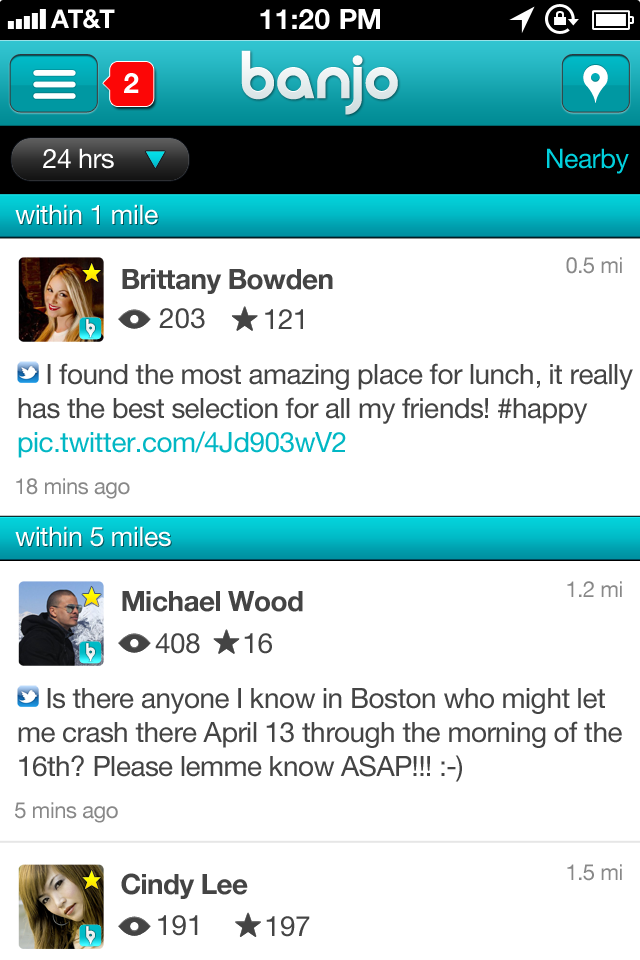
What’s a SXSW bump worth? To Redwood City’s Banjo, which pools check-ins and geotagged updates from friends across all the major social networks, it was worth 100,000 downloads during the interactive part of the conference. That brought the app to more than 900,000 users. Of those, a little more than a half-million users are active every month and iOS users still outnumber Android ones by two-to-one.

That’s not bad for an app that has grown pretty much organically since it came out nine months ago, and Banjo is showing an upward tick in users at least if you look at its footprint on Facebook. Social networking is a tougher category to acquire customers in at least compared to games, where developers usually have very cash rich businesses that can pay for marketing. For comparison, Path has said in the past that it has two million registered users, but it’s not clear how many of those are active. Banjo’s numbers almost certainly make it larger than every new social, local and mobile app that we profiled ahead of SXSW.

On the back of that momentum, Banjo has an update out that makes the app even more of a central hub for all location activity on other social networks like Twitter, Foursquare and Facebook. It adds Instagram to the other social networks that Banjo pulls check-ins and location-tagged status updates from. Our own Sarah Perez has called Banjo the “creepy/awesome cyber-stalking app“ that shows you who’s nearby based on their Facebook and Foursquare check-ins and geotagged tweets.

Banjo now feeds all notifications all into one place and there’s a new slide-out navigation menu that’s similar to what Facebook introduced to its mobile apps a few months ago.

Banjo’s chief executive Damien Patton said the company was extra careful around not creating too much hype around SXSW. The issue is that the conference has gotten very crowded with product launches which mostly flame out afterward.

“We made a conscious decision not to have a big presence at SXSW,” Patton said. “They’re not our target market.”

He also says that like in earlier years, post-SXSW consolidation is coming soon. “I don’t have a crystal ball to know who will get acquired, but we’re really trying to focus on the mainstream user for now,” he said. Banjo is funded by BlueRun Ventures and Lightspeed Venture Partners.


On The Nokia Lumia 900 And How AT&T Is The Phone’s Only Downside

OLYMPUS DIGITAL CAMERA

This is it. The stakes couldn’t be higher. The future of Windows Mobile Phone hinges on the success of the Nokia Lumia 900. The phone has a huge amount of hype. It’s priced right at $99 on-contract and it’s a drop-dead gorgeous device. Nokia’s latest marketing campaign directly targets Apple and Google. If any phone could rocket Windows Phone 7 to success it’s the Lumia 900. It’s just too bad Microsoft and Nokia tasked lowly AT&T of all carriers to launch this pivotal phone. And for whatever unknown reason, on Easter Sunday.

The Lumia 900 is arguably the hottest phone of the year so far. It debuted back at CES where it was called a larger Lumia 800, which is about right. The 900 shares the same design spec as the 800 but sports a larger 4.3-inch display and 4G LTE connectivity. But that’s not a bad thing. Much like the 800, the 900 is a looker with a very unique design and very bright screen. It’s proper fine flagship phone.

Previous Windows Phone 7 devices haven’t made a splash. I bet only true mobile geeks can even name another Windows Phone 7 device. And that’s the problem. So far, Microsoft, the makers, and the carriers have yet to fully commit to the platform. Microsoft might be pulling in more money from licensing patents related to Android than Windows Phone anyway.

Windows Phone 7 launched a year and a half ago. The early version lacked competitive features and it wasn’t until the last update that the platform started to feel mature. It’s completely fine now and could make many users happy with its straight-forward live homescreen approach. But this lag killed most of the buzz the platform had prior to launching in late 2010. The Lumia 900 launch could be the turning point. AT&T will make or break the phone and with that, make or break Windows Phone.

The Lumia 900 will only be available on AT&T in the states and hits stores this Sunday — because people are going to line up for a phone on Easter. Even still, there can’t be any iPhone-esque lines if no one knows the phone is coming. But where are the ads? The massive marketing campaign? The only advertisement I’ve seen is Nokia’s secretive Beta Phone campaign.

AT&T has a sour history with Windows Phone. The carrier sells three WinPhone devices but have so far been very slow to push out updates. The carrier simply skipped the last bug fix but will instead push out a major revision — but that’s not scheduled for weeks. AT&T also screwed early adopters back in 2011 by delaying similar, but much more vital updates.

But what’s a Windows Phone fan to do? Much like with the iPhone in the early years, if you want the device, AT&T is your only choice.

The wireless game is complicated and cut throat. AT&T probably cut Nokia a pretty check to get the exclusive rights to the Lumia 900. Whoever is in charge of the pricing did the phone right by pricing it at $100 rather than the industry-standard $200. But AT&T is the most hated wireless carrier in the states. The Lumia 900, and with that, Windows Phone, would have a better chance of success if it was on at least one other carrier.

The Lumia is a fine device. I have no problem labeling it one of the smartest buys on the market. I would still recommend the iPhone 4S over it to most buyers, but the Windows Phone offers a fantastic built-in feature set that could be perfect for first-time buyers or even overloaded iOS/Android owners. My only pause is AT&T and locking into a carrier that seemingly changes contract terms on the fly. Plus, their history with Windows Phone shows they do not take the platform seriously. It’s a shame, really. The only real downfall to the Lumia 900 is AT&T — that and the lack of 3rd party apps.