Andrew Keen interviews Laura Tyson, professor of economics at UC Berkeley.
Blancer.com Tutorials and projects
Freelance Projects, Design and Programming Tutorials
hacking,system security,protection against hackers,tech-news,gadgets,gaming

You know what I hate most about getting too drunk to drive home? The hangover. No, no, I’m kidding (well, sort of) – it’s having to go retrieve my car from wherever I left it the next day. Sometimes, it’s been towed. Other times, it’s been broken into (true story). That’s why I’m hopeful about the possibilities a new service called StearClear has in store. The startup, which is backed by $500,000 in founder-led and VC funding, has been up-and-running for just a month in parts of New Jersey. What StearClear offers, simply put, is a way to get you and your car home. Safely.
Oh god, please let this work.
According to co-founder Craig Sher, the idea for providing a designated driver service is hardly new. “I found 50 or 60 companies across the country,” he said. “But most of the companies that do designated driver services are mom-and-pop shops…and it’s a very difficult business to make money on. Most people who embark on a designated driver service do it from a community service point of view – they’re very focused on volunteer drivers.”
So the big idea with StearClear, then, is how do you make a service like this work to make it profitable for all involved? Their solution: local franchises.
Instead of launching this as their own service from scratch, StearClear takes on a lot of the cost that goes along with creating a business, while leaving the day-to-day to others. The franchises don’t have to process credit cards, handle paying employees or doing their tax reporting; they don’t have to hire HR staff to ensure compliance with U.S. employment law, or worry with insurance and liability protections. StearClear also handles vetting the drivers, handling background checks, criminal and sexual predator checks, driving record checks, and even drug tests.
But, says Sher, “our real magic is the software, and the fact that we have a real end-to-end solution.”
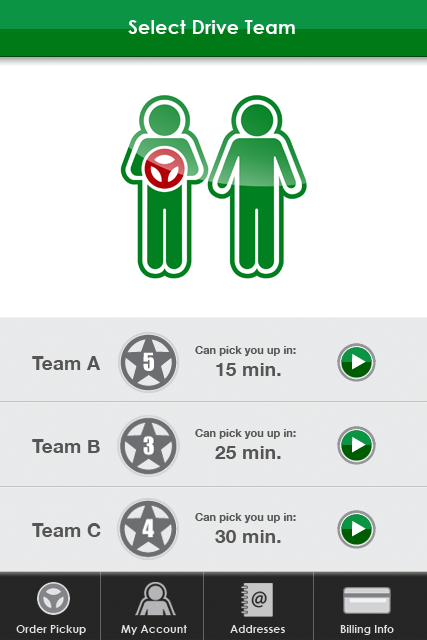
The software he’s referring to is a suite of three mobile applications: an iOS/Android app for end users (them being the drunks), one for the drive teams, and a third iPad app for franchise owners which lets them view a heatmap of their drivers’ cars in action, customer requests, and all the management reporting functions necessary to run the business.
The drive teams are a team of two people – one who drives the customer’s car, another who chases it in their own. Both are hired locally and paid as W-2 employees ($8/hour while waiting, $12/hour while working; plus, for the chaser, 55 cents per mile – the going federal rate). It’s not career-making money, of course. The “waiting” pay is barely above minimum wage. But the drive teams split tips, so there’s a chance to earn a bit more.
Drivers are assigned shifts to keep the busy times covered, but can also make themselves available at any other time, if they want to make extra cash. When customer requests come in, drivers “bid” for the pickup via their own app by saying when they can get there. The customer usually picks the closest driver, of course.
As for customers, the sign-up process is similar to that of black car service Uber: a credit card is kept on file so there’s no need to swipe cards or hand over cash at the end of the ride. Rates are $20/per pickup plus $2.50/mile. Premium members (aka regular drunks), can pay $5/month then get discounted rates of $15/pickup and $2.25/mile.
Sher says the pricing can either be around 5% more or less than local cab rides, depending on your area, but is on average 20-30% cheaper than a black car service.
Meanwhile, franchise owners pay $30,000 to buy a block of 70,000 people (around 6 to 12 zip codes’ worth) for their business. They then get access to the turnkey solution, and keep 80% of the revenue.
The business’s subsequent failure or success, then, is on them. Marketing, raising awareness, finding employees, managing schedules, everyday customer service, etc. – it’s all on them. In Sher’s view, this makes them stakeholders. Well, sure. But it also means that getting the company off the ground has been essentially handed off to a bunch of unknowns in whichever far-flung regions of the country where someone decides to take a risk. Anyone with $30K and a dream of keeping drunk drivers off the road can sign up. Some, like some of the mom-and-pop operations, will make it work. Others will not. And it will all reflect back on StearClear.
Sher believes that this can work, though. “It makes the franchisee profitable. Within their first six months, they’re making money. If they would have started from scratch…number one, they wouldn’t have a software solution, they’d have a phone number – all the things that make the business difficult to implement, we take care of.”
Build a platform, and they will come?
“None of these [mom-and-pops] have been able to scale, none of them have been able to make any money, and worse than that, none can offer a nationwide service,” he says. Now, maybe, they can.
The founders, Craig Sher, Ken Schwartz and Harjinder Sidhu, have technology backgrounds which involve their two previous firms – a consulting firm and software company – which did engineering projects for most of the big banks on Wall Street. Over the years, they accumulated the IP and staff needed to launch something like StearClear. Of the $500,000 in funding, only 20% is outside funding from Accelerant Capital Partners, the rest is from the founders themselves.
StearClear is live in parts of N.J. now during its first public test, a 3-month beta where the idea is put into action for the first time. Stay tuned.

Disrupt NYC is coming up quick and we are working like mad to make sure this Disrupt is as big as ever. So far, we have announced these amazing speakers and judges, who will all be joining us. Not only that, but Michael Arrington is back and will be with us this year, along with our very own columnist MG Siegler. We still have a ton more surprises up our sleeve that we will also announce as we get closer to the event.
For now though, who wants to come with us? We have two free tickets to give away, each being valued at around $1,800. These tickets will get you into all three days of Disrupt, as well as all three after parties (which are incredibly fun thanks to our amazing sponsors). Disrupt NYC is taking place on May 21st through the 23rd, following our super popular Hackathon which is from May 19th to the 20th. To enter for a chance at winning one of these free tickets, all you have to do is follow the steps below.
1) Become a fan of our TechCrunch Facebook Page:
2) Then do one of the following:
– Retweet this post (making sure to include the #TCDisrupt hashtag)
– Or leave us a comment below telling us why you want to come with us
The contest starts now and ends April 8th at 7:30pm PT.
Please only tweet the message once or you will be disqualified. We will choose two separate winners at random and contact them this weekend. Anyone in the world is eligible. Please note this giveaway is for tickets only and does not include airfare or hotel.

Etsy, the popular marketplace for all things handmade, just announced that it will not just be hosting the 2012 session of Hacker School at its headquarters in New York, but that it will also offer ten $5,000 grants to women who would like to attend this year’s session but don’t have the financial means to do so. As Etsy’s VP of engineering Marc Hedlund notes, the idea here is to ensure that about 50% of the next Hacker School class of about 40 participants will be female.
Hacker School is one of the many recently launched programs that aim to teach budding programmers to become better hackers. It’s a three-month, full-time program based in New York. The application deadline for this year’s summer session is May 7 and the program will run from June 4 to August 25. Hacker School itself is a free program and those who get the Etsy grants “can spend the money on whatever expenses necessary to free you up for Hacker School, no questions asked.”
Hacker School co-founder Nick Bergson-Shilcock also notes that the female applicants will be judged on the same scale as men. “It frustrates us a little that we feel the need to say that,” writes Bergson-Shilcock, “and we think it underlines the sexism (intentional and not) that so pervades the programming world.”
Etsy’s Marc Hedlund acknowledges that “20 is a small number,” but that he himself has only hired about 20 female engineers in the past 17 years. He also notes that he would be more than happy to hire any of the female engineers from this next batch of participants, “but more importantly, we just want to see these women go on to get fun, creative, lucrative jobs in technology — and hopefully tell other women about the great experiences they’ve had.” At Etsy, a site that has given many female entrepreneurs a chance to start their own businesses, eleven women currently work in Engineering and Operations. That’s up from just three last September. Etsy has about 100 employees in Engineering and Operations.

Daniel Franklin is the Executive Editor of The Economist magazine and one of the sponsors of last week’s excellent Innovation event at UC Berkeley’s Haas School. He is also author of the new book, Megachange: The World in 2050 which imagines the major economic, scientific and political challenges and opportunities to come over the next 40 years. So how important is the Internet, I asked Franklin when we talked last week, in solving some of what he calls “the wicked problems” of the planet? And, I asked him, what can Silicon Valley learn from the rest of the world in terms of coming up with innovative technological solutions to the world’s most pressing problems?
This is the final interview in the series of conversations from the Innovation event. Check out my other interviews from the event including those with Stewart Brand, Clay Christensen, Don Tapscott and Vivek Wadhwa.

Ask (enough times) and ye shall receive. AT&T has kept the iPhone under lock and key since day one, but we’re hearing that a pretty dramatic policy shift will go into effect starting this Sunday. Once April 8 rolls around AT&T will unlock your iPhone should you so choose, at which point it’ll play nicely with a microSIM from any GSM carrier.
Of course, there are a few conditions you have to meet before AT&T will swoop in and unlock your iPhone. First and foremost, your device has to be completely out of contract and your account must be in good standing — that means no history of missed payments or disconnections. AT&T will also unlock your device if you’ve gotten sick of your contract and decided to shell out the early termination fee, or if you spent full price on it, rather than purchase it subsidized with a contract. Not bad AT&T, not bad at all.
Alright, fine, not everyone actually needs a globetrotting phone, isn’t it better to be safe than sorry? Just don’t expect every SIM card to grant you magical access to high speed data — T-Mobile USA’s pre-cut microSIMs will fit just fine for example, but you’ll be stuck cruising the web at EDGE speeds.
Long time AT&T customers may know that the company’s policy has been to unlock a user’s device after 90 days of continued service, but the iPhone has always been a special case. Then again, we’ve been hearing that Apple CEO Tim Cook has been getting more than his share of iPhone unlock requests lately (mostly because looping him in actually gets things done), so maybe Mr. Cook just didn’t feel like dealing with the masses any more.
[via Engadget]
According to a new report by Experian Hitwise, 91% of online adults now regularly use social media in some form or another. This makes social networking the top online activity in the U.S. today, with 15% of all U.S. Internet visits going to a social networking site. Experian’s report also found that Pinterest is now the third most popular social network in the U.S., right behind Facebook and Twitter. What’s more interesting than those rankings, though, is what the report tells us about social media’s most fervent users.
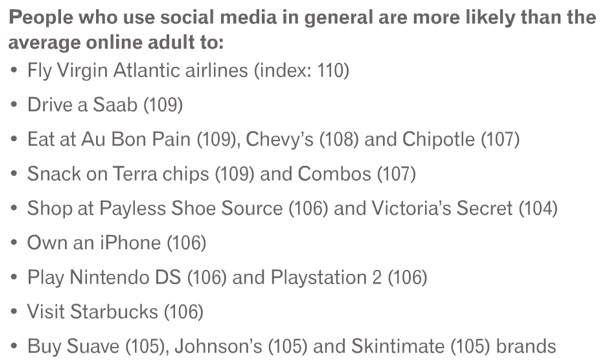
Experian, for example, found that people who use social media regularly are significantly more likely to fly on Virgin Atlantic than the average online adult. These social media users are also more likely to drive a Saab, own an iPhone, eat at Au Bon Pain, Chevy’s and Chipotle, and shop at Payless Shoe Source and Victoria’s Secret.
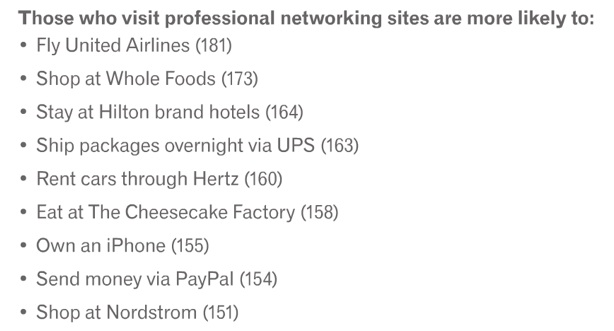
Interestingly, those adults who visit professional networking sites like LinkedIn more than the average Internet user actually prefer United Airlines (they are probably more interested in collecting frequent flyer miles and getting upgrades), Whole Foods and The Cheesecake Factory. Just like the average social media user, though, those who regularly frequent professional social networking sites are also more likely to own an iPhone than the average U.S. adult.

Living in Seattle, you tend to find yourself in the company of tech people all the time. With Microsoft, Amazon, Adobe, Google, and a dozen other major companies established in the area, it’s never a surprise when you find out the guy next to you at the bar is working on Windows Phone 8 or Half-Life 3. This week, I was lucky enough to get a chance to see what Amazon has cooking for its next generation of e-readers. Their new offices and the mysterious Lab 126 are just down the street, after all, so I’m actually surprised it hasn’t happened before now.
Back in November, I speculated that the new Kindles and Nooks and what have yous might have glowing screens, the likes of which we’ve seen occasionally but were never fully implemented. It turns out Amazon was thinking the same thing, and actually bought a company that was, I am told, the world leader in light-guide technology. They’ve finally gotten it to the point where it’s ready to be released, and a new generation of glowing Kindles will be coming our way sometime this year.
Incidentally, that acquisition doesn’t appear to have ever been reported, so although it happened in late 2010, this is the first anyone has heard of it. The company, Oy Modilis, was founded in 1991 in Helsinki, and has a number of patents relating to this sort of thing. This one, for instance, seems to cover the type of lighting technology used in the new Kindle.
The device I saw was crudely camouflaged in a sort of cardboard enclosure, but the screen was clearly visible. With a tap, a slider popped up on the screen, and as it was dragged to the right, the screen lit up evenly with a rather cool light. In the dark, it was plainly noticeable as a glow, and in uneven light — say, shade or a shuttered room — the slight illumination made the screen much more readable. At full blast it was definitely projecting some light (technically speaking it was reflecting it), but it was still a soft glow and not the harsh flashlight of a backlit LCD.
I commented on the temperature of the light — it was that blue-white glow found in uncorrected white LEDs, not the warm light on off-white that most people associate with books by lamplight. But, of course, the e-ink screen is in fact grey and dark grey, not black on off-white, as paper is, so a cooler light may actually work better. At any rate, they are apparently sensitive to these issues and looking into it. I thought that the text looked better as well, but it’s possible that this was the result of improved font rendering and aliasing reduction, or perhaps something to do with the light. At any rate, it wasn’t any of the crazy new bistable displays we’ve been seeing at trade shows (alas).
As for the shape of the device, it was impossible to tell, wrapped as it was in its little cardboard box. But the size appears the same, and the whole point of purchasing the light-guide company was to get the team and their patents, which essentially laminate the light diffusion layer right onto the screen without adding much in the way of depth or interfering with the touch system. I was told the industrial design isn’t finished yet, but I ruled out things like ruggedness, waterproofing, or a flush-front screen — all things, by the way, I suggested they look into. It shouldn’t be any thicker, though it will have to accommodate the LED circuitry and presumably a larger battery.
The current crop of e-readers is, as I recently lamented, both troublingly homogenous and still not good enough for paper-lovers like myself. The new Kindle doesn’t look like it’s going to address all of my issues with this kind of device, but the improved display will definitely set it apart from its rivals. We’ll know for sure when it comes out later this year.
[note: the top image is a concept image from Flex Lighting, not a real device]

If you’re wondering what Philip Kaplan, a.k.a. Pud, has been up to, wonder no longer: He’s working on a social network for musicians called Fandalism. The site went live at the end of January, and without any publicity or advertising, it has grown to more than 350,000 registered users.
You may remember Kaplan as the founder of the blog FuckedCompany and the ad network AdBrite. More recently, he co-founded social shopping startup Blippy, and when the product failed to take off (the other founders are working something new), he focused on smaller projects like newsletter-maker TinyLetter, which was acquired by MailChimp in August.
One thing you might notice: None of these projects seems particularly related to any others. And Fandalism continues that non-pattern. Kaplan says he has actually owned the URL for several years, at one point experimenting with using it as a “YouTube for songs.” He returned to the domain last year as a way to meet one of his own needs: He’s a musician (primarily a heavy metal drummer), and he wanted to connect with other musicians.
Right now, Kaplan says the main way for musicians to find other musicians online is through Craigslist. There’s also Indaba Music, which similarly promises to help musicians find each other, but it’s more focused on collaborating on specific projects. (The site describes itself as a “the music creation marketplace.”) Kaplan wanted to make something that was more social, and also fairly straightforward and simple.
When you create a profile on Fandalism, you enter basic information like where you’re located, the genres of music you play, and your influences. You can also answer questions about your musical history, such as “What was the first concert you went to?”, and share your work through photos, lyrics, and embedded YouTube videos and SoundCloud songs. Then, once your profile is set up, you can start following other members, posting comments on their profiles, giving “props” to their performances, and sending them private messages.
As an example, you can see Kaplan’s profile here.
Judging from the rapid, word-of-mouth user growth, it seems that other musicians also thought there was a need here. And it’s an international userbase — at one point during our demo, Kaplan started searching for musicians in random countries, and the only one that came up empty was Luxembourg. We even found someone in Kazakhstan.
The site was completely invite-only until earlier this week, when Kaplan opened it up a bit, allowing anyone to browse and search. However, you still need an invite from another member to create a profile and post — Kaplan says it’s a basic way to ensure that someone else is vouching for your talent as a musician, so he plans to keep membership invite-only for now. (You can also join as a non-musician, but you’ll need an invite for that, too.)
As for making money, Kaplan says he has some ideas, such as allowing instrument manufacturers to advertise on the site. However, he doesn’t sound committed to any particular model right now. Nor does he seem particularly interested in raising funding, though he doesn’t reject the idea outright, or in hiring any employees. Yep, Kaplan has reached hundreds of thousands of members with a solo project, and while that isn’t quite an Instagram-level user-to-employee ratio, he wouldn’t mind getting there someday.
“Being able to be one guy and have a site with potentially millions of users — you can only do that now,” Kaplan says. “I would like to have 10 million users and still be one person.”

It’s a big day for 500 Startups — you know, the seed-stage accelerator and capital fund founded by rabble rouser and geek on a plane, Dave McClure. Back in July 2010, McClure filed for the accelerator’s first fund, raising $30 million to begin officially investing in startups under the new venture capital fund. Today, we’ve learned via SEC regulatory filing that round two is officially on the books, and 500 Startups is going bigger for its second round, raising $50 million.
McClure and company are also today announcing an expansion of the team, as Paul Singh and Christen O’Brien have been promoted to partners. Singh will continue to lead investments, running the accelerator program, and acting as head Data/Metrics guru, while O’Brien continues on her role as head of business development, leading events and conferences, like Geeks On A Plane, Warm Gun, etc. Bedy Yang and George Kellerman have also joined as venture partners.
Yang will be overseeing investments in Brazil and Latin America, while Kellerman will be scouting emerging talent in Japan. The group of four join existing partners Christine Tsai and McClure, and highlight not only the fact that 500 Startups is no longer a one-person show, but that the team has not only been diversifying, but increasing its focus on identifying and investing in international talent.
In speaking with the Tsai and McClure, the founder was quick to point out that 500 Startups is no longer just an accelerator, but also a set of conferences, and a fund that invests not only in companies of its choosing but those of other accelerators as well. Of the some 257 investments 500 Startups has made to date, McClure says that more than 50 of those have been in other accelerators, including 25 from Y Combinator, 15 from TechStars, 5 from Seedcamp, 3 AngelPad companies, and 3 from Startmeet.
While 10 to 15 percent of the fund’s current investments are in international startups, the partners said that, with the new $50 million fund, this will be increasing in the future, as it looks to build upon its investments in accelerators in Mexico City and Beijing, and beyond. For example, the team held a Geeks On A Plane trip to India in December of last year, and intends to continue focusing on Latin America, the Middle East, and Eastern Europe, both for Geeks On A Plane and in terms of investments, looking to build ties in those ecosystems.
In October, the accelerator and fund peeled back the curtain on its third batch of startups, which included 34 companies, making it the largest roster to date (the initial batch consisted of 12 startups and the second came in at 21). Our coverage also touches on 500 Startups’ growing domestic and international diversity. You can also check out 500 Startups video here. The accelerator’s fourth batch kicked off a few days ago, and we’ll have more on those companies soon.
But another thing that’s interesting to note is that the accelerator is rolling out a new program that enables its mentors to co-invest in its accelerator companies — something that not many other accelerators or capital funds are doing at this point. Co-investing is not required for mentors, and all startups get the final say on which mentors can participate, but it’s a great opportunity for startups to get strategic angels on board, and conversely, an opportunity for mentors to invest in fast-growing stages early in their trajectory.
500 Startups is also adding to its conference brigade, with a new event to be held on Friday April 20th, called MamaBear, which will be a one-day even focused on new technology for moms, kids, and families, with speakers representing companies like BabyCenter, Disney, Sesame Street, Plum District, MindSnacks and more.
For more on 500 Startups current metrics, check out the infographic the team prepared with the help of the wizard designers over at Visual.ly. Can also find a conversation with the partners here.

Microsoft is pushing their Windows Phone platform like crazy these days — it recently debuted in China, and the flagship Nokia Windows Phone is due to hit U.S. shelves shortly with a huge marketing blitz in tow — but the company still has a little app problem to deal with.
More than a few developers still don’t see developing Windows Phone apps as a priority, and the New York Times reported yesterday that Microsoft is doing what they have to in order to change those minds. Among other things on their list of tactics, Microsoft has offered to fund process of bringing big-name apps to Windows Phone “where it makes sense.”
Microsoft is no stranger to this sort of thing — they’ve offered plenty of free Windows Phones to developers in the past in an effort to spark some interest in their still-growing platform. Hell, Microsoft has been offering financial support to developers since before the first Windows Phones were even released.
Among the parties who have taken up Microsoft on their generous offer is Ben Huh of Cheezburger Network fame (not to mention soon-to-be reality TV star), who told the Times that Microsoft “took care of everything” when it came to developing a lolcat-touting Windows Phone app. Foursquare jumped on the wagon too, with bizdev head Holger Luedorf mentioning that a Windows Phone app was low on their list of priorities until Microsoft offered to underwrite its development.
Despite Microsoft’s paradoxically small presence in the mobile space they’ve got a decent-sized checkbook to play with. I can’t blame Microsoft for trying to buy love from developers — right now, they’re just fighting to keep up with major releases that have already found their way to other platforms. If they want to stand any chance at gaining traction in this market, they’ve got to give their customers the impression that they’re not missing out on anything by taking a chance on Windows Phone.
Take the Angry Birds kerfuffle for example — Rovio CMO/Mighty Eagle Peter Vesterbacka ruffled more than a few feathers when he remarked that Angry Birds Space wouldn’t find a home on Windows Phone. Rovio followed up the next day with news that the franchise’s latest game would indeed make the WP transition, but writers and pundits had plenty of fun with the news while it lasted.
That’s exactly the sort of thing Microsoft needs to avoid, and it seems as though they’ll grease the palms they need to to keep it from becoming an issue. While those highly popular, big-name apps may keep consumers from regretting their choice of smartphone, Microsoft still has another issue to contend with: many of the apps to be found are awful.
You see, the news comes just a few days after the number of apps in the Windows Phone Marketplace tip-toed over 80,000 (that includes region-specific apps, your mileage may vary). It seems like it would be quite an achievement, and it gets them that much closer to the milestone, but sifting through the junk can be a hell of a thing. My former colleague (and my favorite Belgian) Robin Wauters has a great piece on The Next Web about how the Windows Phone app store is populated by questionable, derivative crap.
Make no mistake, Microsoft knows about these cr-apps. Last year, they had to cut down on the number of apps a developer would be able to submit to the Marketplace in a single day, from 20 down to 10. It was all in an effort to stem the hordes of spammy app submissions that would flood the Marketplace’s New section, which meant that actual good apps from honest developers may not get the shot they deserved. It’s an environment that doesn’t always seem very conducive to developers on the up-and-up.
And there will be plenty of those developers, if Microsoft has anything to say about it. The Wall Street Journal notes that Microsoft has put plenty of time and money into sponsoring over 850 developer sessions across the globe in 2011, which the Journal says is triple the number they held the year before.
Now, it’s awfully easy to rag on Microsoft and Windows Phone for its app troubles, but they’ve got a great opportunity here. The Windows Phone platform is the youngest of the major smartphone OS competitors, and while it isn’t as pervasive or as popular as iOS or Android, this sort of hands-on approach may end up paying off big time. It’s a fight that must be fought on multiple fronts — Microsoft should ideally be more stringent with submissions but keep the process smooth for well-reputed and promising developers, as well as making sure those big-name apps keep pouring in. Whether or not Microsoft’s machinations will make for a real three horse race remains to be seen, but you can bet that won’t keep the folks in Redmond from trying anyway.

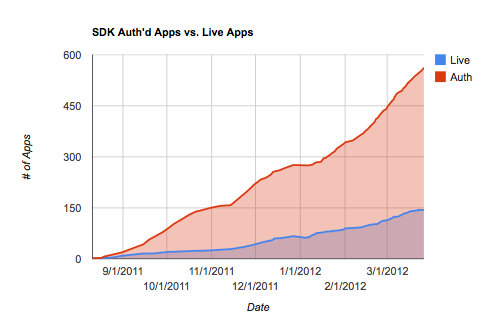
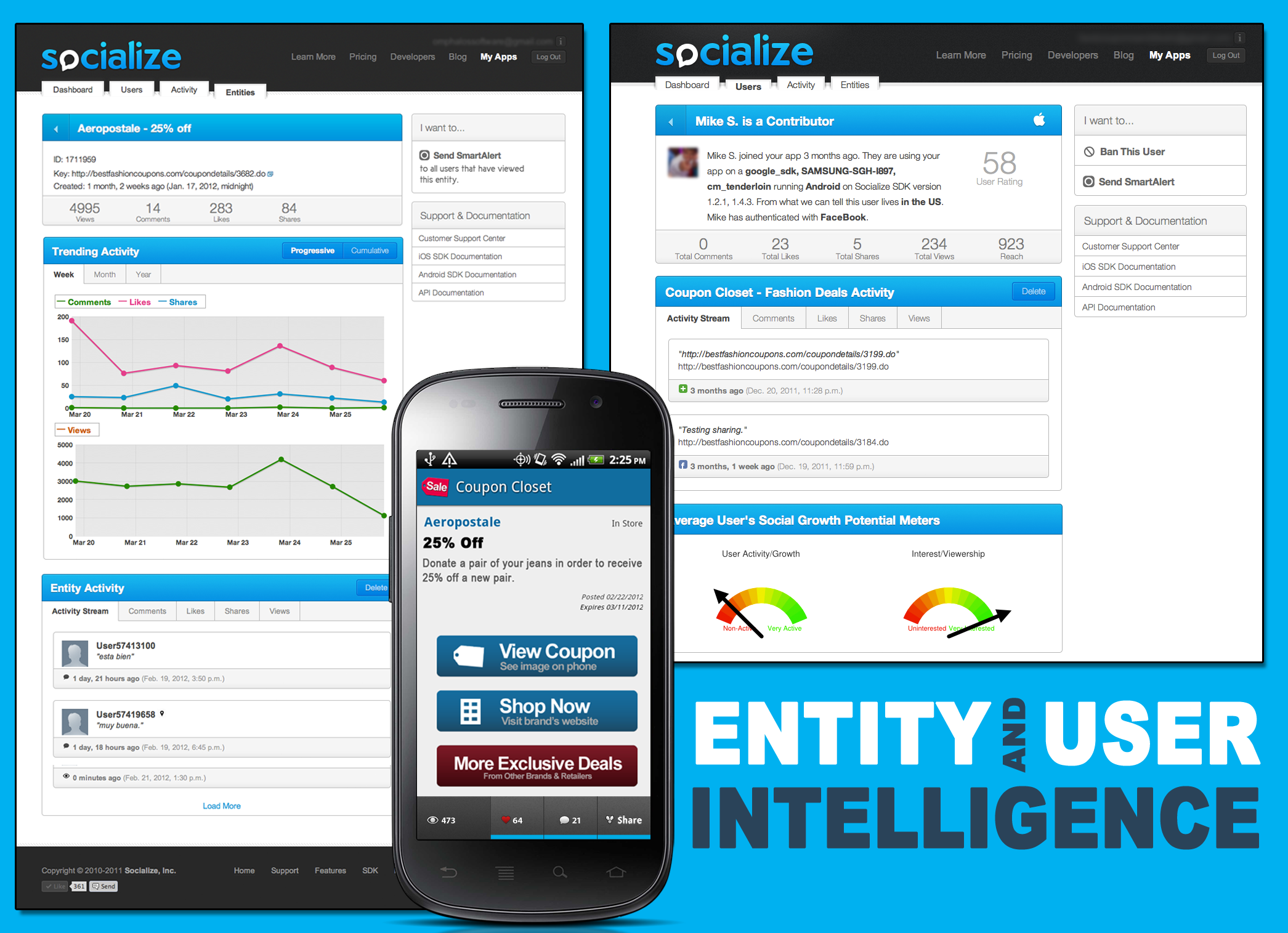
Socialize, the new platform that allows mobile developers to instantly add social features to their apps, has come a long way since its November launch of its Social Action Bar. Apparently, developers are giving this one a shot…in droves. 5,500 developers have downloaded the mobile toolkit to date, with 562 apps in testing and 150 apps which have gone live with integrations. (Here are a few).
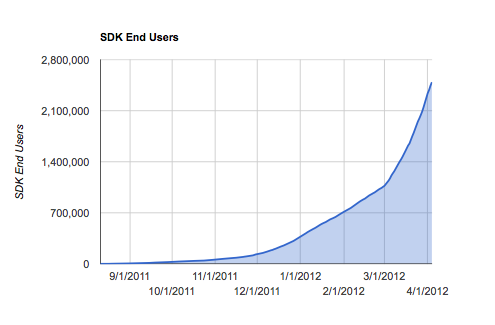
The startup is also now reaching over 10 million end users, up from 3.7 million in November. And its user base is doubling monthly, the company says.
According to CEO Daniel Odio, via new downloads, the SDK now reaches 2 million end users (that is, users who download Socialize-infused apps). However, the majority of that 10 million figure comes via the company’s AppMakr channel.
For background, Socialize actually grew out of the app-making service AppMakr, which had previously built apps for brands like Disney, The Washington Post, Newsweek and Politico. It later rebranded as Socialize with a focus on the social app SDK. Since then, AppMakr has served as sort of a testing ground for the new offerings, and was already reaching 3.7 million end users via the Socialize beta at the time of the Socialize Action Bar SDK public launch.
Since then, the startup has been focused on boosting installs and impressions in apps running Socialize, and is helping developers bring in new users to their apps through the social actions of app users. As users comment, like, and share from within the app, they’re essentially serving as the app’s marketers.
The company recently showcased a few success stories on its blog, where app makers were reporting increases in impressions and revenue. One, a finance app for the Spanish stock market, saw impressions go up 316%, and revenue up 257%. A couple of others, one a couponing app, another a fitness app, saw impressions increase by 120% and 103%, respectively.
Socialize bootstrapped itself by selling a mobile consulting company called PointAbout to fund some of its growth, and currently has $1.5 million in angel funding to help it along.
Now, with Apple’s phasing out of the UDID (the unique device identifier used for user tracking), the company hopes more developers will become interested in its service, which provides insight into user activity surrounding social actions – likes, comments, and shares.
Developers can download the SDK for iOS or Android here.

Even though San Francisco-based Flurry hardly makes any direct revenue from its mobile app analytics, the product has become so widely used that one out of every three iOS apps and one out of every four apps for Android downloaded from Google’s Android app store includes it.
Now the company is overhauling its analytics product by adding custom dashboards, alerts and funnel analysis. In plain English, that makes it easier for companies to follow the metrics that matter most to them, whether that’s user retention after three or seven days or the number of users who complete a transaction. If you look at the example custom dashboard, it shows “rolling retention” or how long an app keeps users after the day they download it.
Alerts can ping a mobile app maker if their usage spikes or suddenly declines, for example. Mobile app publishers can get these alerts by e-mail once a day. If they have several alerts set up, they’re all compiled into a single e-mail.
Then funnel analysis is super key for any sophisticated mobile app maker that wants to understand if users are doing exactly what they want them to in the app. Are they buying virtual currency? Are they getting to Level 20 in a game? Flurry offers two types of funnels: one for tracking “in-app” events and one for tracking “cross-app” events. The latter is key because many developers with more than one app cross-promote users from one title into another. This is important in the gaming category as players sometimes get bored of one title, so developers need to coax them into playing other titles to keep them as a customer.
Flurry competes with a host of other analytics providers like Apsalar, Localytics and Kontagent. But since Flurry was the earliest to market in 2008, it has the widest reach as it’s included in 170,000 apps. The company sees about 500 million unique smartphones or tablets per month, tracks 300 billion data transactions per month and sees 1.2 billion sessions per day. It’s in 18 of the 25 Top Grossing Apps in the iTunes store.
And the growth is just continuing. Flurry has added about 35,000 apps from 10,000 companies since December. The number of sessions it tracks per day has jumped by 50 percent over the last three months. To be fair though, the other analytics providers have their own specialties. Kontagent, for example, has a long history in social gaming metrics that it brings over to mobile and Apsalar has a veteran team that’s done behavioral targeting and analytics in previous companies. But Flurry’s free analytics product has put some downward pricing pressure on the rest of the market.
Even though analytics isn’t a core part of Flurry’s revenue stream, it has been a key part of the company’s business strategy. Analytics gives Flurry a relationship with thousands of developers that it can upsell to other advertising products like incentivized video clips, installs or targeted advertising.
“We get a lot of goodwill from the developer community,” said Peter Farago, Flurry’s vice president of marketing. “And the data set that we build up has other benefits in helping us create new products.”
Flurry has raised more than $25 million to date in three venture rounds led by Menlo Ventures, Draper Fisher Jurvetson and InterWest Partners.

SoMe is a film about the rise (and fall?) of social media. Produced by web rabble-rouser and satirist, Loren Feldman, the film will feature Feldman’s signature puppet act (it will be cool, I promise) and interviews with and segments about web luminaries like:
Feldman is an experienced film producer and comedian and he knows where all the bodies are buried so it may be a good time when it all comes together. He’s asking for $50,000 to fund the project and he’s already hit $5,000 or so with six days left. Here’s hoping he resurrects the Hendrickson puppet.

Just a reminder: starting April 9 TechCrunch will be hitting Virginia for a barnstorming tour of three cities – DC on Monday, Norfolk on Tuesday, and Richmond on Wednesday. You should have already RSVPed (did you?), you should have already picked out what you’re going to wear (did you?), and you should have your pitch ready (do you?).
As a special bonus, DC meet-up folks will get to meet our new co-editor, Eric Eldon, who is coming in from San Francisco and who will be in Virginia with us that evening. It will be, as they say in Virginia, a hoot.
Thanks to all those who helped out in organizing this and a huge thank you to our sponsors. We’re really looking forward to this opportunity to meet with you guys in the tech corridor. Feeling left out? Fear not. We’ll be hitting other cities this summer.
Monday, April 9 – DC – RFD – 810 7th St NW – 6pm-10pm (??) – Our first event will be at RFD in NW. These guys have a huge selection of beers on tap and, if we play our cards right, we’ll have a few hours of open bar. If you haven’t RSVPed hop over to Plancast or email me at [email protected] with the subject “RSVP DC.” Try to include a rough headcount.
Sponsors
Tuesday, April 10 – Norfolk – We Are Titans Offices – 259 Granby St 3rd Floor – 6pm-10pm – We will begin the night at the We Are The Titans offices, kindly provided by a team of titans who work there, and the perhaps we can move to another location later. Please RSVP hereor email me at [email protected] with the subject “RSVP NORFOLK.” Try to include a rough headcount. We are also looking for sponsors, so please let me know in a separate, non RSVP email if you’re interested.
Here’s a little bit about our first Norfolk sponsor:
Wednesday, April 11 – Richmond – SnagAJob HQ – 6pm-10pm – 4851 Lake Brook Dr – Finally, we’ll meet in Glen Allen, outside of Richmond, for our final meet-up. Thanks to SnagAJob for donating a space with a bar and some booze. We’re still looking for Richmond sponsors as well, so please email me directly. RSVP hereor email me at [email protected] with the subject “RSVP RICHMOND.” Try to include a rough headcount.
Here’s a bit about our first Richmond sponsor: