TuneIn Radio Quietly Launches Voice-Based Social Networking App “OpenMic,” Aimed At College Students

TuneIn has a good thing going with its popular online radio service, which now sees over 40 million monthly listeners, so why is the company veering into voice-based social networking? Yes, voice-based. A new mobile app called “TuneIn OpenMic” has appeared on the iTunes App Store, offering select users the ability to record and broadcast their “stories, jokes, reviews and more” and then share them with their friends.

The mobile social messaging craze is apparently hard to resist.

Read the Astroturfed App Store reviews, OpenMic is “definitely a new social networking experience like none-other” and “super fun.”

But it’s not really a new idea. From what we’ve seen, it appears OpenMic competes with a number of other voice-based social apps, like Spreaker, Dubbler, Bubbly, Talkbits, and others. To some extent, you could count several mobile messaging apps as competitors, too, including Voxer, Whatsapp or even Facebook Messenger, as recording your voice is also a feature in those applications.

TuneIn’s OpenMic app, meanwhile, falls somewhere in between wanting to be a purely social “Twitter for Voice” kind of thing, and something which aspiring podcasters could use to build up an audience.

The app is only open to university students right now, and it requires a .edu email address in order to sign up.

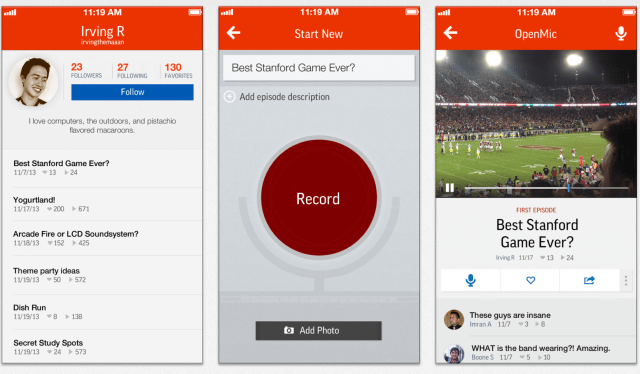
The app lets users set up a profile page, find and follow their friends, mark posts as favorites for later listening, share audio clips outside of OpenMic, and comment on posts others have created, or reply to others’ comments. To create a recording, it’s just a matter of pressing a big, red “Record” button and then attaching a photo to accompany the post.

tunein1

In the screenshots on iTunes, example posts further illustrate the kind of content OpenMic hopes to see, including recordings about football games, parties, music, and oh, yeah, schoolwork. The app is being tested at Stanford, TuneIn tells us, a school which is also featured heavily in the App Store screenshots.

TuneIn raised $25 million in new funding earlier this year, in a round led by IVP, with previous investors Sequoia Capital, Google Ventures, and General Catalyst also participating. At the time of the raise, the company had said it had already surpassed 1 billion listening hours as of mid-April 2013, which would have made it the #2 destination for online music behind Pandora. As of October, TuneIn said it was offering over 70,000 AM, FM and Internet radio stations on more than 200 platforms, in 230 different countries and territories. Today it has 100,00 stations.

Considering these metrics, it’s clear that this new app doesn’t represent a shift away from TuneIn’s core business, but rather an expansion. Though the OpenMic app is obviously still experimental, if successful, it could offer TuneIn’s advertisers another way to reach a targeted demographic – the coveted young and mobile listener. You can download the mobile app here on iTunes, but most won’t be able to actually use the app until TuneIn opens it up more broadly.

QuizUp’s Mobile Play May Be Anything But A Trivial Pursuit

Trivial-Pursuit-Gamepiece-789247

Editor’s Note: Semil Shah works on product for Swell, is a TechCrunch columnist, and an investor. He writes at Haywire, and you can follow him on Twitter at @semil.

About every three months or so, the early adopter tech crowd fixates on a new mobile app as the hip, new thing. It’s not too similar from fashion, I’d imagine, when certain looks go in and out of style. With mobile apps, however, those that break through the noise of the App Store do usually have something unique and compelling about them – for instance, FrontBack designed a mobile interface which made it easy and fun to combine pictures from two cameras into one image, or before it, “Dots” from Betaworks used simple, elegant design and the fear of a 60-second live counter to capture users’ attention. Today, the “hot” app is QuizUp, a new social, mobile trivia game. From the app’s design, the mobile ecosystem may be able to draw new lessons from its success (for a great background on QuizUp, make sure to read Ryan Lawler’s piece, here):

One, most mobile app successes are games. QuizUp is a game…check! Yet, it is not just a game in the traditional sense, as QuizUp could transform into a learning platform where users consume information and even get to contribute content that turns into future trivia. Moreover, unlike traditional games, QuizUp won’t likely be under pressure to create entirely new games, like the hits-driven business of most games, but could rather expand its content (akin to Angry Birds) while keeping the experience fresh.

Two, natural competition among friends encourages users to authenticate with Facebook for login. This gives Plain Vanilla, the parent who birthed QuizUp, access to real names, avatars, and most coveted – the friend graph data associated with each login. The advantages here are obvious, as QuizUp scores are explicitly shared in various social channels as a vanity share, as well as giving the company the data to create richer user profiles with game data and history, to find new people to play with. In a way, QuizUp feels like the mobile-equivalent of what Zynga provided to Facebook on the web, back in the day – something to do that was fun. In fact, it would seem that Facebook would want to provide a similar type of experience inside its mobile app and web site to keep users around once they’ve skimmed through their notifications and newsfeed.

Three, giving users other things to do inside the app “may” be worth the development time and effort. Right off the bat, QuizUp has a packed settings menu, giving users the option to private communicate with other gamers through messages, or by offering digital goods related to the game. Competition for mobile eyeballs is intense, especially in an area as fickle as gaming, so offering users additional options once inside the app may, at scale, help control bounce rates. Plain Vanilla has a larger team and perhaps had the time and resources to pull this off before launch, whereas most startups on a tighter budget may not have had that chance.

Four, social trivia on mobile devices maps to a regular, historical, social, offline behavior. For millions of people who go to weekly or monthly trivia nights at their local pub, QuizUp brings that functionality – minus the hops, of course – to users’ fingertips multiple times a day in an asynchronous fashion, making the app feel as if it’s a live-multiplayer experience when in fact people are playing at different times.

And five, the most striking aspect of QuizUp is they seemed to have built the ontology and infrastructure to classify information by various categories and also planned to accept additional areas of trivia (knowledge). The content of trivia today may be just trivial, but things start to get interesting when you group experts around topics and allow the community to expand the game’s footprint within a known structure. Much in the same way SF-based flash-card site and app Quizlet has grown on the back of user-generated  content, what if QuizUp could benefit from a similar model? Of course, it’s too early to tell, but so far in this game of Trivial Pursuit, the folks have QuizUp seemed to have earned three pieces of pie in their game piece: One, for creating a slick, novel mobile game; two, for cracking distribution early and having a chance to break out; and three for building an infrastructure that could help the content of the game grow in new and exciting ways. Of course, the remaining pieces won’t be earned easily and are the hardest to obtain. The big, overarching trivia question is – will QuizUp be able to keep users engaged and coming back to the app with new games, or will it be stuck on the board with three pie pieces? The answer to this question, no matter the result, will be fascinating to watch.

eBay And Amazon On This Year’s Marketplace Holiday Shopping Trends

Shopping___Flickr_-_Photo_Sharing_

Each year, e-commerce companies predict the new technology shopping trend for the holiday shopping season. In years past, it’s been the rise of the iPad/mobile shopper, or the expansion of major spending online beyond just Black Friday or Cyber Monday. This year is not different, with eBay and Amazon weighing in on the big trends for the 2013 holiday season.

One thing worth noting is that this year’s holiday season is shorter than years past. This year there are only 27 days for retailers, compared to 33 days of the season last year. While a few days doesn’t seem like much of a difference, these days can mean millions (or even billions) in sales for retailers. Adobe says that online sales are still expected to grow by 12%, but the shorter sea­son will represent a whop­ping $1.5 billion in poten­tial online sales from retail­ers.

As Adobe predicts, the shorter season will “mean a more fre­netic, dis­tracted shop­per – one who will need a highly per­son­al­ized mar­ket­ing offer to cap­ture their atten­tion. Retail­ers will be able to off­set those lost days and drive online sales by focus­ing on spe­cial hol­i­day apps, inno­v­a­tive social media cam­paigns, free express ship­ping for last minute shop­pers, and early pro­mo­tions well before Black Fri­day.”

With that in mind, the first trend that e-commerce retailers are noticing is around fulfillment and shipping. The transition between e-commerce and fulfillment is becoming more seamless, and shipping is becoming part of the commerce experience, says Steve Yankovich, VP of Innovation and eBay. For eBay, the company has been working on expanding its click-and collect option, and its same-day delivery option, eBay Now, both in the U.S. and abroad. eBay also recently acquired Shutl, the UK-based marketplace that uses a network of couriers to deliver local goods within a couple of hours.

And eBay has expanded eBay Now relationships with a number of well-known retailers, including The Home Depot, Target, Macy’s, GNC, Walgreens, Best Buy, Toys R Us, Office Depot, Urban Outfitters, RadioShack and AutoZone.

WHile online shoppers would previously have had to wait a few days for gifts to be shipped, a user can be shopping on a phone in a coffee shop or at work, and either have the gift held at the store, or delivered to their location within the day.

A spokesperson for Amazon Marketplace tells us that faster shipping is at the top of Amazon users minds this holiday season. As we heard, Amazon is working with the U.S. Postal Service to deliver packages on Sunday, starting in the Los Angeles and New York metropolitan areas. Amazon Prime members, who receive unlimited, free two-day shipping on millions of items, can now receive their packages on Sunday in these areas. Amazon and the U.S. Postal Service plan to roll out this service to a large portion of the U.S. population in 2014 including Dallas, Houston, New Orleans and Phoenix.

This year, Amazon users can even gift Prime memberships to friends and family, which allows users to access Free Two-Day Shipping on more than 15 million items on the marketplace. Amazon is continuing to ecpand its same-day delivery programs, and even Wal-Mart is getting into the mix with sam-day delivery.

Mobile is still becoming a go-to platform for shopping, and we’re seeing mobile purchasing continue to rise. As Amazon tells, “mobile purchasing is definitely a significant and growing portion of our business. In fact, tens of thousands of new customers make their first ever Amazon purchase via mobile devices every day. Last holiday season alone, Amazon customers purchased more than one toy per second via a mobile device.”

While the majority of commerce purchasing, especially around the holidays, still happens in-stores; more people are using phones in the store to either engage with retailers or price-check items. Amazon caught onto this early with its Price Check app that gave users discounts if they use the app to purchase an item in a store while checking a price.

As Yankovich explains to us, “There is no question that this holiday season, more people are going to be discovering products in a physical store, and using their mobile phone as a companion.” He says that what’s different from years past, is that more consumers have a reliance on their phones, and eBay is aiming to help engage consumers when they are in-stores. One of the biggest drivers of in-store sales on eBay and other retailers is the company’s scanning app Red Laser. But he adds that Red Laser has evolved into more than a scanning mechanism–you can also search for items, see whether a retailer carries an item in-stock close to you and more. This local information will become even more important this season.

eBay recently debuted an expansion of its connected glass initiative in San Francisco that allows users to shop touch screens on digital storefronts in a local mall for specific retailers. Users can make purchases of items via the glass, pay with PayPal or a credit card on their phone, and have the items shipped to them. Yankovich says that eBay wants to provide the same frictionless consumer experience for physical retail that on-demand transportation app Uber has been able to give riders.

Deals and promotions have been a ubiquitous experience every holiday season but this year, Amazon is likely to be pushing more deals via its marketplace, perhaps as a way to make up for some of the lost days for sellers. This season, Amazon started allowing third-party sellers on offer holiday deals that will be featured on the Amazon holiday deal pages. Part of this is helping these sellers drive more traffic during the season, so Amazon will be promoting these third-party seller deals on the marketplace’s high-traffic spots like the Today’s Deals page, the Black Friday and Cyber Monday deal pages, and category holiday pages. Amazon is also pushing its Black Friday deals earlier this year.

With the shorter season, eBay will be using promotions and deals in the context of the omnichannel experience, says Yankovich. eBay is seeing the consumer transition between screens (computer, iPad, mobile) depending on the time of day, and he says that providing these deals and promotions across all screens (vs.offering mobile only deals) is going to be key.

comScore is forecasting double-digit growth in both desktop e-commerce and m-commerce spending, so we’ll see if eBay and Amazon return in January with strong, and potentially record-breaking numbers.

Photo credit/Flickr/myeralan

Notch Is A Wearable Sensor & App For Tracking And Capturing Body Movements

Notch

Movement tracking could get a whole lot more granular if the New York-based startup behind this wearable sensor gets its way. Notch, currently being shown off in prototype form on Kickstarter, is a wearable sensor designed to be concealed within clothing at natural hinge points around the body to track and capture specific body movements – sending that data back to a companion (iOS) app for tracking and review.

Right now, there’s no shortage of wearable tech aimed at fitness and activity use-cases, whether it’s Fitbit or Jawbone’s UP or Nike’s Fuelband to name a few. Easily enough activity tracker bangles to fill the average-sized forearm. And that’s before you get started on smartwatches. But fewer Bluetooth sensor-makers are aiming to capture precise body movements – likely because on the surface it seems a smaller, more niche use-case. Something for dancers, athletes and freerunners to get excited about, perhaps.

But then again, a wearable sensor – or more accurately a network of sensors if you want to capture a whole concert of body movements using Notch – that can record precise, physical movements and deliver localised feedback to an arm or leg, has potential to be useful in a variety of ways. As a warning system against slouching when sitting, perhaps (a la the LUMOback). Or a stress monitor, based on how much nervous gesticulating you’re doing at work.

Notch is designed to both capture movement data (either continuously or on demand – recording and pausing can be controlled by tapping on an individual sensor), and to output haptic feedback, via tiny vibration motors, meaning it can be used for motion-triggered notifications. The sensors use inertial measurement units to capture body motion, and Bluetooth Low Energy to send recorded data to the Notch app.

For starters, Notch’s own app will offer the ability to set up the individual mobiles, record movements, collect data on those movements, replay the movements as 3D visualisations, and download the data in XYZ format, say its makers. But they are also planning to release an API to allow third party developers to build out additional use-cases for Notch. So if they can excite enough developers, they could end up with some pretty off the wall motion trigger-tech scenarios.

Each Notch sensor is 1.3×1.2×0.31inches (30x33x8mm), and weighs less than 0.35oz (10g). They’re designed to be charged via standard microUSB and will run for 3+ days “normal usage”. The sensors are designed to snap onto clothing via standard male sewing snaps. The startup is also offering some custom clothing – including button-up shirts and casual tees – with built in connector pockets for Notch.

Early Kickstarter backers can bag one Notch sensor for $49, with various other pledge levels up for grabs. But if you want the full body capture option it’s considerably more pricey – circa $360 for eight modules, to allow for motion capture of wrists, elbows, head, torso, feet. So that’s clearly going to remain niche.

The startup is also seeking a rather sizeable $100,000 to make Notch fly – with sub-$5,000 raised so far, and 43 days of their campaign left to run. If they hit their funding target they’re aiming to ship Notch to backers next June.

Amazon’s Next Kindle Paperwhite To Feature 300ppi Screen, Better Typography, Arrive Early Next Year

kindles

Amazon is now preparing a new Kindle Paperwhite for release in early Q2 of next year, TechCrunch has learned. The marquee feature of the new device is a high-resolution 300 ppi screen that will bring the company’s e-reader displays back into technical parity with devices from competitors like Kobo.

In addition to a higher resolution screen, the new Paperwhite will be getting a few more hardware improvements. We’ve seen a prototype of the device which has a front screen that is flush with the edges of the device, rather than recessed, and is made out of very matte glass of some sort, not plastic. Despite moving to glass, the new units are said to be lighter than this year’s models.

The current Amazon Kindle Paperwhite features a 212 ppi screen that compares poorly to the Kobo Aura HD. E Ink, the company which manufactures the Pearl E Ink screens for both Amazon and Kobo devices, delivered a high resolution 265 ppi screen to Kobo first. Amazon, we hear, was a bit irritated when Kobo shipped the Aura HD earlier this year with a much higher resolution screen than its upcoming Paperwhite would feature.

The new 300 ppi Paperwhite, code-named Ice Wine, will leapfrog Kobo’s limited edition device and place a high-resolution screen on Amazon’s marquee e-reader. We hear that there are no major software improvements planned for this edition, but that it will be upscaled to take advantage of the new resolution.

However, those of you who are heavy Kindle users will be very pleased to know that Amazon is working on new typography for the device with a custom-built font that’s great for reading. Typography has long been one of the Kindle’s big failing points. Though several fonts were added in its last release, they were not received overly well for the most part. A new custom font specially designed for reading on the device will be a major improvement. We also hear Amazon is working on allowing books to be presented with hyphenation, eliminating the awkward right hand margins, but it’s not clear if that will be in the new software or not.

The edges of the device will also now be ‘buttons’ of a sort. According to what we’ve heard, instead of old-fashioned ‘split’ buttons found on previous Kindles, these will be ‘squeezable’ buttons that give off haptic feedback when activated. Theoretically, this should allow you to change pages without having to awkwardly reach over with your thumb to tap the ‘next page’ zone on the Paperwhite’s screen. And making the buttons squeezable keeps the sleek lines of the Paperwhite’s margins.

The rear casing of the new Paperwhite will follow on with the industrial design of the current Kindle Fire HDX tablets, with a more angular shape and chamfer to the edges. Similar in look to the images of the HDX above. It will also feature a rear power button that looks similar to the new Kindle Fire tablets.

Rounding out the features of the next Kindle Paperwhite is an ambient light sensor that will take readings of the light in the room and adjust the screen brightness to compensate. On the prototype that we saw the light sensor was faintly visible behind the black bezel in the upper corner of the unit. The system gradually adjusts light in timing with the way an average person’s retina expands or contracts in order to prevent jarring transitions.

We’re still several months away from when this new Kindle would debut, so there may be alterations to its design or functionality between now and then, but these are the items currently on the agenda. Amazon is also working on a couple of smartphone offerings we’ve detailed previously. Both a budget model and a crazy-sounding high-end device with six cameras in total are being developed. An Amazon spokesperson declined to comment.

Primo Is An Arduino Robot That Teaches Kids Programming Logic Through Play

primo

Dan Shapiro’s Robot Turtles board game Kickstarter showed there is serious appetite for kids’ games that aren’t just fun to play with but also sneakily teach core coding principles. Instead of the $25,000 he was aiming for, Shapiro raised more than $630,000. Geeky moms and dads clearly have money, and will spend it on the right bit of educational kit.

With that kind of Kickstarter community response, it’s pretty likely we’re set to see a wave of educational toys doing cool fun stuff with programming principles. To wit, meet Primo: a physical programming interface that teaches children programming logic while they control the movements of an Arduino-powered robot.

All of Primo’s electronics are concealed inside wooden boxes, so from the child’s point of view they’re playing with blocks, a board and a cute little robot. But as they snap the coloured pieces (instruction blocks) into the board (the physical programming interface) they are building up a set of instructions that the wheeled bot will execute when they push the big red button. So they get to see their program come to life as the bot moves around the room and navigates around household objects.

The instruction blocks comprise four different coloured pieces: forward, to move the bot forward; left; right; and the green circular function block. The function block adds a little more complexity to the basic instruction set as it calls the last line of blocks on the board every time it’s called. Aka it’s a sub-routine.

The function element, used in conjunction with the setting of longer physical paths for the robot to complete, then requires kids to use logical thinking to build up longer sequences of instructions to complete the challenge. And that’s the subtle learning it’s hoping to achieve.

It’s certainly a lot more basic than the Kano DIY computer Kickstarter – but the idea is to offer coding ‘baby steps’, for four-to-seven-year-olds, not throw kids in at the deep end.

“Skills are mastered gradually. Mountains are climbed one step at a time. Think of Primo as the very first step in a child’s programming education. Primo provides the very basic ABC of programming logic,” Primo’s U.K.-based (Italian) creators note on their Kickstarter page.

They’re aiming to raise £35,000 to get the kit to market. The full, assembled kit costs £160 to early Kickstarter backers – or £135 for a DIY version that you can self-assemble at home. They’ve already managed to raise more than £5,500 since the campaign kicked off on Friday, with 27 days left to run. If it hits its funding target, they’re aiming to ship to backers next August.

Sheet Music App Tonara Adds Interactive Score Synchronization To Help Musicians And Stage Techs

Tonara

Tonara, the interactive sheet music app, has announced a new score synchronization feature for its iPad app. One of Tonara’s biggest updates, score synchronization currently allows musicians to review their practice sessions and, in the future, will power stage management functions such as automatic lighting or supertitle changes at concert venues and opera houses.

Tonara’s technology combines audio signal analysis with proprietary algorithms to enable computers to understand notes in live or recorded music. This means that Tonara’s app can now follow any number of notes played simultaneously on any number of different instruments, track the user’s current position in the score even if he or she changes tempo or makes a mistake, and turn the page at the right moment. It can also match any note in a score with the corresponding note in a session recorded on the Tonara app, so musicians don’t have to rewind or fast-forward through audio playback in order to find passages they need to listen to or practice.

Tonara is currently positioning the score sychronization feature as a practice tool, but the Ramat Gan, Israel-based startup is also working on partnerships that will use its tech to power things like smart karaoke systems or stage management tools that will enable lights, projected images or subtitles to automatically change based on specific notes or passages in a score.

One of the finalists at 2011′s TechCrunch Disrupt in San Francisco, Tonara has raised a total of $4.75 million so far, including a $4 million Series A round announced in July 2012. Investors include Carmel Ventures, Index Ventures, Lool Ventures, Eilon Tirosh and Rami Lipman.

Tonara has built up its library of sheet music by partnering with major print music publishers like Hal Leonard, which manages about 200,000 publications and products including music from popular artists signed to Universal, Sony and EMI. The app serves as a “digital music binder” for musicians by letting them download free scores and purchase sheet music for songs from hit artists, or import scores from email, Web or cloud storage services such as Dropbox. In addition to its score-syncing and page-turning features, Tonara also helps musicians hone their skills with an annotation feature that lets them create layers of notes for different teachers or practice sessions.

Fully-Automated Ad Management Startup Multichannel Raises $3M In Seed Funding

MCDashboard

Multichannel wants to help marketers fully automate their online advertising so they can focus on developing campaigns instead of staring at software dashboards all day. Based in Hong Kong and the U.S., Multichannel has raised $3 million in seed funding from investors including founder Dmitry Fedotov, the Hong Kong Government, angel investor Kevin Ng and a venture capital firm that wants to remain undisclosed.

The company will use its new capital to speed up the development of its automated marketing platform, which it describes as “Rocket Fuel on steroids.” Multichannel’s cloud-based software uses algorithms to manage online advertising campaigns across different channels and search engines like Google, Yahoo or Baidu.

To use Multichannel’s platform, companies first add each of their advertising channels to the dashboard. The software looks at data from the company’s past and present advertising campaigns to give recommendations on which regions to place ads. Its bid management system automatically manages rates for different keywords and guards against “click fraud,” which unscrupulous advertising channels use to artificially inflate rates.

Multichannel says the advantages of its platform over other ad management products include lower costs for companies, less administrative tasks and potential “unlimited scalability” into advertising channels across the world regardless of language, currency or local regulations (target users include companies seeking to advertise in China).

The Battle For The Connected Home Is Heating Up

newbattle

Editor’s note: Matt Turck is a managing director of FirstMark Capital. Follow him on Twitter at @mattturck.

Almost 15 years ago, a friend of mine at McKinsey spent a few nights writing a document called “The Battle for the Home”. The thesis at the time was that with broadband, the home PC was gradually going to challenge the TV as the core home digital system. Over the following few years, that battle gradually grew more complex, as the home saw the adoption of a new generation of HDTV sets, game consoles, set-top boxes and DVR options. But fundamentally, the discussion was about who was going to control the home entertainment system.

Now, the battle has expanded to the rest of the home. With the emergence of connected devices, the entire home is being reinvented as a data product, opening great opportunities to entrepreneurs.  A whole new generation of startups is rushing in. Nest, with its beautifully-designed home products, has become the poster child for this phenomenon, but many others are producing exciting new connected devices and platforms, at an outstanding pace.

The irony of this market, not always acknowledged, is that a number of large companies with big brands and existing “pipes” in our homes, have been unusually innovative. From connected locks to mobile-controlled home automation platforms, large companies such as GE, Comcast or Philips have been offering connected home products for a while now, sometimes at the risk of cannibalizing their own analog products. As a result, the new wave of connected home startups finds itself in the fairly unusual position of having to not only execute and build consumer brands, but also out innovate dynamic incumbents. The home is once again at the crossroads of a major battle between startups, cable companies, telcos, industrial conglomerates, and large technology companies.

As VC money is starting to pour into the space (SmartThings, August and Arrayent all announced significant rounds just in the last two weeks, as did Quirky, as part of an increased focus on the Internet of Things), a new battle for the home is heating up between startups, cable companies, telcos, industrial conglomerates, and large technology companies.

The first battle for the home was not always kind to startups. Many found that, once past the sheer difficulties of building a hardware product, consumers often preferred the convenience of package deals offered by cable companies to best-of-breed point solutions, resulting in many failures or tepid exits.

While this new generation of startups has an exciting opportunity in front of it, the path to success will also be narrow. To succeed long term, startups will need to maneuver shrewdly among the giants in the space, and do what startups do best: deliver truly ground breaking products, build developer networks, bet on openness and interoperability, and leverage data in innovative ways.

The new household brands

There are plenty of reasons to be excited about the emergence of new connected home startups. For reasons I discussed in an earlier post, there’s been an explosion of activity in the space, initially financed by crowdfunding and now increasingly by institutional money –  SmartThings and August, for example, both just announced large Series A rounds. Each category is seeing rapid innovation: thermostats (Nest), locks (August, Lockitron), security (Canary, Doorbot), lights (LIFX), home automation (SmartThings, Zonoff, Ninja Blocks, Ube, Berg, Twine, Xively, etc.), garden products (Bitponics, Click & Grow), bathroom appliances (Withings), nursery products (Sproutling, in which I’m an investor), and many others.

This is a big opportunity. Beyond the fact that it’s already a significant market ($13 billion, say some estimates), connected home entrepreneurs have an opportunity to create, quite literally, new household brands. The emergence of connected devices is one of those disruptive waves that define entire new product categories. Consumption habits change and reform around a handful of brands that become leaders in the space. Some wonder why smart and ambitious entrepreneurs are scrambling to build products in those seemingly mundane home categories; in fact, those entrepreneurs are attracted like heat-seeking missiles by the opportunity to build category-defining brands. At the current pace, this window of opportunity may not last more than a couple of years, and successful first movers will have a strong brand advantage.

Clearly, the adoption of those connected home products is still largely the province of hobbyists and tech enthusiasts. Interestingly however, large retailers seem to be excited about distributing those products to their mainstream audiences.  Many entrepreneurs I speak with report engaging with some of the biggest players, such as Home Depot, Lowe’s, Staples, Apple stores and AT&T.

While this is not a recipe for long-term success, there’s an element of self-fulfilling prophecy here, where the combination of entrepreneurial energy, investor money and retailer interest could lead to rapid growth for the connected home startups.

Not so fast

However, for all the enthusiasm on crowdfunding platforms and in the press, this is already a crowded space. Many of the existing players are large companies that come equipped with deep distribution networks and a whole ecosystem of service providers that make a living installing and maintaining their products.

First, there are all the incumbents, both in home and energy automation (Crestron, Lutron, Control4, etc) and home security (ADT, Protection 1, Vivint, etc.). Not the most exciting brands? Perhaps.

Second, many large industrial companies have already launched their own connected home products – think, for example, Yale’s Z-Wave deadbolt or the Philips Hue, a smartphone-controlled LED bulb. There are many other examples.

Third, the cable providers and telcos increasingly view home automation as a strategic priority. Comcast (Xfinity), Time Warner Cable, Cox, AT&T and Verizon (FiOS) all have solutions for anything from thermostat and light control to security, accessible through mobile apps.

Last but not least, the large technology companies Apple and Google are already de facto active in the space, as the mobile phone has become the remote control for the connected home. They may want to go deeper. Google’s “Android @Home” effort seems to have faltered so far, but Chromecast is intriguing. Apple is rumored to be interested in the space at the highest level of the organization, and actively meeting with startups. It has been suggested that they should acquire Nest to enter the space and re-acquire the Apple-bred talent there. Microsoft (Kinect), Samsung and HTC all have existing or emerging efforts.

Dancing with the giants

So what’s a startup to do? For those ambitious startups that are gunning for a central position in the connected home, the question is what strategy gets you there faster

One key choice is whether to go “product first” (build a consumer product, like Nest) or “platform first” (build a platform that connects all products, like Revolv). The former involves more hardware, but arguably offers a better chance of gaining rapid sales traction if the product delivers. It is also less of an immediate challenge to most of the large companies in the space. The path to control of the home involves releasing multiple products that connect to one another (which Nest is starting to do with its Protect smoke alarm), and eventually become a platform.

The “Platform First” strategy is more of a software play, and its core value proposition is home automation.  It offers strong long term defensibility if you get there, but the journey is fraught with difficulties.  First, as Lowe’s has learned with Iris and Schlage with Nexia, it is difficult to get consumers to buy and install a “hub”.  In addition, among the early adopters that are likely to do so, a non-trivial portion are Arduino and Raspberry Pi aficionados that prefer to hack their own system.   For mainstream adoption, one avenue for platform players could be to work with home developers and gradually get their systems included in new construction, obviously a long process.   Second, the Platform strategy places startups in direct competition with Comcast, Verizon FiOS and many other large companies that are also vying to become the hub for the automated home, and already have millions of customers.  The bet here for “Platform First” players is that, by promoting openness and interoperability in a way that is harder for large companies to do, they can build a strong network of developers that write to the platform – perhaps starting with hobbyists and the smaller “Product first” companies that need help competing with the “Product first” leaders – the benefit for the customer being that they will be able to connect all their best-of-breed point solutions.

Another key choice, particularly for “Platform First” players, is whether to go consumer (develop your own brand) or enterprise (be an enabling technology for other brands).  Some solid companies have chosen the latter, such as iControl Networks (which powers Comcast’s Xfinity and others) or Zonoff (which powers Staples Connect). Others like SmartThings have been building a recognizable brand in the space, which some large companies could perceive as a threat. My sense is that eventually most startups will need to work with the large companies in some capacity to be successful, so perhaps the question is what strategy puts you in the best negotiating position for a partnership (or an acquisition).

Seven Key Characteristics

Beyond positioning, connected home startups will need to combine several characteristics to build long term value and defensibility. Here is my list of seven.

  1. Design quality is hugely important in transforming those trivial products into objects of desire, and to succeed connected home startups will need to be true “design natives”: Nest, August and Canary are great examples of design done right.
  2. Simplicity of installation and usage will be essential: little effort in, maximum return out.
  3. Mission criticality and strong ROI are key in a space where some products could easily be mistaken for nice to have “gadgets”:  security, health and energy are great categories from that perspective.
  4. In the same vein, startups will need to deliver real innovation.  Simply adding connectivity to a home product doesn’t make it great.  Is the connected product 10X better than its analog equivalent? Or, even better, does it simply not have an analog equivalent?
  5. A multi-product vision and the ability to release successful products back to back will be crucial in building self-standing, long-term successes in the space – obviously, easier said than done.
  6. Software openness and interoperability will be necessary to successfully build developer networks and partnerships.
  7. Perhaps most importantly, startups will need to be true “data natives”.  Many connected devices offer exciting opportunities to build “data network effects”:  each device captures data that, aggregated and analyzed at the cloud level, enables the extraction of insights that in turn make each individual device smarter, through machine learning and predictive analytics.  This is one of the main reasons why the Internet of Things goes much beyond a simple hardware play, and will be a key aspect of the defensibility of the winners in the space: you pay for the hardware, but the software (and data) is what keeps you using the product.

This new battle for the home is just getting started.  It will have many twists and turns, and I’m very excited to see how it all unfolds.

Big Insurance Can Now Bypass Obamacare Website, Tech Companies Still Waiting

4485359963_eb54f361d0_z

As the federal government struggles to regain hope that it can get enough consumers to buy health insurance, it is piloting an option for consumers to purchase insurance outside of state websites. Consumers in three states, Florida, Texas, and Ohio, will be able to enroll in new plans entirely through insurance company websites.

Unfortunately, tech companies such as eHealth and startups like Fuseinsurance have been busy building more sophisticated Orbitz-like shopping experiences, and are still waiting for their opportunity. For the new healthcare law, the Affordable Care Act, to follow through with its promise of cheap insurance, it needs to sign up an army of young invincibles.

The still malfunctioning federal website, healthcare.gov, is in danger of missing a key Thanksgiving holiday deadline, when parents will be able to guilt their children into both giving them grandchildren and getting insurance. With luck, private insurance companies will be able to leverage their vast marketing powers to snag even more new consumers.

Hence, the Department of Health And Human Services is expediting fixes to the healthcare.gov’s data hub so that insurance companies in these states can sign up people directly (and take a slice of the profit, of course). Part of the problem with insurance “direct enrollment” is that most of them don’t give the Progressive guarantee of informing consumers about other options. On Blue Cross’s website, you’ll only see their plans, even if others are better.

Tech companies and startups are building platforms to compare all available plans, but, for unknown reasons, the federal government decided to make giving them access a low priority.

It’s not clear why startups are being treated like second-class citizens, being forced to wait in idle while other corporations are given access. In two states, California and New York, they’ve been completely shut out of the e-commerce process for around two years.

Still, it’s important to note that this new workaround depends on the federal website being functional. According to sources familiar with healthcare.gov, and the Annual Medical Report’s general counselor, Joel Winston, both insurers and tech companies are forbidden from directly accessing healthcare.gov’s database. In order to determine eligibility for discounts, they’d need access to IRS income data, but that’s not legal to give out.

So, the pilot to come up with an alternative to healthcare.gov may work, but if it does, consumers won’t necessarily have access to the best options. [Image Credit: Flickr User trezomfreak]

CrunchWeek: The Xbox One & Playstation 4, The Rise Of QuizUp, The Fall Of Turntable.fm

It’s time for a new episode of CrunchWeek, the show in which a few of us writers sit ourselves down in front of a few TechCrunch TV cameras to discuss the most interesting news stories from the past seven days in the tech industry.

In this week’s show, Ryan Lawler, Greg Kumparak and I discuss the brand new Xbox One and Playstation 4 gaming consoles that are on the market just in time for the holiday shopping season (and whether or not they’d recommend that you buy one right away), the seemingly quick rise of QuizUp, the iPhone app that lets you challenge your friends to trivia competitions, and the announcement that Turntable.fm is shutting down its once-popular music streaming app.

The rise of QuizUp and the fall of Turntable is just the latest proof that the consumer app market is trend-driven in a lot of ways – so just like in fashion, an app that is in one day can be out the next. Watch us discuss that and more in the video above.

Daric, A New Peer To Peer Lending Platform, Will Go Live Next Week

daric_screenshot1

Daric, a new peer to peer lending platform, will launch next week as a place for individuals and small businesses to obtain loans, and a place for lenders to see up to 9-10% returns on their investments. Individuals will be able to apply for a loan up to $35,000 and small businesses can apply for a loan up to $50,000 on Daric. According to an SEC filing, the company will offer up to $10 million on the platform, which will compete with Lending Club and other peer to peer lending services.

The company was co-founded by Greg Ryan, Vasant Ramachandran, and Cooper Dawson. Dawson notes that Daric hopes to differentiate itself with a great user experience, as other financial services companies haven’t focused on design much. He explains that users don’t have to upload any documents to Daric, and can make an account, apply, and (if approved) receive a loan in just a few hours, instead of weeks.

Ramachandran tells me the company wants to focus on the positives of a person’s accounts: the income, cash flows, and the ability to pay back a loan, instead of looking at traditional frameworks like credit lines, delinquencies, and credit scores.

Daric raised an angel round of funding in January 2012 from Goldcrest Investments; Dick Kovacevich, former CEO of Wells Fargo; Jennifer Johnson, COO of Franklin Templeton Investments; and others.

Ryan, whose father was an early employee at Goldman Sachs, says his “fundamentally different approach is that this is a technology
play.” He believes Daric can leverage big data and be much more efficient and cost effective than a traditional bank by using
computer algorithms.

Daric will go live on Wednesday, November 27, barring any unforeseen regulatory issues.