Keen On… The Future of Money: Kickstarter and the Bitcoin Climax

Having raised over $37,000 on Kickstarter to make a TV show about the future of money, Heather Schlegel knows a thing or two about both social and financial value. “I ate my own dogfood,” she explained why she used Kickstarter – which she intriguingly describes as an “ATM to tap our social capital” –  to finance a pilot for her TV show.

So, as a current victim of digital disruption, I asked Schlegel if the financial establishment could be about to go through the same meltdown as the media industry.

Perhaps she says. Schlegel believes that we need “more currencies” and describes what she calls the “Bitcoin climax” as a “harbinger of the future.” So let’s hope she raises that next $350,000- $600,000 which will finance her six-part tv show. The future of money is a critically important subject for both startup entrepreneurs and consumers, and we need well-informed futurists like Heather Schlegel to make sense of what she rightly calls this great “paradigm” shift.

Microsoft Publishes Sexist Form Letter To Help Dudes Convince Women To Let Them Buy An Xbox One

Update: According to the Wall Street Journal, Microsoft has slightly edited the letter following complaint. Good on them for doing so.

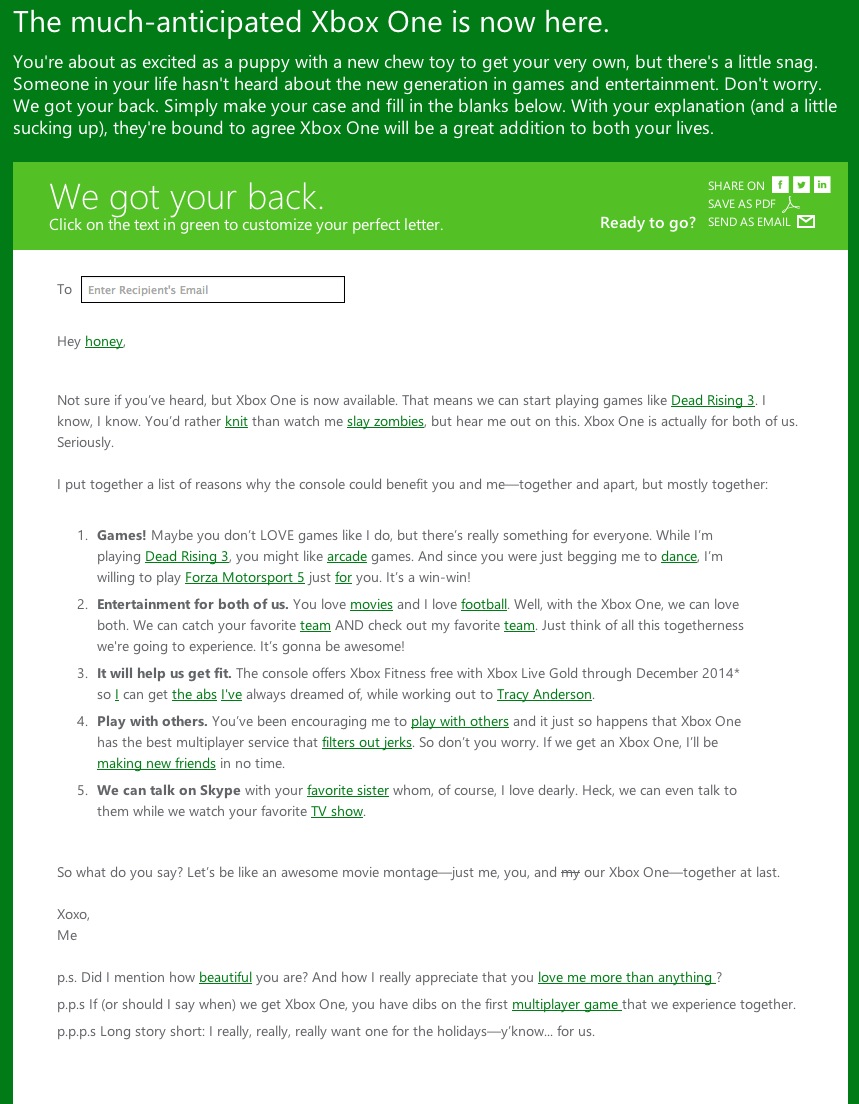
Today Microsoft released a form letter essentially created for men to send to women, encouraging their partners to let them buy an Xbox One console, as the new device will be great for both of them.

The letter, which can be customized slightly, is incredibly bad, playing to ridiculous male and female gender stereotypes. It presumes that women don’t like sports or play video games and need to be condescended into technology purchase decisions by their male partners as they oh-so-certainly couldn’t come to those conclusions on their own!

After all, women and technology, amirite?

Holy hell, Microsoft. I know that young male gamers can be a touch on the ignorant side when it comes to gender equality, but from a company worth more than $300 billion, and with better-than-normal female representation in its senior leadership, producing something this sexist and ignorant is an incredible disappointment and shame.

Propagating sexist stereotypes isn’t something to be tolerated. What’s almost incredible in the letter (before its language is potentially shaken up by the user) is that it manages to be directly sexist in implication, using loaded language like “honey” and comments on the physical appearance of the unnamed recipient, while eliding direct indication of gender. But it’s there. If you can’t see it, open your eyes.

This from a company that managed to come out on the right side of history on gay rights in Washington. The letter is also stridently heteronormative. Its almost oppressively straight tone is off-key from a company such as Microsoft, which has a large LGBT workforce. You almost want to wonder what’s up over in Xbox-land.

For flavor, a few quotes:

Hey honey, Not sure if you’ve heard, but Xbox One is now available.

After all, women don’t follow news, let alone technology news, and so how could she know! Time to let her in on the secrets of little boxes with blinky lights!

Maybe you don’t LOVE games like I do, but there’s really something for everyone. […] You love movies and I love football. Well, with the Xbox One, we can love both. 

Again, women don’t play games. Ever. And apparently don’t like football. But they do love those movies! You know, the ones with the actors and actresses they read about in their fluffy women’s magazines! The sort of magazines that never discuss technology, of course. We know that as we’ve already established that the women this letter is for have never heard of the word “Xbox” before!

We can talk on Skype with your favorite sister whom, of course, I love dearly. 

Because men don’t have close family! That’s for women! And dear heavens if men have, you know feelings and all that. Those are for women! And fine dear we can talk to your goddamn sister so long as I get Man Time later to shoot things. Pew, pew, pew, woman.

So what do you say? Let’s be like an awesome movie montage-just me, you, and my [the my is crossed out] our Xbox One-together at last.

Again, women don’t own consoles! Silly women!

P.S. Did I mention how beautiful you are? And how I really appreciate that you love me more than anything?

Microsoft, did I mention how stupid this letter is and how much respect for you I just lost?

Screen Shot 2013-11-27 at 11.31.56 AM

Facebook Testing A ‘Save For Later’ Feature, Chasing That Engagement Carrot

Facebook is looking at implementing an Instapaper- or Pocket-like “Save for Later” feature, according to AllThingsD. There’s no offline access at the moment, however, so it seems more like a way to try to drive better engagement and click-through rates for stuff shared by users on the network than anything else.

The implementation is fairly simple: When you see a link shared by your network in your newsfeed, you can click a small bookmark icon on the right side to save it to a list of saved links available from your apps menu. The feature is currently visible only to a small selection of Facebook users, as is common when the company rolls out new features. Whether or not it gains wider release is up in the air, and while some features Facebook tests in this way do make it to the general population, many others do not.

The advantage of something like this, as demonstrated by the success of Pocket and other services, is that it results in better engagement for content partners on the site. That’s because people who otherwise might have ignored something they were too busy to read, or to busy to go through the steps to click through and bookmark, would still potentially save that link and view it at a later date.

In the past, Pocket has been quick to point out how strong their engagement stat is. Unlike social networks like Facebook and Twitter, it seems to enjoy a lower growth rate but higher engagement out of that smaller pool of users. Popularity for content on Pocket peaks sometime after it spikes on social feeds, providing an echo boom, and also drives engagement for longer, meaning there’s a more even curve of interaction over an extended period versus how people interact with it on more fleeting platforms like Facebook and Twitter.

Even without an offline mode, Facebook could use a saved article mode to drive up engagement, return visits and perceived value delivered to publishing partners, which is a group it’s increasingly interested in bringing on board. It sets up the network to become even more of a portal. I think the danger lies in making it feel too much like a personalized Yahoo homepage and not enough like a social network where you can actually connect with friends and loved ones, but that’s why Facebook tests these things: To see if they strike the right balance with its user base.

Paygarden’s Platform Lets You Finally Redeem Those Unused Gift Cards For Good And More

After selling Etherpad-maker AppJet to Google four years ago, former Y Combinator partner Aaron Iba is at work launching his next project.

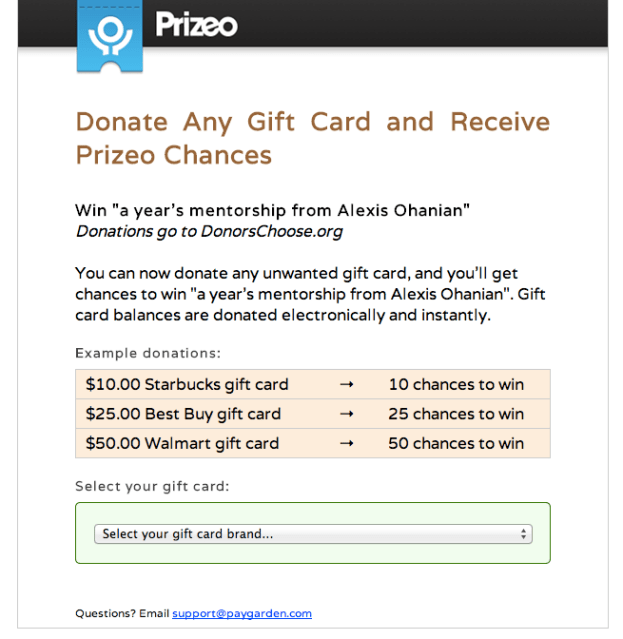
After getting frustrated with all of the unused gift cards he would rack up over the holidays, he started Paygarden. It’s a way for businesses that aren’t the original gift card provider to accept the cards as an alternative form of payment.

“When I was working at Y Combinator, many startups had big challenges around payments – how were they supposed to grow revenue and get more users to pay?” Iba said. “But many users don’t have credit cards, or are unwilling to enter in their credit card numbers into a webpage.”

The big vision here is that providing these alternatives helps consumers pay for goods and services online without giving up too much information about their identities or compromising their privacy.

Businesses can integrate with Paygarden by adding a link alongside their traditional credit card billing form.

Iba says he’s designed the experience to be as easy as PayPal: users just enter their gift card number and PINs. Paygarden’s platform checks the balance on the gift card and uses the remaining value for the online purchase. (You can see what the user flow looks like below.)

Screen Shot 2013-11-27 at 11.47.31 AM

They’ve done deals with gift card networks covering about a hundred big retailers including Best Buy, Walmart, Target and Starbucks. (The full list of accepted brands is here.)

On the other side for redemptions, Paygarden is launching with two partners – Prizeo and Private Internet Access.

Prizeo is a YC-backed platform that channels celebrities’ social media influence into funding for charity. So now you can use your unwanted gift cards for good, instead of buying things that you may not necessarily need.

“Something like $40 billion in unused gift card value is sitting there in people’s wallets, purses and drawers. Some of that could go for charity,” Iba said.

The other company, Private Internet Access, is a VPN service provider. VPNs or virtual private networks are used by privacy-conscious web users who want to protect data on their browsing activity from outside observers. (They’re popular in China for netizens that want to get around the Great Firewall.)

This particular partnership ties more deeply into Paygarden’s longer-term vision, which is to provide an alternative payments system that helps protect identity and consumer privacy. Instead of using credit cards, people can hand over gift cards without compromising any data about who they are. Their identity is never linked with their purchase.

Iba is also exploring ideas around Bitcoin. But for now, the crypto-currency is still difficult for mainstream consumers to use or understand.

On top of protecting privacy, Paygarden helps another segment of consumers. There are some 26 percent of adult Americans who don’t have credit cards. Now they have more of an ability to make online purchases if they have gift cards on hand.

The Paygarden team, which includes Iba’s former MIT classmate George Huo and early Cardpool engineer, is bootstrapped for now.

[Image via Flickr]

Betaworks Is Closing On $20 Million, Its First Raise In Over Three Years

New York City-based technology studio, betaworks, home to Digg, Instapaper, Dots, Bitly, Chartbeat, and many other products and services, is raising $20 million in new capital – news that betaworks CEO John Borthwick actually broke himself via Twitter last Friday, in case you missed it. The company is raising $10 million in fresh capital, while the other $10 million was from a note, Borthwick confirmed to us via email.

In terms of the new capital, the company has closed on $4.25 million out of this larger round, which includes both old and new investors. From our understanding, the round is less about betaworks needing to raise more capital, and more about the company allowing some interested new investors in – something that was made possible by the timing with the note’s conversion.

There are several high profile new investors, sources close to the matter tell us, including Tumblr’s David Karp, Salesforce CEO Marc Benioff, Jerry Yang (Yahoo), Ev Williams (Twitter), Abdur Chowdhury (Summize founder), Dave Morin (Path), and Gerry Laybourne, Nickelodeon founder, among others.

Betaworks is also doing something with Laybourne in the kids space, which should be out in either January or February.

Previous investors from betaworks’ A and B rounds have returned, an SEC filing shows, including RRE Ventures, Lerer Ventures, Intel Capital, and White Star Capital. In addition, Paul Cappuccio and John Drzik are also listed (update: as they board members). The company had previously raised roughly $28 million, according to Crunchbase.

Betaworks, along with other outfits like IdeaLab, has long been a pioneer in the “studio model” method to building new companies. That is, the company actually incubates several products in-house, and it makes smaller seed stage investments in outside companies of around $100,000 to $200,000 apiece. The product teams inside betaworks are able to leverage a shared platform of tools, including those for data, analytics, and monetization, all of which can help services quickly build up, ship and market their products.

This allows for a more flexible environment, where failures can happen fast, thanks to the experimentation the studio model allows for.

In earlier years, betaworks made a name for itself by selling Twitter search engine Summize to Twitter, and later doing the same with TweetDeck.

This year, the company has been heavily focused on building and expanding Digg, the once leading crowdsourced and crowd-voted internet news portal, which has now returned as a fuller suite of news gathering and news reading products, including a Google Reader replacement called Digg Reader, a trending video site, a pair of native mobile applications, and more. Traffic to the new Digg has been growing steadily since its relaunch, with some reports of the so-called “Digg Effect” even making a comeback.

Digg has also grown by 600% in unique visits since its relaunch, sources tell TechCrunch, and its one-month old Digg Video vertical has seen traffic go up by 15% month-over-month.

Betaworks also made headlines for acquiring Instapaper this year, after founder Marco Arment decided the popular “read-later” service needed a new home. The addition helped betaworks increase its bottom line, too, as Borthwick said on stage at this year’s Disrupt NYC event – Instapaper alone makes roughly $1 million per year after Apple’s take, he claimed.

As for the new funding, as Borthwick himself previously noted, this is the first time the company has raised capital in over three years.

Earlier in November, the company hired former Huffington Post Media Group publisher Janet Balis as its chief revenue officer, AllThingsD reported. At the time of the hire, Borthwick gave a hint of what was to come, saying, “Phase One of Betaworks was building great companies. And Phase Two is really building Betaworks as an operating media company.”

From what we’re hearing, that means that while betaworks won’t necessarily stop its company building focus, it will be looking to further monetize its current products. In particular, that includes Digg, which runs sponsored posts; Giphy which has done joint promotions with “The Hunger Games” and Gap recently; Dots, which has 15 million installs and worked with GE on a sponsored in-game feature; and bloglovin, which has 10 million users and 15 million monthly pageviews.

More to come, apparently.

Excited to bring a few new investors into betaworks. Approx. 20m total capital. The first time in 3 yrs+ that we have have done a raise

– John Borthwick (@Borthwick) November 22, 2013

UPDATE: This post was updated shortly after publication with the list of new investors.

Nokia Controls 90% Of The Windows Phone Market, As Its Lumia 520 Continues To Impress

Ahead of the formal transfer of Nokia’s hardware business to Microsoft in exchange for a few dollars, a new report out today details how dominant the Finnish handset company is in the Windows Phone market. According to AdDuplex, Nokia now controls 90 percent of the Windows Phone market.

That’s to say that 9 out of 10 Windows Phone handsets in the market today were made by Nokia. As that number continues to rise on a monthly basis, its current sales share is higher than 90 percent. Or, put another way, Windows Phone is Nokia as much as the reverse is true.

Another milestone was reached today: Among Windows Phone handsets in the market, more than 75 percent now run Windows Phone 8. That’s to say that in the past year, Microsoft has sold enough new handsets to triple the usage of all Windows Phone 7.X handsets that are still in use. Of course, some Windows Phone 7.X owners upgraded to new Windows Phone 8 hardware, but it’s still a mark of maturity for the new Windows Phone build to cross the 75 percent threshold.

The low-end Lumia 520 continues to perform strongly, picking up another 3.3 percent market share in the month. Its 521 variant broke into the top 10 most-used handset list with 3.4 percent. A new version of the phone, the Lumia 525, will reach markets in short order.

Tossing light onto why the Lumia 520 matters for Windows Phone (and therefore NokiaSoft), is the Vietnamese market, which, by percentage, is made up of 57 percent Lumia 520 handsets. The low-cost side of the Lumia line of smartphones is driving unit volume for the platform.

That’s the gist of the market: Nokia is the only Windows Phone OEM that matters; the Lumia 520 and its children are selling well; and Windows Phone 7.X is firmly in the past. What Microsoft needs now is a hit handset in its home market, and it will have a decent footing the world around. What will be more than interesting will be whether Windows Phone can move more than 10 million units in the fourth quarter of 2013. If not, concerns about its unit volume growth rate will resurface.

Live Nation Buys Mobile Startup Meexo, Courtesy Of Acquisition Marketplace Exitround

Live music giant Live Nation is announcing today that it has acquired Meexo, a startup that first launched at TechCrunch’s Disrupt conference in 2011.

The companies connected through Exitround, a website that helps startups find potential acquirers in an anonymized way. Co-founder and CEO Jacob Mullins (a former colleague of mine from my time at VentureBeat) told me that Exitround has facilitated other deals, but this is the first time he’s been given permission to name the buyer and the seller.

The financial terms of the deal are not being disclosed. Ethan Kaplan, Live Nation’s vice president of product, said his company is only acquiring the team, not the Meexo assets. Meexo’s two co-founders will take on new roles at Live Nation Labs, the digital-focused arm of the company, with Romain David becoming head of mobile product and Dav Yaginuma leading mobile engineering.

Including Meexo, Kaplan said Live Nation Labs has made three talent acquisitions – one of them was last year’s purchase of Rexly, while the other hasn’t been announced yet. And there will probably be more: “In the next year, I have a big mandate for mobile.”

According to David, Meexo had already turned its attention away from the dating app that it launched at Disrupt, working instead a new product that he wouldn’t say much about, except that it was a mobile social app that involved “context.” However, there were unforeseen technical challenges, and after talking to investors (Meexo was backed by undisclosed angels) and hearing from potential acquirers, David and Yaginuma decided to look at their options, including Exitround.

When I asked David if he had any regrets about leaving his startup behind, and he replied via email:

I made my very first cellular call on July 3, 1994 at the Formula One Grand Prix in France on a Mitsubishi MF 450. I knew that one day mobile would change our lives, not only in a utilitarian way but also in an emotional way. This is why I made every decision in my education and career around it, since that day. I have had dreams about what mobile should do and what it should become. Some of these dreams have become reality, some have not. To me, the most important is for these dreams to happen rather than being part of a small company or large company.

This post has been updated with Kaplan’s correct title.

Meet Omakase, The Charity That Wants To End The Tech Industry’s Giving Problem

omakase good logoThe tech industry is one of the brightest spots in the economy today. It’s where lots of jobs are being created and lots of money is being made. But there’s one notable area in which the tech sector lags in comparison to other well-performing industries: Philanthropy.

The average salary of Silicon Valley tech professionals is $101,278. So it’s pretty embarrassing that as flush with cash as so many people here are, shortages at local charities mean that many needy families in the San Francisco Bay Area are likely to be without turkey this Thanksgiving. And in the top 10 corporations that gave the most cash to charity in 2012, there was not one tech company to be found.

A new San Francisco-based organization called Omakase Charity wants to help change that, by creating a non-profit giving system that’s explicitly built to appeal to people in the tech industry. Omakase is named after the Japanese phrase for “leave it to you” that is often used in sushi restaurants to allow the chef to choose your meal for you. The Omakase Charity works the same way: You leave the selection of non-profits to experts, people whose full-time job it is to source the most well-run organizations targeting the most worthy causes. The only decision you make is whether to give $10, $25, or $50 per month.

To make a tech startup comparison, you could say it’s like a Birchbox for charitable giving.

Omakase’s founder Theresa Preston-Werner has spent her career in the non-profit sector, with a Ph.D. in cultural anthropology and years of experience studying global inequality and volunteering throughout the world, particularly in Central America. So when she moved to San Francisco and tried to encourage her friends and acquaintances in the tech industry (many of whom she encountered through her husband, GitHub co-founder and CEO Tom Preston-Werner) to participate in philanthropic causes, she found it incredibly frustrating and perplexing to be met with ambivalence. Why were all these people, who were smart and affluent and seemingly conscientious, not donating their money or time to causes that need help?

By asking around the tech community, Preston-Werner says she discovered that it’s not that techies are stingy – but there are several barriers that keep them from charitable giving. For example, they want lots of data because they’re hyper-afraid of being scammed, but at the same time they’re overwhelmed by the number of non-profits out there. They want to donate money to causes, but they don’t want to be included on mailing lists or receive telethon calls for years to come. So Omakase has been structured to address those exact needs.

I think it’s a fantastic idea that’s come at just the right time, as tensions about the gap between the tech elite and the less fortunate are increasing. As Omakase’s Holiday Giving packages say, it’s the perfect gift to give to the “techie in your life” – someone who already has all the gadgets, games, and hoodies any one person could possibly need. Hopefully, Omakase can be the tech industry’s gateway drug of sorts for generosity – people can start with $10 per month, and eventually become more philanthropic in larger ways.

Theresa Preston-Werner came by TechCrunch’s headquarters recently to talk about what inspired her to create Omakase Charity, how it selects its non-profits, and much more. Watch that in the video embedded below.

Clumsy Ninja Took A While To Get Here, But It’s A Terrific Demonstration Of The A7?s Power

An app that was demoed at Apple’s iPhone 5s launch just got its official release last week, and despite the wait, Clumsy Ninja proves a solid game that really demonstrates the power of Apple’s new A7 processor. It’s part virtual pet, part RPG, part tech demonstration, but it turns out that’s a very addictive combination.

I played the game in a zeroed in stupor for about 10 hours on Sunday while waiting for a service technician to show up and install my Internet. It was a near-perfect example of the “just… one.. more… level” type of gaming experience, driving you on via a cleverly designed series’ of challenges that make even repetitive in-game action seem fresh and new for a long time.

There is a lot of repetition, to be sure: Most of what you do with your Ninja involves getting it to either jump on a trampoline or hit a punching bag. There are a number of other activities facilitated by in-game items, too, each of which is purchasable via one of two forms of in-game currency (one which is earned freely through activities, and one which is much more easily achievable via in-app purchases).

But the balance here is well-struck: in-app purchases greatly increase the speed with which you can advance through the game, but they aren’t necessary to its enjoyment or ultimately, your ability to finish the game. The point of the whole thing is that your Ninja is searching for his long-lost Ninja (girl)friend, and needs to improve his skills to be able to find her. He progresses by accumulating experience and advancing through a series of levels, picking up a different coloured belt once every other level. Hitting new levels unlocks new training accessories, and training on those builds experience and unlocks special moves.

Click to view slideshow.

The graphics in this game, and the physics that animate the ninja, which is essentially an elaborate rag doll, are both outstanding. It’s enough that you forgive the odd blending of virtual pet and human central character (some challenges require you to rub the ninja’s belly or pet its head, which is absolutely bizarre and more than a little uncomfortable).

What really makes this game so good is the attention to detail and the flawless execution: This doesn’t feel like your typical mobile game, with bugs and cut corners and a maximizing of revenue opportunities with a minimum of effort. It instead feels like something that could approach a console quality of experience, but with game mechanics uniquely suited for mobile devices.

Ultimately, Clumsy Ninja did get me to fork over some money for in-game purchases, despite the free price tag, but at no point did I feel like I was being unfairly bullied into doing so. This is a great game with a unique character and interesting play mechanics that should provide ample opportunity for distraction this holiday, if that’s what you’re after.

Twitter Surveys Users On Live TV Viewing, Second Screen Habits As It Pulls Thread On Television Features

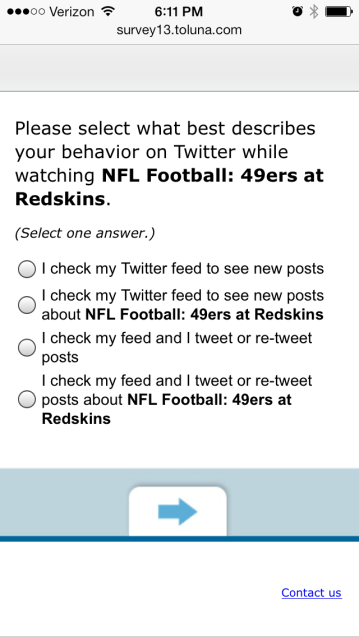
Twitter fielded a survey to a subset of its users yesterday about their live TV viewing habits. The survey began by asking age and gender info, then asked whether a user had watched live TV on Monday night.

Judging from chatter on Twitter, the survey ended if you didn’t say you watched any live TV. But, if you did, the questions then delved into which TV programs that users had been watching, including NFL football, WWE wrestling, Love & Hip Hop, The Voice or Sleepy Hollow. If you answered one of them, it then asked which device you were using while you watched.

Other questions in the survey included queries about apps or websites that they used while watching the shows. The survey was delivered from inside Twitter’s website and native apps on Android and iOS and featured a short list of questions delivered by the Toluna polling platform. Developer Ryan Jones was kind enough to share screenshots he took of the survey.

Twitter was interested to know whether people had been using Pinterest, Facebook, Twitter, email, Instagram, Vine or another (to be filled in by the user) app while watching the game. Also on the list was an entry for ‘chat’ apps like G-Chat, Snapchat, WhatsApp or text messages. The interest in what people are using their second screen for is obviously of intense interest for a company like Twitter, which hopes to couch itself (heh) as the ‘TV companion’ app. The thing to do while you’re doing nothing watching TV.

Obviously there are several initiatives underway at Twitter that this survey could be looking to gather information on. It recently partnered with Comcast on the ‘SEEiT’ button, which allows users to control their TV with Twitter. And Twitter has a partnership with Nielsen to generate a ‘Twitter TV Rating’ for the U.S. market. Its first report last month showed that there was a 38 percent increase in TV tweet volume year-over-year and offered a variety of metrics surrounding various TV programs.

We asked Twitter last night whether this was part of the Nielsen deal or just an internal survey, but hadn’t heard word back yet.

BZecOVsCIAE8cxx

Obviously, Twitter is very interested in what people are doing around live TV. We’ve been tracking its efforts to make TV a bigger part of its platform for a while. A recent update to its apps added some trending TV features, but buried them in the Discover section. We hear there were originally some plans to make this more prominent, but those got scaled back. It wouldn’t be surprising at all to see this section pop out and into its own tab or timeline in the future.

Here’s what the survey looked like:

imageimage-1image-4

image-3

image-2

Image Credit: CCHarmon

Microsoft Brings Xbox Video To The Web Ahead Of Windows Phone, Forgets HD Playback

Happy pre-fat day, Super Troopers. Today Microsoft brought Xbox Video to the web, meaning that if you use the service on your Xbox or Windows 8.1 device, you can access your content on other machines.

The downside? There is no HD playback, which will disappoint many. The easy rebuttal to that is that people who use Xbox Video likely have an Xbox console, which is probably linked to the largest screen in their house. So, where they need HD content the most, they have it. Still a bit of a bummer to not have it on the web, but perhaps it will come in time.

As The Verge’s Tom Warren notes, Microsoft is “planning to release a Windows Phone version of Xbox Video shortly,” but notes that that version will also lack HD playback. This is more excusable, as you can only imagine the bandwidth cost of such content flowing over Verizon or AT&T’s networks.

As a product move, this is about as surprising as Apple introducing a new iPad on a yearly basis. Microsoft is building out its consumer content business, which will eventually contain in-house-created video and the like. It wants to ensure if you toss your lot in with it, you can hit up all your videos regardless of what device you’re on.

Now, stop reading tech news and go hug someone.

Top Image Credit: Microsoft

Report: NSA Considered Revealing Porn Habits To Discredit Radicals

I feel like when people freak out about the unknown threat of mass government surveillance, they’re secretly worried a clandestine agent will reveal their naughty web-surfing habits to friends and family. Today, that fear was revealed. At least for suspected terrorists.

The Huffington Post* reports on new top-secret documents showing that the National Security Agency considered blackmailing suspected Muslim radicals by revealing their Internet porn history.

The classified documents leaked by whistleblower and current Russian language-learner Edward Snowden show that an “assessment report on radicalization indicated that radicalizers appear to be particularly vulnerable in the area of authority when their private and public behaviors are not consistent.”

According to the document, the NSA has embarrassing information on at least two suspected targets and some of the data was gathered through FBI surveillance under the controversial Foreign Intelligence and Surveillance Act (FISA).

There’s no information on whether the NSA actually used the red-face-inducing porn discredit plan. Perhaps more importantly, it’s unclear whether the NSA was targeting suspected terrorists, or those assisted in radicalizing others through Internet messaging.

Stewart Baker, former NSA general counsel and the media’s favorite defender of surveillance, said that “On the whole, it’s fairer and maybe more humane” than bombing a suspect, describing the “it” as “dropping the truth on them.”

It’s a safe bet that the NSA could likely find terrorists that sneak in some porn on their downtime; not because it’s a scientific fact that all men look at porn, but because officials have found it before. U.S. officials discovered an “extensive” porn library in Osama Bin Laden’s last hideout in Pakistan.

For those readers who have finished this story without erasing their Internet history, the Huffington Post reminds us that our intelligence agencies have kept juicy secrets on political dissidents in the past, including Martin Luther King.

The Internet apparently has a sense of irony, because the first suggested “you may like” link on the Huffpo story was “Why Do Lesbians Watch Gay Porn,” perhaps posted in a deliberate attempt at entrapment – or because porn is just all over the Internet.
Screen Shot 2013-11-27 at 8.55.02 AM

*The Huffington Post is owned by TechCrunch’s parent company, Aol. Now that you know this, I would like to personally thank one of the authors, Ryan Grimm, for allowing me to use “porn” and “NSA” in a headline.

Embeds Return To New Google Maps, Will Soon Include Ads

Google has quietly brought back embeds to its new Google Maps interface today and announced that it plans to include ads in these embedded maps in the coming weeks.

When Google launched the new version of its online mapping service, it introduced a new look, more personalized maps and a slew of other features, but it also left out things like easy access to Streetview and the ability to take a map and embed it elsewhere. Earlier this month, Google brought back Pegman to make Street View more accessible and today, it’s reintroducing embeds, too.

The feature is now available again to everybody who has opted in to using the new Google Maps. Just zoom in to the area you want to embed, look for the gear icon in the bottom-left corner and click on “embed map.” From there, you just choose the size of your embed (small, medium, large or custom), copy and paste the HTML snippet and you’re done.

As Google notes, these embedded maps will be customized for each individual user, just like the main Google Maps experience (assuming they are logged in). Unlike the regular Google Maps, though, these embeds don’t feature the advanced 3D view that Google introduced earlier this year. Users are limited to a top-down satellite view and the regular maps view.

Google didn’t say much about the new ad experience for embedded maps besides announcing that it’s coming in a few weeks. According to Google Maps API product manager Ken Hoetmer, the “new on-map design will allow relevant local businesses to connect with your users.” These ads, he writes, will be “similar to the ads you currently see in the new Google Maps and Google Maps for Mobile.”

To prepare for this launch, Google has updated the Google Maps/Google Earth API Terms of Service, so it will be able to insert these ads in maps. While today’s post focuses on embeds and developers who use the Google Maps API, chances are we will also see these new ads in the standard Google Maps interface in the near future.

Printhug Automatically Prints & Ships Your Dropbox Photos

One of the popular use cases for Dropbox, which just this month hit 200 million users, is photo storage. In addition to saving photos from your desktop to Dropbox by way of drag-and-drop, the company also added automatic photo uploads to its mobile application back in 2012. Today, a new service called Printhug lets you do something useful with your expanding Dropbox photo collection – by simply dropping photos into a select folder, Printhug will automatically print and ship photos to any address of your choosing.

Printhug is the first product to publicly launch out of Israeli startup Token Labs, which was founded this March by Nir Buschi, who previously spent three-and-a-half years as VP of Business Development at Wibiya (acquired by Conduit), and Shachar Tal, formerly the CTO at Equitick and Gamescale.

However, the service was not the first product the team had actually built. “We stumbled across the need of a simple photo printing solution while working on the other products,” explains Buschi.

Token Labs’ other photo products are still in private beta, he says, and are more social in nature. He declined to provide further details about these products, but says that it’s possible that Printhug could connect with one of the company’s other offerings in the future.

“The more we researched and spoke to people about it, we understood there were many barriers to printing photos. It’s a time-consuming task, uploading, downloading, driving, waiting in line – it’s a hassle,” says Buschi. “Many people do not have the time for that, and for that reason they just don’t print even though photo prints have a special and personal touch to them.”

So the team decided they wanted to come up with a way to offer a simpler solution. Like Dropbox itself, using Printhug isn’t much difficult than dragging and dropping items into a folder. To get started, you authorize the application, which creates a “Printhug” folder within your Dropbox “Apps” folder to which you add the photos you want to have printed. This allows Printhug to work on any platform where Dropbox works – web, mobile, tablets, or desktop.

printhug-auth

Printhug watches that folder in real time and then automatically sends an email invoice after you finish shuffling around your photos. You receive the invoice, pay online, and then the photos ship out in the standard 4×6 format. The company is working with a handful of printing partners in Israel and the U.S., and is working to make connections in Europe, too. The photos are $0.39 each, and the shipping cost is a flat $3.00 worldwide for now, at least.

In addition, Printhug includes a few hacks for sending photos to new addresses, requesting more copies, or soon, specifying different sizes, too. In the case of the former, you can create a sub-folder in the Printhug folder, throw in a text file or doc with a different address or addresses from the one you set up in your Printhug account, and the service will automatically ship photos to those addresses instead. As for requesting more copies or different print sizes, you can again use a new folder, or edit a file name to include the request. For example, you could make a folder called “8 Copies” or rename a file “5x7_photoname.jpg” or “8copies_photoname.jpg” as a way of communicating your request.

Doing this makes using the Printhug service a bit more hands-on than maybe originally intended, but it is a straightforward enough method which would work fine for the occasional one-off request.

A number of companies have tried to go into the photo-print business, competing with giants like Shutterfly, launching as standalone web and mobile applications, or offering prints in conjunction with a variety of photo products like photo gifts and books. But Printhug’s support for working right within Dropbox could be a draw for those who aren’t interested in adopting an entirely new product, and just want to stick with something they already know.

The company is currently based just outside of Tel Aviv and is a bootstrapped team of just the two founders. You can try out Printhug for yourself here.

PayPal Launches A Mobile Check-In And Payments Service With Orderbird In Germany

PayPal has been bullish on boosting its payments business by tapping into the growing use of smartphones, and this week the company launched a service in Germany to extend that further into Europe. It is partnering with Orderbird, a Berlin startup that offers an iPad-based point of sale service to merchants, for a check-in service that will recognise users when they walk into participating businesses, and then, using those customer profiles, to let them pay for goods and services automatically from their PayPal accounts.

Jakob Schreyer, the CEO and founder of Orderbird, tells me that the initial pilot for this will be with a handful of cafes and eateries in Berlin to get more user feedback, iron out kinks and potentially add more features. (One extra feature Schreyer described to me: a way of offering users “menu cards” for participating eateries and cafes so that users can preorder whatever they want through their handsets.)

If all goes well, the intention will be to roll this out other kinds of merchants among the 1,700 already using Orderbird across Germany, Austria and Switzerland, as well as future customers in those countries and others where Orderbird will be launching. First up with new markets, he tells me, will be the UK, followed by Spain, France and Ireland.

Orderbird has been working on a deal with PayPal for a while now – as far back, in fact, as May 2012, when I wrote about its $3.5 million round of funding and asked Schreyer if he’d ever crossed paths with PayPal, since it sounded like something they could use. Then, it was still early days and so he wasn’t prepared to make any official comment.

If the idea of PayPal working on retail check-ins that link up with seamless payments sounds familiar, that’s because it is: the eBay-owned payments company wants to incorporate the same kind of purchase flow into its Beacon product – a piece of hardware that (like Apple’s iBeacon) works with Bluetooth Low-Energy (BLE) technology to push alerts to customers when they walk into a participating store, restaurant or other space where they might make a purchase.

PayPal_Check-In_App_Übersicht_LädenBeacon is not part of the Orderbird pilot project “yet”, a spokesperson for the startup tells me. (PayPal, which says that its Beacon service will start to become available early in 2014, has not specified a country roadmap for it.) For now, Orderbird has integrated the check-in into its POS system, meaning that merchants already using Orderbird will be able to use the PayPal authentication and payment service without needing to purchase or integrate any new Beacon technology. If Beacon gets incorporated later, then the check-in process will happen automatically and more accurately.

The logic behind PayPal partnering with Orderbird is two-fold.

First, PayPal, and owner eBay, have long followed a pattern of working on services in certain local markets before releasing them more widely (note that one of PayPal’s first mobile check-in and payment services was actually in Australia). Second, PayPal has sought out ways of integrating their platform with whatever local consumers and merchants are already using.

Orderbird, with its 1,700 customers, is a logical partner in both of those respects. PayPal Here, the company’s mobile payments service, is live in the U.S., UK, Canada, Australia, Japan and Hong Kong, but not Germany. Meanwhile, collectively, German-speaking countries are big business for eBay. Germany is eBay’s second-largest market after the U.S.; and it is the biggest single economy in Europe. So it would make sense that PayPal would want to build on both of those facts (and also, just as a side-note, the head of PayPal, David Marcus, is Swiss).

At the same time, however, if PayPal went at it alone, it would have to build out a mobile payments business in its German footprint effectively from scratch.

And there is the question of what they would be able to offer to merchants. Gartner estimates that the mobile payments business has been a $235 billion opportunity in 2013, but those working at the point of sale have found it challenging to reach critical mass in their services.

One of the selling point for companies like PayPal, Square, iZettle, Payleven and others competing on the mobile-based payments front has been that they are offering merchants with no card systems a way of accepting cards. But for the thousands who already do accept cards using legacy systems, making the switch has been significantly less compelling.

“The benefit to switch needs to be big enough for retailers, and also interesting enough to get consumers to use it,” notes Schreyer. That translates into more value-added merchant services, for example those that link up with accounting systems and menus, let customers split checks, accept cash, and more – services that Orderbird has created and already provides to its customers. (It’s also what drove Groupon to acquire and integrate the point-of-sale service Breadcrumb into its own mobile commerce play, although that service remains limited to the U.S. for now.)

From what we understand, PayPal is talking to other would-be local partners in other markets, and Orderbird is also speaking to a number of others in the e-commerce space – covering areas like delivery, for example. This points to how as the mobile commerce space continues to mature, we are seeing both increasing localisation, but also service consolidation, to sweeten the deal and make it more interesting for merchants and customers to buy in.

Check-in_im_orderbird-Kassensystem_Zahlvorgang