Happy Thanksgiving, dear readers. What are you thankful for?
My list is short, but sweet: I’m thankful for you guys, gaming consoles, and 3d scanners.
This week, on a very grateful episode of the TechCrunch Gadgets podcast, we look into the differences between the PS4 and the Xbox One, the latest generations of console gaming. Meanwhile, John’s excited about the new Sense scanner from 3D Systems, even though he can’t stop calling it “Scene”.
For our phone fans out there, we’re also chatting about the Moto G smartphone.
We invite you to enjoy our weekly podcasts every Friday at 3 p.m. Eastern and noon Pacific. And feel free to check out the TechCrunch Gadgets Flipboard magazine right here.
Wibidata, a big data application provider, has a new platform for building real-time apps that shows the increasing accessibility of machine learning and how e-commerce companies can provide an experience similar to a giant like Amazon.com.
The new WibiEnterprise 3.0 platform allows a company to power a site with advanced analytics that fine-tunes itself, providing better recommendations and other features over time, including more relevant search results and personalized content.
The platform is designed for the customer who is beginning to use data science, said Omer Trajman, vice president of field operations at Wibidata. “They are not classically trained but they have an analytics background. They have been doing marketing analytics. The mechanics are similar, what has changed is the availability of data.”
WibiEnterprise 3.0 is built on an open source framework called Kiji, which provides a common platform for building applications that leverage large data sets.
At its core, Wibidata is offering a platform that takes into consideration the fact that companies often have just a few seconds to engage their customers. People use all sorts of personal devices and can turn to a competitor with just a few clicks. But with all this data, companies also have an opportunity to learn about their customers by analyzing their digital interactions. Doing that means building a storage system that provides a 360-degree view of the customer.
Like Google and Amazon, Wibidata’s Kijii framework uses a central storage system that allows a customer to collect user interactions across all of its applications, searches, purchases, likes, clicks and requests for product information. It’s what is called an “entity-centric storage system,” which essentially pools all the data so a company with sophisticated apps and services can do real-time queries and act on a customer’s recent information to deliver content personalization, relevant search results and recommendations.
Wibidata’s approach is in contrast to traditional data warehouse systems that manage data in a much different way. In the context of e-commerce, these older systems store transactional information such as likely purchases, or shopping cart manipulations in a central fact table. For a retail bank, this data might include credits and deductions from accounts. SKU information or geographic location data are stored in dimension tables to provide a detailed view of the transaction.
There are two problems with the approach, Wibidata argues. It can get expensive and it centers around the transaction instead of the user that is generating those transactions. Furthermore, it gets even more complex when using historical data, which has to get extracted from other systems, cleansed and then integrated with the current transaction data.
Companies using WibiEnterprise 3.0 include a top 10 retailer which has integrated it with its website to create relevant, contextual shopping recommendations during the online sales process. An international retail bank is also using WibiEnterprise 3.0 technology to combine multiple customer data sources and apply in-house debt models to better detect fraud and credit risks. Opower uses WibiEnterprise 3.0 to deliver personalized reports to utility provider customers explaining how to reduce energy usage and save money. And one of the largest SaaS providers uses WibiEnterprise 3.0 to help their customers identify prospective customers.
Wibidata is a powerful platform but it also reflects the complexity that comes with managing data across so many different devices. There is an infinite data supply but the technology needed to use it means a new way of organization that cuts across the way a company treats its own historical investments. There are the added cultural hurdles that come with a change in business approach that is more customer, than transaction-focused.
These sets of challenges also impact new startups like Wibidata, which are advocating disruptive approaches that put them in direct competition with companies like Oracle and established SaaS providers like Baynote.
There is no doubt that it is getting easier to have the same capabilities as a company like Amazon.com. But the challenges come with the will of the customer and the ability of a company like Wibidata to keep ahead of the competition.
(Feature image courtesy of Trevor on Flickr via a Creative Commons License)
Just in time for the holidays, virtual gift card service Kiind today announced that it now offers an API, which will allow third-party vendors to hook right into its services and to create gift cards from their own systems.
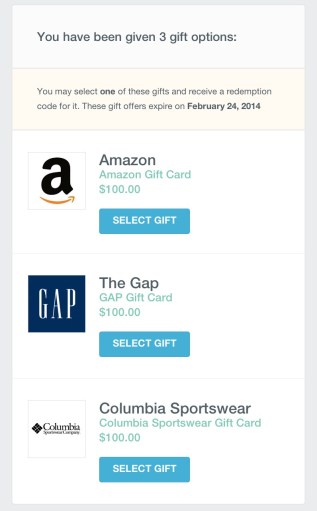
The company also today said that it has added Nike and Apple’s iTunes as gift card options to its store. These are two major deals for Kiind, which already offered gift cards from major retailers like Amazon, Columbia Sportswear and Gap.
Unlike other gift card services, Kiind’s system, which launched earlier this year, is based on deferred payments. The sender is only charged when the gift card is actually claimed (and a surprisingly large number of gift cards remain unclaimed). For shops like Amazon, Kiind also offers gift givers the ability to pre-select certain items from their stores, though the receivers can always change these selections.
The new API allows developers to easily create and send cards from Kiind, but also to create their own gift card marketplaces based on Kiind’s inventory.
As the company’s CEO and president Leif Baradoy told me earlier this month, the Victoria, Canada-based Kiind has seen good traction in the B2B space and decided to focus on this over making its service available to consumers. In the business world, most enterprises already use similar services to offer their employees or good customers gift cards. Kiind hopes that at least some of these services will use its API to also offer cards through its service. Some businesses, the Kiind team believes, will also integrate this API into their regular CRM or HR tools (and real estate agents, apparently, have taken to it to send gifts to homebuyers after a deal closes). The idea here, Baradoy said, is to extend the reach of the Kiind platform as wide as possible.
As for the relationships with Nike and Apple, Baradoy couldn’t say too much, given that these deals tend to be confidential. He did, however, note that the company likes to create direct relationships with vendors whenever possible. He sees the fact that some of these major brands are now interested in the service as a sign that Kiind “has something interesting going on.”
The company also recently launched a user-based referral program to attract more businesses to its platform. Referrers now get 5 percent of the first gift and 0.5 percent for every gift after.
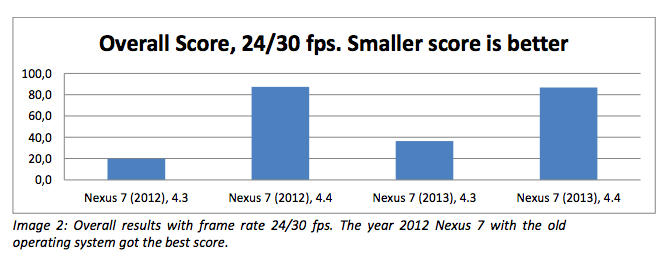
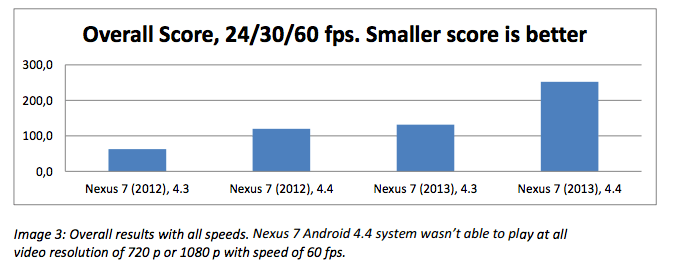
Google’s Android 4.4 KitKat update is rolling out to Nexus devices globally, and I was eager to get it on my Nexus 7 tablet. Turns out, it’s possible I should’ve left well enough alone. Immediately after updating (via official, OTA channels), I noticed performance seemed to suffer, and now a study conducted by Finnish mobile video and touch testing firm OptoFidelity adds some solid data to back up my observations.
OptoFidelity compared performance of HD video playback, both 720p and 1080p at both 30 and 60 fps on the Nexus 7 from 2012, and the Nexus 7 from 2013, before and after an upgrade to KitKat. The results show dramatically better performance on Android 4.3, before both tablets made the jump to Google’s latest mobile OS. Frighteningly, the Nexus 7 from 2013 couldn’t even play any 60fps video after the update.
The score differences aren’t small, either, as according to OptoFidelity’s classification system, both Nexus 7 devices drop from delivering “satisfactory” performance to offering up something in the “unsatisfactory” range, with the newer model suffering the most. I found using my own device that animations seemed to execute less smoothly, and I was more prone to encounter missed touches than I had been before the KitKat update.
For an update that was supposed to be backwards compatible with a lot of down range devices, this performance backslide on the most modern tablets is a little bit of a head scratcher. Hopefully it’s just a launch bug that’ll be zapped in a future update. We’ve reached out to Google for more info, but for now you might want to hold off on that KitKat update, unless you really badly need those emoticons.
Alice, a single mom living in Daly City, was facing major roadblocks with her public school system. Her five-year-old son was advanced enough to enter first grade instead of kindergarten. And her older son, who was about to enter third grade and had been diagnosed with attention deficit hyperactivity disorder, hated school.
She knew there was a better educational alternative but couldn’t afford to send her kids to private school. She happened to be searching online and saw an ad on Facebook for AltSchool, a small one-room school, located in the Dogpatch neighborhood of San Francisco, that focused on child-centric education. The school was exactly what her children needed: learning based on the specific child’s needs and challenges rather than a rigid curriculum based on standardized test results.
AltSchool, while private, also offered a generous financial aid package, and she enrolled her kids right away. AltSchool is the brainchild of Aardvark founder and longtime Google executive Max Ventilla. Ventilla, whose social search company was sold to Google in 2011, previously worked on the Google+ team, and was one of the search giant’s early proponents of social search and personalization. He sold another tech startup in enterprise software before his long tenure at Google (he worked at Google before Aardvark, as well). Earlier this year, he started thinking about his next startup and what area he’d like to focus on.
Education was at the top of his mind, as he has a two-year-old daughter about to enter pre-school, and a son on the way. And he saw education as an area where he could have a huge impact.
“One of top five industries in the U.S. by expenditure is elementary education, and as opposed to other large industries, the median experience is bad from every angle,” he explains. The dysfunction and relative slow-to-change nature of the educational system is one of his biggest frustrations. The cost of education is increasing, he adds, but that isn’t translating into children excelling more effectively at skills like reading and math.
“If a time traveler came back from the early 1900′s, and looked at schools, they would look relatively the same. And there’s something wrong with that, because children and our world have changed.”
He started researching where success was actually taking place at a broader scale in schools, in early education. What ties these schools together is the notion of child centeredness, he says, which is providing individualized education where the student learns at his or her own pace in ways most nurture them and their education.
If a time traveler came back from the early 1900s and looked at schools, they would look relatively the same.
With this in mind, Ventilla decided that he wanted to build a school that approaches education and learning through a lens of things the children are most passionate about. “I believe the right way to teach a person is not as a subject but through an immersion,” he continues. An example of this is if you are teaching children about aquatic life, you can incorporate the subject to teach chemistry, ecology, economics, politics and even culture.
The more he imagined what his vision would look like in reality, the more it sounded like a home school environment but with a larger group, skilled teachers, and a curriculum that focused on exposing children to experiences, as well as skill-building.
Armed with this goal, Ventilla left Google in April and raised $3 million from First Round Capital, Harrison Metal, Baseline and a few other investors who had backed him during the Aardvark days. He hired teachers, operators who worked with him at Aardvark, and brought on Richard Ludlow, the founder of Academic Earth, as his COO. Ludlow’s online education video site, which was called a “Hulu for Education” and was a Bill Gates favorite, was eventually acquired last year by Ampush Media.
Ventilla found space in Dogpatch for his micro-school, hired a bunch of former Google engineers and set upon redesigning the entire school experience in the spring and summer of this year. One of the first distinctive characteristics of Ventilla’s AltSchool is that there is no such thing as a child “at grade level.”
As he explains, most students vary in skill level in subjects like math, reading, science, art, physical education and social studies, and “grades” are confining. Like Alice’s children, most children learn at different levels, so they need specialized attention.
In this inaugural class, there are around 20 students between the ages of five and 10. They are split into two main learning groups, with the 5-7 year olds, and the 8-10 year old populating each group. There are generally eight students to one teacher but for some activities the entire group learns together. The actual building has one large room that is sectioned off into areas for play and learning.
AltSchool teachers create highly personalized curriculum each week, called Playlists, which are a set of 10 or so goals and projects that the student has to complete for the week. Each child is given an iPad mini, where they can access their playlists through project management software Trello. Each weekend, AltSchool teachers plan their playlists for each of their students based on what that student’s personalized curriculum and goals are for the week. Projects could range from making a list of what you are thankful for for Thanksgiving to reading a book.
Another area where Ventilla is hoping to disrupt traditional education is video. The classroom is outfitted with a number of video cameras so that teachers can just press a button to document a moment. Ventilla says that teachers, parents and students who have been able to actually watch a breakthrough moment or a moment of breakdown have been able to help their children learn better. ”You can see what works for specific children, and what doesn’t work,” he tells me. The technology is pretty impressive. AltSchool has built audio hardware to better record in noisy settings, and video is uploaded to an online CMS that both parents and teachers can access.
Unsurprisingly technology is the central foundation of education and planning at the AltSchool. Ventilla has brought on a team of technologists, designers and engineers who are developing tools and formatting existing ones to support teachers, parents, and students. He envisions this base of talent as building an R&D shop for what works in his micro-schools.
In addition, AltSchool students are using LearnZillion on their iPad minis to learn math skills, as well as an internal SMS where parents and teachers can access children’s work, progress, videos and more. Plus, parents and teachers can collaborate through this dashboard on students’ weekly playlists.
In fact, Ventilla is hoping to build some proprietary software of his own to use within the school. His vision is to have a hundred engineers and designers working on developing better technology products for in-class learning.
AltSchool also embraces a “school without walls” approach. Classes regularly venture outside the classroom to take advantage of the amazing cultural experiences available in San Francisco, often leveraging Uber SUVs for easy quick trips.
Recent field trips include Smitten Ice Cream, which inspired a study of the applied physics of their innovative quick freeze process using liquid nitrogen; Mission Science Workshop, to engage in hands-on chemistry lessons; Walt Disney Family Museum, to study animated filmmaking; San Francisco Maritime Museum, as children explored life before modern transportation and communication; and Good Eggs (founded by Aardvark co-founder Rob Spiro) to learn about sustainable farming, healthy eating and environmental awareness.
Looking to the future, Ventilla is building out a network of micro-schools, which will be modernized versions of the “one room schoolhouse” housing 60-100 students each. Continuing the theme of customization, elements of each micro-school – such as electives offered, foreign language instruction, academic calendar, and even locations – will be customized for the interests and needs of local communities of parents.
Next year, AltSchool will open up another school in the Potrero Hill area, and a middle school (for older children) in SOMA. The startup is also looking at a possible Palo Alto location based on demand. Tuition isn’t cheap–it’s $19,100 per year (which is lower than many private schools in the area) but Ventilla says generous financial assistance is available. “We don’t believe that classes should be comprised of the elite who can afford it,” says Ventilla.
Ventilla has much larger ambitions of taking AltSchool nationwide, or even outside of the U.S. And he says, this is definitely his last startup. And he looks forward to his children attending AltSchool for their primary education.
As for Alice, within three months of attending AltSchool, her five year old is reading at a first grade level, and doing math at a second grade level. Alice’s nine-year-old son is currently excelling at fourth grade math and reading. And they both love school.
After a strong Thanksgiving holiday push in e-commerce spending, Black Friday online sales were up close to 20 percent in 2013 over the same period last year. IBM says that by their counts, sales are record-breaking.
The data, from IBM’s Benchmark real-time reporting unit, covers 800 online retailers and millions of transactions. For the day, the average order value was $135.27, up 2.2 percent year-over-year.
Mobile shopping continues to grow, as mobile traffic grew to 39.7 percent of all online traffic, an increase of 34 percent over Black Friday 2012. Mobile sales were also strong, reaching 21.8 percent of total online sales, an increase of nearly 43 percent year-over-year.
Smartphones drove 24.9 percent of all online traffic on Black Friday compared to tablets at 14.2 percent, making it the browsing device of choice. Tablets drove 14.4 percent of all online sales, double that of smartphones, which accounted for 7.2 percent of all online sales. On average, tablet users spent $132.75 per order compared to smartphone users who spent $115.63, a difference of 15 percent.
By smartphone OS, iOS users spent $127.92 per order on Black Friday compared to $105.20 per order for Android users. iOS traffic reached 28.2 percent of all online traffic, compared to 11.4 percent for Android. iOS sales reached 18.1 percent of all online sales, compared to 3.5 percent for Android. New York City took the top spot for online sales on Black Friday. Rounding out the top five were Atlanta, Los Angeles, Washington, D.C. and Chicago
In terms of social, shoppers referred from Pinterest on Black Friday spent 77 percent more per order than shoppers referred from Facebook. Facebook average order value was $52.30 versus Pinterest average order value which was $92.51. However, Facebook referrals converted sales at
nearly four times the rate of Pinterest.
On average, IBM says more retailers were trying to engage with shoppers on their smartphones–retailers sent 37 percent more push notifications during the two day period over Thanksgiving Day and Black Friday when compared to daily averages over the past two months. Average daily retail app installations also grew by 23 percent using the same comparison. Retailers sent more notifications on Thanksgiving Day than Black Friday.
By sector, Black Friday online sales for department stores grew by 61.4 percent over 2012, with mobile percentage of sales growing by 46.4 percent. Average order value was $146.84, an increase of 15 percent year-over-year. Black Friday total online sales for health and beauty grew by 28 percent over 2012, with mobile percentage of sales growing by 65 percent. Average order value was $66.31, an increase of 3.2 percent year-over-year. For home goods, online sales grew by 16.8 percent over 2012, with mobile percentage of sales growing by 24 percent. Lastly, for apparel, online sales grew by 50.4 percent over 2012, with mobile percentage of sales growing by 43 percent. Average
order value was $123.31, an increase of 3.5 percent year-over-year.
IBM is saying that this was a record breaking Black Friday by online sales but it’s unclear what that number is–so we’ll see what comScore reports with sales over the next few days. U.S. e-commerce spending last year on Black Friday was $1.042 billion, an increase of 26 percent from 2012. Black Friday online sales actually surpassed $1 billion for the first time last year. But comScore is forecasting double-digit growth in both desktop e-commerce and m-commerce spending for the holiday season.
UPDATE: As of 11 am PT on Friday, PayPal saw a 123.9% increase in global mobile payment volume (mTPV) on Black Friday 2013 compared to Black Friday 2012.
Just in time for Black Friday, Bond is bringing its gifting platform to the web after spending a couple of months as a native mobile app.
Bond, created by Sonny Caberwal, takes all the heavy lifting out of gift giving, with a large focus on the enterprise and professional gifts.
So let’s say you just finished up a big interview at your dream job, or you just left the office of a brand new client after making a huge sale. That’s the perfect moment to open up Bond and choose a gift in a certain price bracket, easily obtain the recipient’s address, and even formulate a hand-written note.
Oh, did I mention? Bond has a robot that writes hand-written notes. And according to Caberwal, the Robot is being refined to learn new versions of handwriting, so that one could eventually send a hand-written note to a friend or colleague in their own handwriting.
But why?
Well, after a few months on the market, Bond has realized that big corporate clients are going to be the future for Bond.
Caberwal eventually sees Bond becoming a platform that large corporations can customize to their own gifting needs. As a first step, the team is bringing Bond to the web.
Last week, Om Malik at GigaOm reported that Instagram was working on a messaging feature to complement its already very-popular social photo app, now with some 150 million monthly active users. Now we’ve caught wind of something that could point to a possible feature on this would-be messaging product: @instagram.com email addresses.
A source who works in marketing for an e-commerce company has emailed us a list of such @instagram.com email addresses. They appeared, she says, as part of a request she made of one of the many companies out there that compiles data from social networking sites.
She says that part of the results consisted of Twitter handles and Facebook email addresses, and it seems as if the @instagram.com addresses appeared as part of that list.
“We requested verified email addresses for the followers of a certain fan club on Twitter and received back these results,” she wrote in an email. “We use [the data provider] as a tool for gathering information, and suddenly A LOT of the email fields were being filled in with Instagram email addresses.”
(I’m intentionally keeping out the names of the users, the marketing exec, her e-commerce company, and that of the data provider.)
The data provider, which uses a number of different APIs to populate its database, says that it had never seen these Instagram email addresses before. A spokesperson for Instagram declined to comment for this story.
So what might be going on here?
It could be a pure database fluke. I’ve been sending messages to the list of email addresses on the list provided by our source, and I’ve also tried out my own would-be Instagram email based on my own user ID. They have all come back to me with “too many hops” error messages. Too many hops can indicate an endless forwarding loop, or too many servers involved in relaying a message, but not necessarily that the address does not exist.
On the other hand, Instagram email addresses could support Om’s claim that a messaging service is on the horizon. (His report noted that messaging features, which could be person-to-person or may include group messaging, will be in the next version of the app, expected before the end of the year.)
For starters, look to Instagram’s owner, Facebook. There is something instructive here in how Facebook has built its own messaging services that Instagram may have gleaned.
The world’s largest social network saw as far back as 2010 the usefulness of having a native email address integrated with a messaging service. It means making that messaging service more useful, but it also means more ways of keeping people on your own platform. So, when Facebook unveiled its revamped messaging system in 2010, it included the option for users to create @facebook.com email addresses.
Sending messages to that @facebook.com email address then automatically sync up with Facebook’s messaging platform, which also aggregate messages sent to you by SMS (if you have a phone number associated with your account); Facebook’s standalone Messenger app; or Facebook itself.
“This is not an email killer. This is a messaging experience that includes email as one part of it,” Zuckerberg said at the time. “This is the way that the future should work.”
Instagram, in a way, has already laid some groundwork for using email on its platform. You share photos by default to your Instagram stream, but you can additionally send them to specific people via email.
Other developers, meanwhile, have already shown the way forward for what an Instagram messaging service might do. Instachat, InstaMessage and InstaDM are among those that are standalone apps that let you send direct messages to your Instagram contacts.
Giving users on the Instagram network native email addresses could make the process of sending directly to individuals more seamless and integrated to the bigger platform. It could also be a way for those recipients of your emailed images a way to respond back to you.
Facebook, it should also be pointed out, has actually already started to create a link between Instagram and direct messaging: an update to Facebook’s Messenger app in August let users access their Instagram libraries to send messages to friends. A first step for Instagram messenger, as it were, and a way of offering more picture-messaging services to a public that has demonstrated and appetite for the feature, courtesy of new hits like Snapchat and a host of apps with an image-first focus.
Instagram has proven to be the king of photo apps when it comes to social, open consumption, so it seems natural that it, too, would eventually sprout its own private communications channel, to tap into that opportunity as well.
But while Instagram emerged at a time when there was little in the way of its growth, times are different today. Services like WhatsApp – at an average of 15 billion messages per day as of November – are now pushing close to SMS’s 20 billion/day messaging dominance.
Focusing on sending photos and video that disappear soon after they are sent, Snapchat is not quite that big – the last number Snapchat revealed, earlier this month, was 400 million messages received (not sent) each day. But it is tapping into a key, young segment of consumers, who (at least for the moment) like to use it, a lot.
Between that rock and hard place of apps attracting people to totally new features (ephemeral messages), and those that have become heavyweights in more text-based mobile messaging (SMS, WhatsApp, Instagram’s owner Facebook, and many more), whether Instagram will be able to wedge its own 150-million MAU presence into the scene – with email addresses or without – remains to be seen.
(My informal straw poll points to some early resistance to the concept, but as Twitter co-founder Biz Stone once famously said, it could end up being “The messaging system we didn’t know we needed until we had it.”)
Detroit-based watchmaker Shinola is doing something pretty unique: hand-making watches in the United States, right down to the quartz movements contained within. The startup’s founding team includes some who worked for Swiss movement maker Ronda previously, and they built the company by flying in high-tech watchmaking equipment from Europe, as well as experts to train their Detroit-based workforce in the fine art of assembling timepieces.
The result is a watch that’s on the pricey side for a quartz keeper, starting at $475 and ranging up to $900 for their new chronograph model. And the parts are flown in from Switzerland and Hong Kong, so not made in the U.S. of A, even if they are assembled locally in Michigan’s case study in disastrous metropolitan economics.
It’s expensive for what it is, and in part it seems like the company is hoping to sell on the back of an “American made” campaign, but it’s also undeniable that these watches are well designed and finely crafted. I’ve been using the model seen in the photos for a few weeks now, and the so-called “Argonite-1069″ movement keeps excellent time. The large readable numerals on the face are great for actually, you know, telling the time, and the small second-hand dial keeps things both uncluttered and adds to the overall attractiveness of the design.
It’s definitely a retro affair, and the model I tested emphasizes that with a brass finish on the metal case. The lugs are similar to those that were once welded to pocket watches to make the first wristworn timepieces, and even the choice of typefaces for the Shinola logo and movement name harken back to a vaguely 30s or 40s-ish time period. All of which is to say, I like the look of the watch very much, but if your taste runs more modern you might not agree.
Another very nice aspect of the model I tested was the Horween leather strap (made in Florida), which has a couple of lines of contrast stitching near the lugs and matte brass hardware to match the case. It’s extremely comfortable, while also remaining durable and good-looking.
It’s not typically my thing to go in for quartz watches, even when the design language they use is right up my alley. But the Shinola features such a bold design that it earns a place next to something like a Uniform Wares in terms of esteem, meaning it’s unique enough that the price tag becomes less of an issue. At those prices, however, you’re still getting into the affordable range for great entry-level automatics, like the Defakto lineup or a Stowa Flieger, which means there’s going to be a lot of competition for the Shinola with any customer serious about watches. Still, it’s good-looking, works well and, marketing aside, it is assembled in Detroit by a company that employs more than a hundred Americans, so there’s plenty of reason to consider one as a gift for the watch appreciator in your circle.
Are you tired of watching expensive gadgets turn your friends into Abercrombie models? Well, my pudgy popper, we’ve got a holiday gift guide that’ll give you five more ab packs without breaking your piggy bank.
Standing Desk Vs. Cardboard Box
It’s well-known that sitting all day long is slowing killing us, so a few savvy furniture manufacturers have begun to market chic “standing desks” boldly priced at $1,000 or more. TheStir Kinetic Standing Desk is an artificially intelligent $3,800 table that learns a users’ habits and automatically adjusts its height throughout the day.
Or, if you’re like the former CEO of Hulu, you can use the good ol’ 20th century technology of a cardboard box. This geometrically sound paper-based tech comes in all shapes and sizes; with enough digging users can find an ideal height for them. At TechCrunch, it took me five minutes to find some boxes laying about.
Treadmill Desk Vs. SurfShelf
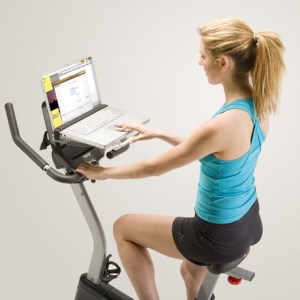
According to Science, standing desks may not be all that healthy, since what the body really needs is constant movement throughout the day. Your best bet for being super-healthy is to walk while you work (it even makes doctors better at diagnosing!). But, these suckers are expensive: the cheapest quality LifeSpan Treadmill desk is $1,300 or you can DIY it for a few hundred dollars less.
Or, for a price of Comcast’s shoddy Internet ($39.95), you can own the portable miracle, the SurfShelf, a laptop shelf that attaches to the face of most treadmills. I brought it with me on a three-week tour of the East Coast and it worked marvelously. You still need a gym membership (or a hotel with a treadmill), but it’s a great excuse to get out of the coffee shop and into a gym.
Juicer Or Blender Vs. Teeth
Getting one’s daily allowance of vitamins can be a real pain, so nutrition-happy consumers have been more than willing to shell out their weekly paycheck for a gadget that shreds solid fruits and vegetables into a drink that can be gulped in between emails. The $300 Breville Elite Juicer makes bright shakes without the inconvenience of cutting, while the Costco holiday centerpiece, the $500 Vitamix, spins fast enough to prep uranium for a nuclear core.
But both juicing and blending are probably terrible for your body. Fructose can be toxic to humans; Mother Nature naturally wraps its sugary sweetness in a fiber shield that protects the human body from blood sugar spikes and liver damage. University of California, San Francisco health guru Rob Lustic told a crowd at the Aspen Ideas Festival that if you’re going to juice, the only non-toxic foods are pure vegetables (icky).
Unfortunately, pulverizing foods into an indistinguishable mush could destroy much of the nutrients. It’s unclear how much survives the shredding process, and it allows people to consume foods far faster than the body prefers to process them (leading to overeating and blood sugar spikes).
Teeth are a healthy, free alternative to mashing food. Designed by mother nature, these calcium-based chompers are perfectly tailored to each individual users’ digestive operating systems. The chomping co-processor safely throttles the bandwidth of nutritional uploads, protecting vitamins in a salty liquid sheath.
Poke pedometer Vs. Wrist Thingies Vs. iPhone Counter
I honestly don’t know how hunter-gatherer societies managed to stay fit before the advent of plastic buzzing pedometers. The Jawbone Up24 ($150), Nike+ Fuelband SE ($150), Fitbit Force (129.99) all delight consumers into using their legs with rainbow-colored reward screens for those who meet their daily walking goals.
Or, according to the University of Iowa, you could enjoy the most accurate of pedometers, the Pikachu-friendly Pokewalker ($43). This smile-inducing trapper of pixelated Japanese gladiators will count your steps each day while providing hours of endless entertainment.
Fortunately, the brain has a built-in timer that naturally sends dreamy signals to the brain if a regular schedule is kept. However, the piercing fluorescent blue light from computer monitors is wreaking havoc on our evolutionary response of being awake at sunlight. To get our melatonin pumper back into shape, blue-light filtering sunglasses, a.k.a. “blue blockers, ($15.99) are scientifically proven to improve some sleep-related diseases. I wear mine every night two hours before bed (and try to turn out the lights, as well).
There you have it, folks. How to be super healthy on a shoestring budget. In the comments section, please post photos of your rippling abs, as you roll around in a pile of one-dollar bills and Ivy-league diplomas.
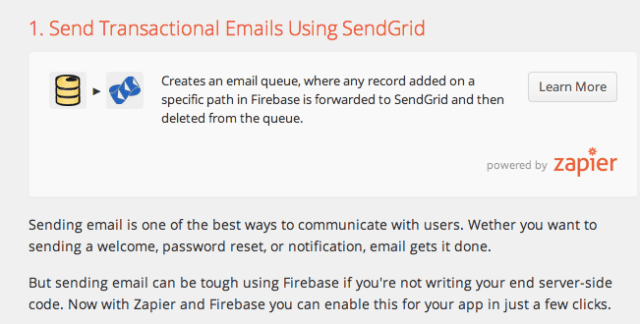
Firebase, a real-time back-end service for managing apps, has added an integration with Zapier, a platform for connecting services such as SendMail, Twitter and Twilio. The new integration means developers can connect multiple apps without having to do any back-end server management themselves.
A developer using Firebase can now integrate apps that before would have required a fair degree of work. “You do not have to do all these small server spinups,” with the new integration, said Firebase CEO and Co-Founder James Tamplin during a phone call today. It may only be five lines of code to connect a new app with Firebase, but with that comes the need to provision a server, run it on a service and then do the maintenance and everything else that comes with doing it yourself. All that goes away with Zapier connected to Firebase.
Now a customer can use Firebase to connect different services to do a variety of tasks such as email notification.
Here are some additional examples.
Developers increasingly just have to learn how to code in JavaScript, use frameworks like Angular and then integrate platforms like Firebase to manage their back-end. It’s this new generation of front-end developers who want to focus on the app, not the back-end that makes Firebase so pertinent. It manages the heavy lifting with its data storage API, which Tamplin says has the real-time capabilities that other back-end service providers do not have.
He describes Firebase as a service that abstracts storage into a sync paradigm. Every time new data is added to the app, the end user sees it without refreshing the browser. With Firebase, developers focus on the app without having to manage any back-end tasks, such as the database or the server code.
API Evangelist Kin Lane writes that this syncing capability makes Firebase a service that can scale from one user to millions without the need to change any code.
The Firebase API is built from the ground up for performance and scale. You simply specify which data you would like to synchronize with each client, and Firebase calculates the minimum set of updates that need to be sent to keep everyone in sync. In addition, all Firebase API functions are designed to scale linearly with the size of the data being synchronized and to shard well into a distributed cloud environment. More importantly, Firebase handles all of the scaling and operations for you. Your Firebase app will scale automatically from its first user to its first million without needing any code changes
With the help of syncing, Firebase handles all the authentications for the apps that a user connects through the Zapier service. That removes a level of complexity that gives users the ability to make apps talk to each other in new ways.
(Feature image courtesy of Colin Dunn on Flickr via Creative Commons license.)
Holiday weeks tend to be a little quiet, but there’s always something going on in the world of Android to dig into. This time around, though, Darrell and I roped in MobileSyrup’s Daniel Bader and our very own Natasha Lomas to liven things up before it goes quiet for a few days. And I daresay we pulled it off nicely.
Oh, but you want details. We four jolly bloggers couldn’t help but dig into BlackBerry’s curious new BBM preloading deal with Android device OEMs, and it wasn’t long at all before Dan and I shifted the conversation to the joys and tribulations of loading some custom ROMs on your smartphone (for the record, he’s a fan of Paranoid Android). Throw in some kooky startup ideas and some even more outlandish funding offers, and you’ve got this week’s show in a nutshell.
We’re not exactly the sappiest people you’ll ever meet, but we even had ourselves something approaching a heartwarming moment. Despite the fact that I’m the only one of the four who’s actually celebrating Thanksgiving tomorrow, I made everyone sit in a make-believe circle and share what they’re thankful for. Guess who went the classy route and chose something alcoholic? (Hint: it was Darrell.)
In an era of Google Glass, Siri, and Snapchat, small businesses will still have to enroll for some new health insurance plans by paper or phone. The White House admitted that on-going problems with the federal e-commerce website, healthcare.gov, will delay the Small Business Health Options Program (SHOP) Exchange until Nov 2014.
“We’ve concluded that we can best serve small employers by continuing this offline process while we concentrate on both creating a smoothly functioning online experience in the SHOP Marketplace,” wrote the Centers for Medicare and Medicaid.
Right now, the administration has conscripted every geek on hand to fix enrollment for the individual market, with the hopes of snagging enough young-invincibles to lower the costs of everyone else. The New York Times reports that the malfunctioning healthcare.gov website is now able to handle 50,000 concurrent users, the original goal for the failed launch on October 1st.
“With this new delay, small businesses will likely see little change in the way they purchase health insurance until 2015. They will, however, need to use the SHOP exchange if they want to access a health law tax credit available to employers with fewer than 25 employees,” explains The Washington Post, in their early report of the announcement.
When they do enroll, they’ll have to figure out how to sharpen a pencil.
After releasing a brief statement when the FDA’s decision to block the sale of 23andMe’s home DNA testing kits was made public, the company’s CEO Anne Wojcicki has sent a letter to her customers further explaining their position relative to the ban and the government agency that oversees and regulates medical devices and technologies.
In the letter, sent out to 23andMe registered customers earlier today, Wojcicki begins by reassuring folks that their tech is both solid and trustworthy, and the product of years of development. Accuracy is the central point of the explainer, and she says they remain comfortable with their track record in that regard. This is likely an indirect response to some criticism that surfaced after the letter was made public, suggesting that 23andMe’s test may not be nuanced enough to deliver a full picture associated with risks of contracting certain diseases, including breast cancer.
Wojcicki characterizes the issue with the FDA as part of an ongoing process to clarify how their service is classified, which explores “new territory” for both parties. It’s true that the FDA has never before had to regulate a test that provides general genetic testing beyond just a specific type of disorder. The FDA, for its part, has given 23andMe 15 days to respond to its letter and describe a plan for resolving its issues with the service.
You can see the full text of Wojcicki’s letter pasted below. Clearly, the company is taking the position that it’s providing a service which is accurate to the claims that it makes about what it provides, while the FDA seems worried more about what consumers will do with the info they receive. As with any type of diagnostic information, there’s a huge amount of agency left in the hands of the person being diagnosed, but the FDA seems intent on making sure that 23andMe’s results don’t somehow result in a public that’s misinformed about the risks they face.
Dear 23andMe Customers, I wanted to reach out to you about the FDA letter that was sent to 23andMe last Friday.
It is absolutely critical that our consumers get high quality genetic data that they can trust. We have worked extensively with our lab partner to make sure that the results we return are accurate. We stand behind the data that we return to customers – but we recognize that the FDA needs to be convinced of the quality of our data as well.
23andMe has been working with the FDA to navigate the correct regulatory path for direct-to-consumer genetic tests. This is new territory, not just for 23andMe, but for the FDA as well. The FDA is an important partner for 23andMe and we will be working hard to move forward with them.
I apologize for the limited response to the questions many of you have raised regarding the letter and its implications for the service. We don’t have the answers to all of those questions yet, but as we learn more we will update you.
I am committed to providing each of you with a trusted consumer product rooted in high quality data that adheres to the best scientific standards. All of us at 23andMe believe that genetic information can lead to healthier lives.
Thank you for your loyalty to 23andMe. Please refer to our 23andMe blog for updates on this process.


 Unlike other gift card services, Kiind’s system, which launched



 Ventilla found space in Dogpatch for his micro-school, hired a bunch of former Google engineers and set upon redesigning the entire school experience in the spring and summer of this year. One of the first distinctive characteristics of Ventilla’s AltSchool is that there is no such thing as a child “at grade level.”


 It’s well-known that
  According to Science,
  Getting one’s daily allowance of vitamins can be a real pain, so nutrition-happy consumers have been more than willing to shell out their weekly paycheck for a gadget that shreds solid fruits and vegetables into a drink that can be gulped in between emails. The $300 Breville
  I honestly don’t know how hunter-gatherer societies managed to stay fit before the advent of plastic buzzing pedometers.