RetailNext Acquires Eric Schmidt-Backed Wi-Fi Analytics Company, Nearbuy Systems

In-store analytics provider RetailNext is plugging a hole in its product suite with the acquisition of Nearbuy Systems, a three-and-a-half year old, in-store mobile analytics firm backed by $2.5 million from Eric Schmidt’s Innovation Endeavors, Motorola Solutions Venture Capital, Metamorphic Ventures, and others. Terms of the deal were not disclosed, but it is an all-stock, 100% equity deal which values Nearbuy in the “high teens millions” internally at RetailNext. RetailNext CEO Alexei Agratchev characterized the acquisition as not being an exit for Nearbuy stakeholders, but a way for the two firms to “build a really big business together.”

Founded six years ago, RetailNext was one of the first companies thinking about how to introduce e-commerce analytics for physical retail stores. Today, the company focuses on crunching retailers’ so-called “big data” from a variety of sources, including from video surveillance, passive Wi-Fi tracking, point-of-sale systems, workforce management tools, credit card transactions, and more. It even grabs weather data. Combined, the analytics that RetailNext provides helps its retailer clients better understand everything that happens in their store and among their customer base.

RetailNext Today: 500M+ Shoppers Monitored By 65,000 Sensors

The company’s footprint is large. It tracks over 500 million shoppers per year, collecting data from over 65,000 in-store sensors, across thousands of stores in 33 countries worldwide. Over 100 retailers are in production mode (no longer piloting the system), says Agratchev, and over 400 stores are installed each month. Some of its current customers include Bloomingdales, American Apparel, Brookstone, Mont Blanc, Caché, Ulta, and Family Dollar, to name a few.

heat_mapRetailNext has been generating revenue since 2009, and now sees annual revenue well into eight figures, and 100% year-over-year growth.

These days, the “e-commerce for brick-and-mortars” space has become more crowded with newer startups, like Euclid, for example, founded by the team behind Urchin (which became Google Analytics). That company once drew fire for its privacy policies from tech commentators and congressmen who don’t seem to understand the extent that retail customers are already monitored today, for everything related to running a retail store, including loss prevention, bonus systems, store layout and design, sales and promotions, window and signage conversions, and more.

What RetailNext Lacked: Opt-In Data

However, of all the ways RetailNext could peer into shopper behavior, one thing it did not yet collect was data that consumers opted-in to share, which is what Nearbuy brings to the table.

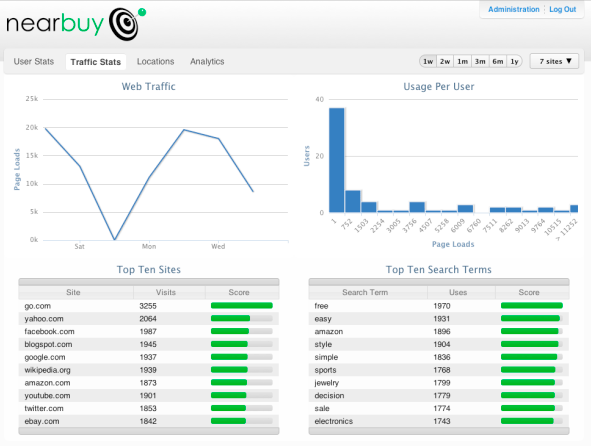
The company, founded by a team from Aruba Networks, allows retailers to offer free Wi-Fi to shoppers which is tied into their existing wireless LAN infrastructure, whether that’s from Aruba, Cisco, Motorola, or another major wireless player. In return, consumers agree to a terms of service which allows the retailer to track where they go online while in-store. This lets the retailer better understand their customer base, including what products they’re researching on their smartphones (“showrooming”), what offers they might be interested in, as well as where they go physically within the store.

The company counts over 40 customers today, including U.K. baby superstore Kiddicare, several mall retailers, major luxury goods big box retailers, grocery stores, and electronics retailers. (The majority of its customers are under NDA.)

nearbuy-data

Nearbuy and RetailNext were originally working on a partnership agreement, started a year ago, which would have allowed RetailNext to leverage Nearbuy’s existing infrastructure.

“Nearbuy has the largest amount of opt-in users and opt-in deployments out of anyone out there on the market,” says Agratchev of his interest in the company. “They’re adding about a hundred thousand new opt-in users every day, and they have a few million people who have opted-in to their platform. That was one of the bigger drivers for the deals,” he adds.

Today, retailers are using data they collect to improve store operations and marketing, but they’re now looking to get into personalization, Agratchev explains. They want to identify their best customers, tailor offers specifically to them, and serve them in different ways. This is especially true among high-end retailers, he notes, and Nearbuy has several customers in the “high-end, luxury brand” space.

Nearbuy Tech Already Available, Being Piloted

Because the two companies had already worked together on a partnership, RetailNext’s latest release (ver 4.5) already has the initial Nearbuy integration, thanks to the earlier OEM agreement the two had signed. There are also a couple of pilot customers on board now, too. Going forward, this additional functionality is available to any of RetailNext’s current client base, while Nearbuy’s customers will continue to be served uninterrupted, and its API will also still be available to third-parties looking to integrate the in-store behavioral data into their own applications.

retailnext

The entire 13-person Nearbuy team is joining RetailNext’s team of over 100, with the four co-founders taking up positions in their respective areas of focus, including former Nearbuy CEO Bryan Wargo, now VP of Sales.

Chartbeat Looks Beyond Clicks With Redesigned Publisher Analytics

It’s not unusual to hear complaints about websites that are too focused on maximizing clicks – but it’s a little surprising to hear those words coming from Tony Haile, CEO of real-time analytics startup Chartbeat. After all, Chartbeat is arguably the perfect tool for monitoring the effectiveness of a click-focused strategy.

Yet when I spoke to Haile yesterday, he told me, “For a long time now, I have been somewhat frustrated by the way we as an industry have been chasing traffic. We’ve been buying traffic, using linkbait headlines, throwing in slideshows, all because it’s driving more traffic, more traffic, more traffic. But the real goal is not to build traffic, it’s to build an audience.”

In other words, instead of just trying to get as many clicks as possible, Haile is arguing that publishers should focus on attracting readers who will come back to the site again and again. For one thing, that’s the kind of audience that brand advertisers are more likely to value. Hopefully, that focus means creating content that’s genuinely worthwhile, either because it’s newsworthy, or informative, or entertaining – not just annoying clickbait.

To encourage that shift in focus, Chartbeat is launching a new version of its Chartbeat Publishing dashboard for editorial organizations, placing a big emphasis on engagement (something that Chartbeat has been trying to emphasize for a while) and returning visitors.

Haile showed me the redesign yesterday, and the new vision is reflected right at the top of the dashboard, where publishers won’t just see the familiar meter showing the number of visitors on their site, but also the percentage of users who are recirculating (i.e., those who aren’t just reading one page and leaving) and the average engagement time.

A little further down on the dashboard, publishers can also see their visitors divided into segments – new, returning, and loyal. They can see their different traffic sources – not just who’s delivering the most visits but also which sites deliver visitors who will actually return (Chartbeat refers to this as the conversion rate). And when publishers look at the list of individual articles, they’ll see which ones are actually doing a good job of retaining readers and acquiring new ones.

Other new features include more prominent placement for video analytics, more detailed mobile data that goes back 30 days, detailed traffic breakdowns by geography, and the ability to see the amount of traffic driven by specific tweets.

Haile argued that the new Chartbeat will allow publishers to take “many of the same actions in pursuit of more meaningful goals.” In other words, a publisher could still use the data to decide what kind of content to focus on, but now they can prioritize that content based on a number of metrics, not just clicks.

“The bet that I’m making is that if you care about building audience, this is the product for you,” Haile said. “I think that any publisher that’s purely going for clicks at this point in time is in a commodity business, and they’re going to be constnatly running up the down elevator.”

What if some publishers don’t agree? “We need to help change their minds, or they’re not going to be around for very long.”

The updated version is supposed to go live for all Chartbeat Publishing customers today. You can read more here and play with a demo here. Oh, and here’s an infographic that the company created to break down the likelihood that a visitor will return to your site.

TC Return Infographic

IntelClinic’s NeuroOn Launches On Kickstarter, Promises To Let You Sleep Like Da Vinci

If you need a better night’s sleep you can either kick the chickens out of your bed (true story) or try something like the NeuroOn. Designed to work as a sleep mask and neural sensor, the system knows when you are in deep REM sleep and slowly wakes you when you will be most alert and refreshed. It also allows DIY sleep experimenters to take cat naps during the day, opening up whole new vistas of unexplored work time between 2 am and the crack of dawn.

The NeuroOn is primarily designed to enable polyphasic sleep. By cutting sleep into chunks – Da Vinci tended to sleep 20 minutes every four hours, it is said – you can reduce the amount of bed time you need. The founder, Kamil Adamczyk, created the device when he was studying and trying to start a company.

“It was terrible experience switching,” he said. “But the results were amazing.” He had more time to study and work. Using the skills he learned he built a prototype NeuroOn mask. The system currently measures a number of things including EEG, EOG and EMG as well as eye tracking. Using low-energy Bluetooth it connects to your phone and will vibrate and light when it’s time to wake up. It fits snugly on the head like a sleep mask and keeps light out completely.

I’ve used a number of prototypes of this device and was quite impressed with the verve with which Adamczyk expressed his love of the product and his mission. While I was never able to actually sleep with this thing on, he does promise that it will start you on the road to Tesla-like productivity – provided you’re willing to wear it with other people in the room. I first met the team in Warsaw and they subsequently showed up at Disrupt in SF and Berlin, presumably doing all this while sleeping a few hours a day.

You can get the mask for a pledge of $225 and they expect to deliver by May of next year. While I can’t see all of us hitting the polyphasic trail, the mask is also a good sleep aid and will wake you gently and without much fuss when you need to be woken.

“People should buy it if they’re working really hard and sleeping irregularly,” said Adamczyk. Sounds like all of us.

Firehose Provider DataSift Raises $42M Led By Insight Venture Partners For Global and Non-Social Ambitions

DataSift, a social data platform that provides brands and enterprises with access to content from the likes of Facebook, Twitter, Tumblr and dozens of other social networks, is today announcing a $42 million, Series C round of funding. Rob Bailey, DataSift’s CEO, tells me that the company plans to use the new financing for a number of different purposes.

First up is international expansion, starting initially with Japan, Brazil, Turkey, South Africa, and Indonesia. DataSift also plans to add more data partners; and to expand into what Bailey calls “non-social” data sources – which can include messaging and gaming services, enterprise collaboration platforms and more. DataSift has seen a “huge amount of inbound interest” for data from these sources, he says.

Bailey tells me that today DataSift is not profitable today, but that is intentional. “We could be if we wanted to but we’re playing the long game. We want to be a billion-dollar company and so we are investing for growth. Going public is our long term goal.” The company in understood to today be generating in the region of $25 million annually, according to sources.

Insight Venture Partners – the VC firm that has backed Flipboard, Buddy Media, HootSuite – led the round with existing investors Scale Venture Partners, Upfront Ventures, IA Ventures, Northgate Capital and Daher Capital also participating. As part of the round, Insight Venture Partners’ co-founder and MD Jeff Horing is joining DataSift’s board of directors.

DataSift has now raised just under $72 million.

Bailey and DataSift are not providing a post-funding valuation, but considering that another player in the data firehose game, Topsy, has just sold to Apple for reportedly over $200 million, and DataSift is “considerably” bigger in size, it may well be a number well north of that.

Since being founded in 2010 in the UK, DataSift has been riding a veritable social media tsunami. A swathe of popular (and free) services like Facebook, Twitter and Tumblr attract billions of users, who use the sites daily to post messages to each other and read what others have to say. That rush of consumers and their opinions are of huge interest to advertisers and others for obvious reasons, yet most of that data is unstructured and therefore hard to “read”. DataSift therefore provides a way for those enterprises to make better use of that data from these social media platforms: each piece of data gets tagged with metadata, which can then be used in different applications to chart what people are talking about, gain insight on different trends, and so on.

DataSift says that its 1,000 corporate customers today cover 40 countries and include Bloomberg, Dow Jones, CBS Interactive and Dell and social technology application innovators Marketwired, Dachis Group, Conversocial, SecondSync, HootSuite and Simply Measured.

The move to looking for new business in international markets makes sense for DataSift, Bailey says, because they are the markets “where we see the biggest amount of social activity, yet are the most underserved.”

Unsurprisingly, DataSift ate a little of its own dogfood when selecting what countries it would target first. “We did a lot of sophisticated analysis internally,” he says. “We looked at aggregated social and local networks and the size of the advertising and business intelligence markets in these countries.” And in a sense the infrastructure for growth is already in place: the company already provides detection on its platform for 150 different languages, and is built for scaling. “Right out of the gate, it will be an incredibly easy path for us to enter Brazil, for example,” he says.

I also asked him about Japan. There, a lot of the buzz has been around messaging platform Line, which is more of a private, direct service than the one-to-many nature of networks like Twitter and Tumblr. In these sorts of scenarios, it’s likely that messaging companies might tap DataSift for competitive intelligence of their own platform for their own commercial development, CTO Nick Halstead tells me. Still, the two would not comment on Line directly. “We have not announced a deal with Line yet,” Bailey said. “We cannot comment on deals that have not been announced but I think Line is one the most important data sources in Japan, along with some other ones.” (My interpretation: watch this space.)

The move to work messaging platforms that are not built on the one-to-many principle is indicative of a development at DataSift, says Bailey: “We are expanding outside of social.” The first area, he says, is news. The company already has a partnership with NewsCred, and he says that around nine of the world’s top 10 news organizations already use DataSift “as a part of how they identify breaking news and validate stories, optimising content and helping them publish for things like virality and pageviews.” (CBS Interactive is one news organization that has developed a company-wide platform that uses DataSift data.) Now he says that this is evolving to build bigger applications within news organizations. That makes sense when you consider that these news organizations themselves are on the hunt for new revenue streams to make up for the drop off from legacy platforms like print.

Another area will be to tap further into enterprise applications, many of which are built on social media premises and therefore provide a lot of unstructured data to tackle – 70% unstructured data, according to one estimate from McKinsey. One example here is Yammer, which DataSift already users as a data source for enterprise customers. Halstead explains it this way: “Let’s say you have 10,000 users on Yammer. What they talk about in there can flow into DataSift, where we use our processes to apply curation and context.” He says that DataSift has a waiting list of other enterprise social networks, and enteprises using them, “where conversations have no analysis done to them today.”

Although Topsy is not a direct competitor to DataSift – both are firehose data providers, but Topsy also veers into the area of search, which is thought to be of key interest to Apple – Bailey and Halstead were happy to hear about the sale to Apple. “We think it’s a fantastic validation of our market,” Bailey told me.

And on the subject of acquisitions, DataSift may use some of this latest round in that area itself. “We’ve had a number of startups come to us already,” he says. “But we’re very cautious on any kind of acquisition. Our core focus is building out our platform and constantly serving our customers.” He adds, however, that there are some opportunities out there where interesting technology to better shape big data has been created, but the companies have not managed to pick up enough customers for it, and therefore are running out of money. These kinds of companies, he says, “Constantly reach out to us.”

What else is on the cards? Since DataSift is thinking a bit outside the social databox these days, I thought I’d ask about something else: Pinterest. To date, DataSift has focused on text-based data, but image-first Pinterest is an obvious area for the company to tap into as well. “We haven’t announced anything at this time but I’m a big fan of Pinterest,” Bailey says, but then moves the conversation to the bigger idea. “It’s not the individual data sources, but what you can do with them. Companies that work with social data are overwhelmed by it, and think they are wasting massive amounts of money. What we hear from companies is not that they we want more data, but more precise data, more usable data.”

Photo: Flickr

In Which We Make Coffee With The Founders Of Bonaverde, A Machine That Roasts, Grinds, And Brews

Last we heard from the founders of Bonaverde, they had just launched a Kickstarter campaign to raise $135,000 to produce a coffee maker that turns green, unroasted beans into a cup of coffee in under 14 minutes.

At this point the startup has raised $465,475 with eight days to go, so we caught up with founders Hans Stier and Felix Artmann when they were in New York to check out a prototype of the machine. You may be wondering if this was just an elaborate ploy to get a free cup of coffee. The answer is yes.

As far as user experiences go, the Bonaverde is about as easy to manage as the Keurig you bought for your dad on Black Friday – although presumably less so on the cleanup. A couple spoonfuls of green coffee beans go in the hatch on top, you hit “On,” and the machine does its thing: roasting, cooling, grinding, and brewing the beans.

Unroasted beans stay fresh for months – much longer than the pre-roasted beans you might otherwise buy – so flavor is one of the claims on which Bonaverde is staking its business. Turns out their machine brews really solid coffee that’s neither stale-tasting nor bitter. Some critics have pointed out that roasted beans should be allowed more time to air before they are ground, and while that may be optimal, Bonaverde’s coffee was still really good.

When it launches Bonaverde will also serve as the online marketplace for the raw beans, meaning coffee farmers can connect directly with their end consumers. Down the line, the site will feature all of the producers that shoppers can buy from.

Note that coffee maker in the video is just a prototype of the one that will go to market, which has a much prettier exterior.

A VC And Olympic Hopeful Taps Indiegogo With A Game To Raise Funds For Young Athletes

Paul Bragiel, the batshit crazy awesome VC who has been training for months in the Arctic Circle to compete in the Sochi Winter Olympics, has a side charity project up his sleeve.

After seeing dozens of other younger Olympic contenders struggle to raise funds for training, he felt he needed to do something to help out. Some friends over at Belarusian and Lithuanian gaming studio On5 offered their talents pro bono to develop a game called Team Paul Skiing.

It’s a beautiful, little side-scroller that takes a player through Bragiel’s training as he skis in Finland, which is where he’s done the bulk of his preparation. Then it shifts to Colombia, the country that gave Bragiel citizenship to compete on behalf of its Olympic team. And finally it ends in Sochi, Russia, where the Olympics will be held next year.

They set a low goal of raising $10,000 in the next seven days, and half of the proceeds will go toward different youth sports foundations in Finland and Colombia while the other half will go toward game development. But they hope to raise somewhere between $25,000 and $30,000.

Bragiel, who started i/o Ventures out of San Francisco, decided earlier this year to realize his lifelong dream of competing in the Olympics.

But there were many hurdles. For one, he didn’t have a sport. Then, he was also pretty old for an Olympic hopeful at 36 years of age.

But he’s hacked his way so far. After considering everything from curling to the luge, he settled on classical cross country skiing, which is a more traditional Winter Olympic sport that has more lenient rules around qualifications.

Then he secured citizenship in a warm, tropical country that is less competitive for winter sports – Colombia.

Now he’s in the middle of qualifying races. To make it to the Olympics, he must be able to finish five qualifying races where he’s not more than 10 minutes behind the world’s top cross-country skiier – no hard feat. He’s competed in his first qualifying race already, which was a miss. But he’s definitely not deterred. There are plenty more to come.


IndieVoic.es Hopes To Become Kickstarter For Independent Media

The Internet wasn’t kind to media. Huge media corporations have managed to transform their businesses, for the most part, but independent media, often playing a vital role in emerging countries, are seriously threatened by the lack of available funds.

IndieVoic.es hopes to change that. Founded by Sasa Vucinic, V Media Ventures CEO and a former Editor-in-Chief of B92 (Serbian media corporation which played important role in the overthrow of Milosevic), the project is essentially a crowdsourcing platform focused on providing necessary funding to independent media in developing countries.

Just like Kickstarter or Indiegogo, IndieVoic.es uses a familiar concept. Media owners can create campaigns and specify the amount of money they need to run their venture. Contributors from all over the world can fund their campaigns in return for valuable prizes (ranging from a postcard to a dinner with former Prime Minister of Thailand).

However, crowdfunding isn’t the only way IndieVoic.es aims to help independent media raise money. By announcing no-interest loans and mini-loans for 2014, the platform will enable its users to choose the best funding option for their media. Think of it as a mix between Kickstarter and Kiva.

“Our goal is not just to fund independent media. We want to engage the audience and democratize the ownership of media. It is the only thing that hasn’t changed about this industry in the past 20 years” stated Vucinic in an interview for Netokracija.

And he should know a thing or two about financing media. Vucinic co-founded Media Development Investment Fund which he ran for over fifteen years. During that time, MDIF has raised 123 million dollars and funded more than 220 independent media projects all over the world.

Much like MDIF, IndieVoic.es supports different media outlets ranging from investigative journalism reports and local radio stations, up to specialized blogs covering various topics of interest. Although anybody can submit a project, only those which are curated and checked will actually be eligible for a campaign. We are ensured that this is necessary to maintain a certain standard of funded media.

Despite all this, IndieVoic.es is not your ordinary crowdfunding platform. Unlike Kickstarter or Indiegogo, this service is not looking to cash-in on their revenue any time soon as it is specifically trying to operate as a non-profit.

“Our goal is to break-even beginning 2016. If our revenue is higher than expected, we will definitely lower our initial cost per campaign”, Vucinic added.

Although media isn’t every investor’s cup of tea, “there are those who might find interesting opportunities in specialized media covering a range of interesting subjects”, stated Vucinic. Is IndieVoic.es leading the revolution independent media owners have been waiting for? It sure seems like it.

Gillmor Gang: Private Practices

The Gillmor Gang – Robert Scoble, Keith Teare, Kevin Marks, and Steve Gillmor – work off that stuffed feeling with a show devoted to the intersection between public and private messaging. What started with Twitter and continued with Facebook has now yielded a startup frenzy many mistake for a bubble. Instagram started the ball rolling, SnapChat doubled down on it, and many fear it will end badly and absorbed by the big players.

But just as the Yankees can’t buy a championship, neither will Facebook or even Google slow down the momentum of these private streams. What @scobleizer calls Snapchat’s brand promise may seem to be breakable only at the peril of the founders. I think something else is at work, built on the metadata that these self-destructing messages incentivize. As these services morph in their realtime metaloops, we’re seeing the future materialize in front of our mobile eyes.

@stevegillmor, @scobleizer, @kevinmarks, @kteare

Produced and directed by Tina Chase Gillmor @tinagillmor

Live chat stream

The Gillmor Gang on Facebook

Hands On With Jolla’s First Phone – The “Spearhead Device” For Its MeeGo-Successor Sailfish OS

The first handset from Finnish smartphone startup Jolla is simply called Jolla. This phone has been some two years in the making – a timeframe that testifies to the complexity of building handset hardware and a new mobile platform, not to mention rallying developers and achieving Android compatibility. So really two years ain’t bad for a plucky startup whose members used to work for erstwhile king-of-the-mobile-world, Nokia, and left to do what that phone maker decided it couldn’t: make a go of MeeGo as an alternative to Google’s all-consuming Android.

What was MeeGo on Nokia’s N9 is now Sailfish on Jolla’s eponymous handset. The Jolla phone finally launched on Wednesday, in Helsinki, with the first 450 devices taken home mainly by those who had already registered their interest via a pre-sales campaign. Jolla is now shipping handsets to other pre-orderers throughout Europe. The top three countries for pre-sales were, in order of popularity, Finland (as you’d expect), Germany and the U.K.

TechCrunch got hands-on with Jolla’s first phone for a few hours at a London press event, where two co-founders, Marc Dillon and Sami Pienimäki, were also on hand to answer questions.

  1. P1010801

  2. P1010825

  3. P1010800

  4. P1010793

  5. P1010834

  6. P1010831

  7. P1010706

  8. P1010703

  9. P1010829

  10. P1010798

  11. Jolla

  12. P1010807

The Jolla phone hardware reforms the standard smartphone slab into an attractive plastic sandwich, as if two blocks of different coloured liquorice have been smacked together. The back piece – which was plain white on the above demo device but comes in bright pink for Finnish carrier DNA’s first batch of the phones, and in customisable colours in future when Jolla starts direct sales via its own website – is known as The Other Half.

Like Jolla’s software The Other Half is intended as an extensible platform – with connectors built into the back of the phone for power and a bus connection for data transfer allowing for Other Halves that could incorporate a physical Qwerty keyboard, for instance, or a weather station sensor or even an e-ink screen, as well as the NFC-powered software theme-swapping  supported by the current crop of shells.

“Putting something like a keyboard is expected,” said Jolla co-founder Marc Dillon. “We are working on the developers kit so that anybody can do this… We’re working on accessories, and we expect third parties to work on accessories.”

The standard Jolla handset (i.e. with a not-too-fancy Other Half) is a nice size and weight in the hand – neither too big to be overbearing, nor too hefty or lightweight to feel unpleasant to hold. On paper, its specs come across as relatively mid-range – with a 4.5″ display, a dual-core chip, 4G, an 8MP camera plus 16GB of internal memory expandable via microSD card. But differentiating on phone hardware specs is not what Jolla is all about.

Its difference lies in the MeeGo-derived Sailfish software platform, and an open philosophy that wants developers – and other companies – to come in and build all sorts of software and hardware extensions atop this platform. The Jolla phone is a showcase for what Jolla the startup can do – tl;dr: see here what we built for ourselves, why not let us build something for you?

“You can’t really have an operating system without a spearhead device, and although we’ve been talking to almost everybody that’s in the mobile space over the last two years, almost every kind of manufacturer, I think they’ve all been waiting to see what we actually are capable of,” Dillon told TechCrunch.

“Because if you just look, people wise, then we’re really small compared to these guys. Their coffee budget is probably as much as we’ve spent to create this device!… So now they have a way to judge our capabilities by taking a real device and looking at it, and seeing what it does.”

Despite this b2b sales pitch, Jolla is committed to its own consumer play too – believing there is appetite for something new and different to shake up the samey-same smartphone space.

Dillon said about 80% of those who pre-ordered its handset earlier this year – in some instances without putting any down money down – have been converted into sales. Jolla hasn’t confirmed exactly how many devices were pre-ordered, saying only that it was a “typical” sized production batch – of up to 50,000 units. But it did take in €1 million’s worth of sales on the phone’s launch day, according to Dillon.

Doing a back-of-an-envelope calculation, by dividing that figure by the phone’s standard €399 price-tag, equates to 2,500 Jolla handsets sold in one day. Albeit, the pre-sales campaign muddies the water a little. Either way, generating €1 million in revenue in a day ain’t bad for a new kid on the phone block.

Indeed, getting a smartphone to market when you’re a startup of 80+ full-time employees, not an electronics behemoth like Apple or Samsung, is a monumental achievement in itself. But it is also just the start for Jolla. Now the even harder work of community building kicks off in earnest – if it’s to turn one phone into a whole new-wave open mobile movement.

Passion projects attract fans. And Jolla is clearly a passion project for Dillon, who tells me he personally shook the hand of everyone standing in line in Helsinki’s Narinkka Square for Wednesday’s Jolla launch. And for all the ex-Nokians who made the decision to leave to carry on developing a platform that Nokia was abandoning.

Jolla’s early buyers are also clearly passionate about the potential of (another) homegrown mobile platform. The question is whether Jolla can build a community beyond these nostalgic origins. Dillon argues it’s already doing that – and that the launch event was characterised by a broad spectrum of interest.

“There was everyone from high school students to retired people. There were men and women, different nationalities – there was of course a lot of Finns, being Finland, but there was also people had come in from some other countries,” he said

“That was one of the things that we were actually curious about. Usually you have a set of early adopters for a new technology platform – we seem to break that. We had a very wide demographic who was taking our first device.”

I believe that people are looking for something different. Imagine if you could only buy two car choices in the world.

Why does he think Jolla is attracting diversity? “I think that the reason that people have had a lot of interest in us is there’s this David vs Goliath thing but also the fact that instead of just being a corporate face we’re coming out as people and we’re interested in people, and we are people, and I think there’s been a personal connection that we’ve made with a lot of people.

“And I believe that people are looking for something different. Imagine if you could only buy two car choices in the world. People can only buy what’s offered to them – and they’ve have had the same kind of experience for five years. So there’s a curiosity to see what happens next.”

But launches are by their nature exciting. The everyday reality of technology is that people crave the unexciting stuff too – functionality, reliability, stability, simplicity, (app) familiarity, and so on. Those are areas where Jolla has work to do. Its new mobile platform is inevitably an oxymoron: it’s both shiny and rough round the edges.

The Jolla UI is different to Android and iOS, excitingly so, to the point where you can feel its potential to offer something fluid, flexible and freeing to use. It also generally feels fast and responsive – although there is a small lag when opening or switching between apps, and progress bars pop up for certain actions which you might not expect, such as deleting a single photo.

But it’s inevitably still got a lot of kinks to iron out, including actual bugs that cause apps to crash or mess up, but also counterintuitive quirks – things not always working as you’d expect. One of the biggest challenges for Jolla is undoubtedly the learning curve its newness demands of users now fully embedded with icon-based, back-button-sign-posted mainstream user interfaces.

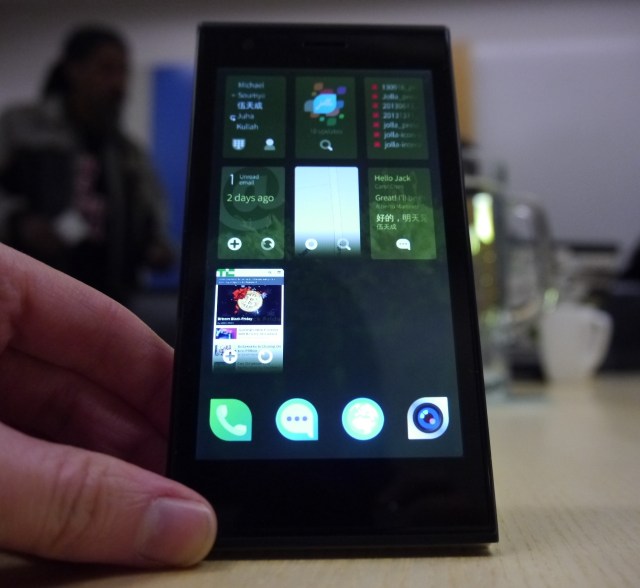
Navigating around Jolla’s UI requires a different set of gestures to iOS and Android; there’s no back button, there are very few buttons at all – it’s more push and pull, more like BlackBerry 10 or even Windows Phone, with gestures for peeking at content, and pulling in more stuff lurking off screen. (Of course Jolla would say its interface is Unlike all the rest.)

Other gestures close or minimise apps – the latter being displayed as small widgets on the homescreen which you can also interact with, if the developer has added in such functionality. So, for instance, you can refresh a webpage from the browser widget or command it open a new tab, or dive right in to search for an app on Jolla’s app store just by swiping left (or right) on the corresponding homescreen widget.
jolla-phone-main

To navigate generally, the user has to follow subtle clues – such as a glowing bar that sometimes appears at the top or bottom of the screen or a menu, to signify there’s a list of actions that can be dragged on screen and selected within the same movement; or breadcrumbs of dots that appear at the top corner of the screen, which signify there are other screens’ worth of content waiting to be swiped into view.

Getting the hang of these elements is not the work of days, but it does take patience and a willingness to learn something new – something Jolla unfortunately can’t take for granted. Users also have to contend with Sailfish gestures being combined with Android nav elements (such as the Android back button and recent apps key) when running Android apps. Which dilutes Sailfish’s signposts with the very Android paradigms it’s hoping to supersede.

“We got rid of the home button – so we did eliminate one of them, but the back button, unfortunately, even though we have our own forward and back solution the [Android] applications still [use] so we still have to have those buttons,” said Dillon.

Jolla is working on getting a community portal rolled out to its website, which will include a forum where users can help each other out with queries – to supplement its already launched online care channel. It’s also making a series of how to videos to explain Sailfish navigation and gestures. And will be staffing a variety of social media contact points where people might be looking for answers, says Dillon. Plus there’s an on-device tutorial that walks users through the gesture basics.

pull-down-tutorial

All of this will certainly help, but getting people to switch from something they know to something different is by definition pushing water uphill – as Microsoft’s long hard slog to get Windows Phone to stick underlines.

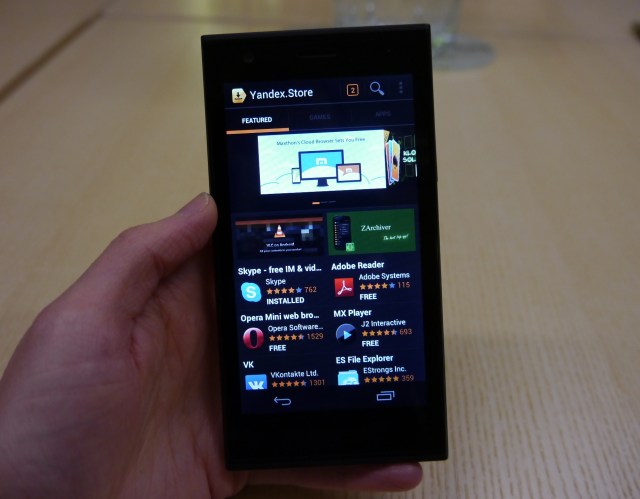
Then of course there is the big challenge for any ‘other’ platform: the app gap that won’t go away. Even with Android compatibility – and Yandex’s app store preloaded – Jolla is inevitably starting a long way behind the Android-powered competition. In terms of native Sailfish apps (accessed via the Jolla store), there are but a handful at launch – I counted about 28 on the device, which includes basic stuff like an email client and a document viewer. There’s also no support for paid Sailfish apps, as yet, but that important developer incentive is coming down the line.

And then Yandex’s Android store presents only a smaller sub-set (apparently 85,000) of the apps Android users get on Google Play (one million+), so inevitably a lot of titles you’d find on bog standard Android are not on these shelves. (And while you may be able to sideload some Android apps, there’s no guarantee of smooth or even workable compatibility with Sailfish).
yandex-store

Even tapping directly into the Android apps on the preloaded Yandex Store isn’t a guarantee of smooth results as there are ongoing compatibility issues at this (early) point. Notably, the Android runtime sometimes spontaneously takes over the interface, dragging the user back to an Android app they had quit out of, as if Mountain View is wrestling back control from this open mobile upstart.

Compatibility issues also mean Android apps can appear buggy, with elements failing to correctly mesh with native Sailfish elements such as the keyboard, or degrading the experience so the app feels sluggish. On the other hand, other Android apps – such as Twitter – seemed to perform ok during my hands on so it’s not all bad. But it is inconsistent, and Jolla’s Dillon concedes the startup does have work to do on the Android compatibility front.

Regardless of myriad consumer-facing challenges, he says Jolla is in it for the long haul. It’s committed to providing its early adopters with a device that improves and continues to evolve, rather than hardware that withers on the vine (as Nokia’s N9 did). “The most important thing for us is that we continue to add value for everyone that bought this,” he said. “What features we do next, we believe the consumers should have a say in what the priorities are – and we will continue to deliver new features via the software.”

Jolla apparently has enough funding to sustain that effort too – with an alliance of industry backers committing to buoy up Sailfish to the tune of €200 million. Back in February Jolla itself also took in a €1 million investment from a Hong Kong based telecoms & mining firm, China Fortune, in exchange for 6.25% of the company. Chinese e-commerce giants Alibaba and Baidu have also been floated as future potential partners for Jolla – albeit that might just be wishful thinking at this point.

Jolla co-founder Sami Pienimäki said the company’s already spent about €20 million getting to the starting point of being able to release its first handset, running the Sailfish OS. How much more it may need to nurture and build out an ecosystem to really get Sailfish moving remains to be seen.

But why might other mobile makers want to use Jolla’s software to power their own devices?  ”Just using Sailfish is a differentiator already because we were able to take a fresh look and do something new,” said Dillon, when I pose this question. “We [also] have no competing services, or no required embedded services” – a veiled reference to how Google tries to keep its Android OEMs (and developers) in line, by dangling the carrot of access to its Play store.

Beyond ‘not being Android’, Dillon argues that Sailfish is a place where the next wave of mobile innovation can occur – a liberal space for experimentation, for forming a way beyond the status quo of segmented services and individual apps consumed in a cacophonous pick’n’mix. Somewhere where smarter, more unified and better targeted services can be developed.

This is just the beginning of how I believe mobile's going to start to break this application barrier.

“What I think the platforms are going to do – and where a real differentiation is going to occur – is when services start to get integrated here [on the homescreen] and not just sticking your application and embedding it into the device but actually connecting multiple applications together to make a more seamless experience,” he told TechCrunch.

Instead of users harvesting data from multiple apps and places individually within a device, Dillon envisages a platform where more and more apps plug into each other to funnel data to where it’s needed rather than sitting in separate silos that the user is required to visit.

“I don’t want to deal with events the second that they happen all of the time, so when I look [at my Jolla phone] I see that there’s these phone calls that I’ve made, so there’s a constant reminder that these are the people in my life at the moment that I’m communicating with… The same with messages… or email… This is just the beginning of how I believe mobile’s going to start to break this application barrier,” he said.

“These kinds of synergies between things is just starting, so that you don’t have to cross apps all the time,” he added. ”What we’re doing is we’re creating a place where these things – well beyond what I can think of or tell you today – are going to occur.

“The openness of the platform lets a developer, a company, an entrepreneur, a new business take something from the user experience all the way down to the hardware, the metal, the silicon – across to one or more Internet services, and provide something that is going to connect a user to one or more services that are locally relevant, that are important to you right now and not spammy.”

All that is for the uncertain future. For now, Jolla has shown a startup can make a smartphone. So it’s already proven a lot of its doubters wrong. It’s also positioned itself to take up the baton from Nokia, as THE Finnish mobile maker – just as Nokia prepares to give up that role (by selling its Devices & Services unit to Microsoft). Which is cruel or opportune timing, depending on your perspective.

Building a new smartphone on a new platform is already an impressive achievement. But Jolla isn’t about to stop and admire the view. This startup has no intention of letting a single lovingly crafted handset remain its crowning glory. Onward Sails!

Yahoo Users Anonymous: A Transcript

This is what happened:

Scene: A Silicon Valley church basement. Folding chairs, coffee, cigarettes tucked behind ears. Jon EVANS, a tall man with a shaved head and an Arsenal FC T-shirt, steps forward to the podium. He has a slight Canadian accent.

Jon: Hi, my name’s Jon, and I’m a Yahoo! user.

Room, in unison: Hi, Jon!

Jon: I guess…I mean, this is so embarrassing, obviously…I guess my story’s like a lot of yours. I got into Yahoo! when I was young, because back then it seemed really cool. If only I had known then what I know now. But I went for a six-month trip across Africa and Yahoo was the only web-mail service that could access my Unix shell account via POP. Gmail didn’t exist yet, Hotmail was a joke, and I was sending friends emails from Cameroon and Zimbabwe, they were amazed, they were jealous. So I got hooked. And then…

He falls into grim silence for a moment.

Moderator (a pale, gaunt woman with nails bitten to the quick): Then what?

Jon: Then I guess I went all the way down the rabbit hole. I registered my domain with them. I used them to host my vanity site. I was in so much denial that when they bought Flickr, you’re not going to believe this, but when they bought Flickr I was excited about it. I thought it would be great.

(Hollow laughter echoes through the room.)

Jon: Now, though – I mean, you all know what it’s like to be a Yahoo! user now.

Pained yet sympathetic expressions ripple across the crowd.

Jon: The things that work haven’t changed in like ten years, and the things that have changed don’t work any more. Or they look prettier, like the Flickr redesign, or their new NFL game reports, but then you try to use them and you realize that actually they’re just more broken than ever. I used to be proud that I was a Yahoo! user. Now it’s shameful. I have to hide it from all my friends. (glances at camera in corner of the room) That thing isn’t on, is it?

Moderator: (hastily – too hastily) No.

Jon: Good. (under his breath) I’m totally going to bury this post on a holiday weekend when no one will read it.

Moderator: Excuse me?

Jon: Uh, nothing. Anyway, the thing is, I even know what their problem is. I’m an engineer, and a long-term user, so I can tell Yahoo!’s engineering is just terrible. I mean, maybe their engineers are pretty good and they’re just hamstrung by their process and bureaucrats and what have you, I don’t know about that, but the results are terrible. Paul Graham said it years ago: “Yahoo treated programming as a commodity.” I mean, consider Yahoo! Mail –

(A loud, angry groan erupts around the room.)

Jon: Last year they mixed secure and insecure JavaScript files on my inbox page for months. Months! Can you imagine Google doing that for so much as a day? Or even Microsoft? And just this week I’ve been getting half-a-dozen copies of every email, but the first one arrives hours late half the time, and that’s if the page loads at all! For days! It’s ridiculous!

Moderator: So why have you stuck with them?

Jon: I…I really don’t know. Partly it was because I was uncomfortable about how much of my online information Google has, but now I’ve lost so much faith that I’m backing up all my mail to one of my Gmail accounts anyway, which kind of fundamentally defeats that purpose. Partly because moving would be such a hassle. But the thing is – well –

Moderator: Go on.

Jon: The thing is, I somehow still want Yahoo not to suck. Every time they say things will get better, I want to believe them, even though every time it’s been a lie. Oh, we’ve licked the peanut butter problem, now everything will be fine. Oh, Marissa Mayer’s CEO, now everything will be fine. But the truth is –

Moderator: What?

Jon: The truth is that it’s not going to be fine. Not now, not ever. Because their engineering sucks, so they’re like a sprinter wearing leg irons starting 50 metres behind the competition. And you know what? It’s too late for even Marissa Mayer to fix that.

Moderator: So you’re quitting? Cold turkey?

Jon: I–

(Chairs creak as their occupants lean forward, with bated breath, hanging on his words)

Jon: you know what, I’m going to give them one more chance. I don’t even know why. Just one more. But this time, I swear, this time if it doesn’t work out, I’m done.

(Disappointment is written loudly across every face in the room, including his.)

Moderator: (with deep sadness) OK. We understand. Thanks, Jon.

Jon: I’m sorry.

Image credit: Dave Ward, Flickr.

How To Sell Your Business And Make And Lose Millions

Editor’s note: James Altucher is an investor, programmer, author, and several-times entrepreneur. His latest book, is “Choose Yourself!” (foreword by Dick Costolo, CEO of Twitter) about how to make, lose, and make back millions. Follow him on Twitter @jaltucher.]

First I totally gave up. I thought there was no way to sell my web services business.

It started when I was in the offices of Loud Records, run by Steve Rifkind. My company, Reset, was doing websites for the Wu-Tang Clan and other Loud artists. It was 1997.

Ol’ Dirty Bastard would call me on the phone sometimes. Mobb Deep would stop by. Trent Reznor would hang out (we did Interscope’s artists as well).

Steve Rifkind’s dad, Jules Rifkind, was a music mogul from the 50s, signing acts like James Brown. He was infamously (supposedly) portrayed in The Sopranos as the character Hesh Rabkin.

And the rumor was that Jules Rifkind’s father used to handle all the details whenever Meyer Lansky threw a party.

When you walked into Loud Records these huge beefy older Jewish guys would pat you down to make sure you weren’t carrying a gun. They looked like they were about 70 years old but you had to have a suicide impulse to disagree with them.

Someone said to me, “Steve needs you in his office. He’s got some guy in there pitching BS.”

So I went in there.

This guy, Justin W., was saying, “Steve, let’s do a rollup of all urban businesses. We take Loud Records, combine with SRC, combine it with five-star basketball camps, maybe get The Source magazine in there. We take it public. You could have a billion-dollar company! This would be hot on Wall Street. Rollups like this are fucking sexy.”

Steve was sitting in the center of the room and everyone was sitting around with him. “A billion dollars. This is too much for me. I gotta go to the bathroom and jack off.” And he got up and left the room.

Justin introduced himself to me. He was a banker at [big investment bank].

A few weeks later Justin called me even though we hadn’t exchanged cards or anything.

True to my style, I didn’t pick up. I don’t like talking on the phone very much.

The next day he called. The next day he called. The next day he called. The next day he called.

Finally I picked up.

“Why do you never pick up?” he said.

“Sorry about that,” I said, and that was that.

“Listen,” he said, “you’ve got a hot company. I know people who want to buy it. Go to this address.”

So I went to the address he gave me. It was a huge empty room about 10,000 square feet with one desk in it. It was the soon-to-be offices of a company called Rare Medium. The CEO, Glenn Meyers, was there. “I like your company,” he said. “I want to buy it.”

But I didn’t understand anything then and his company wasn’t public yet. It would later merge with an air-conditioning company that was trading for one dollar, and then it went up to $300 at the height of the boom and then it went bankrupt. Someone recently told me that Glenn pulled $200 million off the table and relaxes now.

So I didn’t return Justin’s calls for a while more. Finally he got me on the phone. “Listen,” he said, “you have to pick up when I call. I’ve got other guys who want to buy your company.”

He sent me to two or three other places. Everyone made offers. They were all complicated, though. Like, $X up front and then $Y over five years.

I had to practice going to places and saying, “I want to be a part of a larger team” and other BS. But all I really wanted was money.

Independently, for the prior year I had been sending updates to the person who bought companies for Omnicom, the big ad agency, Felice Kincannon.

After a year of meeting her and sending her emails of our updates, we were finally big enough. She started introducing me to other agencies within the Omnicom family to see who would want to buy us. Everyone did. And I started sending ad business to Omnicom agencies.

But again, the deals were all too complicated for me. Deals should be simple. Because they always get complicated later. They should start simple.

Honeymoons are meant for love-making.

Finally, I got tired of it. We wouldn’t get acquired. I called Justin, “Just forget it. I appreciate your help and we’ll figure it out some other time.”

“No wait,” he said. “One more try. These guys will be at your place in 20 minutes.”

Twenty minutes later two guys show up. A tall, older, suited, German guy with a thick accent. And an Orthodox Jew.

They took the tour of the offices. I made sure everyone would be working hard, even if they had no work to do.

When we got into the “map room” (which was also the kitchen), Werner Haase pointed to the map and said “What is this?”

I said, “This is where we have clients,” and there were pins all over the world.

“I find New York City is big enough to have plenty of clients,” he said in his thick accent.

About an hour after they left, Justin called me. “They fucking loved you. They want to buy the company.”

“Ok,” I said, “but everything has to be up front.”

“Give me a number,” Justin said, and I said a number, and he said, “wait for a call from them.”

Ten minutes later they called and offered the exact number. Werner even said, “I look forward to playing chess with you.”

la-sp-serena-williams-venus-williams-family-ci-001

Handshakes don’t always mean a deal is closed.

The closing of the deal took too long. I was stressed every day. Lawyers stopped calling back. Everything was going slow. But Justin and Yitz, the Orthodox Jew, kept telling me to keep my cool.

But I wasn’t cool. I couldn’t focus. I was going to go out of business because I was so anxious.

One time Werner offered to lend the company money. “If you need it,” he said. I said no. I felt like it was a trap.

Meanwhile the Asian Financial Crisis happened. Werner was having second thoughts. The deal was already taking six months.

Finally, it closed.

I called my sister. “It’s closed!” I shouted into the phone.

A woman passing me by on the sidewalk yelled at me, “Who fucking cares!”

Justin wanted his fee. I drove up to his house as soon as I got the money so I could hand-deliver his fee.

Four years later the company that bought us filed for bankruptcy. The chairman of the company, Scott Mednick, produced the movie “Superman Returns” and is now in the movie business. Werner went back to being in the travel agent business. Yitz has a company that cures irritable bowel syndrome.

Justin still does deals. Steve Rifkind never did his urban rollup but kept putting out platinum albums. Every web agency that Omnicom bought went bankrupt or near bankrupt.

With the money I made I bought a 4,500 square foot apartment in Tribeca and I played poker every night at private clubs and in Atlantic City and in Las Vegas. Even the night my first child was born I played poker all night.

Four years later I was broke and had to sell the house, and I moved 80 miles away and didn’t leave my new house for three months because I was so depressed.

The story never ends. This is just a chapter.

Lessons learned:

Get all the money up front. As much cash as possible. This applies no matter what you are selling. A service, a product, a company, etc.

Some people are good deal-makers. Recognize who they are and pick up their calls.

Be honest about what you want. You don’t have to lie to get acquired if you have a good company. This works no matter what you are selling. People pay a premium for authenticity.

Send constant friendly updates to the people who are rejecting you. This works for all sales. Water ultimately dissolves rock.

Stay focused on your business, else you have nothing to sell.

Werner was right. You don’t need to be worldwide. NYC is pretty damn impressive.

As we all know, the stock market has fads. Eventually your company will be part of the fad because all industries have their day in the sun. But make sure you are profitable so you can survive it.

Corollary to the above rule: Sell all of your stock the second you can. Usually it’s restricted at first. Never be fooled by people smoking crack. Sell Sell Sell the second you can. The reason is: chances are your company got bought for an inflated price anyway.

Don’t change your lifestyle for at least two years. You have to let new money marinate your soul. I didn’t do that and my soul exploded and leaked over all the people I loved, hurting them all. The closer someone was to me, the more they were hurt. I felt really bad about that for many years and only recently made amends.

Always be loyal. I never said a bad word about Werner no matter what. If someone helps me feed my family, they are a friend for life. If someone takes money out of my pocket, they are out of my life. Never break this rule.

Always be loyal. I pay my fees the second they are due.

This was the first company I ever sold. First of too many.

Sixteen years later Justin W. and I still do deals together. It was together that the two of us screwed Yasser Arafat out of two million dollars.

But that’s another story.

xinsrc_6b48fc2b1f974f8ab2428c1b62e10605_2

Agent Makes Your Smartphone A Little Bit Smarter

You can’t teach an old phone new tricks.

Hah! Just kidding. Of course you can. This isn’t 1998.

Agent is an app that aims to make your Android smartphone just a little bit smarter, using all of your phone’s sensors to detect what you’re up to and tweak your settings automatically. Driving? It’ll automatically respond to texts to let people know you’re busy, and remember where you parked your car. Sleeping? It’ll only let the most important calls through.

Agent is a spin-off, of sorts, of another Egomotion product called “Trigger” (or, as it was once known, “NFC Task Launcher”). With Trigger, Egomotion sells packs of programmable NFC tags which can fire off actions on your phone. Want your phone to silence itself and set an alarm when you go to bed? You’d stick one of their NFC tags on your nightstand, then set up a series of tasks to fire whenever that tag is detected. Want it to automatically launch your favorite music app when you get in the car? Tuck one of the tags into your cup holder.

agents

In time, however, the team realized that many of the most popular use cases didn’t really require NFC. Instead of an NFC tag on your nightstand, why not just auto-silence the phone during certain hours? Instead of hiding a tag in a cupholder, why not just detect when the user is connected to their car’s Bluetooth? Thus, Agent was born.

Agent takes the core concept of Trigger and boils it down to its essence. Gone is any mention of NFC tags, instead relying on the handset’s built-in capabilities – things like its accelerometer, clock, or WiFi/Bluetooth. Gone is the relatively complicated task setup process, with Egomotion instead providing a small set of pre-built actions that they call “Agents”.

At the moment, the app’s got five different built-in agents:

  • Battery Agent: When your battery starts to fade, the battery agent kicks in to irk a bit more life out of your phone. You can tell it to automatically dim your screen, turn off automatic data syncing, or turn off Bluetooth. Once you’re plugged in, it’ll automatically flip everything back on.
  • Sleep Agent: Automatically silences your phone between specified hours, but with a clever white-listing system. You can specify which contacts are allowed to wake you, and allow for repeat (and thus likely urgent) calls to ring through. It can auto-reply to texts, telling the user to reply “urgent” if it’s an emergency (at which point, your phone will ring loudly to wake you up). You can tell this agent to only start if your handset is plugged in. That way, it probably won’t silence your phone during a night out at the club.
  • Parking Agent: Attempts to automatically remember where you’ve parked your car. By default, it works by detecting your speed; once you’ve stopped moving over a certain speed for more than a few minutes, it figures that you’ve parked your car and marks the location accordingly. Of course, doing things like riding the BART might fire off a false positive, so you can tell the Agent to base its logic off Bluetooth connectivity if it’s an option in your car.
  • Meeting Agent: Silences your phone during meetings. Uses your Google Calendar to determine your meeting schedule.
  • Drive Agent: Uses bluetooth to detect when you’re in your car. Can automatically silence your phone, read your texts aloud, and respond to incoming texts to let them know you’re driving.

The company says that they’ve got more agents in the works, potentially offering add-on agent “suites” tailored to certain use cases – one set that’d be good for school, one set that’d be good for work, etc. That way they can keep adding more functionality without complicating the core application.

If you’re a battle-tested Android expert, Agent’s tricks might not raise an eyebrow. “Pft, I’ve got Tasker!” you say. “And I rooted my imported HTC J One and flashed it with a custom rom that does all this ages ago.”

For the less intense folks (read: most people) out there, though, Agent should hit a sweet spot. It’s simple, it does exactly what it promises to do, and the setup is very straightforward and well thought out.

My one hesitation: while I normally hate when people say “But what if company X just decides to do this”, it’s a pretty valid concern here. With all of the data that Google gobbles up and pipes into Google Now, it’s almost certain that they’re tinkering away with similar concepts right this second.

battery

Actually, it’s not almost certain. It is certain. Google-owned Motorola has already released an app that they call Assist, which aims to do much of the same stuff that Agent does. As Egomotion co-founder Kulveer Taggar pointed out to me, Assist only works with a handful of Motorola phones, whereas Agent works on many, many Android phones. But Moto’s handsets tend to be a test bed for Google (See: the always-listening “Okay Google” voice command debuting on the Moto X months before being integrated into Android 4.4). If the concept proves popular, how long will it be before Google starts tying such functionality right into the core of Android itself?

In the mean time, though, it seems like Egomotion is on to something: according to the company’s stats, 95% of agents that get turned on, stay on.

The app, normally $1.99, is on sale for $0.99 for the Thanksgiving weekend.

IronSource Announces KudosKits, Allowing App Users To Show Their Appreciation With Money

Israeli company IronSource has come up with a new way for developers to ask their users for money or other forms of support.

Chief Design Officer Dan Greenberg told me that the product, called the KudosKit, evolved from an experiment conducted with the iOS app good weather, which was initially developed by Fried Cookie and distributed by IronSource (IronSource has since acquired Fried Cookie).

Greenberg added that developers are “all struggling to earn money for the work that we’re doing,” because for many, existing monetization systems such as in-app purchases have proven to be “very, very hard for them to crack.”

With a KudosKit, instead of requiring users to pay for the app, or for additional content/virtual goods within the app, developers can present them with a screen asking for their support. That can ask users to “buy us a cup of coffee” (make a small donation), Like the app on Facebook, tweet about the app, rate it in the App Store, and more.

In some ways, it’s similar to the “tip jar” widgets that you’ll see on some websites, but customized for mobile. And with the underlying analytics technology, Greenberg said his team is “100 percent focused on making this work.” Specifically, he said the KudosKits can identify the most effective points in the app to ask for support, direct requests at specific user segments (so loyal users see the message while first-time users don’t), and localize the messages in different geographies.

Greenberg said that although the company is only announcing the technology broadly now, six months of early usage are promising, with 700,000 users donating a total of $1.2 million. The KudosKits have supposedly seen an 0.58 percent conversion rate to paid “appreciations”, with an average appreciation size of $2.10.

By the way, IronSource is adopting a similar approach in how it makes money from the KudosKits itself – it’s a revenue sharing arrangement, but developers can determine what percentage of the proceeds they give to the company. In Greenberg’s words, “We’re actually giving the developer the opportunity to decide how much they appreciate our service.”

KudosKits are available for both iOS and Android apps. Interested developers can sign up here.