With A Fresh $200M In The Bank, Airbnb Built A Replica Of The Dr. Strangelove War Room In Its Office

Airbnb recently raised a fresh $200 million (total funding: $326 million), and also built a replica of the war room from the film Dr. Strangelove in its new office.

A profile of its digs in Modern Luxury’s SanFrancisco magazine documented the room, essentially an aggrandized meeting space, along with the new office’s glut of themed rooms, including “a Milanese one-bedroom that features lavender toile wallpaper, a flat-screen TV, and a dining table seating eight.” Sure.

As Valleywag notes, the Room of War has its own Foursquare check-in point!

It’s no secret that there is ample cash slopping around the San Francisco-area technology industry. One excess leads to another, and so while Airbnb is certainly a serious service (I used it this weekend to rent a cabin for a wedding I’m going to, kicking $55 to the company in fees as part of the process), it also managed to build the replica.

TechCrunch’s own Matt Burns thinks that the war room is “rad.”

Is Airbnb alone in its pursuit of whimsical office space? Of course not. Google’s Googleplex has been around for ages, a visit to Yahoo will likely include your sitting in a ridiculous oversized purple chair, and Snapchat’s first office was Jim Morrison’s old house. In this regard Microsoft stands out as a square, which probably isn’t much of a surprise.

Of course nothing is new, especially this sort of risible extravagance. TechCrunch’s Alexia Tsotsis reported in 2010 that Xobni was spending to have a large mural (with a “Seuss-ian feel”!) painted in its office. Xobni raised $41.8 million before selling to Yahoo for a paltry $48 million in cash. So the mural didn’t help it become a real business.

Keeping your employees happy is a good thing. The bacon at Dropbox is great, for example. Instacart’s themed new office party the other week was a good time. I think I took my shirt off on the roof at some point while getting my friend to bring more bourbon up to the outdoor deck. But at what point are companies just throwing money around for fun and calling it Culture?

Twitter’s office deer were all right, I guess.

Apple, PrimeSense And Perceptive Computing Or: Why Your Phone Will See In 3D

Last month Apple confirmed the acquisition of Israeli motion-sensing company PrimeSense. Initial thoughts turned towards applications in the Apple TV set-top box, but other reports that Apple was interested in its ‘mapping’ capabilities as well.

After some digging and asking around, it seems like there might be more than meets the eye with this particular acquisition. Apple could very well be interested in incorporating PrimeSense technology into its TV offerings, in order to recognize gestures for interaction. But when Apple purchases companies it often has both short and long-term goals in mind for their technology. The purchase of Authentec and its touch identification technology in 2012 is an example of Apple bringing acquired technology to market after a period of acceleration and refinement. Something similar could be in the works for PrimeSense.

Specifically, we’re hearing from our sources that Apple was likely interested in a new mobile chipset PrimeSense was developing that would eventually be suited for devices like iPhones and iPads. These chips and accompanying sensor and software tech could be used for a variety of purposes like identity recognition and indoor space mapping.

But in order to understand where Apple is coming from and where this tech might be going in the future, we have to chat for a minute about perceptive computing.

A Brief Primer On Perceptive Computing

Perceptive, or ‘perceptual’ computing is a relatively new field that’s all about capturing and analyzing data with sensors and visualization engines like cameras and infrared light. The purpose is to create a computer simulation that mimics human insight or intuition in a variety of areas – one of which is visualizing a three-dimensional space in a way that’s impossible for traditional cameras.

This field of study is related to natural user interfaces, which will allow humans to interact with computers in a more human way.

The field is actually quite a bit broader than this, but those are the components of it that are important to us. One of the primary proponents of this kind if perceptive computing has been Intel, who has an entire group devoted to exploring this kind of computer visualization to make computers ‘aware’ of their surroundings. The purpose? To enable something called ‘intent-based computing’.

Through a combination of voice, facial recognition, gesture recognition and awareness of signals like depth and 3D space, perceptive computing will allow us to interact with computers in a way that goes far beyond ‘2D gestures’. Though touch screens have dominated the world of computer interaction over the last 6 years since the introduction of the iPhone, they’re just the tip of the iceberg when it comes to moving beyond the ‘mouse and keyboard’ model of computer control.

Imagine, for instance, if your smartphone were to be able to react to not just voice commands, but also the location where they were issued, the identity of the person issuing them and other contextual signals like what apps you have installed and what activities you happen to be involved in at the time. If you issue a command like “shop for groceries” but are looking at a family member and not your computer, the command could be ignored. And there are also security benefits that come with deeper facial recognition powers. If it’s not you using your phone, the interface could be set to a guest mode or locked entirely.

A recent product of Intel’s open Perceptual Computing SDK was a new kind of “visual-musical” instrument called JOY (PDF). It uses hand gestures (and eventually facial recognition) to create visual and audio effects. Here’s a video of it in action:

The privacy implications are enough to make one shiver, but the applications are powerful enough for companies to invest hundreds of millions just to explore the possibilities. This is going to happen, whether we like it or not, and anyone in the mobile market has to have some skin in this game. As a note, Intel acquired (another Israeli) 3D gesture company Omek Interactive earlier this year.

That’s why you’ll see companies like Amazon experiment with smartphones that have multiple cameras for facial tracking, 3D object recognition and more.

There is a lot more to perceptive computing than just ‘3D motion sensor tracking’, as applicable to a product like the Apple TV, for instance. Which is where PrimeSense comes in.

PrimeSense

PrimeSense began as a company that made 3D sensing software and camera systems from off-the-shelf-ish parts. It then made a huge bet on itself by choosing not to just license its system to manufacturers but to also become a silicon company. That’s an insane market to just waltz into, and it takes real conviction that you’ve got something special to do that. Silicon is expensive, difficult to manufacture and relies on a limited number of foundries to produce.

But that’s just what they did, and it paid off with a big partnership deal with Mircrosoft for the original Kinect. Originally dubbed Project Natal, the device was a much refined and polished version of PrimeSense’s original cobbled-together 3D sensor that garnered initial attention from investors and eventually Microsoft incubation director Alex Kipman.

After the Microsoft deal, PrimeSense didn’t stand still, and made arrangements to supply sensors to other companies like Y-Combinator startup Matterport, Qualcomm’s Vuforia gaming platform and 3D scanner Occipital. Matterport is a hardware company that sells cameras which can capture interiors in their entirety, mapping out objects and architecture quickly and cleanly.

We spoke to Matterport CEO Bill Brown about why they chose PrimeSense for inclusion in their systems. He said that there were several attractive things about the Carmine 3D sensor that made sense for Matterport. First of all, it was an active system, not a passive stereo system. This meant that visible light wasn’t an issue, and Matterport could combine multiple sensors into one camera to create complex models of environments that included both 3D imagery and 2D texture info, which allowed them to create accurate representations quickly, with use of their software. Brown also notes that PrimeSense had an aggressive cost structure which made it easy to buy the needed silicon and camera systems whole, from one manufacturer, rather than parting it all out.

Brown didn’t share any details about whether Matterport would need to move away from the PrimeSense platform now, but said they’re obviously keeping an eye on the situation.

PrimeSense uses a structured infrared light system to map a grid of invisible dots onto a scene. Those dots are read by the included sensor and combined with images from a digital camera sensor to craft a map of the scene that includes depth. This method is sometimes referred to as ‘RGB-D’, because it produces a traditional red, green and blue image plus ‘depth’ information.

Other technologies in this space include the plain old passive stereoscopic method, which involves two or more cameras collecting visible light from separate angles. The most popular at the moment, however, is based on ‘time of flight’ or TOF information. This kind of system measures the time it takes light to reach an object and bounce back to an emitting point in order to calculate depth. It’s the system that Microsoft uses in the Kinect 2.0, included with the Xbox One.

You’ll notice that the technology PrimeSense uses and the kind that the new Kinect uses are different. This is because, several years ago, Microsoft began acquiring companies to build their own version of what PrimeSense was selling them.

Perceptive computing generally requires a couple of components; software to detect and parse 3D information and software to detect and parse gestures. Microsoft bought Canesta, a 3D sensing company, in 2010 to take care of the first aspect and 3DV, a gesture-detecting 3D vision company also based in Israel, for the other component.

We don’t have any inside info on why PrimeSense sold to Apple, though the price has been rumored to be around $350M. capri_2-1358236815775

Before it was acquired, PrimeSense had produced an embedded system it called Capri, that was small enough to potentially be included in tablets or a set-top box. It was essentially a compact version of what its original sensors did, with a host of accuracy improvements.It was, however, not nearly small enough for phone use.

PrimeSense VP of Marketing Tal Dagan told Engadget that Capri was the ‘future of PrimeSense’. “Not only is it smaller, lower-power and cheaper, it also has better depth, better middleware that can actually run on a mobile processor… our end goal is to make it small enough to make it into every consumer device.”

He also offered up a couple of examples of how those sensors might be used:

“Instead of having to measure my daughter’s height every two weeks, I could just take a picture of her with my smartphone, and it’ll automatically know she’s grown by a few inches based on her profile and previous height.” He offered other potential ideas like a portable gaming device that utilizes motion gestures, a car-docked handset that sounds an alarm when you’re nodding off to sleep mid-drive or simply the ability to scan an object for a 3D printer.

However, we’ve heard that PrimeSense has actually been hard at work developing another, even more compact and power sensitive, system that could eventually be put to work in smartphone applications.

That project, we understand, is nowhere near ready to ship so we wouldn’t expect to see it in any Apple devices for a couple of years. But, when it does show up, what would Apple want to do with it?

The Next Frontier Of Sensors

Your current smartphone has a bunch of sensors inside. Likely a couple of accelerometers, a gyroscope and a GPS system for location. Even the local radios are used for location data and whatnot. They provide a ton of contextual information about where your device, and therefore you, are and what you are doing together.

But, so far, there has been little advancement in the way of sensing the world outside of the device. The three-dimensional space that surrounds the phone, including the user’s face and body. That’s what adding a 3D sensor to a smartphone will give you, additional contextual information that can implement the next wave of ‘intent based computing’.

“I think it is safe to assume Apple is looking to experiment with the question: what does a world look like when our device can see and hear us,” says Creative Strategies Analyst and Techpinions columnist Ben Bajarin. There is simply too much information still left on the table.

Apple has filed patents that involve customizing a phone’s interface depending on the identity of the user, as detected by sensors that see in 3D. Recognizing the user could add an additional layer of security and personalization to your device.

Screen Shot 2013-12-03 at 2.44.11 PM

This kind of system could also be used to create new kinds of gestures that involve the ‘z’ or depth axis. Apple has filed patents for exactly that kind of application, where a user could lift their fingers off the screen to exert varied control over the interface.

Those possibilities could also extend to mapping interior spaces, something reporter Jessica Lessin noted just after the acquisition. With a sensor on board that could detect 3D spaces, Apple could enhance its indoor mapping efforts, which is why it bought WiFiSLAM in the first place. Knowing where people are when inside is the next frontier for mapping, and Apple’s already working on efforts like iBeacons that will mesh nicely with a better knowledge of how interior spaces are constructed.

There are also applications related to photography that could be interesting. Computer vision companies like Obvious Engineering and its ‘3D photo’ app Seene are already showing us what photographs could look like in the future. Seene uses small camera movements, done by hand, to zip together a depth map, but imagine a sensor that was accurate enough to create a 3D image of a scene without any camera movement at all.

Apple has filed patents for a ‘multi-camera’ 3D system and the possibilities are intriguing. With a simple snap of the shutter you could grab the moment as it really was, rather than in flat old 2D.

Apple TV

This doesn’t rule out the possibility that Apple will use technology acquired in the PrimeSense deal to create a gesture-recognition interface for their TV efforts, though. Remember, Apple often makes acquisitions that have both near-term applications and uses down the road.

Screen Shot 2013-12-03 at 2.48.25 PM

Indeed, Apple has also been filing patents around 3D gesture tracking and interfaces for years that point to them at least pulling the thread on this kind of thing. The technology that Primesense developed for Capri, and whatever its new sensor is, would likely work just as well in a small set top box with a camera and sensor array as it would in a smartphone.

Sensorama

It’s becoming clear that perceptive computing – devices that are aware of us and their surroundings – is going to be the next big thing in portables. The things we carry with us are getting more ways to gather and interpret data and being able to perceive and leverage 3D space is the hurdle that many major mobile companies have chosen to leap next.

Qualcomm, a company that makes an enormous amount of radio and silicon parts for phones like the iPhone and Samsung Galaxy devices, bought GestureTek back in 2011. Besides 3DV and PrimeSense, it was one of the other big patent-holders related to gesture recognition technology. Everyone in mobile, it seems, knows that this kind of tech is table stakes for the next generation of computers.

And now Apple has a nice chunk of that pie in PrimeSense. We’ll just have to wait to see exactly how they leverage it.

Instagram Blocks Competitor Mobli From Its API

The relationship between Instagram and competitor Mobli, a photo- and video-sharing app out of Israel, has been a rocky one. Today Instagram blocked Mobli’s access to the Instagram API, effectively making users choose between the two. For the last 18 months, Mobli users could upload their Instagram content to their feeds with one click. That’s no longer possible.

Here’s what Instagram has to say about it:

Instagram’s API guidelines make it clear that an application that replicates or attempts to replace the essential user experience violates our terms of use. We have a team dedicated to reviewing apps and enforcing our policies.

The company did not express why it blocked off access now, considering Mobli has been using the Instagram API for quite some time.

Mobli is a much smaller app with more than 12 million users, whereas Instagram is home to more than 150 million users. But Mobli, the underdog, actually has more features, boasting video-sharing functionality long before it was available on Instagram or Vine. Still, why would Instagram cut off a competitor with such a small user base?

Well, Mobli also has a list of celebrity endorsers and over $84 million in funding, at an estimated valuation of around $1 billion. It’s a familiar figure for Instagram, which Facebook bought for $1 billion.

And while Mobli lags in users, it has one thing that Facebook and Instagram do not: América Móvil.

América Móvil is the fourth-largest wireless provider, based out of Mexico City, and also happens to be owned by billionaire Carlos Slim. Slim led a $60 million investment in Mobli less than a month ago, and plans to integrate Mobli onto América Móvil handsets as part of that investment.

Mobli has also said that South America accounts for a double-figure percentage of its user base. The company confirms that the roll-out with América Móvil is underway now, but has not been carried out completely.

Here’s what Mobli had to say about Instagram’s API shutdown:

We respect every platform’s right to do with its platform as it sees fit. We believe in the user’s right to control his content and creation and therefore commit to continuing to enable users to do with their content as they see fit. We are working diligently to create a user experience by which users will stay at Mobli because they want to.

To be fair, Mobli hasn’t always played nicely. The company ran an anti-Instagram campaign in March that paid users to quit Instagram. And at the same time, Instagram’s history isn’t necessarily loaded with generosity of spirit. Remember when the company turned off Twitter cards integration to push folks toward Instagram.com?

It’s a rough world out there for a social media startup.

Biba Adds A Desktop Version To Its Mobile-First Internet Conferencing Service

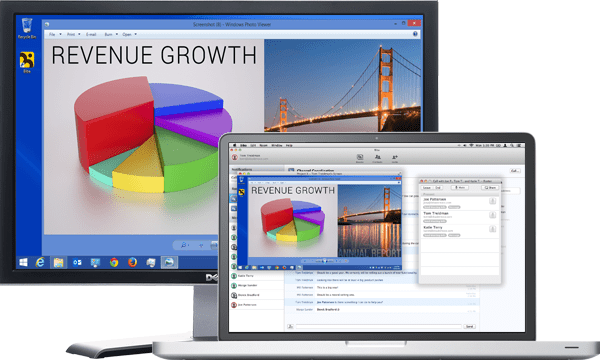
Biba, an Internet conferencing startup that came out of stealth last spring, today launched a new desktop app with screen-sharing capability and HD audio. The service, designed originally to be used on iOS and Android operating systems, is now available on both Mac and Windows machines.

Biba follows the concept that today’s services are more than ever dependent on how well they work on the device itself. By adding desktop support, Biba can extend the ways people participate on different devices across various platforms.

The core of the service revolves around a user’s contact list. Events are scheduled and attendees are notified. In contrast to traditional conference-call services, Biba takes an active approach once meetings are scheduled, reminding attendees to register for the Biba service and again two hours before the meeting begins. At the scheduled time, Biba calls the participants; there is no need for a user name or password, and people who do not register receive a toll-free number five minutes prior to the call.

With Biba, a customer can launch a conference call from their mobile apps to call participants and then move to the desktop without having to re-enter the call. A user leading a Biba call can see who is on the call and the person talking. The organizer can mute individuals who may have lots of background noise.

screen_share_600x360

The new screen sharing service adds to the collaboration that the customer can leverage. A user can do a video call and switch to screen sharing and do that between different devices. Biba has also added HD audio. The company argues that their audio quality is six times better than traditional cell phone calls.

For the most part, services like WebEx don’t work between devices like other communications technologies and business services. For example, a person can use Gmail or a storage service like Dropbox between their tablet and their phone without disrupting the experience.

Biba shows how useful apps and mobile devices have become for people. The combination is what’s killing the PC market and – by proxy – the world of IT. The demise is further fueled by cloud services. Internet conference calls and other telephony services can use Amazon Web Services (AWS) as the foundation for programming a service that can work in almost any part of the world.

Businesses once had the most sophisticated telephone networks, which then evolved into sophisticated conference call services. In the client/server age, Webex and other providers automated the process and served as some of the earliest pioneers in web-based collaboration technologies.

Today, Biba represents a new generation of services that bypass the old switches, fueled by the demand for Internet-based calling and conference-call services.

Biba faces stiff competition, such as Microsoft Lync, but there is no doubt it is riding the right tide. The move is to mobile-first Internet conferencing and there is no going back.

(Feature image courtesy of Bogdan Migulski on Flickr via Creative Commons)

The New Just.me Wins Auction For The Old Just.me’s Assets

Mobile messaging startup Just.me announced a couple of weeks ago that its assets were being auctioned off. Now it looks like the auction is over. The winner? Just.me.

Well, technically it’s “Just.me 2014 Inc.,” but founder Keith Teare (who also co-founded TechCrunch) said the new company’s goal is to continue the same work: “And from a user point of view, we hope not to skip a beat.”

As I wrote in my initial coverage, Teare said the auction was necessary because of the $1.5 million in debt that Just.me took on from Hercules Technology Growth Capital. Combined with decent-but-not-spectacular growth numbers (Teare said it has hundreds of thousands of users), the debt meant the startup had trouble raising money, so it was selling off its assets to pay back the money it owed, or as much of that money as possible. Even then, Teare expressed his hope that he would be the top bidder – but it had to be a fair auction for him to meet his obligations to Hercules.

When Teare told me today about the results, he said he’s not allowed to disclose the exact price, but he did note that the sale was funded by and therefore “within the means” of his incubator Archimedes Labs – in other words, it probably wasn’t an enormous sum. He also said that there were 23 bids total, and that nine of those bids were for the full package of assets rather than individual pieces.

Teare added that Just.me’s focus has shifted since it launched earlier this year. Initially, the app combined taking pictures for your private memories, sending messages to friends, and expressing yourself in public. However, it’s the public expression that has seen the most usage (something Teare attributed in part to the quality of the native photo and messaging experiences on iOS and Android), and that’s where the company has been adding new features like the ability to leave “confessions,” which can be anonymous.

The app isn’t abandoning the other areas completely, but treating expression as the “starting point”: “Public expression leads to serendipitous meetings which leads to the desire to chat privately. We’re really trying to focus on that set of behaviors.”

And yes, Teare acknowledged that there’s no guarantee that the new company, which is fundraising on AngelList, will succeed.

“I would say there’s no slam dunk,” he said. “I didn’t want to acquire the assets because I think there’s a magic formula. I acquired the assets because I think the app is doing really well and there’s no reason for us to die at this point.”

Google Wallet Cards Arriving Now, But Consumer Benefits Remain Unclear

Those who signed up for the new Google Wallet debit card at the end of November are now receiving their cards in the mail, following the Thanksgiving holiday here in the U.S. This MasterCard-powered prepaid debit card allows you to link your online Google Wallet balance to a real, plastic card you can use at point-of-sale, at ATMs, or anywhere else a MasterCard is accepted, stateside.

To clarify, we’re saying “stateside” because the Google Wallet debit card has a magstripe on the back – not the EMV technology which would allow the card to work in other countries where magstripe cards have been largely replaced by the more secure, EMV chip-based payment cards instead. Additionally, Google specifies in black-and-white terms that the Card cannot be used outside the U.S.

Perhaps the more disappointing reveal, however, is in how the card works. A year ago, leaks revealed that Google was working on a universal payment card that could take the place of any plastic credit or debit cards you carried in your wallet with a single card where you could control the source of funding on the fly, from directly within the Wallet mobile app.

Those plans were sadly scrapped ahead of this year’s Google I/O, leaving this new Google Wallet card as a watered-down version of that earlier vision. (A vision which a startup called Coin has picked up and run with, we should point out.)

Today, the Google Wallet Card is funded with your Google Wallet balance, meaning you have to you have to first link a traditional funding source to your Google Wallet account, like a bank account, credit card or debit card you already have, then transfer money into Google Wallet itself.

Getting the Card Activated

If you haven’t already, you have to first request a Google Wallet Card by going through an identity verification process online. When the card arrives in the mail, it comes in a nondescript envelope with no name along with its return address (which almost saw it discarded as junk mail, I have to admit.)

1

The provided instruction sheet is overly simple, too, informing you to first activate your card online or within the mobile Google Wallet app. It’s not immediately obvious where in the mobile app (iPhone or Android) the Wallet card should be activated, since the app doesn’t allow the card to be entered in the same area where you add other debit or credit cards. That is, you can type in the card information there, including the number, expiration date, and security code, but the button to submit remains grayed out.

[Update: A commenter notes there is a call-out in the mobile app to activate your card. However, though I saw this notification online, a similar message did not show in either of my Google Wallet (iPhone or Android) apps, when tested. Your mileage may vary, as they say.]

Online, the activation process is more straightforward. After signing into Google Wallet, a big banner at the top of the screen informs you of your Wallet Card ship and delivery dates and lets you click a button to activate the card immediately. Here, it’s just a matter of entering in the last four digits of your Google Wallet Card, clicking “Next,” then “Done.”

3

Funding The Card

Though the Google Wallet Card FAQ doesn’t specify this, the resulting screen informs you that you can take out up to $300 per day at ATMs. Google itself doesn’t charge ATM fees, but some ATM providers do. Google doesn’t charge fees to order or activate the card either, nor does it charge monthly or annual fees. The only fee Google charges is a 2.9% fee to fund a Wallet account from a credit card. (Other fees are associated with Google Wallet, but not in terms of funding or using the Wallet Card itself).

To fund the Google Wallet Card, you can click on your Wallet balance online or in the app, and choose “Add Money.” You can then pick from one of your other funding sources listed to add money to your Wallet account. This seems like an unnecessary additional step given that Wallet is already linked to your these sources. But if you try to pay for anything from an un-funded account, the card will be declined.

For some people, adding money via bank account and card transactions may be instant. If you’re in that group, then congratulations – your Google Wallet balance could be funded while on the go through a few taps in your mobile app, allowing you to leave your wallet at home, so to speak. But other banks may take up to a week for larger transfers, and some cards may take up to a few days before the money becomes available. In other words, the promise of a “universal” card, as was originally being tested, has not really come through yet.

5

Still, for those whose Google Wallet account is funded via Wallet’s Gmail integration, the Card could offer a handy way for users to spend or pull out cash sent by others. Of course, this would be far more useful if the Card worked overseas, allowing U.S. users to send cash to family back at home. Sadly, the current Wallet Card isn’t there yet. As Google notes in the FAQ, you can’t use the Card outside the U.S. “right now.” (Right now?)

Using The Card

As for the rest of it, the Google Wallet Card works the way any credit card does. You swipe it at a terminal, or you can hand it to a waiter or cashier to swipe on your behalf, no PIN required. One thing to note is that the card does not have your account number in raised numbers on the front. Instead, the numbers are printed on the back of the card. For those tough on their plastic, that means the numbers could wear off more quickly as the card gets used and abused.

google-wallet-newIn addition, it means it won’t work in those old-school “knuckle-busters” which are sometimes (well, rarely…but it happens!) still used here and there when paying a vendor who’s away from a register, power, or an internet connection. This is hardly a major concern, though.

Wallet Card: Good For Google. Good For You?

At the end of the day, the Google Wallet Card is a better deal for Google than it is for consumers, at present. The company benefits by gaining additional insight into consumer spending behaviors, which helps it to build a better profile on Wallet users, which it could then use to sell more targeted ads.

Sellers also benefit when users pay with Google Wallet, as it allows them to gain access to your email address. They can associate that with other data they have on file for you, if you’ve shopped there before.

Consumers using the Google Wallet platform have some conveniences, though. The Wallet app integrates various loyalty programs and merchant offers, and some Android-based phones with NFC can be used to tap and pay at point-of-sale. But these benefits are all features in Google Wallet, the app, not the Card itself, which is really meant to be just a fallback when NFC is not available. If Google ever gets to the point where a Wallet Card could be instantly funded from your connected payment sources on the fly, like online, then the Card would be more interesting.

But for now, it’s still unclear why a consumer would want to or need to use their Google Wallet plastic card today.

House Approves Plastic Gun Ban, But Fails To Update Law For 3D Weapons

The most unproductive Congress in history could not manage to update a ban on plastic guns for the era of 3D printed weapons. Today, the House of Representatives overwhelmingly voted to extend the Undetectable Firearms Act but didn’t amend the law to require permanent metal inserts.

As the law stands, gun manufactures abide by an honors system that they will promise to keep enough metal in a weapon to set off alarms.

“The House bill is better than nothing, but it’s not good enough,” said New York Senator Chuck Schumer. “We absolutely must close the loophole that allows anyone to legally make a gun that could be rendered invisible by the easy removal of its metal part. Under current law, it is legal to make a plastic gun so long as it has some metal in it, even if it is easily removable. The bill we’ll try to pass in the Senate would fix that.”

3D weapons burst onto the scene last year when a libertarian-happy gun-enthusiast produced and distributed blueprints for the first lethal homemade plastic firearm.

Since that time, both the Federal government and New Zealand party monster/pirated software mogul, Kim Dotcom, banned the distribution of the blueprints.

It’s difficult to know how much the law can stop blueprints that require a permanent metal insert. Even after the bans, the software was still widely available on the Internet.

Republicans also blame Democrats for failing to cooperate on a longer-term extension of the law. “The (Democratic) majority is playing politics with public safety,” said Republican Chuck Grassley. (For those paying attention, this bill is Chuck v. Chuck.)

The bill is now off to the Senate.

Paid Game Downloads Spike 34% On The Windows Store In November, But Microsoft Obscures Other Data Points

In November, paid downloads of games on the Windows Store grew 34.12 percent, while free game downloads grew a more modest 13.41 percent. In the month, the Windows Store’s assortment of games saw 1,311,209 paid downloads and 16,744,484 free downloads.

Microsoft has released a partial dataset for its Windows Store app platform’s performance in the month of November. The company previously reported download rates concerning all app categories, for both free and paid applications. However, for the month of November, the company did not. This is annoying, and I’ve asked Microsoft why certain – seemingly random – app categories are now not displayed. In some cases you are provided the following response where the graph should appear: “Due to privacy issues, we are unable to show the reference curve.”

In general, categories that are not displayed relate to paid download rates in less popular categories, such as “Books and Reference.” In October, that category sold a mere 31,240 units. However, applications marked as “Social” that were free are also currently unreported by the company. In October, free social apps moved over 4.3 million units.

The games data is interesting, as paid game downloads in November (1.31 million) essentially matched all paid downloads on the Windows Store in October (1.35 million). In October, games made up 72.12 percent of all paid downloads. If that ratio persists, we could anticipate paid downloads for November to total 1.82 million on the Windows Store. However, I don’t think the paid download curve was as strong in other app categories in aggregate than it was in games for the month, after observing the partial dataset.

Still, 1.31 million paid game downloads, and almost 17 million free game downloads means that Microsoft did manage to grow its largest application category by a firm percentage in the month. That’s good.

What could be driving the growth in game downloads? In November, Microsoft announced that more than 1,000 games had been brought to the Windows 8.x platform by way of its support for the Unity engine. Those titles are presumably behind at least part of the gains. That’s actually decent for Microsoft as it means that its developer outreach efforts to drive new titles is connecting with consumers.

The good news, however, is incremental and should be kept in the following perspective: While Microsoft has managed to grow its download rates, its total downloads remain utterly minute compared to the iOS and Android platforms. So, better is good, but better isn’t itself that great.

If Microsoft gets back with an answer to why it is now obscuring certain data, I’ll update this post. Especially if they release the numbers we need for a more holistic analysis.

Top Image Credit: Flickr

Windows 8.1 Surpasses Windows Vista Among Steam Users, Drives Windows 8.x Over The 18% Mark

The Windows 8.x family of operating systems had a rough November, but among gamers the recently released Windows 8.1 is performing decently. In November, gamers using the Steam platform sent Windows 8.1′s market share to 6.34 percent, up 4.49 percent in the month.

Windows 8 itself ended the month at 12.11 percent, giving the larger Windows 8.x host a combined market share of 18.45 percent among Steam users. That dwarfs, naturally, OS X’s market share among the gaming cohort that uses steam of 3.48 percent, and Linux’s share among the same group of 0.98 percent.

Windows 8.1 grew more quickly than Windows 8 contracted, with the latter shedding 4.02 percent in the month. This mirrors what we have seen in the larger Windows market. Still, Windows 8.1′s growth feels sluggish when framed against Windows 8′s almost commensurate drop. To see more than 4 percent of Steam’s population switch in a month to a yet nascent operating system isn’t shabby, however.

As The Next Web’s Emil Protalinski pointed out recently, Windows 8.1 managed to beat Windows Vista’s market share in November. Vista really is over for all intents and purposes. Interestingly, among gamers Windows XP retains more market share than Vista, which came after.

A metric that must be watched is the aggregate market share of Windows 8.x, as Windows 8 contracts and Windows 8.1 expands. If their combined market share doesn’t quickly expand, we can infer from that information that while Windows 8.1 may be doing a fine job snagging Windows 8 users, overall unit volume of new PCs is soft.

In related news, IDC reported yesterday that it expects a 10.1 percent decline in PC sales in 2013, a smaller decline in 2014, and market stabilization over the 300 million yearly unit volume mark for the coming few years. Given that, Steam should see Windows 8.x absorb increasing market share in the coming years. At least, Microsoft hopes as much.

Top Image Credit: Flickr

Chrome Beta Gets New Tools For Mobile Development With Better Viewport Emulation, Screencast-Enabled Remote Debugging

remote-debug-overview

With the launch of the latest Chrome beta this morning, Google introduced a number of new tools for mobile developers that should make it a bit easier for them to test their mobile web apps right from the desktop. The beta channel for desktop and Android now allows developers to debug their apps using an improved viewport emulation to model mobile devices, screens and touch events as well as screencast-enabled remote debugging.

Until now, developers had to go through quite a few steps and use an extension or drop down to the command line to start debugging on a connected device. Now, Mac users can just plug in a device over USB, and the Chrome Beta will natively support remote debugging. Any instance of Chrome or the Chrome-powered WebView on the device will be available on the desktop and all your keyboard and mouse events are automatically sent to the device. Windows users will have to install a device driver to enable this feature.

With the improved viewport emulation, Google says, developers will have ”full control of the emulation parameters, such as screen resolution, touch emulation, devicePixelRatio, user agent, sensors and many more.” The page will run through the same mobile viewporting code as in mobile Chrome to help developers get accurate results on their desktop.

viewport-emulation

If you really love your Chrome DevTools and have 25 minutes to spare, also take a look at Paul Irish’s talk at the Chrome Dev Summit last month, which covers these new features in more detail.

Gift Guide: Walk Your Way Into 2014

As a convert to the standing desk lifestyle, I wondered just what I could do to further expand my alternative loafing lifestyle. To that end I brought a desk treadmill into the home, a decision that I have yet to regret. The model I’m trying, the Rebeldesk Rebel Treadmill 1000 (a bold name, to be sure) costs $749 and maxes out at 2 miles per hour. If anything I can report that I’ve been able to do a few miles a day at a steady, slow pace while still getting work done. Although, thanks to holiday dinners and lots of beer, the waistline has moved just about a pants size down, which is good enough for fat old me.

First, understand that the best desk treadmill isn’t the best running treadmill. The 2 mph maximums that most of these have are there for a reason: you’re going to fall down if you go much faster. While I could see myself hitting a three or four mile pace on an energetic day, I’d rather not risk the head strike when I’m flipped over my desk while browsing Reddit.

Does it help? Take a look at the chart below. Although I was traveling some of those days, after November 11 I was able to consistently push my steps walked up past 10,000 almost every day thanks to the treadmill. Given that it’s winter and I’m a bit sick, it’s a real boon to be able to get some low-impact cardio in during the day and still get work done. And yes, I am walking as I type this and have completed three miles today.

Screen Shot 2013-12-03 at 12.38.58 PM

Walking treadmills should also be solid and sturdy. You can get away with a cheaper, thinner model – plenty of people have and there are instructions for building your own everywhere – but if you plan on using it with any intensity, look into a dedicated, flat treadmill without a front bar and high control panel. Heck, there’s even a DIY system that uses an IKEA work desk.

The Rebel, for example, is about five feet long and two feet wide. It fits under almost every desk and has a small break-out box controller with stop, start, an emergency system, and sleep control. Setup is quite simple: you just plug it in, connect the controller, and attach the emergency magnet. Then you press start. The treadmill starts very slowly at first and then speeds up to your desired pace. The hardcore will probably balk at the Rebel’s top speed – I thought I would, too – but I’m OK with going at a pace that won’t leave me winded as I work.
tread5
You can also look into the Tread, an $855 treadmill with a much lower profile that almost looks like a rug. It’s a hair shorter than the Rebel at 54 inches and is just about 5 inches off the ground.

Need something a bit more imposing? Folks I’ve spoken to have had good luck with Life Span Fitness desks, including this massive treadmill/standing desk setup that goes for $1,999. This could be a bit too rich for most holiday wallets, but considering the heft and comfort, you can’t go wrong. For example, while the Rebel is working great for me I could imagine the value of having a dedicated desk attached that I could raise and lower.

Can you still sit at a treadmill desk? Sure, but you’re going to have to do a bit of finagling. When my setup is shut down I like to bring a big fitness ball over to sit on, which allows me to take a bit of a breather between miles. It’s a surprisingly seamless move and I’ve not yet fallen off the treadmill while sitting. Remember also that these things can’t just be rolled away and used as a clothes hamper. The Rebel is huge and heavy as is the Life Span model. In fact, almost any treadmill you bring into the office deserves at least more than a cursory trot or two.

Whether or not you spend a few hundred on a huge, hulking, single-purpose desk treadmill or just go the DIY route, setting up a treadmill desk will do wonders for your energy level, potentially your weight, and that nagging feeling that you should be getting out more. While a nice jog around the industrial park is probably best for all involved, a stroll on a treadmill desk is the next best thing. Just ask my pants.

Why It’s Never Mattered That America’s Schools ‘Lag’ Behind Other Countries [2013 Edition]

*Editorial Note: Every year, the media generally reports international student test comparisons with the same narrative about how the US is losing at education. The new annual report out today from the OECD will no doubt fuel another round of that. So, we’re just reposting our story from last year below, solely updated with the new stats covering 2012. They’re italicized and in brackets.

The United States has never ranked at the top of international education tests, since we began comparing countries in 1964, yet has been the dominant economic and innovative force in the world the entire time. Despite this fact, a popular annual education report has once again stoked fears of America’s impending economic mediocrity with fresh stats on how far the U.S. “lags” behind the world in college attainment, pre-school enrollment, and high school graduation.

The reason for the apparent disconnect is because schools don’t prepare students for the real world, so broad educational attainment will have a weak correlation with economic power. Research has consistently shown that on nearly every measure of education (instructional hours, class-size, enrollment, college preparation), what students learn in school does not translate into later life success. The United States has an abundance of the factors that likely do matter: access to the best immigrants, economic opportunity, and the best research facilities.

School Isn’t Educational

The Organization for Economic and Cooperation and Development (OECD), a forum of the top 34 developed economies, released one of its annual education reports yesterday comparing each member’s performance on various school metrics.

[The new 2011 2012 scorecard for the U.S. is not pretty.

  • The U.S. ranks 18th in scientific literacy, with no measurable improvement from last year. Shanghai-China was the top performer.
  • The U.S. ranks 29th in Math, with only 8.8% of students performing at top levels, compared to 55.4% of Shanghai-Chinese.]

“Based on these trends, the U.S. may find that an increasing number of countries will approach or surpass its attainment levels in the coming years,” reads the U.S. report card.

However, the report implies that education translates into gainful market skills, an assumption not found in the research. For instance, while Chinese students, on average, have twice the number of instructional hours as Americans, both countries have identical scores on tests of scientific reasoning.

“The results suggest that years of rigorous training of physics knowledge in middle and high schools have made significant impact on Chinese students’ ability in solving physics problems, while such training doesn’t seem to have direct effects on their general ability in scientific reasoning, which was measured to be at the same level as that of the students in USA,” wrote a team of researchers studying whether Chinese superiority in rote scientific knowledge translated into the kinds of creative thinking necessary for innovation.

In a massive review of research, the Department of Education’s research arm, the Institute for Education Sciences, could not find any evidence that college preparation actually prepared students for college [pdf]. The only effective tools were (sadly) non-classroom-based strategies, such as teaching students how to fill out financial aid forms.

Students’ time in college isn’t much better. Researchers Richard Arum and Josipa Roksa concluded in Academically Adrift that most students float through college without learning much in the way of critical thinking.

“Indeed, the students in our study who reported studying alone five or fewer hours per week nevertheless had an average cumulative GPA of 3.16,” they write, “given such a widespread lack of academic rigor, about a third of students failed to demonstrate significant gains in critical thinking, complex reasoning and writing ability (as measured by the Collegiate Learning Assessment) during their four years of college.”

These facts should not come as a shock. When I taught college, it was commonly known among the professors that incoming high schoolers were not prepared with the requisite critical-thinking skills for our classes. Now as a writer in the private sector, I don’t expect incoming employees to have been prepared in their college classes. Determination, raw intelligence, and creativity are the measures of a successful college student and employee – none of those factors are learned in school.

So What Matters?

It’s easier to know what doesn’t work than what does. We know schooling can’t broadly impact innovation much, because we can track learning step-by-step through the life of a student. Tracking the countless variables that go into creating an innovation superpower is more daunting. But, we can make a few educated guesses.

Most importantly, the innovators at the helm of an economy come from the top quarter of students. While the United States has a dismal track-record of inequality, we treat our brightest minds quite well. The “average test scores are mostly irrelevant as a measure of economic potential,” write Hal Salzman & Lindsay Lowell in the prestigious journal, Nature, “To produce leading-edge technology, one could argue that it is the numbers of high-performing students that is most important in the global economy.”

The United States, they find, has among the highest percentage of top-performing students in the world. Whether the abundance of smart students is a product of U.S. culture, an artifact of the genetic lottery, or some unknown factor hidden in our education system is anyone’s guess.

We do know where some of our best talent comes from: other countries. In some ways, the United States steals its way to economic superiority: it rangles the world’s brightest minds to immigrate. The U.S. holds roughly 17% of the world’s International students, compared to 2nd-place Britain (~12%) and far more than education powerhouses, Korea, Switzerland, and Sweden (all below 5%).

A quarter of CEOs in technology and science are foreign born and 76 percent hold key positions in engineering, technology, and management, according to Stanford researcher and TechCrunch contributor, Vivek Wadhwa.

“More than 40 percent of Fortune 500 companies in the U.S. were founded by immigrants or their children, and these firms alone employ over 10 million individuals. Some of our country’s most iconic brands – including IBM, Google, and Apple – were founded by an immigrant or the child of an immigrant. And nearly half of the top 50 venture-backed companies in the U.S. had at least one immigrant founder,” wrote Aol founder Steve Case (Aol is the parent company of TechCrunch).

And, our brightest native and immigrant minds are greeted with extraordinary research and economic opportunity. After World War II, the United States emerged as an economic superpower. Massive investment poured into universities and scientific research, which became the genesis for the Internet, itself.

While it’s difficult to speculate why the U.S. persists as a titan of innovation, we need not be scared into trying to be like other countries. America has been at the top despite a lack-luster education system.

[Image Credit: Flickr user Geek2Nurse]

Square Acquires Ex-Googler Team Behind Viewfinder To Help Grow Its NYC Presence

Square is announcing today that it has acquired New York-based photo-sharing app Viewfinder, or perhaps more accurately, that members of the Viewfinder team are joining the payments company, where they’ll work out of Square’s New York office. Two Viewfinder co-founders, Spencer Kimball and Peter Mattis, also former ex-Googlers, will now become senior members of Square’s East Coast team, along with the rest of Viewfinder’s staff.

Viewfinder was founded by Kimball, Mattis, and CEO Brian McGinnis, formerly of Lehman Brothers, and had under a dozen employees.

Two of Viewfinder’s founders, Kimball and Mattis, are known for creating GIMP in the 90s, says Square CTO Bob Lee in blog post today. He personally has known the founders for some time, having also crossed paths with them while they were working for Google in NYC, where they focused on infrastructure like Google Servlet Engine and Colossus, Google’s exascale distributed ?le system, he adds.

Viewfinder-01-iPhone-Dial-ScreenGiven the team’s background, this deal appears to be one that’s more acqui-hire in nature, than one about the technology the team at Viewfinder had developed, which had involved a unique photo-sharing application which was part utility, part social network. The app was interesting for the technology under its hood, which was designed to allow users to search back through their photo history more efficiently, with a clever “jump scroll”-style interface.

Square says of Viewfinder that the team “is incredibly talented, having built an app that blends beautiful design and highly technical engineering to create personal, human experiences.” This, the company says, is what Square is also about, and the co-founders will now help Square continue to build its mobile applications.

Specifically, the former Viewfinder team will work on “seller initiatives” out of New York. Today, one of Square’s newer seller initiatives is Square Market, a way to shop online from local stores. This could potentially become a bigger business for Square in time. Today, the Market has a mobile/tablet-optimized look-and-feel, so it wouldn’t be surprising to see it get its own native app at some point, too.

In addition, while we’re hearing that though there was obvious interest in the founders themselves, as Square publicly notes, the deal was for the people at Viewfinder (ten total) as well as some of the company assets.

Square says it’s working to triple the size of its engineering team in New York over the course of 2014, so it’s likely that Viewfinder could be the first of several acquisitions still ahead.

As for the Viewfinder mobile application itself, it will remain up-and-running at least for the time being. However, no further updates will be released and no customer service will be provided.

Square declined to discuss the terms of the deal. Viewfinder had raised an undisclosed seed round of funding from private investors, which was north of $1 million.

Full Viewfinder blog post is below:

We are thrilled to announce that the Viewfinder team is joining Square.

Over the years, we’ve had the privilege of working with some of the very talented folks who are now at Square. Square is already well known for its world-class engineering and design, but in recent months we’ve gotten to know much more about Square the company: its vision, its team, and most crucially, its engineering culture.

The reality behind the reputation is better yet. All of that talent is focused on the mission to make commerce easy – a big challenge and an even bigger opportunity. We love how Square keeps engineering novel solutions to problems people didn’t imagine could be fixed. Their products have already helped millions of local businesses, and the future is more exciting still. We knew Square was the place for us.

We’ve always been proud of our New York City roots, so it’s great to see Square’s contribution to fulfilling the city’s promise as a world capital for technology. We’re excited to help Square build out its NYC office. With its deep tradition in finance, a burgeoning tech scene, and more than 200,000 small businesses in just 300 square miles, the greatest city in the world is a perfect fit for Square.

As for Viewfinder, existing users will still be able to use the Viewfinder app for the time being, although we will no longer be releasing updates or providing customer support.

It’s been a joy to create Viewfinder. We are grateful to our investors, advisors, partners, and most importantly, our users. Your support and feedback made Viewfinder possible. And collectively through Viewfinder, we’ve captured countless memories, bringing us closer together with friends and family.

For press inquiries, please contact [email protected].

Thanks,
The Viewfinder team

The One Percent Foundation, A Non-Profit, Wants To Help Millennials Turn Philanthropy Into A Habit

“Philanthropist” is a daunting word that conjures up images of Bruce Wayne and other people with so much excess money and time that they have to give it away. Most of us, on the other hand, need to budget carefully and the relatively modest sums we can afford to donate seem too insignificant. After all, how much difference can $20 make? Since 2007, a San Francisco-based non-profit called the One Percent Foundation has focused on convincing people–especially young adults–that every dollar they give matters. Now the group is seeking to help companies and organizations become more charitable with its new Pro Giving Circles, the customized, white-label version of its Giving Circles platform. The launch was timed to coincide with Giving Tuesday, an initiative that serves as a counterpoint to the consumerism of Black Friday and Cyber Monday.

The One Perfect Foundation’s name refers not to the growing wealth gap, but the organization’s goal of motivating people to donate at least that amount of their income to worthy causes. People in their 20s to 30s are less likely to give money individually than their parents or grandparents, but they do contribute when asked by friends or colleagues to support a charity event or race, says Lara Volftsun, the One Percent Foundation’s executive director.

“For many millennials, affordability, knowledge and impact are very real barriers to a more sustained, deliberate approach to giving,” she says. “Many do not think they can afford to give, do not know where to give or how to evaluate the effectiveness of organizations, and do not believe their modest donations can make a difference.”

The One Percent Foundation tackles those obstacles with its Giving Circle platform, where groups of people pool their financial resources to make a larger impact. While other fundraising platform, like Kickstarter, IndieGoGo and CrowdTilt, raise funds for a project or individual cause, Volftsun says that One Percent Foundation wants to turn philantrophy into a habit with its “subscription crowdfunding” model. Members of each Giving Circle can use the site to set up monthly recurring donations, nominate charitable organizations and vote to determine who receives the money.

“Instead of giving a couple hundred dollars on your own, our members are able to make a substantial impact when they combine their funds, often donating thousands as a group,” Volftsun says.

All of the money raised through One Percent Foundation’s Giving Circles are distributed in grants. The organization supports itself through two revenue streams: tipping, where members are promoted to add a couple of dollars to their monthly contributions to cover One Percent Foundation’s operating costs, and its new Pro Giving Circles.

The Pro Giving Circles platform is targeted at companies, schools and other organizations that want to create a sense of community among potential donors, instead of hitting them up every so often with fundraising drives (discounted rates are available for qualifying non-profits). In addition to the features of regular Giving Circles, Pro Giving Circles also include one-on-one guidance from the One Percent Foundation’s staff and custom URL and branding. Potential use cases include startups that want to create a Pro Giving Circle with its employees to support charities that “reflect the values of the startup’s culture,” says Volftsun. Non-profit groups and universities, meanwhile, can use the platform to engage alumni and other potential donors.

Google Trends Gets Smarter By Enlisting Data From Knowledge Graph

Google Trends has long been a popular way to find out how much interest there is in a given topic, but until now, it was also a relatively simple tool. It just looked at how often people would search for a keyword over time. Now that Google has its Knowledge Graph and a way better understanding of what a given word actually means, it can also make Google Trends smarter and that’s what it’s doing today.

Google Trends will automatically give you type-ahead search suggestions that are based on topics, not keywords. This means you can now easily tell Google you are looking for trends related to Rice University and not just rice the cereal. In total, Google says, Trends now understands 700,000 unique topics, ranging from Barack Obama to football (soccer) to Hayao Miyazaki.

This new system is also more forgiving when it comes to misspellings and “may even count searches like ‘Lead actress in Kill Bill’” when you’re searching for Uma Thurman.

The data can also be sliced geographically, but only if you live in the U.S., U.K., Brazil, France, Germany, India or Italy. These are also the countries and languages where Knowledge Graph is available, though Russian, which has Knowledge Graph support, isn’t getting this tool for Google Trends yet.