Woman arrested over boy’s murder

Rhoose map

A woman has been arrested on suspicion of murder following the death of an 11-year-old boy at a premises in the Vale of Glamorgan.

The 48-year-old woman was arrested on Sunday after the child’s body was discovered in Rhoose.

A post-mortem examination is being carried out to establish the cause of death.

A major incident room has been set up at Penarth police station, South Wales Police said.

This article is from the BBC News website. © British Broadcasting Corporation, The BBC is not responsible for the content of external internet sites.

Safety fret

South Africa policeman

With a multitude of tourists heading to South Africa for the World Cup, a question hangs on many lips. So how dangerous is the country?

South Africa is a place where a lot of violent crime happens.

That much is hard to dispute.

Each day an average of nearly 50 people are murdered.

In addition to these 18,000 murders each year, there are another 18,000 attempted murders.

Murder is a staple of the news. In April, it was white supremacist Eugene Terreblanche. Earlier this month, it was Lolly Jackson, the flamboyant owner of the Teazers strip club chain, killed at a house in Kempton Park, just outside Johannesburg.

In the run-up to the World Cup, British newspapers have been happy to convey a terrifying picture of South Africa.

One recently told its readers about "Cape Town’s culture of gangsters, drugs, rape, robbery and a murder every 25 minutes".

So should football fans fear for their lives at the World Cup?

It’s a complicated picture, says Johan Burger, senior researcher in the crime and justice programme at the Institute for Security Studies.

The first thing is that the South African murder rate is going down and not up.

"Contrary to what many people think, the murder rate, while still extremely high, is down by about 44% since 1995. That’s a huge decrease."

The geographical and social spread of murder might also be relevant to visitors.

"What is important to understand about our high crime rate is that we know from research that approximately 80% of our murders happen within a very specific social context, mostly between people that know one another.

"There is something wrong within some of our communities in terms of the social interaction and the social conditions."

In blunt terms, areas with problems have murder levels that can be wildly above the national average.

Kwa Mashu, a township outside Durban in KwaZulu-Natal, has the unfortunate honour of being dubbed South Africa’s murder capital by the media, with 300 last year. It took the unwanted honour from Nyanga, a township outside Cape Town.

These are not the kinds of areas that are regularly frequented by tourists.

Dr Burger says research done by other academics points to the social basis for a high crime rate in such areas.

"There are extremely high rates of unemployment in some areas. All of this leads to a large element of frustration. Often this is the thing that sparks violence.

"The gap between rich and poor is still widening and it leads to what is seen as relative deprivation. The people in the very, very poor communities, they see wealth.

"It is not just a gap, it is a visible gap. The situation is aggravated by poor service delivery. Many of our municipalities are in complete disarray, complete dysfunction. This then leads to dissatisfaction. People protest sometimes very violently."

Graph comparing murder rates in UK and South Africa

There are many other crimes apart from murder which are seen as problematic in South Africa.

The national figure of 203,777 episodes of "assault with the intent to inflict grievous bodily harm" might be alarming. It’s hard to compare this with the UK where statistics are grouped differently, though the latter has a larger population (61 million compared with South Africa’s 49 million.)

But like murder, many offences are geographically weighted, says Dr Burger.

Of the 18,438 house robberies in South Africa last year, 8,122 were in the province of Gauteng, which includes Johannesburg. The likelihood of being a victim is twice the national average there.

Carjacking is a category of danger that would be novel to most visitors from western Europe.

Police in a stadium

There are junctions which are signposted as carjacking blackspots, and there are areas where drivers will avoid stopping at red lights, particularly at night, preferring the risk of a fine to the risk of hijack.

"Many people may come in rented cars and then like everyone else they will run the risk of this," says Dr Burger. "Most of the time people are threatened or violently removed from the car [but] not seriously injured."

Unlike most categories of violent crime, recorded instances of carjacking are on the rise in South Africa. The police do their best to fight it, says Pretoria News crime reporter Graeme Hosken.

"We have had a problem with gangs following tourists from OR Tambo airport [near Johannesburg] and the cops cracked down on that. I take precautions. I’ve been nearly hijacked myself on an open freeway."

He advises:

Keep your car locked while driving Don’t stop for strangers or people who have broken down A blue light does not necessarily mean they are police If carjacked, do not offer resistance Carjacking is geographically skewed with half of the 15,000 happening in Gauteng

"There’s another crime that poses some risk to visitors and that’s street robbery," says Dr Burger.

"People are seldom seriously injured or stabbed or shot. In most cases people are threatened. Criminals will see the World Cup as a huge opportunity."

People can take a number of steps to reduce their chances of being robbed in the street, he says:

Avoid advertising. Don’t show you have valuables on your person Take precautions by trying to go to some of these places in groups of five, six, seven or more people Most importantly, make a point of seeking advice

"The locals know which places people should avoid and the times people should stay away from certain areas."

If England win their group and make it as far as the quarter finals, they will play in Soccer City, Johannesburg.

There are areas in the city that have a disproportionate level of crime. Ask a local and they may advise against travel to Hillbrow or Yeoville at night.

At the same time, people could also point out that every city has its bad bits.

"I wouldn’t go to dodgy areas in London, or the dodgy areas in Liverpool or Manchester," says Hosken.

But of course the crime issue is high on the agenda for the World Cup organisers.

The South African Police Service has prepared a plan that includes extra officers, high visibility policing, and deployment of specialist teams.

"I’ve seen the police plan, it’s extremely impressive," says Dr Burger.

Police at a stadium

But while there may be optimism about the police plans, there is still a deep sense of unease, says Hosken.

"The government says crime is going down, [but] 50 odd people are being killed every single day. There is scepticism about what is really happening.

"While crime might be going down, it is [often] extremely violent, armed robberies, hijackings. It is very in your face, it is very gruesome. The robbers will come in and not only attack a couple, [but] rape the wife, and severely assault the husband.

"People are worried about what the government is trying to feed them. The violence associated with crime is increasing."

And while the South African police can point to decreasing crime and the efforts they are making, fighting the fear of violence is harder.

Add your comments on this story, Click here to add comments..

This article is from the BBC News website. © British Broadcasting Corporation, The BBC is not responsible for the content of external internet sites.

Nigeria militant backs Jonathan

Member of Mend (file photo)

A former Niger Delta militant has said Nigeria’s President Goodluck Jonathan is the best person to solve the crisis in the oil-producing region.

Victor Ebokawe, also known as General Boyloaf, told the BBC that, because President Jonathan is from the region, he understands its problems.

Mr Ebokawe also said that Mr Jonathan should contest next year’s elections.

Militants have carried out attacks which have cost Nigeria millions in lost oil revenue over the years.

Last year, thousands of militants laid down their arms in return for promises of training and jobs.

But this programme showed signs of started to unravel during the power vacuum while former President Umaru Yar’Adua was sick.

map

He died earlier this month and Mr Jonathan was sworn in as president to replace him.

On Friday, President Jonathan visited the Niger Delta and said coordination of the amnesty should be improved.

Mr Ebokawe, a leader of the Movement for the Emancipation of the Niger Delta who said he has spoken to Mr Jonathan, believes the Niger Delta’s leaders will be patient with the president as he tries to implement the amnesty.

Mr Jonathan has not said whether he wants to contest next year’s polls and the governing People’s Democratic Party (PDP) has said its candidate will be from the north, not a southerner like him.

"Nothing is going to stop him. He cannot tell us that he will not run," Mr Ebokawe told the BBC’s Network Africa programme.

"The presidency of Nigeria is not the birth right of a particular region," he said.

"[Mr Jonathan] is a man who is ready to rule Nigeria as one Nigeria."

The militants say they are campaigning for more of Nigeria’s oil wealth to be used to benefit local people but analysts say many attacks and kidnappings of oil workers are carried out by criminals trying to extract ransom payments.

This article is from the BBC News website. © British Broadcasting Corporation, The BBC is not responsible for the content of external internet sites.

Tasty tunes

Kelis

In the four years since her last album, singer Kelis has been divorced, had a baby – and qualified as a chef.

Flesh Tone is the Harlem-born star’s fifth studio album, and her first for will.i.am’s Interscope Records. Her David Guetta-produced dancefloor anthem Acapella went into the UK top five last month.

Kelis wrote much of Flesh Tone while pregnant with son Knight, who was born in July 2009. A few months earlier she had filed for divorce from US rapper Nas. They had married in 2003.

Kelis debuted in 1999 with Kaleidoscope, and went onto win a Brit award for best international breakthrough act.

Over the past 10 years, she has worked with a wide variety of artists and producers, including The Neptunes, Andre 3000, Bjork and Enrique Iglesias.

Kelis will be performing at the Glastonbury Festival on 26 June.

Here, the Milkshake star talks about the new album, her cookery qualification and her love of Captain Kirk.

Kelis

Why the four-year wait for Flesh Tone?

Why not? I don’t feel the need to rush out each record, I’m not one of those artists who put them out every six months. I feel the need to live a bit in the interim and in order to write anything viable you have to give yourself some time and some space.

How does it feel to be back?

It’s like riding a bike – I definitely feel like I’m right where I’m supposed to be.

On one track you repeat the line "We control the dance floor…" Is that the album’s mission statement?

Yeah, I guess so. I want people to dance and have a great time and sweat it out again.

You wrote a lot of the album when you were pregnant. Does pregnancy make you more creative?

Artists work off extremes. Some of the greatest art comes from repression, turbulence in someone’s life or extreme glee and happiness.

Pregnancy is as extreme as you can get. Your body is physically and emotionally stretched to such great lengths that I think its inevitable.

So has motherhood changed your priorities?

Ther’s nothing more important than my kid. As an artist I have more to write about, I have more to think about. But I wouldn’t say that it’s changed my art.

The Acapella video is like a sci-fi film trailer. What’s the concept behind it?

I really just wanted it to be as visually strong as the record. It’s a story – imagine some sort of world’s end… sparse and savage and unreal.

On the song 22nd Century you sing "Religion, science fiction, technology". Do you like sci-fi?

I’m a science fiction fan in every possible way.

I used to be a huge Trekkie. I would torture my little sister. They would do Star Trek marathons and she literally would cry: "Not another episode of Star Trek, please!"

I loved Dictrict 9, I loved Avatar – anything from The Matrix to Terminator.

Do you fancy acting in a sci-fi film?

That’s a future I cannot foretell.

You’re a qualified chef. What was it like going back to school?

It was full-on Le Cordon Bleu – almost a year, five days a week, seven hours a day.

I think every adult should go back to school for some time and for something that they love. I think school puts things in perspective, to be avidly learning something every day is important – exciting.

Was there a point where you thought I prefer cooking to music?

Yes, I think that all the time. Not to the music itself but to the business of music.

Do you have a signature dish?

I’m good, I can pretty much do anything.

Flesh Tone is released on 17 May on Interscope Records.

This article is from the BBC News website. © British Broadcasting Corporation, The BBC is not responsible for the content of external internet sites.

YouTube hits 2 bn daily downloads

YouTube with 5 birthday candles

YouTube said it now gets over two billion hits daily – nearly double the number of people who tune into the US’s three prime time TV stations combined.

The news comes as the site celebrates the day five years ago when the first beta version of YouTube was launched.

Over seven months ago the video site clocked up one billion downloads.

"I see this great growth opportunity in the online video market and we are positioning ourselves to be a leader," co-founder Chad Hurley told BBC News.

"We are a stage and we give everyone in the world an opportunity to participate and that is being a video platform for creating a solution for people to not only upload and distribute their videos on a global basis but to find and share videos."

He also said that while the two billion downloads marked a real milestone "I feel we have much further to go.

"Two billion video streams is a large number but on average people are only spending 15 minutes a day on the site compared to five hours a day watching TV.

"I don’t think we could have ever planned or imagined we would get to the scale or the size we are today. We were mostly trying to create a video solution for ourselves based on our own frustrations. We are proud of what we have achieved so far but we have a lot of work ahead," said Mr Hurley.

The site was bought by Google near the end of 2006 for $1.65bn.

The early years

The slogan for YouTube is "Broadcast Yourself" which Mr Hurley said was a play on "be yourself and also captured in my mind the essence of the site which was to let people express themselves."

The first person to express themselves on the platform was fellow co-founder Jawed Karim who posted a 19 seconds long video called "Me at the Zoo". It was uploaded on April 23, 2005 and can still be viewed on the site.

Among the other videos that have made YouTube history is that of a wounded girl dying in front of a crowd during the Iranian election protests, a YouTube interview with President Barack Obama, Ronaldinho’s Nike advert and singer Susan Boyle’s performance on Britain’s Got Talent competition on TV.

"We wanted to create a level playing field that gave everyone that ability to be seen and heard," said Mr Hurley.

"Maybe early on people only recognised us or explained YouTube by placing it in a box but there are so many people on our site and we receive so much content over a 24 hour period, it can’t be about one thing.

"And so from cat videos to political videos to "how to" videos to entertainment – that is YouTube," added Mr Hurley.

Today it hosts channels for everyone from Queen Elizabeth to the Pope and from President Barack Obama to the Iraqi government.

"YouTube really is a phenomenon and is very much part of popular culture," said Catharine P Taylor, media blogger at news website BNET.com.

"It really is a game changer because it gives everybody a platform to broadcast from. There are many examples where an average citizen has become a big hit on YouTube and that is something that would have been impossible to contemplate five, six years ago."

The future

In those early days the site was known for hosting pirated snippets of TV shows or movies. Even today material gets pulled from the site because of issues over copyright.

"They have made a lot of progress about weeding out illegal content," said Allen Weiner senior vice president of research at Gartner.

the youtube page five years ago

"They are serious about it. Their future depends on it."

As a result YouTube has been working hard to win over content makers as it modifies its service to stream professional films and cash in on a trend towards internet television.

Industry watchers have said YouTube could possibly become part of the Google "media cloud" where people can access films, books, magazines tv shows and other digitised content.

"YouTube is going to change in a lot of ways in the next few years," Ryan Lawler of video site NewTeeVee.com told BBC News.

"I think we will see it on more devices and see it used more for live streaming. There are real opportunities for it to become a traditional content distributor like the cable channels. YouTube streams make up around 40% of all online video watched in the US, so there is massive scale there and lot of opportunity."

Analysts have predicted that while the site has struggled to reach profitability since its creation, 2010 could be its year.

Bloomberg News pointed out that the biggest challenge facing YouTube advertising is what makes it so popular – its user generated content. Many advertisers are wary of placing adverts that might run next to videos that might also offend or upset the audience.

"Obviously we want to work with everyone and show the value we can bring on multiple levels. It could be as simple as marketing a movie or show to our users and driving those audiences to another place for the experience.

"We are trying to create opportunities for everyone and this is not just about making big deals with major networks," said Mr Hurley.

This article is from the BBC News website. © British Broadcasting Corporation, The BBC is not responsible for the content of external internet sites.

Ladies first

Veronique Edwards (R) talks to Thandiwe Banda of Zambia

In recent weeks, I have been doing just what my mother said I should never do – eavesdrop.

But perhaps she would not mind so much if she knew I had been privy to conversations of the first ladies at five seats of power in Africa.

Indeed, the candid interviews, conducted by the BBC Network Africa’s Veronique Edwards, give a new perspective on the leaders of the continent and address issues ranging from power and politics to glamour and romance.

Listening to Sierra Leone’s Sia Koroma, Namibia’s Penehupifo Pohamba, Ghana’s Ernestina Mills, Zambia’s Thandiwe Banda, and Uganda’s Janet Museveni, the most striking thing is that these women care deeply about the condition of society.

As professionals in their own right, these women are actively promoting education and rural development and championing poverty eradication and the fight against HIV/Aids.

Mrs Koroma and Mrs Pohamba are both experienced medical professionals while Mrs Banda and Mrs Mills are teachers.

Family matters

The office of the first lady is not an elected one. This means they cannot directly intervene in the running of the country, despite their proximity to power.

However, some first ladies have been known to take matters firmly into their own hands to whip opponents into shape.

Our five ladies have subtle ways of dealing with their partners, too.

"Being a woman, we have our innate feminine tactics," says Mrs Koroma.

"If I call him ‘Mr president’ it means I want something from him. And I do call him ‘Mr president’ sometimes."

For Mrs Museveni, however, it is not enough to live with "power" – she has demanded some of it for herself as an elected MP and minister.

But her appointment to the cabinet, as well as public posts for other close family members, have led to accusations that Ugandan President Yoweri Museveni is running the country like a family business.

"I know that that is rubbish, I’m sorry to say this," said Mrs Museveni.

"But if there is anyone who takes the trouble to do everything by the law, it is my husband."

Uganda’s first lady quickly jumps to her husband’s defence when it is suggested that having come to power in 1986, he has overstayed his welcome with the voters.

"Every time he’s supposed to go back and ask for their support… they give it willingly."

She concludes by confirming that she will retire from active politics after seeking a second, and last, five-year term as an MP at next year’s general elections.

‘Beat about the bush’

Unlike in the West, where first ladies and their children are political tools to be deployed at will during campaigns, or to help attract sympathy for the man at the helm, African leaders are generally very protective of their private lives.

However, Veronique manages to uncover a private view of men who are actually very ordinary, vulnerable and – like many of us – awkward.

"I first met him while I was studying in Germany," says Mrs Pohamba, recalling how the future president of Namibia wooed her and eventually proposed.

"He acted as if he’d been sent by someone else, saying: ‘If there is someone who would like to fall in love with you, would you agree?’

"And I said: ‘It depends on whether I know the person. If I don’t, I won’t agree… so who is this person you’re talking about?’

"Then he continued beating about the bush and four hours later he said: ‘The person I’m talking about is myself’.

"I responded: ‘Wuh! Let me think about it’.

"We met again much later in Angola and fell in love and he proposed to me – on his knees."

Twin palpitations

If the Namibian president was having a hard time securing a future wife, Zambian leader Rupiah Banda, who already has grown up children with his late wife and grandchildren, had palpitations when he heard the news that he had become a father again.

"At the time, I didn’t know I was expecting," his wife said.

"I went to the hospital to check why my stomach was becoming so uncomfortable.

"After the scan the doctor asked me if I was pregnant and I said: ‘No’. Then he informed me that I was two months pregnant with twins.

"When I called my husband with the news, he was in shock. He said: ‘No, no…really?…No!’ He may have been expecting a child, but two was a pleasant surprise."

Zambia’s first lady says she would like to see the establishment of a formal office of the first lady with a government budget allocation to support her public work.

However, this is a view that has provoked controversy in some countries, with many people questioning the need for a formal role for first ladies describing it as a waste of money. They argue that because the first ladies are unelected, they are not directly accountable to the people.

Sweetie Pie

Ghana’s first lady does not have children of her own.

But as a teacher she is passionate about young people and works hard to promote literacy, especially for some of the girls in rural areas whose education is sometimes disrupted by social pressures, including men who prey on them.

But when at home, and away from her duties as a first lady, Mrs Mills spends time with her dogs, a habit she inherited from her father. One dog is called Tandy, another is Max. Then there is Candy and Sweetie Pie. With names like these it is hardly surprising that she talks to them all the time.

"They understand," she says, becoming animated.

"They lie on their back and I scratch their chest and they’re happy!"

Although wining and dining with the high and mighty should bring happiness to many people, Africa’s "first ladies" have their regrets.

‘No more discos’

Despite the fulfilment they get from serving their societies and helping to improve life in Africa, they miss one thing: freedom.

"I used to wear normal clothes that a mother with two kids would wear. You know, easy clothes like jeans and a T-shirt," Mrs Banda recalls.

"Now there are some clothes that I can’t wear because everyone – especially young people – look up to me; I need to set a good example."

For Namibia’s Mrs Pohamba, before her life was surrounded by bodyguards and state protocol, music used to be the food of her soul and body.

"I can’t dance any more… this house is like a prison… you’re not really free, not like how I was in the old days.

"I could go to the disco, and then return to my house and start dancing again and doing this and that. That is no more."

Mrs Koroma will also not mind leaving State House when the time comes. Although her husband is only in the middle of his first term in office, she is clear about an exit plan.

"There’s a golden rule in politics: You must know when to come in and when to get out.

"That is my motto and I’m going to stand by it. That exit is very important."

What do you think about Africa’s first ladies? Are they a force for good? Or a waste of money? Send us your comments using the postform below.

This article is from the BBC News website. © British Broadcasting Corporation, The BBC is not responsible for the content of external internet sites.

Hong Kong activists regain seats

Re-elected Legislative Council members celebrate in Hong Kong (16 May 2010)

Five candidates who resigned from Hong Kong’s Legislative Council in January have won back their seats.

The group resigned in January to fight a by-election and force a discussion on the slow pace of democratisation.

The opposition pro-Beijing parties refused to take part as did the main Democratic Party, and the others were little-known candidates.

The poll angered Beijing and was heavily criticised in Hong Kong as a waste of taxpayers’ money.

The result, amid a record low turnout, came as no surprise.

The 17% turn-out in Hong Kong’s by-election on Sunday was way below the 30% the five main candidates wanted.

But they still toasted their victory, saying 500,000 of the city’s people had voted to show they cared about democracy.

China angered

But others saw the result differently.

As far as the pro-Beijing parties and government figures were concerned, it was a waste of taxpayers’ money, had unnecessarily incurred Beijing’s wrath, and showed that the Hong Kong public preferred more moderate discussions with the Chinese government.

The city’s leader, Chief Executive Donald Tsang, refused to vote in the poll, as did other government leaders.

While he is normally seen going to Mass, on Sunday Mr Tsang was not seen at all.

In fact, the only senior figure to openly support the by-election was Catholic Cardinal Joseph Zen.

But what is not so clear is what the political fall-out of the by-election will be.

The more radical democrats from these two smaller parties may need to come back into the fold and take a more moderate approach to gradual electoral reform.

Currently Hong Kong’s chief executive is elected by a select committee of 800 people handpicked by Beijing.

Only half of the legislative council is directly elected. Some political scientists feel the government needs to allow more consultation with Hong Kong’s youth, who are disgruntled with the lack of a democratic voting system.

Meanwhile, one Hong Kong newspaper has reported that Democratic Party leaders could soon be having face to face meetings with senior government officials in Beijing.

If so, it will be the first time since the Tiananmen Square massacre in 1989.

This article is from the BBC News website. © British Broadcasting Corporation, The BBC is not responsible for the content of external internet sites.

Ash clears for some NI flights

Flights have been cancelled at all UK airports

All flights in and out of Northern Ireland’s three airports have been cancelled until 0100 BST due to the return of the volcanic ash cloud.

The Irish Aviation Authority has closed airports in Sligo, Donegal and Knock.

Flights to and from Dublin Airport will be grounded from 1900 BST on Sunday until 0900 BST on Monday.

Passengers who are due to travel on Sunday have been advised to check with their airline or tour operator before travelling to the airport.

The UK no-fly zones are set out by the Civil Aviation Authority using Met Office data.

Forecasts suggest the ash cloud could extend further over the UK during Monday and Tuesday.

Eyjafjallajokull volcano in Iceland

The cloud is expected to lie over the London area by Tuesday, but is likely to have drifted out of UK airspace by Wednesday, forecasters say.

Prof Brian Golding, head of forecasting research at the Met Office, said the cloud stemmed from an eruption on Thursday.

"The volcano has now dropped back in height. It did that yesterday, so the ash coming towards us for the future isn’t quite so deep as it was on Thursday.

"It isn’t going to turn into a huge area and it’s being blown eastwards, between south-east and east. "

Ash from the Eyjafjallajokull volcano has caused disruption to thousands of flights since April.

The Department of Transport, which is establishing five-day ash prediction charts, is warning there is a chance airports in south-east England may be also be affected in the next few days.

Transport Secretary Philip Hammond said the situation was "fluid" but passenger safety was the top priority.

The air traffic authority Nats’ Jonathan Astill said: "Unfortunately, yet again, a mixture of volcanic activity and weather systems have conspired to bring a cloud of ash down towards the UK."

The ash cloud on a weather model

In April, airspace across Europe was shut down for five days over concerns ash could turn to molten glass in high temperatures, crippling plane engines.

Scientists and engineers have since revised the safe-to-fly threshold, but clouds of volcanic ash have continued to drift over Europe, causing airport closures, flight delays and cancellations.

In the past week, several airports in southern Europe have been forced to close and flights have been re-routed.

This article is from the BBC News website. © British Broadcasting Corporation, The BBC is not responsible for the content of external internet sites.

Using the New Deco Drawing Tool in Flash CS5 – Basix

In this tutorial we’ll use the new features of Flash CS5’s Deco tool to create an animated cartoon backdrop.


Adobe Flash in Creative Suite 5 has been furnished with some great updates and enhancements. Adobe Flash CS5 includes brand new features for both designers and developers such as the new Code Snippet panel, integration with Flash Builder and the new Spring for Bones tool.

One of the new features in Flash CS5 is the Deco drawing tool (although, actually, the Deco tool is not a new feature as it was first added to Flash CS4.) It allows you to create drawings and animation based on dynamic shapes and colors. It is one of the smart tools that can save time and effort by creating drawing objects and animation using ready symbols and objects, or loading custom symbols from the library.

In Adobe Flash CS5, the Deco tool has been improved to include new shapes and functions as we will see in this tut. The example we will cover should provide in depth understanding to the Deco tool by creating an animated cartoon background with the Deco tools. Almost all the work in this example is done using the Deco tool and its functions. However, the aim of this example is to show how to use the Deco tool and understand its functions through creating Flash animated backgrounds or other designs and using objects that you will take from the Deco list of objects.

This tut will demonstrate just how much time and effort can be saved by utilizing the Deco tool. While the cartoon background example below takes hours to create using the drawing tools in Flash along with some drawing skills, we can create this example in less than an hour using the Deco tool, and we don’t need any drawing skills.

You need to have basic knowledge of Flash tools, since I will dig directly into the Deco tool, showing how to customize it to create the background and the animation. However, let’s start with Step 1..


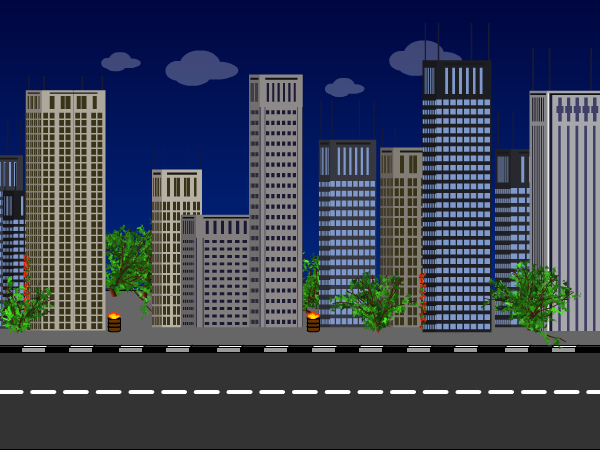
Final Result Preview

Let’s take a look at the final result we will be working towards:


Step 1: Build the Scene Base

We will start by creating the Flash document, preparing it before we start to add the Deco tool objects.

Create a new Flash document with the dimensions 600px X 450 px. Add a rectangle with the same dimensions as the document and fill the rectangle with a linear fill (like the figure below) to create the effect of dark sky.

””

Step 2: Road and Buildings

Now we will create the road background, using the Line tool, create the outline shape of the road and fill it with gray colors to simulate real tarmac. Then create clouds using the Oval tool and the final result should look as follows:

””

Now, we will start using the Deco tool to create the buildings to go by the road sidewalk we created above. You can set the skyscraper type you like to use or use random buildings. Also, you can set the size of the buildings.


Step 3: Random Buildings

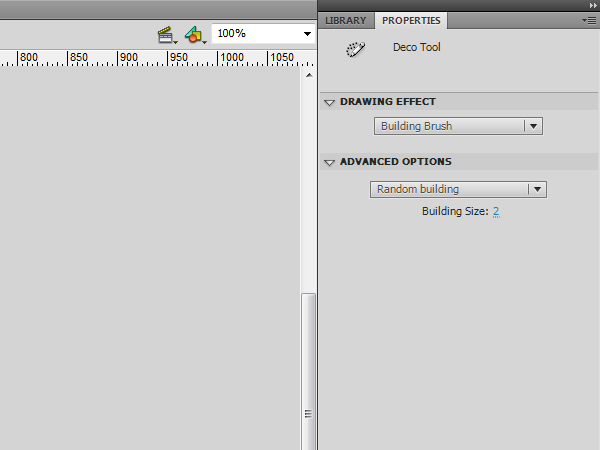
Select the Deco tool or press the key U on the keyboard. In the Properties panel, select “Building Brush” from the Drawing Effect drop-down list. Then, go to the Advanced Options choose “Random building” and set the size to 2.


Step 4: Construction

Click on the road, then drag to the top and release the mouse to create the first building. Repeat the above step to create other buildings on the road as seen in the figure below

In the following steps, we will use the Tree Brush to create trees on the sidewalk and use the Flower Brush to create flowered branches over some buildings. With this brush, you can set the size of the tree and its branch, leaf and flower/fruit colors.


Step 5: Tree Brush

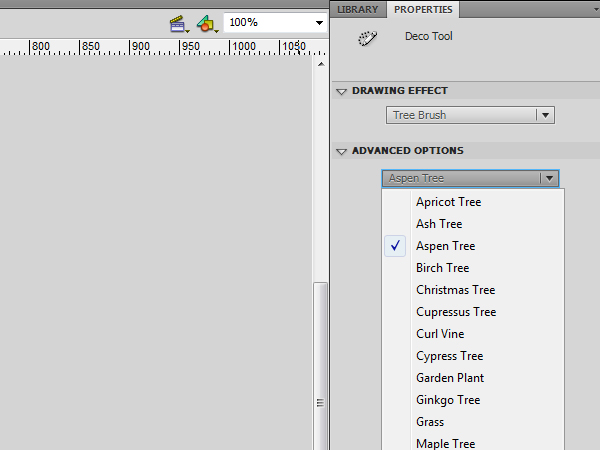
Create a new layer over the buildings layer. Select the Deco tool. In the properties panel, choose Tree Brush from the drop-down menu and in the Advanced option, select “Aspen Tree.”


Step 6: Growth

Click on the sidewalk between buildings to create the trees. Make sure to drag for a few pixels to create small trees. The longer you drag, the bigger the tree size becomes. The final effect after adding the trees, should be as below:


Step 7: Flowers

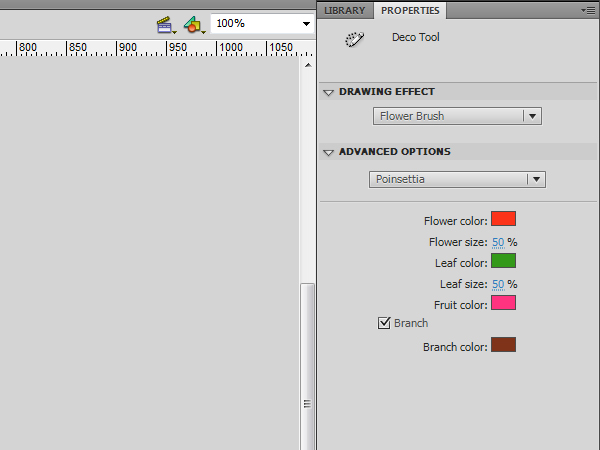
Now, select the Flower Brush, then from the Advanced option choose “Poinsettia.” Set the size of the Flower and leaf to 50% and make sure that the Branch checkbox is checked


Step 8:

Drag up the screen to create branches of flowers. They should be tall to display them as a branch. If the resultant branch is too large you can select it and reduce its size. Then place the resized flower branch on the buildings as seen in the figure below:

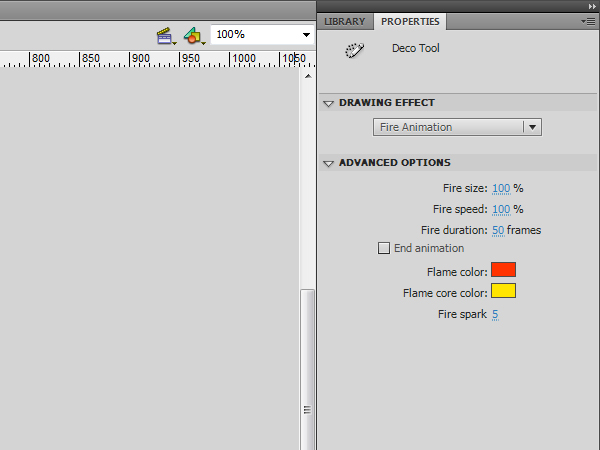
The following steps explain how to create animated barrels of fire. We will also use the Fire Animation brush which allows you to create animated vector fire. You can set the size of the fire, speed and the frame duration. Additionally, you can set the flame color and spark.


Step 9: Great Barrels of Fire

Create a new symbol by going Insert > New Symbol or use the shortcut Ctrl+F8 (Command+F8 in Mac) and set it as movie clip.

In the active layer, create a circle to represent the top of the barrel and another one to make the bottom of the barrel. Drag two lines between them and complete the barrel fill with intermediate lines to look like the example below:


Step 10: Fire Animation

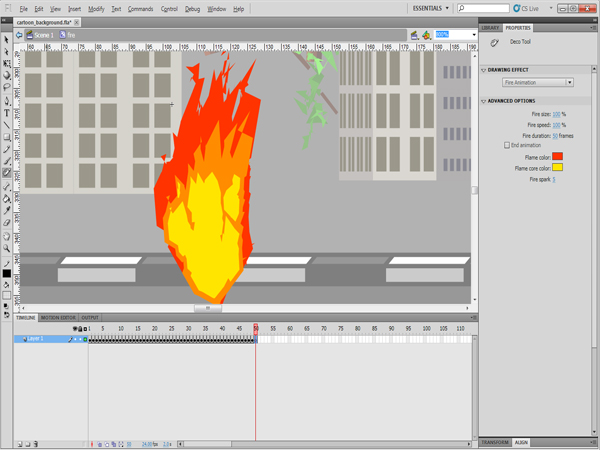
Create a new layer to hold the fire animation. Select the Deco tool or press U in keyboard, choose Fire Animation from the drop-down list in the Properties panel and set the fire animation to 50 frames.


Step 11: Applying Fire

  • Click and hold on the screen to start the fire’s animation.
  • Currently, the created fire animation starts small and get bigger till the end of the animation. This will create an unwanted cut in the looping animation. To solve this, we will remove the starting frames for the fire. In the timeline, select all the frames where the fire is still growing. In this example, we selected the first 15 frames. Right-click the timeline and choose Remove Frames (or press Shift+F5).
  • Make sure that the barrel has the same number of frames as the fire animation.

Step 12: Reposition

Now we will change the size and position of the fire to make it appear like flames are rising out of the barrel:

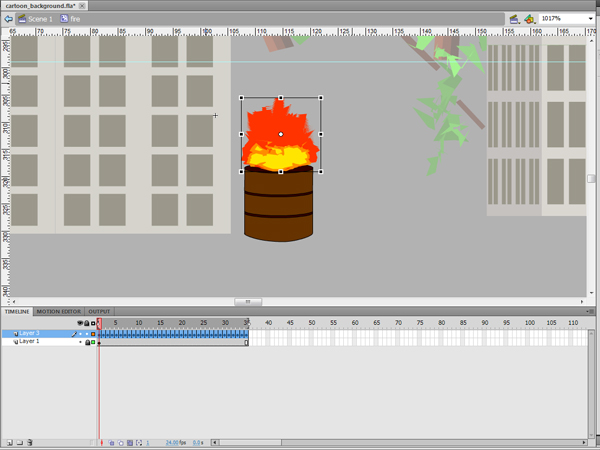
  • To change the size of the fire to fit with the barrel, select all the frames and click the Edit Multiple Frames icon below the timeline.
  • Click the Onion Skin icon on the bottom and choose Onion All from the list.
  • Select the Free Transform tool and make sure that all the frames are selected.
  • Resize the fire ball to fit into the barrel.

Step 13:

Go back to the main stage and add the fire barrel movie clip on the stage next to the buildings as seen in the figure below. You can test the movie by pressing Ctrl+Enter (Command+Enter in Mac)


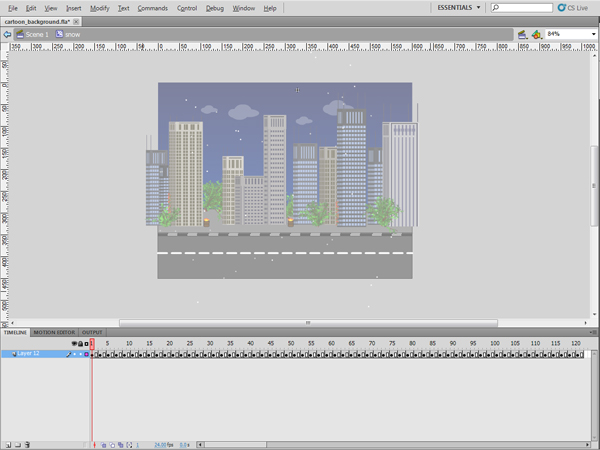
Step 14: Creating Snow

While the Deco tool does not provide all the possible brushes or shapes, you can customize it based on your needs using the symbols or the colors you would like to display. Now, we will use the Particle System which allows you to create flowing animation such as snow falling, fireworks and other effects that depend on small particles exploding from a source.

This brush is based on two particles which can be default symbols or you can use symbols from the library. Also, you can set other options such as the length of the animation, rate per frame and other options as we will see below:

Create a new symbol using Insert > New Symbol or use the shortcut Ctrl+F8 (Command+F8 in Mac) and set it as a movie clip. Go back to the stage and drag the newly created empty symbol from the library to the stage, then double-click the symbol to enter its editing mode


Step 15: Particle System

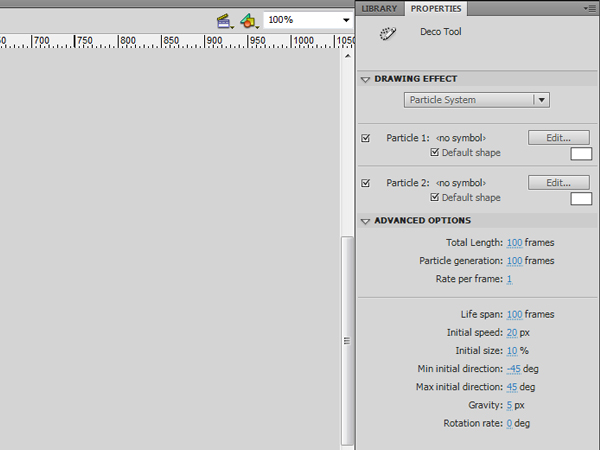
Select the Deco tool or click the U key on keyboard and choose Particle System from the Drawing Effect drop-down list in the Properties panel. Select both Particle 1 and Particle 2, set their color to white to simulate the snow falling and use the Default shape. Set the other values as follows:

  • Set the Total Length and particle Generation to 100 frames
  • Rate per frame: 1
  • Life span: 100 frames
  • Initial speed: 10px
  • Initial size: 10%
  • Gravity: 5px

Step 16: Generation

Now, click the top of the stage to have the particle system fall from top of the stage to the bottom. You will notice that the particle animation is generated and the frames are created.


Step 17:

The snow animation starts small and get bigger till the end of the animation. This (as with the fire) will create an unwanted cut in the looping animation. To solve this, we can again remove the starting frames for the starting snow particles. Select the frame up to the point where the snowfall covers all the stage. In this example, we’ll select the first 40 frames. Right-click and choose Remove Frames or press Shift+F5.

If you notice that the animation is moving fast, you can add an extra frame after each keyframe by selecting the keyframe and pressing F5.


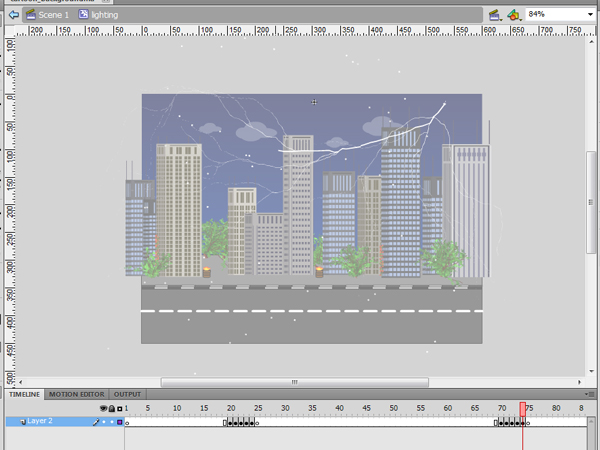
Step 18: Adding Lightning

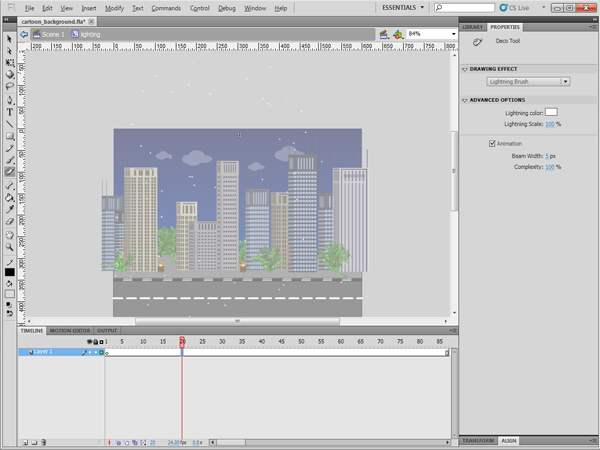
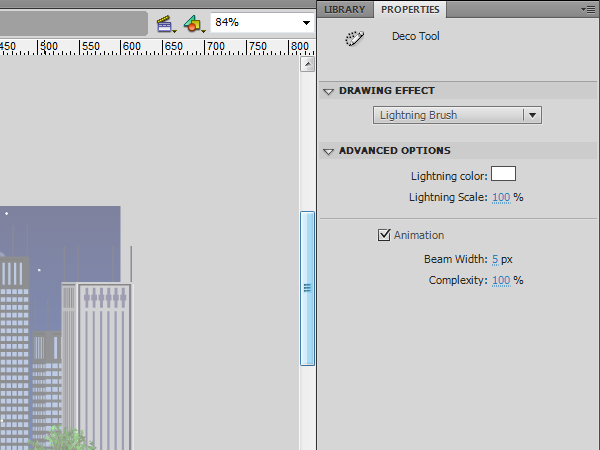
Let’s add some lightning effects using the Lightning Brush. This lightning should animate and appear randomly. You can set loads of options with this brush such as the color of the lighting, its scale, beam width and complexity. Also, you can choose whether or not it should be animated.

Create a new movie clip symbol and add it to the stage behind the buildings layer. In the movie clip symbol, press F7 to create an empty frame in the beginning of the movie clip and go to frame 20.


Step 19: Lighting Brush

Select the Deco tool and from the Properties panel choose Lighting Brush. Keep the settings the same, just change the color to white and check the Animation checkbox.


Step 20: Complexity

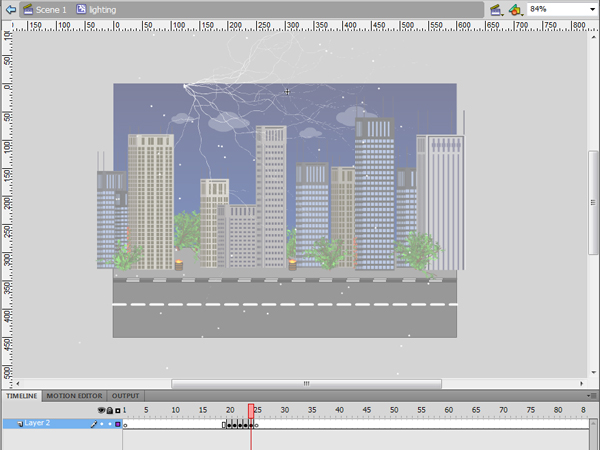
Point your mouse cursor at the top left of the stage, click and hold your mouse until the lightning reaches the desired complexity, then release the mouse. Press F7 after the animation to add a blank frame after it.


Step 21: More Lightning

Go to frame 70, repeat the above steps to create more lightning on the right hand of the stage with different complexity and press F7 after the animation to remove the lightning from the stage.


Step 22: Test

You can test the movie by clicking Ctrl+Enter (Command+Enter in Mac) or choose File > Publish to export the movie as SWF and HTML files.


Step 23: Optimization

Generally, the files that uses the Deco tool generate large size SWFs because the Deco tool generates the brushes and the animation as ungrouped shapes and frame-by-frame animations. These two methods increases the total size of the file. However, it is best practice to optimize the file after reaching the required results. There are some tips to decrease the file size as below:

  • Converted frequently used objects, such as the similar trees and fire barrels, into symbols; this will make Flash count them as one symbol no matter how many times the symbol is used.
  • Break apart the overlapped groups to minimize the hardware processing needed to load it as well as the SWF size.
  • Try to use motion tweening when possible as frame-by-frame animation increases SWF size.

Conclusion

In the above example, we learnt how to use the Deco tool to create an animated cartoon background. This saves time and does not require special cartoon or drawing skills. You can discover the rest of brushes available in the Deco drawing tools, see how to use them and the different options associated with each one.

I hope you liked this tutorial, thanks for reading!

WordPress hack: Insert comments programatically

The following code can be pasted anywhere on your theme files.
Once this code is executed, it will add a new comment into WordPress database. The returned value is the comment ID, or 0 if a problem happenned.

$data = array(
	'comment_post_ID' => 1,
	'comment_author' => 'admin',
	'comment_author_email' => '[email protected]',
	'comment_author_url' => 'http://www.catswhocode.com',
	'comment_content' => 'Lorem ipsum dolor sit amet...',
	'comment_author_IP' => '127.0.0.1',
	'comment_agent' => 'Mozilla/5.0 (Macintosh; U; Intel Mac OS X 10.6; fr; rv:1.9.2.3) Gecko/20100401 Firefox/3.6.3',
	'comment_date' => date('Y-m-d H:i:s'),
	'comment_date_gmt' => date('Y-m-d H:i:s'),
	'comment_approved' => 1,
);

$comment_id = wp_insert_comment($data);

Looking for WordPress hosting? Try WP Web Host. Prices starts at $5/month and you can try it for free!

WordPress hack: Insert comments programatically