In a new post on the Microsoft Edge blog, the browser’s Principal PM Lead Kim Denny has outlined how the company made it faster and more efficient over the past few months. To help users perform their tasks as quickly as possible, the team rolled out…
Category: Tutorials
Tutorials,freelance,projects,joomla,php,mysql,wordpress,blancer.com
How to Calibrate Your Raw Files With Custom Profiles in Lightroom CC (Classic)
{excerpt}
Read More
Watch Amazon’s entire new hardware event right here
If you have to see the Ring Always Home Cam in action to believe that Amazon made a flying security drone for your house, then check out the video of its hardware event. The live stream wasn’t available publicly yesterday, but now you can click throu…
All 45 seasons of SNL arrive on Peacock October 1st
NBC’s Peacock streaming service will start streaming its entire back catalog of Saturday Night Live episodes on October 1st, according to Deadline and Variety. Once all 45 seasons of SNL make their way to Peacock, it will mark the first time the enti…
Roland’s WM-1 turns your instruments into (MIDI) cord cutters
Let’s face it, when you start building out a fleet of synths, cable management can quickly become an issue, with all those wires connecting everything creating an inescapable rat’s nest. Enter Roland with its new WM-1 Wireless MIDI adapter. It’s a co…
How ‘Microsoft Flight Simulator’ became a ‘living game’ with Azure AI
Microsoft Flight Simulator is a triumph, one that fully captures the meditative experience of soaring through the clouds. But to bring the game to life, Microsoft and developer Asobo Studio needed more than an upgraded graphics engine to make its pla…
How to Create and Apply a Grass Brush in Illustrator

If you want to create a grass brush, Illustrator is the right way to go, and I will show you how easy it can be. Using only three simple Illustrator brushes and understanding how the settings work, you can create anything from minimal grass to pretty realistic-looking grass. I’ll guide you step by step to achieve this. Let’s start!
If you need more inspiration and resources to improve your illustrations, make sure to head over to GraphicRiver, where you’ll find plenty of Illustrator Brushes, vectors, and other beautiful illustrations ready to use.
What You Will Learn in This Grass Brush Tutorial
- How to make a brush in Illustrator using simple shapes and tools
- How to save a grass brush in Illustrator
- How to apply a grass brush and understand the Scatter Brush settings
- How to create natural, realistic grass using three simple Illustrator brushes
- How to improve your overall illustrations
Tutorial Assets
To complete the tutorial, you will need the following assets:
1. How to Open a New Document
Launch Illustrator and go to File > New to open a black document. Type a name for your file, set the dimensions, and then select Pixels as Units and RGB as Color Mode.
Next, go to Edit > Preferences > General and set the Keyboard Increment to 1 px and while there, go to Units to make sure they are set as in the following image. I usually work with these settings, and they will help you throughout the drawing process.

2. How to Make a Grass Brush in Illustrator
Step 1
Making a brush in Illustrator is pretty easy. It begins with defining an object, in this case a single blade of grass. Copies of this object will be dispersed along a path, and we will obtain beautiful grass.
Grab the Pen Tool (P) and draw a shape like in the image below as the first piece of grass. Use a 20 x 320 px rectangle as a size reference and make this shape about the same size. This way, the settings we will apply later in the tutorial will work for you as well, and you’ll obtain a similar result.

Step 2
Let’s draw another piece of grass and make it a little different than the first. Notice that this one is more curved.

Step 3
The third piece of grass has a bent tip pointing to the right, and we will use this one to add details to the grass.

3. How to Save a Brush in Illustrator
Step 1
Select the first piece of grass and press New Brush at the bottom of the Brushes panel. Choose Scatter Brush and hit OK to open the Scatter Brush Options window. There, just type “Grass Brush 1” as the name and select Tints as the Colorization Method. Leave the rest of the settings as they are for the moment, and hit OK.

Step 2
Now, select the second piece of grass, drag it into the Brushes panel, and save it as “Grass Brush 2“.

Step 3
Repeat the same thing for the third shape you have drawn, and save it as “Grass Brush 3“.

Step 4
Here are the three simple Illustrator brushes, saved and ready to be used. They should be about the same size but slightly different as this will give us a more realistic look in the end.
Are three different grass brushes really necessary? The answer is no. To achieve quick, minimal grass, one should typically be enough. But if you want to achieve a realistic, random, and natural look in your illustrations, then these three Illustrator brushes are just the right thing.

4. How to Use Illustrator Brushes to Create Medium Grass
Step 1
Grab the Line Segment Tool (\) and draw a straight path on your artboard, 2000 px in length. Stroke it with the Grass Brush 1 by simply selecting it from the Brushes panel, and keep the Stroke Weight at 1 pt. You will get the result from the image below, with the blades of grass equally dispersed along the path, but this is not exactly what we need. This is where the Size, Spacing, Scatter, and Rotation settings play a major role.

Step 2
With the path still selected, open the Stroke Options window by double-clicking on the brush applied in the Appearance panel.
- Size controls the size of the object. Choose Random and then set it between 80% and 100% as this will give us pieces of grass of different sizes.
- Spacing controls the amount of space between objects. Choose Random and set it between 25% and 5% to obtain more pieces of grass along the path.
- Scatter controls how closely objects follow the path independently on each side of the path. The higher the value, the farther the objects are from the path. Choose Random again and set the values between 5% and -15%.
- Rotation controls the angle of rotation of the objects. Choose Random and set the values to -10 degrees up to 10 degrees. Notice how the grass now looks more natural, and we are on the right track.

Step 3
Keep the same path selected and press Add New Stroke at the bottom of the Appearance panel to add a second Stroke attribute above the existing one. Use Grass Brush 2 by selecting it from the Brushes panel, and keep the Stroke Weight at 1 pt.
Open the Stroke Options window and change the settings as shown. For visual reasons, I’ve changed the stroke color to blue so you can see better how the different settings generate a different result.

Step 4
With the path still selected, press Add New Stroke again to add a third Stroke attribute at the top of the Appearance panel. Use Grass Brush 3 and then change the settings as shown. Notice how the Spacing values are bigger this time because we want fewer bent pieces of grass in the design, with only a few pieces to create a natural look.

5. How to Use Illustrator Brushes to Create Tall Grass
Use the Line Segment Tool (\) to draw another straight path 2000 px in length. Add three Stroke attributes and use the thee Grass Brushes as you did before. Keep the Stroke Weight at 1 pt for all of them.
To obtain taller grass, we need to play with the Scatter settings. The bigger the values, the further from the path the pieces of grass will go, creating the appearance of taller grass in the end.

Here are the settings for Grass Brush 1, Grass Brush 2, and Grass Brush 3 in order:

6. How to Use Illustrator Brushes to Create Mixed Grass
Step 1
Use the Line Segment Tool (\) to draw a new path on your artboard, 2000 px in length. Just like before, add three Stroke attributes and use the three Grass Brushes separately. Keep the Stroke Weight at 1 pt for all of them.
All of the settings are important to create mixed, random grass as they need to be varied, but the most important are Scatter and Rotation. These will give us randomly dispersed pieces of grass rotated at a bigger angle than before.

Here are the settings for the three Illustrator brushes:

Step 2
Let’s take another look at the types of grass we have created by using different settings. To demonstrate how to use them, we’ll add grass in a beautiful illustration, but you can use them in other projects as well.
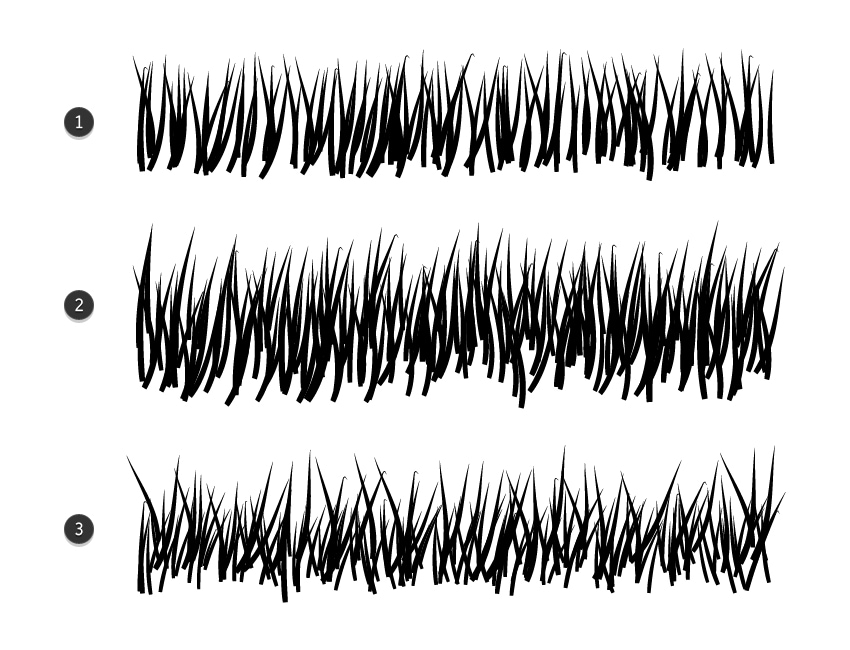
I will refer to them, in the next part of the tutorial, as “medium grass” (1), “tall grass” (2) and “mixed grass” (3), and it’s all about layering and coloring them to obtain a natural, realistic result.
7. How to Create Vector Grass in Illustrator
Step 1
This happy tree illustration from Envato Elements is perfect for us to use. The space in front of this gorgeous tree is ideal for some grass.
Open the file in Illustrator, and let’s clean up the illustration a little by removing some of the plants in front and around the tree. The layers are very well organized and named accordingly, so this will be easy to do.

Step 2
Grab “medium grass” and arrange it at the bottom of the artboard, as shown in the image below. The path is 2000 px long, so it should fit just right (1).
While the path stays selected, go to Object > Expand Appearance in order to turn the brush strokes into a group of individual blades of grass filled with black.
You will notice that each blade of grass will have a rectangle associated with it, with no stroke and no fill. We need to delete all of them before coloring. Use the Direct Selection Tool (A) to select only one of these rectangles (2) and then go to Select > Same > Fill & Stroke. Illustrator will automatically select all the rectangles for you; just press the Delete key on your keyboard.
Now, we can color the grass group. Use a linear gradient from bright green to a darker green, and set the Angle to -90 degrees so the light color is at the top.

Step 3
Next, grab “tall grass” and position the path at the bottom of the artboard. Send it behind the first group of grass. Go to Object > Expand Appearance and then remove all the empty rectangles that you get after expanding, just like in the previous step. After that, you can color the entire group with the linear gradient shown at a -90 degrees Angle.

Step 4
Copy and Paste in Back (Control-B) the second grass group, and make the grass even taller by dragging the bounding box with the Selection Tool (V). Also, change the gradient to a lighter one as shown. Our grass is coming together beautifully, right?

Step 5
Copy and Paste in Front (Control-F) the second grass group, and this time, scale it down using the Selection Tool (V). Change the existing gradient to a much darker one, and notice how much depth this will create in the design.

Step 6
Now, grab “mixed grass” and, after expanding, arrange it at the bottom of the artboard as shown in the image below. Make sure to send it behind all the other groups in the Layers panel, and color it with a darker gradient as well, in order to create shadows in the back.

Step 7
We have successfully used the three types of grass in our design. All the layers and gradients that we used give us a pretty natural look. The more layers you add, the more realistic the end result will be, but don’t overdo it.
To improve the design, let’s add shorter grass in front. Select the “mixed grass” group from the previous step and then Copy and Paste in Place (Shift-Control-V) to make a copy of it in front of everything. Arrange it below the artboard so that only the tips of the grass will be visible.
Make another copy in front of this grass group, and scale it down with the Selection Tool (V). Arrange it in the middle of the artboard, and make sure that only the tips will be visible. Color both of these groups with the linear gradient shown at a -90 degrees Angle.

Step 8
It’s time to clean up the illustration. Use the Direct Selection Tool (A) to select only the background, and then Copy and Paste in Place (Shift-Control-V) to make a copy in front of everything. Set this copy to Stroke: none and Fill: none.
Keep the background copy selected, along with all the grass groups, and go to Object > Clipping Mask > Make (Control-7). Looks great, right?

8. How to Improve the Illustration
Step 1
It’s always a good idea to make the grass match the rest of the illustration. If you use this technique to add grass in your other projects, I highly suggest using this little trick.
I have sampled some of the brown/rust colors in the illustration with the Eyedropper Tool (I) and created two new gradients using these colors, along with green from the grass. Now, grab the Direct Selection Tool (A) and randomly select a few pieces of grass that you can recolor with the new gradients. You can see the result in the image below.

Step 2
You can also create a wind-blown look easily. Select only one of the taller grass groups from your design, and go to the Transform panel (Window > Transform). Type 10 degrees in the Shear field, and this will bend your grass a little, as if the wind is blowing.

Step 3
You can do the same thing for one of the shorter grass groups in front of the illustration. Apply a Shear value of 10 degrees, and you are done.

Congratulations! You’re Done
Here is the final grass illustration. Now you know how to make a brush in Illustrator and use it to create beautiful, natural grass. You can apply these techniques in future projects and add grass in plenty of other illustrations.
If you need more inspiration and resources to improve your illustrations, make sure to head over to GraphicRiver, where you will find plenty of Illustrator Brushes, vectors, and other illustrations ready to use.

Expand Your Drawing Skills
Keep learning and drawing with these recommended tutorials, which will explain lots of other useful techniques:
-

How to Create a Grass Banner in Adobe Illustrator
Learn how to create a realistic, grassy background using the Mesh Tool and Warp effects in Adobe Illustrator! -

How to Draw a Nature Background in Adobe Illustrator Using Gradient Mesh
Learn how to use the Mesh Tool in Adobe Illustrator by drawing a vector nature background! -

How to Draw a Nature Scene With Dandelions and a Butterfly in Adobe Illustrator
Learn how to create a vector natural scene with some flowers and a butterfly using Gradient Mesh in Adobe Illustrator! -

How to Create a Spring Meadow in Adobe Illustrator
Learn how to use the Mesh Tool and Transparency settings to create a vector spring background with a fence! -

Quick Tip: How to Create a Vector Grass Text Effect
Follow this quick tip and learn how to create a simple grass text effect. We will use the Note Paper effect then with the help of the Live Trace options to… -

Get It While It’s Hot! Create a Detailed BBQ in Adobe Illustrator
In the following steps you will learn how to create a detailed barbecue illustration. For starters you will learn how to create a simple pattern brush which…

{excerpt}
Read More
Fonts Similar to Century Gothic
If you love the geometry and simplicity of Century Gothic, you’re going to be very excited by the collection of fonts we’re showcasing today, which are all font styles similar to Century Gothic but with their own unique flair.

What Is the Century Gothic Typeface?
Century Gothic is a geometric sans-serif typeface based on a font called Twentieth Century created by Sol Hess between 1936 and 1947.
Century Gothic was released by the company Monotype Imaging—the same company that owned the Twentieth Century typeface—in 1991. The designers maintained the basic design of Twentieth Century but enlarged the ‘x’ height and added other modifications to ensure a suitable output for modern digital systems.
So what does the Century Gothic font look like? Check out the illustration below:

Century Gothic is often used on movie posters and for TV shows because with its mix of a high x-height and a steady weight, it’s easy to read both in print and on screen.
There are many fonts that harness the simplicity and clean lines of Century Gothic. Let’s look at a few.
18 Fonts Similar to Century Gothic
Palas (OTF)

Palas is a bold typeface that’s designed for headlines and posters. Palas comes with four weights, and it bears the hallmarks of many fonts like Century Gothic. Download it today and see how it looks on your next project!
Clarity Nuvo (OTF, TTF, WOFF, SVG)

Like the Century Gothic typeface, Clarity Nuvo is a clean sans-serif typeface that’s both modern and simple. The typeface comes with a total of ten fonts spread between five weights—thin, light, regular, bold, and heavy— featuring five non-italics and five italics for each weight. With a similar clarity to the Century Gothic font, Clarity Nuvo is a perfect choice for web, print, and any display use.
Equinox Typeface (OTF, TTF)

Equinox captures the modern minimalism of the Century Gothic font to perfection. Though it doesn’t offer lowercase characters, those looking for a simple and legible display font will be more than satisfied with this collection of uppercase multilingual letters, numbers, punctuation, and alternate letters.
Axon (OTF, TTF)
Harness the spirit of the Century Gothic typeface when you use Axon, a minimalist sans serif typeface that offers four different weights and is an excellent choice for magazine layouts, invitations, headers, and large-scale artwork.
Bergen Grotesk Font (OTF)

Any designer looking for fonts like Century Gothic is bound to be drawn to Bergen Grotesk. It’s a beautifully designed typeface with a neutral style that makes it, as the designer claims, “a universal weapon”: suitable both for headlines and body text. It comes in four different widths and includes alternate glyphs, fractions, arrows, ligatures, and more.
Sheylla Sans Serif Typeface (OTF, TTF, WOFF)

If you’re looking for an interesting twist on Century Gothic, download Sheylla Sans. It has many similar characteristics, but with a more condensed style for many of the characters. This makes it perfect for magazines, business flyers, or other print layouts where space is at a premium.
Chronograph (OTF, TTF, EOT, WOFF, SVG)

Check out the Chronograph Bold sample in the image above. It’s a good match for Century Gothic Bold, and the other three styles are also excellent alternatives. Use it for a clean, legible headline if you want to command attention.
Adriell Typeface (OTF, TTF, WOFF)

This sans serif typeface comes in five weights—regular, medium, outline, bold, black—that can be used for a myriad of purposes including magazine titles, quotes, stationery, logotypes, headlines, banners, templates, and more. The font includes upper and lowercase characters, numbers, punctuation, and non-English characters.
Maxwell Sans Small Caps Light (OTF, TTF, WOFF, SVG)

Maxwell is a clean, condensed sans serif typeface inspired by the same period that the Century Gothic typeface was created in. Unlike the Century Gothic typeface, Maxwell offers uppercase characters only, but like Century Gothic it offers a full range of weights from ultralight to bold.
QARTELLA (OTF, TTF, WOFF, SVG)

Qartella Typeface is one of many fonts like Century Gothic that are geometric and easy on the eye. This clean sans serif is a perfect display, branding, and logo font and will retain excellent legibility in print as well as on the web.
Bw Nista Geometric (OTF, TTF, WOFF)

Bw Nista is a geometric sans serif typeface that was designed to be easily read. The font is available in seven weights, from elegant thin to solid black with matching oblique italics, so if you’re looking for an alternative to Century Gothic bold or Century Gothic italic, this is the font for you. It includes upper and lowercase characters, punctuation, and numbers, as well as a selection of foreign language accents.
Proximity Sans (OTF, TTF, WOFF)

Whether you’re looking for fonts like Century Gothic bold, Century Gothic italic, or Century Gothic regular, Proximity Sans won’t disappoint. This beautiful sans serif font is perfectly suited for posters, logo design, banners, web design, and more. It comes in five weights and includes upper and lowercase characters, numbers, and punctuation.
Bensoud (OTF, TTF, WOFF, SVG)

Looking for fonts like Century Gothic to create a poster, logo, branding, or for web design? Then Bensoud is a terrific option, It offers uppercase-only characters, numbers, and punctuation, in a weight that’s reminiscent of the regular weight Century Gothic font.
Grafic (TTF)
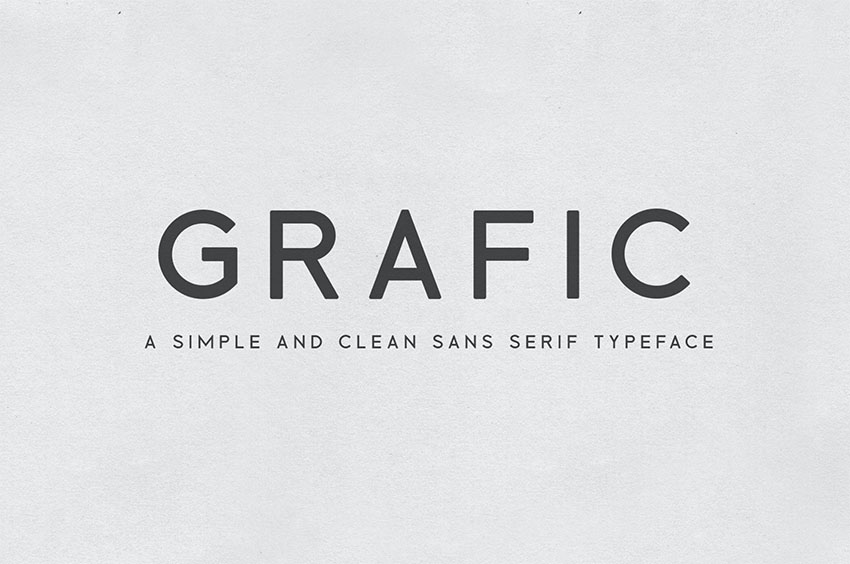
Grafic makes for a great alternative to the Century Gothic typeface because of its simple, clean, modern appeal. Use it on its own, or try pairing it with a script or decorative font for an interesting effect. This would be a great typeface for a poster, logo, album cover, or other purpose.
Rhino Bold Font (OTF)

Like many fonts similar to Century Gothic, Rhino is a clean, bold, versatile typeface. It comes with seven different fonts and is designed to work well at large and small sizes. Use it for headlines, branding projects, or simple, easy-to-read body text.
Echo Grotesque Light (OTF)

Like the iconic Century Gothic typeface, Echo Grotesque is a high-quality sans serif that’s built on the foundations of elegance and readability. Its open counters, light weight, and clean design make it a perfect choice for highly legible body text, but you could also scale it up for use in headlines, posters, and more. It comes with plenty of ligatures, alternates, kerning pairs, swashes, and stylistic sets.
LEANER Extended (OTF, TTF)

For a high-impact alternative to Century Gothic Bold, try Leaner Extended. This bold, all-caps typeface would be perfect for an attention-grabbing headline or logo. It comes with an impressive 363 glyphs, plus diacritics, numbers, and punctuation.
ACCESS (OTF, TTF, WOFF, SVG)

If you’re looking for fonts like Century Gothic, then ACCESS is not to be missed. Another modern sans serif typeface with clean lines and geometric shapes, it comes in five weights: light, normal, bold, extra bold, and distorted.
Discover More Font Alternatives
I hope this article has given you plenty of examples of font styles similar to Century Gothic that you could use in your projects. But if you’re still looking for more fonts like Century Gothic, then be sure to check out the thousands of sans serif fonts at Envato Elements. You’re sure to find plenty of fonts that you’ll love.
And if you want more awesome font inspiration, try some of these articles:
 FontsThe Rise of the Sans SerifLaura Keung
 FontsFonts Similar to Times New Roman (And Its History)Nona Blackman
 FontsAll About Avenir & Fonts Similar to AvenirGrace Fussell
 Fonts15 Fonts Similar to GothamLaura Keung
 Fonts19 Best Small Fonts (Pixel & Tiny Fonts to Download Now)Nona Blackman
 FontsFonts Similar to Futura & What Font Pairs Well With FuturaLaura Keung
 Fonts15 Fonts Similar to HelveticaGrace Fussell
 Fonts29 Best Monospace FontsNona Blackman

{excerpt}
Read More
3 Top Demo Reel Templates for Premiere Pro
{excerpt}
Read More
Google server problems took out Gmail and other services briefly
It feels unusual to see internet problems that aren’t related to someone trying to pre-order gaming equipment, but this evening users on the East and West coasts of the US experienced issues accessing Google services like Gmail, Google Docs, and even…
The first ‘Left 4 Dead 2’ expansion in years is available now for free
In yet another unexpected development from 2020, there’s a massive content update available for Left 4 Dead 2. Valve’s co-op zombie shooter was originally released in 2009, but the community is still active enough to produce a new content pack dubbed…
The 30 CSS Selectors You Must Memorize
{excerpt}
Read More
15 Cinematic Movie Trailer Templates for Premiere Pro
{excerpt}
Read More
iOS 14 update fixes a bug that reset your browser and mail defaults
One of the notable changes in iOS 14 is that it finally allowed users to set new default apps for their web browser and email. Chrome, Firefox, Gmail and others are already taking advantage of the setting, but after the update rolled out last week, m…
Sega’s Football Manager heads back to Xbox this fall
When it comes out on November 24th, Football Manager 2021 will the first entry in the popular simulation series to make its way to Xbox consoles in more than a decade. Sega plans to release the game on Xbox One, Xbox Series S and Xbox Series X, with…