Apple recommends all users download iOS 14.4.2 and watchOS 7.3.3 as soon as possible.
Category: Tutorials
Tutorials,freelance,projects,joomla,php,mysql,wordpress,blancer.com
Survival game ‘Rust’ will hit PS4 and Xbox One on May 21st
They’ll have a separate update roadmap from the PC version.
‘Nobody Saves the World’ is a shapeshifting RPG from DrinkBox Studios
DrinkBox is pitching the game as an action RPG that includes everything people love about the genre, with none of the cruft.
Jeep is installing EV chargers at off-road trailheads throughout the US
The first three will arrive in Utah and California this spring.
VW’s electric ID.Buzz Microbus will hit the US in 2023
Europe gets the EV next year, but VW probably won’t release the fully autonomous version in the US.
HBO Max gets more accessible with audio-described content rollout
The changes coming this week include “nearly 1,500 hours of audio described content on web and mobile platforms.” Some of these titles include His Dark Materials, Dunkirk, Euphoria and Batman v Superman: Dawn of Justice.
No one agrees on how to fix Big Tech
Section 230 reform should be a delicate process, but everyone involved is wielding a hammer.
The internet has become a tool for authoritarian repression
While the internet revolution may have empowered activists, it has also handed new tools to despots for stamping out dissent through digital surveillance, disinformation and internet access to their people.
This week’s best deals: 20 percent off Samsung’s T7 Touch SSD and more
Here’s a list of the best tech deals we found this week, including 20 percent off the Samsung T7 Touch SSD and 43 percent off the Amazon Fire HD 10 tablet.
This center channel speaker by Pioneer is on sale for just $80 right now
The Pioneer PSP-C22 Andrew Jones Designed Center Channel Speaker provides an excellent upgrade over your TV’s built-in drivers, and it’s currently 46 percent off.
‘Tony Hawk’s Pro Skater 1 and 2’ arrives on PS5 and Xbox Series X
‘Tony Hawk’s Pro Skater 1 and 2’ is now available on PS5 and Xbox Series X/S, including 4K and 120FPS options, although it may cost you to upgrade.
17 Fonts Similar to Arial
In this article, we’ll cover the history of Arial, the Helvetica substitute. We’ll give you an overview of the font and some amazing fonts similar to the Arial font.
Arial has become the synonym for Helvetica since its beginnings. There are no two fonts with more history, critique, and comparison than these two. Arial is Microsoft’s star font that has come to replace Helvetica on the platform. It’s probably the font that you and I used to turn in papers at school, it’s used in plenty of presentations and standard documents. So let’s take a look at its history and impact. If you’re wondering what font is similar to the Arial font, we have an amazing list of alternatives.
The History of Arial
The Arial font style is one of the most popular typefaces in the world. Initially created for IBM back in 1982 by Robin Nicholas and Patricia Saunders, the font became one of the most widely known through Microsoft. The Windows operating system included Arial as one of the system fonts, and it’s now also part of macOS and in all PostScript-based laser printers.
Arial was intended to be a competitor to Helvetica, the most influential typefaces in our time. This is where the never-ending Helvetica vs. Arial argument comes from. Arial prides itself in its legibility at large and small point sizes. It’s a popular choice for everything from school work to advertising, book design, and even logos.
Initially, IBM named the font Sonoran Sans Serif due to licensing restrictions. The font was released in 1989 with 14 point sizes, four style and weight combinations, and in 11 languages.

When desktop publishing became a phenomenon in the early 80s, Helvetica was important enough to be included in Adobe’s font package. Therefore, they obtained the license from the original foundries and ensured complete dominance over digital fonts, to the extent that designers could only access certain typefaces through Adobe products. During that era, there were different type qualifications: Type 1 fonts were published by the best foundries, while Type 3 fonts were an inferior format.
Microsoft didn’t want to pay a licensing fee for Helvetica, so they made a typeface that functionally is the same as Helvetica. An outline of Arial as a Type 1 font wasn’t available until 1991. Here’s when font file formats were born as it became a challenge using fonts cross-platform. TrueType and TrueImage were compatible with both systems.
In 1992, a TrueType format of Arial was developed and licensed to Microsoft. This is when the company chose for Arial to be one of its four core TrueType fonts in Windows 3.1. This was officially announced as Arial being an alternative to Helvetica.
In later years, Microsoft would fund the development of Arial to support more font styles, weights, and even more languages. Arial became just as large a family as Helvetica, having just as many options and styles for non-Apple users. As of now, there are several Arial variants: Arial Regular, Arial Black, Arial Narrow, Arial Rounded, Arial Special, Arial Light, Arial Medium, Arial Extra Bold, Arial Light Condensed, Arial Condensed, Arial Medium Condensed, Arial Bold Condensed, and Arial Monospaced.

When it comes to the Helvetica vs. Arial argument, it’s true Arial owes much of its success to the coveted Helvetica. It was designed based on Helvetica’s characters and inspired by its form after all. While Arial is a great substitute for Helvetica, it certainly isn’t Helvetica. It communicates something slightly different—it’s more relaxed, but perhaps just as ubiquitous.
If you’ve ever wondered what the Arial font looks like, here are some pointers: Arial has a more humanist style in comparison to Helvetica. The curves are fuller and softer. The end terminals and strokes are cut on a diagonal, making the font look less mechanical.
Fonts Similar to Arial
Wondering what font is similar to Arial? In this list, we’ll show alternatives similar to the Arial font. We’re looking for sans serif fonts that have a humanistic style.
If you’re looking for more than just Arial alternatives, there are thousands of other fonts over at Envato Elements. For a small fee, you can have access to an always evolving library of fonts and a lot more!
Let’s take a look at some fonts that are similar to Arial:
1. Syabil

Syabil falls into the humanistic category, very similar to the Arial font. This font was created with the intention to look clean, be legible at all sizes, and be used for screen and print purposes. The font contains a big family. Syabil is also a great substitute if you’re looking for fonts similar to Arial Black or an Arial bold font style.
2. Oliviar

Oliviar is a beautiful grotesque font similar to Arial and Helvetica. It’s inspired by humanist sans serifs, exactly like the Arial font style anatomy. The package includes weights that range from thin to bold. It’s a perfect substitute for the Arial bold font. It supports multiple languages and is perfect for any of your projects.
3. Groteska

Groteska is a sans serif font that’s clean and minimalist. It’s a toned-down version of the Arial font style. The font contains seven different weights that come in regular and italics, for a total of 14 individual typefaces. The font also includes extended language support, and it’s suitable for anything from branding to editorial design.
4. Arthura

Arthura is a humanist sans serif font with simple geometric features. The humanist style is what makes great fonts like Arial and Arthura. It also includes subtle contrast in the ultra bold black style. The font is a perfect option for branding, advertising, and printed or web projects.
5. Proda Sans

Proda Sans is a similar Arial font. The humanist typeface mixes with geometric forms from the mid-20th century. Humanist fonts like Arial are usually influenced by calligraphy to add more personality to the font. This family contains nine weights in regular and italic versions. The wide range of weights makes it possible to use Proda either for headlines or as body copy.
6. Aurel

Aurel is a beautiful sans serif typeface that has hints of a humanistic style like the Arial font. It has just enough personality to not appear super minimal. It’s suitable for both headlines and long-form copy, as well as web and printed materials. The family comes with four different weights with their respective regular and italic styles.
7. Bergen Text

This carefully crafted font is highly legible at smaller point sizes, just like the Arial font. This contemporary sans serif font has clean geometric lines with a quirky personality. It’s a great alternative to Arial when it comes to choosing highly legible fonts for smaller copy. This font family consists of six fonts with italics and an extensive character list.
8. RNS Sanz

If you’re looking for a font similar to Arial Black, RNS Sanz is a great substitute. While the font is more neutral, it’s just as modern and clean as Arial Black. There are seven different weights to choose from. Here you’ll find anything from light to black, and the font is perfectly suitable for display purposes. The files are also suitable for web use.
9. RNS Sisma

RNS Sisma includes seven weights, from which you can find fonts similar to Arial Black and Arial bold fonts. The typeface is neutral, with just a touch of grotesk and humanistic style lines. It’s perfect for screen use and is highly legible at smaller point sizes.
10. Magdelin

Magdelin features clean lines and low contrast between the strokes. Yet the contrast that exists is enhanced by the humanistic lines similar to the Arial font. It’s inspired by calligraphy and cursive details, giving it a bit of a vintage feel with a modern twist. The clean design makes it versatile and suitable for a range of design projects, whether it’s on screen or printed.
11. Normal

This super minimal font is similar to Arial. Normal is the perfect sans serif for display purposes. The clean lines will make sure your message gets across successfully and clearly. The package comes in five different weights, making it suitable also for multiple hierarchy projects like editorial design.
12. Barton

If you’re looking for fonts similar to Arial rounded, Barton is a perfect duplicate. Featuring clean lines and rounded edges, the font is beautifully designed. Its modern personality makes it suitable for any project, regardless of theme or topic, and it’s highly adaptable to your message. The font includes multiple language support.
13. Enrique Sans

Enrique Sans is a beautiful, clean, and slightly rounded typeface. It’s one of the fonts similar to Arial rounded, and it looks amazing typeset in all capitals. Add some letter spacing in between, and you’ll have a classic, timeless look. The font comes in three weights, supports multiple languages, and includes an extensive character library.
14. Vengeance

This unique sans serif is best suited for display purposes. Use it anywhere from headlines to logos, advertising, and packing design. The font comes in seven different weights, has an extensive character library, and is ready for web use.
15. Articulat CF

Articulat is a strong sans serif featuring sharp end strokes. The font has that timeless feel similar to the Arial font. Clarity is its strength, making it versatile for a wide range of projects. It’s highly legible at smaller point sizes and packs a punch when used as display. The pack comes with ten weights and their respective italics, supports multiple languages, and offers many alternate characters.
16. Neohead

Neohead is one of the fonts similar to Arial Narrow. This font features minimal strokes and is supported by fine decorative elements. Its condensed nature makes it efficient in saving space while providing legibility to your design. The pack includes upper and lower-case characters, multiple character glyphs, and extensive Latin language support.
17. Config Complete Font

Another of the fonts similar to Arial narrow is Config. This font is highly functional and efficient. Its super clean features make it highly readable when used as body copy or display. The font features clean lines with subtle details, and it has an overall minimal appearance. It’s best suited for editorial design and web.
Do You Have a Favorite Font?
Did you find any new or new favorite fonts from this list? Now that we’ve walked you through the history of Arial, you’ll know that it is closely inspired by Helvetica. We also talked about what an Arial font looks like, so you know what to look for when looking at alternatives. We’ve also gone through a long list of fonts similar to Arial.
If you’re looking for awesome modern sans serif fonts that are super versatile for any project, make sure to check out Envato Elements. With a subscription, you can have access to an extensive font library, photos, video, and much more! It’s an awesome resource to have in your arsenal.
If you liked this article, you might like these:
 TypographyFonts Similar to Myriad Pro & Best Font PairingsDaisy Ein
 FontsFonts Similar to Trajan You Can Use in Your DesignsGrace Fussell
 FontsFonts Similar to Futura & What Font Pairs Well With FuturaLaura Keung
 SVGWhat Is an SVG Font? All About SVG FontsLaura Keung
 Fonts19 Best Small Fonts (Pixel & Tiny Fonts to Download Now)Nona Blackman
 Fonts30+ Beautiful Modern Script Fonts (Typefaces for 2021)Melody Nieves

{excerpt}
Read More
‘S.T.A.L.K.E.R. 2’ devs are spending a lot of time on teeth
The ‘S.T.A.L.K.E.R. 2’ developers made a teeth customization tool to play dentist with the horror game’s characters.
SVG Files: From Illustrator to the Web
SVG is a vector image format which began life back in 1998. It was always developed with the web in mind, but only now has the web actually started to catch up. There’s no denying its relevance today, so let’s have a look at the basics of taking SVG from Illustrator to the web browser. So, what is an SVG file? Is SVG a vector file? Curious about how to view SVG files? We’ll address questions like this and more in this article.
Follow along with us over on our Envato Tuts+ YouTube channel:
What Is an SVG File and What Does SVG Stand For?
So, what is the SVG format? The SVG format was developed, and continues to be maintained, by the World Wide Web Consortium (W3C). The W3C comprises a group of clever folk who strive to standardize the web, making it an open and accessible place for everyone.
SVG is good for the web, especially these days, as it bypasses the problem of screen resolution. It doesn’t matter how densely packed your new smartphone’s pixels are—vectors will always be displayed as crisply as freshly fallen snow, which isn’t always true of rasterized images.
File size is always an issue with the web (no one wants to wait for a 5TB image to load into the browser over a mobile connection). So, what is an SVG document? Is SVG a vector file?
SVG is a simplified vector format. It’s built with XML, and a lot of unnecessary “stuff” is removed, giving a relatively light-weight file.
Lastly, given these XML building blocks, the contents of an SVG file can be manipulated and styled just like any other element on a web page. Parts within an SVG can be isolated, the colors can be changed, the stroke weight and transparency can be altered, and we can even apply certain filters (such as blurring), or even animate—all through CSS and JavaScript.
But what does SVG stand for anyway, you might be asking? SVG stands for Scalable Vector Graphics. This means the graphics in an SVG document can change size without loss of quality.
When Would I Use SVG?
The advantages of crisp line quality and being able to manipulate a graphic element are self-explanatory, but where can you take advantage of this? Here’s a quick list of situations where SVG comes into its own:
Everyday graphics: If you’re using a graphic on a website, consider whether or not it could be in SVG format. If so, why not use it? Photography would be an example where SVG doesn’t make sense, but for everything else, give it some thought.

Icons: Websites the world over are peppered with icons; they’re universally understood (when used properly) and shorten the time it takes for a user to process an interface. Icons these days are often applied to websites through web fonts, but can also be injected into a page as SVG. Perfectly clean and crisp icons for everyone—lovely.

Logos: If there’s one thing a company should keep precious, it’s its identity. SVG offers the best way to display branding on the web, plain and simple. Colors can be precise, line quality is immaculate, and the same file can be used repeatedly across one website, but altered depending on its circumstances. Perfect.
Decoration: I don’t need to sell this idea to a load of vector artists, do I?

Animation: Through CSS3 and JavaScript, a whole world of animation has opened up to the web. SVG is the perfect vehicle too, for all the reasons I’ve listed so far. Can you imagine buttons which animate when you roll over them? Icons which give you direct personalized feedback? The sky really is the limit.
So that’s what SVG is. A vector format, developed with the web in mind. Let’s have a look at how we can use it.
How to Create SVG Files
In this Illustrator SVG tutorial, we’re going to work with a really basic image to demonstrate what SVG does. It’s simple to make an SVG in Illustrator, if you know where to look.
New Document
So let’s dig in with an Adobe Illustrator SVG. Open up Adobe Illustrator, and begin a new document (File > New). Give it a name if you wish, and set the Artboard for our Adobe Illustrator SVG to 300 x 300 px.

Choose an Image
It makes little difference what you use as your demo vector at this point, but go for something relatively simple for this Illustrator SVG tutorial. I’ve used the “No Pirates Allowed” glyph, freely available with the “Webdings” font (I never thought I’d use that for anything!).
Go to the Glyphs panel (Type > Glyphs), and then select the Webdings font to browse the various available characters.

With the Text Tool selected, click on the Artboard, and then double-click your glyph of choice to make use of it.
Convert to Outlines
We’re now going to convert this type glyph into outlines.
Note: SVG does actually support text objects, but to demonstrate things on a fundamental level, we’ll opt for paths.
Select the glyph using the Selection Tool (V):

Then go to Type > Create Outlines.

Super! We now have a path-based vector object.
How to Create SVG Files (Illustrator Export SVG)
To save this document as SVG, go to File > Save, or File > Save As. In the dialogue that pops up, choose a location, give it a file name (if you haven’t already) and, crucially, select SVG as the format.

You’ll then be presented with another dialogue, this time with some SVG options.

In all truth, ignoring these options at this point will serve you perfectly well. The defaults are all as you’d want them under normal circumstances.
We’ll cover some of these options a bit later, but for now, hit OK.

There you go: now you know how to create SVG files!
So Then, Those SVG Options
We skipped over the SVG options because you don’t really need to pay much attention to them. However, for the sake of being thorough, let’s have a look. They’re good to consider when it comes to Illustrator export SVG options.
SVG vs. SVGZ
To begin with, we could have chosen two potential SVG formats in the save dialogue.

SVGZ is a heavily compressed (zipped, I suppose) version of SVG. It gives a smaller file size, but turns the XML within the file itself into gibberish, preventing us from manipulating the vectors through CSS and JavaScript should we want to.
SVG Profiles
The ever-shifting landscape of the web, and the continual development of web standards, mean that SVG is always growing. You can see this thanks to the first option when saving an SVG file: SVG Profiles. The profile choices currently look like this:

They mean (more or less) the following:
- SVG 1.0: The first (2001) incarnation of SVG
- SVG 1.1: Pretty much the same as SVG 1.0, except that SVG 1.1 can be split into further sub-types, those being…
- SVG Tiny 1.1: This is the first sub-type of SVG 1.1 and is optimized with the mobile web in mind. It’s a very simple form of SVG, designed for “highly restricted mobile devices”. Tiny doesn’t support gradients, transparency, clipping, masks, symbols, patterns, underline text, strike-through text, vertical text, or SVG filter effects.
- SVG Tiny 1.1+: A slight development of SVG Tony 1.1, adding support for gradients and transparency.
- SVG Basic 1.1: This is the second sub-type of SVG 1.1 and allows features for the more capable of mobile devices, such as smartphones. Basic doesn’t support non-rectangular clipping and some SVG filter effects.
- SVG Tiny 1.2: This was initially intended to be the next full specification for SVG, but ended up being a development of the Tiny sub-type. Don’t ask me what on earth the difference is.
Soon, we’ll be able to add SVG 2.0 to this list. In reality, the nuances of these profiles are largely irrelevant to us. SVG is capable of handling all kinds of things, but for simple vectors stick to the current default of SVG 1.1 and your graphics will be just fine, wherever possible, on the web.
Fonts
SVG files can contain much more than just vector paths. Text objects are one such example, and the Font option allows you to determine how text objects are treated.

- SVG: Maximum support, recognized by all SVG viewers, but lacking the refinement of Adobe CEF.
- Convert To Outlines: Removes all editing capabilities, but preserves the text in exactly the same way, wherever it’s viewed. Results in a slightly larger file, as the paths need to be described, rather than just stating which characters are present.
Part of the font option involves Subsetting. This is relevant only if you’ve chosen not to convert your text to outlines.

Subsetting embeds character details into the SVG file, allowing the file to display fonts which may not be present on the user’s system. Embedding whole fonts (obviously) results in much heavier files, though you can choose how many glyphs are to be included.
Options
While we’re on the subject of embedding, the last remaining options here can also have an impact on file size.

In much the same way as with fonts, SVG files can hold bitmap images. Where you see Image Location, choose Embed to have images included within the file in code form, or choose Link to have the images referenced instead. This works in much the same way as placing images within Illustrator itself and greatly impacts the end file’s size.
The last checkbox here allows you to preserve Illustrator editing capabilities if needed. This means that details of all layers, filters and effects, symbols, etc. will be kept. Again, keep this unchecked if your SVG is ready for production and file size is important.
Note: It’s recommended you keep a working .AI file to use for editing.
Advanced Options
More recent versions of Illustrator have an Advanced Options section at this point, visible if you’ve clicked the More Options button at the bottom. To hide them again click the Less Options button. If you‘re particular about the type of styling code which is generated, then this section will be of interest.

To begin with, we can specify how we want the CSS Properties within the SVG file to be handled. There are a few options:
- Presentation Attributes: most likely selected as default, this applies styles at the highest possible point in the CSS hierarchy, giving the most flexibility for specific edits and transformations
- Style Attributes: gives the most readable files but will possibly increase the file size. This option is recommended if your SVG is going to be used in transformations.
- Style Attributes (Entity References) gives faster rendering times and reduced file size. It does this by grouping styles outside the SVG elements in separate entities.
- Style Elements: if you’re used to handling CSS, this will be the best option for you. It creates a separate stylesheet (still within the file, but removable if you want to put it elsewhere in your code) styling elements with selectors like this:
<style type="text/css">
    .class { fill:#E76124; }
</style>
- Include Unused Graphic Styles is a final CSS Properties checkbox, just in case you want to add styles you don’t need to your SVG, but I‘ve honestly no idea why you’d do this!
The last advanced options are for serious fine-tuning:
- Decimal Places dictates the precision of vector data in your SVG. A higher value will predictably give you a larger file size and higher image quality.
- Encoding: specifies how characters are encoded.
-
Output Fewer <tspan> Elements: removing elements will always give you a more streamlined file.
<tspan>elements are useful if you need to adhere to auto-kerning. - Include Slicing Data: includes (surprisingly) slicing data.
-
Use <textPath> Element For Text On Path exports text on a path as a
<textPath>element; but don’t expect flawless results in all browsers. - Include XMP includes XMP metadata in the file; useful when sharing between Adobe products.
- Responsive: will make sure that all aspects of the SVG file are resizable by CSS.
Couple o’ buttons
Finally, the two buttons at the foot of the options dialogue do the following:

- SVG Code…: Launches the code contained within the SVG file directly in a text editor.
- Globe: Launches the SVG file directly in a web browser. Just so you can check.
Using the SVG on the Web
If you’re not used to working directly with the web, HTML, browsers, and all that stuff, there are a few things to take into account at this point.
Web Browsers
Firstly, let’s demonstrate that your browser can handle this format perfectly well. Right-click your new, shiny SVG file, and choose to open it with your standard web browser:

Older browsers, such as Internet Explorer 8 and earlier, do not support the SVG format, and sadly won’t play along.

But as long as you’re using a modern browser, the SVG file will open and display without any problem.

The first thing to note is that the SVG file has retained the dimensions we originally gave it. Our SVG has opened at 300 x 300px, the Artboard has dictated the outer boundaries, and the pirate icon is placed as it should be in the center.

Embedding SVG Within a Web Page
So far, we’ve created an SVG file, and we’ve opened it in a browser to check it works. Now it’s time to properly use our file within a web page.
To begin with, we need a web page. This needn’t be anything more complex than an empty file, with the .html file extension, saved from within a normal text editor. We needn’t worry about having any code within this file, but if you’re interested in the basics of HTML, take a look at The Best Way to Learn HTML at some point.
Here’s my file, open in TextEdit for Mac OS X, but you can use whatever text or code editor you please.
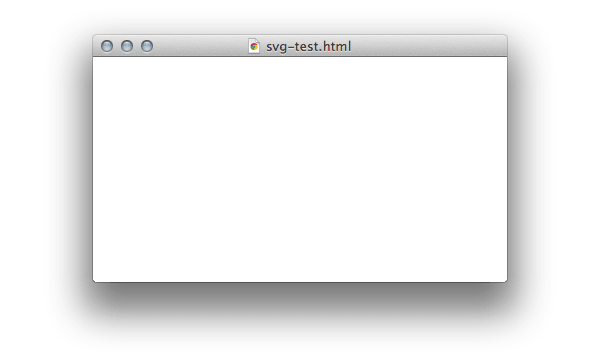
This file will open in a web browser just fine as it is, but we need to add some HTML “markup” code in order to embed the SVG. There are a few approaches to doing this.
The <img> Tag Approach
Firstly, we can use an image tag (which you might be used to using for JPG, PNG files etc.) pointing to the exact file path within the src="" attribute. Paste this snippet into your HTML file:
<img src="SVG-Test.svg" />
Assuming the file path is correct, your HTML page will open in a browser just like this:

Yes, I know the general effect at this stage is precisely the same as when we opened the SVG directly in the web browser, but now we have much more power! For example, we can immediately make the SVG larger, by using the width="" attribute:
<img src="SVG-Test.svg" width="900" />

This approach is perhaps the easiest, but it does have its problems. Some browsers, for security reasons, will restrict what you’re able to do with the web SVG (with JavaScript, for example). Let’s look at alternatives.
The <object> Tag Approach
Using the <object> tag is similar, but you point to the file path like this:
<object type="image/svg+xml" data="SVG-Test.svg"></object>
The result is precisely the same:
For browsers which don’t support SVG, you can even place a warning within the contents of the <object>, to be displayed if the SVG can’t be:
<object type="image/svg+xml" data="SVG-Test.svg">This browser sucks</object>
Many web designers agree that this approach is the most reliable and flexible way to use SVG within a web page at the moment.
The Inline Approach
We’ve spoken about the XML origins of SVG, and if you open the SVG file with your text editor, you’ll see something like this:

Wow, what a load of nonsense! Actually, once you’re over the initial shock, you should be able to see some sense in amongst it. We can use this XML code inline, by pasting the contents directly into our HTML file.
When you become a bit more familiar with the SVG XML structure, you’ll be able to trim bits out of the file, which all helps file size.
Feel free to remove the <!DOCTYPE> line, the <!-- Generator: Adobe Illustrator comment, and even the <?xml statement, if you feel like it.
All you really need is a simplified version, comprising just a couple of XML tags:
<svg>
	<path/>
</svg>
Our SVG:
<svg version="1.1" id="Layer_1" xmlns="http://www.w3.org/2000/svg" xmlns:xlink="http://www.w3.org/1999/xlink" x="0px" y="0px"
	 width="300px" height="300px" viewBox="0 0 300 300" enable-background="new 0 0 300 300" xml:space="preserve">

	<path d="M220.784,150c0,19.533-6.914,36.214-20.742,50.042c-13.828,13.829-30.51,20.743-50.042,20.743
		c-19.533,0-36.213-6.914-50.042-20.743C86.13,186.214,79.216,169.533,79.216,150c0-19.533,6.914-36.213,20.743-50.042
		C113.787,86.129,130.468,79.215,150,79.215c19.532,0,36.214,6.914,50.042,20.742C213.87,113.786,220.784,130.467,220.784,150z
		 M209.463,150c0-16.421-5.806-30.436-17.416-42.047C180.437,96.343,166.421,90.537,150,90.537c-14.693,0-27.6,4.753-38.72,14.261
		l11.149,11.148l-7.865,8.644l-11.322-11.409c-8.47,10.775-12.705,23.048-12.705,36.819c0,16.422,5.804,30.438,17.415,42.048
		c11.61,11.609,25.626,17.415,42.047,17.415c13.712,0,25.957-4.265,36.732-12.791l-10.199-10.112l7.778-8.643l10.804,10.717
		C204.68,177.514,209.463,164.636,209.463,150z M175.756,177.744c0,7.145-2.521,13.224-7.562,18.236
		c-5.043,5.013-11.106,7.52-18.193,7.52c-7.145,0-13.253-2.507-18.323-7.52c-5.071-5.013-7.605-11.092-7.605-18.236v-15.212
		c-2.882-0.114-5.315-1.18-7.303-3.197c-1.988-2.017-2.982-4.408-2.982-7.174c0-2.708,0.994-5.069,2.982-7.087
		c1.988-2.017,4.421-3.082,7.303-3.198v-38.114c17.861,0,31.315,3.197,40.362,9.593c7.548,5.302,11.322,12.044,11.322,20.225
		V177.744z M124.072,158.729v-13.051c-4.207,0.346-6.31,2.507-6.31,6.483C117.762,156.195,119.865,158.384,124.072,158.729z
		 M152.333,111.28l-17.977-4.148h-5.963v6.31L152.333,111.28z M165.384,119.663l-7-5.186l-29.991,3.284v6.31L165.384,119.663z
		 M170.311,128.824l-2.247-4.84l-39.67,4.754v5.186L170.311,128.824z M171.435,138.418v-4.84l-43.042,4.84H171.435z
		 M171.435,177.744v-35.869h-3.458c0,6.167-0.691,10.473-2.074,12.921c-1.383,2.45-3.774,3.674-7.173,3.674
		c-6.108,0-9.162-5.532-9.162-16.595h-21.175v35.869H171.435z M146.802,173.681h-3.198v-24.027h-12.187v-2.938h15.384V173.681z
		 M138.678,151.728l-2.939,3.112l-2.506-3.112H138.678z M159.68,186.559v-3.371h-19.532v3.371H159.68z"/>

</svg>
Note: You’ll see our SVG element has a viewbox attribute too; if you’re interested in learning how this works, Kezz Bracey has written a thorough beginner’s guide:

The CSS Background Approach
Using CSS (the styling syntax used in combination with HTML), we can also dictate that our SVG file acts as a background image to an element on our webpage.
We’re pushing the boundaries of this tutorial now, but if you’re interested in learning the basics of CSS, take a look at The Best Way to Learn CSS.
We can use a separate CSS file, linking to it from our HTML document, or we can use <style> tags directly within our HTML. Our styles would look something like this:
html { background-image: url(SVG-Test.svg); }
This style rule states that our SVG file should display as the background to our HTML element.
SVG Files for Cricut Machines
SVG files are also really useful when using a Cricut machine. Now that you’ve explored how to make an SVG in Illustrator, imagine the possibilities!
One of the most important aspects of using imagery for Cricut is the ability to cut out the shapes you need. Thankfully, using Cricut SVG’s ability to store vector data in layers makes SVG a great file choice when importing into Cricut Design Space. This kind of versatility is one of the reasons that SVG files work so well.
To do this, you import the Cricut SVG just like you would with any other image file for Cricut. You’ll find that providing your image had a transparent background, the cutting process will already be done for you. This is especially helpful as many vector programs such as Illustrator can export to the SVG file type.

SVG Files for Cricut and Design Projects
Looking for SVG files for Cricut or other design projects? Then check out Envato Elements! Envato Elements has countless vector assets that you can use in your design projects. Just one subscription and you can download to your heart’s content. There are many SVG documents, ranging from logos to illustrations and design elements.

If you’re looking for some recommendations for SVG vector files, then check out this collection!
1. Creative Technology Logo (AI, EPS, SVG)

This cool logo comes with a web SVG file, making it a great starting point for a new logo or icon design. The simple forms and shape are perfect for any design project you have which needs a clean and crisp look.
2. Let’s Go Explore Logo (AI, EPS, SVG)

This charming T-shirt design comes in a large variety of formats, including an SVG vector file! Use the design as is or pick and choose elements from the design to add to your own!
3. Friends are Forever (SVG, EPS, PNG)

This charming hand-drawn text element is the perfect SVG document to get you started on your next Cricut Design project. Just import the SVG into Cricut Design Space, and you instantly have yourself an SVG vector file project.
4. Coral Icon Series (AI, EPS, SVG)

Check out these fresh and airy autumn season icons. These SVG Illustrator icons come with 85 designs to choose from! Every one of them is an SVG vector file that can be expanded and transformed to suit many project ideas.
5. Vector Flourish Dividers (SVG, AI, EPS)

Looking for even more SVG files for Cricut? Then check out these vector SVG flourish dividers. You get a large variety of different designs which are great for adding some flair to your work. As they come as an SVG document, feel free to scale them as small or as large as you need.
Conclusion
That about wraps up the basics! In this tutorial, we discussed questions like: what is SVG format, how to view SVG files, what is an SVG document, and ways you can view and use SVGs.
If you’ve always wondered what SVG was, but never knew precisely why you should use it, I hope this tutorial has opened your eyes. The potential for this format is huge and is growing all the time thanks to the imagination and technical wizardry of folks in the web and graphics industries.
However, your questions might go beyond things like “what is an SVG file?” Curious about more things you can do with Adobe Illustrator, Cricut, and other SVG file possibilities? Check out these free tutorials on Envato Tuts+.
-
SVGWhat Is an SVG Font? All About SVG FontsLaura Keung
 Adobe IllustratorHow to Use an SVG Color Font to Create a Logo Design in IllustratorAndrei Marius
 Affinity DesignerHow to Make an Isometric Christmas Tree SVG in Affinity DesignerKezz Bracey
 SVGHow to Enhance Your Website Layouts With SVG ShapesGeorge Martsoukos
 SVGIntroduction to SVG FiltersAdi Purdila
 SVGHow to Make an Animated Beating Heart with SVGIan Yates

{excerpt}
Read More
15 Top Infographic Video Templates to Animate Data With Premiere Pro
{excerpt}
Read More