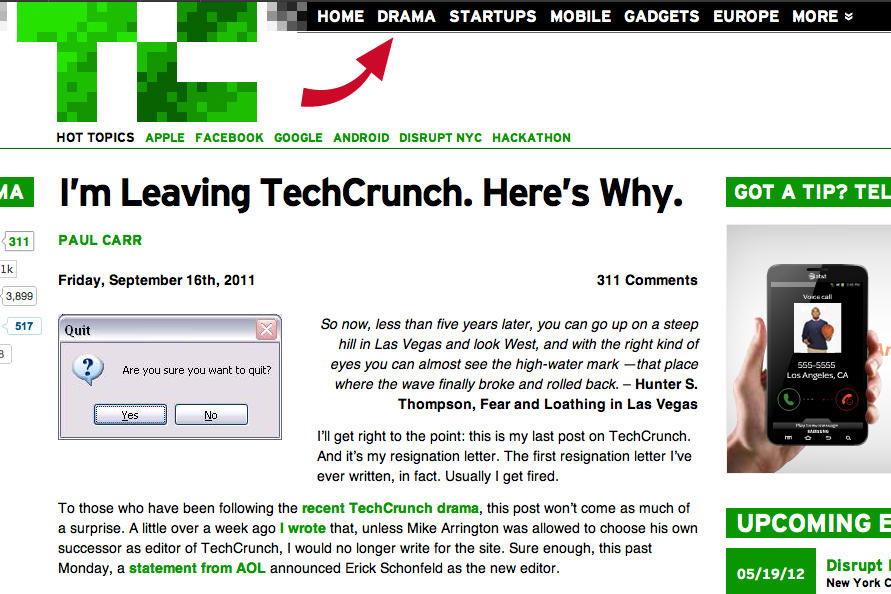
Tired Of Straight Tech News? Check Out Techcrunch.com/Drama

tc-drama

We know that many of you visit TechCrunch on the regular for a hearty dose of startup coverage, general tech news and opinionated coverage of the tech zeitgeist.

But we also know that the trainwreck posting on our hirings and firings, Aol spats, tech gossip and quibbles between staff is what really gets your fingers clicking and blood boiling.

I mean, it’s like a car accident, you can’t help but stare.

So to cater to everyone who just visits here just for the drama, we’re today launching a drama-only new channel, TechCrunch.com/Drama, where you can find such conflict-infused fare as “I’m Leaving TechCrunch. Here’s Why” or “How The Hell Is It My Fault?” or “CrunchPad Federal Lawsuit Filed; Some Additional Thoughts.”

But it’s not just about navel-gazing and staff changes (though there’s plenty of that) certain actual news also qualifies as dramatic, simply by virtue of the spools and spools of comment threads it produces, e.g. the leaked Twitter documents.

There’s not really a way to define what constitutes a “dramatic” post, other than when it hits it causes an Internet explosion.

We’ve heard time and time again that you’ve missed TechCrunch’s “swagger,” and we agree; So the next time your eyes glaze over while reading the umpteenth re-written press release, click on the “Drama” link up there on the navigation bar and relive some our site’s most superfluous, gut wrenching and annoying coverage.

You know you love it.


Dwayne “The Rock” Johnson On Social Media And His Favorite Tech [TCTV]

puopolo the rock

Editor’s note: Guest contributor Joseph Puopolo is an entrepreneur and startup enthusiast, who blogs on a variety of topics including green initiatives, technology and marketing. Follow him on Twitter @jpuopolo.

It’s the eve of WrestleMania 28, and I got a chance to meet with Dwayne “The Rock” Johnson. What does that have to do with tech? Well, in the video interview, Johnson shares his thoughts on how social media has changed the game, what is his favorite tech and how he uses it to engage his fans.

Johnson says he launched his Twitter account a little more than a year ago, and that it’s “one of the greatest things” he’s ever done, because it gives him a way to connect directly to fans.

“A lot of people would have had a team coming in … these great business minds, but I wanted to strip away the business of it all,” he says.

You can see more, including a peek at Johnson’s iPhone, in the video above. (The background noise is a little loud at first, but Johnson comes through loud and clear.)


The ‘So What’ Of The Quantified Self

so what

Editor’s note: Tim Chang is a managing director at Mayfield Fund. This is the second in a three-part series about the Quantified Self movement. Follow Tim on Twitter @timechange.

Assuming that each of us has a picture of the “real world superhero” we want to become someday, then the optimal way to level up and reach that goal begins with the ability to measure and score our lives. Thankfully, new technologies in mainstream gadgets like iPhones and the Nike+ enable this kind of measurement, and are fueling the so-called Quantified Self movement, starting with the continuous tracking of various aspects of our physical bodies.

Using sensors in our smartphones and other wearable devices, we can chart how many calories we burn, our body fat percentage, how many steps we take in a day, how long we sleep — even how many hours a week we spend commuting or sitting at a desk. Soon we’ll be able to access the same kind of statistics on our digital selves: Social reach and influence; tastes and preferences; achievements; credibility and reputation; habits; expertise.

All that information at your fingertips at all times theoretically allows you to carefully chart a path for improvement—and share your winning strategy and stats with others. On a grand scale, that makes for an interconnected world of healthier, happier people making much more informed decisions.

Make it Seamless, Make it Mainstream

The Quantified Self movement is made possible by ubiquitous, low-cost, and always-on connected sensors. The real key for successful measurement and tracking solutions is to make them seamless, meaning that there’s minimal friction and initial behavior change for the user. Consumers don’t want to wear clunky, ugly, embarrassing, or uncomfortable devices, nor will they tolerate products that require them to change their daily routines to input lots of stats or data themselves. If behaviors and signals can be measured in the background or with minimal disruption to existing habits, then users can be on-boarded easily and are more likely to accept the idea of being tracked continuously for long periods of time.

Once users are being measured and quantified, the data must be interactive and easy to understand. The users need to be able to look at their data in ways that are interesting to them, but also know what to do to influence their measurements and scores.

Basis cleverly embeds a heartbeat sensor in a watch (a form factor that’s already familiar to people and non-disruptive to wear) and then offers analytic tools that motivate them to make changes based on the data.

When I tried out the Basis demo, it overlaid my heart rate with my Outlook calendar and even told me which meetings (and people) were stressing me out the most (!). There were other surprising insights: I learned that when I hit stop and go traffic on Highway 101, my heartrate often spikes into the 90s from silent, internalized road rage. Those are the sorts of self-discovery insights that make the Quantified Self experience so rewarding. Numbers, presented with useful context, provide an immediate path to better control over my own life.

Zimride, a service that pairs up car drivers and commuters looking for rides, also uses the Quantified Self to incentivize users. If I frequently commute down to San Jose and I’m known to be on time, I build a reputation score through my riders that makes me valuable and desirable to other potential riders, who pay me for the trip. My punctuality is quantified, I feel good about myself by seeing my score go up, and I’m motivated to keep increasing my status and show it off. I can also see a running tally of how much pollution I have spared the atmosphere by eliminating another vehicle from the road.

Insight, Not Data, is the Key

When it comes to productizing these solutions for consumers, it’s important for entrepreneurs to remember to package their offerings not as Analytics, Data or Tools, but instead to sell Insights from the numbers. That’s where I think Quantification can move away from just efficacy and become about taking control of your own life. The emotional value of that is what people pay for.

Astrologists, fortune tellers and even management consultants remain popular today for a simple reason: Most people would rather be told what the big takeaways are, what they really need to worry about and what exactly to do next. This kind of “so what?” is ultimately more valuable in the eyes of the consumer. (Anecdotally, I’ve seen enterprises pay 10 times more for business insight reports and consultations than for self-service analytics tools).

Furthermore, the richer the data set one can draw from, the more interesting the potential insights to be gained, which leads me to my new business mantra: “proprietary data equals power, but insights equals gold.”  So while it’s important to build up a data set comprised of useful and complementary signals, it’s the “so what?” that allows you really make money from the numbers.

Hungry Games?

Despite the growing buzz and proliferation of new gadgets and apps in QS, I have found that much of the initial innovation and entrepreneurial activity has been around tracking physical activity (“calories out”).  However, I’m personally on a quest to tame what I think is the most elusive beast of all: “calories in.”  Most common medical problems stem from our eating habits, but there really isn’t an easy way to seamlessly and accurately capture the data about the food we ingest each day, short of implanting a sensor into the body to track caloric intake (which violates the low-friction requirement for an effective QS solution).

Many food-tracking apps ask users to input or tag each item they eat (too much work for most people), and some even attempt to identify nutritional data from photos (not accurate enough via automation). If we can’t find a seamless, automatic method to accurately quantify what we’re putting into our bodies, then perhaps we can leverage the interactive, social and fun aspects of Gamification to get users to play along and enter the data needed?

As an example, each day I play a game of “Foodville” with myself: I set a target # of points (calories) each day, and I get to spend them however I like for as long as I don’t exceed my 24 hour limit. As I’m about to eat or drink something, I think about the number of calories I’m about to spend on that item (usually glancing at the product packaging, or doing a quick Google mobile search to look up approximate nutritional info), and then take a mental note of my remaining point budget. At the end of the day, I feel great about meeting my target and advance one day closer to weekly Cheat Day, or else push off Cheat Day until I qualify again. Each week that I stay on plan I count towards my “winning streak,” which culminates in an Amazon shopping splurge that I treat myself to

Although it was a pain at first to look up caloric values for everything I ate or drank, I found that after several weeks I developed a sixth sense for nutritional data, and could pretty much ballpark the point count for most everything I ate.  As I got deeper into Foodville, I layered on advanced missions to maximize lean protein and fiber, and minimize net carbs and sugar.

It turns out that this is the same approach that Weight Watchers has been using for decades – I simply think about it as a game and try to layer in “boss battle” and “epic win”-style levels and rewards for myself.  Unfortunately, I’m only playing Foodville in my mind, and don’t have a simple, gamified app that I can share or play with others.  Perhaps a slick app encompassing elegant use of social and game mechanics would enable multiplayer modes, P2P pressure/obligation/guilt loops, use of Seven Deadly Sin motivators, progressive and adaptive leveling, and other tools to make Foodville palatable and easier to begin playing for mass audiences? I’m hoping to see clever QS + gamification designers team up to come up with such apps, and someday seeing the Top 25 charts dominated by titles like:

  • Angry Burns: Spice
  • Where’sMyWater(cress)
  • Cut the Coke
  • FruitSlicer
  • Plants vs. Breads
  • Food With Friends
  • DrinkSomething(Sugar-Free)
  • DinnerDash


Gillmor Gang: Daddy, What’s Microsoft?

Gillmor Gang test pattern

The Gillmor Gang — Robert Scoble, John Taschek, Rob La Gesse, Kevin Marks, and Steve Gillmor — rode out of Dodge and straight into an ambush. Well, no, but in service of the OverAggregator Lord here are our talking points: Microsoft trembles at the alter of irrelevance, Google doesn’t get TV but may sneak into the tablet market by giving them away, and HTML5 still can’t get a date.

I snuck in the usual mentions of Mad Men and push notification, the first a reference to the return of the mesmerizing prequel to Seinfeld, and the second the technology that ensures that you don’t have to watch the stream all day to stay up with what’s going on. Combining delayed gratification theatre with premature notification will produce the next big hit of the iPad Age.

@stevegillmor, @scobleizer, @jtaschek, @kr8tr, @kevinmarks

Produced and directed by Tina Chase Gillmor @tinagillmor


So Long, And Thanks For All The Quantum Research

dodo

I’d like to be an optimist, like Matt Burns. I really would. Like Research In Motion itself, I was born and raised in Waterloo, Ontario. Like its former co-CEO Mike Lazaridis, I studied electrical engineering at the University of Waterloo. I’ve seen RIM transform my home town over the years, giving it new parks, new buildings, huge bequests for the university, and the Perimeter Institute for Theoretical Physics. I’d love to see it survive its current dire straits and somehow thrive. But I just can’t see it happening.

I guess it’s still just barely possible to maintain optimism. This was the first quarter since their rise that they’ve reported a loss; they can still spin that into a Rocky-esque down-but-not-out narrative, as long as they rearrange a few deck chairs. But as Paul Graham recently pointed out, “revenue is a lagging indicator in the technology business.” Revenue down 25% year-over-year, for a tech company of RIM’s size, in one of the hottest markets in the world? That’s not a setback, that’s a catastrophe.

Realistically, what are their possible futures now?

  1. They mount an Apple-like comeback;
  2. They limp on, maintaining a 5-10% market share;
  3. Somebody buys them, or at least, their crown jewels;
  4. They slowly diminish into distant irrelevance.

Any other options? Not that I can see.

We can write number 1 off immediately. Apple did it! people say. Yes, but that’s the exception that proves the rule. Even if BB10 is to RIM what OS X was to Apple, that won’t be near enough. OS X alone wouldn’t have turned Apple into a winner. Apple transformed itself from doormat to behemoth by creating not one, not two, but three megahit brand-new markets — iPod, iPhone, and iPad. It’s hard to imagine RIM coming up with even one new game-changer. I suppose it’s possible, just, but I sure wouldn’t bet on it.

Limp on with a 5% market share? How? They’re not even the third choice any more; Windows Phone is. Their only bright spots are emerging markets, where cheap Android devices will be eating their breakfast, lunch, and dinner before long, and those businesses so security-conscious that they still see RIM’s private secure network as an advantage rather than a liability.

But secure email, even if it’s the best secure email in the world, just isn’t enough to be competitive these days. You have to be able to do more, and to do it at least as well as the competition. RIM’s most fundamental problem is their technical ineptitude. Remember when they released the PlayBook? I do: my very first TechCrunch post was about its inevitable doom. How sadly right I was. Remember David Pogue’s NYT review?

You read that right. R.I.M. has just shipped a BlackBerry product that cannot do e-mail. It must be skating season in hell. (R.I.M. says that those missing apps will come this summer.)

Note that last line. That review was written in April 2011. When did those “missing apps” finally arrive? That’s right: last month. Let’s not even talk about the ongoing debacle of their third-party apps. How about the BlackBerry Colt, the new BBX – I’m sorry, BB10 – device that was supposed to have launched by now? Oh, that’s right; it was cancelled.

So when will those BB10 devices arrive? In the second half of this year. Maybe. You know, just in time to compete with the iPhone 5 and Galaxy S III. Meanwhile, bring-your-own-device policies grow ever more popular, and Android/iOS enterprise solutions get better and better. Every passing month feels like another nail in RIM’s coffin.

I keep hearing people talk about RIM as if a management change, or a strategy change, might be enough to save the company. But I believe the reason their products are vastly inferior to their competitors, and are regularly crippled by huge schedule delays, is that RIM’s technical braintrust is simply not up to the job of competing with Apple and Google. It’s not a question of direction, or focus; it’s a question of ability. And that’s a predicament no new CEO can solve. “BlackBerry cannot succeed if we try to be … all things to all people,” he says — but their real problem is that they’re well on their way to being nothing to anybody.

So forget about them coming back like Apple. Forget about them maintaining third-choice market share; Microsoft — which knows a thing or two about selling to businesses — is busy elbowing their way into that role while RIM dithers, swoons and languishes. So we’re left with survival option 3, someone buying them. But who? Their patent trove, sure. But their operations? Who wants to splash out billions of dollars to catch this falling knife, especially after HP’s WebOS debacle? Samsung apparently kicked the tires and walked away. Who else? I can’t think of a single name.

Which leaves us only option 4: softly and silently withering away, until they’re small enough for carrion eaters to pick over the bones of the carcass. It’s a damn shame, but it now seems to me inevitable. You had a great run, RIM. Thanks for all your good work back home. Sorry it couldn’t last.

Image credit: Dodo bird, by mwanasimba, on Flickr.


(Founder Stories) Kayak.com’s Paul English: On Hiring Athletes, Design Simplicity & Angel Investing [TCTV]

Kayak Video 2 Out.mov

In part II of his Founder Stories interview with host Chris Dixon, Kayak.com’s co-founder Paul English discusses why job applicants will be hard pressed to find job postings on Kayak.com, relays the lessons he learned from Kayak’s mobile app and tells Dixon the traits founding teams need to possess in order to impress him as an angel investor.

Having helped grow the company to roughly 150 employees, English says Kayak is somewhat unorthodox when it comes to hiring talent. “We don’t hire for open positions but we are looking for athletes, we are looking for star performers and then when we find someone great, we make a spot for them.” He adds, “I am always recruiting.”

In addition to beefing up staff, Kayak has expanded into mobile, which accounts for “almost 20-percent of our traffic” says English. Initially weary that its mobile platform would be a watered-down version of its website, English’s fears have been swept aside. “The team that we hired to build our iPhone product actually found a way to build the version of Kayak that has all the same power of Kayak but is expressed in way that was actually more simple than our website.” He adds, “I think the design experience we have learned on the iPhone, which is to force simplicity, because you have less real estate, has caused us to rethink how we do design on the web.”

English wraps the interview by telling Dixon key lessons he’s learned as an entrepreneur and offers what he looks for when investing in startups.

Make sure to watch the entire video to hear all his insights, and watch episode I of this interview here.

Past episodes of Founder Stories featuring founders ZocDoc, Charity: Water, Turntable.fm, Bump, Birchbox and many other companies are here.


Is Technology A Zero-Sum Game?

pacman

Editor’s note: Contributor Ashkan Karbasfrooshan is the founder and CEO of WatchMojo, he hosts a show on business and has published books on success.  Follow him on Twitter @ashkan.

In last week’s Get Rich or Die Trying article, I mentioned that “tech is a zero-sum, winner takes all game”.  A reader objected, arguing: “I think that may be an inappropriate use of the term ‘zero-sum’ – one company’s increase in profits (or revenue) does not mean a competitor must see declining profits (or revenue)”.

History suggests that Jack Welch’s philosophy that “a company should be #1 or #2 in a particular industry or else leave it completely” is even more applicable to the tech industry, where the top player can build a sustainable and ever-growing business but everyone else is practically better off getting out.

Examples of market dominance by the #1 that come to mind include:

–          Google in search,
–          Facebook in social networking,
–          Groupon in daily deals, and
–          Amazon in e-Commerce.

This doesn’t mean that the:

–          #1 player isn’t susceptible to the Innovator’s Dilemma, or
–          #2 competitor can’t build a massive business.

Indeed, Microsoft’s Bing or LivingSocial are meaningful #2’s in search and daily deals respectively, but clearly the network effects and economies of scale that come with market share dominance make it nearly impossible for challengers to remain relevant over-time. Monopolies are nothing new and come and go: Google is the evolution of Standard Oil, AT&T and Microsoft in search, you can argue that Apple is next in line in mobile.

What is Zero-Sum Game Anyway?

First, the definition:

“In game theory and economic theory, a zero-sum game is a mathematical representation of a situation in which a participant’s gain (or loss) of utility is exactly balanced by the losses (or gains) of the utility of the other participant(s). If the total gains of the participants are added up, and the total losses are subtracted, they will sum to zero.”

Indeed, while the tech sector is huge, within each segment, you see a zero-sum game from each individual purchasing decision out.  For example,

–          a consumer will buy a Mac or PC; an iPhone or Android device, etc.
–          a business will adopt a solution from Oracle or Siebel, for example,

But it’s rare for a consumer to buy or a company to adopt both.

If you repeat this binary-like decision process throughout the industry and economy, you get a zero-sum situation where one competitor’s gains come at the expense of others’ in the industry: Apple’s iPhone sales obviously put a dent in the Blackberry; and its iPads are evidently going to affect PC sales – no matter how much some want to deny it.

It’s Like This in Most Industries, The Only Difference Is Severity

I run an online video content company and categorize video companies into four quadrants:

–          Content (creators),
–          Distribution (search, distribution),
–          Technology (content management systems, content delivery networks), and
–          Advertising (ad networks, servers)

Clearly there’s a lot of overlap and how those four interact with one another merits an article in of itself (or hundreds).  While technology (with a lower case) enables Content companies, it increasingly underpins Distribution, Technology and Advertising companies.

As such, I see this zero-sum phenomenon every day with the latter three.  When TechCrunch’s parent AOL bought 5Min for example, it was a matter of time before AOL stopped licensing Brightcove’s Online Video Platform and instead use 5Min’s player.  Seeing how AOL and 5Min were my distribution partners, I kept that thought to myself, but it was a matter of time.  Today AOL’s main platform for video is indeed 5Min (note: I am not an AOL/5Min employee).

Content Isn’t a Zero-Sum Game: “I’m Your Pusher”

In content, it’s not really like that. ABC, CBS, FOX, NBC all have meaningful franchises.  Sure, if you watch FOX on Sunday at 6pm then you may not watch ABC at that time, increasingly with cord-cutting and time shifting that isn’t the case anymore.  In fact, content is so not a zero-sum game that a company like Viacom has multiple brands to address that reality.

Indeed, if you want to travel to Barcelona, you won’t watch one video or read an article, you will read/watch many and I’d argue that content consumption – like a drug – just creates more demand.

But if you want to book a ticket to Barcelona, you will either use Travelocity or Expedia, for example.

Place Your Bets

That makes content a less-risky endeavor, and, with digital media and digital distribution reducing the marginal cost of production and distribution, then content has become a better risk-adjusted bet, though arguably not as scalable and certainly not a winner-takes-all gamble.

It will take an entire generation before investors realize this; though some argue that it’s already started. According to media guru Jack Myers, “VC funds are being redirected away from tech and toward content. Technology-based venture opportunities in the media and advertising space have been largely played out. Bottom line, venture capital funds will be shifting from technology to content, context, commerce and research.”

I’m not holding my breath, even though digital content is effectively the new software.

In Tech, Competition Becomes Blurry Over Time

The same way that the Internet has changed content, it has also changed technology.  For one, with consumer-focused technology companies being free, advertising-supported businesses, the prevailing asset isn’t necessarily the underlying hardware or software, but rather, the audience.

This is why tech companies are all seemingly fighting one another:

–          Facebook vs Google in search and social networking,
–          Google vs Apple in mobile,
–          Amazon vs Apple in tablets and entertainment,
–          Microsoft vs Google in search.

You get the idea: in tech, everyone morphs into everyone’s competitor… and since the main asset – the audience or consumer base – is so fleeting, tech becomes an even riskier bet.

The Four Horsemen

Whereas initially the Web pitted “content vs. tech”, as the Web matures, it becomes “tech vs. tech” with Content becoming Switzerland amongst Distribution, Technology and Advertising companies.

In the real world, there is no perfect example of a zero-sum game – granted.  But whereas Jack Welch argued that a business ought to be #1 or #2 or get out, the network effects that the web has unleashed over time force technology (lower case) businesses to either be #1 or get the hell out.


Why Google Might Be Going to $0

google

Editor’s note: James Altucher is an investor, programmer, author, and entrepreneur. He is Managing Director of Formula Capital and has written 6 books on investing. His latest books are I Was Blind But Now I See and FAQ MEYou can follow him on Twitter @jaltucher.

Ken Lang could perform miracles. In 1990 we would head off to a bar near where we were going to graduate school for computer science, and we would bring a Go board. Then we would drink and play Go for five hours. At the end of the five hours, after a grueling battle over the board, I remember this one time when magically Ken would show up with two girls who were actually willing to sit down and hang out with two guys who had a GO BOARD in front of them. How did Ken do that?

Fast forward: 1991, CMU asks me to leave graduate school, citing lack of maturity. The professor who threw me out still occasionally calls me up asking me when I’m going to be mature enough.

Fast forward: 1994, one of our classmates, Michael Mauldin is working on a database that automatically sorts by category pages his spider retrieves on the Internet. The name of his computer: lycos.cs.cmu.edu. Lycos eventually spins out of CMU, becomes the biggest seach engine,  and goes public with a multi-billion dollar valuation.

Fast forward: Ken Lang starts a company called WiseWire. I was incredibly skeptical. I read through what the company is about. “No way,” I think to myself, “that this is going to make any money”.

1998: Ken files a patent that classified how search results and ad results are sorted based on the number of click-thrus an ad gets. He sells the company to Lycos for $40 million. Ken Lang becomes CTO of Lycos and they take over his patents.

$40 million! What? And then Lycos stock skyrockets up. I can’t believe it. I’m happy for my friend but also incredibly jealous although later in 1998 I sell my first company as well. Still, I wanted to be the only one I knew who made money. I didn’t think it was fun when other people I knew made money. And, anyway, weren’t search engines dead? I mean,what was even the business model?

Fast forward: the  2000s. Almost every search engine dies. Excite, Lycos, Altavista. Before that “the world wide web worm”. Lycos got bought by a Spanish company, then a Korean company, then an Indian company. To be honest, I don’t even know who owns it now. It has a breathing tube and a feeding tube. Somehow, in a complete coma, it is being kept alive.

One search engine, a little company called Google, figured out how to make money.

One quick story: I was a venture capitalist in 2001. A company, Oingo, which later became Applied Semantics, had a technique for how search engines could make money by having people bid for ads. My partner at the firm said, “we can probably pick up half this company for cheap. They are running out of money.” It was during the Internet bust.

“Are you kidding me, “ I said. “they are in the search engine business. That’s totally dead.” And I went back to playing the Defender machine that was in my office. That I would play all day long even while companies waited in the conference room. (See: “10 Unusual Things I Didn’t Know About Google, Plus How I Made the Worst VC Decision Ever“)

A year later they were bought by Google for 1% of Google. Our half would’ve now been worth hundreds of millions if we had invested. I was the worst venture capitalist ever. They had changed their name from Oingo to Applied Semantics to what became within Google…AdWords and AdSense, which has been 97% of Google’s revenues since 2001. 97%. $67 billion dollars.

Don’t worry.  I’m getting to it.

(Yahoo won hundreds of millions from Google on the Overture patent even before Google amassed the bulk of their $67 billion in overall revenues from AdWords)

Fast forward. Overture, another search engine company that no longer exists (Yahoo bought it) files a patent for a bidding system for ads on a search engine. The patent office says (I’m paraphrasing), “you can file patents on A, B, and C. But not D, E, and F. Because Ken Lang from Lycos filed those patents already.”

Overture/Yahoo goes on to successfully sue Google based on the patents they did win. Google settled right before they went public but long before they achieved the bulk of their revenues.

Lycos goes on to being a barely breathing, comatose patient. Fast forward to 2011. Ken Lang buys his patents back from Lycos for almost nothing. He starts a company: I/P Engine. Two weeks ago he announced he was merging his company with a public company, Vringo (Nasdaq: VRNG). Because it’s Ken, I buy the stock although will buy more after this article is out and readers read this.

The company sues Google for a big percentage of those $67 billion in revenues plus future revenues. The claim: Google has willfully infringed on Vringo – I/P’s patents for sorting ads based on click-throughs. I remember almost 20 years ago when Ken was working on the software. “Useless!” I thought then. Their claim: $67 billion of Google’s revenues come from this patent. All of Google’s revenues going forward come from this patent. And every search engine which uses Google is allegedly infringing on the Vringo patent and is being sued.

Think: Interactive Corp (Nasdaq: IACI) with Ask.com. Think AOL. Think Target which internally uses Google’s technologies. Think Gannett, which uses Google’s technology and is also being sued. Think, eventually, thousands of Google’s customers who use AdSense.

Think: “willfully”. Why should you think that? Two reasons. Overture already sued Google. Google is aware of Yahoo/Overture’s patent history. The patent history officially stated that Ken Lang/Lycos already has patented some of this technology.  What does “willfully” mean in legal terms? Triple damages.

Why didn’t Lycos ever sue? After Lycos had its massive stroke and was left to die in a dirty hospital room with some uncaring nurse changing it’s bedpans twice a day, Google was STILL Lycos’s biggest customer. Why sue your biggest customer? Operating companies rarely sue other operating companies. Then there are countersuits, loss of revenues, and all sorts of ugly things. The breathing tube would’ve been pulled out of Lycos and it would’ve been left to die.

Think: NTP suing RIMM on patents. NTP had nothing going on other than the patents. Like Vringo/Innovate. NTP won over $600 million from RIMM once Research in Motion realized this is a serious issue and not one they can just chalk up to a bad nightmare.

(the beginning of the end for RIMM)

Guess who NTP’s lawyer was? Donald Stout. Guess who Vringo’s patent lawyer is? Donald Stout. Why is Donald Stout so good? He was an examiner at the US Patent Office. He knows patents. They announced all of this but nobody reads announcements of a small public company like Vringo. It’s hard enough figuring out how many pixels are on the screen of Apple’s amazng iPad 3.

Well, Google must have a defense? Even though their AdWords results are sorted by click-throughs in the way described by the patent maybe they sorted in a different way (a “work-around” of the patent), and didn’t infringe on the patent.

Maybe: But look at Google economist Hal Varian describing their algorithm right here in this video. And compare with the patent claim filed in court by Vringo. You decide. But it looks like the exact same to me.

Maybe: But does Google want to risk losing ten billion dollars plus having all of their customers sued. The district the case is getting tried in rules 70% in favor of the plaintiff in patent cases. Most patent trials get settled on the court steps.

Maybe: But then there’s still Microsoft /Yahoo search which, by the way, sorts based on click-throughs and has not been sued yet.

Guess what? Google’s patent lawyer is Quinn-Emmanuel. They are defending Google. Oh, and here’s something funny. Guess who Yahoo’s lawyer is? Yahoo is suing Facebook for patent infringement in the search domain. Quinn-Emanuel. So the same lawyer is both defending and accusing in the same domain. Someone’s going to settle. Everyone will settle. If anyone loses this case then the entire industry is going down in the same lawsuit and the exact same lawyer will be stuck on both sides of the fence. I’m not a lawyer but that smells. The trial is October 16 in the Eastern District Court of Virginia and will last 2 weeks. An appeal process can take, at most, a year.

I’ve known Ken for 23 years. I’ve been in the trenches with him when he was writing what I thought was his useless software. I watched his company get bought and we’ve talked about these technologies through the decades.

I’ve read the patent case. I watched Hal Varian’s video. Also look at this link on Google’s site where they describe their algorithm. Compare with the patent claim.  I have a screenshot if they decide to take it down. $67 billion in revenues from this patent. Imagine: double that in the next ten years. Imagine: triple damages.

Vringo will have an $80 million market capitalization post their merger with I/P. NTP won $600 million from RIMM using the same lawyer. RIMM’s revenues are a drop in the bucket compared to Google. And compared to 1000s of Google’s customers who will be embarrassed when the lawyer shows up at their door also. That’s why I made my investment accordingly. Is Google going to take the risk this happens?

I doubt it.

You can think to yourself: “ugh, patent trolls are disgusting”. But the protection of intellectual property is what America is built on. Smart people invent things. Then they get to protect the intellectual property on what they invents. Other companies can’t steal that technology. That’s why we have such a problem outsourcing to China and other countries where we are worried they might steal our intellectual property. Patents are the defense mechanism for capitalism.

Ken can perform miracles. But no miracle would save me. At the end of one evening of Go playing and beer drinking in 1990 we gave two girls our phone numbers. I don’t know if Ken ever got the call. I didn’t. But I guess I’m happy where it all ended up.


Here Are The Women of Y Combinator And They Are Awesome

Olga-Vidisheva

I would normally rather have a root canal instead of write about the issue of women in technology. I just find most essays on this really tedious and obvious. (Sorry Alexia.)

But I do want to point one thing out. When I went to my first Y Combinator Demo Day three years ago, there was one woman. At this week’s Demo Day, there were six companies with one or all female founders among the 66 startups in the class.

I’m going to keep this post simple. No complaining. Less navel gazing. Just more role models. So here are the women of Y Combinator and they are awesome. (Update: We’re missing one at the moment, but Somaira Punjwani of MedMonk will hopefully be added soon.)

And ladies, if you’re interested in joining the next class, the deadline just passed. But there are two classes a year, so the next one will come up soon.

Nikki Durkin, 99Dresses

Durkin wrote her first business plan when she was eight years old. As a girl growing up in the Australian countryside, she desperately wanted a horse. After begging didn’t work, she biked down to her local co-op, determined the price of hay, calculated out operational expenses and wrote a cost-benefit analysis, even sticking in a risks section just in case the horse died.

“Ever since then, I’ve been pretty good at figuring out how to get what I want,” she said.

At 15, she and her thirteen-year-old brother started their first online business called KultKandy, where they designed T-shirts and drop shipped them from China.

While in college, she came up with a concept around dress swapping. She put her idea on Facebook and sent it out to friends in Sydney. In less than three weeks, suddenly 20,000 women signed up from around the country.

“It wasn’t really planned out to the nth degree, but it really resonated,” said Durkin, who is now 20 years old. “Girls absolutely loved it.”

The idea was to have a market where women post pictures of their clothing and swap it. The seller would set the price and handle shipping costs. Instead of using a real currency, Durkin wanted to use a virtual one so that the experience would really feel guilt-free. She asked the community for a name for the virtual currency, and they came up with “Buttons,” for which she now charges $1 a piece.

Within four months, women had uploaded 4,500 dresses and sold 3,500. She hadn’t even heard of Y Combinator until a business adviser Matt Barrie, who is the chief executive of Freelancer.com, told her about it.

“I told him that I’d love to get into the American market but I didn’t have any of the connections or a tech team,” she said. She rounded up a technical co-founder, applied, got in and moved all the way from Australia to the Bay Area. “There’s a lot of potential here,” she said.

Tracy Young, PlanGrid

Growing up in Silicon Valley, Young was always fascinated by buildings. While working as a civil engineer on constructing hospitals, she was intrigued by the little curiosities that told a story about every building.

Like why did a hospital need to have video cameras on every corner of its third floor? (It was to guard infants in the maternity ward.)

“I love learning about how and why buildings are structured in the way that they are,” she said. She added, “Nothing compares to the smell of drywall dust and seeing people work together to build something that’s useful.”

But being a civil engineer wasn’t quite enough. Growing up just miles away from the headquarters of companies like Apple and Google, Young had the entrepreneurial itch.

“It’s pretty hard to grow up in this area and not want to start your own business,” she said.

Young started with what she knew best. The construction industry had horribly outdated software that often cost firms north of $100,000.

“There’s a really small overlap between construction and hackers,” she said. “Construction software is just notoriously bad so we knew that we could do better.”

On top of that, she and her co-founders estimated that for every $1 million spent on construction projects, about $3,500 of it would go just toward printing blueprints.

“Blueprints are constantly changing so they’re always being reprinted,” she said, adding that one $240 million hospital project she had worked on had budgeted $1 million just for blueprints.

So she co-founded PlanGrid with one other civil engineer and two hackers. They’ve started with an iPad app that lets people save and share blueprints with others. They use a freemium model with prices that range from totally free to about $50 per month. So far the app is spreading by word of mouth and it has 3,500 users and 1,000 projects on it.

“I don’t believe that Steve Jobs realized how he was going to completely disrupt the construction industry with the iPad,” she said. “Now a construction superintendent can bring a computer out to the field that’s light enough to carry in a bag and has enough battery power to last the whole day.”

Young says the company has other ideas in the works for managing bids, estimates and workflows. PlanGrid is in the process of closing their angel round.

Olga Vidisheva, Shoptiques

After making her way to the U.S. as a teenager from Kyrgyzstan and Moscow following the collapse of the Soviet Union, Vidisheva didn’t have much money to pay for living expenses and tuition at pricey Wellesley College. So she modeled on the side, doing everything from wearing Ben Sherman to appearing in vacuum cleaner ads.

And while she was at that, she graduated Phi Beta Kappa and landed a job out of school as one of two women out of around 100 men in her investment banking group at Goldman Sachs.

Both the modeling and the banking experience are now paying off. Today she’s running Shoptiques, an e-commerce play that brings high-end boutiques online. Even before Demo Day, the company’s seed round was snapped up by three of Silicon Valley’s top tier venture firms including Greylock Capital, Andreessen Horowitz and Benchmark Capital.

Vidisheva’s modeling helped her understand how to present merchandise and do high-end photography for her clientele.

“Very highly curated models can work well,” she said, pointing to models like Fab, a design-centric flash sales site. “We’re creating a market for tastemakers.”

Shoptiques handholds sometimes very tech shy fashion boutiques onto the web. Vidisheva’s startup eats the up-front costs of building the e-commerce presence and photographing the apparel. The company sends these shops the shipping labels, provides the tracking analytics and handles payment processing. Naturally, Shoptiques intends to make its money back through a revenue share on sales. It’s just launched with 50 stores around the U.S.

While at Harvard Business School, she researched the plan for what would become Shoptiques for well over a year.

“I saw this huge gap in the market,” she said. “I wouldn’t have been able to breathe if I wasn’t doing this business.”

Paul Graham, Y Combinator’s co-founder, paired her with some alums who were behind Anyvite, an events invitation startup that came out of a mid-2008 class. Dan and Jeff Morin were thinking about next steps with their company, and Graham suggested they meet Vidisheva. After trial run where they worked together for a few weeks, they joined full-time on the startup.

“PG is amazing at figuring out people who will work well together,” she said.

Elli Sharef, HireArt

Growing up in Colombia, Sharef was lucky to have a strong female role model right by her side. Her mother had a Ph.D. in economics

“She’s a strong figure with opinions and she was an intellectual,” Sharef said. “I never thought about being a man or woman. She just told me to be ambitious, to do my thing and try and build something good for the world.”

Sharef’s company is attacking the HR and recruiting space. She’s a co-founder of HireArt, which is trying to ease that first step of sifting through an impossible number of resumes.

HireArt has job candidates actually perform a series of tasks or do video interviews. For example, if an interview candidate says they are an expert in Excel, they can demonstrate their skills on HireArt by creating an Excel model using a dataset.

“I saw how hard it was to hire the right person. Everyone knows that the right person can 10X your team,” she said. “At the same time, it’s equally bad when you don’t hire the right person. It can be really terrible.”

HireArt’s site is growing 40 percent week over week and currently has 238 open positions. The company earns revenue every time a candidate is successfully placed, the way a good recruiter might earn a fee or a salary percentage if they find a good hire.

To get into Y Combinator, Sharef came together with a few friends from her university days at Yale: Dain Lewis and Nicholas Sedlet.

There’s a question of how easy it will be to scale HireArt’s model given the idiosyncrasies of hiring and finding a good cultural fit between employees and employers.

Sharef says that over time, the company will collect more and more data from employers about interview questions or tests that are strong predictors of success.

“We really try to work with data to understand which questions work the best. You can think about it like designing the SATs for different jobs,” she said, pointing out that one of her co-founders has experience working with huge data sets as a commodities trader and quant.

Kathryn Minshew, Alex Cavoulacos and Melissa McCreery of The Daily Muse

This trio met on their first day at consulting giant McKinsey. After finding that they worked well together through their two-year analyst stint, they started thinking about what to do next.

“While we felt like we got a lot of great training at McKinsey, we felt like there wasn’t a go-to resource for young women who wanted career advice,” McCreery said.

They had worked on a previous startup before, but then decided to start over with a new concept called The Daily Muse, a career resources destination for high-achieving young women. They packed it with advice on salary negotiations, interviews and how to manage people for the very first time.

But there was a lucrative piece that was missing — job search. Because the site had started attracting a small, but valuable audience of young women from top-tier universities, employers reached out wondering how they could recruit some of these visitors.

“Talented people choose jobs, not the other way around. So we realized there was a need for us to profile awesome companies,” she said. ”Women and men look at things differently. Women will go to a store and browse. But job search is built around knowing what you want and going after that.”

So The Daily Muse has these immersive company profiles, which tell the story of the company’s culture and explain what it’s like to work there. There are video interviews with current employees and professional photos of the office space. ”We want to be the go-to career resource for young, professional women, and now we’re also helping them discover cool places to work,” she said.

McCreery says that The Daily Muse already has 25 paying companies. Monthly fees are variable, but a ballpark range puts them around $1,500. Then there are another 70 companies that are on the waiting list.

Admittedly, any content-centric play is going to have issues scaling. But McCreery says the team has experience. ”We’ve never seen ourselves as just a media company and we’ve done scaled content before,” she said, saying that the site the team last worked on had 200 writers and a full-time editorial staff of five. The company is working on training three full-time employees to make the company profiles.


Hallmark Greets Digital, Acquires SpiritClips To Let You Send Photo/Video E-Cards

Hallmark SpiritClips

Photos and video can be even more personal than a handwritten card. That’s why Hallmark has just acquired SpiritClips, an online video production and streaming service that also makes personalized digital greeting cards. It looks like Hallmark customers will soon be able to create and send e-cards by uploading their own photos or choosing from video content created by SpiritClips.

Hallmark already has its own line of animated video e-cards, but they’re not very personalized. As more of our intimate connections happen online, the SpiritClips acquisition will let Hallmark stay relevant rather than living off its dead-tree printing business.

SpiritClips has been running a $3 to $5 a month subscription service where users could get streaming access to an array of heartwarming, family-friendly films and documentaries produced by the company and sourced from elsewhere. Customers could also create personalized digital greeting cards where they upload photos and SpiritClips then collates them into videos. Now its content, team, and tech will serve Hallmark customers.

The two companies were already working together, as SpiritClips is the official online, on-demand, and streaming-to-tv provider for Hallmark’s Hall Of Fame inspirational film series. Hall Of Fame has been delivering original content to TV since the 1950′s, and the SpiritClips production staff should make its films even warmer and fuzzier. The startup’s team will continue to operate from its California headquarters rather than moving in with Hallmark in Kansas City, Mo.

While services like Animoto may offer more powerful photo and video editing tools for creating e-cards, they could be too complicated for the average Hallmark customer. Hallmark could use SpiritClips to make it as simple as possible to create e-cards full of user generated content. That way Hallmark could could bring even its least-savvy offline customers into the modern age where 1s and 0s can express love.


“Girls Around Me” Creeper App Just Might Get People To Pay Attention To Privacy Settings

girlsaroundme1

Cult of Mac has a great write-up of an app for iOS called Girls Around Me, which essentially displays the public check-ins and profiles of girls around you. With a little shift in context it could easily be confused for a hot new startup (discoverability meets speed dating!), but no, it really is just a way for guys to creep on nearby girls who have failed to lock down their info.

It’s sad, but maybe something like this is what people need to shock them into understanding just how much information they put online.

The app itself is pretty much straight-up stalker material, but the fact is it uses publicly available information — information that, really, is being deliberately broadcast. There is a larger debate to be had about the nature of privacy and how information like location and profiles should be handled, and many subtle points to be made. But right now it seems that things must be done in broad strokes, and it’s mainly broadly offensive things like this app that will bring attention to the issue.

It’s perfect fodder for evening news debates: “After the break, we talk with our tech experts about a new app that lets you track women in your area without their knowledge.” And that’s a good thing: the more exposure the problem gets, the better. Many of the people being tracked by this app, male and female, haven’t even considered the idea that their movements might be tracked systematically by a stranger.

For example: all these options in Foursquare default to on, which is really fine, since after all the service is about sharing your location. And linking it to your Facebook or Twitter account is a natural step for many. But at the same time it’s easy to fail to understand that one is providing a sort of path that strangers can follow from a face on the street to a name, other photos, current location, and a number of other things.

Girls Around Me is a shortcut for creeps, but it’s not like it had to do anything illegal or complicated to get this information. A handful of public APIs is all it took to put a faces on a map and link them to a trove of personal data.

Apps like this one are distasteful, sure, but they are also important ways to show how exposed many of our friends and peers are. An understanding of social media is not prerequisite to its use, and many are ignorant of the level to which their actions and data are public. With any luck, Girls Around Me and its ilk will convince these people to take their own privacy seriously.

Update: Foursquare has reached out to say that the app was in violation of their API policy, so they’ve revoked access. I feel safer already!


Groupon’s Profit In 2011 Was Actually $22.6 Million Less Than They Previously Said

groupon_logo

Daily deals site Groupon today issued a pretty significant revision of the financial results it previously reported for the fourth quarter and the full year of 2011.

According to the company, it actually made $14.3 million less in revenue during the fourth quarter of 2011 than it previously reported — $492.2 million, compared to the previously stated $506.5 million. It also spent more in operating expenses than it previously said it did — resulting in its Q4 operating income and net income being $30 million and $22.6 million less, respectively, than the company initially said it was.

How did this mixup occur? Groupon said in a filing with the Securities and Exchange Commission that the revisions “are primarily related to an increase to the Company’s refund reserve accrual to reflect a shift in the Company’s fourth quarter deal mix and higher price point offers, which have higher refund rates.” (Full disclosure: I’m not sure what that means.)

Not surprisingly, Wall Street was none too happy about the news. Groupon issued the revision on Friday afternoon after trading stopped for the week, but at the moment (2:45 PM Pacific Time) the company’s stock price is down 6.4 percent in after-hours trading. The company’s stock price as of market close today was $18.38, which was already well below the $20 share price of its initial public offering back in October.

Groupon’s accounting practices have raised many eyebrows in the tech and business worlds, particularly in the run-up to its stock market debut last fall, so this is not a completely unexpected situation. Going forward, though, the company vows that it has its financial house in order. Groupon’s CFO Jason Child said in a press release today: “We remain confident in the fundamentals of our business, as our performance continues to highlight the value that we provide to customers and merchants.”


Evinar – A Google Hangouts For Facebook That Broadcasts Anything (Except The Audience)

Evinar Screenshot

With Evinar, you can’t bring audience members onto a live streaming stage with you, but you can broadcast anything else. Evinar is a new Facebook Page app launching today via TechCrunch that lets you stream to a live audience nearly nearly any type of content, including YouTube, Ustream, Hulu, Facebook photos, Flickr, SlideShare, tweets, or uploaded text and images.

Evinar definitely lacks interactivity. You can’t collaborate or video chat with the first 10 viewers like on Hangouts, or pipe in the webcam streams of any audience member like promising startup OnTheAir. Plus you can’t stream your own webcam directly. Still, web celebs and thought leaders could use Evinar to connect with their fans in more ways than a standard video stream.

Hosts control Evinar from a separate web interface, while viewers watch via the Evinar app on the host’s Facebook Page. Setting up a broadcast takes just a few seconds, and then you can promote your Evinar event with tweets and Facebook updates, unroll the graphic curtains on your stage, and start broadcasting one of the supported content types. You don’t even need embed codes — just paste in a URL from your address bar and Evinar scrapes and embeds the content.

Evinar lets you broadcast to up to 50 viewers for free, so if you’ve got a Facebook Page you could watch YouTube videos with friends or show them your vacation photos. Premium accounts cost between $9 for 500 simultaneous viewers and $49 a month for 10,000. Hosts can allow viewers to freely text chat with them and each other below the video, or require messages to be approved before appearing.

Evinar co-founder Adeel Raza tells me he built the product because he thought Livestream and Ustream were too focused on streaming webcam feeds rather than other content types. The team proofed the idea for a Facebook Page to fan communication app with a group chat app called Clobby that it says has received 3.5 million installs. Ad revenue from Clobby is giving the bootstrapped company some runway, but it hopes premium account subscriptions will eventually support it.

For now Evinar’s biggest strength is that viewers don’t need to download anything or have a Google+ account to watch. Otherwise Hangouts is a better, much more interactive solution. The lack of a native, direct video streaming option in Evinar is a big annoyance, but the team tells me it’s currently building that functionally on top of the TokBox OpenTok API. The ability to watch from outside Facebook would be nice too.

My biggest gripe with Evinar, though, is that most of the content types including Facebook photos, twitter content, and SlideShare can only be broadcast from a paid account. If Evinar is going to grow, at the very least it needs to make these features available for all users to demo. So in conclusion, a cool app that could kill itself by trying to monetize too aggressively.


Wheels for the Well-Heeled

Judging by the sales of its ES, RX and LS models, it’s easy to forget that Lexus hasn’t always had the Midas touch.

The once-stylish SC, best known for a throwaway line in an equally forgettable Big Tymers song, languished for almost a decade until it became the last new car sold with a cassette deck as standard equipment. Nobody paid attention to the first-generation IS, either, until it got some love from the aftermarket tuner crowd.

Since its 1993 introduction, the rear-drive Lexus GS — the company’s supposed BMW 5-series fighter — remained yet another also-ran: Over twenty years, its sales were half that of the flagship LS. Driving dynamics and perceived quality aside, Lexus had a hard time even getting customers to walk through the showroom doors in the first place. Even after redesigns, the car’s thick C-pillar and high trunkline gave it a chunky, bloated look, and a rising yen meant the GS had a hard time beating its German rivals on price. In a segment where image is all-important, the most famous GS owner was Larry David, who ceremoniously ditched his for a Prius in the second season of Curb Your Enthusiasm.

The revamped GS’s improvements include a wider stance, an all-new multilink suspension and a more aggressive design — plus a high-tech interior and a long list of optional upgrades.

With nearly two decades of lackluster sales performance in mind, Lexus went all-out with the 2013 GS lineup, which includes hybrid and performance-oriented F Sport variants. The revamped car’s improvements include a wider stance, an all-new multilink suspension and a more aggressive design — plus a high-tech interior and a long list of optional upgrades.

I got the chance to drive a pre-production model of the 2013 GS 350 AWD (estimated MSRP of $59,150) and came away from the experience thoroughly impressed with the car — but with a nagging fear the car still doesn’t have what it takes to be a mainstream player in the sport sedan segment.

That sense of dread had nothing to do with the time I spent behind the wheel. On the road, the new GS is an authentic driver’s car, as far removed from the anodyne RX as authentic Tex-Mex is from a Chili’s lunch special. But as anyone who’s tried to sell a taco from a rusty pickup truck can tell you, first impressions matter, and that’s where the GS falls short.

Lexus says the GS debuts a new design philosophy, though it appears that whoever penned the car spent more time studying the latter of those two disciplines. The refreshed car’s lower decklid gives the car a more athletic stance, but the overall package underwhelms. I couldn’t help but see shades of an Avalon from the rear, and the indented “spindle” grille is reminiscent of an Accord with a mouthful of Sour Patch Kids. When courting buyers with a vested interest in appearances, that’s just not good enough, especially when the likes of Audi and Infiniti have upped their whip appeal.

Rotel’s Stereo Receiver Isn’t Afraid of the Future

Rotel’s RCX-1500 integrated stereo amplifier comes with a host of digital features. Photo by Ariel Zambelich/Wired

Rotel is a well-respected home audio brand known for making excellent amplifiers and CD players. But with the RCX-1500, the 50-year-old company has built upon those core strengths and produced a stereo amplifier that not only handles CDs and terrestrial radio stations, but also plays digital music from just about any source — either from your mobile device (through a USB connection), or streaming wirelessly over your home network.

This isn’t a compact unit that does double-duty as an iPhone dock. Nor is it a multi-channel surround-sound head meant to serve as the central hub of your home theater. Rather, it’s a full-size, full-featured, somewhat expensive ($1,500 MSRP) amplifier that’s meant to be matched with a pair of passive speakers.

This may seem out of step from current home audio trends, which have provided a bounty of sub-$500 mobile-centric wireless speakers, multi-room streaming systems and phone dock/clock-radio hybrids. But Rotel is catering to a different audience here: those who crave sweet-sounding, 2-channel stereo music pumped through a set of finely tuned floor-standing speakers, and who are willing to pay a premium for it. You know, the kind of people who own every re-issue of Dark Side of the Moon, or those who argue over which recording of Beethoven’s Symphony No. 9 is superior, the 1942 Furtwangler or the 1962 Karajan.

All digital sources are routed through the Wolfson 24-bit/192kHz DAC inside, which performs excellently.

As a dedicated head, it excels. There’s a 100-watt-per-channel Class D amp inside that’s capable of powering any set of speakers down to 4 ohms. The integrated FM radio and slot-loading CD player eliminate the need for additional components (even if the CD player is maddeningly slow to load and start playing).

But as I mentioned earlier, the real selling point here is in the bevy of digital capabilities. The USB port on the front provides a digital connection to your iPhone or iPod, and the same port can be used to play MP3s stored on a USB stick or other USB drive. Plug the little wireless dongle into the back (or just connect an RJ-45 Ethernet cable) and the Rotel becomes a networked device. It has a standard internet radio tuner, plus built-in access to SiriusXM and Pandora streams. There’s also a UPnP option, so you can stream music to the head wirelessly from any device that can output audio using the protocol.

All of these digital sources are routed through the Wolfson 24-bit/192kHz DAC inside, which performs excellently. In my testing, I hooked up the Rotel to a pair of Bowers & Wilkins CM9 loudspeakers, as well as some vintage Advents, for some extended listening sessions. (Tough job, I know.) The lossless files stored on my iPhone sounded especially good — a huge boost in quality over the standard analog mini-jack cable, and comparable to the better external DAC boxes I’ve tried. The 256K MP3s on my phone sounded much better as well.

I streamed some FLACs over a UPnP connection using WinAmp on a Windows PC, easy as pie. Internet radio stations are tough to dial in using the run-of-the-mill remote, but there are 30 preset slots, so the pain of dialing up favorites is minimized. The presets are easy to program, and I doubt many people will max out that allocation.

Usability isn’t an issue, and in general, the head sounds great. A nitpick: I do wish the extreme highs and lows were a little cleaner. The treble range isn’t as crisp and clear as I’d like it to be, and the bass tended to sound a little thin when I threw some thumping electronic music (Actress, Shabazz Palaces, Tanlines) through it. But for classic rock, acoustic music, and jazz especially, the Rotel sounds lively and clear, with every nuance represented beautifully.

Downsides? The CD player is slow, and there’s no good excuse for this. Also, as a proper vinyl-loving audiophile, I view the lack of an integrated phono stage on a $1,500 amp as a personal affront.

And then there’s that price. Yes, it’s steep. Savvy shoppers might be able to assemble something similar — a nice DAC, a 100-watt Class D head, a CD player and a Wi-Fi box — for less money. But this is great-sounding gear from a trusted manufacturer, and it’s everything you need in one handsome case. Still, a grand and a half is a tough ask for all but the most dedicated customers.

WIRED One box to play it all — CDs, radio, internet streams, iPhone audio, USB sticks, and lossless streams over Wi-Fi. Digital sources benefit from the Wolfson 24-bit/192kHz DAC. Surprisingly easy to set up and use. Austere design has plenty of Euro charm.

TIRED Slot-load CD player is slow to start and makes unsettling mechanical crunching sounds. Simple, 4-line digital display on the front feels like the ’90s. The price is high, even though you get a lot for your money.

Photo by Jon Snyder/Wired