Opera Software Launches Yet Another UDID Alternative For Anonymous Mobile Ad-Tracking

UDID-e1292882803383

Just when iOS developers had thought they had heard of every UDID replacement mechanism out there, Opera Software had to go and launch its own, too. Today, the company, best known as the maker of the Opera web browser, is introducing something it’s calling “App-Tribute” – and yes, it’s yet another system providing an alternative to the now deprecated UDID.

The UDID, an identification number that’s unique to every mobile Apple device, had been previously used by mobile developers for advertising and user tracking purposes. Following what can perhaps be seen as overuse, and in the worst cases, abuse, Apple announced it was ending support for UDIDs six months ago, in an effort to address ongoing privacy concerns as well as to head off future complaints. UDIDs, unlike web browser cookies, for example, can’t be deleted by users themselves, and users have no options to opt-out from tracking save for simply not using mobile apps.

Recently, Apple began rejecting apps utilizing UDIDs from the iTunes App Store. Meanwhile, a number of workarounds and alternatives have presented themselves for use.

And now, you can add Opera’s latest to that growing list.

The company is launching “App-Tribute” via its advertising subsidiaries AdMarvel, Mobile Theory, and 4th Screen Advertising. However it was Mobile Theory, a recent Opera acquisition, that came up with the solution. With App-Tribute, like many of the other alternatives, the goal is to protect consumer privacy while still allowing developers the ability to collect user analytics.

The product can track and attribute downloads without those having any form of ID mechanism to identify the user. Nor does App-Tribute depend on any ID or the transmission of that information between apps, networks and advertisers, like some of the other alternative solutions.

The system contains two parts: the App-Tribute Advertiser SDK and the App-Tribute Publisher SDK. With the former, developers can track successful downloads and subsequent installs of an application, but again, without using any personally identifiable information to do so. Its only server-side communication involves tracking and validating the app installs.

The Publisher SDK, meanwhile, can then track the promotion of apps as well as anonymous user interest in designated apps. It also provides the proper attribution to the publishers that promoted and facilitated the downloads of the promoted apps without handing off personally identifiable information in the process.

“Since the launch of iOS in 2007 and Android in 2009, we’ve watched both sides of the industry – both developers who want to advertise their apps and those that want to monetize their app traffic — struggle with the thorny issue of promoting and tracking app downloads. We’ve seen schemes that attempted to solve the problem through device and user tracking, many of which raise troubling questions around accuracy and consumer privacy,” explains Mahi de Silva, EVP of Consumer Mobile at Opera Software as to challenges that led up to the development of this system.

He also says that the new solution was developed alongside Opera’s publisher customers, and is now being used by some of its and AdMarvel’s customers. Opera can’t specifically name them, but describes the apps as “a personal radio service” and “some leading mobile game publishers.”

The Publisher SDK is also being bundled with AdMarvel’s own SDK, for its customers’ use. AdMarvel’s cloud-based ad platform currently reaches over 150 million smartphone users across over 8,000 mobile sites and apps.

Opera says more details will become available on its Advertising site at www.opera.com/advertising, but that information has yet to be posted at the time of publishing.

UPDATE: Opera says it has posted information about the solution to the website at: admarvel.com/app-tribute. We also asked the company if it could describe the App-Link system in more detail.

Opera says the system fits more closely into the “pasteboard” method (more on that here), but there are some differences. When someone clicks an app download ad, the phone stores the app information, which creative to attribute the download to, and the first time it occurred. Opera doesn’t know anything else about the device or user, though. When the download happens, the information from the pasteboard is sent to Opera’s server. If no attribution on an app download happens, then nothing is sent to the server. In addition, all the attribution takes place on the device, not the server.


Rumblefish Catalog Grows To 1M Songs, Powers Soundtracks In Socialcam, Animoto, And More

friendly music

Rumblefish, a service where consumers and businesses can easily license music for their online videos, says it now has licensing rights to more than 1 million songs, making it the largest catalog of pre-cleared music.

The idea is pretty simple: When you’re posting a video on a site like YouTube, you might want to flesh it out by adding a soundtrack. However, most people don’t have any idea how to license music legally, and even if they do, they probably don’t have the money to pay for their favorite hits. So Rumblefish makes it easy to license music at affordable rates. On its site Friendly Music (which launched in 2010), you can search for songs based on things like mood, see how the song looks when played with the YouTube video of your choice. When you’ve found what you’re looking for, you can instantly create a “Mash” with the synced up video, or download the song to edit into the video yourself. The licensing fees start at 99 cents.

In addition to Friendly Music, Rumblefish also has an API allowing other apps and websites to add its soundtracks. Existing partners include Animoto and Socialcam, who both offer Rumblefish integration as a way for customers to include music in their videos. Founder and CEO Paul Anthony says that as the social video market grows, it’s becoming more and more central to Rumblefish’s strategy.

“We used to think of ourselves as more of music company, but now we’re providing more of a video service,” Anthony says.

Rumblefish said the catalog started out at 35,000 songs, growing to more than 500,000 songs last year. That growth has come thanks to partnerships with labels like APM Music, CD Baby, and Indaba.

Anthony says reaching 1 million songs is another sign that users can find a song for any occasion — you probably won’t find your favorite songs by Lady Gaga, but you will find music that works with your video. Plus, now that Rumblefish is starting to reach “critical mass,” Anthony says reaching out to more “iconic artists” could be a logical next step.


Jonathan Heiliger: From Yahoo’s ISP To Facebook’s Infrastructure To Being A North Bridge VC

2012-03-26_09-38-02 (1)

If you’re familiar with Jonathan Heiliger’s work, it’s probably because you used Facebook sometime in the last five years. He was the person in charge of keeping the site online as it grew from 35 million to more than 800 million users. Or, maybe you’ve encountered his efforts over the past decade and half when you logged online — because he helped build some of the core technologies and businesses that ran sites like Yahoo, starting fresh out of high school in the 90s.

Next time you hear about him, it might also be because of the next hot company that blows up in Silicon Valley. But this time he’ll be one of its investors. He’s joining North Bridge Venture Partners today, a firm that has quietly distinguished itself by focusing on infrastructure and enterprise startups over the last two decades.

His focus will include the infrastructure plays that have taken him from ISPs to Walmart to Facebook. But it will also span into consumer and consumer-IT startups — areas he’s gotten more exposure to recently. And with his years of experience in Silicon Valley, expect the dealflow to be good.

Heiliger, now a young 35, got his start straight out of high school in the heady days of 1995, when the world awoke shocked by the growth of early web. As a senior staffer at telecom company MFS Communications, he developed early web infrastructure, and helped to buy formative ISP UUnet.

In a well-timed move, he co-founded an early web hosting company in 1996 called Internet Systems, Inc. It built a data center in Mountain View, and landed Yahoo as an early client (and office neighbor — “lots of crazy stories,” Heiliger coyly tells me), along with a breadth of other names, including Netscape and Playboy. Sequoia invested, and convinced the startup to merge with Globalcenter, a spin-out of Global Village that featured a strong sales team. The combined property was headed towards an initial public offering when telecom giant Frontier Communications grabbed it for nearly $200 million.

Then, Heiliger won a ping pong game.

That is, 100 year-old Frontier had been building its infrastructure on the older ATM/frame relay network. Heiliger led a push for an “all IP” network, relying on internet protocols to send packets. While the move would set Frontier up to enable the most services the most efficiently out of any telecom, the change would be millions of dollars more expensive, which made the old guard balk.

So Heiliger ended up in a best-of-five ping pong challenge with Frontier’s vice president of finance. Although the company was mostly won over already, the game was a symbolic deal in which Heiliger stood to get a sizable bonus. He won — both the game and the technology bet. Frontier would go on to have the fastest network in the U.S. at the time, and also set the stage for his next move.

Startups at the time saw Yahoo on board, and the list of other clients, and were inspired by the forward-thinking approach. They started signing up to Frontier in droves. This in turn inspired Heiliger to take his first shot at investing. In the wild late 90s, the firm set him and partner Paul Santinelli with a $100 million fund to invest in web companies. As 20-somethings with no experience, they ended up bringing in a 4x return even as the bubble popped.

Not everything worked. “We were the first to come up with application service providers — the platform as a service concept,” Heiliger relates. “We said ‘we’re gonna drop storage into data centers and share systems infrastructures.’ We were having these conversations with Sun and Oracle about selling slices of their products so smaller companies could get access to them. That turned out to be something they weren’t interested in doing.”

As Silicon Valley fell into recession, Heiliger went straight back into startups, working at some of the most cutting-edge companies of the day. He spent three years at Loudcloud, “automating the sins of the previous generation of datacenters and application companies” — the company, which became Opsware, eventually sold to Hewlett-Packard in 2007 for $1.6 billion. Then he spent nearly two years at Danger, leading service operations for the device developer (that eventually inspired Android).

The middle part of last decade was marked by a few senior jobs at various companies large and small — Betfair, Walmart, and BubbleMotion — as well as a side gig as a technology advisor to various investors include Sequoia, Index and Accel.

That last firm was, of course, the first VC in Facebook. Jeff Rothschild, an Accel affiliate who had recently moved into the portfolio company to expand its tech team, tapped Heiliger to come in and help the company scale.

And the rest is recent history. While maintaining roughly 99% uptime during some of the fastest growth of any web company, ever, and growing his team from 40 people to hundreds, he also pushed forward new initiatives that are still shaking the infrastructure industry. After publicly criticizing the stodgy ways of existing networking companies, he initiated the Open Compute project, which developed a set of open-source server and data center technologies that were 38% more efficient and 24% cheaper than rival products. This also led the creation of the Open Network Foundation to help promote software-defined networking for the changing landscape of data growth in enterprises and web companies

Today, he’s getting back together with his old friend Santinelli, an entrepreneur and former Red Hat executive who has been a partner at North Bridge since 2005. The focus will be like what you hear these days from other top VCs — getting deep into the operations of growing companies, and using the partners’ expertise to help with key things like scaling. But don’t look for the firm to be going after the latest fads.

As Heiliger and Santinelli explain in an interview, their criteria for investing is as follows. The company ”must go after a big market that you can disrupt, like Linux went after Windows, which was a huge market at the time.” The team “has to be the best, everyone has to contribute code.” And they have to “truly be building something different, that’s defendable, that’s really thought through — something that a big company couldn’t just pour person-years into and get a result from in six months.”

“I’m about partnering with entrepreneurs to build a company,” Heiliger says, “investing is a way to add value but so is time.” So entrepreneurs, get your pitches ready if you’re this serious. Heiliger starts at North Bridge today.


Keen On… Vivek Wadhwa: Why There Are So Few Black Or Female Entrepreneurs in Silicon Valley [TCTV]

Screen Shot 2012-04-02 at 10.11.21 PM

Sexism and racism in Silicon Valley. It’s a debate that doesn’t seem to want to die. On one side are those who believe that Silicon Valley is a genuine meritocracy; on the other, are those who are deeply troubled by the self-evident lack of female and/or black start-up entrepreneurs. And one of the most vocal members of the latter group is the multi-affiliated academic, Vivek Wadhwa, who isn’t shy to take on what he calls the “white boy’s club” in Silicon Valley. But Wadhwa, who spent his first career as a start-up entrepreneur, is no enemy of Silicon Valley. “It’s an amazing place,” he told me when we met last week at The Economist‘s Innovation conference in Berkeley. But what troubles Wadhwa are the smattering of sexists and racists at large venture capitalist firms who, he says, kill the deals that fund minority-led startups. These “arrogant people who think they are gods,” he told me, they are the bigots who are undermining the meritocratic foundations of Silicon Valley.

This conversation with Wadhwa is the third in a series of interviews from the Innovation conference that I will be running all this week. Yesterday, I ran conversations with the legendary innovator Stewart Brand and with Clay Christensen, the inventor of the innovator’s dilemma.


TL;DR: The Problem With Long-Form Publishing Plays

tldr

Last week, our writer Devin Coldewey wrote a 3,000-word essay on Google+. It got 114 comments. Comment numbers are a wildly inaccurate metric for popularity in general – some posts get 100 comments because they’re poorly written, sensationalistic, and/or just strike a nerve – but in this case 114 is a good number for a long piece on a relatively boring subject. On the same day we posted a video filmed inside Dropbox HQ with a 298-word post attached and a post about 99dresses that topped out at 501 words. Those got 18 and 41 comments, respectively. I could probably dig into our metrics, but you could argue that all three of those posts were interesting to our audience and that, on a comment-per-word basis, Devin had to write 26 words to get one comment while the Dropbox post needed 18 words per comment. The 99dresses post had 12 words per comment. It’s inexact science, to be sure, but bear with me.

What did we prove? Not a damn thing. That’s what’s a bit disturbing about all of these “long-form publishing” plays we’re seeing popping up on the Internet these days. The latest is PostDesk, a site that, according to Betakit, will “give absolutely anyone with a desire to write – whatever their background – a platform in order for them to get the exposure they deserve.” Another play, one that looks decidedly less catholic in their acceptance of any old drivel, is Matter. But both use that buzzword – long-form – with the intimation that “short-form” is somehow bad.

That’s the trick. Long-form is no better than short-form or tweets or image tumblrs. All three can be equally good or equally bad. I can argue that Devin wrote too much – and maybe Eric wrote too little – but the effect in terms of views, comments, media sharing, and general “pleasure” gained from the consumption of this content is approximately the same. A short story that holds your interest can be as powerful as a Stephen King novel, although you may not feel you’ve gotten the same “value” out of reading The Lottery than you would reading some hunk of text like Under The Dome. It’s all about time and attention, and no one has any of either.

The problem you face with long-form sites is the problem you face with most sites: to gain traffic, in a general way, you have to write a lot. And I’m not talking about a lot of words, but a lot of subsequent posts. A fresh page is what most people flock to, and arguably, there can be too much of a good thing. But the low-hanging fruit in the blog world, something that no one wants to talk about, is that you really have to publish a lot to gain traction. Sure if you’re a Gruber or a Dash or a Scoble you can maybe squeak by with a few posts per week, but that’s a lot different from one big post every five days.

I worry that the assumption that people are clamoring for long form writing is incorrect. The main mission of most web browsing sessions – to dick around on the Internet – points directly to the value of brevity. To say people are looking for the gravitas in their writing through length is akin to telling a Shakira fan they’ll really like Joanna Newsom – after all, Newsom is just a female singer who sings longer. Like Shakira but inherently “better”.

There are two consumption cases for long-form writing. The first is “free-time” reading that can be online or offline and this encompasses the mass of potential “long-form” pieces including multi-tomed volumes of fiction or non-fiction. In a world where there are no physical pages, everything longer than a few thousand words is long form.

Then there is the “dicking around on the Internet when you should be working” use case, which is decidedly harder to crack. Too long and you’re bored, too short and you cry “link bait.” That’s why you have Instapaper – it’s a graveyard for things you don’t want your boss seeing you read at work.

Obviously there are other markets for long-form writing – journals, trade publications, magazines – and we’re not talking about those. We’re talking about organizations that aim to make what amount to podcasts in print – one good story a day or week, written well, and well edited. The world is clamoring for that, they say, and I agree – to a degree. The world is also clamoring for pictures of Levi Johnston’s new girlfriend, and they’re clamoring for a 1,000-word screed against/for Obamacare. The world is too much with us, late and soon, to quote a noted aquatics enthusiast.

I worry that what we’re seeing is the next, misguided generation of “magazines.” The idea is that you pay a small amount for a 5,000-word piece, stuff it onto your e-reader for later, and then don’t read it. Rinse. Repeat. I also worry that what they mean by “long form” is long-winded, interesting only to a chosen few and valued by nearly none. The idea of long form reeks of a sort of school marmish attitude that all of the short form content we are consuming is junk. Arguably, this is often true, but it’s not anyone’s place to tell us what to consume, right?

It is noble to want to fix online journalism. It really is. But I worry that in the fixing, we’re going to move too far from where online publications – like this one – really shine: producing a little something for everyone, occasionally producing a real gem, and generally pushing the conversation forward on a number of important topics on the day. You rarely, if ever, can pull off all three when your goal is to hit some “long-form” tripartite target of length, readability, and topicality. You can try, sure, but you often fail.


Canon’s High-End, High-Priced G1 X Camera Hindered by Subpar Lens

Photo by Jon Snyder/Wired

As with many cameras nestled in the niche between sub-$500 point-and-shoots and full-fledged, $1,000-plus DSLRs, the PowerShot G1 X is pure, drooling goodness when you take it out of the box. It’s got a massive 1.5-inch, 14.3-megapixel sensor and the same DIGIC 5 processor found in Canon’s latest digital SLRs. Couple that with 1080p video, a solid body that takes its design cues from the stalwart days of film, and you’re left wondering: What’s the catch?

In a word, the lens. Despite a camera that is in nearly every other way a capable replacement for your SLR, Canon has saddled the G1 X with a f/2.8-5.8 fixed lens that’s slow, only manages a 4X zoom and leaves the G1 X wanting. However, as the argument goes, it’s a point-and-shoot, so it’s intended to complement, rather than replace, your DLSR.

But then why is it $800? Is it that much more capable than similarly priced compact cameras from Sony or Olympus that let you swap lenses? Or even a sophisticated point-and-shoot like Canon’s S100 or the Fujifilm X10, both around $500?

Maybe I’m being too harsh, because there’s definitely some good stuff here, and it’s obvious this is an outstanding camera. First, the G1 X is attractive, and a joy to hold. It looks and feels more like my old Nikon F3 than any of its digital cousins. Though it’s a bit chunky and won’t fit in most pockets, the styling has been kept simple and understated, like an old film camera. Second, the G1 X’s sensor is often capable of producing amazing pictures, which makes the limitations of the subpar lens that much more of a shame.

The G1 X looks very much like previous G-series releases, albeit slightly longer, wider and taller. Think of the G1 X as an overgrown G 12 (By the way, the G 12 is not going away — Canon says the $800 G1 X is being introduced at the top end of the PowerShot line, where it will sit above the $450 G 12, still a very popular camera).

The G1 X’s sensor is capable of capturing images at a level of quality closer to that of a DSLR than any other compact camera I’ve ever used.

For this new camera, Canon has borrowed the majority of the G 12′s manual controls. With a few exceptions — notably setting the ISO — nearly all of the G1 X’s controls are mechanical dials which all have a nice, solid “click” to them. The nested dials on top of the camera give quick access to shooting modes and exposure compensation. On the front, you’ll find another dial below the shutter release for controlling aperture and shutter speed (depending on which mode you’re in). It’s worth noting that, despite the build quality exhibited on most of the camera, the buttons and LCD hinges are plastic and may not fare well when pitched in a travel bag.

But while the G1 X looks like a point-and-shoot, it quacks much more like an SLR.

The sizable sensor — over six times larger than the sensor found in the G 12, and just 20 percent smaller than Canon’s DSLR chip — produces gorgeous, crisp images. Most people would be hard-pressed to tell the photos shot with this camera from those shot with a full-frame DSLR. The G1 X’s image quality also handily outshines similarly priced Micro Four-Thirds cameras in many situations. There’s no question that the G1 X’s sensor is capable of capturing images at a level of quality closer to that of a DSLR than any other compact camera I’ve ever used.

The DIGIC 5 image processor in the G1 X helps as well, allowing for impressively sharp images clear up to and sometimes beyond 1600 ISO. In fact, the G1 X is usable all the way up to its full ISO 12800, as long as you aren’t expecting to blow up or crop those images. Some noise will start to show in shadows at around ISO 800, but it’s easily removed with some simple post-processing in Adobe Lightroom. That said, G1 X’s f/2.8-5.8, lens is really too slow to be an effective low-light camera. It can handle the odd late-night shot, but if low-light situations are your focus, better alternatives exist.

Another weakness of the G1 X is macro photography. Try focusing on anything under a foot away and the G1 X simply falls on its face. If you’re a macro enthusiast, you should look elsewhere.

Fans of HD video will also be disappointed in the G1 X, which is capable of 1080p output, but only shoots 24fps and offers no manual controls. While you’re not going create the gorgeous movies the EOS 5D Mark II is capable of, the G1 X’s 24fps is much smoother than other 24fps cameras I’ve used. Once again, the G1 X fills the gap, handling video well enough that it can fill in when your SLR isn’t handy, but not so well that it replaces the SLR.

In-camera post-processing is almost always a disaster, but the G1 X has one exception to that rule: the in-camera HDR processing. Sure, you can get much better results with dedicated HDR software like Photomatix, but for a quick and dirty way to open up shadows in a high-contrast shot, the G1 X’s in-camera HDR works just fine.

For a similar price and form factor, a more versatile Micro Four-Thirds kit is still your best bet.

And while the build quality is very excellent overall, there is one component on the G1 X that doesn’t hold up: the viewfinder. It’s a tiny, rangefinder-style viewfinder than offers no additional information — not even focus — and only offers about 80 percent of what the lens sees. It’s tempting to say it’s better than nothing, but given that the G1 X also has a very nice, bright LCD screen, it’s really not. Do yourself a favor and never bring the G1 X up to your eye.

After using the G1 X for the better part of a month, I really want to love it. It’s frustratingly close to the perfect SLR/point-and-shoot hybrid that I’ve been dreaming of for years. If the G1 X accepted interchangeable lenses, it would be a no-brainer. A faster prime lens would solve 90 percent of my frustration with the G1 X, making it the perfect SLR/point-and-shoot hybrid. But that’s probably why it has a fixed lens — Canon still wants to sell SLRs, after all.

Sadly, it’s still far enough from ideal that I can’t in good faith recommend it for the hobbyist or the serious consumer. For a similar price and form factor, a more versatile Micro Four-Thirds kit is still your best bet.

The G1 X is a really nice point-and-shoot camera that will probably find an audience among some SLR owners who’d like a lighter, grab-and-go camera and don’t mind paying the extra $300 to go one step up the ladder from the PowerShot G 12, the PowerShot S100, the Fujifilm X10, or any number of excellent cameras around $500.

WIRED Large sensor produces excellent images. Solid construction. Nice manual controls have a satisfying feel. Very little noise, even at higher ISOs.

TIRED Slow, fixed lens. Viewfinder is close to worthless. Battery life isn’t great. Difficult to justify the $800 price tag for the subpar fixed lens when multi-lens cameras are available for under $1,000.

Hoodie Goodies: 3 Spring Jackets Tested

<< Previous
|
Next >>


Aether Space Hoodie

Aether Space Hoodie. Photo by Ariel Zambelich/Wired
<< Previous
|
Next >>

Spring weather is characteristically unpredictable. Whether your lifestyle entails walking around town or summitting 14,000-foot peaks, you’ll need a jacket that can keep the cold out, but is also breathable enough to continue wearing all day, and light enough be packed away easily when the mercury climbs.

We’ve taken a look at three light jackets from outdoor outfitters that use a variety of insulation types: natural down, synthetic down, and a quick-drying faux fur. And, to protect your dome from the chill, all three are hoodies.

The City Boy: Aether Space Hoodie

The ideal jacket keeps you warm while helping you maintain your cool. Aether’s Space Hoodie jacket ($300) uses internal baffling and a slim cut to prevent the Michelin Man look, and the 60 grams of Primaloft synthetic insulation keeps your body temperature at a survivable level. There aren’t a lot of outdoorsy features — the Space Hoodie lacks hood adjustment cords, and there are no cinch-closures on the sleeves or waist. It’ll keep you warm on the ski lift, but you’re likely to get a few pounds of snow down your back if you catch an edge on the trail. But that’s not where the Aether is meant to thrive. This baby’s made for the mean streets, and it looks darn good out there.

WIRED Polyester interior stays warm when wet. Big hood makes you look like you’re brooding.

TIRED No zip pockets. No hood drawstring. Wind tends to creep up the hem and sleeves.


The Lightweight: First Ascent Microtherm Down Hoodie

At a mere 12 ounces for a men’s size medium, Eddie Bauer First Ascent’s Microtherm Down Hoodie ($200) is the outfitter’s lightest insulated jacket. Padded with 800-fill goose down, the Hoodie packs its insulation loft in the lightest, most compressible package of all the jackets tested. On day hikes when the temperature stayed between 10 and 20 degrees Fahrenheit, the hoodie was plenty warm and effectively blocked wind, while the DWR (Durable Water Repellent) finish easily shed two hours’ worth of light rain without wetting out. Stretchy side panels added extra mobility, and the jacket packed down to roughly the size of a paperback book. My only issue with this jacket was that it initially seemed to lose a bit of down every time I wore it. But after a month, the leakage stopped, and the jacket never seemed to lose any warmth as a result.

WIRED Lightweight and very warm. Packs down into its own chest pocket. Stretch panels make for a comfortable fit.

TIRED No drawstring hem. Builds up enough static electricity to defibrillate a cat.


The Cuddler: Triple Aught Design Shag Master

Triple Aught Design’s Shag Master hoodie ($200) is one of the warmest and softest jackets I’ve ever worn. The warmth comes from the Polartec R3 high-loft fleece, which covers the interior and exterior. On winter hikes, the jacket worked great when I was walking on the flats and when I stopped moving to have lunch in the middle of a snowstorm. When I picked up the pace, though, the jacket was prone to overheating. Even if you sweat in it, the fleece construction will dry off quickly. One night in Park City, some clown spilled a whole glass of whiskey on the Shag Master while I was wearing it, so I hung it on a chair and it was dry in about 10 minutes. The jacket’s an attention-getter as well. People seem to dig the Muppet look — wearing the Shag Master definitely increases the frequency of hugs and petting. If you don’t like being touched, this isn’t the jacket for you.

WIRED Extremely warm. Dries quickly. Chest and arm pockets. Lets you wear “fur” without fear of PETA activists throwing red paint on you. Logos on the back of the hood glow in the dark for night hikes.

TIRED Not windproof. Heavy. Breathability can be an issue. Requires orange safety vest during bear season.


Sony Laptop Swings Big, but Doesn’t Deliver

The Sony Vaio S Series. Photo by Jon Snyder/Wired

Man, I wanted to love this laptop when I first heard about it. On paper, the Sony Vaio S Series has everything I could want in a machine.

It’s massively spec’ed out with a 2.8GHz Core i7 CPU, 6GB of RAM, a 640GB hard drive, and an integrated Blu-ray drive. Switchable graphics let you jump between a Radeon HD 6630M and an integrated chip, depending on how miserly you need to be with your power consumption. And the dazzlingly bright IPS screen, an odd 15.5 inches diagonally, offers a phenomenal 1920 x 1080 resolution — genuine 1080p right there. Ports include 3 USBs (one is USB 3.0), SD slot, Memory Stick slot, Ethernet, HDMI, and VGA.

All this in a package which, at 4.4 pounds, is lighter than most 14-inch laptops. What’s not to like?

Well, a few things.

First, there’s performance: The numbers aren’t bad when compared to the field, but when you consider its specs, this Vaio underperforms. It’s noticeably sluggish during many routine operations. I also experienced a few unexpected crashes — hardcore, hold-down-the-power-button-to-restart crashes — which dampened my enthusiasm. Perhaps it’s all the preinstalled, resident software that’s to blame, including the Mac-like Vaio Gate dock at the top of the screen.

And while the S Series has a truly phenomenal trackpad — a nice, large surface with the right level of traction, spacious buttons, and excellent tracking accuracy — the keyboard is no great shakes. The island-style keys have too little travel and feel a bit too small, with too much space between them. But the bigger issue is actually the backlighting. There’s a lot of air between the keys and the surrounding tray, and light absolutely pours out from these gaps. This actually makes the symbols on top of the keys — just transparent cut-outs — surprisingly difficult to read at a number of angles. And while the numeric keypad is a useful addition, at the risk of sounding like a broken record, there’s just no excuse for a keyboard this spacious to have arrow keys this small.

The S Series kicks out loud but somewhat scratchy audio, and the volume at least is a good thing, because the fan on this laptop is so noisy — even when idling — that it tends to drown out everything else in the room. Battery life, at 2.25 hours in “Speed” mode, is another miss.

At $1,430 as configured, the S Series is expensive, but not grotesquely so. Still, those performance and reliability concerns are nagging. But resolve the problems under the hood and this could be one of the most compelling notebooks on the market at any price.

WIRED Nice extras, including a hard drive shock sensor and a massive battery slice add-on ($150) available. Fantastic display. Refined touchpad could make you give up on mice for good. Incredibly lightweight for its size.

TIRED Xanadu-like, chrome-heavy design. Fourth USB port would be appreciated. Stability and performance issues. Noisy fan and a crummy keyboard.

Vaio S closed. Photo by Jon Snyder/Wired

Funding Circle, a Kickstarter for SMBs, Picks Up $16M From Index, Union Square Ventures

funding circle

Some great news for small business owners, and perhaps a sign of more crowdsourced funding coming to the U.S.: the UK-based Funding Circle — a kind of Kickstarter for lending to smaller enterprises — has just announced that it has raised a $16 million round to further build up its business of enabling non-bank lending to small enterprises.

The investment included participation from existing investor Index Ventures as well as new investor Union Square Ventures — a sign of how Funding Circle may have its sights set on taking advantage of new crowdfunding laws and expanding to the U.S. This Series B round takes the total raised by Funding Circle to $21 million.

Funding Circle has made some impressive strides since launching in the UK 18 months ago: it’s facilitated lending to 670 small businesses in the UK, with funds totaling £28 million ($45 million), representing annual growth of over 400 percent. More than 10,000 people have registered on the site to date; the company claims “inflation-beating average yields of 8.4 percent” for investors.

Funding Circle says it is collectively currenty lending £1 million ($1.6 million) to small businesses per week through its site.

The startup is a sign of the times not only in its crowdsourced, P2P roots, but also in the fact that it is aimed at bypassing banks, the subject of so much  criticism for their practices over the last several years — the thinking goes: why give them the benefit of making money off of lending when you can find others to do that instead?

And there is something decidedly more efficient-sounding about Funding Circle compared to banks: whereas it can take months to finalize a bank loan and get the money flowing, Funding Circle claims that a deal can be secured and funded through its site within days.

There is also a big opportunity there to take some business away from the banks:  Funding Circle notes that currently some 90 percent of small business lending in the UK still goes through the traditional bank channel.

There is some state impetus behind Funding Circle in the UK that is somewhat similar to what we’ve been seeing in the U.S. Whereas the Senate in Washington has been trying to make it easier for crowdfunding to become a more legitimate way of kick-starting small business enterprises, in the UK the government has also proposed a plan in its most recent Budget to create facilities to lend £100 million ($160 million) through “non-bank channels.”

Funding Circle has not said whether it plans to take its business outside of the UK at this point, but the fact that they’ve signed on USV — which funds Kickstarter, among others — as a backer is a strong vote of confidence that this project may try to grow beyond its current borders.

For now, Funding Circle is saying that the capital from this round “will be used to continue to innovate around Funding Circle’s service, increase marketing presence and drive recruitment.” The company wants to double headcount in the next year.

Interestingly, Funding Circle has chosen to keep any references to Kickstarter completely out of its own statements on the new round of investment:

“This deal represents the next step in the growth of Funding Circle and will help us to create a lasting alternative to banks for small business loans. Index has been a prominent supporter and advocate of what the business is trying to achieve, and we are delighted to continue our partnership together. We are also excited to welcome Union Square Ventures as co-investors. They bring with them a wealth of expertise and experience having worked with some of the most recognisable technology businesses in the world, including Twitter, Zynga and Foursquare,” Samir Desai, co-founder of Funding Circle, said in a statement.

Another co-founder, James Meekings, meanwhile, says that the UK small business lending market is currently worth about £70 billion in total. “I don’t see a reason why we couldn’t eventually get to a stage where we had about 10% of that market,” he told the Sunday Times (behind paywall).

Funding Circle offers a couple of basic models to would-be users of the service, taking a £1,200 transaction fee in the process: one person can fund many different projects; and one business can borrow from several people based on what interest rates people are offering in an auction/bidding process. The loans can cover working capital, expansion capital, asset finance and one-off business expenses and range in value from £5,000 to £250,000.

“We believe this approach of financing businesses – away from banks and towards a marketplace model – is powerful and more beneficial to all participants,” Andy Weissman, partner at Union Square Investment, added in the statement.

Other participants in this most recent rounded included existing angel investors Jon Moulton (founder of Better Capital), Edward Wray (co-founder of Betfair) and Charles Dunstone (founder of The Carphone Warehouse).


Creating Victims And Then Blaming Them

black-box3.31.12

Girls Around Me is a perfect storm of everything too many people find creepy about the new mobile age. Download an app to your iPhone, link up your Facebook account and Girls Around Me will find girls around you who’ve recently checked into Foursquare near your location and return their Facebook profiles. Before Foursquare shut off access to their API and they were pulled from the App Store, Girls Around Me met your 21st century stalking needs, complete with in-app purchases.

It is an undoubtedly fascinating story, raising too many issues to discuss in one article. But I found myself with a growing sense of discomfort after reading much of the coverage and discussion surrounding the app. This stemmed from two points that were raised again and again:

  1. Our dismay at how publicly exposed these women are and how they need to be educated on the dangers of online privacy.
  2. What, exactly, Girls Around Me did wrong. All they did, after all, was hook into various services.

It was the first point that initially raised my hackles, because the tone was too similar to statements I had heard before. Not from those writing about this, but from those who believe that young black men shouldn’t be wearing hoodies, or that single women with two children shouldn’t be out at nightclubs. Those who believe in acceptable standards of behavior for groups of people, and that victims of crimes who deviated from these modes of behavior brought these crimes on.

Victim shaming simmers throughout the coverage, unsaid and unintentional, but so does the worst-case scenarios of sexual assault that remain largely unspoken but very clearly imagined. Unsurprisingly, as this a deeply uncomfortable and controversial subject.

Perhaps my ears were too finely-tuned by years of education at a liberal college campus. I may be alone; the majority of opinions formed in the last two days seem to agree that people, especially women, must be educated about the privacy implications of Facebook.

There is a discussion to be had about the default privacy settings of Facebook. But when I hear people proclaim the importance of educating these presumably ignorant young women about the dangers of Facebook, it is just a little too close to comfort to those seeking to educate women about the dangers of hemlines that end above the knee.

I do not mean to paint these people as villains. My purpose in writing this is not to call out anyone, but to think of how we are perhaps perpetuating a dangerous way of thinking about these situations.

Consider what these statements about education imply. What is the result the educators want after these people have been educated? And what if those educated choose to continue their behavior? What of those who decide to live in public? The camgirls we have met? The ones that share their lives with abandon? What is the lesson being imparted? What is the grade women get if they are victims of a crime after choosing to ignore the clicked tongue, the waggled finger, the raised eyebrow?

We are focusing our education on the wrong people. We do not blame the victims. It is not their fault.

The fault is with the perpetrator. That is where educational efforts should be directed. But here’s where it gets tricky. Because to me there are two perpetrators in situations like these. Those who committed the crime, obviously, but also those who make apps like Girls Around Me. In this situation there is no first perpetrator. The horrific tableau is entirely imagined. That does not absolve the second.

How much blame do the developers of Girls Around Me deserve? Some give them a pass. They have been described as nice. To which my only response is, really? I submit to evidence that these nice guys present women as shiny metallic objects, targets to be taken down, complete with radar imagery. These nice guys developed an app that made some who first saw it think the women within were prostitutes. I argue that these nice guys couldn’t have been ignorant that many of the Girls Around would have been horrified to know they were on it.

Why is it reasonable to not blame gun manufacturers, or cigarette companies, or McDonald’s, but Girls Around Me? Because these developers are treating others as objects they have the right to use and manipulate without their permission or their knowledge. I’m sure it’s all very legal according to the terms of service we accepted when we created accounts on Facebook or Twitter or Foursquare. That does not excuse the clear moral failing that the makers of Girls Around Me demonstrated.

But, you may argue, the women signed up to be a part of this when they signed up to be on Facebook. No. What they signed up for was to be on Facebook. Our identities change depending on our context, no matter what permissions we have given to the Big Blue Eye. Denying us the right to this creates victims who then get blamed for it. “Well,” they say, “you shouldn’t have been on Facebook if you didn’t want to…” No. Please recognize them as a person. Please recognize what that means.

This is all part of a larger problem right now, not just limited to shady apps like Girls Like Me but exhibited frequently by the supposedly-reputable companies springing up that seek to tap into the vast troves of personal data we have given to the Facebooks of the world, hoping to strike it rich mining this data from servers around the world. These companies make assumptions about the permissions we have supposedly granted them because of permissions we have granted another.

No. Stop it. Stop collecting money on other’s behalf. Stop promising the time of people who had never agreed to give it. Stop creating profiles of people and assigning them a score they never asked for. Stop speaking for us. Stop denying us agency.

“Others find value in our service…” No. People have different motivations.

“We’re trying to make you money…” No. You are trying to make money and assume people will be fine with your methods as long as you share some of that money with them.

“You can always opt-out…” No. Please. No. Wait — I’ve reconsidered. That’s fine. Just tell me when you want me to stop hitting you.

Stop speaking for me.

There is an extremely fine line to be walked in these situations involving identity and too many companies are on the wrong side of it, which makes me think that it must be very fine indeed if very smart people can’t see it. They can’t see the difference between a person finding a site that collects their most favorited tweets harmless and that same person being irritated that a profile was created for them on a site that seems to do something very similar.

The line is this: when you begin speaking for another person without their permission you are doing something wrong. When you create another identity for them without their permission you are doing something wrong. When you make people feel victimized who previously did not feel that way you are doing something wrong.

Please. Stop.

Amit Runchal blogs at Interactioned.


A Fistful of Smart Media Dollars

fistful

Editor’s note: Jay Fulcher is CEO of video technology company Ooyala. This is a follow-up to his columns “Fear And Loathing In Online Video” and “One Screen To Rule Them All“. Follow him on Twitter @jbfulcher.

The rise of smart, multi-screen streaming media is fundamentally changing the TV experience. This year, for the first time ever, Americans will watch more movies over the Internet than on physical media like DVD and Blu-ray. Ooyala’s Video Index Report found that non-desktop video plays doubled in the fourth quarter of 2011. Tablet sales continue to explode. People now spend more time on Xbox Live streaming movies and TV shows than playing video games. And consumer electronics manufacturers are gearing up to ship 125 million Smart TVs in 2014. Simply put, TV is no longer constrained to a single box, a single screen, or a single UI.

Smart networks, broadcasters, studios and service providers recognize that there’s real money to be made as TV moves into the information age. People are not only watching more movies and TV shows online, they are paying for access to premium video content. Recent studies reveal that over half of American tablet owners paid to watch a movie in Q4 2011 and more than 40% paid for TV content. These are strong signs that we’ve come a long way from Jeff Zucker’s “digital pennies” remark back in 2008.

To make the most digital dollars, new TV technologies should securely deliver media to viewers on their terms. Audiences today have personal, portable ways to consume content. There are more screens, platforms and devices to display their favorite shows, and more ways than ever to rent, purchase, gift and download video content. It is an exciting time for both TV viewers and TV content providers.

Innovation is a tricky business, however, and change can be hard. There are bound to be a few missteps and failures as we invent the next generation of TV. This isn’t a new phenomenon. For every VHS recorder there is a Betamax; for every DVD, a Laserdisc. But there will also be key victories and new revenue streams as media and technology combine to create the TV experience of tomorrow.

Here’s how forward-thinking media companies will profit from the new TV.

Big Data & Analytics

More than a buzzword, Big Data is changing the way we look at information — and the world around us. The ability to quickly extract actionable insights from vast sets of data has already become a business imperative in some sectors. This trend can only grow. Corporations, governments, and non-governmental organizations will all leverage distributed computing to gain insights into their operations and their constituencies and maximize efficiencies.

Big Data and analytics will become mission critical for major media companies as TV moves to IP delivery. Firms that fail to invest in data-driven solutions will be at a severe disadvantage in the marketplace. Putting analytics tools in place to collect and analyze key metrics enables video publishers to see how people interact with their content — and understand where and why it’s underperforming (something that was impossible before). These insights will inform critical business decisions that impact audiences and drive revenue.

Intelligent Monetization

As we all know, the easiest way to make more money in media is to sell more advertising. But simply inserting more pre-roll ads into a video stream, for example, quickly falls prey to the law of diminishing marginal returns. An initial uptick in revenue is followed by a substantial dropoff in ad completion rates, as viewers quickly grow weary of the oversupply of irrelevant ad messages.

Smart monetization strategies go hand-in-hand with analytics. With the right tools in place, video publishers can analyze how variables like ad load (the number of ads served per video) and ad placement (where ads are inserted within the video) impact viewer engagement. It’s even possible to find the optimal rental price for, say, a feature-length movie. And soon it will be commonplace to match ads to viewers based on social graph interests, location, device type, and viewing history.

Smart video publishers will use analytics to simultaneously accomplish two somewhat conflicting goals: (1) maximize digital revenue, and (2) create and/or maintain an optimal viewing experience for their viewers.

Personalized Content

A streaming media strategy based on Big Data computing, powerful analytics and smart monetization results in a personalized viewing experience across all connected screens. Content producers and providers will attract and retain more viewers when they deliver highly relevant content to their viewers, and presented in a way the viewer prefers.

Insights derived from vast data collection ensures that the right content is delivered to the right viewer at the right time. The future of personalized television is geo-targeted, interactive content. Viewers who opt to share data will receive a better experience: location-specific ads, augmented reality media experiences, interactive games and content targeted for their viewing history, network and device. Content publishers will also tap into social networks to deliver meaningful content that is informed by viewer interests. As social media continues to evolve, expect video to play a bigger role in how we relate to one another online.

In Sum…

The TV of tomorrow will be smart. It will understand who is watching, where they are, and what shows they enjoy. The end result will be a more personal TV experience that spans multiple screens and locations.

TV is changing quickly. There is a real need for companies to recognize and get out ahead of this change. With the right tools (like those offered by my company Ooyala), fistfuls of digital dollars are there for the taking.


Hackathon Planning In Less Than 10 Steps

hackers

Editor’s note: Erin Tao is a business development associate at Aviary — and, yes, its hackathon organizer. Follow her on Twitter @etaooo.

It’s been about a month since Photo Hack Day 2, and I’ve recovered sufficiently from my hackathon hangover – a very legitimate ailment, though less literal than a SXSW one – to put some coherent thoughts together. A number of people have reached out, asking for tips, thoughts, and advice on throwing hackathons; only now that the second one is under my proverbial belt do I feel slightly more qualified to speak on the subject.

There’s so much involved in terms of planning that I can’t adequately address the important points in a single post. The emphasis of this article is the requisite planning, whereas the follow-up will focus on best practices for actual execution of demos, which are the most challenging and stressful element of hackathons.

Why organize hackathons?

You want a strong showing of local technical talent, who will presumably use the next twenty-four hours to create awesome things. You also want to establish your company or organization as a thought leader and community mobilizer in a particular space. In lieu of cash, the currency of hackathons is the collective goodwill that builds relationships and carries on long after the event; though possible, it’s not the ideal shindig for turning a profit.

Why attend hackathons?

If you’re a company: Nothing gives your API the same degree of exposure as providing a room full of developers with the opportunity to do some tinkering firsthand. Better yet, you have the ability to be present for the duration of the hacking process. There are very few chances to get such immediate, fresh feedback on what’s confusing, what’s awesome, and what you can be doing better.

If you’re a participant: You need an arena to demonstrate your coding prowess. You don’t mind missing out on sleep. You also don’t mind subsisting on pizza, beer, and flat soda for 24 hours. Most importantly, you want an opportunity to participate in an event that really brings your local developer community together: you’ll meet fellow hackers, see what they’re up to, and show what you can do.

Why would companies want to get involved in the first place?

I’ve gotten this question (which I consider absolutely fair) a number of times. Nowadays, hackathons possess a much broader appeal; in fact, they provide one of the most direct forms of exposure to the startup scene and the technical talent in it. No longer are they niche events that are only relevant for a university computer science department: a perfect example is how the original Photo Hack Day was the first of NASDAQ’s many event sponsorships, such as Shelby.tv’s hackday.tv, the foursquare hackathon, and the hackNY benefit / fashion show, Raise Cache. Nokia’s headline support of Photo Hack Day 2 enabled them to reach mobile developers and showcase the platform to the Windows Phone community – in addition to New York City startups – as a whole.

Big companies are beginning to understand that hackathons offer the brand visibility they desire as well as the audience they’re trying to target – and that audience is quite receptive. Yes, developers aren’t exactly fond of being pitched to, but they’re undeniably curious: what new APIs are out there? How they can build on them, and what can be made? Each Demo Day I’ve had the pleasure of attending has proven that these answers are limited solely by the imagination and technical expertise of the hacker. This begs the question “Where else does – or can – this sort of thing happen?”, which encapsulates everything that is awesome and slightly magical (yes, seriously) about hackathons.

Interested in throwing a hackathon of your own?

Organization and the pre-event legwork are everything. Here are the major points you must cover:

1. Pick a theme. A good approach is to explore existing verticals: at Aviary, we picked photos because of their relevance to our API / SDK in addition to the abundance of companies building awesome products in the space. If community is your primary concern (and it should, at a minimum, be a key motivation for throwing one in the first place), keep your role explicitly neutral. Don’t name the hackathon after your company (this is why we opted for “Photo Hack Day” rather than “Aviary Hack Day”). Most importantly, don’t privilege your own product.

2. Leave ample time to plan. Depending upon the scale of the event, you need anywhere from three to six weeks to properly prepare for the event. The first Photo Hack Day was organized in three incredibly frantic weeks, and Photo Hack Day 2 – a much more extensive endeavor, in terms of attendees, offerings, and general scale – took over two months.

3. Lock down a venue. For obvious reasons, nothing substantive can happen until this is taken care of. General Assembly is the go-to hackathon destination in New York City, but other alternatives exist: the Spotify hackathon was held at SPiN, hackNY continues to be held at NYU, and plenty more take place in a range of corporate venues such as Microsoft, Google, or Aol ventures.

4. Secure sponsorships. To be sure that the broadest range of potential sponsors can participate, use tiered sponsorships and keep price points relevant to what you can provide in exchange for support. This consists of varying degrees of product / API exposure, as well as branding opportunities. Generally speaking, the most expensive elements of a hackathon are venues, food, and prize money – contributions from a headline sponsor should cover the cost of at least one of these.

That being said, as an organizer, it’s crucial to strike a balance between making an event worth a sponsor’s time and preventing the weekend from degenerating into a pitch-fest. Your priority is to throw the best event possible for hackers and the tech community. After all, when builders and innovators are exposed to sponsors in ways that don’t feel forced, everyone wins.

5. Rally the interested parties. Tap into existing developer networks – Meetup is perfect for this – and make the appropriate reach-outs to sponsors and companies with cool, useful APIs. If a company with an irrelevant API contacts you, it’s perfectly okay to tell them that the event may not be the best use of their time. You save them the time, effort, and the risk of being disappointed, while sparing developers from demos of technology they won’t use.

Figure out who can help you on the day of the event: coworkers, volunteers, or friends alike. If the venue offers on-site help, be sure you establish, in writing, who is taking care of what, and what time you can rely on them to be where. When you don’t know how the hell the A/V system works or where extra power cables are stored, these people will help fend off the waves of potential panic attacks.

6. Market like heck to potential attendees – and don’t forget students! In addition to the obvious press reach outs, look for influencers who can spread the word via social media and word of mouth. Attend events, happy hours, and contact listservs: a few great places to start include StartupDigestGary’s Guide, or incubator mailing lists. Ask sponsors for help with cross-promotion and leverage their networks; after all, it’s in their best interest to have the widest audience.

We’ve had great success with student-hackers, so reach out to the computer science departments at local universities. At Photo Hack Day 2, Columbia senior Yufei Liu created Synviary and walked away with the Aviary company prize, People’s Choice, and First Place, winning a grand total of $7,500.  Abe Stanway and Misha Ponizil, students at Rutgers and NYU, respectively, won People’s Choice and Second Place at Photo Hack Day for Honey Badger. Their bounty? $4,000.

If, according to one redditor, neon wayfarers, American Spirits, and PBR are ingredients for the hipster beartrap, then free pizza, free beer, and the potential to win hundreds (if not thousands) of dollars over the course of a weekend is the student developer equivalent. Their attendance is absolutely worth the time it takes to reach them. For those of us a few years removed from college, we can’t allow ourselves to forget that the next wave of members in the New York tech community will be new graduates.

7. (Slightly) over-order on food. I can speak on this matter as someone who has epically over and under-ordered. If you over-order, it sucks to see food wasted (especially if you’re footing the presumably expensive bill), but it’s nothing compared to facing a maelstrom of empty, angry developer bellies. There should be two golden rules concerning hackathons and food: (1) don’t f*ck up the coffee, because nothing is more endearing than dragging developers out of bed on a Saturday morning and depriving them of caffeine, and (2) don’t f*ck up the meals. (In the interest of full disclosure: I have done both.) If you think it is remotely feasible for a room of over 200 young men and women to finish the spread, trust me – they will. Also, it helps tremendously to ask attendees to note any special dietary needs when they sign up for the event.

To give you an idea of why you should oh-so-slightly over-order on food, here’s what hackers at Photo Hack Day 2 consumed in a span of thirty-two hours: 250 bagels, 300+ tacos, 300+ burritos, 12 buckets of BBQ chicken, 20 quarts of pulled pork, 12 pans of cornbread, 20 quarts of mashed potatoes, 150 cookies, 80 boxes of pizza (640 slices total), 27 cases of water (432 bottles total), 384 beers, and 28 cases of soda (448 cans total). Hackathon organizers, do yourself and your hackers a favor by including an extra pizza (or ten) in your catering order.

8. Make sure there’s (a wide range of) cool stuff to give away. There’s a strong correlation between the quality of prizes and the quality of hacks. For the first Photo Hack Day, Twilio gave away an 11″ MacBook Air, while Shutterstock gave away a Nikon dSLR. I’m sure you can guess whose APIs were well represented on Sunday.

Push participating companies to sponsor a prize and give them the freedom to choose the winner. It’s a win-win situation for everyone: companies want developers to hack on their APIs, developers (like the rest of us) don’t mind material motivation, and attendees want to see cool hacks.

9. Remember that, regardless of how much you prepare, sh*t may – and probably will – go wrong. It’s just a matter of figuring out what constitutes an acceptable mishap and what is debilitating, and building safeguards to ensure that the latter doesn’t happen. Mishap: an order of twenty Hawaiian pizzas, when you meant to order pepperoni. Percolators end up brewing what looks like dirty water, rather than coffee. Not enough small or medium tees to go around. Compare this to the disastrous counterpart: the wifi cuts out. Projector breaks during demos. Not enough power outlets. See what I mean?

Once all of these moving pieces are in place, the foundation is set for a solid hackathon. Solid does not mean smoothly run, by any means – execution of the actual event is an entirely new beast.

(Credit must be given where it is due. Everything I learned about building some semblance of order and structure came from John Britton, whose knowledge once existed as a seven-page Word doc that he kindly shared with me. John’s thoughts have since turned into a more cohesive article by Ben Doernberg, which I would absolutely recommend as a starting point.)

[image from Hackers]


OMGPOP Draws Zynga’s Daily User Traffic Up By 25%

omgpop3.30.12

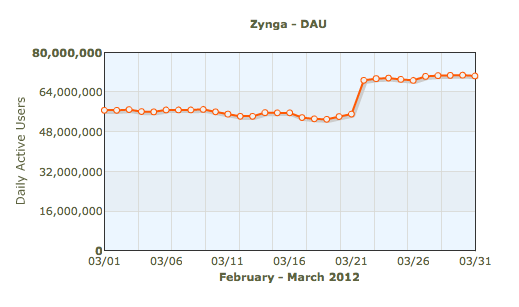
As the dust settles after Zynga’s purchase of New York mobile social game developer OMGPOP, the company is visibly taking on a new shape. A 25% larger and more mobile one. That’s the percentage growth of its total daily active user base, when you add in the 14.6 million people playing mobile sketching app Draw Something to its existing 55 million players.

The game has gone from 1.7 million to 14.6 over the month of March, based on app tracking service AppData. Today, it’s nearly the combined size of Zynga’s two biggest hits on Facebook, CityVille and Texas Hold’em Poker.

Which means Draw Something’s share of the market is likely to grow in the coming months. CityVille was launched at the end of 2010, and Poker years before. Zynga has milked them along, and will no doubt continuing doing so far into the future. But, they’re never likely to grow significantly beyond their current sizes, based on the overall lifecycle of these games.

Draw Something is a blank slate. It’s been out for around two months, and could keep growing. Zynga has the analytics and marketing skills to help with that. And it also has the experience keeping traffic up across its games on social and mobile platforms. Its core mobile franchise to date, Words With Friends, has the second-most daily active users out of any Zynga game, with 8.1 million daily actives.

The user count comes with a caveat here. Only Zynga knows the non-deduplicated daily unique user number. It’s quite possible that users of other Zynga games are already playing Draw Something, particularly with Words With Friends. That’s still good, in that they might be paying for virtual goods across titles. But it also means the total traffic is lower than it looks here.

The big long-term potential isn’t just that Zynga has all these users from this game. It also has the ability to promote its other games, including any it’s planning on launching in coming months, to this vibrant user base. That could extend the value of the game far beyond its own cycle.

The $210 million bet on OMGPOP has the obvious risks, too. The acquired company has never made a hit even close to this big. And Draw Something may have a shorter life cycle — Zynga hasn’t had a chance to see how long this type of sketching-sharing game can stick around.


Tech Jobs And Airbnb Are Squeezing The SF Housing Market — Here’s What To Do

planet for rent

Editor’s note: Jon Sterling has been in the real estate business since 2002. Follow him on Twitter @mistersterling.

Have you been searching for a place to live in San Francisco lately? You’re not the only one thinking @$#%&! on a daily basis.

Forget the speculation about a tech bubble. This is a real estate bubble.

It’s a common scene on a weekend morning: A line of people waiting for an open house at an apartment that just hit the market, with rental applications, credit reports, and certified checks in-hand. The first one who qualifies wins the prize.

SOMA condos under $600,000 (now considered “entry level”) are going under contract in a matter of days, often with multiple offers. So far in 2012, the median market time for sold condos in SOMA is 42 days. That’s 42 days from the time it goes for sale to the time the title changes hands. In the past month, that number has dropped to 34 days.  When it comes to real estate transactions, 34 days is fast. Very fast.

I have a client who wanted to see two condos that hit the market last week ($589,000 and $599,000). Both were under contract before we had a chance to see them, and both had multiple offers.

New tech jobs are increasing the housing demand and causing pain for buyer and renters, but that’s not the only way technology companies are adding to the Silicon Valley housing woes. The success of short-term rental companies like Airbnb and HomeAway are contributing to the lack of inventory as well.

The short-term rental companies have provided liquidity for homeowners and renters by making it convenient for them to rent out rooms, apartments, and entire houses. Owners and renters are now able to subsidize some (or all) of their monthly payments, which limits the number of units on the market. If a tenant loses his job, he can rent his bedroom and sleep on the couch to generate some cash. If a condo owner quits her corporate gig to launch a startup, she can stay with friends for the weekend while visitors rent her place. A few years ago, those units would have gone on the market out of necessity. Today, the classic illiquid asset — real estate — has a new kind of liquidity.

The San Francisco Business Times reported that 8,000 new tech jobs are expected to be created in San Francisco this year. That much job growth is great news for the local economy, landlords, and home sellers, and will have a positive trickle-down effect.

At the same time, that is very bad news for renters and buyers. Many of the new jobs will be filled by people who already live and work in tech in San Francisco, so 8,000 new jobs does not necessarily mean 8,000 new residents. Nonetheless, aggressive hiring by tech firms is contributing to the housing scarcity. The war for engineering talent has expanded across the country, and often includes hefty relocation packages.

So what should you do?

If you are a renter, use your network — Facebook, Twitter, Path, co-workers, and anyone else who is connected in San Francisco. If you can nab a place before anybody else knows about it, you win. Also, walk the neighborhoods where you’d like to live and look for “For Rent” signs in windows. Not all landlords use Craigslist. Have a current copy of your credit report handy and move quickly when you find a place that might work.

If you are a buyer, find a great advisor. Most of the time that will be a real estate agent, but it doesn’t have to be. A great real estate agent will bring your properties as soon as they hit the market, and maybe even before they hit the market, in addition to helping you navigate the home buying process. Also, be smart about your bidding strategy. This is not a market where low-ball offers are going to work.

If you are a seller, thank your lucky stars. Most sellers in the country are not as fortunate as you. Just don’t gloat, okay?

If you are lucky enough to have an awesome place at a decent price, do your best to lock-in your current rental rates for as long as you can stomach it. You may be able to negotiate with your landlord if you’re willing to sign an extended lease. Try something like, “I will commit to this apartment for the next three years if you will commit to the current monthly rental rate for the next three years.”

If you are a landlord, make hay while the sun shines.  Rainy days will be upon us again. We will remember the landlords who treated us well, and those who didn’t. And even if we forget, the Internet doesn’t.

[photo via flickr/J_P_D]


We’re Going To This Super Happy Block Party In Palo Alto, And You Should Too

Screen Shot 2012-03-31 at 2.57.43 PM

Who throws a party in Palo Alto?!

Well actually … Today Eric Schmidt’s Innovation Endeavors, Talenthouse, Super Happy Dev House and the City of Palo Alto itself have joined forces to give nerds a place to play on University Ave for 12 hours. So why should you stop coding and jump on Super Happy Block Party bandwagon? Well a gaggle of VCs have occupied the 3rd floor of the High/Alma South Garage, committing themselves to hearing your ideas until 7pm tonight. Poor things!

Full list of VCs to harass to pitch:

Mark Goines, Morgenthaler
David Krane, Google Ventures
Jeremy Schneider, Webb Investment Network
Jon Soberg, Blumberg Capital
Ryan Kottenstette, Khosla Ventures
Michael Marquez, Morado Ventures
Felix Shpilman, Start Fund
Peter Ashley, 500 Startups
Todd Kimmel, Mayfield Fund
Vicki Levine, Lightbank
Thomas Korte, AngelPad
Peter Moran, DCM
Dave McClure, 500 Startups
Josh Goldman, Norwest Venture Partners
Stephanie Palmeri, SoftTech VC
Raymond Nasr, Innovation Endeavors
Itamar Novick, Morgenthaler
Gil Ben Artzy, UpWest Labs
CeCe Cheng, First Round Capital
Pejman Nozad, Angel
Eric Chen, Uj Ventures
Jay Jamison, BlueRun Ventures
Anne De Gheest, HealthTech Capital
Ron Hose, Angel
Scott Brady, Angel (Slice)
Nils Johnson, Angel (Beautylish)
Harpinder Madan, Angel (Slice)
Dror Berman, Innovation Endeavors

The organizers are expecting more than 2500 people and have a contingency plan in case it starts raining and they have to move the Popup Innovation Parking Lot, Hack the Future Tent, the Day Star Yurt & Silent Disco, the Soap Box Stages, and the Techno Petting Zoo of Robots indoors. Whatever those things are, they sound pretty trippy and cool.

Which is why I’m about to get in my car, and go pick up my colleagues Kim-Mai Cutler and Josh Constine (if he ever wakes up from whatever party he was at last night) and drive their butts down south.

Because way to let your geek flag fly Palo Alto; Your move SF.

Pics via/Amir Youssefi