Twitter Drops 7.24% In Its Second Day Of Trading, Burning $2.3B In Market Cap

2013-11-08_14h00_14

Twitter priced its IPO at $26 per share. It opened yesterday at $45.10, closing the day at $44.90. Today it closed at $41.65, down 7.24%. Using a fully diluted share count (705,098,594), Twitter’s valuation fell $2.3 billion in regular trading. 

That’s more than half a Snapchat.

The company’s massively successful IPO led some to claim that Twitter mispriced its offering. The company originally indicated that it would price the offering as low as $17 per share, a firm discount to its final $26 offer price.

The markets and larger technology industry will closely watch Twitter in its first few quarters, given that the degree of its success – or weakness – as a public company will set the temperature for other companies’ IPO paths.

Keep in mind that Twitter, even after this correction – call it what you will – is valued richly. As Peter Kafka of AllThingsD points out, “Twitter investors are valuing the company at the same level as LinkedIn, even though LinkedIn generates twice as much revenue. And they’re valuing Twitter at about a fifth of Facebook, even though Facebook has more than ten times more revenue.”

That implies that Twitter investors are expecting the company to outperform comparable, and rival firms.

In other news, barometric pressure in San Francisco fell from 30.09 inches this morning, to 30.01 inches by the end of trading on the East Coast. Temperature moved in the opposite direction, rising from a chilly 52 degrees in the city this morning to a far warmer 63 degrees by the end of the regular trading. It isn’t clear that impact this will have on Twitter’s stock price tomorrow, but we’re digging into that now.

Top Image Credit: Flickr

Elop Is Going To Do What Now?

Ballmer and Elop

The technology press is abuzz this morning after Bloomberg published an article concerning what Nokia’s – and soon Microsoft’s again! – Stephen Elop would do to reform Microsoft should he be selected as its next CEO. He is widely tipped as a leading candidate for that role as he is set to return to Microsoft as an executive vice president once the sale of Nokia’s hardware business to the Redmond-based software giant is consummated.

The piece is interesting because it makes a number of claims concerning Elop’s plans for Microsoft that seem slightly odd. Elop, 49, is not an idiot, of course. But if this is his vision, and it could be, I don’t understand it.

Let’s examine the largest claims of his leaked, rumored, or invented vision for Microsoft, via Bloomberg’s unnamed sources that claim to know his thinking.

Office

According to Bloomberg, Elop has a radical plan for Office:

[Elop] ould consider breaking with decades of tradition by focusing the company’s strategy around making the popular Office software programs like Word, Excel and PowerPoint available on a broad variety of smartphones and tablets, including those made by Apple Inc. and Google Inc., said three people with knowledge of his thinking.

Tradition here strikes me as slightly tricky, as Microsoft has built Office for Mac for decades. Word for Mac came out in 1985, so the company clearly has a history of selling Office, or at least making it available, on rival platforms.

I think that smartphones and tablets are too new to have software traditions of their own, so to speak. But, granted, Office has been slower than some anticipated to land on tablets and smartphones. Let’s review where we are at the moment: Office for iOS exists, so if you are an Office 365 subscriber, you can Office all day on your iPhone, and according to the product page, iPad.

But you have to pay for that, so what about a free option? Microsoft has a free suite of Web apps called Office Web Apps that are, surprise, cross-platform. They are not quite good enough yet, and Microsoft knows it. In a piece detailing recent upgrades to Office Web Apps, journalist and general mensch Ed Bott pointed out that the apps

are relentlessly cross-platform [and] work on every popular browser in Windows, OS X, and iOS. (In a blog post announcing the changes, Microsoft says it’s “still on track to enable editing from Android tablets, so you can access Office files and tools from even more devices.” That change is due “in the next several months.”)

So, Microsoft is bringing free Office to all platforms, and paid versions likely as well, if you need something more heavy duty. The gist here is that Microsoft understands that the landscape for productivity applications is changing. I am not saying that Microsoft will succeed with its current plans. It may fail. But to say that bringing Office to other platforms is a radical departure from its current strategy doesn’t quite square with my understanding of the company’s current positioning.

Bing And Xbox

Elop is said to be more than open to slicing off parts of Microsoft if they aren’t core:

Elop would be prepared to sell or shut down major businesses to sharpen the company’s focus, the people said. He would consider ending Microsoft’s costly effort to take on Google with its Bing search engine, and would also consider selling healthy businesses such as the Xbox game console if he determined they weren’t critical to the company’s strategy, the people said.

This is reasonable until you think about it. It is fair to say that any new CEO should review business units, and excise where sensible. However, you can’t extract Bing and Xbox from Microsoft, as you would a crouton from that damned salad you had at lunch. They are far more intertwined than that.

Xbox, for example, is now part of the Windows family. The Xbox One is partially run on the shared Windows core. This matters because Microsoft is working as fast as it can – not fast enough, in my view, but that’s a separate story – to unify its platforms. Once the Xbox One is released, Windows will span, as I have said time and again, from your smartphone (Windows Phone 8), to your tablet, laptop, and desktop (Windows 8.1), to your TV and finally projector (Xbox One).

This is not an accidental result. Microsoft has made two massive platform shifts in mobile and the living room to get here. Windows Phone 7.5 was essentially left in the dustbin of mobile history so that Microsoft could move Windows Phone 8 to the shared Windows core. Xbox 360 games are not compatible on the Xbox One, I think in part due to the radical changes that exist between it and the Xbox One.

All told, Microsoft’s work to create the largest, unified developer platform (not a PC on every desk, but Windows on every machine, form factor regardless) is not something that the company would, or should be willing to undo. Selling Xbox would be a blow to the strategy and harm Microsoft’s ability too woo developers long-term – a material impact.

Also Xbox is a massive success for Microsoft and is key to its current device (the console) and services (Xbox Live) strategy. To sell it off for a short-term financial gain would be, in my view, idiotic.

Bing. Oh, Bing. Bing loses money, so far as we can tell. Who else wants to buy the money-losing firewall to Google’s hegemony in search? Apple, perhaps, but why buy the weight that someone else is already carrying? Facebook can’t stomach its losses. And while Microsoft wishes Bing were profitable, it tolerates its deficits because as a company it cannot afford to cede the organization and searching of the world’s information to a rival; imagine Windows 8.1 without Bing. You can’t.

The simple idea that Bing can be hocked is to me a fantasy. Moving on.

Windows

Best for last:

Elop would probably move away from Microsoft’s strategy of using [Office] programs to drive demand for its flagship Windows operating system on personal computers and mobile devices, said the people, who asked not to be identified because the 49-year-old executive hasn’t finalized or publicly discussed his analysis of the business. […]

Elop’s assumption is that Microsoft could create more value by maximizing sales of Office rather than by using it to prop up sales of Windows-based devices, said two of the people with knowledge of his thinking.

Windows revenue has been slipping, it is true, though not as much as was anticipated. Office is incredibly profitable and important for Microsoft. However, when it comes to the core of Microsoft, we’ve already established that instead of shifting away from Windows, Microsoft is currently in the process of re-betting its future on Windows.

If Elop thinks that maximizing short-term Office revenues at the expense of Windows is a good plan, that’s his business. I can’t imagine how he would accomplish that, however. If he cedes Office’s focus on Windows (which it does have, to be fair), and cuts its price and ships it on rival platforms, would that drive more revenue? Or if Elop merely intends to bring it to more platforms, the company is already doing that, at whatever implied cost to Windows. I’m not following this argument.

Microsoft, now focused on devices and services, wants to grow those components of its business. To say that it is going to sell off its most successful devices and services businesses is confusing.

Typically verbose Microsoft spokesperson Frank Shaw responded to the Bloomberg piece by saying “We appreciate Bloomberg’s foray into fiction and look forward to future episodes.” If Frank is right and the above points are not representative of Elop’s vision, he might make a fine CEO. If Bloomberg is correct in its portrayal of Elop’s views on how to grow Microsoft, I don’t see his selection as making much sense. It would undo much of what the company has spent recent years, and billions, to create.

Top Image Credit: Sam Churchill

Oppo’s First Cyanogen-Modded Smartphone Will Launch In December

oppo-n1_00

As much as I love stock Android sometimes you just need something different, and that’s essentially been the guiding mission of the folks over at Cyanogen Inc.

They’ve made plenty of strides with their customized version of Android over the past few months, but now they’re on the verge of a big milestone – after officially revealing the thing back in September, Chinese OEM Oppo announced earlier today that its first Cyanogen-modded smartphone will launch internationally in December.

Wait, what? Who’s Oppo?

To really get a feel for what’s going on here, we need to flash back to mid-September. Cyanogen raised $7 million from Benchmark Capital at the time, and the company not-so-subtly hinted that it would forge partnerships with some honest-to-goodness smartphone makers to bring their modified version of Android to a wider audience than just avid phone tinkerers. That first hardware partner wound up being none other than Oppo, a curious Chinese OEM who may be best known for its Blu-ray players that has managed to cultivate a reputation for churning out some impressive (and impressively cheap) Android devices.

The specifics of the arrangement were… interesting, to say the least – Oppo developed its N1 smartphone in such a way that owners can easily flash Cyanogen’s custom Android build, but they’re also producing a limited quantity of those N1s that will ship to consumers with CyanogenMod pre-loaded onto them. It’s worth pointing out that the N1 is no slouch either – it sports among other things a 1.6GHz quad-core Snapdragon 600 chipset, 2GB of RAM, a 6-inch 1080p display, and what the company refers to as the world’s first rotating camera so a single camera module can handle selfies as well as it can landscapes.

Now this is a nice turn of events for Cyanogen fans but this launch could prove to be an important barometer for the Cyanogen team. The Cyanogen-laden version is being pegged as a limited edition release so Oppo isn’t going nuts churning these things out, so an international launch means that both companies will be better able to gauge the sort of demand for honest-to-goodness CyanogenMod phones. And this more widespread launch goes well, Oppo has that much more ammo in its arsenal if it tries to ink similar deals with other OEMs down the road.

That’s not to say the team can just call it a day though – one of their bigger priorities is to complete a dead-simple Cyanogen installer built so owners of existing Android devices can swap their current builds for something a little different. The Cyanogen team has been rounding up beta testers to work on early versions of the installer (which will ultimately wind up in the Google Play Store if everything goes according to plan), but only time will tell when Ma and Pa will be able to flash their smartphones without getting bogged down in the minutia.

This Week On The TC Gadgets Podcast: Xbox One, Nexus 5, And The HTC Gramohorn

xboxone

Thanksgiving is around the corner, which means that the Holiday season is actually upon us. And you know what that means? Electronics makers are literally spewing gadgets at us in time for gift-giving season.

The Xbox One is on its way, with a launch date of November 22. But will the new model wow you the same way older generations of the Xbox did?

Meanwhile, Google released the Nexus 5 with KitKat, which the boys are calling the best and most efficient Android phone available. And finally, we can’t help but notice that HTC has gone a little cray-cray with this whole Gramohorn audio amplifier.

Helping you finish up this chilly Friday, we discuss all this and more on this week’s episode of the TC Gadgets Podcast, featuring John Biggs, Matt Burns, Jordan Crook, and Darrell Etherington.

Enjoy!

We invite you to enjoy our weekly podcasts every Friday at 3 p.m. Eastern and noon Pacific. And feel free to check out the TechCrunch Gadgets Flipboard magazine right here.

Click here to download an MP3 of this show.
You can subscribe to the show via RSS.
Subscribe in iTunes

Intro Music by Rick Barr.

At $26 Per Share, Twitter’s Executives And Directors Own A Combined $3.24 Billion Of Its Stock

2013-11-06_15h53_33

Today Twitter priced its IPO at $26 per share. At that price, the company will raise $1.82 billion from the public markets, and be valued at $14.16 billion, based on a non-diluted share count, and $18.33 billion based on a diluted count. Here’s a fun statistic: The value of the stock held by Twitter’s executive staff and directors is now worth $3.24 billion.

Currently, that group holds 124,529,741 shares in the company, or 25.5% of the company. After the IPO, and 70 million shares are sold to the general public, the group will control 22.3% of the company.

Evan Williams, who owns the most shares of the group will see his stake fall to 10.4%, but don’t feel sorry for the guy – his 56,909,847 shares are worth $1.48 billion. In second place among the leadership cadre is Peter Fenton, with beneficial ownership of 31,568,740 worth $820 million.

Twitter’s initial public offering saw its price rise, as demand the modest 70 million offered shares was more enthusiastic than what was perhaps anticipated by Twitter. Hoped for, certainly, but expected, perhaps not.

A final statistic: According to its filed S-1, existing stockholders of Twitter paid on average $2.21 for the company’s stock over the life of the company. The public has to pay the IPO gate rate. In a nutshell, that’s the VC game.

Top Image Credit: Flickr

Twitter Prices IPO Above Estimates At $26 Per Share, Raising $1.82B And Valuing Company Up To $18.1B

Screen Shot 2013-11-06 at 1.50.54 PM

Twitter will start trading at $26 when it goes on sale, according to an announcement made today by the company on Twitter. That’s on the low side of expected pricing but still above the new official range that Twitter released yesterday.

At $26 the proceeds of the sales of 70M shares of common stock will net it $1.82B. This means that the company has a valuation of $14.16 billion based on 545M non-diluted shares or a maximum of $18.1B based on 705M fully diluted shares.

Twitter pricing chatter has been hot and heavy over the past few weeks, with some predicting that it would price its IPO well above the new $23-$25 range it set earlier this week in a revised S-1 filing. The pricing range was originally set at at $17-23, which many considered very low and which drove high demand.  Yesterday, we noted that Twitter could easily price as high as $25-28 on IPO.

MicroVentures CEO Tim Sullivan told us that the pricing in the private market has been running up hard over the last year. Sullivan noted that it was priced at around $15 last summer, $17 in December, $20 in March and $30 in September. Bids were entered at around $35 recently but could not be filled because the demand was so high.

Twitter’s aggressive pricing early on led to oversubscription chatter.

Much of the talk about Twitter’s IPO pricing in the runup has been about comparisons to Facebook’s relatively disastrous offering. It had many issues including a high price, disappointing opening and behind-the-scenes drama, but has eventually far surpassed its opening price of $38 per share.

Twitter’s indicated revenue over the past quarter was $169M, though it also scored a net loss of $64M over the same period.

More to follow…

Image Credit: Garrett Heath/Flickr CC

Microsoft Unifies Windows And Windows Phone Developer Programs, Lowers Registration Fees

2013-11-06_14h11_26

Microsoft announced today that it is bringing together its Windows and Windows Phone developer programs. The commingling of both groups is a move by Microsoft to encourage developers to build for more than one of its supported device classes. It also represents another step in Microsoft’s effort to unify its platforms on top of a shared Windows core.

Microsoft now pitches Windows Phone and Windows as a package. The company has also combined the products’ marketing teams, likely helping to further unify their messaging and prevent crosstalk.

The Xbox One also leans on the shared Windows core. So, when that console is released, Windows will extend to your smartphone, tablet, laptop, desktop and TV. Thus to see Microsoft bring together the Windows and Windows Phone developer groups is hardly surprising.

If you were a registered Windows Store developer, you can submit Windows Phone apps at no cost and vice versa. Microsoft has also lowered the price of registering to build for (now) both platforms. If you were already both a Windows Phone and Windows Store developer, Microsoft will give you a code for a free year-long renewal of your account.

The application ecosystem issue has long been the key issue holding Windows Phone back, and has become the largest issue with Windows 8.1, after Microsoft fixed a swath of usability plagues that made it frustrating to use Windows 8.

Therefore, Microsoft needs to eliminate all hurdles to building for its platforms. I noted above that the unification of the Windows and Windows Phone developer registration systems wasn’t surprising. That doesn’t mean that it isn’t a smart move.

AWS Updates Its Elastic MapReduce Console For Exploring Large Amounts Of Data

silocloud

Amazon Web Services (AWS) has updated its Elastic MapReduce console, making it easier to manage large amounts of data.

The update centers on providing better usability and access to new features that include resizing a cluster by adding or removing instances; cloning a cluster; running Hadoop 2; and targeting a specific availability zone.

The EMR console to configure clusters is now on one page:

A developer can choose between multiple versions of Hadoop and MapR:

The cluster list has also been improved:

AWS is notorious for its complexity and usability. The model is to provide the bare minimum and let the user add AWS or third-party services for their deployments. But with the acceptance of cloud computing from the overall market, there comes a higher bar for the way a service is presented.

“The new Elastic MapReduce console is a great step forward towards better usability, an area where AWS has struggled in the past,” said Jeff Martens, co-founder and CEO at CPUsage in an email interview with me today. CPUsage is a platform as a service that launched at TechCrunch Disrupt. “Kudos to the team in Seattle. I hope this is a sign of more to come, especially for some of the other products in their siloed eco-system which desperately need UI and UX improvements.”

AWS executives made a point last year at AWS re:Invent of stressing their commitment to the enterprise market. That’s a challenge for AWS as competing providers like Google offer managed services that abstract the complexity that comes with using cloud services.

This Week On The TechCrunch Droidcast: We’re All Getting The Nexus 5, So Break Me Off A Piece Of That KitKat

droidcast13

Google messed up Daniel Bader’s Nexus 5 order, and that makes him sad. Truly, our guest from MobileSyrup and BetaKit deserves better than having half his hopes dashed by a UPS delivery man live on air. We’ve all ordered Nexus 5 smartphones like the Android suckers we are, and so we chat KitKat and what dreams may come.

Other topics up for discussion with Daniel, me and Chris Velazco this week include Samsung’s awful assault on the English language, Motorola’s Moto G mid-range phone announcement next week, and whether or not we’re too attached to our devices (i.e., the eternal metaphysical struggle of the gadget lover). So turn off your phone/Pebble/fonblet for just over half an hour and join us.

We invite you to enjoy weekly Android podcasts every Wednesday at 5:30 p.m. Eastern and 2:30 p.m. Pacific, in addition to our weekly Gadgets podcast at 3 p.m. Eastern and noon Pacific on Fridays. Subscribe to the TechCrunch Droidcast in iTunes, too, if that’s your fancy.

Intro music by Kris Keyser.

Direct download available here.

With $1.2 Million In Seed Funding, Sprig Launches To Bring Fast, Healthy Meals To SF Eaters For $12 Each

IMG_6440

It seems like every day there’s a new food delivery service launch, each seeking to connect a large and growing number of hungry customers with high-quality meal choices. While the way each tries to approach the market and handle demand differs, it’s clear that there’s huge interest in revolutionizing the way that food is sourced and delivered.

So anyway, here comes Sprig, yet another food delivery service with an interesting new approach to the market. With its own executive chef and delivery team, the service officially launched in some select neighborhoods of San Francisco earlier this week, seeking to make available a few interesting meal choices each night for about $12 each.

How Sprig Is Different

There are a few different ways to approach food delivery. Some companies are positioning themselves to handle delivery and logistics, and work with existing restaurants to improve the order and delivery experience. That includes incumbent food delivery services like Seamless and Grubhub, as well as newer startups like Postmates and Zesty.

Meanwhile, others are seeking to produce and deliver the food themselves, which they believe can increase the quality of what’s available, while lowering costs all around. Companies in this group include startups like Y Combinator alum SpoonRocket and Munchery, which works with in-house chefs and “chef partners” to come up with meals for delivery. For the most part, they offer a limited, curated selection which changes daily.

Sprig falls into that latter category of food delivery services, giving customers a choice of three different meal choices for delivery. Meals cost $12 each (plus a $3 delivery fee) and generally include one entree selection and a couple of sides. Sprig users make purchases via mobile app, which stores their location and payment information, and food is delivered within about 15 minutes.

So, Um, How’s The Food?

Ok, so it’s one thing to announce that there’s a new food delivery service, but I wanted to try it out myself so I could let all of you know what to actually expect. So here goes.

I ordered all three available meal options on Monday night, which happened to be the first night of Sprig’s “soft opening” in San Francisco. There was one beef dish, one pork dish, and one vegetarian dish, each of which came with a couple of interesting sides. And I shared with a friend, to see what she thought as well.

Dishes were as follows:

  • Pork tenderloin brined and grilled, topped with an apple fennel compote. Served with roasted maple garnet yams and Rodoni Farms brussel sprouts with sweet onions.
  • Coleman natural beef tri-tip rubbed with herbs and spices and cooked sous vide. Presented atop black-eyed peas and River Dog Farms collard greens.
  • Cabbage dumplings stuffed with wheat berries, Coke Farms radichio, and Sonoma dry jack cheese. Accompanied by roasted Frazier Lake butternut squash and red beans and rice.

All of the meals were hot when delivered, but not soggy or overcooked, as sometimes happens when you get delivery. Presentation wasn’t bad, considering meals were delivered, and overall the food was better than you might expect from usual delivery options. But there were definitely some highlights to the meal, and some things we weren’t thrilled with.

Far and away, the pork tenderloin was our favorite part of the meal, and the apple fennel compote went perfectly with it. The yams and Brussels sprouts were also paired well, and weren’t overdone, as one might expect. We also liked the tri-tip, but the best part of that meal was the spicy collard greens that came with it. My friend thought that, while ok, the amount of black-eyed peas was a little overwhelming – she would have preferred more greens instead.

Which brings us to the vegetarian offering, the cabbage dumplings. We were both disappointed in the dumplings, which was a shame, especially since it was the only veg-friendly option. Butternut squash and red beans and rice were also both ok, but nothing to fawn over.

Some other notes:

  • The lightweight wooden “cutlery” that came with our meal is compostable and great for the environment, but not so great for slicing up tri-tip. We had one fork just completely break on us in the process.
  • We weren’t in love with the bonus dessert truffle that came with the meals. Instead, my friend suggested that Sprig add actual optional dessert options to go with them – cookies, cake, or something similar.
  • While the dishes were labeled with pig, cow, or vegetables on the top of the container to quickly show what each was, we would have liked to see a more detailed description of each meal, and maybe a nutritional information breakdown alongside it.

All in all, not bad for the opening night of the service. (At 6:00, we placed the first order of the service’s soft opening.) But it could have been improved, and hopefully will be with time.

Founders, Investors, And Advisors

Sprig was co-founded by Gagan Biyani, who had been on the founding team of online education startup Udemy, and had also worked as an advisor to Lyft during its expansion into the Los Angeles market. (Disclosure: Once upon a time, Biyani was part of the TechCrunch family as a contributor to MobileCrunch.) The startup’s executive chef is Nate Keller, who was previosuly executive chef at Google during its growth from 400 to about 40,000 employees. Other co-founders include Neeraj Berry, who runs ops; product lead Morgan Springer; and engineering lead Matt Kent.

To help get it off the ground, Sprig has raised $1.2 million in seed funding. Investors in the round include Battery Ventures’ Brian O’Malley, Greylock Partners’ Simon Rothman, Andrew McCollum, Larry Braitman, Haroon Mokhtarzada, Darian Shirazi, MHS Capital, Jim Payne, Dan Martell, Andrew Garvin, and Pascal Levy-Garboua.

In addition to its investors, Sprig is also receiving help from some big-name folks in the restaurant and logistics world. Advisors to the startup include three-star Michelin chef Kyle Connaughton, Lyft co-founders Logan Green and John Zimmer, Google’s first executive chef Charlie Ayers, AF&Co founder Andrew Freeman, and World Wrapps and Pacific Catch restaurant co-founder Aaron Novesheen.

The company is operating under what it calls a “soft opening” – which means that it’s available during limited hours (6:00 pm to 9:00 pm) and in just a few neighborhoods in San Francisco. For now, Sprig is serving SOMA and Mission Bay (zip codes 94107, 94103, 94105 and 94158), but plans to be available more broadly throughout the city by early 2014.

Blockbuster’s Demise; An Elegy To Video Store Culture

4165217347_ec1dabe345_b

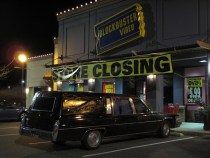
After years of clinging to life, Dish Network has announced it will pull the plug on its remaining 300 Blockbuster Video brick-and-mortar locations by early next year, signaling another death knell to the age of home video rental. The once-mighty video juggernaut had more than 9,000 locations at its peak in 2004, a number that significantly plummeted over the past decade.

I worked for Blockbuster as a teenager in New Jersey in the late ’90s. The job had its ups and downs, and some parts that downright sucked, but it was a generally fun time in my life. With the advent of Redbox, a machine not much larger than an ATM performs a service that in my lifetime once took a building, a payroll, a management hierarchy, and two-dozen employees to deliver. Despite the distinct lack of “experience” involved in sauntering up to a machine and pressing a few buttons to make your selection and pay for it, the store model didn’t stand a chance.

While most of us probably haven’t set foot inside a physical video store in a while, those of us of a certain age undoubtedly have a multitude of memories associated with the now almost quaint practice of going out to “rent a video.”

When I was a kid, going to the video store was an event. We’d excitedly pile in the car and chatter the whole trip about which movie or game we wanted to rent. As part of the first generation with the technology to re-watch at home a movie we saw in the theater, we took full advantage of this brave new world of home entertainment. My parents grew up in a cinematic era littered with classics; the start of the James Bond film franchise, “The Graduate,” “Planet of the Apes” and countless others. Once they saw them in the theater, the only way to ever see them again was as a movie of the week on one of the handful of television channels available at the time.

The roots of the “on-demand” home entertainment world we all now live in started with those robust black rectangles called VHS tapes.

Everything about the video store was novel. The different membership cards, how they displayed the boxes and the security mechanisms on the tapes themselves were each unique, seemingly with an endless number of permutations. “Ooh, this place cuts one side of the spine of the display box and puts them in a clear case”; “ooh, this one has the boxes you have to pinch on the sides to release the tape”; “Ohhhh-this place displays their tapes SIDEWAYS?!” were common refrains among my friends and me.

Each trip had something a little different.

Renting video games was always the biggest deal. I lost count of how many times I mowed the lawn, shoveled the driveway or cleaned the gutters for a crack at renting a game of my choice. Who knows how much deeply discounted labor my parents got out of me in those bargains?

On display at the store were always dozens, nay, hundreds of video game boxes. Back in the NES era, about the only way I could get my hands on a new boxed game was at Christmas or birthday time. The standard $50 price tag was too rich for my Pixy Stix-laced blood. So visiting the video store games section was like a trip to Shangri-La. The carefully drawn boxes at eye level, featuring full-color paintings of dragons or knights with swords or race cars. Sure, the actual game graphics never matched up to the box art, but it didn’t matter. I was at the video store, and would be taking one of those puppies home to play with.

Except for possibly the toy store, no trips to a place of retail commerce inspired such joy and happiness for me growing up. Every time was an adventure, and mystery lurked behind every corner. Who knows what untold secrets lived in the back of the store behind a creaky pair of swinging old west saloon-style doors under a conspicuously placed “Adults Only!” sign?

As the last decade-plus of home entertainment has really emphasized the “home,” most Americans now have access to a virtually bottomless library of movies, TV shows, documentaries and adult entertainment literally at their fingertips. Even as an admitted fairly infrequent purchaser of new gadgets, I personally have six different platforms available to me through which I can rent my little heart out. Six platforms, with no effort on my part to accumulate so many choices. Don’t get me wrong. It’s wonderful having the world of video-based entertainment accessible without leaving our couches. But what’s lost are the experiential qualities of obtaining and watching it.

The concept of video “stores” (even the word “video” only lives on as an anachronistic colloquialism these days) took another step into the yawning chasm of obsolescence today. And with it, a place of cherished childhood memories for any kid who ever peeked through a return slot, or had to step on their tippy-toes to put a returned tape up on the counter.

[Photo: Flickr/The Consumerist]