Mozilla’s Asm.js Gets Another Step Closer To Native Performance

aurora_rocket

Mozilla’s asm.js is a strict subset of JavaScript that Firefox can run significantly faster than regular JavaScript code. Thanks to the so-called OdinMonkey module for Firefox’s built-in JavaScript engine, asm.js code was running at about 2x native speed in March and this week, the organization announced that it’s now running most benchmarks at just 1.5x slower than native or better.

While Google is betting on Native Client to allow web apps to execute native compiled code in the browser, Mozilla is betting on its ability to run JavaScript at near-native speeds, too. While they approach this problem from very different angles, both Google, through Native Client, and Mozilla, through its Emscripten LLVM-to-JavaScript compiler, allow developers to write their code in C or C++ and then run it in the browser.

Given that most game engines are written in C or C++, the focus for asm.js has mostly been on gaming too. Indeed, one of the first public asm.js demos Mozilla showed was Epic’s Unreal Engine 3 running natively in the browser.

As Mozilla’s Alon Zakai and Robert Nyman note in the most recent announcement, the team manged to get to 1.5x performance through a number of small, incremental changes to both asm.js and the Emscripten compiler. The team, however, also profited from some general improvements to Firefox’s JavaScript engine. Specifically,  Zakai and Nyman note, the fact that Firefox has now been optimized for some floating-point operations resulted in “substantial speedups.”

Mozilla measures asm.js performance by compiling the code natively (using clang and gcc) and comparing the results to running the same code through Emscripten and asm.js.

Here are the most current results:

asm1.5b

For the time being, asm.js remains a Mozilla project. While Google’s Chrome team is clearly aware of it and recently added it to its Octane benchmark, it seems unlikely that Chrome will support it natively anytime soon. It’s worth noting, though, that asm.js code will run in any current JavaScript engine – it just won’t run as fast as on Firefox.

Gillmor Gang: Robophobia

gillmor-gang-test-pattern_excerpt

The Gillmor Gang — Danny Sullivan, Dan Farber, Robert Scoble, John Taschek, and Steve Gillmor — talk about what it means to be human in a digital age. The rise of the stream threatens to overwhelm us, and the Gang seems bent on drowning in wearables. But maybe that’s just a harsh look at a tough nut we’re all trying to crack: keeping up with the impossible flow.

Meanwhile, @dannysullivan delivers a TED talk on Google algorithm repair, @jtaschek charms the chat room with his advance look at @scobleizer’s next book The Shrinking Size of Everything, and @dbfarber talks of the coming mindful computer. “But you’ll have to have them all pulled out after the Savoy Truffle.”

@stevegillmor, @dbfarber, @dannysullivan, @scobleizer, @jtaschek

Produced and directed by Tina Chase Gillmor @tinagillmor

Live chat stream

The Gillmor Gang on Facebook

Overstock.com Reportedly Plans To Accept Bitcoin In 2014

2009_os_about_WWA

Overstock.com is moving to accept Bitcoin as payment in 2014, the CEO told The Financial Times. Apparently the retailer has the ambition to become the first major online retailer to accept the digital currency. And it very well could be. No other major retailer has announced a similar plan yet. However, put away your digital wallet for the time being. The retailer doesn’t expect to start accepting Bitcoin until the second half of 2014, by which time, Dogecoin could eclipse its popularity.

This announcement comes just days after a major shakeup in the Bitcoin ecosystem as China’s largest BTC exchange stopped accepting deposits in Chinese yuan, causing Bitcoin’s monetary value to drop 50% in a few hours.

Overstock saw just over $1 billion in revenue last year. The company trades on NASDAQ and its stock price is up 109.29% on the year. The news about accepting Bitcoin caused the shares to jump 7.77% on the day.

Overstock CEO Patrick Byrne stated that a healthy monetary system isn’t based off of an upside pyramid or the whim of a government official. Bitcoin fits that bill. Byrne stated that when Overstock starts accepting Bitcoin, the retailer would bank the digital currency in the event derivatives (such as Dogecoin) are increasing in popularity. If offshoots fail to gain steam, Overstock would transfer the Bitcoins into dollars on a daily basis, essentially day trading the Bitcoin income.

In the latter half of 2013, a number of retailers have moved to accept Bitcoin as payment with OkCupid, Namecheap and Humble Bundle among the list. Charities are also latching onto the digital currency since it lacks fees usually associated with monetary donations. If Overstock follows through with its plan, it would be come the largest U.S.-based retailer to accept Bitcoins. That is, of course, if Amazon or the like doesn’t beat them to the punch.

The Ultimate Cheat Sheet For Selling Anything

deathofasalesman

Editor’s note: James Altucher is an investor, programmer, author, and several-times entrepreneur. His latest book is “Choose Yourself!” (foreword by Dick Costolo, CEO of Twitter). Follow James on Twitter @jaltucher.

I’ve never read a book on sales. They seemed corny. Like many people, I always looked down on the concept of “selling.” It seemed like something lower than me.

To some extent, selling appears manipulative. You have a product where you give the perception it has more value than it has in reality. So you need to manipulate people to buy it. This seems sad, as in “Death of a Salesman” sort of sad.

I was a salesman snob.

I was wrong. And for the past 25 years all I have been doing is selling. Selling products, selling services, selling businesses, selling myself.

Sometimes I have been manipulative. And sometimes I’ve sold things I’ve had such passion for I sold it cheap just because I wanted the message out about what I was selling.

And often, it was very much in the middle: I needed to sell something because I had to pay my bills. Maybe I was a little desperate, a little hopeful, a little scared, and I wanted to make sure my family got fed.

We live in a hard world where our basic needs cost money, and as we get older we become responsible for the basic needs of others. We become adults.

Adults sell for today. Professionals sell for life.

So here are the rules of this cheat sheet: None of this comes from a book. All of this is from my own experience. Which means it might not work for you. Which means it might go counter to the basic rules of salesmanship. I have no idea.

I downloaded a book by Og Mandino and by Zig Ziglar but I didn’t read them. Maybe I should.

But I can say that over the past 25 years I’ve sold hundreds of millions of dollars of stuff. That stuff being everything in Pandora’s box that I had to sell just to stay alive. When I think what worked for me, here’s what I come up with:

A) Friendship

Nobody is going to buy from someone they hate. The buyer has to like you and want to be your friend. People pay for friendship.

This sounds sort of whoreish, and it is. The times when I’ve hated myself the most were the times when I’ve prostituted myself to make money (this isn’t as sexual as it sounds but it might as well be).

One time when I was raising money for something, the buyer was going through a business catastrophe and was worried he would go out of business. I didn’t like him but I called him every day for three months at the same time to see if he “wanted to talk” and to offer my advice on how he should deal with his situation.

I eventually raised a lot of money from him even though the first time I met him he was honest with me and said, “it seems like you don’t know your industry very well.”

Which just goes to show: friendship outweighs almost every other factor in selling. One time I wanted to do a website for ABC.com. How did I do it? The main decision maker was involved with a school in Harlem for charity. I went up there for four weeks in a row and played 20 kids simultaneously in chess. Everyone had fun. I got the website job. My competitors were all bigger, better financed, and probably better.

Unfortunately, I didn’t like either of those people personally. And eventually, I lost the business.

The only good outcomes come when both sides like each other.

At one point I was so sick of my new “friendships” I went to see a therapist with the clichéd line, “I don’t even know who I am anymore because I hate all my friends and all my friends are customers so I’m their slave friend.”

Now I only do business with people I like. The fastest way to lose all your money, mutilate your heart, and then kill yourself is to work with people you don’t like. I will never do that again.

Nor do you have to, despite what you might think.

B) Saying No

If someone wants to do a big deal with you it’s hard to say “no.” But No is valuable for many reasons:

Opportunity cost. Instead of pursuing something you really don’t want to do, you could free up time and energy to find something more lucrative or something you would enjoy more. Opportunity cost is the one BIGGEST cost in all of our lives. We spend it like there’s no tomorrow.

And guess what? Eventually there’s no tomorrow.

Supply and demand. If you reduce the supply of you (through “No”) then the demand for you goes up and you make more money (and have more fun).

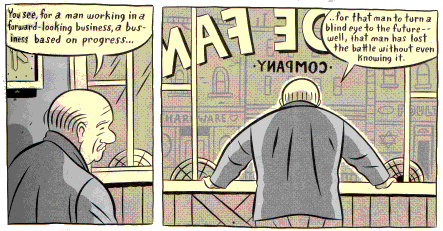
You’ll hate yourself. I see this every day, particularly in my own life. The reason I can write about this is not because I’m an expert. We don’t write about the things we KNOW. We right about the things that are deep down CHALLENGES for us right now. When I say “yes” to something I don’t want to do, I end up hating myself, hating the person I said “yes” to, doing a bad job, and disappointing everyone. I try try try not to do it anymore.
(source: Palookaville by Seth)

(source: Palookaville by Seth)

C) Over-Deliver

If someone pays $100 and you give them just $100 in value then you just failed. F.A.I.L.E.D.

You’ll never sell to that person again. That’s fine in some situations, but in most situations it’s no good. If someone pays $100, you need to give them $110 worth of value.

Think of that extra $10 as going into some sort of karmic bank account that pays interest (as opposed to a U.S. bank account). That money grows and compounds. Eventually, there’s real wealth there. And that wealth translates into wealth in the real world.

People are three-year-olds. They like to get presents.

People want to do business with people who give them presents. Over-delivering is a present. And it makes you feel good. Give and you will receive.

D) Never Take “No” For An Answer

This statement, which everyone knows, is usually applied incorrectly.

People think it means, keep pushing and trying new things until you get a “yes.” That’s not what it means. If you do that, you end up in the spam box. Then you end up in the coffin box. In other words, you end up dead to the person you are trying to sell to.

Instead, remember point A. Be a friend. However flimsy that connection of friendship is. Follow on Twitter, follow on Facebook. Say nice things about the person to other people. Never gossip.

Do the art of the “check in.”

Send updates after the “No” on how you are doing, on how the product or service or business or whatever is doing. Not every day. Maybe once a month. Maybe once a year. Who knows. Eventually you will find the “yes” with that person. It could be, and often is, up to 20 years later.

Who knows? You plant a seed and eventually the garden blooms.

E) Under-price (when it’s your passion so it’s easier to over-deliver)

I once wanted to do the website for Fine Line Films. I loved their movies. I met the guy running their site. He kept saying over and over again, “we can’t afford a lot” and I kept saying, “don’t worry about it” and would show him more and more of our work.

Eventually we did the websites for every one of their movies. $1,000 per website. We made amazing websites for $1,000. Then, when Con Edison wanted to hire us, Nevin at Fine Line was a reference. Price for coned.com (a basic four-page website): $250,000. And that was the first of five websites we did for them plus monthly maintenance.

I write for a lot of places right now for free. Any medium I love, I am willing to write for. It’s like a dream come true for me. The benefits from doing that have been incalculable. Not always financial, but always real.

We are a combination of many constituencies inside of our bodies and minds. Financial is just one. But all of our constituencies need to work together to make us well-balanced and peaceful.

The art of selling, for me, is to have everything inside of me working together.

F) Be The Source

One time I wanted to buy a company. The details of how I would do that are sort of obscure and not important. The company is well-known in the financial media space.

At the critical moment, the owner called me and said, “what should I do? I have this other offer and I have your offer.” He described the other offer to me. I told him to take it.

I missed out on what could have been a lot of money to me. But there was a slight chance we would have all gone bust. Now he is thriving and eight years later he is a friend.

Will we ever do business together? I can’t predict the future. But I know I delivered value to another human being. That value is real and I can put it to use whenever I want.

Often the best way to make friends and customers for life is to direct them to a better service or product than yours.

Be the source of valuable information rather than the source of your “product-of-the-day.” Then they will know forever that you are a trusted source.

Trust is worth more than next month’s rent being paid. Trust builds a bridge that will never wear out. At some point in the distant future, when you are on the run in every other way, you may need to cross that bridge.

G) Sell Everything

Your offering is not your product. Your offering is product, services, your employees, your experiences, your ideas, your other customers, and even (as mentioned above) your competitors. Sell them all.

When you are good at what you do, the product or service you offer is just the way people build the first link to you. It’s the top of a huge pyramid.

But the base of the pyramid, the real service, is when they have access to you and you can provide advice and the full power of your network and experience. This is when you are over-delivering on steroids and how real wealth is built and not just a one-time fee for a service or product.

Many people say, “no! My product is high margin and I want to make money when I sleep.”

Stop going to BS entrepreneur, get-rich conferences. In the long run nobody cares about your product. In the long run, it is the entire holistic view of your offering, your service, you, that you are selling. Without that, you will build a mediocre business that may or may not pay the bills. With that, you will create wealth.

H) Sell The Dream

People can see what your product is right now. What they want to know is…the future. Will your product make them more money? Will it get them a promotion? Maybe even: will YOU hire them if they buy your product.

Everything is possible. When you get in the door, do not sell your product. People make a decision on your product in five seconds. Sell the dream. The dream has up to infinity in value. Build up images of the dream. Give a taste of what the dream is like. Let it linger. Let it weave itself. Let the imagination of the buyer take hold and run with it.

But then, you might ask, do I risk under-delivering.

Answer: Yes. Don’t do that. Be as good as the dream.

I) Fire Customers

This is similar to point B with the one difference that you have already made a sale.

If it’s not going well or if it’s leaving a bad taste somewhere inside of you, or if they have gone from friend to enemy for whatever reason and it seems like there is no repair, then fire your customer. The sooner the better.

This applies to not just customers but everyone in your life. EVERYONE.

If someone no longer has your best interest at heart, then in your own self-interest you need to back off. NOW.

A bad customer (a bad person) spreads like a disease inside you, your employees, your other customers, your competitors, your future customers, your family, etc.

“But what if it’s my biggest customer? How do I pay the bills?”

I don’t know. Figure it out. You have to or you will die.

When I tell people to build their “idea muscle” (by writing down 10 ideas, good or bad, every day) it’s not so they can come up with great business ideas (although they might).

It’s so they can come up with ideas in situations like this. This is where being an idea machine saves your life and saves everything around you.

But remember: bad customers will kill you and your family and your friends.

J) Welcome To The Pleasure Dome

Your best new customers are your old customers. If you need to make more money or build new business then go to your customers (who are now your friends) and ask them, “I need advice. What other service can I provide you or anyone you know.”

It might be something totally unrelated to your business. No problem. Do it. It might be your customer is looking for a new job. That’s great. Make it your business to find him a new job. Now you have a new customer.

It might be your customer needs a boyfriend. Ok, introduce her to all of your friends who might be good for her. If you’ve been following this approach to sales then your customers are now your friends, are now your family, are now the lifeblood of how you wake up in the morning.

We spend years building a garden. We plant the seeds. We tend the soil. We water the plants.

But we are also the sun. The sun shines no matter what. It doesn’t care which flower blossoms. The sun is always there providing value every second of the day.

Be the sun and you will become abundance.

I don’t know the buzzwords to make a sale. I’m not very good at shaking hands. I don’t take people out to baseball games or do any of the things I see other people do.

But I’ve been selling for 25 years. And whenever I’ve been dead broke, depressed, and suicidal, I’ve picked myself up and sold again and again.

I am a salesman.

It’s A Wonderful Life, For A Few Of Us

itsawonderfullife

So where were we? Oh yes: everybody hates us. San Francisco’s recent Google-bus and “homeless trash” kerfuffles are symptoms of an increasingly broad, deep, and bitter anti-tech animosity. The Economist predicts: “The tech elite will join bankers and oilmen in public demonology.” The New York Times concurs: “Tech workers have, rightly or wrongly, received the blame. Resentment simmers.”

Such ingratitude! What’s wrong with these warped, blinded haters?

…Well, OK, it might be the very real sense that these days, with software eating the world, if you’re not in tech, or you’re not already rich, then you are probably basically screwed for life. “We are in the midst of the worst rental affordability crisis that this country has known.” Unemployment remains high, and many unemployed “may simply give up looking for jobs once their benefits lapse.”

Meanwhile, US income inequality today is the highest that it’s been since 1928 — which matters especially because “the decline in middle-class incomes owes as much to rising inequality as it does to the depressed state of the economy.” The NYT recently highlighted a Brooklyn neighborhood where

the top 5 percent of residents earn 76 times as much as the bottom quintile … addicts gather outside a food pantry a block from $2 million brownstones

The economic doldrums have hit Europe, too, outside of Germany. Don’t even get me started on Spain or France: and as for the UK, well, the BBC recently reported that, for the first time, “More working households were living in poverty in the UK last year than non-working ones … low pay and part-time work has prompted an unprecedented fall in living standards.”

So just go get a good education! Right? Sorry, no. Even if you have a Ph.D.:

The academic job market is structured in many respects like a drug gang, with an expanding mass of outsiders and a shrinking core of insiders. … Academia is only a somewhat extreme example of this trend, but it affects labour markets virtually everywhere. One of the hot topics in labour market research at the moment is what we call “dualisation.” Dualisation is the strengthening of this divide between insiders in secure, stable employment and outsiders in fixed-term, precarious employment.

Hell, even law school is a disaster nowadays. And total American student-loan debt exceeded $1.2 trillion this year. At that price, for many people, paying for higher education is almost like dumping your life savings into a lottery, or a casino; great if it works out…but absolutely crippling if it doesn’t.

So everyone can move to the tech sector! Again, sorry, no — or at best, not any time soon. You cannot reasonably expect to retrain significant numbers of people into skilled engineers, and there’s little-to-no room for the unskilled. (Unlike most fields, bad software engineers actually add negative value to the projects they work on.) Engineering is hard. Most people aren’t any good at it.

So people who aren’t rich, and aren’t in tech — the vast majority, I hasten to remind you — will increasingly become part of the precariat:

This is not just a matter of having insecure employment, of being in jobs of limited duration and with minimal labour protection, although all this is widespread. It is being in a status that offers no sense of career, no sense of secure occupational identity and few, if any, entitlements to the state and enterprise benefits that several generations … had come to expect as their due.

Meanwhile, the rich, as a class, are behaving with their usual elegance, taste, and restraint. Finding new ways to evict tenants so they can charge higher rents. Reshaping corporations into what The Economist calls “distorporations.” “Ruining art for the rest of us.” And it’s hard to wander amid San Francisco’s new-growth luxury boutiques, artisanal coffee shops, and opulent social events without getting the sense that techies, too, are making decadent hay of today’s inequalities. I mused the other day on Twitter:

Sometimes I feel like we in SF/LA/NYC live in the modern-day Belle Epoque. Which is, to be clear, a backhanded compliment at best.—
Jon Evans (@rezendi) December 14, 2013

You think this is bad? You ain’t seen nothing yet. Right now the precariat mostly just resents the tech world because we’re wealthier. That’s because tech has only barely begun to eat their jobs — and keep their homes and cars under constant surveillance. How do you think they’ll feel about us in five years’ time?

That process has already begun, though, and it will only accelerate. Everyone’s worried about the way Amazon treats its workers; will they be as upset about those replaced by the robots now rolling out to Amazon’s warehouses? (And before you start blaming Asian outsourcing, note that Foxconn is seeking to replace its Chinese laborers with a “robot army” too.) As Andrew Leonard put it in Salon:

the big difference between the current technological revolution and the Industrial Revolution is that the initial technological advances of the 18th century created jobs for unskilled workers, while today’s robot armies are increasingly replacing the jobs of unskilled workers.

Raising the minimum wage will help those cursed with shitty jobs…but it won’t create more of them. Cutting food stamps may save money, but it can’t drive the poor to take jobs that don’t exist.

In the long run all this ferment, disruption, and innovation is a good thing for everyone, of course, but in the medium term, we’re staring down the barrel of a wrenching period of transition. Ask the poor, struggling, and insecure — the precariat — how they feel about Silicon Valley’s hallowed goal of disruption, and its implications for them.

True, we seem to be in a cyclical economic upturn at last; but at the same time, the real US unemployment rate is probably something like 11.5%. As the Washington Post puts it, when people drop out of the work force, “it will look as if the labor market has improved, even though it hasn’t.” Even if we are enjoying a cyclical upswing, it can only mask an ongoing structural decline in employment for so long.

It seems to me (and many others) that we’re at the beginning of a Great Bifurcation. On one side: those who were rich when it began, plus the upper echelon of the tech world, the usual oil/finance suspects, and a smattering of others. Figure about 15% of the population. They will cluster in dense little islands of wealth — San Francisco, Manhattan, beach houses and mountain chalets. They will travel to all the best places. Their parties will grow ever more decadent. Their children will get the best education — and, in time, the best biotech — that money can buy.

But not all techies will be winners. This modern-day Belle Époque is increasingly for people who can tick at least two of the following boxes: smart, skilled, and well-connected. (Don’t kid yourself–the tech world is by no means a pure meritocracy.) The room for people who can boast only one of those, let alone zero, is diminishing. The mediocre, unskilled, poorly-connected, and/or just plain unlucky will join the other side of the great divide soon enough.

By which I mean the teeming masses of the precariat, getting by with part-time jobs, contract work, and sharing-economy serfdom, perpetually fighting a Sisyphean battle to erase their debts and amass some savings … and mostly losing.

If you were born after 1960, you probably won't retire comfortably unless you inherit wealth. qz.com/159066/if-you-…
Christopher Mims (@mims) December 18, 2013

And across that great divide? Growing resentment verging on fury. Again, you think techies are disliked now in places like San Francisco? Just wait another five or ten years. Yes, SF could and should build out much more housing–

Fun fact: SF's pop density is half of Brooklyn's (17,620 vs 34,920). We don't even need to go Manhattan to add enough housing/lower rents.—
Steve Simitzis (@s5) December 11, 2013

–but if I’m right about the fundamental trends here, even that won’t help. The tech world, and/or the machinations it is setting in motion, is becoming Henry Potter to the precariat’s George Bailey, and/or Ebenezer Scrooge to its Bob Cratchit, for a period of wrenching disruption measured in decades. I know that’s not how we like to think of ourselves. But until and unless we come up with a better way — a fundamental change, not band-aids — then it’s what we will become.

Amazon Bought GoPago’s Mobile Payment Tech And Product/Engineering Team, DoubleBeam Bought The POS Business

gopago screens

Last week, we wrote about how Amazon had quietly acquired mobile payments startup GoPago. Today, some more details about the deal: A source close to the situation confirms that Amazon bought the technology and the engineering/product team of GoPago, but none of the existing point of sale business and current merchant relationships. This part of GoPago is going to DoubleBeam — a sale confirmed by DoubleBeam late Friday.

DoubleBeam — founded and run by a team of seasoned payments executives from companies like PayPal, Green Dot, and Digital Insight (bought by Intuit for $1.3B) — provides white-label mobile payments technology for mobile apps and point-of-sale systems, including services like e-checks.

Amazon really wanted the GoPago technology, a source says, but not the existing business. That eventually led to this “non-traditional” arrangement that seems to include some aspects of GoPago’s point-of-sale technology, which will be integrated with DoubleBeam’s existing products.

“We are very excited about the synergies between Doublebeam’s leading mobile commerce solutions and the mobile point-of-sale systems that GoPago brings to the table” says Ted Tekippe, CEO of DoubleBeam, in a statement. “The complimentary capabilities of these technologies will bring a unique and holistic solution to the retail industry. It’s exactly what our customers have been asking us for.”

However, “The bulk of the story stays the same: Amazon is getting into the mobile payment space and has major plans for it,” says the source.

It seems that originally there was going to be an official announcement in January about some aspects of this deal — such as the fate of what would happen to the part of the business that wasn’t going to Amazon. But with the news leaking out this week, it looks they moved up the DoubleBeam announcement so that merchants and employees had more security about what would be coming next. (It may have also been to fend off more reputation-damaging stories like like this one and this one from coming out.)

It’s still not clear when and how Amazon will use GoPago’s technology, but as we mentioned when we first reported on the sale, there are already a lot of moving pieces that point to Amazon’s ambitions to offer a way to make payments for goods more seamless and mobile-friendly:

– Amazon already has some mobile payment systems in place, mainly for in-app payments on apps sold via Amazon’s app store, and APIs that let third parties sell Amazon products in their apps.

– Over a year ago, we reported that Amazon was working on a Square competitor, and Gopago, with its business firmly rooted in facilitating local commerce by way of mobile devices, could be part of that plan.

– Amazon has other e-commerce giants in sight. It recently launched “Log In and Pay with Amazon“, a digital wallet service that places it in competition with the likes of PayPal and credit card companies, with a one-click checkout option for online sellers that would let a customer pay instantly through his or her Amazon account. Mobile payments would help Amazon reach even more product parity with PayPal and eBay.

– Many believe Amazon will soon launch its own mobile phones — alleged models revealed to us here. If there is a Square competitor in the works, you can envision how Gopago technology might get integrated into those handsets and a Kindle Fire tablet souped up specifically for merchants to provide Amazon with a built-in payment loop between consumers and merchants — putting Amazon also in competition with Apple and its merchant-friendly iPad/iBeacon pitch.

Snapchat Sacrifices Ephemerality With New Replay Feature

instant-replay

My least favorite part of Snapchat is mistakenly opening a video Snap when I can’t hear it, like in a noisy public place or when my sound is off. Snapchat tried to address that today with an experimental new Replay feature that lets you rewatch one old Snap per day. But by fixing that problem it created a much bigger one. It killed off some of its ephemerality.

A lot of the excitement and urgency of Snapchat stems from the fact that you only get one shot to look at a Snap. That means you have to pay close attention and be fully engaged.

But with Replay, you can be lazy. Once a day you can re-view a Snap a second time if you don’t close the app or get another Snap first. “Oh, that looked funny. Wow, they looked sexy. I’ll watch it again.”

It’s not quite the “forever” of Facebook’s Timeline, but suddenly I’m a bit more self-conscious of what I send. Did I line up the shot right? Does my stupid hair look ok?

A big draw of Snapchat was that once someone had viewed your Snap, it only lived on in their imperfect memory. That made sending them carefree and lightweight — something I’d do without second guessing what could happen. That encouraged the silly and racy behavior Snapchat thrives on, and set it apart from other photo sharing services that create a permanent record you have to worry about.

Now whoever I send a Snap to can verify their first impression, show it to someone else, or get a second camera or phone out and secretly screenshot it. This makes sexting with Snapchat a lot more risky. Who wants to flash their jubblies if they have to worry they’ll get replayed in front of a crowd or a camera?

Snapchat optionsThere are certainly times when the Replay feature could come in handy, but the whole feature is poorly designed right now. There’s no explanation of how it works, you have to enable it in the buried Manage Additional Services menu, and then it’s not at all intuitive that turning it on means you can replay Snaps, not that your recipients can. In fact, you can’t prevent your recipients from replaying your pics and vids.

Snapchat deviated slightly from its self-destructing style in October with the Stories feature. It lets you share a Snap publicly or with friends that can be viewed an unlimited number of times for the next 24 hours, and then it’s gone. But with Stories, it’s the sender who chooses to make a Snap viewable multiple times, whereas Replay hands that immense power to the recipient.

If Snapchat wanted to help you avoid missing the sound in a video, it could tell you whether a Snap you’ve received is a photo or video before you open it. [Update: Or at least do it more clearly, as I didn’t even realize red Snaps are photos and purple Snaps are videos] If it wanted to keep you from accidentally slipping and starting the timer on a Snap you then don’t, it could make you double-tap-and-hold or swipe-and-hold to open a Snap.

Instead, it broke the core mechanic that’s the foundation of its budding social empire. CEO Evan Spiegel better be dead certain this is the right move, or he should remove the Replay feature before Snapchat’s ephemerality itself vanishes.

Snapchat Adds Filters, A Replay Function And For Whatever Reason, Time, Temperature And Speed Overlays

IMG_3282

Snapchat busted out an update to its app today just before the holidays. The new version of the ephemeral messaging app includes several color filters, a new ‘special text’ font and a few other additions.

The main update is the ‘visual filters’ that will add juiced up color effects to your images. If you’re stumped at how to activate them it is likely because you are not a teen. It took me 10 minutes to figure out that you have to swipe from right to left to trigger the filters. You’ve got 3 filters including two color and one black & white to choose from.

IMG_3285

Bizarrely, the update also adds 3 ‘smart filters’ which overlay the time your image was taken, the temperature when it was taken and — get this — how fast you were going when you shot it, in MPH. I foresee a whole new sport being made of snaps being sent at the highest possible speeds.

There’s also now a larger Helvetica font to choose from. You can activate this — also obscurely — by tapping again on the text entry box when you’re typing out a message.

IMG_3288

There’s a front-facing flash option now as well, which flashes white on the screen while you shoot, lightening up those selfies. You can now also choose up to 7 best friends if you choose. All of these options are enabled under the Settings>Additional Services>Manage section and none of them add a single additional indicating UI element to the interface.

There’s also a Replay option, which lets you re-view snaps once a day if you have it enabled. This seems to go against some of the major point of Snapchat, which is that messages are once-only briefs that are ‘gone forever’ once you’ve seen them. You can only replay the most recent image or video in your stream — but it’s opt-in by the recipient, not the sender. So if you get sent a snap you can now view it up to twice whether the sender wants you to or not.

Still, it’s a limited use option — you can only do it once per day. And this could help if your finger was covering an important bit in the image or if you missed a video clip because you thought it was a still image.

Snapchat has been experimenting with less and less ephemeral content with its ‘Stories’ feature, which lets people see your images as many times as they want for a 24 hour period. Our writer Josh Constine has more analysis on how Replay kills off some of Snapchat’s ephemerality.

Screen Shot 2013-12-20 at 5.15.33 PM

Snapchat continues to have some of the worst feature discoverability and user experience in any consumer app that I use regularly — but maybe that’s sort of the point? And perhaps because these functions are experimental maybe the UI will get a bit of polish once they’re ‘real’ features. The app is still a lot of fun, but I wish the design held up a bit better under use. Anyhow, snappers should have some more options over their winter break.

For more on Snapchat’s big update, read Snapchat Sacrifices Ephemerality With New Replay Feature

BTC China CEO Attempts To Calm The Bitcoin Market After RMB Deposit Shutdown

Bitcoin Mt Gox

In a letter posted on the Chinese bitcoin trading site BTC China CEO Bobby Lee attempted to calm the markets by posting a long, detailed description of the way forward for the company. “As China’s first Bitcoin and Bitcoin trading platform company, we have more than two and half years of operating experience and a good reputation,” he wrote. ”I believe you love Bitcoin and will fully understand our decision.”

Lee also clarified that the ban on RMB deposits is temporary and that the People’s Bank Of China saw bitcoin markets as similar to any commodity market and that “ordinary people have the freedom to participate in them at their own risk.” He also announced a number of improvements and changes to the platform aimed at retaining customers.

The company announced a new product called “Currency Lock” that stores bitcoin in “cold storage” with “bank-level” security. Commentators see this as a move to prevent a bitcoin sell-off by skittish investors who could see their wallets disappear while they wait out the RMB ban. They have also added a 0.3% transaction fee to all deposits and withdrawals to discourage rampant bitcoin conversion or transfers and to prevent large accounts from buying or selling speculatively.

In short, it’s business as usual at BTC China, but with a few caveats. The company recently closed a $5 million Series A round from institutional investors Lightspeed China Partners and Lightspeed Venture Partners. BTC China was bootstrapped prior to this round, with money put in by its three co-founders, Bobby Lee, Linke Yang, and Xiaoyu Huang. The closure of RMB deposits by the People’s Bank Of China this week precipitated a 50% decline in the currency which has stabilized at about $700 on Mt. Gox.

Mobile Rewards Startup Kiip Upgrades Its User Contests With New “Challenges” Product

kiip-challenges

When Kiip announced last week that that it’s powering rewards in Zepto Labs’ popular Cut the Rope mobile games, co-founder and CEO Brian Wong said it didn’t share one of the key details (because, uh, reasons) — that this is the debut of a new Kiip product called Challenges.

The company is best-known for allowing advertisers to sponsor rewards in games and other apps at key moments, say when players beat a level. With Challenges, instead of just giving each user a reward, brands can run contests and sweepstakes and give prizes to the winners. For example, Wong said Cut the Rope players will have a chance to win plush toys today (and you’ll see them on the Kiip rewards site tomorrow).

That concept may sound familiar to readers who have been following Kiip, because it first started offering these types of user contests about two years ago, through a product called Swarm. (At the time, Wong told me that Swarm would allow Kiip to enlist advertisers in new industries like automotive, where “you can’t give away a million cars.”) Since then, however, Kiip has been relatively quiet about Swarm — Wong told me this week that the product is doing fine, but it’s really meant to be integrated with games, and he’s been spending more time talking up Kiip’s efforts to bring rewards to other non-gaming apps, such as Any.Do, 8Tracks, and Recipe Search.

Challenges are supposed to address several of the main limitations to Swarms. For one thing, they could only be activated at a specific point in the game, which meant that if a player wanted another chance to win the prize, they’d have to go back and play that same level again. Now, however, Wong said that contests can now be “run dynamically” on any game level. He also said they can now be triggered server-side, which means they can be updated more easily, without requiring any changes to the software development kit.

Even though Wong describes Challenges as a specific product within the broader umbrella of Kiip’s Swarms, he also suggested that all Swarm campaigns would have access to the new features. This might seem like a pedantic point, but honestly, going back-and-forth with Wong about the relationship between the two products made me a little nuts. So I asked Wong why he didn’t just call it Swarm 2.0 (or, you know, something like that), and he replied, “That’s great feedback. Challenges just stuck. We might rename it.”

The “Target Breach Flood” Is Already Appearing On The Carder Black Market; Target Reacts

target_dog

In a deliciously detailed post, security writer Brian Krebs has explained the path taken by credit card numbers stolen in the Target breach on their way to the carder black market. Krebs has far more information in his post but he’s discovered that some card shops have created Target-only sections for the trove of numbers.

Krebs described visiting a particularly infamous card shop where he and an anonymous bank representative found sets of cards belonging to a “base” called Tortuga. In carder slang, a base is simply a source of cards. And Tortuga cards, according to Krebs, belonged to a set of numbers stolen from target stores. Amazingly, many of the cards included zip code or state data, thereby circumventing the fraud protections, as many banks automatically treat out-of-state card purchases as suspect.

How quickly did customer react on hearing about the breach? Clearly not fast enough:

The New England bank decided to purchase 20 of its own cards from this shop, cards from Tortuga bases 6-9, and Tortuga 14 and 15. The store’s “shopping cart” offers the ability to check the validity of each purchased card. Any cards that are checked and found to be invalid automatically get refunded. A check of the cards revealed that just one of the 20 had already been canceled.

Should you be worried? If you shopped in a physical Target store and swiped your credit or debit card there between November 27 and December 15, then the answer is “Yes.” However, thieves cannot fully recreate your card and, say, withdraw cash from your account or make an online purchase. Target media representative Molly Snyder wrote:

1. At this time, there is no indication that there has been any impact to PIN numbers. What this means is their bank PIN debit card or Target debit card still has this additional layer of protection. It also means that someone cannot visit an ATM with a fraudulent card and withdraw cash.
2. We have no indication that the data that was inappropriately accessed included a guest’s date of birth or social security number.
3. The CVV data that may have been impacted was data in the magnetic strip and NOT the three or four-digit code visible on the card that guests use that would allow someone to make an online purchase.

Target CEO Gregg Steinhafel said that customers can enjoy a brief discount on everything at the store as well as free credit monitoring for a year.

We take this crime seriously. It was a crime against Target, our team members, and most importantly, our guests. We’re in this together, and in that spirit, we are extending a 10% discount – the same amount our team members receive – to guests who shop in U.S. stores on Dec. 21 and 22. Again, we recognize this issue has been confusing and disruptive during an already busy holiday season. We want to emphasize that the issue has been addressed and let guests know they can shop with confidence at their local Target stores.”

The small bank Krebs assisted in the exploration of the carder site will probably re-issue all 5,300 of its customer’s cards after Christmas. That just leaves thirty-nine million nine hundred ninety-four thousand seven hundred more cards to check for fraud.

Today In Dystopian War Robots That Will Harvest Us For Our Organs

dystopian-war-robots10

Hello, future IKEA Swedish meatballs! How are you this Friday? Ready to be torn to bits by sharp, gnashing, robotic teeth? I bet you are. In this exciting edition of TIDWRTWHUFOO we meet some tiny flying robots, some big climbing robots, and some bigger flying robots.

First, say hello to the DelFly Explorer. This teeny weenie little flying robot weighs 4 grams – as much as four sheets of paper – and flies autonomously around the room using on-board computing and vision to keep the robot from crashing into anything. All of the processing power is on board the ultralight robot and it moves by flapping its funny little wings. But don’t let it hear you calling it funny. It will cut you. You can learn more about it here.

Think you can escape from the DelFly by climbing a tree? Not so fast, buster. Take a look at RiSE from Boston Dynamics, a six-legged robot that can climb walls, hump over ledges, and even jump from tree to tree. It’s a little old, but it tells you just what Google has in store for us when we get out of line in the woods.

Finally we see these exciting flying robots that self-right themselves when they’re thrown in the air. The InstantEye from PSITactical is a tool for creating instant vantage points above a scene without having to take the time to launch devices into the air. I can also imagine them self-righting after we smack at them with baseball bats. Again… and again… and again.


NSA Reportedly Paid A Security Firm Millions To Ship Deliberately Flawed Encryption Technology

Screen Shot 2013-12-20 at 2.28.21 PM

Today Reuters reported that the NSA paid RSA, a security company and subsidiary of EMC, $10 million to use a flawed random generator technology as the “preferred” option in its BSafe software, increasing its popularity.

In September of this year, the New York Times reported that the NSA was working to, in its own words, “break widely used Internet encryption technologies.” That the NSA wanted to get past encryption was not surprising.

How far along it was, however, came as a shock. An NSA memo was blunt in its assessment of its own progress: “Cryptanalytic capabilities are now coming online. Vast amounts of encrypted Internet data which have up till now been discarded are now exploitable.”

After being implicated in the NSA’s efforts to get around encryption, RSA told its customers that they should stop using the flawed algorithm. As the Wall Street Journal reported at that time, the warning was “one of the first instances of a security company acknowledging the U.S. government may have been involved in propping open a backdoor into a product.”

Reuters’ revelation that the NSA had paid RSA $10 million to use the flawed algorithm changes the discussion. Instead of the NSA being some sort of evil mastermind, bent on making popular security standards obsolete, it was instead buying its way into companies.

And for small sums to boot. Who wants to wager that this is the only time the NSA paid a security company to use flawed code that it prefers so that it can better beat back encryption?

And if it can get a company with as long a history as RSA to bend so far to its quarter for a mere ten million dollars, the NSA could have bought any sort of access and influence that it wanted.

Depressing, but probably true.

Top Image Credit: Flickr

Facebook Officially Joins The S&P 500, Prices Follow-On Offering At $55.05 Per Share

Facebook said this afternoon that it has priced its previously-announced secondary offering of 70 million shares of Class A stock at $55.05 per share. At this price, some $3.85 billion in stock will be offered in the sale. The offering is expected to close on December 26th.

Facebook also said that Standard & Poor’s has officially added Facebook’s stock to the venerated ranks of the S&P 500 Index, as of market close today.

Here’s the breakdown of where the 70 million shares are coming from: “A total of 27,004,761 shares are being offered by Facebook, and a total of 42,995,239 shares are being offered by certain selling stockholders, including 41,350,000 shares offered by Mark Zuckerberg.” Facebook says that the money it makes in the sale will be utilized for “working capital and other general corporate purposes.”

It’s important to note that Zuckerberg’s participation in this stock sale does not mean that he’s cashing out of the company he helped found. This week Zuckerberg exercised a stock option to purchase 60 million shares of Class B stock, and Facebook says that the bulk of proceeds from his Class A sale will be used to “satisfy taxes that he incurred” with the Class B purchase. CEO problems, I guess.

Ask A VC: GGV Capital’s Glenn Solomon On How Companies Should Build And Expand In China

In this week’s episode of Ask A VC, we had GGV Capital’s Glenn Solomon in the studio to talk about the developing technology market in China, and his predictions for 2014.

Solomon, who has taken 32 trips to China in the past eight years, tells me in our interview that developing for the Chinese market is completely different than developing for the Western markets. And any U.S. company that wants to expand to China has to be aware of this, and take into account these differences when introducing a product in China.

Solomon explains, “Several years ago, VCs thought they would create the blank of China, and a company that was successful here would work in China. But China is unique and the way you grow and start companies there has to be local.”

Solomon also made his predictions for the IPO market in 2014, investing changes and more.