Betaworks Takes Another $10M In Funding Led By Japanese Incubator Digital Garage

disrupt-borthwick

NYC’s betaworks has taken $10 million in additional investment from Japanese digital media incubator and Twitter investor Digital Garage, which is tagged on to the $20 million round the company received in December.

According to betaworks founder John Borthwick, Digital Garage is very similar to betaworks. “They’re a builder and an investor,” said Borthwick. “They’ve been operating for a long time in the Japanese market as well as other Asian and U.S. markets.”

The partnership is meant to help Japanese startups expand into the U.S.

The WSJ reports that $7.5 million of the $10 million investment is coming from Digital Garage, with the remaining $2.5 million coming from other angel investors, such as Adrian Aoun and Blake Krikorian.

Borthwick said that after the $20 million round in December, the first time betaworks has raised money in four years, the firm received additional outreach from other investors who wished to be more involved with betaworks.

Digital Garage joins an impressive list of investors, including Tumblr’s David Karp, Salesforce CEO Marc Benioff, Jerry Yang (Yahoo), Ev Williams (Twitter), Abdur Chowdhury (Summize founder), Dave Morin (Path), and Gerry Laybourne, who recently joined the board at betaworks.

Betaworks is a startup factory of sorts, making seed-stage investments in existing companies (such as Airbnb and Kickstarter), as well as launching and creating new products, such as Digg, Dots, Chartbeat, Bitly, Poncho, Telecast and, most recently, crowdfunding-based equity platform Alphaworks.

TechCrunch Giveaway: A Bouquet Of Flowers

T85IsUv24HsdfGkHBTJSPe0_Pn1VJuspmVjAZPdVI6k

What is everyone doing tomorrow? You do know that tomorrow is one of the most romantic days of the year, right? Do you have plans? Dinner? A trip? Is dessert made? Well, thanks to BloomNation, you don’t have to add flowers to your checklist!

BloomNation has agreed to give a romantic bouquet of flowers to five lucky people. They will have the flowers hand crafted by one of their local artisan florists and hand delivered to your valentine.

That means you have more time to do things for the night — maybe clean the house or scatter those rose petals on the ground. Whatever you’re into.

Sadly, this giveaway is for the U.S. only. It starts now and ends tonight at 9pm EST. All you have to do to enter is comment below about what love means to you. We will go through the comments and pick five winners tonight, so be on the lookout if you enter.

Silk Road 2 Hacked, Over 4,000 Bitcoin Allegedly Stolen

Silk Road

Silk Road 2 moderator Defcon reported in a forum post that hackers have used a transaction malleability exploit to hack the marketplace. The hackers stole over 88,000 4474.26 bitcoins worth $2,747,000, emptying the site’s escrow account.

UPDATE – Fixed estimate.

The site used a central escrow service to send bitcoins from buyers to sellers. The hackers exploited the transaction malleability bug – essentially a way users can mask transfers and ask for the same amount of BTC multiple times – to clean out this wallet. This is the same bug that forced Mt. Gox to halt all withdrawals and recent updates have made average bitcoin wallets secure against this sort of attack. According to the site, hackers used the Silk Road’s automatic transaction verification system to order from each other and then request refunds for unshipped goods. Hackers were able to use the transaction malleability bug because the Silk Road used only transaction ID to confirm the transfer of bitcoins. You can read more about the problem here.

They supposedly run an automated refund system for their vendors that relies on the TXID to verify transactions. Their claim is that six vendors colluded to exploit that system by ordering from one another and then submitting circular refund requests.

Defcon is calling on the hackers to return the bitcoin. “Given the right flavor of influence from our community, we can only hope that he will decide to return the coins with integrity as opposed to hiding like a coward,” the moderator wrote.

The site’s users are currently attempting to track down the thief. Writes Defcon:

# Attacker 1: (Responsible for 95% of theft)
Suspected French, responsible for vast majority of the thefts. Used the following six vendor accounts to order from each other, to find and exploit the vulnerability aggressively.
## Usernames used:
narco93
ketama
riccola
germancoke
napolicoke
smokinglife

News of the theft has driven the price of BTC down by about 50 points and it’s currently hovering at 600. We’ll post more information on the hack and the exploit as we get it. Defcon, for his part, is calling for further decentralization of online markets and currency.

“No marketplace is perfect. Expect any centralized market to fail at some point. This is precisely why we must unite in the decision to decentralize,” he wrote.

Screen Shot 2014-02-13 at 4.39.57 PM
via DeepDotWeb

Apartment Listing Startup RentHop Opens Up Nationwide

map_screenshot

Who likes Craigslist? No one! Who wants to see a startup succeed in providing a better alternative when searching for an apartment? Pretty much everyone! Will RentHop be that startup? I dunno, maybe.

RentHop, which launched in 2009 and has spent the last several years refining its marketplace for apartment rentals, is now moving beyond just that market and has opened up nationwide. In doing so, it will (hopefully) make apartment hunting more bearable to people outside of New York City.

The key to RentHop is in giving each listing a score, based on a lot of different data it has. That includes information about the apartment itself, its location, the property manager, the number of photos it has and how good they are.

According to co-founder Lee Lin, Renthop also takes into account how new a listing is, and how many other people have clicked through on it. The thinking there goes that the longer a unit has been on the market, the more likely it is that there’s something wrong with it. And the more people have clicked through, the less likely it is that it will be available for rent.

The goal is to separate the wheat from the chaff, and make it easier to find high-quality rentals that are actually available. While much of that is focused on the user experience for renters, the platform also makes it easier for property managers and brokers to gain qualified leads.

RentHop charges just $2 per listing per week, which is low enough that there should be no barrier to getting brokers involved. At the same time, having just the tiniest cost ends up ensuring that brokers and property managers end up putting higher-quality listings on the site.

In general, Lin says some have a habit of spamming Craigslist with bait-and-switch listings, which is something you can’t really do on RentHop. The algorithm behind the scenes does the work of filtering out most fraudulent listings, so renters are only served up the best.

While RentHop is now working with some of the largest brokers in New York City, it’s relying on outside data providers to populate its listings in other markets. But the hope is that as users in those cities start using the site, it’ll become more attractive to local property owners and managers and brokers to list there.

Kinvey Launches Dedicated Backend As A Service Platform For Enterprise Developers

kinvey-mobile-platform

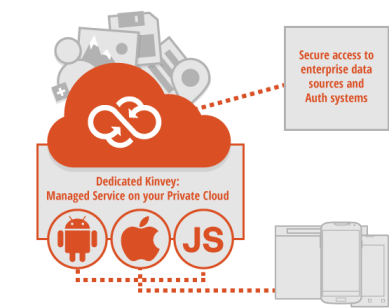
Kinvey, the enterprise-centric backend as a service (BaaS) platform for mobile apps, is launching a new feature today that will allow its customers to run their apps in a dedicated private cloud or on-premise instead of on Kinvey’s regular multi-tenant platform.

While BaaS platforms like Parse or StackMob (which is about to shut down after its acquisition by PayPal) remove much of the hassle of managing and scaling the server stack that powers modern applications, enterprises are still often hesitant to host their proprietary data on somebody else’s servers.

In many industries, these companies also have to comply with government regulations (HIPAA/PCI) that effectively preclude them from putting their data into a public cloud service. Kinvey CEO Sravish Sridhar tells me those are exactly the kinds of industries this service is going after (pharmaceutical, insurance, financial services, etc.) with its on-premise solution. The company plans to get its own HIPAA and PCI certifications in the near future, too.

Once a company has provisioned the on-premise servers for the Kinvey install, the service ties them into its release system and from then on it’s managed by Kinvey. As a part of the dedicated solutions, enterprises can then select which add-ons to make available to their developers and customize the developer portal for their employees.

unnamed (3)With this new dedicated service, Kinvey says, enterprise IT will be able to offer a company’s developers access to enterprise data, authentication service and mobile backend features without the risk of the data leaking out. This means enterprises can launch apps for their employees, partners and customers while staying in control of the data. The dedicated platform is firewalled and all data and network communication is encrypted.

The company currently offers official support for native mobile apps on Android and iOS, as well as for HTML5 apps. In addition, the team actively supports developers who use tools like AngularJS, Backbone.js, PhoneGap, Node.js and Appcelerator’s Titanium. Customers that need support for other platforms like BlackBerry and Windows can use a set of open-source libraries.

With StackMob shutting down in May and Parse having been acquired by Facebook, Kinvey remains one of the few independent BaaS platforms left. He reckons this is due to the company’s focus on the enterprise. He believes it’s difficult to create a sustainable and long-term business by “just” solving backend issues for individual developers – especially for companies that only have raised a Series A round.

Because other platforms tend to tie pricing to the success of an app, they end up being very reliant on having startups that grow quickly on their site, but the majority of users remain on their free or low-end tiers. To scale independently, he believes these platforms need to go after the enterprise market.

Kinvey, which is based in Boston, currently has 21 employees and is ramping up its hiring quickly. The company has raised about $7 million to date, including a $5 million Series A in 2012.

Citia Raises $600K To Power “Card-Based” Websites And Content

citia

The Internet is “melting,” according to Linda Holliday, founder and CEO of startup Citia.

“I’ve been watching this movement from solids and pages to liquids and flows,” she told me. “Everything’s becoming atomic.”

Holliday argued that when you look at sites like Pinterest, you can see how the web is shifting towards a more “card-based” structure. And Citia, which is announcing that it has raised $600,000 in additional funding, aims to help marketers and content creators take advantage of that shift.

The company launched in 2012 by offering card-based layouts for e-book publishers, but now it powers a range of web pages, including eMusic’s Year In Music 2013. When you visit the site, you can browse through cards representing each of the top albums, with the cards sorted into different stacks. Each individual card can be linked to and allows users to listen to music.

Holliday, who was also an angel investor and co-founded Medical Broadcasting Company (now owned by Publicis Groupe and called Digitas Health), described Citia as a “platform as a service.” Ultimately, she wants to be the technology provider for these types of online experiences, although the initial projects “need more hand holding.” She also said that content management systems like WordPress aren’t competitors — instead, Citia can sit on top of a CMS.

These fancy layouts and the platform powering them are supposed to help marketers in a few key ways. For one thing, they can automatically add and organize streams of content from services like Facebook, Twitter and YouTube. For another, it allows websites to “blow through the Z axis,” creating three-dimensional layouts that are more dynamic and allow users to browse through much more content.

The company recently added support for Android, so a big part of my conversation with Holliday involved swapping between demos on a laptop, a tablet and a smartphone. Regardless of the device and whether we were on a website or an app, I found the experience was slick and engaging.

As for the funding, it comes from angel investors including David S. Rose and Geoff Judge, and it brings Citia’s total funding to $2.8 million.

Microsoft Has Sold More Than 200 Million Windows 8 Licenses

Screen Shot 2014-02-13 at 12.01.31 PM

Microsoft’s executive vice president Tami Reller announced today that the company has sold more than 200 million Windows 8 licenses.

TechCrunch confirmed the data point with Microsoft. The company provided greater detail on the figure, stating that it does not “include volume license sales to enterprise,” while it does take into account upgrades to Windows 8 along with normal inclusion on new personal computers.

Microsoft has been incredibly tight-lipped about Windows 8 sales in recent months, providing essentially no guidance since disclosing 100 million copies sold in May of 2013. Windows 8.x, both Windows 8 and Windows 8.1, have enjoyed the regular momentum of the PC market as sustenance to their sales figures.

The last sales milestone, 100 million, was disclosed on May 7, 2013. So in 282 days, Microsoft moved more than 100 million more copies of the operating system. That works out to more than 350,000 licenses sold per day.

Microsoft also disclosed that in January of 2013, Windows 8 had sold 60 million copies.

Aggregate market share for Windows 8.x has been somewhat stagnant of late, as users shift from Windows 8 to Windows 8.1. With the Windows 8.1 Update 1 on the horizon, Microsoft may choose to scoot users more quickly from the original Windows 8 to the newer code to prevent a trifurcation of its traditional operating system base.

Is 200 million a strong number? The pace of Windows 8 sales is lower than in previous periods. Between November 27, 2012, and January 8, 2013, Microsoft moved 20 million copies of Windows 8, or more than 450,000 per day. But that was during the time in which Windows 8 upgrades were discounted.

I think that the 200 million figure doesn’t change the market narrative except that it shows that if Microsoft is able to better convert its extant Windows 8 install base to Windows Store customers, it has a potentially massive user base on its hands.

IMAGE BY FLICKR USER DELL INC. UNDER CC BY 2.0 LICENSE (IMAGE HAS BEEN CROPPED) 

Wikileaf Is Like Yelp For Kine Bud

Bugles_brand_snack_food

Dan Nelson has a dream. His dream is to offer an easy way to find the cheapest chronic in your pro-ganja neighborhood. While you could simply ask your buddy Badger how much he pays, Nelson thought, why not create a website? And so he did.

Wikileaf is a price comparison engine for pot dispensaries. You put in your location and how far you’re willing to travel and the system scours the dank web for pot prices. Think of it as Expedia for herb or Kayak for Kush.

“My background is in banking. I’ve run a successful banking website/blog full time since 2008 and have logged countless hours mulling over interest rate tables. To me, the parallels between banking and marijuana were surprisingly striking and the ways in which banks and credit unions compete against one another online provided an easy framework to apply to the emerging marijuana industry,” said Nelson. “As anyone who’s ever searched for medical marijuana dispensaries online knows there are dozens of websites that all do the same thing. They show where dispensaries are on a map and maybe have some menu options for dispensaries to update. These sites are great and work for a lot of people, but we knew there was a major opportunity in comparing prices openly from these dispensaries and thus forcing them to compete against one another in a completely open and transparent marketplace.”

Nelson hopes to make dispensaries more transparent with his tool. Because each location can set its own prices – and because of the current density of dispensaries in towns like Seattle and Denver – it makes little sense for these companies to advertise their prices unless something like Wikileaf comes along and opens up the various costs associated with picking up a little bud.

“I’m from Seattle, and here in certain parts of the city you can literally stand at the entrance of one dispensary and huck a rock to another dispensary. That’s how abundant they are. The only problem is their current prices and inventory aren’t out in the open. And to make matters worse their store fronts are generally discreet and vague. With wikileaf I wanted to hit two birds with one stone and solve both of these problems in one clean and tidy package,” he said. Dispensaries can update their prices and even add THC strength to their inventory descriptions, allowing users to fine tune their shopping experience.

So far, Nelson has shied away from investment.

“We’ve boot-strapped this with my own personal funds along with minor investments from family,” he said. “That being said, we’re being approached with investor inquires daily and in the coming weeks and months we will be weighing our options for additional funding sources.

The company is still small – he’s only hired a few programmers – but the market has huge potential. Sadly, those in backwater cities like New York can’t yet use the service but here’s hoping that some day it will be 4:20 all day, every day around the world.

Meet Bellabeat, The Quantified Self Startup That Wants To Be The FitBit For Pregnancy

BELLABEAT_8

If there’s ever a time in a person’s life when she wants to keep tabs on everything that’s going on with her body, it’s while she’s pregnant. Every inch added to her waistline, pound gained, heartbeat she hears, and kick she feels is something to be monitored and celebrated.

But even as the quantified self movement has become mainstream when it comes to counting steps and tracking calories, many expectant mothers still largely rely on their doctor appointments to chart out the progress of the lives growing inside of them.

Bellabeat, a startup in the current Winter 2014 class of Y Combinator, wants to help change that by providing a “connected system” that enables mothers to track their pregnancies on their own, while in between doctor visits. Today the startup is launching its first product, a $129 pocket-sized digital ultrasound tool that connects to a smartphone app to let women hear, record, and share their babies’ heartbeat.

Bellabeat’s mobile app, which is available on both iPhone and Android, also lets women easily track important data such as weight gain, nutrition, and fetal movements through a “kick counter.” There is also a social component for connecting with other expectant moms and sharing their stories.

BELLABEAT_APP

Bellabeat co-founder and COO Urska Srsen told me in an interview this week that the goal of Bellabeat’s system is to give pregnant women the data and feedback they crave while in between doctor visits — and to make the visits they do have more satisfying and productive. During a healthy pregnancy, Srsen says, visits to the doctor can often seem short and unsatisfying for the patient because “from the doctor’s perspective, being pregnant is not a disease. It is a normal state. But for the woman, being pregnant is so exciting, and she wants to know everything that she can right away,” she said.

Bellabeat’s goal is to bridge that gap. “We want for patients to be more calm, and for the relationship between doctor and patient to be more fluid and communicative.”

There is also a cost saving component at play. “In the United States, we spend $98 billion each year on pregnancy and childbirth. That is a huge amount of money,” Srsen says. “Some doctors’ appointments are just for checking blood pressure, weight, and making sure the heartbeat is still there. If we could enable women to do some small routine exams at home, that could reduce the cost of healthcare so much.” The company’s longer term vision is to expand into more remote medical patient tracking tools, but for the time being, Bellabeat’s full focus is on the pregnancy space.

In terms of competition, Srsen says that on one side, there is the world of mommy blogs, pregnancy web forums, and simple pregnancy apps; on the other side, there is a market that includes hardware for checking your own vital signs. “We bring it all together and make it all easy to analyze and process,” she says.

It’s one of those ideas that makes so much sense, it’s a wonder that more Silicon Valley startups aren’t tackling it right now. It will be exciting to see how Bellabeat grows in the months ahead.

Here’s a video that shows Bellabeat in action:

Radical Transparency And How Buffer Is Changing The Game On Startup Culture

Screen Shot 2014-02-13 at 10.31.07 AM

As a social-media focused startup in San Francisco that has raised a few hundred thousand dollars, you might think that Buffer would be Just Another Startup. Instead of being something to forget, however, Buffer is one of the most interesting young companies in technology today.

Unlike other companies of its age that closely guard their financial and product-focused metrics, Buffer is open, sharing its vital signs with the world, almost radically so.

The company publishes a regular report detailing the growth in its userbase, its revenue, total cash position, and more. Every month.

The company also caused waves late last year when it published how much it pays its workers, and the methods by which it came to those numbers. Seniority, role, and incentives based on revenue are used to calculate what each Buffer denizen makes.

Instead of the move causing staffing problems internally, the company saw an uptick in applications for open roles.

Given how the differently the company operates from others in its cohort in terms of age and industry, I wanted to talk to the guys running the ship. So, I sat down with the cofounders, CEO Joel Gascoigne and COO Leo Widrich, to chat about what they do, and why.

IMAGE BY FLICKR USER PETE SIMON UNDER CC BY 2.0 LICENSE (IMAGE HAS BEEN CROPPED) 

True Ventures Is Raising $250M For Its Fourth Fund

Screen Shot 2014-02-13 at 12.10.12 PM

An SEC filing details that True Ventures is looking to raise a new $250 million fund, its fourth. True Ventures’ last fund clocked in at $205 million, as TechCrunch reported at the time.

According to the filing, the raise is fresh. However, given the track record that True has racked up recently, I doubt that it will have too much trouble filling out the funding. Fortune reported in late January that True had more than $225 million in capital commitments in place for the new fund.

TechCrunch has reached out to True Ventures for comment regarding the raise.

True Ventures, founded in 2006, had more than $600 million under management before the new raise schedule, meaning that the firm will have taken in more than 80% of a billion dollars when the current traunch is settled.

In terms of investments, True has invested in technology firms like Makerbot, About.me, Fitbit, Automattic, and TastemakerX, not to mention Blue Bottle coffee, an investment that some have called exotic.

With new capital True can keep up its pace of investments, furthering the current technology blush we find ourselves. When the round closes, we’ll bring you the news.

IMAGE BY FLICKR USER FRANCK BLAIS UNDER CC BY 2.0 LICENSE (IMAGE HAS BEEN CROPPED) 


MuckerLab Launches New $20 Million Seed Fund

mucker

MuckerLab, a startup accelerator in Los Angeles, has raised a new seed fund, Mucker Capital. We hear the total amount of the fund is $20 million to $25 million.

MuckerLab launched a few years ago as a three-month accelerator based in L.A. The incubator provides selected startups with $21,000 in seed funding, plus the typical incubator benefits like shared office space, legal assistance, infrastructure and hosting, and mentorship from a network of advisers. The accelerator has helped launch 18 startups who have raised a combined $40 million in funding.

Mucker has two full-time founders, Erik Rannala, formerly of Harrison Metal, and William Hsu, the former chief product officer at AT&T Interactive who will also run Mucker Capital. The fund has already made a number of investments, including TaskRabbit, menswear styling company Trunk Club, and API marketplace Mashape.

According to the site, Mucker Capital will invest in seed and “pre-seed” stage companies both in and outside of L.A.

Facebook Opens Up LGBTQ-Friendly Gender Identity And Pronoun Options

1040259_10151766465225229_1322392396_o

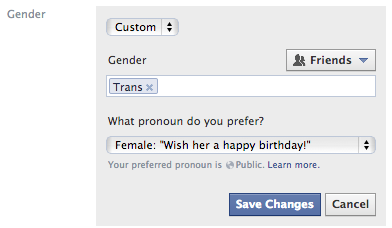
Facebook has just updated to let users choose the gender pronoun they associate with. Aside from the usual “male” and “female” options, users can choose up to 10 different gender definitions to describe themselves out of more than 50 options, including “cisgender,” “transgender” and “intersex.”

Not only will this show up on the user’s About page, but it will show up in all other pronouns on the site that refer to that user. This way, users will not only show up as he/him and she/her, but some may show up with the neutral they/their. So instead of getting a prompt that says “Write on Joey’s wall for HIS birthday,” the prompt will say “write on Joey’s wall for their birthday.”

You can change this by heading into the settings menu on your About page and clicking on the gender options. Alongside male and female, you’ll see an “Other” option. When “other” is selected, a list of 10 more nuanced options will appear.

Previously, Facebook’s gender selector looked like this:

cg_context cg_before

But now it has the added LGBTQ options:

cg_after2

cg_after

“While to many this change may not mean much, for those it affects it means a great deal,” said Facebook publicist Will Hodges in an email. “We see this as one more way we can make Facebook a place where people can express their authentic identity.”

According to the email, Facebook worked closely with LGBT activist groups to compile the new list of gender-identity options. Facebook also added a new privacy option that lets users select who sees their gender:

“We also have added the ability for people to control the audience with whom they want to share their custom gender. We recognize that some people face challenges sharing their true gender identity with others, and this setting gives people the ability to express themselves in an authentic way.”

This lets users block certain less tolerant people from seeing their gender identity.

gay-at-facebook

The update comes three years after Facebook added LGBTQ-friendly relationship statuses, including “in a civil union” and “in a domestic partnership.”

Facebook has shown a consistently progressive attitude towards gender and sexual preference over the year. The company won a Gay and Lesbian Alliance Against Defamation Media Award for fair and accurate representation of the LGBTQ community and issues that impact it. To combat bigotry, it released stats noting that 70 percent of U.S. Facebook users have a friend who lists themselves as LGBTQ.

In 2013, over 700 employees and CEO Mark Zuckerberg marched in the San Francisco Pride parade. It’s even painted the Hack logo in its Menlo Park headquarters’ courtyard with rainbow colors. 

Both through its service’s options and its company culture, Facebook is setting a positive example for how tech can promote tolerance. This could help it attract LGBTQ talent and users, and push other companies to build in compassion for all people.

6a00d8341c730253ef01774297bff3970d-800wi-1

How Frontback Is Getting Popular in Japan

Frontback Community

While today’s update is a significant one for photo-sharing app Frontback, something unexpected is happening as well — Frontback is blowing up in Japan, China and Brazil. In fact, the app is now more popular in these countries than in the U.S.

“In the U.S., people are using Frontback for important events like the Superbowl to make a statement and share what they are doing,” co-founder and CEO Frédéric della Faille told me in a phone interview. “In Japan, people found a way to express themselves through the app, and it’s very different,” he continued.

A Frontback post is a very restrictive form of expression. In some way, taking a Frontback is the visual equivalent of writing a Haiku. There are some artistic rules that you need to follow — it’s short and self-contained. But after that, the sky is the limit.

In Japan, the community has recently decided to self-organize. On February 24, there will be a Japan Frontback meetup. One of the attendees will be Himesora, a Frontback power user who really took advantage of the platform.

She loves art, cartoons and graffiti. She always carries with her a binder with fake paper eyes. Every time she wants to take a Frontback, she pulls the appropriate pair of cartoon eyes and put them on her glasses. In other words, she has created a character for Frontback. You can see the result at the top of this article.

And with the global feed, people all around the world noticed her. They started interacting with her. In the U.S., Mexico and South America, Frontback users have engaged with Himesora — they reply using selfies and captions.

Frontback Community 2

“The non-product team is composed of two persons right now, that’s a quarter of the team,” della Faille said. “We are realizing that when you are dealing with a public graph, you need to provide inspiration to fight timidity. That’s why we are doing staff picks as well. We want to show the true face of the world, with a smile.”

Other users are using Frontback for very specific purposes. For example, Tamkai transforms his daily life into drawings. Willie Myers wants to tell stories using only two pictures.

While Frontback created a new medium, the team is only realizing now the power of this photo format.

“There is something deeply personal about the experience sharing and viewing community member profiles daily in the public space,” community manager Elissa Patel wrote in an email. “All of these photos fall into the category of no filter, no cropping, no photoshop — real people with real stories.”

Frontback Meetup

Frontback Update Adds Photo Booth-Like Timer, Notifications & Localizations

IMG_1481

Photo-sharing app Frontback just received a brand new update in the App Store. The two main new features are a new notification screen and the addition of a timer in the photo-taking screen. This way, you can just tap once to take the front picture, and a timer will start for the back picture, like in a photo booth.

The new hands free self-timer is also a fun way to take a Frontback. When the camera turns towards you, your friends will see the timer on your screen and get ready for the picture. It’s much more natural than having to press the button yourself.

“We now have the feature set that we wanted,” co-founder and CEO Frédéric della Faille told me in a phone interview. “For us, this is the v1 because you have the notification panel that allows you to move back in time. There is the ‘Discover’ tab as well that lets you get unlimited content, with the popular algorithm to surface nice posts from the community.”

It is now the third time that della Faille told me that Frontback is now worthy of the v1 tag. Arguably, the first release in the App Store wasn’t good enough. Developed over the course of four weeks, it was a great proof of concept. It was a nice photo-taking app to capture fleeting moments. But there wasn’t any profile. There wasn’t any way to follow and unfollow someone.

The much-needed September update brought all those features. At the time, della Faille considered it as the true version 1. Yet, one important thing was still missing: a community.

The company hired a community manager (Elissa Patel) and someone who doesn’t work on design or development (Spencer Chen). His job consists of listening to user feedback, optimizing engagement and working on metrics. He’s the missing link between the community and the product team.

Frontback has purposely remained under the radar for the last few months to work on these aspects. For example, the new ‘Discover’ tab was released in January without any big announcement, even though it introduced a global feed to satisfy hardcore users. Other features in today’s update include Facebook single sign-on, localizations in Japanese, Spanish, Chinese, and French, and fullscreen photo views with a translucent status bar. Overall, the app feels a lot more polished now.

And the startup attracted a massive international audience with these product updates, with Japan, China and Brazil now above the U.S. when it comes to usage numbers — 90 percent of Frontback’s new users are now coming from outside the U.S.

The last couple of updates have been really good to improve engagement. For example, every time someone launches the app, he or she now gives 12.5 likes on average — people are spending time in the app. Simultaneously, Frontback has doubled its active user base between December and January.

“We are very excited about what’s happening when it comes to our community,” della Faille said. “We are doing it all ourselves and the numbers have been really good lately.”

Now, the startup is ready for its big push. It will try to put the app into everyone’s hands. It thinks it has a strong core community to make newcomers stick around. And most of this community is in Asia. Without even realizing it, the team has cracked the code of social apps in Asia. Japanese users are much more active than American users, sharing four times as much.

I also asked della Faille about other apps that have been taking cues from Frontback’s design, like Mindie, Flink, and even Facebook Paper. “We think we have had an impact on design when you see Mindie, Flink and others,” he said. “We try to associate a finger swipe with an emotion, like Tinder. But we didn’t realize that the overall design trend was going to go in that direction. Now, content comes first, and not design.”