Kickstarter Hacked, Customer Addresses and Other Info Accessed

ks logo

These days, it really seems we can’t go a week without some big site getting hacked. The latest target? Kickstarter.

Kickstarter announced on its blog (and via an email sent to customers) that hackers had found their way into certain parts of their database.

The good news: No credit card information was accessed — and even if it somehow would’ve been, Kickstarter doesn’t store full credit card numbers.

The not-so-good-news: they’ve detected that the hackers were able to access a database that contained usernames, email addresses, mailing addresses, phone numbers, and encrypted passwords. That “encrypted” bit is a bit of a plus — but given that no encryption is uncrackable with the right resources, you should absolutely change your password anyway.

Kickstarter says they were alerted to the breach by law enforcement officials (which law enforcement group, specifically, wasn’t mentioned) on Wednesday night, that they immediately closed the exploit that allowed the breach to occur, and that the last four days have been spent investigating exactly what was accessed.

Update: Kickstarter has updated its blog to answer a few questions that they were seeing a lot of. Here’s what we can glean from it:

  • Passwords were protected in one of two ways. Old passwords were salted and hashed with the SHA-1 protocol. Newer passwords were hashed with bcrypt
  • The company says it took 4 days to alert customers because they had to wait until they’d “thoroughly investigated the situation.”
  • Two accounts showed (unspecified) unauthorized activity; both of those accounts have been re-secured.
  • If you use Facebook to login to Kickstarter, the company says your FB account hasn’t been compromised. They’ve reset all Facebook tokens, which severs any ties Kickstarter has to your Facebook account until you manually give it permission again.

CrunchWeek: Comcast’s $45B Time Warner Cable Bid, Bye-Bye Flappy Birds, Snapchat’s Smoothie Hack

ryancrunch

We’re at the end of a week where snow was on the ground in 49 out of the 50 states in the U.S. What better way to escape the winter blues than by virtually pulling up your chair to the TechCrunch writer roundtable for a new episode of CrunchWeek, the show in which a few of us bloggers talk about the most interesting news stories from the past seven days in tech?

In this episode, Leena Rao, Ryan Lawler and I discuss Comcast’s $45 billion bid to buy its fellow cable behemoth Time Warner Cable, the rapid rise of the simple and addictive mobile game Flappy Birds (and the shocking decision of its creator to take it down at the height of its success), and how the latest Snapchat hack by an apparent fruit smoothie enthusiast shows the importance of security for all kinds of apps.

With Hackathons Taking Center Stage, The Coming Transformation Of The Computer Scientist

Crichton Hacking

When Dave Fontenot moved to the University of Michigan from his home in South Florida in the fall of 2011, he brought the standard equipment every freshman college student needs -– clothes, shoes, books, and a backpack. One item, though, was missing.

“I didn’t own my own laptop,” he said.

That didn’t stop him from attending his first hackathon several weeks later at Hacka2thon, where he built his first website. The experience ignited his enthusiasm, and over the next two years, Fontenot would found and develop MHacks into one of the largest hackathons in the country, last month hosting more than 1,000 students from across the Midwest and the United States to Michigan for a weekend of coding. “#hellyeah,” as Fontenot puts it subtly.

For the first time next semester, more than 10,000 students are expected to participate in one of 10 mega-hackathons, in a discipline that graduated just about 16,000 students in 2012. That could mean that a majority of CS students will have participated in a hackathon before graduation in just the next few semesters.

Hackathons, though, are just one part of the coming transformation of computer science education. Once a theoretical subject to the chagrin of many undergraduates, computer science students are increasingly finding outlets like hackathons, open source projects, and startups to learn the applied skill sets desired by industry – and are getting the job offers to prove it.

Yet, this rebuilding of the pipeline for new engineers poses deep questions about the future of educating software developers. What is the proper role of universities and degree programs? How should the maker culture, which exists at the heart of these projects, connect with the traditional education mores of research universities? And at a time when access, particularly for females and underrepresented minorities, remains a deeply salient issue, how can organizers ensure that programs lower rather than raise any barriers to new entrants?

Changing The Culture

One of the defining moments for Dave Fontenot was PennApps, the first and one of the largest student-run hackathons in the United States. He had heard that the organizers were paying students to attend from other schools, and so he worked to recruit his fellow Michigan friends to join him, eventually convincing around 25 of them to trek to Philadelphia. The environment and atmosphere were rousing. “We came back and half the people switched their majors to CS,” Fontenot recalls.

Alexey Komissarouk, who founded the PennApps Hackathon in fall 2010, believes that part of that excitement is the ability to create using one’s own skills. “They learn to make, as opposed to doing homework,” he says of the students attending these events.

There is clearly demand. This semester, there are expected to be 10 or possibly more student mega-hackathons across the country, up from three last semester, and their growth appears likely to accelerate. To assist in that growth, Komissarouk helped to organize HackCon last month to teach student organizers how to run effective hackathons. Even so, Fontenot, a speaker at the seminar, notes that “the evangelism is spreading faster than we can scale the events.”

Computer science majors have traditionally followed several different career paths, including corporate software development and academic research. That divergence between theoretical and applied work has been a key battleground in the development of computer science curriculum since the discipline was formed.

Computer science is a relatively young discipline in academia, coming out of the emergence of computer technology for missile targeting near the end of World War II. Much of the education in this early period was informal, or attached to other academic programs like mathematics or electrical engineering. Progress moved at a much more torrid pace starting in the 1960s, with the rise of formal departments and divisions of computer science.

It was clear in those early days that computer science had enormous potential, but there were deep concerns on the state of the discipline. For researchers at the time, the question was whether computer science should be seen as a technical and applied subject, or whether it should develop a coherent set of abstractions that would afford it intellectual legitimacy within the academy.

The debate did not last long. Under pressure at universities like Stanford, the discipline quickly moved in a theoretical direction. This can be seen in the development of Curriculum 68, which promulgated a set of model computer science programs in 1868. Computer science education was focused on mathematics and data structures, with limited credit to be awarded for software development. That direction still underpins many of the top computer science programs in the United States.

Since the publication of the landmark curriculum almost five decades ago, however, employers have completely changed their hiring standards. They increasingly desire engineers ready to develop software from day one, and target graduates who already have significant software experience under their belts. This is particularly acute at startups, many of which lack the mentoring and training infrastructure to bring new graduates up to speed.

It is telling then that these hackathons are almost exclusively student-run, filling in the gap between their enthusiasm for building new products and their curriculum’s emphasis on theoretical constructions.

Fontenot believes that “People are going to realize that this is more than just a hobby, but an educational revolution.” He emphasized that the skills developed at hackathons go beyond just pure programming, and include product design and working in teams, skills that have traditionally been excluded from computer science work.

Komissarouk, though, cautions that the changes need to be seen more as additive to a traditional computer science education, rather than a replacement. “Hackathons are a reasonable adjustment of the CS curriculum. Penn’s IR [international relations] department has a huge MUN [Model United Nations] program, our creative writing program has a writing program, but all we had in our CS curriculum was a bunch of PhDs talking about advanced research. Which is cool, but it’s not what many students will be doing after college and it’s not why most of them came to CS.”

Hackers hack during the MHacks Hackathon 2013 in the Big House on September 21, 2013 in Ann Arbor, MI.

Hackers hack during the MHacks Hackathon 2013 in the Big House on September 21, 2013 in Ann Arbor, MI. (Joseph Xu, Michigan Engineering Communications & Marketing, All rights reserved. Used by permission.)

Learning Through Open Source Projects

Hackathons, though, are only one means to building a new product. Open source projects are increasingly being seen by both employers and students as a viable means to develop key skill sets in new graduates, and inculcate a long-term development mindset.

Google has offered its Summer of Code since 2005, placing about 7,500 students on prominent open source projects around the world. But it is not just large companies that are focused on the potential of students in open source, but startups as well.

Quinn Slack and Beyang Liu founded SourceGraph to help developers find usage examples of code across codebases. They see students playing a key role in expanding the company’s knowledge of development and its role in the open source community. Last month, they announced the selection of 10 Open Source Fellows working on a range of projects, from MIDI input libraries to data-analytics tools for political analysts. They hope to shortly select a second class of fellows.

“Working in open source gives students experience with real-world code, teaches them how to collaborate with others on software projects, and builds their reputation as a programmer. And it can be super fun,” Slack writes to me in an email. “By getting involved in open-source, students see how some of the best, brightest, and most passionate programmers actually do things.”

For Julia Lee, a computer science undergraduate at Stanford and an inaugural Sourcegraph Open Source Fellow, she appreciates that the projects are more involved and closer to real-life software development.

“A lot of Stanford CS courses have final projects, but projects tend to be smaller than many open source projects.” She also likes the flexibility to define her own project. “I’m teaching myself Android development in the process of building an app that public health researchers from Stanford will use later this year.”

The hackathons are killing the career fairs, particularly the engineering school ones. [Recruiters] want people who can actually build something.

Recruiting

For companies like Sourcegraph, it also doesn’t help to get an early introduction to some of the top software engineering graduates out of Stanford, Berkeley and other schools. Indeed, everyone I talked to agreed that recruiting developers is going to fundamentally change in this new world.

Fontenot from MHacks is very clear on this point. “One thing that is very concrete, the hackathons are killing the career fairs, particularly the engineering school ones. [Recruiters] want people who can actually build something,” and demonstrating that ability through hackathons or other projects gives candidates a “huge competitive advantage.” Komissarouk from PennApps believes that hackathons are becoming a sort of “farm team” like the minor leagues in baseball.

The two see VCs and other recruiters pouring into hackathons to find the best talent. Fontenot particularly noted the visibility of Andreessen Horowitz at these events. “I did a survey on where [participants] started their job search, and close to a majority said that A16z’s website was the key place they went through,” Fontenot says. “They have been very effective, since they bring a lot of top founders and engineers from their portfolios decked out in A16z swag and it gives a great impression.”

Fontenot believes that hackathons are already starting to replace the process of interviewing at a company. “For companies, it is all about relationships. It is like a meritocracy, where you bring your best engineer [to these hackathons], and he actually has to help mentor and help a team to achieve some large problem. You don’t need to interview the candidates, you are seeing them right there at crunch time. You don’t need to evaluate them, because your engineer is experiencing the person live.”

Access And Acceleration

One benefit of these events is their democratized nature — anyone can sign up for a hackathon or work on an open source project and receive credit for their work.

But Komissarouk points out the problem of access here. “On one hand, it’s great that hackathons are becoming more popular. The fact that more engineers are being exposed to the fact that theirs is a maker profession, and there’s more to CS than homework assignments and jobs, that’s wonderful. On the other hand, as the bar for what makes a great hack goes up, hackathons become more exclusionary and intimidating to exactly the kinds of people we want to attract.”

Indeed, while students in the past needed only graduate and apply to a company (perhaps with a small portfolio of class projects), today’s students have significantly higher expectations set for them. For instance, many startups use GitHub to keep track of code activity for potential recruits. That may make the hiring process a bit more transparent, but it also raises the requirements for students, who must actively contribute code before they may have even reached their first algorithms class.

Fontenot and other hackathon organizers are acutely aware of such concerns, and have actively worked to broaden the base of students in engaging in CS. “As you get bigger, you get more diverse,” he notes.

Slack of Sourcegraph sees the changes as a positive development, giving students the ability to accelerate their learning. “Today’s CS students will be the future leaders of the tech and open source community, so if anything we’re just helping them get there a few years sooner.”

That acceleration can already be seen in MHacks, where two of the seven top prizes were awarded to high school students. Indeed, Fontenot argues that if you want to get into college today, doing a hackathon is a particularly strong approach.

“At Michigan, we sent over 50 names of high school students to the admissions office, because they all want the next 10 Mark Zuckerbergs,” and will look at their applications accordingly.

But that acceleration comes at a potential cost. If students need to start demonstrating their aptitude for engineering well before college, that precludes a large number of students who may not even have access to a computer during their adolescence. And while the open and flexible nature of such programs are indeed positive for students, the more they become associated with recruiting, the more these programs will become about demonstrating recruitment potential rather than opening opportunities for further education.

Conclusion

Like many professions today, software development is developing new rules for education and status identification. At one point, a degree from MIT or Stanford was the key ticket to a major Silicon Valley company, and from there, a start-up or a management role.

The new culture around hackathons and open source projects is going to upend this forced march. Students increasingly are engaging with startups earlier in their careers, and they are building products rather than writing code samples. With a continued focus on education, there is an opportunity here to solve the engineer crunch, and perhaps even expand the range of people who are involved in engineering the next great startups.

Top image: The MHacks Hackathon 2013 opening ceremony in the Crisler Arena on September 20, 2013 in Ann Arbor, MI. [By Joseph Xu, Michigan Engineering Communications & Marketing, All Rights Reserved, used with permission]

Apple & Google Begin Rejecting Games With “Flappy” In The Title

flappy-tee

The Flappy Bird phenomenon shows no signs of slowing down, despite the fact that the original title was yanked out of the App Store by creator Dong Nguyen, whose newfound fame apparently became too overwhelming. But though “Flappy Bird” itself may be gone, the App Store’s top charts today are filled with clones that mimic the addicting, frustrating game that became this year’s viral hit.

However, that may not be the case for long. Word has it that both Apple and Google are now rejecting games that have the word “flappy” in their title.

According to Vancouver-based game designer Ken Carpenter of Mind Juice Media, Apple rejected an app of his called “Flappy Dragon” from the App Store. Apple told him “we found your app name attempts to leverage a popular app,” says Carpenter.

Apple told him the app was in violation of the following section of the App Store Review Guidelines:

Reasons:

22.2: Apps that contain false, fraudulent or misleading representations will be rejected
22.2
We found that your app, and/or its metadata, contains content that could be misleading to users, which is not in compliance with the App Store Review Guidelines.
We found your app name attempts to leverage a popular app.

Clearly, the only app “Flappy Dragon” would be leveraging is “Flappy Bird” – which, to be clear, is technically no longer present in the App Store.

This is just not my fucking week: Rejected. “We found your app name attempts to leverage a popular app.” Which app? FB doesn’t exist!?!?!

— Ken Carpenter (@MindJuiceMedia) February 15, 2014

Carpenter isn’t the only game developer affected by the policy shift, it seems. A tweet from Kuyi Mobile indicates that a small handful of developers attempting to launch their own “Flappy” clones have also been rejected for the same reason:

@madgarden @wtrebella @kylnew @MindJuiceMedia I think you should resubmit. Besides Ken, I know 3 other devs who just got rejected. :S

— Kuyi Mobile (@kuyimobile) February 15, 2014

This is somewhat odd, given that there are already several similarly named games on the market, including “Flappy Bee,” “Flappy Plane,” “Flappy Super Hero,” “Flappy Flyer,” and even “Flappy Bird Flyer,” Carpenter points out. Plus, there are clones that don’t include “Flappy” in the title, like “Splashy Fish” and “Ironpants” – #1 and #2 in the App Store’s top charts, at present. Meanwhile, others that include “Flappy,” but don’t lead with it, are also doing well: spot #3 is “City Bird – Flappy Flyer” and #7 is “Fly Birdie – Flappy Bird Flyer.”

In other words, the App Store’s top charts are being absolutely decimated by “Flappy Bird” clones. And users are still eating them up en masse.

But perhaps enough is enough? Apple may not want the App Store to be overrun with these spinoffs, especially because their proliferation is likely causing consumer confusion. The “Flappy Bird” craze reached mainstream media, which means everyday users who may not following each turning point in this ongoing saga are just hitting up the App Store and searching for a download.

Unfortunately, if Apple was trying to prevent these “Flappy Birds” clones from taking over the top ranks in the App Store, they’re too late. Now the new rejections have the potential of being seen as unfair since there are those whose “Flappy” knockoffs are still live and well-ranked…and raking in plenty of extra cash, too. The fair thing to do is force everyone to rename their “flappy” games, and/or pull “flappy” from their keywords. (Update: That may be the case! See below.)

Screen Shot 2014-02-15 at 5.43.41 PM

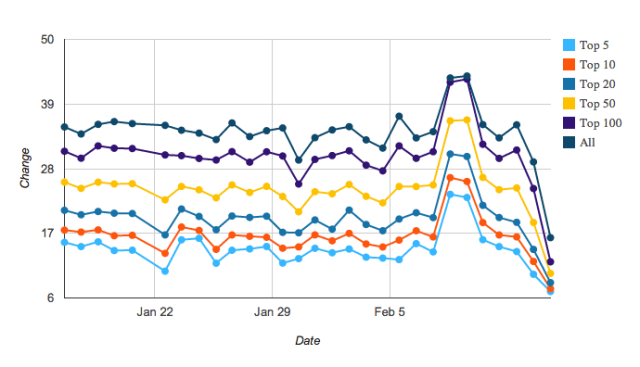
Also of note, around the same time that developers were discussing the “Flappy” rejections on Twitter, movement in Apple’s Top Charts ground to a halt. Below is a chart that shows the average number of changes in the iOS Top Charts provided by MobileDevHQ. You can see it fell of a cliff, meaning the Top Charts were effectively “frozen” as of 2/14.

appstore-frozen-2-14-14

The charts soon returned to normal, which MobileDevHQ says makes it seem more like a transient error on Apple’s end, as opposed to an algorithm change.

Google Rejects “Flappy,” Too

Apple isn’t alone in deciding to bounce the “Flappy Bird” clones from the app store, however. Both Kuyi Mobile and Happy Mage Games stated that Google is also rejecting app submissions that use “Flappy” in the title.

Says Carpenter, “Yeah, I was rejected from Google Play, too.”

Screen Shot 2014-02-15 at 4.37.49 PM

“The first time I assumed it was because I included a phrase about ‘Flappy Dragon’ being the best flapping game to play now that ‘Flappy Bird’ is dead. My app was originally published with no issue and was online and searchable for a few hours,” Carpenter explains.

Shortly afterwards, Google removed it from search, but it was still visible through its direct link. Around 24 hours later, he received a suspension notice. “There was no ‘Fair Warning’ email, which Google claims to send before taking such actions. I checked and rechecked my spam folder to be sure. They just arbitrarily removed the app with no warning,” says Carpenter. ”The message they sent me simply referenced the ‘spam’ provision of the Google Play terms and did not specifically call out what my transgression was,” he adds.

After removing the competitor’s app name in the description, Carpenter resubmitted the game. After a few hours, it, too, disappeared from search.

We reached out to Apple and Google for comment, but given that it’s the weekend (and Apple doesn’t typically respond to inquires about App Store policy changes), there may not be an update on this post with the companies’ immediate response.

Hat tip: Ouriel Ohayon; Image credit: Flappy tee, tweeted by @kunaalarya; Note: Post updated with additional comments from Carpenter after publication.

This iQi Hack Shows Why Apple Hasn’t Bothered With Wireless Charging

iQi

iQi is a hardware add-on that brings the tech Apple hasn’t — wireless charging (using the Qi standard) — to your iPhone without the need to put it in a bulky case. Think of it as akin to Bill Gates’ quest for sensation enhancing graphene condoms. Or, er, having some cake and eating it.

The slender iQi gizmo is designed to work with soft cases, including Apple’s leather iPhone 5 sleeve, so you don’t have to compromise the overall look of your iPhone just to be able to wirelessly charge it. Although, once this phone-hugging gizmo is installed, there will be a slight bump on your phone’s rear, i.e. where the case has to swell to accommodate its wireless-charge providing passenger.

Visually, this is an all-but imperceptible bump if you’re using Apple’s leather sleeve, but it’s a bit more sticky-outy when paired with some soft plastic cases. The slight swelling does mean the handset won’t now sit entirely flat on a table or other flat surface.

iQi

Wireless charging has huge potential, albeit much of that promise remains to come. For now it plays a relatively small role in the consumer electronics space — possibly making a few mobile owners’ lives slightly more convenient by allowing them to charge their device by sticking it on a charger plate, rather than fumbling around to plug in a power cord once per day. (Although wireless chargers still have to plug the charger plate in at some point, and make some space for it  – and its unpleasing cable — on their desk.)

Nokia adding wireless charging to its flagship Windows Phone Lumia smartphones wasn’t enough to convert legions of iPhone users to the platform and save the once mighty mobile maker from having to sell that business unit to Microsoft. But that doesn’t mean there isn’t appetite for the tech, even among iPhone owners. More Android flagships are adding built-in wireless charging (including Google); yet Apple continues to stand aloof.

iQi’s Indiegogo campaign for its slender, soft-case compatible iPhone wireless charger, concluded a successful crowdfunding run last December, raising over $161,500 (from 2,350+ backers) — more than 5x its makers’ original target of $30,000. So even though Cupertino hasn’t seen the point of wireless charging yet a portion of iPhone owners are clearly keen. Or keen enough to shell out $25+.

But, is the iQi any good? Well, it certainly doesn’t look like much when my test unit arrives, being packaged in an envelope housed on a piece of card with a small paper user manual. But that’s a good thing: less, not more, is exactly the point of this iPhone wireless charger hardware hack.

  1. P1020034

  2. P1020043

  3. P1020042

  4. P1020040

  5. P1020046

  6. P1020048

  7. P1020049

  8. iQi

  9. iQi

  10. P1020056

  11. P1020062

  12. P1020075

It’s basically a couple of pieces of cardboard (smaller than a credit card in size), sandwiched around some low profile electronic innards, with a flexible connector sticking out one end that plugs into the iPhone’s Lightning connector port.

Plugging the iQi into your iPhone is pretty straightforward, although it helps to have a fingernail long enough to push the connector snugly into the port. At that point you just bend the flexible plastic ribbon over so the main bulk of the iQi sits flush with the back of your iPhone (that’s bend, not fold; the ribbon won’t stand up to any kind of creasing). A flat silicon disk is also provided in the pack which you can stick onto the iQi’s rear to stop it sliding around on the phone’s rear. Simples.

Of course you do need a Qi charger plate to use the iQi with — such as the KoolPuck or KoolPad — or another charger plate that uses the Qi wireless charging standard. You’ll also need a soft-case to help protect the iQi and keep it fixed in place — unless you fancy augmenting your iPhone’s rear with duct tape.

iQi

Now to the main issue: does the iQi actually work? Not, I’m afraid to say, reliably. Which may well illustrate why Apple thinks this nascent tech isn’t worth bothering with (yet).

Some of the issues I encountered while testing the iQi (with an iPhone 5) are likely those generally associated with the Qi standard. As my TC colleague John Biggs has previously noted, Qi is slow and finicky — requiring the user to align the device with the charging place in just the right place or no dice. Or rather, no juice.

Which isn’t a huge hassle per se but it is a problem for a device that only offers an incremental convenience boost anyway. To add to the irritation, when it’s not aligned, the iQi beeps persistently, like a mournful robot child in need of a bottle feed.

One time I left it charging — everything apparently going tickety-boo — yet when I returned to the house half an hour later I heard its urgent call. Turns out the phone was sitting there, where I had left it charging on the plate, now not charging but beeping. Stuck on 99% battery.

Perhaps the iQi cuts out charging when it’s almost full and beeps to signify this but, if so, that’s going to get really annoying if the moment it chooses to pipe up coincides with the middle of your night.

I did also have a missed call, which perhaps caused the charging function to cut out. Whatever triggered the Qi break, the iQi’s reliability evidently can’t be relied upon.

It had been working prior to this point, but after this break it stubbornly wouldn’t resume charging — even after I tried draining the battery a bit to give it more scope for juicing. I also swapped out the KoolPuck charging plate for the KoolPad. But it still didn’t want to charge (even though the charger light on the plate switched to blue, as if charging, yet the battery indicator did not respond).

Next I tried removing the iPhone sleeve. Still no joy. So, finally, I did the inevitable reboot of removing the iQi and then plugging it back in again. And lo it started working again. So, yeah.

Another caveat: this is a hardware hack of the iPhone. iQi Mobile notes on its Indiegogo page that it’s not part of the MFi program, and “as such is not Apple certified” — so, while it claims the iQi “works well with iOS 7.0.4″, that statement carries an implicit caveat that it can’t guarantee smooth operation with future iterations of Apple’s OS.

So, down the line, iQi owners might have to choose between their iPhone having a sporadic wireless charging ability, and their iPhone having iOS 8. So, yeah…

Bottom line

If you really are desperate for an iPhone that supports wireless charging, and are willing to live with temperamental tech while you wait for Apple to take the plunge itself, the iQi does get around the need to stick a bulky, unattractive case on your iPhone. It’s certainly very visually unobtrusive, especially paired with Apple’s leather case.

Just don’t expect your phone to sit entirely flush with any flat surface, ergo prodding a resting-on-a-table iPhone’s screen or pushing its home button will result in the handset rocking about or lifting up like an angry ouija board.

But — above all — don’t expect the iQi-powered wireless charging to ‘just work’. Much like the nascent convenience of wireless charging generally, the additional functionality offered by the iQi can be marginally useful sometimes — but only when it’s not being a bit annoying.

Square Cuts More Custom Pricing Deals For Merchants And Ramps Up Sales Hiring

Square_-_Accept_credit_cards_with_your_iPhone__Android_or_iPad

This past week brought the news of a fairly significant development for Square — the rollout of Square Stands in bars, Whole Foods restaurants, and other venues. This comes a year-and-a-half after the huge deal the payments company inked with the coffee and beverage giant Starbucks.

The lengthy wait between these big deals was a signal to some in the payments world that perhaps Square wasn’t ready to attract large retailers to drop legacy systems and processing deals.

But then the Whole Foods deal was announced. While the partnership isn’t for the grocery checkout side of the business, it’s still a lucrative deal. And we’re hearing that Square is aggressively working to do more custom pricing for merchants, especially chains and big names, in order to bring in bigger names and retailers.

Square is also now crafting a big sales team; the company is staffing up on sales people, we hear, which is something CFO and operations head Sarah Friar had said in the past that the company was trying to hold off on.

Custom Pricing

Square’s pricing is 2.75 percent for swiped transactions, Square Wallet payments, and Square Market transactions, and 3.5 percent + 15 cents for manually entered transactions. The company cut a deal for custom pricing for Starbucks and we’re also assuming for Whole Foods, but previously this was done on an exclusive basis.

Now, any larger chain merchant can apply for custom pricing via Square’s site. For example, Square tells TechCrunch that the Butterfly Studio Salon in New York City is processing millions in payments per year, and has negotiated a custom rate of 2 percent for each swipe using Square. The custom pricing allows merchants who are growing to stay with Square instead of moving to a POS system with better rates.

As Adlin Palencia, manager of the Butterfly Studio Salon explains, “I switched to Square because it was simple and had a flat rate for all cards, including American Express, which is how many of my customers like to pay. As the business has grown, I’ve been able to stick with Square because my custom rate saves me more than $2,000 a month, which is money I can invest back into my business.”

Palencia considered switching from Square to another POS system as her business grew, but she stayed with Square because of the custom pricing deal she got.

Square commented on the change: “As our sellers continue to grow, we want to ensure we are growing with them. Custom rates, like many of our other new offerings, make Square a great fit for larger sellers.”

The fact that they are open to negotiating with mid-size to large merchants, as well as large ones like Starbucks, is telling. It’s likely that Square was “encouraged” to start negotiating with some merchants on fee structure after eliminating the flat, monthly fee structure last fall.

The question I have is whether Square is making any money off of the deals where the company goes down to 2 percent per transaction (or less in more high-volume deals like Starbucks). We’re also not sure what the exact criteria is for merchants to be eligible for custom pricing. And in terms of sales, it’s still not clear what Square’s actual revenue looks like beyond what the company is processing per year.

Sales

Square has notoriously done little marketing beyond simple advertising. At one point the company did a TV commercial, but for the most part, Square has prided itself on word-of-mouth marketing to target small to medium-sized businesses. As Friar infamously said at a Goldman Sachs Technology and Internet Conference, she doesn’t want to be involved with hiring sales people. But that tune has changed, and Square has been quietly building an army of sales teams focused on bringing small to mid-sized retailers onto the platform.

It’s unclear how big the sales team will be, but according to this LinkedIn job posting for a sales recruiter, “Square is beginning to build a world-class Sales team for the SMB and Mid Market marketplace.”

The company has attracted the attention of large brands as well more recently, with the Whole Foods partnership, as well as small promotional deals with Godiva and Uniqlo. But it seems like with these deals, these larger retailers are dipping their feet into the pool, and not diving in. Whole Foods has not enlisted Square stands to replace its cash registers on the grocery line, and it’s unclear yet if the promotional partnerships will amount to a bigger deal. Burberry has been using Square to take payments at a few of its stores, but it’s not a widespread implementation.

Another area where Square is beefing up in the hope of attracting larger retailers is in customer support. Square is adding phone support, which the company previously didn’t have available to merchants. The lack of phone support had been a pain point for many merchants, who want access to a live person to get problems fixed in real-time. If Square is pitching large retailers on switching from legacy systems, then phone support is a must.

While Square still has consumer-facing apps (Square Wallet, and most recently peer-to-peer payments app Square Cash), these changes are squarely focused on the merchant services side of the business. And all of these moves aim to collectively accomplish the goal of attracting more large merchants to the platform. As the company matures, and is potentially looking at a public offering, Wall Street will be looking not only at the number of small merchants and revenue, but also how many mid-size to large merchants are willing to forgo legacy POS systems in favor of Square.

On-Demand Ride-Sharing Startup Lyft Is Raising Another Big Round Of Funding

Lyft Highway shot

Lyft is raising yet another big round of funding, according to sources. The company, which is seeking to make ride-sharing mainstream in cities across the U.S. and around the world, is expected to use the new cash to fund expansion into new cities and territories.

We’ve heard Lyft has pitched a number of venture firms and late-stage institutional investors, but hedge fund Coatue Management seems to be in the lead for the deal. Coatue has recently invested in hot companies like Box, Snapchat, and HotelTonight, and is part of a growing trend of hedge funds making bets on later-stage startups with traction.

Andreessen Horowitz, which led Lyft’s $60 million Series C round, is also expected to contribute a large chunk of cash. Other investors in Lyft include Founders Fund, Floodgate, Mayfield Fund, K9 Ventures, Ooga Labs, fbFund, and Keith Rabois.

The company was founded as Zimride back in 2007, but it wasn’t until 2012 — when it shifted from long-range to on-demand ride-sharing — that things began to really take off.

With the launch of the Lyft mobile application, it broke new ground in enabling passengers to get rides from other people with a car and spare time on their hands. Due to the success of the on-demand platform, the company rebranded as Lyft and sold its legacy Zimride assets to Enterprise Holdings last summer.

After its initial stint in San Francisco, Lyft began expanding to other cities early last year and now is offering service in 20 markets throughout the U.S. But like Uber, which also offers on-demand rides via mobile app, Lyft has plans to aggressively increase the number of international cities that it operates in beginning this year.

The additional funding will be vital to getting it on the right track toward that goal, as it bulks up operations both in its San Francisco headquarters and in remote offices around the world.

In the meantime, Lyft is trying to get more regulators and local officials comfortable with the idea of letting unlicensed drivers give rides to passengers around town. To that end, it recently hired Google X legal director David Estrada as its VP of government relations.

The company also announced the creation of a peer-to-peer rideshare insurance coalition that includes other transportation companies, as well as regulators and insurance providers, to figure out the tricky issue of insurance for its drivers.

Lyft, Coatue, and Andreessen Horowitz all declined to comment.

Gillmor Gang: Lip Sync

Gillmor Gang test pattern

The Gillmor Gang – Robert Scoble, Keith Teare, Dan Farber, Kevin Marks, and Steve Gillmor — Boy, the way Glenn Miller played, those were the days. The Gang was a deck stacked against the Gillmor young versus old, Lorde versus The Stones. Just when we finally convinced everybody Beatles was spelled with a Capital T. The talent drought continues.

Sure, there are great artists. And even greater records Et tu Get Lucky. The Gang circles the distribution, the locked up soundtrack of our lives, the Age of Streaming. And in the end, the love you make is equally to the haul you take.

@stevegillmor, @scobleizer, @dbfarber, @kteare, @kevinmarks

Produced and directed by Tina Chase Gillmor @tinagillmor

Live chat stream

The Gillmor Gang on Facebook

Was Y Combinator Worth It?

Y_Combinator_Logo_400

Editor’s note: Jarrett Streebin is a Y Combinator alumnus and founder and CEO of EasyPost, a San Francisco-based startup with a simple shipping API. Follow him on Twitter @jstreebin.

Almost any time someone asks about the Y Combinator experience they ask, “Was it worth it?” It’s a difficult question to answer concisely given the complexity of such a program. During Y Combinator we had a chance to make a lot of friends, learn from experienced entrepreneurs, pitch to investors, and even sign up valuable early adopters.

While it’s difficult to quantify many of these benefits, one area we can quantify is fundraising. We have been collecting data on fundraising since day one and were fortunate enough to attract investors both before and after YC. We looked back over the data recently to see if we could quantify what Y Combinator is worth.

Midway through the fundraising process, we realized that the single most important indicator of success (getting a check in the bank) was whether or not the investor was introduced to us (inbound), or whether we solicited them originally (outbound). On account of this we noted whether each investor was inbound or outbound.

Also, since we were attempting to measure the value of Y Combinator, we broke the groups of investors into two segments: before we found out we were accepted into Y Combinator and after. The first we’ll refer to as Pre-YC, the second Post-YC. This not a division of round or terms, just whether they were before we were accepted Y Combinator or after.

To date we’ve raised $3 million from SV Angel, CrunchFund*, Mesa+, Kevin Barenblat, Lars Kamp, Rahul Vohra, Ullas Naik, Shawn Bercuson, Initialized Capital (Garry Tan, Harj Taggar, and Alexis Ohanian), Sherpalo Ventures (Ram Shriram), Alex Polvi, Google Ventures, Charlie Cheever, Mike McCauley, David and Ryan Petersen, Jenny Haeg, Jody Glidden, Dalton Caldwell, Funders Club, Adrian Aoun, Fritz Lanman and Hank Vigil, Charlie Songhurst, Bill Lee, David Sacks, RightVentures, Capricorn, A Grade, Matthew Cowan, Sean Byrnes, Founders Fund, Valor Capital, Greg Kidd, Jeffrey Schox, and more.

This is excluding YC and YCVC ($20K notes from General Catalyst, Maverick, Sequoia, and Start Fund each).

Being “accepted” into YC is synonymous with securing an investment from YC; so we’re going to say that one’s presence in Y Combinator has no impact on whether or not Y Combinator chooses to invest.

In total we took 121 calls/meetings with potential investors, and received a check from 43 of them. That’s an average of $25,041.32 per call/meeting.

As we alluded to earlier, the most important difference was between inbound and outbound investors. To be clear, we’re defining inbound as either the investor contacted us directly, requested an intro, or someone in our network introduced the investor to us without our asking. Anything else (e.g. requesting the intro, contacting the investor, etc.) we considered outbound. We realized what a critical signal this was midway through our fundraising and adapted to it, as you will see in the breakdown of the two rounds.

All of our investors – every single one of the 43 – contacted us or requested an introduction through their network. Even when we were introduced by a friend at our request, these fared the same as all the cold outbound requests. What we realized is that when you request an intro the introducer is doing something they weren’t naturally inclined to do. If they had thought you were that hot of a deal they would have already introduced you. Not only are you decaying the relationship with the friend, but also that friend’s relationship with the investor, since they likely won’t invest in you (and won’t be as interested when they have a hot deal to show the investor). In our experience, the only intros that were worth anything were the ones that weren’t requested in any way. All others were a significant waste of time.

One last point on this, almost any VC will take a meeting with almost any entrepreneur. Why? Because that’s their job, to meet with entrepreneurs. It also means that if they schedule it on, say a Friday in SF at 11am, they can: a) avoid driving down to Sand Hill altogether, and b) arrive in Tahoe in time for a few evening runs. Be wary in thinking it’s anything more than that. The trajectory of your idea or company has yet to be set, and you’re burning valuable time chasing capital from unlikely sources instead of doing the most attractive thing to investors: building a valuable company.

We didn’t track time between meetings and close or money in the bank because we saw very little variance in that. Almost everyone that committed and signed the docs wired the money within two weeks. And if they didn’t they let us know if it was going through complaince or something (at larger funds).

Additionally, with first contact to commitment, 90 percent of the time this was within two weeks. There were about 10% that waited to decide, or waited for other investors to join the round, but I could count them on one hand and there was no difference pre or post YC.

Pre Y Combinator

Our first seed round began when SV Angel emailed us in September 2012, since that was our first fundraising discussion, and ended April 28, 2013 when we were accepted into Y Combinator.

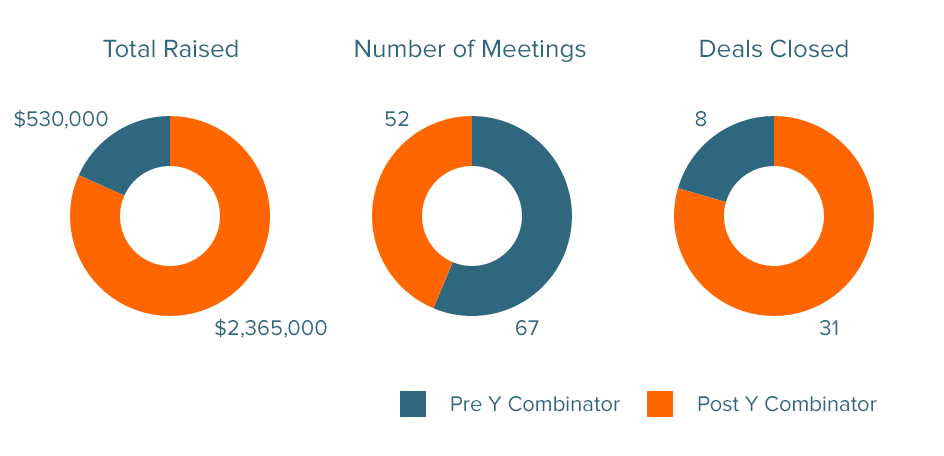
Although we had SV Angel in from very early on, and then a few others, it took six and a half months to raise $530K from eight investors. Had we stopped after our third investor, Mesa+, we would have been at $450K over three months. Better, but not by much.

Post Y Combinator

Our second round of funding began that day we were officially accepted into Y Combinator, April 28, 2013. With that we were able to raise a quick $250K, stopped talking to investors for the duration of YC, and then began raising again a few days before Demo Day. Unlike our first round, we didn’t raise at all during Y Combinator, so the period lasted only about a month and a half. As you can see, we had a much easier time fundraising after being accepting into Y Combinator.

Streebin1

What Is Y Combinator Worth?

When it comes to fundraising the effect of Y Combinator cannot be overstated. In our case, Y Combinator meant raising more than four times as much money in a quarter the amount of time. We were able to attract more investors, and receive an investment from a higher percentage of them – spending less time in meetings and more time building EasyPost.

Does this mean you’re out of luck if you didn’t get into Y Combinator? Absolutely not. In raising $3m from 43 investors we learned a lot of ways to stack the cards in your favor. And since we learned many of them before we were accepted, they amplified the effects of Y Combinator dramatically.

*CrunchFund is owned by TechCrunch founder Michael Arrington.

Dosomething.Org Taps Snapchat For Teen-Centric Valentine’s Campaign

2

Dosomething, a not-for-profit focused on making volunteer work and social change exciting to people under 25, is going after its key demographic where they’re comfortable: Snapchat.

The company used the photo-sharing platform, which has yet to launch a formal advertising or brand program, to run a Valentine’s-themed campaign in NYC.

“We noticed that teenagers, our core demographic, were flocking away from Facebook,” said DoSomething’s Colleen Wormsley. “But they love Snapchat.”

DoSomething first signed up for a Snapchat account in November of 2013, with Bryce Mathias in charge of the channel. The company alerted their Twitter following that they now had a Snapchat account, and simply waited for requests to come in. Mathias, a male model, mostly sent selfies to new friends making goofy faces.

The team learned that they received more response snaps during school days, so Mathias began setting aside a block of time just before lunch to respond to everyone’s snaps.

As February rolled around, DoSomething launched a Love Letters campaign that encourages teens to create Valentine’s Day cards for homebound seniors. As a part of the campaign, the not-for-profit created a Snapchat story promising that Mathias would deliver these Love Letters on Valentines Day dressed as cupid. In the middle of New York. In February.

All the followers had to do was text to vote for how he should deliver them: by bike, ice skates, or around Central Park. Once they voted, they would be sent a call-to-action to create their own Love Letter for a homebound senior.

In the end, 11 percent of the people who viewed the story asked him to go ice skating. Of those who texted in to vote, 57 percent signed up to participate in Love Letters.

Putting those figures in perspective can be difficult without much transparency into Snapchat’s monetization plan, but we may not have to wait too much longer.

The interactive portion of the campaign might be just the ticket on a platform where social media responses and feedback can’t be shared or showed off by brands. But that works in those brands favor. Younger demographics would much prefer a more authentic relationship with the brands they like, and with 400 million snaps sent per day, there could actually be potential to build lasting conversations between brands and younger consumers.

Snapchat was rumored to be building out a sales team last summer, and the company certainly has people in place to communicate with brands behind the scenes.

Snapchat’s Josh Stone responded to DoSomething shortly after they published the story to welcome them to the platform and lend a hand with any support or feedback they might need.

Is Tech Money Good For San Francisco’s Middle Class? An Economist’s Perspective

money

The liberal wonderland of the San Francisco Bay Area has one of the highest concentrations of wealth in the country. Twitter’s IPO, alone, created an estimated 1,600 millionaires. But, are the local residents catching any of the dollar bills being shaken from the post-IPO money trees?

It’s been hard to decipher the broader impacts of technology on the average San Franciscan because heart string-tugging anecdotes have clouded the narrative. Critics of tech companies make headlines by protesting Google’s private buses and indirectly linking their existence with the surge in housing evictions. ”There’s a war brewing in the streets of San Francisco,” wrote former San Francisco Mayor Willie Brown.

On the other hand, tech champions like to trot out small business owners who have benefited from re-locating tech HQ’s to blighted areas of the city’s historic Market district. So, to cut through the cherry-picked anecdotes, I asked San Francisco’s local economists what their take is and, as you’d imagine, they fall somewhere between the techno-utopian dreamspeak that you sometimes hear in the industry and the dire descriptions of the activists.

One thing is clear: they believe that the money flowing into SF is a good thing and is bolstering the local economy.

There is a “but” in the economic optimism, and it’s big enough to need two plane seats: skyrocketing rents are pricing many locals out of the city. Some have managed to fasten themselves to rent-controlled properties, but many have been forcibly evicted from their homes. On balance, tech money has built one of the sturdiest economic shelters from the ravages of recession, but those who get hit, well, they get hit hard.

Local Multipliers Makin’ It Rain

“Our analysis suggests the tech sector is responsible for the vast majority of the economic growth in San Francisco since 2010,” said San Francisco’s Chief Economist, Ted Eagen. “In 2010-2012, the latest year we have complete data, local inflation has been 2.6%, while wages for all workers have increased by 4.5%.” About 2/3rds of those approximately 40,000 new jobs do not require a computer science degree or a closet full of expensive sneakers.

Partly thanks to the tech sector, the San Francisco Bay Area enjoys the 3rd lowest unemployment rate (4.8%) of California’s 58 counties. What accounts for this? Berkeley Economist Enrico Moretti argues that technologists have a special bond with the local economy.

“Anytime there is a job opening for a software engineer at Google In San Francisco, there’s an increase in the demand for local service workers,” he said. On average, Moretti says that every tech job creates five in other industries, as compared to just two from a manufacturing job. In part, because tech jobs just pay more there’s more disposable income to spend on maids, lawyers, and clothing.

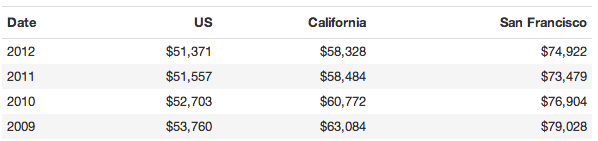
“There must be someone who brings in the wealth,” said Moretti. Additionally, unlike the specialized needs of a manufacture, all the hair dresses, car washers, and tax pros that Google brings in for its workers are local. As a result, San Franciscans have seen their paychecks swell about 2x faster than inflation can eat it, (4.6% increase in wages vs. 2.6% inflation). From census data (below), San Francisco has fared slightly better than their surrounding California neighbors during the recession recovery. Screen Shot 2013-12-20 at 1.50.30 PM “So outside of the tech industry, workers have benefitted from increased employment opportunities and rising real wages,” Eagan concludes.

However, it’s not all rainbows and sunshine. I spoke to one local clothing store owner whose story is a microcosm of all the city’s changes. The owner, who preferred to stay anonymous, resides on San Francisco’s Valencia St., the super-hip drag that has become the dividing line between the poverty-stricken Mission St. just a half-a-block East.

As chic restaurants with +$20 entrees began to swarm his business, it likewise brought with it new customers willing to shell out their ample recreational budgets on new forms of expensive Bay Area entertainment. “Burning Man, it’s like Christmas for me,” he jokes, referring to the drug-friendly arts festival held in the Nevada desert every Fall, especially popular among Googlers.

But, his long-time regular clients were forced to move into cheaper parts of the Bay. “Most of my customer, they drove away,” he notes with a hint of melancholy. Sky-high rents have eroded both his additional income, as well as the regulars that used to grace his store.

And, this is where the otherwise happy tale of tech money gets dark: housing prices.

Home Ownership As Housesitting For Rich People Not Yet Moved In

Technologists are fans of a non-zero sum world, but they have yet to discover an app that can physically expand San Francisco, seasteading notwithstanding. Scarcity in housing has led to a rent-hiking arms race.

San Francisco is burdened with the least affordable housing in the country. Just 14% of homes are affordable to the middle-class and two bedroom apartments are above $3,200 for families. According to real estate website, Redfin, San Francisco housing is more than 3x as pricey as it’s windy city peer to the East, Chicago ($177K vs. $599,000). chart_2 With sky-high purchasing prices and rents, housing costs are outstripping the pace of salary for some in San Francisco. “In 2012 average rents paid (as measured by the Census) grew over 7%, which is faster than the wage increases for most non-tech industries,” said Eagan.

However, “The vast majority of rental units in San Francisco are covered by rent control, so workers who did not move out of such units since 2010 will have seen wages growing much faster than their rents.”

Unfortunately, some landlords has found a way to evict long-time residents, and the resulting fight has made the tech industry the target. One local bookstore owner in the Mission District told me the rent hikes have challenged some of the good that the tech industry has brought.

“There’s less crime, which is good; rents are insane, which is very very very bad,” he said. Without rent control, he says, he wouldn’t be able to live in his current neighborhood.

Do We Need Affordable Housing Units? 

The mayor is calling for more cheaper units reserved for struggling middle-class families making less than the $72,947 median income (yes, that’s the median income in San Francisco, FML). But, it’s unclear how many are needed, if at all, since government assistance begets bureaucracy, and city bureaucracy tends to slow things to a grinding halt.

Berkeley Economist Enrico Moretti tells me that increased housing supply does relieve rents in “every spectrum” of income. He observed that after Seattle significantly increased construction, rent hikes slowed even during a jobs boon that outpaced San Francisco’s.

Most importantly, the impact is linear, meaning that every single new house affects the price of every other house. The faster we build, the faster rent gets cheaper, and faster techies stop battling locals for coveted rent-controlled units. Unfortunately, there is no plausible economic model under which prices go down, and homes are already beyond the reach of 86% of middle-income families.

Hong Kong, California

We love economists, but sometimes they discount the innumerable parts of life. San Francisco has a long history restricting housing to maintain the quaint Victorian look of the Bay.  ”Do we want San Francisco to look like Hong Kong?” asks San Francisco State University Professor and former city planner, Jasper Rubin. He says that the city has never really tried to quantify the demand, but describes it as “tantamount to infinite.”

With enough housing to accommodate the hundreds of thousands of tech workers and wanna be entrepreneurs, San Francisco would be reshaped into a wall of sky-scrappers. Indeed, the good folks at Firstcultural.com simulated what the South Bay’s sky-line would look like if it housed all of the major tech company’s workers. It’s Hong Kong-ish:

Googleplex Housing Aerial from East

Thank A Techie, But Help The Needy

For most San Franciscans, tech’s presence has brought reprieve from a recession that ravaged the rest of the country. But, economists deal in averages; those who fall to the left of the distribution curve are subject to a game of capitalism Russian roulette, where their house and community are left to the whims of wealthier buyers.

The defenseless ought not be discounted in our praise of the tech sector, but we should also not forget that without their presence, San Francisco would likely be much worse off.

Illustration: Bryce Durbin

VCs On Inequality, Unemployment, And Our Uncertain Future

home_of_the_future

The Great Bifurcation is underway. The American economy is polarizing between the minority rich and the majority poor; technology is a major cause of this; and the rest of the world will soon follow, if it hasn’t already. I’ve been writing about this for years, and by now you’re probably sick of my perspective — so I went to tech VCs Steve Jurvetson and John Frankel for theirs.

Let me just set the table first. Not so long ago, the Great Bifurcation thesis was a minority view. Now it’s nearly the consensus. The New York Times recently announced: “The middle class is steadily eroding. Just ask the business world.” The Wall Street Journal concedes: “Last year, the richest 10% received more than half of all income, the largest share since such record-keeping began in 1917.”

Forbes argues that “around 70% of American families are receiving more from the government than they are paying in.” (Which is exactly what you’d expect from a progressive tax system in a time of drastic inequality.) In Silicon Valley, “those making $100,000 and up, a group that constitutes 45 percent of the region’s population, saw their incomes rise” last year … but incomes fell for those making less than that.

Is tech to blame? Is technology destroying jobs faster than it creates them? A couple of years ago, that view was often dismissed offhand with a little contemptuous muttering about buggy whips; nowadays it is taken extremely seriously by The Economist, The New York Times, The Financial Post, and others, courtesy of Erik Brynjolfsson and Andrew McAfee’s book The Second Machine Age.

OK then. Brace yourself. There’s a lot to chew on below.

So. Steve Jurvetson. He sits on the boards of Tesla and SpaceX, among others. He’s a managing director of Draper Fisher Jurvetson, which just raised $325 million for its 11th early-stage fund, and he’s been pondering the accelerating divide between the rich and the poor for some time, as per his Solve for X talk from last year:

John Frankel, based in NYC, is the founding partner of ff Venture Capitalwhich recently raised $52 million across two funds — and sits on the board of Klout and Interaxon, among others. He followed up on our wide-ranging conversation two months ago by writing:

Technological disruption seems to be accelerating and we think it is due to a secular confluence of advances in technology and development of platforms, which leads to more unemployment in the short term. The problem is that the Federal Reserve’s response was to cut interest rates to zero making capital even cheaper vs. labor. This pulls forward investment in technology that displaces labor and accelerates disruption, causing more unemployment, into a vicious loop. The Fed seems to have created half the problem here but cannot see that raising interest rates would slow down the rate at which jobs are being replaced. I am concerned that if robotic technology gets cheap enough we reach a tipping point where too many industries are disrupted at the same time, leading to massive unemployment and too long to retrain people.

Theoretically, by extrapolating the trend, we might hit 60% unemployment. But, that is impossible, and the impossible does not happen. Something will break before then. But this is like a new Industrial Revolution, and though we know the outcome of that, which most would say was good, it was rough getting there. There are many dystopian outcomes you can see here, but I want to be hopeful.

…which sets the tone nicely. You cannot accuse either Frankel or Jurvetson of trying to hide their heads in the sand and/or minimize the situation. They’re both extremely accomplished and intelligent men who have thought deeply about the subject from a variety of angles; in the long term, they’re both optimists (as am I); but the medium term seems uncertain, at best, to us all.

Feedback, Religion, and Social Media

Both of them talked about sociopolitical feedback loops a lot. Consider social media. On the one hand, Frankel argues that “social media empowers the people — Twitter in Turkey, Facebook in Brazil — and forms a tighter feedback loop among people and between those who govern and the governed in a way that takes power from those who govern.” On the other, Jurvetson suggests that since increasing inequality can obviously foster resentment, an important open question is: do social networks subtly aggravate that resentment, since envy is often their default emotion, as everyone tries to show off and paint the best possible portrait of themselves? Will Facebook and Twitter become subtle but potent equalizers of power, or will they breed a vicious cycle of jealousy and anger between the rich and the poor? Or both?

In a similar vein, Jurvetson has said: “One tech-related concern with religion is that it appears to be a positive feedback loop to the accelerating rich-poor gap, as the disenfranchised opt out of modernity.” He cites Sam Harris:

While most developed societies have grown predominantly secular, with the curious exception of the United States, orthodox religion is in florid bloom throughout the developing world. Religiosity is strongly coupled to perceptions of societal insecurity. In addition to being the most religious of developed nations, the United States also has the greatest economic inequality. The poor tend to be more religious than the rich, both within and between nations. And on almost every measure of societal health, the least religious countries are better off than the most religious.

He also suggests that a similar feedback loop — the famous network effect, aka the winner-take-all nature of much of the tech industry — may perpetuate America’s pre-eminence. Even as and when China grows wealthier than America, America’s tech giants are likely to remain dominant for the foreseeable future. (At the same time, of course, technology will be an enormous boon to people throughout the developing world, and Steve is eager to invest in companies that can help capture/maintain/provide health information around the world; to paraphrase him, health is very low on Maslow’s hierarchy of needs, and at the same time, so much of healthcare is simple information transfers. What’s more, another significant piece is pharmaceuticals, which, in a slightly more distant and misty-eyed future, can be delivered by drone.)

But for a more stark and pessimistic view of the future of the developing world, see John Robb:

There's a race to see if 2.5 billion people in the BRICs can reach the middle class before tech eats the economic system. I bet tech.—
John Robb (@johnrobb) January 29, 2014

Basic Incomes and Reputation Economies

I was a little surprised by how open both Jurvetson and Frankel were to a drastic revision of our social / political / economic status quo, in order to accomodate a new normal. Frankel spoke approvingly of some form of a sizable basic income replacing all of America’s existing welfare/entitlements/tax credits/etcetera. Jurvetson was more cautious with his enthusiasm, but was certainly willing to take the idea seriously, along with notions like Milton Friedman’s negative income tax, or the intriguing notion from one Shwan Jo:

I wonder what would happen if we had a tax system that organically responded to the wealth distribution in the country. Not meaning there is simply higher rate as you go up, but which is responsive to the rate of change of the shape of the distribution. Thus, the calculation is adaptive to a shape that changes too quickly.

Both also agreed that reputation economies will continue to grow in importance. As Jurvetson pointed out, in an unofficial, unquantified way, a lot of us already spend a lot of time maintaining our reputation. (Indeed, if you ask me, all marketing is a kind of reputation-economy investment.) And Frankel, of course, is a director of Klout.

The Bitcoin Dilemma

One subject on which they do not agree: Bitcoin. Frankel speaks and tweets of it dismissively:

ha! so simple and, well, true #bitcoin #ponzi ponzi.io
john frankel (@john_frankel) February 08, 2014

Bitcoin is doing a very good impression of being a momentum driven asset that has no underlying value. #Tulip
john frankel (@john_frankel) December 08, 2013

whereas Jurvetson is a (long-term) believer in e-cash in general — he wrote an article about e-cash and its sociopolitical side effects for the Stanford newspaper 20 years ago, in fact — and, technically at least, admires Bitcoin’s blockchain solution of the Byzantine Generals’ Problem. (Also, his precocious son insisted more than a year ago that his allowance be paid entirely in Bitcoin, which has worked out well for him.)

He is, however, a little concerned that semi-anonymous cryptocash like Bitcoin, if/when it becomes widespread, may be a double-edged sword; enormously useful to the developing world, where it could give financial tools to the unbanked and cut transfer fees/difficulties immensely … but, in theory, cryptocash could also be used for tax avoidance/evasion among the wealthy, which could undercut any basic income those taxes are meant pay for. (All in some indefinite future, obviously.) A solution which isn’t worryingly surveillance-state might be anonymous e-cash for small amounts but identified/tracked e-cash for large amounts / taxes etc … if that can be technically enforced.

Our Clouded Road To Utopia

In the long term, both agreed, everything is going to be great: innovation and new technologies will make lives colossally better around the world. The question is how we get to that destination. As Steve put it: “The problem isn’t that jobs are going away, it’s that people need jobs.” After a difficult medium-term period of disruptive transition, this new revolution should benefit every human being on the planet…but the exact mechanism, the means by which we as a society morph from the difficult period just ahead into that quasi-utopian low-scarcity future, remains stubbornly unclear. “And then a miracle occurs!” Steve joked, describing that transition.

Frankel agrees that we’re in uncharted territory:

We are not the only people that see now as something similar to the Industrial Revolution with regard to job and social disruption, secular unemployment and rapid adoption of new technologies. What is new this time is that it is happening in every country, every imaginable political regime, every place at the same time. The Industrial Revolution burned through countries slowly: Great Britain first, then Europe, then the US, etc. Here it is all playing out everywhere at the same time. If software is eating the world, it is eating it at the pace of a World War Z Zombie! […] I don’t know what’s going to happen. Nobody does. We need to just keep innovating for a better outcome.

Food for thought.

Image credit: James Vaughan, Flickr.

Why Fads Fade: The Inevitable Death Of Flappy Bird

Kid computer

Editor’s Note: This article is adapted from Hooked: A Guide to Building Habit-Forming Products, a new book by Nir Eyal and Ryan Hoover.

On February 8, 2014, an app called Flappy Bird held the coveted No. 1 spot in the Apple App Store. The app’s 29-year-old creator, Dong Nguyen, reported earning $50,000 a day from the game.

Then, the Vietnamese developer sent a shocking message. In a tweet many dismissed as a publicity stunt, Nguyen wrote, “I am sorry ‘Flappy Bird‘ users, 22 hours from now, I will take ‘Flappy Bird‘ down. I cannot take this anymore.” And as promised, the game disappeared the next day.

This is not the way success typically ends.

Flappy Bird was downloaded over 50 million times and unleashed a digital tsunami of players and pundits dissecting what turned into a global fixation. Players’ only goal in the game was to pilot a pixelated bird through gaps of pipe. Yet the app seemed to have a mysteriously seductive power. In a TechCrunch article titled Confessions Of A Flappy Bird Addict, Josh Constine wrote, “It humiliates me, but I like it. It’s the dominatrix of mobile games.”

What is at the heart of today’s digital juggernauts and why do they seem to disappear as quickly as they rise? What is it about the things that capture our attention in a mental vice grip, only to be ridiculed as faddish whims later?

Given the meteoric success and subsequent decline of other games like Candy Crush Saga, Angry Birds, and FarmVille, perhaps the death of Flappy Bird was more than a rash decision. Perhaps it was a mercy killing?

Why We Get Hooked

In 2008, a television series called Breaking Bad began receiving unprecedented critical and popular acclaim. The show followed the life of Walter White, a high school chemistry teacher who transforms himself into a crystal meth-cooking drug lord. As the body count on the show piled up season after season, so did its viewership. The first episode of the final season in 2013 attracted 5.9 million viewers and by the end of the series Guinness World Records dubbed it the highest-rated TV series of all time. Though Breaking Bad owes a great deal of its success to its talented cast and crew, fundamentally the program utilized a simple formula to keep people tuning in.

At the heart of every episode — and also across each season’s narrative arc — is a problem the characters must resolve. For example, during an episode in the first season, Walter White must find a way to dispose of the bodies of two rival drug dealers. Next, challenges prevent the resolution of the conflict and suspense is created as the audience waits to find out how the storyline ends. In this particular episode, White discovers one of the drug dealers is still alive and is faced with the dilemma of having to kill someone he thought was already dead.

Invariably, each episode’s central conflict is resolved near the end of the show, at which time a new challenge arises to pique the viewer’s curiosity. By design, the only way to know how Walter gets out of the mess he is in at the end of the latest episode is to watch the next episode.

The cycle of conflict, mystery and resolution is as old as storytelling itself, and at the heart of every good tale is uncertainty. The unknown is fascinating, and strong stories hold our attention by waiting to reveal what happens next. In a phenomenon called “experience-taking,” researchers have shown that people who read a story about a character actually feel what the protagonist is feeling. As we step into the character’s shoes we experience his or her motivations. We empathize with characters because they are driven by the same things that drive us.

But if the search to resolve uncertainty is such a powerful tool of engagement, why do we eventually lose interest in the things that once riveted us? Many people have experienced the intense focus of being hooked on a TV series, a great book, a new video game or even the latest gadget. Yet, most of us lose interest in a few days or weeks. Why does the power of these variable rewards seem to fade away?

The Finite and Infinite

Perhaps no company in recent memory epitomizes the mercurial nature of variable rewards quite like Zynga, makers of the hit Facebook game FarmVille. In 2009, FarmVille became an unmissable part of the global zeitgeist. The game smashed records as it quickly reached 83.8 million monthly active users by leveraging the Facebook platform to acquire new players. In 2010, as “farmers” tended their digital crops — while paying real money for virtual goods and levels — the company generated more than $36 million in revenue.

The company seemed invincible and set a course for growth by cloning its FarmVille success into a franchise. Zynga soon released CityVille, ChefVille, FrontierVille, and several more “-Ville” titles using familiar game mechanics in the hope that people would enjoy them as voraciously as they had FarmVille. By March 2012, Zynga’s stock was flying high and the company was valued at over $10 billion.

But by November of that same year, the stock was down over 80 percent. It turned out that Zynga’s new games were not really new at all. The company had simply re-skinned FarmVille, and soon players lost interest and investors followed suit. What was once novel and intriguing became rote and boring. The “Villes” had lost their variability, and with it, their viability. As the Zynga story demonstrates, an element of mystery is an important component of continued user interest.

Online games like FarmVille suffer from what I call “finite variability” — an experience that becomes predictable with use. While Breaking Bad built suspense over time as the audience wondered how the series would end, eventually interest in the show  waned when it finally concluded. The series enthralled viewers with each new episode, but now that it is all over, how many people who saw it once will watch it again? With the plot lines known and the central mysteries revealed, the show just wouldn’t seem as interesting the second time around. Perhaps the show might resurrect interest with a new episode in the future, but viewership for old episodes people have already seen will never peak as it did when they were new. Experiences with finite variability become less engaging because they eventually become predictable.

Businesses with finite variability are not inferior per se, they just operate under different constraints. They must constantly churn out new content and experiences to cater to their consumers’ insatiable desire for novelty. It is no coincidence that both Hollywood and the video gaming industry operate under what is called the “studio model,” whereby a deep-pocketed company provides backing and distribution to a portfolio of movies or games, uncertain which one will become the next mega-hit.

This is in contrast with companies making products exhibiting “infinite variability” — experiences, which maintain user interest by sustaining variability with use. For example, games played to completion offer finite variability while those played with others people have higher degrees of infinite variability, because the players themselves alter the game-play throughout. World of Warcraft, the world’s most popular massively multiplayer online role-playing game, still captured the attention of more than 10 million active users eight years after its first release. While FarmVille is played mostly in solitude, World of Warcraft is played with teams and it is the hard-to-predict behavior of other people that keeps the game interesting.

While content consumption, like watching a TV show, is an example of finite variability, content creation is infinitely variable. Platforms like YouTube, Facebook, Pinterest and Twitter all leverage user-generated content to provide visitors with a never-ending stream of newness.

Of course, even sites utilizing infinite variability are not guaranteed to hold onto users attention forever. Eventually — to borrow from Michael Lewis’s book title — the “new, new thing” comes along and consumers migrate to it. However, products utilizing infinite variability stand a better chance of holding onto the user’s attention, while those with finite variability must constantly reinvent themselves just to keep pace.

Gone Forever

Dong Nguyen, the Flappy Bird creator, has largely avoided media attention related to the spectacular success of his game. However, Nguyen told Forbes he decided to take down the game because it had become, “an addictive product.” While smoking several cigarettes during the interview, Nguyen told the reporter, “I think it has become a problem. To solve that problem, it’s best to take down Flappy Bird. It’s gone forever.”

So far, Nguyen’s goal of curing players’ of their bad habit seems to have fallen short. Phones with the app installed were listed for sale on eBay within hours of the game’s demise. In Flappy Bird’s absence, a wave of clones appeared, hoping to siphon-off Nguyen’s success.

However, as inevitably as the world discarded the fads that came before it, the finite variability of a game where a bird flies through gaps of pipe will soon be forgotten — nostalgia of a time when a young man in Vietnam could get rich quick and become Internet famous. Had Nguyen wanted to see Flappy Bird die, all he had to do was wait.

Image by Shutterstock

Editor’s Note: For more, check out Hooked: A Guide to Building Habit-Forming Products, a new book by Nir Eyal and Ryan HooverNir will be speaking at the upcoming Habit Summit at Stanford and TechCrunch readers get $50 off when using this link.

RocksBox Gets A $1.5M Seed Round For Valentine’s Day

Screen Shot 2014-02-14 at 3.27.28 PM

Meaghan Rose wanted RocksBox to be a thing so badly that she singlehandedly built a WordPress site for the idea, and stocked it with her own jewelry. She sent out boxes of samples from her own closet so friends who wanted to participate could try on different looks.

Rose and RocksBox have come a long way since the company’s beta launch during Thanksgiving 2012. The originally bootstrapped subscription jewelry box startup has since moved out of Rose’s own jewelry box and into a light-filled office in San Francisco. And it has just closed a seed round of $1.5 million from Matrix Partners, Ellen Levy and Sandra Perkins.

Jewelry is a vertical that has companies trying out a couple of approaches as the industry expands to online. There is straight-up e-commerce like BaubleBar, as well as startups like Chloe + Isabel that attempt to leverage social media in addition to an offline approach.

In the same vein as companies like Le Tote, RocksBox allows you to sign up for a membership for between $15 and $19 a month, which gets you a unique box of jewelry FedExed to you as often as you’d like for 12, six or unlimited months. Rose buys the pieces wholesale from designers.

With RocksBox, you can either buy any of the three or four pieces in the box or wear them until you tire of them and simply return them. The service learns from your feedback and purchasing data and sends an even more uniquely tailored experience with each subsequent box.

Screen Shot 2014-02-14 at 3.27.02 PM

Rose wants RocksBox to empower her customers. “Jewelry is a fun category, but it’s filled with fear and intimidation.” She says she decided on the RocksBox model by thinking about jewelry as an actual consumer as opposed to a CEO or consultant (Rose did a brief stint at McKinsey after attending Wharton):

As a consumer, I knew a few things: One, shopping for jewelry the old way was horrible (overwhelming, intimidating and hard to find unique stuff – no one has time for that). Two, we love variety (the very first time you wear something is the most exciting time, and it generally goes down from there). And three, there are a few pieces that you just fall in love with and you can’t let go (but it’s impossible to know which ones will reach that ‘true love’ status when you’re looking at a pile of jewelry on a shelf).

Although she would not reveal actual numbers, Rose asserts that RocksBox was cash-flow positive in December and says she is growing the customer base 30-40 percent month-over-month, over 20x in the past year. She also recently launched her own designer collection and hopes to one day offer a higher-end box, as well as expand the RocksBox brand beyond jewelry, incorporating other accessories like belt loops.

Investor Josh Hannah compares the company to Blue Nile. “I was really pushed to invest by the fact that several people close to me subscribed and could not stop raving about RocksBox. I’ve rarely seen that level of enthusiasm for such a young product,” he says.

Hannah, who also has investments in Gilt Groupe, JustFab and Polyvore, is right; after I was gifted a subscription by my boyfriend, I turned around and invited another six friends.

“I think part of the reason jewelry hasn’t moved online faster is the need to try something on and touch and feel the product,” Hannah explains. Blue Nile got around that by selling to men, so the product was never going to be tried on ahead of time anyway,” he says. “RocksBox solves this in their own way: Your subscription allows you to constantly try and rotate what you wear, but if you find a keeper, it’s easy to buy — a perfect trial model that’s profitable on both subscription and purchase.”

There is an interesting intersection at play here, between the subscription model and the usage of scale to solve a long-running conundrum. Certain segments of the market are simply more suited to offering subscriptions with an option to buy — and fashion is certainly one of the larger ones.

With commodities, the desire to touch and personally experience items has nearly disappeared — people now subscribe to toilet paper on Amazon. But with items that aren’t commodity-based, like jewelry, the key to converting browsers to buyers might actually be the oldest one in the book: get them into the store. Only, with RocksBox’s approach, that store is your living room.

Whether the sometimes problematic subscription commerce model will find its unique fit with jewelry remains to be seen. RocksBox’s funding means we have the first chance at finding out.

Screen Shot 2014-02-14 at 3.31.17 PM

Yahoo Acquires Technical Recruiting Startup Distill

Screen Shot 2014-02-13 at 3.33.20 PM

Yahoo just acquired a San Francisco-based startup called Distill, which was working on a way to make technical recruiting easier by pairing video interviews and programming challenges. They had raised $1.3 million in funding from investors including Felicis Ventures, China’s Innovation Works and DN Capital.

The startup’s two founders Deng-Kai Chen and Ken MacInnis came from Tapjoy, StumbleUpon and Google. They created Distill because they had built up engineering teams before and were familiar with the frustrations that come with managing and scheduling technical interviews.

Distill’s product paired the basic features of a video chat service like Skype, and put them alongside a text editor and file upload space so that an interviewer could walk a candidate through a collaborative coding session.

We hear they’ll be working on mobile ads products for Yahoo.

Here’s the memo the company just posted to its website:

We are excited to share the news that the Distill team is off to start a new adventure! We are joining Yahoo. Prior to creating Distill, we were part of the original team behind the creation of Tapjoy, a mobile performance-based advertising platform that drove deep engagement and monetization opportunities for mobile app publishers. We’ll be drawing upon our expertise from the Tapjoy days to help build out Yahoo’s mobile advertising solutions.
As of today, we have stopped development of Distill Schedule and Distill Interview. You will still be able to schedule interviews through the end of February, and the Distill platform will remain available through March 30, 2014. If you have any questions, concerns, or data requests, please contact us at [email protected], or reach out to your account manager directly.
We want to express our sincere thanks and gratitude to everyone at the awesome companies we have been working with, as well as the candidates who have met their future employers through Distill. It’s been a fun ride for us, and we couldn’t have gotten this far without your help. Thank you!!