
Tractors have been an extra limb for landowners and workers for over a century, and in that time they have gone through many changes, including power, traction, and above all usage. In this tutorial we are going to be looking at how to draw a basic tractor and trailer from scratch.
1. Construct the Body and Wheels
Step 1
To construct the body and wheels of a tractor, we are going to start by
drawing some basic shapes. Firstly, we are going to add a long, rectangular cube
for the chassis.

Step 2
We are then going to add a larger cube on top of our original,
which will house the engine.

Step 3
Bearing in mind that the engine will be at the front of the
tractor, at the rear of the tractor add a circle which will be the transmission
housing.

Step 4
On the top of our transmission housing, add a large cube which
will act as a guide either for a roll bar or cab, whichever you choose to draw.

Step 5
Then add a large cube on the side of our tractor, which will
be the mud guard for the large rear wheel.

Step 6
Talking of wheels, we now need to add in some cylinders that
will act as our wheels for the time being.

Step 7
To finish our guide work, add in any additional shapes that
you think might help you with your drawing later. For example, in the
screenshot below I have added a cylinder for the exhaust stack on the side of
the tractor, a small cube that will be a counterweight on the front of the
tractor, and some circles for the lights.

Step 8
To complete this section, we are going to compare a few
tractor types below to see how much they differ with design and progress.

2. Work in More Detail
Step 1
Now that we have established a guide for all our tractor parts,
we can work into them in more detail. It is up to you which side you start
from, but for this example we are going to go from right to left and begin by
adding the front counter weight.

Step 2
Now we work on the engine cover, the grille, and what little
there is of the engine on show. This should be quite straightforward as there
is not much engine that can be seen.

Step 3
Then we add the lights, and it may be best to use a compass
for accuracy in drawing these circles.

Step 4
Now we draw the exhaust using simple cylinders, a smaller one
stacked one on top of a larger one.

Step 5
Next, draw the seating area itself, not forgetting the
steering wheel and hand controls.

Step 6
Once you have drawn the lower driver area, you now add the
roll bar (or cab if that is what you choose to do). For this basic tractor, it
has a very simple roll bar, but it does the job!

Step 7
To complete our body, we can now work on the rear mudguards.

Step 8
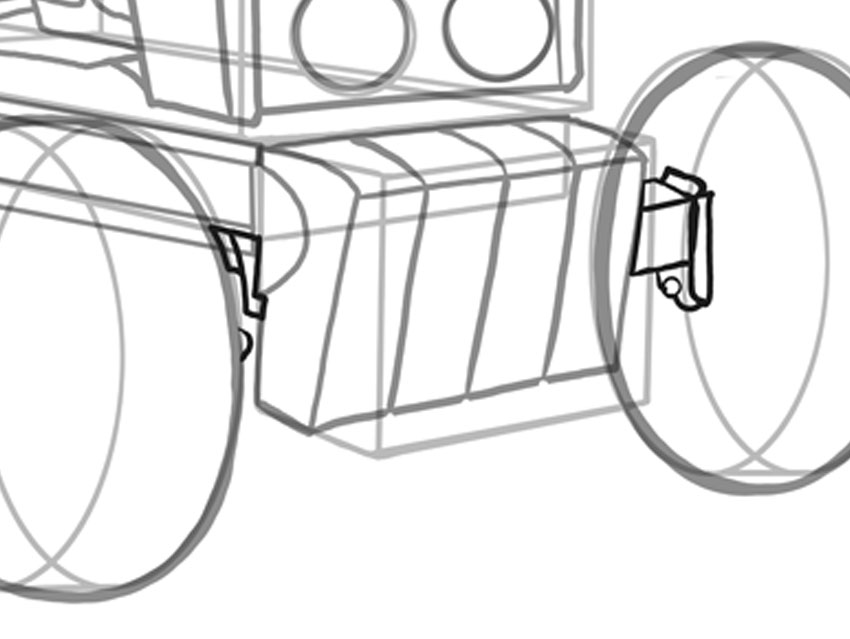
Now for one of the really detailed parts, the front axle.
Step 9
Now let’s compare the differences in tractors over the years—notice how the function of pulling and powering machinery has been there from the early days, but the design has differed so much from period to period.

3. Work on the Rims and Tyres
Step 1
We now move on to working in more detail on the wheels of
this tractor, firstly by drawing the outer tyre with a simple ellipse.

Step 2
Don’t forget the opposite side!

Step 3
Next, we draw the outer rim using a smaller ellipse and do
the same for the opposite side.

Step 4
Then we move on to drawing the hubs for the wheels. Again, a
simple ellipse is the way to do this but, to gain perspective, part of the hub should
be obscured.

Step 5
For the rear wheel, a large ellipse needs to be drawn, but
part of the ellipse you will notice will be obscured by the mudguard. When you draw your rear tyres, you will notice that the
treads are much more pronounced, so take care when drawing them.

Step 6
Notice that at the front of the tyre the treads can be marked out
by simple lines at a diagonal angle.

Step 7
As with the front wheels, we need to draw an outer rim for the
tyre.

Step 8
Next up comes the inner rim.

Step 9
With the hub, we need to draw another two ellipses, but you will notice that the perspective of the drawing will again affect how much of this you can see at the end.

Step 10
For the wheel nuts that hold the wheel itself onto the hub, we need to draw an ellipse.

Step 11
Then complete the rest of the nuts. Remember, each one will differ in shape thanks to perspective.

4. Add a Trailer
Step 1
We are now going to add a simple trailer to show one of the
many uses for these vehicles, starting by drawing some narrow cubes that will
act as guides for the towing hitch. The tow hitch itself will be hidden by
perspective in our final image.

Step 2
Next, we draw in the chassis, which is made up of a
narrow cube.

Step 3
A larger cube is then placed on top of the chassis, which
will be for the sidewalls and tail.

Step 4
A long, thin cube on the bottom of the chassis will be the
axle.

Step 5
The axles on most old trailers are supported by suspension
parts called leaf springs; you can make a guide for this by drawing a triangle.

Step 6
Now we add a wheel which will almost finish off our trailer.
The final touches can be achieved by drawing in the finer details. Bear in mind
that that perspective will hide a lot of our trailer parts such as the tow
hitch, the second wheel, and parts of the chassis and trailer side walls.

Awesome Work, You’re Done!
Thanks for stopping by and joining me in this tutorial on how to draw tractors. These vehicles have done so much for so many people in the last century and hopefully will continue to play a very big part in agriculture and transportation over the next 100 years!
If you want more, why not check out our series on How to Draw Vehicles.


{excerpt}
Read More