Rumor: iPad 3 case thicker, shows more gradual taper

Chinese tech website M.I.C Gadget gets some amazing spy shots on occasion. This time, they have photos that purport to show the back case of the rumored iPad 3.

As you can see from the photos above, the alleged iPad 3 case (bottom) is slightly thicker than the case of the iPad 2. Although the difference in thickness appears to be significant, another photo (below) shows that the iPad 3 case is actually only about 1 to 1.5 mm thicker.

The site notes that a poster on a Chinese forum has said that the bezel on the new device is narrower, which could be a way to resolve the “light leak” issues that some early owners of the iPad and iPad 2 experienced.

M.I.C Gadget also published a photo of the back case that shows a slightly larger rear camera. That’s in line with rumors of an improved iPad 3 camera, although nobody will know the exact specifications of such a device until the new iPad is announced.

The site has a complete “rumor roundup” for your reading enjoyment, but remember that at this point, everything is pure conjecture.

Rumor: iPad 3 case thicker, shows more gradual taper originally appeared on TUAW – The Unofficial Apple Weblog on Tue, 21 Feb 2012 10:30:00 EST. Please see our terms for use of feeds.

Source | Permalink | Email this | Comments

GEVEY Ultra S – Unlock iPhone 4S On iOS 5.0.1 / iOS 5 Baseband 1.0.11, 1.0.13, 1.0.14 [VIDEO]

New Turbo SIM interposers with claims to unlock iPhone 4S has started appearing now and then. This time it’s from a trust worthy and well know SIM interposer maker; Gevey Ultra S SIM…

[[ This is a content summary only. Visit my website for full links, other content, and more! ]]

iOS 5.0.1 Security Bug Lets You Bypass Passcode to Access Contacts, Make Calls [Video]

An iOS 5.0.1 security bug reported by iPhoneIslam lets you bypass passcode protected iPhone to access contacts list, make calls, and even send emails. You can access the contacts and make calls from…

[[ This is a content summary only. Visit my website for full links, other content, and more! ]]

Example: Emulating The iPhone’s Clear App Gesture Responsive Tableviews With Html5

Just yesterday I mentioned a set of Phonegap beginner tutorials that cover many of the basics of developing an application with the Phonegap framework – what was how to create an interface that can can respond to more advanced touch gestures.

Last week I mentioned an open source library created to enable touch gesture responsive UITableViewCell’s like in the popular Clear app.

Today I came across an that makes a great example for anyone looking to program gesture responses using HTML5 (great example if you’re using a framework like Phonegap).

Here’s a video of the code in action:

This example was created by Evan You, and can be found on Github here.

You can test out the example on your iPhone through Evan’s site.

100% of the functionality found in the tableviews of the Clear app are not implemented but quite a bit of it is and it is a great example of how to respond to gestures and perform transforms using Webkit.

©2012 iPhone, iOS 5, iPad SDK Development Tutorial and Programming Tips. All Rights Reserved.

.

DeliciousTwitterTechnoratiFacebookLinkedInEmail


Dvd Cover Art Modifiication To Support Amazon Publishing

I have an extremely simple job for the right person. i have some psd and jpeg files which are 300 dpi and according to Kunaki’s dimensions for DVD publishing.

I simply need you to take these files and make it fit it according to Amazon publishing dimensions. You can find amazon cover art dimensions and regulations here with a template:

https://www.createspace.com/Products/DVD/Index.jsp#content3

There are 2 DVD’s

You can access my files here so you can see what your dealing with:
DV…

Dvd Cover Art Modifiication To Support Amazon Publishing

I have an extremely simple job for the right person. i have some psd and jpeg files which are 300 dpi and according to Kunaki’s dimensions for DVD publishing.

I simply need you to take these files and make it fit it according to Amazon publishing dimensions. You can find amazon cover art dimensions and regulations here with a template:

https://www.createspace.com/Products/DVD/Index.jsp#content3

There are 2 DVD’s

You can access my files here so you can see what your dealing with:
DV…

Dvd Cover Art Modifiication To Support Amazon Publishing

I have an extremely simple job for the right person. i have some psd and jpeg files which are 300 dpi and according to Kunaki’s dimensions for DVD publishing.

I simply need you to take these files and make it fit it according to Amazon publishing dimensions. You can find amazon cover art dimensions and regulations here with a template:

https://www.createspace.com/Products/DVD/Index.jsp#content3

There are 2 DVD’s

You can access my files here so you can see what your dealing with:
DV…

Cloud Security: DataLocker Lets You Encrypt Your Sensitive Dropbox Files For Free

Screen shot 2012-02-22 at 8.39.09 PM

We’re all becoming increasingly reliant on consumer cloud services, as cloud storage providers like Dropbox make it easy to share and store files, folders, images, sync between platforms, and more. They make our lives easier, but because they store an enormous amount of potentially sensitive data, there are some inherent risks. While Dropbox is for personal use, it and services like it are increasingly being used by businesses — another example of the ongoing consumerization of enterprise and IT.

It’s also true that most people want their data in their cloud service to be synced across all platforms on which they have the app installed, mobile, desktop, etc. So, with individuals and companies storing sensitive data in the cloud, cross-sync can make for some potential security problems, and it’s not really something you want to do at work.

That’s why virtualization provider AppSense has created DataLocker, a set of mobile and desktop apps for iOS, Windows and Mac that enable users to encrypt sensitive information in their Dropbox accounts for free — without giving up the convenience of cross-platform syncing.

DataLocker is the first product from “AppSense Labs,” the company’s new research arm, which is dedicated to building consumer-friendly solutions around cloud, mobile, and data that work within traditional IT infrastructure. As the boundaries between personal and professional computing are blurring, AppSense Labs will look to ride that wave with new products that capitalize on this transition, making it easier on consumers and enterprise, piece by piece.

And to that point, DataLocker is a great first step in alleviating some of the worry over the security of our personal information as it moves about the cloud. With the advent of Apple’s iCloud and Microsoft’s SkyDrive, businesses will have to decide whether these proprietary clouds are something they want to adopt. In iCloud’s case, user accounts are tied to Apple not to businesses, which may lead to some businesses balking at using the service to share sensitive company information.

This is where DataLocker could really come in handy. For now, it’s focused on Dropbox, but there’s potential for it to move beyond Dropbox, even if iCloud/SkyDrive integration isn’t in the cards. Businesses want to use friendly cloud services, and encryption of sensitive data is key to encouraging further adoption.

As to how the app works? It’s fairly straightforward, users simply install the app and link it to their Dropbox accounts, at which point they can upload new files, protect them instantly, while browsing and viewing existing and protected Dropbox files.

AppSense raised $70 million from Goldman Sachs a year ago today.

For more, check out the iOS app here.


Report: Video Accounts For Half Of All Mobile Traffic; Android Biggest For Mobile Ads

Screen shot 2012-02-23 at 05.21.31

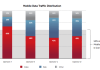
Mobile video now accounts for half of all mobile traffic; and on some networks, that number is as high as 69 percent — a testament to the rise of smartphones and tablets as the mobile devices of choice for consumers, and their growing interest in using these devices to do a lot more than just make phone calls.

The data, from quarterly report on mobile data usage out today from mobile analytics firm Bytemobile, also found that Android is generating more mobile ad volume than iOS devices, and that Google now accounted for 75 percent of ad-generated data across all platforms.

Bytemobile says it has collected this data from a cross-section of its mobile carrier customers. It focuses on usage of two main platforms, Apple’s iOS and Google’s Android.

As many have already suspected, tablets are driving significantly more data traffic than smartphones. On Apple’s iOS platform, an iPad user generates three times as much traffic as someone using an iPhone; while on Android, the figure is twice as much when comparing Android tablets and handsets.

This is not too surprising: tablets’ bigger screens are that much more conducive to consuming video and other content than the smaller screen of a smartphone; and in the case of something like video, those tablets will require higher resolutions, which also translates to heavier data use.

Indeed, video, along with other streamed services, are proving, once again, to be bandwidth hogs. The most-used application on iOS, for example, is Safari, accounting for 61 percent of all transactions. But when it comes to what takes up the most data volume? Bytemobile says it’s the Media Player, with 47 percent of all volume:

The same goes for individual applications. Although users spend slightly more time per session on Facebook than they do YouTube — 9.06 versus 8.51 minutes, respectively — YouTube generates, on average, 40 megabytes per session, compared to 120 kilobytes for Facebook or 170kb for Twitter. Twitter’s average session usage is 4.57 minutes.

Bytemobile also took a look at where mobile advertising is sitting in the mix. As ad networks have also been demonstrating for the last several quarters, Android devices are edging out over Apple’s iPhone and iPad in terms of generating mobile advertising traffic.

Yes, part of that is because collectively there are more Android devices on networks than iPhones — Android now accounts for half of all smartphones worldwide, says Gartner.

But perhaps just as importantly, those Android devices appear to be generating more ad impressions and engagement — collectively called “transactions” by Bytemobile. On Android, some nine percent of all data transactions were ad-related, while on iOS the proportion was five percent.

Why is that? It could be down to the fact that Android generally has less paid apps in the Market than Apple’s App Store, and those more popular free apps are pulling more ads down from networks when they get used.

But if you are reading this and starting to worry about how mobile ads are draining your monthly data allowances on your contracts, save your worries for the future: Bytemobile notes that ads accounted for only two percent of data volume on Android, and only one percent on iPhone.

As with online, Google dominates the mobile ad space with its owner of AdMob, AdSense and DoubleClick holdings. Together, these accounted for 75 percent of all ad data. But when it comes to the single-most consuming ad network, that dubious honor goes to Apple’s iAd: its video-rich ad units generate nearly 16 MB of data per transaction, while the lowest were AdMob’s display units, which generated less than 4MB.


Clothes Horse Wants To Solve The Biggest Problem With Online Shopping: Finding Clothes That Fit

clotheshorse_site_screenshot

Clothes Horse, a fashion technology company based out of New York, is publicly launching its platform today in an attempt to address one of the biggest challenges facing online shoppers: buying clothes that fit. Through the use of a customizable widget that merchants add to their own websites, Clothes Horse can determine within just 30 seconds how the retailers’ items will fit any customer. The goal is not only to decrease shopping cart abandonment, but also the rate of returns due to ill-fitting clothes.

The problem with shopping for clothes online is that customers have gotten burned by their past experiences. “Instead of being excited about this great new thing you’re about to buy,” explains Clothes Horse co-founder Vikram Venkatraman, “you think about the last time you had to return something, or you start wondering if it’s really going to be as nice on you as it looks in the picture.”

It’s those points of hesitation that cause 70% of shopping cart abandonment, he says. Not only that, but 60% of the time customers return clothes they bought online, it was because of fit issues.

Retailers, of course, know the challenges surrounding fit – it’s why they provide measurements and size charts for all their clothes on their websites. But just because you can zip something up, that doesn’t necessarily mean it fits well. To address these issues, Clothes Horse provides a quick, user-friendly product that helps online shoppers determine, in about thirty seconds, whether something will actually fit in real life.

The product is a white-labelled Q&A system that enables shoppers to build a profile based on their answers to questions, which don’t have to involve measurements. Although retailers can customize the system to suit their needs, the idea is to go beyond things like height and weight, and find out about a customer’s body type, preferred brands, comfort in a given brand, and more.

For example, a men’s clothing site might ask “What brand’s dress shirt fits you best?” to which the shopper could choose “Ralph Lauren,” “Calvin Klein,” “DKNY,” etc. They could also describe how well that brand fits, answering “it’s perfect,” “it fits well,” or “it doesn’t fit very well.”

After a handful of questions like this are answered, the Clothes Horse widget then tells you what size to buy, and, most importantly, how it will fit (e.g. “tight around the chest,” “just right in the collar”).

“Now you know what trade-offs you have to make, if any,” explains Venkatraman. “You know what to expect given your lifetime of shopping. It lets you put this new thing that you’re shopping for in a context that you’re used to, so you know a little bit about it,” he says.

In early tests with Clothes Horse beta customer Bonobos.com, use of the new system delivered a 13% sales boost, results which the retailer has called encouraging. Heck, it may even be able to help you find jeans that fit!

Behind the scenes, Clothes Horse has a large database of human measurements which they’ve combined with measurement data from around 50 brands, six of which are live now on the web (Bonobos, Modus Man, Duke & Winston, Five Four Jeans, Frank & Oak, and one undisclosed customer). The startup is also in talks with several large retailers, who are reportedly very interested in the platform.

Finding fit is really only phase one of Clothes Horse’s grand scheme. Further down the road, it plans to support Facebook integration to help users build a shopping profile based on brands they “like” and what their friends like. This profile will function as a portable identity that moves with you from site to site. A mobile experience that ties offline shopping to the online profile is also in the works.

Besides Venkatraman, a former Deloitte consultant, entrepreneur and author, the other two co-founders are V Bespoke co-founder Dave Whittemore and software engineer Will Charczuk.  The team has an undisclosed amount of seed funding from Contour Ventures, and angel funding from Mark Wachen, Ben Ling, DreamIt and others.