Netflix has shared a new trailer for Spriggan, its upcoming adaption of Hiroshi Takashige and Ryoji Minagawa’s seminal manga of the same name. The streaming giant first announced seriesin 2019, at which point it said it would release the show in 2021. Spriggan is now slated to debut next year, following production delays related to the coronavirus pandemic.
The Spriggan manga ran between 1989 and 1996 and was most recently adapted into a movie in 1998 that was overseen by Akira director Katsuhiro Otomo. The source material might not be familiar to most anime fans in the West, but if you follow the medium there’s a good chance you’ve seen the work of some of the people who are working on the new series. David Productions, the studio behind Jojo’s Bizare Adventure, is on animation duties, with Hiroshi Kobayashi (Kill la Kill) directing the project and Hiroshi Seko (Attack on Titan, Mob Psycho 100) penning the show's screenplay.
CD Projekt Red will release its free next-gen update for the Witcher 3: Wild Hunt later this year, the studio announced today at its joint WitcherCon event with Netflix. What’s more, CDPR will release free DLC inspired by Netflix’s live-action adaptation of Andrzej Sapkowski's books. What that downloadable content will look like, the developer didn’t say, but key art the studio shared mentions “extra items.” Take that as you will.
The Witcher 3: Wild Hunt next-gen update is coming to PS5, Xbox Series X/S, and PC this year! Here’s a sneak peek of our updated cover art.
Spoiler alert: we also prepared some free DLCs inspired by @witchernetflix ?
When CD Projekt Red first announced it was developing native versions of The Witcher 3: Wild Hunt for the new current generation consoles, it said the ports would include features like ray tracing and faster loading times. On Friday, it promised to share more information “soon.” In 2020, the studio said those who already own the game on PC, PlayStation 4 and Xbox One would get the new release for free. We’ll also note here that CDPR plans to release a next-gen update for Cyberpunk 2077 sometime later this year as well.
Outside of an excuse to replay The Wild Hunt, fans can also look forward to watching Nightmare of the Wolf—an animated prequel film centered on Geralt’s mentor, Vesemir — next month, and, at long last,season two of The Witcher in December.
Fans of the Witcher won’t have to until the end of the year to see something new from the franchise. At WitcherCon, Netflix announced it will debut Nightmare of the Wolf on August 23rd.The company first announced the animated prequel movie at the start of last year and shared today it will focus on Geralt’s mentor, Vesemir. Korean animation house Studio Mir, best known for its work on The Legend of Korra, worked on the project, as did The Witcher showrunner Lauren Hissrich.
The film should give fans of The Witcher something to enjoy while they wait for Netflix to release season two of The Witcher. Following multiple delays, the new season of the live-action series is slated to hit the streaming service on December 17th.
Earlier this year, a nearly perfect copy of Super Mario Bros. for the NES sold for $660,000. Now, a mere three months later, The Legend of Zelda has shattered that record. On Friday, a rare, early production version of the NES classic sold for $870,000 at auction.
Outside of a single sealed copy from its original manufacturing run, it's believed the game that sold this week is one of the earliest known sealed copies of The Legend of Zelda in existence. According to Heritage Auctions, the cartridge sold on Friday comes from the game's "NES-R" production run. Nintendo only made that version of the game for a handful of months in late 1987. "Essentially, this copy is the earliest sealed copy one could realistically hope to obtain," the auction house said of the game before it went on sale.
Still, $870,000 is a lot of money to spend on a collectible, whether it's in mint condition or not. To put the price in perspective, Heritage Auctions sold a copy of The Legend of Zelda from the game's more common 1988 "Rev-A" production run for $50,400 last year.
The Witcherwill return to Netflix almost exactly two years after the fantasy series debuted. You can stream all eight episodes of the show's second season starting on December 17th. Season one premiered on December 20th, 2019.
Season two of The Witcher will pick up where the first batch of episodes left off. Following some COVID-related delays, filming for season two wrapped in April. The release date was revealed during WitcherCon. Netflix teamed up with CD Projekt Red for an event that celebrates both the show and CDPR's games.
Netflix also revealed the titles for the season two episodes. However, the finale's title remains top secret for now. There's no sign of a proper trailer just yet, but WitcherCon (which is still running at the time of writing) will close out with an interview with star Henry Cavill and the tease of a surprise or two.
OnePlus is readying a new version of its low-cost in-ear headphones. In a post spotted by 9to5Google on the company’s Lab website, OnePlus says it’s looking for fans to test the Nord 2 and “Buds Pro.” Beyond the name, the company doesn’t say much about the earbuds. But based on that information alone, there’s a good chance they’ll include active noise cancellation. In any case, with OnePlus slated to launch the Nord 2 on July 22nd, we won’t have to wait long to find out more details.
We’ll also point out here Nothing, the company started by OnePlus co-founder Carl Pei, will unveil its Ear 1 true wireless earbuds on July 27th. So at the very least, fans of OnePlus will have plenty of options. If you want to test the OnePlus Buds Pro, you have until July 17th to apply to take part in the Lab program.
TikTok will use automation to detect and remove many of the videos that violate its policies. For the past year, the service has been testing and tweaking systems to find and take down such content. It will roll out those systems in the US and Canada over the next few weeks.
To start with, the algorithms will be on the lookout for posts that violate policies related to the safety of minors, violence, graphic content, nudity, sex, illegal activity and regulated goods. If the systems detect a violation, they'll yank the video immediately and the user who posted it can appeal. Users can still flag videos for manual review as well.
Automated reviews will be "reserved for content categories where our technology has the highest degree of accuracy," TikTok said. Only one in 20 of the videos that have been automatically removed were false positives and should have remained on the platform, according to the company. TikTok hopes to improve the algorithms' accuracy levels and notes that "requests to appeal a video's removal have remained consistent."
TikTok says automation should free up its safety staff to focus on content that requires a more nuanced approach, including videos containing bullying, harassment, misinformation and hate speech. Crucially, the systems could reduce the number of potentially distressing videos that the safety team have to watch, such as those containing extreme violence or child exploitation. Facebook, for one, has been accused of not doing enough to protect the wellbeing and mental health of content moderators who are tasked with reviewing often-disturbing content.
Elsewhere, TikTok is changing how it notifies users after they're caught breaking rules. The platform now tracks the number, severity and frequency of violations. Users will see details about those in the account updates section of their inbox. They can also view information about the consequences of their actions, such as how long they're suspended from posting or engaging with anyone else's content.
After nearly two years, Amazon’s highly public legal feud with the US government over the Pentagon’s decision to award Microsoft a $10 billion cloud contract in 2019 is over. According to Reuters, a federal judge dismissed the challenge on Friday with no objection from the company. The dismissal follows Tuesday’s announcement that the Department of Defense had canceled JEDI, the program at the center of the legal battle, to pursue a new multi-vendor project that would see both Amazon and Microsoft awarded contracts.
"We understand and agree with the DoD’s decision,” an Amazon spokesperson told Engadget after the announcement. “Unfortunately, the contract award was not based on the merits of the proposals and instead was the result of outside influence that has no place in government procurement."
When Amazon first challenged the Defense Department’s handling of JEDI, it alleged the Pentagon had shown "unmistakable bias" in the evaluation process. The company accused former President Donald Trump of improperly pressuring the agency to award the contract to Microsoft due to his dislike of Jeff Bezos and The Washington Post. In 2020, The Pentagon’s inspector general released a report that said it had found no evidence that the Trump administration had interfered with the procurement process but noted at the same time that several White House officials had not cooperated with the probe.
Volvo has made no secret of its plans to go green by 2030, first unveiling the XC40 Recharge SUV in 2019, then partnering with the Geely corporation to develop its performance EV Polestar line. And come early next year, the XC will be joined by a sleeker, curvier sibling dubbed the C40 Recharge. The C stands for coupe.
Understand, the XC40 and C40 are very much the same vehicle, at least under the hood. The two — along with the Polestar 2 — all share the same Compact Modular Architecture (CMA) platform that Volvo plans to build its future EV fleet on top of. As such, the C40 and XC40 offer literally identical performance profiles. They share a 78 kWh (75 kWh effective) battery pack which produces 408 HP and 486 lb-ft of torque across all four wheels, giving both cars a 0-60 time of 4.7 seconds, a 112 mph top speed and an estimated 210 miles of range.
Volvo
And, like its predecessor, the C40 Recharge will do so at rates up to 150kW on an L3 DC charger, enabling it to refill its power cells from basically dead to 80 percent capacity in 40 minutes. The C40 Recharge can also accept power from Level 2 (220V) sources, requiring around 8 hours to fully charge. You can, technically, charge the C40 on a standard 110V outlet — Volvo includes an adapter for doing so standard — but the company is positioning that charging level as more of a trickle-charge, topping-off option than one for actually, fully refilling a completely depleted battery.
As a Volvo rep explained to Engadget on Wednesday, the company envisions drivers using Level 3 DC fast charging stations located along their commutes more as quick recharge points — stopping for 5-10 minutes at a time, grabbing a cup of coffee as they wait — while using an in-home L2 charger to fully replenish the charge overnight, like an drivable cell phone.
Volvo
On the outside, the C and XC are easily discernible. While the XC40 adheres to the classic tenets of SUV styling, the C actually stands around 3 inches shorter overall and features a broadly curved roofline that falls away into an upturned spoiler — resulting in the coupe designation. I for one am smitten with the styling, especially the Fjord Blue paint scheme, which mimics the color of Sweden's local waters, as well as the all-glass roof.
The interior is even more impressive. For one thing, you won’t find a speck of leather in there. The floor mats are produced from recycled water bottles, as are the startlingly realistic faux-suede seats. “It's a very practical, sustainable solution, trying to get us away from traditional luxuries,” Volvo’s design rep told Engadget. “I think our future of luxury is more about the simplicity of something. Not, how many layers of wood and how many buttons you can have, it's more about the experience.” One unique aspect of that experience are the highlight panels that run throughout the C40 Recharge’s cabin, which depict topographical features of a Swedish national park.
Volvo
The cabin itself is quite minimalist though you’ll find a host of storage spaces subtly placed around the front seats with slick holders for everything from travel mugs to credit cards. The dashboard consists of the front-and-center Android Auto infotainment system, a series of physical buttons and knobs controlling the audio playback, front and rear defrost, and hazards sit just below. While I personally am a fan of tactile controls, C40 drivers won’t have a whole much use for them on account of the ever-present Android Assistant. You’ll be able to control the stereo, make calls, send texts, adjust the climate controls and even turn on the heated steering wheel. The Assistant’s knack for locating and evaluating charging stations along your route should prove especially helpful to range-wary EV adopters, Volvo reps explained on Wednesday, by not only alerting drivers to where these stations are but also what kind of connections they offer and the status of the vehicle’s battery once it arrives.
Volvo has yet to officially announce its MSRP for the C40 Recharge so it’ll be interesting to see how it might compare to its expected competition, assuming the C40 ends up being priced roughly around $54,000 like its XC predecessor. For example the Model Y Long Range starts from $52,490 and gets a 100 miles-plus more distance using an equivalently sized battery pack. The Audi Q4 e-tron on the other hand manages to achieve the same range on a surprisingly tiny 52 kWh pack. To be fair though, its 0-60 is 9 seconds flat and they’re only for sale in Europe for the moment. Then you’ve got the ID.4 which starts at $40,000 and boasts 50 miles more range but, in my opinion at least, doesn't offer quite the same level of refinement that I saw in the C40 Recharge.
Volvo
The C40 is expected to hit US streets in the first quarter of 2022 but it will not be available for sale through Volvo dealerships. You’ll be able to see them at the dealership, sure, as well as test drive them, pick yours up from there and get it serviced there if you buy one. However the purchase process itself happens exclusively online. You can reserve one today for $500 at the Volvo website.
This is but the second step in Volvo’s efforts to transition to EVs. The company plans to release a new electric model every year until 2025 as part of its larger goal of becoming completely carbon neutral by 2040. Rumored to be coming next: a fully-electric XC90 Recharge.
Volvo has made no secret of its plans to go green by 2030, first unveiling the XC40 Recharge SUV in 2019, then partnering with the Geely corporation to develop its performance EV Polestar line. And come early next year, the XC will be joined by a sleeker, curvier sibling dubbed the C40 Recharge. The C stands for coupe.
Understand, the XC40 and C40 are very much the same vehicle, at least under the hood. The two — along with the Polestar 2 — all share the same Compact Modular Architecture (CMA) platform that Volvo plans to build its future EV fleet on top of. As such, the C40 and XC40 offer literally identical performance profiles. They share a 78 kWh (75 kWh effective) battery pack which produces 408 HP and 486 lb-ft of torque across all four wheels, giving both cars a 0-60 time of 4.7 seconds, a 112 mph top speed and an estimated 210 miles of range.
Volvo
And, like its predecessor, the C40 Recharge will do so at rates up to 150kW on an L3 DC charger, enabling it to refill its power cells from basically dead to 80 percent capacity in 40 minutes. The C40 Recharge can also accept power from Level 2 (220V) sources, requiring around 8 hours to fully charge. You can, technically, charge the C40 on a standard 110V outlet — Volvo includes an adapter for doing so standard — but the company is positioning that charging level as more of a trickle-charge, topping-off option than one for actually, fully refilling a completely depleted battery.
As a Volvo rep explained to Engadget on Wednesday, the company envisions drivers using Level 3 DC fast charging stations located along their commutes more as quick recharge points — stopping for 5-10 minutes at a time, grabbing a cup of coffee as they wait — while using an in-home L2 charger to fully replenish the charge overnight, like an drivable cell phone.
Volvo
On the outside, the C and XC are easily discernible. While the XC40 adheres to the classic tenets of SUV styling, the C actually stands around 3 inches shorter overall and features a broadly curved roofline that falls away into an upturned spoiler — resulting in the coupe designation. I for one am smitten with the styling, especially the Fjord Blue paint scheme, which mimics the color of Sweden's local waters, as well as the all-glass roof.
The interior is even more impressive. For one thing, you won’t find a speck of leather in there. The floor mats are produced from recycled water bottles, as are the startlingly realistic faux-suede seats. “It's a very practical, sustainable solution, trying to get us away from traditional luxuries,” Volvo’s design rep told Engadget. “I think our future of luxury is more about the simplicity of something. Not, how many layers of wood and how many buttons you can have, it's more about the experience.” One unique aspect of that experience are the highlight panels that run throughout the C40 Recharge’s cabin, which depict topographical features of a Swedish national park.
Volvo
The cabin itself is quite minimalist though you’ll find a host of storage spaces subtly placed around the front seats with slick holders for everything from travel mugs to credit cards. The dashboard consists of the front-and-center Android Auto infotainment system, a series of physical buttons and knobs controlling the audio playback, front and rear defrost, and hazards sit just below. While I personally am a fan of tactile controls, C40 drivers won’t have a whole much use for them on account of the ever-present Android Assistant. You’ll be able to control the stereo, make calls, send texts, adjust the climate controls and even turn on the heated steering wheel. The Assistant’s knack for locating and evaluating charging stations along your route should prove especially helpful to range-wary EV adopters, Volvo reps explained on Wednesday, by not only alerting drivers to where these stations are but also what kind of connections they offer and the status of the vehicle’s battery once it arrives.
Volvo has yet to officially announce its MSRP for the C40 Recharge so it’ll be interesting to see how it might compare to its expected competition, assuming the C40 ends up being priced roughly around $54,000 like its XC predecessor. For example the Model Y Long Range starts from $52,490 and gets a 100 miles-plus more distance using an equivalently sized battery pack. The Audi Q4 e-tron on the other hand manages to achieve the same range on a surprisingly tiny 52 kWh pack. To be fair though, its 0-60 is 9 seconds flat and they’re only for sale in Europe for the moment. Then you’ve got the ID.4 which starts at $40,000 and boasts 50 miles more range but, in my opinion at least, doesn't offer quite the same level of refinement that I saw in the C40 Recharge.
Volvo
The C40 is expected to hit US streets in the first quarter of 2022 but it will not be available for sale through Volvo dealerships. You’ll be able to see them at the dealership, sure, as well as test drive them, pick yours up from there and get it serviced there if you buy one. However the purchase process itself happens exclusively online. You can reserve one today for $500 at the Volvo website.
This is but the second step in Volvo’s efforts to transition to EVs. The company plans to release a new electric model every year until 2025 as part of its larger goal of becoming completely carbon neutral by 2040. Rumored to be coming next: a fully-electric XC90 Recharge.
Roland’s Go:Mixer series has found a fanbase with musicians looking for a pocket-friendly recording solution — and for good reason. The tiny mixers are lightweight, offer bags of connectivity and won’t break the bank. The latest model, the “Pro-X,” brings some modest but important upgrades from the original Go:Mixer Pro.
The main newness here is less about the audio and more about compatibility: Roland claims the Pro-X adds better support for Android phones and iOS devices. Don’t worry, there is some extra audio functionality. Namely, a new gain “pad” for guitars (to attenuate volume on active pickups) and the headphone/monitor port is now bi-directional (i.e. it’s also an input). Roland pitches the latter as a way to record the inline mic in your headphones, but you can also plug in a lavalier/3.5mm source too, if you can live without monitoring.
The rest of the Pro-X is the same as the Pro before it. There’s a single XLR combi port on the right hand side for microphones and 1/4-inch devices. Also on this side you’ll find the phantom power switch (for when using condenser microphones), a smartphone/line level 3.5mm input and a guitar/bass port. The front edge hosts two more 3.5mm line level inputs, that new pad switch, the updated dual-directional headphone port and the phone loopback switch. The left hand side has just a pair of 1/4-inch instrument inputs and the battery cover for four AAA cells needed for the phantom power.
In short, if it has, or can be converted to, a 3.5mm port, a quarter-inch jack or an XLR connector you can likely use it here.
On the top face of the Pro-X is where you’ll find all the gain rotaries for each input. A few things to note though: the “smartphone” 3.5mm input doesn’t have a gain control, you’ll need to adjust that on the phone itself. Although, you can also plug a phone into one of the quarter-inch ports with an adapter, in which case you will have volume control with one of the ports if that’s important. It’s also worth mentioning that the master volume is also the monitor gain which is a little inconvenient if you want high monitoring levels but low gain on your recording or vice versa.
James Trew / Engadget
Given that the Pro-X has been designed to work with your phone, there’s a handy ridge along the battery compartment that doubles as a slot for your handset. Obviously this means you don’t need to have your phone lying around like a tethered paperweight, but it also provides a good position for the camera should you wish to livestream a performance. My iPhone 12 with a case doesn’t quite fit in the groove perfectly, but enough that the phone is steady when using it.
If there’s one immediate thing I would change, it’s the “peak” indicator. Unlike a DJ mixer where you would have a full strip of LEDs indicating the volume of each channel and a separate one for the master volume, the Pro-X has a single LED that will flash red when any input goes over the maximum threshold (i.e. clipping). It’s quite possible to set your levels so that there’s no red light showing during your checks, and then just one plosive can send it over. If there was a way to constantly see how close you are to 0dB that would be much more helpful.
Worse than that, though, I found that some of my recordings that didn’t trigger the red light could be a little distorted on playback. While speaking into the microphone, everything looked fine, but the recording was often “crunchy” in louder sections. Thankfully, you can actually hear this in your headphones while it’s happening, so you can adjust the levels before hitting record, but ultimately what’s the clipping light for if it’s not reliably preventing you from overdriving things? It made me pretty nervous about each recording until I had experimented with various levels and put more confidence in the monitoring.
After some testing with different mics, it became clear that dynamic mics are fine, but any condenser I tried needed much more headroom to avoid sounding harsh. It’s not clear whether this is a pre-amp or phantom power issue, or just the extra sensitive nature of condensers. When I tested with a Shure SM59 (dynamic/no phantom power), for example, I was able to — in fact almost had to — set the gain to full, and even if the master volume was at 75 percent there was still plenty of headroom.
And that brings us back to the fact that the monitor level control is the same as the master gain. You probably want your levels quite modest to make sure you don’t clip, but in doing so, your monitoring levels are also low, making it harder to hear your mix is how you want it, you know, kinda important things.
I largely avoided this issue by making sure that I was recording into something that showed more detailed levels. Rode’s Reporter app, for example, has a nice, broad meter showing you how hot your signal is and it was much easier to use that as a gauge of the aggregate output.
Teething problems aside, once you’re all set, it’s all very straightforward. Like I mentioned above, I preferred plugging in a phone (or any other 3.5mm source to be fair) via the Guitar port. Having the rotary dial for volume allows you to adjust the volume on the fly much more fluidly, which is handy if you want to use music beds or other such sources where you might want to dynamically alter the volume.
James Trew / Engadget
Likewise, if you want to use two XLR microphones — say for a podcast or a vocal and a mic’d instrument) — you can co-opt one of the 3.5mm ports with something like an iRig Pre 2. This means spending out on another bit of gear, but if you record often, having an XLR-to-3.5mm adapter/interface is pretty handy to have around.
As for that new ability to record with the inline mic on your headphones, all I can say is… it works? Those inline mics are never any good, but it’s never a bad thing to have more inputs, and might work well for more conversational podcasts or just recording phone interviews. As already mentioned, you can actually feed in other inputs here if you don’t need to monitor, say if you’re recording a voice over or something for a multitrack piece you want to edit later.
Perhaps the most interesting thing, for me, is what else can I use this for? Its credentials as a portable mixer for musicians are obvious. But I also feel like it’s just something handy to have around if you work with audio in any way. I’ve become something of an audio-adapter collector. I have all sorts of cables, interfaces and various types of microphones. Something like the Pro-X appeals to me as a simple way to put lots of those together into a portable setup.
The wealth of inputs means it’s pretty flexible, too. That’s a pretty compelling combo right there. The levels issue I mentioned earlier is more about learning how to set things up. Once I figured it out it was rarely a problem after that.
I do wish that the monitor volume was separate from the master volume for those occasions where you really do want to record low but still hear how the mix sounds together. Maybe that’s something we can hope for in a future model.
Whether you’re a garage band, an artist on the move or a podcaster that likes to get out in the big wide world there’s a lot to like here. At $150, it’s also a relatively modest investment for something you can easily fit in your back pocket.
A number of new tech deals came up across the web this week, plus there are a few July 4th sales that are still going on. Apple's 10.2-inch iPad is down to $300, and Amazon and Best Buy discounted a bunch of Nintendo Switch games to $45 — including Animal Crossing. If you missed it over the holiday weekend, you can get Solo Stove's Bonfire for $120 less than usual and ThermoWorks' Thermapen Mk4 is down to $69. Here are the best tech deals from this week that you can still get today.
Nintendo Switch games
Both Amazon and Best Buy have a number of Switch games on sale right now, including Animal Crossing: New Horizons for $45. That's the lowest we've seen it, so now's a good time to grab the title if you somehow haven't jumped on the bandwagon yet. Also discounted are Super Smash Bros. Ultimateand a bunch of Mario games like Super Mario 3D All-Stars.
You can still get Apple's 10.2-inch iPad for $299, or $30 off its normal price. It's arguably the best iPad for new tablet owners and we liked its improved performance, familiar design and support for the first-generation Apple Pencil.
Apple's Mac Mini M1 is down to $600 thanks to an automatically applied coupon that knocks $59 off the sale price. In addition to the M1 chipset, you're also getting 8GB of RAM and 256GB of storage in this model. This machine is a good upgrade for those with aging desktops as well as those that want a bit more flexibility than the new, colorful iMacs allow.
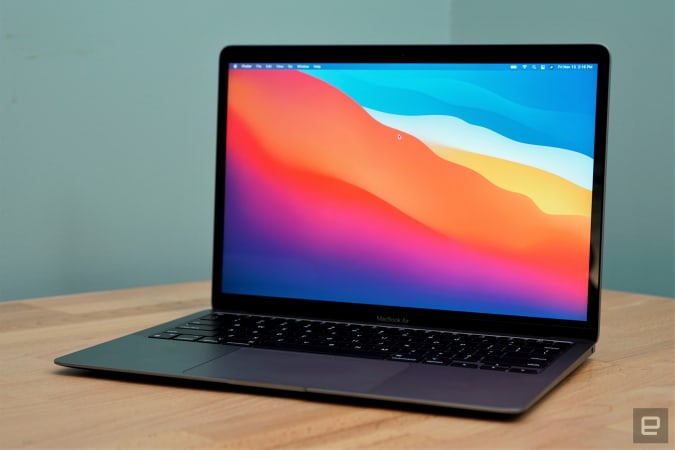
The latest MacBook Air M1 is down to $899 right now, or $100 off its regular price. It's one of the best laptops for most people, and the M1 chipset only makes it a better buy. The Air M1 earned a score of 94 from us for its incredibly fast performance, excellent keyboard and trackpad, good battery life and lack of fan noise.
Apple's colorful iMacs with 8-core GPUs are $50 off right now at Amazon, bringing them down to $1,450. We gave this desktop a score of 89 for its remarkable performance thanks to the M1 chip, lovely 24-inch Retina Display and its thin-and-light design.
The GPS + Cellular models of the Apple Watch Series 6 Product Red Edition are $100 off at Amazon. The 40mm is down to $399, or close to a record low, while the 44mm version has hit an all-time low of $429. We gave the Series 6 a score of 89 for its speedier performance, quicker charging and slightly improved battery life.
The OnePlus 9 Pro smartphone is $100 off right now, bringing it down to $970. The regular OnePlus 9 is also on sale, but it's only $80 off. We gave the 9 Pro a score of 88 for its fantastic display, stellar performance and much-improved main camera.
Samsung's T7 Touch portable SSD in 500GB is down to $90, which is close to its all-time-low price. This palm-sized drive has read speeds up to 1,050 MB/s and write speeds up to 1,000 MB/s, and in addition to password protection, it also has a built-in fingerprint reader for extra security.
Solo Stove's Bonfire remains $120 off even after the July 4th holiday has passed. These are smokeless, portable fire pits that we've recommended in the past as an easy way to upgrade your backyard setup.
The Thermapen Mk4 is still on sale for $69 as ThermoWorks makes room for the new Thermapen One thermometer. The Mk4 is the best instant-read thermometer we've used so far —the backlit display makes it easy to read in almost any situation and the display rotates depending on how you're holding the pen. Plus, you never have to remember to turn it off because the pen automatically turns on when you pick it up and will shut off after some time of no use.
Omaze is giving away another $20,000 to build your ultimate gaming PC. This sweepstakes is free to enter, but funds donated with purchased entries will benefit Schools on Wheels, an organization that provides free tutoring and mentoring services to children experiencing homelessness across Southern California.
Pricing and availability is subject to change. No donation or payment necessary to enter or win this sweepstakes.See official rules on Omaze.
New tech deals
Philips Hue White and Color Ambience smart lights
A three-pack of the Philips Hue White and Color Ambience smart light bulbs is on sale for $99, or $35 off its normal price. While not a record low, this is a great sale on smart bulbs that don't often see steep discounts. In addition to standard white light, you're getting 16 million colors in these bulbs and they can be controlled with your smartphone.
Dyson knocked $80 off its V10 Allergy cordless vacuum, bringing it down to $400. This model includes the V10 motor with 14 cyclones and a filtration system that claims to expel cleaner air as it traps 99 percent of particles as small as 0.3 microns. In addition to the vacuum, you're getting the drop-in dock plus five different cleaning head tools.
A handy Anker fast charger is back down to its Prime Day price of $39. That's an all-time low and nearly $22 off its normal price. This slim brick has two USB-C ports and two USB-C ports, so it can juice up to four devices at once with a total of 63 watts of power.
The Microsoft store just kicked off its back-to-school sale, which includes discounts on Surface devices, gaming gear and more. Of note is a deal that knocks up to $100 off the price of a Surface Go 2 + Type Cover bundle, and you can get up to $500 off gaming laptops from various brands.
One of our recommended VPNs is running a good sale on a two-year subscription. You can sign up for NordVPN for only $89 for the first two years, which comes out to $44.50 per year — and an additional summer promotion adds three free months on top of that. We like NordVPN for its speed, its no-logs policy, the thousands of servers it has to choose from and that one account supports up to six connected devices.
Alto's Odyssey is joining Apple Arcade on July 16th amid an expansion from the game subscription service into classic mobile titles. Developer Snowman recently revealed Apple Arcade members will get access to additional content and it teased some of that in a trailer for Alto's Odyssey: The Lost City.
The latest version of the stylish endless runner adds an urban biome to go along with the desert, canyon and temple areas. In its App Store preview, Snowman said the new area includes "special hidden challenges," but it didn't show any of those in the teaser. It only offered a brief look at the city, which adopts the game's gorgeous art style and features floating lanterns. You'll get to experience The Lost City for yourself next week — assuming you can stay on your snowboard long enough.
If I asked you to envision a fitness tracker on a random person’s wrist, what would your imaginary wearable look like? For years, they’ve largely looked the same — plastic or metal rectangles attached to some generic silicone or nylon strap.
Fitbit likes to say its wearables resemble jewelry. But it’s difficult to make a fitness tracker that actually looks like jewelry and does everything from logging your steps, sleep and workouts to telling you to breathe and relax. The company tried its hand at a stylish fitness band in 2016 with the Alta, but that device was just a slightly narrower Charge with a finicky screen and has since been discontinued. With the Luxe, Fitbit is singing a familiar tune, once again promising a “fashion-forward fitness and wellness tracker… in an effortlessly chic bracelet design."
Design aside, the Luxe packs almost everything you’d want from a fitness band: a heart rate sensor, oxygen saturation (SpO2) monitoring, sleep tracking, water resistance and basic syncing with your phone. At $150, this could be a great option for those looking for a simple no-frills tracker that stands out from the crowd.
Design
Fitbit’s previous claims about how stylish and chic their trackers are have been questionable. They’re all just rectangular blocks with few minor variations. When announcing the Luxe, the company painstakingly detailed how it crafted the Luxe’s case, saying the device’s “breakthrough design has a soft, gentle shape inspired by the human body that sits lightly on your wrist with a jewelry-like look and feel.”
It used techniques like metal injection molding to make the stainless steel case, “providing the warmth expected of handcrafted jewelry, all while delivering a level of precision needed to enable its advanced sensor technology.” After throwing in a few dozen mentions of how elegant the Luxe is, the company ends up calling this “one of Fitbit’s most fashionable and comfortable devices yet.”
Co-founder James Park said “We’ve made major technological advancements with Luxe, creating a smaller, slimmer, beautifully designed tracker packed with advanced features – some that were previously only available with our smartwatches.” Meaning that Fitbit was able to squeeze advanced components into the teeny tiny body of the Luxe, which is about as wide as my index finger and just 1.43 inches long. It’s indeed very small and thin, with a profile of 0.4 inches. That’s about as thick as the Apple Watch SE, but about a third of the width. It’s also about three quarters as wide as a Fitbit Charge 4, and a hair thinner.
So yes, the Luxe is a dainty little thing, which is nice for people like me who have small wrists. The stainless steel case itself is slightly curved along the edges, making it less blockish than the Charge 4 and the Alta. But the strap you pick can make all the difference. When paired with the silicone option you get in the box, the Luxe still looks kinda basic. Swap it out for, say, the Gold Mesh version that Fitbit also sent me, and voila! Instant style elevation.
Cherlynn Low / Engadget
That’s nice, but you could make most other fitness trackers look attractive by swapping in a pretty band. Where the Luxe stands out is in its dainty size and narrow width, and that’s good news for those of us who want something smaller. The added bonus of the Luxe’s footprint is that it never got in the way when I was typing or performing a handstand.
The bad thing about the Luxe’s size is that its screen is correspondingly small. This is a 0.76-inch AMOLED panel running at a 124 x 206 resolution. It’s surrounded by a thick bezel, which is probably hiding all the Luxe’s sensors. But this makes things like your workout stats very hard to read. The screen itself is crisp, bright and colorful. But if you have trouble reading tiny text, you might need a bigger device. Fitbit told Engadget that an update is coming soon that will include larger text, though we still don’t know the specific timeline nor how this will look when it rolls out.
Navigation and in use
Like the Charge 4 and Sense smartwatch, the Luxe has no physical buttons. But unlike the other two, this tracker doesn’t even have an inductive solid state sensor that detects pressure to trigger an action. The only way you’ll be interacting with the Luxe is through its touchscreen. Thankfully, Fitbit uses a standard one here instead of its faux touchscreen that you had to forcefully jab for it to detect a tap. With the Luxe, you can swipe and tap on the screen just like on any smartwatch, albeit with a very rudimentary OS.
Cherlynn Low / Engadget
Swiping up from the main screen shows your daily progress and battery percentage, while dragging down lets you access Settings and enable Do Not Disturb, Sleep or Water Lock modes. Swiping sideways brings you through Notifications, Exercise, Relax (guided breathing), Alarms and Timers. You can scroll vertically on each of these sections to get to more functions. Double tap the top of the screen to go back (or swipe right). That’s it.
For more customization, like rearranging your favorite workouts in Exercise, you’ll need to go to the Fitbit app on your phone. By default, you’ll find Walk, Run, Bike, Swim, Treadmill and Workout (a catch-all for almost everything else) here. When you’re exercising, the Luxe will show your calories burned, time elapsed, heart rate and, where relevant, pace or miles covered. That’s far less information than you’ll see at a glance on a bigger screen, but that’s the sacrifice you make for a smaller tracker. You can swipe up to see more things, like a pause button, but that’s about it.
As you’re working out, too, Fitbit will show your cardio zone below your heart rate, with labels like “fat burn” and “peak.” This is useful information, but again, this is so tiny. I have decent eyesight and even I struggled slightly to read it (and it got harder when I was waving my arms about as I ran).
Cherlynn Low / Engadget
Cramped screen aside, the Luxe behaves like most other basic Fitbit trackers. Though notifications are tedious to read, it’s nice that you can send a quick pre-set reply or emoji from your wrist. The device will also buzz when you’ve been idle too long, or when you’ve achieved your targeted active minutes. When you lift your wrist, the screen wakes up to show you the time (in thankfully large font). If you wear the band to sleep, it’ll use your heart rate to detect what sleep zones you’re in, and after three nights it’ll tell you things like your resting heart rate. If you’ve been running, walking, swimming or biking (or more) for at least 15 minutes, the Luxe will automatically detect and record your activity. You can change that minimum time requirement to something else via the app, too. Unlike the Charge 4, though, the Luxe doesn’t have onboard GPS and will need to connect to your phone to map your outdoor runs.
Something that’s new since Google completed its acquisition of Fitbit is the introduction of Fast Pair, which works with Android devices. This made setting the Luxe up and syncing it to my Pixel 4a a breeze. I charged up the Luxe, and a window popped up on all my Pixel review units asking if I wanted to connect to the tracker. I tapped yes and before I knew it, I was going through the welcome pages since I already had the Fitbit app installed. This is much easier than the old method of first opening the app, hitting the Add New Device button and then waiting endlessly for my phone to find the wearable.
There are some other functions that the Luxe offers, but only if you pay the extra $10 a month for Fitbit Premium. The company is throwing in six months free with every purchase, and that gets you additional insight like your activity, heart rate and sleep trends. It’ll also unlock month-long and year-long reports on your wellness, detailed breakdowns on your sleep and stress, as well as guided workouts, mindfulness and nutrition programs. Without the subscription, most people should find the basic data the Luxe gathers is sufficient. But those who are keen on learning about their long term health trends might benefit from Premium.
Battery life
Cherlynn Low / Engadget
Fitbit promises the Luxe will last up to five days and I actually went a full week of testing the device before it conked out. That’s with tracking multiple workout sessions every other day, though I didn’t wear the band to sleep most nights. If you keep the Luxe on when you go to bed, and also connect it to your phone’s GPS a lot, your runtime will likely be shorter.
Wrap-up
The most impressive thing about the Fitbit Luxe isn’t its style; it’s its size. The fact that this little device can do so much is noteworthy, and those with smaller wrists will like the way it fits. But its size is also one of its drawbacks — its tiny screen makes things hard to read. Still, for $150, the Luxe is a well-made and capable fitness tracker that can track pretty much everything. If you’re looking for a simple activity band that’s smaller than most, this will serve you well. At least, as long as you have near-perfect vision.
PUBG Mobile probably isn't the first game you'd expect to have an electric vehicle tie-in, but it's here all the same. Krafton and Tencent Games have rolled out a 1.5 update for the phone-focused shooter that includes a raft of not-so-subtle plugs for Tesla and its cars. Most notably, you can find a Model Y on Erangel that can drive itself when you activate an autopilot mode on the highway —not that far off from the real Autopilot mode.
You'll also find a Gigafactory on Erangel where you can build the Model Y by activating switches, and self-driving Semi trucks roam around the map dropping supply crates when you damage the vehicles. No, despite the imagery, you can't drive a Cybertruck or Roadster (not yet, at least).
The additions are part of a larger "technological transformation" for Erangel that includes an overhaul of the buildings and new equipment, including an anti-gravity motorcycle.
As is often the case, you shouldn't expect these updates in regular PUBG — the battle royale brawler for consoles and PCs has a more realistic atmosphere. The PUBG Mobile update is really a not-so-subtle way for Tesla to advertise its EVs in countries where it doesn't already have strong word-of-mouth working in its favor.