Banana Capital’s debut fund is for internet-first founders

You might know him for his viral tweets, but Turner Novak wasn’t always a master meme-maker.

Instead, Novak grew up with a single mother in the United States. The financial situation of his family led to the internet being not always accessible. They often hop-scotched between discounted trials and went months without access. The experience, he says, was formative in his relationship with technology more broadly.

“It really made me appreciate just how impactful and how important the internet is” he said. “And it [taught] me how to use it efficiently.”

Now, the investor has started a firm peeled from the ethos. Banana Capital is a firm that will seed and source consumer tech founders from the corners of the web. The oversubscribed debut fund is $9.99 million and the average check size is between $25,000 to $300,000. Investors in Banana Capital include Winnie co-founder Sara Mauskopf, Andreessen Horowitz general partner Sriram Krishnan and GGV managing partner Hans Tung. VC Starter Kit, a meme account for tech Twitter, is also an LP.

Novak will be investing in the broad consumer sector, with specific interest in early-stage startups in the social, healthcare and e-commerce sector. He is targeting ownership between 0.2% to 3%. Comparatively, Cleo Capital, a pre-seed stage with the same assets under management, leads checks and targets between 15% to 20% ownership in its rounds.

Novak says he made a choice to actively target low ownership instead of leading rounds to give him flexibility in what stages to play in long term.

Memes and banana peels

Novak describes Banana Capital as an internet-first fund. But while that phrase can often be a buzzword, his track record gives some color on how a network built by the internet, instead of geography, looks.

Novak’s vibe might be best shown in his meme game. Novak was part of the Eye Mouth Eye ( ???) campaign that rocked Silicon Valley in June 2020, that used meme culture to illustrate how FOMO and hype are what catch investor attention. He is one of a handful of investors who religiously post memes on Twitter and TikTok about tech. He has a recurring series about audio social app Clubhouse and its fundraisers. One of his viral tweets was a mock video of a startup pitching to a VC, which racked up more than 186,200 views on Twitter, as well as a handful of duets on TikTok.

While some of his tweets are simply for the spice, the memes have become somewhat of a strategy for the emerging fund manager. His mock pitch video, for example, led to an investment in a company. Founders often directly message him after a tweet inviting him to join an open cap table slot. The strategy is part of his differentiation when it comes to deal flow. Banana Capital’s portfolio has 11 known investments, including Flexbase, Skillful and Bottomless.

announcing TikTok startup pitch: duet this video pitching your startup

? https://t.co/gNTBfrUzW7 pic.twitter.com/aJUtmcYgIx

— Turner Novak (@TurnerNovak) October 20, 2020

“It just kind of happens where [my investments] are people who understand the culture of the internet, to understand memes and understand wit and humor and appreciate that a little bit more,” he said. “Those are probably the people that are more naturally intuitive investments, so it definitely does skew that direction.”

While Novak didn’t share explicit targets or mandates around investment in diverse founders, he pointed to his track record at Gelt VC, in which 41% of capital went to woman CEOs. To date, 65% of Banana Capital’s portfolio founding teams include non-white founders and 50% of the teams include more than one gender.

Novak plans on staying in Ann Arbor, Michigan for the foreseeable future, but couldn’t resist a poke at Miami, a growing, buzzy tech hub. URL jokes aside, his geography, so to speak, will be the internet.

“My network is not in San Francisco and New York, it’s more so just people like on the internet,” he said. “That’s just how I meet people.”

Novak had multiple explanations for why he is choosing to call his firm Banana Capital. First, bananas are one of the most consumed fruits out there and have been through numerous iterations and bio-engineering processes throughout history, with a nod to the focus of his investments in the consumer sphere.

Second? “There really are no fruit funds out there,” he said. “My vibe is that I take myself a little less seriously than other people and the name just reflected that.


Stripe acquires TaxJar to add cloud-based, automated sales tax tools into its payments platform

Stripe, the privately-held payments company now valued at $95 billion, has made an acquisition to expand the range of tools (and services) that it provides to online businesses. It has acquired TaxJar, a popular provider of a cloud-based suite of tax services, which can be used to automatically calculate, report and file sales taxes.

One key point about TaxJar is that it works across a number of geographies and the many different sales tax regimes that each uses — a complex area for a lot of companies that do business online.

Financial terms of the deal are not being disclosed, but for some context the company was valued at $179 million post-money when it last raised money, in January 2019, according to PitchBook data.

Stripe has confirmed that all 200 employees of Woburn, Massachusetts-based TaxJar are joining the company.

Stripe will be integrating TaxJar technology into its revenue platform — where it will sit alongside Stripe Billing (its subscription tools) and Radar (its fraud prevention technology), and potentially build new services using AI and other technology to automate more functions — but businesses can continue to use TaxJar directly, too.

Launched in 2013, TaxJar today has around 23,000 customers. Stripe didn’t comment on how much of an overlap the two companies have in terms of users, but both have over the years gained a lot of traction with startups and other online businesses, which is likely one reason why TaxJar caught Stripe’s attention.

“There’s a reason TaxJar has been a top choice for businesses: their software tools make it incredibly easy to handle sales tax,” said Dhivya Suryadevara, Stripe’s CFO, in a statement. “With TaxJar, we will help millions of internet businesses running on Stripe with their sales tax and make it easier for them to sell internationally. And as a CFO, I’m delighted to welcome so many new colleagues who care deeply about tax calculation and reporting!”

When TaxJar last raised money — a $60 million round in 2019 led by Insight Partners — it mentioned that it had been profitable since 2016 (fueled by a $2 million investment in 2014 from Rincon Venture Partners and Daher Capital), and said it had 15,000 customers, so that base has been growing (specifically, 53% in two years).

Stripe has actually made some moves in the area of tax before, buying Payable back in 2017 to help with 1099 reporting for customers who pay contractors, and partnering with Intuit to help on-demand workers manage their finances. The TaxJar acquisition, however, is filling a noticeable gap in its native product set, as well as a pain point for its customers, specifically in the area of sales tax.

Stripe says that adding sales tax collection and remittance — a complex system that covers as much as 11,000 tax jurisdictions in the U.S. alone — was one of the most-requested features among users, a fact that users themselves have lamented openly:

Every week I see someone from @stripe tweet “What should we build next for y’all?” and the #1 reply is always people screaming “US sales tax collection and remittance!”… then I watch OP respond to every *other* reply. It drives me insane. ?

— Justin Klemm (@justinklemm) January 21, 2021

Ironically, if you link through on the above Tweet, you’ll see in one thread, TaxJar comes up in the conversation.

Indeed, TaxJar was already “fully integrated” with Stripe as a partner, meaning businesses could use TaxJar to calculate and manage sales taxes on transactions powered by Stripe. But using the two together required logging into TaxJar, creating a separate account, and then getting a unique URL to paste into your Stripe Orders settings to run the services together: not the picture of simplicity that Stripe generally presents to users.

Some of that will now become smoother for Stripe customers as part of its bigger push for more automated tools to cover the more repetitive aspects of the online sales transactions process. (Other automated areas include algorithms around payment rejection, billing methods and so on.)

“Like everyone at Stripe, we think every day about how we can help startups and multinational companies alike remove barriers to growing their business,” said Mark Faggiano, CEO and founder of TaxJar, in a statement. “And what that means is making the complicated work of sales tax compliance as straightforward as possible. We know that to grow the GDP of the internet, compliance is critical. We couldn’t be more excited to join Stripe and help power millions of businesses around the world.”

Stripe noted that the sorts of services that TaxJar covers include providing accurate, localized sales tax rates at checkout, submitting tax returns to local jurisdictions and remitting the sales tax collected, producing itemized, local jurisdiction reports to show sales and sales tax collected, and suggesting the right product tax code based on a company’s products.

That TaxJar is coming into the deal with its own customer base and revenue model is important for another reason: it’s a sign of more diversification for Stripe — key as the $95 billion company continues to grow and inch potentially toward a public listing, now being considered for late 2021 or early 2022, according to rumors. Other signs of that diversification strategy include Stripe’s acquisition of Paystack last year out of Nigeria to help it break into payments in Africa, a deal it made for over $200 million.

(TaxJar’s SaaS pricing starts at $19/month and goes up from there, including an enterprise tier that will be handy for Stripe’s platform product.)

Stripe made revenues of $1.6 billion (or as much as $7.6 billion!… Stripe declined to comment on both numbers) in 2020, according to this profile in the WSJ, but it was also buffeted pretty significantly by the COVID-19 pandemic. Some sectors where Stripe has played strong, like travel, saw a big drop in transactions, while others, like e-commerce, saw a much bigger surge.

One takeaway from that might be: regardless of what our “new normal” will look like, it seems that e-commerce in one form or another will continue to grow, so offering a wider range of services, like automatic sales tax calculations and reporting around its core business of payments will help Stripe grow revenues per user to offset the ups and downs of specific business lines when and if they arise again.

The area of tax-tech sits somewhere between e-commerce and fintech and has found its own steam in recent years, following both the growing size of the e-commerce market and the evolution in fintech, where startups are building the complex processes that are not the core competency of their target customers and putting them into products that are easy to use and integrate. Others in the same space as TaxJar include Avalara, Vertx and Sovos, among a wider field of startups.

Updated to correct that TaxJar’s last round was led by Insight Partners

What can the OKR software sector tell us about startup growth more generally?

In the never-ending stream of venture capital funding rounds, from time to time, a group of startups working on the same problem will raise money nearly in unison. So it was with OKR-focused startups toward the start of 2020.

How were so many OKR-focused tech upstarts able to raise capital at the same time? And was there really space in the market for so many different startups building software to help other companies manage their goal-setting? OKRs, or “objectives and key results,” a corporate planning method, are no longer a niche concept. But surely, over time, there would be M&A in the group, right?

During our first look into the cohort, we concluded that it felt likely that there was “some consolidation” ahead for the group “when growth becomes more difficult.” At the time, however, it was clear that many founders and investors expected the OKR software market to have material depth.

They were right, and we were wrong. A year later, in early 2021, we asked the same group how their previous year had gone. Nearly every single company had a killer year, with many players growing by well over 100%.


The Exchange explores startups, markets and money. Read it every morning on Extra Crunch or get The Exchange newsletter every Saturday.


OKR company Ally.io grew 3.3x in 2020, for example, while its competitor Gtmhub grew by 3x over the same time period. More capital followed. Ally.io raised $50 million in a Series C in the first quarter, while Gtmhub put together a $30 million Series B during the same period.

They won’t be the final startups in the OKR cohort to raise this year. We know this because we reached out to the group again this week, this time probing their Q1 performance, and, critically, asking the startups to discuss their level of optimism regarding the rest of 2021.

As before, the group’s recent results are strong, at least when compared to their own planning. But notably, the collection of competing companies is more optimistic than before about the rest of the year than they were before Q1 2021. Things are heating up for the OKR startup world.

A takeaway from our work today is that our prior notes about how impressively deep the software market is proving to be may have been too modest. And frankly, that’s super-good news for startups and investors alike. So much for SaaS-fatigue.

In a sense, we should not be surprised that OKR startups are doing well or that the startup software market is so large. You’d imagine that the historic pace of venture capital investment that we’ve seen so far in 2021 in Europe and the United States was based on results, or evidence that there was lots more room for software-focused startups to grow.

Interestingly, while these companies look similar to outsiders, they are each betting on strategies and differentiators that could help them win in their selected portion of the OKR space. Which also means that the sector may not be as crowded as it seems.

Don’t take our word for it. Let’s hear from Gtmhub COO Seth Elliott, Workboard CEO and co-founder Deidre Paknad, Koan CEO and co-founder Matt Tucker, Ally.io CEO and co-founder Vetri Vellore, and Perdoo CEO and founder Henrik-Jan van der Pol about just what the software market looks like to them.

We’ll start with how the startups performed in Q1 2021, dig into how they feel about the rest of the year, and then talk about how differentiation among the cohort could be helping them not step on each other’s toes.

Rapid growth

WorkBoard is having a strong start to 2021. Paknad’s company, which raised in both March of 2019 and January of 2020, told The Exchange that it hired 82 people in the first three months of 2021, and that it plans on doing it again in the current quarter. WorkBoard is “investing heavily,” Paknad said via DM, and “made [its] Q1 targets.”

Robotic vision startup Plus One raises $33M

San Antonio-based Plus One Robotics today announced a $33 million Series B. The round follows an $8.3 million Series A announced in 2018 and brings the company’s total funding to north of $40 million. The round, led by McRock Capital and TransLink Ventures, features BMWi Ventures, Kensington Capital Partners and Ironspring Ventures, along with existing investors.

Launched in 2016, the company is primarily focused on computer vision software for robotics in logistics and warehouse settings — clearly a hot category as more companies look to automate their back end. Specifically, the system is designed to be adaptable to a wide range of robotic arms and grippers, which tend to fill different needs for the end user.

The company plans to use the funding to expand operations internationally to keep up with the accelerated demand for robotics. The system also allows for group management, controlling up to 50 robots at once.

“We are excited to grow alongside our clients here and abroad. Like our clients, our investors have a global footprint representing Asia and the EU as well as North America,” CEO and co-founder Erik Nieves said in a release tied to the news. “This potent combination sets Plus One on a course to continue growing our international installed base.”

The round also finds Whitney Rockley of McRock Capital and Toshi Otani of TransLink joining Plus One’s board.

Materials Zone raises $6M for its materials discovery platform

Materials Zone, a Tel Aviv-based startup that uses AI to speed up materials research, today announced that it has raised a $6 million seed funding round led by Insight Partners, with participation from crowdfunding platform OurCrowd.

The company’s platform consists of a number of different tools, but at the core is a database that takes in data from scientific instruments, manufacturing facilities, lab equipment, external databases, published articles, Excel sheets and more, and then parses it and standardizes it. Simply having this database, the company argues, is a boon for researchers, who can then also visualize it as needed.

Image Credits: Materials Zone

“In order to develop new technologies and physical products, companies must first understand the materials that comprise those products, as well as those materials’ properties,” said Materials Zone founder and CEO Dr. Assaf Anderson. “Understanding the science of materials has therefore become a driving force behind innovation. However, the data behind materials R&D and production has traditionally been poorly managed, unstructured, and underutilized, often leading to redundant experiments, limited capacity to build on past experience, and an inability to effectively collaborate, which inevitably wastes countless dollars and man-hours.”

Image Credits: Materials Zone

Before founding Materials Zone, Anderson spent time at the Bar Ilan University’s Institute for Nanotechnology and Advanced Materials, where he was the head of the Combinatorial Materials lab.

Assaf Anderson, Ph.D., founder and CEO of Materials Zone

Assaf Anderson, PhD, founder/CEO of Materials Zone. Image Credits: Materials Zone

“As a materials scientist, I have experienced R&D challenges firsthand, thereby gaining an understanding of how R&D can be improved,” Anderson said. “We developed our platform with our years of experience in mind, leveraging innovative AI/ML technologies to create a unique solution for these problems.”

He noted that in order to, for example, develop a new photovoltaic transparent window, it would take thousands of experiments to find the right core materials and their parameters. The promise of Materials Zone is that it can make this process faster and cheaper by aggregating and standardizing all of this data and then offer data and workflow management tools to work with it. Meanwhile, the company’s analytical and machine learning tools can help researchers interpret this data.


Amazon announces it’s open sourcing DeepRacer device software

When Amazon debuted AWS DeepRacer in 2018, it was meant as a fun way to help developers learn machine learning. While it has evolved since and incorporated DeepRacer competitions, today the company announced it was adding a new wrinkle. It’s open sourcing the software the company created to run these miniature cars.

At its core, the DeepRacer car is a mini computer running Ubuntu Linux and Robot Operating System (ROS), both open source components. The company believes that by opening up the device software to developers, it will encourage more creative uses of the car by enabling them to change the car’s default behavior.

“With the open sourcing of the AWS DeepRacer device code you can quickly and easily change the default behavior of your currently track-obsessed race car. Want to block other cars from overtaking it by deploying countermeasures? Want to deploy your own custom algorithm to make the car go faster from point A to B? You just need to dream it and code it,” the company wrote in a blog post announcing the open source project.

After introducing the cars in 2018, the company has developed in person DeepRacer leagues, and more recently virtual races. In fact, the company reorganized the leagues last month to encourage new people to get involved with the technology. Adding an open source component could increase interest further as developers get a chance to make this their own, and really add new layers of usage to the cars that haven’t been possible up until now.

The idea behind all of this to teach developers the basics of machine learning, as AWS’ Marcia Villalba wrote in a blog post last month:

“AWS DeepRacer is an autonomous 1/18th scale race car designed to test [reinforcement learning] models by racing virtually in the AWS DeepRacer console or physically on a track at AWS and customer events. AWS DeepRacer is for developers of all skill levels, even if you don’t have any ML experience. When learning RL using AWS DeepRacer, you can take part in the AWS DeepRacer League where you get experience with machine learning in a fun and competitive environment.”

If you want to get involved customizing your car’s software, the project documentation is available on GitHub and on the AWS DeepRacer Open Source page, where you can get started with six sample projects.

Ford to open new lab to develop next-gen lithium-ion and solid-state batteries

Ford Motor Company will open a $185 million R&D battery lab to develop and manufacture battery cells and batteries, a first step toward the automaker possibly making battery cells in-house. The facility comes as yet another signal to consumers and other automakers that the auto giant is no longer hedging its bets on the transition to battery electric vehicles.

Company executives declined to provide a timeline on when Ford might scale its battery manufacturing, but it is clear that the company intends this facility to lay the groundwork for such a future.

The Ford Ion Park will be based in southeast Michigan and will be home to more than 150 employees across battery technology development, research and manufacturing. The facility will likely be around 200,000 square feet and will open at the end of 2022. The facility will be supported by Ford’s batteries benchmarking test laboratories in nearby Allen Park, Michigan, which is already testing battery cell construction and chemistries. Also nearby are Ford’s product development center in Dearborn and Ford’s battery cell assembly and e-motor plant in Rossville.

The new facility will be led by Anand Sankaran, who is currently Ford’s director of electrified systems engineering. He described it as a “learning lab” to create both “lab-scale and pilot-scale assembly of cells,” including next-gen lithium-ion and solid-state batteries.

Ford is thinking about the transition to BEVs in phases, Hau Thai-Tang, Ford’s chief product platform and operations officer, explained. In this first phase, when BEVs are being largely purchased by early adopters, Ford’s working with external supplier partners. The company is now preparing for phase two, when Ford will bring more products to market and BEVs will take more of the market share. “So in preparation for that next transition into the second phase, we want to give Ford the flexibility and the optionality to eventually vertically integrate,” Thai-Tang said.

“Our plan to lead the electric revolution will certainly be dependent on the progress that we make on battery energy density, as well as cost,” Thai-Tang told reporters Tuesday.

“The formation of the Ford Ion Park team is a key enabler for Ford to vertically integrate and manufacture batteries in the future,” Thai-Tang said. “This will help us better control our supply and deliver high-volume battery cells with greater range, lower cost and higher quality.”

This would be a huge boost for domestic manufacturing of battery cells, which is dominated by companies based in Asia, such as Panasonic (Tesla’s main supplier), South Korea-based LG Chem and SK Innovation, Ford’s current battery cell supplier. Executives said the global pandemic and the semiconductor shortage have highlighted the importance of having a localized and domestically controlled supply chain.

“We know in terms of batteries, it’s a very capital-intensive business to be in,” Thai-Tang said. “The best tier one suppliers in the world spend a large amount of their revenue on R&D spending, and then the capital expenditure required to build and stand up battery plants is quite high. So as we think about this, the scale and volume that we would need to have dedicated sites for Ford is a big consideration, and we’ve talked about how bullish we see this transition happening. We’re at a point where now, there’s sufficient scale for us to entertain having greater levels of vertical integration at some point.”

Language learning startup Toucan raises $4.5M

Toucan, a startup that helps users learn a new language while they browse the web, is announcing that it has raised an additional $4.5 million in seed funding.

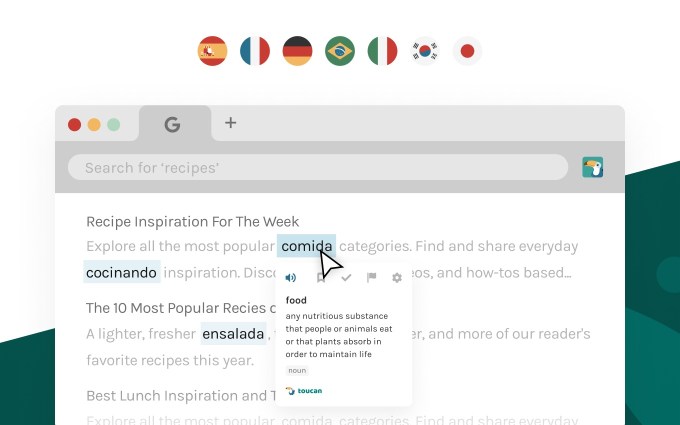
As I wrote last fall, the Santa Monica, California-based startup has built a Chrome extension that scans the text of whatever website you’re reading and translates select words into whichever language you’re trying to learn. That means you’re expanding your vocabulary without having to make time to study or otherwise change your behavior.

Toucan currently supports seven languages — Spanish, Korean, French, German, Italian, Portuguese and Japanese. Co-founder and CEO Taylor Nieman said the company now has around 60,000 monthly active users, all acquired organically.

“On the surface, Toucan can look like a toy, but there’s massive engineering tech on the backend,” Nieman added.

For one thing, although the startup has a team of human translators, it also relies on machine learning and natural language processing to understand the context of each word and make sure it’s being translated properly. Nieman said that the company also takes an intelligent, personalized approach to the translations that appear over time, allowing them to become more complex in order to keep challenging users.

Toucan screenshot

Image Credits: Toucan

Toucan is free, but users can subscribe to Toucan Premium, which starts at $4.99 per month and offers a higher density of translated words. Premium subscribers can also opt in or out of advertising — apparently the ability to “own” a word (a.k.a. have your sponsorship message appear anytime that word is translated) is popular enough that some paying users don’t want to lose it.

Toucan has now raised a total of $7.5 million. The new round was led by LightShed Ventures, with participation from new investors Next Play Ventures, Concrete Rose Capital, GingerBread Capital, Form Capital, Goodwater Capital, Hampton VC, Spacecadet Ventures, GTMfund, Baron Davis Enterprises and Human Ventures, as well as existing investors GSV Ventures, Amplifyher Ventures and Vitalize.

“Screen time is escalating globally with younger generations living their lives always connected,” said LightShed Ventures General Partner Richard Greenfield in a statement. “Toucan seamlessly integrates language learning into the websites (and soon apps) you are already using via a simple browser extension transforming screen time into learning time.”

Nieman said Toucan will use the new funding to expand the team from 12 to 16. It’s also planning to internationalize — so not just translating English to Spanish, but Spanish to English, and so on — and is launching a new Safari extension (it will support more browsers in the future). The ultimate vision is for Toucan to be “layered wherever you are.”

“We want to be this augmented layer of learning on the web, on mobile browsing, in the most popular social apps and even in the physical world,” she said, predicting that in the future, you might be “wearing a crazy cool contact lens that can translate a sign on the subway and provide you with those same micro-moments of learning.”

Social networking app for women, Peanut, adds live audio rooms

Mobile social networking app for women, Peanut, is today becoming the latest tech company to integrate audio into its product following the success of Clubhouse. Peanut, which began with a focus on motherhood, has expanded over the years to support women through all life stages, including pregnancy, marriage and even menopause. It sees its voice chat feature, which it’s calling “Pods,” as a way women on its app can make better connections in a more supportive, safer environment than other platforms may provide.

The pandemic, of course, likely drove some of the interest in audio-based social networking, as people who had been stuck at home found it helped to fill the gap that in-person networking and social events once did. However, voice chat social networking leader Clubhouse has since seen its model turned into what’s now just a feature for companies like Facebook, Twitter, Reddit, LinkedIn, Discord and others to adopt.

Like many of the Clubhouse clones to date, Peanut’s Pods offer the basics, including a muted audience of listeners who virtually “raise their hand” to speak, emoji reactions and hosts who can moderate the conversations and invite people to speak, among other things. The company, for now, is doing its own in-house moderation on the audio pods, to ensure the conversations don’t violate the company’s terms. In time, it plans to scale to include other moderators. (The company pays over two dozen moderators to help it manage the rest of its app, but the team had not yet been trained on audio, as of just a few days ago. They have now been given the training, we understand.)

Though there are similarities with Clubhouse in its design, what Peanut believes will differentiate its audio experience from the rest of the pack is where these conversations are taking place — on a network designed for women built with safety and trust in mind. It’s also a network where chasing clout is not the reason people participate.

Traditional social networks are often based on how many likes you have, how many followers you have, or if you’re verified with a blue check, explains Peanut founder CEO Michelle Kennedy.

“It’s kind of all based around status and popularity,” she says. “What we’ve only ever seen on Peanut is this ‘economy of care,’ where women are really supportive of one another. It’s really never been about, ‘I’ve got X number of followers.’ We don’t even have that concept. It’s always been about: ‘I need support; I have this question; I’m lonely or looking for a friend;’ or whatever it might be,” Kennedy adds.

In Peanut Pods, the company says it will continue to enforce the safety standards that make women feel comfortable with social networking. This focus in particular could attract some of the women, and particularly women of color, who have been targeted with harassment on other voice-based networking platforms.

“The one thing I would say is we’re a community, and we have standards,” notes Kennedy. “When you have standards and you let everyone know what those standards are, it’s very clear. You’re allowed an opinion but what you’re not allowed to do are listed here…Here are the things we expect of you as a user and we’ll reward you if you do it and if you don’t, we’re going to ask you to leave,” she says.

Freedom of speech is not what Peanut’s about, she adds.

“We have standards and we ask you to adhere to them,” says Kennedy.

In time, Peanut envisions using the audio feature to help connect women with people who have specific expertise, like lactation consultants for new moms or fertility doctors, for example. But these will not be positioned as lectures where listeners are held hostage as a speaker drones on and on. In fact, Peanut’s design does away with the “stage” concept from Clubhouse to give everyone equal status — whether they’re speaking or not.

In the app, users will be able to find interesting chats based on what topics they’re already following — and, importantly, they can avoid being shown other topics by muting them.

The Pods feature is rolling out to Peanut’s app starting today, where it will reach the company’s now 2 million-plus users. It will be free to use, like all of Peanut, though the company plans to eventually launch a freemium model with some paid products further down the road.

Update, 4/27/21, 3:40 PM ET: Article updated to note moderators have now received Pods training. 

Gillmor Gang: FreeCoin

The current rave about newsletters and so-called or social audio is just the latest version of the story of podcasting. Take the idea that podcasting is experiencing a new wave of popularity and scaffolding. Are you sure? Apple is bent on turning the space into a subscription model, and we’re all going to twist again like we did last summer. Somehow I doubt it. The basic attraction for me is not paying for podcasts. Subscription startups may be an important step forward, but the heart of the matter is talent formation.

Back when they first started, the real charge was the ability to own the whole stack: writer, producer, editor, star, and marketer. Making money for this may have been a future goal, but right now the real power was in figuring out what might work without the intrusion of what people other than yourself thought about the product. Only if something made itself apparent was it necessary to address the needs and wants of the audience.

Luckily, that ruled out about ninety percent of the resulting wave of stuff. There were Ted talks, or what became Ted talks, well thought out verbal slide decks in an 8 minute payload that grabbed, shook, and exacted payment in credibility and validation of the expertise of the artist. Always lurking was the question of what day job the author was moonlighting from. Many self help business books emerged from this.

Then there were the professionals, the public radio folks who knew how to do this in their sleep but were looking for a role not dependent on grant writing or public liberal funding. Reporters who knew how to squeeze out a story, producers who mined their rolodex to fashion a conversation, screenwriters looking for momentum to bank a shot off studio executives to get a pilot or series starter commitment. Eventually this added up to enough successful podcasts to attract sponsorship support from audiobooks and publishing services. Scripted shows became farm clubs for independent talent aiming for the Big Show. This endured for 20 years.

Meanwhile, the Beatles transformed the music business from a vaudeville-like zero-sum game to a Renaissance of control over writing, performing, promoting, and touring. Aspiration was the fuel of the business model, obviating the need for incremental success in favor of explosive momentum and dominance of the media. Hair, boots, sex, striking fear in the hearts of parents and then politicians everywhere. Sgt. Pepper and Kubrick created a version of the future that made everything else pale by comparison. That it all crashed and burned was just one of the risks of what became the startup culture in Silicon Valley and Route 128.

In today’s world of NFTs and Decacorns, free still has a reason for believing. The old guard of the blogging world have reinvented themselves as Lone Rangers in the creator economy. Slap a badge on that podcast and hitch a ride on the promise of endless subscription growth, minus 10% per newsletter sub or 30% for the first year in the AppStore. It’s not the long tail, so what is it? To be sure, the world will endorse the talented solitary surfers, armed with MG Sieglerian talent for the suite spot of the tech zeitgeist, the revolutionary zeal of the breakthrough synthesists of the political, lyrical, and comic survivalists.

How will the media compensate for the loss of their gatekeeper status? For starters, the more the stampede accelerates, the bundlers will storm the economics with constructs that look very much like the magazines and social destinations they replace. As crypto enters the bloodstream, streaming will generate a new measure of success and equity for the artists. Free will still be the driver of the form, but transitional models like tip jars will migrate to social capital to be banked by investors betting on the future success of the talent.

Even this early, some things have to change. The no recording conceit is an artifact of the launch stage, soon to be jettisoned when the effort reaches escape velocity. Clubhouse gains much of its critical mass from who rather than how many are swarming; interesting combinations of speakers and listeners weigh more tellingly than the raw numbers of name guests and moderators. Live is important, but committing to the voice of the artist is a calculation of time, window of opportunity, relevance to the emotion and tenor of the times. And the competitive landscape for that attention spans so many of the medias being replaced or transformed by the application of free.

None of this means the newsletter and conversation startups won’t succeed. Subscribing gives us something to consume to justify the tithe, and most people who drop streaming subs replace them with another service. As these services proliferate, competition drives innovation and expansion into events and paradigm shifts like Netflix and SPACs. Witness TechCrunch, built on just the dynamics Substack and Revue-Twitter now make accessible to a new wave of Arringtons.

from the Gillmor Gang Newsletter

__________________

The Gillmor Gang — Frank Radice, Michael Markman, Keith Teare, Denis Pombriant, Brent Leary and Steve Gillmor. Recorded live Friday, April 16, 2021.

Produced and directed by Tina Chase Gillmor @tinagillmor

@fradice, @mickeleh, @denispombriant, @kteare, @brentleary, @stevegillmor, @gillmorgang

Subscribe to the new Gillmor Gang Newsletter and join the backchannel here on Telegram.

The Gillmor Gang on Facebook … and here’s our sister show G3 on Facebook.

Building a creator-focused OS

Welcome back to The TechCrunch Exchange, a weekly startups-and-markets newsletter. It’s broadly based on the daily column that appears on Extra Crunch, but free, and made for your weekend reading. 

A week ago TechCrunch covered Pico’s $6.5 million funding round and described it as “a New York startup that helps online creators and media companies make money and manage their customer data.” The Exchange has also covered Pico before, most recently during a mid-2020 dive into the world of indie pubs and subscription media.

While our own Anthony Ha did an inimitable job covering the Pico round, I got on a Zoom call with the company, as well, as their new capital came with a relaunch of sorts that I wanted to better understand.

The Pico team walked me through what’s changed at their business by describing the historical progress of creative digital tooling. They said earlier eras in the space focused on content hosting and distribution. In the startup’s view, a new generation of creative-focused tooling will bring the market to an era in which content management systems, or CMSs — say, Substack or WordPress — will not own the center of tooling. Instead, monetization will.

That’s Pico’s bet, and so it’s building what it considers to be an operating system for the creator market. My gut read is that a creative digital world that centers around monetization sounds like one that is more lucrative than what preceding eras brought us.

Pico’s view is that regardless of where someone first builds their audience, they eventually go multi-SKU — or multi-platform, perhaps — so keeping a single, centralized register of customer data may prove critical.

The startup’s revamped service is a bit of a monetization tool, as before, along with a creator-focused CRM that sits atop your CMS or other digital output on any particular platform. So far customer growth at the company looks good, growing by about 5x in the last year. Let’s see how far Pico can ride its vision, and if it can help build out a middle class in the creator economy.

The grocery revolution will be IRL

Somewhat lost in our circles amid the hype regarding Instacart’s epic COVID period is the fact that most folks still go to stores to buy their fruit and veg, as our friends in the UK might say.

Grocers did not forget the fact. But their historically thin margins and rising competition for customer ownership in the Instacart era hasn’t left them too secure. How can they pursue a more digitally enabled strategy without outsourcing their customer relationship to a third party?

Swiftly might be part of the answer. The startup is building technology that may help grocery chains of all sizes go digital, take advantage of modern mobile technology, and generate more incomes via ads, while offering consumers more shopping options. Neat, yeah?

The startup has raised a little over $15 million to date, per Crunchbase data, but came back into our minds thanks to the launch of a deal with the Dollar Tree company, a consumer retailer that has around one zillion stores in America.

I’ve been aware of Swiftly for ages, having met its co-founder Henry Kim back when he was building Sneakpeeq, which later became Symphony Commerce. The latter company was eventually bought by Quantum Retail. But during my chats with Kim over the years in and around San Francisco, he consistently brought up the grocery market, a space he’d had experience in before building Symphony Commerce.

After hearing Kim hype up the possibilities for grocery and digital for a half decade or so, to see the company that came out of his hopes and planning land a major partner is fun.

Swiftly provides two main products, a retail system and a media service. The retail side of its business provides checkout services, loyalty programs, personalized offers and the like for mobile shoppers. And the media side allows IRL grocers to snag a bit of the consumer packaged goods (CPG) ad spend that they often miss out on, while looping in analytics to provide better attribution to the impact of ads sold.

I expect that Swiftly will raise more capital in the next few quarters now that it has a big, public deal out. More when we have it.

UiPath, SPACs, and a neat venture capital round

Over the past two weeks The Exchange has written quite a lot about the UiPath IPO. Probably too much. But to catch you up just in case, the company’s first IPO pricing range looked like a warning for late-stage investors as the resulting valuations were a bit lower than anticipated. Next the company raised that range, ameliorating if not eliminating our earlier concern. Then the company priced above its raised range, though still at a discount to its final private round. Then it gained ground after starting to trade, and its CFO was like, we did good.

To dig even more into the company’s private-public valuation saga, The Exchange asked B2B investor Dharmesh Thakker, a general partner at Battery Ventures, about his take on the company’s final private round in the context of it landing a bit higher than where the company eventually priced its IPO. Here’s what he had to say:

[T]here was smart money involved in that round. These are people who understand that material value creation happens 3-5 years post IPO, as we have seen with Twilio, Atlassian, MongoDB, Okta, and Crowdstrike who have increased value 5-10x post IPO.

Right now, UIPath has only 1% penetration at $608M revenue in a $60B automation market, and the urgency around intelligent process automation for repetitive tasks is only increasing post-COVID. Companies need help managing their costs with automation. So, as the company penetrates its target market and grows over time, UIPath will drive ongoing value, which pre-IPO and IPO stage investors realize. They will be patient.”

He’s bullish, in other words. A more acerbic take on the UiPath IPO came in from PitchBook analyst Brendan Burke. Here’s what he had to say about the company and its market:

RPA has scaled rapidly due to the demand for automation yet remains a limited solution that may lack durable value. Due to its reliance on custom scripts, we view RPA as a bridge technology to cloud-native AI automation that faces competitive risk from AI-native challengers. The future of enterprise automation is for front-line users to deploy cloud-native machine learning models that can adapt to dynamic data streams and make accurate decisions. UiPath’s implementations are not cloud-native and require third party integrations with around 75 AI model vendors for intelligent decision-making. Additionally, the company lists the ability to recruit AI engineers as a risk factor for the business. UiPath’s ability to expand across the AI value chain will be critical for its long-term prospects.

I include that remark as it can be, at times, hard to get actual negative commentary out of the broader analyst world, as people are so terrified of being rude.

Scooting along, there’s a new SPAC deal out this week that I wanted to flag for you: SmartRent is merging with Fifth Wall Acquisition Corp. I. SmartRent raised more than $100 million while private, according to Crunchbase data, from RET Ventures, Spark Capital and Bain Capital Ventures, among others.

So this particular SPAC deal, which puts a $2.2 billion equity valuation on SmartRent, is a material venture-backed exit. You can check its investor deck here. We care about the company as it appears to work in a similar space to Latch, which is also going out via a SPAC. Dueling OS companies for rental units? This should be fun. (More on Latch’s SPAC deal here.)

Finally for our main work today, HYPR raised $35 million this week. Among all the venture capital rounds that I wish I could have written about this week but didn’t get to, HYPR is up there because it promises a password-free future. And having just raised a Series C, it may have a shot at pulling it off. Please god, let it happen.

Various and sundry

I got to cover a few rounds raised by recent Y Combinator graduates this week, including Queenly and Albedo’s recent funding events. Check ‘em out.

Oh, and Afterpay’s recent earnings show that the buy-now-pay-later market is still growing like all hell,

Alex

What the MasterClass effect means for edtech

MasterClass, which sells a subscription to celebrity-taught classes, sits on the cusp of entertainment and education. It offers virtual, yet aspirational learning: an online tennis class with Serena Williams, a cooking session with Gordon Ramsay. While there’s the off chance that an instructor might actually talk to you — it has happened before — the platform mostly just offers paywalled documentary-style content.

The vision has received attention. MasterClass is raising funding that would value it at $2.5 billion, as scooped by Axios and confirmed independently by a source to TechCrunch. But while MasterClass has found a sweet spot, can the success be replicated?

Investors certainly think so. Outlier, founded by MasterClass’ co-founder, closed a $30 million Series C this week, for affordable, digital college courses. The similarities between Outlier and its founder’s alma mater aren’t subtle: It’s literally trying to apply MasterClass’ high-quality videography to college classes. This comes a week after I wrote about a “MasterClass for Chess lovers” platform launched by former Chess World Champion Garry Kasparov.

Two back-to-back MasterClass copycats raising millions in venture capital makes me think about if the model can truly be verticalized and focused down into specific niches. After 2020 and the rise of Zoom University, we know edtech needs to be more engaging, but we don’t know the exact way to get there. Is it by creating micro-learning communities around shared loves? Is it about gamification? Aspirational learning has different incentives than for-credit learning. In order to be successful, Outlier needs to prove to universities it can use MasterClass magic for true outcomes that rival in-person lectures. It’s a harder, and more ambtious promise.

My riff aside, I turned to two edtech founders to understand how they see the MasterClass effect panning out, and to cross-check my gut reaction.

Taylor Nieman, the founder of language learning startup Toucan:

Although I do love how these models try to lean into this theme of “invisible learning” like we leverage with Toucan, it faces the same issues as so many other consumer products that try to steal time out of people’s very busy days. Constantly competing for time leads to terrible engagement metrics and very high churn. That leads me to question what true learning outcomes could occur from little to no usage of the product itself.

Amanda DoAmaral, the founder of Fiveable, a learning platform for high school students:

Masterclass is important for showing us why educational content should be treated more like entertainment. All of our bars for content quality is much higher now than it ever was before and I’m excited to see how that affects learning across the board.

For students, it’s about creating environments that support them holistically and giving them space to collaborate openly. It feels so obvious that these spaces should exist for young people, but we’ve lost sight of what students actually need. At my school, we built policies that assumed the worst in students. I want to flip that. Assume the best, be proactive to keep them safe, and create ways to react when we need to.

Anyways, that’s just some nuance to chew on during this fine day. In the rest of this newsletter, we will focus a lot on tactical advice for founders, from the money they raise to the peacock dance they might want to do one day. Make sure to follow me on Twitter @nmasc_ so we can talk during the week, too!

The peacock dance

You know when male peacocks fan their feathers to court a lover? That, but for startups trying to get acquired. As one of our many rabbit holes on Equity this week, we talk about Discord walking away from a Microsoft deal, and if that deal ever existed in the first place or if it was just a way to drum up investor excitement in the audio gaming platform.

Here’s what to know: Discord is reportedly pursuing an IPO after walking away from talks with multiple companies that were looking to acquire the audio gaming giant.

Discord aside, the consolidation environment continues to be hot for some sectors.

Four business people used ropes to tighten their money bags, economic austerity, reduced income, economic crisis

Image Credits: VectorInspiration / Getty Images

Even venture capital knows that the future isn’t simply venture capital

Clearbanc, a Toronto-based fintech startup that gives non-dilutive financing to businesses, has rebranded alongside a $100 million financing that valued it at $2 billion. Now rebranded as Clearco, the startup wants to be more than just a capital provider, but a services provider, too.

Here’s what to know: The startup has been on a tear of product development for the past year, launching services such as valuation calculators or runway tools. It’s a step away from what Clearbanc originally flexed: the 20-minute term sheet and rapid-fire investment. I talk about some of the levers at play in my piece:

Many of Clearco’s newest products are still in their infancy, but the potential success of the startup could nearly be tied to the general growth of startups looking for alternatives to venture capital when financing their startups. Similar to how AngelList’s growth is neatly tied to the growth of emerging fund managers, Clearco’s growth is cleanly related to the growth of founders who see financing as beyond a seed check from Y Combinator.

abstract human brain made out of dollar bills isolated on white background

Abstract human brain made out of dollar bills isolated on white background. Image Credits: Iaremenko / Getty Images

Don’t market your opportunity away

Keeping on the theme of tactical advice for founders, let’s move onto talking about marketing. Tim Parkin, president of Parkin Consulting, explained how startup founders can use marketing as a tool to stand out in the noisy environment. Differentiation has never been harder, but also more imperative.

Here’s what to know: Parkin outlines four ways that martech will shift in 2021, strapped with anecdotes and a nod to the importance of investing in influencers.

Red ball on curved light blue paper, blue background. Image Credits: PM Images / Getty Images

Around TechCrunch

Your humble yet favorite startup podcast, Equity, got nominated for a Webby! Me and the team need your help to win, so please vote for us here. Your support means a ton.

This newsletter will always be free, but if you do want to support me, feel free to use code STARTUPSWEEKLY for 25% off a subscription to Extra Crunch.

Across the site

Seen on TechCrunch

The rise of the next Coinbase, thanks to Coinbase

Attack of the robotic SPACs

Tiger Global backs Indian crypto startup at over $500M valuation

This is your brain on Zoom

Early Coinbase backer Garry Tan is keeping the ‘vast majority’ of his shares because of this deal

Seen on Extra Crunch

Dear Sophie: How can I get my startup off the ground and visit the US?

How to pivot your startup, save cash and maintain trust with investors and customers

How startups can ensure CCPA and GDPR compliance in 2021

As UiPath closes above its final private valuation, CFO Ashim Gupta discusses his company’s path to market

European VC soars in Q1

zoom glitch

Image Credits: TechCrunch

Thanks for reading along today and everyday. Sending love to my readers in India and everyone around the world that is facing yet another deadly surge of this horrible disease. I’m rooting for you.

N

The SEC should do more to make startup equity compensation transparent

Yifat Aran
Contributor

Dr. Yifat Aran is a visiting scholar at the Technion, Israel Institute of Technology, and an incoming Assistant Professor in Haifa University Faculty of Law. She earned her JSD from Stanford Law School where her dissertation focused on equity-based compensation in Silicon Valley startups.

Imagine that you get a job offer at your dream company. You start to negotiate the contract and everything sounds great except for one detail — your future employer refuses to say in what currency your salary would be paid. It could be U.S. dollars, euros, or perhaps Japanese yen, and you are expected to take a leap of faith and hope for fair pay. It sounds absurd, but this is exactly how the startup equity compensation market currently operates.

The typical scenario is that employers offer a number of stock options or restricted stock units (RSUs) as part of an offer letter, but do not mention the company’s total number of shares. Without this piece of information, employees cannot know whether their grants represent a 0.1% ownership stake, 0.01%, or any other percentage. Employees can ask for this information, but the employer is not required to provide it, and many startups simply don’t.

But that’s not the end of it. Due to lack of proper disclosure requirements, employees are completely oblivious to the most salient form of startup valuation information — data describing the firm’s capitalization table and aggregate liquidation preferences (which determine, in case the company is sold, how much money will be paid to investors before employees receive any payout). By not accounting for the debt-like properties of venture capital financing, employees tend to overestimate the value of their equity grants. This is especially relevant to employees of unicorn companies because the type of terms that are common in late-stage financing have a dramatic and often misleading impact on the value of the company’s common stock.

What have regulators done to fix this? Not much. Under the current regulation, the vast majority of startups are exempted from providing any information to their employees other than a copy of the options plan itself. A small percentage of startups that issue their employees more than $10 million worth of securities over a year period are required to provide additional disclosures including updated financial statements (two years of consolidated balance sheets, income statements, cash flows, and changes in stockholders’ equity). These disclosures are likely to contain sensitive information about the startup but are only remotely related to the question of valuation that employees want answered. The company’s most recent fair market valuation and the description of the employee’s anticipated payout across various exit scenarios would convey far more useful information.

The problem with the current regulation is not merely that it provides employees with either too much or too little information—it is both and more. As the lyrics of Johnny Mathis and Deniece Williams’ song go, it is “too much, too little, too late.” The regulation mandates the disclosure of too much irrelevant and potentially harmful information, too little material information, and the disclosure is delivered in a timeframe that does not permit efficient decision-making by employees (only after the employee has joined the company).

This situation is unhealthy not only for employees themselves but also for the high-tech labor market as a whole. Talent is a scarce resource that companies of all sizes depend on. Lack of information impedes competition and slows down the flow of employees to better, more promising, opportunities. In the long run, employees’ informational disadvantage can erode the value of equity incentives and make it all the more difficult for startups to compete for talent.

In an article I published in the Columbia Business Law Review, titled, “Making Disclosure Work for Startup Employees,” I argue that these problems have a relatively easy fix. Startups that issues over 10% of any class of shares to at least 100 employees should be required to disclose employees’ individual payout according an exit waterfall analysis.

Waterfall analysis describes the breakdown of cash flow distribution arrangements. In the case of startup finance, this analysis assumes that the company’s equity is sold and the proceeds are allocated in a “waterfall” down the different equity classes of shares, according to their respective liquidation preferences, until the common stockholders finally receive the residual claim, if any exists. While the information the model contains can be extremely complicated, the output is not. A waterfall model can render a graph where for each possible “exit valuation” plotted on the x-axis, the employee’s individualized “payout” is indicated on the y-axis. With the help of a cap table management platform, it is as simple as pressing a few mouse clicks.

This visual representation will allow employees to understand how much they stand to gain across a range of exit values even if they don’t understand the math and legal jargon that operate in the background. Armed with this information, employees would not need the traditional forms of disclosures now mandated by Rule 701, and startups could be relieved of the risk that the information contained in their financial statements would fall into the wrong hands. Critically, I also argue that employees should receive this information as part of the offer letter – before they choose whether to accept a job opportunity that includes an equity compensation component. 

Earlier this year, the SEC released proposed revisions to Rule 701. The proposal includes many developments – among them the introduction of an alternative to the disclosure of financial statements. For startups that hit the threshold of issuing employees over $10 million worth of securities, the proposal allows choosing between disclosing financial statements and providing an independent valuation report of the securities’ fair market value. According to the proposal, the latter should be determined by an independent appraisal consistent with the rules and regulations under Internal Revenue Code Section 409A.

This is a step in the right direction — fair market valuation is far more useful to employees than the firm’s financial statements. However, the disclosure of a 409A valuation in and of itself is just not enough. It is a well-known secret in Silicon Valley that 409A valuations are highly inaccurate. Because the appraisal firm wishes to maintain a long-lasting business relationship with the company, and given that the valuation is based on information provided by the management team and is subject to board approval, the startup maintains nearly full control over the result. Therefore, the company’s 409A valuation has informational value only when it includes the waterfall analysis that was used to generate the outcome. Moreover, the SEC’s proposal still allows the vast majority of startups (as long as they avoid the $10 million threshold) to offer equity grants without providing any meaningful disclosures.  

For over 30 years, the SEC has almost completely deregulated startup equity compensation in order to accommodate the ever growing need of startups to rely on equity in the war for talent. However, the SEC has and still is paying little attention to the other side of the employment equation—employees’ need for information regarding the value of their equity compensation. The time is ripe to revisit the protection of employees in their investor capacity under the securities regulatory regime.

How one founder partnered with NASA to make tires puncture-proof and more sustainable

This week’s episode of Found features The SMART Tire Company co-founder and CEO Earl Cole, a one-time Survivor champion whose startup is working with NASA to commercialize some of its space-age tech. Cole won a NASA startup competition seeking entrepreneurs to work with its scientists and researchers on applications of innovations it created for space exploration that could work right here on Earth, helping people while also forming the basis for a commercially-viable business.

For Cole, that resulted in The SMART Tire Company, a venture that’s using tech NASA developed to create more durable, puncture-proof tires to equip future rovers. NASA turned to shape memory alloys (SMAs), which is a type of metal that can be flexed or bent, but that also has elastic properties to return to its original shape, to handle the unique task of building a tire that wouldn’t require inflation, but that would be able to handle rocky Martian terrain with aplomb. Cole’s startup is using the same technology to tackle the more than $100 billion tire industry — starting with bike tires, but eventually moving on to address other kinds of vehicles as well.

We talked to Cole about the process of working with NASA, including its challenges and what the agency has to offer in terms of unique access to cutting-edge technology. He also shared his perspective on entrepreneurship from decades of experience, including difficulties with traditional VC and access to funding, and why he chose to initially raise money for his own startup through newly-available equity crowdsourcing. Cole also told us about why being a Survivor champ (and the first unanimous winner) provides crucial lessons for not only being a founder, but also running a company and being an effective leader, too.

We had a great time chatting with Cole, and we hope you have just as much fun listening. And of course, we’d love if you can subscribe to Found in Apple Podcasts, on Spotify, on Google Podcasts or in your podcast app of choice. Please leave us a review and let us know what you think, or send us directed feedback either on Twitter or via email. Come back next week for yet another great conversation with a founder all about their own unique experience of startup life.

India orders Twitter to take down tweets critical of its coronavirus handling

Twitter has taken down dozens of tweets in India, some of which were critical of New Delhi’s handling of the coronavirus, to comply with an emergency order from the Indian government at a time when South Asian nation is grappling with a globally unprecedented surge in Covid cases.

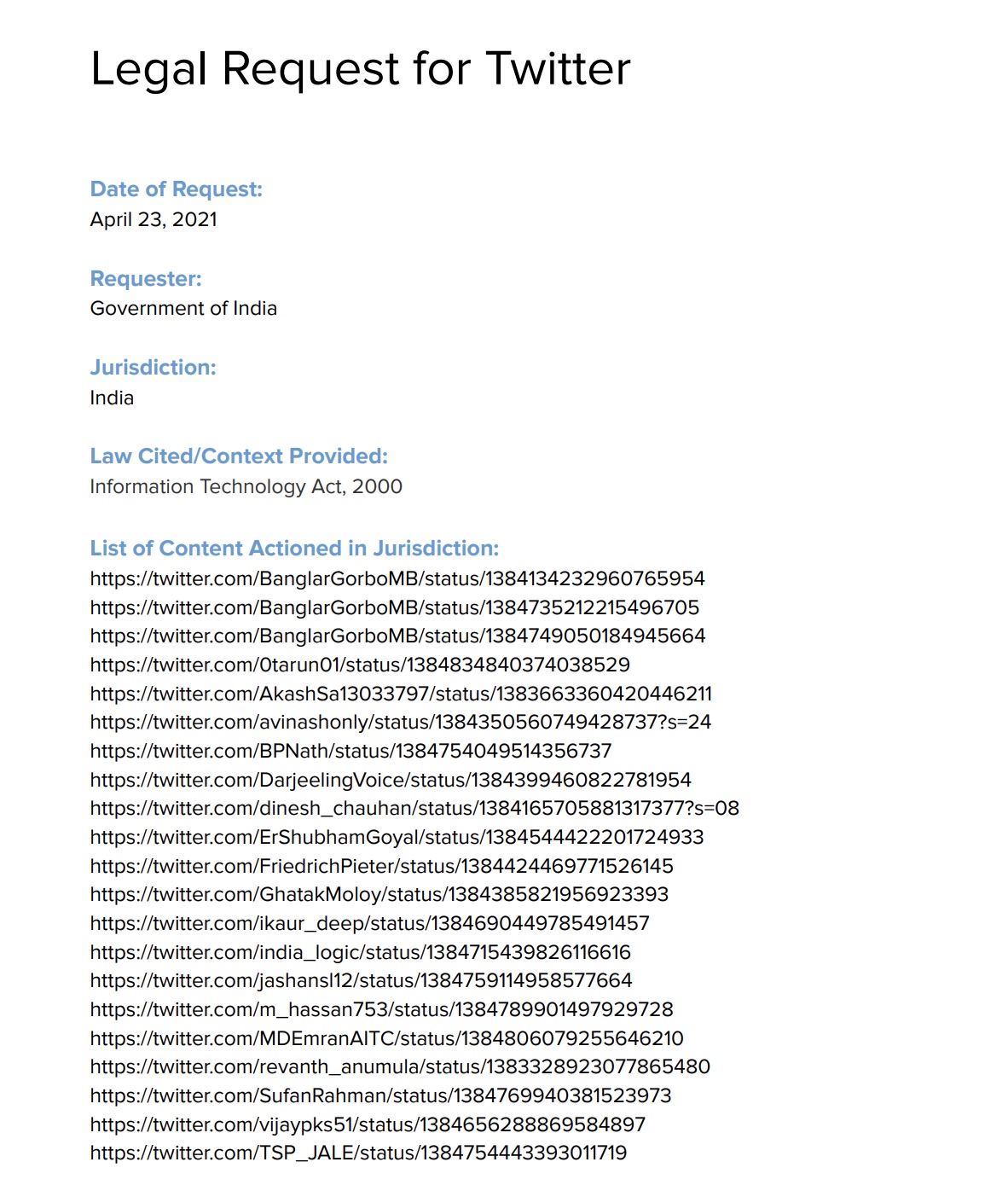
New Delhi made an emergency order to Twitter to censor over 50 tweets in the country, Twitter disclosed on Lumen database, a Harvard University project. The social network has complied with the request, and withheld those tweets from users in India.

TechCrunch has learned that Twitter is not the only platform affected by the new order. Facebook didn’t immediately respond to a request for comment. (Credit where it’s due: Twitter is one of the handful of companies that timely discloses takedown actions and also shares who made those requests.)

The world’s second largest nation — which has also previously ordered Twitter to block some tweets and accounts critical of its policies and threatened jail time to employees in the event of non-compliance — comes as the country reports a record of over 330,000 new Covid cases a day, the worst by any country. Multiple news reports, doctors, and academicians say that even these Covid figures, as alarmingly high as they are, are underreported.

Amid an unprecedented collapse of the nation’s health infrastructure, Twitter has become a rare beam of hope in what it describes as one of its “priority markets” as people crowdsource data to help one another find medicines and availability of beds and oxygen supplies.

A copy of one of Indian government’s orders disclosed by Twitter. (Lumen database)

Policy-focused Indian news outlet Medianama, which first reported on New Delhi’s new order Friday, said among those whose tweets have been censored in India include high profile public figures such as Revanth Reddy (a Member of Parliament), Moloy Ghatak (a minister in West Bengal), Vineet Kumar Singh (actor) filmmakers Vinod Kapri and Avinash Das.

In a statement, a Twitter spokesperson told TechCrunch, “When we receive a valid legal request, we review it under both the Twitter Rules and local law. If the content violates Twitter’s Rules, the content will be removed from the service. If it is determined to be illegal in a particular jurisdiction, but not in violation of the Twitter Rules, we may withhold access to the content in India only. In all cases, we notify the account holder directly so they’re aware that we’ve received a legal order pertaining to the account.”

“We notify the user(s) by sending a message to the email address associated with the account(s), if available. Read more about our Legal request FAQs.  The legal requests that we receive are detailed in the bianual Twitter Transparency Report, and requests to withhold content are published on Lumen.”

India has become one of the key markets for several global technology giants as they look to accelerate their userbase growth and make long-term bets. But India, once the example of an ideal open market, has also proposed or enforced several rules in the country in recent years under Prime Minister Narendra Modi’s leadership that in some ways arguably makes it difficult for American firms to keep expanding in the South Asian market without compromising on some of the values that users in their home market take for granted.