What to expect from Google’s all-virtual I/O

While Apple, Microsoft and the like were scrambling to bring their respective developer conferences online, Google made the executive design to just scrap I/O outright last year. It was a bit of an odd one, but the show went on through news-related blog posts.

While we’re going to have to wait another year to darken the doors of Mountain View’s Shoreline Amphitheater, the company has opted to go virtual for the 2021 version of the show. Understandably so. Google apparently has a lot up its sleeves this time.

Last month, Alphabet CEO Sundar Pichai teased some big news on the tech giant’s investor call, noting, “Our product releases are returning to a regular cadence. Particularly excited that our developer event — Google I/O — is back this year, all virtual, and free for everyone on May 18th-20th. We’ll have significant product updates and announcements, and I invite you all to tune in.”

From the sound of it, next week’s event will find Google returning to form following what was a rough year for just about everyone. So, what can we expect from the developer-focused event?

Forest Row, East Sussex, UK – July 30th 2013: Android figure shot in home studio on white. Image Credits: juniorbeep / Getty Images

Android 12 is the biggie, of course. From a software development standpoint, it’s a lynchpin to Google’s ecosystem, and for good reason has pretty much always taken centerstage at the event.

The developer version of Google’s mobile operating system has been kicking for a while now, but it has offered surprisingly little insight into what features might be coming. That’s either because it’s going to be a relatively minor upgrade as far as these things go or because the company it choosing to leave something to the imagination ahead of an official unveiling.

What we do know so far is that the operating system is getting a design upgrade. Beyond that, however, there are still a lot of question marks.

Google Assistant is likely to get some serious stage time, as well, coupled with some updates to the company’s ever-growing Home/Nest offerings. Whether that will mean, say, new smart displays on Nest speakers is uncertain. Keep in mind, hardware is anything but a given. The big Pixel event, after all, generally comes in the fall. That said, June is an ideal mid-marker during the year to refresh some other lines.

Google Pixel buds

Image Credits: Google

The likeliest candidate for new hardware (if there is any) is a new version of the company’s fully wireless earbuds — which the company has accidentally leaked out once or twice. The Pixel Buds A are said to sport faster pairing, and if their name is any indication, will be a budget entry.

Speaking of which… earlier this year, Google made the rather unorthodox announcement confirming that the Pixel 5a 5G is on the way. Denying rumors that have been swirling around the Pixel line generally, the company told TechCrunch in a statement, “Pixel 5a 5G is not cancelled. It will be available later this year in the U.S. and Japan and announced in line with when last year’s a-series phone was introduced.” Given that the 4a arrived in August, we could well be jumping the gun here. Taken as a broader summer time frame, however, it’s not entirely out of the realm of possibility here.

NEW YORK, NY – SEPTEMBER 13: Michael Kors and Google Celebrate new MICHAEL KORS ACCESS Smartwatches at ArtBeam on September 13, 2017 in New York City. (Photo by Dimitrios Kambouris/Getty Images for Michael Kors)

Wear OS has felt like an also-ran basically for forever. Rebrands, revamps and endless hardware partners have done little to change that fact. But keep in mind, this is going to be Google’s first major event since closing the Fitbit acquisition, so it seems like a no-brainer that the company’s going to want to come on strong with its wearable/fitness play. And hey, just this week, rumor broke that Samsung might be embracing the operating system after years of customizing Tizen.

Things kick off Tuesday morning May 18 at 10 a.m. PT, 1 p.m. ET with a big keynote.

Stripe acquires Bouncer, will integrate its card authentication into the Radar fraud detection tool

On the heels of a $600 million fundraise earlier this year, payments giant Stripe has been on an acquisition march to continue building out its business. In the latest development, the company has acquired Bouncer, a startup based in Oakland that has built a platform to automatically run card authentications and detect fraud in card-based online transactions. Its technology is tailored for mobile transactions and includes a flow to help users authenticate themselves if they are mistakenly flagged, to come back into an app legitimately (hence the name).

Terms of the deal are not being disclosed, but Stripe is acquiring both Bouncer’s technology and the team, which will be integrated into Stripe Radar. Started in 2018, Radar is Stripe’s AI-based anti-fraud technology toolset, and most of the tech — which is focused around preventing fraudulent transactions on the Stripe platform — has been built in-house up to now. Stripe says that Radar already prevents “hundreds of millions of dollars of fraud for businesses” each year.

“Bouncer is a great tool for modern internet businesses. It allows them to quickly identify stolen cards, while also ensuring legitimate customers can transact without being blocked,” said Simon Arscott, business lead for Stripe Radar, in a statement. “We’re thrilled to welcome the Bouncer team, and their years of experience building payment authentication software for businesses, to Stripe and to enable their technology for Radar users. With the addition of advanced card scanning capabilities, Stripe Radar will be able block more fraud and further increase revenue for millions of businesses around the world who rely on Stripe.”

The deal comes a couple of weeks after Stripe announced the acquisition of TaxJar to bring cloud-based sales tax calculating tools into its payments platform.

Like Stripe itself, Bouncer was incubated at Y Combinator, in its case as part of its Summer 2019 cohort. In addition to YC, it had raised funding from Commerce Ventures and the Pioneer Fund, but had never disclosed how much it had raised in total.

Not to be confused with the Polish marketing technology startup Bouncer, which provides bulk email verification, Oakland Bouncer was co-founded by Will Megson (CEO) and Sam King (chief scientist), who between them have an interesting pedigree when it comes to identity verification, from academia to working at fast-scaling companies in categories that have been some of the biggest adopters of verification technology.

Both previously worked for years at on-demand transportation service Lyft in fraud, identity and payment management. Before that, Megson was at Groupon; and King, in addition to holding a position as an associate professor of computer science at UC Davis, worked at Twitter on account security, founding the fake accounts team.

Groupon is among the customers that Bouncer currently works with, alongside OfferUp, ibotta and Dealerware. Bouncer will keep its current service and customers up post-deal.

Radar is currently sold in a number of tiers, ranging from free to 6p per screened transaction, depending on how it is being used (there is a more basic machine learning tier, and an enhanced tier for fraud teams, and the price varies also depending on whether customers are using Stripe’s standard pricing fees or something else). Stripe also offers a chargeback protection service priced at 0.4% per transaction, as well as analytics tools for Radar customers to get an overview of what is going on.

Stripe says that Radar has blocked more than $1 billion in fraudulent transactions since it was launched.

Bouncer is also currently priced at different tiers, ranging from free to $.15/scan for its basic solution, or a custom price for its more tailored services.

Integrating Bouncer’s card scanning and risk technology into the Radar stack will both sweeten the deal for people to buy those services from Stripe, but also make the tools more effective.

As Stripe describes it, when Radar flags a transaction, Bouncer’s card screening and verification technology will kick in as a “dynamic intervention” to confirm whether or not a customer had a legitimate card at the time of the transaction. This is done to help reduce false positives, which are more frequent in high-risk transactions (such as those for big-ticket items, or if a person has been making several transactions in quick succession, or other payment activity that just comes up as unusual in systems).

We’ve been in a wave of new authentication technology that includes things like biometrics and other innovations, but Bouncer takes an approach that is less high-tech at the point of ingestion — needing only a phone’s camera and the card that the customer is using. When a transaction is flagged up and sent to Bouncer for verification, Bouncer works by requesting a picture of the payment card (which can be based on any payment card type and can be a low-light picture).

It then runs that through its PCI- and GDPR-compliant system to see if it’s stolen or real. If it’s real, the transaction continues; stolen and the transaction is cancelled. The whole process can take less than a second (not including the time it takes you to take a picture, of course).

For Bouncer, the idea is that Stripe’s machine learning engine will in turn help Bouncer become more effective.

“I’m excited that we’ll be able to scale our advanced card-verification technology across the Stripe network to help businesses grow their revenue while further reducing fraud behind the scenes,” said Will Megson, CEO of Bouncer, in a statement. “The same signals that Radar learns from will make Bouncer more effective, and Bouncer will, in turn, make Radar more effective. We couldn’t be more excited to join the Radar team.”

Stripe has made a number of acquisitions over the years to bring in key pieces of technology, and in one case — when it acquired PayStack in Lagos (another YC alum) — to help Stripe enter and serve merchants in Africa and more emerging markets overall.

At least two of these have been made in aid of bringing on technologists and technology to build out its compliance and authentication tools. In 2016 Stripe quietly acquired Teapot, a Silicon Valley startup that had been working on APIs for identity verification, trust, credit and other tools needed in financial transactions. Its co-founders spent some years at the company before moving on to other things.

In 2019, Stripe acquired a startup out of Ireland called Touchtech to bring in technology to prepare for Strong Customer Authentication regulations in Europe.

The need for better, more sophisticated tools to ensure online transactions are legit is not going anywhere fast. Malicious hacking — and the consequences that has for obtaining personal data that can be used in consumer fraud — continues to be a persistent threat. And in the meantime, e-commerce continues to become an ever-more mainstream activity, widening the pool of consumers and the chances of things going wrong.

5 ways to raise your startup’s PR game

Adam LaGreca
Contributor

Adam LaGreca is the founder of 10KMedia and previously led communications for DigitalOcean, Datadog and Gremlin.

There’s a lot of noise out there. The ability to effectively communicate can make or break your launch. It will play a role in determining who wins a new space — you or a competitor.

Most people get that. I get emails every week from companies coming out of stealth mode, wanting to make a splash. Or from a Series B company that’s been around for a while and hopes to improve their branding/messaging/positioning so that a new upstart doesn’t eat their lunch.

You have to stop thinking that what you are up to is interesting.

How do you make a splash? How do you stay relevant?

Worth noting is that my area of expertise is in the DevOps space and that slant may crop up occasionally. But these five specific tips should be applicable to virtually any startup.

Leverage your founders

This is especially important if you are a small startup that not many people know about. Journalists don’t want to hear opinions from your head of marketing or product — they want to hear from the founders. What problems are they solving? What unique opinions do they have about the market? These are insights that mean the most coming from the people that started the company. So if you don’t have at least one founder that can dedicate time to being the face, then PR is going to be an uphill battle.

That doesn’t mean there isn’t plenty to do to support these efforts. Create a list of all the journalists that have written about your competitors. Read those articles. How can your founder add value to these conversations? Where should you be contributing thought leadership? What are the most interesting perspectives you can offer to those audiences?

This is legwork and research you can do before looping founders into the conversation. Getting your PR going can be like trying to push a broken-down car up the road: If the founders see you exerting effort to get things moving on your own, they’re more likely to get beside you and help.

Here’s an example: It may be unreasonable to ask a founder to sit down and write a 1,000-word thought leadership piece by the end of the week, but they very likely have 20 minutes to chat, especially if you make it clear that the contents of the conversation will make for great thought leadership pieces, social media posts, etc.

The flow looks like:

  1. You come up with topic ideas based on research.
  2. The founder picks their favorite.
  3. You and the founder schedule a 20-minute chat to get their thoughts on paper.
  4. You write up the content based on those thoughts.

Facebook loses last-ditch attempt to derail DPC decision on its EU-US data flows

Facebook has failed in its bid to prevent its lead EU data protection regulator from pushing ahead with a decision on whether to order suspension of its EU-U.S. data flows.

The Irish High Court has just issued a ruling dismissing the company’s challenge to the Irish Data Protection Commission’s (DPC) procedures.

The case has huge potential operational significance for Facebook, which may be forced to store European users’ data locally if it’s ordered to stop taking their information to the U.S. for processing.

Last September the Irish data watchdog made a preliminary order warning Facebook it may have to suspend EU-U.S. data flows. Facebook responded by filing for a judicial review and obtaining a stay on the DPC’s procedure. That block is now being unblocked.

We understand the involved parties have been given a few days to read the High Court judgement ahead of another hearing on Thursday — when the court is expected to formally lift Facebook’s stay on the DPC’s investigation (and settle the matter of case costs).

The DPC declined to comment on today’s ruling in any detail — or on the timeline for making a decision on Facebook’s EU-U.S. data flows — but deputy commissioner Graham Doyle told us it “welcomes today’s judgment”.

Its preliminary suspension order last fall followed a landmark judgement by Europe’s top court in the summer — when the CJEU struck down a flagship transatlantic agreement on data flows, on the grounds that U.S. mass surveillance is incompatible with the EU’s data protection regime.

The fall-out from the CJEU’s invalidation of Privacy Shield (as well as an earlier ruling striking down its predecessor Safe Harbor) has been ongoing for years — as companies that rely on shifting EU users’ data to the U.S. for processing have had to scramble to find valid legal alternatives.

While the CJEU did not outright ban data transfers out of the EU, it made it crystal clear that data protection agencies must step in and suspend international data flows if they suspect EU data is at risk. And EU to U.S. data flows were signalled as at clear risk given the court simultaneously struck down Privacy Shield.

The problem for some businesses is therefore that there may simply not be a valid legal alternative. And that’s where things look particularly sticky for Facebook, since its service falls under NSA surveillance via Section 702 of the FISA (which is used to authorize mass surveillance programs like Prism).

Facebook lost 100% before Irish High Court: "I refuse all of the reliefs sought by [Facebook Ireland] and dismiss the claims made by it in the proceedings"

?Judgment (Original) and first statement here: https://t.co/81C7pyCBTd

— Max Schrems ?? (@maxschrems) May 14, 2021

So what happens now for Facebook, following the Irish High Court ruling?

As ever in this complex legal saga — which has been going on in various forms since an original 2013 complaint made by European privacy campaigner Max Schrems — there’s still some track left to run.

After this unblocking the DPC will have two enquiries in train: Both the original one, related to Schrems’ complaint, and an own volition enquiry it decided to open last year — when it said it was pausing investigation of Schrems’ original complaint.

Schrems, via his privacy not-for-profit noyb, filed for his own judicial review of the DPC’s proceedings. And the DPC quickly agreed to settle — agreeing in January that it would “swiftly” finalize Schrems’ original complaint. So things were already moving.

The tl;dr of all that is this: The last of the bungs which have been used to delay regulatory action in Ireland over Facebook’s EU-U.S. data flows are finally being extracted — and the DPC must decide on the complaint.

Or, to put it another way, the clock is ticking for Facebook’s EU-U.S. data flows. So expect another wordy blog post from Nick Clegg very soon.

Schrems previously told TechCrunch he expects the DPC to issue a suspension order against Facebook within months — perhaps as soon as this summer (and failing that by fall).

In a statement reacting to the Court ruling today he reiterated that position, saying: “After eight years, the DPC is now required to stop Facebook’s EU-US data transfers, likely before summer. Now we simply have two procedures instead of one.”

When Ireland (finally) decides it won’t mark the end of the regulatory procedures, though.

A decision by the DPC on Facebook’s transfers would need to go to the other EU DPAs for review — and if there’s disagreement there (as seems highly likely, given what’s happened with draft DPC GDPR decisions) it will trigger a further delay (weeks to months) as the European Data Protection Board seeks consensus.

If a majority of EU DPAs can’t agree the Board may itself have to cast a deciding vote. So that could extend the timeline around any suspension order. But an end to the process is, at long last, in sight.

And, well, if a critical mass of domestic pressure is ever going to build for pro-privacy reform of U.S. surveillance laws now looks like a really good time…

“We now expect the DPC to issue a decision to stop Facebook’s data transfers before summer,” added Schrems. “This would require Facebook to store most data from Europe locally, to ensure that Facebook USA does not have access to European data. The other option would be for the US to change its surveillance laws.”

Facebook has been contacted for comment on the Irish High Court ruling.

Update: The company has now sent us this statement:

Today’s ruling was about the process the IDPC followed. The larger issue of how data can move around the world remains of significant importance to thousands of European and American businesses that connect customers, friends, family and employees across the Atlantic. Like other companies, we have followed European rules and rely on Standard Contractual Clauses, and appropriate data safeguards, to provide a global service and connect people, businesses and charities. We look forward to defending our compliance to the IDPC, as their preliminary decision could be damaging not only to Facebook, but also to users and other businesses.

China’s WeRide secures more funding, pushing valuation to $3.3 billion

Only four months after securing Series B fundraising of $310 million, Chinese autonomous driving company WeRide says it has achieved its Series C funding round that brings its post-money valuation to $3 billion.

This is first time the company has disclosed its value. The company did not share how much it has raised this round, only noting that it’s in the “hundreds of millions,” according to a statement released by the company. WeRide intends to use this funding round to invest in R&D and commercialization as it works towards the next-generation of Level 4 driving, a term that means a vehicle can drive without human intervention in some environments and conditions. The company is also using the funds to prepare to commercialize its technology.

WeRide has scored a slew of large investments over the past year, including its $200 million strategic round in December from Chinese bus maker Yutong. The speed and scale of these investments signals that the company is burning through money and hungry for more, and that investors are banking on China’s tech. Rival Momenta has also received large sums this year, exceeding its $1 billion in valuation with recent investments of $500 million and total funding of more than $700 million.

“WeRide Master Platform (WMP), our core autonomous driving technology solution has helped to accelerate the company’s development,” Tony Han, founder and CEO of WeRide, said in a statement. “This drives the successful operation of our Robotaxi service in Guangzhou since 2019 and the introduction of the WeRide driverless Mini Robobus, a completely new product category to the autonomous industry.”

WeRide’s robotaxi pilot in Guangzhou began in 2019, but it began conducting test drives in the city’s Central Business District in January. Not long after, the company’s driverless Mini Robobus began road testing in Guangzhou and Nanjing. WeRide became the first autonomous driving company in China to secure an official license for online car-hailing operations in February, and in April, the California DMV issued WeRide a permit to test its driverless vehicles on public roads in San Jose, California.

Many investors participated in this most recent round, including IDG Capital, Homeric Capital, CoStone Capital, Cypress Star, Sky9 Capital and K3 Ventures, as well as existing investors CMC Capital Partners, Qiming Venture Partners and Alpview Capital.

Elon Musk, Technoking of Tesla, orders a halt to bitcoin car payments 

Tesla CEO and self-dubbed Technoking is back-peddling on the company’s stance about bitcoin and has suspended purchases of its electric vehicles with the cryptocurrency.

The change of stance, which was delivered via tweet, comes just weeks after Tesla CFO and dubbed “Master of Coin” Zach Kirkhorn said the company believes in the longevity of bitcoin, despite its volatility. The tweet from Musk sent the price of bitcoin down more than 4% (and falling). The price of bitcoin is down more than 7% for the day, although some of that decrease occurred prior to Musk’s tweet:

Tesla has suspended vehicle purchases using Bitcoin. We are concerned about rapidly increasing use of fossil fuels for Bitcoin mining and transactions, especially coal, which has the worst emissions of any fuel.

Cryptocurrency is a good idea on many levels and we believe it has a promising future, but this cannot come at a great cost to the environment.

Tesla will not be selling any Bitcoin and we intend to use it for transactions as soon as mining transitions to more sustainable energy. We are also looking at other cryptocurrencies that use <1% of Bitcoin’s energy/transaction.

Tesla & Bitcoin pic.twitter.com/YSswJmVZhP

— Elon Musk (@elonmusk) May 12, 2021

Tesla invested $1.5 billion in bitcoin this quarter and then trimmed its position by 10%, Kirkhorn said during the company’s quarterly earnings call in April. That sale made a $101 million “positive impact” to the company’s profitability in the first quarter.

Kirkhorn said Tesla turned to bitcoin as a place to store cash and still access it immediately, all while providing a better return on investment than more traditional central bank-backed safe havens. Of course, the higher yields provided by the volatile digital currency comes with higher risk.

If you’re getting whiplash from this announcement, you’re not alone. Tesla originally announced in March that it would accept bitcoin as a form of payment in the United States. But Elon Musk, the Technoking of Tesla, is known for drastically affecting the crypto market with just a mere tweeting of his thumbs. Every time the man tweets an image of a Shiba Inu, the joke coin called Dogecoin sores in the stocks.

In anticipation for Musk’s appearance on Saturday Night Live, many anticipated that the coin would reach $1, but when the “Dogefather” admitted (as a joke) to the currency being a hustle, the price of the coin crashed 30%.

Energy sucker

When it first became public that Tesla had purchased $1.5 billion in Bitcoin, investors, analysts and money managers at some of the country’s largest banks noted that it presented risks for the company. Others noted it could damage its reputation.

Bitcoin functions using what is known as a “Proof of Work” consensus, which means the network relies on mining to continue operating. The bulk of bitcoin mining is conducted in Russia and China. Until the energy grid decarbonizes, as TechCrunch noted back in February, mining bitcoin will remain a dirty business, though plenty of mining operations today do use renewable energies, in part. One investor told TechCrunch that the cost per transaction from an energy intensity standpoint has only gotten more intense.

Musk hinted that other cryptocurrencies are on the table. Those will likely be ones that use “Proof of Stake” consensus mechanisms, which networks like Ethereum have committed to transition to due to their energy efficiencies.

Vitalik Buterin donates $1 billion worth of ‘meme coins’ to India COVID Relief Fund

Vitalik Buterin, the creator of Ethereum, on Wednesday donated Ethereum and “meme coins” worth $1.5 billion in one of the largest-ever individual philanthropy efforts.

Buterin transferred 500 ETH and over 50 trillion SHIB (Shiba Inu), a meme coin, worth around $1.14 billion at the time of transaction, to the India COVID-Crypto Relief Fund. The transaction sparked panic among some investors, contributing to over 35% drop in SHIB’s price in the past 24 hours.

The meme coin, which has courted retail investors in China and elsewhere following recent surges in the Dogecoin cryptocurrency, managed to garner billions (USD) worth of investment in recent days before today’s crash.

Buterin’s offloading of several dog-themed meme coins — which were sent to him without his consent in the first place — comes at a time when India is grappling with a surge in the coronavirus infections.

Sandeep Nailwal, who put together the Indian relief fund and co-founded crypto organization Polygon, said in a tweet that he won’t do anything that hurts “any community specially the retail community involved with SHIB.”

Buterin, who became the youngest crypto billionaire at the age of 27 earlier this month, also transferred Ethereum and Dogelon Mars (ELON) — another meme coin — worth $336 million to Methuselah Foundation, a nonprofit that supports efforts in tissue engineering and regenerative medicine therapies; and over 13,000 ETH to Givewell, a nonprofit organization that works to curate the best charities around the world. Buterin also donated to Gitcoin Community, MIRI and Charter Cities Institute.

$54M donation to Givewell here. Thank you @VitalikButerin ! https://t.co/OLXh3zVU4b

— Dustin Moskovitz (@moskov) May 12, 2021

India has been reporting over 350,000 daily infections and over 3,500 fatalities for the last two weeks. The second wave of the coronavirus has overwhelmed the South Asian nation’s healthcare system, leaving countless people to scramble for hospital beds, medical oxygen and other supplies.

A number of entrepreneurs including Balaji Srinivasan have donated to the India Crypto Relief Fund, which maintains a log of all the donations. Buterin himself had donated about $600,000 in ether and maker tokens to the fund last month.

If you’ve been fortunate enough to do well this year, consider joining me and @VitalikButerin by donating at the addresses below.

But if all you have is Twitter, help spread the word. For every RT, I’ll donate another $50 to fight COVID in India, up to $100k. #cryptovscovid https://t.co/eKlOlccelv

— balajis.com (@balajis) April 25, 2021

Scores of startup founders, investors and technology giants have stepped up to help India navigate the pandemic in recent weeks.

Daily Crunch: The early-stage tech talent crunch is real

To get a roundup of TechCrunch’s biggest and most important stories delivered to your inbox every day at 3 p.m. PDT, subscribe here.

By now everyone is familiar with the tech world’s talent crunch: Developers are scarce and expensive, while data scientists are maybe even scarcer and expensiver. Some folks I’ve spoken to think that rising acceptance of remote work may help reduce the supply-demand imbalance. Hell, every early-stage startup I’ve spoken to in weeks is remote-first. Many were born during COVID, but they all love the ability to hire anywhere in the world.

But if a more distributed workforce is not enough to lower the pain that many companies feel when it comes to attracting and then retaining technical talent, good news could be coming. The sibling product philosophies of no-code and low-code are not only attracting lots of venture attention, public companies that dabble with either are posting interesting results.

Perhaps the solution to needing lots more code is no code at all? — Alex

TechCrunch Top 3

Today’s TechCrunch Top 3 come from the three phases of startup life: Early stage, when startups are still getting their product and market in order. Late stage, when they are prepping for an eventual exit. And the exit stage, when a former startup is looking to spread its wings and fly the private markets.

  • The anti-venture movement is global: Today Mary Ann reported that Divibank, a Brazilian startup offering revenue-based financing to other startups, has raised $3.6 million in a seed round led by Better Tomorrow Ventures (BTV). TechCrunch thinks it could build something akin to the Clearbanc of Latin America.
  • London’s Lyst looks to list: When you raise a pre-IPO round, you’d best be heading toward the public markets. With fashion e-commerce app Lyst saying that its new $85 million funding round is pre-IPO money, well, we have big expectations.
  • Bird hopes to take flight: Bird is going public via a SPAC. TechCrunch has the big news here, and a more dorky financial analysis here. I helped write the latter. The short version is that a business-model shakeup is helping the scooter unicorn lose less money over time.

Startups and VC

Scootin’ into startup mode, TechCrunch covered a huge number of funding rounds in the last 24 hours, so what follows is a sampling of the most interesting. Enjoy!

For unicorns, how much does the route to going public really matter?

Natasha Mascarenhas and Alex Wilhelm recently hosted Yext CFO Steve Cakebread and Latch CFO Garth Mitchell on an episode of TechCrunch’s Equity podcast.

In their discussion, “The morality and efficacy of going public earlier,” the group discussed the myriad paths startups are taking to go public and assessed the pros and cons of each method, and, importantly, the potential impacts on employees and business operations.

“I think when money’s chasing money, you don’t want to be the last guy holding the money. You want to be the chase,” said Cakebread.

Since Latch is currently going public via a SPAC and Yext followed a traditional IPO route a few years ago, the discussion is heavily weighted toward experience, not opinion.

(Extra Crunch is our membership program, which helps founders and startup teams get ahead. You can sign up here.)

Big Tech Inc.

Turning to tech’s largest companies today, we have three things for you to chew on:

First, Waymo is losing key talent in a very public fashion. Kirsten reports that “Waymo’s chief financial officer Ger Dwyer and its head of automotive partnerships and corporate development Adam Frost,” both long-time execs, are “leaving this month.” The exits come after the company’s former CEO also departed.

I guess we’ll have to drive ourselves for a bit longer.

Next up is a story that came out yesterday, but we missed in the newsletter. But after burning up the TechCrunch analytics all day, I decided to make sure that you saw it. With the simply excellent headline Prime today, gone tomorrow: Chinese products get pulled from Amazon, Rita writes that several Chinese retailers have evaporated from the online megastore. “In total, the suspended accounts contribute over a billion dollars in gross merchandise value (GMV) to Amazon,” she reported.

Changes afoot at Amazon? We’ll have to see, but the news is driving mega-attention from, we presume, confused shoppers.

Finally, looping back to no-code for a hot second, Salesforce is only adding to its own efforts. It’s everywhere!

Bessemer’s Kent Bennett and Toast’s Aman Narang to discuss how to become a unicorn on ECL

Toast has a reported valuation over $5 billion and has raised more than $900 million since launch. The restaurant POS service has clearly been on a rapid growth trajectory, but how has the company navigated the market during the pandemic, which has pushed and pulled the restaurant industry unlike ever before?

On an upcoming episode of Extra Crunch Live (May 26 at 3pm ET), we’ll find out. We’re sitting down with president and co-founder of Toast, Aman Narang, and one of the company’s investors, Bessemer Venture Partners’ Kent Bennett.

Bennett is a partner out of the Cambridge office, focusing on consumer products and services as well as consumer-facing software. Before venture, Bennett was a creative executive for an entertainment production company called Licht Entertainment.

His portfolio includes Bevi, Blue Apron, Xtime and, of course, Toast.

Narang spent seven years at Oracle, then Endeca, working on the development of the company’s business intelligence platform and mobile commerce platform.

He co-founded Toast in 2011 and has been growing the company ever since, adding new products and features to the restaurant POS system.

On Extra Crunch Live, we’ll sit down with Narang and Bennett to learn about how they came together for the company’s Series B deal, which Bessemer led. We’ll also talk about why Bennett wanted to bet on Toast, how they’ve worked together since and how they overcome challenges and disagreements. If we’re lucky, we may even get a peek at Toast’s original Series B pitch deck.

From there, we’ll head into the Extra Crunch Live Pitch-off. Members of the audience can raise their hand to pitch live on the show, and Bennett and Narang will offer their feedback. It’s always a good time, but the only way to participate is to show up live. Register here for free!

Extra Crunch Live is a free event and accessible to everyone, but only Extra Crunch members get access to the entire library of ECL episodes, all of which are packed with insights on how to raise and run a successful venture-backed company.

Register to hang out with myself, Narang and Bennett on Wednesday, May 26 at 3pm ET/noon PT.

Gillmor Gang: When Doves Cry

Usually we wait a few days until a show has settled. While we stall, our producer and director Tina Chase Gillmor scours the recording for short clips that give a sense of the flavor and tenor of the conversation. This show, recorded a little more than 2 weeks ago, went deep on politics, government, anything but Trump, and eventually a pivot to the tech world and how it was grappling with the possible return to the office. I asked Brent Leary what he thought about the likelihood of working from anywhere, and discovered he was multitasking to the director’s cut of a famous Prince video.

Brian Solis had sent him this re-edit of George Harrison’s induction into the Rock and Roll Hall of Fame as a solo artist, featuring a wonderful version of his classic White Album track While My Guitar Gently Weeps. An all-star cast of friends of the late Beatle included Tom Petty, Steve Winwood, Jeff Lynne, and a surprise guitar solo by Prince that ended with him tossing his guitar to the heavens in triumph. While the new video doesn’t reveal what happened to the instrument, it does extend our views of Prince and particularly his interactions with the other players. Re-released 17 years later, it does the impossible, preserving the magic of the event while somehow extending the mechanics of how Prince captivated not just his audience but his peers.

It also reminds me of what magic we’ve come to expect from the technology industry and its band of stars. The success of the vaccines came not just from the miracle of new science and desperate nature of humanity’s need for rescue from the pandemic, but also from the growing hope that government and even politics can work. The jury has been and will continue to be out on how quickly we can recover, but there’s a question of recovering what. Is it a binary choice of office or mobile or something in between? Already some tech companies have moved toward the hybrid approach, where the office would reopen and workers would return for some but not all of the week.

As a parent of two girls, I’ve watched with fascination as they grew up with technology as a given not the revolution that it is. Our youngest has for many years structured her communication with us and her peers as a text-based, emotional video channel, and occasional authorization for face-to-face interaction. The pandemic made this mandatory, but as we get closer to a safer environment, the skills we’ve been mandated to learn are only going to solidify. Texting can be replied to in a while or treated as just information to be absorbed. Voice calls are optional, Facetime usually accepted as an opportunity to catch up but certainly not a daily proposition. Sneaking a peek at her Instagram feed is good for calming nerves but abstract in terms of any real details. That’s as it should be; I actually need more emotional buttressing than she does.

Prince was like that when he appeared early in his career, conversant in the history of his craft and matter-of-fact in his approach to the technology innovations unleashed by George Martin and the Beatles with Revolver and transformationally Sgt.Pepper. Prince took that studio process, the multitracking inventions of Stevie Wonder, the extra-worldly funk explorations of Hendrix, the cool mastery of Miles — and did it all. The record business pushed him, he pushed back, changed his name to a symbol, and eventually won control of his recordings. Nothing compares 2 U, he wrote.

The music business, like the movie and TV business, has changed everything about how we consume their products. Musicians have been homebound for more than a year with no way of touring to replace what used to be the major part of their income. Some are turning to the crazy world of packaging their work as crypto objects, the so-called non fungible tokens. Joke projects like Dogecoin have become intertwined with Saturday Night Live as Elon Musk plays a character in Weekend Update avoiding persistent questions about just what is going on here. As one Tweeter noted, they made a good choice watching Dogecoin dropping like a stone as funnier than the comedy broadcast.

Sooner or later the dust will settle and we can choose some Sneak Peeks to nudge the way forward. As much as we buy the idea that we need to return to some kind of normal, the sneaking suspicion is that we deserve some relief from the rigged deck that is our politics, our culture, devoid of empathy and based on power as the ultimate rationale for who can run the show. Like the filters in Zoom that let us change our backgrounds to where we choose to be coming from, it’s a reasonable choice to define our new office as a blend of the best of our new worlds.

from the Gillmor Gang Newsletter

__________________

The Gillmor Gang — Frank Radice, Michael Markman, Keith Teare, Denis Pombriant, Brent Leary and Steve Gillmor. Recorded live Friday, April 30, 2021.

Produced and directed by Tina Chase Gillmor @tinagillmor

@fradice, @mickeleh, @denispombriant, @kteare, @brentleary, @stevegillmor, @gillmorgang

Subscribe to the new Gillmor Gang Newsletter and join the backchannel here on Telegram.

The Gillmor Gang on Facebook … and here’s our sister show G3 on Facebook.

AWS releases tool to open source that turns on-prem software into SaaS

AWS announced today that it’s releasing a tool called AWS SaaS Boost as open source distributed under the Apache 2.0 license. The tool, which was first announced at the AWS re:Invent conference last year, is designed to help companies transform their on-prem software into cloud-based software as a service.

In the charter for the software, the company describes its mission this way: “Our mission is to create a community-driven suite of extensible building blocks for Software-as-a-Service (SaaS) builders. Our goal is to foster an open environment for developing and sharing reusable code that accelerates the ability to deliver and operate multi-tenant SaaS solutions on AWS.”

What it effectively does is provide the tools to turn the application into one that lets you sign up users and let them use the app in a multi-tenant cloud context. Even though it’s open source, it is designed to get you to move your application into the AWS system where you can access a number of AWS services such as AWS CloudFormation, AWS Identity and Access Management (IAM), Amazon Route 53, Elastic Load Balancing, AWS Lambda (Amazon’s serverless tool), and Amazon Elastic Container Service (Amazon’s Kubernetes Service). Although presumably you could use alternative services, if you were so inclined.

By making it open source, it gives companies that would need this kind of service access to the source code, giving them a comfort level and an ability to contribute to the project to expand upon the base product and give back to the community. That makes it a win for users who get flexibility and the benefit of a community behind the tool, and a win for AWS, which gets that community working on the tool to improve and enhance it over time.

“Our objective with AWS SaaS Boost is to get great quality software based on years of experience in the hands of as many developers and companies as possible. Because SaaS Boost is open source software, anyone can help improve it. Through a community of builders, our hope is to develop features faster, integrate with a wide range of SaaS software, and to provide a high quality solution for our customers regardless of company size or location,” Amazon’s Adrian De Luca wrote in a blog post announcing the intent to open source SaaS Boost.

This announcement comes just a couple of weeks after the company open-sourced its Deep Racer device software, which runs its machine-learning fueled mini race cars. That said, Amazon has had a complex relationship with the open source in the past couple of years, where companies like MongoDB, Elastic and CockroachDB have altered their open-source licenses to prevent Amazon from making their own hosted versions of these software packages.

GasBuddy tops the App Store for the first time due to Colonial Pipeline attack

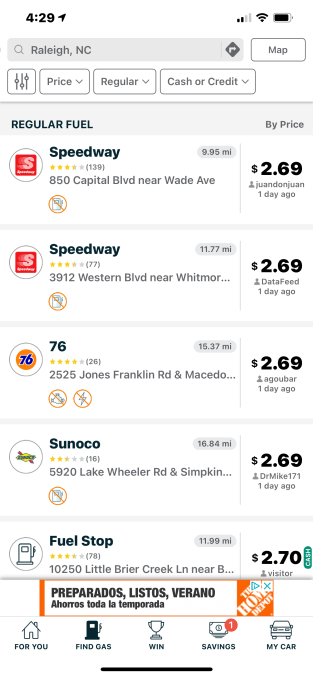
The GasBuddy mobile app, which typically helps consumers find the cheapest gas nearby, has now become the No. 1 app on the U.S. App Store for the first time ever, due to the fuel shortages in the U.S. that followed the cyberattack on the Colonial Pipeline. Americans, fearful that gas would become unavailable, began panic-buying in ways that haven’t been seen since the great toilet paper outage of 2020. As a result, thousands of gas stations ran out of fuel entirely. This dramatic situation has greatly benefitted the GasBuddy app, which includes a crowdsourced feature that helps users locate which local stations still have gas for sale.

As of Wednesday afternoon, GasBuddy says the effects of the Colonial Pipeline shutdown are being felt across 11 U.S. states, largely in the Southeast and Washington, D.C. North Carolina had the highest number of gas stations with fuel outages, with 65% of stations reportedly out of gas as of 2:48 p.m. ET on Wednesday. Kentucky has the lowest at only 2%. Because this data is self-reported by GasBuddy users, it may not represent the most current information, we should note.

Image Credits: GasBuddy app screenshot

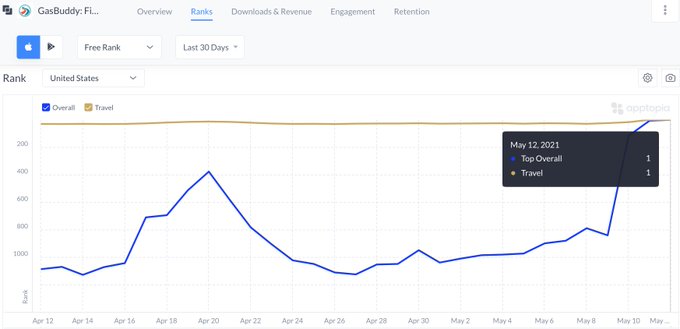
During the week, consumers have been turning to GasBuddy to help them find where they can fill up. Yesterday, the app hit No. 1 in the “Travel” category on the App Store, while it steadily climbed its way up the App Store’s Top Overall charts.

This afternoon, GasBuddy became both the No.1 app in the non-games category as well as the highest-ranked app Overall across the U.S. App Store.

According to data from app store intelligence firm Apptopia, GasBuddy yesterday saw 15,203 new downloads — a 59% increase from its average daily downloads, which were 9,560 for the past 30 days. However, third-party data isn’t always accurate for sudden shots in rank — it catches up a few days after the fact.

Image Credits: Apptopia

Reached for comment, GasBuddy says its downloads were actually far higher than the third-party estimates. Across all platforms, including both iOS and Google Play, it saw 20x more downloads yesterday compared with an average day in 2021. The company told TechCrunch it counted 313,001 total downloads yesterday, compared with average daily downloads for the previous 30 days of 15,339.

Broken down by platform, GasBuddy says it saw 104,735 downloads on Android and 208,266 downloads on iOS on Tuesday, May 11, 2021.

Apptopia also noted that GasBuddy hadn’t been the No. 1 app on the App Store in all the time it’s been recording app store rankings, which goes back to January 1, 2015. However, it noted the app itself launched back in 2010, making it possible (though not likely) that the app had reached No. 1 at some point.

GasBuddy confirmed that’s not the case. Today is the first time it has ever topped the App Store, though it got close once before when it reached No. 2 behind a walkie-talkie app during Hurricane Irma in September 2017.

Image Credits: App Store screenshot on Wed., May 12, 2021

Consumers can continue to track statewide fuel outages here on GasBuddy’s website as well as where highest prices are being found. In the app, they can report whether gas stations have gas or diesel, as well as current prices.

The Colonial Pipeline, which runs 5,500 miles from the Gulf to the Northeast, shut down on Friday due to a ransomware attack from a criminal hacking network known as DarkSide, which is suspected to be based in Russia or Eastern Europe. The pipeline delivers about 45% of fuel used by the Eastern Seaboard. Reports of the shutdown sent Americans to stock up on gas, worsening the situation further. The U.S. Energy Secretary Jennifer Granholm said the Colonial Pipeline intends to restore operations by the end of the week.

Waymo to lose its CFO and head of automotive partnerships

Waymo’s chief financial officer Ger Dwyer and its head of automotive partnerships and corporate development Adam Frost — two longtime executives at the autonomous vehicle company — are leaving this month, departures that comes amid some executive shuffling following CEO John Krafcik’s exit earlier this year.

Dwyer and Frost’s departure was shared internally this week, according to multiple sources. Waymo has confirmed to TechCrunch that Dwyer and Frost are leaving.

“We’re grateful to Ger and Adam for all they’ve done for Waymo and wish them all the best,” a spokesperson said in an emailed statement. “An executive search is underway for a new CFO to lead us into our next chapter as we continue to build, deploy and commercialize the Waymo Driver.”

Dwyer, who reported directly to parent company Alphabet’s executive leadership finance team, is among several executives who have left the company in the past five months. Krafcik announced in April that he was stepping down as CEO. Chief Safety Officer Deborah Hersman left in December and Tim Willis, who was head of manufacturing and global supply and general manager of Waymo’s Laser Bear lidar business, departed in February. Sherry House, who had been at Waymo since 2017 and was most recently treasurer and head of investor relations, left the company in April. She is now CFO at Lucid Motors.

Still, some of the critical leaders, and the people directly below them, have remained. Tekedra Mawakana, who was COO, and Dmitri Dolgov, the CTO, are now co-CEOs of Waymo and appear to have the support of Alphabet CEO Sundar Pichai, according to brief remarks he made during the company’s first-quarter earnings call. Department heads directly below Mawakana and Dolgov are still at Waymo with a few exceptions, according to LinkedIn profiles. In March, both David Twohig, who was director of Future Automotive at Waymo, and Qi Hommes, who was once head of system safety, left. Hommes is now director of system safety engineering and analysis at Zoox, according to LinkedIn.

Dwyer’s departure also comes at a time when the demand for CFOs has rocketed alongside the continuous string of public offerings, including those done via mergers with special purpose acquisition companies. House’s move to Lucid Motors, which is going public via a merger with a SPAC, is one example.

Dwyer is a longtime Google employee, who started at the company in 2006. He made the leap in August 2016 over to Waymo, just a few months before the former Google self-driving project officially announced it had spun out to become a business under parent company Alphabet.

During his tenure, Dwyer oversaw the financial side of the business in a period of explosive growth that took the company from a few hundred employees to more than 2,000 today.

Frost, who headed up automotive partnerships, has also been an important figure at Waymo. He came to Google’s self-driving project in 2013 after nearly 17 years at Ford Motor Co., according to LinkedIn records. He was initially hired as a chief engineer and then rose through the ranks to chief automotive programs and partnerships officer and eventually chief automotive and corporate development officer. Waymo has locked in a number of what it has described as exclusive partnerships with automakers over the past several years, including Volvo, Stellantis (formerly FCA), as well as one with Renault and Nissan to research how commercial autonomous vehicles might work for passengers and packages in France and Japan.

Waymo also expanded its geographic footprint beyond California during both Dwyer and Frost’s stints. The company brought its autonomous vehicles into cities like Austin and Kirkland, Washington for testing and established operations in the Phoenix suburb of Chandler, where it now operates a ride-hailing service called Waymo One using driverless vehicles as well as those with safety operators behind the wheel.

Last year, Waymo completed its first external round of fundraising, which was initially $2.25 billion and later expanded to $3 billion. The $2.25 billion round was led by Silver Lake with investments from Canada Pension Plan Investment Board, Mubadala Investment Company, Magna, Andreessen Horowitz and AutoNation and its parent company Alphabet. The extended capital came from new investors, including those managed by T. Rowe Price, Perry Creek Capital, Fidelity Management and Research Company and others.

The external raise followed a flurry of activity that suggested Waymo was ramping up its commercial enterprise, including expanding its core fleet in Mountain View, Calif., the Phoenix area and into Texas. Waymo also began to move beyond its robotaxi testing and began piloting new business applications for its autonomous vehicle technology such as delivery and trucking and even a plan to start selling its custom lidar sensors to companies in the robotics, security and agricultural technology industries.

It has also made numerous partners and at least one acquisition under Dwyer’s watch. Waymo acquired in December 2019 a U.K. company called Latent Logic that spun out of Oxford University’s computer science department. The company uses a form of machine learning called imitation learning that could beef up Waymo’s simulation efforts. The acquisition marked the launch of Waymo’s first European engineering hub in Oxford, U.K.

TikTok removes 500k+ accounts in Italy after DPA order to block underage users

Video sharing social network TikTok has removed more than 500,000 accounts in Italy following an intervention by the country’s data protection watchdog earlier this year ordering it to recheck the age of all Italian users and block access to any under the age of 13.

Between February 9 and April 21 more than 12.5M Italian users were asked to confirm that they are over 13 years old, according to the regulator.

Online age verification remains a hard problem and it’s not clear how many of the removed accounts definitively belonged to under 13s. The regulator said today that TikTok removed over 500k users because they were “likely” to be under the age of 16; around 400,000 because they declared an age under 13 and 140,000 through what the DPA describes as “a combination of moderation and reporting tools” implemented within the app.

TikTok has also agreed to take a series of additional measures to strengthen its ability to detect and block underage users — including potentially developing AI tools to help it identify when children are using the service.

Reached for comment, TikTok sent us a statement confirming that it is trialling “additional measures to help ensure that only users aged 13 or over are able to use TikTok”.

Here’s the statement, which TikTok attributed to Alexandra Evans, its head of child safety in Europe:

“TikTok’s top priority is protecting the privacy and safety of our users, and in particular our younger users. Following continued engagement with the Garante, we will be trialling additional measures to help ensure that only users aged 13 or over are able to use TikTok.

“We already take industry-leading steps to promote youth safety on TikTok such as setting accounts to private by default for users aged under 16 and enabling parents to link their account to their teen’s through Family Pairing. There is no finish line when it comes to safety, and we continue to evaluate and improve our policies, processes and systems, and consult with external experts.”

Italy’s data protection regulator made an emergency intervention in January — ordering TikTok to recheck the age of all users and block any users whose age it could not verify. The action followed reports in local media about a 10-year-old girl from Palermo who died of asphyxiation after participating in a “blackout challenge” on the social network.

Among the beefed up measures TikTok has agreed to take is a commitment to act faster to remove underage users — with the Italian DPA saying the platform has guaranteed it will cancel reported accounts it verifies as belonging to under 13s within 48 hours.

The regulator said TikTok has also committed to “study and develop” solutions — which may include the use of artificial intelligence — to “minimize the risk of children under 13 using the service”.

TikTok has also agree to launch ad campaigns, both in app and through radio and newspapers in Italy, to raise awareness about safe use of the platform and get the message out that it is not suitable for under-12s — including targeting this messaging in a language and format that’s likely to engage underage minors themselves.

The social network has also agreed to share information with the regulator relating to the effectiveness of the various experimental measures — to work with the regulator to identify the best ways of keeping underage users off the service.

The DPA said it will continue to monitor TikTok’s compliance with its commitments.

Prior to the Garante’s action, TikTok’s age verification checks had been widely criticized as trivially easier for kids to circumvent — with children merely needing to input a false birth date that suggested they are older than 13 to circumvent the age gate and access the service.

A wider investigation that the DPA opened into TikTok’s handling and processing of children’s data last year remains ongoing.

The regulator announced it had begun proceedings against the platform in December 2020, following months of investigation, saying then that it believed TikTok was not complying with EU data protection rules which set stringent requirements for processing children’s data.

In January the Garante also called for the European Data Protection Board to set up an EU taskforce to investigate concerns about the risks of children’s use of the platform — highlighting similar concerns being raised by other agencies in Europe and the U.S.

In February the European consumer rights organization, BEUC, also filed a series of complaints against TikTok, including in relation to its handling of kids’ data.

Earlier this year TikTok announced plans to bring in outside experts in the region to help with content moderation and said it would open a ‘transparency’ center in Europe where outside experts could get information on its content, security and privacy policies.


36 hours left to apply to Startup Battlefield at TC Disrupt 2021

Do you and your early-stage startup have what it takes to be a modern-day gladiator and compete in Startup Battlefield at TechCrunch Disrupt 2021? You won’t know unless you apply, and time is running out. You have only 48 hours left to throw your helmet into the ring.

If you want to compete for glory, global exposure and $100,000 in equity-free prize money, apply to Startup Battlefield here before May 13 at 11:59 p.m. (PT).

Not familiar with Startup Battlefield? It has launched 922 companies — including the likes of Dropbox, Vurb, Mint and a bunch more — that have collectively raised $9.5 billion and produced 117 exits.

We can tell you what it’s like to compete in Startup Battlefield and about the benefits and opportunities that come from it. But Stacey Hronowski — co-founder and CEO of Canix, the winner of Startup Battlefield at Disrupt 2020 — describes it best.

“Our experience in Startup Battlefield was excellent. The rigorous training was specific and tailored to our individual business and presentation. I was particularly impressed with the Q&A training. I’ve fundraised numerous times and the practice questions were some of the most insightful and specific questions I’ve faced. I feel extremely well prepared for future fundraises.

“Post Startup Battlefield, we received significant press coverage and reach outs from notable investors. The experience was one of the most special of my life; I never thought I’d get the chance to share the story of Canix with investors and media across the globe.”

And guess what?! It won’t cost you a thing to apply or to compete. You can be from anywhere in the world and in any industry — but you should have an MVP. Are you detail-oriented? Read more about how Startup Battlefield works.

We’re tapping top VC talent to judge the Battlefield. Here are just a few of the experts you’ll need to impress:

TechCrunch Disrupt 2021 takes place on September 22-23, and if you want a shot at massive exposure and $100,000, you need to apply to Startup Battlefield before the deadline expires — in just 48 hours — on May 13 at 11:59 p.m. (PT). Go, gladiators, go!

Is your company interested in sponsoring or exhibiting at Disrupt 2021? Contact our sponsorship sales team by filling out this form.