This week, we discuss augmented reality and the hype around smart glasses.
Category: Tech news
hacking,system security,protection against hackers,tech-news,gadgets,gaming
Youtube, Facebook, and Google Can’t Expect Wikipedia to Cure the Internet
YouTube and other tech giants have repeatedly turned to Wikipedia to help solve some of their biggest problems—often without giving back.
Voice Chat App Zello Turned a Blind Eye to Jihadis for Years
Despite warnings and flagged accounts, Zello left accounts with ISIS flag avatars and jihadist descriptions live on its service.
Facebook Lite for Android: A Hands-On Look
Facebook Lite, a trimmer version of the mothership app, rolls out to the US, UK, Canada, and more on Friday.
An Aerial Spectacle in the Wright Brothers’ Backyard
With fighter jets, bombers, and other aircraft soaring through the skies, the Dayton Air Show draws more than 40,000 people each year.
Jean Grae’s New ‘Zero’ Music Video Is a Trip Through Classic Arcade Games
The rapper’s partner Quelle Chris designed and animated the video to look like classic 1990s arcade fighter games.
Musk Talks Tariffs, NYC Battles Traffic, and More Car News of the Week
Plus: Waymo puts passengers in its truly driverless cars, Lyft makes a move for self-driving dominance, and more.
Lyft is testing monthly subscriptions for riders
Lyft is testing a monthly subscription plan for people who tend to take a lot of rides, The Verge first reported. This is no surprise, given Lyft CEO and co-founder Logan Green said earlier this week Lyft would like to achieve in transportation what Netflix achieved in streaming media with subscriptions.
There seems to be a couple of plans Lyft is testing out. One costs $199 up front to get 30 free rides worth up to $15 per ride. Another plan costs $399 a month for 60 rides. So, it appears as if Lyft is A/B testing to try to figure out just how much people are willing to pay.
“We’re always testing new ways to provide passengers the most affordable and flexible transportation options,” a Lyft spokesperson told TechCrunch. “For the past few months, we’ve been testing a variety of All-Access Plans for Lyft passengers.
If you already spend $450 a month on Lyft rides, both plans would likely be worth the money. Uber has previously offered a subscription service, Uber Plus Pass that guaranteed prices on rides for an upfront fee.
This Lyft subscription plan seems geared only to the most frequent users, folks who’d otherwise spend $450/month on ride-hailing pic.twitter.com/Ngzsl6S6JG
— Greg Bensinger (@GregBensinger) March 15, 2018
Stock trade app Robinhood raising at $5B+, up 4X in a year
By adding a cryptocurrency exchange, a web version and stock option trading, Robinhood has managed to quadruple its valuation in a year, according to a source familiar with a new round the startup is raising. Robinhood is closing in on around $350 million in Series D funding led by Russian firm DST Global, the source says. That’s just 11 months after Robinhood confirmed TechCrunch’s scoop that the zero-fee stock trading app had raised a $110 million Series C at a $1.3 billion valuation. The new raise would bring Robinhood to $526 million in funding.
Details of the Series D were first reported by The Wall Street Journal.
The astronomical value growth shows that investors see Robinhood as a core part of the mobile finance tools upon which the next generation will rely. The startup also just proved its ability to nimbly adapt to trends by building its cryptocurrency trading feature in less than two months to make sure it wouldn’t miss the next big economic shift. One million users waitlisted for access in just the five days after Robinhood Crypto was announced.

The launch completed a trio of product debuts. The mobile app finally launched a website version for tracking and trading stocks without a commission in November. In December it opened options trading, making it a more robust alternative to brokers like E*Trade and Scottrade. They often charge $7 or more per stock trade compared to zero with Robinhood, but also give away features that are reserved for Robinhood’s premium Gold subscription tier.
Robinhood won’t say how many people have signed up for its $6 to $200 per month Gold service that lets people trade on margin, with higher prices netting them more borrowing power. That and earning interest on money stored in Robinhood accounts are the startup’s primary revenue sources.
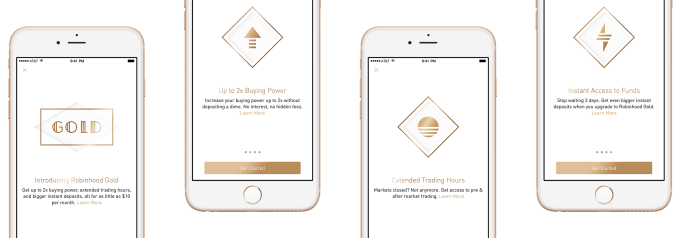
Rapid product iteration and skyrocketing value surely helped recruit Josh Elman, who Robinhood announced yesterday has joined as VP of product as he transitions to a part-time roll at Greylock Partners. He could help the company build a platform business as a backbone for other fintech apps, they way he helped Facebook build its identity platform.
In effect, Robinhood has figured out how to make stock trading freemium. Rather than charge per trade with bonus features included, Robinhood gives away the bare-bones trades and charges for everything else. That could give it a steady, scalable business model akin to Dropbox, which grew by offering small amounts of free storage and then charging for extras and enterprise accounts. From a start with free trades, Robinhood could blossom into a hub for your mobile finance life.
Google adds a wheelchair-accessible option for transit maps
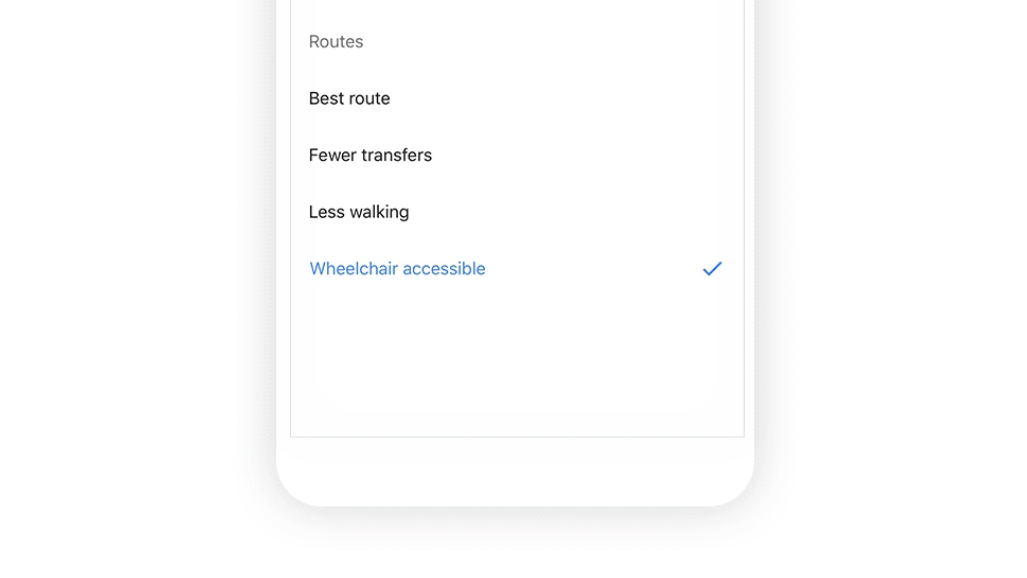
Google Maps has a pretty solid set of data for taking transit from here to there, but anyone with a physical disability knows it isn’t quite that simple. Some stations may be wheelchair-unfriendly, have out-of-service elevators, that kind of thing. A new update to the service adds an option for you to specify a wheelchair-accessible route — though that’s just a start on what’s really needed.
Transit riders in London, New York, Tokyo, Mexico City, Boston and Sydney will now have the option to select “wheelchair accessible” in their route options in the same way they might opt to have fewer transfers or minimal walking. More are on the way.
 No doubt this will make life easier for disabled folks, people with strollers or even anyone lugging around something heavy.
But maps, even Google’s extremely detailed ones, are still extremely short on information critical to anyone with a physical disability. Walking routes that take into account sidewalk condition and grade, curb cuts, pedestrian crossing zones or buttons, wheelchair-accessible entrances to buildings and much more could be better integrated into the world’s most popular mapping platform.
 We know it can be done because a handful of students did it on their own for a summer project. AccessMap uses a combination of manually generated and publicly available data to label sidewalks as safe or risky for people who have trouble getting around. It’s limited to Seattle at present (can’t expect undergrads to map the country) but the concept is more than sound.
Here’s hoping Google dedicates a bit more of its considerable resources to improving this aspect of the product. Millions will thank them.
Intel announces hardware fixes for Spectre and Meltdown on upcoming chips
When the Spectre and Meltdown bugs hit, it became clear that they wouldn’t be fixed with a few quick patches — the problem runs deeper than that. Fortunately, Intel has had plenty of time to work on it, and new chips coming out later this year will include improvements at the hardware/architecture level that protect against the flaws. Well, two out of three, anyway.
CEO Brian Krzanich announced the news in a company blog post. After thanking a few partners, he notes that all affected products from the last 5 years have received software updates to protect them from the bugs. Of course, the efficacy of those updates is debatable, as well as their performance hits — and that’s if your hardware vendor even gets a patch out. But at any rate, the fixes are available.
There are actually three semi-related bugs here: Spectre is variants 1 and 2; then there’s variant 3, which researchers dubbed Meltdown. Variant 1 is arguably the most difficult of them all to fix, and as such Intel doesn’t have a hardware solution for it yet — but variants 2 and 3 it has in the bag.
 “We have redesigned parts of the processor to introduce new levels of protection through partitioning that will protect against both Variants 2 and 3,” Krzanich writes. Cascade Lake Xeon and 8th-gen Core processors should include these changes when they ship in the second half of 2018. Although that’s a bit vague, we can be certain that Intel will prominently advertise what new chips include the mitigations as we get closer to release.
Lastly, even older hardware will be getting the microcode updates — back to the 1st-gen Core processors. Remember Nehalem and Penryn? Those will be patched in time, as well. Anyone surprised that a Nehalem system is still in use anywhere probably hasn’t worked in IT at a big company or government agency. I bet there are 98SE systems running on Pentiums somewhere in the Department of Energy.
This announcement doesn’t require anything from users, but keep your computer up to date if you know how, and ask customer service for your device provider if you’re not sure.

FitHouse aims to make fancy fitness classes more affordable
Fitness-oriented New Yorkers aren’t facing a shortage of classes that they can sign up for, but the prices can add up — Clément Benoit, founder of a new startup called FitHouse, said boutique classes cost an average of $35 per session.
FitHouse, on the other hand, is charging $99 per month for unlimited classes. Contrast that not just with a traditional studio, but also with ClassPass, where pricing in NYC ranges from $45 (for two to four classes) to $135 (for eight to 12 classes) per month.
In many ways, FitHouse offers a more traditional model than ClassPass — instead of giving subscribers access to a classes run by other studios and instructors, it’s building a studio of its own. Benoit said this gives the company more control over the experience, and a bigger piece of the revenue, which he said “we redistribute to both the user and the instructors.”
Beyond the pricing, Benoit said FitHouse also stands out because of its approach to real estate. It’s looking to take over empty spaces that require a minimum amount of investment to make them ready for classes. And it’s signing six-month leases with the possibility of a longer-term extension, so that it can quickly spin up new locations in new neighborhoods, with a minimum of risk.
FitHouse has already opened its first location in New York’s Bowery neighborhood, with plans to launch 12 locations across the city over the next year.

Clément Benoit
Benoit also said he’s attracting the best instructors by putting them front-and-center in FitHouse’s marketing and scheduling, and by paying them 10 to 25 percent more than they’d normally make to teach a class. (Though to be clear, these instructors aren’t working with FitHouse exclusively.)
Benoit, by the way, is a tech entrepreneur who sold his last-mile delivery startup Stuart to GeoPost last year. (And he’s already raised a $3 million round from Global Founders Capital, Xavier Niel and Fabrice Grinda.) He admitted that FitHouse’s technology isn’t the most flashy part of the offering, but he said it’s still important that the startup created its own frontend and backend infrastructure.
“Just the fact that we have information on the user, we can deliver a personalized check in: You came last week, you had a great class with this instructor, how did you like it?” he said. “No studio does that. They don’t control the tech.”
Abra adds 20 cryptocurrencies to its wallet app
Abra, a global currency wallet that was the belle of the early Bitcoin ball, has just added 20 cryptocurrencies and 50 fiat currencies, a feature that allows you to top up and send cash and cryptocurrencies from inside the wallet.

“Bitcoin, Ether, Litecoin, Ripple, Bitcoin Cash, Ethereum Classic, Dash, Zcash, Bitcoin Gold, Stellar Lumens, DigiByte, Dogecoin, Golem, OmiseGO, Qtum, Augur, Status, Stratis, Vertcoin and 0x are the initial 20 cryptocurrencies,” the company wrote.
“Abra developed a first-of-its kind smart contract investing platform that uses bitcoin technology to allow users to hold exposure to cryptocurrencies and fiat currencies on a smartphone much the same way Fidelity allows you to buy an ETF in the old world,” said founder Bill Barhydt. “With this model, we can enable exposure to any asset — Abra has only started with crypto and fiat.”
The system allows you to convert between currencies with “no transaction fees, at any time with no limitations.” It seems to work similarly to ShapeShift, another solution that allows nearly instant conversions between currencies.
There are also a few tricks up Abra’s sleeve, including the clever use of smart contracts to reduce the volatility associated with currency trades. They write:
Consumers can add money to their wallets using a bank account, an American Express credit card in the United States or using bitcoin purchased outside Abra from anywhere in the world. They can then invest in any of the 20 cryptocurrencies offered on the Abra app, quickly, easily and safely. To develop the new wallet and integrated exchange, Abra built a first-of-its-kind platform using price-stabilized crypto tokens, called stablecoins, that facilitates holding both fiat coins as well as cryptocurrencies through a combination of litecoin and bitcoin based smart contracts. This unique multi-sig smart contract based investment platform uses Pay To Script Hash scripts on the litecoin and bitcoin blockchains that simulate investment contracts the way a gold ETF is a contract based on USD. Abra acts as the counter-party (i.e. the other signatory) to the P2SH scripts, enabling the company to now run a market making operation that hedges away its counter-party risk on these scripts.
In short, Abra is trying mightily to ensure that buys and sells won’t drastically change due to volatility.
Abra has raised $40 million in funding to date following its Series B round at $16 million in October 2017. Investors include Foxconn Technology Group, Silver8 Capital, Ignia, Arbor Ventures, American Express Ventures, Jungle Ventures, Lerer Hippeau and RRE Ventures.
“In addition to the 50 fiat currencies, Abra previously supported Bitcoin and Etherium, but found that their users wanted the ability to invest in alternate cryptocurrencies in an easy and quick manner — without the hassle of multiple transactions and fees,” said Barhydt.
TheSkimm raises $12 million for its snarky newsletters
Seven million women (and men) love theSkimm.
With its daily newsletters designed to keep you in the loop on the latest news and pop culture, theSkimm has developed a loyal following, and even recruits fans called “Skimm’bassadors” to help spread the word.
That word-of-mouth hype is helping, and the startup has seen enough growth to warrant more funding. TheSkimm is announcing a $12 million round led by GV (Google Ventures), with participation from Spanx founder Sara Blakely as well as existing investors like RRE Ventures and Homebrew.
Co-founded in 2012 in New York by former TV news producers Carly Zakin and Danielle Weisberg, the company has expanded beyond its newsletters targeting millennial women and offers subscription products, too. TheSkimm’s app includes a calendar of upcoming news and televised events. It also has podcasts and an e-commerce business.
Revenue is said to have more than doubled year over year since 2016, partly due to the subscriptions, but also due to native advertising and affiliate licensing. The staff has doubled, as well, and recently moved into a new headquarters.
The latest funding, which adds to the more than $16 million already raised, will be used to add more subscription services and also further expand into video and podcasting.
TheSkimm also has plans for data analysis.
DHS and FBI detail how Russia is hacking into U.S. nuclear facilities and other critical infrastructure
With a joint alert from the FBI and DHS, the Trump administration has formally accused the Russian government of a “multi-stage intrusion campaign” targeting the U.S. energy grid for the first time. The alert provides some specifics about an emerging threat that could translate a cyberattack into practical chaos for a country in the crosshairs of such an attack.
The alert elaborates on “Russian government actions targeting U.S. Government entities as well as organizations in the energy, nuclear, commercial facilities, water, aviation, and critical manufacturing sectors” — a goal consistent with suspected Russian cyberattacks like last year’s NotPetya malware which focused on industrial targets and past hacks of energy systems in Ukraine. The joint report by FBI and DHS links to Symantec research from October 2017 that detailed efforts by a “sophisticated attack group” then only known as Dragonfly which “[appeared] to be interested in both learning how energy facilities operate and also gaining access to operational systems themselves.”
It’s clear from the alert that Russian reconnaissance efforts to probe critical infrastructure systems were also paired with an effort to override control for those systems:
“DHS and FBI characterize this activity as a multi-stage intrusion campaign by Russian government cyber actors who targeted small commercial facilities’ networks where they staged malware, conducted spear phishing, and gained remote access into energy sector networks. After obtaining access, the Russian government cyber actors conducted network reconnaissance, moved laterally, and collected information pertaining to Industrial Control Systems (ICS).”
To carry out their aims, the attackers employed a blend of technical attacks, social engineering and basic online sleuthing. In one instance, the report describes how the hackers downloaded a small image displayed on a target’s public human resources page. By blowing up the photo, the attackers revealed a “high-resolution photo that displayed control systems equipment models and status information in the background” — a considerable oversight and evidence of just how unevenly implemented basic operational security precautions can be in the energy sector.
During the early stage of compromising a system, the alert states that the threat actors used spear-phishing attacks originating from an already hacked legitimate account and watering hole domains, among other methods. After infiltrating a system, the attackers made organized efforts to cover their tracks, deleting logs and removing installed applications, including the VPN software FortiClient.
More technical detail is available in the document itself on the US-CERT website.