Albertsons will offer Plated’s meal kits across hundreds of stores this year

Following its $200 million acquisition of meal kit startup Plated last fall, grocery chain Albertsons announced this week it would roll out Plated’s meal kits to hundreds of stores by the end of 2018. The meal kits will also be made available for 2-hour delivery through Instacart, same-day and scheduled home delivery, and for in-store pickup through Albertsons Companies Drive Up and Go service.

This is the first public integration between Plated and the grocer following the acquisition, which was meant to give the chain an edge in competing with rivals in the online grocery market. With the rise of meal kit services, like Blue Apron, consumers have less need to visit grocery stores to purchase their recipe ingredients. In addition, many grocers are reacting to the threat posed by Amazon’s purchase of Whole Foods, which allows it to offer pickup and delivery, as well as traditional grocery shopping.

Plated is not the first meal kit to find its way to stores. Kroger also entered the meal kit business last year, and Blue Apron in March announced plans to start selling its kits in stores, too, as did Weight Watchers. Amazon has been selling meal kits on its site, and Walmart just launched its own meal kits and other quick dinner options, too. Walmart says these kits will reach 2,000 stores by year-end.

Albertsons says the meal kits will continue to roll out across the U.S. in the months ahead. By the end of 2018, Plated kits will be available a select Albertsons, Safeway, Vons, Jewel-Osco, Shaw’s, Acme, Tom Thumb, Randalls, United Supermarkets, Pavilions, Star Market and Haggen locations nationwide.

They’ll also become available for in-store pickup and delivery, including through Instacart, in the months ahead.

At launch, a limited selection of meal kits will be offered at the participating stores. A half-dozen of Plated’s most popular kits will be available for sale, including:

  • Crunchy Chicken Milanese with Honey Mustard and Arugula
  • Roasted Chicken au Jus with Orzo and Peas
  • Beef Noodle Bowls with Dinosaur Kale and Mushrooms
  • Steak Frites with Creamy Shallot Sauce and Sautéed Spinach
  • Skillet Grandma Pie with Parmesan-Kale Salad
  • Pine Nut–Crusted Salmon with Creamy Tomato Farro and Roasted Green Beans

This is a small selection, given Plated to date has created 2,200 recipes. However, Albertsons says the meal choices will rotate seasonally to offer variety, and the in-store kits will always include recipes with beef, chicken, seafood and vegetarian options.

With so many meal kits available today for home delivery and, increasingly, in stores, Albertsons hopes to differentiate itself on taste and quality. Plated’s meals are created by a culinary team led by a Le Cordon Bleu-trained chef, Elana Karp, it notes. And with the option to take delivery when you choose, or grab a kit at a store, Albertsons’ meal kits could appeal to a broader market than meal kit subscriptions do which are often pricy and require an ongoing commitment.

“This is the next big step in our journey to enable everyone to enjoy fresh, delicious meals. We’ve
delivered millions of meals to Americans through our acclaimed subscription service, and now we’ll be able to meet and serve millions of new customers with an entirely new level of convenience,” said Josh Hix, Co-founder and CEO of Plated, in a statement. “Since partnering with Albertsons Companies last year, we’ve accelerated our growth and are thrilled to bring an elevated culinary experience to more people in more ways. Today we’re announcing that in addition to our subscription offering, customers near hundreds of Albertsons Companies stores will be able to pick up last-minute or order online for on demand delivery.”

While Albertsons’ acquisition of a meal kit startup was a first for a national grocery chain, it’s becoming clear that meal kit options are becoming a baseline for grocery competitors across the board as they prepare to battle with the likes of Amazon and Walmart, Blue Apron and more.

Image credits: Albertsons

Facebook plans to let everyone unsend messages, will stop Zuckerberg until then

TechCrunch reported last night that Facebook retracted Facebook messages sent by Mark Zuckerberg and other executives from their recipients’ inboxes. That’s an ability normal Facebook users don’t have. But now Facebook tells me it plans to make an “unsend” feature available to all users in several months, and has already been considering how to build this product. Until the Unsend feature is released for everyone, Facebook says it won’t unsend or retract any more of Zuckerberg’s messages.

The retractions of the CEO’s chats were never previously disclosed until Facebook confirmed the news to TechCrunch last night after we reported having email receipt evidence of messages that have since disappeared. Many users are seeing that as a breach of trust.

Revealing plans for the Unsend button now could serve to dampen the backlash by making Zuckerberg look like a beta tester of the feature, and eventually normalizing Unsend as a common behavior.

For the full story on Zuckerberg’s disappearing messages, check out our feature story:

Update: A Facebook spokesperson issued this statement apologizing for not offering Unsend to everyone sooner and explaining its plans:

“We have discussed this feature several times. And people using our secret message feature in the encrypted version of Messenger have the ability to set a timer — and have their messages automatically deleted. We will now be making a broader delete message feature available. This may take some time. And until this feature is ready, we will no longer be deleting any executives’ messages. We should have done this sooner — and we’re sorry that we did not.”

To recap, now six sources confirm that Facebook messages they had received from Mark Zuckerberg had disappeared from their inboxes. When we told Facebook we had an email receipt proving the retractions, Facebook gave TechCrunch this statement: “After Sony Pictures’ emails were hacked in 2014 we made a number of changes to protect our executives’ communications. These included limiting the retention period for Mark’s messages in Messenger. We did so in full compliance with our legal obligations to preserve messages.”

But tampering with users’ inboxes without disclosure has struck many users as a violation of Facebook’s power. Many asked why Zuckerberg and other executives had access to functionality not offered to regular users.

Facebook tells TechCrunch is hasn’t finalized exactly how the Unsend feature will work. A Facebook Messenger spokesperson tells me the only possible option is an expiration timer users can set on messages. When the timer runs out, the message would disappear from both their and the recipients’ inboxes. They tell me this is similar to how retractions of Zuckerberg’s messages work.

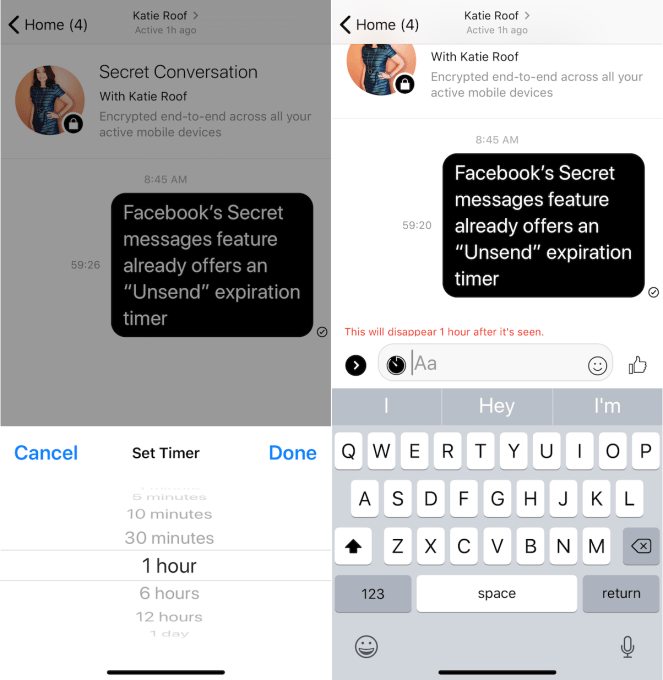
Facebook encrypted “Secret” messaging feature includes an Unsend option with an expiration timer. But Zuckerberg and other executives didn’t use this, and instead had their permanent messages specially retracted.

Facebook already offers a “Secret” encrypted messaging feature that includes an Unsend expiration timer. But this can’t be used in existing traditional Facebook message threads, and instead users have to launch a separate “Secret” conversation. Zuckerberg and other executives weren’t using this feature, and instead had their permanent, non-“Secret” messages retracted. Instagram also offers an Unsend option in its Direct messaging feature, but warns that while it can retract sent messages, the recipient may have already read them.

But in the coming months, Facebook will bring either this expiration timer or another way to Unsend messages to all Messenger threads. Facebook didn’t have details about whether recipients would be notified when a message was unsent and retracted from their inboxes, whether the feature would apply retroactively to old messages sent before the launch or whether users would need to designate a message as expiring/unsendable before they send it.

Beyond the dubious ethics of Facebook manipulating users’ private messaging threads without consent or disclosure, there’s the question of whether and unsend feature is good for Facebook at all. It could make users more willing to share vulnerable, sensitive or confidential professional messages. But it also might make users paranoid that messages they receive could disappear, leading to anxious screenshotting. It also could lead to abuse if users think they can send offensive content then have it retracted shortly after it’s seen.

Facebook could have announced plans for the Unsend feature at any time. It could have disclosed the retractions of Zuckerberg’s messages at any time. But waiting until it was confronted with evidence of the deletions and public backlash shows Facebook is only being transparent with users when forced.

If you have more info on this situation, including evidence of messages from other Facebook executives disappearing, please contact this article’s author, Josh Constine, via open Twitter DMs, [email protected] or encrypted Signal chat at (585)750-5674.

For more on Facebook’s recent struggles, read our feature pieces:

JUMP Bikes weighing Uber $100m+ acquisition, investment offers

JUMP Bikes, the on-demand biking service that integrates with Uber, has been weighing both acquisition and investment offers.

A decision has not yet been reached, but right now possible options include a sale to Uber at a price that exceeds $100 million, or a venture investment round, multiple sources tell TechCrunch. One of the possible investor names that has been floated is Mike Moritz of Sequoia Capital, but we are told that JUMP has several options.

We are also told that various parties have been upping their offers over the past week, as they fiercely compete to get ownership of JUMP.

“E-bikes” are expected to become more popular, where users are able to find and rent bikes quickly via apps. They are part regular bike and part electric, which makes it easier to go up hills.

JUMP launched as Social Bicycles nearly a decade ago, but the startup recently rebranded as JUMP when it announced its $10 million Series A investment round a few months back. Menlo Ventures and Sinewave Ventures invested.

Since then, JUMP has launched a partnership with Uber, available in select cities like San Francisco and Washington, D.C. Users are able to identify a nearby bike via the Uber app and are given a PIN to unlock it. They do not require bike docks, meaning they can be picked up and dropped off everywhere. It costs $2 for every 30 minutes.

JUMP also has its own separate app.

We’ve reached out to JUMP and Sequoia for comment. Uber declined to comment.

TechCrunch’s Megan Rose Dickey recently wrote about JUMP’s expansion:

It “plans to launch in Sacramento and Providence, Rhode Island later this year. Through its software and hardware offerings, it operates via third-parties, like cities, campuses and corporations, in 40 markets including Portland, New Orleans and Atlanta.”

The company also competes with GoBike and Spin. On-demand scooters like Bird and Limebike are also emerging businesses in the urban transportation space.

Spotify’s missing money-maker is artist-to-fan messaging

Streaming royalties are too expensive for Spotify to thrive as a public company just playing us songs. Spotify’s shares closed down 10 percent today during its NYSE trading debut. Luckily it controls much of the relationship between musicians and their fans on its app, poising it to build a powerful revenue and artist loyalty generator by connecting the two through native advertising and messaging that doesn’t stop the music.

Spotify already has a wide range of ad experiences built for traditional brands, from audio ads to display units to sponsored sessions where users get ad-free playback in exchange for watching a commercial. But none of these ad units are designed to help musicians grow their audience within Spotify, even if they can be bent to that purpose.

Spotify could win big by following Facebook’s roadmap.

Back in 2007, Facebook already had ads that led offsite. Think of these as Spotify’s existing audio and display ads. But when Facebook built Pages that let businesses reach you through the News Feed, it also launched ads that let them promote and grow their Pages within Facebook. Unlike the stock banner ads you see all over the web, these ads were native to Facebook, targeted with its profile data, and they used social referrals about Pages your friends interacted with to rope you in. These gave entities on Facebook a paid way to grow their popularity inside the platform.

This is Spotify’s opportunity.

Spotify’s existing ad units are designed for brands, not musicians

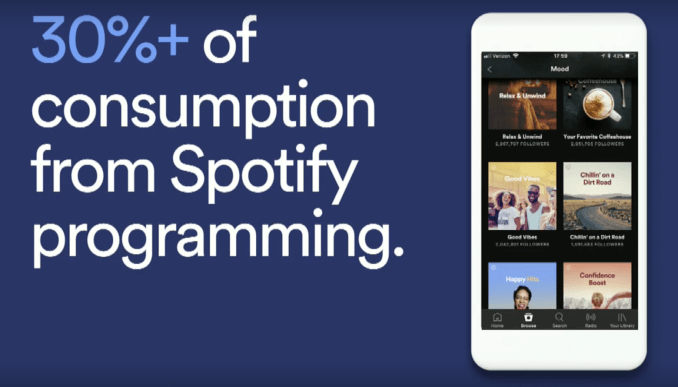
A few years ago, Spotify’s user base was too small for artists to focus on spending money there to get popular. But Spotify has grown to the size where it’s replacing top 40 radio, and over 30 percent of listening now comes from its recommendations and algorithmic playlists like Discover Weekly. The record labels now need Spotify to have a hit. Between that influence and it’s stature as the biggest on-demand music streaming service, Spotify has the leverage to offer artists the best tool to boost their fan base. Whether artists want to build a following on Spotify, sell collectors’ items, or fill premium front-row seats at their shows, Spotify could hook them up.

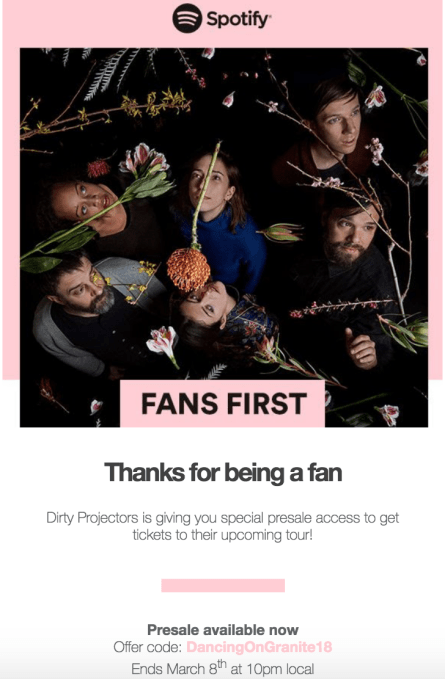
The no-longer-a-startup has already built the groundwork for this with the launch of its Spotify For Artists analytics dashboard app last year that shows a musician’s top songs, and the demographics of their fans including their location, gender, age, and what else they listen to. Spotify’s proven the power of this data with its Fans First email campaigns that let artists reach their most frequent listeners with access to concert ticket pre-sales and exclusive merchandise. It claims the emails see a 40 percent open rate, and 17 percent click-through rate — way higher than the industry standard.

But if Spotify built new surfaces for artists to reach out directly to fans within its apps, it could become the destination for record label marketing money. Since these artist ads and messages would all drive users deeper into the app rather than away from it like brand ads, Spotify could charge less than traditional ads and make them affordable to labels on a budget or musicians paying out-of-pocket.

Here are some ways Spotify could create native artist-to-fan marketing channels:

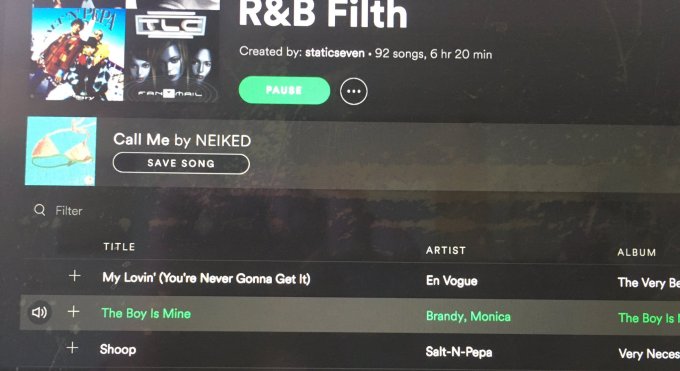
Sponsored songs on its algorithmic playlists could expose fans to artists in the most natural way possible, or turn one-time listeners into loyalists. Wherever there’s recommendations, there’s room for paid discovery. Listeners could easily skip the track or switch to a different playlist, but might end up falling in love with the band, and diving into their catalogue. It’s the equivalent of Facebook’s in-News Feed native ads, but with a musician promoted instead of a business’ Page. Spotify was actually spotted testing what was effectively a sponsored song in mid-2017 above the start of some playlists. While there was an opt-out option within the app’s Settings that’s since disappeared, Spotify has at least considered this idea.

Spotify was spotted testing what was effectively a Sponsored Song back in mid-2017

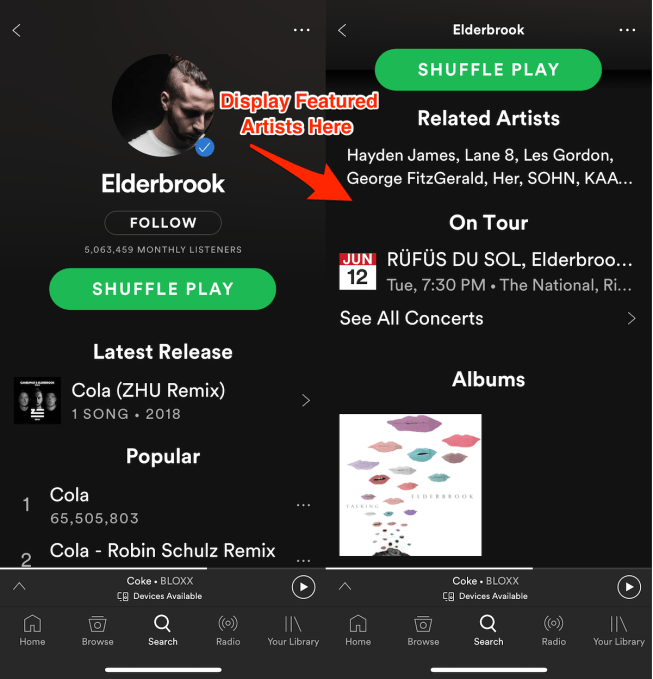
Promoted Artists could use a similar model to Google’s AdWords sponsored search results. When users search for an artist, they could be shown similar artists who’ve paid to be promoted in the search typeahead or results page. Spotify could also insert a box within the profile of another artist you’re browsing below their top tracks. Spotify already lists a slew of related artists in text, but could highlight one that pays, perhaps showing one of their songs that could be instantly played.

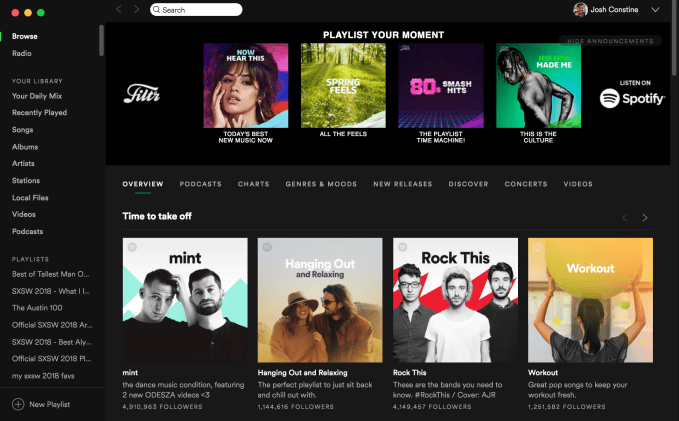
Featured Artists could give artists that pay a special slot on Spotify’s browse page. With so many recommendations here, it’d be easy to insert a sponsored section without feeling interruptive.

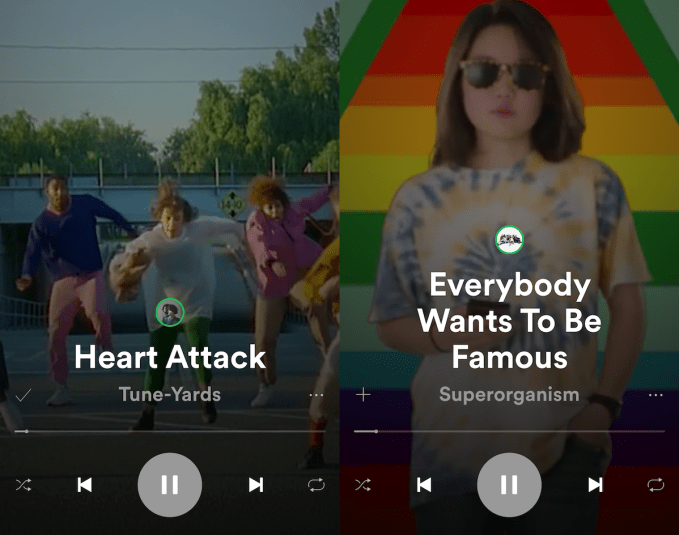
Sponsored Visualizations could make better use of your screen while you listen. Rather than just staring at the album art and playback controls, Spotify could let artists pitch fans their other music, tickets, gear, or social media channels. Spotify could also fill this space with entertaining silent video clips, photo slideshows, and biographical info as I suggested as a differentiator in 2016, and similar to how lyrics site Genius started doing with its Stories this week. Given users are currently listening to the artist, they might be primed for these experiences. Spotify has already tested letting artists show GIFs during playback, and has partnered with Genius to show Behind The Music factoids, but this is real estate that could help artists earn more money as well as entertain fans.

Direct Messaging

The most ambitious and audacious way to let artists reach fans would be a special artist-to-fan messaging channel. Spotify got rid of its in-app inbox and messaging feature for sending friends songs a few years ago, instead pushing users to share music via their chat app of choice. But similar to the Fans First email campaigns, Spotify could create a special artist-to-fan messaging section in its app that could alert users to new releases and playlists as brand advertising, or even push tours and merchandise as more direct performance advertising.

Spotify could give all artists a certain volume of messages they could send for free or let them reach out just to the top 1% of fans a certain number of times per month or year. Then artists could pay to send more messages beyond the limits. Alternatively, it could just charge for any use of messaging.

Done wrong, the above options could feel like Spotify gouging artists to reach their own fans. But done right, users might actually enjoy it. These connections wouldn’t be too far off from following an artist on other social media, but where people are already listening. Finding out about one of your favorite band’s new albums, tours, or t-shirts might feel less like an ad and more like an inside tip from the fan club.

Spotify might be able to get away with showing some of these different experiences to users who’ve subscribed if they don’t get in the way of music listening. Swinging to the other end of the opportunity spectrum, the company could just give away all these experiences to artists, boosting their loyalty to Spotify and getting them to promote their presence there instead of on competing streaming services like Apple Music.

If Spotify doesn’t figure out a way to improve its margins with additional revenue drivers, it may have a tough time surviving as a public company. If it becomes too profitable from just music streaming, the labels can always try to increase their royalty rates. Spotify might hope that more artists work with it directly, cutting out the middlemen, but the record labels still provide some important marketing, radio promotion, and distribution services that artists need. Meanwhile, startups including United Masters (which raised a $70 million Series A from Google parent Alphabet and Andreessen Horowitz) adnd subscription crowdfunding platforms like Patreon want to usurp the record labels and become the way artists earn more before Spotify can.

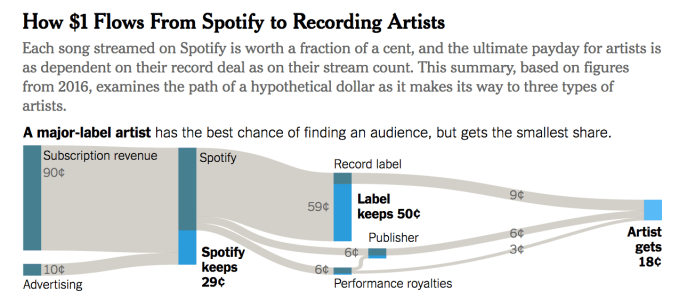
This New York Times’ chart shows why musicians feel screwed, even though it’s labels keeping their money not Spotify

Creating ways to connect with listeners could offer Spotify a way to combat the enduring narrative that it’s screwing over musicians. If Spotify can prove these artist-to-fan messaging options earn them more than they cost, it could be seen as the streaming service that’s actually trying to help musicians make a living.

Recorded music has become primarily a promotional tool for all of a musician’s other revenue monetization methods since the dawn of the MP3. Streaming’s on-demand structure and no-extra-cost-per-play nature turns the curious listener who’s only heard of an artist or just likes one single into a diehard fan who shells out the big bucks every time their favorite act is in town.

As we shift to an experiential culture where our possessions are digitized and its our interests that define us, people want to feel closer to the creators they love. Artist-to-fan messaging could bring the whole life-cycle from discovery to affinity to real monetization beyond the royalties all within one green and black app.

For more on Spotify going public, read our feature stories:


Amazon opens Echo Button games to developers

Echo Buttons are one of the stranger bits of hardware to come out of the Amazon labs in recent memory. Announced alongside the latest Echos, the little light up devices are designed to bring interactive game play to the Alexa Echo system.

The company’s already announced a handful of compatible titles, and it seems that list is about to get a bit longer, as it opens up a beta version of the Gadgets Skill API for the hardware.

Developers can platform to associate button presses with different skills and send light up animation to the hardware. A preview version of the API lead to the development of a number of experiences for the two for $20 peripherals, including light up playback of Martin Luther King Jr.’s “I Have a Dream” speech and Trivial Pursuit from Hasbro. The selections are nothing if not eclectic.

The toy company is also using the announcement to launch a new game: an Echo Button version of Simon, the popular 1980s light up memory game. You can download Simon Tap now, and Alexa will list a sequence of colors the players then match. The hardware works with most of the Echo line, including, Echo, Echo Dot, Echo Show, Echo Plus and Echo Spot.

Apple steals Google’s AI chief

Apple has just poached one of Google’s top AI executives in a move likely to have far-reaching consequences.

Apple has hired John Giannandrea, previously Google’s head of AI and Search, The New York Times reports. Giannandrea will lead Apple’s “machine learning and A.I. strategy,” the Cupertino company said in a statement to the Times; he will be one of only 16 executives that report directly to CEO Tim Cook.

Just yesterday, The Information (paywalled) had reported that Giannandrea would be stepping down from his role at Google and would be replaced by 19-year Google veteran Jeff Dean. Giannandrea first joined Google in 2010 after it acquired MetaWeb, where he served as CTO. The startup sought to make search results more contextually aware through its hefty database of tagged data.

The hire is particularly important as Apple has seemed to fall far behind its rivals in the race to build smarter software powered by artificial intelligence. Siri, the digital assistant into which Apple has pumped much of its consumer-facing AI technologies, is far behind Amazon’s Alexa and Google’s Assistant in capabilities.

TechCrunch chatted with Giannandrea at our most recent Disrupt SF conference, where he spoke at length about how humans could help make computers smarter, but that we could also lend them our biases if we aren’t careful.


NASA grants Lockheed Martin $248M contract to develop a quieter supersonic jet

The Concorde was a generation ago, yet its legend persists — and the dream of supersonic flight may be returning. NASA and Lockheed Martin are taking concrete steps toward the creation of jets that travel faster than the speed of sound but are “about as loud as a car door closing.”

NASA announced today that it has awarded Lockheed a juicy $247.5 contract to produce a single “X-plane,” or experimental plane, meeting certain requirements by the end of 2021. The company created a preliminary design under a previous contract.

Much of the engineering is up to Lockheed, of course, but in the end the single-pilot craft will travel at some 940 MPH at high altitude — 55,000 feet — and produce around 75 perceived decibels (compared with the Concorde’s 90) at ground level.

Of course it will be louder up close — you can’t run engines and split the air at that speed without making a racket, and this thing is using a fighter jet engine. A big problem with supersonic flight was that the sonic boom made it too loud to fly over populated areas. (The Concorde had more problems than that, but the boom was part of it.)

But there’s been a great deal of research (dramatic NASA video here) into improving the aerodynamics of a supersonic craft and carefully designing every contour to control the inevitable pressure waves it creates. This new plane will be the first to test many of those principles.

Once the craft is delivered at the end of 2021, assuming everything plays out according to schedule, NASA will start flight tests and collect community responses. Presumably that means asking if they heard anything unusual that day.

That data will be passed on to regulators as support for new rules on supersonic flight — which could in turn give the aerospace industry the green light to develop practical applications.

As you can see there’s a long way to go before a quiet supersonic jet is even built and tested, but the work is underway.

GoFundMe acquires YouCaring as charitable crowdfunding continues to consolidate

GoFundMe, the startup that focuses on crowdfunding for charitable causes, has made another acquisition to scale up its platform: It has acquired YouCaring, a smaller rival, creating a combined community of around 60 million donors in some 19 countries in the process. Financial terms of the deal are not being disclosed, but it comes amid a flurry of acquisitions in the space as smaller companies look to consolidate in the face of growing competition from the likes of Facebook, and, it seems, Amazon.

Other acquisitions among charitable crowdfunding startups have included GoFundMe buying CrowdRise (and relaunching it last month), and YouCaring acquiring Generosity.com from Indiegogo in January of this year.

GoFundMe says that current YouCaring campaigns will continue as is if they have been started on the latter site or have the option to move to GoFundMe. Future campaigns will all be initiated on GoFundMe. Campaigns will be backed by GoFundMe’s guarantee going forward.

Crowdfunding has become one of the biggest levers for raising money over the internet. Using emotional storytelling campaigns that spread virally through social media (and more traditional media), charitable giving specifically has been given a huge boost. GoFundMe was already the world’s biggest platform for causes-based online giving, and this deal will extend its margin further.

It’s not completely clear why GoFundMe decided to gobble up YouCaring (or YouCaring chose to sell up), rather than both continuing to grow organically, but one reason could be because of changing business models in the charitable crowdfunding space.

Last November, GoFundMe announced that it would drop the 5 percent platform fee that it was charging for personal campaigns in the U.S. (its biggest market) and opt for a tips-based model. Notably, this is the model that forms the basis of how YouCaring — which is profitable — works.

“We have never had a platform fee and never will,” Dan Saper, CEO of YouCaring, told me earlier this year. More than 70 percent of all its users tip the company something, he added. “It has been remarkably sustainable and predictable,” he said. “We treat people like adults and let them decide who to support and how much to give.”

YouCaring also has the distinction of having hosted and run the largest crowdfunding campaign of all time, on any platform, raising $37 million for JJ Watt’s Hurricane Harvey Relief Fund.

It could be that GoFundMe decided to bring in YouCaring either to help it build out its business in the tips-based space, or to work more closely with high-profile fundraisers, or (more cynically) to take out its closest independent rival in order to have less competitive pressure around how it chooses to build out fees and tips in the future. (We’re asking the question and will update as we learn more.)

For now, the combination is being described by GoFundMe as a move to strengthen its lead in the market — putting truth to the adage of “strength in numbers.”

“GoFundMe and YouCaring share a common mission of making it easier than ever for people to get the support they need. With this acquisition, we strengthen our position as the place where more people can unite to make an impact far greater than they can on their own,” said Rob Solomon, CEO of GoFundMe, in a statement. “We’re excited to welcome the YouCaring community to GoFundMe and empower a global community of more than 50 million changemakers to help make a difference in each other’s lives.”

GoFundMe has never revealed how much it has raised from investors, but its backers include Iconiq, Stripes Group, Accel, TCV, Greylock and Meritech. YouCaring also has never disclosed how much it has raised and has only ever disclosed one backer, Alpine Investors.

Alexa’s routines can now play music, podcasts and radio shows

Alexa’s routines are getting a musical upgrade. First launched last year, routines allow Alexa device owners to string together a series of actions that kick off with a simple command — like “good morning” or “I’m home,” for example. Until today, the feature included support for news, weather, traffic, smart home skills, as well as, more recently, a set of “Alexa says” commands that let you add a little personality to a given routine. Starting today, Alexa can play your favorite music, podcast or radio show in a routine, too.

To use the feature, you’ll select an artist, playlist, album or station from your music library or one of the supported streaming services. Currently, the supported services are those that already work with Alexa — Amazon Music, Spotify, Pandora, iHeartRadio, Saavn, Deezer and TuneIn.

Amazon says you’ll also be able to create a volume action to control the audio output on your device.

The addition has the potential to make routines more useful for those who like to have music in their home on a more regular basis. For instance, if you like to start your day with a playlist that gives you energy, you could create a “good morning” routine that turns on your lights and smart coffee maker, then starts playing your favorite upbeat songs.

You also could create a routine for relaxing that includes more soothing music or a nighttime routine that locks the door then plays sleep sounds. A party playlist could be included in a routine that puts your smart light bulbs into a flashing disco mode or crazy colors.

But music isn’t the only option — because some of the services support radio shows or podcasts, those can now be integrated into your routines, too. For instance, a “welcome home” routine could play your daily briefing followed by a podcast or favorite radio show from TuneIn.

Although Alexa gained the ability to run routines before its rival, Google Assistant, Google’s version already supports music, podcasts and radio. So Amazon is playing a bit of catch-up here. In addition, Google Assistant routines can also pick up an audiobook where you left off — that’s oddly not one of Alexa’s routines options today, even though Alexa can read to you from your Audible library. Presumably, Audible support in routines is in the works.

Music is an increasingly important business for Amazon, so better integration with Alexa makes sense. The company this week told Billboard it now has “tens of millions” of paid customers, confirming earlier reports that it has become the third-largest music service behind Spotify and Apple Music.

The ability to customize routines with music and other audio content will be available within the Alexa app for iOS and Android. However, the feature is just now beginning to roll out — so you may not see the option immediately.

Where’s the beef? For Impossible Foods it’s in boosting burger sales and raising hundreds of millions

Any company that’s looking to replace the more than 5 billion pounds of ground beef making its way onto tables in the U.S. every year with a meatless substitute is going to need a lot of cash.

It’s a big vision with lots of implications for the world — from climate change and human health to challenging the massive, multi-billion dollar industries that depend on meat — and luckily for Impossible Foods (one of the many companies looking to supplant the meat business globally), the company has managed to attract big-name investors with incredibly deep pockets to fund its meatless mission.

In the seven years since the company raised its first $7 million investment from Khosla Ventures, Impossible Foods has managed to amass another $389 million in financing — most recently in the form of a convertible note from the Singaporean global investment powerhouse Temasek (which is backed by the Singaporean government) and the Chinese investment fund Sailing Capital (a state-owned investment fund backed by the Communist Party-owned Chinese financial services firm, Shanghai International Group).

“Part of the reason why we did this as a convertible note is that we knew we would increase our valuation with the launch of our business,” says David Lee, Impossible Foods chief operating officer. “We closed $114 million in the last 18 months.” The company raised its last equity round of $108 million in September 2015.

Lee declined to comment on the company’s path to profitability, valuation or revenues.

Impossible began selling its meat substitute back in 2016 with a series of launches at some of America’s fanciest restaurants in conjunction with the country’s most celebrated young chefs.

David Chang (of Momofuku fame in New York) and Traci Des Jardins of Jardiniére and Chris Cosentino of Cockscomb signed on in San Francisco, as well as Tal Ronnen of Crossroads in Los Angeles.

When we launched a year ago, we were producing out of a pilot facility,” says Impossible co-founder Pat Brown. [Now] we have a full-fledged production facility producing 2.5 million pounds per month at the end of the year.”

The new facility, which opened in Oakland last year, has its work cut out for it. Impossible has plans to expand to Asia this year and is now selling its meat in more than 1,000 restaurants around the U.S.

Some would argue that the meat substitute has found its legs in the fast-casual restaurant chains that now dot the country, serving up mass-marketed, higher price point gourmet burgers. Restaurants including FatBurger, Umami Burger, Hopdoddy, The Counter, Gott’s and B Spot — the Midwest burger restaurant owned by Chef Michael Symon — all hawk Impossible’s meat substitute in an increasing array of combinations.

“When we started looking at what Pat and the team at Impossible was doing we saw a perfect fit with the values and mission that Impossible has to drive a stronger mindset around what it is to be conscientious about what is going on,” says Umami Burger chief executive Daniel del Olmo.

Since launching their first burger collaboration last year, Umami Burger has sold more than 200,000 Impossible Burgers. “Once people tried the burger they couldn’t believe that it was not meat,” says del Olmo. “They immediately understood that it was a product that they could crave. We are seeing 38 percent increase in traffic leading to 18 percent sales growth [since selling the burger].”

At $13 a pop, the Impossible Umami Burger is impossible for most American families to afford, but pursuing the higher end of the market was always the initial goal for Impossible’s founder, Patrick Brown.

A former Stanford University professor and a serial entrepreneur in the organic food space (try his non-dairy yogurts and cheeses!), Brown is taking the same path that Elon Musk used to bring electric vehicles to the market. If higher-end customers with discerning palates can buy into meatless burgers that taste like burgers, then the spending can subsidize growth (along with a few hundred million from investors) to create economics that will become more favorable as the company scales up to sell its goods at a lower price point.

Brown recognizes that 2.5 million pounds of meat substitute is no match for a 5 billion-pound ground-beef juggernaut, but it is, undeniably, a start. And as long as the company can boost sales for the companies selling its patties, the future looks pretty bright. “To get to scale you have to sell to a higher price-point,” says Brown.

That approach was the opposite tack from Beyond Meat, perhaps the only other well-funded competitor for the meatless crown. Beyond Meat is selling through grocery stores like Whole Foods, in addition to partnerships of its own with chains like TGIFridays and celebrity backers like Leonardo DiCaprio.

“From a brand-building standpoint it would have been insane for us to launch in supermarkets given that we had the opportunity to launch with great companies like Umami and great chefs like Dave Chang,” says Brown. 

Heme is their best shot

At the heart of the Impossible Food’s meatless revolution is the development of a vegetable-based heme molecule.

Heme is present in most living things and, according to Impossible Foods, it’s the molecule that gives meat its flavor. The company says that it’s the presence of the heme molecule in muscle that makes meat taste like meat. Impossible Foods engineers and ferments yeast to produce that heme protein naturally found in plants, called soy leghemoglobin.

It’s the iron-containing molecule that carries oxygen in the blood… what makes meat red or pink… It’s essential for every living cell on earth,” says Brown. “The thing that we discovered was that pretty much the entire flavor experience of meat that distinguishes it from all other foods is due to heme. Heme transforms fatty acids into the bloody flavored odorant molecules, and when you cook meat, the protein that holds the meat at a certain temperature unfolds and lets loose.”

Brown says Impossible Foods can make fish flavors, chicken flavors and pork flavors, but is going to stick to ground beef for the foreseeable future.

The next trick for the company is to manipulate the flavor profile of its meat substitute so its burgers can win in blind taste tests against any other combination of meat patty.

The company’s mission is to completely replace animals in the food system by 2035,” says Brown. “The only way to do it is to do a better job than any animal at producing the most nutritious, delicious, affordable and versatile foods. And it will be a very interesting proof of concept landmark when we have a burger that is — for flavor and deliciousness — the best burger on earth… that’s going to send a very important signal to the world.”

The global impact

If Impossible Foods, Beyond Meat or any of their competitors that are working on developing cultured meat cells in a lab are successful, it has huge implications for the world.

These lab-grown meats and meat substitutes could use up to 75 percent less water, generate 87 percent fewer greenhouse gases and require 95 percent less land than what’s used for meat production.

Those statistics have attracted investors like the Open Philanthropy Project, Temasek, Bill Gates and Horizons Ventures (backed by the Hong Kong billionaire Li Ka Shing). Those billionaire backers have invested in multiple rounds of funding for the company, alongside other early financiers, including Google Ventures, UBS and Viking Global Investors.

“The fundamental economics are so much more favorable for us than for the cow,” says Brown. 

Those economics could also be compelling for potential meat production partners, he says. Brown envisions a potential future where production facilities that use fermentation processes could be used to manufacture the company’s ingredients to get to scale. “In order to scale rapidly we didn’t want to have to build the entire supply chain from the farm up.”

Given that the main ingredients are wheat, potato and the manufactured heme protein, there’s a chance that the company could actually create an alternative supply chain to the meat packers, butchers and slaughterhouses that dominate the landscape.

The meat industry has taken notice and is beginning to push back.

According to a report in USA Today, the U.S. Cattlemen’s association filed a 15-page petition with the U.S. Department of Agriculture earlier this year calling for an official definition of the terms “beef” and “meat.”

“While at this time alternative protein sources are not a direct threat to the beef industry, we do see improper labeling of these products as misleading,” said Lia Biondo, the association’s policy and outreach director, in a statement. “Our goal is to head off the problem before it becomes a larger issue.”

For Brown, it’s another step along the road of how humans sustain themselves. “People act as if science and technology have been outside of the food system,” he says. “The whole food system is a combination of nature and science that makes the food that we eat come into being.”

Facebook reveals Russian troll content, shuts down 135 IRA accounts

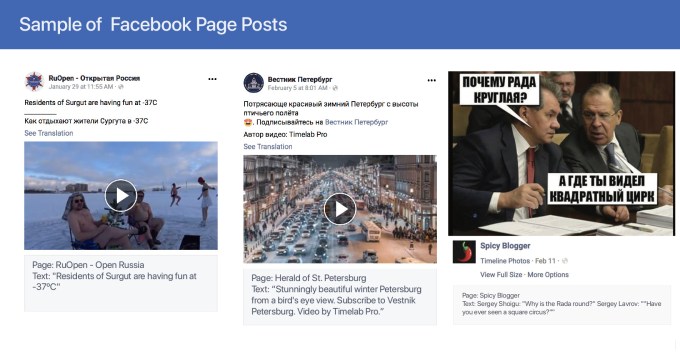
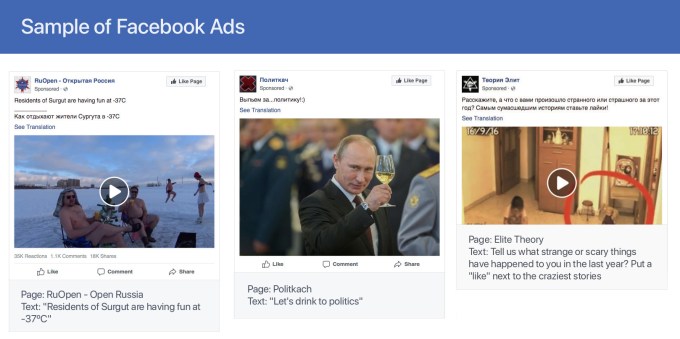
Facebook is showing an unprecedented level of transparency around its latest effort to suspend Russian trolls trying to influence elections and mislead the public as it tries to regain the trust of users and the government. The company shared both stats about the account deletions and samples of the content they shared.

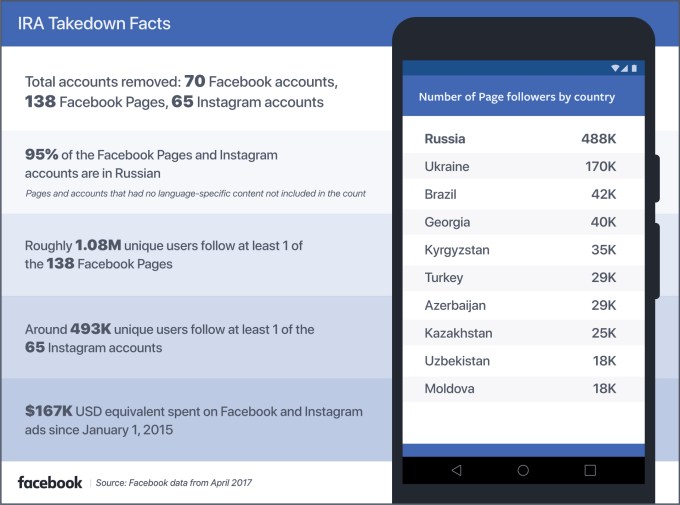
Facebook has removed 70 Facebook accounts, 138 Facebook Pages, and 65 Instagram accounts run by the Russian government-connected troll farm and election interference squad the Internet Research Agency. Facebook chief security officer Alex Stamos cited the IRA’s use of “inauthentic accounts to deceive and manipulate people” as “why we don’t want them on Facebook. We removed this latest set of Pages and accounts solely because they were controlled by the IRA — not based on the content.”

95 percent of the accounts operated in Russian and targeted Russia or Russian-speakers in nearby countries including Azerbaijan, Uzbekistan and Ukraine. 1.08 million users followed at least one of the Facebook Pages, and 493,000 users followed at least one of the Instagram accounts. The accounts had spent a combined $167,000 on ads since the start of 2015.

Facebook CEO Mark Zuckerberg wrote that since discovering the IRA’s election interference efforts, “we have improved our techniques to prevent nation states from interfering in foreign elections, and we’ve built more advanced AI tools to remove fake accounts more generally.” He went on to detail how Facebook is half-way to its promise to double its security and content review staff from 10,000 to 20,000 this year, with 15,000 now working on the efforts at Facebook.

“These efforts have all made it harder for nation states to interfere in foreign elections” Zuckerberg wrote on Facebook. “With today’s update, we have now identified a large network the IRA is using to manipulate people in Russia itself. This is the next step towards removing them from Facebook entirely.”

By detailing the specifics of its efforts rather than dragging its feet or waiting for government inquiries, Facebook may be able convince people it’s not asleep at the wheel of its social network.

Facebook at first said just 10 million users had seen ads bought by the IRA, but later explained that when organic un-paid posts were counted, 126 million people had seen the propaganda group’s Facebook posts and another 20 million had seen its Instagram posts. Facebook previously shut down the IRA’s 170 Instagram accounts that had shared 120,000 pieces of propaganda and 120 Facebook Page that had shared 80,000 pieces of content.

The trickle of information and initial low-ball numbers made it seem like Facebook was trying to downplay the severity of platform abuse. But in recent weeks since the Cambridge Analytica scandal broke, Facebook has seemed increasingly transparent and receptive to criticism. It seems the convergence of bad news has truly shaken Facebook awake.

Several wounded, one dead in shooting at YouTube headquarters

At 12:46PM, an active shooter was reported in an outdoor patio area at YouTube’s headquarters in San Bruno, California. Police arrived at the scene in a manner of minutes, police chief Ed Barberini confirmed during a brief press conference.

“We have four victims who have all been transported for gunshot related injuries and we have one suspect who is deceased inside the building with a self-inflicted wound,” Barberini added, “who at this time we believe to be the shooter but we are still following up on that.”

The department confirmed that the individual believed to be the shooter is a female. Two of the four victims were discovered “at an adjacent business.” All of the wounds on the victims are believed to be “treatable.”

Emergency teams quickly evacuated “hundreds” of employees from the facilities, as they continued to search the premises for additional potential shooters, according to police. Google provided employees shelter at its own San Bruno office.

The event, unsurprisingly, was thoroughly documented on various social media platforms. Snap Maps photos captured the large scale evacuations of the office building. In addition to the images of multiple police cars, eye witness reports have also noted the presence of the bomb squad and fire trucks at the scene.

Google has issued a statement noting that it is “coordinating with authorities,” promising further updates as information becomes available. The company has also confirmed the location of the incident through its own Maps app, pinpointing the location and noting nearby road closures.

San Francisco General Hospital, a nearby Level 1 trauma center, has admitted three victims related to the shooting. According to Hospital spokesperson, Bret Andrew, two female victims, aged 27 and 32 are in serious and fair condition, respectively. A third male victim, age 36, is currently in critical condition.

Stanford Health Care Center confirmed with TechCrunch that it has not admitted any patients from the incident. TechCrunch has been in touch with other nearby hospitals.

Late Tuesday afternoon, Google CEO Sundar Pichai issued the following statement addressing the incident to employees.

Here is the note that @sundarpichai just sent to Googlers worldwide. pic.twitter.com/bdC6KeTl9c

— Google Communications (@Google_Comms) April 3, 2018

YouTube CEO Susan Wojcicki later tweeted out her own statement on the day’s events.

There are no words to describe how horrible it was to have an active shooter @YouTube today. Our deepest gratitude to law enforcement & first responders for their rapid response. Our hearts go out to all those injured & impacted today. We will come together to heal as a family.

— Susan Wojcicki (@SusanWojcicki) April 4, 2018

We will update this story as we learn more. 

Spotify traded down 10% on first day, achieved $26.5 billion market cap

Spotify is done with its long-awaited “direct listing” experiment. The music streaming company went public without the IPO.

After completing its first trade halfway through the day at $165.90, Spotify fell to $149.01, 10 percent beneath the open. It was a down day on the stock market, but at a $26.5 billion market cap, it’s up from the private market trading that happened in the months leading up to the IPO.

The top end of that range, $132, was used as a “reference point,” valuing the company at $23.5 billion. Because there was no IPO price, that demarcation is being used to say that Spotify traded up about 13 percent on its first day.

Yet while it achieved a desirable market cap, some on Wall Street are puzzled as to why Spotify would want to go public without raising money.

One myth that’s been floating around is that Spotify did this to avoid paying bankers. In fact, they worked with Morgan Stanley, Goldman Sachs and Allen & Co. in the lead up to the debut.

They did not eliminate the investment banks, but they did manage to avoid the dreaded “lock-up” expiration, which is when most employees and insiders are allowed to sell shares. This is usually about six months after an IPO, and it often puts downward pressure on the stock in anticipation of the event.

For more on how Spotify could earn enough to thrive as a public company, read our feature piece:

Some are wondering if Spotify’s debut will be replicated in the future.

“The direct listing is really interesting as a potential roadmap for future companies because the price that Spotify now trades it as a real price without any of the distortions which come from a lockup or a banker-managed process,” said Chi-Hua Chen, managing partner at Goodwater Capital. Chen invested in Spotify when he was at Kleiner Perkins. He believes that “the price is as real an expression of the value of the company as possible, which makes it an interesting case study for future companies moving into the public markets.”

Apart from the change in process, this debut also felt different from IPOs because there was no celebration. There was no bell-ringing ceremony and no Spotify employees were present to cheer from the floor.

Outside the New York Stock Exchange, there was a Spotify banner to commemorate the event. And next to it, there was a Swiss flag meant to honor them. The only problem is, Spotify is Swedish.

We talked about what all of this means on TechCrunch’s “Equity” podcast.