Best Buy customer info may have been exposed in data breach

It’s been a week filled to the brim with customer security compromises, and here’s one more to add to the pile. A day after Sears, Kmart and Delta confirmed that they’d been impacted by a breach of data firm, [24]7.ai, Best Buy issued a public statement noting that it’s in the same boat.

At last count, Sears, Kmart and Delta believe that thousands of customers have potentially had data exposed. In its own statement, Best Buy seems slightly more optimistic about its own numbers, but from the sound of things, it’s still relatively early in the investigation.

“Since we were notified by [24]7.ai, we have been working to determine the extent to which Best Buy online customers’ information was affected,” the company said in the statement. “We have done that in collaboration with our third-party vendor and have notified law enforcement. As best we can tell, only a small fraction of our overall online customer population could have been caught up in this [24]7.ai incident, whether or not they used the chat function.”

Of course, a “small fraction” of the company’s overall online customer population still has the potential to be a fairly large number. According to [24]7.ai, the “cyber intrusion” occurred some time between September 27 and October 12, 2017, exposing customer payment information in the process.

The information was exposed by a piece of malware impacting [24]7.ai’s chat tool on October 12. The service says it issued an immediate fix and began an internal investigation into the source of the malicious code.

Facebook reportedly suspends AggregateIQ over connection to improper data-sharing

AggregateIQ, a Canadian advertising tech and audience intelligence company, has been suspended by Facebook for allegedly being closely connected with SCL, the parent company of Cambridge Analytica, reported the National Observer.

News broke late last month that AIQ, which was deeply involved with (and handsomely paid by) pro-Leave Brexit groups, was not the independent Canadian data broker it claimed to be. Christopher Wylie, the whistleblower who blew the lid off the Cambridge Analytica story, explained it candidly to The Guardian:

Essentially it was set up as a Canadian entity for people who wanted to work on SCL projects who didn’t want to move to London. That’s how AIQ got started: originally to service SCL and Cambridge Analytica projects.

AIQ has maintained that it has operated independently. Dogged denials appear on its webpage:

AggregateIQ has never been and is not a part of Cambridge Analytica or SCL. Aggregate IQ has never entered into a contract with Cambridge Analytica . Chris Wylie has never been employed by AggregateIQ. AggregateIQ has never managed, nor did we ever have access to, any Facebook data or database allegedly obtained improperly by Cambridge Analytica.

But the reporting in the Guardian makes these claims hard to take seriously. For instance, a founding member was listed on Cambridge Analytica’s website as working at “SCL Canada,” the company had no website or phone number of its own for some time, and until 2016, AIQ’s only client was Cambridge Analytica. It really looks as if AIQ is simply a Canadian shell under which operations could be said to be performed independent of CA and SCL.

Whatever the nature of the connection, it was convincing enough for Facebook to put them in the same bucket. The company said in a statement to the National Observer:

In light of recent reports that AggregateIQ may be affiliated with SCL and may, as a result, have improperly received (Facebook) user data, we have added them to the list of entities we have suspended from our platform while we investigate.

That will put a damper on SCL Canada’s work for a bit — it’s hard to do social media targeting work when you’re not allowed on the premises of the biggest social network of them all. Note that no specific wrongdoing on AIQ’s part is suggested — it’s enough that it may be affiliated with SCL and as such may have had access to the dirty data.

I’ve asked both companies for confirmation and will update this post if I hear back.

The government seizes Backpage.com

Visitors to Backpage.com today were greeted by a simple message from the U.S. Department of Justice, noting that it had seized the classifieds site. According to the static image, the move was a joint effort that included the FBI, IRS and the U.S Postal Inspection Service.

The action, while brash, perhaps wasn’t unexpected. The site has come under scrutiny from authorities in recent years for its adult ads, which helped make it the second largest classifieds site behind Craigslist.

After pushback against specific ads promoting illegal activity, the site has been insistent that it simply hosts third-party content, removing offending ads when brought to its attention. A Washington Post story from last year, however, noted that, “A contractor for the controversial classifieds website Backpage.com has been aggressively soliciting and creating sex-related ads, despite Backpage’s repeated insistence that it had no role in the content of ads posted on its site.”

Along with the site seizure, FBI officials raided the Arizona home of founder Michael Lacey. According to a local news station, the move included the indictment of seven people on 93 counts, including some related to money laundering and facilitating prostitution. Back in 2016, officials raided the site’s Dallas headquarters, arresting CEO Carl Ferrer in the process. At the time, warrants were also issued for Lacey and co-founder James Larkin.

The move comes in the wake of the Senate and House passing the Fight Online Sex Trafficking Act (FOSTA). The act is still awaiting the president’s signature, but the impending bill was enough to drive Craigslist to shutter its own personal ads section late last month, while coming under fire from internet activists and sex workers alike for the onus it put on sites hosting listings.

We’ve reached out to the DOJ for additional comment.

Massterly aims to be the first full-service autonomous marine shipping company

Logistics may not be the most exciting application of autonomous vehicles, but it’s definitely one of the most important. And the marine shipping industry — one of the oldest industries in the world, you can imagine — is ready for it. Or at least two major Norwegian shipping companies are: they’re building an autonomous shipping venture called Massterly from the ground up.

“Massterly” isn’t just a pun on mass; “Maritime Autonomous Surface Ship” is the term Wilhelmson and Kongsberg coined to describe the self-captaining boats that will ply the seas of tomorrow.

These companies, with “a combined 360 years of experience” as their video put it, are trying to get the jump on the next phase of shipping, starting with creating the world’s first fully electric and autonomous container ship, the Yara Birkeland. It’s a modest vessel by shipping terms — 250 feet long and capable of carrying 120 containers according to the concept — but will be capable of loading, navigating and unloading without a crew

(One assumes there will be some people on board or nearby to intervene if anything goes wrong, of course. Why else would there be railings up front?)

Each has major radar and lidar units, visible light and IR cameras, satellite connectivity and so on.

Control centers will be on land, where the ships will be administered much like air traffic, and ships can be taken over for manual intervention if necessary.

At first there will be limited trials, naturally: the Yara Birkeland will stay within 12 nautical miles of the Norwegian coast, shuttling between Larvik, Brevik and Herøya. It’ll only be going 6 knots — so don’t expect it to make any overnight deliveries.

“As a world-leading maritime nation, Norway has taken a position at the forefront in developing autonomous ships,” said Wilhelmson group CEO Thomas Wilhelmson in a press release. “We take the next step on this journey by establishing infrastructure and services to design and operate vessels, as well as advanced logistics solutions associated with maritime autonomous operations. Massterly will reduce costs at all levels and be applicable to all companies that have a transport need.”

The Yara Birkeland is expected to be seaworthy by 2020, though Massterly should be operating as a company by the end of the year.

Twitter delays API change that could break Tweetbot, Twitterific, etc.

This morning, the developers of third-party Twitter clients Tweetbot, Twitterific, Tweetings and Talon banded together to highlight upcoming API changes that could potentially break the way their apps work. As you might expect, their collective user base — a base largely made up of folks who need more out of their Twitter app than the official one offers (or folks who, you know, just want a native Mac app after Twitter killed the official one) — got loud.

In response, Twitter has just announced plans to delay the API change for the time being.

Last year we announced our plan to retire Site Streams & User Streams, and replace them with the Account Activity API (currently in beta). We are delaying the scheduled June 19th deprecation date.

— Twitter Dev (@TwitterDev) April 6, 2018

Originally scheduled for June 19th, 2018, the API change would see Twitter’s “streaming” API replaced with its new “Account Activity” API.

The problem? The aforementioned developers point out that, with just two months before the change was set to be made, they and other third-party devs hadn’t gotten access to the new API — and changes like this take time to implement correctly.

Meanwhile, even once implemented, the new API seems to have limitations that could keep these apps from working as they do today, potentially breaking things like push notifications and automatic timeline refreshes. You can read the developer group’s breakdown here.

Twitter isn’t giving a new date for when it expects to retire the streaming API, but says that it’ll give “at least 90 days notice.”

As always, we’re committed to providing ample time to migrate. We will provide at least 90 days notice of deprecation date from when the Account Activity API becomes generally available to all developers. More specifics on timing to come.

— Twitter Dev (@TwitterDev) April 6, 2018

Apple voices opposition to Clean Power Plan repeal

The Clean Power Plan is shaping up to be the latest Obama-era legislation on the Trump administration chopping block. In fact, Environmental Protection Agency head Scott Pruitt has been quite open in his intentions to kill the plan focused on cutting greenhouse gas emissions.

Apple is among the first — but likely not the last — of companies to voice opposition to the matter. This week, the company filed a statement with the EPA noting concerns over the potential fallout from rolling back the policy. The note cites both environmental and, likely more importantly in the eyes of the administration, financial consequences.

As the company notes, it’s already made major investments in clean energy, pushing toward 100-percent renewable energy in the US and making similar promises for its work abroad. It’s easy to see how a reversal of a key climate focused initiative would have adverse effects on Apple’s bottom line, in addition to all of the clear negative impact on the, you know, environment.

“As a large consumer of electricity who has successfully pursued a clean energy strategy, we believe the Clean Power Plan codifies and enhances positive long-term trends in the electricity market,” Apple Global Energy Lead Robert Redlinger writes in the statement. “The Clean Power Plan provides a national framework enabling states to ensure that renewable generation resources and more traditional forms of electricity generation are used in an integrated manner to support a reliable and resilient electricity grid.”

Pruitt, meanwhile, has suggested that the Clean Power Plan was an overreach on the part of his predecessors, while Trump has prioritized coal, oil and gas in his own rhetoric. Apple’s statement will be reviewed by the EPA during its approval process.

Under a millimeter wide and powered by light, these tiny cameras could hide almost anywhere

As if there weren’t already cameras enough in this world, researchers created a new type that is both microscopic and self-powered, making it possible to embed just about anywhere and have it work perpetually. It’s undoubtedly cool technology, but it’s probably also going to cause a spike in tinfoil sales.

Engineers have previously investigated the possibility of having a camera sensor power itself with the same light that falls on it. After all, it’s basically just two different functions of a photovoltaic cell — one stores the energy that falls on it while the other records how much energy fell on it.

The problem is that if you have a cell doing one thing, it can’t do the other. So if you want to have a sensor of a certain size, you have to dedicate a certain amount of that real estate to collecting power, or else swap the cells rapidly between performing the two tasks.

Euisik Yoon and post-doc Sung-Yun Park at the University of Michigan came up with a solution that avoids both these problems. It turns out that photosensitive diodes aren’t totally opaque — in fact, quite a lot of light passes right through them. So putting the solar cell under the image sensor doesn’t actually deprive it of light.

That breakthrough led to the creation of this “simultaneous imaging and energy harvesting” sensor, which does what it says on the tin.

The prototype sensor they built is less than a square millimeter, and fully self-powered in sunlight. It captured images at up to 15 frames per second of pretty reasonable quality:

The Benjamin on the left is at 7 frames per second, and on the right is 15.

In the paper, the researchers point out that they could easily produce better images with a few tweaks to the sensor, and Park tells IEEE Spectrum that the power consumption of the chip is also not optimized — so it could also operate at higher framerates or lower lighting levels.

Ultimately the sensor could be essentially a nearly invisible camera that operates forever with no need for a battery or even wireless power. Sounds great!

In order for this to be a successful spy camera, of course, it needs more than just an imaging component — a storage and transmission medium are necessary for any camera to be useful. But microscopic versions of those are also in development, so putting them together is just a matter of time and effort.

The team published their work this week in the journal IEEE Electron Device Letters.

Confirmed: Six months after leaving DFJ, Steve Jurvetson is starting new venture firm

Last year, renowned VC Steve Jurvetson parted ways with his longtime firm, DFJ, in what appeared a painful split. Six months later, he’s back with a new firm, Future Ventures, Jurvetson tells us via email. (Recode was first to take notice of its new site.)

Says Jurvetson: “I am incredibly excited about the future — the future of entrepreneurship, disruptive technologies, and my [“future ventures”] to come. I strongly believe that mission-driven founders forge the future. At Future Ventures, we will support those passionate founders.

Jurvetson’s fast return to the venture scene isn’t a complete surprise. In November, we talked with numerous institutional investors who agreed that if they could invest behind a new Jurvetson effort, they would.

Largely, that interest ties to Jurvetson’s track record, which includes SpaceX, Tesla Motors and the satellite company Planet, among other bets.

The circumstances around Jurvetson’s departure from DFJ appear to have provided an opening for his return, too.

Though Jurvetson left DFJ as he was being investigated by the firm for harassment, the one person who had complained about DFJ publicly, at least, a founder named Keri Kukral, later made clear that her relationship to the firm was not in a professional context. Meanwhile, two women who’d previously worked at DFJ came to Jurvetson’s defense specifically, writing on Medium that, “The fact that we are in leadership positions in the industry today is a testament to Steve and DFJ cultivating an environment where women advance professionally.”

Ultimately, opacity around Jurvetson’s alleged transgressions, combined with his long history of success in Silicon Valley, appeared to embolden investors whose livelihood depends on betting on winning VCs.

Said one such limited partner to us back in November: “Are some of these VCs forever unbackable, or unbackable until the dust settles? As an LP, it’s easier to say right now, ‘I have a fiduciary duty to my investors’ [and pass]. But a family office doesn’t have to answer to anyone. If they think Steve is a great investor, shit, they’ll give him money. They understand he hasn’t [assaulted] anyone.”

When Jurvetson was leaving DFJ, he’d said he intended to “focus on personal matters, including taking legal action against those who have defamed me.” Now, it looks like Jurvetson may have simply decided to move on instead.

We hope to have more on this development soon.

Postmates launching pickup feature

Postmates, the startup that offers on-demand delivery for anything in your city, now lets people order ahead for pickup. This comes about one year after Square’s Caviar expanded into pickups, following the acquisition of OrderAhead’s pickup business.

Postmates started testing Pickup in San Francisco earlier this week, and plans to officially launch it in the next couple of weeks, a Postmates spokesperson told TechCrunch. Currently, there are over 200 merchants participating in Pickup, including my personal favorite, Papalote.

“The idea around pickup is around expanding the retail experience to our merchants,” the spokesperson said. “It’s giving those merchants another tool to expand the reach.”

After the official launch in San Francisco, Postmates plans to expand Pickup to New York and Los Angeles within the next couple of months.

This update comes after Postmates in November shipped a revamped version of its app, which added a grocery service and scheduled deliveries to the platform.

Postmates’ pickup functionality comes on the heels of news it may be teaming up with DoorDash in an effort to better compete against Uber, GrubHub and Amazon, Recode reported earlier today. Postmates declined to comment on the rumor to TechCrunch.

To date, Postmates is doing three million deliveries a month with a gross merchandise volume of $1.2 billion.

Twitter will publicize rules around abuse to test if behavior changes

As part of Twitter’s efforts to rid its platform of abuse and hate, the company is teaming up with researchers Susan Benesch, a faculty associate at the Berkman Klein Center for Internet & Society at Harvard University, and J. Nathan Matias, a post-doc research associate at Princeton University, to study online abuse. Today, Twitter is going to start testing an idea that if it shows people its rules, behavior will improve.

Via TechCrunch. This appeared at the top of one user’s Notifications tab.

“In an experiment starting today, Twitter is publicizing its rules, to test whether this improves civility,” Benesch and Matias wrote on Medium. “We proposed this idea to Twitter and designed an experiment to evaluate it.”

The idea is that by showing people the rules, their behavior will improve on the platform. The researchers point to evidence of when institutions clearly publish rules, people are more likely to follow them.

Launching a new study today with @SusanBenesch and @dangerousspeech to help diminish abuse on Twitter. It’s a simple idea, and we have an open and accountable way to share the findings. https://t.co/aH2KCWJiRd

— jack (@jack) April 6, 2018

The researchers assure the privacy of Twitter users will be protected. For example, Twitter will only provide anonymized, aggregated information.

“Since we will not receive identifying information on any individual person or Twitter account, we cannot and will not mention anyone or their Tweets in our publications,” the researchers wrote.

Last month, Twitter began soliciting proposals from the public to help the social network capture, measure and evaluate healthy interactions on the platform. This was part of Twitter’s commitment “to help increase the collective health, openness, and civility of public conversation,” Twitter CEO Jack Dorsey said in a tweet.

It’s not clear how widespread the test will be, but it seems that the company won’t be releasing specifics.

Hi Megan, thanks for asking! This study is in the U.S.. To preserve the integrity of the results, we can't yet disclose the number until afterward. We did do statistics to minimize the number of people involved, and our ethics boards reviewed that number.

— J. Nathan Matias (@natematias) April 6, 2018

“We’re collaborating with a group of academic researchers and scholars led by Susan Benesch, J. Nathan Matias, and Derek Ruths on an initiative to remind people of the Twitter Rules, to evaluate whether increased awareness of our policies results in improved behavior and more respect on Twitter,” a Twitter spokesperson said in a statement.

MIT’s new headset reads the ‘words in your head’

There’s always been a glaring issue with voice computing: Talking to a voice assistant with other people around makes you feel like a bit of a weirdo. It’s a big part of the reason we’ve been seeing the technology start to take off in the home, where people feel a little less self-conscious talking to their machines.

The advent of some sort of nonverbal device that gets the job done in a similar way, but without the talking, is a kind of inevitability. A team at MIT has been working on just such a device, though the hardware design, admittedly, doesn’t go too far toward removing that whole self-consciousness bit from the equation.

AlterEgo is a headmounted — or, more properly, jaw-mounted — device that’s capable of reading neuromuscular signals through built-in electrodes. The hardware, as MIT puts it, is capable of reading “words in your head.”

“The motivation for this was to build an IA device — an intelligence-augmentation device,” grad student Arnav Kapur said in a release tied to the news. “Our idea was: Could we have a computing platform that’s more internal, that melds human and machine in some ways and that feels like an internal extension of our own cognition?”

The school tested the device on 10 subjects, who essentially trained the product to read their own neurophysiology. Once calibrated, the research team says it was able to get around 92 percent accuracy for commands — which, honestly, doesn’t seem too far off from the accuracy of voice commands for the assistants I’ve used.

The potential for such a device seems clear from a consumer standpoint — once you get past the creepiness of the whole reading words in your head bit. And the fact that it looks like a piece of medieval orthodontic equipment. The team also added bone conduction for audio playback to keep the system fully silent, an element that could potentially make it useful for special ops.

Facebook demands ID verification for big Pages, ‘issue’ ad buyers

Facebook is looking to self-police by implementing parts of the proposed Honest Ads Act before the government tries to regulate it. To fight fake news and election interference, Facebook will require the admins of popular Facebook Pages and advertisers buying political or “issue” ads on “debated topics of national legislative importance” like education or abortion to verify their identity and location. Those that refuse, are found to be fraudulent or are trying to influence foreign elections will have their Pages prevented from posting to the News Feed or their ads blocked.

Meanwhile, Facebook plans to use this information to append a “Political Ad” label and “Paid for by” information to all election, politics and issue ads. Users can report any ads they think are missing the label, and Facebook will show if a Page has changed its name to thwart deception. Facebook started the verification process this week; users in the U.S. will start seeing the labels and buyer info later this spring, and Facebook will expand the effort to ads around the world in the coming months.

This verification and name change disclosure process could prevent hugely popular Facebook Pages from being built up around benign content, then sold to cheats or trolls who switch to sharing scams or misinformation.

Overall, it’s a smart start that comes way too late. As soon as Facebook started heavily promoting its ability to run influential election ads, it should have voluntarily adopted similar verification and labeling rules as traditional media. Instead, it was so focused on connecting people to politics, it disregarded how the connection could be perverted to power mass disinformation and destabilization campaigns.

“These steps by themselves won’t stop all people trying to game the system. But they will make it a lot harder for anyone to do what the Russians did during the 2016 election and use fake accounts and pages to run ads,” CEO Mark Zuckerberg wrote on Facebook. “Election interference is a problem that’s bigger than any one platform, and that’s why we support the Honest Ads Act. This will help raise the bar for all political advertising online.” You can see his full post below.

The move follows Twitter’s November announcement that it too would label political ads and show who purchased them.

Twitter’s mockup for its “Political” ad labels and “paid for by” information

Facebook also gave a timeline for releasing both its tools for viewing all ads run by Pages and to create a Political Ad Archive. A searchable index of all ads with the “political” label, including their images, text, target demographics and how much was spent on them, will launch in June and keep ads visible for four years after they run. Meanwhile, the View Ads tool that’s been testing in Canada will roll out globally in June so users can see any ad run by a Page, not just those targeted to them.

Facebook announced in October it would require documentation from election advertisers and label their ads, but now is applying those requirements to a much wider swath of ads that deal with big issues impacted by politics. That could protect users from disinformation and divisive content not just during elections, but any time bad actors are trying to drive wedges into society. Facebook wouldn’t reveal the threshold of followers that will trigger Pages needing verification, but confirmed it will not apply to small to medium-size businesses.

By self-regulating, Facebook may be able to take the wind out of calls for new laws that apply to online ads buyer disclosure rules on TV and other traditional media ads. Zuckerberg will testify before the U.S. Senate Judiciary and Commerce committees on April 10, as well as the House Energy and Commerce Committee on April 11. Having today’s announcement to point to could give him more protection against criticism during the hearings, though Congress will surely want to know why these safeguards weren’t in place already.

With important elections coming up in the US, Mexico, Brazil, India, Pakistan and more countries in the next year, one…

Posted by Mark Zuckerberg on Friday, April 6, 2018

For more on Facebook’s recent troubles, check out our feature stories:

Skype targets podcasters and live streamers with a new feature for recording video calls

Microsoft is hoping to capitalize on the popularity of podcasts and videos to make Skype more appealing to content creators. The company is now testing a new “Skype for Content Creators” mode for its desktop app that will allow creators to place and record calls using Skype software, which can either be streamed live or imported into other apps for further editing before posting.

The feature is currently in “preview” – Microsoft’s term for software that’s being tested with select users ahead of a broader, public release.

Explains the company in a blog post, Skype for Content Creators will allow digital broadcasters, streamers, and vloggers to record videos, podcasts and live streaming calls “without having to invest in expensive studio equipment.” Instead, Windows 10 and Mac users will be able to use the Content Creators mode to place and record their calls directly in NDI-enabled software like WirecastXsplit, or Vmix, for example. Users won’t need other recording or screen capture software, the company notes. The look-and-feel of the call can be customized, too.

The feature will work best for those who record video chats with other remote guests – like for a weekly call-in show – but it can also work for calls that are live streamed to other platforms, like Facebook, Twitter, or YouTube.

If the call is not being live-streamed, the recording can be imported into other apps for further editing, like Adobe Premier Pro or Adobe Audition.

This isn’t the first time Skype has sought to leverage a specific use case to encourage people to adopt its communication software. For instance, the company launched Skype Interviews last year, aimed at recruiters who want to test candidates’ coding skills during their chats. In both cases, Skype is targeting a subset of its users with features built just for them. Retaining users and appealing to newcomers is critical as Skype’s growth has plateaued in recent years. At Microsoft Build 2016, the company said it has 300 million users – the same figure it cited on Skype’s 10th birthday several years prior.

Microsoft isn’t the only company trying to simply streaming video for content creators, as of late, however. YouTube in March also launched a new feature that lets users “go live” from their desktop without an encoder.

Skype for Content Creators will go live this summer, but will be demoed at the NAB conference in Las Vegas next week.

Making policing more responsive, SPIDR Tech raises $2.5 million

Across the country, police brutality and the series of fatal shootings of mostly black men have soured many on the role that police officers play in the community. To combat those negative assessments, police forces are turning to an array of new technologies, such as body cameras, new communications technologies and social media monitoring services to (ostensibly) become more accountable to and engaged with the citizens they’re policing.

With the new wave of spending comes more venture capital dollars invested in technologies that entrepreneurs are developing to solve these problems.

Los Angeles-based SPIDR Tech, founded by two former officers, Rahul Sidhu and Elon Kaiserman, is one of the companies benefiting from this newfound interest in policing technology. The company raised $2.5 million from investors, including Sidewalk Labs (the urban tech subsidiary of Alphabet, Google’s holding company), Birchmere Ventures, Stage Ventures, Kairos Association, Heartland Ventures and No Name Ventures.

From Tucson to San Antonio and Grover Beach to Redondo Beach, police departments are using SPIDR Tech’s automated messaging system to help departments respond to victims of crimes and keep them informed of the status of the investigation into their case.

A graduate of the Techstars New York accelerator a few years ago, when I first saw the company they were focused on providing actionable intelligence and monitoring services to police departments, but pivoted into a communications platform when the company saw a bigger opportunity to help departments there.

“Originally we were focused on police departments having the data they need to make actionable decisions,” Sidhu says. “[But] we had to look at what could we do with their data to make immediate changes.”

Rather than focus on predictive policing using fairly spotty data sets, SPIDR turned to improving communications. A small thing that Sidhu says can make a large difference in how policing is perceived.

The idea goes back to advice that Sidhu was given by his commanding officer when he was a rookie in his department. “Every department has a bank of trust,” Sidhu says. “Every time you walk an old lady across the street or you touch someone on the shoulder… you’re making a deposit in the bank of trust.” 

(Photo: JIM WATSON/AFP/Getty Images)

Establishing better, more responsive lines of communication becomes an easy way for departments to get another credit in that trust bank, he says. And, according to Sidhu, it works. In Tucson, the company has been running polls on the approval rating of the police department, and the scores increase among citizens who have received messages from the SPIDR service.

I was sitting on a boat with the chief of the Burlington Vermont department. He was telling me you need to focus on public perception… focus on something that might seem small but can make the departments feel like they’re getting results,” says Sidhu. 

Sidhu compares the technology to the kind of customer service that people get from private industry. “Customers of Amazon have confidence that Amazon is going to fulfill the order… that’s what we’re doing for customers of law enforcement,” he says. “Who are law enforcement’s customers? They’re victims of a crime… we call them reporting parties. And we handle the relationship between the reporting parties and departments.”

The service isn’t for the sensitive cases that departments handle — which Sidhu says isn’t where departments are struggling, anyway. “They’re struggling with the 90 percent to 95 percent of investigations. That’s where we come in so that they can set a baseline and set that bar.”

In Tucson, where the victim notification program is already up and running, SPIDR has sent more than 1,000 texts and emails to victims of petty crimes to keep them informed on the status of a department’s investigations into their case.

“These automated messages provide specific information to the victims to include contact information for various police substations, detective details and relevant case information. The limited staffing at the police department simply does not allow this level of engagement for every reported incident possible,” wrote Tucson Assistant Chief Eric Kazmierczak. “Without automation, this simply would not be possible. SPIDR Engage provides a completely automated method for the department to disseminate information to crime victims at the time the crime is reported. The Department is also working toward having SPIDR Engage provide real-time updates in changes of status for each case (e.g. your case has been assigned to Detective X, an arrest has been made in your case, your case has been closed, etc.) SPIDR is providing a service to the police department that allows the police department to maintain better communication with its community when it matters most.”

SPIDR is one of a growing number of startups providing better data analytics tools to police departments nationwide. Last month, Mark43 raised $38 million from investors led by General Catalyst and Jim Breyer of Breyer Capital. Additional investors included Spark Capital, Ashton Kutcher’s Sound Ventures, Bezos Expeditions, Goldman Sachs and General David Petraeus.

Mark43 may be the best capitalized of the new companies working on data and communications tools for police, but it’s far from the only one. Recent Y Combinator graduate Elucd is also working on data and information technology tools for police departments, but it’s focused on the sentiment analysis of the neighborhoods that departments serve.

Sidhu explains the services this way: Mark43 provides better records management tools for departments, his company takes that information and uses it to communicate more effectively with the community and Elucd takes the pulse of the community’s assessment of how its officers are doing.

“Our goal is for this year 2018 to ensure that our customers can rival private sector companies in ensuring that people are staying in the loop and they know what’s happening with the investigation,” Sidhu says.


The high-stakes battle for the Pentagon’s winner-take-all cloud contract

There is a battle afoot, one you might not have heard about yet, but it involves a high-stakes winner-take-all contract for the Department of Defense’s cloud contract. It could involve billions of dollars and when a humongous sum of money meets a set of powerful tech companies, intrigue can’t be far behind.

The story even has a Star Wars reference with the Pentagon dubbing the project the Joint Enterprise Defense Infrastructure (or JEDI for short). Who says the Pentagon is staid?

The tech names involved include the likes of Amazon, Google, Microsoft, Oracle and Rean Cloud, LLC. Wait, what’s that last one doing there you may ask? Good questions, but Rean Cloud, a little known Maryland Amazon Web Services partner was awarded a five-year contract worth up to $950 million in February to help the DoD with cloud procurement and pricing, likely a first step ahead of the cloud contract itself.

It didn’t take long for the big guys to start howling and Oracle (you will hear that name more than once in this story), filed a formal complaint over the deal with Government Accountability Office. Not long after, the DoD announced that the deal was being scaled back from $950 million to $65 million, still a substantial contract for a systems integrator you probably never heard of, but a fraction of the original deal.

A couple of days later, the Pentagon announced it was starting a bidding process for the cloud contract itself. That would be a winner-take-all affair for a contract that could stretch for a decade and involve many billions of dollars. The exact number isn’t clear, but suffice to say it’s a humongous sum and every enterprise cloud company wants this deal.

Photo” Bill Clark/CQ Roll Call

As you might expect with a huge deal in Washington, DC, it didn’t take long for politics to enter into the fray. For starters, the Congress began to question the single winner component. They included language in the $1.3 trillion omnibus spending bill directing the DoD to explain within 60 days how it plans to acquire cloud services in light of the parameters of its cloud bidding process. In particular, Congress was concerned about the Pentagon being locked into a single vendor for a decade with no real way to back out and no competition after the initial bidding process.

Next, the president began a series of Tweets against Amazon, not necessarily related to the cloud or the Pentagon contract, but Amazon is the biggest cloud company bidding for a major contract. It’s worth noting that White House spokesperson Sarah Huckabee Sanders denied the president’s anti-Amazon stance would play a role in the contract award.

Photo Illustration: Thomas Trutschel/Photothek via Getty Images

Perhaps not, but Bloomberg reported that Oracle co-CEO Safra Catz met with the president this week and reportedly criticized the bidding process (again), which could favor Amazon. If you’re wondering why rivals like Oracle and others are concerned, they probably have reason to be. Oracle came very late to the cloud game and is playing catch-up. Certainly a contract of this size could go a long way towards giving the company a huge market share and credibility lift.

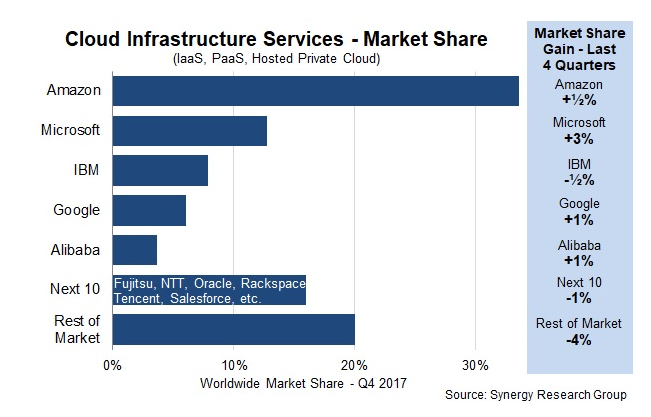
Amazon is the market leader by far with estimates running between 30 and 40 percent of cloud infrastructure as a service marketshare. In a report on fourth quarter cloud revenue, Synergy Research wrote, “AWS maintained its dominant position with revenues that exceeded the next four closest competitors combined, despite huge strides being made by Microsoft .”

Amazon has more than a marketshare advantage, it also has experience implementing large cloud projects for the intelligence community including a $600 million private cloud it built for the CIA in 2013. Of course, Microsoft already has a $927 million contract with the DoD, so this isn’t necessarily a slam dunk for AWS.

With so much drama involved in the size and scope of the project, the president’s anti-Amazon tweets, Congress’s concerns; chances are nobody will be happy with the results except the bid winner. Stay tuned because this isn’t over by a long shot.

We reached out to Amazon, Microsoft and Oracle for comments on this story, but did not hear back by publication. If we hear from them, we will update the story with comments.