What the ‘nonpolitical’ startup leader teaches us about company culture

Deb Muller
Contributor

Deb Muller is founder and CEO of HR Acuity, which creates technology that helps organizations strategically manage employee relations. She has served in executive HR roles at numerous Fortune 500 companies like Honeywell, Citibank, and Marsh and McLennan.

All eyes have recently been on Basecamp, which lost about a third of its workforce at the end of last month after banning “societal and political discussions” at work. Late last year, Coinbase was embroiled in a similar controversy after its CEO declared that political activism at work is a distraction, leading to a smaller but still significant employee exodus.

Before that, controversies erupted at Google, Facebook and other prominent tech firms, leading to virtual employee walkouts and work stoppages. We continue to see headlines that highlight tech company employee revolts over management edicts or perceived policy failures.

These company meltdowns reflect a societal change, and those in the startup community ought to take notice. The strife may be attributable to changing generational expectations in some cases, or an excess of “tech bro” culture in others, but the reality is that things have changed.

“Don’t discuss politics at work” used to be a standard expectation. But employee expectations have shifted, and leaders have to recognize and respond to that.

A generation ago, it was standard policy to keep politics out of work. Today, it’s virtually impossible to separate the political from the personal, and employees are encouraged to bring their whole selves to work, which includes their backgrounds and belief systems.

Political and societal topics impact the everyday lives of employees and the world is more connected than ever. Startup leaders shouldn’t declare a political void — especially if they’re striving for a diverse and inclusive workforce. We’ve seen what happens when we don’t discuss these issues — systemic racism and workplace discrimination are allowed to go unchecked.

I’m the CEO and founder of a growing tech company, and also served as an HR executive at several Fortune 500 companies, which means I’ve seen all sides of the issues at play here.

That gives me some insight on the cultural problems gripping many tech businesses — and some thoughts on solutions. While companies have every right to create rules and policies on employee conduct and internal use of technology, leaders get better results when they approach these issues intentionally and transparently. As we’ve seen with Basecamp and others, banning political activities and discussions outright can result in unintended consequences.

How to change policies without all the drama

It’s impossible to know exactly what caused some of the recent tech company exoduses unless you were there. But most of us have experienced toxic workplace cultures, and having studied the issue extensively as an HR professional and then as a founder, my educated guess is that the recent employee actions that attracted negative media attention are symptoms of a situation that has been simmering for a long time.

If you’re a startup leader who wants to avoid similar controversies, how can you create or change policies without all the drama? Here are some tips to consider:

  • Look in the mirror and analyze culture. People who found successful companies build a culture whether they consciously set out to do that or not. One explanation for cultural growing pains at startups is that many companies unconsciously create a monoculture populated by employees of similar backgrounds, skill sets, attitudes and life experiences. As the company grows, you bring in people with different backgrounds and perspectives to join the group and strengthen the business. But it’s important to remember that company culture and policies need to evolve and mature as the organization grows as well, or conflict will inevitably arise. Leaders can avoid that by being thoughtful about every aspect of the policies they create and adjusting the culture to support all employees, not just those who started on Day One.
  • Get help as your company scales. CEOs set the tone, and for an early-stage startup, policies tend to be less formal and arise directly from company values. But as the organization matures, you may need to codify practices, such as how you handle time off, parental leave and pay structures. Just as you’d turn to the board for financial advice, it’s best to turn to HR and employee relations experts for workplace guidance. Get counsel from HR on how to avoid unintended consequences and communicate changes appropriately. Depending on what kind of policies you’re putting in place, it might also be a good idea to get input from employees.
  • Use employee feedback to understand impact. It’s important to understand what’s going on in your organization before you make policy changes and take other actions that shape the company culture. Collecting employee feedback through surveys and open discussions will allow you to gain visibility into employee priorities and concerns and proceed with greater transparency and decisiveness. Consulting employees before making changes, and even after a policy change, will help you build trust and see if adjustments are needed. Some decisions must be made without staff input; workplaces are not democratic. If possible, try to understand where employees stand so you can better anticipate the impact. One caveat is to not take silence as approval. Just because employees stay after a controversial policy change doesn’t mean they are necessarily OK with it. Many startups put employees in golden handcuffs with benefits or stock options so attractive they “put up with it” for the future payoff. Anonymous surveys will help you understand the sentiment.
  • Don’t capitalize on employee policies for press: It’s not unusual for tech company leaders to publicly issue policy changes to create controversy. Just recently, Coinbase announced a new compensation policy that eliminates negotiations, a decision that is attracting scrutiny. Generally speaking, this practice isn’t necessarily a bad thing; some leaders have used their platforms to change calcified industry standards for the better. But leaders owe it to their teams to be judicious about publicly announcing new policies that affect staff. Employees shouldn’t be used as a pawn to garner press coverage. Employees want changes and programs that are driven by authenticity and what is right for the company, not changes spurred by the news of the week. With Basecamp, the company created an employee-run DEI committee when it was the “thing to do,” but the CEO disbanded it as soon as it became uncomfortable. This type of performative employee support is a surefire way to deteriorate employee confidence and morale. Be thoughtful about decisions and be prepared to stick through it even if challenges arise.

Addressing systemic problems requires a systemic approach

“Don’t discuss politics at work” used to be a standard expectation. But employee expectations have shifted, and leaders have to recognize and respond to that. There is more value to be gleaned from encouraging employees to fully be themselves at work, which helps create an inclusive environment, but it’s also important to know you can’t drop these commitments the minute they become inconvenient.

While startup founders play a leading role, it is also on employees and everyone within the startup community to call out bias or inappropriate behaviors in the workforce and at the leadership level. The reality is that most employees at startups are highly skilled in a job market that values technical talent, putting them in a privileged position to take a risk, speak up or just leave when an organization’s culture is toxic or discriminatory. Their voice and actions will speak volumes for millions of workers who don’t have the ability to walk out the door and risk losing their livelihood — and their next paycheck.

The good news is that several Basecamp employees tried to make a change by suggesting a group focused on diversity. When that effort was shut down, they used their feet to send a message. To drive change, those in positions of privilege and power mustn’t stay silent as bystanders — they have to take a stand for others who aren’t in the position to do so themselves. If all of us harness our privilege to support others who are more vulnerable, we will inevitably create more equitable, welcoming workplaces for everyone.

The turmoil some tech companies are experiencing really comes down to culture and ego. We need to recognize that the old-school “no politics” rule led to situations where systemic racism, sexism and other forms of bigotry festered unchecked. We have an obligation to do better.

Company leaders who acknowledge the direct impact politics can have on employees, engage in open discussions with staff and approach policy changes in a way that reflects the organization’s core values can thrive, even in a divisive political climate.

This $250 million growth fund will divert half its profits to historically Black colleges and universities

There’s been a lot of talk about racial equality in the year since George Floyd was murdered in Minneapolis, but achieving it is far easier said than done given the current state of affairs. Consider: According to the U.S. Government Accountability Office, historically Black colleges and universities have $15,000 on average in endowment per student, while comparable non-HBCUs have $410,000 on average in endowment per student.

That matters, a lot. While higher learning institutions are almost universally focused on diversifying their student base, HBCUs are largely responsible for the nation’s Black middle class, and the larger the endowment, the stronger the school and its ability to support its educators, researchers and, in the case of public HBCUs, its public service mission. Venture capitalist Jamison Hill says that his own father, who attended North Carolina A&T State University in Greensboro, has long maintained that “if it weren’t for that experience, there’s no way he could have gone on to get a high-paying job, where he met my mother, who laid the foundation for the success of our family.”

Hill, who most recently spent more than six years with Bain Capital Ventures, is now doing something to protect that legacy, along with a kind of dream team that features Laura Weidman Powers, who has co-founded or led numerous impact-focused startups and nonprofits, including Code2040; and Luci Fonseca, who helped establish the Institute for Black Economic Mobility at McKinsey & Co. and focused previously on impact investing at Salesforce Ventures.

More specifically, all three have joined the four-year-old venture firm Base10 Partners to invest a new, $250 million growth-stage fund. It’s Base10’s first later-stage vehicle, but it’s not an opportunity fund and follow-on checks aren’t part of the model. Called the Advancement Initiative, the fund’s focus is instead on ringing up meaningful returns by investing in companies on the cusp of going public, then directing half the profits to HBCUs to create student scholarships and support university endowments.

It’s a brilliant play on the part of Base10, a Bay Area outfit that closed its second early-stage fund last year with $250 million in capital commitments. With a mission that is easy to support and gives founders a frictionless way to do good by doing well, the fund has already managed to work checks into eight high-fliers — Attentive, Nubank, Brex, Plaid, Aurora Solar, Wealthsimple, CircleCI and KeepTruckin.

In each case, the fund participated in heavily oversubscribed rounds with the blessing of founders who made room for its capital, as did other investors. (As an added sweetener, Base10 has promised to create scholarships in the name of each of these portfolio companies to fund the education of HBCU STEM students. Think: The Plaid Scholarship, The Brex Scholarship, and so forth.)

It’s certainly a fresh take on how the venture world can help close the racial inequality gap in the U.S., and while it’s not a competition, it could conceivably prove even more effective than other initiatives in the industry, including a bigger push for VCs to diversify their investing ranks.

The fund could be particularly impactful if it inspires copycat efforts. HBCUs confer nearly half of all STEM degrees for African-American students, says Base10, yet all 107 HBCU endowments combined are equal to just 7% of Stanford’s roughly $30 billion endowment.

So how will it work? For now, says Hill, the idea is to operate the fund as any growth-stage fund, meaning the overarching criteria is to back companies with the potential to produce outsize returns, no matter the skin color of their founders. Ultimately, however — “our hope is that this is not one and done,” says Hill — the idea is to drive change even further by layering in requirements about who can receive a check from the outfit.

As for the Advancement Initiative’s returns, some will flow directly back to particular HBCUs because they are limited partners in the fund. These include the private university Howard University in Washington, D.C. and Florida A&M University in Tallahassee, Florida.

Indeed, while the fund’s LPs also include organizations that serve minority communities and mission-oriented foundations, the Advancement Initiative was particularly focused on “removing any barriers to HBCUs investing,” says Weidman Powers, adding that it invited them to invest with “no fees, no minimums, [and] no real closing date.”

The rest of the returns being directed to HBCUs will flow into a donor-advised fund, one’s that focused on increasing financial inclusion for those institutions that don’t currently have endowments large enough to support a private market strategy.

All of this assumes, of course, that there will actually be profits. After all, even the best laid plans don’t always work out. Still, given the late-stage of the companies it is backing, the business models of the companies being pursued (all produce meaningful revenue), and the buzz surrounding them, these bets are about as low risk as it gets in venture capital.

In the meantime, the fund’s pitch is resonating. “We’ve found that a lot of companies are very willing to have a conversation with us,” says Fonseca, who says the idea is to plug between $10 million and $20 million into each of the fund’s portfolio companies.

“The toughest part is just getting in front of the CEO,” she adds. “Once we get in front of that person and we tell that story, we tell them the vision, they’re immediately sold.”

Just 12 hours left to apply to Startup Battlefield at TC Disrupt 2021

We’ve been urging you to apply to Startup Battlefield at TechCrunch Disrupt 2021 for weeks now, and you have just over 12 hours left before the application window slams shut on May 27 at 11:59 p.m. (PT). Don’t procrastinate — the experience alone, whether you win the $100,000 prize or not, can improve the trajectory of your business.

Case in point: Mollie Breen started out as a mathematician at the National Security Agency before co-founding an IoT/OT security startup called Perygee. She and her team competed in Startup Battlefield last year at Disrupt 2020. Although they didn’t reach the finals, Breen has plenty to say about the experience. Here’s what she shared with us in a quick Q&A.

TC: Why did you apply to Startup Battlefield?                                             

Breen: I admired the leadership and growth of other companies that, at one point, were Startup Battlefield contestants. I noticed they had similar traction to us when they applied, and their products resembled ours in their ability to disrupt the respective industry.

TC: What was the training process like?

Breen: It was incredibly valuable both in the short term and long term. Every team gets a weekly session with the Battlefield editor. Together you rehearse and go over every iteration of the pitch line-by-line and slide-by-slide. After each session, I walked away with constructive feedback on everything — the content, the speaking style and even the font color on a particular slide.

This was a unique opportunity, and we put in extra hours to be ahead of schedule, sent drafts for review in the off hours and even doubled down on additional practice with Q&As. As a result, we couldn’t have been more prepared for pitch day. And the training has stayed with Perygee well past the sessions and the competition.

TC: What did it feel like to pitch at Disrupt?

Breen: Pitching at Disrupt was, in some ways, like other pitches except that you have an international audience. Since, at that point, we had practiced our pitch dozens of times, the real unknown during the competition was the Q&A with the VC judges.

There was additional pressure to answer succinctly and convincingly within a time constraint that you wouldn’t have during a normal one-on-one pitch. But with the prep help from the TechCrunch team, I felt ready to speak in front of such a large audience. I encourage anyone who might be nervous about the big stage to go for it and trust you’ll have more than enough preparation when you get there.

TC: What was the post-pitch impact? Did you meet investors, press or other key partners?

Breen: It helped accelerate our progress. Following Battlefield, we closed an oversubscribed fundraising round. We acquired additional beta users, including our first beta user who messaged us after reading about Perygee on TechCrunch. We also gained numerous press opportunities to share our story.

It’s almost a year since Startup Battlefield, and I’m still impressed by how many people start the conversation saying they watched the pitch while reading our company’s background. It’s a reminder that the opportunities created by being a TechCrunch Battlefield company continue.

TC: Do you have any great news to share since your pitch?

Breen: At TechCrunch Battlefield we were a small team doing MVP testing and just about to start raising. Since the pitch, we have scaled on all fronts. We grew the founding team and the engineering team, and we deployed the product to enterprise networks. Some of those deployments include contacts who reached out because of TechCrunch — and we raised our seed round!

TC: Is there anything else you’d like to share?

Breen: I’m grateful for the camaraderie and relationships we developed with the other teams. What you didn’t see on stage during the pitches was all of us cheering one another on from the group chat or social media feed. Even now, we continue to support one another through navigating business questions or promoting product launches. If it weren’t for Startup Battlefield, I would never have met this awesome group of startups.

You have just 24 hours left to channel your inner Mollie Breen. Apply to Startup Battlefield before the deadline expires on May 27 at 11:59 p.m. (PT). Get moving!

The open-source Contributor Covenant is now managed by the Organization for Ethical Source

Managing the technical side of open-source projects is often hard enough, but throw in the inevitable conflicts between contributors, who are often very passionate about their contributions, and things get even harder. One way to establish ground rules for open-source communities is the Contributor Covenant, created by Coraline Ada Ehmke back in 2014. Like so many projects in the open-source world, the Contributor Covenant was also a passion project for Ehmke. Over the years, its first two iterations have been adopted by organizations like the CNCF, Creative Commons, Apple, Google, Microsoft and the Linux project, in addition to hundreds of other projects.

Now, as work is starting on version 3.0, the Organization for Ethical Source (OES), of which Ehmke is a co-founder and executive director, will take over the stewardship of the project.

“Contributor Covenant was the first document of its kind as code of conduct for open-source projects — and it was incredibly controversial and actually remains pretty controversial to this day,” Ehmke told me. “But I come from the Ruby community, and the Ruby community really embraced the concept and also really embraced the document itself. And then it spread from there to lots of other open-source projects and other open-source communities.”

The core of the document is a pledge to “make participation in our community a harassment-free experience for everyone, regardless of age, body size, visible or invisible disability, ethnicity, sex characteristics, gender identity and expression, level of experience, education, socio-economic status, nationality, personal appearance, race, caste, color, religion, or sexual identity and orientation,” and for contributors to act in ways that contribute to a diverse, open and welcoming community.

As Ehmke told me, one part that evolved over the course of the last few years is the addition of enforcement guidelines that are meant to help community leaders determine the consequences when members violate the code of conduct.

“One of the things that I try to do in this work is when people criticize the work, even if they’re not arguing in good faith, I try to see if there’s something in there that could be used as constructive feedback, something actionable,” Ehmke said. “A lot of the criticism for years for Contributor Covenant was people saying, ‘Oh, I’ll say one wrong thing and be permanently banned from our project, which is really grim and really unreasonable.’ What I took from that is that people are afraid of what consequences project leaders might impose on them for an infraction. Put that way, that’s kind of a reasonable concern.”

Ehmke described bringing the Covenant to the OES as an “exit to community,” similar to how companies will often bring their mature open-source projects under the umbrella of a foundation. She noted that the OES includes a lot of members with expertise in community management and project governance, which they will be able to bring to the project in a more formal way. “I’m still going to be involved with the evolution of Contributor Covenant, but it’s going to be developed under the working group model that the organization for ethical source has established,” she explained.

For version 3.0, Ehmke hopes to turn the Covenant into what she described as more of a “toolkit” that will allow different communities to tailor it a bit more to their own goals and values (though still within the core ethical principles outlined by the OES).

“Microsoft’s adoption of Contributor Covenant represents our commitment to building healthy, diverse and inclusive communities, as well as our intention to contribute and build together with others in the ecosystem,” said Emma Irwin, a program manager in Microsoft’s Open Source Program Office. “I am honored to bring this intention and my expertise to the OES’s Contributor Covenant 3.0 working group.”

Facebook co-founder Saverin’s B Capital doubles down on SaaS in China

B Capital Group, the six-year-old venture capital fund formed by Facebook co-founder Eduardo Saverin and Bain Capital veteran Raj Ganguly, is doubling down on China as it looks to allocate $500 million to $1 billion of its fund into Chinese tech companies over the next few years.

With $1.9 billion assets under management, B Capital is going after enterprise software providers in China, an area that has seen “explosive growth” but is still only a “fraction the size of the U.S. SaaS market,” Ganguly said in an interview with TechCrunch.

The idea that Chinese companies are reluctant to shell out for software is “very backward-looking thinking”, he added.

One force fueling the boom of B2B companies in China is surging labor costs. As such, B Capital is hunting down software that could make labor and business operations more productive, and subsequently, give companies a competitive edge. Covid-19 accelerated the shift, as well-digitized companies had proven much more resilient to disruptions caused by the pandemic.

B Capital is able to discern what enterprises need thanks to its close partnership with Boston Consulting Group, which has a raft of customers ranging from healthcare, finance to transportation looking to digitize.

These large corporations “understand that their internal technology can’t be the only solution and they have to look to the outside and be willing to partner with early-stage, high-growth, or late-stage tech companies,” Ganguly suggested. They are also more willing to pay for software compared to scrappy, cash-strapped startups.

B Capital began deploying capital in China early this year and has already closed three deals. It’s stage-agnostic — though growth-stage startups are the focus — and plans to back 15-20 projects in China over the next few years. About 15 of its investment and operating employees are based out of Hong Kong and Beijing. It has around 110 staff worldwide.

Ganguly declined to disclose the names of its Chinese investees at this stage but said they include a biotech company, an automotive parts business, and an e-commerce enabler. Leveraging BCG’s expertise, the biotech company is learning how it can bring actual drugs to market faster. And the automotive business is similarly working with BCG to figure out its pricing and go-to-market strategy.

Going global

Overall, B Capital looks for opportunities in healthcare, fintech, industrial digitalization, and other horizontal enterprise services. Chinese startups that interest B Capital most are also those with the intention and ability to cross borders.

“Biotech is the area that we’ve been the most impressed by what’s happening in China and how that technology can be exported to other countries,” Ganguly said. B Capital has backed one biotech startup with offices in both Shanghai and Cambridge, Massachusettes, and is on track to close a deal with another that also straddles China and the U.S.

The other target is e-commerce, which Ganguly described as “cross-border by its nature” because a product is often sourced in one country, made in another, and then sold in a third market.

The investor is certainly right about the potential of cross-border e-commerce in China, where consumers have a big appetite for imported goods and manufacturers look for new ways to sell globally.

China is also in a good position to export its enterprise software, similar to how Indian counterparts have succeeded overseas, said Ganguly. The difference is that few Indian corporations are willing to pay big bucks for software, which forces B2B entrepreneurs to seek market abroad, whereas China’s domestic companies have an increasing demand for SaaS.

Despite ongoing geopolitical complications, Ganguly is optimistic that the world “is still moving towards globalization” over the long term.

“Certain innovation cycles have started in Silicon Valley and spread to places like China and Southeast Asia. But frankly, other innovation cycles have started in China and gone to South and Southeast Asia and the U.S. We think that China’s enterprise [software], artificial intelligence and biotech are some of the best technology that we’ve seen.”

But these globalizing companies must be able to adapt, hire talent outside their core market, get regulatory approvals, and build the right distribution networks, the investor suggested.

“I think that there are aspects of globalization that have become very politicized, and I think that’s unfortunate but understandable. Our belief is that businesses that we invest in have the ability to cross borders. Sometimes that means going from China to South and Southeast Asia, and sometimes that means extending to the U.S. Sometimes it just means the ability to import or export their products or software, and even staying in China where they can sell their technologies overseas.”

Germany gives greenlight to driverless vehicles on public roads

Germany has adopted legislation that will allow driverless vehicles on public roads by 2022, laying out a path for companies to deploy robotaxis and delivery services in the country at scale. While autonomous testing is currently permitted in Germany, this would allow operations of driverless vehicles without a human safety operator behind the wheel. 

The bill, which last week passed the Bundestag, Germany’s lower house of parliament, specifically looks at vehicles with Level 4 autonomy. Level 4 autonomy is a designation by the Society of Automobile Engineers (SAE) which means the computer handles all the driving in certain conditions or environments. In Germany, these vehicles will be limited to  geographic areas. 

“In the future, autonomous vehicles should be able to drive nationwide without a physically present driver in specified operating areas of public road traffic in regular operation,” reads the legislation. “According to the Federal Government, further steps must be taken to introduce corresponding systems into regular operation so that the potential of these technologies can be exploited and society can participate in them.” 

The bill still needs to pass through the upper chamber of parliament, or the Bundesrat. Included in the bill are possible initial applications for self-driving cars on German roads, such as public passenger transport, business and supply trips, logistics, company shuttles that handle employee traffic and trips between medical centers and retirement homes.

Companies looking to operate commercial driverless vehicles in Germany will need to adhere to a number of other rules, such as carrying liability insurance and having access to stop autonomous operations remotely.

Companies already testing in Germany might have an upper hand in Europe’s largest economy. Argo AI, for example, has been testing its autonomous vehicles at the LabCampus innovation center at Munich Airport. Last June, the company opened its European headquarters in the Bavarian city, and this summer it will open its test site in partnership with Volkswagen to test the VW ID.Buzz electric vans. Intel-subsidiary Mobileye also has a footprint testing AVs in Germany

Several U.S. states and countries have regulations around testing and potentially commercial deployment. Last week, Chinese robotaxi startup Pony.ai became the eighth company to be granted a permit to test driverless vehicles in California, and Nuro is the only company with a deployment permit to operate commercially on public roads in the state. In China, companies like Alibaba-backed AutoX are also testing driverless fleets on public roads. Germany’s legislation is a step beyond testing in the direction of integration into regular traffic. 

Light is the key to long-range, fully autonomous EVs

Nick Harris
Contributor

Nick Harris is a scientist, engineer, and the founder and CEO of Lightmatter, which manufactures photonic processors.

Advanced driver assistance systems (ADAS) hold immense promise. At times, the headlines about the autonomous vehicle (AV) industry seem ominous, with a focus on accidents, regulation or company valuations that some find undeserving. None of this is unreasonable, but it makes the amazing possibilities of a world of AVs seem opaque.

One of the universally accepted upsides of AVs is the potential positive impact on the environment, as most AVs will also be electric vehicles (EVs).

Industry analyst reports project that by 2023, 7.3 million vehicles (7% of the total market) will have autonomous driving capabilities requiring $1.5 billion of autonomous-driving-dedicated processors. This is expected to grow to $14 billion in 2030, when upward of 50% of all vehicles sold will be classified as SAE Level 3 or higher, as defined by the National Highway Traffic Safety Administration (NHTSA).

Fundamental innovation in computing and battery technology may be required to fully deliver on the promise of AEVs with the range, safety and performance demanded by consumers.

While photonic chips are faster and more energy efficient, fewer chips will be needed to reach SAE Level 3; however, we can expect this increased compute performance to accelerate the development and availability of fully SAE Level 5 autonomous vehicles. In that case, the market for autonomous driving photonic processors will likely far surpass the projection of $14 billion by 2030.

When you consider all of the broad-based potential uses of autonomous electric vehicles (AEVs) — including taxis and service vehicles in major cities, or the clean transport of goods on our highways — we begin to see how this technology can rapidly begin to significantly impact our environment: by helping to bring clean air to some of the most populated and polluted cities.

The problem is that AEVs currently have a sustainability problem.

To operate efficiently and safely, AEVs must leverage a dizzying array of sensors: cameras, lidar, radar and ultrasonic sensors, to name just a few. These work together, gathering data to detect, react and predict in real time, essentially becoming the “eyes” for the vehicle.

While there’s some debate surrounding the specific numbers of sensors required to ensure effective and safe AV, one thing is unanimously agreed upon: These cars will create massive amounts of data.

Reacting to the data generated by these sensors, even in a simplistic way, requires tremendous computational power — not to mention the battery power required to operate the sensors themselves. Processing and analyzing the data involves deep learning algorithms, a branch of AI notorious for its outsized carbon footprint.

To be a viable alternative, both in energy efficiency and economics, AEVs need to get close to matching gas-powered vehicles in range. However, the more sensors and algorithms an AEV has running over the course of a journey, the lower the battery range — and the driving range — of the vehicle.

Today, EVs are barely capable of reaching 300 miles before they need to be recharged, while a traditional combustion engine averages 412 miles on a single tank of gas, according to the U.S. Department of Energy. Adding autonomous driving into the mix widens this gap even further and potentially accelerates battery degradation.

Recent work published in the journal Nature Energy claims that the range of an automated electric vehicle is reduced by 10%-15% during city driving.

At the 2019 Tesla Autonomy Day event, it was revealed that driving range could be reduced by up to 25% when Tesla’s driver-assist system is enabled during city driving. This reduces the typical range for EVs from 300 miles to 225 — crossing a perceived threshold of attractiveness for consumers.

A first-principle analysis takes this a step further. NVIDIA’s AI compute solution for robotaxis, DRIVE, has a power consumption of 800 watts, while a Tesla Model 3 has an energy consumption rate of about 11.9 kWh/100 km. At the typical city speed limit of 50 km/hour (about 30 mph), the Model 3 is consuming approximately 6 kW — meaning power solely dedicated to AI compute is consuming approximately 13% of total battery power intended for driving.

This illustrates how the power-hungry compute engines used for automated EVs pose a significant problem for battery life, vehicle range and consumer adoption.

This problem is further compounded by the power overhead associated with cooling the current generation of the power-hungry computer chips that are currently used for advanced AI algorithms. When processing heavy AI workloads, these semiconductor chip architectures generate massive amounts of heat.

As these chips process AI workloads, they generate heat, which increases their temperature and, as a consequence, performance declines. More effort is then needed and energy wasted on heat sinks, fans and other cooling methods to dissipate this heat, further reducing battery power and ultimately EV range. As the AV industry continues to evolve, new solutions to eliminate this AI compute chip heat problem are urgently needed.

The chip architecture problem

For decades, we have relied on Moore’s law, and its lesser-known cousin Dennard scaling, to deliver more compute power per footprint repeatedly year after year. Today, it’s well known that electronic computers are no longer significantly improving in performance per watt, resulting in overheating data centers all over the world.

The largest gains to be had in computing are at the chip architecture level, specifically in custom chips, each for specific applications. However, architectural breakthroughs are a one-off trick — they can only be made at singular points in time in computing history.

Currently, the compute power required to train artificial intelligence algorithms and perform inference with the resulting models is growing exponentially — five times faster than the rate of progress under Moore’s law. One consequence of that is a huge gap between the amount of computing needed to deliver on the massive economic promise of autonomous vehicles and the current state of computing.

Autonomous EVs find themselves in a tug of war between maintaining battery range and the real-time compute power required to deliver autonomy.

Photonic computers give AEVs a more sustainable future

Fundamental innovation in computing and battery technology may be required to fully deliver on the promise of AEVs with the range, safety and performance demanded by consumers. While quantum computers are an unlikely short- or even medium-term solution to this AEV conundrum, there’s another, more available solution making a breakthrough right now: photonic computing.

Photonic computers use laser light, instead of electrical signals, to compute and transport data. This results in a dramatic reduction in power consumption and an improvement in critical, performance-related processor parameters, including clock speed and latency.

Photonic computers also enable inputs from a multitude of sensors to run inference tasks concurrently on a single processor core (each input encoded in a unique color), while a traditional processor can only accommodate one job at a time.

The advantage that hybrid photonic semiconductors have over conventional architectures lies within the special properties of light itself. Each data input is encoded in a different wavelength, i.e., color, while each runs on the same neural network model. This means that photonic processors not only produce more throughput compared to their electronic counterparts, but are significantly more energy efficient.

Photonic computers excel in applications that require extreme throughput with low latency and relatively low power consumption — applications like cloud computing and, potentially, autonomous driving, where the real-time processing of vast amounts of data is required.

Photonic computing technology is on the brink of becoming commercially available and has the potential to supercharge the current roadmap of autonomous driving while also reducing its carbon footprint. It’s clear that interest in the benefits of self-driving vehicles is increasing and consumer demand is imminent.

So it is crucial for us to not only consider the industries it will transform and the safety it can bring to our roads, but also ensure the sustainability of its impact on our planet. In other words, it’s time to shine a little light on autonomous EVs.

Hyundai is launching in-car payments in the all-electric Ioniq 5

Hyundai developed an in-car payment system that will debut in its upcoming all-electric Ioniq 5 crossover that will offer drivers the ability to find and pay for EV charging, food and parking — the latest example of automakers finding new ways to generate revenue and offer customers features that are typically associated with smartphones.

When the vehicle comes to North America in fall 2021, the payments system will launch with Dominoes, ParkWhiz and Chargehub, the company said Monday. The in-car payments system was just one of several new details released during the Ioniq 5’s North American debut.

The payments feature works through Bluelink, Hyundai’s branded connected car system that gives users control over various vehicle functions and services. Bluelink, which requires a subscription, is offered in three different packages that cover areas such as vehicle maintenance and alerts, remote climate control and unlocking and locking as well as destination search. Bluelink also can be linked to a user’s Google Assistant feature on their smartphone to send information to their Hyundai vehicle.

The in-car payments system will eventually expand to include other companies that fall into the charging, food and coffee on-the-go and parking categories. A company spokesperson said Hyundai will continue to add new merchants regularly via the Xevo Marketplace platform.

The Ioniq 5 is the company’s first dedicated battery-electric vehicle built on the new Electric-Global Modular Platform, or E-GMP platform. This platform is shared with Kia and is the underlying foundation of the new EV6.

If the Ioniq name sounds familiar, it’s because it already exists. In 2016, Hyundai introduced the Ioniq, a hatchback that came in hybrid, plug-in hybrid and electric versions. The Korean automaker is using that vehicle as the jumping off point for its new EV brand.

All of the vehicles under the Ioniq brand will have the E-GMP platform. The Ioniq 5 is based on Hyundai’s Concept 45, a monocoque-style body crossover that the company unveiled in 2019 at the International Motor Show in Frankfurt. Designers of the Concept 45 leaned on some of the lines and characteristics from Hyundai’s first concept, the 1974 Pony Coupe. The “45” name comes, in part, from the 45-degree angles at the front and rear of the vehicle.

Hyundai has yet to release pricing for the Ioniq 5.

Florida’s ban on bans will test First Amendment rights of social media companies

Florida governor Ron DeSantis has signed into law a restriction on social media companies’ ability to ban candidates for state offices and news outlets, and in doing so offered a direct challenge to those companies’ perceived free speech rights. The law is almost certain to be challenged in court as both unconstitutional and in direct conflict with federal rules.

The law, Florida Senate Bill 7072, provides several new checks on tech and social media companies. Among other things:

  • Platforms cannot ban or deprioritize candidates for state office.
  • Platforms cannot ban or deprioritize any news outlet meeting certain size requirements.
  • Platforms must be transparent about moderation processes and give users notice of moderation actions.
  • Users and the state will have the right to sue companies that violate the law. Statutory fines could be as high as $250,000 per day for some offenses.

The law establishes rules affecting these companies’ moderation practices; that much is clear. But whether doing so amounts to censorship — actual government censorship, not the general concept of limitation frequently associated with the word — is an open question, if a somewhat obvious one, that will likely be forced by legal action against SB 7072.

While there is a great deal of circumstantial precedent and analysis, the problem of “are moderation practices of social media companies protected by the First Amendment” is as yet unsettled. Legal scholars and existing cases fall strongly on the side of “yes,” but there is no single definitive precedent that Facebook or Twitter can point to.

The First Amendment argument starts with the idea that although social media are very unlike newspapers or book publishers, they are protected in much the same way by the Constitution from government interference. “Free speech” is a term that is interpreted extremely liberally, but if a company spending money is considered a protected expression of ideas, it’s not a stretch to suggest that same company applying a policy of hosting or not hosting content should be as well. If it is, then the government is prohibited from interfering with it beyond very narrow definitions of unprotected speech (think shouting “fire” in a crowded theater). That would sink Florida’s law on constitutional grounds.

The other conflict is with federal law, specifically the much-discussed Section 230, which protects companies from being liable for content they publish (i.e. the creator is responsible instead), and also for the choice to take down content via rules of their own choice. As the law’s co-author Senator Ron Wyden (D-OR) has put it, this gives those companies both a shield and a sword with which to do battle against risky speech on their platforms.

But SB 7072 removes both sword and shield: It would limit who can be moderated, and also creates a novel cause for legal action against the companies for their remaining moderation practices.

Federal and state law are often in disagreement, and there is no handbook for how to reconcile them. On one hand, witness raids of state-legalized marijuana shops and farms by federal authorities. On the other, observe how strong consumer protection laws at the state level aren’t preempted by weaker federal ones because to do so would put people at risk.

On the matter of Section 230 it’s not straightforward who is protecting whom. Florida’s current state government claims that it is protecting “real Floridians” against the “Silicon Valley elites.” But no doubt those elites (and let us be candid — that is exactly what they are) will point out that in fact this is a clear-cut case of government overreach, censorship in the literal sense.

These strong legal objections will inform the inevitable lawsuits by the companies affected, which will probably be filed ahead of the law taking effect and aim to have it overturned.

Interestingly, two companies that will not be affected by the law are two of the biggest, most uncompromising corporations in the world: Disney and Comcast. Why, you ask? Because the law has a special exemption for any company “that owns and operates a theme park or entertainment complex” of a certain size.

That’s right, there’s a Mouse-shaped hole in this law — and Comcast, which owns Universal Studios, just happens to fit through as well. Notably this was added in an amendment, suggesting two of the largest employers in the state were unhappy at the idea of new liabilities for any of their digital properties.

This naked pandering to local corporate donors puts proponents of this law at something of an ethical disadvantage in their righteous battle against the elites, but favor may be moot in a few months’ time when the legal challenges, probably being drafted at this moment, call for an injunction against SB 7072.

Zocdoc says ‘programming errors’ exposed access to patients’ data

Zocdoc says it has fixed a bug that allowed current and former staff at doctor’s offices and dental practices to access patient data because their user accounts weren’t properly decommissioned.

The New York-based company revealed the issue in a letter to the California attorney general’s office, which requires companies with more than 500 residents of the state affected by a security lapse or breach to disclose the incident. Zocdoc confirmed that around 7,600 users across the U.S. are impacted by the security incident.

Zocdoc, which lets prospective patients book appointments with doctors and dentists, said that it gives each medical or dental practice usernames and passwords for its staff to access appointments made through Zocdoc, but that “programming errors” — essentially a software bug in Zocdoc’s own systems — “allowed some past or current practice staff members to access the provider portal after their usernames and passwords were intended to be removed, deleted or otherwise limited.”

The letter confirmed that patient data stored in Zocdoc’s portal could have been accessed, including a patient’s name, email address, phone number, and the times and dates of their appointments, but also other data that may have been shared with the practice — such as insurance details, Social Security numbers and details of the patient’s medical history.

But Zocdoc said payment card numbers, radiological or diagnostic reports, and medical records were not taken, since it does not store this data.

In an email, Zocdoc spokesperson Sandra Glading said that the company discovered the bug in August 2020, but “due to the complexity of the code, it took a significant amount of investigation to determine which, if any, practices and users were affected and how.” The company said it provided notice to the California’s attorney general’s office “as soon as was practicable.”

Zocdoc said it has “detailed logs that can detect exploitation of any data, including any potential exploitation of this vulnerability,” and that after a review of those logs and other investigative work, “we have no indication, at this time, that any personal information was misused in any way.”

Around 6 million users access Zocdoc a month, the company said.

If this incident sounds vaguely familiar, it’s because this was a near-identical security issue to one Zocdoc reported in 2016. A letter filed at the time cited similar “programming errors” that allowed staff at medical providers to improperly access patient data.

Daily Crunch: Police search 2 Twitter offices in India after politician receives warning label

To get a roundup of TechCrunch’s biggest and most important stories delivered to your inbox every day at 3 p.m. PDT, subscribe here.

Welcome back to Daily Crunch. It’s Monday, May 24, and all I can think about is how much I want a Surface Duo now that it can do two-screen gaming. And one of those new iMacs. I don’t need either, of course, but that doesn’t stop my coveting both of the gadgets. Alas.

Regardless, it was a super busy start to the week, with lots of startup funding rounds, more in the long-running saga of governments trying to control social media platforms, even more IPO news and the latest troubles with Tesla. Let’s cut the chatter and dive in. — Alex

The TechCrunch Top 3

  • Governments vs. Tech: Indian police tied to the central government showed up at two different Twitter offices today, in what appeared to be an intimidation effort following Twitter’s decision to not unlabel a tweet from a member of the current ruling party as manipulated media.

A few things here. First, India is not alone in trying to force social media companies to behave as local governments want them to. That said, what the current Indian government is doing is particularly egregious and doesn’t bode well for the country’s tech ecosystem as a whole.

  • Tesla owes Norway: American electric car darling Tesla appears to be in hot water with Norway after a “Norwegian conciliation council” ordered the company to pay $16,000 each to thousands of Model S owners after “it found that a software update led to longer charging times.” Ouch. Tesla will have to sell lots of American regulatory credits to cover that loss. Norway is a key market for EVs.
  • U.S. cities buy abuse-linked tech: From the “you should read this” files, the latest report from our own Zack Whittaker and IPVM states that “at least a hundred U.S. counties, towns and cities have bought Chinese-made surveillance systems that the U.S. government has linked to human rights abuses.” Not good.

Startups and VC

As always we’re picking and choosing the best rounds from the day, so feel free to scrounge around the blog if you need even more!

Solidus Labs raises $20M for crypto-snooping: As the value of cryptocurrencies rose in the past year, so too did business at Solidus Labs, which detects “volume and price manipulation” among bitcoin and its brethren. Per its CEO, Asaf Meir, his company saw a “400% increase in inbound demand over 2020.” That sounds about right. Also, Solidus should drop a monthly report on the level of manipulation on every exchange and crypto. That would rule.

Fireflies.ai raises $14M to record, transcribe and connect your meetings: Former Acceleprise company Fireflies is building software that will record and transcribe your meetings, and then connect the text — and perhaps the embedded tasks — to other bits of software. It’s interesting, and growing like a weed. So Khosla helped put $14 million into it.

Mono raises $2M to power African fintech: From building the Plaid for Africa to “power the internet economy in Africa,” Mono is not short on vision. And now it has had its accounts refreshed to pursue its plans to “[streamline] various financial data in a single API for companies and third-party developers.” APIs are cool. Fintech is cool. Fintech APIs are extra cool. That’s our take.

Flat6Labs raises $13.2M to fund Egyptian startups: This is fund news, but it’s small enough that it fits inside the startup section today. In short, since 2011 Flat6Labs has been an accelerator in Egypt and Tunisia. And now it has a new checkbook to play with.

Inside Zeta Global’s IPO: Finally from the startup world today, Zeta Global is going public. It’s an offering that could set the tone for the martech world for some time to come. So, we dug into its numbers a bit tardily to figure out just what Zeta has that public investors might want.

When to walk away from a VC who wants to invest in your startup

Ofri Ben-Porat flew from London to NYC to meet potential investors, but at the last minute, one canceled, claiming illness. Moments later, he received a DocSend push notification informing him that said VC had just opened the pitch deck he’d sent days before.

Undeterred, he showed up anyway and pretended he hadn’t received their email. The discussion went well; after he flew home, the VCs offered pre-terms and due diligence, “but ultimately, I didn’t feel right taking money from them,” says Ben-Porat.

Securing the right amount of funding at the right moment can make or break a startup, but founders who can’t identify red flags — or worse, ignore them — will live to regret it.

(Extra Crunch is our membership program, which helps founders and startup teams get ahead. You can sign up here.)

Big Tech Inc.

What has a zillion hands and likes to copy its friends? Facebook! This time, however, Facebook could be doing something interesting. TechCrunch dug through some creator-friendly feature work that Big Blue is putting into its TikTok clone. So it’s still running the copy machine at full tilt, just with a few upgrades.

Turning back to Apple, not everything is M1 chips and purple iPhones. Some things are less good at the Cupertino-based technology leviathan. Today TechCrunch reported on a few different macOS vulnerabilities that, frankly, don’t sound good. What’s the old adage? Buy a PC; they just work?

In happier Apple news, the company has a pile of new software updates for your enjoyment, especially if you are an iPhone or iPad user.

Don’t fret, Microsoft fans, we have something for you as well. Namely a review of the new Surface Laptop 4. It’s pretty darn good, keeping all its predecessor’s weaknesses and strengths, with new guts.

Wrapping, ByteDance has another chart-topping app; Airbnb is doubling down on guest flexibility, though we have questions; SiriusXM is partnering with TikTok on a new channel; and SensorTower is making sure that there is at least some M&A to report on.

TechCrunch Experts: Email Marketing

Intellect illustration

Image Credits: Getty Images

TechCrunch Experts is still collecting survey responses to help us identify the top email marketers in tech!

At this time, we’re not looking for self-nominations — we’re only seeking nominations from clients. We want to hear all about your experience and how you found the right expert for your needs. Fill out the survey here.

We’re excited to move this project forward. Visit techcrunch.com/experts to find out more!

TC Eventful

Last year, we held our first dedicated space startup event, TC Sessions: Space, featuring some of the industry’s top founders and leaders, including Rocket Lab’s Peter Beck, Lockheed Martin’s Lisa Callahan, Amazon’s Dave Limp, NASA’s Kathy Lueders and many more. This year, we’re excited to announce we’re doing it again with TC Sessions: Space 2021, happening virtually December 14-15.

TC Sessions: Mobility 2021 is right around the corner of your calendar (June 9). If you want to place your ground-breaking, edge-cutting, envelope-pushing (no extra charge for clichés) early-stage startup in front of the world’s leading mobility movers, shakers and makers you gotta hustle. You have just one week left to buy one of our remaining three Startup Exhibitor Packages.

Lordstown Motors slashes production forecast for its electric pickup

Lordstown Motors’ cash-rich SPAC dreams have turned out to be nothin’ more than wishes. The automaker reported Monday a disappointing first-quarter earnings that was a pile-up of red-ink-stained negativity.

Lowlights include higher-than-expected forecasted expenses, a need to raise more capital and lower-than-anticipated production of its Endurance vehicle this year — from around 2,200 vehicles to just 1,000. In short, the company is set to consume more cash than the street expected and is further from mass production of its first vehicle than promised.

The value of the company, which went public via a SPAC last year, has fallen sharply from its post-combination highs. Today its shares are off another 7% after the close of trading, thanks to its Q1 2021 report.

Investors were not thrilled with the company that 11 months ago showed off a prototype of Endurance, the all-electric pickup truck that it has bet its future on.

Lordstown Motors is an offshoot of CEO Steve Burns’ other company, Workhorse Group, a battery and electric transportation technology company that is also a publicly traded company. Workhorse is a small company that was founded in 1998 and has struggled financially at various points. Its offshoot, Lordstown Motors, has previously said it planned 20,000 electric trucks annually, starting in the second half of 2021, at the former GM Assembly Plant in Lordstown, Ohio. Lordstown Motors acquired in November the 6.2 million-square-foot factory from GM.

Production woes, capital concerns

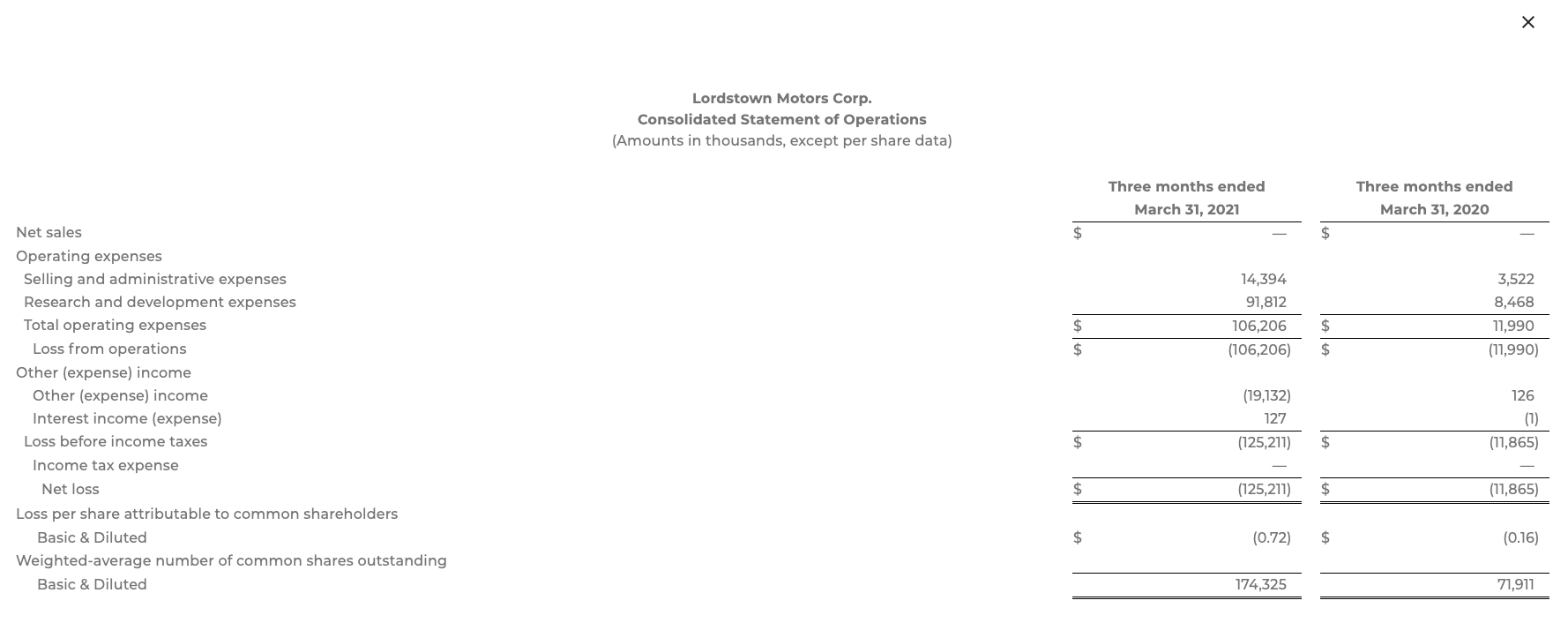
Lordstown reported a $125 million net loss on zero revenue, along with capital expenditures of $53 million in the first quarter. And yet, Lordstown had little to show for its outsized spending.

The company said in a release that it would still begin production of its Endurance electric pickup truck this year but that its output “would be at best 50% of our prior expectations.” That fact on top of its massive cash drawdown was hardly investor catnip.

“Our research indicates a very robust demand for our vehicles,” Burns told investors during a call Monday. “However, capital may limit our ability to make as many vehicles as we would like, and as such, we are constantly evaluating our capital needs and the various types of capital available to us, including strategic capital.”

The EV company anticipates ending 2021 with just $50 million to $75 million in liquidity, despite its recent SPAC combination that helped capitalize its operations. Lordstown finished 2020 with $630 million in cash; it wrapped Q1 2021 with $587 million. The company anticipates “capital expenditures of between $250 [million] and $275 million,” in addition to its regular cash consumption from operating costs.

Burns said the company was in discussions with an unnamed financial entity for asset-backed financing.

“We have zero debt and we have a lot of assets, and we’re buying a lot of parts. So there’s folks that want to finance that,” he said. Lordstown is also still pursuing an Advanced Technology Vehicles Manufacturing loan from the U.S. Department of Energy. Executives said DOE has done several rounds of due diligence but declined to comment on the timing, though Burns said multiple times that Tesla wouldn’t exist had it not gotten an ATVM loan in January 2010.

For post-combination SPAC companies, Lordstown’s lackluster results and bearish trading are yet more indication that the boom in using blank-check agreements to take EV and other automotive-focused companies public was perhaps premature.

Lordstown announced its SPAC merger in September 2020 with a market value of $1.6 billion. Its shares soared to $31.80 apiece at their 52-week highs. Today they are worth $8.77.

Burns lauded the company’s purported competitive advantages, including its hub motor architecture and physical simplicity, which he said would translate into a lower cost of ownership. But the company has stiff competition from new EV entrants Rivian and Tesla (should the Cybertruck ever hit production) and legacy automakers like Ford, which debuted the electric model of its nameplate F-150 truck model earlier this month with a price point under $40,000.

But Burns reiterated his feeling that the company was on par with its competitors and that it wants to be “ready to pounce” in response to vehicle demand. The CEO also said he was confident that the truck would hit the 250-mile target range, though this is less than both the Rivian R1T and the Ford F-150 Lightning.

Lordstown also gave a brief update on preorders following its announcement in January that it hit a milestone of 100,000 preorders. Burns said around 30,000 of those had been converted to what it’s calling “vehicle purchase agreements,” but he demurred on exactly how many of those customers have paid anything, saying only that “many of those” agreements, included some kind of down payment.

The company also began work on its second vehicle, an electric van, with a prototype anticipated later this summer.

Financial results

Turning to Lordstown’s first quarter performance, we’re observing a pre-revenue company in the weeds of testing and scaling production for an incredibly complex product. Which is an expensive endeavor.

Here’s the chart:

Lordstown Q1 2021

Image Credits: Lordstown

The company’s greater-than-before sales and administrative costs are whatever compared to its spiraling research and development spend. For investors holding onto Lordstown shares in hopes of its eventual early construction runs leading to mass production that is now further in the future, it’s a tough income statement to digest.

In the first quarter of 2021 the company spent around $91,000 in research and development expenses. “The higher than expected R&D spend is largely from higher part costs from a supply chain that remains under duress, from collocations, and which impacted our beta costs, higher costs of shipping included expedited shipping and greater use of temporary external engineering,” Lordstown CFO Julio Rodriguez said.

Company executives also briefly addressed accusations by short seller Hindenburg Research, who claimed the automaker was faking preorders of its vehicles. Hindenburg said that “extensive research reveals that the company’s orders appear largely fictitious and used as a prop to raise capital and confer legitimacy.”

Burns told investors that the company established a special independent committee to investigate the allegations in the report. This is in addition to a separate investigation from the U.S. Securities and Exchange Commission, which the company is cooperating with, he said.

In the wake of Lordstown’s results, however, shares of Tesla and Nikola were largely flat.

Flush with $42M, hot AI startup Faculty plans to hoover up more PhDs… and steer clear of politics

In the wake of the news that U.K.-based AI startup Faculty has raised $42.5 million in a growth funding round, I teased out more from CEO and co-founder Marc Warner on what his plans are for the company.

Faculty seems to have an uncanny knack of winning U.K. government contracts, after helping Boris Johnson win his Vote Leave campaign and thus become prime minister. It’s even helping sort out the mess that Brexit has subsequently made of the fishing industry, problems with the NHS and telling global corporates like Red Bull and Virgin Media what to suggest to their customers. Meanwhile, it continues to hoover up PhD graduates at a rate of knots to work on its AI platform.

But, speaking to me over a call, Warner said the company no longer has plans to enter the political sphere again: “Never again. It’s very controversial. I don’t want to make out that I think politics is unethical. Trying to make the world better, in whatever dimension you can, is a good thing … But from our perspective, it was, you know, ‘noisy,’ and our goal as an organization, despite current appearances to the contrary, is not to spend tonnes of time talking about this stuff. We do believe this is an important technology that should be out there and should be in a broader set of hands than just the tech giants, who are already very good at it.”

On the investment, he said: “Fundamentally, the money is about doubling down on the U.K. first and then international expansion. Over the last seven years or so we have learned what it takes to do important AI, impactful AI, at scale. And we just don’t think that there’s actually much of it out there. Customers are rightly sometimes a bit skeptical, as there’s been hype around this stuff for years and years. We figured out a bunch of the real-world applications that go into making this work so that it actually delivers the value. And so, ultimately, the money is really just about being able to build out all of the pieces to do that incredibly well for our customers.”

He said Faculty would be staying firmly HQ’d in the U.K. to take advantage of the U.K.’s talent pool: “The U.K. is a wonderful place to do AI. It’s got brilliant universities, a very dynamic startup scene. It’s actually more diverse than San Francisco. There’s government, there’s finance, there are corporates, there’s less competition from the tech giants. There’s a bit more of a heterogeneous ecosystem. There’s no sense in which we’re thinking, ‘Right, that’s it, we’re up and out!’. We love working here, we want to make things better. We’ve put an enormous amount of effort into trying to help organizations like the government and the NHS, but also a bunch of U.K. corporates in trying to embrace this technology, so that’s still going to be a terrifically important part of our business.”

That said, Faculty plans to expand abroad: “We’re going to start looking further afield as well, and take all of the lessons we’ve learned to the U.S., and then later Europe.”

But does he think this funding round will help it get ahead of other potential rivals in the space? “We tend not to think too much in terms of rivals,” he says. “The next 20 years are going to be about building intelligence into the software that already exists. If you look at the global market cap of the software businesses out there, that’s enormous. If you start adding intelligence to that, the scale of the market is so large that it’s much more important to us that we can take this incredibly important technology and deploy it safely in ways that actually improve people’s lives. It could be making products cheaper or helping organizations make their services more efficient.”

If that’s the case, then does Faculty have any kind of ethics panel overseeing its work? “We have an internal ethics panel. We have a set of principles and if we think a project might violate those principles, it gets referred to that ethics panel. It’s randomly selected from across faculty. So we’re quite careful about the projects that we work on and don’t. But to be honest, the vast majority of stuff that’s going on is very vanilla. They are just clearly ‘good for the world’ projects. The vast majority of our work is doing good work for corporate clients to help them make their businesses that bit more efficient.”

I pressed him to expand on this issue of ethics and the potential for bias. He says Faculty “builds safety in from the start. Oddly enough, the reason I first got interested in AI was reading Nick Bostrom’s work about superintelligence and the importance of AI safety. And so from the very, very first fellowship [Faculty AI researchers are called Fellows] all the way back in 2014, we’ve taught the fellows about AI safety. Over time, as soon as we were able, we started contributing to the research field. So, we’ve published papers in all of the biggest computer science conferences Neurips, ICM, ICLR, on the topic of AI safety. How to make algorithms fair, private, robust and explainable. So these are a set of problems that we care a great deal about. And, I think, are generally ‘underdone’ in the wider ecosystem. Ultimately, there shouldn’t be a separation between performance and safety. There is a bit of a tendency in other companies to say, ‘Well, you can either have performance, or you can have safety.’ But of course, we know that’s not true. The cars today are faster and safer than the Model T Ford. So it’s a sort of a false dichotomy. We’ve invested a bunch of effort in both those capabilities, so we obviously want to be able to create a wonderful performance for the task at hand, but also to ensure that the algorithms are fair, private, robust and explainable wherever required.”

That also means, he says, that AI might not always be the “bogeyman” the phrase implies: “In some cases, it’s probably not a huge deal if you’re deciding whether to put a red jumper or a blue jumper at the top of your website. There are probably not huge ethical implications in that. But in other circumstances, of course, it’s critically important that the algorithms are safe and are known to be safe and are trusted by both the users and anyone else who encounters them. In a medical context, obviously, they need to be trusted by the doctors and the patients need to make sure they actually work. So we’re really at the forefront of deploying that stuff.”

Last year the Guardian reported that Faculty had won seven government contracts in 18 months. To what does he attribute this success? “Well, I mean, we lost an enormous number more! We are a tiny supplier to government. We do our best to do work that is valuable to them. We’ve worked for many, many years with people at the home office,” he tells me.

“Without wanting to go into too much detail, that 18 months stretches over multiple prime ministers. I was appointed to the AI Council under Theresa May. Any sort of insinuations on this are just obviously nonsense. But, at least historically, most of our work was in the private sector and that continues to be critically important for us as an organization. Over the last year, we’ve tried to step up and do our bit wherever we could for the public sector. It’s facing such a big, difficult situation around COVID, and we’re very proud of the things we’ve managed to accomplish with the NHS and the impact that we had on the decisions that senior people were able to undertake.”

Returning to the issue of politics I asked him if he thought — in the wake of events such as Brexit and the election of Donald Trump, which were both affected by AI-driven political campaigning — AI is too dangerous to be applied to that arena? He laughed: “It’s a funny old funny question… It’s a really odd way to phrase a question. AI is just a technology. Fundamentally, AI is just maths.”

I asked him if he thought the application of AI in politics had had an outsized or undue influence on the way that political parties have operated in the last few years: “I’m afraid that is beyond my knowledge,” he says. But does Faculty have regrets about working in the political sphere?

“I think we’re just focused on our work. It’s not that we have strong feelings, either way, it’s just that from our perspective, it’s much, much more interesting to be able to do the things that we care about, which is deploying AI in the real world. It’s a bit of a boring answer! But it is truly how we feel. It’s much more about doing the things we think are important, rather than judging what everyone else is doing.”

Lastly, we touched on the data science capabilities of the U.K. and what the new fundraising will allow the company to do.

He said: “We started an education program. We have roughly 10% of the U.K.’s PhDs in physics, maths, engineering, applying to the program. Roughly 400 or so people have been through that program and we plan to expand that further so that more and more people get the opportunity to start a career in data science. And then inside Faculty specifically, we think we’ll be able to create 400 new jobs in areas like software engineering, data science, product management. These are very exciting new possibilities for people to really become part of the technology revolution. I think there’s going to be a wonderful new energy in Faculty, and hopefully a positive small part in increasing the U.K. tech ecosystem.”

Warner comes across as sincere in his thoughts about the future of AI and is clearly enthusiastic about where Faculty can take the whole field next, both philosophically and practically. Will Faculty soon be challenging that other AI leviathan, DeepMind, for access to all those PhDs? There’s no doubt it will.

2 CEOs are better than 1

Thomas Asseo
Contributor

As co-CEO, Thomas Asseo oversees the strategic direction of Fresh n’ Lean in distributing thousands of meals for active lifestyle consumers. Before joining the company, he rose to the top of the auto racing ladder system.

Netflix has two CEOs: Co-founder Reed Hastings oversees the streaming side of the company, while Ted Sarandos guides Netflix’s content.

Warby Parker has co-CEOs as well — its co-founders went to college together. Other companies like the tech giant Oracle and luggage maker Away have shifted from having co-CEOs in recent years, sparking a wave of headlines suggesting that the model is broken.

It’s impossible to be in two places at once or clone yourself. With co-CEOs, you can effectively do just that.

While there isn’t a lot of research on companies with multiple CEOs, the data is more promising than the headlines would suggest. One study on public companies with co-CEOs revealed that the average tenure for co-CEOs, about 4.5 years, was comparable to solitary CEOs, “suggesting that this arrangement is more stable than previously believed.”

The study’s authors also found that co-CEOs were spread across industry types and that splitting the role can “complement each other in terms of educational background or executive responsibilities.”

I serve as co-CEO of an organic meal delivery company with my sister Laureen. Having two CEOs has helped us take Fresh n’ Lean to new heights. We closed 2020 with $87 million in revenue, more than double from the year before, and project similar growth this year.

We complement each other well, and the results bear that out. During the decade that we’ve served as co-CEOs, the company has grown from a very small team to 475 full-time employees and 40 part-time employees. We’ve delivered more than 17 million meals, launched four different meal lines, expanded our retail offerings, partnered with some great names in sports and fitness, and saw our annual revenues climb exponentially.

The leadership structure isn’t for every company, but it’s been a great fit for Fresh n’ Lean. Here’s why.

Divide and conquer to shorten your learning curve by 50%

Laureen launched the company in 2010 out of her one-bedroom apartment.

“Those early years were especially tough,” she said. “I consistently worked 20-hour days as I performed just about every role — cooking dishes, preparing labels, making deliveries and performing customer service duties. I was devoting so much energy into product, packaging and logistics, but in order for the company to grow, I needed help with marketing, tech and finance.”

Those areas happened to be my strengths. There was too much for one person to oversee as CEO and not enough hours in the day. But given the equal challenges that both sides of the company presented and the trust we shared, it made sense for us to be side by side on the organizational chart.