Waymo van involved in serious collision in Arizona

A Waymo self-driving vehicle was involved in a serious accident in Chandler, Arizona earlier this afternoon. Local police  said there were minor injuries from the incident after a sedan swerved into the Waymo van to avoid another collision.

Although Waymo has said it will be testing vehicles without safety drivers in Arizona, this was not one of them. An operator was in the driver’s seat at the time of the crash, though the car was in autonomous mode, police said.

Aerial footage and images posted online by onlookers show that this was no fender-bender. The sedan’s front crumple zone is wrecked and glass is broken; the van is in better shape, though its front right tire is crushed in. Both vehicles have since been towed.

Reportedly the sedan was traveling eastbound and swerved to avoid another car at an intersection, straying into the westbound lanes and hitting the Waymo van. What actions if any the latter took to avoid the collision are unknown at this time, though an analysis by the company would of course provide that info. I’ve asked the company for comment and will update if I hear back.

Update: The police provided me with the following statement, which doesn’t add much but confirms the above:

We are currently investigating a minor injury collision involving two vehicles, one of which is a Waymo autonomous vehicle. This afternoon around noon a vehicle (Honda sedan) traveling eastbound on Chandler Blvd. had to swerve to avoid striking a vehicle traveling northbound on Los Feliz Dr. As the Honda swerved, the vehicle continued eastbound into the westbound lanes of Chandler Blvd. & struck the Waymo vehicle, which was traveling at a slow speed and in autonomous mode. There was an occupant in the Waymo vehicle sitting in the driver’s seat, who sustained minor injuries. Both the Waymo vehicle & the Honda were towed from the scene. This incident is still under investigation

Waymo has also provided the following statement and video of the accident from the van’s point of view:

Today while testing our self-driving vehicle in Chandler, Arizona, another car traveling in an oncoming lane swerved across the median and struck our minivan.

Our team’s mission is to make our roads safer – it is at the core of everything we do and motivates every member of our team.

We are concerned about the well-being and safety of our test driver and wish her a full recovery.

Update: NASA’s InSight Mars lander lifts off

Update: The Atlas V rocket lifted off on-time and is currently eleven minutes into the second stage of the flight, the booster having separated successfully…

LIFTOFF! Humanity’s next mission to Mars has left the pad! @NASAInSight heads into space for a ~6 month journey to Mars where it will take the planet’s vital signs and help us understand how rocky planets formed. Watch: https://t.co/SA1B0Dglms pic.twitter.com/wBqFc47L5p

NASA (@NASA) May 5, 2018

My fairings open like petals on a flower and let my Centaur upper stage coast through space for a few minutes. Launch blog: https://t.co/50dnoQSHB8

— NASAInSight (@NASAInSight) May 5, 2018

Update 2: The rocket has now entered orbit, and the long coast phase. Despite the fog, it’s a smooth lift off so far for the first interplanetary launch from the US West Coast, seventeen minutes in…

Main engine cutoff (MECO) is confirmed. Watch as @ULALaunch’s #AtlasV rocket continues to propel @NASAInSight on its journey to Mars: https://t.co/SA1B0Dglms #InSight pic.twitter.com/YjCuQ0dhRB

— NASA (@NASA) May 5, 2018

Update 3: The last phase of the launch mission has passed off without a hitch as the Mars Cube One (MarCO) mini-spacecraft have launched from dispensers mounted on the Centaur — beginning the six-month long journey to Mars…

I'm on my own now. Separation from the upper stage of my #AtlasV rocket is confirmed. This marks the beginning of my 6-month journey to #Mars. See launch blog: https://t.co/50dnoQSHB8 pic.twitter.com/aQjGnvUvAc

— NASAInSight (@NASAInSight) May 5, 2018

Original story follows below… 

Night owl? Good news — there’s an historic rocket launch early tomorrow morning that you can catch while the rest of the country is sleeping. NASA’s InSight Mars lander is scheduled for takeoff at 4:05 AM Pacific, weather permitting. You can watch it live at the links below.

InSight is launching atop an Atlas V rocket with a Centaur for the orbital stage, operated by United Launch Alliance. After a six-month trip through space, the mission is to discover the secrets lying deep within the Red Planet using sensitive seismographs and a temperature probe that will bore into the surface. There’s also a pair of CubeSats hitching a ride to test how tiny spacecraft will perform outside Earth’s orbit.

It’s historic not just because it’s an awesome Mars lander that will teach us about the formation of our rocky neighbor and Earth itself, but because this is the first time an interplanetary mission has taken off from the west coast of the country. It’s launching from Vandenberg air base, between Santa Barbara and San Luis Obispo (a couple hours north of LA, for those not familiar with Californian geography).

“If you live on the California Central Coast or south to L.A. and San Diego, be sure to get up early on May 5th, because Atlas V is the gold standard in launch vehicles and it can put on a great show,” said Kennedy Space Center launch director Tim Dunn in a NASA news release.

It’s launch week for @NASAInSight! Launch on #AtlasV is planned for 4:05amPDT on Saturday, May 5. Are you in SoCal? Here’s where the launch may be visible for you. pic.twitter.com/Pyncff3V1V

— ULA (@ulalaunch) April 30, 2018

That all depends on the weather, of course. The dreaded marine layer lies heavy on the coast, and that means visibility will be extremely low. But as coastal Californians know, waiting for it to go away is a good way to waste a whole day. NASA can’t wait that long — the rocket needs to go off when this side of the planet is facing the right direction, of course. So Range Safety may waive the eyes-on visibility requirement for launch, provided all other telemetry systems are working normally.

Going from launch to orbit will take about 13 minutes, at which time InSight will wait for about an hour, and then a final burn will send it on its way to Mars. The whole process should take about 93 minutes.

So if you’re up tomorrow in the predawn hours, check out the launch either at NASA’s stream or at the YouTube hosted one that should appear here half an hour or so before launch.

Pandora shares up 8% after surprise earnings beat

Pandora’s quarterly earnings report was music to investor’s ears.

The digital radio platform reported a better-than-expected first quarter report after the bell on Thursday, sending shares up 8% in after-hours trading.

Wall Street liked that the company showed a sizable increase in subscriber revenue, posting $104.7 million, a 63% increase from last year. Pandora has 5.63 million paid listeners, up 19% from the same timeframe in 2017.

By contrast, Apple Music says it has 40 million subscribers and Spotify has 75 million, so Pandora is a distant third in terms of paid users.

But the competition is already reflected in Pandora’s stock price. It closed Thursday at $5.75, which is up a buck for the past month. It’s also substantially beneath the $37 per share that the stock was trading at in 2014. Its market cap is currently $1.45 billion.

In addition to subscribers, Pandora makes money from its unpaid users via ads. The company had 72.3 million active listeners, bringing in $319.2 million in revenue. Analysts had expected $304.3 million.

Its adjusted loss per share was 27 cents, well above the negative 38 cents that Wall Street forecast.

“Pandora is exactly where we want to be: at the center of a growing market with huge potential,” said Roger Lynch, CEO of Pandora, in a statement.


Flaw in global energy facility software shows critical infrastructure risks

Critical infrastructure worries in the U.S. and abroad are far from over. This week, security firm Tenable published research demonstrating a vulnerability affecting two software programs used by global energy management company Schneider Electric. The company’s systems are in place in facilities across North America, Western Europe and Asia.

Before publishing its research, Tenable notified Schneider Electric, allowing the company to patch its software vulnerabilities in early April while issuing guidance for affected plants to update their systems.

“There’s no doubt the discovery of this severe vulnerability comes at a time when critical infrastructure security is top-of-mind for organizations and government agencies everywhere,” Tenable Chief Product Officer Dave Cole said in a statement. Cole noted that this vulnerability exists at the relatively new intersection of IT and operational technology.

Tenable describes the flaw, present in InduSoft Web Studio and InTouch Machine Edition, as a remote code execution vulnerability possible when an overflow condition is triggered in the software.

As Tenable explains, that loophole could allow malicious code to be executed, granting hackers high-level access in any facility running the affected software:

A threat actor could send a crafted packet to exploit the buffer overflow vulnerability using a tag, alarm, event, read or write action to execute code.

The vulnerability can be remotely exploited without authentication and targets the IWS Runtime Data Server service, by default on TCP port 1234. The software implements a custom protocol that uses various ‘commands.’ This vulnerability is triggered through command 50, and is caused by the incorrect usage of a string conversion function.

The vulnerability, when exploited, could allow an unauthenticated malicious entity to remotely execute code with high privileges.

Critical infrastructure attacks are on the rise, and the results can be devastating. And while compromising a nuclear facility or power grid can result in exceptional consequences, the attacks generally follow the same rulebook that hackers use to compromise other, less high-consequence systems.

“It’s important to keep in mind that attackers are generally after one thing — access. Once they obtain it, their primary goal is typically to make sure long-term access can be maintained,” Ben Johnson, CTO and co-founder of Obsidian Security told TechCrunch.

“… If they compromise devices associated with critical infrastructure, they will find themselves with all kinds of leverage. So any flaw that makes obtaining access easier is a serious concern.”

Spotify tests consumer interest in a bundle with both Hulu and Scribd’s audiobooks

In April, Spotify and Hulu teamed up on a discounted bundle of both of their services for $12.99 per month, following a similar deal for students launched last fall. Now, it seems, the streaming service is considering expanding its entertainment bundle offerings to include one with Scribd’s audiobooks service, too.

In a consumer survey that recently popped up in Spotify’s mobile app, the company asks a lot of questions about audiobooks — and more specifically, about a bundle with Spotify, Hulu and Scribd combined.

.@Spotify to offer @hulu or @Scribd in addition to the premium plan ? pic.twitter.com/pW1ijxEbLE

— Kevin Natanzon (@kevntz) May 3, 2018

The survey begins with questions about media consumption habits involving reading or listening to non-music content — like if the customer had listened to an audiobook or podcast in the past three months, or if they’ve read a physical book, magazine or e-book.

It then asks the customer how they listen to audiobooks, how often and using which format — downloads, borrowing, CDs or subscriptions.

In a question about subscriptions, Spotify asks, “Which is your main audiobook subscription service taht you use?”

The survey taker can then choose from: Playster, Scribd, Amazon Prime, Downpour, Otto, Audiobooks.com, Kindle unlimited, Audible, Kobo and Other. 

But the most interesting question is the one where Spotify tries to get a feel for consumer interest in a Spotify/Hulu/Scribd bundle.

The bundle, the survey explains, would add an additional $2.99 per month on top of the existing Spotify Premium for Family subscription, which currently costs $14.99. Like the Hulu/Spotify deal, it would offer access to Hulu’s Limited Commercials plan along with a Premium subscription to Spotify — in this case, however, its family plan. But for an extra $2.99 per month — bringing the total to $17.98 per month — the customer would receive 1 free book credit per month from Scribd’s library of audiobooks. (Scribd usually is $8.99 per month for unlimited books).

These audiobooks would be ad-free and could be listened to offline, the survey notes.

Of course, a survey question doesn’t mean that a deal currently exists or is being offered to customers. It doesn’t even mean Spotify will follow through by offering a deal with Scribd. But it is an interesting signal about Spotify’s plans — especially given its recent partnership with Hulu, and its earlier comments about exploring different bundles in the future, which were made after its first bundle launched.

The issue facing Hulu and Spotify’s services — and Scribd as well, for that matter — is a war with platform giants like Amazon, Apple and Google, which are already bundling streaming services for music, video and, in Amazon’s case, books, magazines and audiobooks, and a host of other perks via Amazon Prime.

Apple, too, is exploring a magazine subscription service, according to reports; and its upcoming over-the-top TV service is expected to be bundled with Apple Music. Google, meanwhile, is planning a revamp of its music subscription service, which will incorporate YouTube video.

That means rivals like Spotify, Hulu and Scribd will have to fight back with deals of their own — and maybe even consolidation efforts through M&A at some point.

Reached for comment, a Spotify spokesperson responded, “We continuously test new products and features to better the on platform experience for our users. This is not an indication of an upcoming partnership at this time.” 

At this time. Yep. Noted.

Ex-Volkswagen CEO charged for role in diesel emission scandal

A year and change after the car maker pleaded guilty to obstructing investigations and importing cars under false pretenses, Volkswagen’s former CEO Martin Winterkorn has been charged with conspiracy and wire fraud in a U.S. court. All of this stems from a diesel emissions scandal that ultimately found VW paying $4.3 billion in penalties.

Winterkorn stepped down from his role at Volkswagen in September of 2015, only a matter of days after the German car maker confessed to outfitting 11 million cars with a device designed to cheat at emissions testing.

Winterkorn is the highest ranking of a number of former executives named in an indictment unsealed by U.S. courts today. Initial claims by VW had suggested that the cheating was only known by lower-level executives, but the indictment suggests that the former CEO was alerted to the situation as far back as 2014.

”The indictment of Winterkorn alleges that he was informed of VW’s diesel emissions cheating in May 2014 and again in July 2015,” the Justice Department said in a statement issued today. “The indictment further alleges that Winterkorn, after having been clearly informed of the emissions cheating, agreed with other senior VW executives to continue to perpetrate the fraud and deceive U.S. regulators.

The scandal has continued to plague the automaker. Last month, CEO Matthias Müller stepped down from the CEO role three years after replacing Winterkorn.

A group of public radio companies acquires podcast app Pocket Casts

NPR, WNYC Studios, WBEZ Chicago and This American Life announced today that they’ve acquired Pocket Casts, a podcast app created by Australian developer Shifty Jelly.

That might sound like a lot of owners for one app, but the idea is to run Pocket Casts as a joint venture. And while former iHeartRadio executive Owen Grover is becoming CEO, NPR says the existing Pocket Casts team will remain in place, with founders Philip Simpson and Russell Ivanovic holding leadership roles in the company.

All four of the acquirers have released their own apps already, but buying Pocket Casts should give them another way to become more involved in distribution and reach listeners directly. (This seems to be a growing concern among all public radio organizations — in 2016, public radio marketplace PRX spun out a for-profit company called RadioPublic to focus on mobile apps.)

At the same time, NPR says Pocket Casts will continue to offer podcasts from a wide variety of producers.

Laura Walker, president and CEO of New York Public Radio (which includes WNYC Studios), said in the announcement:

Public radio has been at the vanguard of audio innovation and podcasting, bringing in new listeners, experimenting with new forms and topics, fostering engagement and community, and cultivating new talent in the industry. And yet despite this remarkable renaissance, the listening experience — particularly around discovery — has remained virtually unchanged. Pocket Casts will enable us to forge a closer relationship with our listeners, provide audiences with more ways to enjoy audio programming, and create a more tailored discovery experience that helps listeners find their next must-listen podcast.

You should change your Twitter password right now

Yes, it’s that time again — password changing time. On Thursday, Twitter revealed that a bug caused the platform to store user passwords in unmasked form. Normally, sensitive personal data like passwords would be stored in hashed form using a mix of letters and numbers to protect the content of the password itself. In this instance, it sounds like Twitter stored plain text passwords openly without any hashing on an internal log.

We recently found a bug that stored passwords unmasked in an internal log. We fixed the bug and have no indication of a breach or misuse by anyone. As a precaution, consider changing your password on all services where you’ve used this password. https://t.co/RyEDvQOTaZ

— Twitter Support (@TwitterSupport) May 3, 2018

Twitter notes that it currently has “no reason to believe password information ever left Twitter’s system” or that these unprotected passwords were accessed by hackers, but the risk of the unknown remains. The company has advised users to change their passwords as a precautionary measure.

Here’s what Twitter says happened:

We mask passwords through a process called hashing using a function known as bcrypt, which replaces the actual password with a random set of numbers and letters that are stored in Twitter’s system. This allows our systems to validate your account credentials without revealing your password. This is an industry standard.

Due to a bug, passwords were written to an internal log before completing the hashing process. We found this error ourselves, removed the passwords, and are implementing plans to prevent this bug from happening again.

We’ve reached out to Twitter for more details on the bug and additional information about how this could have happened. Update: Twitter declined to provide additional technical details on the incident but emphasized that is believes the likelihood that the passwords were discoverable is “extremely low” and an internal investigation has revealed no indications of a breach or other misuse.

It’s pretty unusual for a company of this size to make such a basic security mistake, but that’s just another reason for users to take password protection into their own hands. Now is the perfect time to start using two-factor authentication and a password manager like LastPass or 1Password to keep your account credentials safe even when the platforms you use fail to do so.

Wear OS gets more Google Assistant features ahead of I/O

I/O doesn’t actually kick off until next Tuesday, but Google’s been steadily trickling out news this week. Perhaps it’s priming the pump for next week’s big event, or maybe the company just had more news than it could cram into a couple of keynotes. Whatever the case, today brought some new additions to the wearable operating system formerly known as Android Wear.

It’s hard to say how much energy Google is going to put into Wear OS in the coming week, but in the meantime, it’s getting some solid Assistant updates. The pairing of the two offerings is a no brainer, of course. Siri’s proven an important driver for Apple Watch, and a workaround for the whole small screen issue.

Google added its own Assistant to Android Wear last year, and is continuing to refine the experience with some key updates. At the top of the list is smart suggestions, which offers followup questions based on context. Ask Google what the weather is, and it will offer up followups for additional days’ forecasts.

Assistant’s wrist worn counterpart can also offer up voice answers through a pair of connected headhones. The update, which is rolling out over the next week or so will also bring Actions to the wearable OS, meaning much more more third-party control. Now users can, say, preheat an LG smart oven from the comfort of their own wrist.

There’s nothing really earth shattering here, but it’s nice to see Google continuing to give Wear OS a little love ahead of I/O. The operating system has failed to make much headway as the wearable category has seemingly plateaued for everyone who isn’t Apple at this point. Hopefully the company will have even more to show off on that front next week.

New York City report pins millions in rent hikes on Airbnb

A report from the New York City Comptroller’s office asserts that New York residents are paying hundreds of millions in extra rent linked to the effects of Airbnb . Naturally, the company bitterly rejects these findings.

The report, which you can read here, is fairly straightforward. It looks at hundreds of neighborhoods and their various demographics and characteristics, along with how much their rents rose over the last 10 years or so. It finds that when controlling for other variables, Airbnb contributes to a part of the rise on its own:

We find that as the share of units listed on Airbnb goes up by one percentage point, rental rates in the neighborhood go up by 1.58 percent, after controlling for neighborhood level demographic and economic changes. The result is statistically significant at the 1-percent level.

By the researchers’ calculations, the total cost of these increases across the city amounted to about $616 million. That came from running their numbers with Airbnb rentals set to zero instead of the actual tens of thousands of listings and seeing what rents would be in that alternative universe.

The amounts of rent increases and the number of Airbnb listings are tightly and reliably correlated, the Comptroller’s office explained. They were careful to control for other factors, for instance a neighborhood becoming trendy or new housing changing the supply. The hypothesis is that Airbnb listings, contrary to the company’s assertions, do in fact reduce housing supply, which has a knock-on effect on rent in remaining rentals.

The increases, the report and its accompanying press release say, are concentrated in midtown and lower Manhattan, where 20 percent of the rent increases were attributed to Airbnb effects. The effect was much weaker in the outer boroughs, as you might expect, where density is lower and fewer listings are available.

Airbnb, of course, calls it a pack of lies and takes the opportunity to pontificate a bit (which, to be fair,  Comptroller Stringer did too):

Unfortunately, this report is wrong on the facts, falsely asserting that middle class New Yorkers who share their space are responsible for the rising cost of housing in New York… Pandering to the powerful by attacking middle class families won’t do a thing to make New York more affordable. It’s time to stop the scapegoating and work with us on a solution.

Its criticisms are a mix of reasonable objections and straw men. It rightly points out, for instance, that Airbnb hosts are most frequently just renting out a room a few nights a month for some extra income, which logically should improve affordability, not harm it. Then there’s the idea that Airbnb units tend to pop up in fashionable areas, which are inherently more likely to see rents increase.

Some of Airbnb’s gripes are less reasonable, however.

“The notion that less than 1 percent of housing stock — much of which is only occasionally shared with short-term renters — is the sole source of New York’s housing affordability challenge is simply not credible,” the company writes. That’s true — which is probably why the report doesn’t say anything like that.

“We never blamed the whole increase in housing costs on one factor – we quite clearly said that Airbnb was just one factor and explained that it’s 9.2% of the increase,” wrote Tyrone Stevens, the Comptroller’s press secretary, in an email to TechCrunch.

Airbnb also criticizes using 2009 as the starting year for its data, saying the financial crisis changed the whole housing market. Then it cites a report showing that a one bedroom in Williamsburg cost the same in 2018 as it did in 2011.

“We picked 2009 as our base year because that was the year prior to Airbnb’s presence in NYC, and it made sense to measure the full impact of the rise of Airbnb. But the choice of base year is utterly irrelevant to measuring the contribution of Airbnb to rent increases,” Stevens wrote. “And randomly picking an industry report on 1-bedroom apartments in one neighborhood over a different time period doesn’t refute a citywide analysis.”

The fact that rents are leveling out lately doesn’t hold much water, either — arguably that might have occurred sooner but for Airbnb’s alleged contribution to their increases in the first place.

Ultimately the difference comes down to whether or not Airbnb effectively removes housing from the market. The company swears up and down that isn’t the case, and cites user numbers to support that position. The city says there’s little other possible explanation for the close correlation between listings in certain neighborhoods and the specific rent increases it sees in them.

Both, however, seem to agree that the lack of regulation puts everyone at risk. Hopefully that common ground will lead to a fruitful collaboration on new rules in the future.

Update: Airbnb has filed a Freedom of Information Law request for “any and all communications regarding the conception and development” of the report, which it calls a “snow job” and alleges “was influenced by powerful special interests,” namely the hotel industry.

Instagram quietly launches payments for commerce

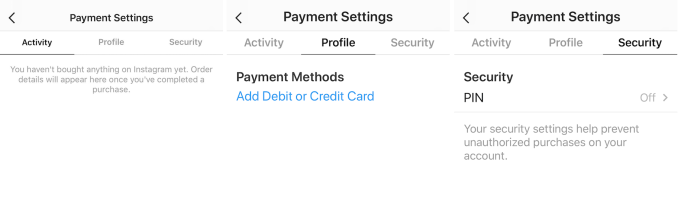
Get ready to shop the ‘Gram. Instagram just stealthily added a native payments feature to its app for some users. It lets you register a debit or credit card as part of a profile, set up a security pin, then start buying things without ever leaving Instagram. Not having to leave for a separate website and enter payment information any time you want to purchase something could make Instagram a much bigger player in commerce.

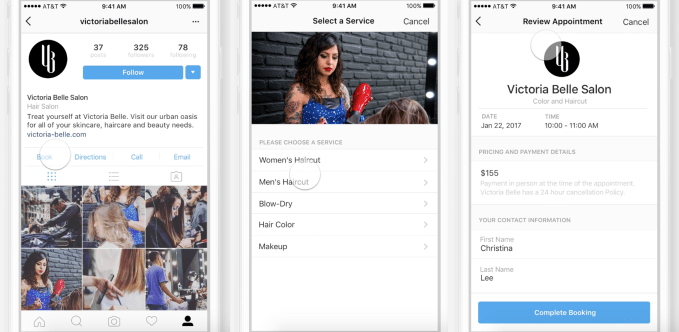
TechCrunch reader Genady Okrain first tipped us off to the payment feature. When we asked Instagram, a spokesperson confirmed that native payments for booking appointments like at restaurants or salons is now live for a limited set of partners.

One of the first equipped is dinner reservation app Resy. Some of its clients’ Instagram Pages now offer this native payment for booking. And in the future, Instagram says you can expect direct payments for things like movie tickets through the app. Instagram initially announced in March 2017 that “we’ll roll out the ability to book a service with a business directly from their profile later this year,” but never mentioned native payments.

Instagram’s native appointment booking

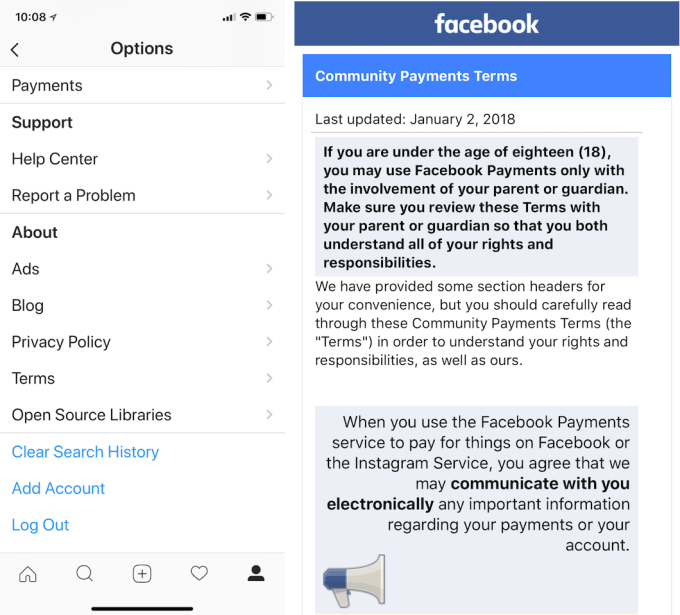
We’ve confirmed that the payment settings are now visible; some, but not all, users in the U.S. have it while at least some in the U.K. don’t. A tap through to the terms of service reveals that Instagram Payments are backed by Facebook’s Payments rules.

With its polished pictures and plethora of brands, shopping through Instagram could prove popular and give businesses a big new reason to advertise on the app. If they can get higher conversion rates because people don’t quit in the middle of checkout as the fill in their payment info, brands might prefer to push people to buy via Instagram.

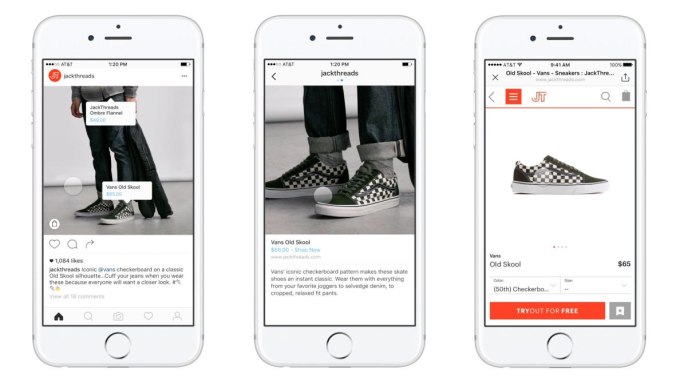
Instagram’s existing Shoppable Tags feature forces you out to a business’ website to make a purchase, unlike the new payments feature

Facebook started dabbling in native commerce around 2013, and eventually started rolling out peer-to-peer payments through Messenger. But native payment for shopping is still in closed beta in the chat app. It’s unclear if peer-to-peer payments might come to Instagram, but having a way to add a credit or debit card on file is a critical building block to that feature.

It’s possible that the payments option will work with Instagram’s “Shoppable Tags,” which first started testing in 2016 to let you see which products were in a post and tap through to buy them on the brand’s site. Since then, Instagram has partnered with storefront platforms BigCommerce and Shopify to get their clients hooked up, and expanded the feature to more countries in March. For now, though, none of Instagram’s previous shopping feature partners like Warby Parker or Kate Spade let you checkout within Instagram, and still send you to their site.

But the whole point of Instagram not allowing links in captions is to keep you in a smooth, uninterrupted browsing flow. Getting booted out to the web to buy something broke that. Instagram Payments could make impulse buys much quicker, enticing more businesses to get on board. Even if Instagram takes no cut of the revenue, brands are likely to boost ad spend to get their shoppable posts seen by more people if the native payments mean more of them actually complete a purchase.

Instagram isn’t the only one who sees this potential. Snapchat started testing its own native payments and checkout feature in February.

Scaleway launches updated cloud servers for $2.40 per month

French cloud hosting company Scaleway announced new servers for its cloud offering. While the company’s offering was already quite cheap, Scaleway is going one step further with prices starting at €1.99 per month (around $2.40 per month).

For this price, you get an x86 server with 1 core, 1GB of RAM, 25GB of SSD, 100Mbit/s of bandwidth with unlimited transfer. For twice that price, you get twice the specs, etc. There are four tiers for this new Start1 cloud server lineup.

And for the first time, Scaleway is using NVMe for its SSD storage. NVMe is a storage protocol that is supposed to be much faster than SATA when it comes to handling read and write instructions on your storage drive. It was designed for SSDs, and that’s what the iMac Pro is using now. Scaleway is also using DDR4 to improve RAM performance.

Overall, Scaleway says that you should see a 50 percent performance increase per core. These new servers are available in the data center in Paris and soon in Amsterdam.

In addition to those new servers, Scaleway is launching hot snapshots in beta. With that feature, you can take a snapshot of your virtual machine while it’s running. You can then boot up another server with the exact same snapshot for instance. It opens up a lot of possibilities for automation and backup.

The company also recently promised a better ImageHub with more updates. For instance, the new Long Term Support version of Ubuntu that was released a few weeks ago is now available for most servers. Scaleway also supports Terraform to orchestrate your cloud infrastructure.

Existing x86 cloud servers are getting phased out. High-end x86 cloud servers and ARMv8 cloud servers are sticking around. Bare-metal ARMv7 and x86 servers are also still available.

Scaleway is the cloud hosting division of Iliad, one of the main internet service providers in France. The division recently got a new influx of cash to go to the next level. After those product updates, you can expect internationalization moves in the coming months.