Amazon Sumerian, a platform for building AR, VR and 3D apps, is now open to all

Last November, AWS announced a new product called Amazon Sumerian, a toolkit and platform for developers to build “mixed reality” apps — that is, using virtual reality, augmented reality and 3D — without needing to have any specialised programming or graphics skills. And today, after running the service in a private beta for the last several months, Sumerian is now generally available.

In addition to being able to build a mixed reality app, you can also deploy it without writing custom code, Amazon says. The web-based editor also integrates with Amazon Lex for natural language and AI, Polly to turn text into speech, AWS Lambda for running code, AWS IoT to connect with Amazon’s IoT platform, and Amazon DynamoDB if you are running a NoSQL database. It supports WebGL and WebVR and Oculus Rift, HTC Vive, iOS and Android ARCore. Support for the new Oculus Go is coming, AWS said.

AWS has made huge strides in building out its cloud business, where developers, startups and much larger and mature organizations use the company’s infrastructure to host apps and other services, in what looks to be on track to be a $20 billion business this year. More recently, Amazon has been looking at ways of expanding its reach (and revenues) with these companies by offering a deeper range of services running within the cloud. Amazon Sumerian is a part of that strategy.

As Kyle Roche, the GM of Amazon Sumerian, described it, the company saw a gap in the market between the rise of new VR, AR and 3D tech, and a huge pool of organizations that might want to use that technology, but either lack the expertise and resources to do so, or would like to test something out before dedicating those resources more seriously.

“We are targeting enterprises who don’t have the talent in-house,” he said. Tackling new tech can sometimes be “too overwhelming, and this is one way of getting inspiration or prototypes going. Sumerian is a stable way to bootstrap ideas and start conversations. There is a huge business opportunity here.”

He said that early users in the closed beta have included a company developing training for medical devices, Mapbox building a framework for geospatial rendering, a business designing a walk-through a hotel lobby, e-sports companies, and some media and entertainment properties.

Adam Schouela, the VP of Fidelity Labs, said that the financial services giant has been working on a range of potential applications, including solutions to train its customer relations teams, ways of visualising financial modelling, and services for its customers to discover and use Fidelity’s services.

“What we try to do is look at emerging tech and rapidly build prototypes for Fidelity and the financial services industry,” he told TechCrunch.  We’ve done a lot of work in the voice interfaces and user interfaces with AR and VR. When we saw what Sumerian was providing and potential integration between voice interfaces and VR, we thought this was a great opportunity. With voice interfaces one of the great use cases is when your eyes and hands are otherwise busy. With VR, it’s stuck to face and you can’t see and your hands are busy so voice happens to be a great way of interacting with virtual environments.”

A demo of one of Fidelity’s services is here:

Google’s Pixel Buds learn some new tricks

I/O may have ended, but Google’s still trickling out news at a steady rate. The latest update comes from one of the more unexpected corners of the Googleverse. Pixel Buds, the company’s hotly anticipated and lukewarmly received bluetooth headphones are getting a nice software update.

In a blog post today, the company highlighted some new features that should help make the earbuds a bit more well-rounded.

At the top of the list is improved bluetooth pairing. It’s not a hardware upgrade, so users may still run into some of the issues the product got dinged for early on, but not it’s a lot easier to switch between synced hardware. Choosing Pixel Buds from the drop down menu on a connected computer will swap the connection from the current to new device.

The headphones are also getting a couple new touch gestures. Triple tapping the right earbud will turn the headphones on and off, while double tapping will skip a song to the next track. Though that second gesture requires going into the Pixel Buds settings inside the Google Assistant app to enable.

All of those updates are rolling out to users starting today. None are earth shattering, exactly, but they should make the Pixel Buds experience a bit better for those who’ve already plunked down the $160 for Google’s wireless headphones.

Blogger gets a spring cleaning

Blogger, the blogging platform Google acquired back in 2003, is somehow still alive and kicking, even though few people remember it still exists. But alive it is — and it’s even getting some updates to its Google+ integration that will see all those 20 people still on Google+ rejoice.

After a year of inactivity, Blogger’s own news blog sprung to live this morning with a brief update that lays out the changes. Google calls this a “spring cleaning,” and we all know what that means: shutting down features.

You probably don’t care, but gone from Blogger are support for third-party gadgets, the Next Blog feature and the polling widget. Soon, OpenID support will be gone, as well, and Textcube.com is also shutting down. What is Textcube.com, you ask? It’s a Korean blogging service Google acquired back in 2008.

But there are also new features, which I’m guessing the sole two engineers still working on this project slaved over for the last year.

Blogger’s Google+ widget integration (yes, try not to laugh) will be transformed into HTML widgets to “give you more flexibility in how you share and see your followers.” Fifteen years after acquiring the service, Blogger now also supports logging in with multiple accounts. Google also today noted that the Blogger infrastructure has moved to Cloud Spanner, Google’s newest database service. 

In the near future, you can expect a new video management feature, too. Exciting stuff.

It’s surprising that Blogger is still around. I can’t remember the last time I saw a Blogger site in my searches, and it sure doesn’t have a lot of mindshare. Google also has let the platform linger and hasn’t integrated it with any of its newer services. The same thing could be said for Google+, too, of course. Google cuts some services because they have no users and no traction. That could surely be said for Blogger and Google+, but here they are, still getting periodic updates. I think the writing is on the wall, though, and I wouldn’t expect them to survive the next major Google spring cleaning.

Sarah Guo breaks through at Greylock, becoming one of the first female general partners in the firm’s 53-year history

Sarah Guo didn’t necessarily set out to become a venture capitalist. She certainly didn’t imagine she would become one of the first female general partners at one of the oldest venture firms in the country. Yet Guo is both of these things today. Indeed, the venture firm Greylock Partners, which Guo joined five years ago as a principal, is announcing her promotion this morning.

Greylock, which closed its current (15th) fund with $1 billion in October 2016, now has eight general partners and four venture partners altogether.

For Guo, the appointment caps a lifetime spent in the world of startups. Before joining Greylock, she worked as an analyst at Goldman Sachs, where she led much of the bank’s coverage of business-to-business tech companies and advised public clients, including Twitter, Netflix, Zynga and Nvidia.

A graduate (for both her undergraduate degree and MBA) of the University of Pennsylvania, Guo also worked previously at Casa Systems, a 15-year-old tech company that develops a software-centric networking platform for cable and mobile service providers and that — in a twist that we think is pretty neat — was founded by her parents. (Her father, CEO Jerry Guo, took the company public earlier this year.)

In a conversation earlier this week, Guo said that growing up around entrepreneurship gave her an “understanding of how difficult” starting a company truly is. It also occurred to her early on that “something related to company building was what I wanted to do in the future.”

Guo also said that not much will change with her promotion. Broadly speaking, she focuses on B2B applications and infrastructure, cybersecurity, AI, AR and healthcare. She already sits on the boards of several companies, including the security startup Obsidian, which was founded by ex-Cylance and Carbon Black execs last year and quickly raised $9.5 million, led by Greylock.

She said she does hope to mentor more up-and-coming investors like herself, however.

Guo first became acquainted with Greylock through Aneel Bhusri, then a partner at Greylock and the co-founder and CEO of the software giant Workday. The two talked occasionally when Guo was covering internet and software startups at Goldman, and he’d encouraged her to meet some of his venture partners, she said. “I came in, not necessarily ready to be in venture forever. But I’m now very excited about it obviously,” she added with a laugh.

Guo’s other deals to date include Aware Networks, a 15-year-old, Buffalo Grove, Ill.-based company that develops collaboration applications for mobile communities, and a still-unannounced company.

We didn’t talk about the fact that Guo just became one of Greylock’s first female general partners, but it’s very much worth mentioning, considering the firm was founded in 1965.

Greylock had lost another senior female investor — Sarah Tavel — to Benchmark last year. Tavel was the first female general partner at Greylock; she went on to become Benchmark’s first female GP.

Altogether, women still represent just 15 percent of decision makers at Silicon Valley’s major venture capital firms. Their ranks are growing slowly, however.

Meanwhile, many other investors are choosing to launch their own female-founded venture firms. Among the newest of these is Breakout Ventures and a fund we reported on last night that’s being created by life sciences investor Beth Seidenberg, long of Kleiner Perkins.

Correction: This story briefly mischaracterized Guo as Greylock’s first female GP. Based on the nomenclature used by Greylock, we were under the impression that Tavel was a partner but not a general partner — a seemingly small but important distinction within venture firms. Tavel had been hired at the GP level at Greylock, we’re told.

Canal+ gives up on its cable box, switches to Apple TV

French premium cable television company Canal+ is slowly moving away from building its own set top boxes. As Next INpact spotted, you can now subscribe to Canal+ and get an Apple TV 4K with Canal+’s myCanal app already preloaded.

Canal+ has been around for decades and was the first premium TV channel in France. Over the years, the company started distributing all sorts of premium channels through satellite, cable and partnerships with internet service providers.

While you had to get your own Canal+ set top box to receive Canal+ 15 years ago, the company’s own box has slowly become irrelevant. As all the main French internet service providers give you a set top box, Canal+ has partnered with them to offer multiple add-ons to receive Canal+’s content.

When Canal+ announced its most recent device, Canal+ already said that you’d get a better experience with the myCanal app on the Apple TV.

That’s why Canal+ is betting everything on over-the-top distribution. If you don’t subscribe to Canal+ through your ISP, you can get an Apple TV 4K for €6 per month in addition to your TV package. If your internet connection isn’t fast enough or you’d rather use satellite TV, you can still get a Canal+ set top box.

But the writing is on the wall. Most people will soon watch Canal+ through myCanal on Android TV, tvOS, iOS, Android, a Samsung TV and desktop computers.

In France, Molotov and myCanal have been some of the top performing apps for tvOS and Android TV. This partnership could boost the Apple TV in France.

AT&T’s DirecTV Now live TV service launches a DVR, upgrades the app with new features

AT&T’s over-the-top streaming service for cord cutters, DirecTV Now, is finally beginning to roll out its cloud DVR feature – a year and a half after its launch. The DVR has been in testing since last year, with AT&T in seemingly no hurry to push out the feature that’s since become a baseline for live TV services, including YouTube TV, Hulu with Live TV, Sling TV and others. In fact, AT&T’s DVR remains in beta today, the company says. But it is now broadly available iOS and tvOS users, along with the launch of several other features, including support for additional streams, an expanded on-demand library, and more access to local channels when traveling.

The DVR – which AT&T calls the “True Cloud DVR” – will offer users 20 hours of free recording, support for fast forward and rewind, and the ability to store shows for up to 30 days. This is far less storage than what beta testers had – they could save up to 100 hours of recordings. As it turns out, AT&T will make expanded storage a paid upgrade. Later this summer, users can opt to pay $10 per month more to save 100 hours of shows for up to 90 days, the company says.

The larger DVR isn’t the only paid upgrade becoming available. Users can also now choose to pay for an additional, third stream for $5 per month.

In addition, DirecTV Now is introducing a new look and feel for its app across platforms. The redesign prioritizes users’ most-watched shows and favorites, and allows you to watch your current stream while browsing for other things to watch.

This new look is rolling out today to iOS and tvOS users, plus supported web browsers, and will hit Android, Fire TV and Roku devices in the weeks ahead.

The revamped app also includes more on-demand content, with over 25,000 titles now available for on-demand viewing, and new episodes on some channels becoming available on-demand right after airing, AT&T says. And users will be able to access their local channels, like ABC, CBS, FOX and NBC, when they’re away from their home market.

The changes to DirecTV Now are critical for AT&T to remain competitive, as they come at a time when the company’s video business is shrinking, in terms of revenue.

But the losses on AT&T’s traditional TV front are currently being offset by the DirecTV Now net new customers. In the past quarter, the service added 312,000 more customers to reach 1.46 million total subscribers. Rival Dish, meanwhile, didn’t offset its pay TV losses this past earnings, with its 91,000 Sling TV adds – though that service is ahead of AT&T’s in total subscribers. Hulu and YouTube TV don’t break out their live TV numbers, but are reportedly angling for third place. 

Starting a robotics company out of school? Not so fast, suggest investors

Every once in a while, a college student or recent graduate dares to launch a robotics startup and . . . everything goes as well as could be expected. Such is the case, for example, with Alex Rodrigues and Brandon Moak, two former University of Waterloo students who worked on self-driving technologies together in college and formed their now venture-backed, self-driving truck company, Embark, instead of graduating. (Originally called Varden Labs, the startup’s trip through Y Combinator undoubtedly helped.)

Still, to capture the sustained interest of robotics investors, it helps to either have experience in a particular industry or to pull in someone, quickly, who does. That much was established yesterday at UC Berkeley, when three veteran investors — Renata Quintini of Lux Capital, Rob Coneybeer of Shasta Ventures, and Chris Evdemon of Sinovation Ventures — took the stage of a packed Zellerbach Hall to talk about where they’ve invested previously, and where they are shopping now.

Though the three expressed interest in a wide range of technologies and plenty of optimism about what’s to come, each lingered a bit on one point in particular, which was the difficulty robotics founders face who are completely unfamiliar with the particular industry they may hope to reshape with their innovation.

You can catch the entire interview below, but we  thought college students — and their professors and mentors — might want to pay particularly close attention to this concern if they’re thinking about hitting up investors in the not-too-distant future.

Quintini on how comfortable she and her colleagues at Lux are when it comes to backing recent college graduates:

What we care the most about what is your unique insight and what do you know about tackling a certain market or problem that’s not obvious or easy to replicate. In some cases, it’s very fair for someone right out of university who finds a technological breakthrough and . . . that breakthrough alone is understandable and comprehensible to the market and it’s a very backable company, and we’ve done that in the past.

But in some cases, and you’ve heard today, [CEO] Patrick [Sobalvarro] from Veo Robotics speak — and [Veo is] actually giving robotic arms perception sensors to allow people and robots to work together — all his insights came because he came from industry. He was at Rethink Robotics; he’s been in the robotics industry, selling to people who use robots as part of the manufacturing process. And so he actually understands the importance of safety and the selling of those systems to customers. Because he knew that, it made a big difference in how he approaches his go-to-market strategy and how he approaches building a product. And somebody who’s just thinking about, ‘Oh, let me figure out the technology and how to understand when a human is close or not’ and who didn’t think about the other angle wouldn’t be so successful or differentiated in our opinion.

Coneybeer sounded a similar tone. In fact, when asked if he felt there were other overlooked opportunities like that identified by Veo — which is refitting existing robotic arms, rather than trying to remake them from scratch — Coneybeer said the most attractive thing of all to him are startups in search of a problem that actually exists: 

What we’re very cognizant of is people who love robots and are trying to invent a market or invent a need and kind of force fit it, as opposed to people who understand a need and are using robotics as a tool to truly solve that need. That’s a really key differentiator.

We directed an entirely different question to Evdemon, about how Sinovation thinks about domestic versus industrial robots and whether it expects to commit more capital to one or the other. But Evdemon first took the time to note that the problem of founders who don’t know their industries is a very big one, and deserved more discussion:

Chiming in to what Renata and Rob were saying, you understated [the issue]. The majority of the teams that we are looking on both the consumer and industrial robot [worlds] at the moment are more of a technology trying to find a fit in the market, and that’s obviously a very big problem from a venture point of view.

We also see a lot of teams that are fresh out of school, usually a supervising professor with a couple of his or her PhD students having come across some kind of technological breakthrough in university and trying to commercialize that. But robotics are all about what sectors they are being applied to. An ag tech team that knows nothing about agriculture, or a security robot that has a team that’s come up with a great computer vision breakthrough around security issues but that has no idea how the security industry in the U.S. or other parts of the world is structured, is obviously not a good starting point — at least not from a business-minded point of view.

And all of these companies run across tremendous difficulty when it comes to sales. Complementary of teams and market fit [both, are] important for [students] who are thinking about such a move straight out of school.

Adobe CTO leads company’s broad AI bet

There isn’t a software company out there worth its salt that doesn’t have some kind of artificial intelligence initiative in progress right now. These organizations understand that AI is going to be a game-changer, even if they might not have a full understanding of how that’s going to work just yet.

In March at the Adobe Summit, I sat down with Adobe executive vice president and CTO Abhay Parasnis, and talked about a range of subjects with him including the company’s goal to build a cloud platform for the next decade — and how AI is a big part of that.

Parasnis told me that he has a broad set of responsibilities starting with the typical CTO role of setting the tone for the company’s technology strategy, but it doesn’t stop there by any means. He also is in charge of operational execution for the core cloud platform and all the engineering building out the platform — including AI and Sensei. That includes managing a multi-thousand person engineering team. Finally, he’s in charge of all the digital infrastructure and the IT organization — just a bit on his plate.

Ten years down the road

The company’s transition from selling boxed software to a subscription-based cloud company began in 2013, long before Parasnis came on board. It has been a highly successful one, but Adobe knew it would take more than simply shedding boxed software to survive long-term. When Parasnis arrived, the next step was to rearchitect the base platform in a way that was flexible enough to last for at least a decade — yes, a decade.

“When we first started thinking about the next generation platform, we had to think about what do we want to build for. It’s a massive lift and we have to architect to last a decade,” he said. There’s a huge challenge because so much can change over time, especially right now when technology is shifting so rapidly.

That meant that they had to build in flexibility to allow for these kinds of changes over time, maybe even ones they can’t anticipate just yet. The company certainly sees immersive technology like AR and VR, as well as voice as something they need to start thinking about as a future bet — and their base platform had to be adaptable enough to support that.

Making Sensei of it all

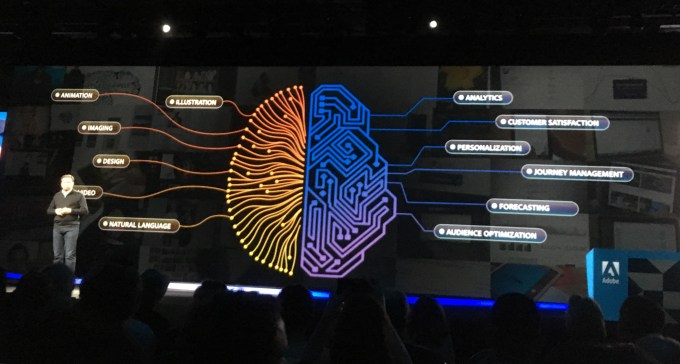
But Adobe also needed to get its ducks in a row around AI. That’s why around 18 months ago, the company made another strategic decision to develop AI as a core part of the new  platform. They saw a lot of companies looking at a more general AI for developers, but they had a different vision, one tightly focussed on Adobe’s core functionality. Parasnis sees this as the key part of the company’s cloud platform strategy. “AI will be the single most transformational force in technology,” he said, adding that Sensei is by far the thing he is spending the most time on.”

Photo: Ron Miller

The company began thinking about the new cloud platform with the larger artificial intelligence goal in mind, building AI-fueled algorithms to handle core platform functionality. Once they refined them for use in-house, the next step was to open up these algorithms to third-party developers to build their own applications using Adobe’s AI tools.

It’s actually a classic software platform play, whether the service involves AI or not. Every cloud company from Box to Salesforce has been exposing their services for years, letting developers take advantage of their expertise so they can concentrate on their core knowledge. They don’t have to worry about building something like storage or security from scratch because they can grab those features from a platform that has built-in expertise  and provides a way to easily incorporate it into applications.

The difference here is that it involves Adobe’s core functions, so it may be intelligent auto cropping and smart tagging in Adobe Experience Manager or AI-fueled visual stock search in Creative Cloud. These are features that are essential to the Adobe software experience, which the company is packaging as an API and delivering to developers to use in their own software.

Whether or not Sensei can be the technology that drives the Adobe cloud platform for the next 10 years, Parasnis and the company at large are very much committed to that vision. We should see more announcements from Adobe in the coming months and years as they build more AI-powered algorithms into the platform and expose them to developers for use in their own software.

Parasnis certainly recognizes this as an ongoing process. “We still have a lot of work to do, but we are off in an extremely good architectural direction, and AI will be a crucial part,” he said.

These schools graduate the most funded startup CEOs

There is no degree required to be a CEO of a venture-backed company. But it likely helps to graduate from Harvard, Stanford or one of about a dozen other prominent universities that churn out a high number of top startup executives.

That is the central conclusion from our latest graduation season data crunch. For this exercise, Crunchbase News took a look at top U.S. university affiliations for CEOs of startups that raised $1 million or more in the past year.

In many ways, the findings weren’t too different from what we unearthed almost a year ago, looking at the university backgrounds of funded startup founders. However, there were a few twists. Here are some key findings:

Harvard fares better in its rivalry with Stanford when it comes to educating future CEOs than founders. The two universities essentially tied for first place in the CEO alum ranking. (Stanford was well ahead for founders.)

Business schools are big. While MBA programs may be seeing fewer applicants, the degree remains quite popular among startup CEOs.  At Harvard and the University of Pennsylvania, more than half of the CEOs on our list graduated as business school alum.

University affiliation is influential but not determinative for CEOs. The 20 schools featured on our list graduated CEOs of more than 800 global startups that raised $1M or more in roughly the past year, a minority of the total.
Below, we flesh out the findings in more detail.

Where startup CEOs went to school

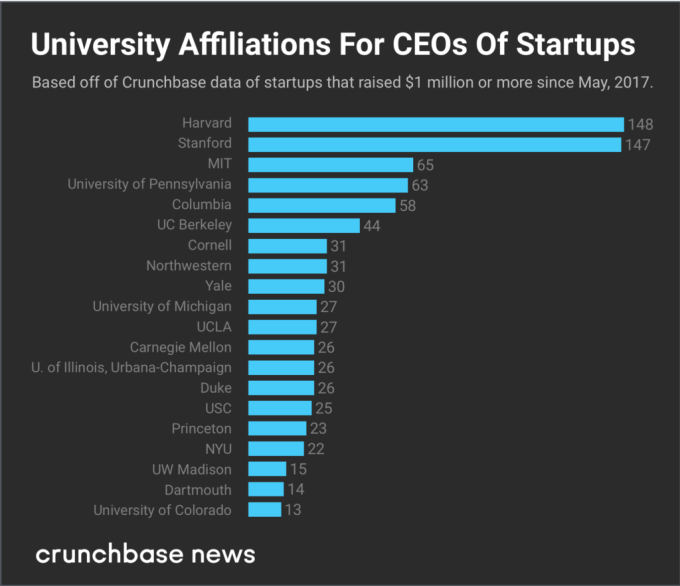
First, let’s start with school rankings. There aren’t many big surprises here. Harvard and Stanford far outpace any other institutions on the CEO list. Each counts close to 150 known alum among chief executives of startups that raised $1 million or more over the past year.

MIT, University of Pennsylvania, and Columbia round out the top five. Ivy League schools and large research universities constitute most of the remaining institutions on our list of about twenty with a strong track record for graduating CEOs. The numbers are laid out in the chart below:

Traditional MBA popular with startup CEOs

Yes, Bill Gates and Mark Zuckerberg dropped out of Harvard. And Steve Jobs ditched college after a semester. But they are the exceptions in CEO-land.

The typical path for the leader of a venture-backed company is a bit more staid. Degrees from prestigious universities abound. And MBA degrees, particularly from top-ranked programs, are a pretty popular credential.

Top business schools enroll only a small percentage of students at their respective universities. However, these institutions produce a disproportionately large share of CEOs. Wharton School of Business degrees, for instance, accounted for the majority of CEO alumni from the University of Pennsylvania . Harvard Business School also graduated more than half of the Harvard-affiliated CEOs. And at Northwestern’s Kellogg School of Management, the share was nearly half.

CEO alumni background is really quite varied

While the educational backgrounds of startup CEOs do show a lot of overlap, there is also plenty of room for variance. About 3,000 U.S. startups and nearly 5,000 global startups with listed CEOs raised $1 million or more since last May. In both cases, those startups were largely led by people who didn’t attend a school on the list above.

Admittedly, the math for this is a bit fuzzy. A big chunk of CEO profiles in Crunchbase (probably more than a third) don’t include a university affiliation. Even taking this into account, however, it looks like more than half of the U.S. CEOs were not graduates of schools on the short list. Meanwhile, for non-U.S. CEOs, only a small number attended a school on the list.

So, with that, some words of inspiration for graduates: If your goal is to be a funded startup CEO, the surest path is probably to launch a startup. Degrees matter, but they’re not determinative.