White House sheds cyber coordinator role

The White House has opted to eliminate the cyber coordinator role on the National Security Council, in what some see as a step back in strong cybersecurity policy. The duties formerly performed by the coordinator will be taken up by the other two senior directors of the NSC’s cyber team. Politico first reported the news.

Rob Joyce, who left the role on Friday, was chief of an NSA hacking outfit (Tailored Access Operations) last March. John Bolton, Trump’s national security advisor, ended the role with Joyce’s departure; a memo sent to NSC employees explained that the elimination is to “streamline authority” in the Council. The other directors will pick up the slack.

The cyber coordinator role was first created by President Obama in 2009; its occupant in charge of, as you might expect, coordinating national cybersecurity policy across the many places in the government where it is being addressed.

In a time when cyber policy is increasing in importance and cyber-threats are clear and present in the country’s elections and other critical infrastructure, it seems a strange decision to “streamline” rather than bolster an important cybersecurity-related office.

Trump’s administration has made noises about taking cybersecurity seriously, and in other areas has taken steps to improve things — for instance, its choice in August to elevate the Military’s Cyber Command and give it more independence. This added roles, rather than subtracting them. But Bolton’s moves put more hats on fewer people, which would seem to complicate authority rather than streamline it.

It is possible that this is all part of a larger plan that will ultimately result in better decision-making capabilities and an improved cyber policy organ, but if so, the plan is unclear, even to those in the know.

Mr. President, if you really want to put America first, don’t cut the White House Cybersecurity Coordinator — the only person in the federal government tasked with delivering a coordinated, whole-of-government response to the growing cyber threats facing our nation. https://t.co/MRkwA8et7y

— Mark Warner (@MarkWarner) May 15, 2018

It’s almost as if the federal government’s policies on cybersecurity aren’t quite in sync. Maybe they should appoint someone to coordinate them!

Yes, HTC is working on a ‘blockchain phone’

A few weeks ahead of its latest flagship announcement, HTC just revealed another piece of hardware. While the Taiwanese company has consolidated much of its mobile offerings in recent years, it announced today at the Consensus 2018 blockchain conference in New York that its upcoming Exodus handset is embracing everyone’s favorite tech buzzword.

So, what makes a phone a blockchain phone, exactly? Security and cryptocurrency support, mostly. According to HTC’s Exodus landing page, “Our vision is to expand the blockchain ecosystem by creating the world’s first phone dedicated to decentralized applications and security. With the release of the HTC Exodus we can now make this a reality.”

The Exodus will support Bitcoin and Ethereum, among others, courtesy of a universal wallet, secure hardware and decentralized apps. According to The Next Web, HTC has also outlined plans to create a native blockchain network, whereby cryptocurrency can be traded amongst Exodus users. Naturally, users will also be able to purchase the phone itself using cryptocurrency. That price and the release date, however, have yet to be revealed.

There’s not really a lot of information beyond that and the above drawing, but HTC is clearly gunning to make a splash as its numbers have shrunk in overall proportion to a declining smartphone market. Even with rapidly increasing awareness and interest in the cryptocurrency space, however, it’s hard to imagine Exodus making much of a splash.

Society needs the Artificial Intelligence Data Protection Act now

On December 31, 2015, I published my original call to arms for society’s rational regulation of artificial intelligence before it is too late. I explained certain reasons why someone who is against solving problems through regulation would propose precisely that mechanism to help hedge the threats created by AI, and announced my proposed legislation: The Artificial Intelligence Data Protection Act (AIDPA).

Since 2015, we have witnessed AI’s rapidly evolving national and international growth and adoption that will soon impact every phase of mankind’s life, from birth to death, sex to religion, politics to war, education to emotion, jobs to unemployment.

Three of many recent developments confirm why now is the time for the AIDPA: (1) a McKinsey study from late 2017 determined that up to 800 million workers worldwide may lose their jobs to AI by 2030, half of contemporary work functions could be automated by 2055 and other recent studies suggest as many as 47 percent of U.S. jobs could be threatened by automation or AI over the next few decades; (2) AI has now created IP with little or no human involvement and continues to be programmed, tested and used to do so; see my Twitter for a library of media reports on AI-created IP; (3) tech giants and regulators are starting to acknowledge that industries that create and use AI should be at least partially responsible for minimizing the impact of AI-displaced workers.

Now – and not later — society must address AI’s legal, economic and social implications with regard to IP and employment. Current legislation does not adequately account for the new challenges, threats and needs presented by the impact of AI. The question is not “if” but “when” society will regulate AI. Rather than leave the job solely to politicians, industry should lead the way through the AIDPA. The urgency to finalize and enact the AIDPA cannot be understated.

This article addresses the AIDPA’s twin focuses (AI’s threats to intellectual property rights and the labor force) and presents a proposed framework to address them. The AIDPA is intended to provide industry with a voice in regulating AI while promoting its safe, secure and ethical use. The United States must lead the way in regulating AI, and leaders in industry, technology and ethics should join together to finalize and enact the AIDPA — the first and most important legislation of its kind.

Intellectual property considerations

The AIDPA’s focuses on ownership of IP and the security risks resulting from machine learning that exceeds its initial programming and/or that by virtue of its programming becomes capable of autonomous human-like reasoning. For a host of legal and technical reasons, current IP laws cannot adequately account for IP created by AI working independent of human involvement or oversight (music, art, medical techniques, processes to communicate, processes to kill, etc.) or that exceeds its initial programming. AI also will acquire vast amounts of confidential information through its ability to collect, process, analyze and utilize mass amounts of data.

Chief AI officer

The AIDPA will require covered entities (see below) to employ a “chief AI officer,” who, among other things, is responsible for monitoring AI within the workplace, creating company-wide plans for AI-impacted employment, implementing the AIDPA regulations, enacting company-wide safeguards that monitor for and respond to malicious AI activity and accounting for AI-created IP.

Governing body

The AIDPA will also establish a governing body (the “AI Board”), staffed with industry, technical, ethical and legal experts, designed to bring specialized expertise and consistency to regulating AI in industry, encourage industry participation, promulgate safety and ethical regulations and adjudicate AI-related IP disputes. The AIB will also ensure that covered entities, through their CIAO, determine if and when certain AI should be outlawed, constrained in specific ways, and/or “terminated” and, where necessary, will enforce the AIDPA’s mandates by making these ultimate determinations.

Industry also will have annual AI-related worker displacement reporting requirements and the AIB will be responsible for analyzing and reporting on AI’s displacement impact on the labor market. Finally, the AIB will administrate and adjudicate disputes related to the AI Worker Realignment Program, which will be funded under the AIDPA.

Ownership, infringement and misappropriation

With regard to AI-created IP, there are many questions of ownership and liability for infringement and misappropriation. Under current IP laws, ownership (and standing to sue) are generally restricted to humans. The AIDPA will allow, under certain circumstances, for IP to be owned by the AI which created it (and in certain circumstances the entity or individual who “owns” the AI machine) in the context of addressing and defining IP rights for non-human created works, set the parameters for human ownership of AI-created IP and, as noted above, determine what AI is off-limits and when AI ownership and even the AI itself must be restrained or terminated.

With regard to infringement and misappropriation, existing law provides that a person or entity is generally liable for infringement regardless of their knowledge of the infringement. The AIDPA will limit the liability of corporations and humans for infringement to cases where there is knowledge of and/or active participation in the infringement.

Employment considerations

The AIDPA currently defines covered entities as government contractors and organizations with 300 or more employees or annual revenue in excess of $30 million that utilize AI or develop or deploy AI-created IP in a manner that results in (i) layoffs of at least 75 workers during a 30-day period on account of implementation and/or use of AI; or (ii) an AI facility opening defined as a covered employer establishing a new facility (brick and mortar), an operation (i.e. a new logistics hub with autonomous trucks and no human drivers) and/or a line of business (i.e. a call center staffed solely with AI-machines) that utilizes AI machines to perform job functions in lieu of what historically was performed by 40 or more humans or (iii) an AI Readjustment, defined as 30 or more workers who experience a reduction of 50 percent or more in their working hours or the loss of more than 75 percent of their job functions, either of which negatively alters the amount of their compensable time.

In the event of a triggering event, the AIDPA provides for certain notice requirements. For example, in the case of layoffs, the AIDPA requires covered entities to provide at least 60 days notice to the impacted workers, which period shall be extended to 180 days for employees who enter and continue approved educational and/or employment retraining through the AIDPA’s Worker Realignment Program. Impacted workers also will be eligible for certain supplemental payments funded through the AIDPA for specified periods. The AIDPA also requires covered entities to submit annual reports on the use of AI and its statistical impact on the labor market.

The dirty “T” word

Like it or not, the undeniable scope and societal impact of AI-caused worker displacement, coupled with the massive reduction in payroll expense for covered entities and the resulting loss in government revenue, mandates that covered entities play a substantial role in funding society’s efforts to respond to and retrain displaced workers.

If it is to be assumed that mass worker displacement left unchecked has the potential to cause serious societal disruption and that AI taxation by politicians is inevitable, then this is not a provocative proposition. It is simply society being intellectually honest with itself. In 2017, Bill Gates proposed a tax on companies using AI which could be used to finance programs for the elderly and others with unmet needs. That same year, San Francisco Supervisor Jane Kim created a task force to explore an AI tax to fund education. And in Europe, Mady Delvaux, a member of the European Parliament, proposed a similar framework as part of an unsuccessful effort to enact AI legislation.

The question for industry is simple: Should the AI taxation framework be left solely to politicians, or should industry that will create and deploy AI play an important role in its formulation. The AIDPA answers that question by including a taxation component designed to secure the necessary funds for society to adjust to AI’s impact.

While still being studied and finalized, the AIDPA favors a tripartite approach for covered entities that is calculated based on (i) a minimum AI “flat” tax; plus a percentage of (ii) human labor cost savings; and (ii) profits generated by AI. The AIDPA provides that the revenue generated from the AI tax shall be used solely for two purposes: (i) retraining workers displaced by AI through the Work Realignment Program and (ii) basic supplemental income payments for AI-displaced workers for a set period.

Questions remain regarding how AI in the workplace should be regulated, but now is the time for lawyers, industry, academia, regulators and politicians to come together to finalize and enact the AIDPA.


First CubeSats to travel the solar system snap ‘Pale Blue Dot’ homage

The InSight launch earlier this month had a couple of stowaways: a pair of tiny CubeSats that are already the farthest such tiny satellites have ever been from Earth — by a long shot. And one of them got a chance to snap a picture of their home planet as an homage to the Voyager mission’s famous “Pale Blue Dot.” It’s hardly as amazing a shot as the original, but it’s still cool.

The CubeSats, named MarCO-A and B, are an experiment to test the suitability of pint-size craft for exploration of the solar system; previously they have only ever been deployed into orbit.

That changed on May 5, when the InSight mission took off, with the MarCO twins detaching on a similar trajectory to the geology-focused Mars lander. It wasn’t long before they went farther than any CubeSat has gone before.

A few days after launch MarCO-A and B were about a million kilometers (621,371 miles) from Earth, and it was time to unfold its high-gain antenna. A fisheye camera attached to the chassis had an eye on the process and took a picture to send back home to inform mission control that all was well.

But as a bonus (though not by accident — very few accidents happen on missions like this), Earth and the moon were in full view as MarCO-B took its antenna selfie. Here’s an annotated version of the one above:

“Consider it our homage to Voyager,” said JPL’s Andy Klesh in a news release. “CubeSats have never gone this far into space before, so it’s a big milestone. Both our CubeSats are healthy and functioning properly. We’re looking forward to seeing them travel even farther.”

So far it’s only good news and validation of the idea that cheap CubeSats could potentially be launched by the dozen to undertake minor science missions at a fraction of the cost of something like InSight.

Don’t expect any more snapshots from these guys, though. A JPL representative told me the cameras were really only included to make sure the antenna deployed properly. Really any pictures of Mars or other planets probably wouldn’t be worth looking at twice — these are utility cameras with fisheye lenses, not the special instruments that orbiters use to get those great planetary shots.

The MarCOs will pass by Mars at the same time that InSight is making its landing, and depending on how things go, they may even be able to pass on a little useful info to mission control while it happens. Tune in on November 26 for that!

Super wearable WHOOP launches $30 subscription service — wearable totally included

WHOOP, the world’s most informative wearable, is launching a new $30 subscription service for the everyday consumer, so everyone can get the benefits of its activity monitoring and analytics tools.

It’s the wearable that professional athletes and other performance-minded alpha-people use to find out how to optimize their workouts, sleep and rest periods to be the best selves they can be.

For $30 per month with a six-month mandatory commitment, anyone can become a member of what chief executive Will Ahmed is calling the WHOOP community.

Indeed, along with the hardware and analytics, which will report on and suggest recovery periods, ideal workouts and the optimal amount of sleep a body needs culled from the five variables WHOOP’s wearable collects 100 times per second, WHOOP is creating a social network where users can create teams and participate in challenges to encourage activity and use.

“We’ve now taken many learnings from the top performers and applied them to a consumer facing membership,” said Ahmed in a statement. “This is for a wider set of consumers — those that take performance seriously, whether that means securing a [personal record] on their next marathon, or improving their personal habits as a business executive on the road for work.”

The $180 sticker price for a WHOOP and membership to the service represents a deep discount from its previous pricing structure.

WHOOP’s devices retail for a not-insignificant $500 for the wearable, with an extra nominal fee to switch out the default band for something with a bit more swag. With the new funding the company will look to accelerate its global expansion so WHOOP can dominate still-more sporting events, and become the new accessory that the high-powered quantified executive (or health-obsessed paranoiac) won’t want to live without.

Indeed, one of WHOOP’s selling points to potential new members is the insights that can be gleaned from its high-performance athletes.

The company has an amazing roster of customers among the elite of American sports. The wearable has been approved for universal in-game use in Major League Baseball, while also getting a partnership with the NFLPA to track recovery times among football players. WHOOP actually is selling data on player performance to other teams so they can see how they stack up against the competition. It’s also talking to NFL broadcasters about displaying WHOOP data during games.

An assortment of NBA players use the app, which could explain the involvement of Kevin Durant’s new investment fund and the appearance of David Stern among the individual investors (to date, the NBA is one of the leagues in the U.S. that WHOOP hasn’t been able to crack). But the Duke University men’s basketball team is using the company’s wearables (even though the Blue Devils suck).

In addition to the new membership service, WHOOP also said it added strategic investor Bose Ventures as a backer. Bose’s investment comes on the heels of the $25 million WHOOP secured in its last financing round earlier this year.

Amazon’s cashier-less Go stores are coming to Chicago and San Francisco

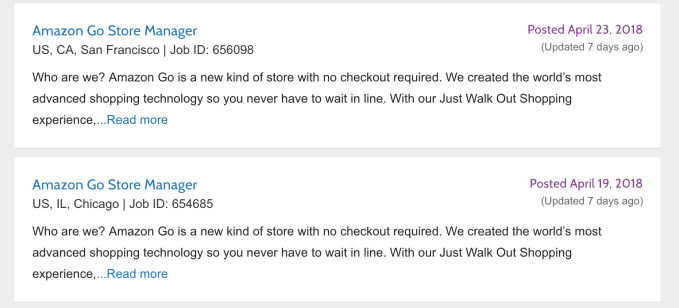
Amazon is looking to open more of its cashier-less Go stores across the United States and it looks like San Francisco and Chicago will be among the next cities to get them, according to new job postings in those cities.

In response to the postings, discovered by The Seattle Times, an Amazon spokesperson confirmed that stores were being planned for both of the cities, though they didn’t specify what timing looked like.

There aren’t many details beyond the general job listings, but they do list a couple of management positions around these two sites.

Earlier this week, the SF Chronicle reported that an Amazon Go store could be coming to SF’s heavily trafficked Union Square downtown area. Meanwhile, the company has a permit for what would be a much smaller 635-square-foot “Amazon store” inside Chicago’s Loop area.

Amazon’s Go store is designed with the idea of getting consumers in and out of a convenient store-like grocery without ever having to go through the check-out process. The store relies heavily on cameras tracking customers and seeing what they select while charging them directly through an Amazon Go app. The company’s “store of the future” is currently only in Seattle and appears to be a wholly separate initiative from Whole Foods, which Amazon acquired last year.

Tushy is the simple bidet for every toilet

If there’s one thing I envy in the global spirit and character its the appreciation of a fine bidet. Hygiene being close to godliness, one can imagine the huddled scientists at CERN and KAUST and Tokyo University creating scientific marvels, secure in the knowledge that their posteriors were as clean and crisp as their lines of thought. The same can be said of peoples of all continents who celebrate the occasional fountainal intrusion, from those who use bidets complete with birdsong to hide their doings to those with a simple hose next to the can.

But America, that land of the free and the home of the brave, can’t join in the fun? Is there no bidet culture in Dear Columbia? Pshaw. After all, there’s something called Tushy.

This simple bidet system is the gateway drug to posterior enjoyment. I’ve been trying to install a proper bidet in my home since 2007. The problem I discovered was that the design of my toilet did not allow for something large and heavy up against the toilet tank. Because the system was so large I couldn’t fit it in place of the seat, resulting in endless heartbreak. I was almost going to swap out my toilet for one of a simpler designed but luckily the Tushy is the low-cost, low tech solution I was looking for.

It works by sitting in line with the tank refill line. You simply connect the line to the Tushy and then connect a line from the Tushy to the tank. The water that would normally go into your bowl is routed through a little movable nozzle and up into your backside. The water, obviously, is cold. You can also turn it so the water cleans the nozzle, and important health and safety addition.

Bear in mind that the Tushy is as simple as it gets. It doesn’t blow out fine perfumes, it doesn’t steam or mist you, and it doesn’t play birdsong. But it costs $69 and seems to work just fine in my testing. In fact, I’m thinking of Tushying up the whole house since it doesn’t actually need electricity or any plumbing changes.

Tushy also sells an $84 Spa model that connects to your hot water line for a bit of warmth. But that’s for the coddled few who can’t manage a little cold water.

Why is this important? Because all innovation is important, for one. The changes in lifestyle associated with tech are moving out of the esoteric into the basic, a fact that should give us all a bit of a giggle. If electrified scooters in SF are a sign of the apocalypse, things like the Tushy are a sign of a renaissance. After all, the clean innovator is the happy innovator.

Ultimately ideas like Tushy will lead us to a new world of butt hygiene. Perhaps, one day, all of us will have a bidet in our homes and offices. Perhaps one day we will be able to break the shackles of toilet paper. And perhaps, one day, we will join the ranks of men and women who enjoy a good squirt in the morning. Until then, Tushy does its business.

Verizon names Los Angeles as the second of four cities to receive 5G rollout before 2019

My boss’ boss’ boss was on CNBC this morning touting Verizon‘s new 5G services and naming Los Angeles as the second city in America to be treated to a commercial rollout of the new networking technology.

“I think we’re a lot closer than people think,” says Verizon chief executive Lowell McAdam of the nation’s move to the higher-speed 5G networks. “We’re locking in on four this year,” McAdam said of the cities that will receive 5G tech from Verizon.

McAdam also named Los Angeles as the second of four cities that will receive 5G rollout from Verizon. “We bought 36 million miles of fiber so we can have big pipes feeding the cells. We will have hundreds of megahertz of bandwidth to deliver the whole suite of services of 5G,” McAdam said.

“We’ll have 1,000 cell sites up and operating on the global standard,” McAdam said on the cable network.

McAdam also name-checked Boston’s mayor when listing the municipal leaders who’ve been most receptive to working with the technology company on bringing new networking technology to consumers.

Verizon first announced its plans in early 2018 to begin bringing 5G to the masses. It had initially named Sacramento, Calif. as the first market to receive the technology.

McAdam hinted at a regimented implementation that would see 5G home networking services make their way to consumers first for fixed wireless applications before mobile wireless wends its way to consumers in the first quarter of 2019.

In February, AT&T said that Atlanta, Dallas and Waco, Tex. would be the first of 12 cities to receive 5G technology, while Sprint is bringing its 5G services to Kansas City, Phoenix and New York City (the millennium capital of the world).

Lime is reportedly trying to squeeze up to $500 million out of VCs

Lime, the electric scooter and bike company, is looking to raise up to $500 million in new funding, Axios reports, citing sources. The round could come in the form of both equity and debt, according to Axios.

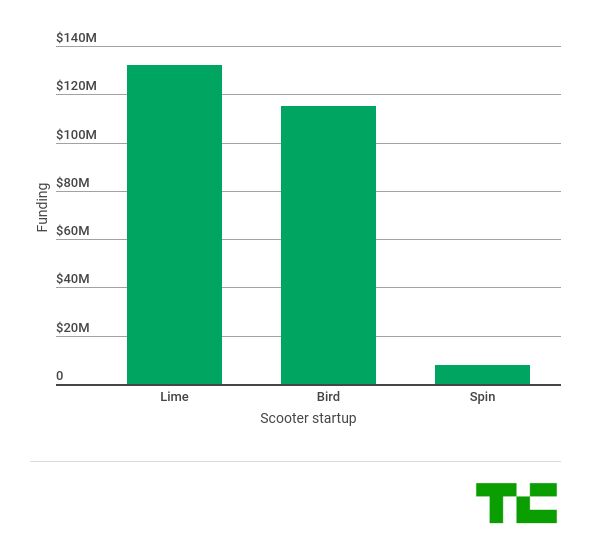
To date, Lime has raised $132 million from investors. Its most recent round was just in February, when it raised $70 million from Fifth Wall. Lime declined to comment for this story.

Earlier this month, Lime announced a partnership with Segway to build version two of its electric scooters. Lime, along with its competitors Bird and Spin, all ultimately rely on Ninebot, a Chinese scooter company that has merged with Segway. Ninebot is backed by investors including Sequoia Capital, Xiaomi and ShunWei.

Without taking into account Lime’s potential round, here’s where Lime compares to Bird and Spin.

The electric scooter space has been under scrutiny as of late — partly due to the fact that Bird, Spin and Lime deployed their respective scooters without explicit permission in San Francisco back in March.

Less than one month ago, the San Francisco Municipal Transportation Authority announced its permitting process for electric scooters. You can read more about that here.

And if you want the full breakdown of what the deal is in San Francisco as it pertains to electric scooters, here’s the story.

Lyft also ends arbitration policy for sexual assault claims

Shortly after Uber announced the end of its forced arbitration policy for individual claims of sexual assault or harassment by Uber drivers, riders or employees, Lyft has done the same, Recode first reported. This means anyone who alleges sexual misconduct at the hands of Lyft drivers, riders or employees won’t have to argue their case behind closed doors. Instead, they can take the claim straight to court.

“Lyft has a longstanding track record of action in support of the communities we serve, from our commitment to the ACLU to standing up for pay equity and racial equality,” a Lyft spokesperson told TechCrunch. “The #metoo movement has brought to life important issues that must be addressed by society, and we’re committed to doing our part. Today, 48 hours prior to an impending lawsuit against their company, Uber made the good decision to adjust their policies. We agree with the changes and have removed the confidentiality requirement for sexual assault victims, as well as ended mandatory arbitration for those individuals so that they can choose which venue is best for them. This policy extends to passengers, drivers and Lyft employees.”

As the Lyft spokesperson noted in their comment, Uber made the decision to drop mandatory arbitration about 48 hours before the company had to respond to a lawsuit filed by 14 women who alleged they were assaulted by their drivers. The women also asked Uber to waive its arbitration clause.

Twitter algorithm changes will hide more bad tweets and trolls

Twitter’s latest effort to curb trolling and abuse on the site takes some of the burden off users and places it on the company’s algorithms.

If you tap on a Twitter or real-world celebrity’s tweet, more often than not there’s a bot as one of the first replies. This has been an issue for so long it’s a bit ridiculous, but it all has to do with the fact that Twitter really only arranges tweets by quality inside search results and in back-and-forth conversations.

Twitter is making some new changes that calls on how the collective Twitterverse is responding to tweets to influence how often people see them. With these upcoming changes, tweets in conversations and search will be ranked based on a greater variety of data that takes into account things like the number of accounts registered to that user, whether that tweet prompted people to block the accounts and the IP address.

Tweets that are determined to most likely be bad aren’t just automatically deleted, but they’ll get cast down into the “Show more replies” section where fewer eyes will encounter them. The welcome change is likely to cut down on tweets that you don’t want to see in your timeline. Twitter says that abuse reports were down 8 percent in conversations where this feature was being tested.

Much like your average unfiltered commenting platform, Twitter abuse problems have seemed to slowly devolve. On one hand it’s been upsetting to users who have been personally targeted, on the other hand it’s just taken away the utility of poring through the conversations that Twitter enables in the first place.

It’s certainly been a tough problem to solve, but they’ve understandably seemed reluctant to build out changes that take down tweets without a user report and a human review. This is, however, a very 2014 way to look at content moderation and I think it’s grown pretty apparent as of late that Twitter needs to lean on its algorithmic intelligence to solve this rather than putting the burden entirely on users hitting the report button.

Lynq is a dead-simple gadget for finding your friends outdoors

If you’ve ever been hiking or skiing, or gone to a music festival or state fair, you know how easy it is to lose track of your friends, and the usually ridiculous exchange of “I’m by the big thing”-type messages. Lynq is a gadget that fixes this problem with an ultra-simple premise: it simply tells you how far and in what direction your friends are, no data connection required.

Apart from a couple of extra little features, that’s really all it does, and I love it. I got a chance to play with a prototype at CES and it worked like a charm.

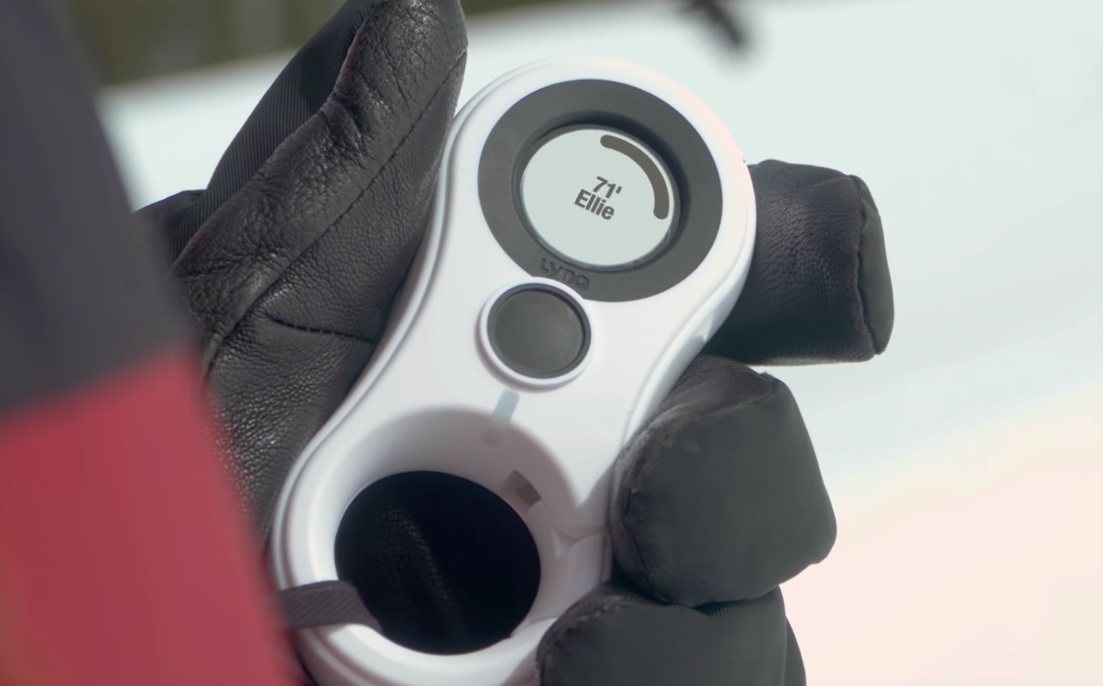
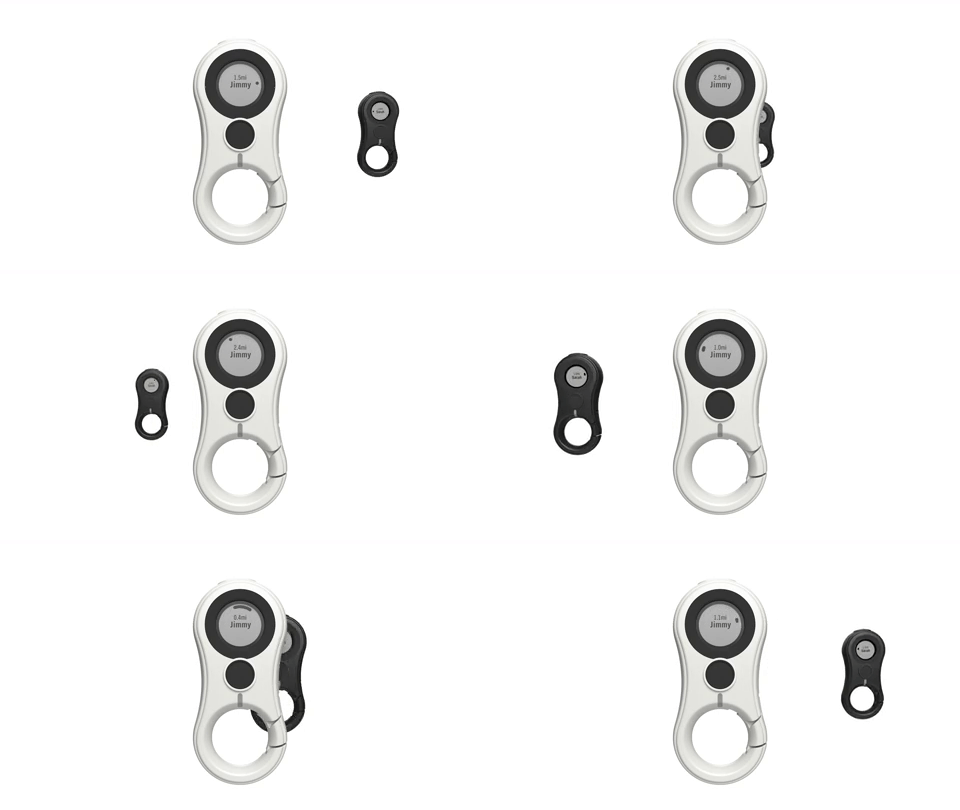
The peanut-shaped devices use a combination of GPS and kinetic positioning to tell where you are and where any linked Lynqs are, and on the screen all you see is: Ben, 240 feet that way.

Or Ellie.

No pins on a map, no coordinates, no turn-by-turn directions. Just a vector accurate to within a couple of feet that works anywhere outdoors. The little blob that points in their direction moves around as quick as a compass, and gets smaller as they get farther away, broadening out to a full circle as you get within a few feet.

Up to 12 can link up, and they should work up to three miles from each other (more under some circumstances). The single button switches between people you’re tracking and activates the device’s few features. You can create a “home” location that linked devices can point toward, and also set a safe zone (a radius from your device) that warns you if the other one leaves it. And you can send basic preset messages like “meet up” or “help.”

It’s great for outdoors activities with friends, but think about how helpful it could be for tracking kids or pets, for rescue workers, for making sure dementia sufferers don’t wander too far.

The military seems to have liked it as well; U.S. Pacific Command did some testing with the Thai Ministry of Defence and found that it helped soldiers find each other much faster while radio silent, and also helped them get into formation for a search mission quicker. All the officers involved were impressed.

Having played with one for half an hour or so, I can say with confidence that it’s a dandy little device, super intuitive to operate, and was totally accurate and responsive. It’s clear the team put a lot of effort into making it simple but effective — there’s been a lot of work behind the scenes.

Because the devices send their GPS coordinates directly to each other, the team created a special compression algorithm just for that data — because if you want fine GPS, that’s actually quite a few digits that need to be sent along. But after compression it’s just a couple of bytes, making it possible to send it more frequently and reliably than if you’d just blasted out the original data.

The display turns off automatically when you let it go to hang by its little clip, saving battery, but it’s always receiving the data, so there’s no lag when you flip it up — the screen comes on and boom, there’s Betty, 450 feet thataway.

The only real issue I had is that the single-button interface, while great for normal usage, is pretty annoying for stuff like entering names and navigating menus. I understand why they kept it simple, and usually it won’t be a problem, but there you go.

Lynq is doing a pre-order campaign on Indiegogo, which I tend to avoid, but I can tell you for sure that this is a real, working thing that anyone who spends much time with friends outdoors will find extremely useful. They’re selling for $154 per pair, which is pretty reasonable, and since that price will probably jump significantly later, I’d say go for it now.