For one photographer, Mary Shelley’s sci-fi novel is more relevant than ever.
Category: Tech news
hacking,system security,protection against hackers,tech-news,gadgets,gaming
Barack and Michelle Obama sign production deal with Netflix
Another (very) big deal for Netflix: Former U.S. President Barack Obama and Michelle Obama have reached an agreement to produce films and series for the streaming service.
The New York Times first reported in March that the Obamas were in “advanced negotiations” with Netflix. The goal, supposedly, was less about criticizing the Trump administration or promoting any specific political message and more about highlighting inspirational stories.
Netflix’s official announcement makes it sound like that continues to be what the Obamas have in mind, with Chief Content Officer Ted Sarandos describing them as “uniquely positioned to discover and highlight stories of people who make a difference in their communities and strive to change the world for the better.”
The Obamas have formed a company called Higher Ground Productions to create this content.
The financial terms of the deal were not disclosed, but Netflix has deep pockets and has shown a willingness to write very large checks. It says the Obamas might produce “scripted series, unscripted series, docu-series, documentaries and features” — so basically any kind of audiovisual content.
In a statement, Mr. Obama said:
One of the simple joys of our time in public service was getting to meet so many fascinating people from all walks of life, and to help them share their experiences with a wider audience. That’s why Michelle and I are so excited to partner with Netflix – we hope to cultivate and curate the talented, inspiring, creative voices who are able to promote greater empathy and understanding between peoples, and help them share their stories with the entire world.
Michelle Obama’s memoir Becoming is scheduled for publication in November, while Barack Obama is expected to release a new memoir under the same deal. He’s kept a relatively low profile since leaving office, but he did make a recent appearance as the first guest on David Letterman’s Netflix interview show My Next Guest Needs No Introduction.
TheSkimm closes its $12M Series C with big names Shonda Rhimes and Tyra Banks on board
In March, the female-led media company and newsletter provider theSkimm reported it was raising a $12 million Series C from Google Ventures and Spanx founder Sara Blakely, along with several existing investors. Today, the company is confirming its Series C round has closed with a number of new, mostly female investors joining — including big names like Shonda Rhimes and Tyra Banks.
Variety was the first to report the news of the new investors.
The Series C’s additional investors include former TV journalist Willow Bay, now dean at the USC Anneberg School for Communication and Journalism; Jesse Draper of Halogen Ventures; Shonda Rhimes; founder and CEO of GingerBread Capital, Linnea Roberts; CEO of ELY Capital, Hope Taitz; as well as the Goldman Sachs Group, Inc.; and Michael Karsch of Juice Press.
Earlier Series C investors included GV (formerly Google Ventures); Spanx founder Sara Blakely; plus former lead investors 21st Century Fox, RRE Ventures and Homebrew Ventures.
TheSkimm began its life as an email newsletter, founded by former TV news producers Carly Zakin and Danielle Weisberg. The newsletter targets millennial women who want an easy way to keep up with the key news of the day. What makes the product so appealing is how it’s written in a conversational tone, making it accessible to a wide audience who often finds reading the news a dreary but necessary chore. Mixed in with its highlights from key U.S., political and international news are samplings of stories from pop culture and the entertainment industry, which gives the newsletter a bit of a palate cleanser — something that’s much appreciated these days.
That newsletter has now grown to around 7 million subscribers, the company says. (This is the same number it reported in March.)
The company has also expanded to other products since its launch, including a $2.99 per month subscription-based app for keeping up with upcoming news and televised events, a podcast, as well as original videos for YouTube and Facebook Watch via its production arm, Skimm Studios.
Its video offerings include Skimm’d with…” and “Get Off the Couch” for Facebook, and digital series “Sip n’ Skimm,” which landed an interview with Canadian Prime Minister Justin Trudeau, followed by a discussion with House Speaker Paul Ryan assessing the proposed GOP tax plan.
Meanwhile, theSkimm’s podcast, “Skimm’d from The Couch,” reached No. 1 on Apple Podcasts hours after its launch.
The company generates revenue from a variety of sources, including its app subscriptions, native ads, affiliate, content licensing and distribution, theSkimm notes in an announcement. The company is not offering revenue details, however.
“As a female led and founded company, we are excited to have the opportunity to bring such an impressive and dynamic group of female investors into theSkimm fold,” co-founders and co-CEOs Zakin and Weisberg, said in a statement. “With a majority of our audience being female, it’s vital to the success of our business to involve women at every single level, and that includes our investors. With their added perspective and resources, we look forward to this next chapter in our company’s history.”
Banks added she had a personal appreciation for the product, in addition to her desire to support female entrepreneurs.
“Going from one business meeting, to the next studio set, and as a new mama, it’s more difficult than ever to stay up to date on the day’s headlines,” the media mogul said. “theSkimm created a media platform that works seamlessly with on-the-go lifestyles. As a fervent supporter of trailblazing female-led businesses, I am thrilled to be a part of the next phase of theSkimm’s development,” Banks said.
The company didn’t offer many specifics in terms of how it plans to utilize the additional capital, but told us that it plans to “continue evolving the brand” and grow its product offerings — both premium and free. One of its plans involves expanding its No Excuses political-engagement campaign, reports Variety, which registered 110,000 U.S. voters.
New York-based theSkimm has 72 full-time employees and has raised $29 million to date.
Lyft reportedly wants to launch electric scooter service
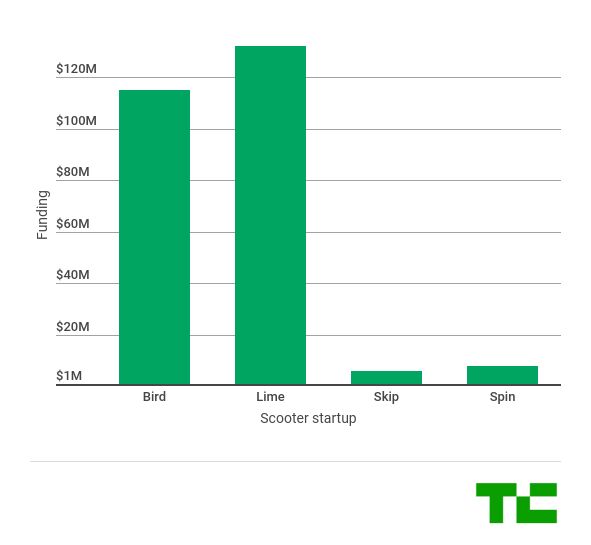
Because there aren’t enough electric scooters on the roads, Lyft is looking into launching its own fleet of electric scooters in San Francisco, The Information reports. Lyft would join the likes of Spin, Bird and Lime — the three startups that deployed their scooters in San Francisco, without permission, back in March.
Lyft has reportedly been in talks with San Francisco city officials to discuss applying for a permit, and has drafted some prototypes of scooter designs. A Lyft spokesperson declined to comment.
Earlier this month, the city of San Francisco laid out its requirements for companies seeking to obtain electric scooter permits. The San Francisco Municipal Transportation Agency has yet to actually finalize the application and terms, but a spokesperson told me on Friday the permit applications should be ready as early as this week. The city will issue permits for no more than five companies during the 24-month pilot program. The program would grant up to 2,500 scooters to operate, but it’s not yet clear how many scooters each company would be allowed to deploy.
Meanwhile, Uber also has its eyes on electric scooters. In April, Uber CEO Dara Khosrowshahi told me the company plans to “look at any and all options” that would help move transportation options in ways that are city-friendly. That same month, Uber acquired bike-share startup JUMP for about $200 million.
As it stands now, there are four companies that have announced electric scooter sharing. Just last week, scooter startup Skip threw its hat in the ring with $6 million in funding.
Facebook and Qualcomm will bring fast Wi-Fi to cities in mid-2019
Facebook’s been talking Terragraph since way back during its 2016 F8 keynote. The social media giant’s ambitious plan to bring fast Wi-Fi to cities is taking another key step toward real world trials with the addition of Qualcomm. The chipmaking giant announced today that it will add the 60Ghz tech to its future chipsets, with plans to start trials in the middle of next year.
“It is based on the pre-802.11ay standard with enhancements provided by the Qualcomm Technologies’ chipset and the integrated software between Facebook and Qualcomm Technologies to support efficient outdoor operation and avoid interference in dense environments,” Qualcomm writes in the announcement.
San Jose has already been floated as a potential testing ground for the technology. It’s not the biggest U.S. city, but the Silicon Valley hub should prove a solid testing ground with its tech savvy population. The companies say the tech will be useful in lowering the cost of high-speed wireless and helping deliver connectivity to populated areas with significant obstacles, including those densely packed with buildings.
The latter, naturally, makes Terragraph a natural for urban environments, where digging up the ground for fiber is a nuisance, to say the least. Facebook is also looking to service more rural spots with its Antenna Radio Integration for Efficiency in Spectrum (ARIES) system, a technology that was unveiled at the same F8 event.
OpenStack spins out its Zuul open source CI/CD platform
There are few open-source projects as complex as OpenStack, which essentially provides large companies with all the tools to run the equivalent of the core AWS services in their own data centers. To build OpenStack’s various systems the team also had to develop some of its own DevOps tools, and, in 2012, that meant developing Zuul, an open-source continuous integration and delivery (CI/CD) platform. Now, with the release of Zuul v3, the team decided to decouple Zuul from OpenStack and run it as an independent project. It’s not quite leaving the OpenStack ecosystem, though, as it will still be hosted by the OpenStack Foundation.
Now all of that may seem a bit complicated, but at this point, the OpenStack Foundation is simply the home of OpenStack and other related infrastructure projects. The first one of those was obviously OpenStack itself, followed by the Kata Containers project late last year. Zuul is simply the third of these projects.
The general concept behind Zuul is to provide developers with a system for automatically merging, building and testing new changes to a project. It’s extensible and supports a number of different development platforms, including GitHub and the Gerrit code review and project management tool.
Current contributors include BMW, GitHub, GoDaddy, Huawei, Red Hat and SUSE. “The wide adoption of CI/CD in our software projects is the foundation to deliver high-quality software in time by automating every integral part of the development cycle from simple commit checks to full release processes,” said BMW software engineer Tobias Henkel. “Our CI/CD development team at BMW is proud to be part of the Zuul community and will continue to be active contributors of the Zuul OSS project.”
The spin-off of Zuul comes at an interesting time in the CI/CD community, which is currently spoiled for choice. Spinnaker, Google and Netflix are betting on an open source CD platform that solves some of the same problems as Zuul, for example, while Jenkins and similar projects continue to go strong, too. The Zuul project notes that its focus is more strongly on multi-repo gating, which makes it ideal handling very large and complex projects. A number of representatives of all of these open-source projects are meeting at the OpenDev conference in Vancouver, Canada that’s running in parallel with the semi-annual OpenStack Summit there, and my guess is that we’ll hear quite a bit more about all of these projects in the coming days and weeks.
Cryptocurrency and a stock market boom pushes TradingView to $37 million in new funding
Fueled by last year’s greed-inducing visions of a cryptocurrency boom and a stock market largely untethered from classical economics, TradingView, a developer of social networking and data analysis tools for financial markets, has raised millions in new venture funding.
The New York-based company just scored $37 million in funding led by the growth-stage investment firm Insight Venture Partners .
TradingView has developed a proprietary, JavaScript-based programming language called PineScript, which lets anyone develop their own customized financial analysis tools. The company “freemium” software as a service model that lets most users connect and exchange trading tips and tricks for free, but begins charging when customers want access to more charts, data and real-time server-side alerts.
There are three payment plans beginning at $15, with a mid-tier at $30 and a high-end $60 per-month premium option.
The company had previously boosted its growth by offering its charting software for free to partner websites like SeekingAlpha, Bitfinex and the Nasdaq. That strategy helped it grow to 8 million monthly active users with around 61 percent coming from direct traffic as of March of this year.
These days the company derives nearly 75 percent of its revenue from those monthly subscription plans to individual traders. TradingView’s executives think the company still has an opportunity to expand its footprint among those retail investors, but it’s also planning to make a push to serve more institutional clients with its toolkit.
For the past seven years the company has enjoyed consistent growth, according to TradingView co-founder and chief operations officer, Stan Bokov.
For Paul Szurek, a vice-president at Insight Venture Partners, the investment in TradingView is building off of broad consumer interest in amateur speculative trading. Looking at RobinHood, Bux and eToro as gateways for new investors who eventually move on to more sophisticated tools, Szurek said that TradingView was often their next step into market investing.
“The rise of cryptocurrencies… and trading those assets… has flywheeled into a broader interest in investing across asset classes,” Szurek said.
While TradingView was never crypto-focused, according to Bokov, the company was supportive from the beginning and it’s been a boon to the broader business. “They came for crypto. They stayed for the other stuff,” Bokov said.
And crypto might just be the gateway drug for younger speculative traders to start investing in financial markets more broadly, according to Szurek. “October to January, during the real core of the crypto boom here, there were a lot of users coming in starting out researching that asset class broadly. Eighty percent move on to research other asset classes,” he said. “As TradingView kind of pushed through the [first quarter], trends in growth really diverged from what we were seeing in purely crypto-focused business and that’s a testament to users leveraging this one-stop-shop component of the platform.”
Additional investors in the new TradingView include DRW Venture Capital and Jump Capital. The company was a graduate of the 2013 Techstars Chicago batch and was seeded by Irish Angels, Techstars, iTech Capital and undisclosed angel investors.
“TradingView was built for non-professional traders, but its accessible trading tools and powerful-yet-intuitive charting capabilities have attracted the attention of institutional investors,” said Kimberly Trautmann, head of DRW Venture Capital, in a statement. “As an investor, we are excited about the diverse cross section of the industry that TradingView has reached and its rapid growth. As a proprietary trading firm on an institutional level, we’re looking forward to leveraging the platform and contributing to its further development.”
Seakeeper’s Super Spinning System Keeps Ships Stable at Sea
Seakeeper’s gyroscopic system counteracts a boat’s natural motion to keep you and your seasick friends from rocking with the waves.
The 6-Foot Chinese Giant Salamander Is in Serious Trouble
Scientists figured out one species is actually at least five. Which means conservationists have been going about trying to save the creature all wrong.
Alibaba’s newest initiative aims to make Hong Kong a global AI hub
Alibaba is teaming up with SenseTime, the world’s highest-valued AI startup, to launch a not-for-profit artificial intelligence lab in Hong Kong in a bid to make the city a global hub for artificial intelligence.
Alibaba, which is SenseTime’s largest single investor thanks to a recent $600 million round at a valuation of $4.5 billion, is providing financing for the “HKAI Lab” through its Hong Kong entrepreneurship fund. SenseTime said it will contribute too, although the total amount of capital backing the initiative hasn’t been revealed.
The partners of the project — which also includes the Hong Kong Science and Technology Parks Corporation (HKSTP) — said the aim is to “advance the frontiers of AI,” which includes helping startups commercialize their technology, develop ideas and promote knowledge sharing in the AI field.
That’s all fairly general — Alibaba has a track record of politicking through technology investment schemes in Greater China and Southeast Asia — but one tangible project is a six-month accelerator program planned for September which will welcome AI startups to the HKAI Lab. Alibaba’s Cloud business and HKSTP are among the backers that will help the program offer early-stage funding to successful applicants, while Alibaba and SenseTime will help with mentoring and development during the program.
“Alibaba sees AI as a fundamental technology that will make a difference to society,” Alibaba executive vice chairman Joe Tsai said in a statement. “We envision the Hong Kong AI Lab to be an open platform where researchers, startups and industry participants can collaborate and build a culture of innovation.”
China and the U.S. are the two biggest players in the global AI battle; this project alone won’t divert that, but it could stir up potential in Hong Kong.
Alibaba maintains tight relationships in Hong Kong, particularly through the fund which is around $130 million in size. While the program is ostensibly aimed at promoting startups in Hong Kong, particularly around AI, it is also sure to galvanize Alibaba’s ties to Hong Kong’s establishment and tech community. Hong Kong is growing as a destination for startups, as a number of the city-state’s key players discussed at a TechCrunch China event last year, but still the issue of talent is a key one and this initiative could benefit Hong Kong in that respect.
HMD raises $100 million to bring even more Nokia phones to market
HMD Global has been one of the mobile world’s biggest surprise hits in recent years. Founded by former Nokia execs, the Finnish company has made a name for itself reviving the dearly departed brand on Android smartphones to great effect. And it just managed to raise another $100 million, led by Ginko Ventures’ Alpha Ginko VC branch.
The new round puts the company’s valuation at more than $1 billion, according to HMD. It’s set to use this latest round to push even more “aggressively” into the mobile category with its branded devices, “doubl[ing] down on expanding channel reach in strategic markets while continuing to deliver innovation where it matters most to consumers.”
Not that the company’s been cautious in its push thus far, of course. HMD already has a lot of options out there for a business that’s essentially been in existence for a year-and-a-half. At MWC back in February, it announced five new phones sporting the legacy brand, including a reboot of the 8110. The company has also been positioning itself in developing markets, where the Nokia name still has a fair amount of cache, by wholeheartedly adopting Google’s Android One program.
It’s a tricky line to walk, between an embrace of retro appreciation and an attempt to offer innovation. Continuing its successful run is going to require more than just playing upon user nostalgia for a bygone brand.
The question moving forward is whether HMD will be able to reassert Nokia as a truly bleeding-edge brand as it continues to flood the market with branded devices. After all, the smartphone market is starting to plateau, and much of the competition has begun to scale back their releases.
Star Wars News: Life After ‘Solo’ May or May Not Include a Lando Movie
Will Donald Glover be getting his own ‘Star Wars Story’? It’s not impossible!
How Self-Driving Cars Will Reshape Cities
Urban planners can ditch those outdated layouts and transform the city into a joyful mess of throughways and byways optimized not for cars but for people.
The Line Between Big Tech and Defense Work
Employees at Google are protesting a Pentagon contract. But there are few signs of unrest over CIA deals at Amazon and Microsoft.
‘Westworld’ Recap, Season 2 Episode 5: More Dead Than Alive
‘Westworld’ is artful, intelligent, and sleek. Warm and relatable? Not so much.