CommerceDNA wins the TechCrunch Hackathon at VivaTech

It’s been a long night at VivaTech. The building hosted a very special competition — the very first TechCrunch Hackathon in Paris.

Hundreds of engineers and designers got together to come up with something cool, something neat, something awesome. The only condition was that they only had 24 hours to work on their projects. Some of them were participating in our event for the first time, while others were regulars. Some of them slept on the floor in a corner, while others drank too much Red Bull.

We could all feel the excitement in the air when the 64 teams took the stage to present a one-minute demo to impress fellow coders and our judges. But only one team could take home the grand prize and €5,000. So, without further ado, meet the TechCrunch Hackathon winner.

Winner: CommerceDNA

Runner-Up #1: AID

Runner-Up #2: EV Range Meter


Judges

Nicolas Bacca, CTO, Ledger
Nicolas worked on card systems for 5 years at Oberthur, a leader in embedded digital security, ultimately as R&D Solution Architect. He left Oberthur to launch his company, Ubinity, which was developing smartcard operating systems.

He finally co-founded BT Chip to develop an open standard, secure element based hardware wallet which eventually became the first version of the Ledger wallet.

Charles Gorintin, co-founder & CTO, Alan
Charles Gorintin is a French data science and engineering leader. He is a cofounder and CTO of Alan. Alan’s mission is to make it easy for people to be in great health.

Prior to co-founding Alan, Charles Gorintin was a data science leader at fast-growing social networks, Facebook, Instagram, and Twitter, where he worked on anti-fraud, growth, and social psychology.

Gorintin holds a Master’s degree in Mathematics and Computer Science from Ecole des Ponts ParisTech, a Master’s degree in Machine Learning from ENS Paris-Saclay, and a Masters of Financial Engineering from UC Berkeley – Haas School of Business.

Samantha Jérusalmy, Partner, Elaia Partners
Samantha joined Elaia Partners in 2008. She began her career as a consultant at Eurogroup, a consulting firm specialized in organisation and strategy, within the Bank and Finance division. She then joined Clipperton Finance, a corporate finance firm dedicated to high-tech growth companies, before moving to Elaia Partners in 2008. She became an Investment Manager in 2011 then a Partner in 2014.

Laure Némée, CTO, Leetchi
Laure has spent her career in software development in various startups since 2000 after an engineer’s degree in computer science. She joined Leetchi at the very beginning in 2010 and has been Leetchi Group CTO since. She now works mainly on MANGOPAY, the payment service for sharing economy sites that was created by Leetchi.

Benjamin Netter, CTO, Lendix
Benjamin is the CTO of Lendix, the leading SME lending platform in continental Europe. Learning to code at 8, he has been since then experimenting ways to rethink fashion, travel or finance using technology. In 2009, in parallel with his studies at EPITECH, he created one of the first French applications on Facebook (Questions entre amis), which was used by more than half a million users. In 2011, he won the Foursquare Global Hackathon by reinventing the travel guide with Tripovore. In 2014, he launched Somewhere, an Instagram travel experiment acclaimed by the press. He is today reinventing with Lendix the way European companies get faster and simpler financing.


And finally here were our hackmasters that guided our hackers to success:

Emily Atkinson, Software Engineer / MD, DevelopHer UK
Emily is a Software Engineer at Condé Nast Britain, and co-founder & Managing Director of women in tech network DevelopHer UK. Her technical role involves back-end services, infrastructure ops and tooling, site reliability and back-end product. Entering tech as an MSc Computer Science grad, she spent six years at online print startup MOO – working across the platform, including mobile web and product. As an advocate for diversity and inclusion in STEM & digital in 2016 Atkinson launched DevelopHer, a volunteer-run non-profit community aimed at increasing diversity in tech by empowering members to develop their career and skills through events, workshops, networking and mentoring.

Romain Dillet, Senior Writer, TechCrunch
Romain attended EMLYON Business School, a leading French business school specialized in entrepreneurship. He covers many things from mobile apps with great design to fashion, Apple, AI and complex tech achievements. He also speaks at major tech conferences. He likes pop culture more than anything in the world.

What President Trump Doesn’t Know About ZTE

David Kline
Contributor

David Kline is a journalist, author and intellectual property strategist.

Although top senators, including Democrat Chuck Schumer and Republican Marco Rubio, are urging the administration not to bend on ZTE, President Trump is planning to ease penalties on the Chinese telecommunications giant for violating sanctions against Iran and North Korea.

But what Mr. Trump may not realize is that ZTE is also one of the world’s most notorious intellectual property thieves — perhaps even the most notorious of all. And since stopping Chinese theft of U.S intellectual property is supposed to be one of the President’s top trade objectives, he should not ease up on ZTE until it stops its high-tech banditry and starts playing by the rules in intellectual property (IP) matters.

To get a sense of just how egregious ZTE’s behavior truly is, we need only to consult PACER, the national index of federal court cases. A search of PACER reveals that in the U.S. alone, ZTE has been sued for patent infringement an astonishing 126 times just in the last five years. This number is even more shocking when you consider that only a subset of companies who believe their IP rights have been violated by ZTE has the means or the will to spend the millions of dollars needed to wage a multi-year lawsuit in federal courts.

But ZTE’s IP thievery is not confined just to the United States. According to one Chinese tech publication, ZTE has also been sued for patent infringement an additional 100 times in China, Germany, Norway, the Netherlands, India, France, the United Kingdom, Canada, Australia, and other countries. As an intellectual property renegade, ZTE certainly gets around.

Even when it’s not being sued, ZTE thumbs its nose at the traditional rules of fair play in intellectual proper matters, commonly engaging in delay, misrepresentation, and hold out when dealing with patent owners. While ZTE is more than happy to accept royalty payments for the use of its own intellectual property, it rarely if ever pays for the use of others’ IP.

Consider ZTE’s treatment of San Francisco-based Via Licensing Corp, a Swiss-neutral operator of patent pools covering wireless, digital audio, and other building-block components of complex products. Patent pools offer one-stop shopping for product makers to acquire licenses to patents from multiple innovative companies at once. Pools are generally a more efficient, and less litigious, way for product makers to acquire the IP rights they need at reasonable prices.

In 2012, ZTE joined Via’s LTE wireless patent pool, whose members also include Google, AT&T, Verizon, Siemens, China Mobile, and another Chinese tech powerhouse, Lenovo, maker of Motorola-branded smartphones. It helped set the royalty pricing of the pool’s aggregated patent rights, and even received payments from other product makers for their use of ZTE’s own patents within the pool.

But in 2017, precisely when it was ZTE’s turn to pay for its use of other members’ patents in Via’s LTE pool, it suddenly and without ceremony quit the patent pool. Via and its member companies are still trying to get ZTE to pay for its use of their intellectual property — and to abide by the very rules it helped establish in the first place.

Even among much-criticized Chinese companies, ZTE’s behavior is completely outside the norm. Despite what you may hear, some Chinese companies are actually good IP citizens — Lenovo for one. In fact, Via’s various patent pools include more than two dozen Chinese companies who play by the rules.

But ZTE is not one of them. It is a blatant serial IP violator who gives other Chinese companies a bad name. And our government should not reward such behavior.

Ease sanctions on ZTE only when it finally starts respecting intellectual property rights.

Trump says ZTE will pay $1.3B fine and overhaul its management to continue US business

U.S. President Donald Trump has claimed that Chinese telecom firm ZTE will pay a $1.3 billion fine and undergo a significant overhaul of its management team in order to remain operational in North America.

ZTE looked to be in dire straits when it ceased its business in the U.S. earlier this month after a Department of Commerce order banned U.S. partners from selling components to the company in response to it flouting trade bans in Iran and North Korea.

The company has since been reprised — a strategy move within the U.S.-China trade stand-off — but Trump said today that its new life comes at a cost. That’s apparently a $1.3 billion fine, a new management team and board, and “high-level security guarantees.”

Senator Schumer and Obama Administration let phone company ZTE flourish with no security checks. I closed it down then let it reopen with high level security guarantees, change of management and board, must purchase U.S. parts and pay a $1.3 Billion fine. Dems do nothing….

— Donald J. Trump (@realDonaldTrump) May 25, 2018

Trump previously took to Twitter to break news of ZTE’s reprieve and today, while aiming to score political points, he gave insight into why ZTE is being given another chance.

ZTE has over 70,000 employees, it grossed more than $17 billion in annual revenue and it maintains close ties to the Chinese government. As I wrote earlier this month, a company of its global scale brings significant revenue to U.S. businesses which, beyond more obvious consumer-facing companies, includes component-level partners like Qualcomm, who would be impacted if ZTE were to disappear tomorrow.

Trump’s claim that ZTE “must purchase U.S. parts,” while as yet unconfirmed, suggests the deal is important for ZTE’s U.S. business partners as well as being a key card in working out his administration’s complicated relationship with China.

Still, despite these apparent conditions, the decision to allow ZTE to continue is hugely controversial. Most companies don’t get a second chance for the kind of activities that the Chinese firm has carried out.

The company flouted trade bans to Iran and North Korea, then it lied about them and tried to cover its tracks before finally admitting its guilt. Speaking in April, Trump’s own Commerce Secretary, Wilbur Ross, said:

“ZTE made false statements to the U.S. Government when they were originally caught and put on the Entity List, made false statements during the reprieve it was given, and made false statements again during its probation. ZTE misled the Department of Commerce. Instead of reprimanding ZTE staff and senior management, ZTE rewarded them. This egregious behavior cannot be ignored.”

Beyond that, the firm’s close links to the Chinese government have long troubled U.S. security agencies concerned that ZTE equipment was being used by American telecom firms and security agencies.

Here’s what FBI Director Chris Wray told the Senate Intelligence Committee in February:

“We’re deeply concerned about the risks of allowing a company or entity that is beholden to foreign governments that don’t share our values to gain positions of power inside our telecommunications networks.”

Twitter will give political candidates a special badge during US midterm elections

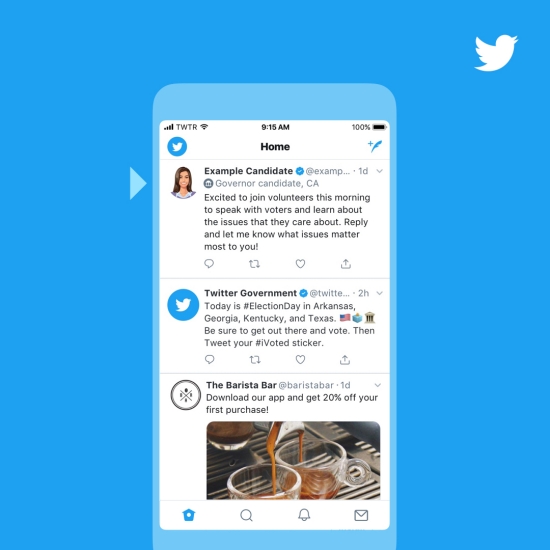
Ahead of 2018 U.S. midterm elections, Twitter is taking a visible step to combat the spread of misinformation on its famously chaotic platform. In a blog post this week, the company explained how it would be adding “election labels” to the profiles of candidates running for political office.

“Twitter has become the first place voters go to seek accurate information, resources, and breaking news from journalists, political candidates, and elected officials,” the company wrote in its announcement. “We understand the significance of this responsibility and our teams are building new ways for people who use Twitter to identify original sources and authentic information.”

These labels feature a small government building icon and text identifying the position a candidate is running for and the state or district where the race is taking place. The label information included in the profile will also appear elsewhere on Twitter, even when tweets are embedded off-site.

The labels will start popping up after May 30 and will apply to candidates in state governor races as well as those campaigning for a seat in the Senate or the House of Representatives.

Twitter will partner with nonpartisan political nonprofit Ballotpedia to create the candidate labels. In a statement announcing its partnership, Ballotpedia explains how that process will work:

Ballotpedia covers all candidates in every upcoming election occurring within the 100 most-populated cities in the U.S., plus all federal and statewide elections, including ballot measures. After each state primary, Ballotpedia will provide Twitter with information on gubernatorial and Congressional candidates who will appear on the November ballot. After receiving consent from each candidate, Twitter will apply the labels to each candidate profile.

The decision to create a dedicated process to verify political profiles is a step in the right direction for Twitter. With major social platforms still in upheaval over revelations around foreign misinformation campaigns during the 2016 U.S. presidential election, Twitter and Facebook need to take decisive action now if they intend to inoculate their users against a repeat threat in 2018.

Apple will add government App Store takedown requests to transparency reports

Apple’s set to up the ante with its transparency report. The same day it dropped the latest version of the twice-yearly document, the company committed to including in future updates government takedown requests for the App Store. The report covering July 1 through December 31 of this year, which is due out in 2019, should be the first to detail that information.

The information should prove a valuable insight into both Apple’s activities and the asks of governments around the world. Future reports will detail the specific government that issued the request, along with whether or not the company ultimately complied.

No word yet on whether the company will detail the specific apps. That would certainly prove even more informative, as far as the motivation behind said request. In the Government and Private Party Requests portion of this most recent document, Apple briefly notes that it, “will report on Government requests to take down Apps from the App Store in instances related to alleged violations of legal and/or policy provisions.”

For this report, the company notes broader government requests, saying it received in excess of 16,000 national security requests, marking a 20 percent increase during the same time frame a year prior. As Reuters notes, the company is hardly alone on this one — both Facebook and Google have been hit with a substantial increase in requests.

As governments around the world take increasing interest in the tech world, that number seems likely to increase further.

Former journo Alexia Bonatsos unveils her new venture fund, Dream Machine

Five years ago, Alexia Bonatsos, née Tsotsis, was co-editor of TechCrunch, a job that made her renowned in startup circles and familiar with a wide number of startups and their founders. What she really longed to do, in fact, was invest in some of them.

“I was among the first people to write about Pinterest and Wish — when it was known as ContextLogic — and Uber and Instagram and WhatsApp,” says Bonatsos. “I started to wonder if I was in the right place at the right time — so, luck — or if I’m in the right information flows. I was curious: What if I’d been writing checks?”

She talked occasionally with venture firms, but the right job didn’t materialize. So she set to work on creating her own dream job. Her first move was to step down from her post at TechCrunch in 2015 to enter into an accelerated, one-year master’s degree program at Stanford University’s business school. (“I wanted to be able to communicate in the same language” as other VCs, she says with a shrug.) All the while, and in the year afterward, she was talking with founders about how to tell their story and shape their editorial and convince people with large followings that they are worth tracking — skills Bonatsos had herself honed as a reporter.

She wasn’t building out her network merely to stay connected; she was also slowly piecing together checks from individual investors for a debut venture fund. Toward that end, last December, she registered her San Francisco-based firm, Dream Machine, with the SEC, listing the target amount at $25 million.

If she has reached or is nearing that number, she won’t say out of an abundance of caution around securities regulations. (This is what happens when business journalists become VCs.) Still, when we caught up with her recently, she disclosed that she has already made seven investments, including as part of one token sale. She also shared a bit about what they have in common, which seemingly centers on two things: they involve the ever-growing sharing economy, and they take advantage of an overarching trend toward decentralization.


One of those bets, for example, is TruStory, which we’d written about earlier this week. Founded recently by an alumna of both Coinbase and Andreessen Horowitz, TruStory is creating a platform for users to research and validate claims that people make online, whether in a blog post, whitepaper, website or social media post. It’s creating a “real system of information hierarchy with the blockchain,” says Bonatsos, whose co-investors in the company include True Ventures and Coinbase co-founder Fred Ehrsam, among others.

Another of Dream Machine’s checks has gone to Omni, a four-year-old, San Francisco-based on-demand storage company that’s making every possession in one’s home rentable — giving members an opportunity to make money from their underused items in the process. By way of example, Bonatsos recently rented a dress that a fellow investor had worn once and stored away. Omni photographs each item and allows users to designate friends who can rent them. Users can also rent their belongings to strangers if they choose.

A third investment, in Fable Studios, perhaps best underscores Bonatsos’s ambition to invest in “founders who turn science fiction into non-fiction.” The startup — created by former members of the Oculus Story Studio team — took the wraps off what is essentially a studio for augmented and virtual reality content this year at Sundance, where it premiered one of its first projects: an animated three-part series called “Wolves in the Walls.” (You can check out the trailer here.)

The company hasn’t disclosed how much it has raised to date, but others of its investors include Shasta Ventures and founder-investor Joe Lonsdale.

Asked how she’s drumming up deal flow, Bonatsos suggests she isn’t shy about networking like a maniac. (We spied her at an industry event last night, in fact.)

She also points to the small but growing number of people who are similarly raising and managing funds as solo general partners, and who are forming collaborations and sharing lessons in the process.

Some of these include Product Hunt founder Ryan Hoover, who is currently managing Weekend Fund, a $3 million fund that has backed roughly 10 startups since last year; Niv Dror, an early Product Hunt employee who is now investing $3 million through a vehicle called Shrug Capital; and Boom Capital, which is a pre-seed fund for “deeply technical, under-networked founders” founded by Cee Cee Schnugg, who previously spent 4.5 years with Eric Schmidt’s Innovation Endeavors fund.

Yet a fourth new, seed-stage fund is 22nd Street Ventures, launched earlier this year by Katey Nilan, who’d spent the previous six years in a variety of marketing and public relations roles.

Whether all of these seed-stage funds, including Dream Machine, can survive, let alone thrive, remains an open question, of course. As a VC at a well-regarded seed-stage fund told us just yesterday, seed-stage funding is “insanity” right now, with so much capital in the ecosystem — between established seed funds, accelerator programs and so many burgeoning funds — that it’s growing harder by the day to obtain a meaningful stake in a promising new startup.

Bonatsos, who expects most of her initial checks to average around $300,000 and is willing to invest in both first-time and serial founders, doesn’t sound concerned.

She has her intuition, a vast network of founder contacts and support from fellow seed investors. She also argues that she’s prepared to invest much earlier than many others.

“I can suspend disbelief and get on board with a wild vision,” she says. As she knows, having been immersed in the startup universe for many years, “Non-obvious deals are where you make returns.”

Collections is a better way to organize those photos you snap as mental notes

Wi-Fi password sticker on your router? Snap. Cute sweater in a store’s window display? Snap. Party invitation? Snap. Cool gift idea for mom? Snap. If any of this sounds familiar to you, then you probably also use your iPhone’s camera to take photos of the things you want to remember – maybe even more often than you use Notes to write things down. If your mental notes are more visual in nature, then you may want give the new app Collections a go instead of relying only on your Camera Roll.

I know, I know…isn’t visual bookmarking already handled by Pinterest?

Well, okay, sure. You can go that route.

But using Pinterest feels heavy. There’s a vast collection of images to explore and search. A Home feed of new stuff to look at. (Why, Pinterest, are you showing me spider tattoos? Why?). People to follow. A feed of notifications to check in on. (Where I get to write back to people things like, “hi, you’re messaging the wrong Sarah Perez. I don’t know you.” Ugh, too often. Stupid common name.)

Collections is just a little app for you to use.

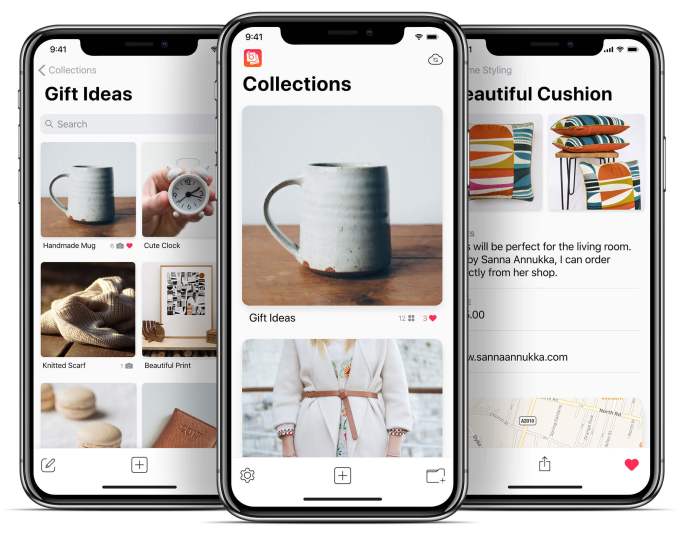
It’s not overwrought. Its simple interface just helps you to better organize those photos you’ve snapped for inspiration, ideas, mental notes, or whatever else you may need to refer back to – like clothes you like, restaurants you passed by and want to try later, art or design ideas, the best photos of your dog, events you want to go to, screenshots, gift ideas, travel inspiration, or really anything else you could think of.

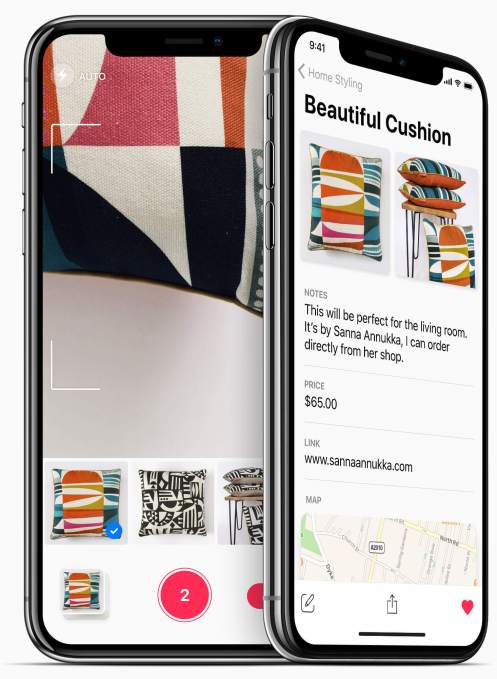
But unlike saving these things to the Camera Roll, where they quickly get lost into a feed of photos, Collections lets you write down little details – like the vendor or price, or your notes. For example, “Great gift for mom. Shop owner says it also comes in blue. Having a summer sale in 2 weeks.” 

While your collections are largely meant just for you, if you ever want to share them, you can use iCloud to do so – friends and family won’t have to sign up for a new service to view your shares, just download the app. You can also share them to social media, iMessage, email, messaging apps, and elsewhere, if you choose.

If you prefer to keep your collections private, you can turn off iCloud syncing during setup to keep them saved to local storage only.

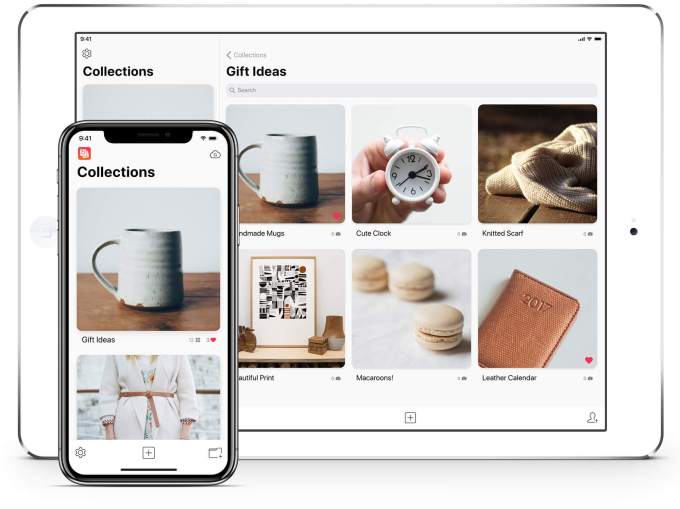
On iPad, the app is even better because it supports drag-and-drop – meaning you drag images from other apps to your collections.

The app was designed by a team of two indie developers, Emile Bennett and Dave Roberts, based in Chamonix, France and Liverpool, U.K., respectively. Bennett had previously launched a budgeting app called Pennies, but built Collections because it’s something he wanted for himself.

“I often find myself in clothes shops just ‘window shopping’. I’ll find a shirt, or a pair of shoes, or yet another over-priced GoreTex outdoor jacket  – I’ve got a bit of a thing about them…I have too many! – and I think “yeah I like this, but I’m not going to buy it now, I’ll pick it up another time,’” he tells TechCrunch.

“So I’d take a few photos, the item, the tag, maybe me wearing it and also maybe the shop front so I remember where it is. I’d always think ‘it’s in my photo stream, I’ll remember it later.’ But, of course, that doesn’t happen as the photos just get lost down in your stream, and even if I did find and remember the photos, there’s no context around them,” he says.

He tried Evernote and Notes to keep tracking of these things, but found Evernote was too bloated and Notes was too text-centric. He also feels Pinterest is too focused on discovery and public sharing to be used for collecting your own private inspirations.

One of the best things about Collections, in my opinion, is that there’s no sign-up. Radical idea, right? Bennett is sick of it, too.

“I’m really passionate about not forcing people to sign up to my apps – I want your data to be yours, I don’t want you to have to sign up to a new service just to use this app,” he says. “I think we’re all getting a bit of ’sign-up fatigue’ these days. Most apps do it because it’s the way they make their money – they give you the app for free, make you sign up to use it, collect your data, and then use that data to make their money. That’s really against my ethos,” says Bennett.

Instead, Collections is a $2.99 download.

Hey people, this is the kind of app development we should be encouraging.

Bennett gave me a few promo codes to try out the app with friends, but I forgot about that, and purchased it.

So here you go, first come, first served:

M77J6T7WLHWJ
N3X9APPT9THE
KNJMTXMY6FFJ
TRT4E77MTR4H
Promo codes are just free downloads. It’s not a scheme to make money, cynics. Nobody’s getting paid here. I just like this app and figured I’d share. Have a good weekend.