ABC acted swiftly yesterday, but it may not be making the grand gesture of civility many seem to think it has.
Category: Tech news
hacking,system security,protection against hackers,tech-news,gadgets,gaming
Nvidia launches colossal HGX-2 cloud server to power HPC and AI
Nvidia launched a monster box yesterday called the HGX-2, and it’s the stuff that geek dreams are made of. It’s a cloud server that is purported to be so powerful it combines high-performance computing with artificial intelligence requirements in one exceptionally compelling package.
You know you want to know the specs, so let’s get to it: It starts with 16x NVIDIA Tesla V100 GPUs. That’s good for 2 petaFLOPS for AI with low precision, 250 teraFLOPS for medium precision and 125 teraFLOPS for those times when you need the highest precision. It comes standard with a 1/2 a terabyte of memory and 12 Nvidia NVSwitches, which enable GPU to GPU communications at 300 GB per second. They have doubled the capacity from the HGX-1 released last year.

Chart: Nvidia
Paresh Kharya, group product marketing manager for Nvidia’s Tesla data center products, says this communication speed enables them to treat the GPUs essentially as a one giant, single GPU. “And what that allows [developers] to do is not just access that massive compute power, but also access that half a terabyte of GPU memory as a single memory block in their programs,” he explained.

Graphic: Nvidia
Unfortunately you won’t be able to buy one of these boxes. In fact, Nvidia is distributing them strictly to resellers, who will likely package these babies up and sell them to hyperscale data centers and cloud providers. The beauty of this approach for cloud resellers is that when they buy it, they have the entire range of precision in a single box, Kharya said.
“The benefit of the unified platform is as companies and cloud providers are building out their infrastructure, they can standardize on a single unified architecture that supports the entire range of high-performance workloads. So whether it’s AI, or whether it’s high-performance simulations, the entire range of workloads is now possible in just a single platform,”Kharya explained.
He points out this is particularly important in large-scale data centers. “In hyperscale companies or cloud providers, the main benefit that they’re providing is the economies of scale. If they can standardize on the fewest possible architectures, they can really maximize the operational efficiency. And what HGX allows them to do is to standardize on that single unified platform,” he added.
As for developers, they can write programs that take advantage of the underlying technologies and program in the exact level of precision they require from a single box.
The HGX-2 powered servers will be available later this year from partner resellers, including Lenovo, QCT, Supermicro and Wiwynn.
Stitch Fix CEO doesn’t seem worried about Amazon
Speaking at the Code Conference today, Stitch Fix CEO Katarina Lake did not express much concern over Amazon and its entrance into fashion with Prime Wardrobe. Lake says that while she does think about Amazon, that Amazon offers a “fundamentally different” value proposition.
With Amazon, Lake said, the value proposition is about having a “sea of choice.” With Stitch Fix, “in a lot of ways ours is almost the opposite,” she said.
Stitch Fix is an e-commerce company that aims to figure out your personal style and then send you a handful of items the company thinks you’ll like. As a side note, this product has worked horribly for me but quite well for some other people.
Stitch Fix went public last year and part of being public, Lake said, is having fiduciary duty to do what is best for the company and its shareholders. With that in mind, Lake said, “I can’t say never” on selling to Amazon, “but I think this is a company that has a lot of value in and of itself.”
To date, Stitch Fix has not “had any serious discussions around combining companies” with Amazon.
“Right now, we feel really confident on the path that we’re on,” Lake said.
Coffee Meets Bagel raises $12M for international expansion and live events
Coffee Meets Bagel scored a $12 million Series B this week. The round, led by U.K. VC firm Atami Capital, brings the popular dating app’s total up to just under $20 million since launching back in 2012.
The San Francisco-based dating app has worked to distinguish itself from competitors like Bumble and Tinder by limiting the number of matches it offers during a 24-hour window. Late last year, it expanded its offering with a video feature, to add an extra dimension to profiles. This month, it introduced additional CMB Experiences to bring users together in the real world.
Of course, Coffee Meets Bagel is battling a juggernaut in the form of the billion-dollar Match Group, which currently owns OkCupid, Tinder, PlentyofFish and Match, among others. According to the company, this latest round will drive investments into more CMB Experiences along with international expansion for the service, along with other “product innovation.”
Co-CEO Arum Kang also notes that the Series B brings a number of VC firms with “prominent female investors,” including Gingerbread Capital. “We’re excited for the next phase of Coffee Meets Bagel, and are pleased to have some wonderful international and female investors on board,” Kang says in a release tied to the news. “Given our focus on female experience, it was very important that we have a female perspective at the investor level.”
Airbnb CEO said company will ‘be ready to IPO next year’ but might not
Airbnb brings in billions of dollars of revenue annually and is profitable on an EBITDA basis, so many wonder if and when the home-sharing company will go public. At the Code Conference today, Airbnb CEO Brian Chesky said the company will “be ready to IPO next year, but I don’t know if we will.”
He added that he wants to make sure it’s a major benefit to the company when Airbnb does go public. Following some more probing, Chesky said he has “no issues with [going public] at all. It could happen.”
Meanwhile, Airbnb has been struggling from a regulatory standpoint since at least 2010. Specifically, San Francisco and New York are two of the most difficult cities from a regulatory standpoint, Chesky said.
In New York, for example, there has been a standstill since 2010. At this point, Chesky said he expects it to take a few more years to overcome the challenge in New York.

“It doesn’t seem like the end is in sight with that challenge,” Chesky said. That challenge, Chesky said, involves the hotel industry and unions that “have galvanized people in these perpetual battles.”
Another general critique of Airbnb is its effect on rising rent costs and displacement. Chesky added that if it was simply a business decision, “it probably wouldn’t be worth it to stay there” in New York. But Chesky said there are hosts who have come to rely on Airbnb to earn income.
At Code, Chesky also touted Airbnb’s experiences product and how it’s growing 10x faster than its homes product. Airbnb Experiences sees 1.5 million bookings a year, Chesky said. Experiences, which Airbnb started testing in 2014 and officially launched in 2016, is Airbnb’s product that helps travelers find things to do in cities throughout the world.
When it first launched, Airbnb didn’t verify the experiences, but after some bad experiences, Airbnb has started verifying them.
“They’re doing incredibly well,” Chesky said. He added that the “experience economy” is growing and “there will probably be a massive economy around experiences.”
Google Calendar now lets you add a message when you change an event
Google is adding a small but useful feature to Google Calendar. Starting today, when you change or delete an event, a dialog box now pops up that allows you to attach a short message to the event to explain why you are making the change and what’s changing.
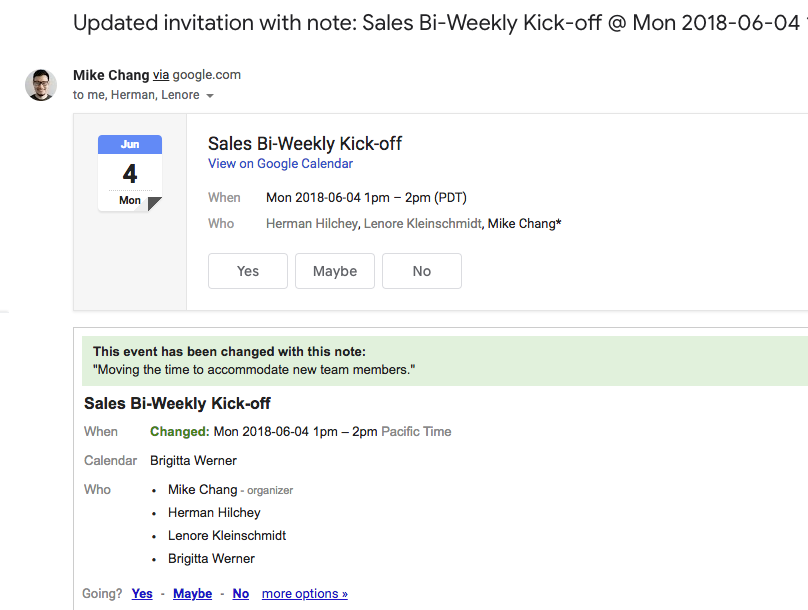
Here is how this new feature will work: When you make a change, a dialog box will pop up and allow you to enter a message for your guests. On the event page in Google Calendar itself — and in the email that alerts your guests of the change — that message will then appear at the top of the event details section.
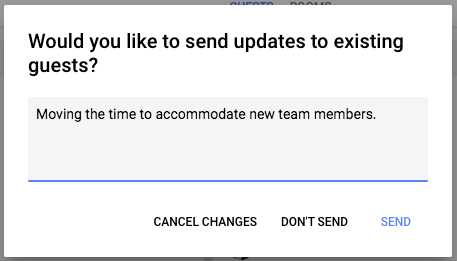
I’m guessing that at least half of the calendar invites I get change a few times before I actually get on the call. It’s generally unclear what has changed, though. The new dialog box appears automatically, so far more people will now explain their changes than before.
It’s nothing fancy and it’s actually a surprise that Google hasn’t done this before, but chances are that people will be using it all day long.
This new feature is now rolling out to all G Suite users and should be available to everybody (no matter whether their admins have them on the rapid release or schedule release schedule) within the next three days.
Messenger Kids no longer requires the kids’ parents to be friends, too
Facebook’s Messenger Kids application, which allows children under 13 to chat with parents’ approval, is today rolling out a small, but notable change – it no longer requires that the children’s parents be Facebook friends with one another, in order for the children to connect. This solves one of the problems with the app’s earlier design, where it operated more like an extension of a parents’ own social circle, instead of one for their child.
Of course, parents still have to approve every contact their child adds, as usual.
As any parent understands, there are always going to be those friends of your child where you have an acquaintance-type, friendly but casual relationship with the parents that falls short of earning “Facebook friend” status. While you might text them for the occasional play date or nod politely at drop-off, you’re not necessarily “friends.” But your kids are friends with each other. And you’re fine with that.
The Messenger Kids update now allows those kids to connect, if you okay it.
 The new feature will still require that both parents are on Facebook.
On Facebook, the parent visits the Messenger Kids section in Facebook’s own main navigation menu, as per usual, and does a search for the name of the parents of the child’s friends. You can then invite them to get the app and allow the children to connect.
This change could potentially help the app grow beyond the 500,000 installs it now has, according to Sensor Tower data – especially once the kids figure out how this invite system works. (And don’t put it past them to just inform you.)
Facebook says it made this decision as a direct result of parent feedback.
However, there is one challenge in not being good friends with the other kids’ parents: it can be harder to discuss problems like bullying or bad behavior, if they come up. With my daughter’s half a dozen or so friends on Messenger Kids (hey, I know), I’m not worried about these things because I know the parents well enough to have a discussion if the kids start fighting. We’d work together to resolve the problems, were they to occur. (And obviously, her family connections on the app are not an issue).
But when you start approving connections with those families you’re less close to, you may run into issues and not have a good way to communicate about them.
That’s why Facebook should be working to roll out systems that flag concerns in kids’ chat sessions – if a bad word is used, for example, or if the child says something rude – that alerts the child’s own parents. The company already has A.I.-based anti-bullying technology that could do this now. And I imagine many parents would opt into a system that asks if you wanted to be alerted to offensive language in chats.
Even a simple chat and call log could help parents address problems – like tell me how often I need to remind my daughter that we don’t place video calls to friends before 9 AM…even if you see them playing Animal Jam and know they’re online. Rules are rules, kiddo.
As it stands now, the best way to monitor the child’s chats is to install a second copy of the app on your own device and actually read them. That takes time and can be a little bit invasive for older kids, who have more of a sense of privacy.
The update is live today on the Messenger Kids app.
* This post was updated after publication with more current install data from Sensor Tower. Earlier, we said Messenger Kids had 350K installs as of April. It has now just passed 500K.
Investor/founder matching platform CrunchMatch returns to Disrupt San Francisco this September
Disrupt San Francisco 2018, TechCrunch’s flagship technology conference, is back this fall on September 5-7, and it’s bigger and bolder than ever. That’s not just hyperbole, people. We’ve staked out new digs at Moscone Center West — that means three times the floor space and more than 10,000 attendees.
Bigger crowds lead to more opportunities, especially when you have a tool to help you cut through the clutter and connect with the right early-stage startup founder — or find the perfect venture capitalist to fund your dream. CrunchMatch is that tool.
We first introduced CrunchMatch, our free, founder-investor connection platform (powered by Brella), at Disrupt SF 2017. Buy a Founder, Investor or Insider pass and you’ll be invited to fill out a CrunchMatch profile. Through the service you can suggest meetings, send, accept or decline invitations and reserve dedicated, private meeting spaces in the CrunchMatch Lounge.
Last year investors and founders used CrunchMatch to set up more than 1,300 meetings. This year, we expect that number to triple. Here’s what Luke Heron, CEO of TestCard.com, had to say about his CrunchMatch experience:
We used the CrunchMatch platform to schedule a bunch of meetings on our second day of the show. We met with six or seven VCs and, by and large, they were very positive meetings.
Whether your company meets the investment criteria of a venture capitalist you just heard speak on the main stage or you see the perfect early-stage company pitch during Startup Battlefield, CrunchMatch will let you send a meeting invitation quickly and easily.
As a reminder, you’ll find a special focus on these tech categories at Disrupt SF 2018: AI, AR/VR, Blockchain, Biotech, Fintech, Gaming, Healthtech, Privacy/Security, Space, Mobility, Retail and Robotics.
You’ll find them all exhibiting in Startup Alley. Or you can join them and place your early-stage startup in front of thousands of potential customers, partners and investors. CrunchMatch will really save you time as you work your way through the Alley.
If you’re looking to invest in early-stage startups — or looking for funding — Disrupt San Francisco 2018 is where you want to be on September 5-7, and CrunchMatch is the tool you need to use. Don’t wait, purchase your Founder, Investor or Insider passes today.
Here’s where it’s cheaper to take an Uber than to own a car
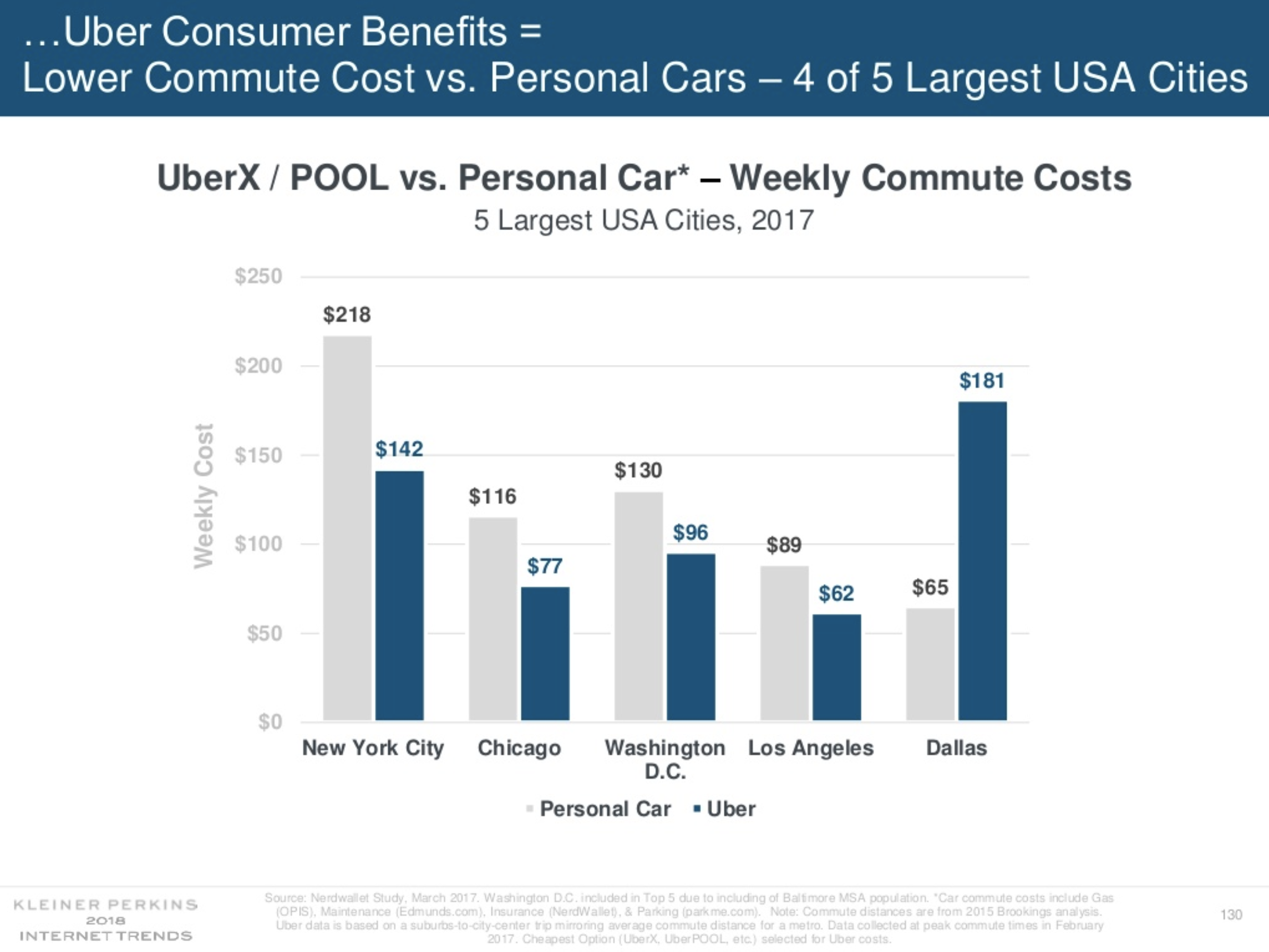
Ride-sharing companies have long touted the cost benefits of their platforms. Well, depending on the city, it can be cheaper on a weekly basis to take an UberX or UberPOOL than it is to own a personal car, according to Kleiner Perkins Caufield Byers partner Mary Meeker’s 2018 annual internet trends report.
In four of the five largest cities in the U.S., it is indeed cheaper to rely on Uber than it is to own a car. Meeker’s analysis took into account cost of gas, car insurance, maintenance and parking.
So, if you live in New York City, Chicago, Washington, D.C. or Los Angeles, it’s cheaper to take an Uber. But that’s not the case in Dallas, where the average weekly cost of car ownership is $65 compared to the average weekly Uber cost of $181.
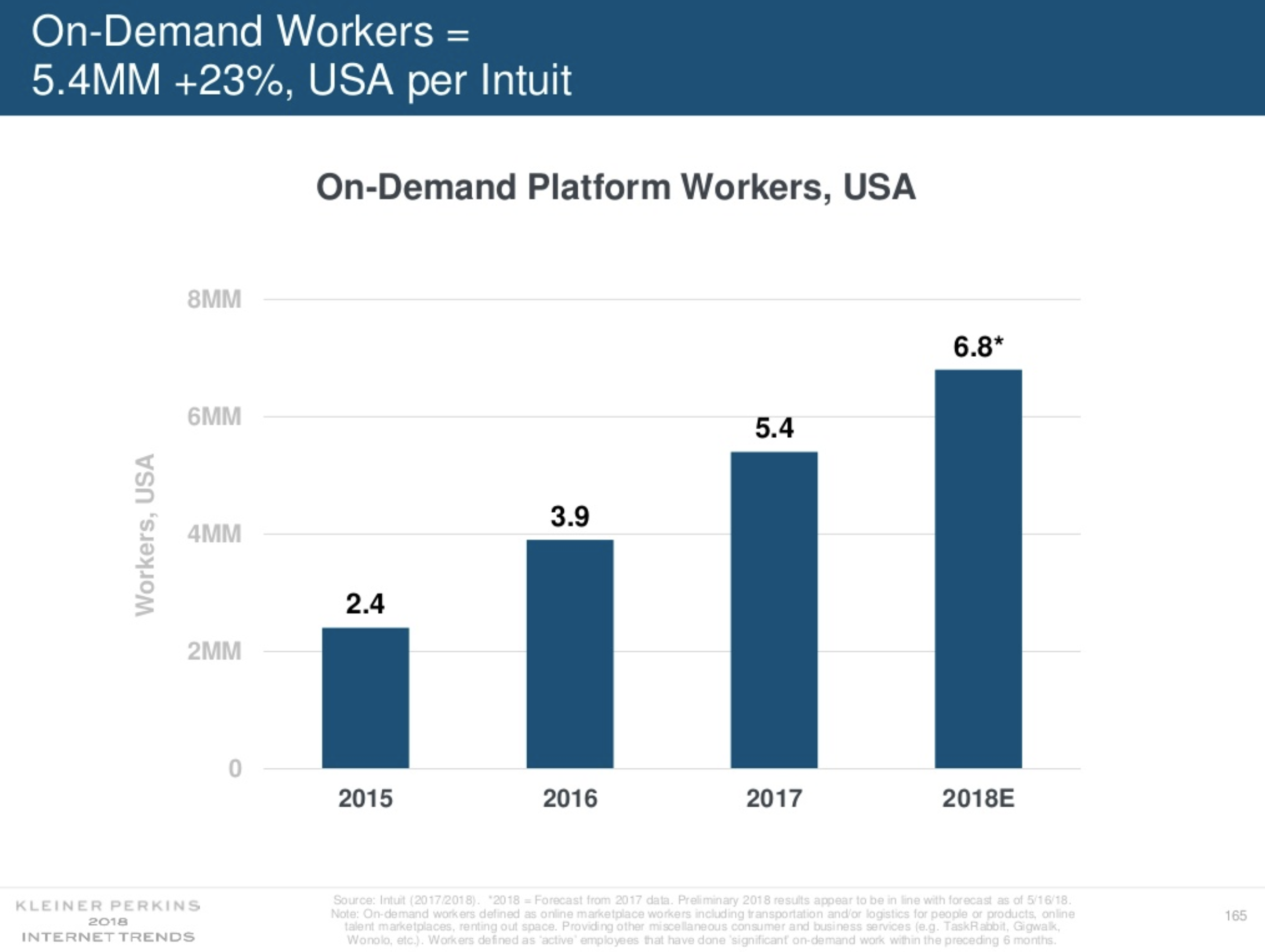
Meeker’s report also looked at the rise of on-demand workers in the U.S. Last year, there were 5.4 million on-demand workers in the country. This year, there are an estimated 6.8 million people working in the on-demand economy.
“These are big numbers,” Meeker said onstage, noting how these types of jobs are helping to supplement income for people, provide greater flexibility and improve work-life balance.
You can check out the full deck below.
Trump’s visa restrictions aimed at Chinese STEM students to start in June
In a policy change set for next month, the Trump administration is moving to shorten visas for Chinese students in fields like tech and engineering. While most visas are issued for the longest possible length of time under law, the new policy will allow U.S. officials to put a one-year cap on visas for Chinese graduate students who are “studying in fields like robotics, aviation and high-tech manufacturing,” according to the Associated Press.
A State Department official told The Hill that “Although the large majority of visas issued to Chinese nationals are issued for the maximum validity, consular officers may limit the validity of visas on a case-by-case basis” under the new rules.
Beyond the student limits, U.S. consulates and embassies reportedly received instructions that any Chinese citizen applying for a visa will need to secure additional special permission form the U.S. if they work in research or management for any company the U.S. Commerce Department lists as an entity “requiring higher scrutiny.”
The new visa policy shifts come as Trump is knee-deep in a controversial new tariff plan targeting Chinese trade and is intended to protect against the theft of U.S. intellectual property, or so the reasoning goes.
The visa change was signaled in the National Security Strategy report that the Trump administration issued in December. That document explains the rationale clearly:
The United States will review visa procedures to reduce economic theft by non-traditional intelligence collectors. We will consider restrictions on foreign STEM students from designated countries to ensure that intellectual property is not transferred to our competitors, while acknowledging the importance of recruiting the most advanced technical workforce to the United States.
The State Department noted these changes will go into effect starting on June 11.
Consumer Reports just reversed its stance on the Tesla Model 3, giving the car its endorsement
It sometimes reads like a punishing love story, the relationship between Consumer Reports and electric car company Tesla . Consumer Reports withholds its affection, Tesla addresses its errant ways and not long afterward, the two come happily together until the next car review.
We saw this happen in late 2015, when Consumer Reports assigned Tesla’s Model S a “worse-than-average” rating in an annual report about the predicted reliability of new vehicles, knocking down the company’s share price by more than 10 percent in one day. Later, the car was re-instated by Consumer Reports as a top-rated ultra-luxury sedan after consumers said its reliability had improved, and it updated its software to include automatic emergency braking at highway speeds.
Something similar happened today. As you may have seen, Consumer Reports last week withheld its recommendation to buy Tesla’s more compact luxury car, the Model 3, after its testers “found flaws—big flaws—such as long stopping distances in our emergency braking test and difficult-to-use controls.”
Specifically, the outlet reported, the car’s stopping distance of 152 feet from 60 miles per hour was “far worse than any contemporary car” it has tested and “about seven feet longer than the stopping distance of a Ford F-150 full-sized pickup,” which weighs about 7,000 pounds. (The Model 3 weighs roughly half that amount.)
Tesla told Consumer Reports that its own testing had found stopping distances from 60 mph to 0 mph were on average 133 feet. Still, Tesla CEO Elon Musk also jumped on the phone with Consumer Reports’s head of auto testing to share information that Tesla had discovered about its braking system and to say the carmaker had an over-the-air software update in the works to address it.
The update has since been completed and shipped, and now Consumer Reports is both confirming that Tesla managed to improve the car’s braking distance by 20 feet and it says it’s giving the Model 3 its highly sought-after recommendation — even while it hopes Tesla will also do more to improve the car’s center-mounted touch controls, which its testers worry are difficult to use while driving.
It’s easy to characterize the whole thing as some sort of routine dance between reviewer and reviewee, but it’s a much bigger deal than that insists Consumer Reports, which has been reviewing products for 82 years and remains a powerful force, even while its influence has waned somewhat in the era of anonymous online reviews.
Indeed, the outlet notes in its newest review of the car that, until now, remote improvement to a car’s basic functionality on such a meaningful scale as Tesla just pulled off was “unheard of.”
That kind of observation clearly pleases Musk, who launched a tirade against the media last week but today is praising Consumer Reports for its “high quality critical feedback.” He also says that more improvements are coming.
Really appreciate the high quality critical feedback from @ConsumerReports. Road noise & ride comfort already addressed too. UI improvements coming via remote software update later this month. https://t.co/ZMLPJxmPlM
— Elon Musk (@elonmusk) May 30, 2018
Wyze’s $30 security camera adds motorized panning
In the crowded security camera category Wyze’s products aren’t so much amazing as they are amazingly cheap. Take last year’s simply named Wyze Cam. There was nothing about the product that set it apart from the likes of Nest or Canary or the Netgear Arlo — beyond, of course, that crazy $20 price tag.
Announced this week, the Wyze Cam Pan is 50-percent more expensive than its predecessor, bringing the cost up to a whopping $30. With that bank breaking price, however, you get the titular panning feature, which gives you a 360-degree remote view of a room, on-top of the built-in 120-degree fish eye. It’s able to scan a full circle in around three-seconds, according to Wyze.
Panning is accomplished through the app with a swipe of the screen. The app also features motion tracking, an improvement over the first generation device, panning the camera as it spots moving objects.
The camera shoots 1080p video at 15 fps and can do up to 8x digital zoom. There’s also two-way audio and night vision — both relatively standard features on security cameras these days, but everything kind of feels like a bonus when the device runs $30. That price also includes up to 14 days of free video storage on AWS, a nice addition that a number of significantly more expensive competitors no longer offer.
Again, this isn’t world-setting-on-fire stuff here, but those who have been balking at pricier competitors don’t have a lot to lose here.
Customer opinions of ISPs somehow drop even lower
Disliking one’s internet provider is such a common condition that it’s hard to imagine that ISPs have anywhere to go but up in the eyes of their customers. Nope! There are new lows ahead, if the latest American Customer Satisfaction Index is any indication. Charts ahead!
The ACSI compiles thousands of interviews with consumers and produce a score for various companies and industries based on a number of metrics. And this year, internet providers fell from last place to last place minus.
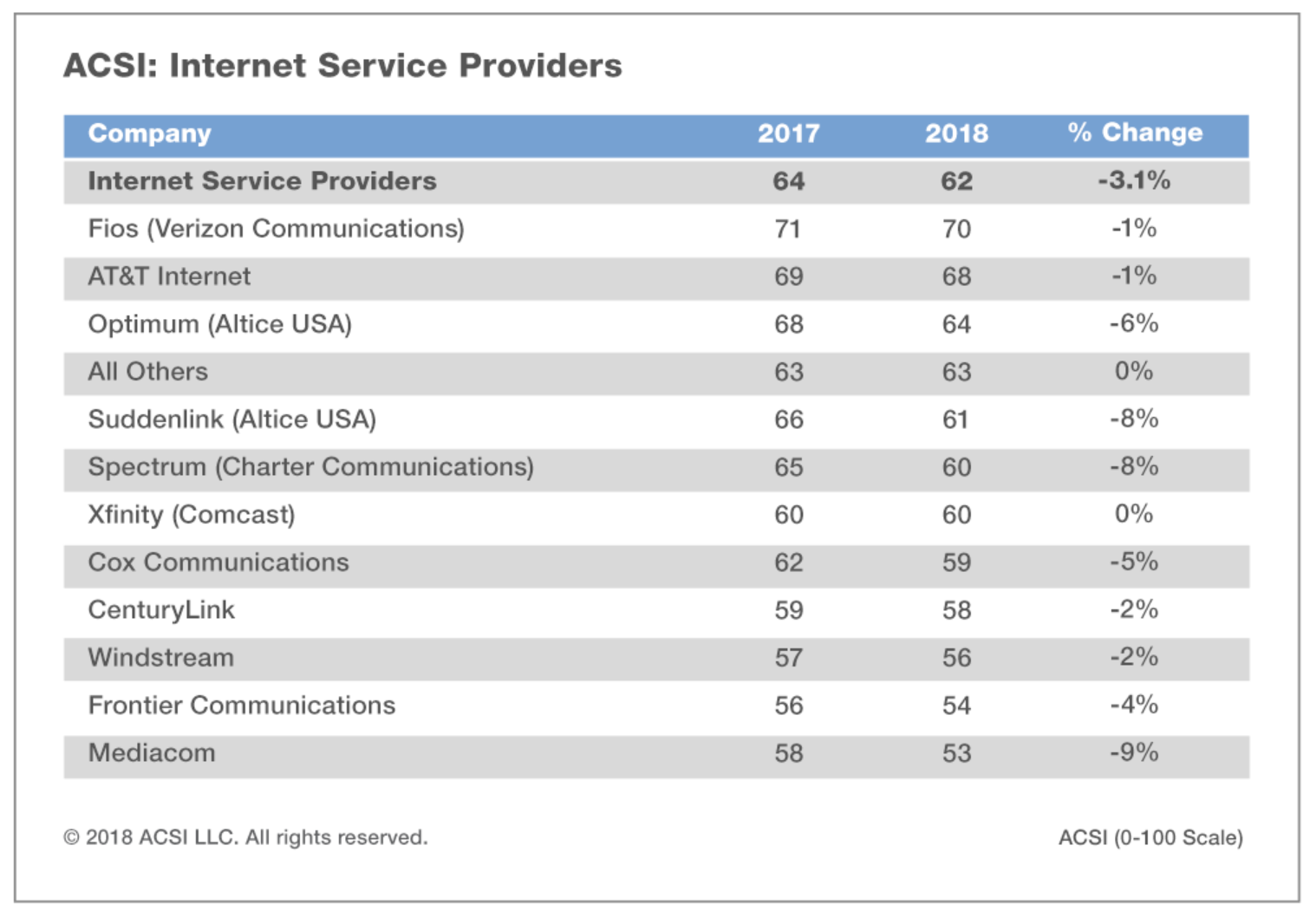
(Note: Verizon owns Oath, which owns TechCrunch. Believe me, it doesn’t affect our coverage.)
“An all-time low for the industry that along with subscription TV already had the poorest customer satisfaction among all industries tracked by the ACSI,” the report reads. “Customers are unhappy with the high price of poor service, but many households have limited alternatives as more than half of all Americans have only one choice for high speed broadband.”
Despite what the FCC and broadband companies like to say, few people have more than one good choice for internet provider, unlike even other industries that are dominated by a handful of companies, like mobile. And the service people do have access to isn’t inspiring loyalty.
Pretty much every category saw a drop, despite ardent promises from the likes of Comcast and Cox to improve their customer service and simplify bills and offers.
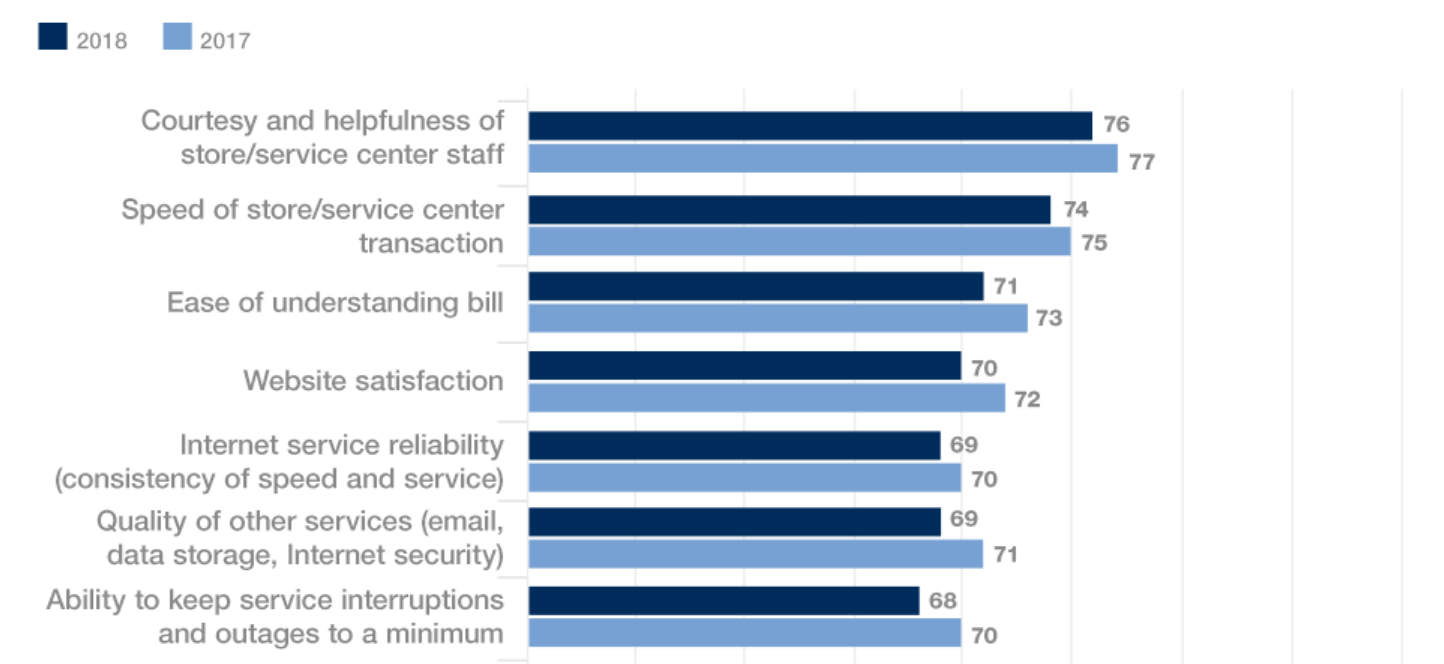
A sample of ratings the ISPs received – dark blue is the latest.
I myself actually just had a good interaction with Comcast, but because it was just a nice customer service agent helping me navigate the company’s labyrinth of misleading offers and upsells, I consider it as breaking even. Or it would have if my bill hadn’t just nearly doubled without any notification, so in the end it’s probably a negative.
Streaming services and video on demand were included in the survey for the first time this year, and did fairly well. Netflix, PlayStation Vue and Twitch were well thought of, and even the worst-ranked service, Sony’s Crackle, beats most of the perennially disliked pay TV providers. Strangely enough, most of the latter are the very same providers are often the same as the perennially disliked broadband providers. Coincidence? You be the judge.
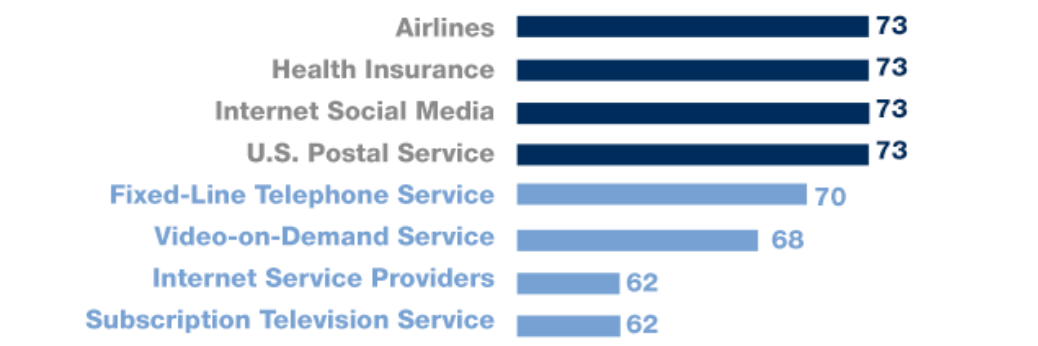
Worse than social media? These days that’s quite a feat.
Overall, those companies are at the very bottom of the list, below even airlines and insurance companies — and ironically, the TVs that are used to watch the content are at the very top of the heap. Time to step up your game, ISPs.
Review: Cult of the Machine at the de Young
Let’s flash back to the Machine Age, the period in American history that gave us the assembly line, the first nonstop transcontinental flight, regular radio broadcasts, and the first robot capable of performing more than 20 movements. These technological advancements inspired a style of art called Precisionism, popularized by big names like Georgia O’Keefe, Charles Sheeler and Charles Demuth.
The Cult of the Machine exhibit at the de Young museum in San Francisco is a reflection of attitudes toward machines and robotics during the Machine Age, the period between the two world wars during which industrial efficiency was the reigning mantra. In an era where efficiency was seen as both beautiful and as a threat, there was an influx of art inspired by anxieties people had about the rise of industrial technology. The exhibit rehashes the “are machines a friend or foe to humans?” debate through a Precisionist lens with a thorough, possibly too thorough, collection.
Curated by Emma Acker, the exhibit is predominantly Precisionist works. Precisionism is an early 20th century American modernist style that was born from artists who synthesized European cubism and futurism with the American vision of industrial, urban themes. We see smokestacks, factories, bridges and skyscrapers painted with geometric, smooth techniques.
Technologists today have expressed concern about the takeover of robotics, decline in manufacturing jobs, losing control to AIs, biased algorithms and the loss of craftsmanship to machines. Every tech company has a strategy around machine learning and AI. Venture capitalists are investing in robotics startups. There are robots designed to make pizzas. Robots that autonomously deliver goods through the last mile. Autonomous vehicles designed to replace drivers and flying cars on the horizon. Tech continues to make our world more efficient and convenient, but it’s impossible to predict whether machines will eventually help or hinder us as a species. When strolling through the Cult of the Machine exhibit at the de Young, one starts to wonder if this line of questioning will ever end.
Duality of machines as light and dark
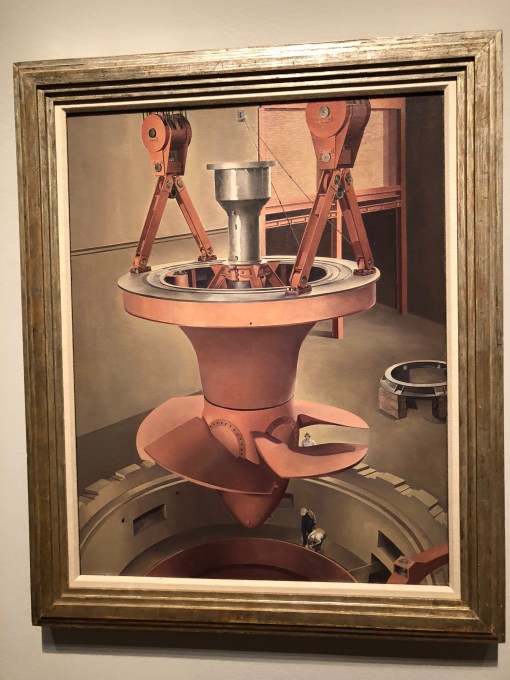
The de Young collection is a balance between the anxieties Americans felt toward technology during the Machine Age, mixed with the hope that technology brought to a more connected, convenient world. One gallery dives into menacing interpretations of what technology meant during the period. Charles Sheeler’s “Suspended Power,” a 1939 oil on canvas depicts a large machine hanging over a few small humans in a factory — a stark representation of the immense, barely-controlled power technology can exert over humanity — and how with one mis-engineered piece, we could be crushed. The piece is the star of the exhibit, encapsulating the looming, unquantifiable threat of the future.
Artists certainly saw the darkness in America’s worship of industry. Take Charles Demuth’s, “Incense of a New Church,” 1921. Here a factory is compared to a church, smoke to incense.

Much of the exhibit is scenes of factories, smokestacks and urban landscapes void of humans, movement and color. The pieces themselves look like they were painted by machines, with no brush strokes to be detected. It could be the combination of the monotony of this art — the quantity of motionless urban landscapes — that makes parts of the exhibit feel empty and tedious. But that just may be the point.
Clarence Holbrook Carter’s “War Bride,” closes the exhibit. A bride stands to face her groom, a machine.

The absence of human error evokes anonymity and alienation that exist in a technological world. There’s an eerie emptiness to these close up shots of mechanical systems. Yet they are the small pieces that make up our world.
Confusing efficiency with beauty
During the Machine Age, the demand for efficiency became the driving force of the modern era. Its easy to see how efficiency was confused with beauty, rather than seen as the fulfillment of economic needs. Yet artists were finding meaning in the intersection of art, commerce and industry.
“I speak in [the] tongue of my times. The mechanical, the industrial. Anything that works efficiently is beautiful.” – Charles Sheeler.
This exhibit is not by any means beautiful. There is nothing here that one might be inspired to hang on a living room wall.
However, for the first time “artists started to discover beauty and meaning in our American fabric of industry and production and elevated it to the level of fine art,” says Acker. “The ideas and themes explored in the works from this period seem to resonate so much with our current moment. That’s what I wanted to emphasize. Precisionism was the springboard for thinking about larger themes around our relationship to technology during the Machine Age and today. And how the excitements and anxieties Americans experienced around tech innovation are reflected in our same social forces today.”
Conflict between humans and machines
Perhaps the most interesting part of the exhibit is an interactive feature that invites visitors to select three words out of 30 to express what technology means to them. Some of the options are: creative, interconnected, revolutionary, automated, isolating, surveillance, collaborative, addicting, alienating, cold. At the end of the exhibit the most frequently-selected words are displayed in a collective word portrait.

The word cloud is updated every three seconds, and is contrasted with another word cloud. The other is a composite of Machine Age terms describing technology, drawn from 1920s-1930s American periodicals. Size and color of the words is determined by how frequently it appeared in the texts. It seems the visitors of this exhibit have more optimistic views of tech than the media during the Machine Age did.
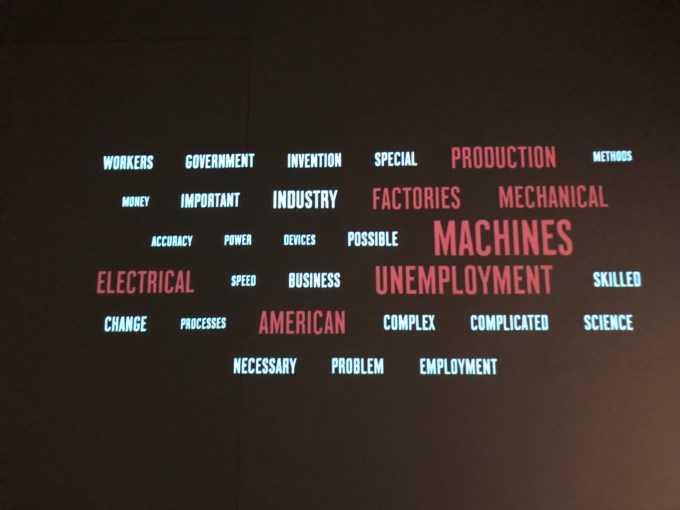
Overall the exhibit connects two views of technology: a cult-like promise of a better engineered world, and the crushing fear of the unknown threatening humanity’s livelihood.
Where does this leave us now? “We can relate to [the Machine Age] now as we enter this 4th industrial revolution. We’re looking forward with excitement and some trepidation toward disruption, displacement and changes on the horizon,” says Acker.
Cult of the Machine: Precisionsim and American Art runs through August 12, 2018 at the de Young Museum in San Francisco. For those interested in exploring how tech has shaped art throughout American history, this exhibit is one to see.
Vermont passes first first law to crack down on data brokers
While Facebook and Cambridge Analytica are hogging the spotlight, data brokers that collect your information from hundreds of sources and sell it wholesale are laughing all the way to the bank. But they’re not laughing in Vermont, where a first-of-its-kind law hems in these dangerous data mongers and gives the state’s citizens much-needed protections.
Data brokers in Vermont will now have to register as such with the state; they must take standard security measures and notify authorities of security breaches (no, they weren’t before); and using their data for criminal purposes like fraud is now its own actionable offense.
If you’re not familiar with data brokers, well, that’s the idea. These companies don’t really have a consumer-facing side, instead opting to collect information on people from as many sources as possible, buying and selling it amongst themselves like the commodity it has become.
This data exists in a regulatory near-vacuum. As long as they step carefully, data brokers can maintain what amounts to a shadow profile on consumers. I talked with director of the World Privacy Forum, Pam Dixon, about this practice.
“If you use an actual credit score, it’s regulated under the Fair Credit Reporting Act,” she told me. “But if you take a thousand points like shopping habits, zip code, housing status, you can create a new credit score; you can use that and it’s not discrimination.”
And while medical data like blood tests are protected from snooping, it’s not against the law for a company to make an educated guess your condition from the medicine you pay for at the local pharmacy. Now you’re on a secret list of “inferred” diabetics, and that data gets sold to, for example, Facebook, which combines it with its own metrics and allows advertisers to target it.
Oh yes, Facebook does that. Or did do it for years, only ending the practice under the present scrutiny. “When you looked at Facebook’s targeting there were like 90 targets – race, income, housing status — that was all Acxiom data,” Dixon told me; Acxiom is one of the largest brokers.
Data brokers have been quietly supplying everyone with your personal information for a long time. And advertising is the least of its applications: this data is used for informing shadow credit scores, restricting services and offers to certain classes of people, setting terms of loans, and more.
Vermont’s new law, which took effect late last week, is the nation’s first to address the data broker problem directly.
“It’s been a huge oversight,” said Dixon. “Until Vermont passed this law there was no regulation for data brokers. It’s that serious. We’ve been looking for something like this to be put in place for like 20 years.”
Europe, meanwhile, has leapfrogged American regulators with the monumental GDPR, which just entered into effect.
The issue, she said, has always been defining a data broker. It’s harder than you might think, considering how secretive and influential these companies are. When every company collects data on their customers and occasionally monetizes it, who’s to say where an ordinary business ends and data brokering begins?
They fought previous laws, and they fought this one. But Dixon, who along with the companies themselves was part of the state’s hearings to create the law, said Vermont avoided this pitfall.
“The way the bill is written is extremely well thought through. They didn’t worry as much about the definition, but focused on the activity,” she explained. And indeed the directness and clarity of the law are a pleasant surprise:
While data brokers offer many benefits, there are also risks associated with the widespread aggregation and sale of data about consumers, including risks related to consumers’ ability to know and control information held and sold about them and risks arising from the unauthorized or harmful acquisition and use of consumer information.
Consumers may not be aware that data brokers exist, who the companies are, or what information they collect, and may not be aware of available recourse.
This straightforward description of a subtle and widespread problem greatly enabled by technology is a rarity in a world dominated by legislators and judges who regularly demonstrate ignorance on high-tech topics. (You can read the full law here.)
As Dixon pointed out, lots of companies will find themselves encompassed by the law’s broad definition:
“Data broker” means a business, or unit or units of a business, separately or together, that knowingly collects and sells or licenses to third parties the brokered personal information of a consumer with whom the business does not have a direct relationship.
In other words, anyone who collects data second hand and resells it. There are a few exceptions for things like consumer-focused information services (411, for example) but it seems unlikely that any of the real brokers will escape the designation.
With the requirement to register, along with a few other disclosures brokers will be required to make, consumers will be aware of which they can opt out of and how. And if they find themselves the victim of a crime that used broker data — a home loan rate secretly raised because of race, for instance, or a job offer rescinded because of a surreptitiously discovered medical condition — they have legal recourse.
Security at these companies will have to meet a minimum standard, as well as access controls. And data breach rules mean prompt notification if personal data is leaked in spite of them.
It’s a good first step and one that should prove extremely beneficial to Vermonters; if it’s as successful as Dixon thinks it is, other states may soon imitate it.