Elizabeth Holmes reportedly steps down at Theranos after criminal indictment

Elizabeth Holmes has left her role as CEO of Theranos and has been charged with wire fraud, CNBC and others report. The company’s former president, Ramesh “Sunny” Balwani, was also indicted today by a grand jury.

These criminal charges are separate from the civil ones filed in March by the SEC and already settled. There are 11 charges; two are conspiracy to commit wire fraud (against investors, and against doctors and patients) and the remaining nine are actual wire fraud, with amounts ranging from the cost of a lab test to $100 million.

Theranos’s general counsel, David Taylor, has been appointed CEO. What duty the position actually entails in the crumbling enterprise is unclear. Holmes, meanwhile, remains chairman of the board.

The FBI Special Agent in Charge of the case against Theranos, John Bennett, said the company engaged in “a corporate conspiracy to defraud financial investors,” and “misled doctors and patients about the reliability of medical tests that endangered health and lives.”

This story is developing. I’ve asked Theranos for comment and will update if I hear back; indeed I’m not even sure anyone is there to respond.

Judge says ‘literal but nonsensical’ Google translation isn’t consent for police search

Machine translation of foreign languages is undoubtedly a very useful thing, but if you’re going for anything more than directions or recommendations for lunch, its shallowness is a real barrier. And when it comes to the law and constitutional rights, a “good enough” translation doesn’t cut it, a judge has ruled.

The ruling (PDF) is not hugely consequential, but it is indicative of the evolving place in which translation apps find themselves in our lives and legal system. We are fortunate to live in a multilingual society, but for the present and foreseeable future it seems humans are still needed to bridge language gaps.

The case in question involved a Mexican man named Omar Cruz-Zamora, who was pulled over by cops in Kansas. When they searched his car, with his consent, they found quite a stash of meth and cocaine, which naturally led to his arrest.

But there’s a catch: Cruz-Zamora doesn’t speak English well, so the consent to search the car was obtained via an exchange facilitated by Google Translate — an exchange that the court found was insufficiently accurate to constitute consent given “freely and intelligently.”

The fourth amendment prohibits unreasonable search and seizure, and lacking a warrant or probable cause, the officers required Cruz-Zamora to understand that he could refuse to let them search the car. That understanding is not evident from the exchange, during which both sides repeatedly fail to comprehend what the other is saying.

Not only that, but the actual translations provided by the app weren’t good enough to accurately communicate the question. For example, the officer asked “¿Puedo buscar el auto?” — the literal meaning of which is closer to “can I find the car,” not “can I search the car.” There’s no evidence that Cruz-Zamora made the connection between this “literal but nonsensical” translation and the real question of whether he consented to a search, let alone whether he understood that he had a choice at all.

With consent invalidated, the search of the car is rendered unconstitutional, and the charges against Cruz-Zamora are suppressed.

It doesn’t mean that consent is impossible via Google Translate or any other app — for example, if Cruz-Zamora had himself opened his trunk or doors to allow the search, that likely would have constituted consent. But it’s clear that app-based interactions are not a sure thing. This will be a case to consider not just for cops on the beat looking to help or investigate people who don’t speak English, but in courts as well.

Providers of machine translation services would have us all believe that those translations are accurate enough to use in most cases, and that in a few years they will replace human translators in all but the most demanding situations. This case suggests that machine translation can fail even the most basic tests, and as long as that possibility remains, we have to maintain a healthy skepticism.

Machines learn language better by using a deep understanding of words

Computer systems are getting quite good at understanding what people say, but they also have some major weak spots. Among them is the fact that they have trouble with words that have multiple or complex meanings. A new system called ELMo adds this critical context to words, producing better understanding across the board.

To illustrate the problem, think of the word “queen.” When you and I are talking and I say that word, you know from context whether I’m talking about Queen Elizabeth, or the chess piece, or the matriarch of a hive, or RuPaul’s Drag Race.

This ability of words to have multiple meanings is called polysemy. And really, it’s the rule rather than the exception. Which meaning it is can usually be reliably determined by the phrasing — “God save the queen!” versus “I saved my queen!” — and of course all this informs the topic, the structure of the sentence, whether you’re expected to respond, and so on.

Machine learning systems, however, don’t really have that level of flexibility. The way they tend to represent words is much simpler: it looks at all those different definitions of the word and comes up with a sort of average — a complex representation, to be sure, but not reflective of its true complexity. When it’s critical that the correct meaning of a word gets through, they can’t be relied on.

ELMo (“Embeddings from Language Models”), however, lets the system handle polysemy with ease; as evidence of its utility, it was awarded best paper honors at NAACL last week. At its heart it uses its training data (a huge collection of text) to determine whether a word has multiple meanings and how those different meanings are signaled in language.

For instance, you could probably tell in my example “queen” sentences above, despite their being very similar, that one was about royalty and the other about a game. That’s because the way they are written contain clues to your own context-detection engine to tell you which queen is which.

Informing a system of these differences can be done by manually annotating the text corpus from which it learns — but who wants to go through millions of words making a note on which queen is which?

“We were looking for a method that would significantly reduce the need for human annotation,” explained Mathew Peters, lead author of the paper. “The goal was to learn as much as we can from unlabeled data.”

In addition, he said, traditional language learning systems “compress all that meaning for a single word into a single vector. So we started by questioning the basic assumption: let’s not learn a single vector, let’s have an infinite number of vectors. Because the meaning is highly dependent on the context.”

ELMo learns this information by ingesting the full sentence in which the word appears; it would learn that when a king is mentioned alongside a queen, it’s likely royalty or a game, but never a beehive. When it sees pawn, it knows that it’s chess; jack implies cards; and so on.

An ELMo-equipped language engine won’t be nearly as good as a human with years of experience parsing language, but even working knowledge of polysemy is hugely helpful in understanding a language.

Not only that, but taking the whole sentence into account in the meaning of a word also allows the structure of that sentence to be mapped more easily, automatically labeling clauses and parts of speech.

Systems using the ELMo method had immediate benefits, improving on even the latest natural language algorithms by as much as 25 percent — a huge gain for this field. And because it is a better, more context-aware style of learning, but not a fundamentally different one, it can be integrated easily even into existing commercial systems.

In fact, Microsoft is reportedly already using it with Bing. After all, it’s crucial in search to determine intention, which of course requires an accurate reading of the query. ELMo is open source, too, like all the work from the Allen Institute for AI, so any company with natural language processing needs should probably check this out.

The paper lays down the groundwork of using ELMo for English language systems, but because its power is derived by essentially a close reading of the data that it’s fed, there’s no theoretical reason why it shouldn’t be applicable not just for other languages, but in other domains. In other words, if you feed it a bunch of neuroscience texts, it should be able to tell the difference between temporal as it relates to time and as it relates to that region of the brain.

This is just one example of how machine learning and language are rapidly developing around each other; although it’s already quite good enough for basic translation, speech to text and so on, there’s quite a lot more that computers could do via natural language interfaces — if they only know how.


Apple and Oprah sign a multi-year partnership on original content

Apple announced today a multi-year content partnership with Oprah Winfrey to produce programs for the tech company’s upcoming video-streaming service. Apple didn’t provide any specific details as to what sort of projects Winfrey would be involved in, but there will be more than one it seems.

Apple shared the news of its deal with Winfrey in a brief statement on its website, which read:

Apple today announced a unique, multi-year content partnership with Oprah Winfrey, the esteemed producer, actress, talk show host, philanthropist and CEO of OWN.

Together, Winfrey and Apple will create original programs that embrace her incomparable ability to connect with audiences around the world.

Winfrey’s projects will be released as part of a lineup of original content from Apple.

The deal is a significant high-profile win for Apple, which has been busy filing out its lineup with an array of talent in recent months.

The streaming service also will include a reboot of Steven Spielberg’s Amazing Storiesa Reese Witherspoon- and Jennifer Aniston-starring series set in the world of morning TVan adaptation of Isaac Asimov’s Foundation books, a thriller starring Octavia Spencer, a Kristen Wiig-led comedy, a Kevin Durant-inspired scripted basketball show, a series from “La La Land’s” director and several other shows.

Winfrey, however, is not just another showrunner or producer. She’s a media giant who has worked across film, network and cable TV, print and more as an actress, talk show host, creator and producer.

She’s also a notable philanthropist, having contributed more than $100 million to provide education to academically gifted girls from disadvantaged backgrounds, and is continually discussed as a potential presidential candidate, though she said that’s not for her.

On television, Winfrey’s Harpo Productions developed daytime TV shows like “Dr. Phil,” “The Dr. Oz Show” and “Rachael Ray.” Harpo Films produced several Academy Award-winning movies, including “Selma,” which featured Winfrey in a starring role. She’s also acted in a variety of productions over the years, like “The Color Purple,” which scored her an Oscar nom, “Lee Daniels’ The Butler,” “The Immortal Life of Henrietta Lacks” and Disney’s “A Wrinkle in Time.”

Winfrey also founded the cable network OWN in 2011 in partnership with Discovery Communications, and has exec produced series including “Queen Sugar,” “Oprah’s Master Class” and the Emmy-winning “Super Soul Sunday.”

The latter has a connection with Apple as it debuted as a podcast called “Oprah’s SuperSoul Conversations” and became a No. 1 program on Apple Podcasts.

Winfrey recently extended her contract with OWN through 2025, so it’s unclear how much time she’ll devote specifically toward her Apple projects.

Apple also didn’t say if Winfrey will star or guest in any of the programs themselves, but that’s always an option on the table with a deal like this. CNN, however, is reporting that Winfrey “is expected to have an on-screen role as a host and interviewer.”

Kustomer gets $26M to take on Zendesk with an omnichannel approach to customer support

The CRM industry is now estimated to be worth some $4 billion annually, and today a startup has announced a round of funding that it hopes will help it take on one aspect of that lucrative pie, customer support. Kustomer, a startup out of New York that integrates a number of sources to give support staff a complete picture of a customer when he or she contacts the company, has raised $26 million.

The funding, a series B, was led by Redpoint Ventures (notably, an early investor in Zendesk, which Kustomer cites as a key competitor), with existing investors Canaan Partners, Boldstart Ventures, and Social Leverage also participating.

Cisco Investments was also a part of this round as a strategic investor: Cisco (along with Avaya) is one of the world’s biggest PBX equipment vendors, and customer support is one of the biggest users of this equipment, but the segment is also under pressure as more companies move these services to the cloud (and consider alternative options). Potentially, you could see how Cisco might want to partner with Kustomer to provide more services on top of its existing equipment, and potentially as a standalone service — although for now the two have yet to announce any actual partnerships.

Given that Kustomer has been approached already for potential acquisitions, you could see how the Ciscos of the world might be one possible category of buyers.

Kustomer is not discussing valuation but it has raised a total of $38.5 million. Kustomer’s customers include brands in fashion, e-commerce and other sectors that provide customer support on products on a regular basis, such as Ring, Modsy, Glossier, Smug Mug and more.

When we last wrote about Kustomer, when it raised $12.5 million in 2016, the company’s mission was to effectively turn anyone at a company into a customer service rep — the idea being that some issues are better answered by specific people, and a CRM platform for all employees to engage could help them fill that need.

Today, Brad Birnbaum, the co-founder and CEO, says that this concept has evolved. He said that “half of its business model still involves the idea of everyone being on the platform.” For example, an internal sales rep can collaborate with someone in a company’s shipping department — “but the only person who can communicate with the customer is the full-fledged agent,” he said. “That is what the customers wanted so that they could better control the messaging.”

The collaboration, meanwhile, has taken an interesting turn: it’s not just related to employees communicating better to develop a more complete picture of a customer and his/her history with the company; but it’s about a company’s systems integrating better to give a more complete view to the reps. Integrations include data from e-commerce platforms like Shopify and Magento; voice and messaging platforms like Twilio, TalkDesk, Twitter and Facebook Messenger; feedback tools like Nicereply; analytics services like Looker, Snowflake, Jira and Redshift; and Slack.

Birnbaum previously founded and sold Assistly to Salesforce, which turned it into Desk.com — (his co-founder in Kustomer, Jeremy Suriel, was Assistly’s chief architect), and between that and Kustomer he also had a go at building out Airtime, Sean Parker’s social startup. Kustomer, he says, is not only competing against Salesforce but perhaps even more specifically Zendesk, in offering a new take on customer support.

Zendesk, he said, had really figured out how to make customer support ticketing work efficiently, “but they don’t understand the customer at all.”

“We are a much more modern solution in how we see the world,” he continued. “No one does omni-channel customer service properly, where you can see a single threaded conversation speaking to all of a customer’s points.”

Going forward, Kustomer will be using the funding to expand its platform with more capabilities, and some of its own automations and insights (rather than those provided by way of integrations). This will also see the company expand into other kinds of services adjacent to taking inbound customer requests, such as reaching out to the customers, potentially to seel to them. “We plan to go broadly with engagement as an example,” Birnbaum said. “We already know everything about you so if we see you on a website, we can proactively reach out to you and engage you.”

“It is time for disruption in customer support industry, and Kustomer is leading the way,” said Tomasz Tunguz, partner at Redpoint Ventures, in a statement. “Kustomer has had impressive traction to date, and we are confident the world’s best B2C and B2B companies will be able to utilize the platform in order to develop meaningful relationships, experiences, and lifetime value for their customers. This is an exciting and forward-thinking platform for companies as well as their customers.”

With its new in-car operating system, BMW slowly breaks with tradition

When you spend time with a lot of BMW folks, as I did during a trip to Germany earlier this month, you’ll regularly hear the word “heritage.” Maybe that’s no surprise, given that the company is now well over 100 years old. But in a time of rapid transformation that’s hitting every car manufacturer, engineers and designers have to strike a balance between honoring that history and looking forward. With the latest version of its BMW OS in-car operating system and its accompanying design language, BMW is breaking with some traditions to allow it to look into the future while also sticking to its core principles.

If you’ve driven a recent luxury car, then the instrument cluster in front of you was likely one large screen. But at least in even the most recent BMWs, you’ll still see the standard round gauges that have adorned cars since their invention. That’s what drivers expect and that’s what the company gave them, down to the point where it essentially glued a few plastic strips on the large screen that now makes up the dashboard to give drivers an even more traditional view of their Autobahn speeds.

With BMW OS 7.0, which I got some hands-on time with in the latest BMW 8-series model that’s making its official debut today (and where the OS update will also make its first appearance), the company stops pretending that the screen is a standard set of gauges. Sure, some of the colors remain the same, but users looking for the classic look of a BMW cockpit are in for a surprise.

“We first broke up the classic round instruments back in 2015 so we could add more digital content to the middle, including advanced driving assistance systems,” one of BMW’s designers told me. “And that was the first break [with tradition]. Now in 2018, we looked at the interior and exterior design of our cars — and took all of those forms — and integrated them into the digital user interface of our cars.”

The overall idea behind the design is to highlight relevant information when it’s needed but to let it fade back when it’s not, allowing the driver to focus on the task at hand (which, at least for the next few years, is mostly driving).

So when you enter the car, you’ll get the standard BMW welcome screen, which is now integrated with your digital BMW Connected profile in the cloud. When you start driving, the new design comes to life, with all of the critical information you need for driving on the left side of the dashboard, as well as data about the state of your driving assistance systems. That’s a set of digital gauges that remains on the screen at all times. On the right side of the screen, though, you’ll see all of the widgets that can be personalized. There are six of those, and they range from G meters for when you’re at a track day to a music player that uses the space to show album art.

The middle of the screen focuses on navigation. But as the BMW team told me, the idea here isn’t to just copy the map that’s traditionally on the tablet-like screen in the middle of the dashboard. What you’ll see here is a stripped-down map view that only shows you the navigational data you need at any given time.

And because the digital user interface isn’t meant to be a copy of its analog counterpart from yesteryear, the team also decided that it could play with more colors. That means that as you move from sport to eco mode, for example, the UI’s primary color changes from red to blue.

The instrument cluster is only part of the company’s redesign. It also took a look at what it calls the “Control Display” in the center console. That’s traditionally where the company has displayed everything from your music player to its built-in GPS maps (and Apple CarPlay, if that’s your thing). Here, BMW has simplified the menu structure by making it much flatter and also made some tweaks to the overall design. What you’ll see is that it also went for a design language here that’s still occasionally playful but that does away with many of the 3D effects, and instead opted for something that’s more akin to Google’s Material Design or Microsoft’s Fluent Design System. This is a subtle change, but the team told me that it very deliberately tried to go with a more modern and flatter look.

This display now also offers more tools for personalization, with the ability to change the layout to show more widgets, if the driver doesn’t mind a more cluttered display, for example.

Thanks to its integration with BMW Connect, the company’s cloud-based tools and services for saving and syncing data, managing in-car apps and more, the updated operating system also lays the foundation for the company’s upcoming e-commerce play. Dieter May, BMW’s VP for digital products and services, has talked about this quite a bit in the past, and the updated software and fully digital cockpit is what will enable the company’s next moves in this direction. Because the new operating system puts a new emphasis on the user’s digital account, which is encoded in your key fob, the car becomes part of the overall BMW ecosystem, which includes other mobility services like ReachNow, for example (though you obviously don’t need to have a BMW Connect account just to drive the car).

Unsurprisingly, the new operating system will launch with a couple of the company’s more high-end vehicles like the 8-series car that is launching today, but it will slowly trickle down to other models, as well.

Showcase your country or state’s startups at Startup Alley

Disrupt SF is just a few months away (September 5-7 at Moscone Center West) and we’re looking for delegations of international startup groups, government innovation centers, incubators and accelerators to organize a country, state or regional pavilion in Startup Alley. Are you ready to step on a world stage, show off your emerging companies and be recognized as a leader in tech innovation?

Startup Alley is prime real estate, where hundreds of founders from everywhere in the world — and investors looking to fund them — gather to meet, connect and network. And maybe even produce a unicorn or two.

If you want to exhibit in Startup Alley as part of a country, state or region, your delegation startups must meet one requirement only: they must be Pre-Series A startups. If so, shoot our Startup Alley manager, Priya, an email at [email protected]. Tell us about your delegation and where you’re from, and we’ll provide more information about the application process.

Regions that have participated in previous TechCrunch events include St. Louis, Argentina, Austria, Belgium, Brazil, the Caribbean, Catalonia, the Czech Republic, Germany, Hungary, Hong Kong, Korea, Japan, Lithuania, Taiwan, Ukraine and Uruguay. We believe that innovation and great ideas know no geographical boundaries, and we strive to increase the diversity within our regional pavilions at every Disrupt.

Organize a minimum of eight (8) startups in your region and you’ll receive a discount off each Startup Alley company’s exhibitor package — and you’ll get organizer passes to the event. Plus, if you book your pavilion before July 25, your startups will receive one additional Founder ticket to attend Disrupt SF. Email [email protected] for more pricing information.

Lemonade files lawsuit against wefox for IP infringement

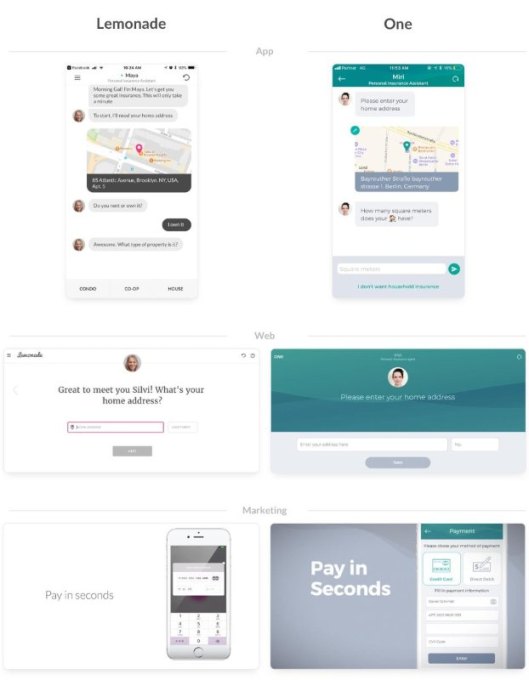
Lemonade, the insurance platform based out of NYC, has filed a lawsuit against German company ONE Insurance, its parent company wefox, and founder Julian Teicke.

The complaint, filed in the U.S. District Court Southern District of NY, alleges that wefox reverse engineered Lemonade to create ONE, infringing Lemonade’s intellectual property, violating the Computer Fraud and Abuse Act, and breaching its contractual obligations to Lemonade not to “copy content… to provide any service that is competitive…or to…create derivative works.”

In the filing (which you can see on Pacer or here), Lemonade alleges that Teicke repeatedly registered for insurance on Lemonade under various names and for various addresses, some of which do not exist. Teicke also allegedly filed claims in what appeared to be an attempt to assess and copy the arrangement of those flows.

Lemonade’s counsel says Teicke started seven claims over the course of 20 days, prompting Lemonade to cancel his policy.

Alongside Teicke, a number of other executives and members of leadership at wefox also filed fake claims, says the complaint, despite having opted in to Lemonade’s user agreement and taking an honesty pledge, which is required of all Lemonade users.

This, according to Lemonade, violates the Computer Fraud and Abuse act. Lemonade also alleges that the ONE app infringes Lemonade’s IP, and that in assessing the Lemonade app and building a competitor, Teicke also violated Lemonade’s TOS.

Lemonade has changed the insurance business in two key ways: First, it made the process of actually buying insurance as easy as a few clicks on your smartphone. Digitizing the process makes the issue of getting home or renters insurance far less daunting and more approachable to consumers. Secondly, Lemonade rethought the business model of insurance.

Normally, insurance providers charge you a certain monthly rate based on the value of the property/items looking to be insured. But at the end of the year, the money remaining in that policy becomes profit, putting the insurance company in direct opposition to the consumer any time a claim is filed.

Lemonade takes its profit directly out of each payment, and if a file isn’t claimed, it sends the rest of the leftover money to the charity of your choice, ensuring that Lemonade and the consumer are on the same page when a claim is filed.

In keeping with that thesis, any proceeds generated from this lawsuit will go directly to Code.org.

“We’re not trying to enrich ourselves by poking another startup,” said Lemonade CEO Daniel Schreiber . “We’re not anti-competition. We’re just saying ‘Play by the rules, play fair and square.’”

Update: A wefox spokesperson offered up the following statement:

At wefox Group, we have 160 talented people whose hard work has created a unique business that is challenging the status quo every day. These allegations have no merit and ultimately appear to be an attempt to disrupt our business rather than a serious dispute. Lemonade actually raised these questions with us nine months ago, and – as we explained at the time – the concerns are meritless and we further received no answer. We have not been served any paper from Lemonade: if we are, we intend to defend ourselves vigorously. This lawsuit appears to be an attempt to bait the media into covering a non-issue.

Uber’s unrelenting desire to be everything

Welcome back to CTRL+T, the TechCrunch podcast where Megan Rose Dickey and I talk about stories from the week that we either found interesting or hated and had more to say about.

This week we talked about Uber . Uber, Uber, Uber. This company wants everything. The rideshare market! Autonomous vehicles! Flying vehicles! And now? Scooters. And to be able to detect inebriation in passengers! This week, we found out that Uber filed for a patent for tech to be able to tell whether a potential passenger is drunk.

And regular listeners know how we at CTRL+T feel about scooters, but we have to keep talking about them because the companies that facilitate that mode of transportation keep getting funded. Thanks, funders. And Uber is taking its place in the scooter racket. I mean, market.

Click play on the little player below or, better yet, subscribe on Apple PodcastsStitcherOvercastCastBox or whatever other podcast platform you can find.

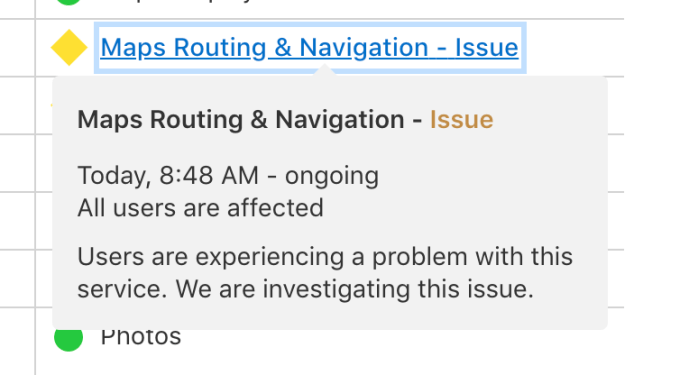
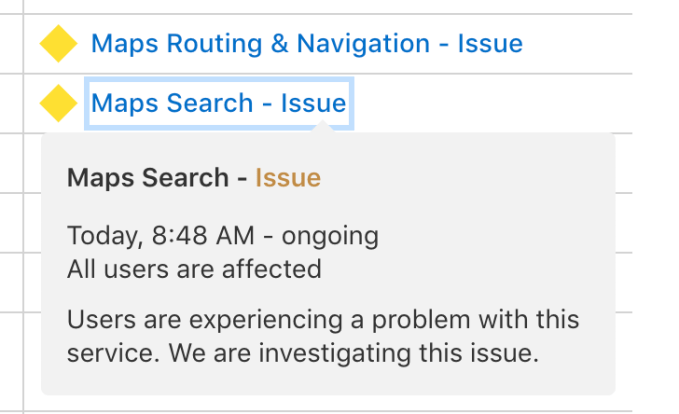
Apple Maps outage disrupts search and navigation for all users [Update: resolved]

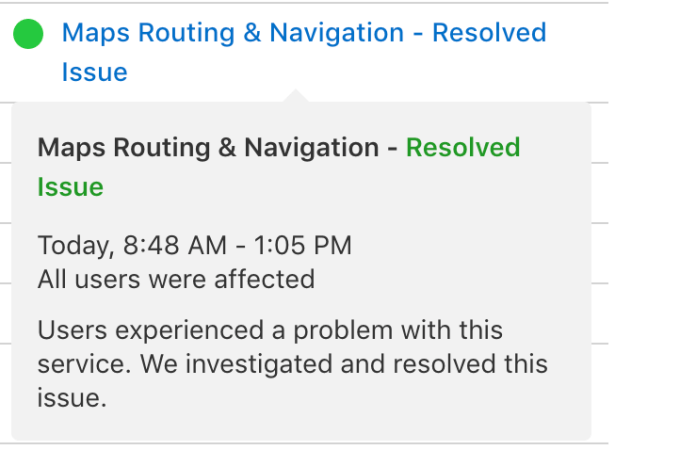
Apple Maps is experiencing a widespread outage, according to the company’s System Status page. Maps routing, navigation and search are impacted by the outage, which is affecting all users, the page informs. [Update: the problems were resolved at 1:05 PM ET.]

The issues were first noticed by the Apple news site MacRumors, before Apple’s own website confirmed the outage starting at 8:48 AM ET.

The disruption is impacting Apple Maps across platforms, including iPhone, iPad, Mac, Apple Watch and CarPlay.

Unfortunately, Apple has only just announced its CarPlay platform would open up to third-party navigation and mapping apps with the release of iOS 12 – but that hasn’t yet come to pass. That means CarPlay users will have to launch a different navigation app on their phone in order to get directions during this outage.

While the Apple Maps user interface will load, when you try to search for a given destination or try to navigate, it gives an error message like “No Results Found” or “Directions Not Available.” Or sometimes, the screen will just continue to read “Loading..” without ever displaying the results, or say “The network connection was lost.”

Apple has not said what’s causing the outage or when it expects a fix to be in place. Often, these sort of things are related to data center issues or unstable software updates. Currently, Apple’s System Status page states that Apple is “investigating the issue.”

Reached for comment, an Apple spokesperson pointed TechCrunch to the System Status page but had no other information at this time.

Update: The problems were resolved at 1:05 PM ET according to the status page, but no other information was provided.

European and Indian regulators team up to defend net neutrality

Representatives of Europe’s BEREC (Body of European Regulators for Electronic Communications) and India’s TRAI (Telecom Regulatory Authority of India) met up yesterday to sign a joint statement to promote an open internet.

This short document describes a set of rules to guarantee net neutrality. Those are some basic rules, such as equal treatment of internet traffic, a case-by-case assessment of zero-rating practices and more.

Both the European Union and India have implemented regulation to ensure net neutrality already. But they now want to go further and work together on the same set of rules. Net neutrality is always evolving and rules need to be updated regularly. This collaboration should contribute to a unification of net neutrality.

Even more important than the statement itself, the timing of this announcement is interesting. The FCC officially repealed net neutrality in the U.S. on Monday. While other regulators can’t do anything about what’s happening in the U.S., they can make sure net neutrality remains intact in their own country.

There’s a risk that the FCC decision triggers a domino effect. Telecom companies in other countries could lobby regulators to end net neutrality (the U.S. has done it, so why not us?).

As ARCEP president Sébastien Soriano told me a few months ago, it’s time to show that there’s another way. And the best way to do it is by forming a group of countries and regulators who share the same principles. With India and the European Union, a good chunk of the world population is now clearly defending net neutrality.

Other countries could now join this alliance and prove that net neutrality is important for innovation, competition and end customers.

Venmo is discontinuing web support for payments and more

PayPal-owned, peer-to-peer payments app Venmo is ending web support for its service, the company announced in an email to users. The changes, which are beginning to roll out now, will see the Venmo .com website phasing out support for making payments and charging users. In time, users will see even less functionality on the website, the company says.

The message to users was quietly shared in the body of Venmo’s monthly transaction history email. It reads as follows:

NOTICE: Venmo has decided to phase out some of the functionality on the Venmo.com website over the coming months. We are beginning to discontinue the ability to pay and charge someone on the Venmo.com website, and over time, you may see less functionality on the website – this is just the start. We therefore have updated our user agreement to reflect that the use of Venmo on the Venmo.com website may be limited.

The decision represents a notable shift in product direction for Venmo. Though best known as a mobile payments app, the service has also been available online, similar to PayPal, for many years.

The Venmo website today allows users to sign in and view their various transaction feeds, including public transactions, those from friends, and personal transactions. You can also charge friends and submit payments from the website, send payment reminders, like and comment on transactions, add friends, edit your profile, and more.

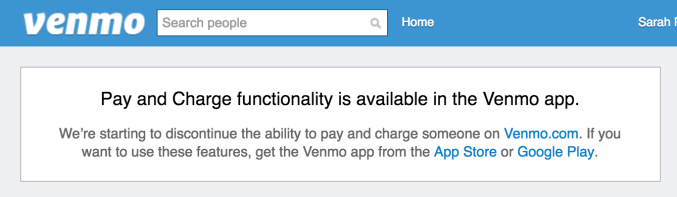
Some users may already be impacted by the changes, and will now see a message alerting them to the fact that charging friends and making payments can only be done in the Venmo app from the App Store or Google Play.

It’s not entirely surprising to see Venmo drop web support. As a PayPal-owned property after its acquisition by Braintree which later brought it to PayPal, there’s always been a lot of overlap between Venmo and its parent company, in terms of peer-to-peer payments.

Venmo had grown in popularity for its simple, social network-inspired design and its less burdensome fee structure among a younger crowd. This made it an appealing way for PayPal to gain market share with a different demographic.

It’s also cheaper, which people like. PayPal doesn’t charge for money transfers from a bank account or PayPal balance, but does charge 2.9 percent plus a $0.30 fixed fee on payments from a credit or debit card in the U.S. Venmo, meanwhile, charges a fee of 3 percent for credit card payments, but makes debit card payments free. That’s appealing to millennials in particular, many of whom have ditched credit cards entirely, and are careful about their spending.

Plus, as a mobile-first application, Venmo was offering a more modern solution for mobile payments, at a time when PayPal’s app was looking a bit long in the tooth. (PayPal has since redesigned its mobile app experience to catch up.)

Another factor in Venmo’s decision could be that, more recently, it began facing competition from newcomer Zelle, the bank-backed mobile payments here in the U.S. which is forecast to outpace Venmo on users sometime this year, with 27.4 million users to Venmo’s 22.9 million. In light of that threat, Venmo may have wanted to consolidate its resources on its primary product – the mobile app.

Not everyone is happy about Venmo’s changes, of course. After all, even if the Venmo website wasn’t heavily used, it was used by some who will certainly miss it.

@venmo i only use the website to send/receive payments so in guess you're cancelled!

— respectfully yours (@biking_away_) June 15, 2018

@venmo This makes me really #sad…."Venmo has decided to phase out some of the functionality on the https://t.co/Dw7W551BsL website over the coming months." #CanWeGoBackToHowItWas

— V Lav (@Druzy920) June 14, 2018

@venmo Why are you breaking your website?

— Lozaning (@lozaning) June 14, 2018

@VenmoSupport @venmo Just got an email saying you're phasing out website functions. What's the justification? Pay and charge by web is incredibly useful.

— Woode (@Woode2380) June 14, 2018

Venmo email: “We are beginning to discontinue the ability to pay and charge someone on the https://t.co/iAFTbn3EY0 website, and over time, you may see less functionality on the website – this is just the start.”

Is this a threat?

— Noah Mittman (@noahmittman) June 14, 2018

Reached for comment, Venmo explained the decision to phase out the website functionality stems from how it sees its product being used.

A Venmo spokesperson told TechCrunch:

Venmo continuously evaluates our products and services to ensure we are delivering our users the best experience. We have decided to begin to discontinue the ability to pay and charge someone on the Venmo.com website. Most of our users pay and request money using the Venmo app, so we’re focusing our efforts there. Users can continue to use the mobile app for their pay and charge transactions and can still use the website for cashing out Venmo balances, settings and statements.

The company declined to clarify what other functionality may be removed from the website over time, but noted that using Venmo to pay authorized merchants is unaffected.

Fitbit employees charged with stealing Jawbone trade secrets

Six current and former Fitbit employees have been hit with a federal indictment over the theft of trade secrets from one-time rival, Jawbone. All had worked for Jawbone for at least a year between 2011 and 2015, before jumping ship and getting hired by the company’s chief competitor.

The allegations have been floating around for a while. Look, we even made a graphic for the stream of allegations being lobbed back and forth between the wearable makers.

Shortly before Fitbit’s 2015 IPO, Jawbone filed a suit alleging that Fitbit had attempted to recruit nearly a third of its employees. The suit was seemingly resolved late last year, however, through a global settlement between both parties.

“In a trade secret misappropriation case brought by Jawbone in the International Trade Commission in 2016 that involved these same individuals,” Fitbit said in a statement given to TechCrunch this morning, “a federal administrative law judge during a nine-day trial on the merits found that no Jawbone trade secrets were misappropriated or used in any Fitbit product, feature or technology.”

Jawbone, of course, has since fallen on tough times. The company was liquidated roughly this time last year, as CEO Hosain Rahman set out to create a related health startup. As far as the DOJ was concerned, however, the story isn’t finished just yet.

“Intellectual property is the heart of innovation and economic development in Silicon Valley,” Acting U.S. Attorney Alex Tse told MarketWatch “The theft of trade secrets violates federal law, stifles innovation, and injures the rightful owners of that intellectual property.”

Update: Rahman has provided TechCrunch the following statement,

We believe the Justice Department’s indictment of six current and former Fitbit Inc. employees for stealing trade secrets from their former employer, Jawbone, validates the claims we made in our 2015 lawsuit against Fitbit . On behalf of former employees, investors, suppliers and others associated with Jawbone, we look forward to seeing justice take its course in this case.

Gmail proves that some people hate smart suggestions

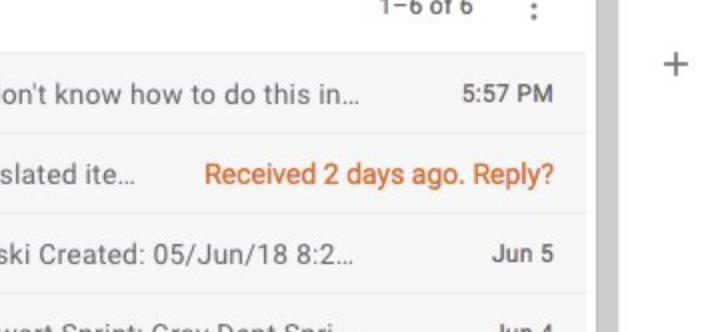
Gmail has recently introduced a brand new redesign. While you can disable or ignore most of the new features, Gmail has started resurfacing old unanswered emails with a suggestion that you should reply. And this is what it looks like:

The orange text immediately grabs your attention. By bumping the email thread to the top of your inbox, Gmails also breaks the chronological order of your inbox.

Gmail is also making a judgement by telling you that maybe you should have replied and you’ve been procrastinating. Social networks already bombard us constantly with awful content that makes us sad or angry. Your email inbox shouldn’t make you feel guilty or stressed.

Even if the suggestions can be accurate, it’s a bit creepy, it’s poorly implemented and it makes you feel like you’re no longer in control of your inbox.

There’s a reason why Gmail lets you disable all the smart features. Some users don’t want smart categories, important emails first and smart reply suggestions. Arguably, the only smart feature everyone needs is the spam filter.

A pure chronological feed of your email messages is incredibly valuable as well. That’s why many Instagram users are still asking for a chronological feed. Sure, algorithmic feeds can lead to more engagement and improved productivity. Maybe Google conducted some tests and concluded that you end up answering more emails if you let Gmail do its thing.

But you may want to judge the value of each email without an algorithmic ranking.

VCs could spot the next big thing without any bias. Journalists could pay attention to young and scrappy startups as much as the new electric scooter startup in San Francisco. Universities could give a grant to students with unconventional applications. The HR department of your company could look at all applications without following Google’s order.

When the Gmail redesign started leaking, a colleague of mine said “I look forward to digging through settings to figure out how to turn this off.” And the good news is that you can turn it off.

There are now two options to disable nudges in the settings on the web version of Gmail. You can tick off the boxes “Suggest emails to reply to” and “Suggest emails to follow up on” if you don’t want to see this orange text ever again. But those features should have never been enabled by default in the first place.

The new look of gmail has this new little reminder and I keep reading it as "Received 4 days ago. Really?" And this is stress I just don't need. pic.twitter.com/IHp9wATORl

— Mary Kate McDevitt (@MaryKateMcD) June 11, 2018

Ooh, new Gmail has an incredibly annoying feature where it bumps a message ending in a question to the top of your inbox with a banner saying "Received 2 days ago. Reply?"

— Seb Patrick (@sebpatrick) June 8, 2018

Switching back to classic @gmail. I REALLY don't need these "Received 6 days ago. Reply?" notes. I have four jobs connected to six email accounts. I'll manage my own productivity, thanks. #oldmanyellingatthesky #leavemealone

— mitchell bloom (@bloomin_onions) June 13, 2018

Wtf Gmail on mobile now resurfacing emails I haven't replied to with a "received two days ago. Reply?" Label. Insane. Can't seem to turn it off. Breaks my entire inbox.

— Tom Critchlow (@tomcritchlow) May 18, 2018

I’m not really a fan of gmail’s new feature that hounds you if you don’t reply to emails. ‘Received 2 days ago. Reply?’ I don’t need to technologically enhance anxiety.

— Thomas Lynch (@thomasjlynch) January 11, 2018

Hey @gmail,

One message in my inbox suddenly has a garish red message.

"Received 2 days ago. Reply?"

Never seen this happen and never want this suggestion. pic.twitter.com/HkEgkcKS3E

— Brendan Falkowski (@Falkowski) June 8, 2018

Adobe could be the next $10 billion software company

Adobe reported its Q2 FY’18 earnings yesterday and the news was quite good. The company announced $2.2 billion in revenue for the quarter up 24 percent year over year. That puts them on an impressive $8.8 billion run rate, within reach of becoming the next $10 billion software company (or at least on a run rate).

Revenue was up across all major business lines, but as has been the norm, the vast majority comes from the company’s bread and butter, Creative Cloud, which houses the likes of Photoshop, InDesign and Dreamweaver, among others. In fact digital media, which includes Creative Cloud and Document Cloud accounted for $1.55 billion of the $2.2 billion in total revenue. The vast majority of that, $1.30 billion was from the creative side of the house with Document Cloud pulling in $243 million.

Adobe has been mostly known as a creative tools company until recent years when it also moved into marketing, analytics and advertising. Recently it purchased Magento for $1.6 billion, giving it a commerce component to go with those other pieces. Clearly Adobe has set its sights on Salesforce, which also has a strong marketing component and is not coincidentally perhaps, the most recently crowned $10 billion software company.

Moving into commerce

Adobe CEO Shantanu Narayen speaking to analysts on the post-reporting earnings call sees Magento as filling in a key piece across understanding the customer from shopping to purchase. “The acquisition of Magento will make Adobe the only company with leadership in content creation, marketing, advertising, analytics and now commerce, enabling real-time personalized experiences across the entire customer journey, whether on the web, mobile, social, in-product or in-store. We believe the addition of Magento expands our available market opportunity, builds out our product portfolio, and addresses a key underserved customer need,” Narayen told analysts.

If Adobe could find a way to expand that marketing and commerce revenue, it could easily surpass that $10 billion revenue run rate threshold, but so far while it has been growing, it remains less than half of the Creative revenue at $586 million. Yes, it grew at an 18 percent year over year clip, but it seems as though there is potential for so much more there and clearly Narayen hopes that the money spent on Magento will help drive that growth.

Battling with Salesforce

Even while it was announcing its revenue, rival Salesforce was meeting with Marketing Cloud customers in Chicago at the Salesforce Connections conference, a move that presented an interesting juxtaposition between the two competitors. Both have a similar approach to the marketing side, while Salesforce concentrates on the customer including CRM and service components. Adobe differentiates itself with content, which shows up on the balance sheet as the majority of its revenue .

Both companies have growth in common too. Salesforce has been on quite a run over the last five years reaching $3 billion in revenue for the first time last quarter. Adobe hit $2 billion for the first time in November. Consider that prior to moving to a subscription model in 2013, Adobe had revenue of $995 million in Aug 2013. Since it moved to that subscription model, it has reaped the benefits of recurring revenue and grown steadily ever since.

Each has used strategic acquisitions to help fuel that growth with Salesforce acquiring 27 companies since 2013 and Adobe 13, according to Crunchbase data. Each has bought a commerce company with Adobe buying Magento this year and Salesforce grabbing Demandware two years ago.

Adobe has the toolset to keep the marketing side of its business growing. It might never reach the revenue of the creative side, but it could help push the company further than it’s ever been. Ten billion dollars seems well within reach if things continue along the current trajectory.