SpaceX nabs $130 million to launch an Air Force satellite with Falcon Heavy

SpaceX beat out one other competitor to land a $130 million launch contract with the U.S. Air Force using its Falcon Heavy rocket. The award is an important validation of the Falcon Heavy, one of the most powerful rockets ever made.

Under the contract, the Hawthorne, Calif.-based rocket company founded by Elon Musk will launch the Air Force Space Command-52 satellite to its intended orbit. The contract includes launch vehicle production and mission, as well as integration, launch operations and spaceflight worthiness activities, according to a notice posted by the U.S. Department of Defense.

The work, which will be performed at SpaceX’s headquarters, the Kennedy Space Center in Florida and in McGregor, Texas, is expected to be completed by September 2020. The mission is planned to be launched from Kennedy Space Center.

Two proposals were received by the DOD in the competitive bidding process.

“SpaceX is honored by the Air Force’s selection of Falcon Heavy to launch the competitively-awarded AFSPC-52 mission,” said SpaceX President and COO Gwynne Shotwell. “On behalf of all of our employees, I want to thank the Air Force for certifying Falcon Heavy, awarding us this critically important mission, and for their trust and confidence in our company. SpaceX is pleased to continue offering the American taxpayer the most cost-effective, reliable launch services for vital national security space missions.”

SpaceX successfully launched the Falcon Heavy for the first time (with a Tesla Roadster strapped to the top, no less, because… well, Elon.) in February 2018. The rocket has three cores, or first-stage boosters, that work in unison to get the rocket into a low Earth orbit. There are two side boosters and a center core. SpaceX has designed the rocket so that after stage separation all three boosters will land and be able to be reused. The company recovered two of the three boosters.

Bag Week 2018: Chrome’s Yalta 2.0 is a roomy rolltop that keeps up

At first, I didn’t know where the Yalta fit in.

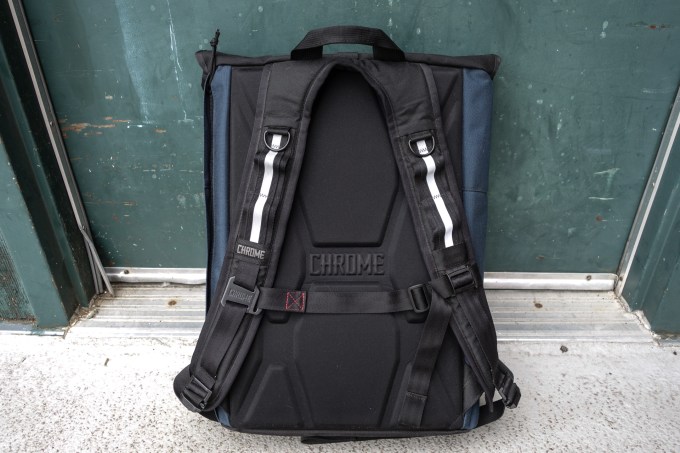
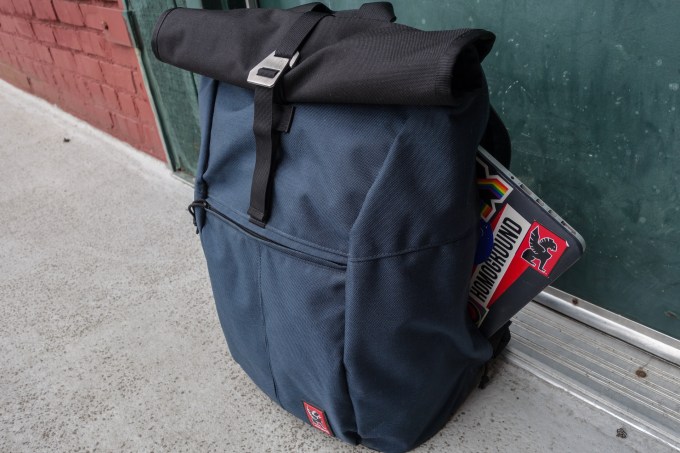
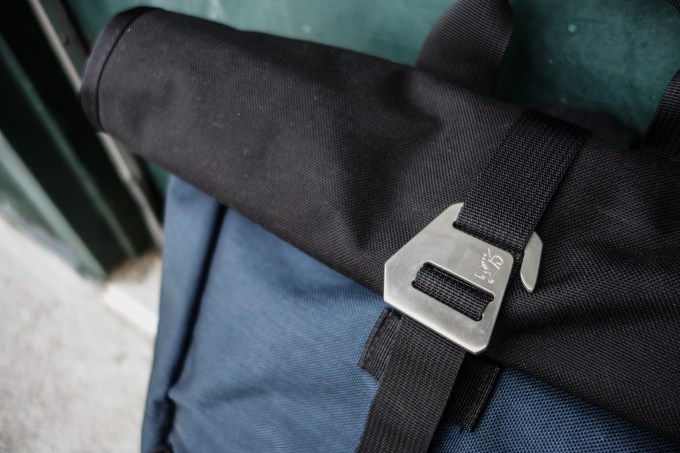
With a 30L capacity, the Yalta 2.0 (Chrome Industries, $96) is not a small bag but it’s not massive either. It’s a little bulkier on the bottom than the top, an inversion of most bike-friendly bags that usually crunch most of your carry weight high up on your shoulders. As a classic Chrome bag, I’ve always admired the Yalta from a distance for its unique profile, full side zipper and its decision to opt for a tension hook clasp instead of Velcro or a Chrome buckle (cool but heavy). The Yalta’s adjustable closure hook feels good to use and means that you don’t have to deal with the noise Velcro makes, which if you’re me is definitely not your primary ASMR trigger.

TechCrunch / Taylor Hatmaker

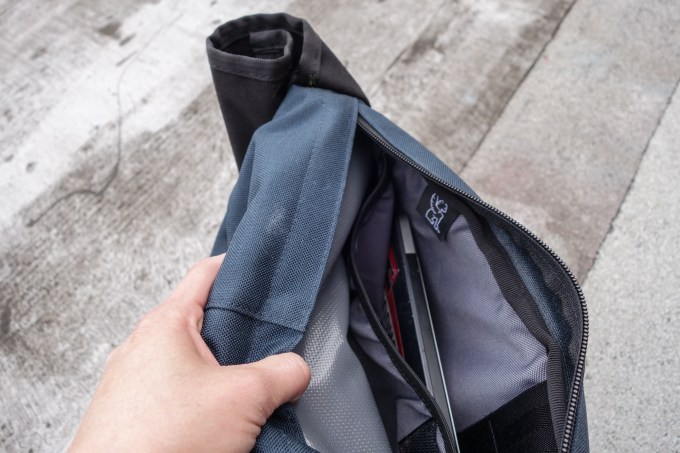
I tested the Yalta in two contexts: during the week for my normal routine and on a low-key weekend camping trip. During the course of my normal day-to-day testing, the Yalta turned out to be a surprisingly adept gym plus laptop bag thanks to its strangest design quirk: a large opening that lets you access the space that the waterproof main rolltop compartment sits in. Once you unzip the full-length side zipper you feel a little weird, like you’re somewhere you’re not supposed to be, but ride it out. That pocket, kind of an internal bladder around the true inner roll-top compartment, is handy if you figure out what to use it for.

TechCrunch / Taylor Hatmaker

For one, you can put your weird filthy stuff in there so it doesn’t ever touch your clean normal stuff, and that’s pretty cool. In my case that meant a full-sized Brazilian Jiu Jitsu gi — a huge robe-like training uniform — and the rest of my workout clothes, plus assorted nerd stuff, like my inhalers and 10 micron pens ranging from fine tip to extremely very fine tip. You can also get to anything in the cavernous side-zip area (again, this is the entire interior of the bag minus whatever is in the rolltop section) super easily, so it’s nice to have two big sections with varied levels of accessibility instead of just one huge main compartment and a side pocket or whatever. The laptop sleeve sits at the very back of the bag, accessible within this full side zip. While side-zip laptop slots are amazing, the Yalta’s did feel on the large side and my 13″ MacBook was safe but not very snugly positioned.

TechCrunch / Taylor Hatmaker

For my second trial, I loaded the Yalta up for a day hike to a local rock climbing spot with friends (note: this thing cannot carry a rope). It’s not what the Yalta is designed for, but it’s what I was up to so I figured I’d give it a shot. The bag performed well on the hike in, fully loaded with lunch, snacks, many layers, a raincoat, a small first aid kit, a Sony RX100 II, a really heavy guidebook for the area and a two-liter water bladder, which I stuffed into the strange side-zip area, snaking the hose out through the top of the zipper. I managed to forget my helmet, which I wished I’d had later when a nearby climber dropped a metal carabiner from 60 feet off the ground, but had I remembered it would have clipped on to the closure loops on front of the pack nicely.

TechCrunch / Taylor Hatmaker

Surprisingly, the Yalta — much more of a bike bag than a crag bag — did well throughout the day, distributing my weight comfortably enough that I didn’t notice it at all. The front pocket made essentials easy to access and the rolltop waterproof area gave me peace of mind that my stuff would stay dry if it started raining, which it usually does. One gripe: the sternum strap was surprisingly hard to hook and came undone sometimes, but it wasn’t a huge deal. It’s also worth remembering that any rolltop without full side access is going to be tough to organize, and that was definitely the case here.

TechCrunch / Taylor Hatmaker

Compared to some of Chrome’s more heavy-duty bags and other less-technical packs, the Yalta is a likable middle ground. The pack isn’t as rain resistant as a bag made out of fully waterproof material and the laptop sleeve could use some structure, but it carries a fair amount and it’s got a nice slender profile that looks and feels good. The Yalta doesn’t really have any quirks or tricks beyond the strange side-zip compartment, and that makes it a good fit for anyone who needs a good-looking, weather resistant mid-sized rolltop backpack for work and what comes before and after.

What it is: A great multi-purpose rolltop backpack that isn’t too technical.

What it isn’t: The ultimate gear pack. Full of pockets.

Read more reviews from TechCrunch Bag Week 2018.

bag week 2018

The future of AI relies on a code of ethics

Facebook has recently come under intense scrutiny for sharing the data of millions of users without their knowledge. We’ve also learned that Facebook is using AI to predict users’ future behavior and selling that data to advertisers. Not surprisingly, Facebook’s business model and how it handles its users’ data has sparked a long-awaited conversation — and controversy — about data privacy. These revelations will undoubtedly force the company to evolve their data sharing and protection strategy and policy.

More importantly, it’s a call to action: We need a code of ethics.

As the AI revolution continues to accelerate, new technology is being developed to solve key problems faced by consumers, businesses and the world at large. It is the next stage of evolution for countless industries, from security and enterprise to retail and healthcare. I believe that in the near future, almost all new technology will incorporate some form of AI or machine learning, enabling humans to interact with data and devices in ways we can’t yet imagine.

Moving forward, our reliance on AI will deepen, inevitably causing many ethical issues to arise as humans turn over to algorithms their cars, homes and businesses. These issues and their consequences will not discriminate, and the impact will be far-reaching — affecting everyone, including public citizens, small businesses utilizing AI or entrepreneurs developing the latest tech. No one will be left untouched. I am aware of a few existing initiatives focused on more research, best practices and collaboration; however, it’s clear that there’s much more work to be done. 

For the future of AI to become as responsible as possible, we’ll need to answer some tough ethical questions.

Researchers, entrepreneurs and global organizations must lay the groundwork for a code of AI ethics to guide us through these upcoming breakthroughs and inevitable dilemmas. I should clarify that this won’t be a single code of ethics — each company and industry will have to come up with their own unique guidelines.

For the future of AI to become as responsible as possible, we’ll need to answer some tough ethical questions. I do not have the answers to these questions right now, but my goal is to bring more awareness to this topic, along with simple common sense, and work toward a solution. Here are some of the issues related to AI and automation that keep me up at night.

The ethics of driverless cars

With the invention of the car came the invention of the car accident. Similarly, an AI-augmented car will bring with it ethical and business implications that we must be prepared to face. Researchers and programmers will have to ask themselves what safety and mobility trade-offs are inherent in autonomous vehicles.

Ethical challenges will unfold as algorithms are developed that impact how humans and autonomous vehicles interact. Should these algorithms be transparent? For example, will a car rear-end an abruptly stopped car or swerve and hit a dog on the side of the street? Key decisions will be made by a fusion processor in split seconds, running AI, connecting a car’s vast array of sensors. Will entrepreneurs and small businesses be kept in the dark while these algorithms dominate the market?

Driverless cars will also transform the way consumers behave. Companies will need to anticipate this behavior and offer solutions to fill those gaps. Now is the time to start predicting how this technology will change consumer needs and what products and services can be created to meet them.

The battle against fake news

As our news media and social platforms become increasingly AI-driven, businesses from startups to global powerhouses must be aware of their ethical implications and choose wisely when working this technology into their products.

We’re already seeing AI being used to create and defend against political propaganda and fake news. Meanwhile, dark money has been used for social media ads that can target incredibly specific populations in an attempt to influence public opinion or even political elections. What happens when we can no longer trust our news sources and social media feeds?

AI will continue to give algorithms significant influence over what we see and read in our daily lives. We have to ask ourselves how much trust we can put in the systems that we’re creating and how much power we can give them. I think it’s up to companies like Facebook, Google and Twitter — and future platforms — to put safeguards in place to prevent them from being misused. We need the equivalent of Underwriters Laboratories (UL) for news!

The future of the automated workplace

Companies large and small must begin preparing for the future of work in the age of automation. Automation will replace some labor and enhance other jobs. Many workers will be empowered with these new tools, enabling them to work more quickly and efficiently. However, many companies will have to account for the jobs lost to automation.

Businesses should begin thinking about what labor may soon be automated and how their workforce can be utilized in other areas. A large portion of the workforce will have to be trained for new jobs created by automation in what is becoming commonly referred to as collaborative automation. The challenge will come when deciding on how to retrain and redistribute employees whose jobs have been automated or augmented. Will it be the government, employers or automation companies? In the end, these sectors will need to work together as automation changes the landscape of work.

No one will be left untouched.

It’s true that AI is the next stage of tech evolution, and that it’s everywhere. It has become portable, accessible and economical. We have now, finally, reached the AI tipping point. But that point is on a precarious edge, see-sawing somewhere between an AI dreamland and an AI nightmare.

In order to surpass the AI hype and take advantage of its transformative powers, it’s essential that we get AI right, starting with the ethics. As entrepreneurs rush to develop the latest AI tech or use it to solve key business problems, each has a responsibility to consider the ethics of this technology. Researchers, governments and businesses must cooperatively develop ethical guidelines that help to ensure a responsible use of AI to the benefit of all.

From driverless cars to media platforms to the workplace, AI is going to have a significant impact on how we live our lives. But as AI thought leaders and experts, we shouldn’t just deliver the technology — we need to closely monitor it and ask the right questions as the industry evolves.

It has never been a more exciting time to be an entrepreneur in the rise of AI, but there’s a lot of work to be done now and in the future to ensure we’re using the technology responsibly.

MoviePass introduces surge pricing for the summer

Starting in July, you might have to pay a little extra to see the newest blockbusters when using MoviePass . The movie subscription service has plans to instate surge pricing for non-annual subscribers starting at $2 for movies and times the app deems “very popular,” Business Insider reports.

This comes one day after AMC announced its plan for a competing movie subscription service called AMC Stubs A-List, coming in June. In MoviePass CEO Mitch Lowe’s statement to Business Insider, he seemed unfazed by AMC’s entrance into the subscription game, saying instead it “validates that subscription is really here to stay.”

But for MoviePass to stay, it might have to start changing it business plan. The subscription service’s parent company Helios and Matheson Analytics announced today that MoviePass’ monthly losses soared to $40 million in May. The company also expects its cash deficit to reach $45 million by June. These numbers are in part a reflection of the 545,000 new users who joined the service between May 1st and June 15th.

In addition to a few additional dollars to see the next dinosaur movie or superhero film this summer, MoviePass said it plans to roll out two new programs come August that will bring in a little extra money as well. Starting at the end of August, users will be able to use the app to watch IMAX or Real 3D movies for an additional $2 to $6 and have the option to bring a friend (though, they’ll have to pay almost full price for the additional ticket) through the app. To start, these features will have to be applied to separate films, but MoviePass has plans to combine them.

PayPal to buy Simility, a specialist in AI-based fraud and risk management, for $120M

Payment provider PayPal continues apace with its acquisitions streak to bring more modern tools into its platform to serve its 237 million customers. Today the company announced that it is buying Simility, a fraud prevention specialist, for $120 million in cash.

PayPal had been an investor in Simility (it owns three percent of the company, it says), along with Accel, Trinity Ventures and others. The startup had raised just under $25 million and was last valued at $52.75 million, according to figures from PitchBook, making this a decent return for its backers. The deal is expected to close in Q3.

Online fraud involving either buyers or sellers — and sometimes people within organizations themselves — has been one of the biggest limiting factors to the growth of e-commerce, and that has only become more of an issue as digital transactions have become more mature and spread to more platforms.

Simility’s approach is to use a set of APIs and beacons that essentially monitor digital transactions and buying activity wherever they happen to take place: on mobile, web or in physical environments. Augmenting these with machine learning and feeds from other data sources, it creates something it calls “adaptive” risk management: a changing approach and protection strategy based on what the threat of the moment might be.

Acquiring a company like this makes sense on two levels for PayPal: not just for its own systems, but for that of its customers, who make PayPal-powered transactions on the web, on mobile and at physical points of sales.

“Digital commerce has exploded, and fraudsters have taken note, adapting and developing new methods to carry out their crimes,” said Bill Ready, chief operating officer, PayPal, in a statement. “PayPal has been at the forefront of developing innovative fraud prevention and risk management solutions for nearly 20 years, but until now, merchants haven’t been able to configure those solutions to manage the unique complexities of their businesses. Together with Simility, we will be able to put more control in the hands of our merchants to fight fraud while helping make commerce experiences faster and more secure.”

Ready in a separate blog described the company’s strategy currently as an effort to create a one-stop shop for all things commerce, and simplification is also an aspect of this deal: Simility already has a number of customers that also work with PayPal, such as PayPal’s former owner eBay/StubHub, OfferUp, Dick’s Sporting Goods and Rebtel. The acquisition will mean a more integrated approach for them where their PayPal services have a stronger layer of fraud protection on them, and they also get used to help form a bigger picture about the overall state of fraud that the companies.

PayPal said that after the deal closes, it will also extend Simility’s tools to the rest of the merchants on its platform.

“Our vision for Simility was to create an adaptive risk management platform that empowers organizations operating in a digital world to manage an evolving fraud and risk landscape where data breaches are the new normal,” said Rahul Pangam, co-founder and CEO, Simility, in a statement. “We are excited to enter the next phase of our growth with PayPal and are thrilled to join them to help drive the next generation of payment and commerce solutions while scaling our business together.”

PayPal has made a number of acquisitions over the last few weeks, all pointing to adding new technologies and tools to reflect our changing times and how that is playing out in the world of payments. They have included European mobile payments and financial services business iZettle, payments aggregator Hyperwallet and AI-based CRM specialist Jetlore.

Microsoft backpedals on VR promise

If you were still waiting patiently for the virtual reality features that Microsoft promised in 2016, then I have some bad news for you. During E3 last week, Microsoft’s chief marketing officer for gaming, Mike Nichols, told GamesIndustry.biz that the company had no plans to fulfill that promise.

“We don’t have any plans specific to Xbox consoles in virtual reality or mixed reality,” Nichols told GamesIndustry.biz.

This goes against a promise that Microsoft made two years ago when Xbox chief Phil Spencer told The Verge that the Xbox One X (then dramatically known as Xbox Scorpio) would support “[the kind of] high-end VR that you see happening in the PC space.”

The release of the Xbox One X came and went without any news of VR integration, but in the interim, Microsoft did make strides toward VR and mixed reality tech for PC gaming with the release of the Windows Mixed Reality headsets for Windows 10.

According to Nichols, it seems like Microsoft may be sticking to this PC gaming territory for awhile.

“PC is probably the best platform for more immersive VR and MR … but as it relates to Xbox, no,” he said.

Species-identifying AI gets a boost from images snapped by citizen naturalists

Someday we’ll have an app that you can point at a weird bug or unfamiliar fern and have it spit out the genus and species. But right now computer vision systems just aren’t up to the task. To help things along, researchers have assembled hundreds of thousands of images taken by regular folks of critters in real life situations — and by studying these, our AI helpers may be able to get a handle on biodiversity.

Many computer vision algorithms have been trained on one of several large sets of images, which may have everything from people to household objects to fruits and vegetables in them. That’s great for learning a little about a lot of things, but what if you want to go deep on a specific subject or type of image? You need a special set of lots of that kind of image.

For some specialties, we have that already: FaceNet, for instance, is the standard set for learning how to recognize or replicate faces. But while computers may have trouble recognizing faces, we rarely do — while on the other hand, I can never remember the name of the birds that land on my feeder in the spring.

Fortunately, I’m not the only one with this problem, and for years the community of the iNaturalist app has been collecting pictures of common and uncommon animals for identification. And it turns out that these images are the perfect way to teach a system how to recognize plants and animals in the wild.

Could you tell the difference?

You might think that a computer could learn all it needs to from biology textbooks, field guides and National Geographic. But when you or I take a picture of a sea lion, it looks a lot different from a professional shot: the background is different, the angle isn’t perfect, the focus is probably off and there may even be other animals in the shot. Even a good computer vision algorithm might not see much in common between the two.

The photos taken through the iNaturalist app, however, are all of the amateur type — yet they have also been validated and identified by professionals who, far better than any computer, can recognize a species even when it’s occluded, poorly lit or blurry.

The researchers, from Caltech, Google, Cornell and iNaturalist itself, put together a limited subset of the more than 1.6 million images in the app’s databases, presented this week at CVPR in Salt Lake City. They decided that in order for the set to be robust, it should have lots of different angles and situations, so they searched for species that have had at least 20 different people spot them.

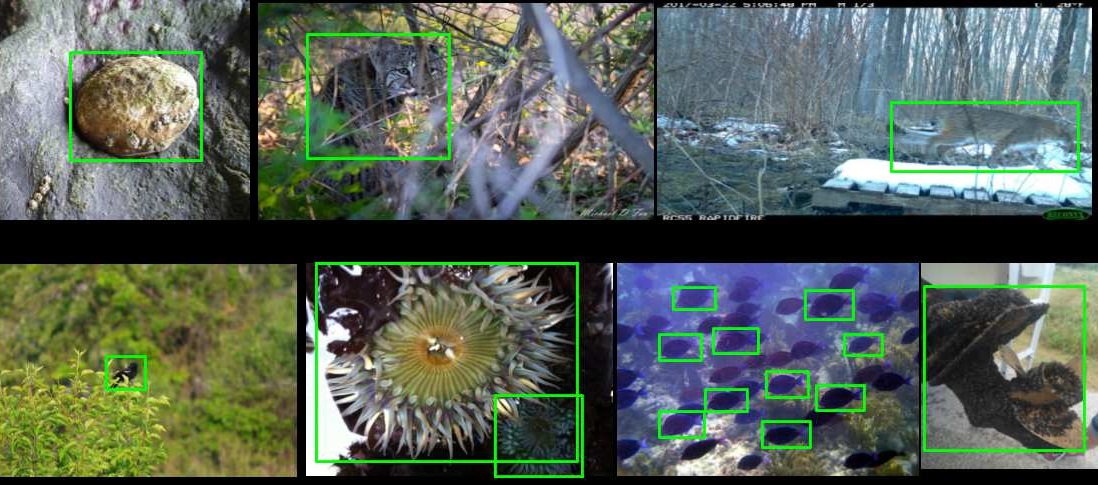
The resulting set of images (PDF) still has more than 859,000 pictures of over 5,000 species. These they had people annotate by drawing boxes around the critter in the picture, so the computer would know what to pay attention to. A set of images was set aside for training the system, another set for testing it.

Examples of bounding boxes being put on images.

Ironically, they can tell it’s a good set because existing image recognition engines perform so poorly on it, not even reaching 70 percent first-guess accuracy. The very qualities that make the images themselves so amateurish and difficult to parse make them extremely valuable as raw data; these pictures haven’t been sanitized or set up to make it any easier for the algorithms to sort through.

Even the systems created by the researchers with the iNat2017 set didn’t fare so well. But that’s okay — finding where there’s room to improve is part of defining the problem space.

The set is expanding, as others like it do, and the researchers note that the number of species with 20 independent observations has more than doubled since they started working on the data set. That means iNat2018, already under development, will be much larger and will likely lead to more robust recognition systems.

The team says they’re working on adding more attributes to the set so that a system will be able to report not just species, but sex, life stage, habitat notes and other metadata. And if it fails to nail down the species, it could in the future at least make a guess at the genus or whatever taxonomic rank it’s confident about — e.g. it may not be able to tell if it’s anthopleura elegantissima or anthopleura xanthogrammica, but it’s definitely an anemone.

This is just one of many parallel efforts to improve the state of computer vision in natural environments; you can learn more about the ongoing collection and competition that leads to the iNat data sets here, and other more class-specific challenges are listed here.

A huge spreadsheet naming ICE employees gets yanked from GitHub and Medium

A massive database of current U.S. Immigration and Customs Enforcement (ICE) employees scraped from public LinkedIn profiles has been removed from the tech platforms hosting the data. The project was undertaken by Sam Lavigne, self-described artist, programmer and researcher in response to recent revelations around ICE’s detention practices at the southern U.S. border.

Lavigne posted the database to GitHub on Tuesday and by Wednesday the repository had been removed. The database included the name, profile photo, title and city area of every ICE employee who listed the agency as their employer on the professional networking site. A more in-depth version of the data pulled all public LinkedIn data from the pool of users, including previous employment, education history and any other information those users opted to make public. The total database lists this information for 1,595 ICE employees, from the agency’s CTO on down to low-level workers and interns.

The project accompanied a Medium post about the project’s aims that has since been removed by the platform:

While I don’t have a precise idea of what should be done with this data set, I leave it here with the hope that researchers, journalists and activists will find it useful…

I find it helpful to remember that as much as internet companies use data to spy on and exploit their users, we can at times reverse the story, and leverage those very same online platforms as a means to investigate or even undermine entrenched power structures. It’s a strange side effect of our reliance on private companies and semi-public platforms to mediate nearly all aspects of our lives.

The data set appears to have violated GitHub and Medium guidelines against doxing. Medium’s anti-harassment policy specifically forbids doxing and defines it broadly, preventing “the aggregation of publicly available information to target, shame, blackmail, harass, intimidate, threaten, or endanger.”

Because it doesn’t include personal identifying information like home addresses, phone numbers or other non-public details, Lavigne’s project isn’t really doxing in the normal sense of the word, though that hasn’t made it less controversial.

GitHub’s own policy leading to the data’s removal is less clear, though the company told The Verge the repository was removed due to “doxxing and harassment.” The platform’s terms of service forbid uses of GitHub that “violate the privacy of any third party, such as by posting another person’s personal information without consent.” This leaves some room for interpretation, and it is not clear that data from a public-facing social media profile is “personal” under this definition. GitHub allows researchers to scrape data from external sites in order to aggregate it “only if any publications resulting from that research are open access.”

While Lavigne’s aggregation efforts were deemed off-limits by some tech platforms, they do raise compelling questions. What kinds of public data, in aggregate, run afoul of anti-harassment rules? Why can this kind of data be scraped for the purposes of targeted advertising or surveillance by law enforcement but not be collected in a user-facing way? The ICE database raised these questions and plenty more, but for some tech companies the question of hosting the data proved too provocative from the start.

Happn takes on Tinder Places with an interactive map of missed connections

Dating app Happn, whose “missed connections” type of dating experience connects people who have crossed paths in real life, is fighting back at Tinder. Seemingly inspired by Happn’s location-based features, Tinder recently began piloting something called Tinder Places – a feature that tracks your location to match you with those people who visit your same haunts – like a favorite bar, bookshop, gym, restaurant, and more.

Of course Tinder’s move into location-based dating should worry Happn, which had built its entire dating app around the idea of matching up people who could have met in real life, but just missed doing so.

Now, Happn is challenging Tinder Places with a new feature of its own. It’s debuting an interactive map where users can discover those people they’ve crossed paths with over the past seven days.

Happn founder, French entrepreneur Didier Rappaport, dismisses the Tinder threat.

“We don’t see it as a threat at all but as a good thing,” he tells TechCrunch. “Find the people you’ve crossed paths with has always been in Happn’s DNA since the beginning….We are very flattered that Tinder wants to include the same feature in its product. However, we will never use the swipe in our product,” he says.

Rappaport believes swiping is wrong because it makes you think of the other person as a product, and that’s not Happn’s philosophy.

“We want to [give our users a chance] to interact or not with a person, to take their time to decide, to be able to move back in their timeline if suddenly they change their mind and want to have a second chance,” he notes.

To use Happn’s map, you’ll tap on a specific location you’ve visited, and are then presented with potential matches who have been there too, or within 250 meters of that spot. The map will use the same geolocation data that Happn already uses to create its timeline, but just displays it in another form.

For those who aren’t comfortable sharing their location all the time with a dating app (um, everyone?), Happn also offers an “invisibility” mode that lets people hide their location during particular parts of the day – for example, while they’re at work.

While Happn’s new feature is a nice upgrade for regular users, Tinder’s location-based features – we’re sorry to report – are more elegantly designed.

Today, Happn’s invisibility mode has to be turned on when you want to use it, or you have to pay for a subscription to schedule to come on automatically at certain times. That means it requires far more effort to use on a day-to-day basis.

Meanwhile, Tinder Places lets you block a regular place you visit – like, say, the gym – from ever being recorded as a place you want to show up for matches. It also automatically removes places that would be inappropriate, including your home and work addresses, and alerts you when it’s adding a new one – so you can quickly take action to remove it, if you choose. Tinder Places is also free. (It’s just not rolled out worldwide at this time).

Happn, however, does offer a way to hide your profile information and other details from select users, and never shows your current location in real time, also like Tinder.

Happn, which launched back in 2014, now claims nearly 50 million users worldwide, across 50 major cities and 40 countries. It claims to have 6.5 million monthly users – but that’s much smaller, compared with Tinder’s estimated 50 million actives.

And with Tinder parent Match Group snatching up Hinge, suing Bumble, and effectively copying the idea of using “missed connections,” one has to wonder how much life rival dating apps, especially those of Happn’s size, have left.

The app is a free download on the App Store, Play Store and Windows Store.

Google StreetView cars to help map pollution in London

From next month two Google StreetView cars will be driving around London’s streets fitted with sensors that take air quality readings every 30 meters to map and monitor air quality in the UK capital.

There will also be 100 fixed sensors fitted to lampposts and buildings in pollution blackspots and sensitive locations in the city — creating a new air quality monitoring network that Sadiq Khan, London’s mayor, is billing as “the most sophisticated in the world”.

The goal with the year-long project is to generate hyperlocal data to help feed policy responses. Khan has made tackling air pollution one of his priorities.

It’s not the first time StreetView cars have been used as a vehicle for pollution monitoring. Three years ago sensors made by San Francisco startup Aclima were fitted to the cars to map air quality in the Bay Area.

The London project is using sensors made by UK company Air Monitors.

The air quality monitoring project is a partnership between the Greater London Authority and C40 Cities network — a coalition of major cities around the world which is focused on tackling climate change and increasing health and well-being.

The project is being led by the charity Environmental Defense Fund Europe, in partnership with Air Monitors, Google Earth Outreach, Cambridge Environmental Research Consultants, University of Cambridge, National Physical Laboratory, and the Environmental Defense Fund team in the United States.

King’s College London will also be undertaking a linked study focused on schools.

Results will be shared with members of the C40 Cities network — with the ambition of developing policy responses that help improve air quality for hundreds of millions of city dwellers around the world.

More tickets available to the TechCrunch Summer Party at August Capital

We hope you’ve saved the date for the TechCrunch Summer Party at August Capital on July 27, because we’re releasing our second batch of tickets today. Jump on this opportunity, folks, because our first group of tickets sold out in a flash — and these babies, available on a first-come, first-served basis, won’t last long, either. Buy your ticket today.

If you haven’t attended our classic summer fete — this is our thirteenth year — you’re in for a treat. Enjoy the beautiful grounds and patio deck at August Capital in Menlo Park, lovely libations and a delicious snack or two. And do it all in the company of your peers, celebrating entrepreneurship and possibility.

Networking is always a part of every TechCrunch event, and you never know when you’ll meet the perfect future investor, founder or collaborator. True fact: Box founders Aaron Levie and Dylan Smith met one of their first investors, DFJ, at a backyard party hosted by TechCrunch founder, Michael Arrington.

Here are the when, where and how much details for the TechCrunch Summer Party at August Capital:

  • July 27, 5:30 p.m. – 9:00 p.m.
  • August Capital in Menlo Park
  • Ticket price: $95

Of course, there’s more than one way to enjoy this party. If you have an early-stage startup, buy a Summer Party demo table. It’s a great opportunity to showcase your business in front of all the right people in a relaxed, convivial atmosphere. Each demo table includes four Summer Party tickets. Learn more about demo tables here.

Come and share a friendly evening of cocktails and relaxed networking in a beautiful setting. Who knows, you might win nifty door prizes, including TechCrunch swag, Amazon Echos and tickets to Disrupt San Francisco 2018.

The second round of TechCrunch Summer Party at August Capital tickets is available now, and you can buy yours today. We hope to see you there!

Disrupting the paycheck, Gusto’s Flexible Pay allows employees to pick when they get paid

People should get paid for work they have done. It’s a pretty simple principle of capitalism, but a principle that seems increasingly violated in the modern economy. With semi-monthly paychecks, the work an employee does on the first day of the month won’t be paid until the end of the third week — a delay of up to 21 days. That delay is despite the massive digitalization of bank transfers and accounting over the past few decades that should have made paychecks far more regular.

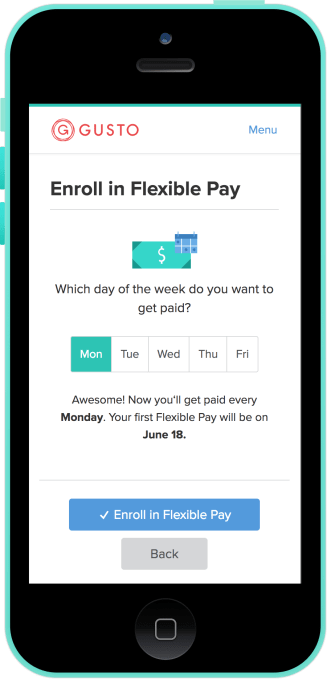
Gusto, a payroll and HR benefits provider focused on small businesses, announced the launch of Flexible Pay today, a new feature that will allow its payroll users to select when they receive their income for work already completed. The feature, which must be switched on by an employer, will cost employers nothing out-of-pocket today. The launch is limited to customers in Texas, but will expand to other states in the coming year.

As Gusto CEO Joshua Reeves explained it to me, a kid mowing lawns in a neighborhood has a much more visceral connection to income than the modern knowledge economy worker. Cut the grass, get cash — it’s that simple. He also pointed out, with irony, that terminated employees experience much better payroll service than regular employees: they have to be paid out on their last day of work outside of the standard paycheck schedule. Reeves and his team wanted to offer that flexibility and convenience to every worker.

Flexible Pay allows users to choose when they get paid, outside of typical paycheck schedules

The key to this new feature has been Gusto’s increasing data about small businesses. Gusto now serves 1 percent of all small businesses in the U.S., and it has comprehensive access to its customers’ financial and payroll data. With integrations to time sheet services and proper risk modeling, Gusto is able to predict exactly what salary a worker has already earned, and can front the money at minimum risk to itself.

One major challenge for Gusto was how to reconcile the books of the employer with the irregular paycheck schedules desired by employees. Gusto handles all the logistics transparently, including tax withholding, so that for employers, the paycheck distribution looks and feels “normal” on its books.

That means that Gusto is effectively loaning money to companies, since it is paying payroll in advance. Gusto is funding those loans off its balance sheet today, but over time, the company expects to create a financial facility to underwrite the product.

For Reeves, Flexible Pay is “the right thing to do.” He believes that this new level of flexibility will empower workers to control their financial lives. In the long run, as more users get habituated to the product and its convenience, he hopes that the feature will draw other employers into using Gusto based on employee demand.

The unfortunate reality in the American workforce is that huge numbers of workers live paycheck-to-paycheck, by some counts as many as 80 percent. A bill can come due just a day or two before a paycheck hits, but without cash in a checking account, people often have to resort to predatory financial products like payday loans or high-interest credit cards in order to make ends meet. Flexible Pay is one step in the right direction of fighting for workers to get the money they justly deserve.

Hinge sells 51 percent of shares to Match Group

Match Group, parent company of dating apps Tinder, OkCupid and Match, announced yesterday that it has acquired a 51 percent stake in Hinge. With this new acquisition, Match Group has the right to acquire all remaining shares of Hinge within a 12-month period.

Match Group says its interest in Hinge began in 2017 after a redesign in which it did away with the “right swipe” in favor of more detailed profiles. According to a statement from Hinge, its app saw 400 percent growth in its user base after these changes. In a dating world often dominated by “hook-ups,” Hinge positions itself as a “relationship app” and focuses on building real relationships instead.

Hinge in many ways is the antithesis to Tinder, but Match Group says this is part of the advantage to the partnership, not an obstacle.

“Dating isn’t a one-size-fits-all approach,” a Match Group spokesperson told TechCrunch. “We operate a variety of products because people gravitate to different apps for different reasons.”

Hinge CEO Justin McLeod says that this merger will help the company expand even further than it could alone.

“At a certain point, having the scaling capability of a well-funded and experienced partner [like Match Group] makes sense,” McLeod told TechCrunch. “We want to bring a more thoughtful dating experience to the most people.”

This acquisition by Match Group follows a reportedly failed attempt to acquire the dating app Bumble in November. Following the collapse of those discussions, Match Group filed a lawsuit against Bumble in March for patent infringement, claiming that it “copied Tinder’s world-changing, card-swipe-based, mutual opt-in premise.” Two weeks later, Bumble followed up with its own lawsuit to the tune of $400 million that alleged Match Group fraudulently obtained trade secrets during its acquisition talks six months earlier. These lawsuits are still being settled.

Hinge offers an alternative acquisition for Match, which is clearly looking to continue diversifying its dating offerings. “[Hinge] has been getting real traction with cosmopolitan millennials,”a Match Group spokesperson said. “We hope to meaningfully accelerate [its] growth.”

A Tesla telenovela

Tesla’s lawsuit against a former employee was filed just 24 hours ago and it’s already ripe fodder for Hollywood. As CEO Elon Musk has noted in the past, Tesla is a real drama magnet. Get ready, it’s exhausting.

Tesla filed the lawsuit against former employee Martin Tripp for $1 million, alleging the man, who worked as a process technician at the massive battery factory near Reno, hacked the company’s confidential and trade secret information and transferred that information to third parties, according to court documents. The lawsuit also claims the employee leaked false information to the media.

Within hours, The Washington Post had an interview with Tripp, who said he did not tamper with internal systems and is instead a whistleblower who was compelled to act. Tripp admitted to speaking to the media, but only because he saw “some really scary things” inside the company. Post reporter Drew Harwell later tweeted that Tripp told him Musk emailed him shortly after the lawsuit today to say he was a “horrible person.”

Tripp says @elonmusk emailed him shortly after the lawsuit was filed today to say he was a horrible person. Tripp said he responded that Musk deserved what was coming. https://t.co/cilMMnogyq

— Drew Harwell (@drewharwell) June 21, 2018

An email exchange obtained by TechCrunch, and confirmed by Tesla, suggests otherwise, and shows Tripp lobbing the first written attack. To be clear, the emails viewed by TechCrunch could have been edited or show an incomplete exchange. We’ll update the story as we learn more.

Here’s the email exchange, which kicks off rather suddenly:

From: Marty Tripp
Date: June 20, 2018 at 8:57:29 AM PDT
To: Elon Musk<br />
Subject: Termination/Lawsuit

Don’t worry, you have what’s coming to you for the lies you have told to the public and investors.

On Jun 20, 2018, at 9:42 AM, Elon Musk wrote:

Threatening me only makes it worse for you

On Jun 20, 2018, at 9:59 AM, Marty Tripp wrote:

I never made a threat.  I simply told you that you have what’s coming.

Thank you for this gift!!!!

On Jun 20, 2018, at 10:00 AM, Elon Musk wrote:

You should ashamed of yourself for framing other people. You’re a horrible human being.

On Jun 20, 2018, at 10:03 AM, Marty Tripp wrote:

I NEVER ‘framed’ anyone else or even insinuated anyone else as being involved in my production of documents of your MILLIONS OF DOLLARS OF WASTE, Safety concerns, lying to investors/the WORLD.

Putting cars on the road with safety issues is being a horrible human being!

On Jun 20, 2018, at 5:16 PM, Elon Musk wrote:

Begin forwarded message:
From: Elon Musk
Date: June 20, 2018 at 10:28:06 AM PDT
To: Marty Tripp

Subject: Re: Termination/Lawsuit

There are literally injuries with Model 3. It is by far the safest car in the world for any midsize vehicle. And of course a company with billions of dollars in product is going to have millions of dollars in scrap. This is not news.

However, betraying your word of honor, breaking the deal you had when Tesla gave you a job and framing your colleagues are wrong and some come with legal penalties. So it goes. Be well.

From: Elon Musk
Date: 6/20/18 5:17 PM (GMT-08:00)
To: Todd Maron, Sarah O’Brien
Cc: EMDesk
Subject: Re: Termination/Lawsuit

Meant to say “no injuries”

After Musk and Tripp battled it out via email, the former employee allegedly told a friend he was going to attack the company’s Gigafactory in Sparks, NevadaThe friend then called Tesla’s customer service line, according to a source. Tesla notified the police. It’s not clear why this friend turned first to Tesla and not the police. But there you go.

And since TechCrunch has been unable to reach Tripp, it’s worth noting that this is one side — Tesla’s side — of a developing and complex story.

Tesla confirmed receiving a call.

“Yesterday afternoon, we received a phone call from a friend of Mr. Tripp telling us that Mr. Tripp would be coming to the Gigafactory to ‘shoot the place up,’ ” a Tesla spokesman said. “Police have been notified and actions are being taken to enhance security at the Gigafactory.”

TechCrunch reached out to Storey County Sheriff’s department, which confirmed they sent deputies to investigate the threat. The deputies found no credible threat.

“After several hours of investigation deputies were able to determine there was no credible threat,” Sheriff Gerald Antinoro said in a statement provided to TechCrunch. “Further investigation in the origins of the threat continues.”

Win cash and prizes from Visa and HERE Mobility at the Disrupt SF 2018 Virtual Hackathon

Calling all hackers, programmers and tech heads from around the world: The Hackathon at TechCrunch Disrupt SF 2018 is a virtual reality. We wanted something truly special to celebrate the biggest, most ambitious Disrupt event in history, so we launched the Virtual Hackathon. Thousands of the most highly skilled developers and coders will go head-to-head. But you only have about five weeks left to sign up and complete your hack, so you’d better hurry and sign up now.

Here’s how this super-sized Virtual Hackathon works. Show us how you’d produce and apply technology to solve different challenges. Our judges will review all eligible submitted hacks and rate them on a scale of 1-5 based on the quality of the idea, technical implementation of the idea and the idea’s potential impact. Here’s what you receive for your effort:

  • The 100 top-scoring teams get up to 5 Innovator Passes to attend TechCrunch Disrupt SF 2018
  • The 30 highest-scoring teams also get to go to the semifinals at Disrupt SF, where they will demo their crafty hack
  • Out of those 30 teams, we’ll pick 10 to pitch their product on The Next Stage in front of thousands of Disrupt SF attendees
  • One team will win the $10,000 grand prize to become the inaugural TechCrunch Disrupt Virtual Hackathon champ

Of course, every TechCrunch Hackathon is jam-packed with sponsored contests and prizes galore, and this one is no exception. We already told you about the contests sponsored by BYTON, TomTom and Viond, and now we’re thrilled to announce two new hack contests from the folks at Visa and HERE Mobility.

Visa

The Visa Developer Platform empowers developers to transform great ideas into new digital commerce experiences using Visa’s proprietary APIs. Over the last several years, Visa has fundamentally evolved both its platforms and how it works with partners and clients, to encourage a broadening of the commerce ecosystem. From geo-location to real-time alerts and tokenization, the Visa Developer Platform offers direct access to a growing number of APIs, tools and support materials so developers can start building easier, faster and more secure ways to power digital commerce.

In this digital age, consumers expect seamless experiences personalized to their needs. Point of sale is no longer a destination — it’s wherever and whenever the customer wants it. Help Visa reshape commerce and accelerate digital payment acceptance. Build an app that enhances the customer journey and helps provide seamless, secure payment experiences. Consider Visa’s unique payment network data to drive your innovation.

Think about one of the use cases below or create your own to build a solution:

  • Replace cash with Visa digital solutions to create a more secure way to pay
  • Leverage data to create value for our businesses, consumers and stakeholders
  • Build tools to help Small Businesses better manage finances
  • Create solutions to enable business-to-business payments using virtual accounts

We encourage exploring integrations of Visa Developer APIs with other solutions and capabilities.

Sponsor Prize: We’ve got a prize-pool of more than $9,000 for the best three teams that use Visa Developer APIs. More details coming soon! Register now!

HERE Mobility

The HERE Mobility SDK provides direct access to the Mobility Marketplace so you can build integrated transportation experiences into your application. With this connection you’ll be able to create door-to-door mobility solutions for your users within your app to increase user engagement, customer loyalty and daily active users.

Develop within your platform of choice with our SDKs for iOS and Android or execute calls to the Mobility Marketplace through our web app API. Offer your users advanced mobility services such as ride hailing, booking and ETA tracking, and map and location services covering everything from 2D/3D rendering to forward and reverse geocoding. Request access to the SDK by registering here; you’ll also need to register on Devpost here.

Workshop: Join Adi Rome, Head of the Mobility SDK, on Monday, July 2 at 11 am ET for a tutorial session. During the session we’ll walk you through the Mobility Demand API, and Map & Location package, including sample use cases, workflows and demos. Register here.

Sponsor Prize: Best Use of the HERE Mobility SDK: $6,000 API. Contact: [email protected]

Competing in our virtual hackathon is free, and you can participate from anywhere. What the hack are you waiting for? Call your most talented dev friends, form your team and sign up today!