New offers from consumer genetic testing companies raise more questions than they answer.
Category: Tech news
hacking,system security,protection against hackers,tech-news,gadgets,gaming
Gadget Lab Podcast: Our Vertical-Video Future
With a new long-form video app called IGTV, Instagram is giving us a glimpse of our vertical-video future.
VC Brian O’Malley jumps from Accel to Forerunner Ventures
Brian O’Malley may be the most-poached venture capitalist in Silicon Valley. While rising through the ranks at the global investment firm Battery Ventures, where O’Malley had led deals in Hotel Tonight among others, he was plucked out of the firm by Accel Partners in 2013, where both O’Malley and Accel thought he could be even more successful.
Fast-forward five years and O’Malley is announcing today (through Forbes) that he just joined Forerunner Ventures, the top e-commerce investing firm launched in 2010 by founder Kirsten Green.
That O’Malley is willing to make moves is hardly a knock. For someone whose job it is to create and manage promising portfolios, he seems to be managing his career with that same, smart mindset.
The move also reflects well on Forerunner, a much younger firm than storied Accel but whose star has been soaring in recent years, thanks to early bets on companies like Bonobos (sold to Walmart), Jet.com (sold to Walmart), Dollar Shave Club (sold to Unilever) and Hotel Tonight, among other growing brands, including the cosmetics company Glossier, the athleisure-wear company Outdoor Voices and the home furnishings company Serena & Lily.
Indeed, though Forerunner seems to be doing just fine with its current team, one can imagine that adding O’Malley to its ranks will only make fundraising easier — and our bet is the firm is fundraising right around now, based on the close of its current, third, fund in the summer of 2016.
You can learn more about O’Malley’s newest move here. In the meantime, if you’re interested in some of what’s involved in switching firms in Silicon Valley, O’Malley gave us some great insight into these moves back in 2015, when he discussed what a VC needs to factor in when joining a new team, what happens to his or her board seats and much more.
Bill Could Give Californians Unprecedented Control Over Data
Lawmakers in California have introduced a sweeping privacy bill that could reign in the power of their Silicon Valley neighbors.
A look back at the best tech ads of the last 35 years
Last week the Association of Independent Commercial Producers announced the winners of its annual awards honoring the best moving image marketing of the year and Apple’s “Welcome Home” ad took home the prize for Advertising Excellence in the single commercial category. Directed by Spike Jonze, the person behind movies like Her and Being John Malkovich, the musical short film follows the journey of a young woman, FKA Twigs, as she returns home from a challenging work day to an empty apartment. After asking Siri to “play something [she’d] like” her world is literally transformed as the music of Anderson .Paak’s “Til It’s Over” spills out of her HomePod.
With stunning visuals (most of which were not CGI) and captivating choreography, Jonze breathes life into a product that got mixed reviews after its release in February. This made us think, what other tech commercials have grabbed our attention in the last 35 years and transformed how we think about technology? Here are a few of our favorites.
It’s hard to talk about transformative tech ads without mentioning this one first. This Super Bowl ad from 1984 was directed by Ridley Scott (who directed Alien in 1979) and was the world’s introduction to the Macintosh personal computer. The ad draws some not-so-subtle connections between PC consumerism and soulless corporate office spaces of the 1980s to George Orwell’s dystopian ‘1984.’
In the commercial, a depiction of Big Brother speaks hypnotically to a mass of identical workers as a woman in bright colors streaks through the crowd, mallet in hand. With Olympian effort, she sends it flying into the screen, disrupting the status quo of personal computing and promising the world that with the Macintosh “1984 won’t be like ‘1984′.”
Noticeably less high-concept than the introduction of the Macintosh, this 26-commercial campaign still captured a lot of attention in the earlier 2000s. The spots feature a character named Steven — a stereotypical easy-going, cool teenager who has a particular knack for charming parents into buying Dell computers for their families. A popular spot for Dell, the commercials even launched the star Ben Curtis into a little bit of fame himself. The actor recently appeared in a 2017 off-Broadway show, The Crusade of Connor Stephens.
Confession time: I loved these commercials as a kid. Like, binge-watched-them-on-Apple .com loved them. This campaign ran for four years between 2006 and 2009 and featured suit-clad John Hodgman as a PC and hoodie-toting Justin Long as a Mac. The commercials put these two computers in direct conversation with each other (quite literally) and highlighted different features of Mac computers (e.g. iMovie, Time Machine and being dual compatible with Windows) against its PC counterparts.
Not biting or hostile, Mac came across as laid-back and creative — everything Apple was telling its customers they could be — and left PC flustered in its wake. In 2010 Adweek declared this campaign the best in the first decade of a new century.
Stepping outside the world of personal computing, we can’t fail to mention this famous Verizon campaign. These spots ran between 2002 and 2011 and featured a character named Test Man, decked out in a Verizon jacket and large glasses, who traveled around to test the strength of Verizon’s network. Ever thorough, he consistently asks the tech on the other side of the line “can you hear me now?” In 2002 Test Man won an award from Entertainment Weekly for “Most Mysterious Pitchman.”
While the Verizon campaign ended a little less than 10 years ago, the character has been recently revived — for Sprint. As another campaign of my childhood, this betrayal still stings.
You might want to get some tissues ready for this one. This minimalist commercial aired during the Super Bowl in 2010 and follows the love story of a couple from their first meeting to marriage and starting a family; all within the window of a Google search. The ad was one of the most popular aired during the game and was actually designed by a handful of ad and design students known as “Google 5.” According to AdAge, the commercial concept was sparked by a comment in a Google brief to “remind people what they love about Google search” and a maxim by Google Creative Lab VP Robert Wong that “the best results don’t show up in a search engine, they show up in your life.”
Did we miss any ads that changed how you thought about technology? Let us know in the comments!
Reddit launches a ‘News’ tab into beta testing
Reddit is rolling out its “news” tab into beta, the company announced this week. The expansion follows on Reddit’s initial test of a news-related feature that began this May, when an alpha version shipped to some users of Reddit’s iOS app. At the time, Reddit explained it wanted to give news its own dedicated home on its site in order to make it easier for those with a lot of subreddit subscriptions to find the news without having to hunt around.
To determine what’s newsworthy, Reddit says it first figured out which subreddits were engaging with news the most. It did this by looking at the most-clicked posts by domain in the subreddits. The company came up with a list of around 1,000 domains from media publishers focused on news. This list was used to help it surface those communities where news was regularly discussed.
To be clear, the domain list was only used to find the appropriate subreddits where news was often discussed – it doesn’t mean Reddit is limiting news stories it surfaces to those 1,000 domains.

In addition, Reddit has a few other requirements for the communities featured in the News tab. They must have active moderation, abide by Reddit’s content policies and its guidelines for healthy communities, and the community has to require the post title accurately reflects the article title.
The communities included in the News section of Reddit discuss a variety of topics, across business, science, sports, gaming, entertainment, tech news, and more – popular categories across Reddit as a whole. The majority of the posts are link posts, with the exception of some sports news where video is allowed.
The News tab itself then organizes the posts by category, so users can filter the news for themselves. And users can further configure the tab to their own liking.
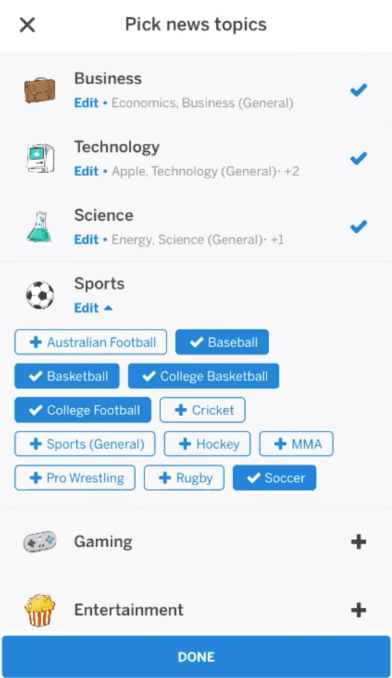
While Reddit users are often known to actually break news by (sometimes unwittingly) being the first to spot things, the News tab is focused on showcasing the work from news publications.
It’s more of a scannable list of top stories with an active comments section. That’s something that you don’t find on a number of news sites these day, as many have removed commenting. Meanwhile, a lot of discussion around the news takes place on social media, like Facebook and Twitter – but it’s not necessarily centralized.
Given that the product is still in beta, Reddit is still listening to user feedback about the new feature.
As you’d expect, there’s a lot of it – from “this is a bad idea” to “can we see the list?” to “this site is such a joke” to “this is actually controlling the bubble” to “this sounds like a sales pitch to someone who has never used Reddit” to this feels like another ‘Facebook’ style change that nobody asked for” to completely unrelated complaints about other issues.
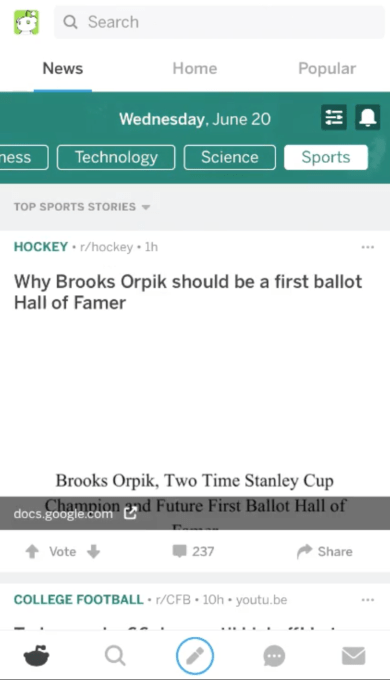
It could be that Reddit is hoping to attract some attention to its app in the wake of Facebook pulling Trending Topics – its news discovery feature – from its social network.
A larger audience of non-Reddit users may now be looking for another way to easily browse news on mobile – so Reddit thinks it may as well filter some of its existing content and pop it into a tab for easy access. But it’s not likely that people will turn to Reddit for news, especially when there are formidable alternatives like Google News and Apple News.
The feature is in beta for the time being. The company has not said when it’s publicly launching.
Konsus looks to give companies a way to get specially designed documents in under a day
Fredrik Thomassen as a consultant used to have the resources to offload the annoying project tasks — like making PowerPoint presentations — but now that it’s gone, he and his team wanted to make that available for everyone.
Now the startup, called Konsus, wants to turn that around even faster. Konsus is a design marketplace where companies can quickly post design projects that they need for various parts of their jobs, like presentations, and designers can pick up those jobs and submit their work back — a task that could take up a lot of unnecessary time for an employee that might be better spent working on other parts of their job. Konsus said it is compressing that even further by now looking to provide a 12-hour turnaround for those companies. The company launched out of Y Combinator in 2016.
“[Employees] want to be valuable and spend time on core tasks,” Thomassen said. “The average knowledge worker, depending on various specifics, spends around 40 percent of that time on non-core tasks that should be outsourced. That’s the 40 percent we’re going after, and people quite readily understand it. Some companies have in-house design agencies and so on, and they are 3 or 4 times as expensive as we are, and they typically want to work on these larger or more grand projects and don’t want to work on the small projects that range from 10 hours to 15 hours. Most of the projects we do are these small, nominal projects that people would have had to do themselves.”
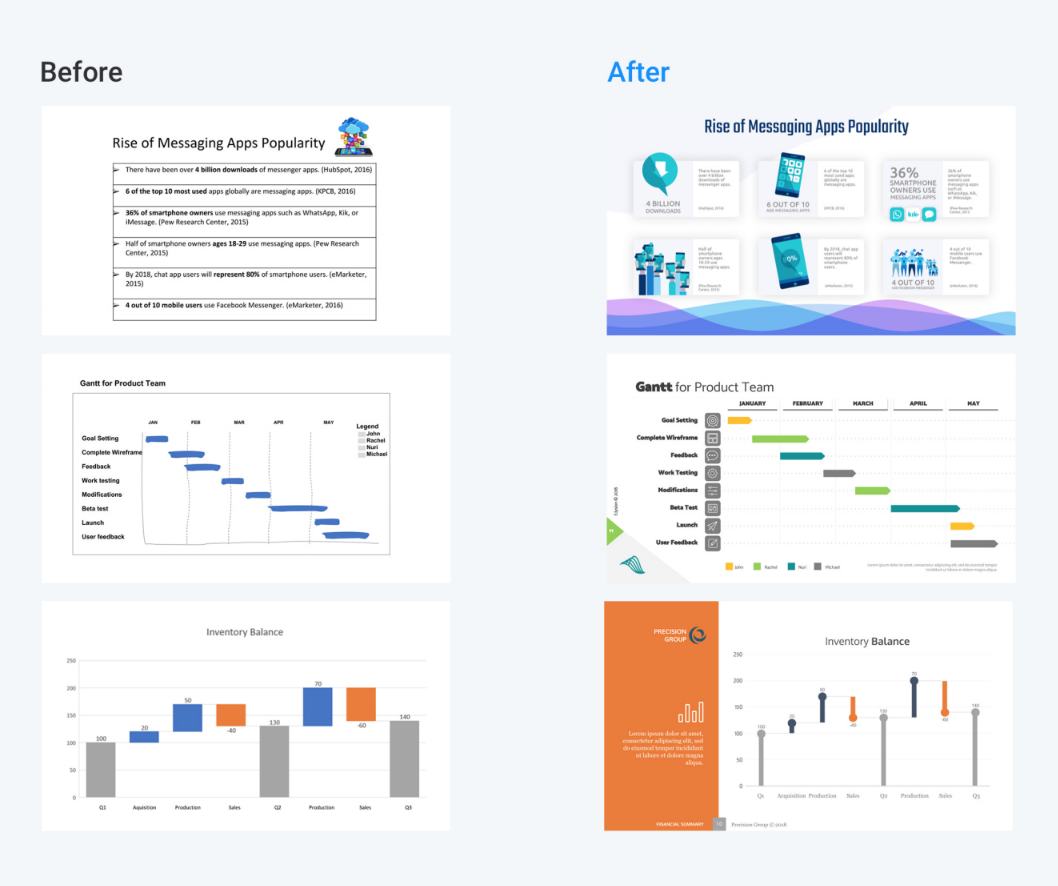
Konsus hires account managers and project managers handling the relationships with the customers to ensure that they’re getting the quality they need when they are posting projects like PowerPoint presentations onto the site. But Thomassen also said there are plenty of examples of those firms finding designers and contractors that they’ve decided to bring on full-time, and he’s fine with the startup being seen as a springboard for contractors that want to polish their skills for working with western clients — and even end up with a full-time job after that. A lot of the designers are coming in from eastern Europe, southeast Asia and other parts of the world that aren’t necessarily on the radar of these western firms.
Like many other modern services and marketplaces, Konsus hopes to come in at the bottom of a company and work its way up. One person or a team from a larger corporation will discover it, start using it and then eventually the startup might track that firm down and start talking about a custom team and dedicated emails. Then the outsourcers working for that firm goes through a background check, signs confidentiality agreements and goes through training on corporate branding material. Konsus’ revenue comes partly from subscriptions and people pre-paying to get a team, and the other half a pay-as-you-go model where firms get a rate and Konsus takes a commission.
“If you look at [big consulting firms], they have a similar solution as we have, and you can get support for all kinds of services — data entry, PowerPoint, various graphic design tasks — that make life much, much easier,” Thomassen said. “You go home from work and then you get it back in the morning, it becomes part of your workflow. That’s what we wanted to build for everyone else. Freelancers come to us from all corners of the world, they apply on our website, and we have our own recruiter work with them. We get around 5,000 to 10,000 people who apply, and we accept 10-20 depending on how many we need. The bar is extremely high.”
Of course, given that these are the kinds of tasks that firms might outsource without such a platform, Konsus has to potentially deal with larger consulting firms like Accenture, and there are plenty of startups looking to create an online labor marketplace that might not be targeting design just yet. But as those platforms start to put together a lot of potential customers, they’ll likely start asking for tools like Konsus — which means the company is going to have to figure out ways to outcompete early.
The company has raised $1.7 million from Sam Altman, the Slack Fund, Acequia Capital, Paul Buchheit, Geoff Ralston, John Collison and Liquid2 Ventures.
Your second chance for Startup Battlefield at Disrupt SF
If you missed the deadline last week to apply for the renowned Startup Battlefield at Disrupt SF, have no fear. There is still one more chance at being part of the action!
Out of all of the early-stage companies exhibiting at Disrupt, three Startup Alley companies will have the opportunity to be selected as one of the “Wild Card” winners. You might be wondering, “what is Wild Card”? Wild Card is a Startup Alley exhibiting company that is selected by our TechCrunch editorial team to participate in the celebrated Startup Battlefield competition. This year we’re selecting three, and if you are exhibiting in Startup Alley, you could be one of the lucky winners.
Last year at Disrupt NY 2017, RecordGram got a table in Startup Alley, where they ended up being selected as one of the Wild Card companies and ultimately went on to win the Startup Battlefield competition — and took home $50,000. Guess what? This year, the grand prize of Startup Battlefield at Disrupt SF has been doubled to $100,000!
Plus, you’ll have all the benefits of being a Startup Alley exhibitor, including access to CrunchMatch, Disrupt’s matchmaking service between startups and investors. So far, the investors coming to Disrupt SF this year have investment funds in excess of $4 billion, and we’re expecting more to sign up in the coming weeks. Also, over the course of the three-day conference, there will be curated tracks of content across four unique stages in 12 different verticals, plus tons of educational workshops and a plethora of networking opportunities.
So, if your company is pre-series A, Startup Alley at Disrupt SF is the place for you. Secure your exhibitor package here before we sell out!
Facebook mistakenly leaked developer analytics reports to testers
Set the “days without a Facebook privacy problem” counter to zero. This week, an alarmed developer contacted TechCrunch, informing us that their Facebook App Analytics weekly summary email had been delivered to someone outside their company. It contains sensitive business information, including weekly average users, page views and new users.
Forty-three hours after we contacted Facebook about the issue, the social network now confirms to TechCrunch that 3 percent of apps using Facebook Analytics had their weekly summary reports sent to their app’s testers, instead of only the app’s developers, admins and analysts.
Testers are often people outside of a developer’s company. If the leaked info got to an app’s competitors, it could provide them an advantage. At least they weren’t allowed to click through to view more extensive historical analytics data on Facebook’s site.
Facebook tells us it has fixed the problem and no personally identifiable information or contact info was improperly disclosed. It plans to notify all impacted developers about the leak today and has already begun.
Update: 1pm Pacific: TechCrunch was provided with this statement from a Facebook spokesperson:
“Due to an error in our email delivery system, weekly business performance summaries we send to developers about their account were also sent to a small group of those developer’s app testers. No personal information about people on Facebook was shared. We’re sorry for the error and have updated our system to prevent it from happening again.”
Below you can find the email the company is sending:
Subject line: We recently resolved an error with your weekly summary email
We wanted to let you know about a recent error where a summary e-mail from Facebook Analytics about your app was sent to testers of your app ‘[APP NAME WILL BE DYNAMICALLY INSERTED HERE]’. As you know, we send weekly summary emails to keep you up to date with some of your top-level metrics — these emails go to people you’ve identified as Admins, Analysts and Developers. You can also add Testers to your account, people designated by you to help test your apps when they’re in development.
We mistakenly sent the last weekly email summary to your Testers, in addition to the usual group of Admins, Analysts and Developers who get updates. Testers were only able to see the high-level summary information in the email, and were not able to access any other account information; if they clicked “View Dashboard” they did not have access to any of your Facebook Analytics information.
We apologize for the error and have made updates to prevent this from happening again.
One affected developer told TechCrunch “Not sure why it would ever be appropriate to send business metrics to an app user. When I created my app (in beta) I added dozens of people as testers as it only meant they could login to the app…not access info!” They’re still waiting for the disclosure from Facebook.
Facebook wouldn’t disclose a ballpark number of apps impacted by the error. Last year it announced 1 million apps, sites and bots were on Facebook Analytics. However, this issue only affected apps, and only 3 percent of them.

The mistake comes just weeks after a bug caused 14 million users’ Facebook status update composers to change their default privacy setting to public. And Facebook has had problems with misdelivering business information before. In 2014, Facebook accidentally sent advertisers receipts for other business’ ad campaigns, causing significant confusion. The company has also misreported metrics about Page reach and more on several occasions. Though user data didn’t leak and today’s issue isn’t as severe as others Facebook has dealt with, developers still consider their business metrics to be private, making this a breach of that privacy.
While Facebook has been working diligently to patch app platform privacy holes since the Cambridge Analytica scandal, removing access to many APIs and strengthening human reviews of apps, issues like today’s make it hard to believe Facebook has a proper handle on the data of its 2 billion users.
Uber safety driver of fatal self-driving crash was watching Hulu, not the road
A safety driver operating an Uber self-driving vehicle looked down at a phone that was streaming The Voice on Hulu 204 times during a 43-minute test drive that ended when pedestrian Elaine Herzberg was struck and killed in Tempe, Arizona, according to a 318-page police report reviewed by TechCrunch.
The Tempe Police Department released late Thursday evening the report on the fatal self-driving car crash that occurred in a Phoenix suburb in March. The lengthy report reveals that safety driver Rafaela Vasquez was streaming the show The Voice on her phone at the time of the crash.
Police determined that Vasquez’s eyes were off the road for 3.67 miles of the 11.8 total miles driven, or about 31 percent of the time.
Based on the data, police reported that Vasquez could have avoided hitting Herzberg if her eyes were on the road. The case has been submitted to the Maricopa County Attorney’s office for review against Vasquez, who could face charges of vehicular manslaughter.
“We continue to cooperate fully with ongoing investigations while conducting our own internal safety review,” an Uber spokeswoman said. “We have a strict policy prohibiting mobile device usage for anyone operating our self-driving vehicles. We plan to share more on the changes we’ll make to our program soon.”
Uber has hired former National Transportation Safety Board chair Christopher Hart as an adviser on the company’s overall safety culture. The company is reviewing internal processes, including its safety driver training practices.
While the report reveals the actions of the safety driver, questions are still swirling around Uber’s self-driving technology system in the modified Volvo XC90. A preliminary report by the NTSB found Uber’s modified Volvo XC90’s LiDAR and radar first spotted an object in its path about six seconds before the crash. The self-driving system first classified the pedestrian as an unknown object, then as a vehicle and then as a bicycle. At 1.3 seconds before impact, the self-driving system determined that an emergency braking maneuver was needed to mitigate a collision, according to the NTSB. But Uber had disabled Volvo’s emergency braking system so it didn’t work when the vehicle was under computer control to reduce the potential for “erratic behavior.”
The accident occurred March 18 at about 10 p.m. when an Uber self-driving vehicle struck 49-year-old pedestrian Herzberg on Mill Avenue, just south of Curry Road, according to the Tempe Police Department. The vehicle was in autonomous mode at the time of the collision.
Uber immediately halted public testing of its self-driving vehicles following the crash. At the time, Uber was testing autonomous vehicles on public roads in the Phoenix suburb of Tempe, Pittsburgh, San Francisco and Toronto.
Arizona Gov. Doug Ducey later suspended Uber from testing its self-driving cars in Arizona.
WordPress.com parent company acquires Atavist
Automattic, the company behind WordPress.com, WooCommerce, Longreads, Simplenote and a few other things, is acquiring Brooklyn-based startup Atavist.
Atavist has been working on a content management system for independent bloggers and writers. With an Atavist website, you can easily write and publish stories with a ton of media.
You might think that this isn’t particularly groundbreaking as anyone can create a website on WordPress.com or Squarespace and do the same thing. But the company also lets you create a paywall and build a subscription base.
Many writers don’t want to deal with the technical details of running a website. That’s why Atavist gives you the tools so that you can focus on your stories.
Atavist is also running a publication called Atavist Magazine. The publication is also joining Automattic. It’s unclear if it’s going to be part of Longreads or remain its own thing.
The CMS itself won’t stick around. Automattic said that the publishing platform will be integrated into WordPress. And this is the interesting part.
While WordPress is probably a much more solid CMS than Atavist, it could mean that Automattic wants to start offering subscriptions and paywalls. You can imagine WordPress.com websites that offer monthly subscriptions natively.
30 percent of the web runs on WordPress. Many of them are open source instances of WordPress hosted on their own servers. But many websites are hosted by WordPress.com, including TechCrunch.
Subscriptions on WordPress.com is good news for the web. Medium abruptly canceled its subscription program leaving many independent publications in the dust. So it’s hard to trust Medium when it comes to providing enough revenue to independent writers.
Automattic could create a seamless portal to manage subscriptions to multiple publications. And this could lead to less advertising and better content.
Lime scooters are live in Paris
Lime is the hot new thing in San Francisco, but will it work in other countries? The company just launched its electric scooter service in Paris.
This isn’t the first European city as Lime is also operating in Berlin, Bremen, Frankfurt and Zurich. But it’s a significant launch as alternative mobility solutions have all been trying to grab some market share in Paris.
Yesterday, you could see 200 scooters in the South East of Paris ready to be deployed. Lime plans to expand its fleet over time. Every day, the company will collect all the scooters at 9 PM to recharge them and put them back on the streets at 5 AM.
Between October and January, four bike-sharing services launched in Paris — GoBee Bike, Obike, Ofo and Mobike. GoBee Bike has left the market since then because it was underfunded and suffering from too much competition.
But Mobike and Ofo seem to be doing really well, especially if you compare it to the docked bikes — Vélib is more or less broken right now. Vélib started in 2007, years before cities like New York and London adopted a bike-sharing system. That’s why Parisians have had enough time to get familiar with the idea of sharing a bike with other members.
And then, there is Cityscoot and Coup, two electric scooter services (motorcycles, not standing scooters). They’re more expensive but quite popular, especially for longer distances.
It leaves Lime in an awkward position. I tried a Lime earlier today and wasn’t convinced it was the right solution for Paris. First, it’s quite expensive. You pay €1 to unlock it and then €0.15 per minute. A 20-minute ride costs €4 for instance. This is more expensive than 20 minutes on a Cityscoot, and less expensive than 20 minutes using Coup.
But it’s way more expensive than 20 minutes on an Ofo bike, which costs €0.50. I’m not convinced people are willing to pay eight times as much for everyday rides. Public transport options are also much more efficient in Paris than in San Francisco.
Paris is also much more difficult to navigate on a Lime scooter than San Francisco. There are speed bumps made out of paving stones and narrow streets. In addition to that, you can’t brake abruptly because you’re just standing on a scooter. I had to brake constantly in order to overcome those obstacles.
And yet, cities will need many different options to replace cars. There won’t be just one thing. People will use a multitude of transportation methods, from bikes to Lime scooters to electric motorcycle scooters. Now let’s see if Lime scooters won’t end up in the Seine.
Twitter ‘smytes’ customers
Twitter today announced it was acquiring the “trust and safety as a service” startup Smyte to help it better address issues related to online abuse, harassment, spam, and security on its platform. But it also decided to immediately shut down access to Smyte’s API without warning, leaving Smyte’s existing customers no time to transition to a new service provider.
The change left Smyte’s current customer base stranded, with production issues related to the safety of their own platforms.
Needless to say, many were not happy about this situation and took to Twitter to register their complaints.
According to Smyte’s website, its clients included Indiegogo, GoFundMe, npm, Musical.ly, TaskRabbit, Meetup, OLX, ThredUp, YouNow, 99 Designs, Carousell, and Zendesk – big name brands that used Smyte’s feature set in a variety of ways to combat fraud, abuse, harassment, scams, spam, and other security issues.
While Twitter had earlier told TechCrunch that it would be “winding down” Smyte’s business with existing clients, what that apparently meant was that it was going to announce the acquisition, then effectively shut off the lights over at Smyte and leave everyone in the lurch.
According to reports from those affected, Smyte disabled access to its API with very little warning to clients, and without giving them time to prepare. Customers got a phone call, and then – boom – the service was gone. Clients had multi-year contracts in some cases.
And again, to reiterate, Smyte is a provider of anti-abuse and anti-fraud protections – not something any business would shut off overnight.
In npm’s case, it even led to a production outage.
Twitter declined to comment, but we understand it was making phone calls to affected Smyte customers today to match them with new service providers.
The decision to smite smyte an existing customer base the minute the startup joined Twitter isn’t a good look for either company, and is especially ironic in light of Twitter’s promises of “trust and safety” improvements in the months to come.
Trust, huh?
That’s how it works?
Holy shit Twitter bought Smyte and immediately shut it down. We had a 3 years contract with them and they just disappeared overnight. No communication at all, they just turned their servers off, closed our shared support channel and walked away. What the actual fuck
— Giacomo Gatelli (@arthens) June 21, 2018
»Trust and safety as a service«, they said. Now @Twitter owns @HelloSmyte, and trust is down the drain. Shutting down their services immediately, not giving their customers any grace period to adjust. Thought #Smyte was better than that #massivedisgrace
https://t.co/ttXmLNg3qb
— Ekaterina Damer (@ekadamer) June 21, 2018
Wait…so did @HelloSmyte just shut down it's service entirely today with no warning after @Twitter bought them? What about their customers that rely on them for advanced moderation and the safety of their platforms? #smyte
— Michael Ehinger (@MichaelEhinger) June 21, 2018
A vendor notified us of their acquisition at 6am this morning and shut down their APIs 30 minutes later, creating a production outage for npm (package publishes and user registrations). The sheer unprofessionalism of this is blowing my mind.
— Laurie Voss (@seldo) June 21, 2018
It takes weeks to negotiate and sign an acquisition. You didn't find out at 6am. You couldn't give us a week? Even a couple of hours to take your service out of our critical path and avoid an outage? Fucking shocking behavior.
— Laurie Voss (@seldo) June 21, 2018
Damage is done already anyway. We had the same experience; luckily we were only using them in an async capacity so it didn't take us offline.
— Jeff Goldschrafe (@jgoldschrafe) June 21, 2018
#smyte pic.twitter.com/SAPnHxdyMU
— theredwarrior (@theredwarrior) June 21, 2018
from https://t.co/oarjqaRFlr:
"Twitter tells us that Smyte will wind down its operations with those customers including Indiegogo, GoFundMe, npm"
— Adam Perry (@dika10sune) June 21, 2018

Hey @HelloSmyte , it's a massive bummer that you couldn't give your customers any notice before turning everything off. Is there anything you can do to help us out?
— Dennis Hotson (@dennishotson) June 21, 2018
Thanks for just shutting off service at 615am this morning with 7 minutes notice.
— Curtis Schofield (@curtisjennings) June 21, 2018
Bag Week 2018: Mission Workshop’s Radian rolltop starts simple but grows piece by piece
Welcome to Bag Week 2018. Every year your faithful friends at TechCrunch spend an entire week looking at bags. Why? Because bags — often ignored but full of our important electronics — are the outward representations of our techie styles, and we put far too little thought into where we keep our most prized possessions.
I’ve always been wary of modular, rail-based bag systems. They’ve always struck me as rather military and imposing, which I suppose is kind of the point. Even Mission Workshop, whose other bags I have always enjoyed, put out one that seemed to me excessive. But they’ve tempered their style a bit and put out the Radian, a solid middle ground between their one-piece and modular systems.
The Radian is clearly aimed at the choosy, pack-loving traveler who eschews roller bags for aesthetic — which describes me to a tee. Strictly rolltop bags (originating in cyclist and outdoors circles) end up feeling restrictive in where you can stow gear, and rollers are boxy and unrefined. So the Radian takes a bit from both, with the added ability to add bits and pieces according to your needs.
What it is: Adaptable, waterproof, well-designed and not attention-grabbing
What it isn’t: Simple or lightweight
The core pack is quite streamlined, with no protruding external pockets whatsoever. There’s the main compartment — 42 liters, if you’re curious — and a cleverly hidden laptop compartment between the main one and the back pads. Both are independently lined with waterproof material (in addition to the water-resistant outer layer) and the zippers are similarly sealed. There’s also a mesh pouch hidden like the laptop area that you can pop out or stow at will.
You can roll up the rolltop and secure it with Velcro, or treat it as a big flap and snap it to a strap attached to the bottom of the bag — the straps themselves are attached with strong Velcro, so you can take them off if you’re going roll style. The “Cobra” buckle upgrade is cool but the standard plastic buckles are well made enough that you shouldn’t feel any pressure to pay the $65 to upgrade.
Access is where things begin to diverge. Unlike most rolltop packs, you can lay the bag on the ground and unzip the top as if it were a roller, letting you access the whole space from somewhere other than the top. The flap also has its own mesh enclosure. This is extremely handy and addresses the main ergonomic issue I’ve always had with strictly top-loading bags.
In a further assimilation of rolltop qualities, there’s a secret pocket at the bottom of the bag that houses a large cloth cover that seals up the pack straps and so on, making the bag much more stowable and preventing TSA or baggage handlers from having to negotiate all that junk or bag it up themselves.
Of course, a single large compartment is rarely enough when you’re doing real traveling and need to access this document or that gadget in a hurry. So the Radian joins the Mission Workshop Arkiv modular system, which lets you add on a variety of extra pockets of various sizes and types. Just be careful that you don’t push it over the carry-on size limit (though you can always stuff the extra pockets inside temporarily).
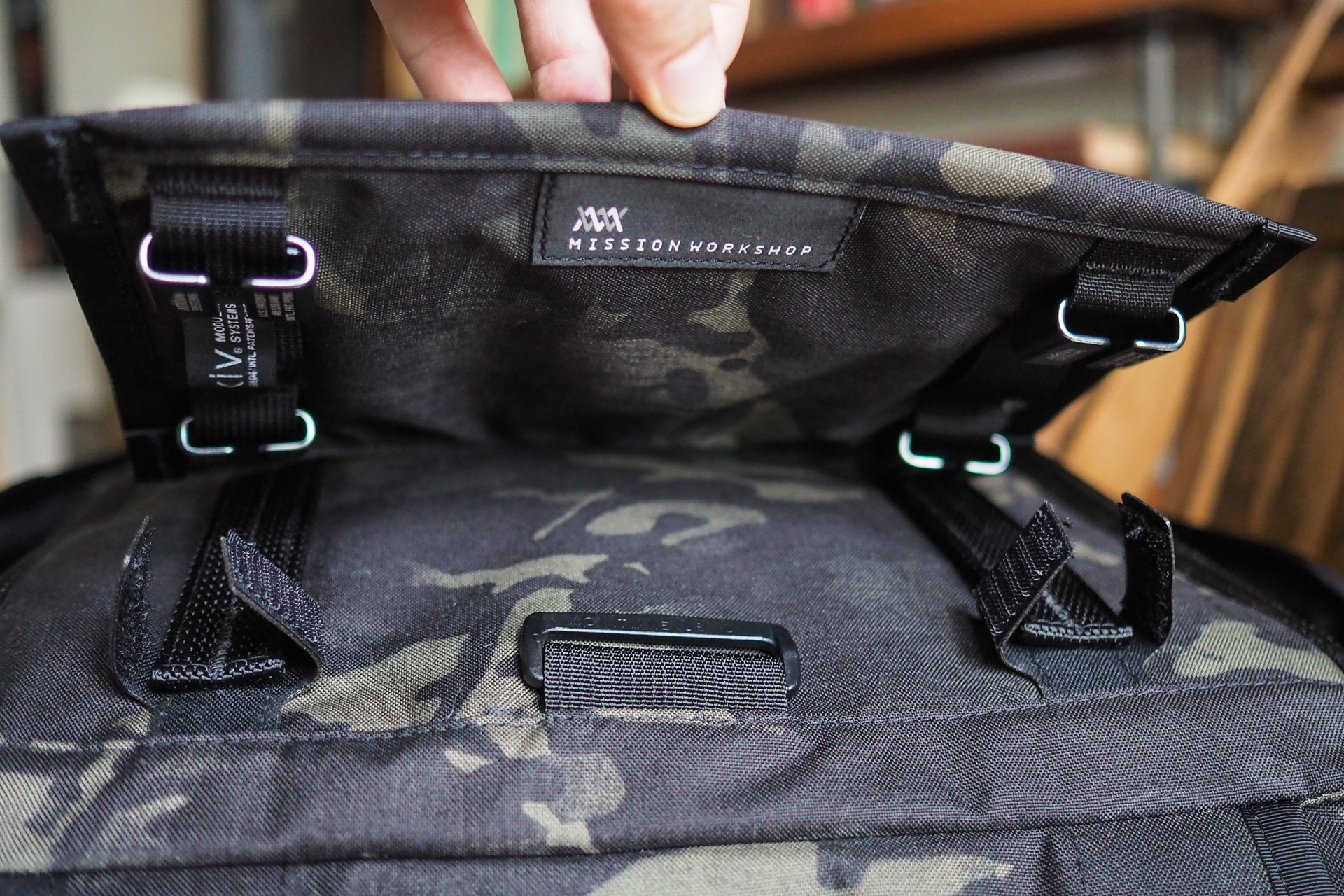 There are six rails — two on each side and two on the back — and a handful of accessories that go on each, sliding on with sturdy metal clips. The pack I tested had two zippered side pockets, the “mini folio” and the “horizontal zip” on the back, plus a cell phone pocket for the front strap.
They’re nice but the rear ones I tried are a bit small — you’d have trouble fitting anything but a pocket paperback and a couple of energy bars in either. If I had my choice I would go with the full-size folio, one zippered and one rolltop side pocket. Then you can do away with the cell pocket, which is a bit much, and have several stowage options within reach. Plus the folio has its own rails to stick one of the small ones onto.
There’s really no need to get the separate laptop case, since the laptop compartment would honestly fit two or three. It’s a great place to store dress shirts and other items that need to stay folded up and straight.
As far as room, the 42 liters are enough on my estimation to pack for a five-day trip — that is to say, I easily fit in five pairs of socks and underwear, five t-shirts, a sweater or two, a dress shirt, some shorts and a pair of jeans. More than that would be kind of a stretch if you were also planning on bringing things like a camera, a book or two and all the other usual travel accessories.
The main compartment has mesh areas on the side to isolate toiletries and so on, but they’re just divisions; they don’t add space. There are places for small things in the outside pockets but again, not a lot of room for much bigger than a paperback, water bottle or snack unless you spring for the folio add-on.
As for looks — the version I tested was the black camo version, obviously, which looks a little more subdued in real life than my poorly color-balanced pictures make it look. Personally I prefer the company’s flat grey over the camo and the black. Makes it even more low-profile.
In the end I think the Radian is the best option for anyone looking at Mission Workshop bags who wants a modular option, but unless you plan on swapping out pieces a lot, I’m not personally convinced that it’s better than their all-in-one bags like the Rambler and Vandal. By all means take a look at putting a Radian system together, but don’t neglect to check if any of the pre-built ones fit your needs as well.

YouTube introduces channel memberships, merchandise and premieres
YouTube creators are gaining a number of new tools to generate revenue from their videos outside of traditional advertising, as well as those that will help them better engage their fans, according to news the video streaming site announced today at the VidCon conference in Anaheim, California. This includes the rollout of channel memberships, merchandising, marketing partnerships via FameBit and the launch of “Premieres,” which offers a middle ground between pre-recorded, edited video and live streaming.
Memberships
Before today, YouTube had offered a Twitch-like “Sponsorship” model on YouTube Gaming. This gave fans the ability to sponsor a channel for $4.99 per month, which also gave them access to exclusive digital goods, like a custom badge and emoji.
YouTube started testing this program across its larger video network last fall, it said. Those tests led to YouTube channel memberships.
Unlike on YouTube gaming, Channel memberships have additional requirements.
Creators will need to have 100,000 subscribers or more, be over 18 and be members of the YouTube Partner Program.
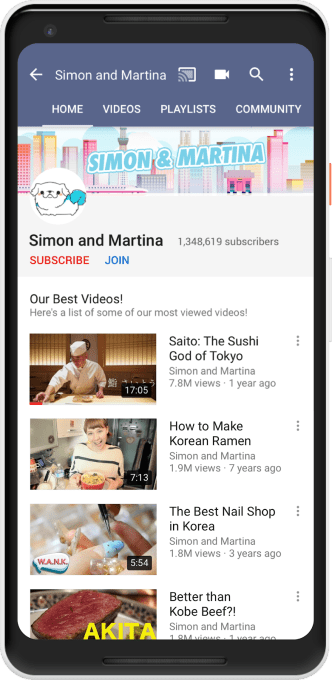
However, the price point for backing a creator’s channel remains the same: $4.99 per month, and includes the custom badges and exclusive emoji.
It will also allow subscribers to gain access to members-only posts in the Community tab where creators will share custom perks from time to time, like access to an exclusive live stream, additional videos, shout-outs, news of upcoming events, early access to ticket sales and other things.

YouTube says it will vet these perks manually, to ensure they meet YouTube’s guidelines and are something the creator can actually deliver.
“This tool set is fairly powerful, so we want to make sure that they don’t put products out there, that they really can’t commit to,” explains Director of Product Management, Rohit Dhawan, who heads alternative monetization at YouTube.
He says the perks can be almost anything the creator wants to offer, within YouTube’s guidelines.
“It’s kind of like a blank canvas…it’s us giving the creators the tools to customize their membership offering and provide whatever perks that they feel is going to be valuable to the fans,” he says.
This feature launched in January for select creators, who have already been generating revenue. It will soon arrive for all who are eligible.
Comedy creator Mike Falzone more than tripled his YouTube revenue, thanks to memberships, says YouTube. Spanish gaming channel elrubiusOMG now has six times the number of members as it did sponsors on YouTube Gaming alone. And Wintergatan is making over 50 percent of revenue from Channel Memberships.
Overall, the number of creators earning five figures a year is up 35 percent, and the number of those earning six figures is up by 40 percent, YouTube says.
Similar to sponsorships, YouTube retains 30 percent of sponsorship revenue after local sales tax is deducted, but covers all transaction costs, including credit card fees.
Merchandise
In addition to memberships, creators will also be able to sell to fans directly, starting today.
In a shelf directly below the video itself, creators with more than 10,000 subscribers can offer merchandise like tee-shirts, hats, phone cases or any one of over 20 different merchandise items that make sense for their channel.
For example, the creator of Lucas the Spider turned his character into a plushie, and sold more than 60,000 units, making over $1 million in profit in just 18 days.
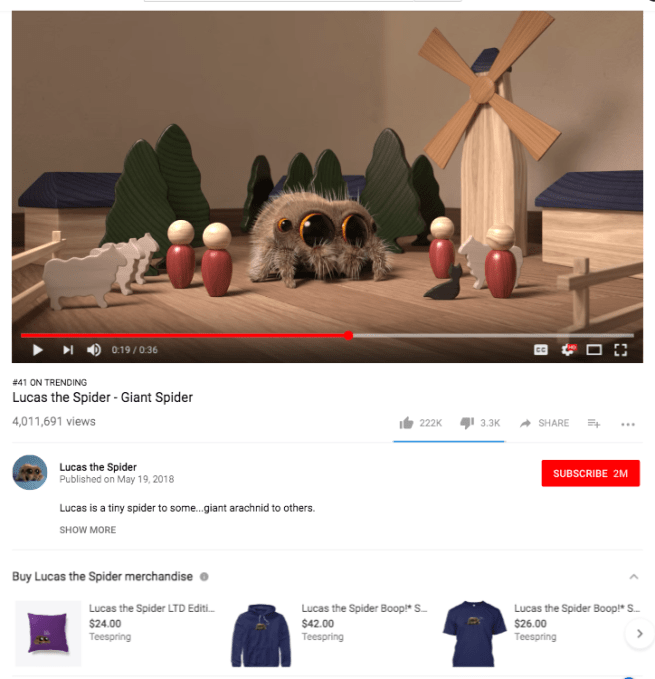
This new program is being launched in partnership with custom merchandise platform Teespring.
YouTube says that Teespring will retain a cut of the merchandise, which varies per item. Effectively, the way this works is that there’s a flat price per item sold that goes back to Teespring, but the creator can mark up the item to whatever price they want, then keep the upside.
For example, a single t-shirt’s base price is $10.22, but creators typically sell them for $22. However, if the creators sells 200-499 t-shirts, the base price drops to $9.82, so the creator makes more money.
But YouTube has also negotiated a deal with Teespring where it receives a commission on those sales — a small flat percentage, we’re told — the majority of which is returned to the creator. This is meant to incentivize the creator to sell merchandise through YouTube, as they’ll receive more thanks to this returned commission than if they sold direct.
This is also a massive win for Teespring, which only a few years ago was restructuring its business and laying off staff.
During beta testing, Teespring says there was an 82 percent success rate for YouTubers using the merchandise service, and conversions from views to sales were testing at 2.5 times higher than with standard description links. This led to an average of 25 percent more units sold per user, among early adopters.
In addition, creators who have been connected directly with brand sponsorships via FameBit, the company it acquired in fall 2016, will also be able to use the merchandise shelf to point fans to whatever they’re selling — like video games, apparel or any other product sold online. This feature was announced at VidCon, but hasn’t rolled out at this time.
Premieres
Finally, YouTubers who want to leverage the revenue generation possibilities that come with Live video will have a way to do so without having to actually go live.
Instead, they can use a new YouTube feature called “Premieres” that creates a landing page they can promote ahead of a video’s release. This page will also have a chat feature, like Live videos do, which means creators can use Super Chat and take advantage of Channel Membership perks even if they aren’t doing live content.
The videos are uploaded in the same interface on YouTube, so there’s no new workflow to learn beyond toggling the “Premiere” switch on.
Creators can also join in the chats as the video goes live to engage with their fans around this pre-recorded content, as well as comment on the videos before they start. When the Premiere wraps, it’s posted as a regular video on the site (without the two-minute countdown video YouTube adds).
“We’re going to use our search and discovery platform to promote these,” notes Kurt Wilms, Group Product Manager at YouTube, who’s leading Live.
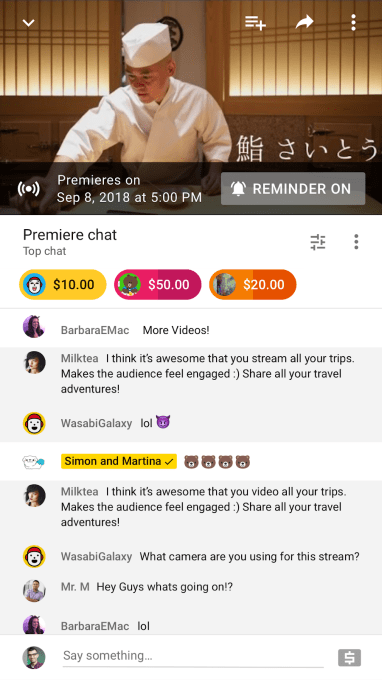
“Upcoming premieres can appear on the [YouTube] homepage and in recommended videos,” he says. Premieres will also show in the section where all the channel content you’ve subscribed to displays, we’re told. And Premieres will be in YouTube search and YouTube related videos.
“They’re going to appear across all the dedicated discovery portions of our site, which is awesome,” he says.
Premieres can be used to promote upcoming videos from creators as well as things like new movie trailers from studios, trailers from video games, or even music videos. But Premieres is not tied to YouTube Music at this time.
A number of YouTube creators will be turning on Premieres after VidCon, including Simon & Martina, Leroy Sanchez, Jackson Bird, Los Polinesios, Ari Fitz, ZerkaaPlays, Theskorpionshow, Laura Kampf, Vintage Space, Yammy, R.LUM.R., JacksFilms, Corridor Digital and Innana Sarkis.
YouTube also said its version of Stories will arrive for all eligible creators with more than 10,000 subscribers later this year.
The announcements come at a critical time for YouTube, as Facebook is trying to woo creators away to its own network and video hub with unique features of its own.
The news also follows another announcement YouTube made to advertisers this week, about new ways they’ll be able to connect with their audience using a Creative Suite of ad tools.