Electric scooter startup Spin is finalizing a $125 million security token offering

Spin, an electric scooter startup, is raising around $125 million via a blockchain-based security token offering (STO), Axios first reported and TechCrunch has independently learned. Spin, which declined to comment for this story, has previously raised just $8 million.

The idea with Spin’s security token offering is to raise money from accredited investors, who will then be entitled to a portion of the revenue from Spin’s electric scooter operations, according to a source close to Spin. Last year, initial coin offerings were the hot thing in the cryptocurrency space. Now, STOs are starting to emerge, given that they provide more security for potential investors. With STOs, investors can buy tokens that are linked to real-world financial instruments. In the case of Spin’s offering, the tokens are linked to its revenue.

Spin has been one of the more quiet scooter startups in the industry after announcing its expansion into scooters in February. This comes shortly after electric scooter startup Bird raised a $300 million round led by Sequoia Capital, and after reports of Lime raising $250 million led by GV.

Spin currently has a contract with electric scooter manufacturer Ninebot to purchase 30,000 scooters a month through the end of this year, according to a source. Bird, on the other hand, said in May it inked an exclusive deal with Ninebot for rights to the company’s supply of scooters. Clearly, that’s not true.

Spin had previously only operated a bike-share platform. Last August, Spin brought its stationless bike-share program to South San Francisco after launching in Seattle earlier that year. Then, in January, Spin unveiled its stationless electric bike. However, Spin is now solely focused on electric scooters, according to a source close to Spin.

Meanwhile, Spin and other electric scooter operators are currently awaiting word from the city of San Francisco regarding whether or not they can deploy their respective scooters in the city.
Thousands of cryptocurrency projects are already dead

Two sites that are actively cataloging failed crypto projects, Coinopsy and DeadCoins, have found that over a 1,000 projects have failed so far in 2018. The projects range from true abandonware to outright scams, and include BRIG, a scam by two “brothers,” Jack and Jay Brig, and Titanium, a project that ended in an SEC investigation.

Obviously any new set of institutions must create their own sets of rules and that is exactly what is happening in the blockchain world. But when faced with the potential for massive token fundraising, bigger problems arise. While everyone expects startups to fail, the sheer amount of cash flooding these projects is a big problem. When a startup has too much fuel too quickly the resulting conflagration ends up consuming both the company and the founders, and there is little help for the investors.

These conflagrations happen everywhere and are a global phenomenon. Scam and dead ICOs raised $1 billion in 2017 with 297 questionable startups in the mix.

There are dubious organizations dedicated to “repairing” broken ICOs, including CoinJanitor from Cape Town, but the fly-by-night nature of many of these organizations does not bode well for the industry.

ICO-funded startups currently use multi-level marketing tactics to build their business. Instead they should take a page from the the Kickstarter and Indiegogo framework. These crowd-funding platforms have made trust an art. By creating collateral that defines the team, the project, the risks and the future of the idea, you can easily build businesses even without much funding. Unfortunately, the lock-ups and pricing scams the current ICO market uses to incite greed rather than rational thinking are hurting the industry more than helping.

The bottom line? Invest only what you can afford to lose and expect any token you invest in to fail. Ultimately, the best you can hope for is to be pleasantly surprised when it doesn’t. Otherwise, you’re in for a world of disappointment.

Leena AI builds HR chatbots to answer policy questions automatically

Say you have a job with a large company and you want to know how much vacation time you have left, or how to add your new baby to your healthcare. This usually involves emailing or calling HR and waiting for an answer, or it could even involve crossing multiple systems to get what you need.

Leena AI, a member of the Y Combinator Summer 2018 class, wants to change that by building HR bots to answer questions for employees instantly.

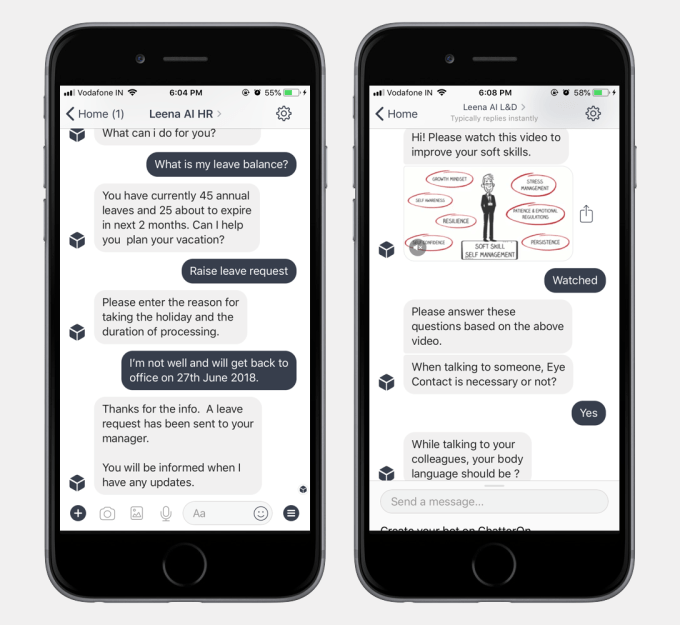
The bots can be integrated into Slack or Workplace by Facebook and they are built and trained using information in policy documents and by pulling data from various back-end systems like Oracle and SAP.

Adit Jain, co-founder at Leena AI, says the company has its roots in another startup called Chatteron, which the founders started after they got out of college in India in 2015. That product helped people build their own chatbots. Jain says along the way, they discovered while doing their market research a particularly strong need in HR. They started Leena AI last year to address that specific requirement.

Jain says when building bots, the team learned through its experience with Chatteron that it’s better to concentrate on a single subject because the underlying machine learning model gets better the more it’s used. “Once you create a bot, for it to really add value and be [extremely] accurate, and for it to really go deep, it takes a lot of time and effort and that can only happen through verticalization,” Jain explained.

Photo: Leena AI

What’s more, as the founders have become more knowledgeable about the needs of HR, they have learned that 80 percent of the questions cover similar topics, like vacation, sick time and expense reporting. They have also seen companies using similar back-end systems, so they can now build standard integrators for common applications like SAP, Oracle and NetSuite.

Of course, even though people may ask similar questions, the company may have unique terminology or people may ask the question in an unusual way. Jain says that’s where the natural language processing (NLP) comes in. The system can learn these variations over time as they build a larger database of possible queries.

The company just launched in 2017 and already has a dozen paying customers. They hope to double that number in just 60 days. Jain believes being part of Y Combinator should help in that regard. The partners are helping the team refine its pitch and making introductions to companies that could make use of this tool.

Their ultimate goal is nothing less than to be ubiquitous, to help bridge multiple legacy systems to provide answers seamlessly for employees to all their questions. If they can achieve that, they should be a successful company.

Redbox lands deal with Warner to rent DVDs on the same day they go on sale in physical stores

DVD and Blu-ray rental kiosk operator Redbox announced a deal with Warner Bros. today that allows it to begin offering new releases on the same day they go on sale in physical retail stores. Redbox’s former agreement with the studio meant they had to wait until seven days after the home-video release. In a statement, Redbox said this deal also maintains the availability of new releases in Redbox On Demand, its streaming rental service.

According to Variety, this means Redbox now has same-day deals with almost all of the major studios. In addition to Warner Bros., they include Sony Pictures Entertainment, Universal Pictures and Lionsgate (its deal with 20th Century Fox is similar to its previous one with Warner Bros ., in that it allows Redbox to rent its movies seven days after their home-video release). One notable exception is Disney, which Redbox has not had a distribution deal with since 2012. This is likely due to an ongoing legal dispute involving digital download codes for Disney content.

Redbox now operates more than 41,500 kiosks, which it said in its announcement is “more locations than Starbucks and McDonalds in the U.S. combined.”

While the idea of waiting for DVD rentals might seem quaint in the age of on-demand and streaming everything, many Americans still rent discs. According to the NPD Group, nearly a third of people it surveyed in the United States last year said they rent DVDs and Blu-rays in addition to using a subscription service like Netflix. Despite reporting declining revenue before its parent company, Outerwall, agreed to be taken private in July 2016, Redbox doubled down on kiosks last year, adding 1,500 with plans to add more this year.

Jury rules Dr. Dre and Jimmy Iovine owe $25M to early Beats collaborator

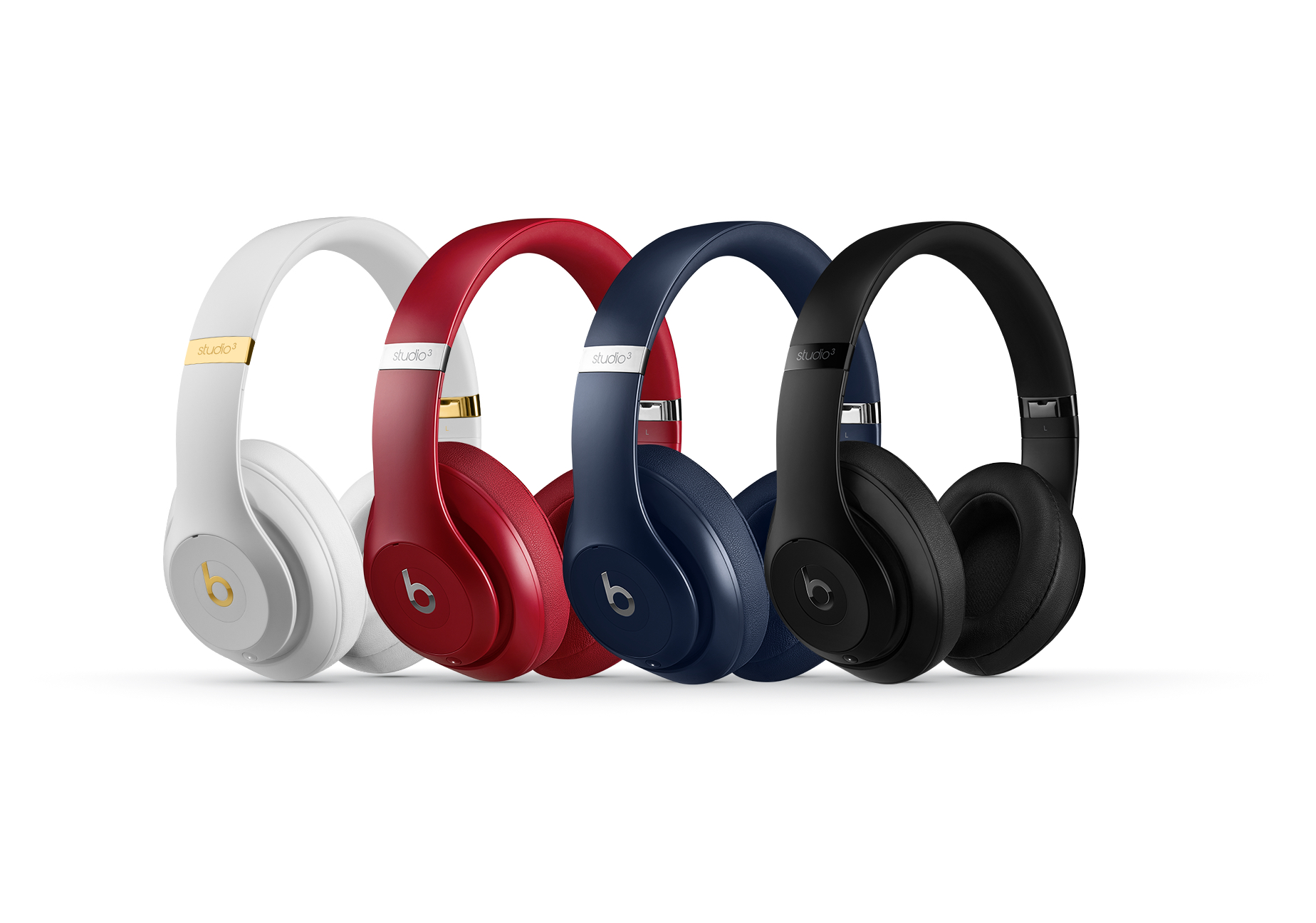
Beats Studio 3 wireless headphones

A Los Angeles jury has ruled that Dr. Dre and Jimmy Iovine, the founders of Apple-owned Beats Electronic, owe $25.25 million in royalties to an early collaborator who helped create the first model of Beats Studio headphones. Founded in 2008, Beats was acquired by Apple in 2014.

The plaintiff, Steven Lamar, claims that he first proposed the concept behind the headphones to Jimmy Iovine and Dr. Dre (real name Andre Young) in early 2006 and continued working with the Beats founders until falling out with them later that year. This led to a settlement that Lamar claims stipulated he would receive royalties on all future releases in the Beats Studio line. Dre and Iovine argued, however, that they had fulfilled their end of the agreement by paying Lamar royalties for the original headphone model, which was released in 2008.

The jury decided that under the 2007 settlement, Lamar is indeed entitled to a percentage of the sales on all models of Studio headphones.

TechCrunch has sent requests for comment to Apple, Beats and Roam, the headphone company founded by Lamar.

Instagram Lite quietly launches to find a billion more users abroad

Instagram’s future growth depends on the developing world, so it’s built a version of its app just for them. “Instagram Lite” for Android appeared today in the Google Play App Store without any announcement from the company. “The Instagram Lite app is small, allowing you to save space on your phone and download it quickly” the description reads.

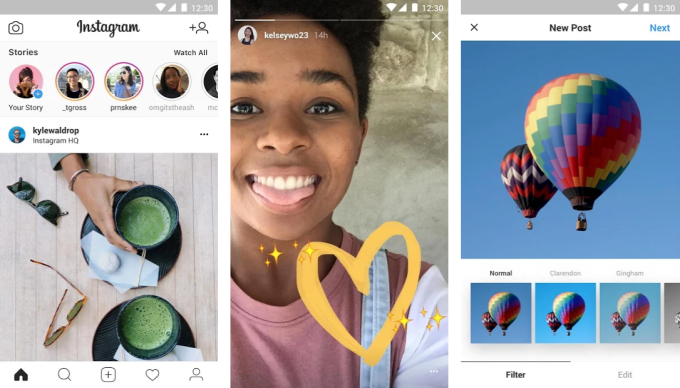
At just 573 kilobytes, Instagram Lite is 1/55th the size of Instagram’s 32 megabyte main app. It lets you filter and post photos to the feed or Stories, watch Stories, and browse the Explore page, but currently lacks the options to share videos or Direct message friends.

Instagram Lite addresses many problems common amongst mobile users in the developing world who are often on older phones with less storage space, slower network connections, or who can’t afford big data packages. Users might not have to delete photos or other apps to install Instagram Lite, or wait a long time and pay more for it to download.

Screenshots of Instagram Lite

The release follows Instagram’s revamped mobile website that launched last month, also designed for the developing world. At the time I wrote, “The launch begs the question of whether Instagram will release an Instagram Lite version of its native app.” The answer is yes. Mobile analytics service Sensor Tower tipped TechCrunch off to the release.

When asked for comment, an Instagram spokesperson confirmed that Instagram Lite began testing in Mexico this week, and provided this statement: “We are testing a new version of Instagram for Android that takes up less space on your device, uses less data, and starts faster.” The company wouldn’t say whether ads would be included. Later this year the app will expand to more countries, and get messaging and video posting capabilities.

The “Lite” trend has picked up steam recently. Facebook launched Facebook Lite in 2015, and it had 200 million users by 2017. That paved the way for the launch of Messenger Lite in April 2018, and Uber glommed on to the strategy with the release of its own Lite app earlier this month. Users have clearly been craving Instagram Lite, since a fake/unofficial Facebook Page with that has racked up over 2000 Likes.

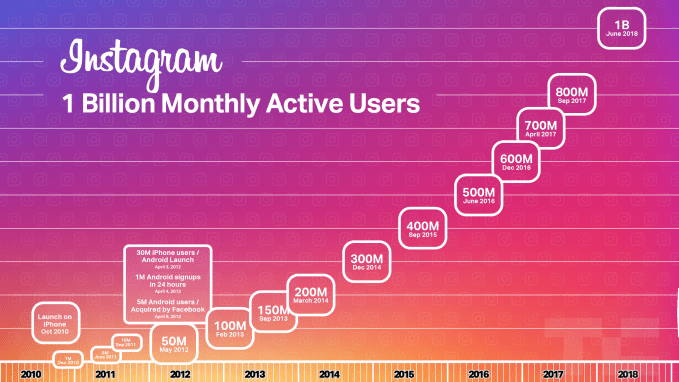
Instagram announced last week at the IGTV unveiling that it had hit 1 billion monthly active users. It’s been growing at roughly 100 million users every four months, with much of that coming from the developing world. Snapchat neglected international markets to focus on US teens, leaving the door open for Instagram and WhatsApp’s clones of Snapchat Stories to grab big user bases in countries like India and Brazil.

With this new growth tool in its belt, Instagram may see even swifter adoption in emerging markets. It could score potentially score evenue straight from Lite if ads are included, then as phones and networks improve, hope to shift users onto the full-fidelity version. Now, eyes will be on Snapchat to see if it builds its own Lite app. Otherwise it risks continuing to slip further behind the Instagram juggernaut.