Facebook quietly relaunches apps for Groups platform after lockdown

Facebook is becoming a marketplace for enterprise apps that help Group admins manage their communities.

To protect itself and its users in the wake of the Cambridge Analytica scandal, Facebook locked down the Groups API for building apps for Groups. These apps had to go through a human-reviewed approval process, and lost access to Group member lists, plus the names and profile pics of people who posted. Now, approved Groups apps are reemerging on Facebook, accessible to admins through a new in-Facebook Groups apps browser that gives the platform control over discoverability.

Facebook confirmed the new Groups apps browser after our inquiry, telling TechCrunch, “What you’re seeing today is related to changes we announced in April that require developers to go through an updated app review process in order to use the Groups API. As part of this, some developers who have gone through the review process are now able to access the Groups API.”
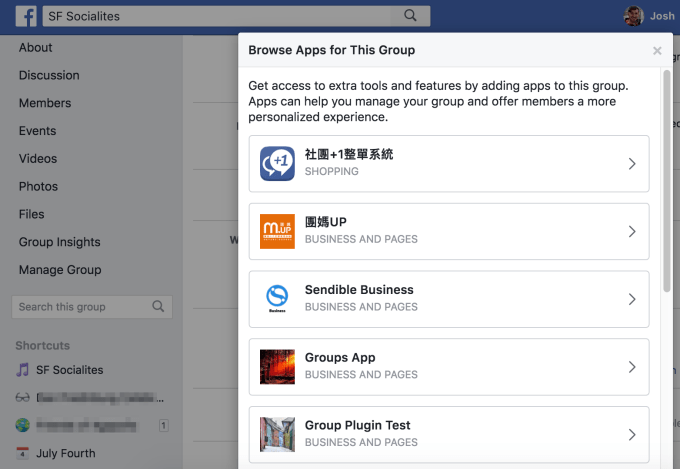
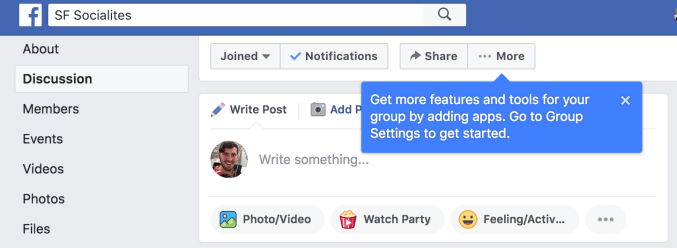
Facebook wouldn’t comment further, but this Help Center article details how Groups can now add apps. Matt Navarra first spotted the new Groups apps option and tipped us off. Previously, admins would have to find Group management tools outside of Facebook and then use their logged-in Facebook account to give the app permissions to access their Group’s data.

Groups are often a labor of love for admins, but generate tons of engagement for the social network. That’s why the company recently began testing Facebook subscription Groups that allow admins to charge a monthly fee. With the right set of approved partners, the platform offers Group admins some of the capabilities usually reserved for big brands and businesses that pay for enterprise tools to manage their online presences.

Becoming a gateway to enterprise tool sets could make Facebook Groups more engaging, generating more time on site and ad views from users. This also positions Facebook as a natural home for ad campaigns promoting different enterprise tools. And one day, Facebook could potentially try to act more formally as a Groups App Store and try to take a cut of software-as-a-service subscription fees the tool makers charge.

Facebook can’t build every tool that admins might need, so in 2010 it launched the Groups API to enlist some outside help. Moderating comments, gathering analytics and posting pre-composed content were some of the popular capabilities of Facebook Groups apps. But in April, it halted use of the API, announcing that “there is information about people and conversations in groups that we want to make sure is better protected. Going forward, all third-party apps using the Groups API will need approval from Facebook and an admin to ensure they benefit the group.”

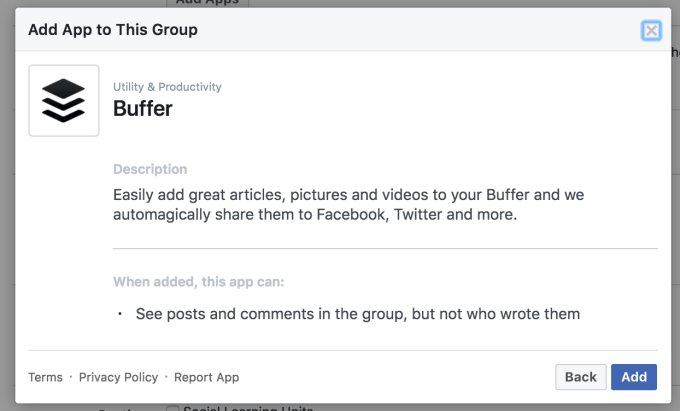
Now apps that have received the necessary approval are appearing in this Groups apps browser. It’s available to admins through their Group Settings page. The apps browser lets them pick from a selection of tools like Buffer and Sendible for scheduling posts to their Group, and others for handling commerce messages.

Facebook is still trying to bar the windows of its platform, ensuring there are no more easy ways to slurp up massive amounts of sensitive user data. Yesterday it shut down more APIs and standalone apps in what appears to be an attempt to streamline the platform so there are fewer points of risk and more staff to concentrate on safeguarding the most popular and powerful parts of its developer offering.

The Cambridge Analytica scandal has subsided to some degree, with Facebook’s share price recovering and user growth maintaining at standard levels. However, a new report from The Washington Post says the FBI, FTC and SEC will be investigating Facebook, Cambridge Analytica and the social network’s executives’ testimony to Congress. Facebook surely wants to get back to concentrating on product, not politics, but must take it slow and steady. There are too many eyes on it to move fast or break anything.

The hottest new space to disrupt is immigration

Ayah Bdeir
Contributor

Ayah Bdeir is the founder and CEO of littleBits, a platform of easy-to-use electronic building blocks for children to create inventions, large and small.

Tech CEOs and founders are disrupting everything from travel to food, to space, to sleep. Now it’s time to disrupt a process that so many of us have relied on to get where we are today: immigration. According to a study by the National Foundation for American Policy, immigrants have founded more than half of U.S. startup companies that are valued at more than one billion dollars.

With all that is happening around us, now is the time for entrepreneurs to use their playbook for disrupting markets and apply it to immigration as a space — not for a financial upside, but for a more social, human upside.

Turning a problem into an opportunity

One of the most important lessons you learn as an entrepreneur is outlining the problem you are trying to solve and turning it into an opportunity.

Economists generally agree that immigration has net positive effects on both the sending and receiving countries. Contrary to popular belief, immigration doesn’t increase crime rates or take jobs away from native workers. In fact, according to The Silicon Valley Competitiveness and Innovation Project Report, almost every major tech hub has more foreign-born workers than domestic ones.

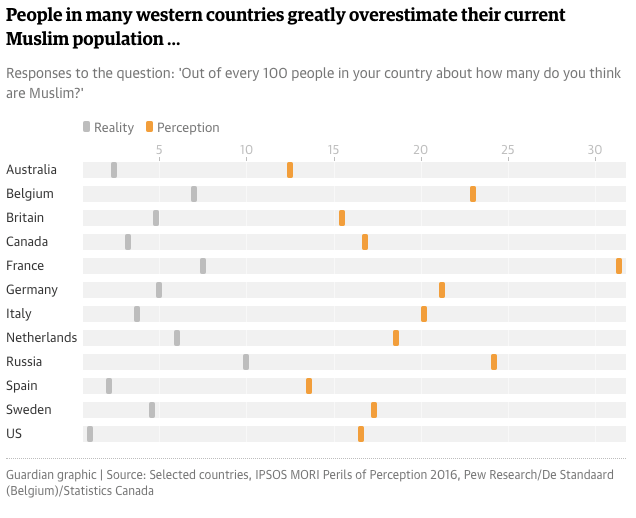
Before solving a problem, we have to agree on the facts. Research shows that people in many western countries greatly overestimate the number of immigrants — in this case, Muslim immigrants — coming into their country. Misinformation makes it difficult to pursue effective solutions.

Source: The Guardian

There’s an opportunity to educate ourselves and instead highlight the economic and innovation opportunity that immigration offers. Immigrants provide access to more talent, more diverse thinking and more creativity.

Dr. Adrian Furnham, a professor of psychology at University College London who studies immigrants and entrepreneurship said, “What I’ve found is that immigrants not only have the qualities that help any entrepreneurs succeed—including aggressiveness and creative thinking—but they get a big boost because many of the skills they picked up coping with a new world are transferable to the entrepreneurial world.”

Rebranding the word “immigrant”

Another important step in an entrepreneur’s playbook relates to changing perceptions. Airbnb, for example, had to challenge people’s assumption that opening their home to strangers was a dangerous and risky endeavor. Now, facilitating these types of interactions is an act of hospitality and the beginning of a friendship.

More and more recently, the word “immigrant” has become a bad word. We have the responsibility to rebrand it to mean “maker” not “taker.” Look at Hamdi Ulukaya, the Turkish immigrant who created the Chobani yogurt empire. He employs 3,000+ people and has given them 10 percent of the shares in the company.

When people research the word “immigrant” online, they need to find Ulukaya’s story. They need to find images of successful, eloquent and positive entrepreneurs and leaders. That’s why it’s so important to speak as immigrants. To tell the story of how we came here and the challenges we’ve had to overcome. It’s tempting to try to blend in, but we have to infuse the word “immigration” with more positive visuals.

The University of North Carolina at Greensboro (UNCG) established the Center for New North Carolinians (CNNC), with the aim of supporting refugees and immigrants living in the local community. CNNC piloted a STEM club program for female refugees and immigrants using littleBits’ electronic building blocks. Photos from the CNNC STEM Club, courtesy of littleBits

Taking [commercial] risks

In January 2017 when the Trump administration’s travel ban was first implemented, littleBits posted a billboard in Times Square that said in English and Arabic: “We Invent the World We Want to Live In.” We wanted people to associate Arabic script with a positive, inclusive message. It was the first time I decided to speak to my background as an Arab and Muslim immigrant. The public response, the impact on our team culture and the feeling of having stood up for what’s right made me bolder about using my platform to speak out.

That’s why, when the debate around immigration rose up again in response to family separation at the border, I knew I had to say something.

At littleBits, being from “another” place is a reality; we are a company built on diversity. We have close to 20 languages in the office, a multitude of religions and about 20 percent of us have visas or green cards or were born in other countries. I myself know firsthand the struggle that immigrants face — I’ve had to flee my country of Lebanon three times for my own safety.

So, last week I joined leaders from Facebook, Twitter, Airbnb and Microsoft and made my voice heard. I announced a donation program and wrote a blog post that opened with: “We at littleBits strive to separate politics from our work. But when something touches human rights, it is no longer about politics. It becomes about justice.”

And you know what? Like most things in America today, the reaction we received was polarizing. Some people said that speaking out was an “admirable move” and that it was clear we were focused on “making a big difference.” On the other hand, 27 percent of respondents explicitly told us they would be less likely to purchase littleBits products as a result of us speaking out. One loyal customer told us they would now “actively discourage” their children from buying or using our products. Another said they would “throw [their] Bits in the trash.”

And yet, I stand by our statement.

The business risks involved with speaking out are real. But to me, putting a flag in the ground is always worth it. One email, one blog post, one donation at a time, I protect the diversity of my team, my company, and the country in which I reside. History will judge us if we quietly allow our government to strip us of the diversity and innovation that make America so amazing.

As entrepreneurs, we have a platform. Despite the potential costs, we must use this platform to put ourselves out there, to speak out on the issues that matter to our country, our businesses and ourselves. There may be financial downside and yes, it will be more difficult to quantify the human upside, but I for one am willing to take a gamble that net, it will be a positive.

The state of the IPO market

Sandy Miller
Contributor

Sandy Miller is a general partner at IVP. He co-founded investment bank Thomas Weisel Partners and served as a senior partner at Montgomery Securities.

Sixteen months ago, I predicted 2017 would be “the best year for tech IPOs since the dot-com heyday almost two decades ago.” 

Well, that was not exactly what happened — though 2017 was a good year for IPOs compared to previous years. Despite strong public markets, where we saw the NASDAQ jump 28 percent and the Dow by 25 percent — there were 59 VC-backed IPOs, which was an improvement over the 41 we had in 2016 (2018 NVCA Yearbook) — last year was far from the torrent I expected. One key reason was concerns by private companies that public valuations might not give private investors a solid gain. At the same time, there was abundant private capital for those companies, so IPOs were not critical for raising capital.

2018 IPOs are off to a strong start

The highly anticipated and successful IPO by Dropbox (DBX) in March and Spotify’s (SPOT) direct listing in April have put a spotlight on the U.S. tech IPO market. Four recent tech IPOs — Avalara (AVLR), Carbon Black (CBLK), Smartsheet (SMAR) and DocuSign (DOCU) — all revised the filing ranges upward, priced at or above the high-end of the new range, and are trading up an average of 79 percent since their debuts in late April through mid June. This is consistent with tech IPOs so far this year, which have traded up 92 percent.

Halfway through 2018, VC-backed IPOs in the U.S. have reached $6.9 billion, second only to 2012 when Facebook made its debut. I am feeling bullish about the IPO environment over the next 18 to 24 months, with some new factors that merit close attention. As IPOs take off, we will also see an acceleration of M&A.

So what’s in store for the rest of 2018?

We see a pipeline of later-stage companies with strong fundamentals, and pent-up investor demand for fast growth investments. The pipeline of later-stage companies seems larger than ever, and tech IPOs are the strongest among industry sectors so far this year — and at double the pace of last year, according to Renaissance Capital. High-profile companies like Lyft, Sonos, Eventbrite and Airbnb are all in various stages that signal they may go public.

When venture-backed U.S. technology companies go public, it opens the doors for others.

Valuations, though still sky-high in some cases, may not be a roadblock. Some people were worried about whether these companies could sustain the valuations and be able to achieve a strong exit. We have quite a few vivid examples of highly valued private companies that marched forward to an IPO and trade at levels giving good returns to their private investors.

More companies are starting to realize that it is a good time to go public. Even with some temporary pullbacks like Facebook after the Cambridge Analytica incident, Zuck and team went on to blow out first quarter earnings. The markets are still at great levels by historic standards.

A very strong exit environment is good for the VC ecosystem. When venture-backed U.S. technology companies go public, it opens the doors for others.

Strong IPO market will fuel M&A

Robust M&A and IPO cycles tend to flow together, and we seem to be riding that wave already. The last strong joint cycle was in 2014, which saw 124 IPOs and 941 acquisitions (NVCA).

The new tax laws have lowered corporate tax rates, encouraged repatriation of massive offshore cash held by tech companies and brought the cash positions of large tech companies up to the highest levels they have ever been. Not only will there be an uptick in the number of acquisitions, but in the size of transactions as large tech companies become active buyers. Salesforce’s $6.5 billion acquisition of MuleSoft, which had gone public last year, and Microsoft’s acquisition of GitHub for $7.5 billion, are good examples. Expect Amazon, Facebook, Google and Microsoft to continue to be active.

We are seeing a number of acquisitions of private tech companies that are realistic IPO candidates. The most vivid example of this was the acquisition of AppDynamics by Cisco last year for $3.7 billion, which was announced at the “11th hour” before what would have been a successful IPO by AppDynamics (which had completed its roadshow and was poised to price).

An IPO filing, even the prepping for an IPO, can serve as a catalyst for an acquisition. The big tech acquirers are tracking all the great young private tech companies, and when an IPO is imminent, it can motivate them into action to acquire a company that is a great strategic fit.

Just recently, Glassdoor was acquired by Recruit Holdings for $1.2 billion and Walmart bought 77 percent of Flipkart for $16 billion — either company could have gone public, but once companies are either on file and preparing for an IPO or make a confidential filing, it becomes a catalyst for potential buyers that have been tracking them for a while to make an acquisition.

Not only will we see acquisitions by the big technology companies, but more traditional-sector companies as well. For example, in October, General Motors acquired Strobe, a startup focused on driverless technology, building on its earlier buy of Cruise Automation. Walmart’s acquisition of Flipkart, the Indian e-commerce giant, is another example.

Technology opportunity follows public demand

Growing concerns about privacy and security have created a lot of interesting opportunities, and emerging companies in those sectors are achieving scale rapidly. We are seeing a lot of demand for companies using technology to solve cybersecurity issues; for example, Zscaler saw its shares more than double on its first day of trading back in March. 2018 is projected to be a strong year for cybersecurity IPOs, with companies like Cloudflare, Illumio and Lookout.

Startups now have more options, including remaining private.

We have seen this movie before — back in the early 2000s when the tech industry was climbing its way out of the dot-com bust, cybersecurity companies were among the first to gain traction, along with startups using technology to help Fortune 500 companies cut costs — an early standout was VMware, which pioneered server virtualization and was quickly gaining market share before it was acquired by EMC in 2004.

Regulatory easing

The current administration’s relaxation of the JOBS act has made the regulatory environment more benign than it has been for a long time, which could make things easier for companies to go public.

Larger private companies can now use the confidential filing provision of the JOBS Act that smaller tech companies have had access to over the last few years. The SEC is also proposing to allow the larger private equity companies to use the test-the-waters provision of the JOBS Act. These provisions dramatically reduce any perceived risk of a disappointing IPO.

New exit opportunities via private equity and direct listings

Startups now have more options, including remaining private. That said, times are even more interesting for private companies looking for liquidity. Private equity firms and sovereign wealth funds are coming into the game and buying up tech startups, thereby providing another exit opportunity.

Recently, Spotify turned heads with its unusual IPO by doing a direct listing. For companies that do not need primary capital and are already well-known by investors, the direct listing is a realistic option. For a company with these characteristics, the biggest reason a company would do a direct listing is to save on fees and redirect who benefits from the first day pop.

There is a lot of speculation whether more companies will choose a direct listing over the traditional IPO and how it impacts VC. I believe it is beneficial for the VC ecosystem as it is another way for companies to go public. However, I do not expect too many companies will follow the direct listing approach Spotify took, as they were in a somewhat unique position.

It’s exciting to see alternatives to the traditional IPO, and the second half of this year into 2019 will likely see a boom of IPOs. Going public enables startups to provide liquidity for employees and investors, as well as generate much-needed publicity and credibility, which in turn bring customers and revenue. It’s an exciting time to be in the technology VC space following a year of unexpected drama.

Win cash and prizes in the Virtual Hackathon at Disrupt SF 2018

Our Startup Battlefield pitch competition may be legendary, but it’s not the only throw-down going on at TechCrunch Disrupt SF 2018 on September 5-7. This year, in honor of the largest Disrupt event ever, we’ve launched the Virtual Hackathon. Thousands of the best developers, coders and hackers will compete — from anywhere in the world — to build tech products that address and solve a range of challenges.

And we have even more contests, cash and prizes to share with you — more on that in a minute. Right now, you better sign up and get moving, because the deadline to submit your hacks is August 2.

Our team of judges will review every eligible project and assign each submission a score between 1-5. Score criteria include the idea quality, technical implementation and potential market impact.

The 100 highest-scoring teams will receive up to five Innovator Passes to attend TechCrunch Disrupt SF 2018. They can enjoy everything the show has to offer, including (for starters) Startup Alley, incredible speakers from four unique stages, Startup Battlefield, Q&A sessions and the TC After Party — the perfect place to network in a fun atmosphere.

The teams who make the top 30 will move on to compete in the semifinals at Disrupt SF, where they will demo their creation to a team of judges. Those judges will then select 10 teams to go on to the finals, where they will step onto The Next Stage and showcase their baby to an audience of thousands of Disrupt SF attendees.

Finally, one team will rise above the rest, win the $10,000 grand prize and become the first-ever TechCrunch Disrupt Virtual Hackathon champ.

OK, let’s get back to the bit about more contests, cash and prizes. You also can win some sweet cash from contests sponsored by BYTON, TomTom and Viond, plus Visa and HERE Mobility.

The Virtual Hackathon takes place at TechCrunch Disrupt SF 2018 on September 5-7, but you have only until August 2 if you want your hack to be eligible. Don’t miss the fun and excitement. Sign up to participate in the Virtual Hackathon and start hacking today.

The brains behind one of marketing’s biggest hits are out to reshape the industry again… with direct mail

Postie, a new Los Angeles-based startup, has a vision for the future of advertising and marketing — and it’s direct mail.

Founded by some of the men responsible for the biggest hits in online marketing (like the Dollar Shave Club commercial that launched what became a billion-dollar acquisition) think that it’s time to take technology where it’s never gone before — into targeted, direct mail campaigns using the best ad-targeting that money can buy.

Postie uses a combination of online data collection and an on-demand print and mail technology to give its customers turnaround times on print orders in as little as 24 hours, and what the company boasts is the equivalent of online ad-targeting.

Using the service, customers can access demographic, interest and behavioral data of more than 320 million people; can use retargeting to provide direct mail campaigns; and integrate with existing customer relationship management tools.

The company was founded by Dave Fink and Jonathan Neddenriep, two former principals at the startup studio and early-stage investor, Science. At the early-stage investment firm, Fink said he was responsible for marketing activities for companies including Dollar Shave Club, DogVacay, SpringRole, Wishbone and Hello Society over the six years he worked at the company. Neddenriep served as the chief technology officer for Science — a role he’s continuing at Postie.

Where once Fink focused on reaching the widest possible audience with a viral message that could cut through the noise of online advertising, the scale of his messaging is now much smaller, even if the scope of the market he’s trying to capture remains just as vast.

“A highly targeted physical piece of mail, especially in today’s ephemeral world, elicits an emotional response that goes above and beyond what is possible online,” says Fink, in a statement. “It’s now possible to open up a whole new scalable media channel by leveraging the same data driven insights and quantitative approach as digital.”

According to study from the Direct Marketing Association, direct mail campaigns rang up $46 billion from advertisers and companies in 2014, and Fink and his co-founder are hoping that number will climb.

They aren’t the only ones. Postie has raised $3.5 million in seed funding from the Los Angeles-based firms Bonfire Ventures and Crosscut Ventures to expand its business (maybe through direct marketing?).


Spotify users push back at the over-the-top Drake promotion

Some Spotify users were so annoyed by the recent Drake promotion that they asked for and were granted refunds, according to a report from Billboard. The streaming service had heavily promoted the artist’s latest album, “Scorpion,” even using his image on playlists that didn’t even contain his music, like “Massive Dance Hits,” “Best of British” and “Happy Pop Hits,” for example.

The promotion, dubbed “Scorpion SZN,” was the first-ever global artist takeover of Spotify’s service and the first time an artist took over multiple Spotify playlists on the same day.

While it’s not uncommon for artists to receive promotion on Spotify, some felt that the Drake promotion had gone too far — the album and Drake’s image were everywhere in sections like Browse and Playlists.

One Reddit user shared how they were able to obtain a refund from customer service, and that post soon went viral. The screenshot of their chat with the support rep has, to date, been viewed nearly 12,000 times. That transcript doesn’t indicate any official policy on Spotify’s part here, but was instead the efforts of a customer service rep helping retaining an individual’s business.

However, a few other people then tried similar tactics, and were also able to get refunds, they said.

Spotify isn’t officially commenting on the pushback from users, but Billboard claims the number of refunds were minimal.

It’s clear that the streaming service noticed the complaints, however, as it was responding to users on Twitter to clarify that things would soon be back to normal.

Hey there! We're celebrating Drake's new album and his spot as most streamed artist in the world right now. The Browse section and Playlists will be back to normal soon /JX

— SpotifyCares (@SpotifyCares) July 1, 2018

While Spotify has never refunded customers unhappy over a promotion — the larger news here is not the financial loss of those refunds, or even that they happened at all, but rather the damage this has done to Spotify’s reputation.

For those who complained, the problem wasn’t just that they weren’t Drake fans (though that’s obviously a part of it), but rather that they felt they were viewing advertisements when they were paying for a Premium, ad-free version of Spotify’s service.

really? pic.twitter.com/XLHrCAzfqi

— vinnie and the wasp ?? (@viniciuscsena) June 30, 2018

Spotify: YOU WILL LISTEN TO DRAKE AND YOU WILL LIKE IT.

Me: But I want to….

Spotify: DRAKE. pic.twitter.com/xdxcej6bB5

— Dani Deahl (@danideahl) June 29, 2018

Me: I'm looking for some good music..

Spotify: How about Drake?

Me: Eh.. Kinda in the mood for something else..

Spotify: Ok, so Drake?

Me: No, listen I just..

Spotify: DRRRAAAKKKEEEEE pic.twitter.com/N4T7eqCwFA

— tanner ? (@tanncap) June 29, 2018

In addition, a heavy-handed promotional effort like this flies up against Spotify’s desire to position itself as a service that’s personalized to its subscribers’ musical tastes.

With Drake showing up all over Spotify playlists and recommendations, the overall effect was one of discounting users’ own interests — those who complained were likely not Drake fans or perhaps not even heavy listeners of hip-hop in general. As a result, they felt like Spotify was trying to push them to listen to music they didn’t like.

Though Drake is a hugely popular artist, there may not be an artist out there who could withstand a promotion like this. It’s just too much. After all, there’s a fine line between being excited about an album release and promoting it, and shoving something in people’s faces. Spotify crossed that line.

Spotify: hey, we make playlists catered to your unique tastes.
Spotify user: listens to 18 hours of Mongolian throat singing, Icelandic drumming bands and a peruvian death metal band.
Spotify: pls listen to drake

— Spochadóir. (@creamygoodness_) July 1, 2018

Billboard noted that some people had even compared this to the Apple/iTunes scandal when the company gave away U2’s “Songs of Innocence” back in 2014 by downloading it without consent to users’ iTunes libraries. But it’s not quite as bad as that. The issue was not one of stealthily downloading content to your device, which is far more of a violation.

That said, the user outrage feels similar: I don’t like this music, why are your forcing it on me?

Spotify’s original intention was to promote Drake’s album and the artist in a more playful way. It put Drake on the cover of its biggest Rap, R&B, Pop and Mood playlists, including RapCaviarBeast ModeAre & BeSummer PartyToday’s Top Hits Morning Commute and others.

In those cases where Drake’s image was used on the playlist but not his music, the idea was that it would showcase the artist’s personality. But these efforts clearly fell flat. Users were confused as to why Drake was appearing on playlists that didn’t make sense — like those featuring a different genre of music.

From a sheer numbers standpoint, meanwhile, Spotify’s promotional efforts were successful.

The album broke the U.S. one-week streaming record for an album in three days, Billboard also reported, and the album was being streamed more than 10 million times per hour the weekend of its release, Spotify said. The album is estimated to reach more than 700 million streams in the U.S. by the end of the tracking week on July 5. 

Not everyone thought the promotion was that big of a deal.

Some people said that while they noticed the suggestions, they just bypassed them and listened to their own music as usual. But even then, some sympathized with those who complained that this felt like an advertisement on what’s supposed to be an ad-free service.

Spotify collaborates with artists on promotions — the details of Drake’s takeover weren’t dictated. (In fact, it’s not even the biggest promotion from a financial investment standpoint.) So Spotify will likely chalk this up to a learning experience that may help it craft better promotions in the future that don’t involve as much overreach.

Facebook confirms that it’s acquiring Bloomsbury AI

Facebook announced this morning that the London-based team at Bloomsbury AI will be joining the company.

My colleague Steve O’Hear broke the news about the acquisition, reporting that Facebook would deploy the team and technology to assist in its efforts to fight fake news and address other content issues.

In fact, Bloomsbury AI co-founder and Head of Research Sebastian Riedel also co-founded Factmata, a startup that purports to have developed tools to help brands combat fake news.

Facebook doesn’t quite put it that way in the announcement post. Instead, it says the team’s “expertise will strengthen Facebook’s efforts in natural language processing research, and help us further understand natural language and its applications” — but it certainly seems possible that those applications could include detecting misinformation and other problematic content.

While financial terms were not disclosed, we reported that Facebook is paying between $23 and $30 million. Bloomsbury AI is an alumnus of Entrepreneur First, and it was also backed by Fly.VC, Seedcamp, IQ Capital, UCL Technology Fund and the U.K. taxpayer-funded London Co-investment Fund.

Google Cloud’s COO departs after 7 months

At the end of last November, Google announced that Diane Bryant, who at the time was on a leave of absence from her position as the head of Intel’s data center group, would become Google Cloud’s new COO. This was a major coup for Google, but it wasn’t meant to last. After only seven months on the job, Bryant has left Google Cloud, as Business Insider first reported today.

“We can confirm that Diane Bryant is no longer with Google. We are grateful for the contributions she made while at Google and we wish her the best in her next pursuit,” a Google spokesperson told us when we reached out for comment.

The reasons for Bryant’s departure are currently unclear. It’s no secret that Intel is looking for a new CEO and Bryant would fit the bill. Intel also famously likes to recruit insiders as its leaders, though I would be surprised if the company’s board had already decided on a replacement. Bryant spent more than 25 years at Intel and her hire at Google looked like it would be a good match, especially given that Google’s position behind Amazon and Microsoft in the cloud wars means that it needs all the executive talent it can get.

When Bryant was hired, Google Cloud CEO Diane Greene noted that “Diane’s strategic acumen, technical knowledge and client focus will prove invaluable as we accelerate the scale and reach of Google Cloud.” According to the most recent analyst reports, Google Cloud’s market share has ticked up a bit — and its revenue has increased at the same time — but Google remains a distant third in the competition and it doesn’t look like that’s changing anytime soon.

Alan launches Alan Map to find doctors around you

Health insurance startup Alan has launched a new product in France called Alan Map. It’s a dead simple way to find GPs, dentists, ophthalmologists and more around you.

You first type your address and the name of a doctor or the type of doctor you’re looking for. There’s a big map front and center with dots representing doctors around you.

If you click on a dot or a name in the right column, you can learn more about this doctor. Alan Map currently lists the name, address, phone number, opening hours and average price. You also can find out if you can see this doctor without booking an appointment, and if they accept national healthcare cards.

This is already so much better than searching through a directory. But Alan doesn’t plan to stop there. The company will soon launch an integration with MonDocteur so you can book an appointment from Alan Map directly. MonDocteur is one of the leading healthcare scheduling services in France along with Doctolib.

But compared to Doctolib and MonDocteur, Alan Map doesn’t stop at doctors that use their own scheduling systems. Alan has partnered with the official health directory from France’s national healthcare system. You’ll find more than 245,000 health professionals on Alan Map, with pricing information for nearly half of them.

The main advantage compared to Ameli.fr is that it looks much better and it’s much easier to find what you’re looking for. Design can be important, even for health products. It can be the main difference between an obscure directory on an official website and a useful map.

Eventually, Alan plans to add more data to its mapping product. For instance, as Alan is a health insurance startup, the company knows how much users are paying when they visit a specific doctor. You could anonymize and leverage this data to get exact pricing information.

Alan Map is a free product. It’s a good way to promote the company’s health insurance product and get inbound traffic. For instance, it should give an SEO boost and you might see Alan in your Google search results.

As for Alan users, they can find a doctor and know how much they’ll get back from the national healthcare system and from Alan. This way, there’s no surprise when you get reimbursed.

Planck Re scores $12M Series A to simplify insurance underwriting with artificial intelligence

Planck Re, a startup that wants to simplify insurance underwriting with artificial intelligence, announced today that it has raised a $12 million Series A. The funding was led by Arbor Ventures, with participation from Viola FinTech and Eight Roads. Co-founder and CEO Elad Tsur tells TechCrunch that the capital will be used to expand Planck Re’s product line into more segments, including retail, contractors, IT and manufacturing, and grow its research and development team in Israel and North American sales team.

The Tel Aviv and New York-based startup plans to focus first on its business in the United States, where it has already launched pilot programs with several insurance carriers. Tsur says that Planck Re’s clients generally use it to help underwrite insurance for small to medium-sized businesses, including business owner policies, which cover property and liability risks, and workers’ compensation.

Founded in 2016 by Tsur, Amir Cohen and David Schapiro, Planck Re poses its technology as a more efficient and accurate alternative to the lengthy risk assessment questionnaire insurers ask clients to fill out. Its platform crawls the internet for publicly available data, including images, text, videos, social media profiles and public records, to build profiles of SMBs seeking insurance coverage. Then it analyzes that data to help carriers figure out their potential risk.

Before launching Planck Re, Tsur and Cohen founded Bluetail, a data mining startup that was acquired by Salesforce in 2012, where it served as the base technology for Salesforce Einstein. Schapiro was previously CEO of financial analytics company Earnix.

There are already a handful of startups, including SoftBank-backed Lemonade, Tr?v, Cover, Hippo and Swyfft, that use algorithms to make picking and buying insurance policies easier for consumers, but AI-based underwriting is still a nascent category. One example is Flyreel, which focuses on underwriting property insurance and recently signed a deal with Microsoft to accelerate its go-to-market strategy.

Tsur says Planck Re is developing more dedicated algorithms to meet the evolving needs of insurance providers. For example, many underwriters now want to know if clients in photography use aerial imaging equipment, so Planck Re’s imaging process capabilities automatically check images for that information.

He adds that being able to automate underwriting enables carriers to find new distribution channels, including allowing customers to apply for insurance online without needing to fill out any forms. Planck Re also continues to monitor and underwrite policies, which means if a customer’s risk profile changes, insurers can react quickly.

In a statement, Arbor Ventures vice president and head of Israel Lior Simon said, “We are excited to partner with Planck Re and the driven, entrepreneurial team. Insurance companies are thirsty for actionable data, to assess risk, gain real time insights and enhance customer understanding. Planck Re aims to empower them through a streamlined digital approach, which we believe will truly alter the insurance industry.”

UK job ad indicates Amazon wants to bring TV advertising and free TV channels to Prime

People have long wondered if one of Amazon’s goals in video and advertising — two key areas in Amazon’s media strategy — ultimately would be to bring the two together, with Amazon-powered ads running in video streams also served by Amazon. A job ad in the U.K. appears to indicate that the company might be gearing up for such a play. According to the ad, the company is currently hiring for someone to lead its efforts in free-to-air TV and advertising in Europe.

Free-to-air TV refers to the range of ad-supported (or TV license-supported) TV channels that you can access through a digital TV tuner, satellite or cable without paying anything to receive them.

The advertisement for the job when it was posted four weeks ago was titled, “Head of Free to Air TV & Advertising.” Yesterday, after people started noticing it (and what it implied about Amazon’s plans), Amazon appeared to change it to a slightly more muddled “Head of Prime Video Channels Free To Air TV & Advertising TV Partner Channels.” Then this morning, as we started asking questions, the title appeared to change again, to “Head of Prime Video Partner Channels” — without any reference to free-to-view or advertising. All the ads had the same job ID number.

“Channels have launched in US, UK and Germany and this is a new and fast-growing area within Prime Video,” the advertisement reads. “As part of this expansion we are seeking a senior leader to join the European Channels & Sports team, based in London. This individual will be responsible for widening the content range with the development of free and advertising-funded channels.”

The job ad notes that the responsibilities will include developing Prime Video’s European strategy for free-to-air and advertising-funded channels; collaborating with global peers; and working with major broadcasters across Europe, “translating their requirements into Amazon capabilities and execution for our customers.”

The person will also work with various internal teams — product, tech, ad sales, marketing, finance, operations — “and act as internal champion for free-to-air and advertising funded content.”

This is notable because currently it appears that Amazon does not have any free-to-air channels on its U.K. service (and an Amazon spokesperson would not directly answer me on this point and declined to provide a comment on the record for this story), and it’s also gearing up to have some free significant sports content on its platform, in the form of Premier League football matches.

Amazon’s current Prime Video offerings in the U.K. include films and TV shows it picks up by way of licensing deals with third parties; Amazon original content; and a selection of live-streamed broadcast channels (which include HBO, Showtime and Starz for now, Discovery and Eurosport in the U.K., as part of Amazon Channels, launched in March 2017). We’ve also heard it has been eyeing purchasing at least one commerce-minded broadcaster outright. Globally, Prime Video is live in 200 countries worldwide.

But as with its TV streams in the U.S., the TV streams in the Channels list are focused on premium subscriptions, where users have to pay extra fees, on top of their Prime subscriptions, to get the extra channels.

Offering free-to-air would be a significant move for the company not only because it would be “free,” but because it would represent a large jumpstart on the amount of content that Amazon presents to its users. Bringing in what are essentially table stakes in TV services, a large range of free channels could be another way of attracting more would-be cord cutters to switch over to Amazon for all of their video and TV interests, rather than using Amazon’s video offerings as a supplement to a core service from another provider.

And that, in turn, could become one more sweetener — alongside the other free video services, the free shipping, and many other perks — for people to pony up for the Prime annual subscription.

Amazon has never disclosed figures for how many viewers it has for its video service, in the U.K. or elsewhere, but a document leaked earlier this year that said it had 26 million viewers of its video content in early 2017. The company is estimated to be putting $5 billion per year into original content production and licensing content to drive more audience to its platforms, which it ties to its ultimate drive for more shopping on Amazon.

“When we win a Golden Globe, it helps us sell more shoes,” CEO Jeff Bezos has been quoted as saying.

That strategy is also playing out in the U.K., where Amazon recently won the rights to stream 20 Premier League football matches in the 2019/2020 season — which it will show to viewers at no extra charge, another twist on the “free to view.”

Amazon has not disclosed the price it paid, but as a point of comparison, BT is paying £975 million for 52 live games a season for three years, while Sky is paying £3.75 billion for 128 live games.

Ramping up the amount of streamed, free content on Amazon’s platform will pave the way for the other part of the job Amazon is seeking to fill: advertising.

Currently, Amazon does not sell ads into any of the live-streamed channels on its platform, although some of them do run ads. However, if Amazon were to scale up the advertising opportunity by way of popular sports content and a wider range of free-to-air channels, suddenly the idea of creating its own TV-based ad network to inject ads into those various streams might be a little more compelling both to Amazon and would-be advertisers.

In the U.S., Amazon has dipped its toes in the waters by running ads during broadcasts of NFL games it had acquired the rights to broadcast — although by one account advertisers were paying up to $1 million less than Amazon had hoped they would for their packages.

Amazon has been quite gradual in building out its ads business. The company made $4 billion in advertising revenues in 2017, from a variety of services that range from native ads across third-party websites, through to banners on top of the Fire TV landing page and display units that run on Kindle devices. Its ad business is projected to make $9.5 billion in 2018. Relatively speaking, this is still modest in comparison to Google, which made $95 billion in advertising revenues in 2017.

But while Amazon slowly grows its ads business, it’s also chopping and changing, and it appears that one aim is to focus more on opportunities that speak to more scale for the business overall.

Just last week, we reported that Amazon quietly announced that it would be retiring an ad unit called CPM Ads, one of its earlier efforts in building a display network, which was aimed at smaller websites that were a part of its Associates program.

New malware highjacks your Windows clipboard to change crypto addresses

In what amounts to be an amazingly nefarious bit of malware, hackers have created an exploit that watches 2.3 million high-value crypto wallets and replaces the addresses in the Windows clipboard with an address associated with the hackers. In other words, you could paste your own wallet address – 3BYpmdzASG7S6WrpmrnzJCX3y8kduF6Kmc, for example – and the malware would subtly (or unsubtly) change it to its own private wallet. Because it happens in the clipboard most people wouldn’t notice the change between copying and pasting.

Security researchers at BleepingComputer have found similar hijackers in the wild but this latest version is actively watching valuable wallets and trying grab bitcoin as they enter the accounts. Below is an example of the malware at work.

The malware runs a massive, 83MB DLL file that masquerades as a Direct X service. Inside the DLL is a 2.5 million line text file full of bitcoin addresses. In the above test when cutting and pasting from an HTML page into WordPad you’ll notice that the accounts are subtly modified in each case while leaving the beginning of the address unchanged.

Multiple anti-virus engines are now tagging this DLL as dangerous and you should be safe as long as you keep your virus protection up to date. But, as BleepingComputer notes, the only way to be sure your BTC is safe is to meticulously check each address you paste. They write:

As malware like this runs in the background with no indication that it is even running, is it not easy to spot that you are infected. Therefore it is important to always have a updated antivirus solution installed to protect you from these types of threats.

It is also very important that all cryptocurrency users to double-check any addresses that they are sending cryptocoins to before they actually send them. This way you can spot whether an address has been replaced with a different one than is intended.

PayPal sells its consumer credit portfolio to Synchrony for $7 billion

In November 2017, PayPal announced it had agreed to sell $5.8 billion in consumer credit receivables to Synchrony Financial as a part of an expanded relationship between the two companies. That deal has now closed, with Synchrony actually acquiring $7.6 billion in receivables, including PayPal’s U.S. consumer credit portfolio, totaling $6.8 billion at the close, as well as around $0.8 billion in participation interests held by unaffiliated third parties.

PayPal received approximately $6.9 billion in total consideration at the time of closing.

Both companies’ stocks were up this morning in pre-market trading as a result of the news, with PayPal up 0.7 percent and Synchrony up .06 percent.

The two companies have been partners since 2004 to offer PayPal-branded credit cards that allow PayPal users to shop online and in stores. As part of the deal to sell the consumer credit receivables business, the companies have extended through 2028 their credit card program agreement involving the PayPal Extras Mastercard and the PayPal Cashback Mastercard.

In addition, Synchrony will now be the exclusive issuer of the PayPal Credit online consumer financing program in the U.S, also through 2028.

While the sale means PayPal loses the interest the loans could generate, it was part of the company’s strategy to free up billions in cash it could use in other ways to grow the business, including in ways that could produce higher returns.

It could use the cash to make acquisitions, for example — something it’s already done, in fact, with the $2.2 billion all-cash acquisition of iZettle in May, and the $400 million in cash acquisition of Hyperwallet in June.

“We’re pleased that we’ve completed the sale of our U.S. consumer credit receivables portfolio,” said Dan Schulman, president and CEO of PayPal, in a statement. “Our agreement with Synchrony accomplishes every goal we set out for our asset light strategy. We look forward to working with Synchrony to double down on our innovative consumer credit experiences for our customers and profitably grow the portfolio over time.”

Synchrony will update the financial impact of the transaction in its second quarter 2018 earnings call.

Light is building a smartphone with five to nine cameras

Light, the company behind the wild L16 camera, is building a smartphone equipped with multiple cameras. According to The Washington Post, the company is prototyping a smartphone with five to nine cameras that’s capable of capturing a 64 megapixel shot.

The entire package is not much thicker than an iPhone X, the Post reports. The additional sensors are said to increase the phone’s low-light performance and depth effects and uses internal processing to stick the image together.

This is the logical end-point for Light. The company introduced the $1,950 L16 camera back in 2015 and starting shipping it in 2017. The camera uses 16 lenses to capture 52 megapixel imagery. The results are impressive, especially when the size of the camera is considered. It’s truly pocketable. Yet in the end, consumers want the convenience of a phone with the power of a dedicated camera.

Light is not alone in building a super cameraphone. Camera maker RED is nearing the release of its smartphone that rocks a modular lens system and can be used as a viewfinder for RED’s cinema cameras. Huawei also just released the P21 Pro that uses three lenses to give the user the best possible option for color, monochrome and zoom. Years ago, Nokia played with high megapixel phones, stuffing a 41 MP sensor in the Lumia 1020 and PureView 808.

Unfortunately, additional details about the Light phone are unavailable. It’s unclear when this phone will be released. We reached out to Light for comment and will update this report with its response.

The UDOO BOLT is a powerful computer on a tiny board

When we last met UDOO, the team was building a powerful Raspberry Pi-based DIY board with a bunch of impressive features, including more ports and a better processor. Now the team behind the first units has released the UDOO BOLT, a DIY board that can run “AAA games” thanks to a built-in AMD Ryzen Embedded V1202B 3.2 GHz SoC processor and a Radeon Vega 3 graphics card. The system is also Arduino compatible so you can connect it to your robotics and other electronics projects.

The BOLT, when outfitted with a chunk of RAM, is, according to the creators, “almost twice as powerful as a MacBook Pro 13-inch equipped with an Intel i5, and three times more powerful than a Mac Mini.” Because it is nearly a fully fledged computer, you can stick it into a case and treat it like a mini-workstation with a USB keyboard and mouse and HDMI out to a monitor. The BOLT can drive four monitors at once, two via 4K HDMI and two via USB-C. It runs Linux or Windows.

The team plans to ship in December 2018. The starter kit costs $298 on Kickstarter and includes a power supply and 4GB of RAM. The 8GB unit with SATA and Wireless costs $409.

Is a DIY board with a massive processor and graphics card a bit of overkill? Absolutely. However, because the system is designed for experimentation and on-the-fly design, you can easily repurpose a board like this for a kiosk, store display or workstation. Because it is so portable, you could slap a few of these on school desks and give the kids powerful computers that run nearly everything you can throw at them. Plus, it’s pretty cool to be able to play VR games on a machine the size of a peanut butter and jelly sandwich.

UDOO has been adding onto the traditional Raspberry Pi/Arduino stack for so long that they’ve become experts at making basic boards much more powerful. Given their earlier models could run drones and control multi-legged robots all while running Android, this new product should be a real treat.