The social network exploded in Myanmar, allowing fake news and violence to consume a country emerging from military rule.
Category: Tech news
hacking,system security,protection against hackers,tech-news,gadgets,gaming
How Facebook Checks Facts and Polices Hate Speech
Chief product officer Chris Cox talks to WIRED about disinformation, filter bubbles, and the prospect of regulation.
Samsung forecasts slowing profit growth for Q2, missing analyst estimates
Samsung has put out earnings guidance for its Q2 which indicate quarterly growth at its slowest for more than a year — as a lack of new ideas to sell high end smartphones drags on the company’s bottom line.
The electronics maker is reporting estimated profit of 14.8 trillion Korean won (USD$13.2BN) on revenue of 58 trillion Korean won (USD$51.9BN) for the quarter.
Samsung’s expectation just misses an average estimate of 14.9 trillion won from 18 analysts polled by Thomson Reuters, and shares in the company are down just over 2 per cent on the earnings guidance news.
The Q2 forecast compares to profit of 15.64 trillion Korean Won (USD$14BN) on revenue of 60.56 trillion Korean Won (USD$54.2BN) for its Q1 — when Samsung reported a record operating profit off the back of growth in its semiconductor business plus the early global launch of its flagship Galaxy S9 smartphone.
Despite that Q1 high, it had prepared investors for a Q2 slowdown — warning in April of challenging conditions ahead, citing weakness in the display panel segment and a decline in profitability on the mobile side, amid rising competition in the high-end smartphone segment.
At the same time, the global smartphone market is shrinking — even in China, the erstwhile growth engine for smartphones after Western markets saturated. So Samsung’s smartphone business is facing a dual squeeze from shrinking sales opportunities and rising competition from the likes of China’s Huawei and Xiaomi — two rival Android device makers that have been carving out additional marketshare.
Meanwhile, Samsung’s main rival for high end smartphone profits, Apple, beat analyst estimates of iPhones shipments in its Q2 in May, despite an earlier miss in the holiday quarter — showing the staying power of its high end smartphone brand and a positive, if slow burn, response to how it’s iterating its mobile business, with the iPhone X.
Returning to Samsung, the positive story for the company — continued record growth for its chip business — is still not filling the smartphone-shaped profit hole in its books, even as restarting momentum in the smartphone segment is looking increasingly tough in a very tough market.
The Galaxy S9 is a solid smartphone but serving up more of the same equals diminishing returns in the fiercely competitive Android space. And investors look circumspect, with shares in Samsung down around 12% this year.
One wild card on the device innovation front: Samsung has been teasing its R&D work to build a foldable smartphone for multiple years. Ahead of Apple’s iPhone X flagship launch last year Samsung suggested it was targeting 2018 to finally release a product.
However this is also a risky strategy given the obvious manufacturing challenges, and — beyond that — question marks over whether a foldable smartphone is really the type of mainstream innovation that could fire up major momentum among high end handset buyers or be viewed as a niche gimmick.
New California Bill Restores Strong Net Neutrality Protections
Lawmaker who pushed changes that critics said gutted the original bill agrees to reinstate sweeping prohibitions on broadband providers.
Huawei MateBook X Pro Review: About That Webcam…
Huawei’s MateBook X Pro is an incredible laptop with one unforgivable flaw. Our full review.
The Boat Circling the Planet on Renewable Energy and Hydrogen
The French-built Energy Observer is on a years-long, 50-country tour of the planet, spreading the gospel of fossil fuel–free ocean travel.
The Sooty Logistics of Fighting 2018’s First Major Wildfire
As the 2018 fire season gets going, a report from Durango, Colorado, lays out how firefighters tackle major blazes like the 416 Fire.
Welcome To The Highly Probable World of Improbability
Humans love to read meaning into the improbable, even when such events—from Germany’s World Cup loss to Alexandria Ocasio-Cortez’s congressional win—happen frequently.
How to Take a Screenshot on a Mac
Because in 2018, you need the receipts.
An Astronomer Explains Black Holes at 5 Levels of Difficulty
His specialty: The structure of the universe. (That’s the official name of his research group at NASA.)
How to Check App Permissions on iOS, Android, Windows, and macOS
It’s never a bad time to audit your app permissions. In fact, it’s more important than ever.
The Air Force Is Already Betting on SpaceX’s Brand-New Falcon Heavy
The Falcon Heavy has only flown once, but the Air Force is already buying in.
Baidu just made its 100th autonomous bus ahead of commercial launch in China
Baidu is preparing to launch a driverless service in China — and elsewhere — with another update to its Apollo autonomous driving platform and the mass production of Apolong, an autonomous mini bus that seats up to 14 people.
Baidu made the announcements at Baidu Create 2018, the company’s annual AI developer conference. Baidu has started volume production of the autonomous mini buses in partnership with Chinese manufacturer King Long. The buses are being produced at King Long’s manufacturing facility in Xiamen, in southeastern China’s Fujian province.
Baidu’s Chairman and CEO Robin Li introduced the milestone while livestreaming the 100th bus rolling off of the production line to more than 6,000 attendees at Baidu Create 2018 in Beijing.
Baidu plans to launch the autonomous bus service in several Chinese cities including Beijing, Shenzhen, Pingtan and Wuhan. But the company has aspirations beyond China. Baidu is partnering with SB Drive, the autonomous driving subsidiary of SoftBank Group, to bring Apolong autonomous mini buses in Japan early next year.
Apolong is outfitted with Baidu’s Apollo autonomous driving system, which is capable of Level 4 operations, a designation by automotive engineering association SAE International that means the vehicles take over all driving in certain conditions. The buses, which will initially deployed in tourist spots, airports, and other controlled, or geo-fenced areas.
“2018 marks the first year of commercialization for autonomous driving. From the volume production of Apolong, we can truly see that autonomous driving is making great strides, taking the industry from zero to one,”Robin Li said during his keynote address.
The autonomous buses are the physical embodiment of Baidu’s Apollo program, an open source autonomous driving platform that has been under development for years. Baidu isn’t interested in making the actual car—just the software that drives it. Baidu has focused its effort on delivering services, like data and high-skilled computing. Baidu is betting that its tech will help it become China’s leading developer of self-driving vehicles.
And it wants as many companies as possible to use its Apollo platform. Some 116 partners are now on the Apollo platform, including new partners Jaguar Land Rover, Valeo, Byton, Leopard Imaging and Suning Logistcs.
The latest upgrade to the Apollo platform —also announced at Baidu’s developer conference — aims to better support autonomous driving in geo-fenced areas. Apollo 3.0, as it’s being called, includes new solutions to support valet parking, autonomous mini buses, and autonomous microcars. The aim is for this update to help its dozens of partners deploy volumes of autonomous vehicles, not just one or two.
A previous update, announced in January at CES 2018, included support for new computing platforms, new reference vehicles and more HD mapping services. At the time, Baidu also said it would offer support for the four main computing platforms: Nvidia, Intel, NXP and Renesas.
Captiv8 is making its influencer database available for free
You might think that the main selling point of an influencer marketing startup like Captiv8 is to help marketers find influencers and creators to work with. Maybe so, but that isn’t stopping the company from making its creator discovery product available for free.
“We felt that we really wanted to just open up that ecosystem, to provide brands access to find and research influencers without having to pay for it,” co-founder Krishna Subramanian told me.
Through the free product, marketers can look through the 1 million-plus influencers indexed on the platform — in some cases, those profiles are based entirely on public data, but influencers can also claim them and provide additional data.
Marketers can then search based on filters like personality archetype, content type, location, representation and much more. Plus, Captiv8 is offering demographic and brand affinity data about an influencer’s audiences.
Until now, Subramanian said that if you weren’t paying for a service like Captiv8, you could only find influencers in scattershot, ad hoc ways, like reading articles about the top influencers in various categories.
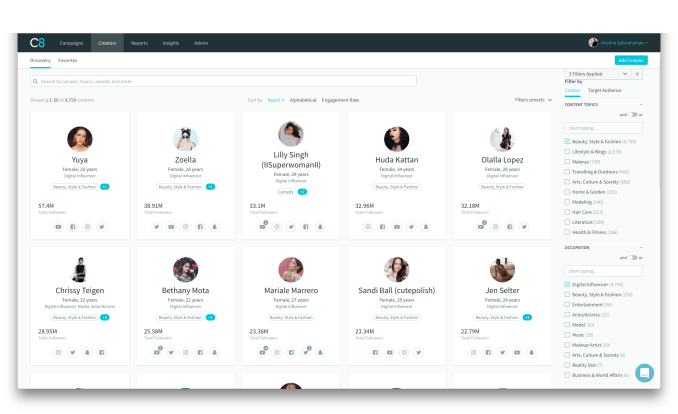
On Captiv8, meanwhile, marketers are apparently spending two hours per day on creator discovery, saving them 60 percent of the time they would have spent on the process.
So why make it available for free? While brands like Dr Pepper, Snapple, StubHub and Honda already use Captiv8, Subramanian said the goal is to “widen the funnel,” turning this into “the default place” where marketers go to learn about influencers.
And then, of course, the company can upsell you on Captiv8’s entire “end-to-end SaaS platform,” charging for additional audience data, as well as tools like campaign management, measurement and social listening.
500 Intel drones to replace fireworks above Travis Air Force Base for Fourth of July
The Fourth of July will be a little different tomorrow at Travis Air Force Base in Fairfield, Calif. Instead of fireworks, 500 Intel Shooting Star drones will take to the sky to perform an aerial routine in honor of the holiday and the base’s 75th anniversary.
These are the same drones that preformed at Disney World, the Super Bowl and the Olympics.
One person controls the fleet of drones thanks to a sophisticated control platform that pre-plans the route of each drone. Intel engineers told me that the system can control an unlimited amount of drones. In the version I saw, the drones used GPS to stay in place and the drones lacked any collision detection sensors.
It’s an impressive show of technology. I was in attendance for the first show at Disney World and the drones are a wonderful alternative to fireworks. Sure, fireworks are a Fourth of July tradition, but they can’t do the things these drones can do, plus, because they’re much more quiet, more people can enjoy the show.