Astrophysicists have traced the origin of some of Earth’s cosmic rays to a blazar 4 billion light years away.
Category: Tech news
hacking,system security,protection against hackers,tech-news,gadgets,gaming
Apple MacBook Pro 2018: Price, Specs, Release Date
Apple leans in on the high end of the laptop market, rather than going light and cheap.
How Does NASA Test For Spacecraft Safety? Brutalize a Replica
In Denver, engineers have built an architecturally identical twin for Orion, NASA’s next launch vehicle—and they’re putting it through its paces.
BlackBerry Key2 Review: A Comfy Keyboard and Long Battery Life
This keyboard-packing smartphone is the best kind of throwback. Our full review.
Einride’s T-log Is a Self-Driving Truck Made for the Forest
The Swedish robo-truck ditches the engine for batteries, the human for software, and the container for a big pile of logs.
FCC Retracts a Plan to Discourage Consumer Complaints
A proposal that critics said would have forced consumers to file formal complaints, at a cost of $255, appears to have been dropped from Thursday’s agenda.
Why Nevada’s Execution Drug Cocktail Is So Controversial
A sedative, an opioid, and a paralytic sit at the core of legal and ethical debates over the state-sanctioned killing of death row prisoner Scott Dozier.
Live on ESPN: Will the Overwatch League Usher in Esports’ Crossover Moment?
Thanks to a new agreement, ESPN will be broadcasting esports live in primetime for the first time.
The Engineering Behind Elon Musk’s Bid to Save Thailand’s Cave Boys
The SpaceX and Tesla CEO’s work to help the rescue operation captivated the internet and reinforced the most flattering image of Musk, as a brilliant engineer with a nose for unexpected solutions to pressing problems.
Senators Fear Meltdown and Spectre Disclosure Gave China an Edge
By not informing the US government of two industry-wide hardware flaws, Intel may have inadvertently given ammo to China’s hackers.
Colorful Circuit Cities Built From Motherboards, Processors, and Microchips
Photographer Heiko Hellwig envisions a world made of silicon.
Rats! Coral Reefs Aren’t Getting the Bird Poop They Need
Rat invasions ripple across an island ecosystem into places you’d never expect—including all the way into surrounding coral reefs.
YouTube is fighting fighting fake news with $25M to promote journalism and more context in search results
YouTube announced new measures today to stem the spread of conspiracy theory videos and fake news on its platform, including inserting context from trustworthy sources into search results about hot topics. In a blog post, YouTube also said it is working with the Google News Initiative, which was launched by its parent company earlier this year to support journalists and publishers.
This includes earmarking $25 million in Google News Initiative funding to create a working group of news organizations and media experts that will advise YouTube on new features. Members already include Vox Media, Brazilian radio station Jovem Pan and India Today, with more to be added in the coming weeks. Part of the funding will also be used for grants that will be awarded to news organizations through an application process to help them train staff and build their video production capabilities. The money will also be used on expanding the YouTube team that works with news publishers.
YouTube has been blamed for the proliferation of conspiracy theories about historical topics including the moon landing and news events like the 2016 presidential election and Sandy Hook and Parkland, Florida school shootings, with its search and recommendation algorithms cited in particular for pushing problematic videos to more viewers. In March, YouTube CEO Susan Wojcicki promised new features to make YouTube a more reliable source of information during a South by Southwest panel, stating that “this has been a year of fake news and misinformation and we have seen the importance of delivering information to our users accurately.”
Similar to Facebook’s attempts to fight fake news by adding information about publishers and articles to News Feed, YouTube said it is will add context to search results about breaking news topics to help people quickly see if a video is from a trustworthy source. Search results will also include linked previews of news articles, since journalists usually write about breaking news first before producing more labor-intensive videos, and reminders that information about developing events can change quickly.
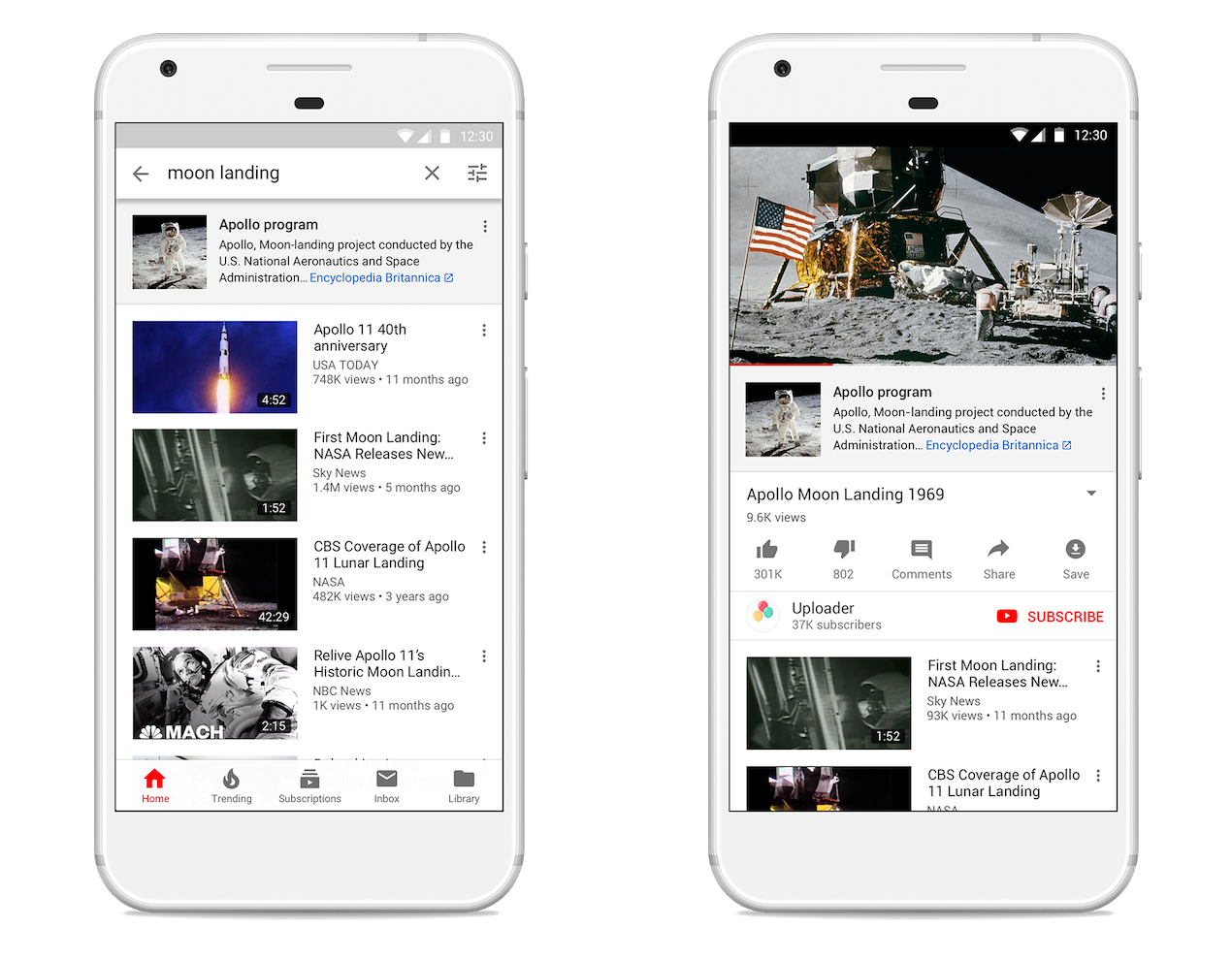
To combat conspiracy theories, YouTube will start displaying information from third-party sources like Wikipedia and Encyclopedia Britannica next to videos about “well-established historical and scientific topics that have often been subject to misinformation,” including the Oklahoma City bombing and the moon landing.
Other new features include ones that will surface local news in the YouTube app for TV screens across 25 American media markets and the addition of Top News and Breaking News shelves (the row of videos users see at the top of their screens) that will highlight videos from news organizations on YouTube’s homepage. The Top News and Breaking News features are already available in 17 countries, including the U.S., the U.K., France, Italy, Japan, India, Mexico, Brazil, South Africa and Nigeria. YouTube says that number will double in the coming months.
The platform is also supporting MediaWise, a non-profit led by the Poynter Institute to help teens develop media and online awareness, and working with six YouTube Creators popular with young audiences, including John Green, Ingrid Nilsen and Mark Watson “to bring awareness to digital literacy and help educate teens.”
Trump’s Supreme Court nominee opposes net neutrality, supports NSA bulk collection
President Trump’s new Supreme Court nominee will face more scrutiny for his ideological leanings around issues like abortion than his thoughts on tech, but we do know a bit about the latter.
On Monday, Trump nominated Brett Kavanaugh to fill the seat that opened when Justice Anthony Kennedy announced his retirement in late June. A list of Trump’s potential picks circulated previously and Kavanaugh was believed to be a frontrunner. Kavanaugh, who previously clerked for Kennedy, was appointed to the Washington D.C. Circuit Court of Appeals in 2003 by former president George W. Bush and eventually confirmed in 2006.
As future digital privacy cases wend their way toward the Supreme Court, Kavanaugh’s stated views on the NSA’s spying program could prove relevant. In 2015, Kavanaugh sided in favor of the NSA’s warrantless bulk collection of phone metadata, issuing strong support for the controversial practice and categorizing its collection as a “special need” that eclipses personal privacy concerns.
In his own words:
“The Government’s collection of telephony metadata from a third party such as a telecommunications service provider is not considered a search under the Fourth Amendment, at least under the Supreme Court’s decision in Smith v. Maryland, 442 U.S. 735 (1979).
… Even if the bulk collection of telephony metadata constitutes a search, cf. United States v. Jones, 132 S. Ct. 945, 954-57 (2012) (Sotomayor, J., concurring), the Fourth Amendment does not bar all searches and seizures. It bars only unreasonable searches and seizures. And the Government’s metadata collection program readily qualifies as reasonable under the Supreme Court’s case law. The Fourth Amendment allows governmental searches and seizures without individualized suspicion when the Government demonstrates a sufficient “special need” – that is, a need beyond the normal need for law enforcement – that outweighs the intrusion on individual liberty. In short, the Government’s program fits comfortably within the Supreme Court precedents applying the special needs doctrine.”
Kavanaugh is also an opponent of net neutrality. In a 2017 dissent, he argued that rules supporting net neutrality impinges on an internet service provider’s “editorial discretion” and therefore violates its First Amendment rights.
“In short, although the briefs and commentary about the net neutrality issue are voluminous, the legal analysis is straightforward: If the Supreme Court’s major rules doctrine means what it says, then the net neutrality rule is unlawful because Congress has not clearly authorized the FCC to issue this major rule. And if the Supreme Court’s Turner Broadcasting decisions mean what they say, then the net neutrality rule is unlawful because the rule impermissibly infringes on the Internet service providers’ editorial discretion. To state the obvious, the Supreme Court could always refine or reconsider the major rules doctrine or its decisions in the Turner Broadcasting cases. But as a lower court, we do not possess that power. Our job is to apply Supreme Court precedent as it stands. For those two alternative and independent reasons, the FCC’s net neutrality regulation is unlawful and must be vacated.”
Kavanaugh, a reliable conservative, also opposes the Consumer Financial Protection Bureau (CFPB) and argued in 2018 that the bureau’s existence is an unconstitutional threat to executive power. In theory, the CFPB advocates for consumer interests in incidents like the Equifax hack, but CFPB supporters argue that the agency has been gutted during the Trump administration at the hands of its acting director, Trump appointee Mick Mulvaney.
Broadly, Kavanaugh looks like a friend to big business and an enemy to digital privacy advocates, though we’ll likely learn more of his record as he moves forward in the sure to be controversial confirmation process.
This is Microsoft’s $399 Surface Go
Microsoft dropped a pretty clear hint about this big news. After all, the latest addition to the Surface line has been over the past couple of months the subject of everything from early rumors to FCC approval to spec sheet leaks. And for the most part, the rumors were spot-on.
This is the Microsoft Surface Go. It represents the low end of the Surface line. The $399 starting price puts it well below the Surface Pro’s $799. More to the point, really, it puts the product firmly within spitting distance of the $329 9.7-inch iPad. Surface has long been an entirely different class, focused on creative professionals, with higher-end specs and peripherals, putting it more in line with the iPad Pro, perhaps.
The Surface Go is meant to be a kind of halfway point between the standard tablet and the convertible. Spec sacrifices were made in order to hit that price point, of course — though for most users the size is probably the most notable. That said, the 10-inch display might actually amount to a benefit, depending on what you’re looking for in a device.
When I met with the company, they pulled it out of a purse to make the big reveal. That depends on, among other things, how big your purse is, of course. For those still holding out hope for something akin to a Surface Phone, however, well, keep holding. The 1.15-pound Go may be the thinnest Surface yet, but a phone it ain’t.
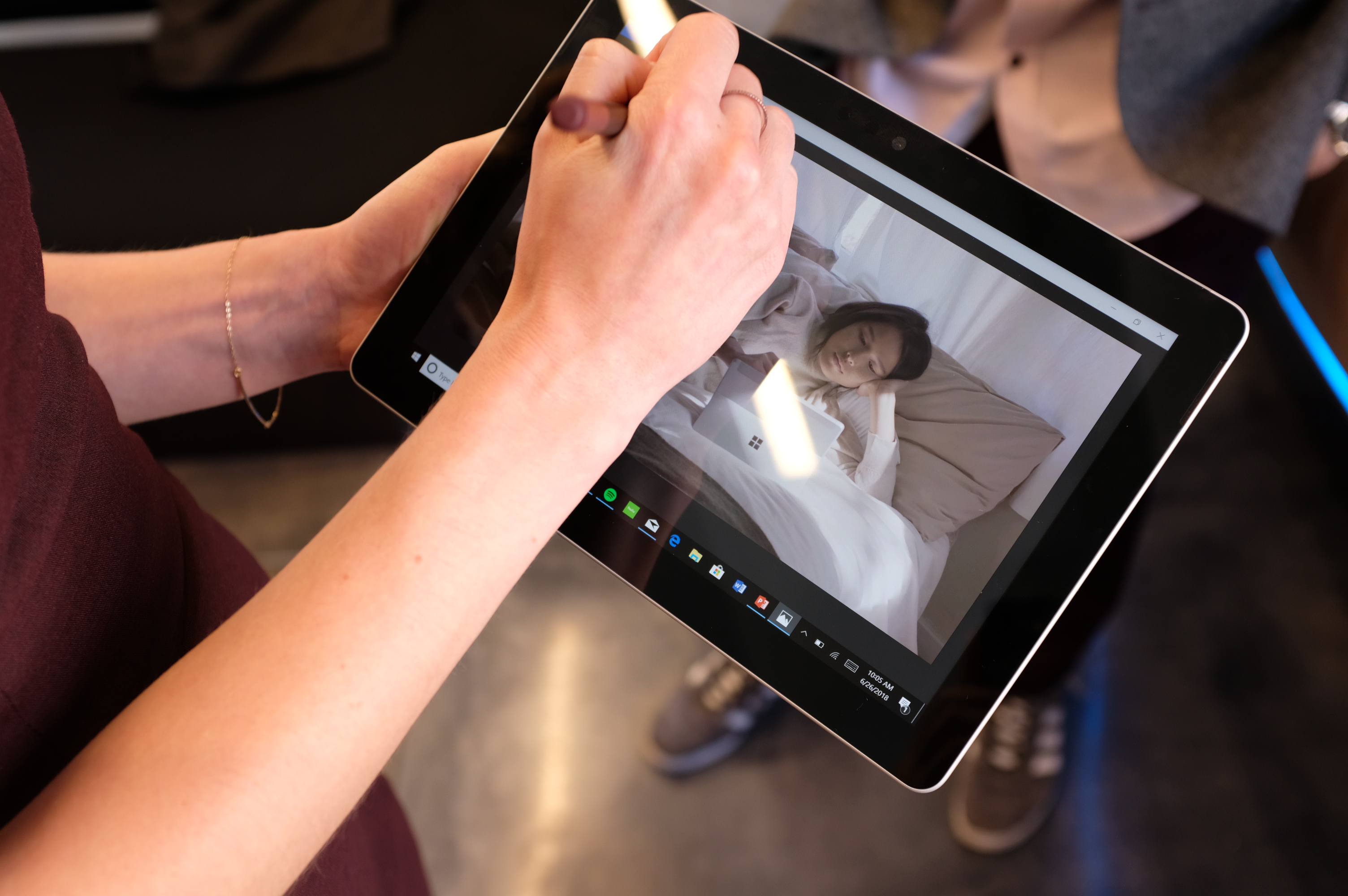
As for the target demo, well, Microsoft clearly believes it’s just about everyone. For those who are already locked in to the ecosystem, there’s something to be said for getting the full suite of apps on a smaller but still relatively premium piece of hardware that includes 4GB/8GB of RAM and 128GB/256GB of storage. There also are some familiar software touches, like Windows Hello facial recognition for log-in.
Like the iPad itself, however, I probably wouldn’t recommend the thing for those looking to do a lot of typing or other office work. There are plenty of cheap Windows laptops that will do the trick. Remember those $189 Chromebook competitors the company announced last year?
The combination of the Go keyboard case and the smaller footprint means it won’t be ideal for typing. And while a Microsoft rep attempted to convince me that it’s possible to actually use it on one’s lap, let’s just say that it’s less than ideal. A plane’s seat-back tray table, on the other hand, is a pretty solid application. And the nine hours of battery life should get you through most flights. Of course, the keyboard case isn’t bundled with the Surface just yet, so that will raise the price another $99.
One of the more interesting tidbits here: The proprietary Surface port is still here. That flies in the face of some of the early rumors and the larger trend toward USB-C-only charging. USB-C can still be used to charge, but the company tells me they wanted to keep the Surface Connect on board for legacy reasons. A lot of people are on their second or third Surface already, and some are apparently doubling up on devices.
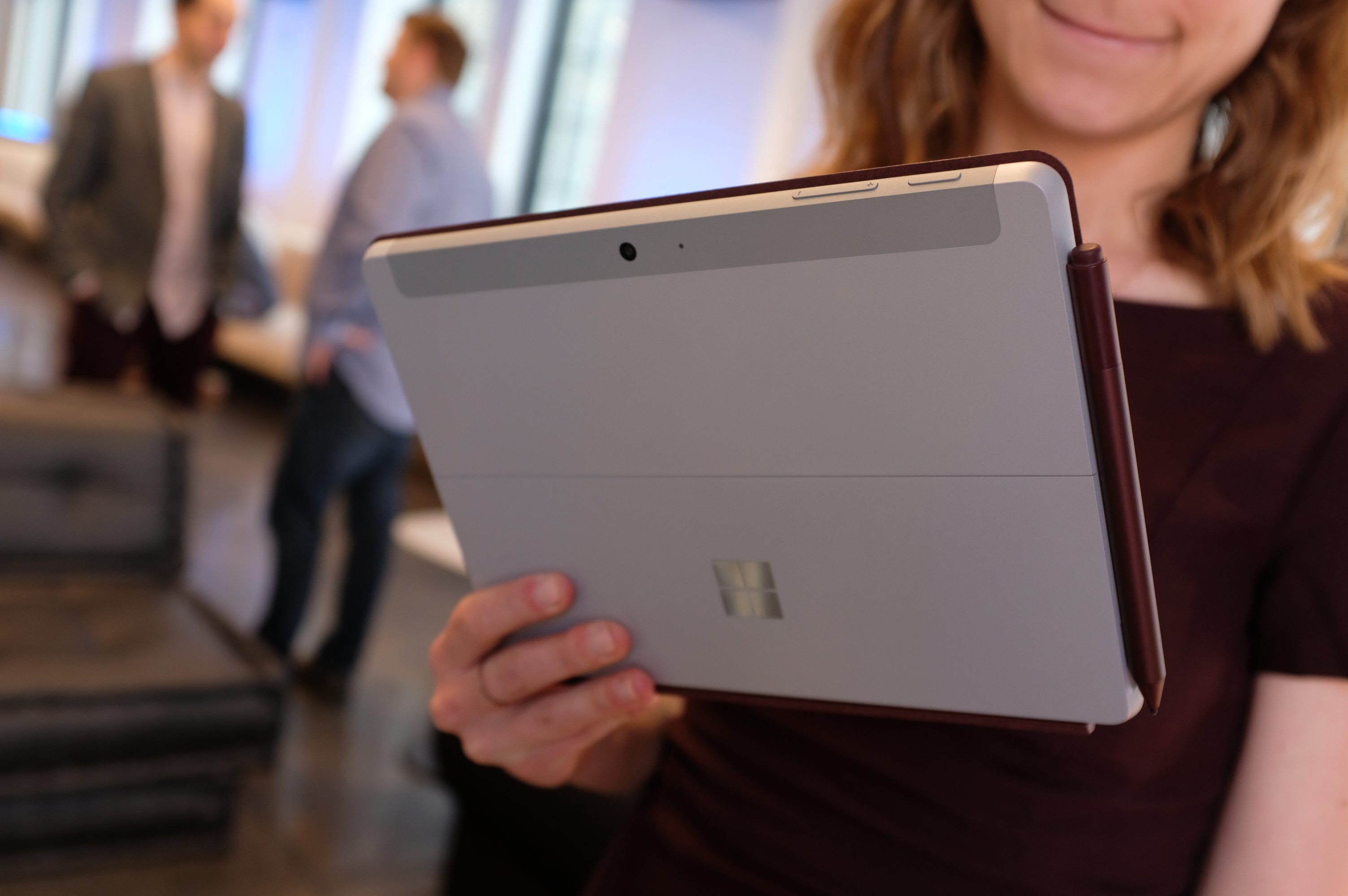
The Surface Go arrives August 6, sporting Windows 10 S — a pretty clear indication that the company is also heavily targeting education here. Again, the price point will likely be a deal killer for public schools, though perhaps those who have the funds for an iPad per student will welcome the competition.
For the rest of us who aren’t interested in the limitations of 10 S, users can upgrade to the standard version of the operating with a “one-time switch.”