Ransomware technique uses your real passwords to trick you

A few folks have reported a new ransomware technique that preys upon corporate inability to keep passwords safe. The notes – which are usually aimed at instilling fear – are simple: the hacker says “I know that your password is X. Give me a bitcoin and I won’t blackmail you.”

Programmer Can Duruk reported getting the email today.

Woah. This is cool. A Bitcoin ransom with using what I think is passwords from a big leak. Pretty neat since people would be legit scared when they see their password. The concealed part is actually an old password I used to use. pic.twitter.com/clEYiFqvHY

— can (@can) July 11, 2018

The email reads:

I’m aware that X is your password.

You don’t know me and you’re thinking why you received this e mail, right?

Well, I actually placed a malware on the porn website and guess what, you visited this web site to have fun (you know what I mean). While you were watching the video, your web browser acted as a RDP (Remote Desktop) and a keylogger which provided me access to your display screen and webcam. Right after that, my software gathered all your contacts from your Messenger, Facebook account, and email account.

What exactly did I do?

I made a split-screen video. First part recorded the video you were viewing (you’ve got a fine taste haha), and next part recorded your webcam (Yep! It’s you doing nasty things!).

What should you do?

Well, I believe, $1400 is a fair price for our little secret. You’ll make the payment via Bitcoin to the below address (if you don’t know this, search “how to buy bitcoin” in Google) .

BTC Address: 1Dvd7Wb72JBTbAcfTrxSJCZZuf4tsT8V72
(It is cAsE sensitive, so copy and paste it)

Important:

You have 24 hours in order to make the payment. (I have an unique pixel within this email message, and right now I know that you have read this email). If I don’t get the payment, I will send your video to all of your contacts including relatives, coworkers, and so forth. Nonetheless, if I do get paid, I will erase the video immidiately. If you want evidence, reply with “Yes!” and I will send your video recording to your 5 friends. This is a non-negotiable offer, so don’t waste my time and yours by replying to this email.

To be clear there is very little possibility that anyone has video of you cranking it unless, of course, you video yourself cranking it. Further, this is almost always a scam. That said, the fact that the hackers are able to supply your real passwords – most probably gleaned from the multiple corporate break-ins that have happened over the past few years – is a clever change to the traditional cyber-blackmail methodology.

Luckily, the hackers don’t have current passwords.

“However, all three recipients said the password was close to ten years old, and that none of the passwords cited in the sextortion email they received had been used anytime on their current computers,” wrote researcher Brian Krebs. In short, the password files the hackers have are very old and outdated.

To keep yourself safe, however, cover your webcam when not in use and change your passwords regularly. While difficult, there is nothing else that can keep you safer than you already are if you use two-factor authentication and secure logins.
As product development incorporates more feedback, development toolkit productboard raises $8M

Since its debut on the TechCrunch Disrupt stage in September 2016, demand for a service like productboard, which gives companies a holistic view of product development and encourages input from across an organization, has only gotten more acute, according to company chief executive Hubert Palan.

Now, with an $8 million commitment from Kleiner Perkins Caufield & Byers, with participation from Index Ventures, Credo Ventures, Reflex Capital and Rockaway Capital, alongside a host of angel investors, the company is looking to expand its sales and marketing and product development efforts to bring the benefits of its toolkit to more companies.

In the two years since TechCrunch last saw productboard, the company’s user base has grown significantly, from 100 customers in 2016 to more than 1,200 companies today, spanning a broad range of industries.

For Palan, the company’s growing user base (which now includes medical device companies, academic publishers and news organizations in addition to traditional digital product developers) is proof of a new demand in the market for more inputs around product design and development.

“Every company is now a digital company,” Palan said. “So every company needs to worry about digital product design.”

The company’s toolkit still includes features that allow it to hoover up information from customer support tickets, emails, input from sales teams and user research, to organize and prioritize features that need to be built.

But now, the company’s services allow anyone in an organization (with the proper access) to provide feedback and track the process of product development.

“Product Excellence is no longer optional,” said Palan in a statement. “These days competitors arise in a matter of months, not years. Customer loyalty is declining and users will happily switch to a competing solution that offers a better product experience. It’s more critical than ever to get the right products to market faster.”

As part of the financing, Kleiner Perkins’ new general partner, Ilya Fushman, will join the company’s board of directors. Fushman, who was integral in locking down productboard’s seed financing when he was at Index Ventures, has a long product history from his time at Dropbox, and is a welcome addition to the company’s board, Palan said.

While Fushman’s imprimatur is one sign of the company’s viability, the investment from strategic angel investors like Intercom co-founders Eoghan McCabe and Des Traynor; Clark Valberg, the co-founder of InVision; and Larry Gadea, the founder of Envoy, is still another.

“Product management is a core function in every technology organization, but few dedicated tools exist for it,” said Fushman, in a statement. 

Intel acquires eASIC to take its chipsets deeper into IoT and other future technologies

In the wake of Broadcom failing to complete its takeover of Qualcomm, Intel is buying another chip company as it works on adjusting its own its business to fit the next generation of computing. Today, the company is announcing that it is acquiring eASIC, a fabless semiconductor company that makes customisable eASIC chips for use in wireless and cloud environments.

Financial terms of the deal are not being disclosed, as the price paid will not be material to Intel. eASIC has 120 employees, was founded in 1999 and has counted Khosla, Kleiner Perkins and Seagate among its investors, raising $149 million in total. It had been recapitalised in 2012 and so, in its last round, in November 2017, it was valued at around $110 million post-money, according to PitchBook, to give you a basic idea of a possible pricing ballpark.

eASIC’s technology and team will become a part of Intel’s Programmable Solutions Group (PSG), which Intel created after it acquired Altera in 2015 for $16.7 billion. Altera is a producer of FPGA chips, and the idea will be to complement those with eASIC’s technology, said Dan McNamara, corporate vice president and GM of the PSG division:

“We’re seeing the largest adoption of FPGA ever because of explosion of data and cloud services, and we think this will give us a lot of differentiation versus the likes of Xilinx,” which is one of Intel’s biggest competitors in FPGA. “We’ll be able to offer an end-to-end lifecycle that fits today’s changing workloads and infrastructure. No one on the marketplace will have this.” FPGA designs allow companies to quickly modify chip architectures, but they also require a lot of power. eASIC chips are more efficient, and they can be configured quickly from the outset (but cannot be modified).

The idea will be to offer eASIC as a transition to customers of Intel’s (and its competitors) who are already using FPGA and looking for a migration to the next thing. Applications that might need eASIC power could range from baseband and radio heads in 4G and 5G networks as well as applications based in the cloud that require heavy data computations, for example AI and video services, or financial risk analysis.

Intel and eASIC have actually been working together since 2015, when the latter company started to provide its flavor of ASIC designs to Intel for its Xeon chips. McNamara confirmed that Intel never invested in eASIC but it had considered the idea “multiple” times, including recently, instead of acquiring. 

However, ultimately, owning the company outright made more sense for both sides, he said.

“Strategic partnerships are good but a combination much better,” he said, “because it brings the investment capability to the next node. When you are privately held and venture-backed you can be challenged by the investment needed for the next phase of innovation.” He also noted the “key talent” and IP — including multiple patents — that Intel will be getting in the deal.

eASIC itself has felt the pinch of being a smaller chip company: it tried to file to go public in 2015 to raise $75 million but cancelled its IPO at a time when the public markets were freezing up for listings of startups. Its move to Intel is part of what’s been a long-term consolidation in the chip industry, which gets more value out of economies of scale and selling end-to-end services to larger customers.

“The eASIC team has developed and deployed a truly innovative structured ASIC product. The marriage of the eASIC technology with IP and capabilities of Intel will allow the ubiquitous deployment of this proven structured ASIC product into a wide breadth of exciting end applications and markets. This is the perfect time to usher in this new chapter for eASIC,” said Ronnie Vasishta, president and CEO of eASIC, in a statement.

While many in the technology and communications industries believe that areas like the Internet of Things and 5G — and the infrastructure, hardware and related services powering them — will be huge businesses, today they remain relatively small. In Intel’s most recent quarterly earnings reported in April, PSG had revenues of $498 million — up 17 percent on a year ago but still the smallest division within the company’s data-centric business units. As a point of comparison, Intel’s PC-centric Client Computing Division made $8.2 billion. But CCG only grew three percent over a year ago, and that stagnation and slowdown in Intel’s business is one reason why it needs to buy companies like eASIC and focus on future technologies.

eASIC’s customers include a number of vendors that work in the communications industry, including Huawei, NEC, Violin Memory, Seagate, Microsoft, Flir Systems and Arm. After it added a longtime Apple vet to its board several years ago, it was speculated that Apple might also have a tie to the company, although that has never been confirmed.

The deal comes at a key time for Intel, which in addition to its over-reliance on revenues from its legacy business, has been facing delays on the production of 10nm chips, and then unexpectedly lost its CEO Brian Krzanich in June when he resigned over inappropriate behavior. But Robert Swan is in the role now on an interim basis, and McNamara says the company is going full-steam ahead on its previous strategy.

“The executive team is fully focused on the execution of our strategy and this is a good example of it,” he said.

Microsoft launches new wide-area networking options for Azure

Microsoft is launching a few new networking features today that will make it easier for businesses to use the company’s Azure cloud to securely connect their own offices and infrastructure using Azure and its global network.

The first of these is the Azure Virtual WAN service, which allows businesses to connect their various branches to and through Azure. This basically works like an airline hub and spoke model, where Azure becomes the central hub through which all data between branches flows. The advantage of this, Microsoft argues, is that it allows admins to manage their wide-area networks from a central dashboard and, of course, that it makes it easy to bind additional Azure services and appliances to the network. And with that, users also get access to all of the security services that Azure has to offer.

One new security service that Microsoft is launching today is the Azure Firewall, a new cloud-native security service that is meant to protect a business’s virtual network resources.

In addition to these two new networking features, Microsoft also today announced that it is expanding to two new regions its Azure Data Box service, which is basically Microsoft’s version of the AWS Snowball appliances for moving data into the cloud by loading it onto a shippable appliance: Europe and the United Kingdom (and let’s not argue about the fact that the U.K. is still part of Europe). There is also now a “Data Box Disk” option for those who don’t need to move petabytes of data. Orders with up to five of those disks can hold up to 40 terabytes of data and are currently in preview.

Microsoft speeds up its Azure SQL Data Warehouse

Microsoft’s Azure SQL Data Warehouse, the company’s cloud-based database service for big data workloads, is getting yet another speed bump today. A few months ago, the company sped up the service with the general availability of its second-generation compute-optimized tier and today it’s doubling its query performance thanks to the launch of its new instant data movement technology.

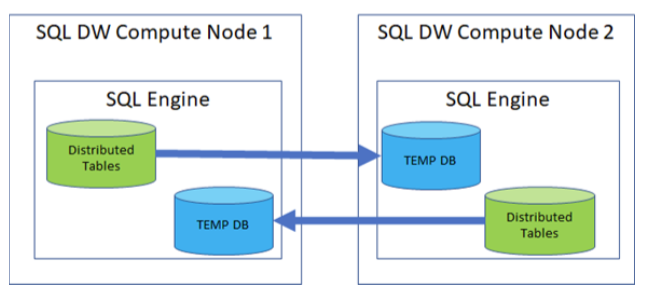
Raghu Ramakrishnan, Microsoft’s CTO for Azure Data, tells me that instant data movement is the result of the company’s decades-long investments in database technology. “Given the fact that we’ve been doing data management for decades now, we can marry data storage and management,” he noted and stressed that I/O bandwidth tends to be a major bottleneck for many of the analytics workloads that Microsoft’s customers use SQL Data Warehouse for. In a distributed system like a data warehouse, moving data becomes a problem — one that is typically managed by yet another layer in the system. “In these systems, when you take simple standard operations like joins, if the tables are not already nicely organized by an attribute, you have to sort on one or the other, so you have to move data across the network at a rapid clip, Ramakrishnan said.

To do away with this bottleneck, Microsoft has now integrated the data movement layer right into the SQL Server engine that powers its data warehousing service. Thanks to this, every SQL Server node can now create intermediary results and move the data as necessary.

Never shy to compare its services to its competitors, Microsoft also notes that Azure SQL Data Warehouse can support up to 128 concurrent queries now, compared to the 50 that Amazon Redshift is currently limited to.

Microsoft wants to make you a better team player by nudging you into submission

Microsoft announced a number of new tools for its MyAnalytics tool for Office 365 users today that are geared toward giving employees more data about how they work, as well as ways to improve how teams work together. In today’s businesses, everybody has to be a team player, after all, and if you want to bring technology to bear on this, you first need data — and once you have data, you can go into full-on analytics mode and maybe even throw in a smidge of machine learning, too.

So today, Microsoft is launching two new products: Workplace Analytics and MyAnalytics nudges. Yes, Office 365 will now nudge you to be a better team player. “Building better teams starts with transparent, data-driven dialog—but no one is perfect and sticking to good collaboration habits can be challenging in a fast-paced job,” Microsoft’s Natalie McCullough and Noelle Beaujon, using language only an MBA could love, write in today’s announcement.

I’m not sure what exactly that means or whether I have good collaboration habits or not, but in practice, Office 365 can now nudge you when you need more focus time as your calendar fills up, for example. You can block off those times without leaving your Inbox (or, I guess, you could always ignore this and just set up a standing block of time every day where you don’t accept meetings and just do your job…). MyAnalytics can also now nudge you to delegate meetings to a co-worker when your schedule is busy (because your co-workers aren’t busy and will love you for putting more meetings on your calendar) and tell you to avoid after-hours emails as you draft them to co-workers so they don’t have to work after hours, too (that’s actually smart, but may not work well in every company).

With this new feature, Microsoft is also using some machine learning smarts, of course. MyAnalytics was already able to remind you of tasks you promised to co-workers over email, and now it’ll nudge you when you read new emails from those co-workers, too. Because the more you get nudged, the more likely you are to finish that annoying task you never intended to do but promised your co-worker you would do so he’d go away.

If you’re whole team needs some nudging, Microsoft will also allow the group to enroll in a change program and provide you with lots of data about how you are changing. And if that doesn’t work, you can always set up a few meetings to discuss what’s going wrong.

These new features will roll out this summer. Get ready to be nudged.

Microsoft Teams gets a free version

Microsoft opened up the news floodgates this morning, in the kick off to its annual Inspire event in Vegas. One of the more compelling announcements of the bunch is the addition of a free version of Teams.

The Slack competitor has been kicking around in some form or other since late-2016, but the $60 a year fee has likely made it a bit of a nonstarter for smaller businesses. After all, it’s Slack’s free tier that helped the work chat app gain so much traction so quickly. A free version makes a lot of sense for Microsoft.

Signing users up for Teams is way to get more feet into the door of its application ecosystem, which was once ubiquitous in offices. Once they’ve download teams, workplaces will be hooked into the Microsoft 365 suite.

The free tier actually brings a fair bit of the app to up to 300 people per workplace. Here’s the full rundown of features per Microsoft,

  • Unlimited chat messages and search.
  • Built-in audio and video calling for individuals, groups, and full team meetups.
  • 10 GB of team file storage plus additional 2 GB per person for personal storage.
  • Integrated, real-time content creation with Office Online apps, including built-in Word, Excel, PowerPoint, and OneNote.
  • Unlimited app integrations with 140+ business apps to choose from—including Adobe, Evernote, and Trello.
  • Ability to communicate and collaborate with anyone inside or outside your organization, backed by Microsoft’s secure, global infrastructure.

The company’s done a good job hooking in enterprise customers, but as it notes, SMBs constitute 90+ percent of businesses globally, so that’s a whole lot more devices to tap into. The free tier is available in 40 languages starting today.

Microsoft Whiteboard is available to all on Windows, iOS version coming soon

Microsoft previewed White Board last May, alongside the new Surface Pro, eventually rolling it out in public beta in December. The collaboration app just went live to all Windows users, as part of the deluge of announcements tied to the upcoming Inspire conference.

Whiteboard is kind of digital sibling to Microsoft’s large Surface Hub display. The company describes it as an “infinite canvas,” in a phrase cribbed from comics theorist, Scott McCloud. With the drawing app, users can sketch out notes and images with a finger, keyboard or compatible pen.

The app lets teams collaborate remotely, automatically uploading the final project to the cloud. The company says it’s also added a bunch of new features based on feedback during the beta, including, “text notes, the ability to add and manipulate images, enhancements to shape and table recognition, accessibility improvements, compliance with various global standards, and more.”

In addition to Windows availability, it will also be arriving on iOS and as a browser based version some time in the near future.

Turo files lawsuit against Los Angeles in car-sharing battle at LAX

Peer-to-peer car-sharing marketplace Turo has filed a lawsuit against the city of Los Angeles Airport in a preemptive strike aimed at defending the ability of its users to rent out their personal cars at Los Angeles International Airport.

Turo filed the lawsuit Thursday in the U.S. Central District Court of California in Los Angeles. The city is not able to comment on ongoing litigation, Alex Comisar, press secretary for LA Mayor Eric Garcetti said.

Turo contends in its lawsuit that LAX has misclassified its peer-to-peer car-sharing platform as a rental car company. Turo argues that California’s car-sharing law is clear and notes that it doesn’t own or operate a fleet of vehicles or use the airport’s facilities that traditional rental car companies do.

“Due to this misclassification, the airport expects Turo to obtain a rental car company permit and expects our community to pay anti-competitive fees whenever they choose to exchange cars at or near LAX,” Turo Chief Legal Officer Michelle Fang told TechCrunch. “We’ve seen firsthand how rental car giants Enterprise Rent-a-Car have prodded airports across the country, including LAX, to attack our community, including our users’ rights to choose transportation options other than rental cars and to share their own cars to supplement their income.”

Fang said LAX has repeatedly refused to even come to the table despite efforts to negotiate.

Turo says in the lawsuit that it has reached out to LAX officials in an effort to develop an appropriate fee structure. The company is open to paying a fee that is in line with how ride-hailing companies are charged.

“The fees need to be proportionate for the way that the ground transportation is being used,” Fang said, adding that rental car companies need parking lots and shuttles and other infrastructure at airports. “The use to LAX is much more comparable to TNCs and limos and taxis than it is to rental cars.”

The company decided to take action after it viewed email messages between the car rental company Enterprise Holdings and city officials that discussed an impending lawsuit against Turo. Enterprise has yet to respond to a request for comment on the lawsuit.

The lawsuit against Los Angeles marks further escalation of a battle between Turo and established car rental companies that aim to protect their domains.

Earlier this year, San Francisco sued Turo for allegedly ignoring fee requirements and other rules at San Francisco International Airport. The city’s lawsuit argued that Turo’s users have added to airport traffic congestion and that its operation at the airport without paying fees gives it an unfair advantage against competitors.

Turo countersued San Francisco, saying the city was trying to classify it as a traditional rental car company.

Turo closed a $104 million Series D round in April. The company has raised $205 million to date. 

Brexit means blockchains, lots and lots of blockchains

Does Brexit mean blockchain? The UK government has published a whitepaper — some two years in the baking — where it sets out its fuzzy thinking in an attempt to move beyond two years of Brexit fudge by squashing its warring factions behind a compromise customs arrangement to try to live up to its promise of a “future relationship with the European Union”, i.e. without lashings of fudge.

Unfortunately though, for citizen sanity, business reality, and, well, anyone not happy gambling everything on fantastically functional systems that don’t exist yet, it’s still leaning heavily on undefined technological solutions to try to make its alternative customs arrangement fly. (Or, more realistically, limp towards another accusation of magical thinking by the EU.)

Instead of the current Customs Union, which the UK is part of as a member of the EU, the government is proposing entering into what it calls a “facilitated customs arrangement” (FCA) with the EU — which it wants to cover goods (services would not be included in this arrangement).

It fondly imagines this FCA would “remove the need for customs checks and controls between the UK and the EU as if in a combined customs territory, while enabling the UK to control tariffs for its own trade with the rest of the world and ensure businesses pay the right tariff”.

So, in other words, this is the desperately sought for ‘frictionless’ Brexit border outside the Custom Unions — in order that the UK can go around the world trying to strike its own trade deals (which it cannot do if it stays inside the EU’s Customs Union).  

The UK plan to circle this square is for it to apply tariffs on all imported goods at the border, rather than EU tariffs — but then track the goods and, if they subsequently get sent to the EU, apply the EU tariff — and send the money where it’s then due (i.e. to the EU). Honest! 

Which raises the obvious question of how goods will be effectively tracked in order for tariffs to be correctly calculated and/or remitted.

The risk of customs fraud draining EU (and/or indeed UK) coffers via a badly implemented version of this arrangement, or probably just by this arrangement, is clear.

“The UK recognises that the rules and processes governing eligibility for repayment, including risk profiling and effectively targeted audit and assurance activity, must be sufficiently robust to ensure the mechanism cannot be used to improperly evade EU or UK tariffs and duties, through methods such as re-exporting of goods from the UK to the EU, or vice versa,” the government itself admits in the whitepaper.

Meanwhile, there’s no suggestion that EU negotiators have any intention of accepting its proposal. Even though it took the UK two years to come up with. But here we all still are. (Well, minus a few cabinet ministers.)

The UK’s great white hope is that cutting-edge technologies will save the day. Along with it agreeing to abide by a “common rule book” and the Union Customs Code.

But of course just saying you have a rulebook and not checking and enforcing those rules isn’t any good at all, as Facebook has been finding out lately.

And so technology.

The whitepaper specifically mentions the possibility of “exploring how machine learning and artificial intelligence could allow traders to automate the collection and submission of data required for customs declarations” — i.e. to try to streamline the repayment mechanism that this FCA idea demands.

It's alright guys, they're going to use artificial intelligence to sort it out. No need to worry. pic.twitter.com/FyBQ2Og3LB

— Ian Dunt (@IanDunt) July 12, 2018

But the whitepaper’s suggestive techno-solutioneering goes further — describing something that sounds suspiciously like a blockchain.

Or, actually, lots and lots and lots of blockchains. Implying that, at the very margins of ministerial thought processes, someone, somewhere in Whitehall is dreaming that Brexit means blockchain, all the way down.

The buzzword is not explicitly mentioned in the government’s whitepaper. But what else could a secure, shareable “chain of transactions” be referring to… ?

It writes:

This could also include exploring how allowing data sharing across borders, including potentially the storing of the entire chain of transactions for each goods consignment, while enabling that data to be shared securely between traders and across relevant government departments, could  reduce the need for repeated input of the same data, and help to combat import and export fraud.

So there you have it. Brexit could mean blockchains at the border, immutably ledgering every little thing that passes into and out of the UK, forever and ever, until crypto amen.

Assuming, that is, the goverment’s FCA idea doesn’t get slung back towards the English Channel stat by an immutable EU.

But as we wait for probable rejection of the latest Brexit hash, are there any crypto startups out there who reckon they have what it takes to put Brexit on the blockchain?

We’re all ears. Ideas in the comments pls. We’ll fwd anything that sounds even a satoshi baked straight to DExEU — because they’re clearly in need of every little bit and byte of help they can get to try and make something — anything, please! — stick.

Alternatively, perhaps this is a job for Elon Musk? We hear he’s good at making stuff that can pass through incredibly bounded and contorted spaces. And Brexit most definitely means that.

You can now trade Litecoin and Bitcoin Cash on Robinhood Crypto

Fintech startup Robinhood is expanding its cryptocurrency trading product with two new token listings. Users in selected states can now trade Litecoin and Bitcoin Cash from the app.

Robinhood is currently providing one of the easiest ways to get started with cryptocurrencies. You can download the app, upload some money and buy tokens in just a few minutes.

But there are a few caveats. First, Robinhood is only available in the U.S. if you want to trade stocks, ETFs and options. And if you’re interesting Robinhood Crypto more specifically, it is only available in 17 states.

Robinhood also claims that there’s no fee on cryptocurrency trading. Given the liquidity of cryptocurrency exchanges, there’s always some spread. It means that if you buy one bitcoin and if you sell one bitcoin, there will be a tiny gap between those two prices because of the tiny order book. Saying that there’s no fee is misleading.

The startup doesn’t operate an exchange itself. It acts as a broker with other exchanges. That’s why it doesn’t make sense to say that Robinhood is going to kill Coinbase. Robinhood is most likely partnering with Coinbase behind the scene as one of its exchanges for instance. On a user experience level, Robinhood Crypto competes with Coinbase’s main product and Circle Invest.

The company has created a second company that doesn’t comply with the same regulatory framework because it’s not a broker dealer. You can currently trade Bitcoin, Ethereum, Litecoin, and Bitcoin Cash.

Unfortunately, Robinhood doesn’t let you manage your wallet addresses. It means that you can’t send or receive tokens from another wallet. You have to convert to fiat currency first. But it’s still a dead simple way to get started on this market.

Announcing the TC Top Picks for Disrupt SF 2018

When we put out the call for early-stage startups to apply to be a TC Top Pick at Disrupt San Francisco 2018, which takes place September 5-7, we knew we were in for something good. But crikey! The competition was fierce, and narrowing the field to a cohort of 60 startups was no easy task. Fortunately, we love a challenge, and our work here is done. Read on to find the list of winners and what they receive.

TC Top Picks is our latest way to shine a spotlight on amazing pre-Series A startup founders. We carefully reviewed and vetted each application and chose only five startups from each of these categories: AI, AR/VR, Blockchain, Biotech/Healthtech, Fintech, Gaming, Privacy/Security, Space, Mobility, Retail or Robotics/IoT/Hardware.

These TC Top Pick founders have won a free Startup Alley Exhibitor Package, which includes a one-day exhibit space in Startup Alley, three Founder passes (good for all three days of the show), use of CrunchMatch — our investor-to-startup matching platform — and access to the Disrupt SF 2018 press list. They also will receive a three-minute interview on the Showcase Stage with a TechCrunch editor — and we’ll promote that video across our social media platforms.

Without further ado, here are our TC Top Picks for Disrupt SF 2018.

AI

  • Jack Automation Technologies: A conversational platform for automated messaging and voice experiences with tenants/residents for all property types and portfolio sizes.
  • ConserWater Technologies: AI to grow more plants or crops with fewer resources.
  • Rosey: A web platform that automatically grades freely written text for teachers and provides meaningful feedback to students.
  • Vence: Reinventing livestock management. An invisible fence/Fitbit for livestock, which eliminates costs and increases profits for customers.
  • 3DLOOK: Develops the most advanced mobile body scanning tech for apparel brands and e-commerce and retail.

AR/VR

  • COZYO: An interior design technology for e-commerce optimization.
  • KeepEyeOnBall: Virtual reality and virtual 360º tours software development.
  • ORBI Inc.: Specializes in developing innovative 360° imaging technology that captures life’s best moments.
  • Skrite Labs: A sky-based augmented reality platform.

Blockchain

  • Airfox: Offers a free Android app to extend critical financial services to billions of unbanked and underbanked people in emerging markets around the globe.
  • Zeehaus: Real estate marketplace with equity sharing fractional ownership.
  • Omega Grid: A peer-to-peer blockchain energy platform for utilities.
  • Humaniq: A London-based fintech firm that provides next-generation financial services using its blockchain-based mobile application.
  • LifeBank Technology and Logistics Services: A platform that makes blood available when and where it is needed in Nigeria to save lives.

Biotech & Health

  • Slighter: A smart device with cutting-edge smart technology that helps you master your smoking habit and reduce cigarette consumption.
  • Listen Longer: Track personal sound exposure in your ear for safe, lifelong enjoyment of your music.
  • Actijoy: A sophisticated system for monitoring doggy’s activity, health, rest and water and food intake.
  • Circadia Technologies: Wireless sleep sensor and personalized sleep coach to improve your sleep, mood and energy.
  • Virtue: An award-winning startup that applies the research-proven benefits of virtual reality to improve mental wellness.

Fintech

  • ID R&D: Developer of biometric authentication for conversational interface (voice, behavioral).
  • Oxygen: Banking and lending for the massive gig economy.
  • Mount Wish: Fully automated mutual insurance for FICC risks (Fixed Income, Currencies, Commodities) and digital CIB front office.
  • SimbaPay: A mobile application that offers money transfer services to its users.

Gaming

  • SportsMe: Turn sports fandom into a mobile video game.
  • Storyball: A screenless gaming console that keeps children active, playful and engaged.
  • Sonder Design: Infinite possibilities at your fingertips, with the world’s first E Ink keyboard. 

Privacy/Security

  • Carbn: A developer of data and privacy management software for business customers.
  • Openpath: An access control system that grants entry to locations.
  • UATAG: Unique authentication tag for product originality verification and counterfeit protection.

Space

  • Audacy: A space communications service provider.
  • Infostellar: A satellite antenna sharing platform.

Mobility

  • Cargofy: Virtual AI-assistant for owner-operators.
  • Einride: A cargo and freight company that designs and builds technologies for transportation systems.
  • Toposens: Builds robust, ultra-low power and low-cost 3D ultrasound and radar sensors for smart buildings and autonomous vehicles.
  • Caaresys: An Israeli startup that develops a vehicle passenger monitoring system based on contactless low-emission radio frequency radar.
  • Rideshare Sellers: In-vehicle headrest advertisement delivery system for rideshare.

Retail

  • GreenSTOP: An ancillary cannabis technology company that utilizes hardware and software to automate the retail cannabis industry.
  • Garbi: A smart trash can that can recognize anything you throw away and reorder it with the tap of a button.
  • Eazyloop Express: A platform that delivers packages from the USA to Ghana.
  • Resonado: Introduces patented audio hardware that enables essential solutions to the sound experience.
  • SmartBins: Promotes shopper traffic to the bulk aisle boosting high-margin bulk sales.

Robotics, Hardware and IoT

  • Cedar Robotics: Revolutionizing the restaurant industry with menu digitization, cloud infrastructure and robotics.
  • Robotic Materials: Materials that make robots smart.
  • Orby: Flying robots for your business.
  • Livin: Creating products and services that improve people’s lives where they use water.
  • Mitte: The world’s first smart water system that unites water purification with enhancement.

If you missed out on applying to be a TC Top Pick and exhibiting for free, it’s not too late to buy a Startup Alley Exhibitor Package and showcase your startup alongside 1,200+ companies and sponsors in Startup Alley. Exhibiting makes sense for early-stage founders, but don’t just take our word for it. Luke Heron, the CEO of TestCard.com, had this to say following his Startup Alley experience:

If you’re a startup or an entrepreneur, exhibiting at Disrupt is a no-brainer.

Disrupt San Francisco 2018 takes place September 5-7 at Moscone Center West. Come join us and discover new opportunities. We can’t wait to see you there!

FCC looks to revamp children’s media rules, but advocates cry foul

One of the FCC’s many jobs as a media regulator is to make sure there is adequate time being dedicated by broadcasters to educational content for kids. As the media landscape changes, however, so too should the regulations — and the FCC is looking to update its “Kid Vid” rules for the 21st century. But the agency’s proposal is half-baked, warn some advocates.

This latest move, one of several in the FCC’s so-called “modernizing media regulation” efforts, got its start back in January, when Commissioner Michael O’Rielly wrote a blog post explaining why he felt it was high time children’s television regulations were revisited.

The chief reason for this was essentially that with the plethora of different avenues by which kids can reach educational media these days, it doesn’t make sense to have regulations requiring broadcasters to have 30-minute shows making up at least 3 hours of content per week. Why not shorter format stuff? Why not let programs on Netflix and Hulu count? Why not allow sub-channels to carry that content instead of main channels? They’re good questions.

Following this post, FCC Chairman Ajit Pai asked O’Rielly to head up a review of the rules and propose changes. And today the FCC votes on whether that proposal should be made official. (To be clear, it would then have to be formalized, opened for comment and voted on again later to take effect.)

Does it seem like they skipped a step? Perhaps the step where they answer those questions listed above? You’re not the only one who thinks so.

The Notice of Proposed Rulemaking, or NPRM, raises all kinds of questions:

  • Are kids really consuming more content on other platforms? How much, and who? Are some populations left out of this new economy? If so, how will they be affected by the new regulations?
  • Absent regulation requiring 30-minute-long shows, will anyone bother to make them? Who makes them now, and would they continue to? Is the 30-minute show length useful or detrimental? Do parents like it? Do kids like it?
  • Among underserved households that only receive basic broadcast or cable, and/or have inadequate broadband, or lack multiple screens, how is kids’ media consumed? How will those households be affected? What do parents in that position think would be helpful?
  • If programs are not listed on a channel’s schedule, how will kids and parents find them? How will programming meeting the “educational” threshold be designated or searchable on other platforms?

Some of these questions are in the NPRM itself, such as when it asks whether there are any studies on engagement with short versus full-length shows. Others are the natural result of a little thought on the topic.

The problem is not that the answers to these questions are all negative or troubling — it’s that there are no answers at all. The NPRM makes many “tentative” conclusions based on little or no evidence, and when there is evidence it seems to have been provided by broadcasters.

Critics proposed an easy solution to this: instead of proposing new rules based on scant data, change this NPRM into an NOI — a “Notice of Inquiry.” An NOI is the appropriate official item for when you have more questions than answers; you get lots of answers, then you use that information to create a more informed NPRM.

A coalition of advocates for children’s welfare writes the following in a letter to the FCC:

We agree that major changes have taken place in the video marketplace and that it is appropriate for the FCC to take a fresh look at its rules in light of these changes. But the draft NPRM appears to be a wish-list for broadcasters, which does nothing to serve the needs of children. It makes numerous ‘tentative conclusions’ based on no evidence. Finalizing these ‘tentative conclusions’ would effectively eliminate the existing rules, and as a result, many children would lose access to educational programming designed to serve their needs. Children of color and those whose families are of limited means will especially be harmed by adopting these tentative conclusions, because they are less able to afford cable, satellite, or broadband (even if available), tend to watch more television, and may have fewer opportunities to learn in other ways. Changing the draft to a NOI would allow the Commission to obtain the necessary evidence and to craft proposals in light of that evidence.

And Senator Ed Markey (D-MA), joined by several colleagues, writes:

In the absence of key information about how American children access educational programming on television and how significant changes to the ‘Kid Vid’ rules would affect this access, the Commission’s proposed rulemaking is premature. Given the critical importance of these rules and our concern that several proposals in the Commission’s NPRM have the potential to undermine the rules’ effectiveness, we respectfully request that the FCC revise its item on children’s programming rules as an NOI and go through a rigorous fact finding process. The Commission should not act in haste to revise rules that can negatively impact children in our country.

Unfortunately the majority was not interested in this line of action, which would of course have had the effect of delaying the whole operation. The Commission voted 3-1 (on party lines, naturally) to approve the item.

Commissioner Rosenworcel, in her remarks on the item, lamented the lack of due diligence:

I regret my colleagues refused to convert this effort to a notice of inquiry so that we could include the evidence we need to proceed fairly. I am disappointed that this rulemaking all but announces where we are headed—a future with less quality children’s programming that is also harder for families to locate and watch. Moreover, I regret that dozens of times the text before us cites the need to ease industry of the “burdens” of serving our children with educational programming under the law. It never once cites children, parents, families—or mothers. So take it from this one: This is not the effort our children deserve.

Concerned parents and experts in the field should still feel free to comment; this probably won’t be the melee that net neutrality was. That it is an NPRM and not an NOI just means it’s critical to make those comments sooner and more forcefully, as the next time we see this item it will be when it is being proposed as an official order. You can file a comment into the system here.
