Warner Bros. unveils the first trailers for ‘Aquaman’ and ‘Shazam’

Today at Comic-Con, Warner Bros . gave fans a peek at the first DC Comics films post-Justice League.

Warner Bros. and DC had a bumpy 2017. There was the astonishing critical and commercial success of Wonder Woman, followed by the box office disappointment of Justice League — leading to an executive shakeup and a general rethinking of its movie strategy.

Will Aquaman, which stars Jason Momoa as the titular superhero and is due out on December 21, turn things around? Director James Wan told the Comic-Con audience that his goal is to create a movie that “plays more like a science-fiction fantasy film than a traditional super hero movie.”

Wan (who’s best-known for horror titles like Saw and The Conjuring but also directed Furious 7) previously said there’s been a long wait for the trailer because he wanted to ensure the visual effects were ready — and after watching this footage, you can see what he was talking about.

The trailer does spend some time establishing the relationships between Aquaman, his love interest Mera (Amber Heard), his mother Atlanna (Nicole Kidman) and his half-brother/rival Orm (Patrick Wilson). My real takeaway, though, is that this is going to be a spectacular, effects-filled movie with plenty of undersea action.

Then there’s Shazam!, which looks like it could be DC’s first outright comedy.

With the film’s release date (April 5, 2019) still nearly a year away, this trailer seems to focus on a few key scenes setting up the premise, with young Billy Batson (Asher Angel) gifted by a mysterious stranger with the ability to turn into a big red superhero (Zachary Levi) by just calling out the word “Shazam!” (The character was originally known as Captain Marvel, but I assume that they’ll stick with the Shazam name in the movie.)

Like Wan, director David F. Sandberg has previously helmed horror movies (specifically Lights Out and Annabelle: Creation), but the trailer makes it clear that he’s taking a light-hearted approach to the material. Despite his appearance as an invulnerable superhero, this version of Shazam is still a goofy kid.

And if you were hoping for a glimpse at Wonder Woman 1984, it sounds like the filmmakers did show off footage at Comic-Con, but they don’t have a polished trailer yet to put online.

Director Patty Jenkins said she looks at the movie as less of a sequel and more a standalone story with the same character: “We can make a whole new movie that’s as strong and unique as the first. It’s not more of anything; it’s its own thing.”

Oh, and stop reading now if you don’t want to be spoiled for a year-old movie, but if you’re wondering why Chris Pine is in 1984 when his character Steve Trevor appeared to die in the first Wonder Woman: Apparently there were no answers forthcoming during the panel.

Weekly Roundup: July 21

Jeff Bezos’ aerospace company, Blue Origin, performed its most critical test to date, Prime Day had some ups and downs but ultimately broke records and major tech companies are uniting to help you move data across apps.

Here’s your weekly roundup of the top stories from the tech world: 

1. Blue Origin successfully lands both booster and crew capsule after test launch

Blue Origin crossed a major milestone on Wednesday as it successfully executed a live separation test. This sent the rocket’s crew capsule higher than it’s ever gone before, while the rocket’s booster coasted back down to earth unscathed. The critical achievement marks a big win for Jeff Bezos’ company and the prospect of commercial space flights.

2. What Amazon lost (and made) on Prime Day 

Widespread glitches on Amazon’s site during the first two hours of Prime Day are estimated to have cost the e-commerce giant $1.2 million per minute. The total loss is difficult to nail down, in part because the exact span of the outage varied; however, multiple reports put the loss in the $90 million range. And yet, these setbacks didn’t dampen the day. Prime Day broke a number of records, making it the biggest sales day in Amazon history, beating out Cyber Monday, Black Friday and the previous Prime Day in 2017.

3. Google gets slapped with $5 billion EU fine for Android antitrust abuse

Google has been fined a record-breaking €4.34 billion (~$5 billion) by European antitrust regulators for abusing the dominance of its Android mobile operating system. The European Commission is arguing the tech giant dominates markets for general internet search services, licensable smart mobile operating systems and app stores for the Android mobile operating system. Google responded stating it will appeal the fine and argued Android brings more choice to the market, not less.

4. Living with the new 15-inch MacBook Pro 

After spending some quality time with the latest MacBook Pro, it’s obvious  Apple is tipping its cap to its core user base of creative professionals. The 2018 model is the most substantial upgrade (at least regarding performance) since the introduction of quad-core processors in the 2011 MacBook Pro.

5. Midwest rising 

Emerging venture capital firms in smaller American cities are increasingly attracting larger funding as investors see opportunities for returns beyond the coasts. But the Midwestern investment scene isn’t just defined by Valley transplants, and many success stories are home-grown.

6.Facebook, Google and more unite to let you transfer data between apps 

The Data Transfer Project is a new team-up between tech giants to let you move your content, contacts and more across apps. Founded by Facebook, Google, Twitter and Microsoft, the DTP today revealed its plans for an open source data portability platform any online service can join. Creating an industry standard for data portability could force companies to compete on utility instead of being protected by data lock-in that traps users because it’s tough to switch services.

7. Microsoft caps off a fine fiscal year seemingly without any major missteps in its last quarter 

In the past year, Microsoft’s stock has gone up more than 40 percent. In the past two years, it’s nearly doubled. In addition, Microsoft passed $100 billion in revenue for a fiscal year. That Microsoft is even in the discussion of being one of the companies chasing a $1 trillion market cap is likely something we wouldn’t have been talking about just three or four years ago.

Now is the time for Walmart to strike at Amazon Prime

Amazon Prime has been an enormous influence on e-commerce, but this online juggernaut is beginning to show cracks. Now is the time for arch-rival Walmart to swoop in with a Prime-like offering that strikes at the weaknesses Amazon has introduced into its formidable loyalty program: price, a lack of focus, and competing subscription services.

Here’s the problem. Amazon has invested in its Prime program continuously, adding feature after feature in an obvious bid to make the service appear as valuable as possible. But while these additions are superfluous to many a user’s needs, everyone pays for them whether they’re used or not.

That’s part of the strategy, of course — if you know your customer won’t stop paying for a subscription, you can use that to squeeze the life out of other subscriptions they might pay for, and redirect that money to yourself. Prime Video and Music, for example, are clearly meant to take the place of Netflix or HBO and Spotify or Apple Music. Why pay for two? And if you have to choose, well, it’s easier to quit HBO than Prime.

This only goes so far, though. For years users have been subject to these pressures, watching the price of Prime rise all the while, and meanwhile other services are getting better and better. Streaming services and exclusive content have multiplied, and Prime users are frequently left out in the cold.

Photo storage? Isn’t that free everywhere? Twitch Prime? Is that really useful for millions of working families? Prime Originals? Not exactly raking in the Emmys. But still… it’s Prime. It’s necessary.

The only one who can realistically break this deadlock is Walmart. Not by providing the same thing as Amazon, but by providing something simpler and more focused, taking over the workhorse duties of Prime (shipping, sales, some basic media of opportunity) at a much lower price, granting the customer freedom to pursue their own choice in subscriptions while not meaningfully affecting their online retail experience.

What would this Walmart offering consist of? They already offer free shipping on a lot of items, free store pickup, and so on. You don’t need to use your imagination here. What would make this better? Free 2-day shipping on all items with no minimum amount; grocery and secure package delivery; a set of basic TV and music streams or even just a partnership with a couple existing products; and lastly some in-store benefits like members-only promotions and perhaps even early access on Black Friday. (Plus extra perks at sub-chains like Sam’s Club.)

Leveraging Walmart’s brick and mortar presence is important, but it’s hard to say what they have the leeway to try there, as it’s likely a delicate balance. But it’s a major advantage to have regular visitors to major retail locations, whereas Amazon has to either home-deliver or install lockers.

There are already indications this is happening — a pilot with a smart-lock company for home delivery, a rumored streaming service, cashierless(ish) checkout (even easier with an account), revamping of existing grocery delivery partnerships, emphasis on cloning or promoting existing services that match or exceed Amazon’s… it looks a lot like a shift to an end-to-end loyalty service.

There are rumors of a Microsoft-powered standalone smart device, but that might conflict with existing voice-ordering partnership with Google. Still, voice assistants are hot and Walmart needs an answer to Alexa if it wants to compete directly with Amazon in the living room. A possible acquisition of Shopify could conceivably broaden the company’s reach considerably as well.

How much would it cost? I’d say if they go about $50 per year they’re asking for trouble. It’s one of those magic numbers not just on its own, but in relation to Amazon’s $120 per year. $60 would be merely half price — $50, why that’s positively generous!

And the considerable savings opens up a bit of cash for secondary subscriptions like Netflix, which ends up, ironically, causing consumers to lock themselves into Walmart just as they were with Amazon, since once again they can’t switch easily! But they will almost certainly be getting more for their money.

Naturally $50 won’t pay for all that stuff on Walmart’s side — but building brand loyalty on the scale of years, while sucking a customer from a competitor… that’s worth spending a little cash for.

Timing-wise they’d want to announce this well ahead of the holidays — at least three months. First three months free if you sign up now and all that. It’ll be a big cash outlay but you don’t unseat a titan like Amazon on a shoestring budget. You do what it takes to put items in carts and go from there.

Walmart won’t risk its business on this, but it makes sense to do it now and do it with vigor. Walmart doesn’t get by on word of mouth — it needs a full court press ahead of Amazon’s busiest period, in which it can unequivocally say “This is the better option for you. Switch now and you’ll never look back.”

The real question is: what will they call it? MartLand? WalSmart? Or perhaps… Wal Street?

While tech waffles on going public, biotech IPOs boom

For people who make investment decisions based on revenues and projected earnings, biotech IPOs are kind of a non-starter. Not only are new market entrants universally unprofitable, most have zero revenue. Going public is mostly a means to raise money for clinical trials, with red ink expected for years to come.

That pattern may be one reason the venture capital press, Crunchbase News included, tends to devote a disproportionately small portion of coverage to biotech IPOs. It’s more exciting to watch a big-name internet company pop in first-day trading or poke fun at an underperforming dud.

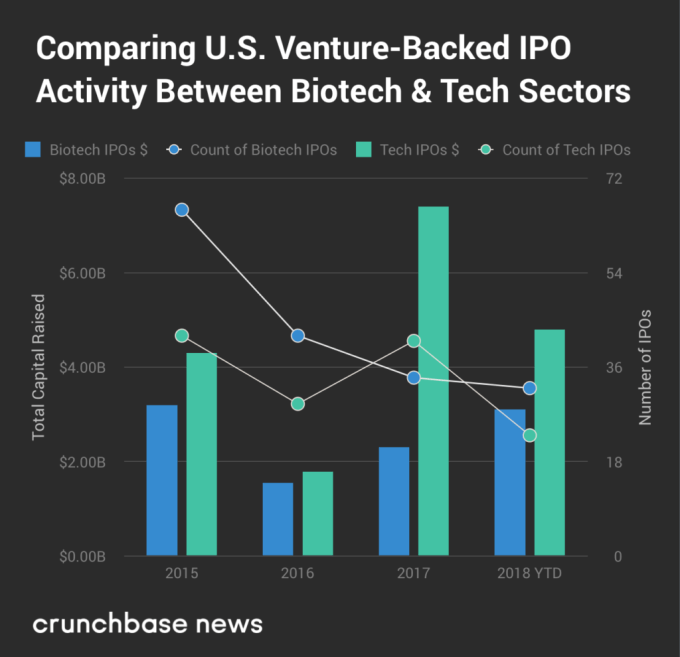
But with our fixation on all things tech, we’re missing out on the big picture. There are actually a lot more biotech and healthcare startup IPOs than tech offerings. In the second quarter of this year, for instance, at least 16 U.S. venture-backed biotech and healthcare companies went public, compared to just 11 tech startups. In three of the past four years, bio offerings outnumbered tech IPOs, according to Crunchbase data.

In the following analysis, we attempt to get up to speed on the pace of biotech offerings, assess where we are in the cycle and spotlight some of the rising stars.

Biotech outpaces tech

As mentioned above, U.S. bio IPOs outnumber tech offerings in most years. However, the bio cohort raises less total capital, partly because the largest technology IPOs tend to be much bigger than the largest bio IPOs. In the chart below, we compare the two sectors over the past four years.

Globally, the numbers are much higher. Using Crunchbase data, we’ve put together a chart looking at global VC-backed biotech and healthcare IPOs over the past four years. While we’re just over halfway through 2018, biotech and health IPOs have already raised more money than in any of the prior three full calendar years.

Fundamentals driven, cycle amplified

It’s pretty clear we’re in an upcycle for all things startup-related. VCs are flush with cash, late-stage rounds are ballooning in size and IPO and M&A action is picking up, too.

So what does that mean for bio IPOs? Is the uptick in the pace and size of offerings mostly a result of bullish market conditions? Or is the current slate of pre-IPO candidates more compelling than in the past?

We turned to Bob Nelsen, co-founder of ARCH Venture Partners, one of the top-performing biotech investors, for his take, which is that it’s a “fundamentals driven, cycle amplified” IPO boomlet.

More companies are launching well-received IPOs because the pace of startup innovation is faster than in the past. Nelson calls it “the result of the previous 30 years of investment and innovation in biotech that has finally led to essentially data-driven innovation.” That’s leading to more curative treatments, disease-modifying therapies and preventative technologies.

Yet we’re also in a bullish segment of the market cycle for biotech. That’s prompting companies that might have stayed private under other conditions to give going public a shot. It’s also providing bigger outcomes for emerging companies that were already on the IPO track.

The latest example of a big outcome IPO is Rubius Therapeutics, which develops drugs based on genetically engineered red blood cells. This week, the five-year-old company raised $241 million at an initial valuation of over $2 billion, making it the largest bio offering of 2018. The Cambridge, Mass. company, which previously raised nearly a quarter-billion-dollars in venture funding, is still in the pre-clinical trial phase.

This year has delivered several other good-sized offerings as well, including drug developers Eidos Therapeutics and Homology Medicines, recently valued around $800 million each, along with Tricida, valued around $1.2 billion. (See the full list of 2018 global bio and health offerings here.)

As for aftermarket performance, that’s been up and down, but includes some big ups. Last year, biotech led the pack for best-performing IPOs on U.S. exchanges. The sector accounted for four of the six top spots, according to Renaissance Capital, led by drug developers AnaptysBioArgenx and UroGen, along with Calyxt, an agbio startup.

Looking ahead

While things are already up, bio VCs, generally an optimistic bunch, see several reasons why bio IPOs could go higher.

Nelson points to what he sees as the lagging pace of in-house innovation at big pharma and biotech players. Increasingly, they need to acquire startups and recently public companies to stay competitive and build out new product pipelines.

There is also tons of fresh capital earmarked for healthcare startups. In the U.S. in 2017, healthcare-focused venture capitalists raised $9.1 billion. That figure was up 26 percent from 2016, per Silicon Valley Bank.

More dollars also are flowing from venture firms that invest in a mix of tech and life sciences through a single fund. That list includes well-established VCs with dry powder to invest, including Polaris PartnersFounders FundKleiner Perkins and Sequoia Capital.

Still, Nelson observes, deep into an IPO bull market, the average quality of offerings does tend to decline. That said, he’s been through similar inflection points in previous cycles and “for the same point in the cycle, the quality is markedly higher.”

With its goofy video loops, YC backed Splish wants to be the ‘anti-Instagram’

Is there any space on kids’ homescreens for another social sharing app to poke in? Y Combinator backed Splish wants to have a splash at it (?) — with a super-short-form video and photo sharing app aimed at the under-25s.

The SF-based startup began bootstrapping out of their college dorm rooms last July, playing around with app ideas before settling on goofy video loops to be their social sharing steed of choice.

The Splish app pops content into video loops of between 1-5 seconds. Photos can be uploaded too but motion must be added in the form of an animated effect of your choice. So basically nothing on Splish stays still. (Hence its watery name.) But while wobbly, content on Splish is intended to stick around — rather than ephemerally pass away (a la snaps).

Here are a few examples of Splishes (embedded below as GIFs… but you can see them on its platform here, here and here):


 

It’s the first startup for the four college buddy co-founders: Drake Rehfeld, Alex Pareto, Jackson Berry and Zac Denham, though between them they’ve also clocked up engineering hours working for Snapchat, Facebook and Team 10.

Their initial web product went up in March and they landed a place on YC’s program at the start of May —  when they also released their iOS app. An Android app is pending, and they’ll be on the hunt for funding come YC demo day.

The gap in the social sharing market this young team reckons it’s spotted is a sort of ‘anti-Instagram’ — offering a playful contrast to the photo sharing platform’s polished (and at times preening) performances.

The idea is that sharing stuff on Splish is a bonding experience; part of an ongoing smartphone-enabled conversation between mates, rather than a selectively manicured photoshoot which also has to be carefully packaged for public ‘gram consumption.

Splish does have a public feed, though, so it’s not a pure messaging app — but the co-founders say the focus is friend group sharing rather than public grandstanding.

“Splish is a social app for sharing casual looping videos with close friends,” says Rehfeld, giving the team’s elevator pitch. “It came out of our own experience, and we’re building for ourselves because we noticed that the way you socialize right now in real life is you do activities with your friends. You go to the beach, you go to the bar, the bowling alley. We’re working to bring this same type of experience online using Splish through photo and video. So it’s more about interaction and hanging out with your friends online.”

“When you use Instagram you really feel like you’re looking at a magazine. It’s just the highlights of people’s lives,” he adds. “And so we’re trying to make a place where you’re getting to know your friends better and meeting new people as well. And then on the other side, on Snapchat, you’re really sharing interesting moments of your lives but it’s not really pushing the boundaries or creating with your friends. It’s more just a communication messaging tool.

“So it’s kind of the space in between broadcast and chat — talking and interacting with your close friends through Splish, through photo and video.”

Users of the Splish app can apply low-fi GIF(ish) retro filters and other photographic effects (such as a reverse negative look) to the video snippets and photos they want to send to friends or share more widely — with the effects intended to strip away at reality, rather than gloss it over. Which means content on Splish tends to look and feel grungy and/or goofy. Much like an animated GIF in fact. And much less like Instagram.

The team’s hope is the format adds a bit of everyday grit and/or wit to the standard smartphone visual record, and that swapping Splishes gets taken up as a more fun and casual way of communicating vs other types of messaging or social sharing.

And also that people will want to use Splish to capture and store fun times with friends because they can be checked out again later, having been conveniently packaged for GIF-style repeat lols.

“Part of the power here in Splish is that relationships are built on shared experiences and nostalgia and so while [Snapchat-style] ephemerality reduced a lot of the barriers for posting what it didn’t do is strengthen relationships long term or over time because the chats and the photos disappeared,” says Rehfeld.

The idea is a content format to gives people “shared experience that lasts”, he adds.

They’re also directly nudging users to get creative via a little gamification, adding a new feature (called Jams) that lets users prompt each other to make a Splish in response to a specific content creation challenge.

And filming actual (playful) physical shoulder pokes has apparently been an early thing on Splish. That’s the merry-go-round of social for ya.

Being a fair march north of Splish’s target age-range, I have to confess the app’s loopy effects end up triggering something closer to motion sickness/vertigo/puking up for me. But words are my firm social currency of choice. Whereas Rehfeld argues the teenager-plus target for Splish is most comfortable with a smartphone in its hand, and letting a lens tell the tale of what they’re up to or how they’re feeling.

“We started with that niche first because there’s a population in that age range that really enjoys this creative challenge of expressing yourself in pretty intuitive ways, and they understand how to do that. And they’re pretty excited about it,” he tells TechCrunch.

“There’s also been a little bit of a shift here where users no longer just capture what they have in real-life using the camera, but the camera’s used as an extension of communication — especially in that age range, where people use the camera as part of their relationship, rather than just capturing what happens offline.”

As with other social video apps, vertical full screen is the preferred Splish frame — for a more “immersive experience” and, well, because that’s how the kids do it.

“It’s the way users, especially in this age range, hold and use their phones. It’s pretty natural to this age range just because it’s what they do everyday,” he says, adding: “It’s just the best way to consume on the phone because it fills the whole screen, it’s how you were already using the phone before you clicked into the video.”

Notably, as part of the team’s soft-edged stance against social media influencer culture, Rehfeld says Splish is choosing not to bake “viral components” into the app — ergo: “Nobody’s rewarded for likes or ‘re-vines’. There’s no reblog, retweet.”

Although, pressed on how firm that anti-social features stance is, he concedes they’re not abandoning the usual social suite entirely — but rather implementing that sort of stuff in relative moderation.

“We have likes and we have a concept of friends or follows but the difference is we’re building those with the intention of not incentivizing virality or ‘influencership’,” he says. “So we always release them with some sort of limit, so with likes you can’t see a list of everybody who’s liked a post for example. So that’s one example of how we’ve, kind of, brought in a feature that people feel comfortable with and love but with our own spin that’s a little bit less geared towards building a following.”

Asked if they’re trying to respond to the criticism that’s been leveled at a lot of consumer technology lately — i.e. that it’s engineered to be highly and even mindlessly addictive — Rehfeld says yes, the team wants to try and take a less viral path, less well travelled, adding: “We’re building as much as possible for user experience. And a lot of the big brands build and optimize towards engagement metrics… and so we’re focused on this reduction of virality so that we can promote personal connections.”

Though it will be interesting to see if they can stick to medium-powered stun guns as they fight to carve out a niche in the shadow of social tech’s attention-sapping giants.

Of course Splish’s public feed is a bit of a digital shop window. But, again, the idea is to make sure it’s a casual space, and not such a perfectionist hothouse as Instagram.

“The way the product is built allows people to feel pretty comfortable even in the more public feeds, the more featured feeds,” adds Rehfeld. “They post still very casual moments, with a creative spin of course. So it’s stayed pretty similar content, private and public.”

Short and long

It’s fair to say that short form video for social sharing has a long but choppy history online. Today’s smartphone users aren’t exactly short of apps and online spaces to share moving pictures publicly or with followers or friends. And animated GIFs have had incredible staying power as the marathon runner of the short loop social sharing format.

On the super-short form video side, the most notable app player of recent years — Twitter’s Vine — sprouted and spread virally in 2013, amassing a sizable community of fans. Although Instagram soon rained on its video party, albeit with a slightly less super-short form. The Facebook-owned behemoth has gatecrashed other social sharing parties in recent years too. Most notably by cloning Snapchat’s ‘video-ish’ social sharing slideshow Stories format, and using its long reach and deep resources to sap momentum from the rival product.

Twitter voluntarily threw in the towel with Vine in 2016, focusing instead on its livestreaming video product, Periscope, which is certainly a better fit for its core business of being a real-time social information network, and its ambition to also become a mainstream entertainment network.

Meanwhile Google’s focus in the social video space has long been on longer form content, via YouTube, and longer videos mesh better with the needs of its ad network (at least when YouTube content isn’t being accused of being toxic). Though Mountain View also of course plays in messaging, including the rich media sharing messaging space.

Apple too has been adding more powerful and personalized visual effects for its iMessage users — such as face-mapping animoji. So smartphone users are indeed very, very spoiled for sharing choice.

Vine’s success in building a community did show that super-short loops can win a new generation of fans, though. But in May its original co-founder, Dom Hofmann, indefinitely postponed the idea of reviving the app by building Vine 2 — citing financial and legal roadblocks, plus other commitments on his time.

Though he did urge those “missing the original Vine experience” to check out some of the apps he said had “sprung up lately” (albeit, without namechecking any of the newbs). So perhaps a Splish or two had caught his eye.

There’s no doubt the space will be a tough one to sustain. Plenty of apps have cracked in and had a moment but very few go the distance. Overly distinctive filters can also feel faddish and fall out of fashion as quickly as they blew up. Witness, for example, the viral rise of art effect photo app Prisma. (And now try and remember the last time you saw one of its art filtered photos in the wild… )

So sustaining a novel look and feel can be tough. Not least because social’s big beast, Facebook, has the resources and inclination to clone any innovations that look like they might be threatening. Add in network effects and the story of the space has been defined by a shrinking handful of dominant apps and platforms.

And yet — there’s still always the chance that a new generation of smartphone users will shake things up because they see things differently and want to find new ways and new spaces to share their personal stuff.

That’s the splash that Splish’s team is hoping to make.

Data breach exposes trade secrets of carmakers GM, Ford, Tesla, Toyota

Security researcher UpGuard Cyber Risk disclosed Friday that sensitive documents from more than 100 manufacturing companies, including GM, Fiat Chrysler, Ford, Tesla, Toyota, ThyssenKrupp, and VW were exposed on a publicly accessible server belonging to Level One Robotics.

The exposure via Level One Robotics, which provides industrial automation services, came through rsync, a common file transfer protocol that’s used to backup large data sets, according to UpGuard Cyber Risk. The data breach was first reported by the New York Times.

According to the security researchers, restrictions weren’t placed on the rsync server. This means that any rsync client that connected to the rsync port had access to download this data. UpGuard Cyber Risk published its account of how it discovered the data breach to show how a company within a supply chain can affect large companies with seemingly tight security protocols.

This means if someone knew where to look they could access trade secrets closely protected by automakers. It’s unclear if any nefarious actors actually got their hands on the data. At least one source at an affected automaker told TechCrunch it doesn’t not appear that sensitive or proprietary data was exposed.

UpGuard’s big takeaway in all of this: rsync instances should be restricted by IP address. The researchers also suggest that user access to rsync be set up so that clients have to authenticate before receiving the dataset. Without these measures, rsync is publicly accessible, the researchers said.

The breach exposed 157 gigabytes of data—a treasure trove of 10 years of assembly line schematics, factory floor plans and layouts, robotic configurations and documentation, ID badge request forms, VPN access request forms. The breach even included sensitive non-disclose agreements, including one from Tesla.

Personal details of some Level One employees, including scans of driver’s licenses and passports, and Level One business data, including invoices, contracts, and bank account details.

The security team discovered the breach July 1. The company successfully reached Level One by July 9 and the exposure was closed by the following day.

Indie gem Stardew Valley will get multiplayer on August 1st

Stardew Valley, the popular indie farming simulator (it’s more fun than “farming simulator” makes it sound, I promise) is quite possibly the chillest game of all time. But, without any multiplayer aspect, it can get … a bit lonely. From farming, to fishing, to exploring mines, it’s always felt like a game that would be better with friends.

We’ll soon find out if that’s true. After about year of work has been put into the feature, the game will get cooperative multiplayer starting on August 1st.

There’s a slight catch: multiplayer will be limited to PC/Mac/Linux, at first. The trailer (below) says support will roll out to Nintendo Switch/PS4/Xbox One “soon,” but doesn’t get into specifics.

Multiplayer Stardew Valley will support up to four (4) players on the same farm, with all players sharing the same money and farmland. According to this page on the Stardew Valley fan wiki, groups will be able to tweak the game a bit to their tastes (specifically, they can scale things like profit margins and in-game item costs) to account for the added ease of having four players doing the work that was previously designed for one.

Stardew Valley is surprisingly in-depth for a game built primarily by just one person; while it’s published by a company, the vast majority of the work — from the pixel art, to the musical composition, to the programming — is done by Eric “ConcernedApe” Barone. By the beginning of this year, it was reported that the game had sold more than 3.5 million copies. GQ did a profile on Barone and how he built the game.

Barone clarified a few things on Twitter shortly after the trailer went live:

  • If you’ve already found your way into the multiplayer beta, there won’t be any major changes in the public releases besides a “few last-minute bug fixes”
  • While work on the console builds is underway, he doesn’t have any release dates in mind yet
  • No split-screen or shared screen co-op — if you want multiplayer, you’ll need your own device to play on

CowryWise micro-savings service opens high-yield government bonds to everyday Nigerians

In emerging market countries where economic volatility is a way of life, there aren’t a lot of relatively safe options for members of the burgeoning middle class to park their money.

For instance, countries like Nigeria have experienced a tremendous growth in the number of citizens entering the middle class, which now accounts for about 23 percent of the population (it’s around 50 percent in the U.S.), according to a recent article citing the African Development Bank.

While Nigeria now faces some significant headwinds from a weak domestic currency (the naira), high interest rates and a manufacturing recession, there are ways that local investment can both protect the wealth that’s been created and encourage investment domestically to potentially spur development.

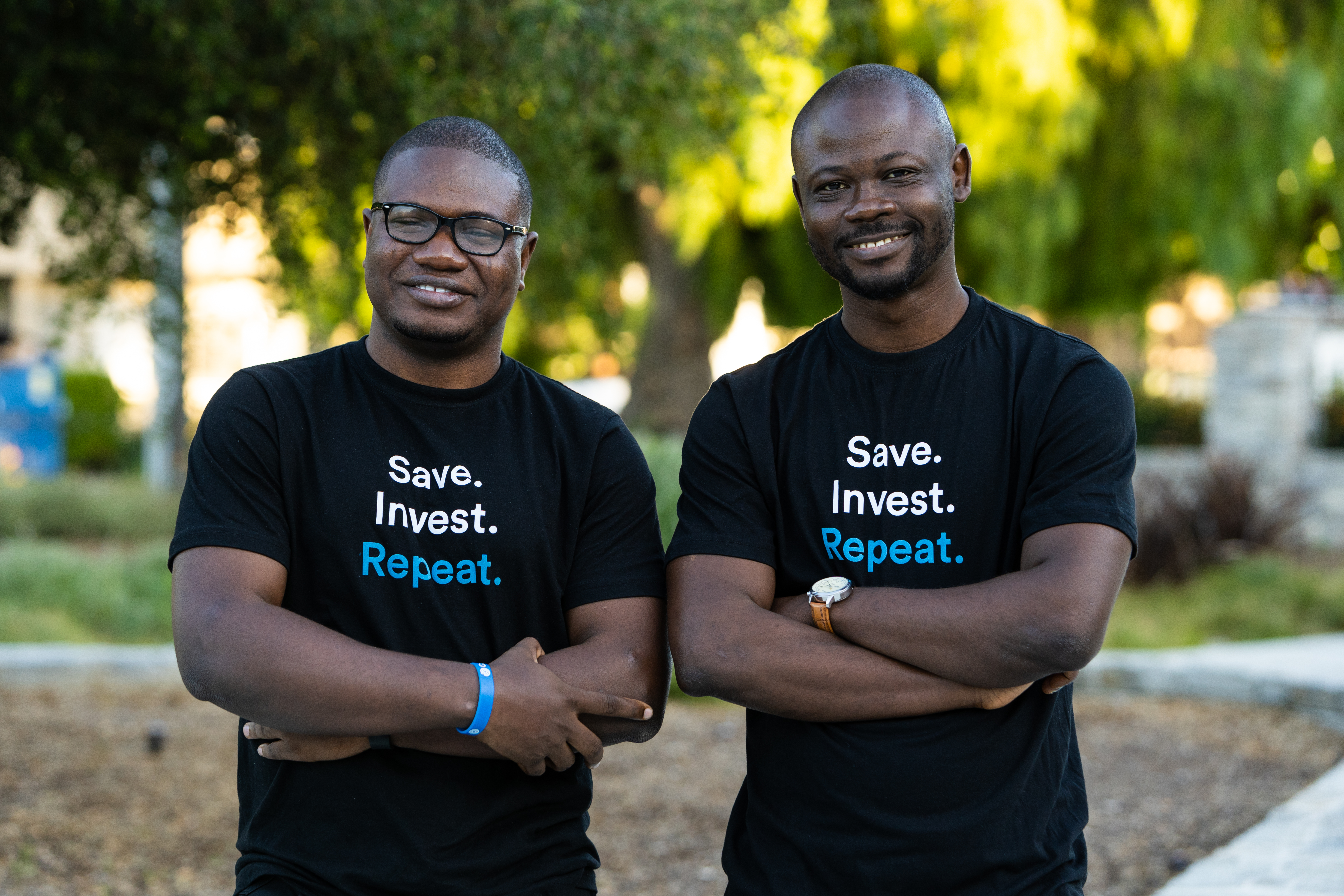
At least, that’s the conclusion that college friends Razaq Ahmed and Edward Popoola came to while they were thinking about opportunities for new financial services options in their home country of Nigeria.

The two men, Ahmed with a background in finance and Popoola in computer science, are launching a company called CowryWise that gives Nigerian investors a way to save their money by investing in high-yield government bonds. The rates on those products are high enough to absorb the wild swings in value of the naira and still provide a healthy return for investors, according to Ahmed.

Set to present at this year’s demo day from Y Combinator, CowryWise is one of a number of startups that Y Combinator has backed coming from the African continent, and an example of the wellspring of entrepreneurial talent that is flourishing in sub-Saharan Africa.

Using CowryWise, a customer would just have to sign up with their email address and phone number and link their bank account up to the CowryWise platform.

There are already roughly 57 million savings accounts in Nigeria and 32 million unique bank users. By investing in the bonds, these savers gain access to interest rates that range between 10 percent and 17 percent, according to Ahmed.

“The bonds… are similar to the treasuries issued by the U.S. government, which is A-rated,” says Ahmed. Even if there were foreign currency risk from investing in the naira, the inflation rate is currently around 11 percent, according to Ahmed. Given that most of the bonds are yielding interest rates on the higher end, it’s just a better deal for consumers, he said.

“There’s more value in keeping the money in government treasury bills” than in the bank, says Ahmed.

For Ahmed and Popoola, the decision to launch CowryWise was a way to bring investment opportunities to a retail investor that hadn’t been able to access the best that the financial system in Nigeria had to offer.

To target these retail investors meant leveraging technology to scale quickly and cheaply across the country. The two men started developing their service in January and tested it in February and March with friends and family.

CowryWise isn’t without competitors. Another Nigerian company, Piggybank, recently raised $1.1 million for its own automated savings solution. Like CowryWise, Piggybank also taps into government bonds to offer better rates to its investors.

That company already has 53,000 registered users — who have saved in excess of $5 million since 2016, according to a release.

There are subtle differences between the two. Piggybank touts its ability to save through bonds, but it is primarily working with banks to get Nigerians saving money. CowryWise is using Meristem Financial (Ahmed’s old employer) as the asset manager for its investments into the bond market.

Another difference is the time customers’ funds are locked up. Piggybank has a three-month savings period required before investors can withdraw funds, while CowryWise will let its customers withdraw cash immediately, according to this teardown of the two services.

Ultimately, there’s a large enough market for multiple players, and a need for better financial services, according to Ahmed.

“We kept having interest from retail investors on why they want to do micro-savings and micro-investment, but they didn’t have the required capital,” Ahmed says. “That was the major reason for staring the company. Why not democratize the assets? And make them available in investments and savings in this traditional instrument?”

What next? Oh yes, turning a luxury car into a non-fungible token

We’ve seen more than one project use the immutability of blockchain to verify important physical things. So, for instance, a pioneer in the space, Verisart, has brought blockchain certification of high art to leading galleries worldwide, and other players are now entering this growing market. Codex Protocol is a new startup also putting art on the blockchain. The benefits are obvious: reducing to near-zero the possibility that an artwork could be fake. This is an incredibly powerful idea, especially at the high end of the commercial spectrum.

A relatively new idea is to take blockchain to the car market. Automakers are already starting to take an interest. BMW, Ford, Renault and General Motors recently joined a new working group of more than 30 auto companies to employ blockchain technology. The Mobility Open Blockchain Initiative aims to speed up the adoption of blockchain, with use cases ranging from autonomous payments to ridesharing. But that’s not where blockchain adoption for cars ends.

There remains the need for trustworthy assurances of authenticity and condition, especially when it comes to high-end cars. And that’s doubly true of classic and exotic vehicles. Collectible, classic cars can have their documentation forged or misassigned as there’s no one, single, global document standardization for these kinds of cars.

Now a startup hopes to bring their newly launched platform for tokenization to this market.

Proxeus is a blockchain startup that has launched a user-friendly method to register classic car collections on the blockchain, making it both unforgeable and verifiable by anyone. The first client is Mercuria Helvetica in Switzerland.

Proxeus’s process verifies the certificates of authenticity and conditions of the vehicles. As an additional step, the car itself could actually be taken to the blockchain as a non-fungible token with an integrated certification library, offering not only proof of ownership and history but also to serve as a permanent link to the verified documentation.

It’s now launching the beta version of its engine, which has a drag and drop interface.

But do we really want to tokenize luxury cars? Proxeus says that’s not the point. They say their technology means someone without specialized programming skills can have the ability to deploy blockchain for a wide variety of use cases.

Antoine Verdon, co-founder, says: “For the first time we are able to show that our technology is real.” Artan Veliju, CTO, says the platform has the “ability to easily build the workflows needed to use blockchain productively without needing to launch a software development project.”

Their idea is to allow anyone to legally incorporate businesses, register assets and validate certificates on their testnet blockchain. It’s so far been used by the University of Basel’s Center for Innovative Finance course certificates or WWF Switzerland’s tax donation verification system. Test XES tokens will be provided to show how they function within the Proxeus ecosystem and are used to pay for Proxeus’ services.

Shortly after raising $25 million as a part of their ICO, Proxeus now plans to complete the functions described in its whitepaper and release a fully developed solution for enterprise.

Meantime, I’m going to make a, perhaps obvious, observation: The tokenization craze is clearly not going to end here.

What should competitive Fortnite look like?

Last weekend, Epic Games put forth its first true effort at official competitive Fortnite Battle Royale. It was a disaster.

The private hosts used for the tournament were about as laggy as could be, with pro players getting eliminated simply because they couldn’t move. This tournament was for a total prize of $250K. That’s big money, and big frustration for pro players who were essentially eliminated by the whims of the server gods. But on top of the lag, the whole thing was, well, boring. A cardinal sin in any sport.

The fact is that when you put 100 pro players in a lobby together and tell them that the last man standing wins, most of them will simply sit in a fort and stay safe as long as possible. This does not generate a whole lot of action.

And when there is action on the map, there was no way for a spectator to know about it. There are, after all, a hundred people to watch out for, and jumping from one engagement to another is not only difficult but lacks a certain narrative quality, making the whole thing feel scattered.

It seems clear that a guided mode or hotspot indicator would go a long way to improving the viewing experience. Being told where the fighting was or could be happening or having a guide that flagged these opportunities could work. There could also be a documentary-style concept that followed a few top players on their entire run, with the hope that they’ll find action and maybe even be pushed into conflict to impress viewers.

Epic recently published a post-mortem on the event, outlining ways that the publisher can improve on the tournament. They’ve also set forth the rules for this weekend’s event, proposing a score-based tournament where both eliminations and Victory Royales count toward players’ overall score. Whether or not this will incentivize more action will be determined following the event.

It’s also worth noting that Epic scheduled today’s event during the Fortnite Friday tournament. Fortnite Friday, hosted by popular YouTuber Keemstar and facilitated by UMG, was a $20,000 elimination-based tournament with top players. In this week of the Summer Skirmish Series, which is worth a total of $8 million, Epic is choosing to host a two-day tournament, effectively rendering Fortnite Friday playerless.

It doesn’t have to be this way, Epic. I know that the concept of 100 of the best players in the world dropping into one map sounds incredible. It does. It sounds great, in theory. But in practice, it’s just a disorderly live stream of a bunch of highly talented players sitting around in bases, or, worse, lagging to the point of being frozen.

And, an invitational tournament (that goes terribly wrong) doesn’t scream “inclusive,” which is what Epic repeatedly says competitive Fortnite should be.

There is another way, and it’s the same way that Fortnite players have been competing for months now. A kill race.

But let’s back up a bit.

What should competitive Fortnite be?

Right now, Fortnite is played by 100 people in a single lobby, and “winning” the game is defined by being the last survivor(s). This can be played in solo mode, with 100 individuals facing off against the storm and each other, or in 50 teams of two (Duos), or 25 teams of four (Squads).

Video games often get tweaks for the competitive scene, whether it’s limiting the resources/gear that players can use or reducing the number of maps that can be played. When skill level is that high, most games must make changes to allow for true competition.

Given it’s still early days, Fortnite Battle Royale featuring purely pro players simply hasn’t worked.

But as it stands now, there are roughly two schools of thought.

Whoever gets the most eliminations wins.

Pros:

  • Super fun to watch
  • Requires skill
  • Inclusive to non-pro players

Cons:

  • A lot of RNG
  • More time-consuming

Gamebattle sites like CMG and UMG have been running minor tournaments for quite a while now using this format. Fortnite Friday, arguably one of the biggest weekly tournaments, also follows this format.

Here’s how it works: Individual players load up in a Duo match on the same team, or teams of two load up into a Squad match, also on the same team, and race for who can get the most kills in a public match.

This means that these opposing players can’t kill each other, but can keep track of each other’s kills and placement on the map. When you’re racing for kills, understanding where the other duo is fighting and how many kills they have is important information.

Given only four players are competing at a time, that means the rest of the 92 people on the map are regular Fortnite players.

This is where RNG comes into play. RNG is a term used in gaming that means Random Number Generator. It is the gaming equivalent of Alanis Morissette’s “Ironic.” It essentially means there is some level of random luck involved in the game. For example, you might land in a place where there is usually a weapon or chest, but that weapon or chest isn’t there, leaving you vulnerable to other players who land around you.

Great players can work around or overcome a certain level of RNG, but if the opposing team comes up on a squad of noobs and your team rolls up on a squad of great players, the tide of the match will inevitably shift against you, and may even result in a loss.

This is the cost of the 2v2 format that has become popularized with the vast majority of Fortnite competitive players.

While it takes more time to have 100 players compete four at a time, this format allows the viewer to watch no more than four players as they traverse the map and seek eliminations. At most, the audience has to follow along with four separate stories on the map. In most cases, duos play together, which brings that number down to two. In either case, it’s much easier than following along with the stories of 50 separate teams.

Traditional Battle Royale

Pros:

  • Less RNG
  • Amazing build fights
  • Fair, in the sense that players are fighting players of equal skill level

Cons:

  • It’s boring
  • Not inclusive
  • Confusing and scattered for viewers

This format was used during the Ninja Live tournament, the Fortnite ProAm tournament and, most recently, during the $8 million Summer Skirmish series, hosted by Epic Games.

Here’s how it works: 100 pro players/streamers pair off into teams of two and all load into the same lobby, with the goal of lasting the longest.

As I said, Fortnite Battle Royale is built around the idea that there would be a sole survivor, but doesn’t predicate that survival on a certain level of skill. In other words, it’s relatively easy to hide, avoid fights and survive to the near end of a game, or potentially even win. It doesn’t take much skill to squat in a bush or set traps in a house and sit in the bathroom.

Obviously, with pro players, there will be gunfights, and those gunfights should be pretty interesting. But they are few and far between, and are difficult to predict and capture for the live stream.

This also excludes regular players from being a part of the action. Yes, it’s a risk to construct a competitive scene on the backs of public gameplay. But it’s also never been done before in the pro gaming world. And it is the best way to include public players into the competitive scene. A regular player is far more likely to get interested in the competitive scene knowing that, on Friday or Saturday, they have the chance to play against the world’s greatest competitors.

The best way to build on the momentum of Fortnite’s popularity, as well as support the community as a whole, is to build out tournaments focused on eliminations within public lobbies.

It makes sense for Epic to want to control that experience, and it certainly makes sense for Epic to want the competitive scene to fit within the game they built, which is a Battle Royale. But thus far, competitive Battle Royale featuring purely pro players simply hasn’t worked. And it feels slightly underhanded for Epic to barrel over Fortnite Friday, given that the more competitive tournaments around Fortnite, the better for the game.

The community is here, telling you what it wants, Epic. And in true Fortnite fashion, if you build it, they will come.

James Gunn fired from ‘Guardians of the Galaxy 3’ after offensive tweets resurface

Disney fired director James Gunn from the set of Guardians of the Galaxy Vol. 3, the company confirmed at Comic-Con this week. The move came after highly offensive joke tweets dating from between 2008 and 2011 resurfaced. The tweets, which have since been deleted, make light of topics ranging from molestation and rape to pedophilia.

“The offensive attitudes and statements discovered on James’ Twitter feed are indefensible and inconsistent with our studio’s values, and we have severed our business relationship with him,” Walt Disney Studios chairman Alan Horn said in a statement provided to TechCrunch.

1. Many people who have followed my career know when I started, I viewed myself as a provocateur, making movies and telling jokes that were outrageous and taboo. As I have discussed publicly many times, as I’ve developed as a person, so has my work and my humor.

— James Gunn (@JamesGunn) July 20, 2018

Gunn, for his part, acknowledged the distasteful statements. The director, who helmed the first two installments of the Marvel franchise, tweeted a multi-part apology/explanation for the old tweets, in which he refers to himself as a “provocateur” during his early career.

“I used to make a lot of offensive jokes,” Gunn wrote. “I don’t anymore. I don’t blame my past self for this, but I like myself more and feel like a more full human being and creator today. Love you to you all.”

Prior to helming blockbuster superhero films, Gunn made a name directing films for Troma, the comedically offensive, aggressively B-movie studio behind films like The Toxic Avenger. The tweets resurfaced after being promoted by right-wing personalities like Jack Posobiec and Mike Cernovich.

Gunn has been a vocal critic of the Trump administration and took to Twitter to weigh in on actor/director Mark Duplass’ recent tweets about conservative pundit Ben Shapiro. 

Update: Gunn has issued a statement that reflects and expands on his earlier Twitter apology,

My words of nearly a decade ago were, at the time, totally failed and unfortunate efforts to be provocative. I have regretted them for many years since — not just because they were stupid, not at all funny, wildly insensitive, and certainly not provocative like I had hoped, but also because they don’t reflect the person I am today or have been for some time.”

“Regardless of how much time has passed, I understand and accept the business decisions taken today. Even these many years later, I take full responsibility for the way I conducted myself then. All I can do now, beyond offering my sincere and heartfelt regret, is to be the best human being I can be: accepting, understanding, committed to equality, and far more thoughtful about my public statements and my obligations to our public discourse. To everyone inside my industry and beyond, I again offer my deepest apologies. Love to all.

Facebook suspends analytics firm Crimson Hexagon over data use concerns

As part of its ongoing mission to close the barn doors after the cows have got out, Facebook has suspended the accounts of British data analytics firm Crimson Hexagon over concerns that it may be improperly handling user data.

The ominously named company has for years used official APIs to siphon public posts from Facebook, Instagram, Twitter and other sources online, collating and analyzing for various purposes, such as to gauge public opinion on a political candidate or issue. It has clients around the world, serving Russia and Turkey as well as the U.S. and United Kingdom.

Facebook, it seems, was not fully aware of the extent of Crimson Hexagon’s use of user data, however, including in several government contracts which it didn’t have the opportunity to evaluate before they took effect. The possibility that the company is not complying with its data use rules, specifically that they may have been helping build surveillance tools, was apparently real enough for Facebook to take action. Perhaps the bar for suspension has been lowered somewhat over the last year, and with good reason.

“We are investigating the claims about Crimson Hexagon to see if they violated any of our policies,” said Facebook VP Product Partnerships Ime Archibong in a statement.

The Wall Street Journal, which first reported the suspension, noted that Crimson Hexagon currently has a contract with FEMA to monitor online discussion for various disaster-related purposes, but a deal with ICE fell through because Twitter resisted this application of their “firehose” data.

However, beyond the suggestion that the company has undertaken work that skirts the edge of what the social media companies consider appropriate use of public data, Crimson Hexagon doesn’t seem to have done anything as egregious as the wholesale network collection done by others. It restricts itself to publicly available data that it pays to access, and applies its own methods to produce its own brand of insight and intelligence.

The company also isn’t (at least, not obviously) a quasi-independent arm of a big, shady network of companies working actively to obscure their connections and deals, as Cambridge Analytica was. Crimson Hexagon is more above the board, with ordinary venture investment and partnerships. Its work is in a way similar to CA, in that it is gleaning insights of a perhaps troublingly specific nature from billions of public posts, but it’s at least doing it in full view.

As before, the onus of responsibility is equally on Facebook to enforce as it is on partners to engage in scrupulous handling of user data. It’s hardly good data custodianship for Facebook to let companies take what they need under a handshake agreement that they’ll do no evil, and then take them to task years later when the damage has already been done. But that seems to be the company’s main priority now: To reiterate the folksy metaphor from above, it is frantically counting the cows that have bolted while apologizing for having left the door open for the last decade or so.

Incidentally, Crimson Hexagon was co-founded by the same person who was put in charge of Facebook’s new social science initiative: Harvard’s Gary King. In a statement, he denied any involvement in the former’s everyday work, although he is chairman. No doubt this connection will receive a bit of scrutiny on Facebook’s side as well.

Comics writer Grant Morrison signs a content deal with Magic Leap

Grant Morrison’s Square Slice Studios just signed a content deal with Magic Leap. If you’ve read a comic book at some point in the past two decades, odds are you’re very excited at this news. Morrison is, after all, one of the most exciting writers working in the comics media today.

The Scottish writer came to prominence with series like the mind-bending ’90s title The Invisibles, before helming some of the most exciting big-name superhero books, from All-Star Superman to the New X-Men. Magic Leap, meanwhile — well, those precious few who have actually tried the thing say it’s pretty cool, at least.

Morrison’s been trying his hands with a number of different storytelling mediums of late. The writer is behind the well-received SyFy series, Happy!, along with the channel’s upcoming Brave New World adaptation. He’s also been flirting with augmented reality for a while, having served as a consultant for Magic Leap since its early days.

“Storytelling is my passion and I’ve found that new platforms allow me to extend my creative boundaries,” Morrison told Deadline, which broke the news during San Diego Comic Con this week. “We see Magic Leap as the next great platform for storytelling and we are excited to collaborate on content that helps bring our wildest dreams to life in the near future.”

That, apparently, will be happening sooner than later. Magic Leap announced earlier this month that its One headset will finally start shipping this summer. That announcement came in the wake of years of building up a crazy amount of funding that pegged the company at a $6.3 billion valuation.

Morrison co-founded Square Slice in 2016, along with a handful of gaming industry veterans, including Rockstar’s Stewart Waterson.

Niantic explains how and why it bans players in Pokémon GO

Getting banned for cheating is nothing new in Pokémon GO. There’ve been big ol’ ban waves every few weeks for ages now.

The policies have never been totally set in stone, however — at least not publicly. Like many of the game’s mechanics, the player base has had to share info amongst themselves to figure out the offenses and their relative punishments, from slaps on the wrist to lifetime bans.

At long last, Niantic has published a proper “Three-Strike Discipline Policy.”

As the name implies, most infractions will be handled on a three-strike system. Niantic notes, however, that “some misbehaviors” (they leave that one pretty open-ended) will work out to an instant perma ban.

So what’s worthy of a strike? Spoofing (making the game think you’re somewhere you’re not), using modified Pokémon GO clients or bots or doing something that accesses Pokémon GO’s backend in an unauthorized way.

On the first strike, you’ll get a warning message. You’ll still be able to play, technically, but you won’t see anything even remotely rare for seven days.

On the second strike, they’ll close your account for a month.

On the third strike, the account is banned for good.

And if you think you got stuck in the crosshairs by accident? Niantic has an appeal process for that.

It’s worth noting that these punishments aren’t really new; bans of all variety have been happening since shortly after the game’s release. This is just the first time Niantic has really put the hows-and-whys in stone.

Niantic could probably go a few steps further in their clarifications here, though, as plenty of players are still confused as to whether or not they’re breaking the rules.

Will they get in trouble for using third-party software (like an automated IV calculator) that doesn’t modify the client or access Niantic’s backend but does provide the player with more info? What about players using third-party versions of the Go Plus hardware, like the Go-tcha? That thing pretty much automates catching/spinning as you walk around… but it’s also been sold in retail stores for years now, likely to many players who’ve never considered that this thing they bought in their local GameStop might not be allowed.

Oscar and Lemonade founders will join us at Disrupt SF to strategize about the future of insurance innovation

Insurance premiums total more than a trillion dollars in the U.S., and yet, where that money goes is something of a mystery. It certainly doesn’t seem to get invested in the consumer experience, where ancient incumbent companies still process paperwork as if it is the 1800s, and consumers are left wanting for new insurance options that meet their needs.

Insurance might well be the last frontier for disruptive innovation, but now, a generation of insurance tech startups is bringing new data models and product experience talent to bear on this sclerotic industry. In the process, they may well become some of the most durable and profitable companies the industry has ever seen.

Those startups face challenging questions. How can a startup even get started in an industry where an insurer often needs millions sitting on the balance sheet just to get started? How can a startup compete in a highly regulated industry, where incumbents have the financial might to actively stamp out competition? Can there be such a thing as delightful insurance?

These are just some of the questions we will be investigating during a high-powered insurance tech panel at Disrupt SF this September 5-7. We will be joined by two founders who are spearheading a complete overhaul of the industry through their companies.

Mario Schlosser is the CEO and co-founder of Oscar, a New York-based health insurance startup that has raised approaching a billion dollars in venture capital. Schlosser started programming as a young boy in Germany, and eventually moved to the U.S. to work on computer science research at Stanford. Later, he migrated to Harvard Business School, where he met his Oscar co-founder Joshua Kushner.

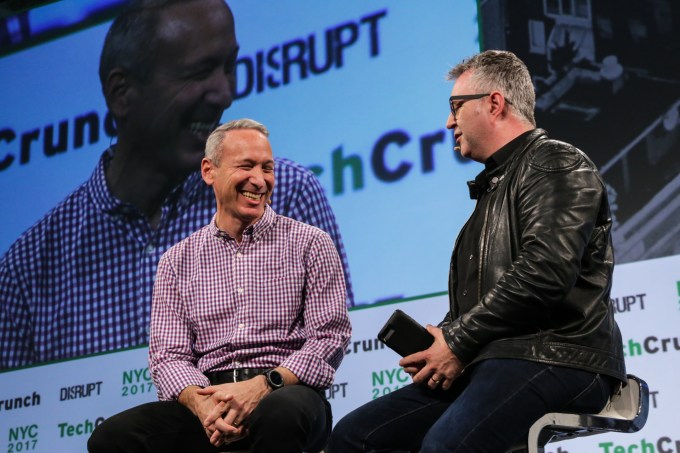
Mario Schlosser (Oscar Health) at TechCrunch Disrupt NY 2017

Working with Kevin Nazemi, the trio launched Oscar in 2013 just as Obamacare’s exchanges were becoming operational. Since then, the company’s health insurance products have become available in six states, and it has more than 700 employees. The company is reportedly on track to hit a billion in revenue in 2018, and recorded its first quarterly profit a few months ago.

Health is just one segment of the insurance landscape though. We also will be hosting Daniel Schreiber, who is the CEO and co-founder of Lemonade, a New York-based renters and home insurance startup. Lemonade, which uses artificial intelligence to make the insurance process faster and more consumer friendly, has gotten huge attention from investors since its launch in 2015, receiving $180 million in venture capital, including a mega round from SoftBank late last year.

Daniel Schreiber (Lemonade) at TechCrunch Disrupt NY 2017

Schreiber, a former attorney who was perviously president of wireless charging startup Powermat, joined with Shai Wininger to launch the startup, and since then the company’s product has been made available in 19 states and the District of Columbia. Perhaps most interestingly, Lemonade has a unique service model for its policyholders. Policyholders are grouped together with “peers” who want to commit to helping the same causes. Then, at the end of the calendar year, any premiums remaining in that group of peers is donated to their cause as part of a “Giveback.” Lemonade takes a fixed cut of the premium, to incentive-align itself with customers and ensure they always pay out claims as efficiently as possible.

If you want to understand the challenge but incredible opportunities present in regulated businesses like insurance, these two founders are not to be missed. They will be chatting on the Next Stage of Disrupt SF the morning of September 5th.

The full agenda is here. Passes for the show are available at the Early-Bird rate until July 25 here.