Facebook buys studio behind Roblox-like Crayta gaming platform

Facebook has been making plenty of one-off virtual reality studio acquisitions lately, but today the company announced that they’re buying something with wider ambitions — a Roblox-like game creation platform.

Facebook shared that they’re buying Unit 2 Games, which builds a platform called Crayta. Like some other platforms out there, it builds on top of the Unreal Engine and gives users a more simple creation interface teamed with discovery and community features. Crayta has cornered its own niche pushing monetization paths like Battle Pass seasons, giving the platform a more Fortnite-like vibe as well.

Unit 2 has been around for just over three years, and Crayta launched just last July. Its audience has likely been limited by the studio’s deal to exclusively launch on Google’s cloud-streaming platform Stadia, though it’s also available on the Epic Games Store as of March.

The title feels designed for the lightweight nature of cloud-gaming platforms, with users able to share access to games just by linking other users, and Facebook seems keen to use Crayta to push forward their own efforts in the gaming sphere.

“Crayta has maximized current cloud-streaming technology to make game creation more accessible and easy to use. We plan to integrate Crayta’s creation toolset into Facebook Gaming’s cloud platform to instantly deliver new experiences on Facebook,” Facebook Gaming VP Vivek Sharma wrote in an announcement post.

The entire team will be coming on as part of the acquisition, though financial terms of the deal weren’t shared.

Facebook will reconsider Trump’s ban in two years

The clock is ticking on former President Donald Trump’s ban from Facebook, formerly indefinite and now for a period of two years, the maximum penalty under a newly revealed set of rules for suspending public figures. But when the time comes, the company will reevaluate the ban and make a decision then whether to end or extend it, rendering it indefinitely definite.

The ban of Trump in January was controversial in different ways to different groups, but the issue on which Facebook’s Oversight Board stuck as it chewed over the decision was that there was nothing in the company’s rules that supported an indefinite ban. Either remove him permanently, they said, or else put a definite limit to the suspension.

Facebook has chosen… neither, really. The two-year limit on the ban (backdated to January) is largely decorative, since the option to extend it is entirely Facebook’s prerogative, as VP of public affairs Nick Clegg writes:

At the end of this period, we will look to experts to assess whether the risk to public safety has receded. We will evaluate external factors, including instances of violence, restrictions on peaceful assembly and other markers of civil unrest. If we determine that there is still a serious risk to public safety, we will extend the restriction for a set period of time and continue to re-evaluate until that risk has receded.

When the suspension is eventually lifted, there will be a strict set of rapidly escalating sanctions that will be triggered if Mr. Trump commits further violations in future, up to and including permanent removal of his pages and accounts.

It sort of fulfills the recommendation of the Oversight Board, but truthfully Trump’s position is no less precarious than before. A ban that can be rescinded or extended whenever the company chooses is certainly “indefinite.”

In a statement, Trump called the ruling “an insult.”

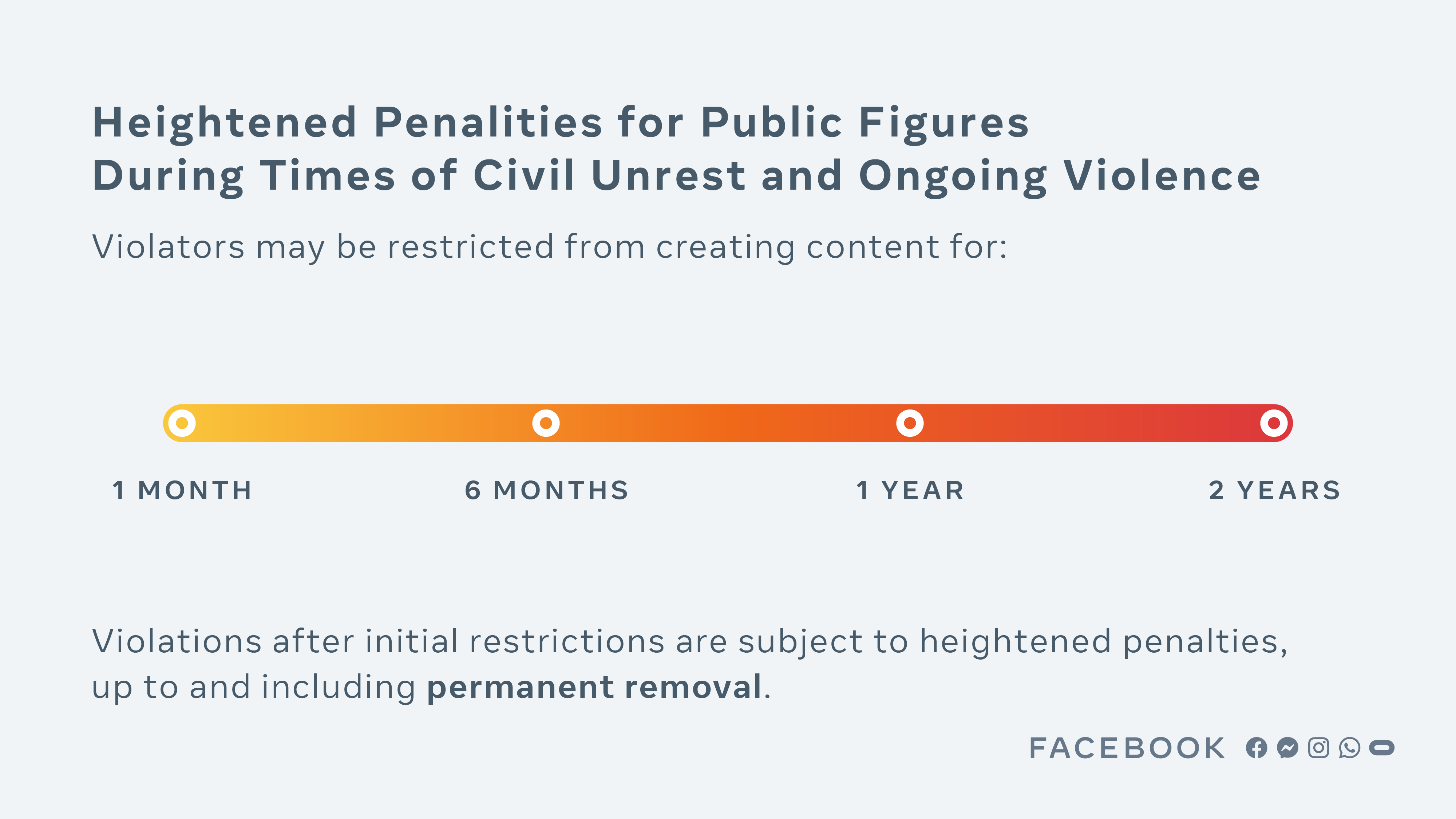
That said, the Facebook decision here does reach beyond the Trump situation. Essentially the Oversight Board suggested they need a rule that defines how they act in situations like Trump’s, so they’ve created a standard… of sorts.

Diagram showing different lengths of bans for worse violations by public figures.

Image Credits: Facebook

This highly specific “enforcement protocol” is sort of like a visual representation of Facebook saying “we take this very seriously.” While it gives the impression of some kind of sentencing guidelines by which public figures will systematically be given an appropriate ban length, every aspect of the process is arbitrarily decided by Facebook.

What circumstances justify the use of these “heightened penalties”? What kind of violations qualify for bans? How is the severity decided? Who picks the duration of the ban? When that duration expires, can it simply be extended if “there is still a serious risk to public safety”? What are the “rapidly escalating sanctions” these public figures will face post-suspension? Are there time limits on making decisions? Will they be deliberated publicly?

It’s not that we must assume Facebook will be inconsistent or self-deal or make bad decisions on any of these questions and the many more that come to mind, exactly (though that is a real risk), but that this neither adds nor exposes any machinery of the Facebook moderation process during moments of crisis when we most need to see it working.

Despite the new official-looking punishment gradient and re-re-reiterated promise to be transparent, everything involved in what Facebook proposes seems just as obscure and arbitrary as the decision that led to Trump’s ban.

“We know that any penalty we apply — or choose not to apply — will be controversial,” writes Clegg. True, but while some people will be happy with some decisions and others angry, all are united in their desire to have the processes that lead to said penalties elucidated and adhered to. Today’s policy changes do not appear to accomplish that, regarding Trump or anyone else.

Europe wants to go its own way on digital identity

In its latest ambitious digital policy announcement, the European Union has proposed creating a framework for a “trusted and secure European e-ID” (aka digital identity) — which it said today it wants to be available to all citizens, residents and businesses to make it easer to use a national digital identity to prove who they are in order to access public sector or commercial services regardless of where they are in the bloc.

The EU does already have a regulation on electronic authentication systems (eIDAS), which entered into force in 2014, but the Commission’s intention with the e-ID proposal is to expand on that by addressing some of its limitations and inadequacies (such as poor uptake and a lack of mobile support).

It also wants the e-ID framework to incorporate digital wallets — meaning the user will be able to choose to download a wallet app to a mobile device where they can store and selectively share electronic documents which might be needed for a specific identity verification transaction, such as when opening a bank account or applying for a loan. Other functions (like e-signing) is also envisaged being supported by these e-ID digital wallets.

Other examples the Commission gives where it sees a harmonized e-ID coming in handy include renting a car or checking into a hotel. EU lawmakers also suggest full interoperability for authentication of national digital IDs could be helpful for citizens needing to submit a local tax declaration or enrolling in a regional university.

Some Member States do already offer national electronic IDs but there’s a problem with interoperability across borders, per the Commission, which noted today that just 14% of key public service providers across all Member States allow cross-border authentication with an e-Identity system, though it also said cross-border authentications are rising.

A universally accepted ‘e-ID’ could — in theory — help grease digital activity throughout the EU’s single market by making it easier for Europeans to verify their identity and access commercial or publicly provided services when travelling or living outside their home market.

EU lawmakers also seem to believe there’s an opportunity to ‘own’ a strategic piece of the digital puzzle here, if they can create a unifying framework for all European national digital IDs — offering consumers not just a more convenient alternative to carrying around a physical version of their national ID (at least in some situations), and/or other documents they might need to show when applying to access specific services, but what commissioners billed today as a “European choice” — i.e. vs commercial digital ID systems which may not offer the same high-level pledge of a “trusted and secure” ID system that lets the user entirely control who gets to sees which bits of their data.

A number of tech giants do of course already offer users the ability to sign in to third party digital services using the same credentials to access their own service. But in most cases doing so means the user is opening a fresh conduit for their personal data to flow back to the data-mining platform giant that controls the credential, letting Facebook (etc) further flesh out what it knows about that user’s Internet activity.

“The new European Digital Identity Wallets will enable all Europeans to access services online without having to use private identification methods or unnecessarily sharing personal data. With this solution they will have full control of the data they share,” is the Commission alternative vision for the proposed e-ID framework.

It also suggests the system could create substantial upside for European businesses — by supporting them in offering “a wide range of new services” atop the associated pledge of a “secure and trusted identification service”. And driving public trust in digital services is a key plank of how the Commission approaches digital policymaking — arguing that it’s a essential lever to grow uptake of online services.

However to say this e-ID scheme is ‘ambitious’ is a polite word for how viable it looks.

Aside from the tricky issue of adoption (i.e. actually getting Europeans to A) know about e-ID, and B) actually use it, by also C) getting enough platforms to support it, as well as D) getting providers on board to create the necessary wallets for envisaged functionality to pan out and be as robustly secure as promised), they’ll also — presumably — need to E) convince and/or compel web browsers to integrate e-ID so it can be accessed in a streamlined way.

The alternative (not being baked into browsers’ UIs) would surely make the other adoption steps trickier.

The Commission’s press release is fairly thin on such detail, though — saying only that: “Very large platforms will be required to accept the use of European Digital Identity wallets upon request of the user.”

Nonetheless, a whole chunk of the proposal is given over to discussion of “Qualified certificates for website authentication” — a trusted services provision, also expanding on the approach taken in eIDAS, which the Commission is keen for e-ID to incorporate in order to further boost user trust by offering a certified guarantee of who’s behind a website (although the proposal says it will be voluntary for websites to get certified).

The upshot of this component of the proposal is that web browsers would need to support and display these certificates, in order for the envisaged trust to flow — which sums to a whole lot of highly nuanced web infrastructure work needed to be done by third parties to interoperate with this EU requirement. (Work that browser makers already seem to have expressed serious misgivings about.)

Web browsers will be forced/compelled to accept authentication certificates. This is to guarantee the proof of the website operator identity. What standards should be used here? Will web browsers implement it? pic.twitter.com/sygngNHyQW

— Lukasz Olejnik (@lukOlejnik) June 3, 2021

Another big question-mark thrown up by the Commission’s e-ID plan is how exactly the envisaged certified digital identity wallets would store — and most importantly safeguard — user data. That very much remains to be determined, at this nascent stage.

There’s discussion in the regulation’s recitals, for example, of Member States being encouraged to “set-up jointly sandboxes to test innovative solutions in a controlled and secure environment in particular to improve the functionality, protection of personal data, security and interoperability of the solutions and to inform future updates of technical references and legal requirements”.

And it seems that a range of approaches are being entertained, with recital 11 discussing using biometric authentication for accessing digital wallets (while also noting potential rights risks as well as the need to ensure adequate security):

European Digital Identity Wallets should ensure the highest level of security for the personal data used for authentication irrespective of whether such data is stored locally or on cloud-based solutions, taking into account the different levels of risk. Using biometrics to authenticate is one of the identifications methods providing a high level of confidence, in particular when used in combination with other elements of authentication. Since biometrics represents a unique characteristic of a person, the use of biometrics requires organisational and security measures, commensurate to the risk that such processing may entail to the rights and freedoms of natural persons and in accordance with Regulation 2016/679.

In short, it’s clear that underlying the Commission’s big, huge idea of a unified (and unifying) European e-ID is a complex mass of requirements needed to deliver on the vision of a secure and trusted European digital ID that doesn’t just languish ignored and unused by most web users — some highly technical requirements, others (such as achieving the sought for widespread adoption) no less challenging.

The impediments to success here certainly look daunting.

Nonetheless, lawmakers are ploughing ahead, arguing that the pandemic’s acceleration of digital service adoption has shown the pressing need to address eIDAS’ shortcomings — and deliver on the goal of “effective and user-friendly digital services across the EU”.

Alongside today’s regulatory proposal they’ve put out a Recommendation, inviting Member States to “establish a common toolbox by September 2022 and to start the necessary preparatory work immediately” — with a goal of publishing the agreed toolbox in October 2022 and starting pilot projects (based on the agreed technical framework) sometime thereafter.

“This toolbox should include the technical architecture, standards and guidelines for best practices,” the Commission adds, eliding the large cans of worms being firmly cracked open.

Still, its penciled in timeframe for mass adoption — of around a decade — does a better job of illustrating the scale of the challenge, with the Commission writing that it wants 80% of citizens to be using an e-ID solution by 2030.

The even longer game the bloc is playing is to try to achieve digital sovereignty so it’s not beholden to foreign-owned tech giants. And an ‘own brand’, autonomously operated European digital identity does certainly align with that strategic goal.

A new video platform offering classes about skilled trades begins to build momentum

Trade schools are nothing new, but a new startup called Copeland thinks it can build a big business by bringing education about plumbing, drywall, cabinetry and more to the masses through high-quality pre-filmed classes online that feature industry pros and professional educators.

If it sounds like a kind of MasterClass for all things construction, that’s not an accident. Copeland sprung from the mind of renowned investor Michael Dearing, who wrote the first check to MasterClass (now reportedly valued at $2.5 billion) and spied an opportunity in pairing underemployed Americans with homebuilders who can’t find enough people to hire. Meanwhile, Copeland’s cofounder and CEO, Gabe Jewell, previously spent nearly four years as a creative producer with MasterClass.

Of course, in addition to trade schools, Copeland, which charges for its content, is competing with an endless — and free — number of YouTube videos about how to both build and dismantle things. Still, the year-old, six-person, Bay Area-based company, which has produced nine distinct pieces of content so far, has investors excited about its prospects. Indeed, in addition to early backing from Dearing, the company just raised $5 million in seed funding from Defy.vc and Collaborative Fund in a round that brings its total funding to date to $7 million.

This afternoon, we talked with Jewell to learn more about what Copeland — named after an educator — is assembling, and whether homeowners, as well as aspiring tradespeople, are target customers, too. Some of that conversation follows, below:

TC: You’re trying to educate trade workers and those aspiring to work in construction — an industry that’s in the midst of a years-long labor shortage and needs people with know-how. Do you envision awarding credentials so employers know your customers have gone through training?

GJ: That’s on the table — proof of aptitude or certificates of completion after you’ve successfully passed an assessment. On the licensing side, that would be complicated because [general contractor] licenses are offered regionally, and you need to be a licensed electrical contractor so you don’t burn someone’s house down, and that’s a four-year process typically. So we’re right now focused more on general education and support rather than [anything more tangible than that].

TC: Out of curiosity, how would you test users, given this is a one-to-many platform?

GJ: Some of it could involve testing construction math — putting you through an assessment to ensure you know how to calculate angles and area and so forth. Other tests cold be more around general knowledge. We can’t, with an online test, ensure that you’ll build a great cabinet, but it’s easy to imagine [other testing] opportunities.

TC: MasterClass relies on celebrities and stars in their respective fields. To generate more buzz, might you pull in celebrity homebuilders and tradespeople from do-it-yourself-type shows as teachers?

GJ: We’re talking about that, too. There’s a healthy online community of professional builders who share what they do and they’ve given us a warm welcome. What’s most important to us is ensuring that the quality of instruction is really high really.

TC: I spent part of yesterday watching videos about how to dismantle a brick wall; it makes me wonder whether there will be content on your platform that’s accessible to, and even targeting, homeowners.

GJ: We are hopefully going to see a DIY halo audience for this stuff. For example, deck building is an employable skill and one that we’ll teach you such that you can learn to do it as a professional would. At the same time, if you’re serious about building your own deck, who else would you rather learn it from than pros who know how to teach it?

We’re also thinking of ways to bring those audiences together. You could learn how to dismantle that wall, but you could also come to Copeland to find a professional remodeler who you come to see as a trusted resource.

TC: How long does it take to create each piece of programming for the site?

GJ: It takes us a couple of months to put the courses together, which mostly fall right now between an hour and two hours, though well see more variability in that down the road.

TC: Do you have partnerships with homebuilders or commercial real estate developers that are desperate right now for help?

GJ: We are establishing partnerships with real estate builders. A few are [coming together now] and we’re really excited about growing that side of the business as we develop and film more stuff and add to our current library.

TC: Will subscriptions be part of the picture as you build out that content?

GJ: Yes, right now we charge $75 per course, and you have access to it forever, or a business can purchase a number or seats. As we grow the library, though, you’ll see see flexibility regarding the pricing structure.

TC: What type of content is coming?

GJ: Currently, we’re really focused on residential construction, both hands-on trade skills, like carpentry and cabinet making, but also blueprint reading, and we’ll continue to grow that by adding in plumbing, and drywall and general contractor skills, like reading contracts and risk management. But we’re also building a commercial construction management library that’s taught by university professors largely centered around skills between the field and the office. Maybe you’re an experienced craftsman and you need to learn leadership skills, or you come to construction from retail and you’re working in an office capacity and need to learn how to connect the dots.

Rebranded Toyota Ventures invests $300 million in emerging tech and carbon neutrality 

Toyota AI Ventures, Toyota’s standalone venture capital fund, has dropped the “AI” and is reborn as, simply, Toyota Ventures. The fund is commemorating its new identity by investing an additional $300 million in emerging technologies and carbon neutrality via two early-stage funds: the Toyota Ventures Frontier Fund and the Toyota Ventures Climate Fund. 

The introduction of these two new funds, each worth $150 million, brings Toyota Ventures’ total assets under management to over $500 million. With the new capital infusion into the Frontier Fund comes an expansion of Toyota Ventures’ core thesis, which previously focused on AI, autonomy, mobility, robotics and the cloud, and now is adding smart cities, digital health, fintech and energy. So while Toyota Ventures’ investment approach isn’t changing, it’s broadening the scope of startups it will consider investing in. 

“AI is kind of shrinking as a proportion of everything,” Jim Adler, founding managing director of Toyota Ventures, told TechCrunch. “The first mission of the Frontier Fund has always been to discover what’s next for Toyota. Toyota pivoted to cars in the 1930s, and Toyota will grow to other businesses in the future. Startups are experiments in the marketplace, and this is a way for us to understand and get comfortable with where innovations are coming from.” 

Toyota as a global company has more than 370,000 employees that cover a range of business units in which the company at large stands to benefit from investing, such as financial technology. The Frontier Fund is a step outside of mobility. It not only seeks to bring emerging tech to market, but it also wants to bring new innovations onboard, whether as a customer or an acquisition, according to Adler. 

“I think the vision of the company really is that machines are here to stay, they amplify the human experience, and Toyota understands how machines amplify humans really well for the benefit of society, which sounds incredibly corny, but the company really believes that,” said Adler.

By that same token, the new Climate Fund seeks to invest in startups that can help Toyota accelerate its goal of reaching carbon neutrality by 2050. The company has been investing in hydrogen for years, including a recent partnership with Japanese fuel company ENEOS, but it’s open to whatever technology will help achieve carbon neutrality, according to Adler.

“We think renewable energies will play a role,” said Adler. “Hydrogen production, storage distribution and utilization will play a role. We think carbon capture and storage will play a role. We’re not going to get dogmatic about hydrogen because we’ve been at it for decades and maybe things will change. Hydrogen hasn’t been crowdsourced across the startup community because there just wasn’t a market for it, but I think the market may be emerging.”

The fund is accepting online pitches on its website from entrepreneurs seeking early-stage funding. On Thursday, Toyota Ventures also announced it would be expanding its team and working with a new Advisor Network as a resource for founders looking for guidance on anything from product development to diversity and recruitment. 

“Toyota Ventures has been an invaluable partner for Boxbot since they invested in our seed round in 2018,” said Austin Oehlerking, co-founder and CEO of Boxbot, in a statement. “They have been instrumental in helping us to navigate complicated, existential challenges on our journey from concept to product/market fit. Jim and the team really understand how corporate venture capital should function in order to successfully partner with startups.” 

Adler says he and his team come from an entrepreneurial background, so they understand what it’s like on the other side of the table. Toyota Ventures’ focuses on early-stage startups because that’s where it believes some of the most interesting innovations come from. 

“I’m a big believer that early-stage venture capital is a telescope into the future,” said Adler. “I think we can actually find those incredibly valuable innovations that make this all worthwhile.”

TikTok just gave itself permission to collect biometric data on US users, including ‘faceprints and voiceprints’

A change to TikTok’s U.S. privacy policy on Wednesday introduced a new section that says the social video app “may collect biometric identifiers and biometric information” from its users’ content. This includes things like “faceprints and voiceprints,” the policy explained. Reached for comment, TikTok could not confirm what product developments necessitated the addition of biometric data to its list of disclosures about the information it automatically collects from users, but said it would ask for consent in the case such data collection practices began.

The biometric data collection details were introduced in the newly added section, “Image and Audio Information,” found under the heading of “Information we collect automatically” in the policy.

This is the part of TikTok’s Privacy Policy that lists the types of data the app gathers from users, which was already fairly extensive.

The first part of the new section explains that TikTok may collect information about the images and audio that are in users’ content, “such as identifying the objects and scenery that appear, the existence and location within an image of face and body features and attributes, the nature of the audio, and the text of the words spoken in your User Content.”

While that may sound creepy, other social networks do object recognition on images you upload to power accessibility features (like describing what’s in an Instagram photo, for example), as well as for ad targeting purposes. Identifying where a person and the scenery is can help with AR effects, while converting spoken words to text helps with features like TikTok’s automatic captions.

The policy also notes this part of the data collection is for enabling “special video effects, for content moderation, for demographic classification, for content and ad recommendations, and for other non-personally-identifying operations,” it says.

The more concerning part of the new section references a plan to collect biometric data.

It states:

We may collect biometric identifiers and biometric information as defined under US laws, such as faceprints and voiceprints, from your User Content. Where required by law, we will seek any required permissions from you prior to any such collection.

The statement itself is vague, as it doesn’t specify whether it’s considering federal law, states laws, or both. It also doesn’t explain, as the other part did, why TikTok needs this data. It doesn’t define the terms “faceprints” or “voiceprints.” Nor does it explain how it would go about seeking the “required permissions” from users, or if it would look to either state or federal laws to guide that process of gaining consent.

That’s important because as it stands today, only a handful of U.S. states have biometric privacy laws, including Illinois, Washington, California, Texas and New York. If TikTok only requested consent, “where required by law,” it could mean users in other states would not have to be informed about the data collection.

Reached for comment, a TikTok spokesperson could not offer more details on the company’s plans for biometric data collection or how it may tie in to either current or future products.

“As part of our ongoing commitment to transparency, we recently updated our Privacy Policy to provide more clarity on the information we may collect,” the spokesperson said.

The company also pointed us to an article about its approach to data security, TikTok’s latest Transparency Report and the recently launched privacy and security hub, which is aimed at helping people better understand their privacy choices on the app.

Photo by NOAH SEELAM / AFP) (Photo by NOAH SEELAM/AFP via Getty Images)

The biometric disclosure comes at a time when TikTok has been working to regain the trust of some U.S. users.

Under the Trump administration, the federal government attempted to ban TikTok from operating in the U.S. entirely, calling the app a national security threat because of its ownership by a Chinese company. TikTok fought back against the ban and went on record to state it only stores TikTok U.S. user data in its U.S. data centers and in Singapore.

It said it has never shared TikTok user data with the Chinese government nor censored content, despite being owned by Beijing-based ByteDance. And it said it would never do so, if asked.

Though the TikTok ban was initially stopped in the courts, the federal government appealed the rulings. But when President Biden took office, his administration put the appeal process on hold as it reviewed the actions taken by his predecessor. And although Biden has, as of today, signed an executive order to restrict U.S. investment in Chinese firms linked to surveillance, his administration’s position on TikTok remains unclear.

It is worth noting, however, that the new disclosure about biometric data collection follows a $92 million settlement in a class action lawsuit against TikTok, originally filed in May 2020, over the social media app’s violation of Illinois’ Biometric Information Privacy Act. The consolidated suit included more than 20 separate cases filed against TikTok over the platform’s collection and sharing of the personal and biometric information without user consent. Specifically, this involved the use of facial filter technology for special effects.

In that context, TikTok’s legal team may have wanted to quickly cover themselves from future lawsuits by adding a clause that permits the app to collect personal biometric data.

The disclosure, we should also point out, has only been added to the U.S. Privacy Policy, as other markets like the EU have stricter data protection and privacy laws.

The new section was part of a broader update to TikTok’s Privacy Policy, which included other changes both large and small, ranging from corrections of earlier typos to revamped or even entirely new sections. Most of these tweaks and changes could be easily explained, though — like new sections that clearly referenced TikTok’s e-commerce ambitions or adjustments aimed at addressing the implications of Apple’s App Tracking Transparency on targeted advertising.

In the grand scheme of things, TikTok still has plenty of data on its users, their content and their devices, even without biometric data.

For example, TikTok policy already stated it automatically collects information about users’ devices, including location data based on your SIM card and IP addresses and GPS, your use of TikTok itself and all the content you create or upload, the data you send in messages on its app, metadata from the content you upload, cookies, the app and file names on your device, battery state and even your keystroke patterns and rhythms, among other things.

This is in addition to the “Information you choose to provide,” which comes from when you register, contact TikTok or upload content. In that case, TikTok collects your registration info (username, age, language, etc.), profile info (name, photo, social media accounts), all your user-generated content on the platform, your phone and social network contacts, payment information, plus the text, images and video found in the device’s clipboard. (TikTok, as you may recall, got busted by Apple’s iOS 14 feature that alerted users to the fact that TikTok and other apps were accessing iOS clipboard content. Now, the policy says TikTok “may collect” clipboard data “with your permission.”)

The content of the Privacy Policy itself wasn’t of immediate concern to some TikTok users. Instead, it was the buggy rollout.

Some users reported seeing a pop-up message alerting them to the Privacy Policy update, but the page was not available when they tried to read it. Others complained of seeing the pop-up repeatedly. This issue doesn’t appear to be universal. In tests, we did not have an issue with the pop-up ourselves.

Hey @tiktok_us if you’re going to FORCE users to sign a new privacy policy I think you should make it available to read. pic.twitter.com/0qw9UfS8Q2

— Matthew Eric (@matthewericdoes) June 2, 2021

Yes Tiktok, you changed your privacy policy, you only need to tell me once pic.twitter.com/LRs7CxcNht

— Dieghoe (@diegheaux) June 2, 2021

if i open up tiktok one more time and see that notification that they’ve updated their privacy policy i might just- pic.twitter.com/uzArIoysZW

— alli ? (@allimaemangsat) June 3, 2021

Additional reporting by Zack Whittaker

White House expands investment ban on Chinese tech and telecom companies

The Biden administration has replaced and expanded Trump-era restrictions on investing in certain Chinese firms deemed supportive of that country’s surveillance and military apparatus. Major tech, space and telecom companies are listed in the initial 59 covered by the executive order, with more to come by order of the Treasury.

“I find that the use of Chinese surveillance technology outside the PRC and the development or use of Chinese surveillance technology to facilitate repression or serious human rights abuse, constitute unusual and extraordinary threats,” writes President Biden in the introduction to the order.

The E.O. has its roots in the Trump administration’s long-running and evolving blacklist of Chinese companies, whether for government procurement, private investment by U.S. firms, or other purposes. Major tech companies like ZTE and Huawei were put on the list straight away in 2019, but others were steadily added over time.

The Biden order refines these orders, revising certain portions and expanding others, particularly in the definition of what constitutes dangerous behavior or collaboration with Chinese authorities. Notably it stretches this to cover companies involved in domestic surveillance of Uygur Muslims in China and political dissidents in Hong Kong and elsewhere.

The new list of companies includes many of those listed over the last two years and adds plenty more. Seemingly any major company that deals with tech, communications or aerospace is at risk of being entered on the list, from China Mobile and China Unicom to China Aerospace, Hikvision and SMIC. Direct investment in the companies is disallowed, as is investing in an intermediary such as an index fund that includes one of the prohibited companies.

The Treasury — rather than the Defense Department, as it was previously — is given the responsibility of maintaining and updating the list, either adding to or subtracting from it.

“Tackling these challenges head-on is consistent with the Biden administration’s commitment to protecting core U.S. national security interests and democratic values, and the administration will continue to update the list of PRC entities as appropriate,” read a fact sheet accompanying the order.

Clearly the White House aims to continue and refine the trade war with China started by Trump. Whether U.S. pressure will be enough to influence Chinese policy or if the international community’s support will be necessary may soon be clear as the president goes to visit allies in search of support on this and other measures.

Aurora brings in outsiders to boost safety efforts, public trust of driverless vehicles

Aurora, the autonomous vehicle company that acquired Uber ATG last year, has assembled a team of outside experts, shared new details about its operations in a self-assessment safety report and launched a website as part of a broader effort to win over consumers wary of the technology that they may someday share the road with, or even use.

Aurora said Thursday it has tapped experts in aviation safety, insurance, medicine and automotive safety — all people from outside of the niche AV industry — to provide an outside perspective on the company’s overall approach to safety, to look for gaps in its system and advise on the best ways to share its progress and record with regulators and the public. The advisory group is designed to augment Aurora’s existing safety efforts, which includes on-road testing and development.

“I think for a while we’ve almost done the ‘Field of Dreams’ analysis where it’s like, ‘well if we build it they will come, just look at iPhones,’” Nat Beuse, Aurora’s head of safety said in a recent interview with TechCrunch. “We are always comparing it to these other consumer products, and I’m not so sure that is actually how we win over the hearts and minds of consumers in every single community in the United States.”

Beuse, who previously led the safety team at Uber ATG and once oversaw automated-vehicle developments at the U.S. Department of Transportation, said the goal is for driverless vehicles — whether that’s robotaxis shuttling people or trucks hauling freight — to be adopted broadly. That can’t happen, he said, without being able to measure and show the public that the technology is safe. He noted that public trust is one of the two biggest threats he sees to the AV industry.

“If all we worry about is a small number of people who get exposed to [AVs] we will never see the benefits of this technology and the broad scale, sweeping changes and the impact that it can have on our lives in a beneficial way,” he said. “We have to do a lot more there [gaining public trust]. Beuse added that gaining public trust should be done in concert with the government.

“I think for too long it’s been, ‘You, industry, you solve it. You’re building this stuff,’” he said. “And I really think it’s a partnership. Of course, we’re building the tech, we have a huge responsibility, but also the government has a huge, huge role to play and helping us kind of get the public on board.”

The members of the safety advisory board include Intelligent Transportation Society of America President and CEO Shailen Bhatt, Dave Carbaugh, the former chief pilot for flight-operations safety at Boeing and Victoria Chibuogu Nneji, the lead engineer and innovation strategist at Edge Case Research. Other members include Biologue President Jeff Runge, who is also a former administrator of the National Highway Traffic Safety Administration, Adrian Lund, managing member of HITCH42, LLC and former president of the Insurance Institute for Highway Safety and GHS Aviation Group CEO George Snyder.

The committee, which has already been meeting, is comprised of people who “don’t live and breathe the tech,” Beuse said.

Most importantly, for Aurora and the rest of the industry, is addressing the looming question of ‘how safe is safe enough?’ when it comes to driverless vehicles. One metric that has been adopted, and increasingly criticized, is comparing vehicle miles traveled and vehicle miles per “disengagement,” an industry jargon term that means a human safety operator has taken over from the computer driving the vehicle.

“We’ve been pretty adamant that that’s not a real metric because you can drive around in a parking lot and generate some interactions and that’s a whole lot different than if you’re driving in a city — and oh by the way, that’s a whole lot different if you’re driving on the highway,” Beuse explained.

Aurora is part of the Automated Vehicle Safety Consortium (AVSC), which includes Daimler, Ford, GM, Honda, Lyft, Motional, SAE and Toyota, that is working to come up with better safety metrics. The new Aurora safety advisory board isn’t working directly on the AVSC project, however it is providing general guidance that could help in this effort.

While there is still more work to be done to validate these new metrics, the group does have a handful that it thinks are pretty promising, Beuse said.

For SaaS startups, differentiation is an iterative process

Jason VandeBoom
Contributor

Jason VandeBoom is founder and CEO of ActiveCampaign, a customer experience automation (CXA) company.

Software as a service has been thriving as a sector for years, but it has gone into overdrive in the past year as businesses responded to the pandemic by speeding up the migration of important functions to the cloud. We’ve all seen the news of SaaS startups raising large funding rounds, with deal sizes and valuations steadily climbing. But as tech industry watchers know only too well, large funding rounds and valuations are not foolproof indicators of sustainable growth and longevity.

Failing to come across as a unique, differentiated company will likely mean settling for an exit that feels mediocre instead of incredible.

To scale sustainably, grow its customer base and mature to the point of an exit, a SaaS startup needs to stand apart from the herd at every phase of development. Failure to do so means a poor outcome for founders and investors.

As a founder who pivoted from on-premise to SaaS back in 2016, I have focused on scaling my company (most recently crossing 145,000 customers) and in the process, learned quite a bit about making a mark. Here is some advice on differentiation at the various stages in the life of a SaaS startup.

Launch and early years

Differentiation is crucial early on, because it’s one of the only ways to attract customers. Customers can help lay the groundwork for everything from your product roadmap to pricing.

The more you know about your target customers’ pain points with current solutions, the easier it will be to stand out. Take every opportunity to learn about the people you are aiming to serve, and which problems they want to solve the most. Analyst reports about specific sectors may be useful, but there is no better source of information than the people who, hopefully, will pay to use your solution.

The key to success in the SaaS space is solving real problems. Take DocuSign, for example — the company found a way to simply and elegantly solve a niche problem for users with its software. This is something that sounds easy, but in reality, it means spending hours listening to the customer and tailoring your product accordingly.

Daily Crunch: Canada and Australia get first look at Twitter Blue subscription service

To get a roundup of TechCrunch’s biggest and most important stories delivered to your inbox every day at 3 p.m. PDT, subscribe here.

Hello and welcome to Daily Crunch for June 3, 2021. If you are a startup founder or early employee or investor, there’s good news on the TechCrunch front today: The start of the Disrupt agenda is live! It’s going to be one hell of a show for anyone interested in startups and how they grow. See you there! — Alex

The TechCrunch Top 3

  • United goes Boom: News broke today that United Airlines has agreed to purchase 15 supersonic jets from Boom, a startup focused on building them. For Boom, the deal is a big happening, evidence of material market demand for its products. And, given how much planes cost in general, a huge set of bookings for the company to show to its investors that have plowed nearly a quarter billion dollars into the company, according to Crunchbase.
  • Twitter is Blue: No, the social media company isn’t sad. Quite the opposite. Instead, Twitter’s subscription service Blue is going live in two markets for a few dollars per month. It’s something of a very public test of what Twitter hopes — we presume — will be a globally available subscription option for those of us who can’t stop tweeting.
  • Women’s health remains an underinvested startup niche: TechCrunch’s Natasha Mascarenhas dug into the world of hormonal health for the blog today, asking why there aren’t unicorns in the huge market. It’s a great read.

Startups and VC

We’re dividing up today’s startup and venture capital news into two buckets. The first comprises early-stage rounds, and the latter investments in upstarts that are a bit more mature.

  • India’s early-stage market accelerates: Manish Singh reports for TechCrunch that a host of Indian startups are in the process of raising money. He broke an ocean of news in his piece on the matter, not only underscoring how active the global venture market is, but just how hard it can be to keep track of all the activity.
  • Simplified raises $2.2M to support marketing creative: Marketers are expected to generate lots of content. Simplified is taking on Canva and that huge market need in a single go. And now it’s backed by Craft Ventures.
  • Ganaz raises $7M to help agricultural workers get paid: Not every tech company has to cater to the tech elite or the wealthy. Ganaz is betting that its business — focused on what we described as changing “how people with little documentation and no bank account get paid and send money with a modern workforce stack” — is going to be a hit. Given how huge the agricultural sector is, its wager makes some sense.

And then, on the late-stage front:

  • Gong raises $250M for sales automation: Gong’s rapid growth and latest funding was part of my column this morning because of how interesting they proved to be. In short, the sales automation company has roughly tripled its valuation to more than $7 billion since last August. How? By growing by more than 2x in the last year.
  • Realtime Robotics raises $31M for real-time robotics: Boston’s startup scene is more than biotech, it should be clear by now. Realtime Robotics is one such Beantown startup that isn’t building new drugs. Instead, Brian Heater reports, it’s building robot software to “help companies deploy systems with limited programming, offering adaptable controls that work for multiple systems at once.”
  • LeoLabs raises $65M to keep satellites from hitting each other: As SpaceX sends bushels of internet satellites into space, the issue of crowding in near-Earth orbit will only get stickier. LeoLabs is betting that keeping expensive space tech from hitting other space tech, or even space trash, is going to be a growth industry.

3 lessons we learned after raising $6.3M from 50 investors

Two years ago, founders of calendar-assistant platform Reclaim were looking for a “mango” seed round — a boodle of cash large enough to help them transition from the prototype phase to staffing up for a public launch.

Although the team received offers, co-founder Henry Shapiro says the few that materialized were poor options, partially because Reclaim was still pre-product.

So one summer morning, my co-founder and I sat down in his garage — where we’d been prototyping, pitching and iterating for the past year — and realized that as hard as it was, we would have to walk away entirely and do a full reset on our fundraising strategy.

In a guest post for Extra Crunch, Shapiro shares what he learned from embracing failure and offers three conclusions “every founder should consider before they decide to go out and pitch investors.”

(Extra Crunch is our membership program, which helps founders and startup teams get ahead. You can sign up here.)

Big Tech Inc.

Big Tech was busy yet again today, with news from Waymo, Twitter and Blackstone. We also have to talk about the law.

  • You can now hail Waymo taxis in Google Maps: Vertical integration, baby! It’s a jam if you are a platform company that makes self-driving cars, operates a taxi service, and also publishes what I presume is the most popular mapping software in the world.
  • In related news: Waymo, bring self-driving taxis to Providence, Rhode Island, you cowards!
  • In related apologies: Waymo is not made up of cowards, but merely businesspeople who should invest more of their testing budget in Providence, Rhode Island.
  • Twitter wants to hear you talk: Twitter is bringing its Spaces product more front-and-center in its mobile experience. Sure, all you use Twitter for today is tweets, but Big Tweet will soon want to send your newsletters, host your chats, and, well, distribute your Fleets as well.
  • A court case draws limits around a controversial American hacking law: Per TechCrunch, the U.S. Supreme Court “ruled that a police officer who searched a license plate database for an acquaintance in exchange for cash did not violate U.S. hacking laws” in a “landmark ruling [that] concludes a long-running case that clarifies the controversial Computer Fraud and Abuse Act, or CFAA.”
  • In terms of legal news and tech, it’s nice to have some good news.
  • And, finally, Blackstone is buying IDG: While your humble TechCrunchers are somewhat sensitive to the idea of private equity buying media properties, the Blackstone-IDG deal is yet another example of the trend.
  • The deal means that titles like “CIO, Computerworld, InfoWorld, Macworld, Network World, PCWorld, and Tech Hive” are changing hands, along with IDC itself.

Medium sees more employee exits after CEO publishes ‘culture memo’

In April, Medium CEO Ev Williams wrote a memo to his staff about the company’s shifting culture in the wake of a challenging year.

“A healthy culture brings out the best in people,” he wrote. “They feel psychologically safe voicing their ideas and engaging in debate to find the best answer to any question — knowing that their coworkers are assuming good intent and giving them the benefit of the doubt because they give that in return.”

A few paragraphs later, Williams wrote that while counterperspectives and unpopular opinions are “always encouraged” to help make decisions, “repeated interactions that are nonconstructive, cast doubt, assume bad intent, make unsubstantiated accusations, or otherwise do not contribute to a positive environment have a massive negative impact on the team and working environment.”

He added: “These behaviors are not tolerated.”

The internal memo, obtained and verified by TechCrunch, was published nearly one month after Medium staff’s unionization attempt failed to pass, and roughly one week after Williams announced a pivot of the company’s editorial ambitions to focus less on in-house content and more on user-generated work.

Medium’s editorial team got voluntary payouts as part of the shift, with VP of Editorial Siobhan O’Connor and the entire staff of GEN Magazine stepping away.

However, several current and former employees told TechCrunch that they believe Medium’s mass exodus is tied more to Williams’ manifesto, dubbed “the culture memo,” than a pivot in editorial focus. Since the memo was published, many non-editorial staffers — who would presumably not be impacted by a shift in content priorities — have left the company, including product managers, several designers and dozens of engineers.


Those departing allege that Williams is trying to perform yet another reset of company strategy, at the cost of its most diverse talent. One pull of internal data that includes engineers, editorial staff, the product team, and a portion of its HR and finance team, suggests that, of the 241 people who started the year at Medium, some 50% of that pool are now gone. Medium, which has hired employees to fill some vacancies, denied these metrics, stating that it currently has 179 employees.

Medium said that 52% of departures were white, and that one third of the company is non-white and non-Asian. The first engineer that TechCrunch spoke to said that minorities are overrepresented in the departures at the company. They also added that, when they joined Medium, there were three transgender engineers. All have since left.

“A beloved dictator vibe”

In February, a number of Medium employees — led by the editorial staff — announced plans to organize into a union. The unionization effort was eventually defeated after falling short by one vote, a shortfall that some employees think was due to Medium executives pressuring staff to vote against the union.

The month after the unionization effort failed, Medium announced an editorial pivot. The company offered new positions or voluntary payouts for editorial staff. A number of employees left, which is not uncommon in the aftermath of a tense time period such as a failed unionization and the offer of a clear, financially safe route out.

In April, Williams posted the culture memo outlining his view on the company’s purpose and operating principles. In the memo, he writes that “there is no growth without risk-taking and no risk-taking without occasional failure” and that “feedback is a gift, and even tough feedback can and should be delivered with empathy and grace.” The CEO also noted the company’s commitment to diversity, and how adapting to “opportunities or threats is a prerequisite for winning.”

Notably, Medium has gone through a number of editorial strategy changes, dipping in and out of subscriptions, in-house content, and now, leaning on user-generated content and paid commissions.

“Team changes, strategy changes and reorganizations are inevitable. Each person’s adaptivity is a core strength of the company,” the memo reads.

The memo doesn’t explicitly address the unionization attempt, but does talk about how Medium will not tolerate “repeated interactions that are nonconstructive, cast doubt, assume bad intent, make unsubstantiated accusations, or otherwise do not contribute to a positive environment [but] have a massive negative impact on the team and working environment.”

Employees that we spoke to think that Williams’ memo, while internal rather than publicly posted, is reminiscent of statements put out by Coinbase CEO Brian Armstrong and Basecamp CEO Jason Fried, which both banned political discussion at work due to its incendiary or “distracting” nature. While the Medium memo doesn’t wholly ban politics, the first engineer said that the “undertone” of the statement creates a “not safe work environment.” Frustrated employees created a side-Slack to talk about issues at Medium.

In a statement to TechCrunch, Medium said that “many employees said they appreciated the clarity and there were directors and managers involved in shaping it.”

The month of the memo, churn tripled at the company compared to the month prior and was 30 times higher than the January metric, using an internal data set obtained by TechCrunch.

The second engineer that spoke to TechCrunch left the company last month and said that the memo didn’t have anything “egregious” at first glance.

“It was more of a beloved dictator vibe, of like, your words are vague enough that they’re not enforceable on anything else, and it looks good on paper,” they said. “If you just saw that memo and nothing else, it’s not a Coinbase memo, it’s not a Basecamp memo.”

But, given the timing of the memo, the engineer said their interpretation of Williams’ message was clear.

“[Medium wants] to enforce good vibes and shut down anything that is questioning ‘the mission,’” they said.

Medium’s extreme 

The same engineer thinks that “very few people left because of the editorial pivot.” Instead, the engineer explained a history of problematic issues at Medium, with a wave of departures that seem to be clearly triggered by the memo.

In July 2019, for example, Medium chose to publish a series that included a profile of Trump supporter Joy Villa with the headline “I have never been as prosecuted for being Black or Latina as I have been for supporting Trump.”

When the Latinx community at Medium spoke to leadership about discomfort in the headline, they claimed that executives from editorial didn’t do anything about the headline until it was mentioned in a public Slack channel. One editor asked anyone who had gone through the immigration process or was a part of the Latinx community to get in a room and explain their side, a moment that felt diminishing to this employee. The headline only changed when employees posted in a public Slack channel about their qualms.

“They think caring is enough,” the employee said. “And that listening is merciful and really caring, and therefore they’re really shocked when that is not enough.”

The third engineer who spoke to TechCrunch joined the company in 2019 because they were looking for a mission-driven company impacting more than just tech. They realized Medium had “deeper issues” during the Black Lives Matter movement last summer.

“There were deeper issues that I just hadn’t heard about because I wasn’t part of them. That just kind of got slid under the rug,” they said, such as the Trump supporter profile. The former employee explained how they learned that HR had ignored a report of an employee saying the N-word during that time, too. Medium said this is false.

“I don’t feel like I needed the memo to really understand their true colors,” they said.

After The Verge and Platformer published a report on Medium’s messy culture and chaotic editorial strategy, the second engineer said that multiple employees who were assumed to be tied to the story were pressured to resign.

“The way I see it, they fought dirty to defeat the union,” the first engineer said. “But it wasn’t a total success because all of these people have decided to leave in the wake of the decision, and that’s the cost. The people who are left basically feel like they have to nod and smile because Medium has made it clear that they don’t want you to bring your full self to work.”

The engineer said that Medium’s culture of reckoning is different from Coinbase because of the mission-oriented promise of the former.

“Some companies, like Coinbase, have said that ‘we want people who are not going to bring politics and social issues to work,’ so if you join Coinbase, that’s what you are expecting, and that’s fine,” they said. “But Medium specifically recruited people who care about the world, and justice, and believe in the freedom of speech and transparency.”

The engineer plans to officially resign soon and already has interviews lined up.

“It’s a good job market out there for software engineers, so why would I work for a company that is treating their own people unfairly?”

Paramount+ will launch a $4.99 monthly ad-supported subscription

If you didn’t want to shell out $9.99 per month to watch the meme-worthy iCarly reboot, now you won’t have to. On Monday, Paramount+ will launch its ad-supported Essential Plan, priced at $4.99 per month.

This less expensive plan will replace the CBS All Access plan, which included commercials, but also granted access to local CBS stations. If you’re currently subscribed to that $5.99 per month plan, you can keep it. But starting Monday, it won’t be around anymore for new subscribers. 

What makes the Essential Plan different from CBS All Access? Subscribers on the new tier will get access to Marquee Sports (including games in the NFL, UEFA Champions and Europa Leagues), breaking news on CBSN, and all of Paramount’s on-demand shows and movies. This includes offerings from ViacomCBS-owned channels like BET, Comedy Central, MTV, Nickelodeon, the Smithsonian Channel and more. But, local live CBS station programming will no longer be included. So, if that’s a deal-breaker, you might want to subscribe to CBS All Access this weekend. 

The existing Premium Plan ($9.99 per month) removes commercials and adds support for 4K, HDR and Dolby Vision. Like other streaming services, only Premium subscribers will have access to mobile downloads. 

Both plans include access to parental controls and up to six individual profiles. The service doesn’t have a watch list at this time. But that has become a baseline feature for being competitive in this space, so it’s not a matter of if, but when. 

For comparison, the basic Netflix plan costs $8.99 per month, but only lets you watch on one screen at a time. That makes it harder to share an account with family or friends. Their standard tier is $13.99, making it a bit pricier than Paramount+.

Earlier this week, HBO Max unveiled their own lower-cost, ad-supported subscription tier, priced at $9.99 per month. The WarnerMedia-Discovery merger could also have major implications for the popular streaming service, though how that shakes out in terms of content libraries, or even possibly a combined streaming app, remains to be seen. 

Ultimately, consumers will make their decisions about which services to pay for based on a variety of key factors including content, pricing and user experience. On the content front, Paramount+ plans to announce a slate of big-name titles when the new plan goes live on Monday, in hopes of wooing new subscribers. But the low-cost plan may also appeal to those who don’t necessarily care about top movies — they just want an affordable add-on to their current streaming lineup that provides them with access to some of the programs Netflix lacks. 

Paramount+ owner ViacomCBS said it added 6 million global streaming subscribers across their Paramount+, Showtime OTT and BET+ services in Q1, to end the quarter with 36 million global users. Most of those come from Paramount+.

Lux Capital has raised $1.5 billion more to invest in — and create — new startups

The fundraising continues apace in the go-go world of venture capital. Today, it’s Lux Capital — known for its frontier investing — that has closed a $675 million early-stage venture fund and an $800 million growth-stage fund from its existing LPs, including many of the foundations, endowments and family offices that have backed the firm from its start in 2000.

It’s easy to appreciate why they would re-up. Over the last 12 months alone, a dozen of Lux’s portfolio companies have either been acquired, gone public or announced plans to go public, either via a SPAC or the good-old-fashioned way. Among them is Zoox, bought by Amazon last year; Desktop Metal, which went public by merging with a blank-check company last December; and Shapeways, which agreed in April to merge with a blank-check company.

The most recent of Lux’s portfolio companies to announce a SPAC deal is Bright Machines, a manufacturing software company that two weeks ago announced a merger with a publicly traded shell company. (Lux also raised its own $345 million blank-check company last fall, one that has yet to identify a target.)

Still, even a firm with Lux’s track record isn’t immune to competition in a crowded market. That’s partly why Lux — whose last two funds closed with a collective $1 billion in August 2019 — has incubated more than a dozen companies of its own, says the firm’s co-founder, Peter Hebert, who talked with us yesterday from Menlo Park about that approach, along with whether and when he sees a correction coming. Some of that conversation is excerpted below, edited lightly for length.

TC: What size checks will you be writing from these new funds?

PH: The median investment in this current early-stage fund will be about $25 million over the life of [each] investment, and that could range from $100,000 to something like $50 million. With our opportunity vehicle, that can be up to a $100 million check and also larger, but I would expect there to be at least one investment in that range.

TC: And the opportunity fund can back companies inside of the portfolio or outside it?

PH: That’s right. I would expect that the majority will be companies where we were an early-stage lead investor, but that there’s no requirement that it’s exclusively Lux-seeded or Series A-backed companies that receive investment. There’ve been a handful of companies we’ve backed in the past [that weren’t earlier bets] including (the liquid biopsy company) Thrive Earlier Detection [which was acquired soon after], (contract management software maker) IronClad [backed earlier this year], and (the at-home health testing company) Everly Health [which Lux first funded in December].

TC: What startup in your portfolio right now has received the most funding from Lux?

PH: I guess that would be Applied Intuition (which makes simulation software and infrastructure tools to test and validate autonomous vehicles at scale).

TC: How much do you look to own?

PH: Generally, where we are coming in as the lead institutional investor in a Series A, it’s 20% to 25%, and that can be higher or lower. In many cases, we will create companies from scratch and more often those can be as high as 50%.

TC: I didn’t realize that incubating companies was a big part of Lux’s business.

PH: Yeah, for us, one of the most successful of our investments was a company called Kurion that was a pioneer in nuclear waste remediation that we created based largely on the vision of my co-founder, Josh Wolfe, and his view on the future of alternative energy. We recruited all these great folks out of MIT’s material science department and built that and owned north of 30% when it was acquired by a French waste water company, Veolia, for $400 million in 2016 — and that [was part of a] $100 million fund.

TC: How active are you on this front right now? Given how heated pricing is out there, I’d think it’s a good time to be starting companies in-house.

PH: In the last two to three years, we’ve been most active in new [company] formation for exactly [those] reasons. It’s not like we’re just a factory [looking to] churn things out. Inspiration is the starting point. But whether it’s a market opportunity that we assess, or whether it’s interesting science and tech that needs a catalyst to get things off the ground, we’re happy to play that role.

TC: What do you think of what’s happening in terms of the feverish pace of fundings and how quickly companies’ valuations are soaring? It seems nuts, but it’s also hard to imagine it ending anytime soon.

PH: I think we’re uncomfortably optimistic. Structurally, [I’m optimistic] because the way that science and technology are funded today is so changed. When I got into business in the late ’90s, the venture industry was small, it was provincial, it was people on Sand Hill Road who wouldn’t talk with anyone who was beyond 10 miles of their office. People were proud to know nothing about the financial markets because there was little connectivity in terms of their impact on [what VCs were doing].

Now it’s global and while some might say the market is frothy, [all that capital is] allowing companies that are really ambitious and that require capital that otherwise might not have [materialized] to [gain momentum], and from the perspective of scientific advancement and technological progress, this is good.

There will certainly be experimentation, people will lose money, there will be hundreds of companies funded and most of them wash out. But there’s going to be a lot of lasting transformative change that comes out of all of this.

3 lessons we learned after raising $6.3M from 50 investors

Henry Shapiro
Contributor

Henry Shapiro is the co-founder of Reclaim.ai, an intelligent calendar assistant platform used daily by over 4,000 companies. Prior to founding Reclaim, Henry led product and marketing at New Relic.

It was August 2019, and the fundraising process was not going well.

My co-founder and I had left our product management jobs at New Relic several months prior, deciding to finally plunge into building Reclaim after nearly a year of late nights and weekends spent prototyping and iterating on ideas. We had bits and pieces of a product, but the majority of it was what we might call “slideware.”

When you can’t raise big on the vision, you need to raise big on the proof. And the proof comes from building, learning, iterating and getting traction with your first few hundred users.

When we spoke to many other founders, they all told us the same thing: Go raise, raise big, and raise now. So we did that, even though we were puzzled as to why anyone would give us money with little more than a slide deck to our names. We spent nearly three months pitching dozens of VCs, hoping to raise $3 million to $4 million in a seed round to hire our founding team and build the product out.

Initially, we were excited. There was lots of inbound interest, and we were starting to hear a lot of crazy numbers getting thrown around by a lot of Important People. We thought for sure we were maybe a week away from term sheets. We celebrated preemptively. How could it possibly be this easy?

Then in July, almost in an instant, everything started to dry up. The verbal offers for term sheets didn’t materialize into real offers. We had term sheets, but they were from investors that didn’t seem to care much about what we were building or what problems we wanted to solve. We quickly realized that we hadn’t really built momentum around the product or the vision, but were instead caught up in what we later learned to be “deal flow.”

Basically, investors were interested because other investors were interested. And once enough of them weren’t, nobody was.

Fortunately, as I write this today, Reclaim has raised a total of $6.3 million on great terms across a group of incredible investors and partners. But it wasn’t easy, and it required us to embrace our failure and learn three important lessons that I believe every founder should consider before they decide to go out and pitch investors.

Lesson 1: Build big before you raise big

In 2019, we were hunting for what some referred to as a “mango seed” — that is, a seed round that was large enough that it was perceptibly closer to a light Series A financing. Being pre-product at the time, we had to lean on our experience and our vision to drive conviction and urgency among investors. Unfortunately, it just wasn’t enough. Investors either felt that our experience was a bad fit for the space we were entering (productivity/scheduling) or that our vision wasn’t compelling enough to merit investment on the terms we wanted.

When we did get offers, they involved swallowing some pretty bitter pills: We would be forced to take bad terms that were overly dilutive (at least from our perspective), work with an investor who we didn’t think had high conviction in our product strategy, or relinquish control in the company from an extremely early stage. None of these seemed like good options.

Ford-owned Spin shakes up scooter business with new CEO, e-bikes and city strategy

Spin, the Ford-owned micromobility operator, has added a new CEO, launched a new strategy to capture market share and announced a plan to get back into bike share, although this time with an electric twist. 

The flurry of moves suggest that Spin is still trying to figure out the best path forward to push past its rivals and become profitable. Under the changes announced Thursday, co-founder and CEO Derrick Ko is moving to a strategic advisory role, along with the other two co-founders Zaizhuang Cheng and Euwyn Poon. In Ko’s place is Ben Bear, who previously served as CBO of Spin.

Alongside the change in leadership, Spin is deploying e-bikes for the first time, expanding to multiple cities in the U.S. and Europe, implementing new technologies and coming for Bird as the Number Two e-scooter company in the country (behind Lime, of course), according to Bear. Both Bird and Lime consider themselves to have the top ranking in the country based on different metrics that make it difficult to actually provide an accurate comparison. 

Pressure among micromobility operators to actually turn a profit is increasing, so Spin is flexing its compliance record in order to secure those limited vendor permits. The end game is to angle for more exclusive, and perhaps more lucrative, partnerships with cities. Amid all this activity are reports that Ford might be divesting Spin into a separate company, including a sale or spinoff of the subsidiary. Which leads us to wonder in which direction the new CEO will be steering this ship. 

“We’re full speed ahead on the hiring front, and we’ve got ambitious growth plans for this year, heading into 2022 and beyond,” Bear told TechCrunch. “We really think the market is reaching a tipping point where cities are more and more moving towards limited vendor permits, which is right where we’re focused and have been focused throughout our history.”

(Spin would not comment on the reports of Ford divesting the e-scooter company.) 

Most cities have evolved from an unregulated market to an open one, and many, like Atlanta and Washington, D.C., are operating limited vendor permits. Spin is counting on this trend continuing to exclusive vendor permits, similar to the deal Lyft-owned Citi Bike has made with New York City. This might mean going after mid-tier cities that charge Spin less in fees, or even pay them to operate.

“In Bakersfield, we recently received a $1.1 million state grant to install infrastructure and conduct the program, and then $257,000 from the city as well to make sure that the project was supported, and that we’re able to offer low-cost rides to residents who need that,” said Bear. 

In Grand Rapids, Spin is working with nonprofits to deliver scooters as an addition to public transportation, and in Pittsburgh, the company has integrated with the public transit app to make different types of mobility as frictionless as possible. 

“We definitely see ourselves as part of that broader ecosystem, which includes public transit,” said Bear. 

Spin claims that its win rate on new markets in the U.S. is 85% and its renewal rate is 93%. However, the company has lost a few big permit awards, including New York City and Paris. Of its nearly 100 markets in the U.S., a large majority are made up of mid-tier cities and college campuses. Spin says it will be in up to 25 additional U.S. markets through the rest of the year, with plans to expand to Portugal and Ireland, as well. 

Of Spin’s nearly 100 markets in the U.S. and Europe, over 70% are limited vendor exclusive, according to Bear. He says Spin’s reputation of ensuring safety, compliance and equitable service for residents makes it a trusted city partner. But if it wants to monopolize the micromobility of cities, it has to provide a multi-modal fleet. Enter electric bikes. 

Spin also announced plans to roll out up to 5,000 e-bikes on the streets this year, starting with Providence, Rhode Island on June 14. It will also bring e-bikes, as well as e-scooters, to recently won markets like Fort Collins, Colorado; Bakersfield, California; and Penn State University — all of which are exclusive partnerships. 

Spin was founded as a pedal bike share in 2017, but pivoted to e-scooters the following year. Of the major micromobility companies, Spin is a bit late to the e-bike party. Bear says the company wanted to delay bringing e-bikes to market until the form factor had developed enough to be as compelling as its scooters. This prudence could just as well hurt the success of its e-bike program if Spin isn’t bringing something as good as an e-bike that’s already been through multiple iterations of deployed field use. First-generation hardware is rarely, if ever, perfect out the gate. And since Spin hasn’t run a fleet of e-bikes yet, it might not be the smoothest management transition. 

Either way, e-bikes aren’t the only iron in Spin’s fire. True to its promise of being what cities want a micromobility operator to be, Spin is thinking strategically about technological add-ons. For example, Spin has partnered with computer vision startup Drover AI to launch its Spin Insight Level 2, or a bundle of sensors, cameras and on-board computing power to detect sidewalk and bike lane riding and validate parking. Spin launched this new capability for the first time on Wednesday, deploying 100 Drover-tech equipped e-scooters in Milwaukee with plans to launch in Miami, Seattle and Santa Monica, as well. Last month, Bird was booted by the Santa Monica City Council in favor of Spin, Veo and Lyft and will have to remove all of its scooters from its own hometown by July. 

Seattle and Santa Monica, along with Boise, Idaho, will also be seeing some of Spin’s new tech in the form of the S-200, a three-wheeled adaptive sit-down scooter. The vehicle is built in tandem with mobility startup Tortoise, whose repositioning software allows remote operators to move vehicles off sidewalks and into proper parking spots, as well as rebalance them. 

This article has been updated to reflect the uncertainty of which micromobility company, Bird or Lime, retains the top position in the United States.