Star Wars: Episode IX will feature unseen footage of Carrie Fisher as Princess Leia

Spoiler warning for anyone who hasn’t seen The Last Jedi, though, if you still haven’t at this point, what are you even doing reading casting announcements for the next one?

No one ever really dies in the Star Wars universe. The official cast list for Star Wars: Episode IX has been posted, and it features some familiar, intriguing names. Along with the long-awaited return of Billy Dee Williams as Lando, Carrie Fisher is listed among the names.

Fisher sadly passed away in late-2016, of course, but Princess Leia Organa will be returning for one last film. Rather than recreating the character with CGI, however, director/co-writer J.J. Abrams will be resurfacing unseen footage from The Force Awakens.

“We desperately loved Carrie Fisher,” Abrams said in a press release tied to the announcement. “Finding a truly satisfying conclusion to the Skywalker saga without her eluded us. We were never going to recast, or use a CG character. With the support and blessing from her daughter, [Billie Lourd], we have found a way to honor Carrie’s legacy and role as Leia in Episode IX by using unseen footage we shot together in Episode VII.”

Meet the cast of Star Wars: Episode IX. Beginning filming next week.https://t.co/BUCl4H8aRT pic.twitter.com/ezEaLzijLq

— Star Wars (@starwars) July 27, 2018

Rogue One, of course, took a slightly uncanny valley approach to recreating a young Leia with actress Ingvild Deila and a little bit of the old Industrial Light & Magic.

Also returning is Mark Hamill. Given how things worked out for him during The Last Jedi, however, it’s hard to say if he’ll be doing so as a translucent blue ghost. We’ll have to wait until December 2019 to know for sure.

Cast members Daisy Ridley, Adam Driver, John Boyega, Oscar Isaac, Lupita Nyong’o, Domhnall Gleeson, Kelly Marie Tran and Joonas Suotamo will be returning, as well. 

NASA’s 3D-printed Mars Habitat competition doles out prizes to concept habs

A multi-year NASA contest to design a 3D-printable Mars habitat using on-planet materials has just hit another milestone — and a handful of teams have taken home some cold, hard cash. This more laid-back phase had contestants designing their proposed habitat using architectural tools, with the five winners set to build scale models next year.

Technically this is the first phase of the third phase — the (actual) second phase took place last year and teams took home quite a bit of money.

The teams had to put together realistic 3D models of their proposed habitats, and not just in Blender or something. They used Building Information Modeling software that would require these things to be functional structures designed down to a particular level of detail — so you can’t just have 2D walls made of “material TBD,” and you have to take into account thickness from pressure sealing, air filtering elements, heating, etc.

The habitats had to have at least a thousand square feet of space, enough for four people to live for a year, along with room for the machinery and paraphernalia associated with, you know, living on Mars. They must be largely assembled autonomously, at least enough that humans can occupy them as soon as they land. They were judged on completeness, layout, 3D-printing viability and aesthetics.

So although the images you see here look rather sci-fi, keep in mind they were also designed using industrial tools and vetted by experts with “a broad range of experience from Disney to NASA.” These are going to Mars, not paperback. And they’ll have to be built in miniature for real next year, so they better be realistic.

The five winning designs embody a variety of approaches. Honestly all these videos are worth a watch; you’ll probably learn something cool, and they really give an idea of how much thought goes into these designs.

Zopherus has the whole print taking place inside the body of a large lander, which brings its own high-strength printing mix to reinforce the “Martian concrete” that will make up the bulk of the structure. When it’s done printing and embedding the pre-built items like airlocks, it lifts itself up, moves over a few feet, and does it again, creating a series of small rooms. (They took first place and essentially tied the next team for take-home case, a little under $21K.)

AI SpaceFactory focuses on the basic shape of the vertical cylinder as both the most efficient use of space and also one of the most suitable for printing. They go deep on the accommodations for thermal expansion and insulation, but also have thought deeply about how to make the space safe, functional, and interesting. This one is definitely my favorite.

Kahn-Yates has a striking design, with a printed structural layer giving way to a high-strength plastic layer that lets the light in. Their design is extremely spacious but in my eyes not very efficiently allocated. Who’s going to bring apple trees to Mars? Why have a spiral staircase with such a huge footprint? Still, if they could pull it off, this would allow for a lot of breathing room, something that will surely be of great value during a year or multi-year stay on the planet.

SEArch+/Apis Cor has carefully considered the positioning and shape of its design to maximize light and minimize radiation exposure. There are two independent pressurized areas — everyone likes redundancy — and it’s built using a sloped site, which may expand the possible locations. It looks a little claustrophobic, though.

Northwestern University has a design that aims for simplicity of construction: an inflatable vessel provides the base for the printer to create a simple dome with reinforcing cross-beams. This practical approach no doubt won them points, and the inside, while not exactly roomy, is also practical in its layout. As AI SpaceFactory pointed out, a dome isn’t really the best shape (lots of wasted space) but it is easy and strong. A couple of these connected at the ends wouldn’t be so bad.

The teams split a total of $100K for this phase, and are now moving on to the hard part: actually building these things. In spring of 2019 they’ll be expected to have a working custom 3D printer that can create a 1:3 scale model of their habitat. It’s difficult to say who will have the worst time of it, but I’m thinking Kahn-Yates (that holey structure will be a pain to print) and SEArch+/Apis (slope, complex eaves and structures).

The purse for the real-world construction is an eye-popping $2 million, so you can bet the competition will be fierce. In the meantime, seriously, watch those videos above, they’re really interesting.

Idaho inmates hacked prison-issued tablets for $225,000 in credits

Inmates in Idaho successfully hacked the software of the prison-issued tablets to issue themselves nearly a quarter of a million dollars in credits on the devices that are often one of their only connections to the outside world. The tablets, made by prominent prison vendor JPay, give inmates the ability to use email, listen to music and transfer money, among other basic computing functions, but charge fees for some services.

The Associated Press reports that Idaho prison officials discovered 364 inmates leveraging a software vulnerability to increase their JPay account balances. In Idaho, the devices are the result of a partnership between JPay and CenturyLink. The latter company confirmed the software vulnerability but declined to offer further details beyond stating that it had since been resolved.

Of the 364 inmates exploiting JPay, 50 inmates were able to issue themselves credits for more than $1,000. One inmate was able to use the software flaw to self-issue a credit of almost $10,000. The company has recovered about a quarter of the total of around $225,000 so far and has suspended some functions for inmates until they reimburse the stolen credits.

“This conduct was intentional, not accidental. It required a knowledge of the JPay system and multiple actions by every inmate who exploited the system’s vulnerability to improperly credit their account,” Idaho Department of Correction spokesperson Jeff Ray said in a statement on the JPay incident.

The individuals exploiting the JPay system are incarcerated at a handful of Idaho prisons, including Idaho State Correctional Institution, Idaho State Correctional Center, South Idaho Correctional Institution, Idaho Correctional Institution-Orofino and a private Correctional Alternative Placement Plan building.

On its website, JPay describes itself as a “highly trusted name in corrections because we offer a fast and secure method of sending money,” which seems up for debate given the recent turn of events. The company has a presence in prisons across 35 states.

Check out this first of its kind, direct-to-consumer urine-testing app with FDA clearance

Urinary tract infections are highly uncomfortable and distracting, and they are very common for women because of the female anatomy. In fact, according to the Mayo Clinic, many women experience more than one infection during their lifetimes.

Many of the afflicted try resolving the infection on their own — using heating pads, drinking more water, taking pain medications. But often, these infections become quickly more advanced, a doctor is called, an in-patient visit is made, and the whole terrible episode is only ended after a trip to the pharmacy for some antibiotics.

Until now, at least.

A young San Francisco-based startup called Scanwell Health just this week began selling directly to consumers the first and, for now, the only FDA-cleared urine testing app that allows someone to test their urine at home using a paper test strip and a camera phone. (Its app uses sophisticated color metrics to analyze the strip and determine what’s what.)

The kits are just $5. A call to Scanwell to confirm the results — it relies on outside physicians — will cost another $25. But that prescription service will also call in an order for antibiotics immediately if there’s an infection. (Users can also order the antibiotics, but it takes a couple of days for them to arrive.)

The startup — which has so far raised just $120,000 from Y Combinator — was founded by Stephen Chen, a Harvard MBA who has the kind of backstory that makes investors slobber.

Right out of school, he joined Teco Diagnostics, a now 33-year-old maker of in-vitro diagnostics and medical devices, first as an R&D manager and later as a GM. Using what he’d learned there, he left Teco in 2013 to create a separate company, Petnostics, which makes a urine test for pets that can help identify a range of issues, from diabetes to kidney stones to bacterial infections. He even pitched the company on the show “Shark Tank,” which was hosting open tryouts within distance of his home a couple of years ago, and he landed $300,000 in exchange for 20 percent of the company.

While the exposure was great, the terms were not, suggests Chen, who says he ultimately didn’t take the money. He didn’t need to, apparently. Petnostics is still a going concern and it has generated enough revenue to support the development of Scanwell, which Chen says was always part of his master plan. In fact, Chen started the FDA approval for Scanwell nearly three years ago. The reason: UTI testing for humans is a much bigger market, especially when factoring in the billions of dollars that are wasted on emergency room trips for UTIs each year. Though hard to fathom, a visit to the ER for the condition can cost a stunning $2,600.

What happens from now depends on how effectively Scanwell reaches its target market, but so far, it seems, so good.

Though the direct-to-consumer service will take some time (different states have different regulations around over-the-phone prescription services), people in California and select other states can use the service today. In the meantime, Scanwell is making its kits available on as many college campuses as possible, given UTIs tend to be prevalent at schools because students are sexually active.

The company is also looking to work more closely with insurance companies, arguing it can help them improve their own quality ratings by using Scanwell kits to reduce Medicare and other insurance payouts.

Not last, the four-person team is already working on other urine-based tests, including a test that identifies chronic kidney disease, and another test for cardiovascular diseases.

Says Chen, “Paper tests are so cheap. They can reach people through the mail. It’s kind of like when AOL used to send out a bunch of discs. We can work with health providers to work with their patient populations and reach them more effectively through home tests.”

Hopefully, they’ll agree with Chen. Certainly, as he notes, home access to diagnostics is “long overdue.”

Why unskippable Stories ads could revive Facebook

Prepare for the invasion of the unskippables. If the Stories social media slideshow format is the future of mobile TV, it’s going to end up with commercials. Users won’t love them. And done wrong they could pester people away from spending so much time watching what friends do day-to-day. But there’s no way Facebook and its family of apps will keep letting us fast-forward past Stories ads just a split-second after they appear on our screens.

We’re on the cusp of the shift to Stories. Facebook estimates that across social media apps, sharing to Stories will surpass sharing through feeds some time in 2019. One big reason is they don’t take a ton of thought to create. Hold up your phone, shoot a photo or short video and you’ve instantly got immersive, eye-catching, full-screen content. And you never had to think.
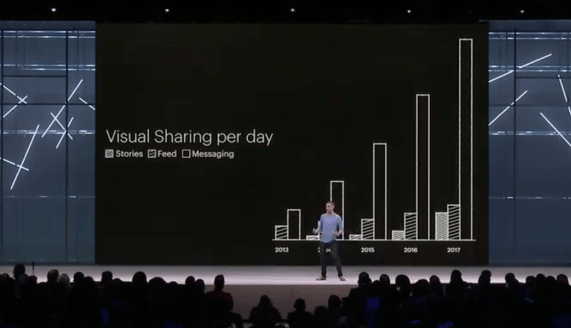
Facebook CPO Chris Cox at F8 2018 charts the rise of Stories that will see the format surpass feed sharing in 2019

Unlike text, which requires pre-meditated reflection that can be daunting to some, Stories are point and shoot. They don’t even require a caption. Sure, if you’re witty or artistic you can embellish them with all sorts of commentary and creativity. They can be a way to project your inner monologue over the outside world. But the base level of effort necessary to make a Story is arguably less than sharing a status update. That’s helped Stories rocket to more than 1.3 billion daily users across Facebook’s apps and Snapchat.

The problem, at least for Facebook, is that monetizing the News Feed with status-style ads was a lot more straightforward. Those ads, which have fueled Facebook’s ascent to earning $13 billion in revenue and $5 billion in profit per quarter, were ostensibly old-school banners. Text, tiny photo and a link. Advertisers have grown accustomed to them over 20 years of practice. Even small businesses on a tight budget could make these ads. And it at least took users a second to scroll past them — just long enough to make them occasionally effective at implanting a brand or tempting a click.
Stories, and Stories ads, are fundamentally different. They require big, tantalizing photos at a minimum, or preferably stylish video that lasts five to 15 seconds. That’s a huge upward creative leap for advertisers to make, particularly small businesses that’ll have trouble shooting that polished content themselves. Rather than displaying a splayed out preview of a link, users typically have to swipe up or tap a smaller section of a Story ad to click through.

And Stories are inherently skippable. Users have learned to rapidly tap to progress slide by slide through friends’ Stories, especially when racing through those with too many posts or that come from more distant acquaintances. People are quick with the trigger finger the moment they’re bored, especially if it’s with an ad.
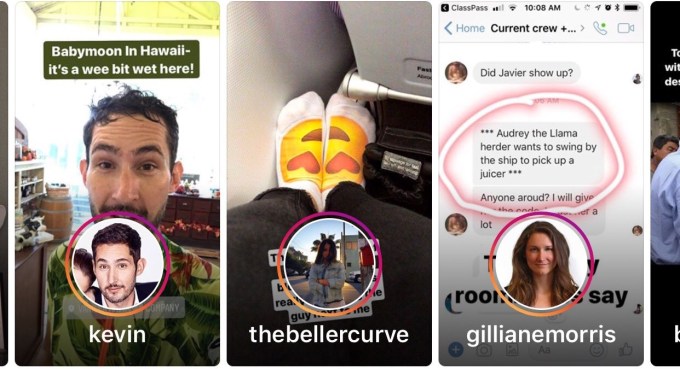
A new type of ad blindness has emerged. Instead of our eyes glazing over as we scroll past, we stare intensely searching for the slightest hint that something isn’t worth our time and should be skipped. A brand name, “sponsored” label, stilted product shot or anything that looks asocial leads us to instantly tap past.

This is why Facebook COO Sheryl Sandberg scared the hell out of investors on the brutal earnings call when she admitted about Stories that, “The question is, will this monetize at the same rate as News Feed? And we honestly don’t know.” It’s a radically new format advertisers will need time to adopt and perfect. Facebook had spent the past year warning that revenue growth would decelerate as it ran out of News Feed ad inventory, but it’d never stressed the danger as what it was: Stories. That contributed to its record-breaking $120 billion share price drop.

The shift from News Feed ads to Stories ads will be a bigger transition than desktop ads to mobile ads for Facebook. Feed ads looked and worked identically, it was just the screen around them changing. Stories ads are an entirely new beast.

Stories ads are a bigger shift than web to mobile

There is one familiar format Stories ads are reminiscent of: television commercials. Before the age of TiVo and DVRs, you had to sit through the commercials to get your next hit of content. I believe the same will eventually be true for Stories, to the tune of billions in revenue for Facebook.

Snapchat is cornered by Facebook’s competition and desperate to avoid missing revenue estimates again. So this week, it rolled out unskippable vertical video ads it actually calls “Commercials” to 100 more advertisers, and they’ll soon be self-serve for buyers. Snap first debuted them in May, though the six-second promos are still only inserted into its longer-form multi-minute premium Shows, not user-generated Stories. A Snap spokesperson said they couldn’t comment on future plans. But I’d expect its stance will inevitably change. Friends’ Stories are interesting enough to compel people to watch through entire ads, so the platform could make us watch.
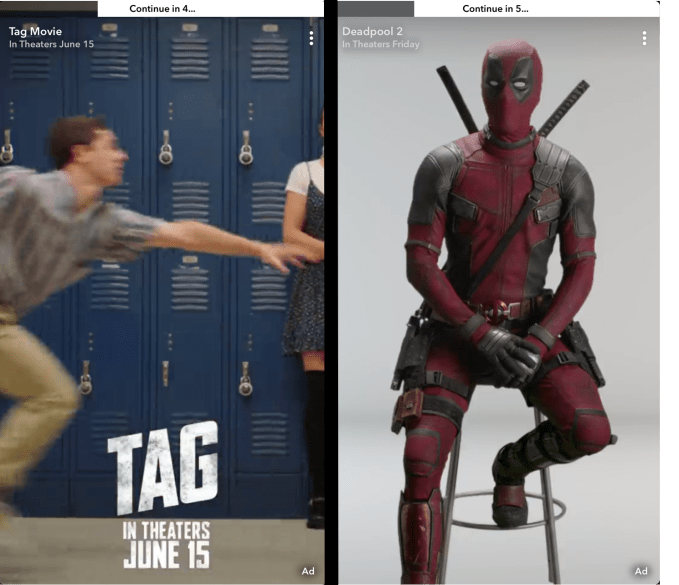
Snapchat is desperate, and that’s why it’s already working on unskippable ads. If Facebook’s apps like Instagram and WhatsApp were locked in heated battle with Snapchat, I think we’d see more brinkmanship here. Each would hope the other would show unskippable ads first so it could try to steal their pissed-off users.

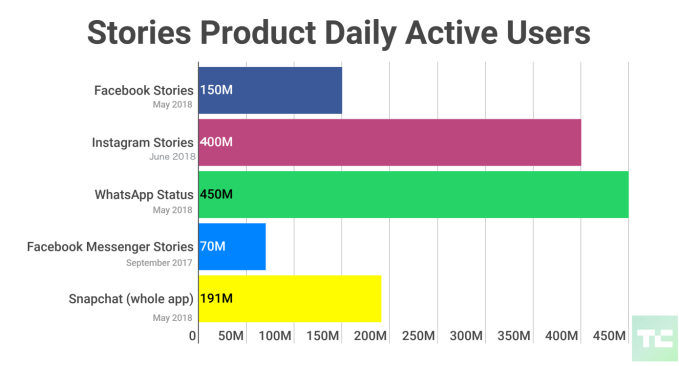
But Facebook has largely vanquished Snapchat, which has seen user growth sink significantly. Snapchat has 191 million daily users, but Facebook Stories has 150 million, Messenger Stories has 70 million, Instagram Stories has 400 million and WhatsApp Stories (called Status) leads with 450 million. Most people’s friends around the world aren’t posting to Snapchat Stories, so Facebook doesn’t risk pushing users there with overly aggressive ads, except perhaps amongst U.S. teens.

Instagram’s three-slide Stories carousel ads

That’s why I expect we’ll quickly see Facebook start to test unskippable Stories ads. They’ll likely be heavily capped at first, to maybe one to three per day per user. Facebook took a similar approach to slowly rolling out auto-play video News Feed ads back in 2014. And Facebook’s apps will probably only show them after a friend’s story before your next pal’s, in-between rather than as dreaded pre-rolls. Instagram already offers carousel Stories ads with up to three slides instead of one, so users have to tap three times to blow past them.

An Instagram spokesperson told me they had “no plans to share right now” about unskippable ads, and a Facebook spokesperson said “We don’t have any plans to test unskippable stories ads on Facebook or Instagram.” But plans can change. A Snap spokesperson noted that unlike a full 30-second TV spot, Snapchat’s Commercials are up to six seconds, which matches an emerging industry trend for mobile video ads. Budweiser recently made some six-second online ads that it also ran on TV, showing the format’s reuseability that could speed up adoption. For brand advertisers not seeking an on-the-spot purchase, they need time to leave an impression.

By making some Stories ads unskippable, Facebook’s apps could charge more while making them more impactful for advertisers. It would also reduce the creative pressure on businesses because they won’t be forced to make that first split-second so flashy so people don’t fast-forward. Employing unskippable ads could also create an incentive for people to pay for a hypothetical ad-free Facebook Premium subscription in the future.

If Facebook makes the Stories ad format work, it has a bright future that contrasts with the doomsday vibes conjured by its share price plummet. Facebook has more than 5X more (duplicated) Stories users across its apps than its nearest competitor Snapchat. The social giant sees libraries full of Stories created each day waiting to be monetized.

Viacom acquires Gen Z digital media company AwesomenessTV

Viacom today confirmed it’s acquiring digital media company AwesomenessTV, whose network reaches 158 million subscribers and approximately 300 million monthly views. The news follows a report from earlier this week that said the two were in talks about an acquisition, which priced the deal at “well below $300 million,” according to Variety.

Viacom did not confirm the deal terms, but an under $300 million price point would be less than half of AwesomenessTV’s previous $650 million valuation, cited by Bloomberg. [update: The Hollywood Reporter pegs the price at $25M + debt]

Prior to this, AwesomenessTV was majority owned by Comcast/NBCUniversal which has a 51 percent stake in the company; Hearst and (TechCrunch parent company by way of Oath), Verizon, are minority shareholders with 24.5 percent stakes. When Verizon acquired its stake two years ago, it spent around $159 million, which valued the business then at the $650 million price point, or double its valuation at the time Hearst invested in 2014.

“Awesomeness has done an incredible job building their brand into a digital media powerhouse for today’s most sought-after and hard-to-reach youth audiences,” said Kelly Day, President of Viacom Digital Studios and former Chief Business Officer of AwesomenessTV, in a statement about the deal. “The team brings strong digital expertise, deep connections with top talent and influencers, a world-class television and film studio, and a robust branded content team and creative agency that will accelerate the growth and scale of Viacom Digital Studios.”

Viacom’s interest in the property has to do with its ability to reach young viewers – specifically “Gen Z” viewers who are growing up watching YouTube, not traditional TV. AwesomenessTV has reach into this market by way of its 158 million total subscribers and over 6 million YouTube subscribers.

Viacom sees its youth focus as a natural fit that falls in between its younger Nickelodeon and older MTV audiences.

AwesomenessTV’s studio has put out Emmy-winning content, and has developed a library of over 200 hours of long-form TV series and feature films, which it brings to Viacom. It also has connections with those in the digital-native talent and influencer space of value. And it has established relationships with advertisers catering to this youth market, including Hollister, Gatorade, Invisalign, and Kraft, which Viacom took into consideration when making this deal.

Following the deal’s close, AwesomenessTV will be integrated into Viacom’s Digital Studios division led by president Kelly Day, while its existing CEO Jordan Levin will depart. Levin will remain during a transition period only, we understand. But a CEO is no longer needed as AwesomenessTV will not operate as a standalone entity.

AwesomenessTV was co-founded by Brian Robbins, who currently serves as President of Paramount Players at Viacom, and Joe Davola. Robbins connection likely helped to spark the talks, sources had earlier told Variety.

Viacom seemed an ideal suitor for the business, given its interest in digital video/influencer space, which it has acted on before with its February acquisition of the video creator conference VidCon, and its acquisition of the influencer marketing firm Whosay.

The news of the deal also follows the high-profile closure of one of AwesomenessTV partners’ efforts in the streaming space: Verizon’s go90. Verizon had been working with AwesomenessTV to develop short-form original programming for its misguided streaming service go90, which failed to take off and is shutting down for good this month.

Russian hackers already targeted a Missouri senator up for reelection in 2018

A Democratic senator seeking reelection this fall appears to be the first identifiable target of Russian hacking in the 2018 midterm race. In a new story on the Daily Beast, Andrew Desiderio and Kevin Poulsen reported that Democratic Missouri Senator Claire McCaskill was targeted in a campaign-related phishing attack. That clears up one unspecified target from last week’s statement by Microsoft’s Tom Burt that three midterm election candidates had been targeted by Russian phishing campaigns.

Russian Election Interference

The report cites its own forensic research in determining the attacker is likely Fancy Bear, a hacking group believed to be affiliated with Russian military intelligence.

“We did discover that a fake Microsoft domain had been established as the landing page for phishing attacks, and we saw metadata that suggested those phishing attacks were being directed at three candidates who are all standing for elections in the midterm elections,” Burt said during the Aspen Security Forum. Microsoft removed the domain and noted that the attack was unsuccessful.

Sen. McCaskill confirmed in a press release that she was targeted by the attack, which appears to have taken place in August 2017:

Russia continues to engage in cyber warfare against our democracy. I will continue to speak out and press to hold them accountable. While this attack was not successful, it is outrageous that they think they can get away with this. I will not be intimidated. I’ve said it before and I will say it again, Putin is a thug and a bully.

TechCrunch has reached out to Sen. McCaskill’s office for additional details on the incident. McCaskill, a vocal Russia critic, will likely face Republican frontrunner and Trump pick Josh Hawley this fall.

Amazon may soon let you collaborate with others on Wish Lists

Amazon may soon be adding a feature consumers have wanted for years: collaborative wish lists. A number of people using Amazon.com and its mobile app recently spotted the option to “invite others” to their wish lists. This offers a URL that can be shared via text messages, email, social apps and more. Once clicked, the invitees can then both add and remove wish list items, alongside the wish list’s original owner.

The feature, while relatively minor, is something Amazon shoppers have been clamoring for. Parents want to be able to co-manage wish lists for their kids, while others – like friends, couples, party planners, family and friends – have also wanted to team up on lists of gift ideas for special occasions, such as birthdays, holidays, and various celebrations.

But there’s been some confusion over whether the feature was something Amazon was only testing, or if it was in the early stages of a rollout to all users.

Amazon declined to comment on its plans specifically, but did tell us this is a test with a “small number of customers.”

As one report from MacRumors noted, there are some Wish List features not everyone has, even if they’ve been opted in to the new collaborative lists test. For instance, some people will also see a conversation icon on the right side of the list’s page that allows list members to discuss items on the list with one another. Another ellipsis icon lets the original list creator manage the list’s membership.

So far, the feature has been spotted on the Amazon.com desktop and mobile website, and on iOS but not Android. It’s common for Amazon to launch new features on iOS first, however. That’s the case with the recent debut of Part Finder, which has launched publicly, but only on iOS to start.

Image credit: MacRumors

Magic Leap details what its mixed reality OS will look like

Magic Leap just updated its developer documentation and a host of new details and imagery are being spread around on Reddit and Twitter, sharing more specifics on how the company’s Lumin OS will look like on their upcoming Magic Leap One device.

It’s mostly a large heaping of nitty-gritty details, but we also get a more prescient view into how Magic Leap sees interactions with their product looking and the directions that developers are being encouraged to move in. Worth noting off the bat that these gifs/images appear to be mock-ups or screenshots rather than images shot directly through Magic Leap tech.

Alright, first, this is what the Magic Leap One home screen will apparently look like, it’s worth noting that it appears that Magic Leap will have some of its own stock apps on the device, which was completely expected but they haven’t discussed much about.

Also worth noting is that Magic Leap’s operating system by and large looks like most other operating systems, they seem to be well aware that flat interfaces are way easier to navigate so you’re not going to be engaging with 3D assets just for the sake of doing so.

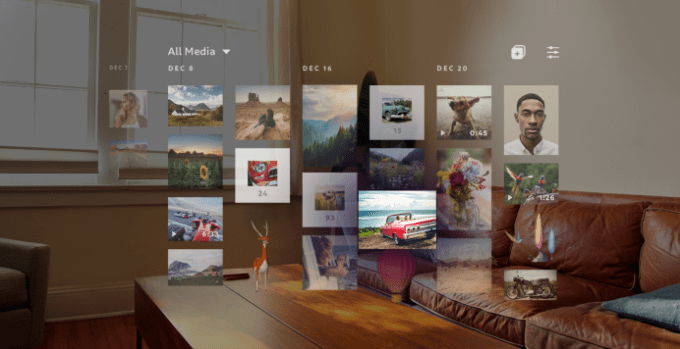
Here’s a look at a media gallery app on Magic Leap One.

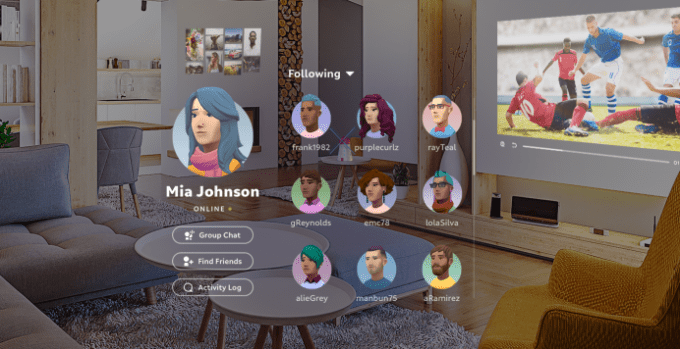
Here’s a look at an avatar system.

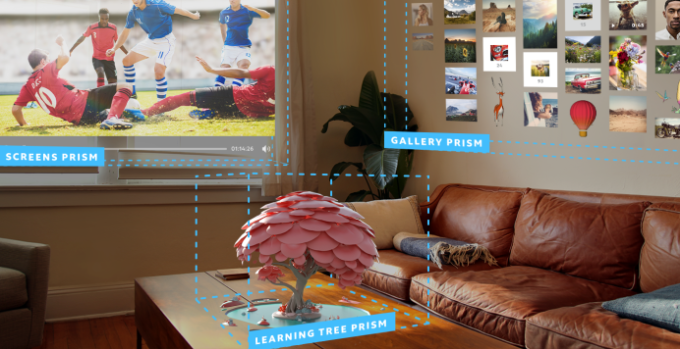
The company seems to be distinguishing between two basic app types for developers: immersive apps and landscape apps. Landscape apps like what you see in the image above, appear to be Magic Leap’s version of 2D where interfaces are mostly flat but have some depth and live inside a box called a prism that fits spatially into your environment. It seems that you’ll be able to have several of these running simultaneously.

Immersive apps, on the other hand, like this game title, DrGrordbort— which Magic Leap has been teasing for years — respond to the geometry of the space that you are in and is thus called an immersive app.

Here’s a video of an immersive experience in action.

Make your own derpy gravity defying driving game using this #Magicleap developer lesson in #Unity! ?? https://t.co/P70P4kCtvG pic.twitter.com/H4VGXXVPTN

— Giant Space Turtle (@GST_naomi) July 26, 2018

Moving beyond apps, the company also had a good deal to share about how you interact with what’s happening in the headset.

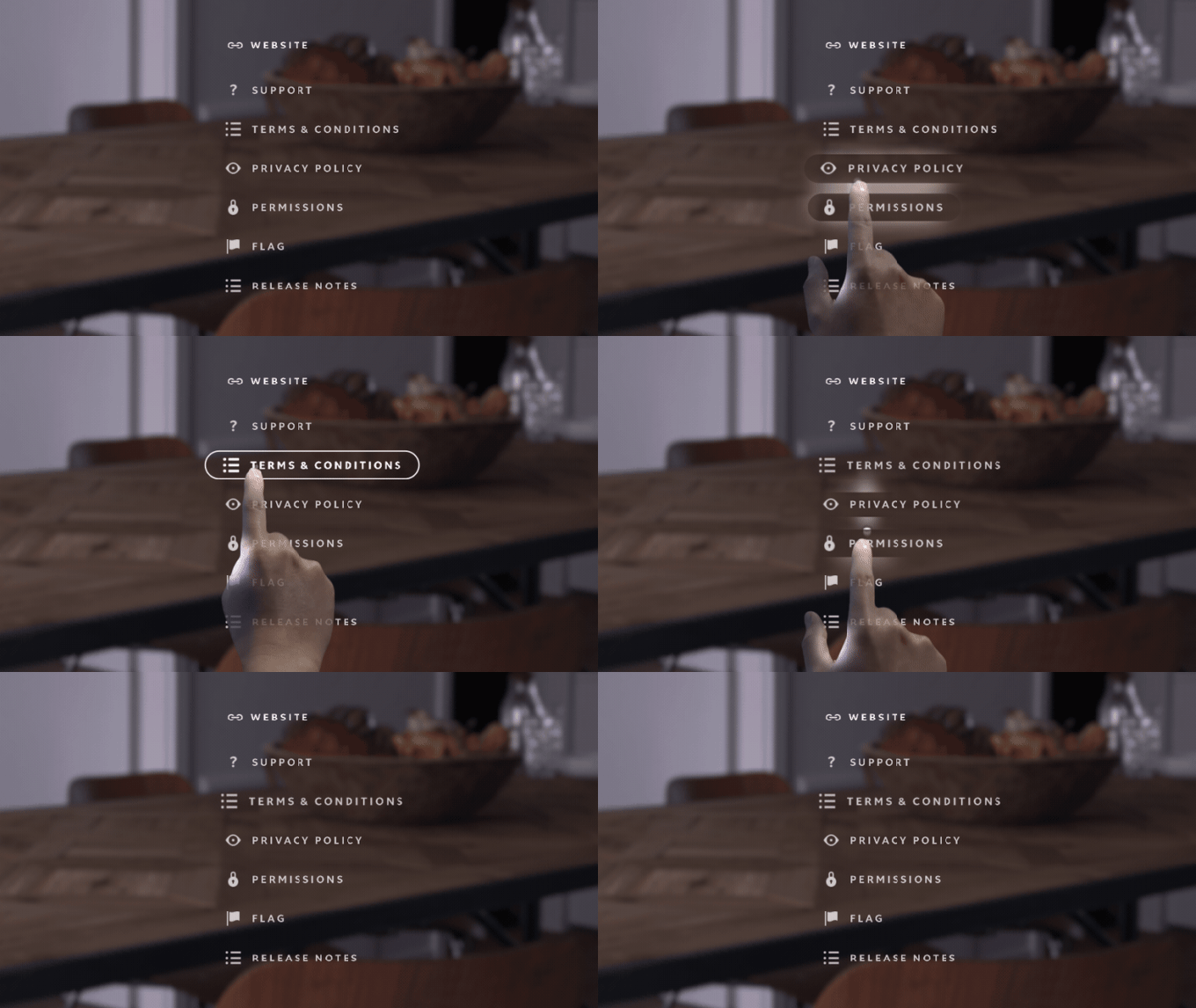
We got a look at some hand controls and what that may look like.

When it comes to text input, an area where AR/VR systems have had some struggles, it looks like you’ll have an appropriate amount of options. Magic Leap will have a companion smartphone app that you can type into, you can connect a bluetooth keyboard and there will also be an onscreen keyboard with dictation capabilities.

One of the big highlights of Magic Leap tech is that you’ll be able to share perspectives of these apps in a multi-player experience which we now know is called “casting,” apps that utilize these feature will just have a button that you can press to share an experience with a contact. No details on what the setup process for this looks like beyond that though.

Those are probably the most interesting insights, although there’s plenty of other stuff in the Creator Portal, but also here are a few other images to keep you going.

It really seems like the startup is finally getting ready to showcase something. The company says that its device will begin shipping this summer and is already in developer hands. Based on what Magic Leap has shown here, the interface looks like it’ll feel very familiar as opposed to some other AR interfaces that have adopted a pretty heavy-handed futuristic look.

Anchor opens a Manhattan studio where people can podcast for free

One of the best things about podcasting is the low barrier of entry. Anyone with a computer, internet connection and a little know-how can launch one. It’s a wonderfully democratized medium. The downside, of course, is that most of them sound terrible. Just really, really awful. Apps are overrun with tinny, Skype recordings.

Anchor, the New York based startup behind the podcast editing app of the same name, is helping change that, one small show at a time. The company is opening up its Manhattan-based studio to a handful of podcasters later this summer through an online form. The startup says it originally developed the studio for in-house shows, but “After recording a few episodes and hearing the results, we realized that this space might be useful for others, too. So we decided to open the space up to members of the local podcasting community, too, and the Anchor Podcast Lab was born.”

Hosts will get access to a small studio with three mics and an iPad. Once finished, recorded files will be uploaded to their Anchor account for editing. Anchor is offering that all up for free, and it seems that users will still own their content. For now, at least, it appears to mostly be a clever little promotional tool for the company’s app.

Anchor says it’s also looking to expand into more cities at some point. Before they do, however, someone can probably make a pretty penny offering up a WeWork-style studio to podcasters looking to step up their game. Strike while the podcasting iron is hot. 

You can sign up to use the studio here.

1 week until the deadline for Disrupt SF 2018’s Hackathon + new sponsor prizes

Are you a hacking speed demon of incomparable skill? Then we want you to submit your best hack to the Virtual Hackathon going down at TechCrunch Disrupt San Francisco 2018 on September 5-7. But you need to chug Red Bull like never before, because this is the last week you can submit your hack. The deadline is August 2, so no matter where you are in the world, get coding and submit your hack right here. C’mon, show us your mad skills.

Here’s how the Virtual Hackathon works. We’ve recruited some awesome judges — including a few from Pinterest and Slack — and they’ll scrutinize and score all submitted hacks. Based on the quality of the idea, technical implementation of the idea and the product’s potential impact, the judges will score each hack on a scale of 1-5.

The 100 top-scoring teams win up to five Innovator Passes to Disrupt SF 2018 for the members of their team. The top 30 teams move forward to the semi-finals and demo their hacks at Disrupt SF 2018. The top 10 semi-finalists will step onto The Next Stage to demo their product to the world. The “Best in Show” team will win a grand prize of $10,000 and be crowned TC Disrupt Virtual Hackathon’s first champion.

Of course, our Hackathon is famous for interesting hack contests from our sponsors, and the Virtual Hackathon has many additional thousands of dollars in cash and prizes on the line. Not to mention some wicked cool challenges from Sony Pictures and United Airlines, BYTON, TomTom, Viond, Visa, HERE Mobility and Amazon. Check them out and jump on in!

You have no time to waste if you want to participate in our first Virtual Hackathon and have a shot at free passes to TechCrunch Disrupt San Francisco 2018 on September 5-7 — and a whole lot more. The deadline for submitting your hack is August 2. That’s just one week away, so sign up today.

Now we’re thrilled to tell you about this contest sponsored by Novartis .

Novartis

The challenge: Help us empower heart failure patients and save lives!

Heart failure is a chronic debilitating and potentially life-threatening disease affecting 26 million people worldwide. It is one of the most difficult and chronic heart diseases to manage and the biggest cause of hospital admissions in adults aged over 65 in the Western world (Source: Heart Failure). As a result, treatment costs, including hospitalizations, are estimated at $108 billion a year worldwide. About 25 percent of patients die within a year of diagnosis and 50 percent within five years (Source: CDC and WHO).

What Novartis is looking for is a digital solution to help better monitor, manage and even predict worsening symptoms of heart failure. After a patient is diagnosed with heart failure, there are very few resources available to easily and unobtrusively monitor their heart health over time. Adherence to therapy and lack of health interventions are major reasons why patients’ health often deteriorates rapidly after a diagnosis. This solution should therefore drastically reduce the number of hospital re-admissions and deaths following an initial diagnosis.

Our challenge to you

Help us reimagine medicine by using your creativity and tech skills to develop a tool that easily captures important cardiovascular vitals and monitors symptom progression, empowering patients to detect potential problems earlier and seek treatment sooner. Novartis is looking for accessible, affordable and easy to use technologies that can seamlessly integrate into the life of a patient who has recently been diagnosed with heart failure. Use of personal digital devices (smartphones, smartwatches, etc.), telemedicine and innovative patient engagement are encouraged.

Novartis is not looking for diagnostic devices that (a) is not a standard consumer device (e.g. a non-commercial wearable) and (b) increases the burden and involvement of a patient in monitoring their disease.

What to submit?

  • An elevator pitch (50 words or less)
  • An awesome pitch deck (max 10 Slides)

Consider including the following:

  • Vision and value proposition
  • Problem being solved
  • Description of solution
  • The product (description of the technology)
  • Business model
  • Traction to date and roadmap to scale
  • The team
  • How will winning the Novartis TechCrunch Hackathon help you?
  • Link to your website (optional)
  • Additional information (optional)
  • Demo of product
  • Logo and other marketing materials

Things to think about:

  • Passive data collection
  • Ease of use; noninvasive
  • Software/tool that integrates with diffusive devices
  • Measuring health status and change-over-time, specifically health deterioration
  • Capturing shortness of breath (dyspnea) and respiratory rate
  • Capturing body fluid retention (edema)
  • Capturing physical activity, changes in energy and fatigue
  • Capturing heart vitals (bpm, arrhythmia, EKG)
  • Affordable for the general population
  • Not a diagnostic tool

Have you been working on something truly innovative, but started before the hackathon began? We still want to see what you’ve been cooking up. Submit your project to Devpost regardless of when you started working on it. We’ll be awarding up to $30,000 in prizes, including TWO first prizes – one for the hackathon challenge and another for our “Extended Innovation Challenge” (for teams that have worked on their solution before the hackathon started on June 5, 2018). Three more prizes will be awarded to the runner-up teams.

The top five teams will be invited to a pitch competition, live at the Novartis booth during TechCrunch Disrupt SF 2018. They will be judged by a panel of esteemed healthcare industry veterans and there will be a single Grand Prize (detailed below) awarded to the overall best team, which will be announced and awarded on the main TechCrunch stage.

Prizes:

First Prize – Novartis Hackathon Challenge: $12,000

First Prize – Novartis Extended Innovation Challenge: $12,000

Second Prize: $3,000

Third Prize: $2,000

Fourth Prize: $1,000

Grand Prize:

A validation study (where appropriate), dedicated Novartis mentors, access to Novartis data lakes, free space and use of fabrication equipment, frequent encounters with industry leaders and investors through events, office hours, and networking opportunities.

To contact our challenge administrators at HITLAB send an email to: [email protected].

MoviePass borrowed $5M to end yesterday’s outage

More bad news for subscription movie ticket service MoviePass, which acknowledged yesterday that there was an unidentified issue preventing people from using their MoviePass credit cards to get tickets.

A regulatory filing from parent company Helios & Matheson offers more insight about what happened. The filing (first spotted by Business Insider) announces a “demand note” of $6.2 million, including $5 million in cash that the company borrowed. It goes on to explain:

The $5.0 million cash proceeds received from the Demand Note will be used by the Company to pay the Company’s merchant and fulfillment processors. If the Company is unable to make required payments to its merchant and fulfillment processors, the merchant and fulfillment processors may cease processing payments for MoviePass, Inc. (“MoviePass”), which would cause a MoviePass service interruption. Such a service interruption occurred on July 26, 2018.

In other words, it looks like MoviePass wasn’t able to pay one of its service providers, which led to the outage. In order to make those payments, it borrowed $5 million.

This doesn’t exactly inspire confidence in MoviePass’ finances. A Helios & Matheson filing from earlier this month suggested that the company was looking to raise up to $1.2 billion in equity and debt financing to fund MoviePass’ operations and growth.

Meanwhile, although the service is best-known for offering access to unlimited movie tickets for $9.95 per month, the specifics of the pricing model have been changing pretty frequently.

Disney and Fox shareholders give acquisition the green light

With Comcast officially out of the way, Disney’s buyout of 21st Century Fox assets just took another major step toward reality. Shareholders from both mega media companies have approved the $71.3 billion deal.

In a lovely bit of classic media performance art, shareholders from both boards took separate meetings at the New York Hilton this morning to vote on the deal.

In an interview with Variety, Fox general counsel called the deal a “transformative transaction that will enable us to unlock significant value for our stockholders.” It also means yet another major bit of major media consolidation among a withering major movie studio system, but at least the X-Men will get to fight the Avengers, I guess.

Some fun bits from these meetings, per Variety again: one shareholder at Disney said the company was overpaying for Fox, while another at Fox apparently walked up to the mic to say, “Nobody does it like Rupert Murdoch. I love Rupert Murdoch.”

I don’t know. We love who we love, I guess.

The deal has been brewing for more than half a year. Back in December, Disney offered up $52.4 billion for assets, including the 20th Century Fox movie studio, the FX network and more. Comcast helped hike up the price with a $65 billion offer back in June, but ultimately pulled out of the race a week or so back.

According to the companies, the deal is expected to close in early 2019, pending all of the standard regulatory approval.

Discovery may launch its own streaming service, too

Following Discovery Communications $14.6 billion acquisition of Scripps Networks Interactive in March, the company is now toying with the idea of launching its own direct-to-consumer service. According to remarks made by Discovery CEO David Zaslav at an industry event, AdWeek reports [paywalled], the company is considering a service with all of Discovery’s networks at a price point of $5 to $8 per month.

Whether the service would be U.S.-only has not been determined, nor did the CEO hint at any kind of timeframe for a launch.

However, Zaslav did note that he was encouraged by other newcomers in the streaming space, including the low-cost skinny bundle Philo, and AT&T’s just launched WatchTV.

Discovery’s channels today are available on a number of the over-the-top live TV services, including WatchTV, which houses 30 of its networks.

Following its merger with Scripps, the company operates four of the top five cable networks for women 25-54, the exec also said – ID, HGTV, Food Network and TLC. And it accounts for 22 to 25 percent of the U.S. female audience on any given night, he claimed. That sizable chunk of the viewing audience, plus demand for its popular fare like “Shark Week,” could drive customers to a standalone service.

However, it’s unclear if that many consumers would pay for Discovery as a standalone offering, given how competitive the streaming landscape has become these days.

Beyond the big three – Netflix, Hulu and Amazon – consumers are being asked to consider a variety of other add-ons, ranging from premium cable networks like HBO, Showtime, Starz and Cinemax, to channels’ own apps, as with CBS All Access, to streaming sports services like fuboTV.

Then there are the over-the-top live TV offerings including Sling TV, Hulu with Live TV, YouTube TV, PlayStation Vue, AT&T’s DirecTV Now and Watch TV, and Philo.

It’s possible Discovery could have some success through Amazon’s Prime Video Channels, which allow consumers to build a true a la carte service.

Amazon’s Channels today reportedly account for 55 percent of all direct-to-consumer video subscriptions, and is growing. But critics have suggested that even with Scripps, Discovery would need to pick up another company to make its offering more appealing and competitive – especially in light of industry consolidation efforts, like Disney’s Fox acquisition, and its plans to take on Netflix in streaming in 2019, as well as AT&T’s purchase of Time Warner.

With so much choice today, and the high-quality, award-winning shows appearing on services like Netflix, Discovery’s traditional cable TV fare – like reality shows, home makeovers, animal documentaries, and cooking shows – may not have enough pull to support a standalone offering.

In Argentina, venture capital surges even as the broader economy stutters

Even as the Argentine government was announcing the biggest slide in the country’s economic output in nearly a decade, technology investors in the nation’s capital are all gearing up for record fundraising years.

Three of the country’s biggest firms (which are still small by international standards) are raising new, exponentially larger funds in a sign that technology companies are showing promise despite the bleak picture painted by the broader economy in Latin America.

Leading the pack is NXTP Labs, the early-stage investor that’s developing a regional network of accelerators and seed investment funds through partnerships that extend from Mexico City to Montevideo and São Paulo up to San Francisco. Despite its regional reach, home for NXTP is Buenos Aires and it’s there that the firm began accelerating and investing in early-stage companies back in 2011.

NXTP has already had 13 exits, according to Crunchbase, and is perhaps the most mature of the crop of investment firms in the country. It’s also looking to be among the largest as it capitalizes on that track record of exits and a portfolio of investments that has raised follow-on capital of nearly half a billion dollars. 

The firm is currently knocking on doors to raise $120 million, a significant step up from its previous $38.5 million investment vehicle.

NXTP Labs isn’t the only firm based in Argentina that’s looking to significantly expand its capital under management. Jaguar Ventures, a firm that invests in both Argentina and Mexico, and Draper Cygnus, an Argentine-focused, Buenos Aires-based investment firm, has already raised roughly $30 million of the $60 million it has targeted for its new fund.

While Cygnus is very much focused on the early-stage Argentine opportunity (which makes sense given the track record of technology companies coming out of the country — and the capital behind the firm) both NXTP and Jaguar have more of a regional perspective. And Jaguar, too, is massively increasing the size of its fund.

While its first fund was only $10 million, the new one will be closer to $60 million, according to one person with knowledge of the firm’s plans.

Behind the surge of confidence in the region’s technology fortunes, despite the economic turmoil that continues to roil the region, is a growing track record of valuable companies — all with a home base in Latin America’s largest market.

And while Brazil remains the region’s undisputed economic powerhouse, there’re growing numbers of tech giants coming from Mexico, Argentina, Colombia and Chile, investors said.

As Gonzalo Costa, a co-founder of NXTP Labs wrote in an editorial for TechCrunch earlier this week:

For the first time, companies are raising rounds of $100 million plus. 99 (acquired by Didi Chuxing), Nubank and Rappi, have all raised mega rounds in the past two years. Others have raised large rounds, such as Selina and Movile, with $90 million-plus, or Auth0 (part of our portfolio), with $50 million rounds in 2018. But the increase in dollar amounts is not only driven by mega rounds. More than 30 transactions of $3 million or more happened in 2017, which is triple in amount of rounds of that figure when compared to 2016. This shows a market maturity not seen before.

Not only are companies attracting more capital, but entrepreneurs are launching companies across a dizzying array of technology verticals.

These are companies like NubiMetrics, which provides competitive analysis and data for marketplaces like MercadoLibre; or Satellogic, which is developing a network of satellites for earth observation (and raised $27 million last year); or Pago Rural, which provides financing options for farmers in Latin America (and is raising a $20 million round, according to sources).

It’s clear that venture capital and tech in Argentina (and across Latin America) is having a moment. But with a broader base of local capital, it’s possible that this moment could become a movement. And that would have a profound effect on economies around the world.