With the help of local scientists, the unincorporated community of Brandywine plans to collect its own air quality data to test the impacts of new power plants.
Category: Tech news
hacking,system security,protection against hackers,tech-news,gadgets,gaming
Climate Change’s Looming Mental Health Crisis
“As we have more natural disasters, one would expect to also have increases in those kinds of mental health consequences.”
Logitech is buying Blue Microphones
Logitech today announced its intention to acquire Blue Microphones, the hardware company behind popular podcasting microphones like the Yeti and Snowball. It’s a pretty logical acquisition, as far as these things goog –Logitech already operates in the audio space, with speakers and gaming headsets.
The acquisition of Blue would add an important dimension to that category and help the company take on a rapidly expanding space. Blue’s best known products aren’t high-end, exactly, but they’ve become the go-to choice for upstart podcasters looking to get in on the ground floor in the medium.
Heck, we’ve been known to use them from time to time for our own podcasts. The company offers higher end products for music producers, as well, and in recent years, Blue has begun dabbling in the gaming space, offering up microphone and gaming bundles.
“Logitech’s acquisition of Blue Microphones will accelerate our entry into a growing market, and offers another way for us to help bring people’s passions to life,” Logitech CEO Bracken Darrell said in a release tied to the news. “Joining with Blue is an adjacent opportunity for us – a new way to grow – with additional synergies related to our existing gaming, PC webcam and audio categories.”
Blue is being acquired for $117 million in cash. We’ve reached out to the companies to determine what the deal will mean for the Blue brand and its existing staff.
Update: In an emailed statement a company spokesperson confirmed to TechCrunch that the Blue brand is sticking around and the company’s team will be joining up with Logitech . “Logitech is delighted to welcome all Blue employees plus contractors to Logitech. The brand is also welcomed into Logitech’s broader portfolio.”
Firefox is getting a new logo (or 10)
When you think of “Firefox,” you probably think of something that looks like this:

Or, perhaps, something like this:

That logo (or some iteration between the two) has been the browser’s logo since it launched back in 2002. Its time for change, Mozilla says.
In a blog post about “evolving the Firefox brand,” Mozilla Creative Director Tim Murray outlines the company’s thinking: Firefox isn’t just one browser now. With side projects like Firefox Rocket (the company’s browser for connections with less bandwidth) and Firefox Reality (Firefox, but for virtual reality), the company is finding it needs a bit more wiggle room with its design language.
While they shared a few work-in-progress potential logos, they were quick to note that none of them are final. They might tweak things over time (and they’re asking for feedback), or just go back to the drawing board all together.
The whole thing might sound a bit up-in-the-air right now, and that’s mostly intentional — it’s still pretty early days in the process. But eventually, Firefox will be getting a new logo; or, more accurately, new logos.
The work was presented in two potential “systems,” each composed of one “Masterbrand” logo and 11 auxiliary logos. The masterbrand would be the primary one used for representing the brand as a whole, while those beneath it could each represent an individual product.
The two new “Systems” of icons:


If it’s a choice between the two systems, I like System 2 — but I’ve always liked the existing Firefox logo, and that’s the set that feels like more of an update and less of a complete replacement. It’s more “Firefox”, less just “fox.”
Firefox says the branding shift should come together “over the next few months” — so if you’re a fan of the classic logo, it’ll still be hanging around for a while.
Google snags Sony’s ‘Magic Lab’ VR guru
Google has hired Richard Marks, Sony’s Magic Lab head who was behind much of the company’s VR efforts, to a position in its Advanced Technology and Projects group, VentureBeat reports.
Google confirmed the hire to TechCrunch, sending along a statement from ATAP head Dan Kaufman. “ATAP is at the intersection of science and application where our goal is to solve significant problems and close the gap between what if and what is. We’re super excited about Richard joining the senior team and look forward to his contributions.”
According to LinkedIn, Marks spent the last 19 years at Sony, including time as a research fellow while getting his doctorate at Stanford. Marks has been the public face of Sony’s virtual reality efforts throughout the development of the company’s virtual reality tech, but has also worked on some of the computer vision tech behind other PlayStation products.
The Magic Lab, which Marks ran, was devoted to researching gaming technologies for future generation hardware and software. One of the big projects to emerge from the group was called “Project Morpheus,” a precursor for what would later be called PlayStation VR.
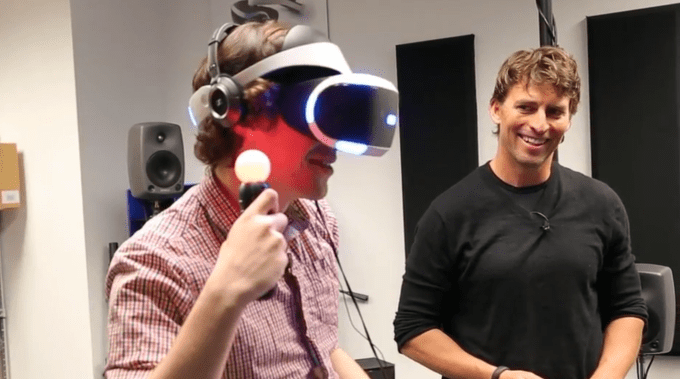
While Sony was quick to express an interest in virtual reality technologies and publicly debut its experiments with PS VR years before its 2016 launch, the technology platform has been facing an uncertain future as headset sales have failed to meet expectations.
The PlayStation VR headset debuted as a cheaper alternative to headsets from Oculus and HTC that debuted at prices that were hundreds of dollars more expensive, but after aggressive price slashing from Oculus moved hardware margins downwards across the board, the console maker seems to have had a tougher time distinguishing its efforts. Also, while it had appeared that Sony’s efforts were arriving ahead of a current-generation Xbox VR play, the company announced that it would not be pursuing a virtual reality headset for the Xbox One X, though that was initially a selling point of the more powerful system.
It’s unclear where exactly Marks will be directing his attention at Google within ATAP, though the company certainly has plenty of efforts in the AR/VR and gaming spaces that would benefit from his experience.
Newly legal 3D-printed gun blueprints targeted by state lawsuits
Hot on the heels of the effective legalization of 3D models used to print firearm components, 21 states have filed a joint lawsuit against the federal government, alleging not only that decision is dangerous but also that it’s illegal for a number of reasons. But the lawsuit may backfire via the so-called Streisand Effect, further entrenching the controversial technology.
Earlier this month brought the news that the U.S. government dropped its case against Cody Wilson and his companies dedicated to the proliferation of 3D models of firearm parts. There are still restrictions on how guns can be made and sold, but the files containing 3D data and allowing people to print components seem to have been determined not to fall under those rules.
This was unwelcome news for those in favor of stricter gun control laws, a group apparently including the attorneys general of 21 states. Bob Ferguson, AG for Washington, announced that his team would be leading a lawsuit intended to block the federal actions that legalized this particular form of data.
“These downloadable guns are unregistered and very difficult to detect, even with metal detectors, and will be available to anyone regardless of age, mental health or criminal history. If the Trump Administration won’t keep us safe, we will,” he said in a press release issued today.
They allege that the administration needs the Defense Department to sign off on the decision, and that Congress needed to be notified 30 days in advance. The decision is also held (owing to a lack of on-record citations or consultations) to be “arbitrary and capricious,” and thus illegal under the Administrative Procedure Act.
The Tenth Amendment also gives states the right to regulate firearms, and the filers say that the federal action deprives them of this right and is therefore unconstitutional.
That’s all well in order, but the danger posed by these files is overestimated, as is the ability of the government, state or federal, to curtail their distribution. If this lawsuit is successful, it will have little or no effect on 3D printed guns at all.
“The status quo – which currently ensures public safety and national security by prohibiting publication of firearm design files on the Internet – should be maintained,” reads a letter sent from a number of AGs to Secretary of State Mike Pompeo and AG Jeff Sessions.
At the risk of dipping into an extremely charged debate and sensitive political topic (I’ve added the “Opinion” tag just in case), the status quo does no such thing. It must be said that if effective gun control is the goal, there are far more important steps to pursue. Loopholes abound in existing regulations, for instance gun show purchases of unregistered firearms and “80 percent lowers,” which are a quite legal method for creating them.
Furthermore, any attempt to remove something from the internet is doomed to failure, as we have seen again and again, often enough that the phenomenon has its own nickname, the Streisand Effect. Workarounds for illegal content are numerous and effective, and presumably the type of person interested in printing their own gun will not be shy about using a VPN or torrent site. If anything, a concerted effort to remove something from the internet usually causes that thing to be permanently maintained online as a sort of middle finger to the authorities. It’s not in the internet’s DNA to forget.
While it’s true that outlawing the 3D models would give prosecutors and investigators more to work with, the nefarious actors of the world haven’t been waiting with bated breath on the outcome of the previous lawsuit. Criminals, terrorists, foreign adversaries and so on in the first place don’t even need these files to obtain or create unregistered guns in the first place, nor would their being illegal deter them in the least.
The lawsuit may, it is true, tie up and possibly bankrupt Wilson and his supporters, but that’s not much of a victory and certainly doesn’t make anyone safer. Unfortunately this particular demon isn’t going back in the box.
Cult classic indie game La-Mulana finally gets a proper sequel
The sequel to the legendary, and legendarily difficult, indie sleeper hit La-Mulana has finally been released, and all gamers with a penchant for retro-style platforming and a broad masochistic streak are encouraged to descend into its depths.
If there were a gaming achievement hall of fame, surely one of the rarest feats would be beating La-Mulana. The original game was a contemporary of the revered and influential Cave Story; both were wonderful free games made with charming retro pixel art, but beyond that the stories diverged.
While Cave Story was a relatively accessible action-adventure that took seven or eight hours to complete, La-Mulana’s tale of an archaeologist delving into the titular ruin was so deep, complex, obscure and difficult that only the truly dedicated were able to survive even the first few hours, let alone the dozens to come.
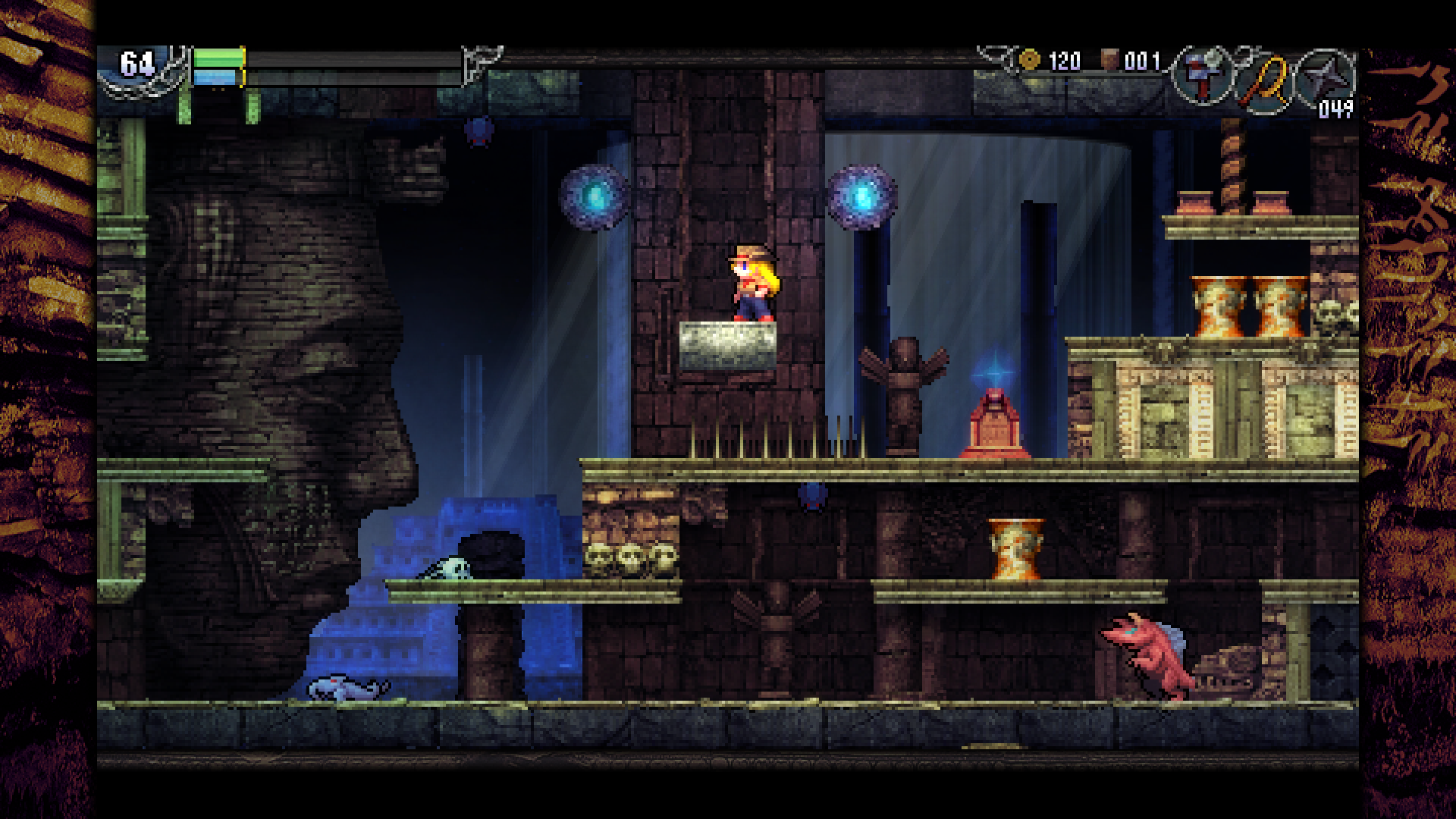
The new game goes for a sort of 32-bit look, like the 2012 remake of the original.
This gem, lovingly crafted to closely mimic the look and feel of an MSX game (though enormously expanded), received a screen-for-screen remake for the Nintendo Wii in 2012, but it wasn’t until early 2014 that the original team of three decided to make a whole new game. They raised $266,000 on Kickstarter, with an estimated delivery date of December 2015. That date slipped and slipped, but seemingly because the game they were creating was one worth taking the time to do right.
Fast-forward a few more years and here we are: La-Mulana 2 was released today. It’s substantially the same: a labyrinthine underground ruin to explore, deadly traps and monsters to avoid and maddening puzzles to solve. I’ve played the first couple of hours and from what I can tell it is true to form.
You’ll play as the daughter of the original explorer, who has arrived at the ruins to find them turned into a tourist trap — but soon it becomes clear that a twin ruin, hitherto unexplored, is wreaking havoc on the first one and must be investigated.
If this game is even half the size and depth of the original it will be well worth the $25 price tag — plus you get the warm fuzzy feeling of supporting an indie developer that’s been doing its own weird thing for 15 years or so now. Just don’t expect any hand-holding — this game is the real deal, “Nintendo hard” all the way.
It may not be up everyone’s alley, but I wanted to celebrate La-Mulana and its new sequel. I like to think of small gaming studios as startups, as indeed they are, and a big launch like this deserves recognition. It’s available right now for Windows and macOS — but I’d be surprised if we didn’t see it on Switch at least fairly soon.
MoviePass could block more big movies from its subscription service
During an all-hands meeting earlier today, MoviePass CEO Mitch Lowe reportedly informed staff that the service will bar additional big titles from its subscription service. According to a report from Business Insider, upcoming titles Christopher Robin and The Meg will be getting similar treatment as Mission: Impossible — Fallout.
The service caused an uproar among users when it barred users from seeing the latest Tom Cruise blockbuster using its app. It’s another in a string of unfortunate incidents for the service, which has fallen on rough financial times, of late. Earlier today, users were met with a blank screen when attempting to view screenings on the app. And just a few days ago, the startup borrowed $5 million to end another service outage.
On today’s call, Lowe apparently suggested that these blocks wouldn’t be the last for the company “imply[ing] the practice of not offering tickets to major movies would continue for the foreseeable future,” according to the report.
While the service would admittedly still be a bargain at $10 a month, MoviePass would lose a lot of luster if users were no longer able to see the latest films. That would join a number of new fine-print asterisks for the service, including the addition of surge pricing and other changes to the pricing structure.
We’ve reached out to MoviePass to clarify the report. Whatever the case, it’s starting to look like the service that was once considered too good to be true is precisely that.
Gillmor Gang: Backflip
The Gillmor Gang — Esteban Kolsky, Frank Radice, Michael Markman, and Steve Gillmor . Recorded live Sunday July 29, 2018. Social markets, what is notification media, the 20 percent solution.
Produced and directed by Tina Chase Gillmor @tinagillmor
MoviePass is down again
After the revelation that MoviePass borrowed $5 million to keep its service up and running last week, things aren’t looking good.
MoviePass subscribers, myself included, were met on Monday with a blank screen where their choice of screening should be. Navigating around dozens of theaters only shows a message that “There are no more screenings at this theater today.”
Twitter noticed too, and people are starting to sound the death knell for the beleaguered monthly movie subscription service. Some MoviePass theaters that offer e-ticketing still appear to have available showings according to Twitter users, but that doesn’t appear to be true across the board.

Plenty of companies fail, but few flail so publicly before doing so. MoviePass has dragged its subscribers on for its own apparent financial rollercoaster ride, switching pricing schemes around with bizarre frequency, adding surprise fees and suffering repeated outages.
We are very sorry to users having issues checking-in this evening. Some users have reported issues with card-based check-ins and we are working towards a fix on this technical issue. In the meantime, all e-ticketing remains fully functional.
— MoviePass (@MoviePass) July 29, 2018
On Monday, stock for MoviePass parent company Helios and Matheson Analytics (HMNY) plunged by a rather bleak 60 percent.
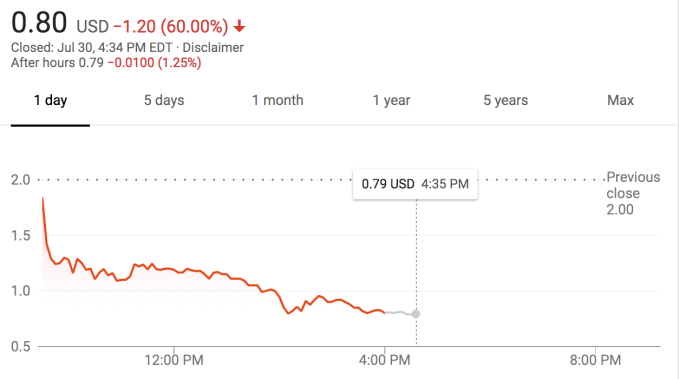
Competing services from Sinemia and AMC are moving into the space with seemingly less doomed business models, so for frequent moviegoers, that’s something to watch. Unfortunately, jumping ship from MoviePass is easier said than done, as many users have reported problems cancelling the service. (For the record, I just tried to cancel my subscription through the Android app and my own cancellation would not go through.)
Given the service’s unreliability and apparently shady cancellation practices, it wouldn’t be surprising to hear the FTC and other consumer protection groups getting involved.
Is this the end? Has MoviePass burned through its last stack of cash? Is it just a really popular day at the movies? The company hasn’t tweeted or provided any official updates yet, but if this isn’t the end, then it’s certainly near.

Uber’s self-driving trucks division is dead, long live Uber self-driving cars
Uber is shuttering its self-driving trucks unit, a beleaguered program borne out of the company’s controversial multi-million acquisition of Otto nearly two years ago.
The company said Monday that Uber Advanced Technologies Group will stop development of self-driving trucks and instead focus its efforts on self-driving cars.
“We recently took the important step of returning to public roads in Pittsburgh, and as we look to continue that momentum, we believe having our entire team’s energy and expertise focused on this effort is the best path forward,” Eric Meyhofer, head of Uber Advanced Technologies Group, said in an emailed statement.
Uber Freight, a business unit that helps truck drivers connect with shipping companies, is unaffected by this decision. Uber Freight, which launched in May 2017, is designed for vetted and approved drivers, who can use it to find nearby available loads and see destination info, distance required and payment upfront. If the drivers like what they see, they can tap to book.
Uber Freight, which started in three regions, is now available throughout the continental U.S. And it is considered a viable and promising business (and revenue opportunity) within the company. The business unit has expanded threefold in the past 15 months and has offices in San Francisco and Chicago.
“Rather than having two groups working side by side, focused on different vehicle platforms, I want us instead collaborating as one team, according to an email reviewed by TechCrunch that was sent by Meyhofer to employees. “I know we’re all super proud of what the Trucks team has accomplished, and we continue to see the incredible promise of self-driving technology applied to moving freight across the country. But we believe delivering on self-driving for passenger applications first, and then bringing it to freight applications down the line, is the best path forward. For now, we need the focus of one team, with one clear objective.”
Uber’s self-driving trucks unit is based in San Francisco, while the team dedicated to self-driving cars is located in Pittsburgh. Uber says it will pivot employees focused on self-driving trucks to other work that supports its ongoing development of self-driving technology. If there isn’t a comparable role, Uber will offer relocation to Pittsburgh or a separation package to support the transition.
Uber ATG is going to continue to investigate approaches to highway driving using the car platform, and is going to keep its relationship with truck manufacturers intact. The company may return to self-driving trucks, but only after it has developed the foundation of the self-driving system.
Uber ATG will continue its in-house development of light detection and ranging radar known as LiDAR. This technology, which would later be at the heart of a lawsuit between Uber and Waymo, measures distance using laser light to generate highly accurate 3D maps of the world around the car.
Uber’s self-driving truck efforts have been plagued by controversy since its beginning. Uber bought Otto, the self-driving trucks startup founded by former Google engineer Anthony Levandowski and three others, including Lior Ron, who was head of product at Google Maps, in August 2016 for $680 million. (Later reports suggest the actual payout might have been as low as $220 million.)
As part of the acquisition, Levandowski became head of Uber’s self-driving car research.
Two months later, the company enjoyed a moment of glory that received a lot of media attention: a self-driving truck that drove 120 highway miles along a route in Colorado with a trailer full of Budweiser.
But the buzz around the size of the Otto deal and its self-driving truck run in Colorado would soon be replaced with a different, more unwelcoming kind of attention.
Nine months after the acquisition, Uber was embroiled in a trade secrets lawsuit with Waymo, the former Google self-driving project that spun out to become a business under Alphabet. Waymo accused Levandowski of hatching a plan to use trade secrets related to Waymo’s in-house development of LiDAR tech and use it to kickstart Otto and ultimately, Uber’s own self-driving technology program.
The lawsuit, filed against Otto and its parent company Uber in February 2017, alleged patent infringement and stealing trade secrets. The lawsuit made a number of allegations specifically against Levandowski, including that he downloaded more than 14,000 confidential and proprietary files shortly before his resignation. Waymo contended that Otto and Uber were using key parts of its self-driving technology, specifically related to LiDAR.
Uber would later fire Levandowski. However, the polarizing star engineer isn’t out of the self-driving trucks game just yet. TechCrunch uncovered that Levandowski was behind Kache.ai, a self-driving trucks company that is still in stealth mode.
The case did go to trial in February 2018. Before a jury could weigh in, the two parties reached a settlement agreement. Uber agreed to not incorporate Waymo’s confidential information into their hardware and software. Uber also agreed to pay a financial settlement that includes 0.34 percent of Uber equity, per its Series G-1 round $72 billion valuation. In other words, Waymo got about $244.8 million in Uber equity.
Uber ATG has had other existential struggles in recent months. The unit has suffered a number of departures. The other three Otto founders left, including Don Burnette, who, with Paz Eshel, formerly of Battery Ventures, in April founded an autonomous vehicle company called Kodiak Robotics.
In March, and just six weeks after settling with Waymo, an Uber self-driving test vehicle was involved in a tragic fatal accident in Tempe, Ariz. Uber halted all of its autonomous vehicle operations March 19, the day after one of its vehicles struck and killed pedestrian Elaine Herzberg in the Phoenix suburb. Uber was testing its self-driving vehicles on public roads in Tempe, Ariz., where the accident occurred, as well as in Pittsburgh, San Francisco and Toronto.
Uber’s decision to shut down its self-driving trucks operation comes just a week after the company put its autonomous vehicles back on Pittsburgh’s city streets. For now, Uber’s modified self-driving Volvo XC90 vehicles will only be driven manually by humans and under a new set of safety standards that includes real-time monitoring of its test drivers and efforts to beef up simulation.
This manual-first rollout is a step toward Uber’s ultimate goal to relaunch its autonomous vehicle testing program in Pittsburgh.
Optoro raises $75 million more to make it easier for brands to manage and resell returned and excess inventory
As the economy has chugged along, so have retail sales, which last year capped their strongest year since 2014. Online sales have been especially brisk, growing 16 percent between 2016 and 2017 alone, according to the U.S. Commerce Department, which estimates that consumers spent $453.5 billion online last year.
Of course, with every booming market comes supporting cast members that benefit. Such is the case with eight-year-old, Washington, D.C.-based Optoro, which itself just rang up $75 million in new funding. A logistics company, Optoro’s software helps retailers — both online and off — more easily re-sell inventory that has been returned by customers.
That’s a big number. The overall amount of merchandise returned as a percent of total sales last year was 10 percent in 2017, according to the National Retail Federation. In dollars, that’s $351 billion.
Right now, that includes sales from big box retailers and many other “legacy” companies that allow shoppers to buy items — and return them — in their stores. But as online sales rise, so do online returns. Indeed, Optoro co-founder and CEO Tobin Moore tells the WSJ that the “return rate from e-commerce sales is two to three times the return rate of brick-and-mortar” and “sometimes higher in fashion and apparel.” And with most retailers also paying for shipping on returns — after all, a happy customer is a repeat customer — it’s a major logistics cost for these online brands.
Little wonder that Optoro, which uses data analytics and multi-channel online marketing to determine the best path for each item (ostensibly maximizing recovery and reducing environmental waste in the process) is a hit with a growing base of customers.
A growing number of investors is getting behind the company, too. Optoro’s newest round was led by Franklin Templeton Investments, but the company has now raised at least $200 million altogether, including from Revolution Growth, Generation Investment Management, Grotech Ventures and even the UPS Strategic Enterprise Fund.
Google gives Chrome the virtual reality treatment
Google is injecting a little Chrome into its VR platform, bringing the web browser to Daydream headsets, the company announced today. It’s been a long time coming considering the depths of Google’s WebVR experimentation on desktop and mobile Chrome.
The Mountain View tech giant announced it was working on this quite a while ago, back at I/O 2017.
Google has been moving pretty slowly with any big Daydream updates lately, all while Facebook’s Oculus has driven heavy news to its mobile platform thanks to new standalone hardware. Daydream rolled out its own positionally-tracked headset with Lenovo earlier this summer but a major lack of content has been the system’s biggest issue. Bringing the web to Daydream could help correct this, and directing more mobile developer attention to WebVR might be a positive move for Google as it looks to make content discovery more simple.
Last year, the company made it so that you could open WebVR content in mobile Chrome on your phone and then drop it into a Cardboard headset and check out the content, with this you’ll be able to launch inside VR, explore inside VR and then move onto something else.
Loading desktop webpages inside a VR headset doesn’t necessarily seem earth-shatteringly disruptive but there are some optimizations Google has ensured that some non-WebVR content gets special treatment including a “cinema mode” that drops videos into a special environment to keep your eyes on the content. You’ll also get incognito mode, voice search and access to your saved bookmarks.
The browser is available for Lenovo’s Mirage Solo as well as Google’s own Daydream View headset and you’ll gain access after updating Chrome on Android.
The web is largely still an untested wilderness for virtual reality that nobody is racing to conquer given headset volume is still pretty low and a lot of wind has been sucked out of VR’s sails lately. There’s a lot of interesting stuff that the web enables for virtual social environments especially and though most major powers are drawing attention to their own platforms, a platform like Chrome arriving on Daydream could start to spark some developer imagination for what’s possible.
Google’s lead lawyer moves into a global policy role
Google is promoting its top lawyer, Kent Walker, into a global policy position, CNBC reports. Walker, Google SVP and general counsel, has already been a public voice in the company’s recent privacy tangles, but will move into a formal role as senior vice president of global affairs, overseeing Google’s policy, trust and safety, corporate philanthropy and legal teams.
Last year, Walker joined Richard Salgado, Google’s Director, Law Enforcement and Information Security, to head to Capitol Hill for the first round of reckoning on big tech’s failure to mitigate political disinformation campaigns during the 2016 U.S. presidential election.
Since then, Walker has commented publicly on Google’s policies around political ad transparency and extremist content on YouTube, among other policy issues facing the company. With social platforms at an ethical crossroads globally and tech chafing at its newly forced compliance with international privacy laws, any public-facing global policy role will be very much in the spotlight in 2018 and beyond.
Google hired Walker away from eBay in 2006, where he served as the company’s deputy general counsel. Prior to his time at eBay (and AOL, prior to that), Walker was an assistant U.S. attorney with the Department of Justice.
OpenAI’s robotic hand doesn’t need humans to teach it human behaviors
Gripping something with your hand is one of the first things you learn to do as an infant, but it’s far from a simple task, and only gets more complex and variable as you grow up. This complexity makes it difficult for machines to teach themselves to do, but researchers at Elon Musk and Sam Altman-backed OpenAI have created a system that not only holds and manipulates objects much like a human does, but developed these behaviors all on its own.
Many robots and robotic hands are already proficient at certain grips or movements — a robot in a factory can wield a bolt gun even more dexterously than a person. But the software that lets that robot do that task so well is likely to be hand-written and extremely specific to the application. You couldn’t for example, give it a pencil and ask it to write. Even something on the same production line, like welding, would require a whole new system.
Yet for a human, picking up an apple isn’t so different from pickup up a cup. There are differences, but our brains automatically fill in the gaps and we can improvise a new grip, hold an unfamiliar object securely and so on. This is one area where robots lag severely behind their human models. And furthermore, you can’t just train a bot to do what a human does — you’d have to provide millions of examples to adequately show what a human would do with thousands of given objects.
The solution, OpenAI’s researchers felt, was not to use human data at all. Instead, they let the computer try and fail over and over in a simulation, slowly learning how to move its fingers so that the object in its grasp moves as desired.
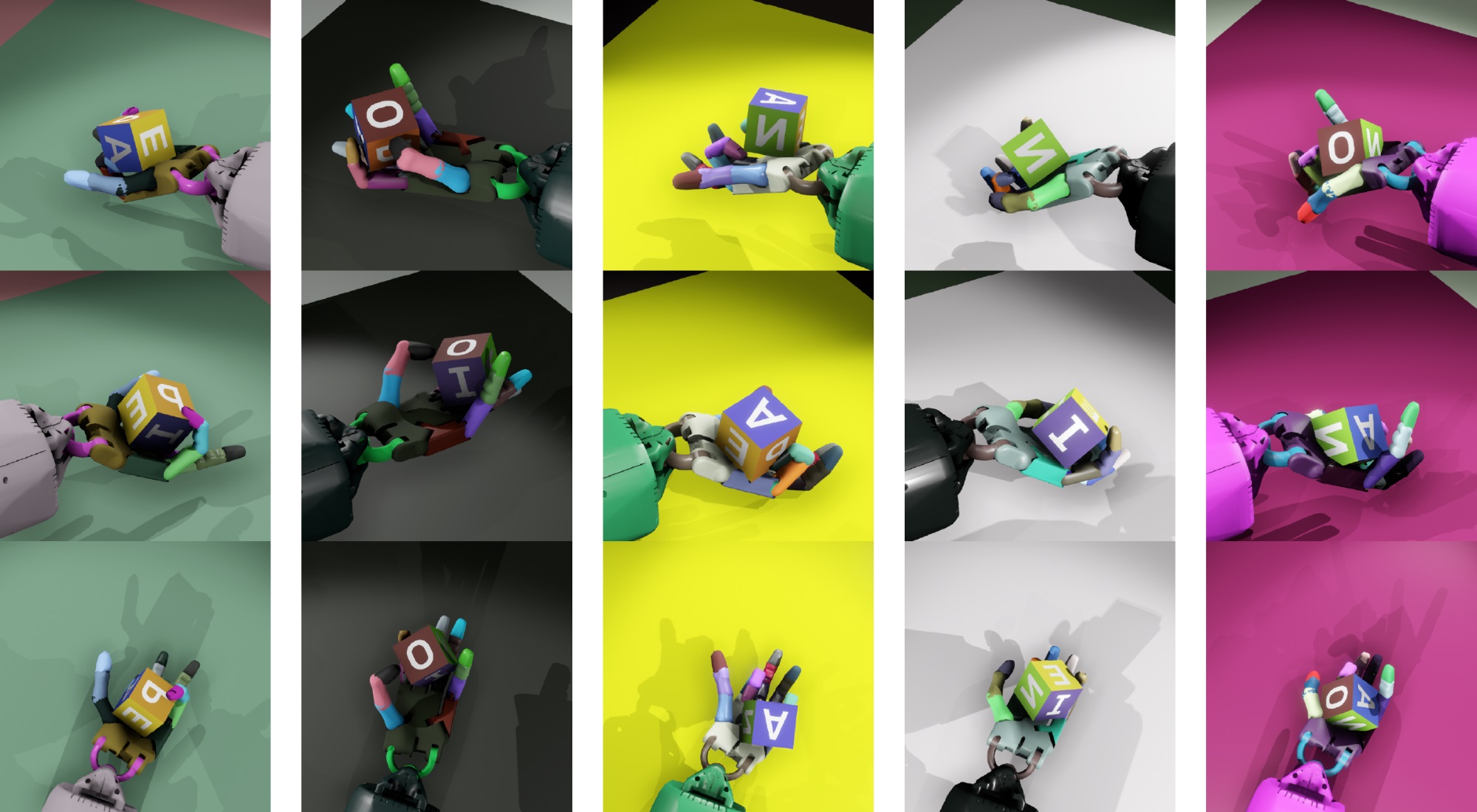 The system, which they call Dactyl, was provided only with the positions of its fingers and three camera views of the object in-hand — but remember, when it was being trained, all this data is simulated, taking place in a virtual environment. There, the computer doesn’t have to work in real time — it can try a thousand different ways of gripping an object in a few seconds, analyzing the results and feeding that data forward into the next try. (The hand itself is a Shadow Dexterous Hand, which is also more complex than most robotic hands.)
In addition to different objects and poses the system needed to learn, there were other randomized parameters, like the amount of friction the fingertips had, the colors and lighting of the scene and more. You can’t simulate every aspect of reality (yet), but you can make sure that your system doesn’t only work in a blue room, on cubes with special markings on them.
They threw a lot of power at the problem: 6144 CPUs and 8 GPUs, “collecting about one hundred years of experience in 50 hours.” And then they put the system to work in the real world for the first time — and it demonstrated some surprisingly human-like behaviors.
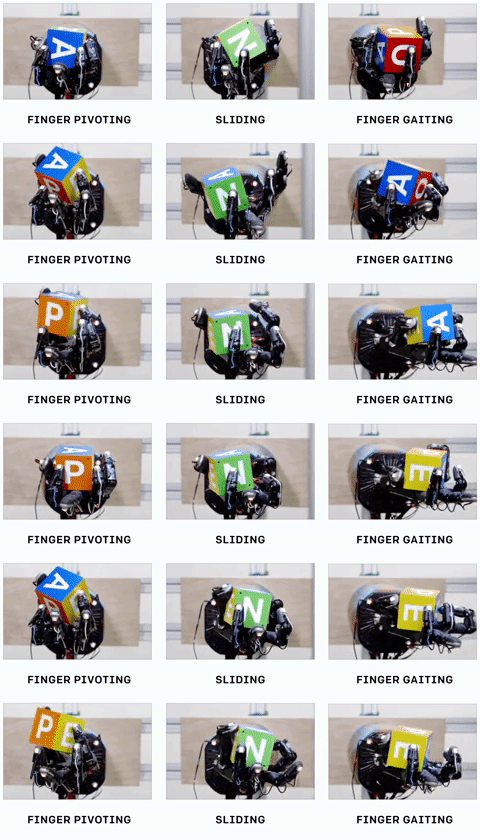 The things we do with our hands without even noticing, like turning an apple around to check for bruises or passing a mug of coffee to a friend, use lots of tiny tricks to stabilize or move the object. Dactyl recreated several of them, for example holding the object with a thumb and single finger while using the rest to spin to the desired orientation.
What’s great about this system is not just the naturalness of its movements and that they were arrived at independently by trial and error, but that it isn’t tied to any particular shape or type of object. Just like a human, Dactyl can grip and manipulate just about anything you put in its hand, within reason of course.
This flexibility is called generalization, and it’s important for robots that must interact with the real world. It’s impossible to hand-code separate behaviors for every object and situation in the world, but a robot that can adapt and fill in the gaps while relying on a set of core understandings can get by.
As with OpenAI’s other work, the paper describing the results is freely available, as are some of the tools they used to create and test Dactyl.