Google acquires GraphicsFuzz, a service that tests Android graphics drivers

Google has acquired GraphicsFuzz, a company that builds a framework for testing the security and reliability of Android graphics drivers. The news, which was first spotted by XDA Developers, comes on the same day Google announced the release of Android 9 Pie.

A Google spokesperson confirmed the news to us but declined to provide any further information. The companies also declined to provide any details about the price of the acquisition.

The GraphicsFuzz team, which consists of co-founders Alastair Donaldson, Hugues Evrard and Paul Thomson, will join the Android graphics team to bring its driver-testing technology to the wider Android ecosystem.

“GraphicsFuzz has pioneered the combination of fuzzing and metamorphic testing to yield a highly automatic method for testing graphics drivers that quickly finds and fixes bugs that could undermine reliability and security before they affect end users,” the team explains in today’s announcement. The company’s founders started their work at the Department of Computing at Imperial College London and received funding support from the U.K. Engineering and Physical Sciences Research Council and the TETRACOM EU project.

While this is obviously not the splashiest of acquisitions, it is nevertheless an important one. In the fractured Android ecosystem, graphics drivers are one of the many pieces that make a phone or tablet work — and when they don’t, it’s often immediately obvious to the user. But broken drivers also expose a phone to security exploits. GraphicsFuzz uses the same kind of fuzzing technique, which essentially throws lots of random data at a program, that’s also becoming increasingly popular in other areas of software development.

Clear for beer: Biometrics provider now enables alcohol purchases at Seahawks and Mariners games

Clear, the biometrics company you’ve probably seen at airports and at a few other prominent queues, is rolling out the capability to simultaneously verify your ID and pay for an alcoholic drink with your fingerprint. It’s only at Seattle’s CenturyLink and Safeco Fields (and only a handful of concessions stands at those), but if it’s successful you can bet we’ll be seeing more of it.

That makes it the first time in the U.S. that biometrics are used for both age check and payment, but this exception will almost certainly become less uncommon in time: Clear announced its intention to pursue the payments side of biometrics when it raised $15 million last year.

This also marks the first NFL team to partner with Clear; Seahawks fans going to home games this season will be able to use a separate Clear lane at the northwest and southwest gates. It can be quite a melee or a considerable wait getting into both venues (I’m a local), so this will almost certainly be embraced by the Clear-privileged among Seattle sports fans. Sounders games at CenturyLink, by the way, will have the same perks, as will any concerts at either venue.

After you get inside the field, you’ll have to hoof it a bit to find one of the concession stands from which Clear serves. At Safeco it’s Double Play in section 136 and Shortstop Beer in 185. At CenturyLink it’s at the Delta Sky360 Club, by sections 210 and 234.

So, it’s not exactly everywhere. But during the beer rush of halftime or the seventh-inning stretch at a good ballgame, it might be worth it to traverse a few sections and skip the line. Unfortunately, Clear doesn’t get you a discount on the outrageously priced drinks, so savor those $10 tallboys. Your wallet may stay in your pocket, but the money flies out of it just the same.

It’s a bit remarkable to me that alcohol merchants are allowed to take anything but a state-issued ID or passport — but as at the airport, Clear has been given authority to track those IDs internally and verify their authenticity and the identity of the person. Obviously the company’s success there warmed the frozen hearts of our state’s Liquor Control Board and allowed this small divergence from the status quo.

There are still plenty of Mariners games at which to test this out, and the Seahawks preseason starts Thursday, at which time the Clear lane for entry and fingerprint-powered concessions will be available to all 12s. Assuming it goes well, we can expect it to show up at other major sports venues soon.

Amazon Alexa’s new ‘Answer Update’ feature will notify you when Alexa learns something new

Amazon confirmed it’s rolling out a new feature called “Answer Update” to Alexa device users over the next week, which will notify users when Alexa learns the answer to a question the assistant didn’t know when first asked. The idea is to allow people to better take advantage of Alexa’s quickly improving Knowledge Graph – its informational database containing general knowledge facts and figures that Alexa uses to answer users’ questions.

The feature was first spotted by Voicebot, which said they were prompted to enable the feature after listening to some information a news item. Alexa then asked if the user wanted to enable “Answer Updates.”

When asked what this was, Alexa replied that she could notify the user later if she learned the answer to a question.

Typically, Alexa would have simply declined to answer the question when she didn’t know an answer, saying something like “I don’t know that, but I’m always learning,” “I can’t find the answer to the question I heard,” or “Sorry, I didn’t understand the question,” the report noted.

Amazon tells us that customers will be able to opt into the new experience, when offered, and can later choose to opt out by saying “Alexa, turn off Answer Update.”

“The Alexa service is getting smarter every day, and Answer Updates is just another way we’re continuing to expand Alexa’s Knowledge Graph,” an Amazon spokesperson said.

They also clarified the prompt would be triggered when you ask Alexa a factual question she didn’t yet know the answer to, not after listening to a news item or other information about a news item. The prompt will be offered randomly to customers.

Once you turn on Answer Updates, the feature will send you an on-device notification when Alexa learns an answer to a new question you asked previously, while the feature was enabled.

We found we were able to turn on Answer Update on our own Alexa device by saying “Alexa, turn on Answer Update.”

The assistant then responded by saying:

“Okay, if you ask me a question and I don’t know the answer, but I find out later I’ll notify you.” 

The feature is meant to offer a challenge to Google’s Knowledge Graph, which is far more developed, and gives Google Home a competitive advantage. Though Alexa has enjoyed an early lead in smart speaker market share, Google has been catching up, with some firms estimating its portion of the speaker market will grow both in the U.S. and abroad in the months ahead. Alexa needs to get better at basic Q&A and quickly.

For example, in a study reported by AdWeek last year, Google Home was found to be 6 times more likely to answer a user’s question than Amazon Alexa. The study involved asking both devices some 3,000 questions.

Answer Updates is not necessarily a fix for that problem, but it could be used as a way to reach frustrated users who expect their “smart” assistant to be a bit…well…smarter.

Facebook taps banks, but for chatbots not purchase data like Google

Backlash swelled this morning after Facebook’s aspirations in financial services were blown out of proportion by a Wall Street Journal report that neglected how the social network already works with banks. Facebook spokesperson Elisabeth Diana tells TechCrunch it’s not asking for credit card transaction data from banks and it’s not interested in building a dedicated banking feature where you could interact with your accounts. It also says its work with banks isn’t to gather data to power ad targeting, or even personalize content such as which Marketplace products you see based on what you buy elsewhere.

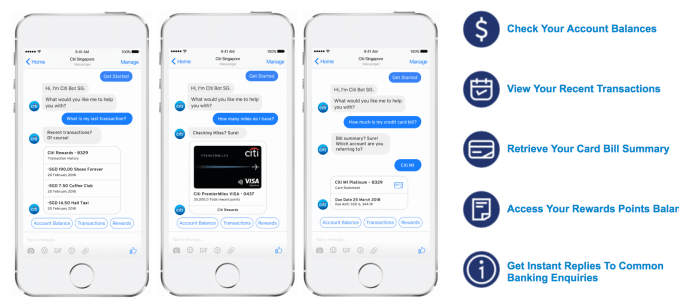
Instead, Facebook already lets Citibank customers in Singapore connect their accounts so they can ping their bank’s Messenger chatbot to check their balance, report fraud or get customer service’s help if they’re locked out of their account without having to wait on hold on the phone. That chatbot integration, which has no humans on the other end to limit privacy risks, was announced last year and launched this March. Facebook works with PayPal in more than 40 countries to let users get receipts via Messenger for their purchases.

Expansions of these partnerships to more financial services providers could boost usage of Messenger by increasing its convenience — and make it more of a centralized utility akin to China’s WeChat. But Facebook’s relationships with banks in the current form aren’t likely to produce a steep change in ad targeting power that warrants significant heightening of its earning expectations. The reality of today’s news is out of step with the 3.5 percent share price climb triggered by the WSJ’s report.

“A recent Wall Street Journal story implies incorrectly that we are actively asking financial services companies for financial transaction data – this is not true. Like many online companies with commerce businesses, we partner with banks and credit card companies to offer services like customer chat or account management. Account linking enables people to receive real-time updates in Facebook Messenger where people can keep track of their transaction data like account balances, receipts, and shipping updates,” Diana told TechCrunch. “The idea is that messaging with a bank can be better than waiting on hold over the phone – and it’s completely opt-in. We’re not using this information beyond enabling these types of experiences – not for advertising or anything else. A critical part of these partnerships is keeping people’s information safe and secure.”

Diana says banks and credit card companies have also approached it about potential partnerships, not just the other way around as the WSJ reports. She says any features that come from those talks would be opt-in, rather than happening behind users’ backs. The spokesperson stressed these integrations would only be built if they could be privacy safe. For example, signing up to use the Citibank Messenger chatbot requires two-factor authentication through your phone.

But renewed interest in Facebook’s dealings with banks comes at a time when many are pointing to its poor track record with privacy following the Cambridge Analytica scandal, where people were duped into volunteering the personal info of them and their friends. Facebook hasn’t had a big traditional data breach where data was outright stolen, as has befallen LinkedIn, eBay, Yahoo [part of TechCrunch’s parent company] and others. But users are rightfully reluctant to see Facebook ingest any more of their sensitive data for fear it could leak or be misused.

Facebook has recently cracked down on the use of data brokers that suck in public and purchased data sets for ad targeting. It no longer lets data brokers upload Managed Custom Audience lists of user contact info or power Partner Categories for targeting ads based on interests. It also more adamantly demands that advertisers have the consent of users whose email addresses or phone numbers they upload for Custom Audience targeting, though Facebook does little to verify that consent and advertisers could still buy data sets from brokers and upload them themselves

Facebook’s statement today shows more scruples than Google, which last year struck ad measurement data deals with data brokers that have access to 70 percent of credit and debit card transactions in the U.S. That led to a formal complaint to the FTC from the Electronic Privacy Information Center. [Correction: Google tells us the deals are for ad measurement data, not ad targeting as we originally published. It only learns the aggregate purchase value, not what the items were bought, and the data is encrypted.]

Cambridge Analytica has brought on an overdue era of scrutiny regarding privacy and how internet giants use our data. Practices that were overlooked, accepted as industry standard or seen as just the way business gets done are coming under fire. Internet users aren’t likely to escape ads, and some would rather have those they see be relevant thanks to deep targeting data. But the combination of our offline purchase behavior with our online identities seems to trigger uproar absent from sites using cookies to track our web browsing and buying.

Facebook’s probably better off backing away from anything that involves sensitive data like checking account balances until Cambridge Analytica blows over and it’s proven its newfound sense of responsibility translates into a safer social networking. But at least for now, it’s not slurping up our banking data wholesale.

YouTube removes Alex Jones, too

Another social media domino has fallen for Infowars. After bans this morning from Apple and Facebook, Google followed suit by terminating Alex Jones’ page for “violating YouTube’s Community Guidelines,” according to a bright red bar that now graces the page. The embattled, conspiracy peddling host’s Infowars page, which until recently boasted 2.4 million subscribers, has been removed from both the site and its search results.

YouTube was among the first to levy punishment against Jones. Back in July, the site issued a strike against Infowars, for violating child endangerment and hate speech policies. Four videos were removed in the process, and the host was banned from live-streaming for 90 days.

“We have long standing policies against child endangerment and hate speech,” YouTube wrote at the time. “We apply our policies consistently according to the content in the videos, regardless of the speaker or the channel. We also have a clear three strikes policy and we terminate channels when they receive three strikes in three months.”

YouTube hasn’t specified the second two strikes leading to termination, but a spokesperson for the company confirmed with TechCrunch that the concerns once again centered around hate speech and harassment.

“All users agree to comply with our Terms of Service and Community Guidelines when they sign up to use YouTube,” a spokesperson told TechCrunch. “When users violate these policies repeatedly, like our policies against hate speech and harassment or our terms prohibiting circumvention of our enforcement measures, we terminate their accounts.”

Last week Spotify also removed Jones’ podcasts over a violation of company terms.

15 names that would have been better than Android Pie

Let’s say, hypothetically, that you make a mobile operating system, and somewhere along the line, you decided whimsically to name major updates after alphabetical dessert foods. What a fun idea!

Sure, some letters will prove harder than others. “K” and “O” are admittedly tough, but that’s nothing that little bit of clever cross-branding can’t fix. Who doesn’t love a good Kit-Kat or Oreo? (Don’t @ me.) Others, however, will be simple. In fact, some letters will be such an embarrassment of riches. “P” is one such letter. There are a ridiculous number of options for the consonant.

So, naturally, Google went with the most boring one possible.

Pie. Freaking Android Pie. It sounds more like a rejected Philip K. Dick manuscript than mobile operating system. If this was Android 3.14, maybe, sure. The nerd jokes are just way to strong not to go all-in. But Slices jokes aside, Android 9.0 Pie feels like a missed opportunity. It seems possible that a licensing deal fell through last minute, leaving the company to settle on cake’s lesser cousin.

Sure, it’s too late to make suggestions, and honestly, Google never really listens to us in the first place, but here are a few belated replacements for the half-baked Pie.

Popsicle: This one seemed to be the front runner. In fact, the company appeared to tease in an early release of wallpaper. Popsicle would have been the perfect, colorful name for a summer OS release. Of course, there are two issues here. First, believe it or not, the name is still a trademark. Second, the name is hardly universal outside of North America. Those cold things on a stick are alternately (and incredibly delightfully) known as ice pops, freezer pops, ice lollies, ice blocks, icy poles ands ice drops, according to the always-correct editors of Wikipedia.

Pez: Another trademarked name, of course, holy moly, imagine the marketing on this one.

Pop Rocks: Ditto, but totally worth is for all the free packets of Pop Rocks we’d be getting from Google events for the next year.

Popcorn: Okay, kind of boring and a borderline dessert food at best, but still more fun than Pie.

Pecan, Pumpkin Pie: A little alliteration goes a long way.

Parfait: A delicious, refreshing summer treat, Also, everyone loves France! (Again, don’t @ me.) 

Pop-Tart: Or, if you prefer to keep it in the States, nothing says “America” quite like a mass produced, foil wrapped frosted breakfast pastry from Kellogg’s.

Peppermint Patty: A delicious treat and an iconic supporting Peanuts cast member? Yes, please.

Pudding: Sweet, gelatinous, sometimes found in pop-form. If that doesn’t say mobile operating system, what does?

Poundcake: Cake is better than Pie. I’m not backing down on this one.

Pancake: Okay, more of a breakfast food, but crepes count, right?

Phish Food: Google’s been taking jam band enthusiasts for granted for far too long. And besides, Ben & Jerry never met a cross promotion they didn’t like.

Pastry: Simple, elegant, slightly better than Pie.

Peanut Brittle: Okay, fine, maybe Pie’s better than this one. You win this round, Google. 

There’s also Petit Four, though these bite-sized French cakes actually served as the internal code name for Android 1.1.

Say hello to Android 9 Pie

The nickname for Android 9 is “Pie.” It’s not the most inspired of Android names, but it’ll do. What really matters at the end of the day are the new features in Pie — and there are plenty of those.

If you are a Pixel owner, you’ll be happy to hear that Pie will start rolling out as an over-the-air update today. The same goes for every other device that was enrolled in the Android Beta (that includes any Sony Mobile, Xiaomi, HMD Global, Oppo, Vivo, OnePlus and Essential devices that got the betas) and qualifying Android One devices. Everybody else, well, you know the drill. Wait until your manufacturer launches it for you… which should be the end of the year for some — and never for quite a few others.

Overall, Pie is a solid upgrade. The only real disappointment here is that Pie won’t launch with Android’s new digital wellness features by default. Instead, you’ll have to sign up for a beta and own a Pixel device. That’s because these new features won’t officially launch until the fall (Google’s hardware event, which traditionally happens in early October, seems like a good bet for the date).

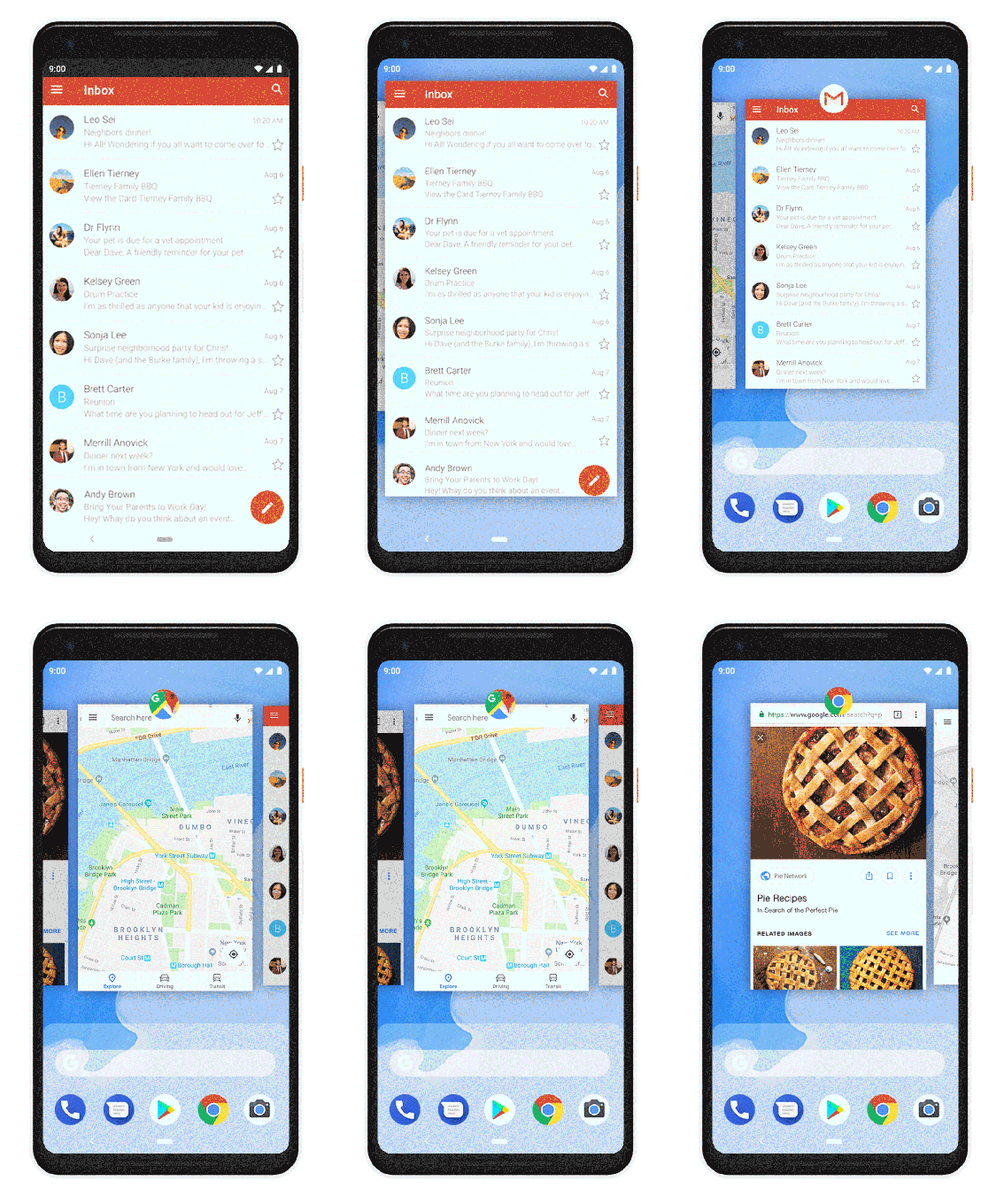
Let’s talk about the features you’ll get when you update to Android 9 Pie, though. The most obvious sign that you have updated to the new version is the new system navigation bar, which replaces the standard three-icon navigation bar that has served Android users well for the last couple of iterations. The new navigation bar replaces the three icons (back, home, overview) that are virtually always on screen with a more adaptive system and a home button that now lets you swipe to switch between apps (instead of tapping on the overview button). You can also now swipe up on the home button and see full-screen previews of the apps you used recently, as well as the names of a few apps that Google thinks you’ll want to use. A second up-swipe and you get to the usual list of all of your installed apps.

In day-to-day use, I’m not yet 100 percent convinced that this new system is any better than the old one. Maybe I just don’t like change, but the whole swiping thing does not strike me as very efficient, and if you leave your finger on the home button for a split-second longer than Google expects, it’ll launch the Assistant instead of letting you swipe between apps. You get used to it, though, and you can get back to the old system if you want to.

Google’s suggestions for apps you’ll like and want to use when you swipe up feel like a nice tech demo but aren’t all that useful in day-to-day use. I’m sure Google uses some kind of machine learning to power these suggestions, but I’d rather use that area as an extended favorites bar where I can pin a few additional apps. It’s not that Android’s suggestions were necessarily wrong and that these weren’t apps I wanted to use, it’s mostly that the apps it suggested were already on my home screen anyway. I don’t think I ever started an app from there while using the last two betas.

But that’s enough grumbling, because it’s actually all of the little things that make Android 9 Pie better. There’s stuff like the adaptive battery management, which makes your battery last longer by learning which apps you use the most. And that’s great (though I’m not sure how much influence it has had on my daily battery life), but the new feature that actually made me smile was a new popup that tells you that you have maybe 20 percent of battery left and that this charge should last until 9:20pm. That’s actually useful.

Google also loves to talk about its Adaptive Brightness feature that also learns about how you like your screen brightness based on your surroundings, but what actually made a difference for me was that Google now blends out the whole settings drawer when you change the setting so that you can actually see what difference those changes make. It’s also nice to have the volume slider pop up right next to the volume buttons now.

Talking about sound: Your phone now plays a pleasant little sound when you plug in the charger. It’s the little things that matter, after all.

The other new machine learning-powered feature is the smart text selection tool that recognizes the meaning of the text you selected and then allows you to suggest relevant actions like opening Google Maps or bringing up the share dialog for an address. It’s nifty when it works, but here, too, what actually makes the real difference in daily usage is that the text selection magnifier shows you a larger, clearer picture of what you’re selecting (and it sits right on top of what you are selecting), which makes it far easier to pick the right text (and yes, iOS pretty much does the same thing).

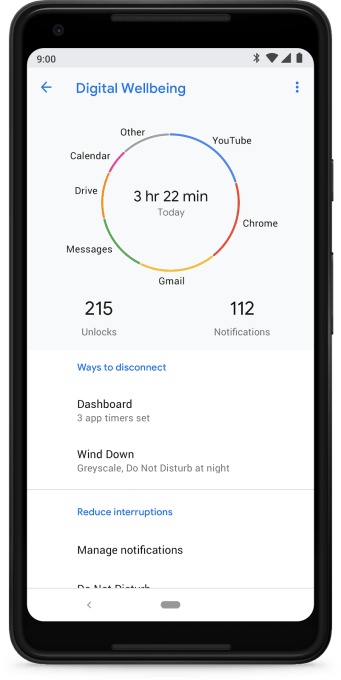
And now we get to the part where I wish I could tell you all about the flagship Digital Wellness features in Pie (because pie and wellness go together like Gwyneth Paltrow and jade eggs), but we’ll have to wait a few days for that. Here’s what we know will be available: a dashboard for seeing where you spend time on your device; an app timer that lets you set limits on how long you can use Instagram, for example, and then grays out the icon of that app; and a Wind Down feature that switches on the night-light mode, turns on Do Not Disturb and fades the screen to grayscale before it’s bedtime.

The one wellness feature you can try now if you are on Pie already is the new Do Not Disturb tool that lets you turn off all visual interruptions. To try out everything else, you’ll have to sign up for the beta here.

Another feature that’s only launching in the fall is “slices” (like slices of pie…). I was looking forward to this one as it’ll allow developers to highlight parts of their apps (maybe to start playing a song or hail a car) in the Android Pie search bar when warranted. Maybe Google wasn’t ready yet — or maybe its partners just hadn’t built enough slices yet, but either way, we won’t see these pop up in Android Pie until later this year.

And that’s Android 9 Pie. It’s a nice update for sure, and while Google loves to talk about all of the machine learning and intelligence it’s baking into Android, at the end of the day, it’s the small quality of life changes that actually make the biggest difference.

Facebook Dating will be a feature, not an app; here’s a peek

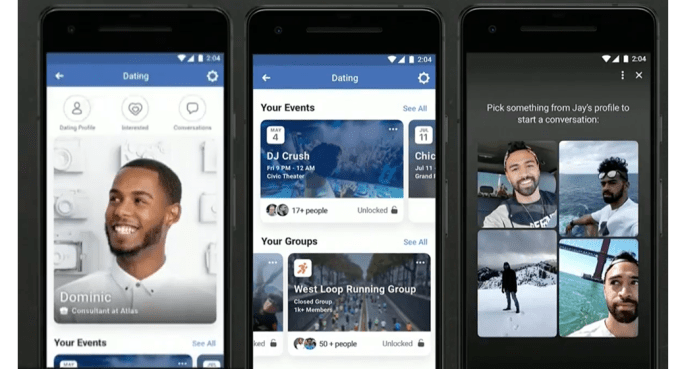
Facebook Dating doesn’t plan to launch a standalone dating app, which should temper expectations about how deeply it’s diving into Tinder and Match Group’s territory. The feature will be based inside Facebook’s main app, alongside its many other utilities buried beyond the home screen. It’s not ready for the public yet, but company employees are now internally testing it — though they’re warned that it’s not for dating their co-workers.

Facebook gave a preview of its Dating features back in May at its F8 conference. Now we’re getting an early look at its onboarding process thanks to screenshots pulled from the Facebook app’s code by mobile researcher and frequent TechCrunch tipster Jane Manchun Wong. The designs give a sense of the more mature vibe of Facebook Dating, which seems more purposeful for finding a serious partner than a one-night stand.

Once you opt in to activating Facebook Dating, only other people who have also turned it on will be able to see you, and it won’t be shared to News Feed. You can choose if friends of friends can see you or not, and Dating profiles allow non-binary and transgender and orientation options. You’ll unlock Groups or Events you’re a part of for Dating, and you’ll be able to browse potential matches based on the plethora of info Facebook knows about you. If two people express interest in each other (no swiping), they can text each other over Messenger or WhatsApp.

TechCrunch has learned some new details from Facebook, as well. Facebook is considering a limit on how many people you can express interest in, which would prevent a spammy behavior of rapidly approving everyone you see. Blocking someone on Dating won’t also block them on Facebook, though that’s not finalized.

Facebook has no plan for paid subscriptions to premium Dating features. It’s currently not going to show ads in Dating, though it could reconsider that later.

Dating will be 18+ only in the U.S. and abide by local laws on who is considered an “adult.”

For now Facebook is taking careful steps toward Dating. It’s not blitzing into the market with a big flashy app. Instead it’s hoping the feature could create the meaningful relationships that make people appreciate Facebook and stick with it over the years. That’s more important than ever with all its recent troubles.

Rentlogic lands millions to grade NYC real estate for renters and landlords

A company called Rentlogic has raised $2.4 million to take the guesswork out of determining whether that cheap, beautiful New York apartment is actually a deathtrap wrapped in a brownstone’s clothing.

Renting in New York is murder already, but using Rentlogic, apartment hunters can figure out if their new housing situation could actually kill them (or put them at significant risk of bodily or property harm… or even minor inconveniences).

Investors in the company’s seed round include the Urban-X accelerator (which is a partnership between Urban.US and Mini); Urban.Us, an investor in urban technologies; the millennial-entrepreneur-focused investment firm, Kairos; and Seagram beverage company scion Edgar Bronfman, Jr.

Rentlogic already provides a grade for every building in New York — more than 1 million properties — but has added an inspection feature that it charges landlords for so that they can display a rating outside of their building. It’s like the city’s scoring grades for restaurants in neighborhoods.

“We grade every single property in New York,” says Yale Fox, the company’s founder and chief executive. “We have inspected 103 properties. Everybody is really happy with it and everybody is going to re-sign and we’re going to start scaling this out to every property in New York.”
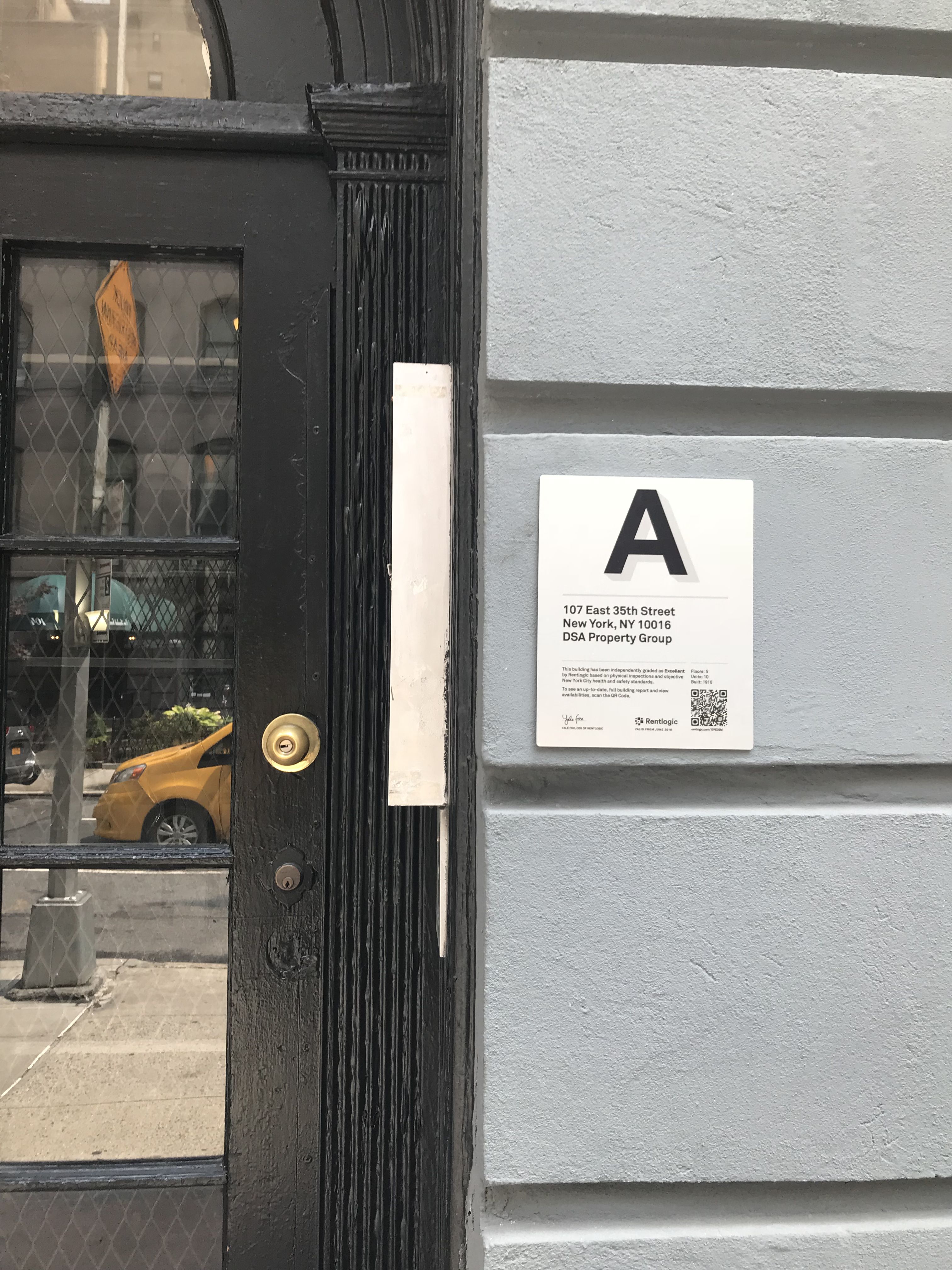
Rentlogic scores buildings on a combination of around 150 different variables, including the ability to provide continuous heat and hot water, and whether or not a building has evidence of bed bugs or rodents.

The looks of the building doesn’t matter, Fox says. It’s more about the conditions of the building.

“It’s the same way a building would get LEED-certified,” says Fox. “It’s a good way for one landlord to differentiate their property as higher quality than a competitor’s in the same neighborhood.”

Launched initially in 2013, Rentlogic was born out of Fox’s own tragic experience as a new renter in New York. The Canadian transplant (and the son of a family of real estate professionals and small scale landlords) had come to the city for a new job and was looking at an apartment in the West Village.

After shelling out a $12,000 deposit for first month’s rent, last month’s rent and a security deposit, Fox settled into his abode in the tree-lined luxury of one of Manhattan’s most sought-after neighborhoods. The love affair with the building didn’t last long.

Unexpectedly, Fox started to become sick. Several visits to the doctor couldn’t identify a cause for his illness, until, finally, his physician suggested a mold-related illness.

“I asked the landlord to fix it and I wound up having to take the landlord to court,” says Fox.

By the time the court date arrived, Fox had paid to fix the mold problem himself and had little in the way of solid evidence to show a judge. So he built an app that would track the public complaints filed against the landlord and the public assessments that had been done on the building.

“I went to court and I showed the judge this model that I had put together and he said, ‘Welcome to New York and I’m sorry this happened to you… and you should definitely build an app, because New York City needs this.’”
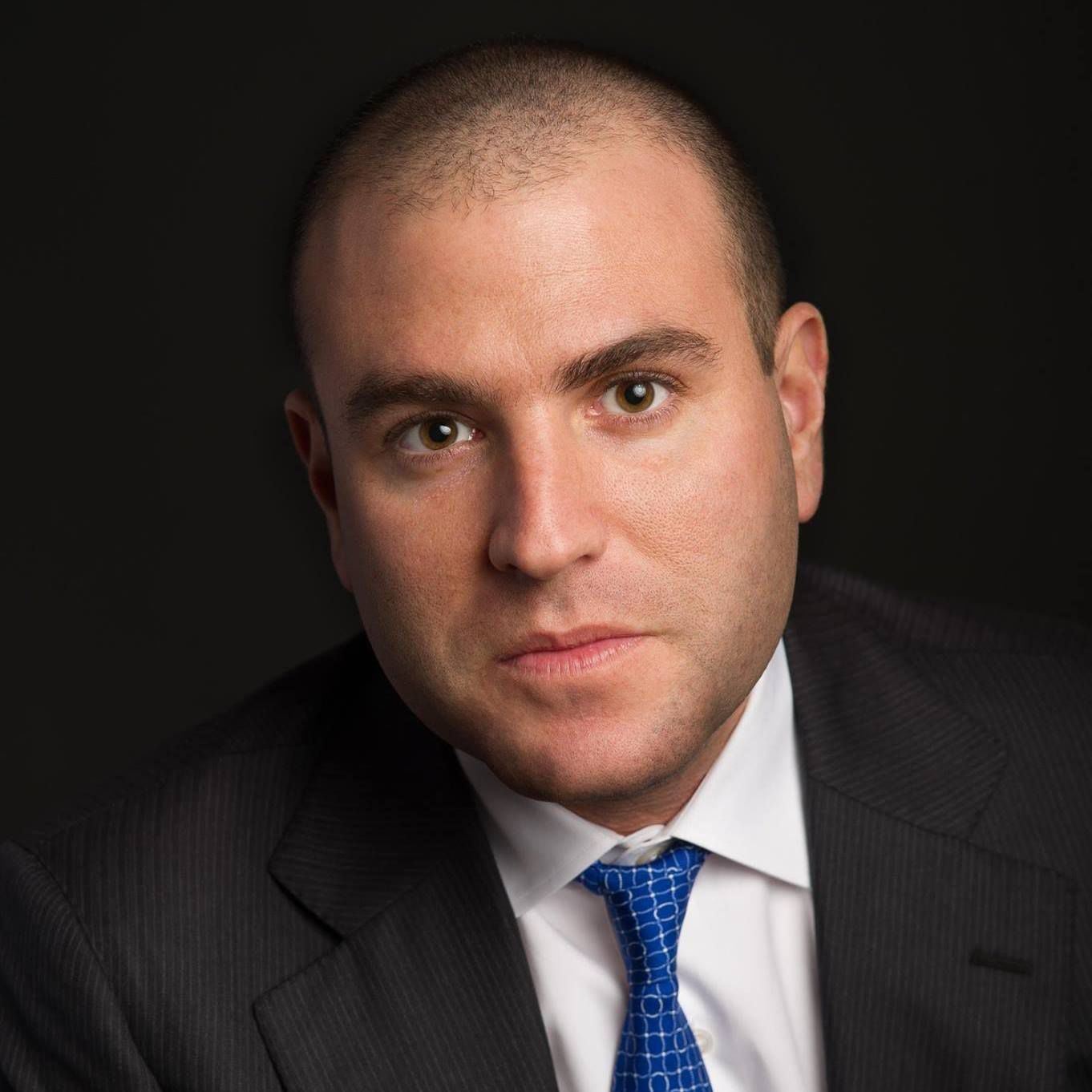
Rentlogic founder Yale Fox

Fox, already enrolled in the TED Fellows program, built the app, initially called “RentCheck” and began marketing it to landlords and renters. “It was just a hobby because I was so angry about how things had happened to me,” says Fox. “We didn’t want to charge renters fees to the site. We thought having equal access to information could prevent this from happening in the future.”

Things continued as a nonprofit for a while until last year Fox hit on a business model. He designed a ratings card for the building based on the data his company had collected and showed it to his current landlord. “She said, ‘How much would you charge for it?’” Fox recalled.

Thus RentCheck became Rentlogic and a business was born. Fox charges landlords for assessments and to display a ratings placard that indicates the building’s grade.

Renters are willing to pay up to an additional $45 per month, according to a white paper, to sign a lease in a building that’s been independently certified. “People are willing to pay a little bit more just to not deal with the constant headaches that happen in certain kinds of buildings,” he said.

Fox appears to have launched Rentlogic at the right time. The market for housing in New York has softened as luxury apartments flood the market and demand softens, meaning that rents are coming down across the board.

But beyond being more competitive there’s a defensive aspect to getting rated in a market filled with demanding, complaint-prone consumers that have no qualms savaging any business, from landlords to local restaurants (although oftentimes the landlords and restaurants deserve it).

“A lot of times landlords are purchasing this because there’s no way to prove they’re not a one-star landlord,” Fox says. “This is accessible for big landlords and small landlords. In a zero-transparency and low-accountability marketplace, there’s no incentive for bad actors to improve their behavior, but with Rentlogic there is.”

The company is already making institutional moves. Fox has inked a deal with Blackstone about providing ratings for their $5.5 billion Stuyvesant Town acquisition on the Lower East Side, according to Fox. In addition, the company has partnered with a number of real estate brokers and roommate-hunting services like Nooklyn and Roomi to use its ratings.

While Rentlogic is scrupulous about using data to train its algorithm, it’s also transparent about how the algorithm works, according to Fox.

“Algorithms control so much what’s going on in the world and people just don’t understand them,” he says. So in the interest of full transparency, the company is putting together a building simulator where users can add problems and see how it affects a building’s rating on the Rentlogic site. The company also has an algorithmic review committee that reviews the results coming from the building assessments.

And while Rentlogic is starting in New York, the company has plans to use its machine learning system to hoover up publicly available data and provide grades for real estate across the United States.

Ultimately, Fox just wants to help improve the tenant-landlord relationship, he says. “I was in a terrible situation with a landlord who went to jail… I launched this site so no one would have to go through what I went through.”

EA apologizes for ‘unfortunate mistake’ of cutting Colin Kaepernick reference from ‘Madden’

EA became the subject of online scrutiny this week when it was discovered that the gaming giant deleted a reference to Colin Kaepernick on the soundtrack for Madden 19. The former 49ers quarterback was name-checked by rapper Big Sean on a verse of the YG song “Big Bank,” only to have the mention deleted. The track includes the line, “You boys all cap, I’m more Colin Kaepernick.”

The move was noted on Twitter this week and amplified by radio host (and Kaepernick’s girlfriend) Nessa Diab, along with Big Sean himself. The latter said the reference was deleted “like it was a curse word,” adding, “he’s not a curse, he’s a gift! Nobody from my team approved any of this.”

Oh!!!!! @EAMaddenNFL who told you to edit Colin’s name out???? @nfl ? @NFLPA Curious minds want to know ? Thanks Jean for the info!!! If you guys see more shady stuff send it over. https://t.co/EIBQbaQ5SA

— NESSA (@nessnitty) August 2, 2018

Kaepernick became a leading figure in the Black Lives Matter movement after sitting and later kneeling during the National Anthem as a form of protest against black deaths at the hands of police officers. A number of NFL players have since followed suit, leading Donald Trump to call for the firing of players over on-field protests. 

Hey Sean, no doubt we messed up here. We look forward to making it right. pic.twitter.com/taFXQ7UwBA

— EA SPORTS Madden NFL (@EAMaddenNFL) August 3, 2018

In a statement to TechCrunch, EA called the deletion “an unfortunate mistake,” chalking up the move to confusion of relating to player rights:

We made an unfortunate mistake with our Madden NFL soundtrack. Members of our team misunderstood the fact that while we don’t have rights to include Colin Kaepernick in the game, this doesn’t affect soundtracks. We messed up, and the edit should never have happened. We will make it right, with an update to Madden NFL 19 on August 6 that will include the reference again. We meant no disrespect, and we apologize to Colin, to YG and Big Sean, to the NFL, to all of their fans and our players for this mistake.

NBC Sports notes, however, that this is apparently not the first time Kaepernick’s name has been removed from a Madden soundtrack. While the player’s likeness appeared in last year’s version of the game, his name was apparently also removed from the Mike WiLL Made-It track, “Bars of Soap.” 

Kin expands its celebrity-driven ‘neighborhood’ model for online video

Digital media company Kin has announced a slate of new video series from singer/actress Jordin Sparks, Bachelorette JoJo Fletcher and Jordan Rodgers (who successfully proposed to Fletcher over on the series).

The company also revealed more details about its programming with Vanessa Lachey (who had already signed on with her husband Nick). She’ll be hosting a competition series called Beauty School Knockout, where contestants compete to create specific looks using unconventional products.

This is all part of what the company calls its “neighborhood” strategy, where it launches a set of interconnected channels, usually featuring stars who became famous on traditional media. The new announcements bring Kin up to five channels, with the goal of creating three more by the end of the year.

“[Ultimately,] We want to create 20 of these channels … a neighborhood of channels for women in what we call the ‘builder’ phase of their lives,” Kin CEO Michael Wayne told me. “And they all have sort of the same like-minded, inspirational, accessible feeling to them, in women lifestyle verticals.”

The company’s first big success with this model was Tia Mowry’s Quick Fix, a series of lifestyle and how-to videos from the Sister, Sister star.

According to research by Nielsen, Quick Fix reached 8.8 million total viewers in the week of June 25, including 3.7 million women between the ages of 18 to 34 — an audience that’s comparable to cable reality hits like Chopped, Property Brothers and Keeping Up with the Kardashians. So Kin said it’s extending its partnership with Mowry to develop more lifestyle content in addition to Quick Fix.

In Wayne’s view, it makes more sense for Kin to work with a “mainstream star” like Mowry rather than someone who recently became famous on social media, especially since the first wave of social media influencers is being “completely disrupted by the next wave.”

He said that Mowry, on the other hand, has been in the public consciousness for decades: “No one searches for Tia because she did a smokey eye video.”

Wayne added that he remains focused on a cross-platform strategy, where individual platforms might get early access to the videos (Beauty School Knockout will premiere on Facebook Watch), but the videos ultimately get posted to YouTube, Facebook, Instagram TV and Amazon. He also said it’s crucial that the “unit economics” of advertising on each series makes sense, so Kin isn’t relying on the platforms or on custom, branded video deals to subsidize production.

“With Tia, I know exactly how much money I’m spending  on Facebook, I know how Amazon will monetize, I can chart this investment and know it’s going to pay off and become profitable within 9 to 12 months,” he said.

GameFly to shutter streaming service this month

GameFly, the video game rental company, will be shutting down its streaming service at the end of the month, Variety reported earlier this week. This closure comes just over three years after the streaming service launched in 2015.

GameFly, the no-console streaming service for gamers, offered packages for $7 and $10 per month that gave users unlimited access to titles — as long as they had a smart TV like an Amazon Fire or Samsung Smart TV, in addition to a controller and access to the internet. Just as GameFly’s original snail-mail rental service for games mimicked Netflix’s from days of yore, many touted the streaming service as the Netflix of gaming.

Support for the service will be maintained through the end of August and accounts will not be charged for the service after that date, according to Variety. But people can still rent physical games (and movies) from the company for $9.50 per month (one rental at a time) or $13.50 per month (two rentals at a time.)

This news comes about three months after EA acquired the technology and team members from GameFly’s cloud gaming division — a division that helped make it possible to save your progress to the cloud while gaming on the streaming service. But the acquisition did not include GameFly’s streaming service.

“We acquired the team in Israel and the technology they’ve developed, we did not acquire the Gamefly streaming service,” an EA spokesperson told Variety. “We have not been involved in any decisions around the service.”

TechCrunch reached out to GameFly for comment but the company did not respond by the time of publication regarding the reasons behind this closure.

Meanwhile, the world of streaming games appears to be continuing on just fine. Sony’s PlayStation Now continues to add titles to its service, French startup Blade’s streaming service is expanding availability this week in the U.S. and EA itself announced at E3 this summer plans to start work on its own streaming service.

Sagewise pitches a service to verify claims and arbitrate disputes over blockchain transactions

Sometimes smart contracts can be pretty dumb.

All of the benefits of a cryptographically secured, publicly verified, anonymized transaction system can be erased by errant code, malicious actors or poorly defined parameters of an executable agreement.

Hoping to beat back the tide of bad contracts, bad code and bad actors, Sagewise, a new Los Angeles-based startup, has raised $1.25 million to bring to market a service that basically hits pause on the execution of a contract so it can be arbitrated in the event that something goes wrong.

Co-founded by a longtime lawyer, Amy Wan, whose experience runs the gamut from the U.S. Department of Commerce to serving as counsel for a peer-to-peer real estate investment platform in Los Angeles, and Dan Rice, a longtime entrepreneur working with blockchain, Sagewise works with both Ethereum and the Hedera Hashgraph (a newer distributed ledger technology, which purports to solve some of the issues around transaction processing speed and security which have bedeviled platforms like Ethereum and Bitcoin).

The company’s technology works as a middleware, including an SDK and a contract notification and monitoring service. “The SDK is analogous to an arbitration clause in code form — when the smart contract executes a function, that execution is delayed for a pre-set amount of time (i.e. 24 hours) and users receive a text/email notification regarding the execution,” Wan wrote to me in an email. “If the execution is not the intent of the parties, they can freeze execution of the smart contract, giving them the luxury of time to fix whatever is wrong.”

Sagewise approaches the contract resolution process as a marketplace where priority is given to larger deals. “Once frozen, parties can fix coding bugs, patch up security vulnerabilities, or amend/terminate the smart contract, or self-resolve a dispute. If a dispute cannot be self-resolved, parties then graduate to a dispute resolution marketplace of third party vendors,” Wan writes. “After all, a $5 bar bet would be resolved differently from a $5M enterprise dispute. Thus, we are dispute process agnostic.”

Wavemaker Genesis led the round, which also included strategic investments from affiliates of Ari Paul (Blocktower Capital), Miko Matsumura (Gumi Cryptos), Youbi Capital, Maja Vujinovic (Cipher Principles), Jordan Clifford (Scalar Capital), Terrence Yang (Yang Ventures) and James Sowers.

“Smart contracts are coded by developers and audited by security auditing firms, but the quality of smart contract coding and auditing varies drastically among service providers,” said Wan, the chief executive of Sagewise, in a statement. “Inevitably, this discrepancy becomes the basis for smart contract disputes, which is where Sagewise steps in to provide the infrastructure that allows the blockchain and smart contract industry to achieve transactional confidence.”

In an email, Wan elaborated on the thesis to me, writing that, “smart contracts may have coding errors, security vulnerabilities, or parties may need to amend or terminate their smart contracts due to changing situations.”

Contracts could also be disputed if their execution was triggered accidentally or due to the actions of attackers trying to hack a platform.

“Sagewise seeks to bring transactional confidence into the blockchain industry by building a smart contract safety net where smart contracts do not fulfill the original transactional intent,” Wan wrote.