SIM swap hacker caught in Florida

Florida police have arrested a 25-year-old named Ricky Joseph Handschumacher. The young man is suspected of grand theft and money laundering. Handschumacher used SIM swapping techniques to steal thousands in Bitcoin and to “drain bank accounts,” according to security researcher Brian Krebs.

Handschumacher’s scam was simple: He called telecom operators and asked them to swap his SIM card for the victim’s SIM card. This, in turn, gave him access to two-factor authentication techniques via SMS and allowed him to access email accounts, bitcoin wallets and file storage systems. I experienced this firsthand a year ago when my phone stopped working and all of my Google passwords began changing without my control.

“In some cases, fraudulent SIM swaps succeed thanks to lax authentication procedures at mobile phone stores. In other instances, mobile store employees work directly with cyber criminals to help conduct unauthorized SIM swaps, as appears to be the case with the crime gang that allegedly included Handschumacher,” wrote Krebs.

The takedown happened after a mother overheard her son pretending to be an AT&T employee. Police found multiple SIM cards and a Trezor in the Michigan home of the first hacker, as well as logins for Telegram and Discord channels dedicated to SIM swapping. The police found that the hackers had stolen 57 bitcoins from one victim. Handschumacher was head of the group.

The hackers were allegedly targeting the Winklevoss twins before Handschumacher was arrested.

According to the police complaint, “Handschumacher and another co-conspirator talk about compromising the CEO of Gemini and posted his name, date of birth, Skype username and email address into the conversation. Handschumacher and the co-conspirators discuss compromising the CEO’s Skype account and T-Mobile account. The co-conspirator states he will call his ‘guy’ at T-Mobile to ask about the CEO’s account.”

Worried about getting hacked? Given the ease with which Handschumacher and his team worked, non-SMS-based two-factor authentication is still the best solution for ensuring you aren’t effected. There are also methods to add a SIM lock to your phone so outsiders can’t swap your SIM as easily, but remember: All the protection in the world can’t stop a dedicated hacker. Keep your important data and cryptocurrencies offline if possible.
Samsung courts mainstream users with the Galaxy Watch

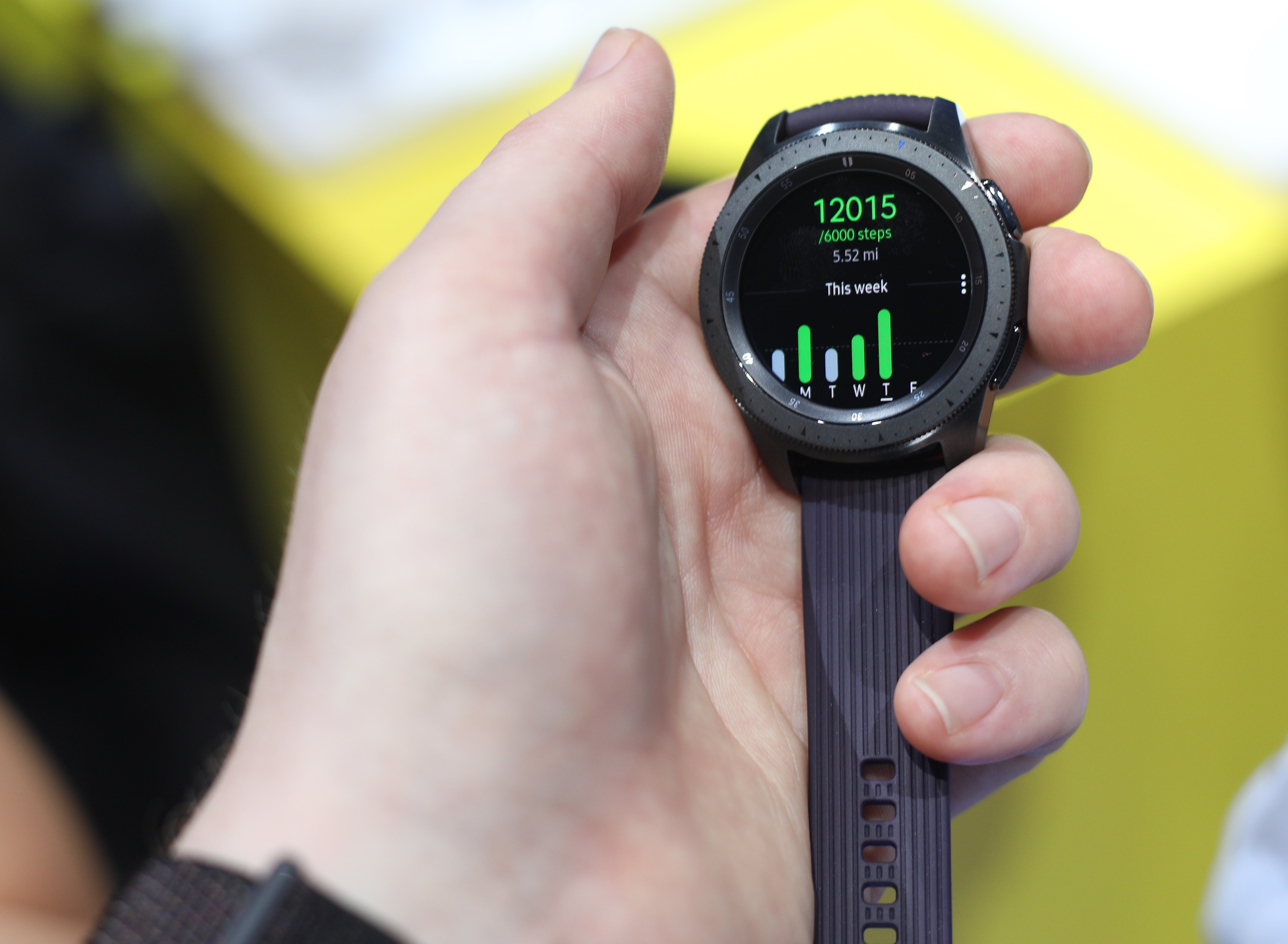
Name aside, not all that much appears to have changed with the new Galaxy Watch. Samsung’s clearly used the Gear Sport as the jumping off point here. And that’s a good thing. Since the beginning, Samsung’s wearables have been plagued by a size issue.

They’re huge — big on my wrists, even, and I’m 5’11. That rules out a pretty massive potential user base right out of the gate. The Galaxy Watches on display appeared to be the smaller of the two, at 42mm, which fit pretty comfortable on my wrist. There’s also a 46mm for those diehard big-watch fans. Samsung has yet to introduce a size for even smaller wrists, but this is certainly a step in the right direction.

Those earlier rumors that the company would be jumping to the more widely used Android Wear operating system were off-base. Samsung’s sticking with Tizen here, with the Galaxy Watch running version 4.0. Not a huge surprise, of course. Samsung’s taken ownership over the open OS — moving to Google’s would feel like starting from scratch.

The industrial design is also similar to earlier models, with a well, pronounced metal case and large buttons. There are two color designs, however, so you can opt for rose gold for a bit of a softer touch. And, of course, there are a whole bunch of different band options to further customize it.

LTE functionality is present here — Samsung beat Apple to the draw on that one. The watch is also 5ATM + IP68 water-resistant and features a Gorilla Glass face, so it can take a licking.

Like the rest of the wearable world, health is a big feature here. There are six automatic exercises (walking, running, cycling, elliptical, training, rowing and dynamic workouts), plus sleep tracking and breathing reminder. Speaking of sleeping with the thing on, the company promises “several days of usage,” but that will depend in no small part on which size you opt for. The battery sizes are 472mAh and 270mAh for the 46mm and 42mm, respectively. So that’s certainly a point in favor of opting for the largest one possible.

We’ll no doubt be testing that, along with everything else, soon. For now, I’m not seeing any features that really stand out from the rest of the wearable masses. The 46mm runs $350 and the 42mm version is $330. Pricing on the LTE models will be carrier-dependent (AT&T, T-Mobile, Sprint and Verizon are all repped here). The device is launching at some unspecified time later this year.

Blissfully grabs $3.5 million seed investment to help companies get their SaaS in gear

Blissfully, a New York City startup that helps companies understand their SaaS usage inside their organizations, announced it has received a $3.5 million seed round.

The investment was led by Hummer Winblad Venture Partners. Hubspot, Founder Collective, and several unnamed pre-seed investors also participated. They got a $1.5 million pre-seed investment, bringing the total so far to $5 million, according the company.

Company co-founder and CEO Ariel Diaz says Blissfully actually helped him and his co-founder solve a problem they were having tracking the SaaS usage at their previous startups. Like many companies, they were using spreadsheets to track this information and they found it was untenable as the company grew beyond 30 or 40 people. They figured there had to be a better way, so they built one.

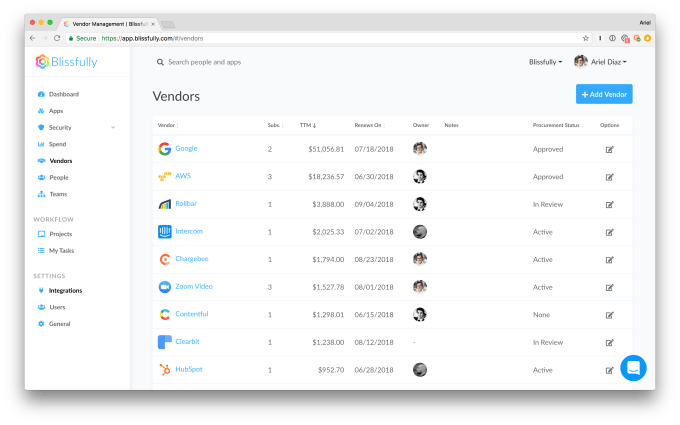
Their product is much more than simply a database of the SaaS products in use inside an organization. It can integrate with existing company systems like single sign-on tools such as Okta and OneLogIn, financial reporting systems and G Suite login information. “We are trying to automate as much of the data collection as possible to discover what you’re using, who’s using it and how much you are spending,” he said.

Blissfully SaaS report. Screenshot: Blissfully

Their scans often turn up products customers thought they had canceled or those that IT had asked employees to stop using. More than finding Shadow IT, the product also gives insight to overall SaaS spend, which many companies have trouble getting a grip on. They can find most usage with a scan. Some data such as customized contract information may have to be manually entered into the system, he says.

Hubspot CEO Brian Halligan, whose company is one of the investors in this round, sees a growing need for this kind of tool. “The widespread growth of SaaS across companies of all sizes is a leading indicator of the market need for Blissfully. As business’ investments in SaaS increase, they lose visibility into issues ranging from spending to security,” Halligan said in a statement.

The company offers a freemium and pay model and is available in the G Suite Marketplace. If you go for the free version, you can scan your systems for SaaS usage, but if you want to do more complex integrations with company systems, you have to pay. They currently have 10 employees and 500 customers with a mix of paying and free.

One interesting aspect of the Blissfully tool is that it is built entirely using Serverless architecture on AWS Lambda.