Starry launches pilot program with Boston Housing Authority to expand affordable internet access

Internet service provider Starry announced today the launch of its Starry Connect program with a pilot through Boston Housing Authority (BHA) to help provide free access to internet for residents living in one of the city’s public housing apartment complexes.

The Boston-based startup launched in 2016 with a plan to provide internet access through a spoke-and-wheel system of transmitters and access points. This point-to-multipoint system uses a phased array laser on top of a city building to send a 5G signal out that users can connect to via Starry Points that can be installed at a window or personal roof.

“Access to high-speed broadband is critical for education, communication, and personal and professional development, and yet today, many people still lack access to a basic, affordable, and reliable internet connection,” said Chet Kanojia, co-founder and CEO, in a statement. “That’s why we’re excited to partner with the Boston Housing Authority to devise creative solutions to help get more of their residents online and engaged with the critical services they need.”

With the program Starry launched today, residents of the public housing apartment building will be able to access free Wi-Fi in the building’s common area, hallways and new computer lab.

Virginia Lam Abrams, Starry senior vice president of communications and government relations, told TechCrunch that some residents may also be able to access the signal in their rooms, but the primary focus for this installation is to provide common area access for these primarily elderly and disabled residents.

Because Starry Connect’s pilot launch in the BHA building is part of the Boston public housing system, residents will receive free connection, but Starry also has plans to provide low-cost pricing options for residents living in affordable housing, as well.

The program has no set end date, says Abrams, but the company has plans to check in with residents in a few months to see where the program is succeeding and where it can be improved. Following this initial pilot launch, Abrams says that Starry has hopes to expand into other BHA communities, as well as public and affordable housing in other U.S. cities.

Since its launch, the startup has expanded into Los Angeles and Washington, D.C., and following a $100,000 million funding round it closed this July, has plans to scale and expand into more cities in the coming year, including Houston, Chicago, San Francisco and Portland, Ore.

With no white knight in sight, Tesla shares plummet from Musk’s tweet-related highs

Investors definitely aren’t stoked by the deafening silence coming from Tesla after its chief executive announced in a tweet that he plans to drop a fat sack of cash on public shareholders in a bid to take the company private.

Tesla’s shares have tumbled from their post-tweet highs as investors are now left with the embers of what is increasingly looking like a Musk-induced pipe dream to lift the economic burdens the company faces by delisting it.

At the close of the market Tesla shares were down $17.89, to $352.45, basically erasing the gains it had earned based on speculation of an acquirer at a $420 price tag.

Days after Tesla chief executive Elon Musk tweeted a $420 per share buyout offer for the company, no new details have emerged and several potential contenders for Tesla’s white knight have basically said “It wasn’t me.”

Reports from The New York Times, Axios and Bloomberg indicate that none of the likely buyers — the private equity firms, multinational banks, sovereign wealth funds or SoftBank — had approached or been approached by Tesla about the take-private transaction.

Dan Primack reported in Axios that “it’s none of the usual suspects on the debt side (i.e. big Wall Street banks). Nor many on the equity side, such as big strategics (not Apple or Uber), private equity (not KKR, Mithril, Silver Lake, TPG, etc.) nor deeper financial pockets (not SoftBank or Mubadala).”

That’s kind of everyone that would be involved in what would be the biggest take-private deal in history (Primack valued Tesla at around $85 billion including debt).

Indeed, the New York Times noted that Wall Street banks are only now looking at ways to get in on the action.

From the Times’ report:

Executives at banks including Goldman Sachs and Citigroup are discussing ways a deal could be structured, angling to land the potentially prestigious assignment of taking the maker of electric cars off public markets, according to people familiar with the discussions. Bankers and lawyers on Wall Street said any deal is likely to be valued at $10 billion to $20 billion.

The $20 billion figure, far lower than what would be required for full privatization, assumes that Tesla is only looking to reduce the number of shareholders on its cap table so that it is no longer required to list on a major exchange. The argument is that with fewer shareholders, the company would not be subject to the whims of short sellers as easily as it is on the open markets.

That’s the publicly stated rationale that Musk has given for his desire to take the company private.

While some speculate about what Elon may have been smoking when he made his (potential) bid public on Twitter, SEC regulators are more concerned with whether he’d told investors he had a quality deal instead of just shake.

Clouding the picture is the large stake that Saudi Arabia’s investment fund had taken in the company right before Musk baked short sellers’ positions with the buyout tweet and the promise of financing.

Some conspiracy-minded speculators on HackerNews even theorized that the tweet was an attempt to forestall a hostile takeover from the Saudis.

Allegedly @elonmusk is in a race to avoid a hostile takeover of @tesla from the Saudi’s https://t.co/qTyIZz9AxH pic.twitter.com/MYxJwrfiOm

— Pieter Levels ? (@levelsio) August 7, 2018

No matter the rationale, Musk may have more to worry about than just Tesla’s stock price should more detailed plans of the financing not materialize. The Securities and Exchange Commission is knocking, and they don’t take too kindly to the practice of defrauding investors.


7 takeaways from Samsung Unpacked 2018

Samsung introduced a wide range of gadgets and upgrades today at its Unpacked event in Brooklyn. The overarching theme of the event centered on increased productivity throughout its connected ecosystem with performance improvements across the board.

Here are seven takeaways from Samsung Unpacked:

1. Note 9 rumors are confirmed

Samsung’s latest phablet was introduced this afternoon without much surprise after weeks of leaks, speculation and even a photo of CEO DJ Koh using the phone in public made their rounds online. Little has changed aesthetically on this year’s Note, aside from a few new colors, a shifted fingerprint scanner and a screen that’s a fraction of an inch larger than its predecessor. The one improvement that does stand out, however, is found in the Note’s battery, which now measures 4,000mAh hours — that’s a 700mAh jump over the Note 8. Samsung is on the offensive this time around and made sure to highlight its eight-point safety check the company instituted after the firestorm of Note 7 batteries exploding.

2. Increased functionality on the S-Pen

Samsung’s stylus got its own reboot today with a focus on performance. The company has equipped the S-Pen with Bluetooth low energy, allowing users to untether themselves from the phone and use the stylus as a remote to take pictures, advance slideshows or play music. Samsung also said developers will be able to incorporate BLE into their apps later this year.

3. The new Galaxy Watch seeks mainstream adoption

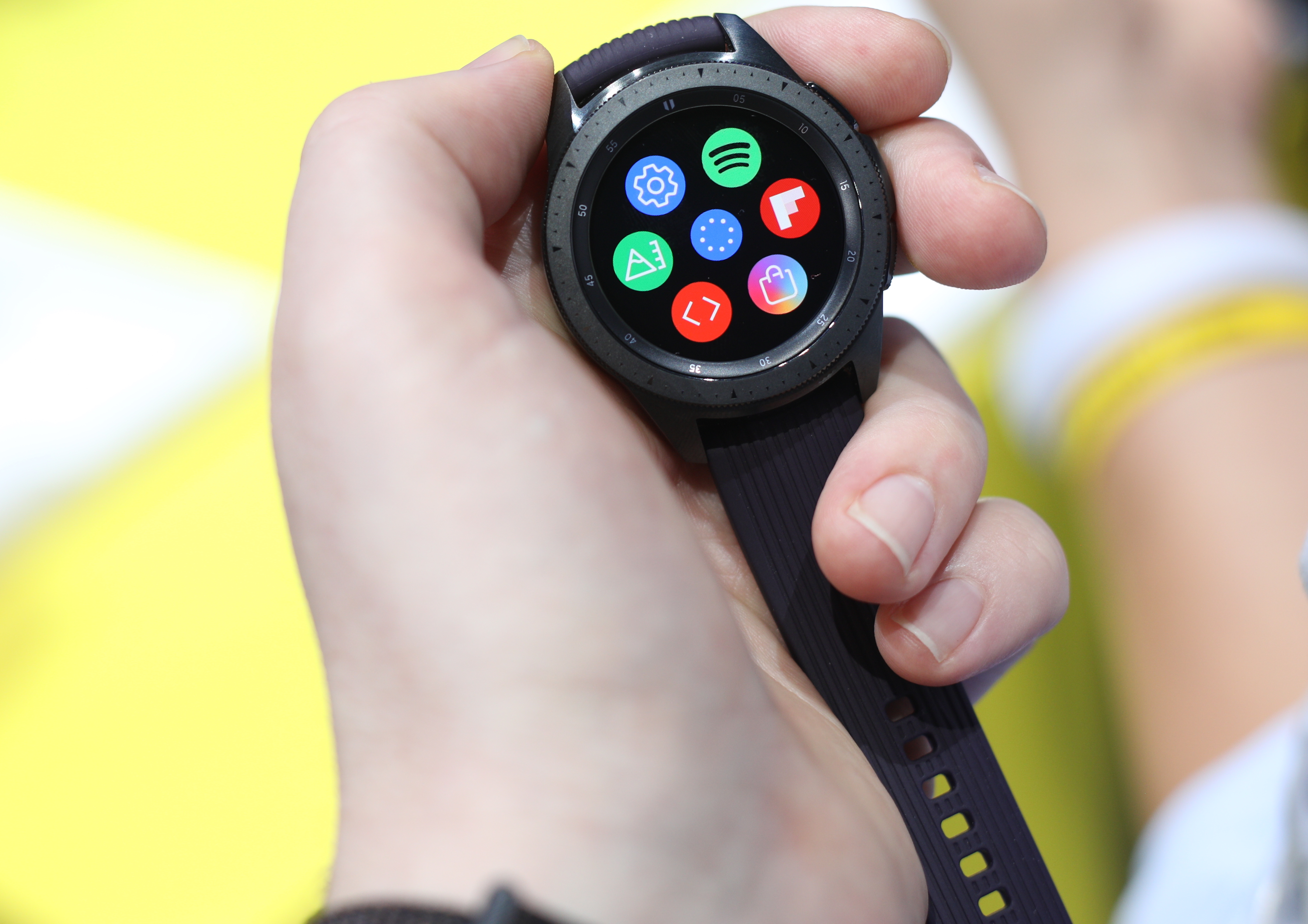
While Note 9 rumors were swirling leading up to today’s event, Samsung did a better job at keeping its new Galaxy Watch under wraps. The company’s latest smartwatch will come in two sizes, an improvement from previous Samsung watches that were too large for many wrists. Samsung beat Apple to the draw by introducing LTE functionality on the Galaxy Watch and it’s sticking with Tizen as an OS, rather than switching to Android Wear.

4. Bixby gets more conversational

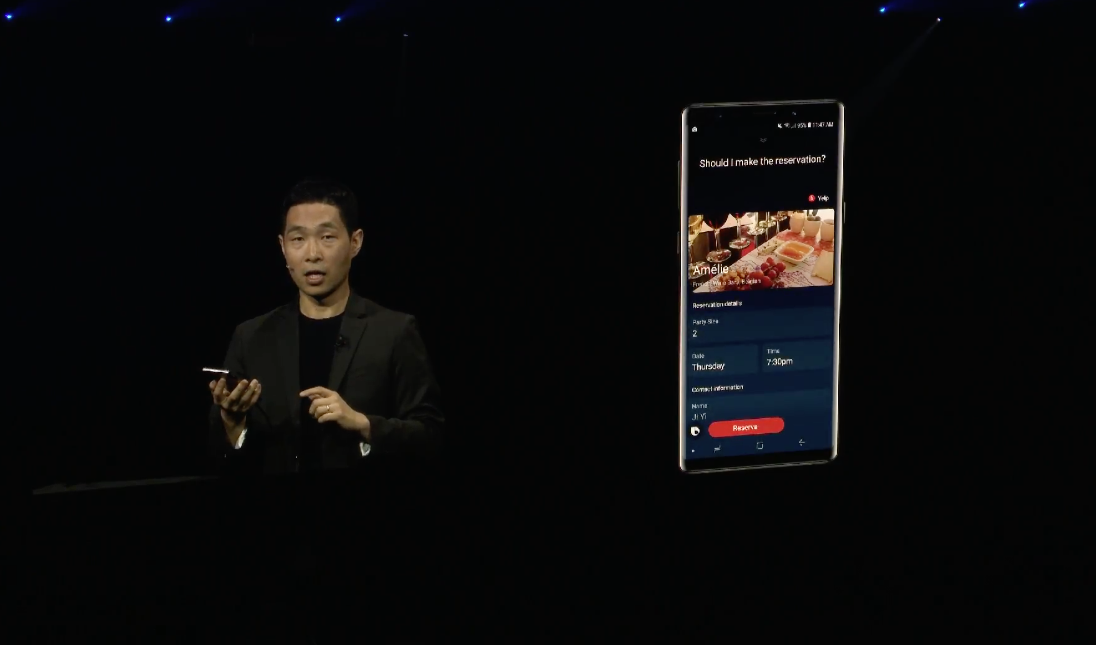
Samsung demoed an updated version of Bixby, the company’s voice assistant that saw much backlash when it was released last year, due to its lackluster performance. Luckily, that’s changed, and at today’s event Samsung showed how Bixby will carry on conversations and answer follow-up questions. The upgrade also features a range of app integrations with Yelp, Uber, Ticketmaster and more, allowing users to make reservations, hail rides and buy tickets even if they don’t have the app installed on their phone. Samsung also noted that Bixby will learn from your past decisions to better serve requests in the future. For example, if you’ve asked for French restaurants in the past, Bixby will generate other French restaurants in future requests related to food.

5. Samsung is (finally) getting into the smart speaker game

Improvements to Bixby were made even more apparent when Samsung unveiled its own smart speaker at today’s event. The Galaxy Home features a cloth covering and a tripod stand with a built-in subwoofer and eight microphones designed for far-field communication that’s seen on other smart speakers. Much like the initial announcement of the HomePod, there wasn’t much information on a release date or price. For now, the product is only listed as “coming soon.”

6. Spotify integration allows for seamless cross-listening experience

To go along with its new smart speaker, Samsung announced a partnership with Spotify, cementing the Swedish streaming service as the preferred music supplier on Samsung devices. Spotify will now be part of the set-up process for Samsung devices, and the integration allows for a seamless cross-devices listening experience within the Samsung ecosystem. The partnership also pins Samsung directly up against Apple and the HomePod’s exclusive integration with Apple Music.

7. Fortnite for Android launches as a Samsung exclusive

At long last, Fortnite is coming to Android this summer. The insanely popular survival game will be available for Galaxy users with an S7 or higher, and the 6.4-inch display on the Note 9 makes for a mobile gaming powerhouse. Starting today, the title will appear on Galaxy devices’ game launcher and will remain a Samsung exclusive until the 12th — at which point it will most likely be available to all Android users.

Facebook now deletes posts that financially endanger/trick people

It’s not just inciting violence, threats and hate speech that will get Facebook to remove posts by you or your least favorite troll. Endangering someone financially, not just physically, or tricking them to earn a profit are now also strictly prohibited.

Facebook today spelled out its policy with more clarity in hopes of establishing a transparent set of rules it can point to when it enforces its policy in the future. That comes after cloudy rules led to waffling decisions and backlash as it dealt with and finally removed four Pages associated with Infowars conspiracy theorist Alex Jones.

The company started by repeatedly stressing that it is not a government — likely to indicate it does not have to abide by the same First Amendment rules.

“We do not, for example, allow content that could physically or financially endanger people, that intimidates people through hateful language, or that aims to profit by tricking people using Facebook,” its VP of policy Richard Allen published today.

Web searches show this is the first time Facebook has used that language regarding financial attacks. We’ve reached out for comment about exactly how new Facebook considers this policy.

This is important because it means Facebook’s policy encompasses threats of ruining someone’s credit, calling for people to burglarize their homes or blocking them from employment. While not physical threats, these can do real-world damage to victims.

Similarly, the position against trickery for profit gives Facebook a wide berth to fight against spammers, scammers and shady businesses making false claims about products. The question will be how Facebook enforces this rule. Some would say most advertisements are designed to trick people in order for a business to earn a profit. Facebook is more likely to shut down obvious grifts where businesses make impossible assertions about how their products can help people, rather than just exaggerations about their quality or value.

The added clarity offered today highlights the breadth and particularity with which other platforms, notably the wishy-washy Twitter, should lay out their rules about content moderation. While there have long been fears that transparency will allow bad actors to game the system by toeing the line without going over it, the importance of social platforms to democracy necessitates that they operate with guidelines out in the open to deflect calls of biased enforcement.

Dropbox is crashing despite beating Wall Street expectations, announces COO Dennis Woodside is leaving

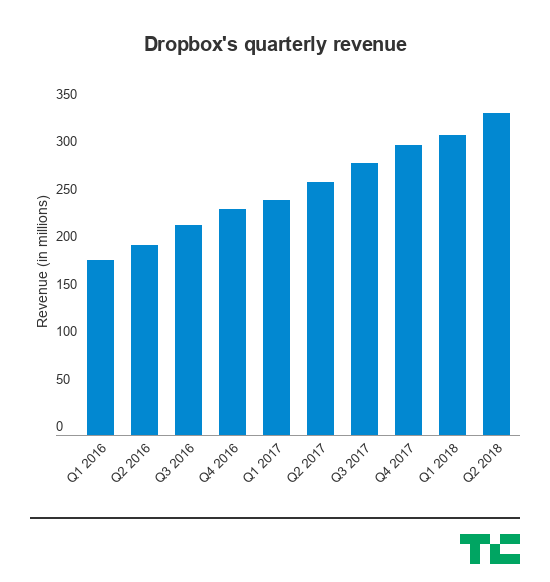
Back when Dennis Woodside joined Dropbox as its chief operating officer more than four years ago, the company was trying to justify the $10 billion valuation it had hit in its rapid rise as a Web 2.0 darling. Now, Dropbox is a public company with a nearly $14 billion valuation, and it once again showed Wall Street that it’s able to beat expectations with a now more robust enterprise business alongside its consumer roots.

Dropbox’s second quarter results came in ahead of Wall Street’s expectations on both the earnings and revenue front. The company also announced that Dennis Woodside will be leaving the company. Woodside joined at a time when Dropbox was starting to figure out its enterprise business, which it was able to grow and transform into a strong case for Wall Street that it could finally be a successful publicly traded company. The IPO was indeed successful, with the company’s shares soaring more than 40 percent in its debut, so it makes sense that Woodside has essentially accomplished his job by getting it into a business ready for Wall Street.

“I think as a team we accomplished a ton over the last four and a half years,” Woodside said in an interview. “When I joined they were a couple hundred million in revenue and a little under 500 people. [CEO] Drew [Houston] and Arash [Ferdowsi] have built a great business, since then we’ve scaled globally. Close to half our revenue is outside the U.S., we have well over 300,000 teams for our Dropbox business product, which was nascent there. These are accomplishments of the team, and I’m pretty proud.”

The stock initially exploded in extended trading by rising more than 7 percent, though even prior to the market close and the company reporting its earnings, the stock had risen as much as 10 percent. But following that spike, Dropbox shares are now down around 5 percent. Dropbox is one of a number of SaaS companies that have gone public in recent months, including DocuSign, that have seen considerable success. While Dropbox has managed to make its case with a strong enterprise business, the company was born with consumer roots and has tried to carry over that simplicity with the enterprise products it rolls out, like its collaboration tool Dropbox Paper.

Here’s a quick rundown of the numbers:

  • Q2 Revenue: Up 27 percent year-over-year to $339.2 million, compared to estimates of $331 million in revenue.
  • Q2 GAAP Gross Margin: 73.6 percent, as compared to 65.4 percent in the same period last year.
  • Q2 adjusted earnings: 11 cents per share compared, compared to estimates of 7 cents per share.
  • Paid users: 11.9 million paying users, up from 9.9 million in the same quarter last year.
  • ARPU: $116.66, compared to $111.19 same quarter last year.

So, not only is Dropbox able to show that it can continue to grow that revenue, the actual value of its users is also going up. That’s important, because Dropbox has to show that it can continue to acquire higher-value customers — meaning it’s gradually moving up the Fortune 100 chain and getting larger and more established companies on board that can offer it bigger and bigger contracts. It also gives it the room to make larger strategic moves, like migrating onto its own architecture late last year, which, in the long run could turn out to drastically improve the margins on its business.

“We did talk earlier in the quarter about our investment over the last couple years in SMR technology, an innovative storage technology that allows us to optimize cost and performance,” Woodside said. “We continue to innovate ways that allow us to drive better performance, and that drives better economics.”

The company is still looking to make significant moves in the form of new hires, including recently announcing that it has a new VP of product and VP of product marketing, Adam Nash and Naman Khan, respectively. Dropbox’s new team under CEO Drew Houston are tasked with continuing the company’s path to cracking into larger enterprises, which can give it a much more predictable and robust business alongside the average consumers that pay to host their files online and access them from pretty much anywhere.

In addition, there are a couple executive changes as Woodside transitions out. Yamini Rangan, currently VP of Business Strategy & Operations, will become Chief Customer Officer reporting to Houston, and comms VP Lin-Hua Wu will also report to Houston.

Dropbox had its first quarterly earnings check-in and slid past the expectations that Wall Street had, though its GAAP gross margin slipped a little bit and may have offered a slight negative signal for the company. But since then, Dropbox’s stock hasn’t had any major missteps, giving it more credibility on the public markets — and more resources to attract and retain talent with compensation packages linked to that stock.

“Our retention has been quite strong,” Woodside said. “We see strong retention characteristics across the customer set we have, whether it’s large or small. Obviously larger companies have more opportunity to expand over time, so our expansion metrics are quite strong in customers of over several hundred employees. But even among small businesses, Dropbox is the kind of product that has gravity. Once you start using it and start sharing it, it becomes a place where your business is small or large is managing all its content, it tends to be a sticky experience.”

The healthcare industry is in a world of cybersecurity hurt

Bob Ackerman Jr.
Contributor

Robert Ackerman Jr. is the founder and a managing director of Allegis Capital, an early-stage cybersecurity venture firm, and a founder of DataTribe, a startup “studio” for fledgling cyber startups staffed by former government technology innovators and cybersecurity professionals.

As a relentless swarm of successful cyber attacks severely disrupt companies in every industry and require enormous expenditures to repair the damage, what typically gets lost in the shuffle is that some industries are victimized more than others — sometimes far more. The corporate victim that almost always grabs this dubious spotlight is the healthcare industry — the second-largest industry in the U.S. and one in which hacker meddling of operations not only costs lots of time, money and operational downtime, but threatens lives.

The healthcare industry itself is partly responsible. In a seemingly admirable quest to maximize the quality of patient care, tunnel vision gives short shrift to other priorities, specifically cybersecurity.

In aggregate, healthcare organizations on average spend only half as much on cybersecurity as other industries. For this and other reasons, such as the unusually high value of stolen patient records on the black market, attracting extra-large flocks of hackers, hospitals especially find themselves in a never-ending cyber war zone. FortiGuard Labs, a major security protection firm, reports that in 2017, healthcare saw an average of almost 32,000 intrusion attacks per day per organization as compared to more than 14,300 per organization in other industries.

Some attacks are outright deadly. For example, MedStar Health, a huge, Maryland-based healthcare system, was severely incapacitated by a ransomware attack that made national headlines when, among other things, it threatened lives. Compromised by a well-known security vulnerability, MedStar Health was not only forced to shut down its email and vast records database, but was unable to provide radiation treatment to cancer patients for days.

Such trouble typically starts when a doctor or other healthcare worker is persuaded to open an email sent by an attacker and click a link or attachment that downloads malware to his computer, a so-called “phishing” attack. The attacker can then use this software to gain access to the healthcare organization’s financial, administrative and clinical information systems.

Attackers also can use the health network to spread into connected medical devices and equipment, such as ventilators, X-ray and MRI machines, medical lasers and even electric wheelchairs.

Any medical device connected to a network is potentially at risk from being taken over and exploited by hackers.

Hospitals and other healthcare providers must practice better cybersecurity hygiene.

Compounding the threat are prevalent and vulnerable Internet of Medical Things (IoMT) devices, which integrate components and software from dozens of suppliers with minimal concern for security. Even individual patients can be targeted. A few years ago, former U.S. Vice President Dick Cheney’s doctors disabled his pacemaker’s capabilities because there were concerns about reports that attackers could hack such devices and kill the patient.

It’s a dire situation that must be addressed. Hospitals and other healthcare providers must practice better cybersecurity hygiene. For starters, healthcare organizations must improve the speed and thoroughness of software patching and update processes. As much as possible, organizations also need to use threat intelligence and automation, as well as institute cyber-awareness training programs to protect against social media attacks and other attack vectors.

As IoMT devices proliferate, more elaborate network segmentation and inspection is required. A segmented strategy enables organizations to institute checks and policies at various points of the network to control users, applications and data flow and to more quickly identify and isolate security threats. And on the network visibility front, healthcare organizations need more insight throughout the network, including the cloud.

Hospitals and other healthcare organizations must do a better job of protecting patient’s records, as well.  Since the transformation from paper records to digitized Electronic Health Records (EHRs), records are commonly updated and then sent by doctors to specialists in other hospitals. The problem is that hospitals are not banks, where financial information is locked up and not shared. This unencrypted information is vulnerable to profit-hungry hacker attacks.

A solution to this is likely to be homomorphic encryption, an impressive technology that allows for the encryption of data-in-use and that has tremendous potential to lock down the most valuable medical information. Specifically, this technology can secure and protect sensitive medical records and personally identifiable information (PII), often the target of cyber thieves.

Notwithstanding the fact that data-rich healthcare records are worth more than 10 times a credit card on the black market, this would shut down the most aggressive “data-focused” hackers.

These improvements will not occur without substantial monetary investment and effort. It’s commendable that hospitals focus overwhelmingly on day-to-day quality of care, but times change, and they must look at their mission with a broader perspective. Because they fail to do so, hospitals typically pay up in almost non-stop ransomware attacks, minimizing the possibility of additional health threats while systems are down.

Among the obstacles that hospitals face in pursuing the path toward change is intensifying merger and acquisition activity in the healthcare sector. IT integration challenges, including different medical technologies, create additional vulnerabilities, as does the need to share information between newly merged organizations.

The reputation of and trust in healthcare organizations depends on their understanding of the true extent of threats and taking sufficient measures to guard against them. The healthcare industry has no choice but to improve its capabilities regarding security. Nothing short of our lives are at stake.

Musical.ly investor bets on internet radio with $17M deal for Korea’s Spoon Radio

One of the early backers of Musical.ly, the short video app that was acquired for $1 billion, is making a major bet that internet radio is one of the next big trends in media.

Goodwater Capital, one of a number of backers that won big when ByteDance acquired Musical.ly last year, has joined forces with Korean duo Softbank Ventures and KB Investment to invest $17 million into Korea’s Spoon Radio. The deal is a Series B for parent company Mykoon, which operates Spoon Radio and previously developed an unsuccessful smartphone battery sharing service.

That’s much like Musical.ly, which famously pivoted to a karaoke app after failing to build an education service.

“We decided to create a service, now known as Spoon Radio, that was inspired by what gave us hope when [previous venture] ‘Plugger’ failed to take off. We wanted to create a service that allowed people to truly connect and share their thoughts with others on everyday, real-life issues like the ups and downs of personal relationships, money, and work.

“Unlike Facebook and Instagram where people pretend to have perfect lives, we wanted to create an accessible space for people to find and interact with influencers that they could relate with on a real and personal level through an audio and pseudo-anonymous format,” Mykoon CEO Neil Choi told TechCrunch via email.

Choi started the company in 2013 with fellow co-founders Choi Hyuk jun and Hee-jae Lee, and today Spoon Radio operates much like an internet radio station.

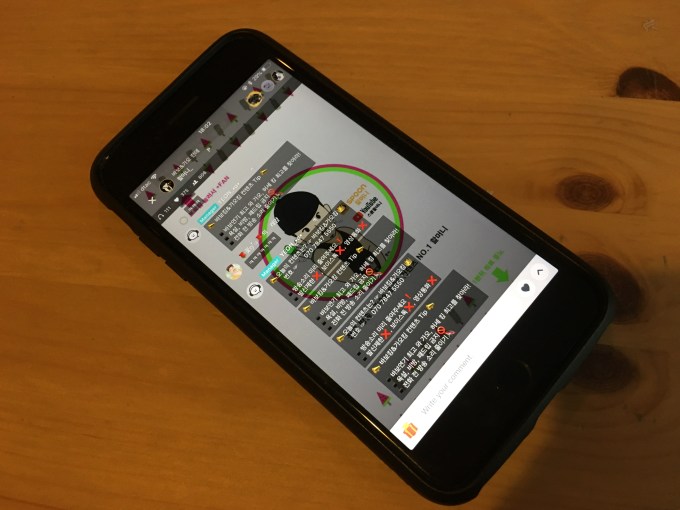
Users can tune in to talk show or music DJs, and leave comments and make requests in real-time. The service also allows users to broadcast themselves and, like live-streaming, broadcasters — or DJs, as they are called — can monetize by receiving stickers and other virtual gifts from their audience.

Spoon Radio claims 2.5 million downloads and “tens of millions” of audio broadcasts uploaded each day. Most of that userbase is in Korea, but the company said it is seeing growth in markets like Japan, Indonesia and Vietnam. In response to that growth — which Choi said is over 1,000 percent year-on-year — this funding will be used to invest in expanding the service in Southeast Asia, the rest of Asia and beyond.

Audio social media isn’t a new concept.

Singapore’s Bubble Motion raised close to $40 million from investors but it was sold in an underwhelming and undisclosed deal in 2014. Reportedly that was after the firm had failed to find a buyer and been ready to liquidate its assets. Altruist, the India-based mobile services company that bought Bubble Motion has done little to the service. Most changes have been bug fixes and the iOS app, for example, has not been updated for nearly a year.

Things have changed in the last four years, with smartphone growth surging across Asia and worldwide. That could mean different fortunes but there are also differences between the two in terms of strategy.

Bubbly was run like a social network — a ‘Twitter for voice’ — whereas Spoon Radio is focused on a consumption-based model that, as the name suggests, mirrors traditional radio.

“This is mobile consumer internet at its best,” Eric Kim, one of Goodwater Capital’s two founding partners, told TechCrunch in an interview. “Spoon Radio is taking an offline experience that exists in classic radio and making it even better.”

Kim admitted that when he first used the service he didn’t see the appeal — he claimed the same was true for Musical.ly — but he said he changed his tune after talking to listeners and using Spoon Radio. He said it reminded him of being a kid growing up in the U.S. and listening to radio shows avidly.

“It’s a really interesting phenomenon taking off in Asia because of smartphone growth and people being keen for content, but not always able to get video content. It was a net new behavior that we’d never seen before… Musical.ly was in the same bracket as net new content for the new generation, we’ve been paying attention to this category broadly,” Kim — whose firm’s other Korean investments include chat app giant Kakao and fintech startup Toss — explained.

After going public in July, Navya nabs $34M from the European Investment Bank for its self-driving bus

While automakers and startups continue to hone the technology for self-driving cars for individuals, a second track of development in the area of autonomous buses is also taking shape. Today, Navya, a French company that has been a leader in developing autonomous shuttles, announced that it has raised an additional €30 million ($34 million) from the European Investment Bank to continue building out its business.

The investment comes on the heels of another significant financial event in the life of the company. On July 24, Navya (first founded in 2014) went public on the Euronext exchange in Paris and raised €38 million ($44 million). It’s had a somewhat lacklustre early performance: the company’s market cap is currently at €188.8 million, compared to a debut at €190 million.

The company has in total raised €80 million this year, it said. “Navya thus has extensive resources to strengthen its technological leadership, to expand its sales and marketing teams and to invest in strategic adjacent markets, while pursuing further international expansion,” the company said of the financing round.

The EIB has backed a number of other fast-moving startups in Europe, including the payments startup iZettle, which later got acquired by PayPal. Its funding for Navya will come in two tranches of €15 million, with the second dependent on the company meeting (unspecified) targets.

The opportunities (and challenges) in fully autonomous cars are vast, and we are still likely many years away from seeing a full-scale roll of them anytime soon, as carmakers and their partners continue to work on safer and more accurate AI systems to run them on the seemingly endless number of permutations of roads, routes and driving scenarios; and that is before you consider the best usage models to underpin these businesses.

Autonomous shuttles, on the other hand, have had some interesting progress that points to their services coming to a stop near you, possibly sooner than you think. One of the reasons for this is that a lot of the deployments are focused on specific loops, often in closed environments where movement might be more easily predicted.

In May, it was reported that Apple had signed a deal with Volkswagen on a fleet of autonomous staff shuttles (and that it might also be partnering, with Mercedes-Benz and BMW, on self-driving cars). Daimler and Bosch are working on a self-driving shuttle service for San Francisco. There is now an autonomous shuttle in Times Square in New York (courtesy of Coast).

Navya itself has been involved in a year-long trial in Las Vegas, offering rides to passengers in a half-mile loop around the center of the city, along with a number of projects in its home market, using a version of its flagship Autonom shuttle. It says that 100 of these shuttles have been produced to date, with 89 of them already sold across 17 countries, including the US, France, Germany, Switzerland, Japan and Australia. It’s also now developing a smaller version called the Autonom Cab that will begin tests shortly.

This is on top of earlier efforts from IBM, which has a Watson-powered shuttle built with Local Motors called Olli, and Yandex, the Russian search giant that has repositioned itself as a mobile and machine learning company, is also building a shuttle bus.

Red Dead Redemption 2 sees Rockstar raising the bar for realism in open-world games

Open worlds have been a staple of gaming for a long time, but recent titles like Breath of the Wild and Horizon: Zero Dawn have significantly pushed the boundaries of what players expect from their environments. Rockstar, of Grand Theft Auto fame, is looking to make them all look like toys with Red Dead Redemption 2 and its wild west frontier that looks to be not just huge, but refreshingly real.

Rockstar is certainly best known for the immensely popular GTA series; but it’s arguable its most beloved game is actually 2010’s Red Dead Redemption, which, though a sequel, so spectacularly transplanted the run-and-gun outlaw freedom of GTA to the American West that gamers have been clamoring for a sequel for years.

RDR2 was teased back in late 2016, but only recently have we seen hints of what it will actually look like. And today brings the first of a series of videos from the developer detailing the world, character and gameplay systems.

The natural beauty of the frontier is, of course, simply amazing to see rendered in such fidelity, and Rockstar’s artists are to be commended. And it is realism that seems to be defining the project as a whole — which makes it a departure from other games whose creators bruit a living, breathing open world to explore.

Take Far Cry 5, which came out last year to mixed reviews: The natural landscape of fictional Hope County in Montana was roundly agreed to be breathtaking, but the gameplay and story were criticized as artificially and (strange juxtaposition) monotonously intense. It’s clear that Far Cry 5, like other Ubisoft games, was a sandbox in which interesting but unrealistic situations were bred by the developers — a helicopter crashing on the person you’re rescuing from bandits, and then a cougar mauling the pilot.

Horizon: Zero Dawn and Breath of the Wild were both praised for the depth and extent of their worlds and gameplay, but they both had the significant advantage of being fantasies. A mechanical dinosaur or ancient killing machine (same thing?) arrests the eye and imagination, but because one can’t really compare them to reality, they can stay definitively unrealistic. Creating a compelling sci-fi or fantasy world has its own significant challenges, but on the whole it’s considerably easier than creating a convincing replica of the real world.

RDR2 seems to be attempting real realism in its game, to the extent that it’s possible. Take for example the fact that your items and cargo actually take up space on your horse. Your horse isn’t 20 more grid spaces of inventory — you can tie a deer you hunted on top, but then it can’t run. There are loops for two long guns but not three, and you can’t carry an arsenal yourself.

The flora and fauna are real frontier flora and fauna; they’ll react realistically. Encounters can be approached in multiple ways, peaceful or violent. Your fabulous hide coat gets dirty when you fall in the mud. You get new things to do by getting to know people in your gang.

Many of these have been seen before in various games, but what Rockstar is going for appears — and for now only appears — to be taking them to a new level. It will of course have the expected cartoonish violence and occasionally eye-roll-worthy dialogue of any game, but the attempt to realistically, and at this level of fidelity, represent such a major and well-known portion of history is an undertaking of gargantuan proportions.

Will the game be as good as the amount of work that has clearly been put into it? We’ll find out later this year when it comes out.

The Flaw Detection is my favorite unsung Note 9 feature

Today’s big Note 9 event was all about internals, but the company also had a few camera tricks up its sleeve. Scene Optimizer should prove familiar to Android users, as a number of companies, including, notably, LG, have offered something similar. The software addition includes 20 different scene options, including Night, Snow, Street Scene, Birds, Indoors, Text, Food, Pets, Flowers and Sunset.

It’s a diverse and interesting bunch, and should go a ways toward helping amateurs take decent photos with Samsung’s industry-leading cameras. But Flaw Detection is an interesting and unsung addition here. The feature alerts the user if a shot is blurry, there’s a smudge on the screen, the image is overly backlit or if the subject blinked at the precise wrong moment.

As Samsung put it, the new phone “does everything but take the picture for you,” and with Flaw Detection, the system takes a step closer to eliminating the weakest link: human error. That is you, dear user. Blinks and the like are easy enough to overlook, and amateur users might not be entirely aware of what excessive backlighting can do to an image (i.e. completely ruin it).

It’s getting harder and harder to distinguish phone imaging based on hardware alone. The camera you get on any 2018 flagship is going to be pretty damn good at this point. These new software features, on the other hand, go a ways toward making sure you’re able to take advantage of that sophistication, regardless of skill level. 

Lyvly scores $4.6M for its members-based shared living and rental platform

Lyvly, a London-based startup that offers what might best be described as a members-based shared living and rental service, has raised $4.6 million in Series A funding. Leading the round is Mosaic Ventures, while Greg Marsh, who co-founded Onefinestay, has joined the burgeoning company as chairman and investor.

The latest take on how to improve the experience for “generation rent” in sprawling cities like London, Lyvly is at its most basic a two-sided marketplace that helps renters find high-quality shared living accommodations and landlords find good tenants. However, it goes far beyond simply matching supply and demand for house shares.

Not only are properties fully managed — including providing tenant services such as managing household bills, replacing consumables and cleaning — but at the heart of it all is the Lyvly community platform, which treats Lyvly renters as members within a network of “like-minded individuals who share a passion for shared living.” And, as wishy-washy as that sounds, there is no doubt that city living is often devoid of community, and in London especially it can be difficult to meet new people.

“Renting is often not a pleasant experience, and living in cities can be lonely and stressful,” says co-founder and CEO Philip Laney. “Moving into your new apartment, sorting out furniture and utilities, and then trying to connect with busy people around you all whilst working long hours in a transient economy are frustrations many of us have experienced. We are confronting three problems for renters in the city: their desire for community, convenience and affordability.”

Laney says the current way people rent shared accommodations is also painful for landlords, who don’t have consistency and control over the quality of their tenants, and often pay high fees to a middle-person and struggle with vacancy rates. “We provide them guaranteed income with no voids and no fees, and a genuinely positive social impact,” he says.

For renters, Lyvly operates a little like a members club. Once you’ve applied to join the community, you have a call with a member of the Lyvly team to learn more about your “life stage and values.” “We are people, not property first. So we establish what you’re seeking from your Lyvly move and whether you are keen to actively participate in the Lyvly community and share your life, not just spaces,” says Laney.

Next, you are given profiles of the members (and prospective housemates) you will be meeting with, and they are sent your profile and an overview as to why you are well-matched. You then meet each other, and if you like each other, you can apply online to the membership committee, which is made up of the most active Lyvly members and the team. This includes submitting your bio and stating why you want to be part of Lyvly, and what you would bring to the community.

Adds Laney: “Once you’re in, we then guide you through the whole moving process, taking care of everything and removing any usual stresses that come from moving to a new place in London. You are introduced to other members in the area who have similar interests and values and other members reach out to you directly to invite you to other activities they’re hosting. We also regularly host events and actively support members to engage with each other and give value to the community.”

Lyvly’s target tenants are 25-35-year-olds who are looking for single occupancy. Laney says that’s because they are at similar life stages to each other and this is where the startup can make a meaningful difference. “We really care about being something to someone, rather than everything to no one. In time however, we will be able to expand Lyvly into different community groups,” he says.

Landlords using the platform range from individuals who are first-time owners to some of London’s biggest property companies.

Asked who Lyvly competes with, he cites the grey and black economy of shared housing and “dodgy landlords.” Technically the company is also competing with estate agents, although it is open to working with them to help find better tenants for their landlords.

Meanwhile, don’t confuse the startup for co-living, build-to-rent developers who “put property first” and aim to profit from the development of assets. In contrast, Lyvly makes money from the managed services it provides and is not developing new property but renting out existing housing stock.

“We believe people like living in existing houses and apartments and what we need to do is create a community around that. It’s not the configuration of the spaces that need changing, but how people interact inside and outside of them,” says Laney, adding that the use of existing housing infrastructure also means that Lyvly is potentially a lot more scalable.

Along with Laney, the startup’s other co-founders are Dario Favoino and Siraj Khaliq. Both Laney and Favoino have a 10-year background in real estate investment and property management at Deutsche Bank and Realstar. And in case you aren’t keeping up, Khaliq is a partner at London VC firm Atomico and was previously CTO and co-founder of Silicon Valley startup Climate Corporation, which exited in 2013 for more than $1.1 billion.

Tribune sues Sinclair for $1B after spiking merger under FCC pressure

Media giants Sinclair and Tribune were all set to merge and create one of the country’s biggest broadcasters — and a complacent FCC seemed to be doing everything it could to help the deal along. But the regulator had a change of heart after evidence surfaced of duplicity too serious to be ignored, and the resultant red tape and bad PR provoked Tribune into spiking the deal and suing its would-be acquirer for $1 billion.

The FCC, which until recently had been accused of being overly chummy with broadcasters, Sinclair in particular, last month issued a “de facto merger death sentence” to the deal, citing mounds of evidence that the company was shirking the terms of the merger and lying about it. The legal process of working out these issues with a view to approving the merger might have taken years.

Tribune wasn’t having that, and moved quickly to throw Sinclair under the bus. In a statement posted to the company’s website, the company wrote that “Sinclair’s entire course of conduct has been in blatant violation of the Merger Agreement and, but for Sinclair’s actions, the transaction could have closed long ago.”

The legal complaint published simultaneously goes into further detail:

From virtually the moment the Merger Agreement was signed, Sinclair repeatedly and willfully breached 3 its contractual obligations in spectacular fashion… Sinclair fought, threatened, insulted, and misled regulators in a misguided and ultimately unsuccessful attempt to retain control over stations that it was obligated to sell.

The damage, it asserts, amounts to a round $1 billion.

This merger failing can hardly be considered as anything but good news to consumers; as former counsel at the FCC Gigi Sohn put it:

This transaction had but two supporters – Sinclair and Tribune. It was opposed by large and small cable companies, rural broadband providers, conservative cable channels and the public interest community. Chairman Pai and his colleagues did right by the American people and the entire broadcast industry by putting the brakes on this merger.

The ACLU’s Jacob Hutt was even less diplomatic:

This was a terrible idea to begin with. The merger would have trampled on First Amendment principles, crippled the future of journalism, and disproportionately harmed minority communities. We thank the thousands of activists that raised their voices to prevent the damage this deal would have done.

But the most erudite insult surely comes from Sinclair’s complaint.

Sinclair was impervious to appeals to its contractual obligations. It intended to pursue its own narrow self-interest regardless of its obligations until the FCC found its conduct so egregious as to merit administrative review. Tribune is now the victim of that outrageous obduracy.

Emphasis mine. I congratulate Tribune’s lawyers on their prose.