China’s drive to compete against Starlink for the future of orbital internet

There has been a wave of businesses over the past several years hoping to offer broadband internet delivered from thousands of satellites in low-earth orbit (LEO), providing coverage of most of the earth’s surface.

This isn’t the first time we’ve seen excitement in the category. Companies and people that you have heard of — Bill Gates and Motorola, to name a few — invested billions of dollars into this business model two decades ago in an adventure that ended in many bankruptcies and very few people connected to the internet from low-earth orbit. Yet, here we are 20 years later, witnessing billionaires from Elon Musk to Jeff Bezos and entities from SoftBank to the United Kingdom investing billions into broadband from space in a gold rush that began around 2015, and has only accelerated since the beginning of 2020.

During that same period, we have seen a parallel ascendance of China’s space capabilities. In tandem with the accelerated deployment of SpaceX’s Starlink constellation in 2020, China has rapidly responded in terms of policy, financing, and technology, including most notably the creation of a “Chinese answer to Starlink”, namely constellation operating company China SatNet, and the associated GuoWang (??, or National Net(work)) constellation.

While still in early development, SatNet and GuoWang are likely to compete in certain markets with Starlink and others, while also fulfilling what may be a similar strategic purpose from a government perspective. With considerable backing from very high-level actors, we are likely to see the rollout of a Red Star(link) over China (and the rest of the world) over the coming several years.

The rapid rise of Starlink

China’s LEO constellation plans cannot be understood in a vacuum. Like many other areas of high-tech investment, China’s actions here are partially reactive to developments in the West. The acceleration and expansion of Western LEO constellations in recent years — most notably Starlink — has been an accelerant to China’s own plans.

In search of a new crypto deity

Hello friends, and welcome back to Week in Review!

Last week, I wrote about tech taking on Disney. This week, I’m talking about the search for a new crypto messiah.

If you’re reading this on the TechCrunch site, you can get this in your inbox from the newsletter page, and follow my tweets @lucasmtny.


The Big Thing

Elon has worn out his welcome among the crypto illuminati, and the acolytes of Bitcoin are searching out a new emperor god king.

This weekend, thousands of crypto acolytes and investors have descended on a Bitcoin-themed conference in Miami, a very real, very heavily-produced conference sporting crypto celebrities and actual celebrities all on a mission to make waves.

Even though I am not at the conference in person (panels from its main stage were live-streamed online), I have plenty of invites in my email for afterparties featuring celebrities, open bars and endless conversations on the perils of fiat. The cryptocurrency community has never been larger or richer thanks to its most fervent bull run yet, and despite a pretty noteworthy correction in the past few weeks, people believe the best is yet to come.

Despite having so much, what they still seem to be lacking is a patron saint.

For the longest bout, that was SpaceX and Tesla CEO Elon Musk who bolstered the currency by pushing Tesla to invest cash on its balance sheet into bitcoin, while also pushing for Tesla to accept bitcoin payments for its vehicles. As I’ve noted in this newsletter in the past, Musk had a tough time reconciling the sheer energy use of bitcoin’s global network with his eco warrior bravado which has seemed to lead to his mild and uneven excommunication (though I’m sure he’s welcome back at any time).

Goods & services are the real economy, any form of money is simply the accounting thereof

— Elon Musk (@elonmusk) June 5, 2021

There are plenty of celebrities looking to fill his shoes — a recent endorsement gone wrong by Soulja Boy was one of the more comical instances.

Crypto has been no stranger to grift — of that even the most hardcore crypto grifters can likely agree — and I think there’s been some agreement that the only leader who can truly preach the gospel is someone who is already so rich they don’t even need more money. It’s one reason the community has offered up so much respect for Ethereum founder Vitalik Buterin who truly doesn’t seem to care too much about getting any wealthier — he donated about $1 billion worth of crypto to Covid relief efforts in India. A Musk-like cheerleader serves a different purpose though, and so the community is in search of a Good Billionaire.

The best runner-up at the moment appears to be one Jack Dorsey, and while — like Musk — he is also another double-CEO, he is quite a bit different from him in demeanor and desire for the spotlight. He was, however, a headline speaker at Miami’s Bitcoin conference.

Dorsey gathers the most headlines for his work at Twitter but it’s Square where he is pushing most of his crypto enthusiasm. Users can already use Square’s Cash App to buy Bitcoin. Minutes before going onstage Friday, Dorsey tweeted out a thread detailing that Square was interested in building its own hardware wallet that users could store cryptocurrency like bitcoin on outside of the confines of an exchange.

Square is considering making a hardware wallet for #bitcoin. If we do it, we would build it entirely in the open, from software to hardware design, and in collaboration with the community. We want to kick off this thinking the right way: by sharing some of our guiding principles.

— jack (@jack) June 4, 2021

“Bitcoin changes absolutely everything,” Dorsey said onstage. “I don’t think there is anything more important in my lifetime to work on.”

And while the billionaire Dorsey seems like a good choice on paper — he tweets about bitcoin often, but only good tweets. He defends its environmental effects. He shows up to House misinformation hearings with a bitcoin tracker clearly visible in the background. He is also unfortunately the CEO of Twitter, a company that’s desire to reign in its more troublesome users — including one very troublesome user — has caused a rift between him and the crypto community’s very vocal libertarian sect.

Dorsey didn’t make it very far into his speech before a heckler made a scene calling him a hypocrite because of all this with a few others piping in, but like any good potential crypto king would know to do, he just waited quietly for the noise to die down.


(Photo by BRENDAN SMIALOWSKI/AFP via Getty Images)

Other things 

Here are the TechCrunch news stories that especially caught my eye this week:

Facebook’s Trump ban will last at least 2 years
In response to the Facebook Oversight Board’s recommendations that the company offer more specificity around its ban of former President Trump, the company announced Friday that it will be banning Trump from its platforms through January 2023 at least, though the company has basically given itself the ability to extend that deadline if it so desires…

Nigeria suspends Twitter
Nigeria is shutting down access to Twitter inside the country with a government official citing the “use of the platform for activities that are capable of undermining Nigeria’s corporate existence.” Twitter called the shutdown “deeply concerning.”

Stack Overflow gets acquired for $1.8 billion
Stack Overflow, one of the most-visited sites of developers across the technology industry, was acquired by Prosus. The heavy hitter investment firm is best known for owning a huge chunk of Tencent. Stack Overflow’s founders say the site will continue to operate independently under the new management.

Spotify ups its personalization
Music service Spotify launched a dedicated section this week called Only You which aims to capture some of the personalization it has been serving up in its annual Spotify Wrapped review. Highlights of the new feature include blended playlists with friends and mid-year reviews.

Supreme Court limits US hacking law in landmark case
Justices from the conservative and liberal wings joined together in a landmark ruling that put limits on what kind of conduct can be prosecuted under the controversial Computer Fraud and Abuse Act.

This one email explains Apple
Here’s a fun one, the email exchange that birthed the App Store between the late Steve Jobs and SVP of Software Engineering, Bertrand Serlet as annotated by my boss Matthew Panzarino.


illustration of money raining down

Image Credits: Bryce Durbin / TechCrunch

Extra things

Some of my favorite reads from our Extra Crunch subscription service this week:

For SaaS startups, differentiation is an iterative process
“The more you know about your target customers’ pain points with current solutions, the easier it will be to stand out. Take every opportunity to learn about the people you are aiming to serve, and which problems they want to solve the most. Analyst reports about specific sectors may be useful, but there is no better source of information than the people who, hopefully, will pay to use your solution..”

3 lessons we learned after raising $6 million from 50 investors
“…being pre-product at the time, we had to lean on our experience and our vision to drive conviction and urgency among investors. Unfortunately, it just wasn’t enough. Investors either felt that our experience was a bad fit for the space we were entering (productivity/scheduling) or that our vision wasn’t compelling enough to merit investment on the terms we wanted.

The existential cost of decelerated growth
“Just because a technology startup has a hot start, that doesn’t mean it will grow quickly forever. Most will wind up somewhere in the middle — or worse. Put simply, there is a larger number of tech companies that do fine or a little bit worse after they reach scale.”


Again, if you’re reading this on the TechCrunch site, you can get this in your inbox from the newsletter page, and follow my tweets @lucasmtny.

Get thrifty, and your startup might just acquire a generation

Etsy, a marketplace for kitschy and creative DIY goods, acquired Depop, a hippy and thrifty marketplace for resale goods, for $1.625 billion this week. So, today we’ll discuss the tale of two marketplaces, a deal that has given us a peek into the evolving ethos of social shopping.

Depop, for those that don’t know, is a London-based company that targets millennial and Gen Z shoppers. Within the past two years, Depop has grown its user base of stylists, designers, artists, vintage sellers and more, from 13 million to 21 million, And, the company claims, some 90% of its users are under the age of 26.

With the buy, Etsy is growth hacking its way into a younger generation, one that thinks thrifting is trendy and individualism is more interesting than fast fashion. But to me, combining two, two-sided marketplaces is not where the work stops. Etsy, with Depop under its umbrella, has an opportunity to be far more inventive with the way it combines operations.

First, Etsy needs to find other ways — beyond a new volume of fresh goods — to modernize its user experience, from homepage to checkout. Why? Because, and I can say this because I am technically part of the cohort, Gen Z is impatient. Sure, thrifting is trendy — but so is Amazon. The same generation that loves the idea of sporting the individual creative, also loves the idea of low-cost goods and two-day shipping. Sure, there are people that sit at either extreme. But I’d bet an unnecessary milk frother that the majority of Gen Z consumers sit in a more grey space.

Secondly, Etsy and Depop have an opportunity to invest in the growing wave of social shopping experiences. When I saw this news break, I immediately thought of The Landing, a company that is using customizable and collaborative mood boards as a shopping tool. The startup allows users to create mood boards from products that they can then shop from. Right now, it’s starting with interior design, but the vision can easily extend beyond home goods into clothing or CPG products. Similar to Pinterest, The Landing is trying to serve a set of consumers that like shopping in a collaborative, scroll-friendly way. I’m not asking Etsy to go full early-stage startup, but it would certainly be compelling if it found new ways for consumers to experience its broadened marketplace.

I’ll stop there, and end with this: As more and more companies prioritize serving Gen Z, strategy needs to be more than a land grab. As one person put it, Etsy is “ensuring the brand translates through different generational ethos,” with the acquisition. I’m excited to watch this case study in the making play out.

In the rest of this newsletter, we’ll discuss digital health, the beautiful world of S-1 filings and a Medium memo that has caused employees to leave the company. As always, you can find me on Twitter @nmasc_. Scoops keep me happy, so if you have a tip on an early-stage deal or drama that I should know about, DM me or e-mail me at [email protected].

Digital health is late on this one

One of 14 incandescent lightbulbs lit on purple surface

Image Credits: PM Images (opens in a new window) / Getty Images

If my inbox is a fair indicator, every other startup right now is trying to get invited to one group chat: the digital health one. We’ve covered the boom in health tech on TC, but one question has haunted me for the past month: Where are all the PCOS startups? The condition, known as polycystic ovary syndrome, impacts one in 10 women and seems to mesh well with the loud drumbeat of personalized medicine. So, I went digging. 

Here’s what to know: I learned that there is a massive opportunity for startups in hormonal health, but the sector is still nascent due to an array of issues, both related to science and stigma.

And speaking of nascent industries:

IPO’d

illustration of money raining down

Image Credits: TechCrunch

The Equity team has probably spent about 3% of our collective recording time manifesting Robinhood’s S-1. Of course, at the time of writing this, our efforts have proven futile. But no worries, we have other public market news to keep you interested as we wait.

Here’s what to know: Confluent’s S-1 revealed slowing growth amid a history of impressive expansion. Sprinklr’s IPO filing showed uneven cash flow, but did have some healthy growth worth noting. And Acorn, everyone’s favorite consumer fintech biz, listed as a SPAC.

Medium’s extreme

Image Credits: Bryce Durbin

I published a scoop this week about the latest tension at Medium, a startup that has had its fair share of woes and pivots over the years. In April, Medium CEO Ev Williams wrote a memo about the company’s culture. Several employees argue the undertone of the memo has paved the way for an unsafe, “nod-and-smile” work environment, triggering more exits. Of the 241 people who started at Medium, some 50% of that pool are now gone.

Here’s what to know: Similar to Coinbase and Basecamp, Medium’s culture memo has made employees leave due to a change in mission. But, unlike the aforementioned companies, Medium’s memo has a more subtle undertone, exacerbated by tension after a unionization attempt failed the month prior.

And in the early-stage startup world: 

Around TC

Tell me how you really feel, dear Equity listeners! The podcast team put together a survey for Equity listeners. It only takes a few minutes to fill out and will make our entire team very happy. The more information we have about what you want, the better the show will be.

Additionally, TC Sessions: Mobility is happening next week. Here are five reasons for why it’s a must-see event about all things moving. And it’s not too late to grab tickets.

Across the week

Seen on TechCrunch

Seen on Extra Crunch

Talk next week,

N

Not every SPAC is pure garbage

Welcome back to The TechCrunch Exchange, a weekly startups-and-markets newsletter. It’s broadly based on the daily column that appears on Extra Crunch, but free, and made for your weekend reading. Want it in your inbox every Saturday? Sign up here.

Ready? Let’s talk money, startups and spicy IPO rumors.

Happy Saturday everyone. Despite it being a short week I feel pretty run over from the sheer news volume that we’ve put up with in the last few days. So let’s pause, repine and talk about SPACs as a nice little treat.

No, we’re not going through a SPAC investor presentation teardown today. Though we will dig into the Babylon Health SPAC on Monday. Instead, we’re discussing the SoFi and BarkBox blank-check deals.

Both began to trade this week after announcing their public debuts some time ago. And things went just fine? Here’s CNBC on SoFi’s first minutes as a public company:

SoFi, short for Social Finance, went public by merging with Social Capital Hedosophia Corp V, a blank-check company run by venture capital investor Chamath Palihapitiya. The stock closed up more than 12% to $22.65.

That’s not only a win for SoFi, but also for the somewhat-embattled Chamath Palihapitiya, whose SPAC bets have lost some luster in recent months; of course all SPAC-led debuts are speculative, but some retail traders appeared to index more on Palihapitiya’s reputation than fundamentals — what can you do!

BarkBox also did perfectly ok when it began to trade this week after its own SPAC combination was consummated, as Barrons reported:

BARK stock (ticker: BARK) jumped about 7.5% on Wednesday, to trade at around $12 in the afternoon. That gives the company a market value of close to $2.4 billion.

BarkBox stock has since given up some of its gains, but managed to get public without falling below its initial SPAC price. That’s a win given how market conditions have shifted since its flotation was initially announced.

Two wins in a single week is good news for SPAC-land and the myriad players on the blank-check and startup sides of the marketplace. Naturally two solid results does not a trend make, but it seems clear that for companies with material revenues the SPAC-route is not as potholed as we might have expected.

The crypto wager

If you think SPACs are generally annoying, just wait until we fuse the blank-check boom with crypto. As we are about to do!

This week Circle, a crypto-focused company with a particular taste for stablecoins, raised $440 million. That was an ocean of capital for a company best known for the USDC stablecoin; it is also reported to be considering a SPAC-led IPO.

What is a stablecoin? It’s a cryptocurrency that is pegged to a fiat currency. In the case of USDC, as you surmised, the coin is pegged to the US dollar. Stablecoins are useful fiat comps inside the crypto world and have proven to be hugely popular.

Circle’s USDC has $22.8 billion worth of supply in circulation, it claims, and several billion in daily transactions, per CoinMarketCap data. That’s not bad! But what isn’t as clear to your humble servant is precisely how the firm generates huge revenues at super-attractive gross margins. Which is what we’d expect from a company that just locked down nearly a half-billion dollars (or USDC, we suppose) in private capital in a single go.

So, for once, bring on the SPAC. Because we want to see the damn numbers, and quickly, given our sheer curiosity.

Growth?

Wrapping, Ron and I got to dig into a number of public companies’ earnings reports the other day, essentially discovering that the vaunted digital transformation acceleration is actually coming true for some companies.

This week’s news continued the argument. Zoom’s earnings, for example, backed up our thesis. Its revenues were up 191% in Q1 F2022 compared to Q1 F2021. That’s just bonkers good.

On the other end of the spectrum are Dropbox and Box, which are under fresh pressure this week from external investors. The pair of former private-market darlings have run into a growth wall and are taking incoming fire due to it. Grow or die is more than just startup advice. It’s what software companies need to do if they want to stay in charge of their own destiny.

Alex

This Week in Apps: WWDC Prep, F8 recap, TikTok goes after biometric data

Welcome back to This Week in Apps, the weekly TechCrunch series that recaps the latest in mobile OS news, mobile applications and the overall app economy.

The app industry continues to grow, with a record 218 billion downloads and $143 billion in global consumer spend in 2020. Consumers last year also spent 3.5 trillion minutes using apps on Android devices alone. And in the U.S., app usage surged ahead of the time spent watching live TV. Currently, the average American watches 3.7 hours of live TV per day, but now spends four hours per day on their mobile devices.

Apps aren’t just a way to pass idle hours — they’re also a big business. In 2019, mobile-first companies had a combined $544 billion valuation, 6.5x higher than those without a mobile focus. In 2020, investors poured $73 billion in capital into mobile companies — a figure that’s up 27% year-over-year.

This week was a busy one. Facebook held its developer conference F8 which delivered a lot of app-related news across its platform. Now, WWDC is just days away. We also broke a few big app stories this week, including one about TikTok’s privacy policy and its newly added permission to collect biometric data on U.S. users, including “faceprints and voiceprints.” Twitter added a subscription service, and Tinder tested group video chat.

And in our downloads section, we have a treat for readers: a time-sensitive and exclusive invite code to get into one of the hottest new apps for sneakerheads: Sole Retriever. 

Get the This Week in Apps newsletter! Sign up here: techcrunch.com/newsletters

WWDC 21 Prep
Image Credits: Apple

WWDC’s big keynote is kicking off next week on June 7 at 1 PM ET. The livestream page is here. While we may see new MacBook Pros, what software developers will care about are the forthcoming details about Apple’s latest OS releases and other new technologies. As to what they may include? Bloomberg reported that iOS 15 will introduce a way for users to set different notification preferences and automatic replies, based on their current status (driving, working, sleeping, etc.) and an updated Lock Screen where this menu of choices would be accessible. iMessage may be upgraded to be more social, to better compete with Messenger and WhatsApp. Meanwhile, iPadOS could be getting the App Library and an upgraded Home Screen with support for widgets. (And you can fill the screen with just widgets, if you choose.) Or who knows! Until it’s official, it’s all a maybe!

But one potentially interesting rumor to watch for would be a new privacy feature that would show users which apps were collecting data about them. This builds on Apple’s investments in App Tracking Transparency and could make it more difficult for shady SDKs to stay in business.

There will likely be some updates coming to other Apple’s own apps, Siri, watchOS and more. It’s going to be a packed week — stay tuned!

Ahead of WWDC, Apple also updated its report (conducted on its behalf via the Analysis Group) on App Store commerce. The company says the App Store facilitated $643 billion in billings and sales in 2020, up 24% from the $519 billion seen the year prior. It also noted that about 90% of the billings and sales facilitated by the App Store actually took place outside its walls, meaning Apple took no commission on those purchases. This is up from the 85% figure reported last year. The full report delves into other trends related to the pandemic’s impact, small and large businesses, and more. Apple initially commissioned the report to demonstrate how little business on the App Store is actually subject to App Store fees, but now it’s updated the report a year later. It’s interesting how much understanding Apple has about its App Store, especially when Tim Cook claimed to know so little about several crucial figures.
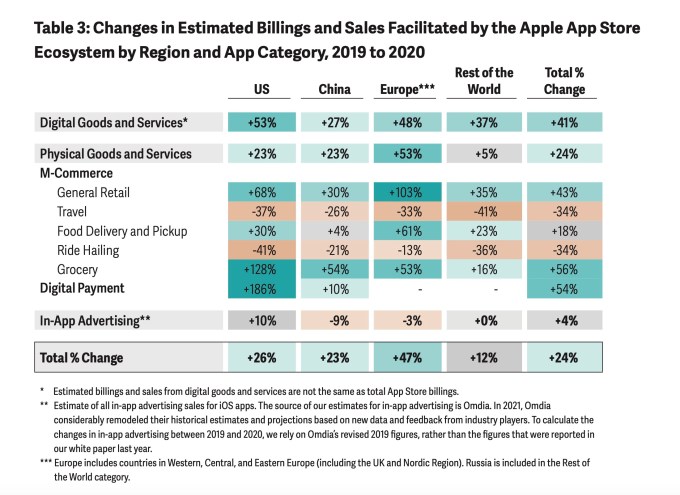
Image Credits: Apple

Apple also this week unveiled its 2021 Apple Design finalists. The awards honor apps and games that offer a combination of innovation, ingenuity and technical achievement — the latter which often means making great use of Apple technologies. The finalists span six categories: Inclusivity, Delight and Fun, Interaction, Social Impact, Visuals and Graphics, and Innovation.

Among the prospective winners are apps including snarky weather app Carrot Weather as well as the unique (Not Boring) Weather, short-form news service Brief, mental wellness app and Google Play award winner Loona, Editor’s Choice Genshin Impact, Snowman’s new kids app Pok Pok Playroom and summertime fun music app Poolside FM, and many others.

Weekly News

Platforms: Google

Google this week opened submissions for two of its annual developer programs: the Indie Games Accelerator and the Indie Games Festival. The programs are designed to help small games studios grow on Google Play. This year, the programs will include more eligible markets and will be fully digital experiences.

Google will restrict third-party apps from customizing the native Android Sharesheet in Android 12. Currently, the UI of the Sharesheet can differ from app to app, but XDA Developers reports it will become more iOS-like, by offering a consistent menu across apps.

Google is taking a cue from Apple by allowing users to opt out of personalization using the advertising ID in the Android Settings. Once users opt out, the advertising ID is disabled. The ID is a unique, user-resettable identifier provided by Google Play services. As part of a coming Google Play services update in late 2021, the advertising identifier will be removed when the user opts out of tracking, and any attempt to access the identifier will only return a string of zeros. Google says ad and analytics service partners will receive notifications about a user’s preferences to help them with compliance. The change will roll out in late 2021 and will impact apps running on Android 12 devices initially, with an expansion to devices that support Google Play in early 2022.

Platforms: Huawei (!!)

Image Credits: Wang Chenglu, president of Huawei Consumer Business Group’s software department

Two years after Huawei was put on a list of Chinese companies banned from doing business with U.S. organizations, it launched its proprietary operating system, HarmonyOS, for smartphones. The OS is designed to power phones, tablets and smart devices. Smartphone maker Meizu has already hinted it may adopt the new OS.

Augmented Reality

Image Credits: Facebook

Facebook’s flagship AR creation software, Spark AR, has already been used by more than 600,000 creators from over 190 countries to publish over 2 million AR effects. At Facebook’s F8 event this week, the company announced Multipeer API for video calls on Messenger, Instagram and Portal. The API will allow developers to create “shared AR” effects that apply to all the call participants — like a party hat that shows up on everyone’s heads for a birthday call, for instance.

E-commerce/Retail

Convenience store-style on-demand delivery startup JOKR launched in New York City to provide 15-minute or less delivery of items you might otherwise find in small stores and local delis. Except instead of dealing with stores, JOKR has its own strategically placed micro-hubs. The startup was founded by Ralf Wenzel, who previously founded Foodpanda, which later merged with Delivery Hero.

Image Credits: Walmart

Walmart is handing out over 740,000 new Samsung Galaxy XCover Pro smartphones (retail $499) to its employees, saying that “constant communication” is essential to its business. The phones will run Walmart’s proprietary Me@Walmart app, where employees clock in, adjust schedules, use the voice assistant “Ask Sam,” and communicate with others via push-to-talk. Employees will be allowed to use the phone for personal use after work hours, and Walmart will not have access to their personal data, the retailer says.

Fintech

Image Credits: Kraken

Coinbase rival Kraken launched a mobile app in the U.S. that allows users to buy and sell more than 50 crypto tokens from their mobile phone. Kraken is the world’s fourth-largest digital currency exchange, in terms of trading volume.

Venmo now lets users hide their friend list for additional privacy. The change to the app came after BuzzFeed News found President Biden’s Venmo account using public friend lists. Digital rights groups had called the design a “security nightmare.”

Japan-based Line Corp. is launching its digital banking platform in Indonesia, which means it will now offering banking services in three of its biggest overseas markets: Indonesia, Thailand and Taiwan.

Coinbase Card, which allows users to spend their crypto while on the go, now works with Apple Pay and Google Pay. The card will offer up to 4% in crypto rewards for everyday purchases.

Chime has established itself as the No. 1 neobank in the U.S., according to eMarketer. The banking app will have 13.1 million U.S. accounts this year, up 30.7% from 2020. Current will have 4 million, double from the 2.1 million it had last year. Aspiration is in third place, with 3 million, followed by Varo, at 2.7 million.

Social

? Scoop: Tinder tested a group video chat feature ahead of parent company Match’s move into social discovery with its $1.73 billion acquisition of Seoul-based Hyperconnect. The feature was only tested briefly in New Zealand and then shut down, but may have served as a way to gain valuable data about younger users’ interest in social discovery apps and services as Match moves into that market which it says is double the size of the dating market.
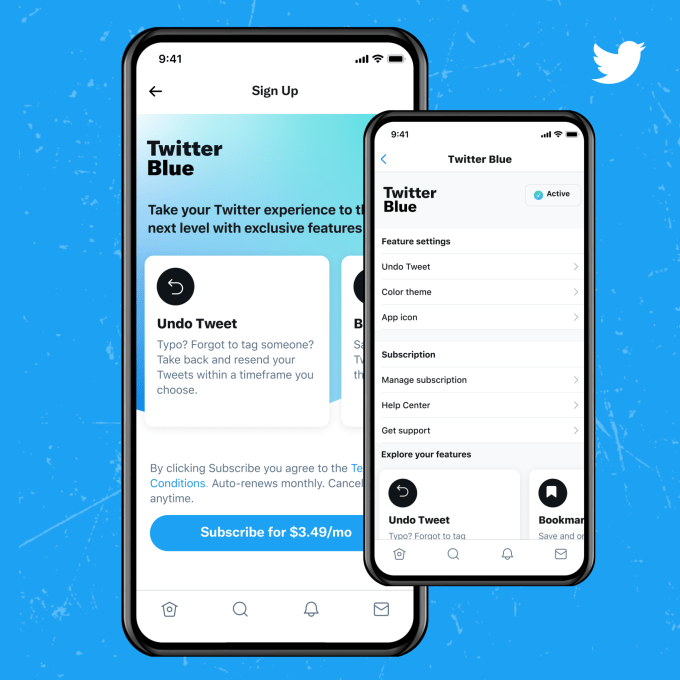
Image Credits: Twitter

Twitter Blue officially launched. Will you pay for better Twitter? Twitter’s new premium subscription brings tools to organize your bookmarks, read threads in a clutter-free format and take advantage of an “Undo Tweet” feature — which is the closest thing Twitter will have to the long-requested “Edit” button. It also offers a few other perks, like custom app icons, colorful themes and subscription customer support. Unfortunately, the service is only live in Canada and Australia for the time being.

Twitter redesigned its mobile app to put its Clubhouse rival, Twitter Spaces, in the middle of its navigation bar. Initially, only around 500 people from the original Spaces beta test will first see the new Spaces discovery tab, but it will expand to more people over time. The tab will help people keep track of Spaces they want to listen to and manage notifications, among other things.

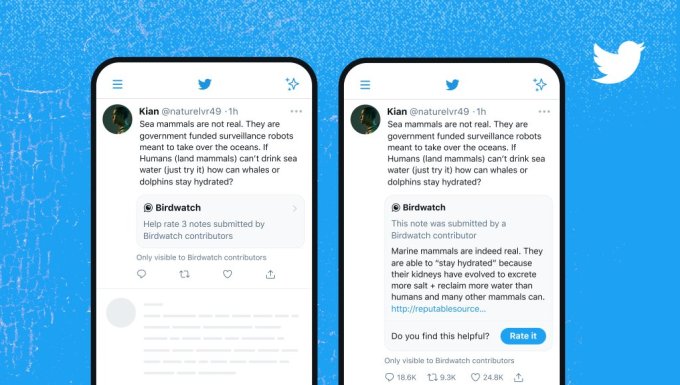
Twitter began rolling out Birdwatch fact checks inside tweets. Birdwatch is Twitter’s pilot program that aims to crowdsource fact-checking of tweets, as an alternative to relying on fact-checkers. The program’s goal will be to append more info to misinformation online in real time.
TikTok reamined the top non-game app worldwide in May 2021 by downloads. According to Sensor Tower, TikTok was No. 1 on both the App Store and Google Play with 80 million combined installs. Brazil accounted for 16% of those, and China 12%.

Facebook at its developer conference F8 also introduced Facebook Login Connect with Messenger. For businesses that have already integrated with Facebook Login, this allow users to log in to their app using their Facebook credentials and opt in to chat with businesses over Messenger, all in the Facebook Login flow. The tool is in closed beta.

Facebook also updated its Business Suite with a new feature that will allow developers to build “business apps,” which are tools made by third-party developers that work alongside the Business Suite. These “apps” could do things like bring in content from a catalog to their Facebook page or Instagram account. The platform already has 30 developers working on it and integrates with e-commerce platforms, like BigCommerce.

Image Credits: Facebook

Messaging

WhatsApp reversed course and now says it won’t reduce the app’s functionality if users don’t agree to its new privacy policy. The rollout had led to a lot of backlash as it revealed the messaging app would begin sharing more info with Facebook.

As part of its F8-related announcements, WhatsApp said it would update its Business API to make it quicker for business to get started with its service. WhatsApp will make it faster to set up a business account (5 minutes instead of weeks), and will allow businesses to respond faster to inbound messages, as well as send messages to users who opted in. The business tool for customer care will allow up to 10 pre-written messages, among other updates.

Facebook CEO Mark Zuckerberg told popular news outlet/leaker WaBetaInfo that WhatsApp will add multi-device support for connecting up to four devices to one account. He also said WhatsApp will introduce a “view once” disappearing feature for photos and videos, and is working on an iPad app. The method of delivering this news is worth noting — WaBetaInfo is not a traditional news outlet, but more of an independent news portal of sorts. Zuckerberg has been taking Facebook news to non-traditional (and often far friendlier) channels as of late, including popping up in Clubhouse rooms and other independent outlets. Facebook clearly feels mainstream press has turned on it when they…[checks notes]…held Facebook accountable for its actions.

Facebook also announced the general availability of the Messenger API for Instagram. First announced last fall and rolling out in phases, the API offers a more efficient way for larger brands to handle a high volume of messages by allowing them to integrate Instagram messaging into the tools and applications they’re already using in-house to manage their Facebook conversations.

Community social network Nextdoor launched a new feature called Free Finds that helps its users unload their unwanted stuff on others in their neighborhood. Notably, the feature doesn’t require you to be a Nextdoor member to access the listings, but eventually, those users may convert.

Streaming & Entertainment

Image Credits: Spotify

Spotify rolled out a sort of mid-year version of Wrapped with the launch of the new personalized experience, Only You. The feature offers insights about your music history in a sharable format, like your musical dinner party or audio birth chart, and other fun finds. Why now? Perhaps Spotify is heading off Apple Music news to come with a feature that reminds users it does personalization best?

Spotify also added Blend, a way to create a playlist with any other Spotify user. The company offers a similar feature for users on its Family and Duo plans, but this new tool doesn’t require users to be in the same household.

Apple tried to acquire livestreaming music platform Verzuz, which later sold to video social network Triller, Bloomberg reported. Apple didn’t engage in a bidding war and offered a lower price than what Triller paid, it said.

The Apple TV app launched on Android devices. Like Apple Music, Apple TV is a service that needs to work across platforms in order to compete with rivals. The Android app’s arrival followed the Apple TV app’s debut on Nvidia’s Shield TV, which means it’s now available across all major Android TV-based devices.

Health & Fitness

Amazon updated its Halo health app with a new feature called Movement Health, which will use computer vision and machine learning to asses users’ posture, mobility and stability and then suggest exercises to improve them.

Peloton slashed the pricing for its fitness app, normally $12.99/mo, for students, teachers, healthcare workers and military. Students can pay $6.99/mo while the others can pay $9.99/mo. Military members and their families can lock in that rate for life. The company is facing a PR crisis after recalling treadmills that injured 70 and led to one infant death.

Utilities

Image Credits: App Annie

A TikTok trend where users prank people by spamming them on text has driven the app that makes that possible, Paste Keyboard, to the top of the App Store. Mashable noted the app’s rise, but couldn’t figure out why. Nor could App Annie. It’s kids, y’all. Honestly, the App Store needs a new “viral” chart at this point.

AirTag support is coming to Android. Apple announced some changes to AirTag, including the period of time they’ll make a sound when moved. The time will change from three times per day to a random time between 8-24 hours. Apple believes the shortening of the window will serve as a better deterrent against bad actors using AirTag to track someone.  Alongside this announcement, Apple said it will later this year launch an Android application that will allow users to detect AirTag or other Find My network-enabled accessories that are separated from its owner and may be traveling with a user.

Firefox revamped its Mac and iOS app this week with a what it claims is a more distraction-free design, featuring streamlined toolbar and menus, expanded privacy protections, a new look for tabs, updated notifications and alerts, easier muting, and more.


Ring added “Request for Assistance posts” on its Neighbors app, claiming this will allow public safety agencies (e.g. police) to ask communities for help in investigations. The Request for Assistance posts can only be issued from verified public safety agency profiles, Ring says. Of course, this isn’t the only way police can acquire Ring videos, as the company has many police partnerships across the U.S. that let them acquire footage without a warrant.

Auto/Transportation

Toyota added a data privacy portal to its apps. The feature is available in the Account Settings of the Toyota and Lexus apps and works with vehicles offering connected services that were built in the 2013 model year or later. It also allows consumers who own multiple Toyota or Lexus vehicles to customize privacy and data-sharing settings for each.

Gokada is launching its ride-hailing service in two more Nigerian cities as part of its super app plans. The company is merging its ride-hailing service with food delivery platform GShop. In the past year, Gokada crossed $100 million in annualized transaction value, and helped onboard 30,000 merchants.

Reading
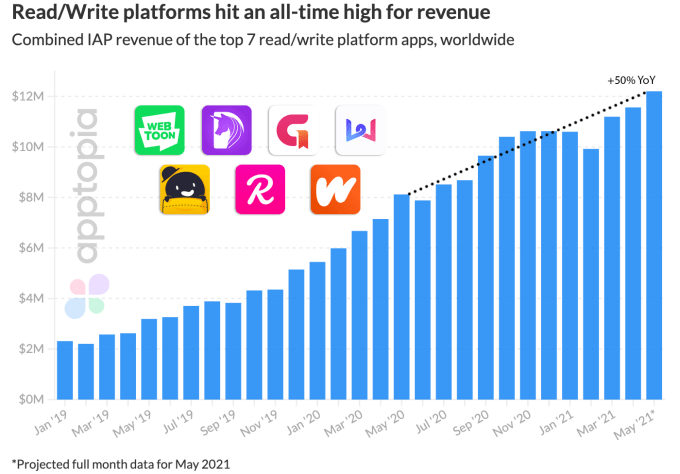
Image Credits: Apptopia

The top reading and writing apps grew their IAP revenue 50% YoY in May 2021, Apptopia reported. This group includes apps for writing novels or comic books, or reading the works from others, like Webtoon, Wattpad, Dreame, GoodNovel, Webnovel, Tapas and Radish. As a grouping, these apps have also grown IAP revenue 15% over the past six months. Since January 2020, Webtoon and Dreame combined accounted for 56.3% of the grouping’s total IAP revenue.

Government & Policy

Google, Facebook, WhatsApp, Telegram, LinkedIn and startups ShareChat and Koo have now either fully or partially complied with India’s IT rules that require them to appoint and share contact details of representatives tasked with compliance, nodal point of reference and grievance redressals to address on-ground concerns. Twitter, whose offices were raided by police in Delhi, has not yet complied.

EU will review TikTok’s Terms of Service following child safety complaints. Areas of concern include hidden marketing, aggressive advertising techniques targeted at children and contractual terms in the company’s policies that could be misleading or confusing for consumers.

Security & Privacy
The TikTok logo is seen on an iPhone 11 Pro max

The TikTok logo is seen on an iPhone 11 Pro max

? Scoop: TikTok just gave itself permission to collect biometric data on U.S. users, including “faceprints and voiceprints.” A change to TikTok’s U.S. privacy policy on Wednesday introduced a new section that says the social video app “may collect biometric identifiers and biometric information” from its users’ content, including things like “faceprints and voiceprints.” Reached for comment, TikTok could not confirm what product developments necessitated the addition of biometric data to its list of disclosures about the information it automatically collects from users, but said it would ask for consent in the case such data collection practices began.

The biometric data collection details were introduced in the newly added section, “Image and Audio Information,” found under the heading of “Information we collect automatically” in the policy.


Alibaba’s UC Browser app has been found to be harvesting the private web activity of users across Android or iOS when incognito mode is turned on. The browser is the fourth largest in the world, with 500 million Android downloads alone. Before being banned in India over security concerns related to Chinese apps, it was also one of the most popular in India, as well.

Funding and M&A

? Miami-based NUE Life Health raised $3.3 million for its telemedicine platform and app in the U.S., where it combines mental wellness solutions that employ psychedelic-assisted therapies with a graph database-driven app. The app was backed by investors who recently left SV for Miami, including Jack Abraham, Shervin Pishevar, Martin Varsavsky, Jon Oringer, James Bailey and Christina Getty.

? Etsy acquired secondhand e-commerce startup Depop for more than $1.6 billion. Depop, which caters to a Gen Z crowd, saw 2020 gross merchandise sales and revenue of approximately $650 million and $70 million, respectively.

? Social network platform Venn raised $60 million in Series B funding led by Group 11. The startup provides technology that allows building owners and other real estate partners and communities to provide social networking services to their tenants, with tools for organizing buy/sell groups, organizing community activities, connecting with neighbors and more.

? Digital health management company Hello Heart raised $45 million Series C led by IVP. The company’s app is marketed by employers as part of their benefit programs and helps patients manage heart health and blood pressure, medications and more.

? Personal finance app Truebill raised $17 million in Series C funding led by Accel, valuing the business at $500 million. The app helps consumers get better control over their finances by helping them cancel subscriptions, negotiate bills, view credit reports, budget, and access spending insights, among other things.

? Newly launched stock trading app Lightyear disclosed it raised $1.5 million pre-seed funding in a round co-led by the new unnamed fund formed by Wise co-founder Taavet Hinrikus and Teleport co-founder Sten Tamkivi. The app was the fund’s first investment.

? Istanbul-based grocery delivery app Getir raised $550 million in new funding, tripling its valuation to $7.5 billion. New investors include DisruptAD and Mubadala Funding Firm (both being arms of Abu Dhabi sovereign wealth funds) as well as Silicon Valley-based Silver Lake.

Downloads

Sole Retriever
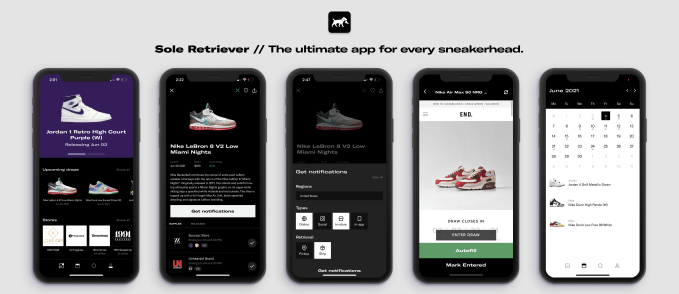
Image Credits: Sole Retriever

Sole Retriever is a newly launched app that aims to be a sneakerhead’s dream.

The app offers a one-stop shop for all things sneaker — including sneaker news, sneaker releases, sneaker raffles, a calendar of upcoming drops and more. The company says its goal is to democratize access to sneaker drops by making this info more accessible and convenient for consumers. Before its mobile launch, Sole Retriever had offered its service via the web only. Now it’s live on both iOS and Android.

Unique to the mobile experience is the ability to customize your alerts so you only hear about the raffles you want to know about — like those in the U.S., or only those that are in-store or online, for example. It also makes entering raffles easier with autofill features. Custom profiles that let you save the info for others who have agreed to let you enter their name and address to increase your chances of winning. And the app can save your logins for different retailers to make shopping easier.

Sole Retriever is currently only available as a waitlist, but TechCrunch readers can bypass the waitlist! Here’s how! 

After downloading the app and logging in, when you reach the waitlist screen, you can redeem a special code — “TWIA” (in all caps!), which lets you bypass the entire waitlist and gain instant access to start your seven-day free trial for the app. The code is only valid for 24 hours after this post goes live so hit it quickly!

Apple Developer app
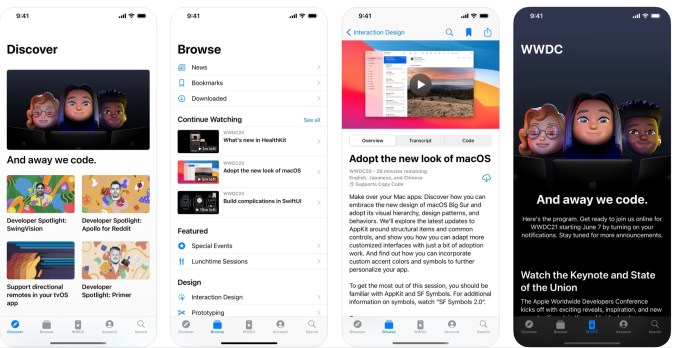
Image Credits: Apple

The Apple Developer app is not new. But it is the must-have download for the week ahead, as it will provide mobile developers with access to everything needed to navigate WWDC 21’s all-digital event. The app was updated this week with details about the agenda, sessions, pavilions, labs, coding and design challenges, and more. Developers can also sign up for labs inside the app and get notifications about their appointments. There are also new WWDC 21 iMessage stickers for some added fun.

Reading Recommendations

  • Marco.org: Developer Relations. Marco Arment has some harsh words for Apple ahead of WWDC. He accuses the iPhone maker of undervaluing what apps mean for iOS beyond their IAP revenue. And he points out that developers themselves bring in a good number of customers through their own marketing efforts, not because of their App Store listing.
  • Pew Research: Mobile Technology and Home Broadband 2021. Pew takes a look at U.S. trends, including smartphone ownership adoption. Eighty-five percent of U.S. adults now own a smartphone, which is more than have broadband (77%) at home.
  • Donny Wals: The iOS Developer’s Guide to WWDC 2021. Wals reminds developers to not get caught up in the WWDC chaos, pace themselves and focus on what matters to their business. He also makes suggestions about what to not overlook during WWDC week.

Tweets

iOS 14 Now Installed on 90% of iPhones Released in Last Four Years https://t.co/2eR04AmZNx by @julipuli pic.twitter.com/7IXmDdaR6x

— MacRumors.com (@MacRumors) June 4, 2021

Target is hiring iOS engineers to work on their flagship app’s platform/infra team. If build tooling, design systems, and/or UI frameworks are your thing, I would love to hear from you!

— Matt Pennig (@pennig) June 4, 2021

It’s time pic.twitter.com/6XiWm9limt

— ????? (@DylanMcD8) June 4, 2021

Idle observation: in all the Epic/Apple filings, there are at least a dozen 100+ slide internal Apple presentations of metrics for the App Store. Billings, genres, popular apps, payment models, developers – every metric
Not a single one has a P&L or any analysis of costs at all

— Benedict Evans (@benedictevans) June 4, 2021

Gee I wonder if iMessage is getting a WWDC update. pic.twitter.com/BUkFbxTU0j

— Ryan Jones (@rjonesy) June 4, 2021

Of course, next week at WWDC the walls will get even higher. I hear there are big updates coming to Safari, Health, Maps and iMessage at WWDC next week.

— Joanna Stern (@JoannaStern) June 4, 2021

Um, where is the SEC when it comes to SPACs and conflicts of interest?

Earlier today, TechCrunch’s Kirsten Korosec reported that the autonomous vehicle startup Aurora is close to finalizing a deal to merge with one of three blank-check companies that have been formed to date by renowned entrepreneurs Reid Hoffman and Mark Pincus and a third partner in these deals, Michael Thompson, who long managed special situation funds.

The development is intriguing for a lot of reasons, including because Aurora’s founders are big wheels in their industry (no pun intended), and having already acquired the self-driving unit of Uber in a complicated arrangement, Aurora could, as a publicly traded entity, snap up even more rivals, given it would have a more liquid currency than it does right now.

Possible merits of the deal aside, the deal is also interesting because of Hoffman’s involvement. His venture firm, Greylock, is an investor in Aurora and has been since co-leading its Series A round in 2018, at which point Hoffman joined the board as a director. Now Hoffman’s SPAC is looking to take Aurora public at what we can safely assume is a much, much higher valuation than where it was valued back then. In fact, Korosec reports that one of the sticking points in this new deal is how much the company could conceivably be worth, writing that talk involved a $20 billion valuation at one point and is now closer to $12 billion, with the deal expected to be announced as early as next week.

This isn’t the first time a SPAC sponsor has pursued an existing investment as a target. In just one similar case, famed VC Chamath Palihapitiya was an investor in insurance company Clover through his firm Social Capital and as industry watchers will know, one of his blank-check companies merged with Clover last year.

A representative for Palihapitiya declined to disclose to Bloomberg whether or not he sold the stake prior to the SPAC deal, but legally, it doesn’t matter anyway. All a SPAC sponsor need do right now is write a lengthy disclosure when raising a SPAC that ultimately says, ‘Hey, I might use the capital I’m raising for this blank-check company to buy another company where I already have a financial interest, and here’s how that’s going to work.’

The question is whether such rules around potential conflicts — or lack of rules — will continue to exist indefinitely. The SEC is clearly taking a closer look right now at SPACs, and while it offered guidance specifically around conflicts of interest last December, saying that they make the agency a little nervous and could sponsors please disclose as much as possible to everyone involved in a deal, there’s a new administration in Washington and a new agency head in SEC Chief Gary Gensler, and it wouldn’t be surprising to see more being done on this front than we’ve witnessed to date.

There perhaps should be. SPACs already have a lousy reputation because investors lose money on the majority of them, and notwithstanding the esteem of individuals like Hoffman, these obvious conflicts of interest — let’s face it — generally smell bad.

Yes, there’s a strong argument that a SPAC sponsor who has been long involved with a target company knows better the value of that company than anyone else. That inside knowledge cuts both ways, though. The target could be an amazing company that just needs a way to go public more quickly than might be possible with a traditional IPO. Let’s assume for now that Aurora falls into this camp. But the target could also need to bailed out by SPAC sponsors who have a vested interest in the company and know its prospects may dim otherwise.

Do most retail investors know the difference between the two? It’s doubtful, and in this go-go market, they seem bound to get hurt if regulators continue to turn a blind eye to the practice. That’s leaving some industry observers to wonder of the SEC: what’s it waiting for?

Cruise can now give passengers rides in driverless cars in California

Cruise, the autonomous vehicle subsidiary of GM that also has backing from SoftBank Vision Fund, Microsoft and Honda, has secured a permit that will allow the company to shuttle passengers in its test vehicles without a human safety operator behind the wheel.

The permit, issued by the California Public Utilities Commission as part of its driverless pilot program, is one of several regulatory requirements autonomous vehicle companies must meet before they can deploy commercially. This permit is important — and Cruise is the first to land this particular one — but it does not allow the company to charge passengers for any rides in test AVs.

“In order to launch a commercial service for passengers here in the state of California, you need both the California DMV and the California PUC to issue deployment permits. Today we are honored to have been the first to receive a driverless autonomous service permit to test transporting passengers from the California PUC,” Prashanthi Raman, Cruise’s director of Government Affairs said in an emailed statement to TechCrunch.

There are two regulatory bodies, the CPUC and the California Department of Motor Vehicles, that dictate the testing and eventual deployment of autonomous vehicles. The California DMV regulates testing of autonomous vehicles with and without safety operators. About 55 companies have permits to test autonomous vehicles with a safety driver. Driverless testing permits, in which a human operator is not behind the wheel, have become the new milestone and a required step for companies that want to launch a commercial robotaxi or delivery service in the state. AutoX, Baidu, Cruise, Nuro, Pony.ai, Waymo, WeRide and Zoox have driverless permits with the DMV.

The final step with the DMV, which only Nuro has achieved, is a deployment permit. This permit allows Nuro to deploy at a commercial scale. Nuro’s vehicles can’t hold passengers, just cargo, which allows the company to bypass the CPUC permitting process.

Over at the CPUC, there are “drivered” and “driverless” permits, which allow companies to give rides in their autonomous vehicles. Aurora, AutoX, Cruise, Deeproute.ai, Pony, Voyage (which was acquired by Cruise) Waymo and Zoox all have “drivered” permits. Cruise is the first to snag the driverless permit.

Any company that wants to eventually shuttle and charge passengers for rides in their robotaxis have to secure all of these permits from the DMV and CPUC.

“Issuance of this first driverless permit for the CPUC’s Autonomous Vehicle Passenger Service Pilot Programs is a significant milestone. Autonomous vehicles have the potential to transform our transportation system and communities by solving individual mobility needs, improving roadway safety, and moving goods throughout the state sustainably and efficiently,” Commissioner Genevieve Shiroma said in statement. “The effective deployment of autonomous vehicles can also transform vehicle manufacturing, maintenance, and service business models to create new jobs and industries for the California workforce.”

Last year, the CPUC approved two new programs to allow permitted companies to provide and charge for shared rides in autonomous vehicles as long as they can navigate the lengthy regulatory process. The decision came after months of lobbying by the AV industry pushing the CPUC to consider a rule change that would allow for operators to charge a fare and offer shared rides in driverless vehicles.

The CPUC said Cruise, along with any other company that eventually participates in the pilot, must submit quarterly reports about the operation of their vehicles providing driverless AV passenger service. Companies must also submit a passenger safety plan that outlines their plans for protecting passenger safety for driverless operations.

Daily Crunch: Facebook extends Trump’s suspension until January 2023

To get a roundup of TechCrunch’s biggest and most important stories delivered to your inbox every day at 3 p.m. PDT, subscribe here.

Hello and welcome to Daily Crunch for June 4, 2021. What a week, yeah? That was four super-packed days. But don’t think that the pace of news is about to slow down. It’s not. Next week is Apple’s big WWDC developer event, which we previewed here. And TechCrunch’s next event focused on mobility is just around the corner.

Here’s to catching up on sleep this weekend. — Alex

The TechCrunch Top 3

  • Facebook can’t quit Trump: News broke today that Facebook will reconsider its ban of former American president and wannabe autocrat Donald Trump in two years’ time. The decision fits inside of Facebook’s larger struggle to decide the rules for its hugely popular social platforms.
  • The IPO wave continues: Venture-backed startups are filing to go public at a rapid clip. Today it was Xometry (our first look here) and SentinelOne (more here). Expect to see more filings as a busy Q3 pipeline forms.
  • Governments v. Tech: The world’s governments continue to push tech companies around. Sometimes for reasons that make some sense, as with the U.S. government’s refreshed crackdown on certain Chinese tech companies. And sometimes for reasons that do not, like Nigeria trying to ban Twitter late this week. Regardless of your politics, expect more from this space every week until the end of time.

Startups and VC

  • Flink raises quick $240M: After operating in the market for just half a year, German grocery delivery startup Flink has raised a quarter billion dollars. Flink is German for quick, which relates to both its delivery timeline and its venture capital cadence.
  • GBM raises “up to” $150M from SoftBank: When is a startup not a startup? When it’s 35 years old. That’s the case with Mexican company Grupo Bursátil Mexicano, or GBM. But as TechCrunch reports, the company is seeing hypergrowth, expanding from “having 38,000 investment accounts in January 2020 to more than 650,000 by year’s end.” It is not over the 1,000,000 account mark. Not bad.
  • The BNPL market is growing quickly, still expensive: A TechCrunch analysis of recent buy-now-pay-later companies that are big enough to report earnings indicates that the popular startup market is still growing quickly, but that few if any companies working on the consumer sales model are actually making money. Yet.
  • Toyota commits $300M to startups: Toyota’s AI-focused venture capital fund is AI-branded no more, and TechCrunch reports that the corporate VC group is “commemorating its new identity by investing an additional $300 million in emerging technologies and carbon neutrality.” That’s a lot of bread to help save the world.
  • Auto SPAC: TechCrunch broke the news that “autonomous vehicle startup Aurora is close to finalizing a deal to merge with Reinvent Technology Partners Y, the newest special purpose acquisition company launched by LinkedIn co-founder and investor Reid Hoffman.”

Domain experts wanted: Submit your guest articles to Extra Crunch

Prospective Extra Crunch contributors regularly ask us about which topics Extra Crunch subscribers would like to hear more about, and the answer is always the same:

  • Actionable advice that is backed up by data and/or experience.
  • Strategic insights that go beyond best practices and offer specific recommendations readers can try out for themselves.
  • Industry analysis that paints a clear picture of the companies, products and services that characterize individual tech sectors.

Our general submission guidelines haven’t changed, but Managing Editor Eric Eldon and Senior Editor Walter Thompson wrote a short post that identifies the topics we’re prioritizing at the moment:

  • How-to articles for early-stage founders.
  • Market analysis of different tech sectors.
  • Growth marketing strategies.
  • Alternative fundraising.
  • Quality of life (personal health, sustainability, proptech, transportation).

If you’re a skillful entrepreneur, founder or investor who’s interested in helping someone else build their business, read our latest guidelines, then send your ideas to [email protected].

(Extra Crunch is our membership program, which helps founders and startup teams get ahead. You can sign up here.)

Big Tech Inc.

Today’s Big Tech news is essentially a huge slug of Facebook. So, if you are irked by spending more time than you have to considering Zuckerberg’s empire, feel free to move on to the Community section of today’s missive!

Facebook land was more today than just the news regarding former U.S. President Donald Trump. Big Blue also got busy buying a gaming company and getting hit with antitrust probes in the U.K. and EU.

On the gaming front, Facebook announced today that it is buying Crayta, which TechCrunch described as a ”a Roblox-like game creation platform.” Roblox, of course, recently went public via a direct listing after seeing its fortunes rise during the COVID-19 pandemic. TechCrunch also wrote that Facebook has been buying one-off VR startups as well. So, there’s something of a larger gaming push afoot at the company, perhaps. If there is any rule to Facebook’s actions, it’s that if it sees any other company doing a thing and making money, it has to copy it.

To close out Big Tech for the week, Facebook is under new scrutiny by both the U.K. and the EU, this time for its use of data from advertising customers and the folks who use its single-sign-on tool. TechCrunch reported that the investigations are “looking at whether it uses this data as an unfair lever against competitors in markets such as classified ads.”

Community

Thanks for joining us yesterday for our chat about the future of e-commerce. It’s nice to be able to dive deeper into the things we write. Twitter Spaces was fun to use, but sadly our friend Brandon Chu from Shopify wasn’t able to join from his Android device (yay beta apps!). Just means we’ll have to do it again.

Speaking of doing Twitter Spaces again, we’re going to be pregaming WWDC on Monday, led by our hardware editor, Brian Heater. We’ll start bright and early at 8:30 a.m. PDT/11:30 a.m. EDT, so bring all of your thoughts and questions then.

Tinder finally adds a Block Contacts feature

Despite the complications of meeting new people in the midst of a global pandemic, dating apps have shown a recent spike in both downloads and usage. Now, as COVID-19 vaccines become more widely available, it’s likely that this trend will continue.

In other words, Tinder is anticipating a “post-pandemic uncuffing season,” and they’re rolling out a new feature to prepare. Now, users can upload their phone contacts to select certain people that they’d rather not see on the app, whether that’s an ex, a co-worker or a family member. According to a survey commissioned by Tinder, 40% of people have found an ex-partner on the app, 24% have encountered a family member and one in 10 have even encountered their professor.

Sure, it would be pretty awkward to see your ex out on the dating market again. But the new feature is more interesting for the user safety aspect. For example, if someone has previously encountered a stalker or otherwise abusive figure — whether on the app or off — they now have a tool to directly block them on Tinder.

However, instead of creating a simple form where you could enter the phone number or email address of the abuser, Tinder is asking for permission to access the user’s entire contacts list. Ostensibly, this is for ease of use — Tinder even claims it only keeps on hand the contact information for those you’ve blocked, and not your entire address book — but users may still be wary. For years, social apps have used address book uploads as a big data grab from users, with little benefit beyond friend-finding functionality. More recently, this trend has reemerged with new apps like Poparazzi and Clubhouse. The latter thankfully stopped the practice in March after user outcry.

“We’re rolling out Block Contacts as an additional resource empowering members with peace of mind by helping create a worry-free space for them to spark new connections,” said Bernadette Morgan, Group Product Manager, Trust & Safety at Tinder, in a statement.

Tinder tested the Block Contacts feature in India, Korea and Japan, reporting that members who used the feature blocked about a dozen people on average.

To use the feature, go to Settings under your profile icon, select “Block Contacts,” then grant the app permission. To block individuals, you can’t rely on whether or not they were blocked on your phone. You’ll need to select each person you want to block under the “Contacts” tab then tap “Block Contacts.”

This user interface makes it easier to block abusers and exes, but it’s also designed for people who want to block a large number of people — like everyone in their family or close friend group. That makes the feature a big perk for those using Tinder’s app to cheat, too.

Tinder is strict about requiring a valid phone number to register, though it’s not impossible for people to circumvent the system by registering with a Google Voice number, for example. So, regardless of which safety features Tinder rolls out, proceed wisely.

It’s time for security teams to embrace security data lakes

Dan Schoenbaum
Contributor

Dan Schoenbaum is a two-time CEO and a two-time COO in cybersecurity. Today, he is a managing partner at High Tide Advisors, a boutique consulting firm helping companies achieve greater success through go-to-market strategies and execution.

The average corporate security organization spends $18 million annually but is largely ineffective at preventing breaches, IP theft and data loss. Why? The fragmented approach we’re currently using in the security operations center (SOC) does not work.

Here’s a quick refresher on security operations and how we got where we are today: A decade ago, we protected our applications and websites by monitoring event logs — digital records of every activity that occurred in our cyber environment, ranging from logins to emails to configuration changes. Logs were audited, flags were raised, suspicious activities were investigated, and data was stored for compliance purposes.

The security-driven data stored in a data lake can be in its native format, structured or unstructured, and therefore dimensional, dynamic and heterogeneous, which gives data lakes their distinction and advantage over data warehouses.

As malicious actors and adversaries became more active, and their tactics, techniques and procedures (or TTP’s, in security parlance) grew more sophisticated, simple logging evolved into an approach called “security information and event management” (SIEM), which involves using software to provide real-time analysis of security alerts generated by applications and network hardware. SIEM software uses rule-driven correlation and analytics to turn raw event data into potentially valuable intelligence.

Although it was no magic bullet (it’s challenging to implement and make everything work properly), the ability to find the so-called “needle in the haystack” and identify attacks in progress was a huge step forward.

Today, SIEMs still exist, and the market is largely led by Splunk and IBM QRadar. Of course, the technology has advanced significantly because new use cases emerge constantly. Many companies have finally moved into cloud-native deployments and are leveraging machine learning and sophisticated behavioral analytics. However, new enterprise SIEM deployments are fewer, costs are greater, and — most importantly — the overall needs of the CISO and the hard-working team in the SOC have changed.

New security demands are asking too much of SIEM

First, data has exploded and SIEM is too narrowly focused. The mere collection of security events is no longer sufficient because the aperture on this dataset is too narrow. While there is likely a massive amount of event data to capture and process from your events, you are missing out on vast amounts of additional information such as OSINT (open-source intelligence information), consumable external-threat feeds, and valuable information such as malware and IP reputation databases, as well as reports from dark web activity. There are endless sources of intelligence, far too many for the dated architecture of a SIEM.

Additionally, data exploded alongside costs. Data explosion + hardware + license costs = spiraling total cost of ownership. With so much infrastructure, both physical and virtual, the amount of information being captured has exploded. Machine-generated data has grown at 50x, while the average security budget grows 14% year on year.

The cost to store all of this information makes the SIEM cost-prohibitive. The average cost of a SIEM has skyrocketed to close to $1 million annually, which is only for license and hardware costs. The economics force teams in the SOC to capture and/or retain less information in an attempt to keep costs in check. This causes the effectiveness of the SIEM to become even further reduced. I recently spoke with a SOC team who wanted to query large datasets searching for evidence of fraud, but doing so in Splunk was cost-prohibitive and a slow, arduous process, leading the team to explore alternatives.

The shortcomings of the SIEM approach today are dangerous and terrifying. A recent survey by the Ponemon Institute surveyed almost 600 IT security leaders and found that, despite spending an average of $18.4 million annually and using an average of 47 products, a whopping 53% of IT security leaders “did not know if their products were even working.” It’s clearly time for change.

Extra Crunch roundup: Guest posts wanted, ‘mango’ seed rounds, Expensify’s tech stack

Prospective contributors regularly ask us about which topics Extra Crunch subscribers would like to hear more about, and the answer is always the same:

  • Actionable advice that is backed up by data and/or experience.
  • Strategic insights that go beyond best practices and offer specific recommendations readers can try out for themselves.
  • Industry analysis that paints a clear picture of the companies, products and services that characterize individual tech sectors.

Our submission guidelines haven’t changed, but Managing Editor Eric Eldon and I wrote a short post that identifies the topics we’re prioritizing at the moment:

  • How-to articles for early-stage founders.
  • Market analysis of different tech sectors.
  • Growth marketing strategies.
  • Alternative fundraising.
  • Quality of life (personal health, sustainability, proptech, transportation).

If you’re a skillful entrepreneur, founder or investor who’s interested in helping someone else build their business, please read our latest guidelines, then send your ideas to [email protected].

Thanks for reading; I hope you have a great weekend.

Walter Thompson
Senior Editor, TechCrunch
@yourprotagonist


Full Extra Crunch articles are only available to members
Use discount code ECFriday to save 20% off a one- or two-year subscription


Opting for a debt round can take you from Series A startup to Series B unicorn

Image of a tree in a field, with half barren to represent debt and half flush with cash to represent success.

Image Credits: olegkalina (opens in a new window) / Getty Images

Debt is a tool, and like any other — be it a hammer or handsaw — it’s extremely valuable when used skillfully but can cause a lot of pain when mismanaged. This is a story about how it can go right.

Mario Ciabarra, the founder and CEO of Quantum Metric, breaks down how his company was on a “tremendous growth curve” — and then the pandemic hit.

“As the weeks following the initial shelter-in-place orders ticked by, the rush toward digital grew exponentially, and opportunities to secure new customers started piling up,” Ciabarra writes. “A solution to our money problems, perhaps? Not so fast — it was a classic case of needing to spend in order to make.”

If companies want to preserve equity, debt can be an advantageous choice. Here’s how Quantum Metric did it.

4 proven approaches to CX strategy that make customers feel loved

CX is the hottest acronym in business

Image Credits: mucahiddin / Getty Images

People have been working to optimize customer experiences (CX) since we began selling things to each other.

A famous San Francisco bakery has an exhaust fan at street level; each morning, its neighbors awake to the scent of orange-cinnamon morning buns wafting down the block. Similarly, savvy hairstylists know to greet returning customers by asking if they want a repeat or something new.

Online, CX may encompass anything from recommending the right shoes to AI that knows when to send a frustrated traveler an upgrade for a delayed flight.

In light of Qualtrics’ spinout and IPO and Sprinklr’s recent S-1, Rebecca Liu-Doyle, principal at Insight Partners, describes four key attributes shared by “companies that have upped their CX game.”

Twitter’s acquisition strategy: Eat the public conversation

woman talking with megaphone

Image Credits: We Are (opens in a new window) / Getty Images

What is a microblogging service doing buying a social podcasting company and a newsletter tool while also building a live broadcasting sub-app? Is there even a strategy at all?

Yes. Twitter is trying to revitalize itself by adding more contexts for discourse to its repertoire. The result, if everything goes right, will be an influence superapp that hasn’t existed anywhere before. The alternative is nothing less than the destruction of Twitter into a link-forwarding service.

Let’s talk about how Twitter is trying to eat the public conversation.

Reading the IPO market’s tea leaves

Although it was a truncated holiday week here in the United States, there was a bushel of IPO news. We sorted through the updates and came up with a series of sentiment calls regarding these public offerings.

Earlier this week, we took a look at:

  • Marqeta‘s first IPO price range (fintech).
  • 1st Dibs‘ first IPO price range (e-commerce).
  • Zeta Global‘s IPO pricing (martech).
  • The start of SoFi trading post-SPAC (fintech).
  • The latest from BarkBox (e-commerce).

How Expensify hacked its way to a robust, scalable tech stack

Image Credits: Nigel Sussman

Part 4 of Expensify’s EC-1 digs into the company’s engineering and technology, with Anna Heim noting that the group of P2P pirates/hackers set out to build an expense management app by sticking to their gut and making their own rules.

They asked questions few considered, like: Why have lots of employees when you can find a way to get work done and reach impressive profitability with a few? Why work from an office in San Francisco when the internet lets you work from anywhere, even a sailboat in the Caribbean?

It makes sense in a way: If you’re a pirate, to hell with the rules, right?

With that in mind, one could assume Expensify decided to ask itself: Why not build our own totally custom tech stack?

Indeed, Expensify has made several tech decisions that were met with disbelief, but its belief in its own choices has paid off over the years, and the company is ready to IPO any day now.

How much of a tech advantage Expensify enjoys owing to such choices is an open question, but one thing is clear: These choices are key to understanding Expensify and its roadmap. Let’s take a look.

Etsy asks, ‘How do you do, fellow kids?’ with $1.6B Depop purchase

GettyImages 969952548

Image Credits: Getty Images

The news this week that e-commerce marketplace Etsy will buy Depop, a startup that provides a secondhand e-commerce marketplace, for more than $1.6 billion may not have made a large impact on the acquiring company’s share price thus far, but it provides a fascinating look into what brands may be willing to pay for access to the Gen Z market.

Etsy is buying Gen Z love. Think about it — Gen Z is probably not the first demographic that comes to mind when you consider Etsy, so you can see why the deal may pencil out in the larger company’s mind.

But it isn’t cheap. The lesson from the Etsy-Depop deal appears to be that large e-commerce players are willing to splash out for youth-approved marketplaces. That’s good news for yet-private companies that are popular with the budding generation.

Confluent’s IPO brings a high-growth, high-burn SaaS model to the public markets

Image Credits: Andriy Onufriyenko / Getty Images

Confluent became the latest company to announce its intent to take the IPO route, officially filing its S-1 paperwork this week.

The company, which has raised over $455 million since it launched in 2014, was most recently valued at just over $4.5 billion when it raised $250 million last April.

What does Confluent do? It built a streaming data platform on top of the open-source Apache Kafka project. In addition to its open-source roots, Confluent has a free tier of its commercial cloud offering to complement its paid products, helping generate top-of-funnel inflows that it converts to sales.

What we can see in Confluent is nearly an old-school, high-burn SaaS business. It has taken on oodles of capital and used it in an increasingly expensive sales model.

How to win consulting, board and deal roles with PE and VC funds

Jumping to the highest level - goldfish jumping in a bigger bowl - aspiration and achievement concept. This is a 3d render illustration

Image Credits: Orla (opens in a new window) / Getty Images

Would you like to work with private equity and venture capital funds?

There are relatively few jobs directly inside private equity and venture capital funds, and those jobs are highly competitive.

However, there are many other ways you can work and earn money within the industry — as a consultant, an interim executive, a board member, a deal executive partnering to buy a company, an executive in residence or as an entrepreneur in residence.

Let’s take a look at the different ways you can work with the investment community.

The existential cost of decelerated growth

Even among the most valuable tech shops, shareholder return is concentrated in share price appreciation, and buybacks, which is the same thing to a degree.

Slowly growing tech companies worth single-digit billions can’t play the buyback game to the same degree as the majors. And they are growing more slowly, so even a similar buyback program in relative scale would excite less.

Grow or die, in other words. Or at least grow or come under heavy fire from external investors who want to oust the founder-CEO and “reform” the company. But if you can grow quickly, welcome to the land of milk and honey.

Even among the most valuable tech shops, shareholder return is concentrated in share price appreciation, and buybacks, which is the same thing to a degree.

Slowly growing tech companies worth single-digit billions can’t play the buyback game to the same degree as the majors. And they are growing more slowly, so even a similar buyback program in relative scale would excite less.

Grow or die, in other words. Or at least grow or come under heavy fire from external investors who want to oust the founder-CEO and “reform” the company. But if you can grow quickly, welcome to the land of milk and honey.

Hormonal health is a massive opportunity: Where are the unicorns?

uterus un paper work.Pink backgroundArt concept of female reproductive health

Image Credits: Carol Yepes (opens in a new window) / Getty Images

There is a growing group of entrepreneurs who are betting that hormonal health is the key wedge into the digital health boom.

Hormones are fluctuating, ever-evolving, and diverse — but these founders say they’re also key to solving many health conditions that disproportionately impact women, from diabetes to infertility to mental health challenges.

Many believe it’s that complexity that underscores the opportunity. Hormonal health sits at the center of conversations around personalized medicine and women’s health: By 2025, women’s health could be a $50 billion industry, and by 2026, digital health more broadly is estimated to hit $221 billion.

Still, as funding for women’s health startups drops and stigma continues to impact where venture dollars go, it’s unclear whether the sector will remain in its infancy or hit a true inflection point.

3 lessons we learned after raising $6.3M from 50 investors

Image of businesspeople climbing ladders up an arrow toward three increasingly tall piles of cash.

Image Credits: sorbetto (opens in a new window)/ Getty Images

Two years ago, founders of calendar assistant platform Reclaim were looking for a “mango” seed round — a boodle of cash large enough to help them transition from the prototype phase to staffing up for a public launch.

Although the team received offers, co-founder Henry Shapiro says the few that materialized were poor options, partially because Reclaim was still pre-product.

“So one summer morning, my co-founder and I sat down in his garage — where we’d been prototyping, pitching and iterating for the past year — and realized that as hard as it was, we would have to walk away entirely and do a full reset on our fundraising strategy,” he writes.

Shapiro shares what he learned from embracing failure and offers three conclusions “every founder should consider before they decide to go out and pitch investors.”

For SaaS startups, differentiation is an iterative process

For SaaS success, differentiation is crucial

Image Credits: Kevin Schafer / Getty Images

Although software as a service has been thriving as a sector for years, it has gone into overdrive in the past year as businesses responded to the pandemic by speeding up the migration of important functions to the cloud, ActiveCampaign founder and CEO Jason VandeBoom writes in a guest column.

“We’ve all seen the news of SaaS startups raising large funding rounds, with deal sizes and valuations steadily climbing. But as tech industry watchers know only too well, large funding rounds and valuations are not foolproof indicators of sustainable growth and longevity.”

VandeBoom notes that to scale sustainably, SaaS startups need to “stand apart from the herd at every phase of development. Failure to do so means a poor outcome for founders and investors.”

“As a founder who pivoted from on-premise to SaaS back in 2016, I have focused on scaling my company (most recently crossing 145,000 customers) and in the process, learned quite a bit about making a mark,” VandeBoom writes. “Here is some advice on differentiation at the various stages in the life of a SaaS startup.”

Autonomous vehicle startup Aurora in final talks to merge with Reid Hoffman’s newest SPAC

Autonomous vehicle startup Aurora is close to finalizing a deal to merge with Reinvent Technology Partners Y, the newest special purpose acquisition company launched by LinkedIn co-founder and investor Reid Hoffman, Zynga founder Mark Pincus and managing partner Michael Thompson, according to several sources familiar with the talks.

One of the sticking points is the targeted valuation, which had been as high as $20 billion. It is now closer to $12 billion and the deal is expected to be announced as early as next week, said multiple sources who have asked not to be identified because they’re not authorized to discuss the deal. Aurora declined to comment. Reinvent also declined to comment.

The Hoffman, Pincus, Thompson trio, who are bullish on a concept that they call “venture capital at scale,” have formed three SPACs, or blank-check companies. Two of those SPACs have announced mergers with private companies. Reinvent Technology Partners announced a deal in February to merge with the electric vertical take off and landing company Joby Aviation, which will be listed on the New York Stock Exchange later this year. Reinvent Technology Partners Z merged with home insurance startup Hippo.

Their latest SPAC, known as Reinvent Technology Partners Y,  priced its initial public offering of 85 million units at $10 per unit to raise $850 million. The SPAC issued an additional 12.7 million shares to cover over allotments with total gross proceeds of $977 million, according to regulatory filings. The units are listed on the Nasdaq exchange and trade under the ticker symbol “RTPYU.”

Aurora already has a relationship with Hoffman. In February 2018, Aurora raised $90 million from Greylock Partners and Index Ventures. Hoffman, who is a partner at Greylock, and Index Ventures’ Mike Volpi became board members of Aurora as part of the Series A round. The following year, Aurora raised more than $530 million in a Series B round led by Sequoia Capital and included Amazon and T. Rowe Price Associates. Lightspeed Venture Partners, Geodesic, Shell Ventures and Reinvent Capital also participated in the round, as well as previous investors Greylock and Index Ventures.

While Hoffman and Reinvent showing up on two sides of a SPAC deal would be unusual, it is not unprecedented. For instance, a blank-check company formed by T.J. Rodgers announced in February a merger with Enovix, a battery technology company that he has been a director of since 2012 and is its largest shareholder, Bloomberg reported at the time. In this case, Hoffman is a board member, but not its largest shareholder.

Aurora, which was founded in 2017 by Sterling Anderson, Drew Bagnell and Chris Urmson, has had a high-flying year. In December, the company reached an agreement with Uber to buy the ride-hailing firm’s self-driving unit in a complex deal that valued the combined company at $10 billion.

Aurora did not pay cash for Uber ATG, a company that was valued at $7.25 billion following a $1 billion investment in 2019 from Toyota, DENSO and SoftBank’s Vision Fund. Instead, Uber handed over its equity in ATG and invested $400 million into Aurora. The deal gave Uber a 26% stake in the combined company, according to a filing with the U.S. Securities and Exchange Commission. (As a refresher, Uber held an 86.2% stake (on a fully diluted basis) in Uber ATG, according to filings with the SEC. Uber ATG’s investors held a combined stake of 13.8% in the company.)

Since the acquisition, Aurora has spent the past several months integrating Uber ATG employees and now has a workforce of about 1,600 people. Aurora more recently said it reached an agreement with Volvo to jointly develop autonomous semi-trucks for North America. That partnership, which is expected to last several years and is through Volvo’s Autonomous Solutions unit, will focus on developing and deploying trucks built to operate autonomously on highways between hubs for Volvo customers.

In March, Aurora disclosed in a regulatory filing, that it has sold $54.9 million in an equity offering that kicked off in March 2021.

Xometry is taking its excess manufacturing capacity business public

Xometry, a Maryland-based service that connects companies with manufacturers with excess production capacity around the world, filed an S-1 form with the U.S. Securities and Exchange Commission announcing its intent to become a public company.

Growth aside, it’s clear that Xometry is no modern software business, at least from a revenue-quality profile.

As the global supply chain tightened during the pandemic in 2020, a company that helped find excess manufacturing capacity was likely in high demand. CEO and co-founder Randy Altschuler described his company to TechCrunch this way last September upon the announcement of a $75 million Series E investment:

“We’ve created a marketplace using artificial intelligence to power it, and provide an e-commerce experience for buyers of custom manufacturing and for suppliers to deliver that manufacturing,” Altschuler said at the time. Xometry raised nearly $200 million while private, per Crunchbase data.

With Xometry, companies looking to build custom parts now have the ability to do so in a digital way. Rather than working the phones or starting an email chain, they can go into the Xometery marketplace, define parameters for their project and find a qualified manufacturer who can handle the job at the best price.

As of last September, the company had built relationships with 5,000 manufacturers around the world and had 30,000 customers using the platform.

At the time of that funding round, perhaps it wasn’t a coincidence that the company’s lead investor was T. Rowe Price. When an institutional investor is involved in a late-stage round, it’s usually a sign that the company is ready to start thinking about an IPO. Altschuler said it was definitely something the company was considering and had brought on a CFO, too, another sign that a company is ready to take that next step.

So what do Xometry’s financials look like as it heads to the public markets? We took a look at the S-1 to find out.

The numbers

Xometry makes money in two ways. The first comes from one part of its marketplace, with the company generating “substantially all of [its] revenue” from charging “buyers on its platform.” The other way that Xometry engenders top line is seller-related services, including financial work. The company notes that seller-generated revenues were just 5% of its 2020 total, though it does expect that figure to rise.

Don’t miss these startups exhibiting at TC Sessions: Mobility 2021

We’re just five days away from TC Sessions: Mobility 2021, where thousands of mobility movers and shakers will dive deep into the game-changing technology that’s reinventing the way we move people — and pretty much everything else — around the world.

Mobility 2021 is a jam-packed event, and we want to make sure you know about everything that’s going down on June 9. But first, a message from the home office: Buy your TC Sessions: Mobility 2021 pass here. We now return you to our regularly scheduled post.

We’ve told you about the incredible slate of speakers, and you’ll find the wide range of topics they’ll cover in the event agenda. Remember, you can watch any session later at your convenience thanks to video on demand.

Now we want to remind you to visit our virtual expo area. It’s one of the most exciting aspects of Mobility 2021 — and one that offers untold opportunity. That’s where you’ll find 28 outstanding early-stage startups exhibiting their awesome tech and talent.

Hopin, our virtual platform, lets exhibitors schedule and host interactive product demos via livestream. Don’t be shy. Ask for a demo and start a conversation. Whether you’re looking to invest, collaborate or find the right solution for your business, you’ll find opportunity waiting for you in the expo.

Pro Tip: Watch all the exhibiting startups pitch live to TC editors and event attendees during the Startup Pitch Feedback Session (check the agenda for the exact time).

Ready to start planning your expo strategy? Here’s the list of the mighty mobility startups exhibiting at TC Sessions: Mobility 2021:

TC Sessions: Mobility 2021 takes place on June 9 — in just five days. Grab your pass and dive into all the information, education, community and opportunity designed to drive your business forward.

Is your company interested in sponsoring or exhibiting at TC Sessions: Mobility 2021? Contact our sponsorship sales team by filling out this form.

The rise of cybersecurity debt

Howard Boville
Contributor

Howard Boville is head of IBM Hybrid Cloud. He leads the global cloud business at IBM and helps develop market-leading capabilities to drive digital transformation for enterprises.

Ransomware attacks on the JBS beef plant, and the Colonial Pipeline before it, have sparked a now familiar set of reactions. There are promises of retaliation against the groups responsible, the prospect of company executives being brought in front of Congress in the coming months, and even a proposed executive order on cybersecurity that could take months to fully implement.

But once again, amid this flurry of activity, we must ask or answer a fundamental question about the state of our cybersecurity defense: Why does this keep happening?

I have a theory on why. In software development, there is a concept called “technical debt.” It describes the costs companies pay when they choose to build software the easy (or fast) way instead of the right way, cobbling together temporary solutions to satisfy a short-term need. Over time, as teams struggle to maintain a patchwork of poorly architectured applications, tech debt accrues in the form of lost productivity or poor customer experience.

Complexity is the enemy of security. Some companies are forced to put together as many as 50 different security solutions from up to 10 different vendors to protect their sprawling technology estates.

Our nation’s cybersecurity defenses are laboring under the burden of a similar debt. Only the scale is far greater, the stakes are higher and the interest is compounding. The true cost of this “cybersecurity debt” is difficult to quantify. Though we still do not know the exact cause of either attack, we do know beef prices will be significantly impacted and gas prices jumped 8 cents on news of the Colonial Pipeline attack, costing consumers and businesses billions. The damage done to public trust is incalculable.

How did we get here? The public and private sectors are spending more than $4 trillion a year in the digital arms race that is our modern economy. The goal of these investments is speed and innovation. But in pursuit of these ambitions, organizations of all sizes have assembled complex, uncoordinated systems — running thousands of applications across multiple private and public clouds, drawing on data from hundreds of locations and devices.

Complexity is the enemy of security. Some companies are forced to put together as many as 50 different security solutions from up to 10 different vendors to protect their sprawling technology estates — acting as a systems integrator of sorts. Every node in these fantastically complicated networks is like a door or window that might be inadvertently left open. Each represents a potential point of failure and an exponential increase in cybersecurity debt.

We have an unprecedented opportunity and responsibility to update the architectural foundations of our digital infrastructure and pay off our cybersecurity debt. To accomplish this, two critical steps must be taken.

First, we must embrace open standards across all critical digital infrastructure, especially the infrastructure used by private contractors to service the government. Until recently, it was thought that the only way to standardize security protocols across a complex digital estate was to rebuild it from the ground up in the cloud. But this is akin to replacing the foundations of a home while still living in it. You simply cannot lift-and-shift massive, mission-critical workloads from private data centers to the cloud.

There is another way: Open, hybrid cloud architectures can connect and standardize security across any kind of infrastructure, from private data centers to public clouds, to the edges of the network. This unifies the security workflow and increases the visibility of threats across the entire network (including the third- and fourth-party networks where data flows) and orchestrates the response. It essentially eliminates weak links without having to move data or applications — a design point that should be embraced across the public and private sectors.

The second step is to close the remaining loopholes in the data security supply chain. President Biden’s executive order requires federal agencies to encrypt data that is being stored or transmitted. We have an opportunity to take that a step further and also address data that is in use. As more organizations outsource the storage and processing of their data to cloud providers, expecting real-time data analytics in return, this represents an area of vulnerability.

Many believe this vulnerability is simply the price we pay for outsourcing digital infrastructure to another company. But this is not true. Cloud providers can, and do, protect their customers’ data with the same ferocity as they protect their own. They do not need access to the data they store on their servers. Ever.

To ensure this requires confidential computing, which encrypts data at rest, in transit and in process. Confidential computing makes it technically impossible for anyone without the encryption key to access the data, not even your cloud provider. At IBM, for example, our customers run workloads in the IBM Cloud with full privacy and control. They are the only ones that hold the key. We could not access their data even if compelled by a court order or ransom request. It is simply not an option.

Paying down the principal on any kind of debt can be daunting, as anyone with a mortgage or student loan can attest. But this is not a low-interest loan. As the JBS and Colonial Pipeline attacks clearly demonstrate, the cost of not addressing our cybersecurity debt spans far beyond monetary damages. Our food and fuel supplies are at risk, and entire economies can be disrupted.

I believe that with the right measures — strong public and private collaboration — we have an opportunity to construct a future that brings forward the combined power of security and technological advancement built on trust.