Openbook is the latest dream of a digital life beyond Facebook

As tech’s social giants wrestle with antisocial demons that appear to be both an emergent property of their platform power, and a consequence of specific leadership and values failures (evident as they publicly fail to enforce even the standards they claim to have), there are still people dreaming of a better way. Of social networking beyond outrage-fuelled adtech giants like Facebook and Twitter.

There have been many such attempts to build a ‘better’ social network of course. Most have ended in the deadpool. A few are still around with varying degrees of success/usage (Snapchat, Ello and Mastodon are three that spring to mine). None has usurped Zuckerberg’s throne of course.

This is principally because Facebook acquired Instagram and WhatsApp. It has also bought and closed down smaller potential future rivals (tbh). So by hogging network power, and the resources that flow from that, Facebook the company continues to dominate the social space. But that doesn’t stop people imagining something better — a platform that could win friends and influence the mainstream by being better ethically and in terms of functionality.

And so meet the latest dreamer with a double-sided social mission: Openbook.

The idea (currently it’s just that; a small self-funded team; a manifesto; a prototype; a nearly spent Kickstarter campaign; and, well, a lot of hopeful ambition) is to build an open source platform that rethinks social networking to make it friendly and customizable, rather than sticky and creepy.

Their vision to protect privacy as a for-profit platform involves a business model that’s based on honest fees — and an on-platform digital currency — rather than ever watchful ads and trackers.

There’s nothing exactly new in any of their core ideas. But in the face of massive and flagrant data misuse by platform giants these are ideas that seem to sound increasingly like sense. So the element of timing is perhaps the most notable thing here — with Facebook facing greater scrutiny than ever before, and even taking some hits to user growth and to its perceived valuation as a result of ongoing failures of leadership and a management philosophy that’s been attacked by at least one of its outgoing senior execs as manipulative and ethically out of touch.

The Openbook vision of a better way belongs to Joel Hernández who has been dreaming for a couple of years, brainstorming ideas on the side of other projects, and gathering similarly minded people around him to collectively come up with an alternative social network manifesto — whose primary pledge is a commitment to be honest.

“And then the data scandals started happening and every time they would, they would give me hope. Hope that existing social networks were not a given and immutable thing, that they could be changed, improved, replaced,” he tells TechCrunch.

Rather ironically Hernández says it was overhearing the lunchtime conversation of a group of people sitting near him — complaining about a laundry list of social networking ills; “creepy ads, being spammed with messages and notifications all the time, constantly seeing the same kind of content in their newsfeed” — that gave him the final push to pick up the paper manifesto and have a go at actually building (or, well, trying to fund building… ) an alternative platform. 

At the time of writing Openbook’s Kickstarter crowdfunding campaign has a handful of days to go and is only around a third of the way to reaching its (modest) target of $115k, with just over 1,000 backers chipping in. So the funding challenge is looking tough.

The team behind Openbook includes crypto(graphy) royalty, Phil Zimmermann — aka the father of PGP — who is on board as an advisor initially but billed as its “chief cryptographer”, as that’s what he’d be building for the platform if/when the time came. 

Hernández worked with Zimmermann at the Dutch telecom KPN building security and privacy tools for internal usage — so called him up and invited him for a coffee to get his thoughts on the idea.

“As soon as I opened the website with the name Openbook, his face lit up like I had never seen before,” says Hernández. “You see, he wanted to use Facebook. He lives far away from his family and facebook was the way to stay in the loop with his family. But using it would also mean giving away his privacy and therefore accepting defeat on his life-long fight for it, so he never did. He was thrilled at the possibility of an actual alternative.”

On the Kickstarter page there’s a video of Zimmermann explaining the ills of the current landscape of for-profit social platforms, as he views it. “If you go back a century, Coca Cola had cocaine in it and we were giving it to children,” he says here. “It’s crazy what we were doing a century ago. I think there will come a time, some years in the future, when we’re going to look back on social networks today, and what we were doing to ourselves, the harm we were doing to ourselves with social networks.”

“We need an alternative to the social network work revenue model that we have today,” he adds. “The problem with having these deep machine learning neural nets that are monitoring our behaviour and pulling us into deeper and deeper engagement is they already seem to know that nothing drives engagement as much as outrage.

“And this outrage deepens the political divides in our culture, it creates attack vectors against democratic institutions, it undermines our elections, it makes people angry at each other and provides opportunities to divide us. And that’s in addition to the destruction of our privacy by revenue models that are all about exploiting our personal information. So we need some alternative to this.”

Hernández actually pinged TechCrunch’s tips line back in April — soon after the Cambridge Analytica Facebook scandal went global — saying “we’re building the first ever privacy and security first, open-source, social network”.

We’ve heard plenty of similar pitches before, of course. Yet Facebook has continued to harvest global eyeballs by the billions. And even now, after a string of massive data and ethics scandals, it’s all but impossible to imagine users leaving the site en masse. Such is the powerful lock-in of The Social Network effect.

Regulation could present a greater threat to Facebook, though others argue more rules will simply cement its current dominance.

Openbook’s challenger idea is to apply product innovation to try to unstick Zuckerberg. Aka “building functionality that could stand for itself”, as Hernández puts it.

“We openly recognise that privacy will never be enough to get any significant user share from existing social networks,” he says. “That’s why we want to create a more customisable, fun and overall social experience. We won’t follow the footsteps of existing social networks.”

Data portability is an important ingredient to even being able to dream this dream — getting people to switch from a dominant network is hard enough without having to ask them to leave all their stuff behind as well as their friends. Which means that “making the transition process as smooth as possible” is another project focus.

Hernández says they’re building data importers that can parse the archive users are able to request from their existing social networks — to “tell you what’s in there and allow you to select what you want to import into Openbook”.

These sorts of efforts are aided by updated regulations in Europe — which bolster portability requirements on controllers of personal data. “I wouldn’t say it made the project possible but… it provided us a with a unique opportunity no other initiative had before,” says Hernández of the EU’s GDPR.

“Whether it will play a significant role in the mass adoption of the network, we can’t tell for sure but it’s simply an opportunity too good to ignore.”

On the product front, he says they have lots of ideas — reeling off a list that includes the likes of “a topic-roulette for chats, embracing Internet challenges as another kind of content, widgets, profile avatars, AR chatrooms…” for starters.

“Some of these might sound silly but the idea is to break the status quo when it comes to the definition of what a social network can do,” he adds.

Asked why he believes other efforts to build ‘ethical’ alternatives to Facebook have failed he argues it’s usually because they’ve focused on technology rather than product.

“This is still the most predominant [reason for failure],” he suggests. “A project comes up offering a radical new way to do social networking behind the scenes. They focus all their efforts in building the brand new tech needed to do the very basic things a social network can already do. Next thing you know, years have passed. They’re still thousands of miles away from anything similar to the functionality of existing social networks and their core supporters have moved into yet another initiative making the same promises. And the cycle goes on.”

He also reckons disruptive efforts have fizzled out because they were too tightly focused on being just a solution to an existing platform problem and nothing more.

So, in other words, people were trying to build an ‘anti-Facebook’, rather than a distinctly interesting service in its own right. (The latter innovation, you could argue, is how Snap managed to carve out a space for itself in spite of Facebook sitting alongside it — even as Facebook has since sought to crush Snap’s creative market opportunity by cloning its products.)

“This one applies not only to social network initiatives but privacy-friendly products too,” argues Hernández. “The problem with that approach is that the problems they solve or claim to solve are most of the time not mainstream. Such as the lack of privacy.

“While these products might do okay with the people that understand the problems, at the end of the day that’s a very tiny percentage of the market. The solution these products often present to this issue is educating the population about the problems. This process takes too long. And in topics like privacy and security, it’s not easy to educate people. They are topics that require a knowledge level beyond the one required to use the technology and are hard to explain with examples without entering into the conspiracy theorist spectrum.”

So the Openbook team’s philosophy is to shake things up by getting people excited for alternative social networking features and opportunities, with merely the added benefit of not being hostile to privacy nor algorithmically chain-linked to stoking fires of human outrage.

The reliance on digital currency for the business model does present another challenge, though, as getting people to buy into this could be tricky. After all payments equal friction.

To begin with, Hernández says the digital currency component of the platform would be used to let users list secondhand items for sale. Down the line, the vision extends to being able to support a community of creators getting a sustainable income — thanks to the same baked in coin mechanism enabling other users to pay to access content or just appreciate it (via a tip).

So, the idea is, that creators on Openbook would be able to benefit from the social network effect via direct financial payments derived from the platform (instead of merely ad-based payments, such as are available to YouTube creators) — albeit, that’s assuming reaching the necessary critical usage mass. Which of course is the really, really tough bit.

“Lower cuts than any existing solution, great content creation tools, great administration and overview panels, fine-grained control over the view-ability of their content and more possibilities for making a stable and predictable income such as creating extra rewards for people that accept to donate for a fixed period of time such as five months instead of a month to month basis,” says Hernández, listing some of the ideas they have to stand out from existing creator platforms.

“Once we have such a platform and people start using tips for this purpose (which is not such a strange use of a digital token), we will start expanding on its capabilities,” he adds. (He’s also written the requisite Medium article discussing some other potential use cases for the digital currency portion of the plan.)

At this nascent prototype and still-not-actually-funded stage they haven’t made any firm technical decisions on this front either. And also don’t want to end up accidentally getting into bed with an unethical tech.

“Digital currency wise, we’re really concerned about the environmental impact and scalability of the blockchain,” he says — which could risk Openbook contradicting stated green aims in its manifesto and looking hypocritical, given its plan is to plough 30% of its revenues into ‘give-back’ projects, such as environmental and sustainability efforts and also education.

“We want a decentralised currency but we don’t want to rush into decisions without some in-depth research. Currently, we’re going through IOTA’s whitepapers,” he adds.

They do also believe in decentralizing the platform — or at least parts of it — though that would not be their first focus on account of the strategic decision to prioritize product. So they’re not going to win fans from the (other) crypto community. Though that’s hardly a big deal given their target user-base is far more mainstream.

“Initially it will be built on a centralised manner. This will allow us to focus in innovating in regards to the user experience and functionality product rather than coming up with a brand new behind the scenes technology,” he says. “In the future, we’re looking into decentralisation from very specific angles and for different things. Application wise, resiliency and data ownership.”

“A project we’re keeping an eye on and that shares some of our vision on this is Tim Berners Lee’s MIT Solid project. It’s all about decoupling applications from the data they use,” he adds.

So that’s the dream. And the dream sounds good and right. The problem is finding enough funding and wider support — call it ‘belief equity’ — in a market so denuded of competitive possibility as a result of monopolistic platform power that few can even dream an alternative digital reality is possible.

In early April, Hernández posted a link to a basic website with details of Openbook to a few online privacy and tech communities asking for feedback. The response was predictably discouraging. “Some 90% of the replies were a mix between critiques and plain discouraging responses such as “keep dreaming”, “it will never happen”, “don’t you have anything better to do”,” he says.

(Asked this April by US lawmakers whether he thinks he has a monopoly, Zuckerberg paused and then quipped: “It certainly doesn’t feel like that to me!”)

Still, Hernández stuck with it, working on a prototype and launching the Kickstarter. He’s got that far — and wants to build so much more — but getting enough people to believe that a better, fairer social network is even possible might be the biggest challenge of all. 

For now, though, Hernández doesn’t want to stop dreaming.

“We are committed to make Openbook happen,” he says. “Our back-up plan involves grants and impact investment capital. Nothing will be as good as getting our first version through Kickstarter though. Kickstarter funding translates to absolute freedom for innovation, no strings attached.”

You can check out the Openbook crowdfunding pitch here.

Supergiant VC rounds aren’t just raised in China

Jason Rowley
Contributor

Jason Rowley is a venture capital and technology reporter for Crunchbase News.

In the venture capital market, big is in. Firms are raising significant sums to finance a growing number of large startup funding rounds.

In July, there were 55 venture rounds, worldwide, which topped out at $100 million or more, totaling just over $15 billion raised in nine and 10-figure mega-rounds alone. This set a record for venture dealmaking.

We’ve already identified approximately when the uptick in huge VC rounds began: toward the tail end of 2013. But where in the world are all the companies raising these supergiant venture capital rounds?

In response to coverage of July’s record-breaking numbers, many commenters were quick to point out that startups based in China raised six of the top 10 largest rounds from last month.

Indeed, on a recent episode of the Equity podcast discussing the supergiant round phenomenon, Chinese startups’ position in the market was a hot topic of conversation. Someone suggested that a series of large venture rounds in China may have preceded the run-up in supergiant rounds being raised by U.S. startups.

At least in the realm of nine and 10-figure venture rounds, that doesn’t appear to be the case. The chart below breaks down the monthly count of supergiant rounds by the company’s country of origin.

Here is what this data suggests:

  • The first major run-up in nine-figure dealmaking took place in the U.S. around Q1 2014, whereas in China that first run-up didn’t occur until Q4 2014.
  • Especially in the last 24 months or so, supergiant round volume in China and the U.S. is highly correlated, perhaps implying competition in the market.
  • We can see, very clearly, the mini-crash in the U.S. through the second half of 2015. For its part though, China hasn’t yet had a serious “crash” in supergiant rounds during this cycle.
  • Startups outside the U.S. and China are beginning to raise supergiant rounds at a faster rate, although the uptick is significantly less dramatic.

What’s less obvious in the chart above is just how quickly China became a mega-round powerhouse. The chart below plots the same data as above, except this format shows what percent of mega-rounds originated in each market. Additionally, rather than displaying somewhat noisy monthly amounts, we aggregated data in six-month increments.

After the start of 2013, it only took a couple of years for Chinese companies to consistently account for roughly 30 to 40 percent of the $100 million-plus VC rounds raised in any given six-month period.

This also reinforces a trend shown in the prior chart: since the beginning of 2017, Chinese startups and U.S. startups are raising roughly the same number of supergiant venture rounds as one another. That number has risen fairly consistently over time.

Before concluding, it’s worth mentioning that our definition of “supergiant” is ultimately arbitrary. Indeed, $100 million is just a tidy, round-numbered threshold to measure against. Our findings would be similar (if somewhat less dramatic) if we counted, say, the set of rounds raising $50 million or more.

The important underlying trend is that round sizes are getting larger on average. And a supergiant wave of money ultimately lifts all rounds, at least a little bit.

Stay up to date with recent funding rounds, acquisitions and more with the Crunchbase Daily.

Samsung Galaxy Note 9: an AR Emojireview

Hi, I wrote a 3K word review of the new Samsung Galaxy Note 9. But you’re busy and it’s the weekend. I get it. For the sake of saving time, here’s a distilled version, narrated by the magic of the company’s deeply troubling AR Emoji version of me.

Design

Battery

Camera

Audio/Visual

Bixby

Price

Anyway, just read the damn review. I promise there’s only one of these creepy things in it.

Only 48 hours left to apply for Startup Battlefield Latin America

Corra, o tempo está se esgotando! You have only 48 hours left to apply for Startup Battlefield Latin America on Nov. 8 in São Paulo, Brazil. Want to launch your company to the world — and possibly become the first Startup Battlefield Latin America champion? It can’t happen unless you submit your application here before Monday, August 13 at 5 p.m. PST.

Startup Battlefield is the preeminent startup-pitch competition that’s launched more than 750 companies. Our alumni community has collectively raised more than $8 billion in funding and produced more than 100 exits. You may recognize names like Mint, Dropbox, Yammer, Fitbit, Getaround and Cloudflare. They competed in Startup Battlefield and achieved greatness. Can you follow in — or even disrupt — their footsteps?

Here’s how Startup Battlefield Latin America works and what’s at stake. TechCrunch editors will select 15 pre-Series A startups to compete head-to-head in front of a live audience — and a panel of expert technologists, entrepreneurs and investors. Participating founders receive free pitch coaching, and they’ll be ready to present a live demo and handle all the tough questions the judges throw their way.

The winning team takes home a $25,000 prize and a trip for two to San Francisco to attend TechCrunch Disrupt San Francisco 2019. While there, they get to exhibit for free in Startup Alley.

TechCrunch does not charge any fees or take any equity. We urge early-stage startup founders to apply if you meet these basic requirements:

  • Have an early-stage company in “launch” stage
  • Be headquartered in one of these countries: Argentina, Bolivia, Brazil, Chile, Colombia, Ecuador, French Guiana, Guyana, Paraguay, Peru, Suriname, Uruguay, Venezuela, (Central America) Belize, Costa Rica, El Salvador, Guatemala, Honduras, Nicaragua, Mexico, Panama, (Caribbean — including dependencies and constituent entities), Dominican Republic and Puerto Rico
  • Have a fully working product/beta reasonably close to, or in, production
  • Have received limited press or publicity to date
  • Have no known intellectual property conflicts
  • Apply by August 13, 2018, at 5 p.m. PST

Startup Battlefield Latin America goes down on Nov. 8, 2018 at the Tomie Ohtake Institute in São Paulo, Brazil. You have only 48 hours left until the deadline expires on Monday, August 13 at 5 p.m. PST. Don’t miss your shot — apply today.

Facebook is the recruiting tool of choice for far-right group the Proud Boys

Twitter may have suspended the Proud Boys and their controversial leader Gavin McInnes, but it was never their platform of choice.

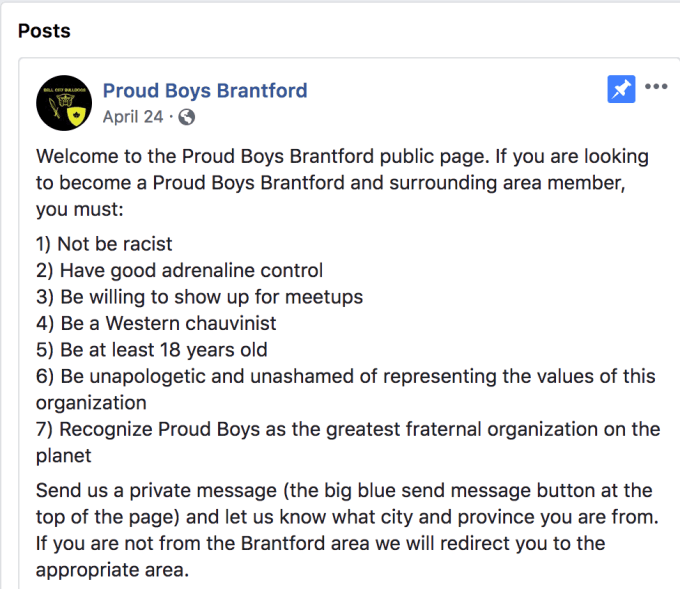
The Proud Boys, a self described “Western chauvinist” organization that often flirts with more hard-line groups of the far right, runs an elaborate network of recruiting pages on Facebook to attract and initiate members. While McInnes maintained a presence on many platforms, Facebook is the heart of the group’s operations. It’s there that the Proud Boys boast more than 35 regional and city-specific groups that act as landing pages for vetting thousands of new members and feeding them into local chapters.

When it comes to skirting the outer boundaries of social acceptability, McInnes could teach a master class. The Vice founder and Canadian citizen launched his newest project in 2016, capturing a groundswell of public political activity on the far right and launching the Proud Boys, a men’s club allied around the mantra “West is best,” its dedication to Trump and a prohibition against flip-flops and porn.

Facebook recruiting

The group makes national headlines for its involvement in violent dust-ups between the far right and far left and has a robust recruitment network centered on initiating members through Facebook groups. As for where it fits into the far right’s many sub-factions, McInnes objects to the term alt-light, sometimes used to describe far right group that oppose some mainstream conservative ideals but don’t openly endorse white nationalism. “Alt Light is a gay term that sounds like a diet soda in bed w Alt Right,” he said on Twitter last year. “We’re “The New Right.”

To that end, most regional affiliate pages run a message outlining some ground rules, including a declaration that its members not be racist or homophobic — a useful disclaimer for making the group more palatable than many of its less clever peers.

The Proud Boys’ agenda is less explicitly race-based than many groups it has affiliations with, espousing instead a broad sort of antagonism to perceived enemies on the political left and a credo of “western chauvinism.” The language is cleaned up, but it’s one degree removed from less palatable figures, including Unite the Right leader Jason Kessler. McInnes hosted Kessler on his own talk show just days after Kessler led the Charlottesville rally that left counter-protester Heather Heyer dead. In the segment, McInnes tried to create space between Kessler and the Proud Boys, though it wasn’t Kessler’s first time on the show or his only affiliation with the Proud Boys.

The Proud Boys also coordinates with the Vancouver, Washington-based group known as Patriot Prayer, another fairly social media-savvy far right organization that doesn’t openly endorse explicitly white nationalist groups, but still welcomes them into the fold during demonstrations that often turn violent.

Who are the Proud Boys?

Like much of the young, internet-fluent alt-right, the Proud Boys intentionally don’t take themselves too seriously, a strategy that conveniently opens the door for them to denounce any kind of controversy that might arise. They show up to protests wearing black and gold Fred Perry polo shirts, have a whole charter’s worth of inside jokes and in general seem a bit more media and internet savvy than hardline white nationalist groups, some of which Facebook has managed to clear out in the last year.

Unlike some less strategic and internet-savvy portions of the far right, McInnes and his Proud Boys are careful not to openly encourage preemptive violence. Still, the Proud Boys do encourage retaliatory violence, going so far as to enshrine physical altercations in its organizational hierarchy.

To earn their “first degree,” Proud Boys must openly declare their allegiance to the group’s ideals, usually in a Facebook vetting group.

To earn the second, they have to get beaten up by other members while naming five breakfast cereals (maybe a loose tie-in to the group’s mantra against masturbation). To earn the third degree they have to get a Proud Boys tattoo. The fourth degree is reserved for members who get in a brawl sufficient for the honor:

“You can’t plan getting a fourth degree. Its a consolation prize for engaging in a major conflict for the cause. Being arrested is not encouraged, although those who are immediately become fourth degree because the court has registered a major conflict. Serious physical fights also count and it’s up to each chapter to decide how serious the conflict must be to determine a fourth degree.”

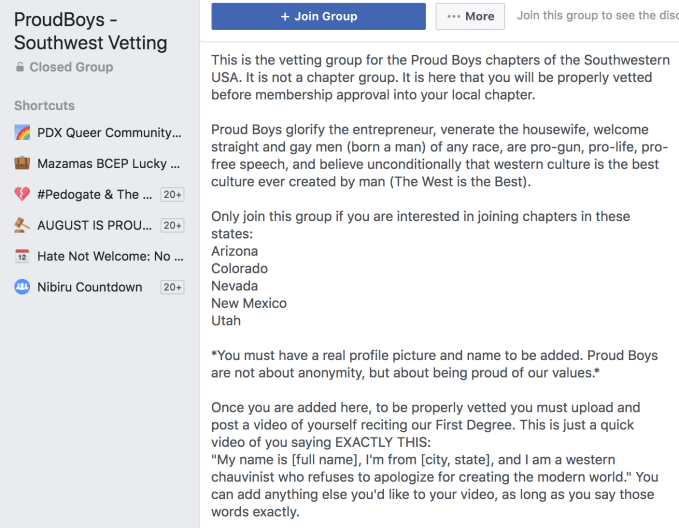
That’s where the Proud Boys Facebook network comes in. To get accepted into a local chapter, prospective members join specific vetting groups and are asked to upload a video of them meeting their “first degree” requirements:

“Once you are added here, to be properly vetted you must upload and post a video of yourself reciting our First Degree. This is just a quick video of you saying EXACTLY THIS:

“My name is [full name], I’m from [city, state], and I am a western chauvinist who refuses to apologize for creating the modern world.” You can add anything else you’d like to your video, as long as you say those words exactly.

YouTube is full of first and second degree videos depicting the usually short half-ironic hazing ceremonies.

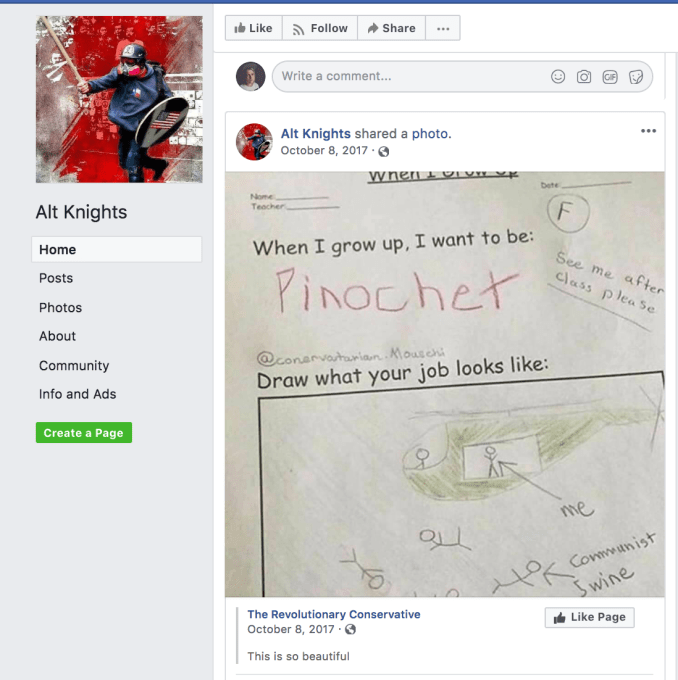
Facebook also hosts pages dedicated to the Fraternal Order of the Alt-Knights, a new-ish subdivision of the Proud Boys and its paramilitary wing. The Alt-Knights, also known as FOAK, are led by Kyle Chapman, a.k.a. “Based Stickman,” a far right figure who grew to fame after beating political enemies with a stick at a 2017 Berkeley protest. The Alt-Knights aren’t always quite as careful to denounce violence.

Whether the Proud Boys are in violation of Facebook’s unevenly enforced and sometimes secretive policies or not, the organization is making the most of its time on the platform. Facebook has rules against organizing harm or credible violence that the Proud Boys’ brawling ethos and alt-knights would seem to run afoul of, but the group stands by the useful mantra “We don’t start fights, we finish them.”

TechCrunch reached out to the Proud Boys to get an idea of their membership numbers and will update this story if we receive a reply. An analysis of affiliated pages shows that Proud Boys groups have added hundreds of members in the last 30 days across many chapters.

With a second Unite the Right rally around the corner and the ugly reality of more real-life violence organized on social media looming large, platforms are on their toes for once. Facebook has cleaned up some of the rampant racism that stemmed from the extreme right presence on its platform, but savvier, self-censoring groups like the Proud Boys are likely to be the real headache as Facebook, Twitter and Google trudge through an endless minefield of case-by-case terms of service violations, drawing sharp criticism from both sides of the political spectrum no matter where they choose to place their feet.

Samsung Galaxy Note 9 review

There are no secrets in consumer electronics anymore. Sometimes it’s the fault of flubs and flaws and leakers. Sometimes it’s by design. In the case of the Galaxy Note 9, it’s a little bit of both.

The Galaxy S9 wasn’t the blockbuster Samsung’s shareholders were expecting, so the company understandably primed the pump through a combination of teasers and leaks — some no doubt unintentional and others that seemed suspiciously less so.

By the time yesterday’s big event at Brooklyn’s house that Jay-Z built rolled around, we knew just about everything we needed to know about the upcoming handset, and virtually every leaked spec proved accurate. Sure, the company amazingly managed to through in a surprise or two, but the event was all about the Note.

And understandably so. The phablet, along with the Galaxy S line, forms the cornerstone of Samsung’s entire consumer approach. It’s a portfolio that expands with each event, to include wearables, productivity, the smart home, automotive, a smart assistant and now the long-awaited smart speaker. None of which would make a lick of sense without the handsets.

If the Galaxy S is Samsung’s tentpole device, the Note represents what the company has deemed its “innovation brand,” the uber-premium device that allows the company to push the limits of its mobile hardware. In past generations, that’s meant the Edge display (curving screen), S-Pen, giant screen and dual-camera. That innovation, naturally, comes at a price.

Here it’s $1,000. It’s a price that, until a year ago seemed impossibly steep for a smartphone. For the Galaxy Note 9, on the other hand, that’s just where things start. Any hopes that the new model might represent a move toward the mainstream for the line in the wake of an underwhelming S9 performance can be put to rest here.

The Note is what it’s always been and will likely always continue to be: a device for the diehard. A very good device, mind, but one for those with an arm and or a leg to spare. Most of the good new features will trickle their way down the food chain to the company’s more mainstream device. At $720/$840, the S9 isn’t a budget phone by any stretch of the imagination, but at the very least, keeping it to three digits seems a little more palatable.

A good rule of thumb for a hardware review is incorporating the product into one’s own life as much as possible. It’s a pretty easy ask with a device like the Note 9, which has the advantage of great hardware and software design built upon the learnings and missteps of several generations.

It’s still not perfect by any means, and the company’s everything-and-the-kitchen-sink approach to the line means there are plenty of features that never really made their may into my routine. And while, as the largely unchanged product design suggests — the Note 9 doesn’t represent a hugely significant milestone in the product line — there are enough tweaks throughout the product to maintain its place toward the top of the Android heap.

All charged up

Let’s address the gorilla in the room here. Two years ago, Galaxy Notes started exploding. Samsung recalled the devices, started selling them, more exploded and they recalled them again, ultimately discontinuing the product.

Samsung apologized profusely and agreed to institute more rigorous safety checks. For the next few devices, the company didn’t rock the boat. Battery sizes on Galaxy products stayed mostly the same. It was a combination of pragmatism and optics. The company needed time to ensure that future products wouldn’t suffer the same fate, while demonstrating to the public and shareholders that it was doing due diligence.

“What we want to do is a tempered approach to innovation any time,” Samsung’s director of Product Strategy and Marketing told me ahead of launch, “so this was the right time to increase the battery to meet consumer needs.”

Given Samsung’s massive business as a component manufacturer, the whole fiasco ultimately didn’t dent the bottom line. In fact, in a strange way, it might ultimately be a net positive. Now it can boast about having one of the most rigorous battery testing processes in the business. Now it’s a feature, not a bug.

At 4,000mAh, the Note 9 features a 700mAh increase above its predecessor. It’s not an unprecedented number — Huawei’s already hit the 4,000 mark — but it’s the largest ever on a Note device, putting the handset in the top percentile.

As far as how that actually translates to real-world usage, Samsung’s not giving a number yet. The company simply says “all day and all night” in its release. I found that to be pretty close to the truth. I unplugged the handset at 100 percent yesterday afternoon. I texted, listened to Spotify, took photos, downloaded and just generally attempted to live my life on the damn thing.

Just under 22 hours later, it gave up the ghost and after much notification-based consternation about a critically low battery, the screen went black. Like I said, it’s not crazy battery life, but going most of a full day and night without a charge is a nice little luxury — and the sort of thing all phone makers should strive to achieve on their flagship products.

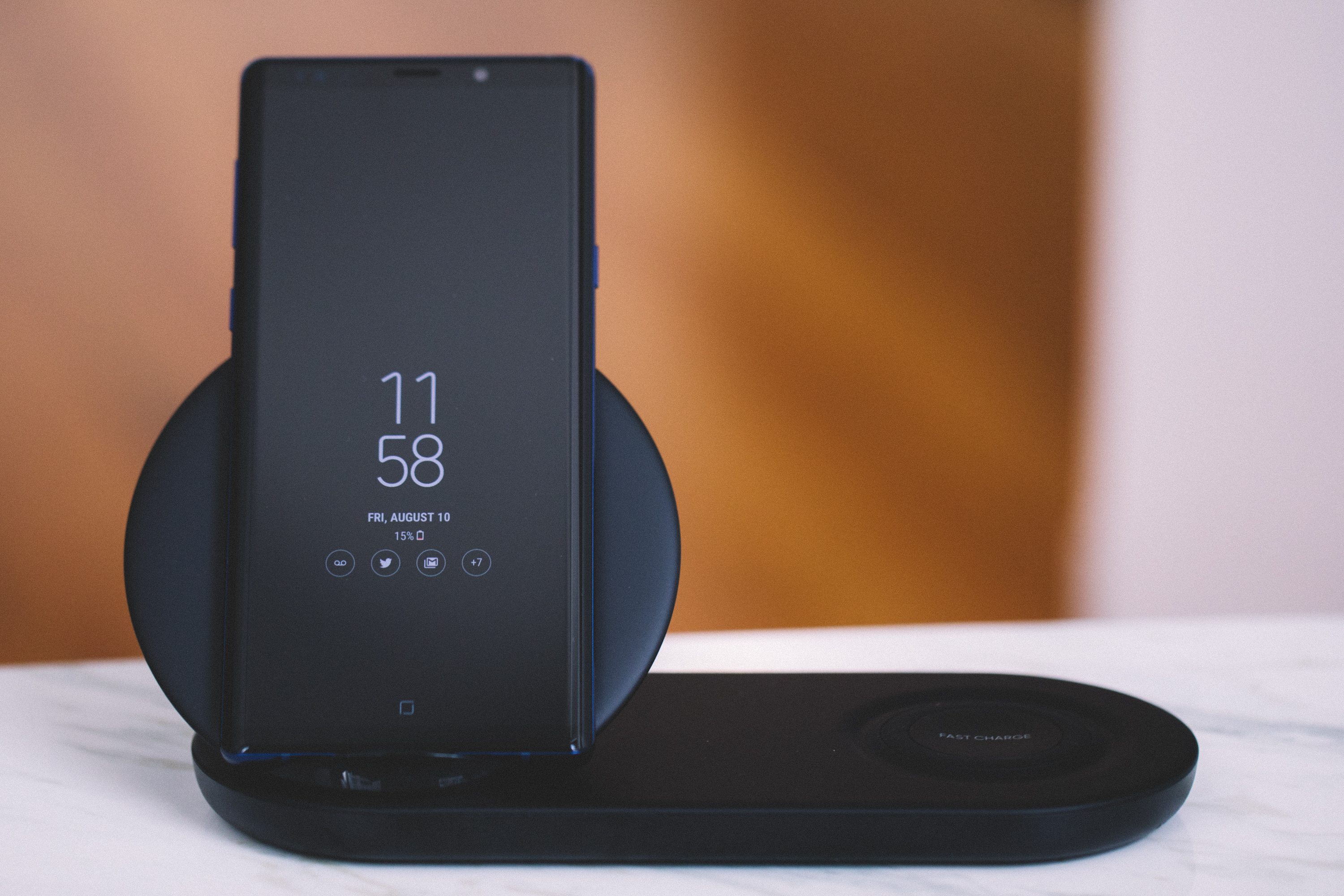
The company also, kindly, included the new Wireless Charging Duo. The charging pad is not quite as ambitious as the AirPower, but unlike that product, introduced nearly a year ago by Apple, I have this in my hands right now. So, point: Samsung. Charging the device from zero to 100 percent took three hours on the dot with the $120 “Fast Charge” pad. And it’s nice and toasty now.

Memories

Okay, about that price. Again, we’re talking $999.99 to start. There’s also a second SKU. That one will run you $1,295.99. Take a moment if you need to.

That’s a silly amount of money if you’re not the starting point guard for the Golden State Warriors. So much for the rumors that the company would be working to make its devices more economically accessible. And while the premium hardware has always meant that the Galaxy line is going to remain on the pricey side, I can’t help but point out that a few key decisions could have kept the price down, while maintaining build quality.

Storage is arguably the primary culprit. The aforementioned two SKUs give you either 6GB of RAM with 128GB or 8GB of RAM with 512GB. With cloud syncing and the rest, it’s hard to imagine I would come close to that limit in the two or so years until the time comes to upgrade my handset.

I’m sure those sorts of crazy media-hoarding power users do, in fact, exist in the world, but they’re undoubtedly a rarity. Besides, as Samsung helpfully pointed out, 512GB SD cards already exist in the world. Sure, that’s another $350 tacked onto the bottom line, but it’s there, if you need it. For most users, it’s hard to see Samsung’s claim of having “the world’s first 1TB-ready smartphone” (512GB+512GB) exists for little more reason than racking up yet another flashy claim for the 1960s Batman utility belt of smartphones.

Sure, Samsung no doubt gets a deal on Samsung-built hard drives, but the component has to be a key part in what’s driving costs up. For a company as driven by choice as Samsung, I’m honestly surprised we’re not getting more options up front here in the States.

Remote control

Confession: After testing many Galaxy Note models over the course of many years, I’ve never figured out a great use for the S-Pen. I mean, I’m happy that people like it, and obviously all of the early skepticism about the return of the stylus was quickly put to rest, as the company has continued to go back to the well, year after year.

But all of the handwritten note taking and animated GIF drawing just isn’t for me, man. I also recently spoke to an artist friend who told me that the Note doesn’t really cut it for him on the drawing front, either. Again, if you like or love it, more power to you, but it’s just not for me.

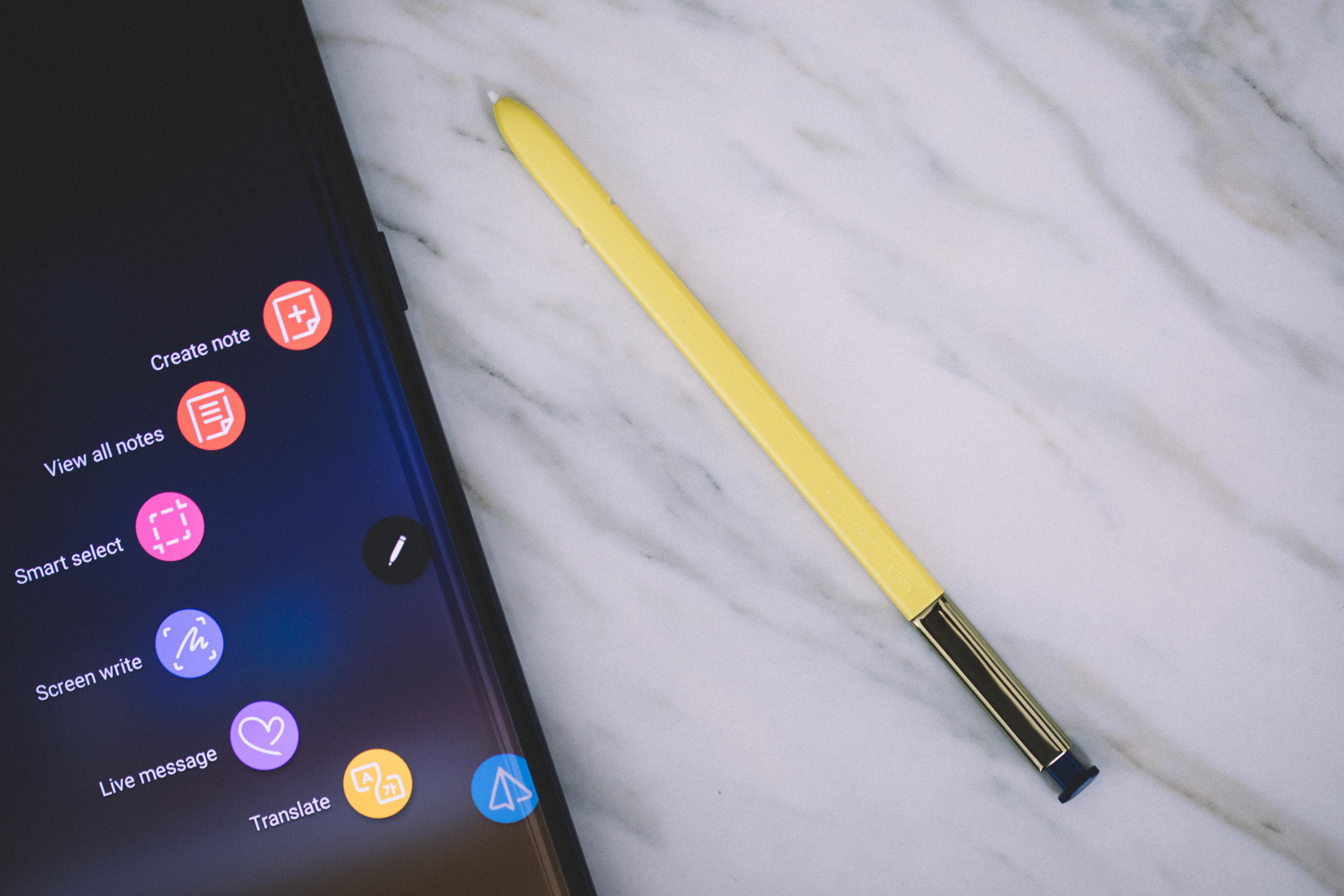
As silly as the idea of using the S-Pen as a remote control might appear at first glance, however, it’s clear to me that this is the first use of the built-in accessory I could honestly see using on a daily basis. It’s handy once you get beyond the silliness of holding a stylus in your hand while running, and serves as a handy surrogate for those who don’t own a compatible smartwatch.

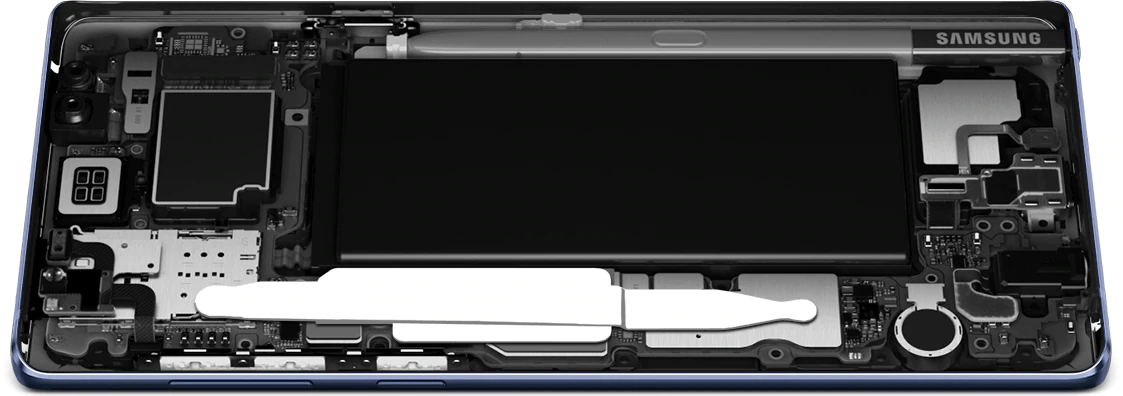
The S-Pen now sports Bluetooth Low Energy, allowing it to control different aspects of phone use. Low Energy or not, that tech requires power, so the stylus now contains a super conductor, which charges it when slotted inside the phone; 40 seconds of charging should get you a healthy 30 minutes of use. Even so, the phone will bug you to remind you that you really ought to dock the thing when not in use.

The compatible apps are still fairly limited at launch, but it’s enough to demonstrate how this could be a handy little addition. Of the bunch, I got the most out of music control for Spotify. One click plays/pauses a song, and a double-click extends the track. Sure, it’s limited functionality, but it saved me from having to fiddle with the phone to change songs went I went for my run this morning.

You’ll need to be a bit more creative when determining usefulness in some of the other apps. Using it as a shutter button in the camera app, for instance, could be a useful way to take a selfie without having to hold the phone at arms’ length.

The entire time, I wondered what one might be able to accomplish with additional buttons (volume/rewind/gameplay)? What about a pedometer to track steps when you’re running on the treadmill without it in the pocket? Or even a beacon to help absent-minded folks like myself find it after we invariably drop it between couch cushions.

But yeah, I understand why the company would choose to keep things simple for what remains a sort of secondary functionality. Or, heck, maybe the company just needs to hold some features for the Note 10 (Note X?).

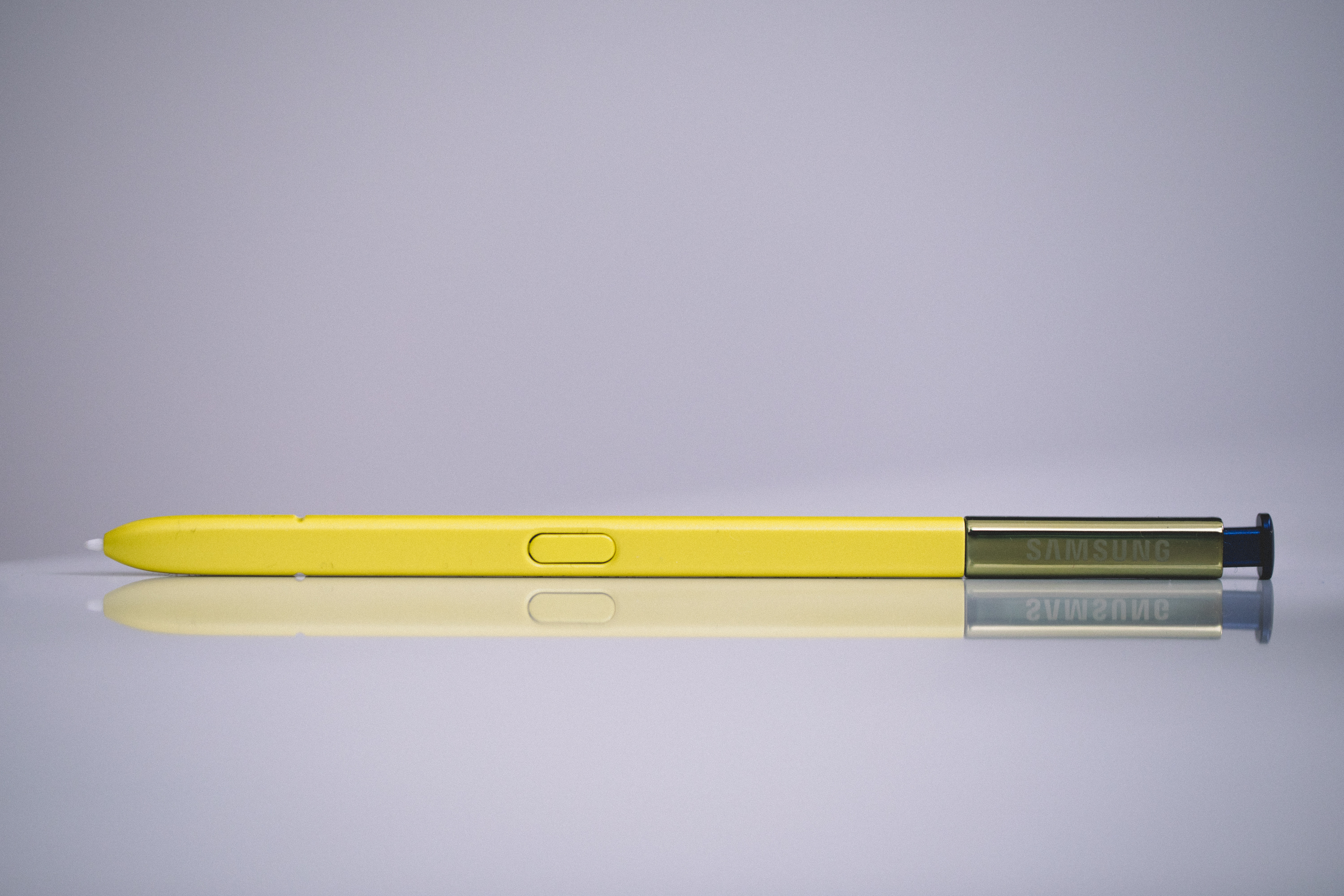
Oh, and the Blue and Lavender versions of the phone come in striking yellow and purple S-Pens, with lock-screen ink color to match. So that’s pretty fun.

Hey man, nice shot

Nowhere is the Note’s cumulative evolution better represented than the camera. Each subsequent Galaxy S and Note release seem to offer new hardware and/or software upgrades, giving the company two distinct opportunities per year to improve imaging for the line. The S9, announced back in February, notably brought improved low-light photography to the line. The dual aperture flips between f/1.5 and f/2.4, to let in more light.

It’s a neat trick for a smartphone. Behold, a head to head between the Note 9 (left) and iPhone X (right):

Here’s what we’re dealing with on the hardware front:

  • Rear: Dual Camera with Dual OIS (Optical Image Stabilization)
  • Wide-angle: Super Speed Dual Pixel 12MP AF, F1.5/F2.4, OIS
  • Telephoto: 12MP AF, F2.4, OIS
  • 2X optical zoom, up to 10X digital zoom
  • Front: 8MP AF, F1.7

This time out, the improvements are mostly on the software side of things. Two features in particular stand out: Scene Optimizer and Flaw Detection. The first should prove familiar to those who’ve been paying attention to the smartphone game of late. LG is probably the most prominent example.

Camera hardware is pretty great across the board of most modern smartphone flagships. As such, these new features are designed to eliminate the current weakest link: human error. Scene Optimizer saves amateur photographers from having to futz with more advanced settings like white balance and saturation.

The feature uses AI to determine what the camera is seeing, and adjusts settings accordingly. There are 20 different settings, including: Food, Portraits, Flowers, Indoor scenes, Animals, Landscapes, Greenery, Trees, Sky, Mountains, Beaches, Sunrises and sunsets, Watersides, Street scenes, Night scenes, Waterfalls, Snow, Birds, Backlit and Text.

Some are pretty general, others are weirdly specific, but it’s a good mix, and I suspect Samsung will continue to add to it through OTA updates. That said, the function itself doesn’t need a cloud connection, doing all of the processing on-board. The feature worked well with most of the flowers and food I threw at it (so to speak), popping up a small icon in the bottom of the screen to let me know that it knows what it’s looking at. It also did well with book text.

The success rate of other things, like trees, were, unsurprisingly, dependent on context. Get just the top part and it identifies it as “Greenery.” Flip the phone to portrait mode and get the whole of the trunk and it pops up the “Tree” icon. I did get a few false positives along the way; the Note 9 thought my fingers were food, which is deeply disturbing for any number of reasons.

[Without Scene Optimizer – left, With Scene Optimizer – right]

Obviously, it’s not going to be perfect. I found, in the case of flowers that it has the tendency to oversaturate the colors. If you agree, you can disable the feature in settings. However, you have to do this before the shot is taken. There’s no way to manually override the feature to tell it what kind of object you’re shooting. That seems like a bit of a no-brainer addition.

[Super slow-mo matcha under the flicking lights]

Flaw Detection serves a similar role as Scene Optimizer, helping you avoid getting in your own way as an amateur photog. The feature is designed to alert you if a shot is blurry, if there’s a smudge on the screen, if the subject blinked or if backlighting is making everything look crappy. In the case of lens smudging and backlighting, it only bothers with a single alert every 24 hours.

The blink detection worked well. Blur detection, on the other hand, was a bit more of a crap shoot for subjects in motion and those that were too close to the lens to get a good focus. The feature could use a bit of work, but I still think it’s one of the more compelling additions on the whole of the device and anticipate a lot of other companies introducing their own versions in the coming year.

Design Note

The more the Note changes, the more it stays the same, I suppose. As expected, the design language hasn’t changed much, which is no doubt part of what made Samsung CEO DJ Koh think he could get away with using the device in public ahead of launch. The footprint is virtually the same in spite of the ever-so-slightly larger screen (6.3 > 6.4-inches, same 2,960 x 1,440 resolution) — from 162.5 x 74.8 x 8.6 mm on the 8, to 161.9 x 76.4 x 8.8 mm on the 9.

That’s perfectly fine. Samsung’s done an impressive job cramming a lot of screen into a manageable footprint over the past several gens. The only major change (aside from the lovely new blue and purple paint jobs) is the migration of the fingerprint sensor from the side of the camera to underneath it.

This was a clear instance of Samsung responding to feedback from users frustrated by all the times they mistook the camera for the fingerprint reader. The new placement helps a bit, though it’s still fairly close to the camera, and the fact that both are similar shapes doesn’t help matters. Thank goodness for that new smudge detector.

Oh, and the headphone jack is still present, because of course it is. For Samsung, it’s an important way to distinguish the product and approach from a world gone dongle mad.

Note on Notes

Oh Bixby, you eternal bastion of unfulfilled potential. A full rundown of new features can be found here. Overall, the smart assistant promises to be more conversational, with better concierge features. That said, Samsung’s once again tweaking it until the last moment, so I can’t offer you a full review until closer to the phone’s August 24 street date.

So stay tuned for that, I guess. I will say that the setup process can be a bit of a slog for a feature designed to make everything easier. Playing with Bixby voice required me to navigate several pages in order to connect the two. Thankfully, you should only have to deal with that the one time.

Samsung’s continuing to tweak the internals to make its device more suitable for gaming. The water-carbon cooling system tweaks the liquid cooling system found on the device since the S7, to help diffuse heat more efficiently. The large, bright screen meanwhile, is well-suited to mobile gaming, and the 6GB model handled Fortnite fairly well.

A final note

The next smartphone revolution always seems to be a year away. The potential arrival of a Samsung device with a foldable display makes the notion of carrying a massive device around in one’s pocket almost quaint. For the time being, however, the Note remains one of the best methods for transporting a whole lot of screen around on your person.

A lot has changed about the Note in the past seven years, but the core of the device is mostly the same: big screen and stylus coming together to walk the line between productivity and entertainment. It’s big, it’s bold, it’s too expensive for a lot of us. But it remains the phablet to beat.

Hackers on new ‘secure’ phone networks can bill your account for their roaming charges

I have good news! The infamous SS7 networks used by mobile operators to interoperate, e.g.
when you’re roaming — which were built on trust, essentially devoid of security, and permitted rampant fraud, SMS hijacking, eavesdropping, password theft, etc. — are being replaced. Slowly. But I have bad news, too! Which is: the new systems still have gaping holes.

One such was described at the Def Con hacking convention today by Dr. Silke Holtmanns of Nokia Bell Labs. She gave a fascinating-to-geeks-like me summary of how the IPX network, which connected five Scandinavian phone systems in 1991, using the SS7 protocol suite secured entirely by mutual trust, has grown into a massive global “private internet” connecting more than 2,000 companies and other entities. It is this private network-of-networks that lets you fly to another country and use your phone there, among many other services.

The quote which stood out most starkly from her slides regarding IPX was this: “Security awareness only recently started (2014).” ? That’s … awfully late to start thinking about security for a massive semi-secret global network with indirect access to essentially every phones, connected car, and other mobile/SIM-card enabled device on the planet. He understated grimly.

Still, better later than never, right? A new protocol, called Diameter, is slowly lurching into place, in fits and starts. (Technically the old system used two protocol suites, SS7 and Radius: Diameter is the successor to Radius, but flexible enough that it can and will absorb SS7’s functions too.) Alas, even Diameter has at least one flaw: its so-called “hop-by-hop” routing can be used by an attacker to spoof an endpoint, i.e. to pretend to be a company which they aren’t.

This, combined with the ability to harvest a unique ID number (known as the IMSI) from a phone, with a device such as a Stingray, and the ability to request a re-assessment of a phone’s quality of service and billing information at any point, ultimately means that a capable hacker could upgrade their phone service at your expense … or downgrade your service to e.g. 2G-only, while roaming, if they were feeling more malicious than greedy.

2G-only! The horror! OK, this is a lot better than the long litany of fundamental flaws to which SS7 was vulnerable, but it’s still sad. Worst of all is the list of countermeasures that Dr. Holtmanns suggested. There are long lists of things that companies and operators on the IPX network can do to fix or mitigate this vulnerability; but if you’re a user? All she can recommend is “check your bill” and “keep an eye on the news.”

This is yet another instance of what I call “the trustberg.” When you pick up your phone, because your bank texted you a one-time password, or to text something private, do you even know who you’re trusting to keep your texts and accounts unhacked? The bank itself, and Google or Apple, sure. Whatever Android app handles your texts, maybe. But it turns out this is only the tip of the trustberg.

Power generation and distribution; water and sewers; food processors and grocery trucks; industrial control systems; emergency response systems; microprocessor manufacturers; phone and satellite networks. We assume that somewhere, in some distant room, teams of competent grown-ups are taking care of these systems and making sure they’re safe — right?

Which is why coming to hacker conventions (such as infamous Def Con, from which I write this) is always such a sobering, saddening experience. Two days ago I wrote about satellite communications devices compromised worldwide … mostly because, it turns out, they relied on hard-coded, easily cracked passwords for “security.” Now I’m writing about new, improved security after a decade of catastrophic failures … and it’s still not actually secure. We can hope the even more important infrastructure I listed above is better taken care of … but the more hacker cons I go to, the harder this hope becomes.

Neat is a challenger bank for early-stage startups and SMEs

With the growth in cross-border payment services and ‘challenger’ bank cards for consumers, you’d be forgiven for wondering where the options are for small business — where cash is particularly precious.

They do exist. One of the newer options is Neat, which is nested in Hong Kong but open for business worldwide.

The startup started off following the same track as the likes of Monzo, Starling and Revolut in Europe, developing a ‘new’ kind of account free of branch-based banking and tedious paperwork. But quickly the team realized that its service was being adopted in large by startups and SMEs as a way to get more flexible financing and perks like install balance/billing.

Neat still offers a consumer service in Hong Kong, but it places a heavy focus on developing its business service. Right now, that helps companies who can’t apply for credit cards get a Neat Mastercard which can be used for trivial (but important!) items such as monthly bills for services, flights, hotels and more. There’s no credit involved since the cards and account are debit-based.

Beyond the basics, Neat Business customers can use their account to handle employee payroll, business invoices, receive money and really pay all other bills that would require a credit card without using their personal one, as is so often the case for early-stage startups. More advanced features include expense cards for employees, while detailed company reporting and automated accounts are planned for introduction soon.

The company is based in Hong Kong, but Neat’s service can be used overseas, and indeed it already is.

Co-founder and CEO David Rosa, a former managing director of Citi Bank Asia Pacific, told TechCrunch that the company has customers in over 100 countries since account holders don’t need to be resident in, or incorporated in Hong Kong, to qualify for the service.

That said, a large portion is based in or associated with Hong Kong as it stands today, but Rosa — who started the business in 2015 alongside CTO Igor Wos — said he wants to change that and grow the userbase globally. The fact that Neat is working on introducing multi-currency solutions, as well as accountancy software integrations, is sure to help widen its appeal to those based outside of Hong Kong.

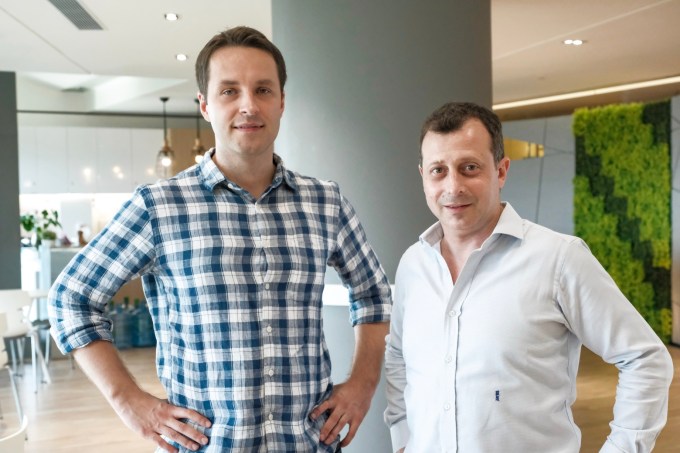
(Left to right) Neat co-founders Igor Wos (CTO) and David Rosa (CEO)

In a further validation, Neat recently snagged $2 million in funding to develop its tech and increase marketing. Those investors included Singapore’s Dymon Asia and Portag3 Ventures, which is the VC arm of Canada-based Power Corp, a public listed international management firm with a market cap of $9 billion. The Neat deal represents the Portag3 Ventures’ first investment in Asia and its CEO is bullish on how the duo can work together.

“From Hong Kong, we can reach the world. There’s a lot to be done here especially because of the China angle,” Rosa, who has lived in Hong Kong for 17 years, said.

Some Infowars tweets vanished today, but Twitter didn’t remove them

A handful of tweets and videos that appear to have been cited in the choice to remove Alex Jones from Facebook and YouTube vanished from Twitter on Thursday after being called out in a CNN piece focused on the company’s hypocrisy.

Twitter confirmed to TechCrunch that it did not remove the tweets in question and that someone affiliated with Alex Jones and Infowars or with access to those accounts is behind the removal. The tweets in question spanned the Infowars brand, including accusations that Sandy Hook was staged by crisis actors, slurs against transgender people and a video asserting that Parkland shooting survivor David Hogg is a Nazi.

All of the tweets CNN linked are no longer available, suggesting that Jones might be trying to walk a narrow line on the platform, keeping most of the Infowars content up even as users and reporters surface some of its most objectionable moments. We reached out to Infowars for the reasoning behind taking down the posts and will update this story when we hear more.

On Wednesday in an internal memo that was later tweeted, Twitter’s VP of trust & safety made the claim that if Jones had posted the same content on Twitter that had resulted in action on other platforms, Twitter would have acted, too.

“… At least some of the content Alex Jones published on other platforms (e.g. Facebook and YouTube) that led them to taking enforcement actions against him would also have violated our policies had he posted it on Twitter,” Twitter’s Del Harvey said. “Had he done so, we would have taken action against him as well.”

Here's an email I sent Twitter employees today with more context around our thinking and our policies. pic.twitter.com/GMkDpKgf5S

— Del Harvey (@delbius) August 8, 2018

On Thursday, CNN called Twitter’s bluff. The news site found that the same content that got Jones and Infowars booted from other platforms “were still live on Twitter as of the time this article was published,” according to CNN.

Update: Twitter spox tells me that Twitter has not deleted these tweets/content. Someone with access to the accounts has deleted them. Twitter is still reviewing the content.

— Oliver Darcy (@oliverdarcy) August 9, 2018

In spite of the missing tweets, at the time of writing, the accounts of both Infowars and Alex Jones remained online and tweeting. In fact, just 30 minutes ago, Infowars accused former president Obama of a “deep state” scheme to purge Infowars from tech platforms.

Cryptocurrency insecurity: IOTA, BCash and too many more

Cryptocurrencies: a weird agglomerate of fascinating technology built by brilliant engineers; a whole new and potentially important form of economics; … and hype-machine puffed-up crazy-talk nonsense. So, as you might expect, they also combine state-of-the art resilient engineering and comical clown-car so-called security. Yes, that’s right — I want to talk about IOTA, and (to an extent) Bitcoin Cash.

Modern security practices include: an understanding of and commitment to responsible disclosure; making yourself available and accessible to third-party security researchers; offering bug bounties; fuzzing your code; etcetera. They also include valuable truisms such as “don’t roll your own crypto.” Here that’s crypto as in cryptography, and it means, always always always use tried and time-tested cryptographic algorithms and implementations. Do not try to build your own from scratch. You will regret it.

IOTA, currently the world’s tenth most valuable cryptocurrency, took an … assertively contrarian stance regarding this dictum. They didn’t just roll their own crypto, they rolled their own fundamental units, deciding that binary wasn’t good enough by half, and that trinary was where it’s at, that their trits and trytes were so much better than bits and bytes.

I confess part of me has a grudging respect for the surreality of this kind of whackadoodle performance art. Alas, this half-admiration doesn’t extend to the recent saga in which a) they rolled their own crypto; b) MIT and BU researchers found a flaw in it; c) IOTA first said that the flaw was intentional, and then, apparently, that it was created by an imperfect AI (!); d) a spectacular war of words (between those parties and several others) erupted. Then, yesterday, Neha Narula, the director of MIT’s Digital Currency Initiative, presented last year’s work in a talk at Black Hat — and even though that work stemmed from last year

The interesting bit is this: Iota has been scrambling to remove their broken homemade hash function (which is still used in their centralized coordinator) before a vulnerability presentation at BlackHat. pic.twitter.com/ofBk3XQyMv

— Matthew Green (@matthew_d_green) August 8, 2018

I interviewed Narula this morning and she said, still amazed, that it actually seemed to her as if IOTA thought her talk yesterday would reveal a new, previously undisclosed vulnerability. Their fundamental misunderstanding of how software security works, and what responsible disclosure means, is staggering.

You may well think IOTA is such an extremely ridiculous project that it’s unfair to use it as an example. But if so, bear in mind that cryptocurrencies remain a very weird field, and many people who have put a lot of money into them are unable to distinguish ridiculous projects from serious ones. A couple of days ago I visited Las Vegas’s “cryptocurrency nightclub,” all too appropriately called MORE; the general idea is that people can both invest in MoreCoin (yes, really) and spend it on better access / parties at Vegas and similar destinations. Whether you think this is a valid concept or a crazy get-rich-quick scheme, it’s an example of how cryptocurrencies are increasingly aimed at the unsophisticated public. To its intended audience, there’s not much difference between MoreCoin and Bitcoin; any technical ludicrousness is no bar to success.

But if you want to talk about something more serious and higher-profile, fine; let’s talk about Narula’s most recent post, this one describing and regarding a bug in Bitcoin Cash, one of the very few currencies traded on Coinbase. Some months ago, a developer, Cory Fields, discovered that the hard fork which birthed Bitcoin Cash included some refactoring of Bitcoin’s consensus code … such that a malicious block could be crafted which would split Bitcoin Cash into two separate blockchains.

This would be very bad, would almost certainly have drastically diminished Bitcoin Cash’s value, and could conceivably be used for a double-spend attack; meaning, given Bitcoin Cash’s value and liquidity, it was a bug which could conceivably have been used to generate many millions of dollars in cold hard cash. Fortunately Fields is an admirable fellow and decided to do the right thing.

But … how? Who to contact? The people with commit rights to the Bitcoin Cash repo, he supposed; but none of them had provided secure methods of public contact. This was information that could be used to bilk many millions of dollars, it couldn’t be emailed in plaintext — and what’s more, if somebody else discovered the bug but this Core developer was the only one known to have discovered it, he would be painting a big target on his back. How can you perform responsible disclosure when there’s no outlet to disclose to?

In the end, Fields found a way. (A very complicated way.) And the bug has been fixed. But the difficulties he had highlights the fact that, as cryptocurrencies mature, their security policies and procedures need to mature along with them. Kudos to those who are already well along this path, such as Ethereum, EOS and Tezos; and brickbats to those who make it hard to disclose vulnerabilities, and/or those who respond with weaponized ignorance.

Sony’s 10? Digital Paper Tablet is an ultra-light reading companion that needs to do more

Last year I had a good time comparing Sony’s DPT-RP1 with the home-grown reMarkable. They both had their strengths and weaknesses, and one of the Sony’s was that the thing was just plain big. They’ve remedied that with a much smaller sibling, the DPT-CP1, and it’s just as useful as I expected. Which is to say: in a very specific way.

Sony’s e-paper tablets are single-minded little gadgets: all they do is let you read and lightly mark up PDFs. If that sounds a mite too limited to you, you’re not the target demographic. But lots of people — including me — have to wade through tons of PDFs and it’s a pain to do so on a desktop or laptop. Who wants to read  Amazon’s Antitrust Paradox by hitting the down arrow 500 times?

For legal documents and scientific journal articles, which I read a lot of, a big e-paper tablet is fantastic. But the truth is that the RP1, with its 13.3″ screen, was simply too big to carry around most of the time. The device is quite light, but took up too much space. So I was excited to check out the CP1, which really is just a smaller version of the same thing.

To be honest, there’s not much I can add to my original review of the RP1: it handles PDFs easily, and now with improved page jumping and tagging, it’s easier to navigate them. And using the stylus, you can make some limited markup — but don’t try to do much more than mark a passage with an “OK” or a little star (one of several symbols the device recognizes and tracks the location of).

It’s incredibly light and thin, and feels flexible and durable as well — not a fragile device at all. Its design is understated and functional.

Writing isn’t the Sony tablets’ strong suit — that would be the reMarkable’s territory. While looping out a circle or striking through a passage is just fine, handwritten notes are a pain. The resolution, accuracy and latency of the writing implement are as far as I can tell exactly as they were on the larger Sony tablet, which makes sense — the CP1 basically is a cutout of the same display and guts.

PDFs display nicely, and the grid pattern on the screen isn’t noticeable for the most part. Contrast isn’t as good as the latest Kindles or Kobos (shots in the gallery above aren’t really flattering, since they’re so close up, but you get the idea), but it’s more than adequate and it beats reading a big PDF on a small screen like those on your laptop’s LCD. Battery life is excellent — it’ll go through hundreds of pages on a charge.

A new mobile app supposedly makes transferring documents to the CP1 easy, but in reality I never found a reason to use it. I so rarely download PDFs — the only format the tablet reads — on my phone or tablet that it just didn’t make sense for me. Perhaps I could swap a few over that are already on my iPad, but it just didn’t strike me as particularly practical except perhaps in a few situations where my computer isn’t available. But that’s just me — people who work more from their phones might find this much more useful.

Mainly I just enjoyed how light and simple the thing is. There’s almost no menu system to speak of and the few functions you can do (zooming in and such) are totally straightforward. Whenever I got a big document, like today’s FCC OIG report, or a set of upcoming scientific papers, my first thought was, “I’ll stick these on the Sony and read them on the couch.”
Although I value its simplicity, it really could use a bit more functionality. A note-taking app that works with a Bluetooth keyboard, for instance, or synchronizing with your Simplenote or Pocket account. The reMarkable is still limited as well, but its excellent stylus (suitable for sketching) and cloud service help justify the price.

I have to send this thing back now, which is a shame because it’s definitely a handy device. Of course, the $600 price tag makes it rather a niche one as well — but perhaps it’s the kind of thing that fills out the budget of an IT upgrade or grant proposal.

Lowe’s Ventures backs Moved, a startup that makes moving less stressful

Adam Pittenger knows that moving is tough — after all, he said he’s moved eight times in the past seven years.

Pittenger said that there are several reasons why the process can be stressful, like the fact that most people aren’t experts on moving, since they don’t do it as often as him (seriously, eight times is crazy). Plus, there’s just an enormous amount of planning and coordination required, whether it’s hiring movers, buying packing materials or putting your things into storage.

So Pittenger decided to make the whole process a lot easier by founding Moved. Moving, he said, “doesn’t have to be that stressful,” because with Moved, you get “a personal assistant coordinating all the aspects of your move.”

Moved is announcing that it’s raised $3.2 million in seed funding from Lowe’s Ventures (the early-stage investment arm of the home improvement giant), FJ Labs, AngelPad, Real Estate Technology Ventures and others.

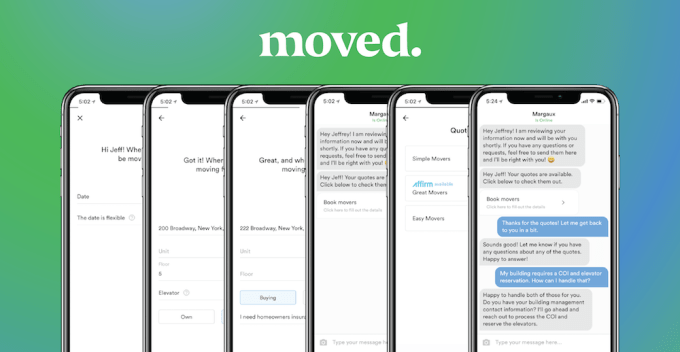
To sign up for Moved, you fill out a questionnaire about where you’re moving to and from, and what kinds of services you need. Moved (available via desktop web or mobile app) will then reach out to movers and provide you with multiple quotes from which you can choose.

Moved Screenshots

And while, as Pittenger put it, “the immediate thing you need to do is book the movers,” Moved offers a broader range of services, like ordering packing supplies, helping you donate stuff you don’t need anymore, finding a storage unit, updating your address, finding painters and more.

Moving can also be expensive, so the company has announced a partnership with Affirm, where Affirm’s financing will allow you to break up the moving costs into monthly payments.

To be clear, Moved isn’t doing the moving itself — instead, it’s basically connecting you to a marketplace of movers and other service providers. Pittenger said the company is “very strict about the suppliers and the vendors” and will remove them if customers aren’t happy with their experience.

Moved is managing all of this through a real, human assistant who can help you figure out what you need, handle the scheduling and serve as a “consumer advocate” who ensures that you’re not getting ripped off.

Pittenger said the service is free for consumers, with a fee charged to vendors at the time of booking. And it’s available throughout the United States.