Mario Schlosser, the CEO of Oscar Health, wants technology to cure what ails the health care industry. And now Alphabet, Google’s parent company, is betting $375 million on this digital panacea.
Category: Tech news
hacking,system security,protection against hackers,tech-news,gadgets,gaming
Best Nintendo Switch Deals and Console Bundles (Autumn 2018)
The best Nintendo Switch console deals, and all the essentials you’ll need when you own one.
Original Content podcast: Netflix’s ‘Disenchantment’ offers tongue-in-cheek fantasy adventures
Disenchantment is the latest animated series from Matt Groening, creator of The Simpsons and Futurama.
The show premieres on Netflix on August 17, and we talk about our initial impressions on the latest episode of the Original Content podcast. Our guest host Brian Heater is a big fan of Groening’s previous creations, and he also interviewed Groening for TechCrunch.
While Disenchantment brings Groening’s funny, skewed approach to a medieval fantasy setting, it isn’t a parody, exactly. It’s packed with jokes, but they rely more on the characters and on general zaniness, rather than references to (say) The Lord of the Rings or Game of Thrones.
Some of us weren’t completely won over the first couple episodes. The most promising aspect of the show is its central trio of characters, including the rebellious princess Bean (voiced by Broad City‘s Abbi Jacobson), her personal demon Luci (Eric Andre) and the runaway elf Elfo (Nat Faxon).
We also discuss recent streaming headlines, including a new show for Apple from the team behind It’s Always Sunny in Philadelphia and new details emerging about Disney’s plans for its yet-to-be-named streaming service.
You can listen in the player below, subscribe using Apple Podcasts or find us in your podcast player of choice. If you like the show, please let us know by leaving a review on Apple. You also can send us feedback directly. (Or suggest shows and movies for us to review!)
Thanks to Anchor for letting us record in their Manhattan podcasting studio before it officially opens.
Nobody minding the store: security in the age of the lowest bidder
So, to recap: Satellite communication systems worldwide are “protected” by easily cracked hard-coded passwords. The private internet connecting the world’s mobile phone operators remains replete with vulnerabilities. Russia has successfully hacked into American power-plant control systems. Oh, and voting machines in use in 18 states can be remotely hijacked.
Just stole an election at @VotingVillageDC. The machine was an AccuVote TSX used in 18 states, some with the same software version. Attackers don't need physical access–we showed how malicious code can spreads from the election office when officials program the ballot design. pic.twitter.com/wa97HWqlv5
— J. Alex Halderman (@jhalderm) August 11, 2018
Do you see a theme here? We assume that everything is fine, that the world in which we live rests on solid foundations, that competent grown-ups are in charge of the fundamental infrastructure on which our society rests, which have been constructed as fault-tolerant, resilient systems. We assume somebody somewhere is at the switch, keeping a sharp eye on things.
In some cases, such as aviation, that does indeed seem to be the case. In others, the infrastructure is too decentralized and disconnected to be seriously at risk. But in far too many others, our we have constructed a perfect-storm-in-waiting of tightly coupled networks, zero oversight, and laughable attempts at security. Authority without responsibility, in other words. And in those cases, the assumption that our structural foundations are fine is a laughable pipe dream.
Reminders of this state of affairs come every month, with every infosec conference, every excited burst of news coverage following the discovery of a new high-profile hole. We patch the holes — maybe — but we don’t change our approach. At last week’s Black Hat conference, its creator Jeff Moss mused: “attackers have strategies, but defenders only seem to have tactics.”
This is tacitly deliberate. We could have a strategy of hardening our collective infrastructure to improve its security, but the daunting list of upgrades (or downgrades) that would require would be ruinously expensive. This isn’t a problem unique to information security: for instance, 54,000 bridges in America need repair, too. Are we going to repair all 54,000 anytime soon? Don’t make me laugh.
I’ve observed while travelling that one of the most striking differences in quality of life, between nations with comparable wealth, is simply what’s culturally acceptable. (A famous example: in Japan it is not culturally acceptable for trains to be late. In wealthier America … not so much.) The only way we’re going to harden our infrastructure, and fix our bridges, if it becomes culturally unacceptable for them not to be fixed.
I don’t see that happening. Instead, in a wealthy world of increasing economic disparity, I expect us to increasingly see two-tier infrastructure; stable, secure, reliable infrastructure for the 20%, and a haphazard, kinda-mostly-functional, vulnerable tier for the 80%. “Natural monopolies” such as power grids will be replaced by e.g. private solar power and PowerWalls. At some point one of the US mobile phone provides may well decide that it’s strategically worth it to become the Apple of phone service, charging twice as much for far better service and security. Etcetera.
Unless, of course, some kind of perfect storm arrives first, and our security problem turns into a genuine crisis, or even catastrophe. I’m an optimist; I don’t think that will happen. But it’s increasingly hard to ignore the possibility.
Hacking the websites responsible for election information is so easy an 11 year-old did it
It’s time to talk about election security.
Over the weekend at Def Con, the annual hacker convention in Las Vegas to discuss some of the latest and greatest (or scariest) trends in the wild world of hacking, a pair of election security hacking demonstrations set up for adults and kids alike offered up some frightening revelations about America’s voting infrastructure. (I’m not even going to begin to touch Voatz.)
For 11 year-old Emmett from Austin, hacking the website for the Florida Secretary of State was as easy as a simple SQL injection.
While it took Emmett only 10 minutes to break into the election reporting section of the Florida Secretary of State web page, it’s important to note that these pages were set up as replicas.
The idea, according to event organizers from Wickr (a secure communications platform), “was mainly focused on breaking into the portions of the websites that are critical to the election process, [so] the kids worked against the replicas of the webpages where election results are reported by secretaries of state.”
The replicas were built by the team at Wall of Sheep Village and they issued the following statement: “The main issues with the live sites we are creating the replicas of are related to poor coding practices. They have popped up across the industry and are not vendor specific.”
And while the National Association for the Secretaries of State had some choice words for the Voting Machine Hacking Village, they didn’t address the hacks the kids made on their actual web sites.
Well this is interesting. National Association of Secretaries of State issues statement against the Def Con Voting Village. Says its attempt to recreate (and likely hack the shit out of) a connected mockup of the election process isn't realistic. pic.twitter.com/c1uy694UPA
— Kevin Collier (@kevincollier) August 9, 2018
In all, some 47 kids participated in the election hacking contest and 89% of them managed to get in to the virtual web sites set up by Wickr and Wall of Sheep Village.
Emmett, whose dad works in cybersecurity and who has been attending Def Con now for four years, has some thoughts on how easy it was for him to get into the system and change the vote tallies for election results.
“It’s actually kind of scary,” the 11 year-old said. “People can easily hack in to websites like these and they can probably do way more harmful things to these types of websites.”
The point, according to Wickr’s (badass) founder Nico Sell, is to bring attention to just how flawed security operations remain at the state level in areas that are vital to the nation’s democracy.
“The really important reason why we’re doing this is because we’re not taking the problem serious enough how significantly someone can mess with our elections,” said Sell. “And by showing this with eight year old kids we can call attention to the problem in such a way that we can fix the system so our democracy isn’t ruined.”
Some executives at big corporations share the same concerns. For Hugh Thompson, the chief technology officer at Symantec, the risks are real — even if the problems won’t manifest in the most important elections.
As Thompson (who worked on election security in the early 2000s) told The Financial Times, “The risk that I think most of us worried about at that time is still the biggest one: someone goes into a state or a county that doesn’t really matter in the grand scheme of the election, is not going to change the balance on x, y or z, but then publishes details of the attack,” he said. “Undermining confidence in the vote is scary.”
Stakes are incredibly high, according to experts familiar with election security. Despite the indictments that Robert Mueller, the special counsel investigating Russian interference, issued against 12 Russian nationals for targeting the 2016 US election, Russian hacking remains a threat in the current election cycle.
Microsoft has already said that it has detected evidence of attempted Russian interference into three campaigns already in the 2018 election cycle.
As Fortune reported in July, Microsoft’s vice president for customer security, said that researchers at the company had discovered phishing campaigns that were linked to the GRU, the Russian military intelligence unit tied to the DNC election hacks from 2016.
For security officers working on the websites for the secretaries of state in the battleground states that the tween and teen hackers targeted during Def Con, young Emmett has some advice.
“Use more protection. Upgrade your security and obviously test your own websites against some of the common vulnerabilities,” the 11 year-old advised.
Inside Nickelodeon’s Teenage Mutant Ninja Turtles VR Interview Experience
Maggie Lane
Contributor
Contributor
Maggie Lane is a writer and producer of virtual reality experiences and covers the industry for various publications.
More posts by this contributor
Last month at San Diego Comic Con, I fulfilled my childhood (and let’s be honest, current) dream of stepping inside a NickToon. In Nickelodeon Entertainment Lab’s Rise of the Teenage Mutant Ninja Turtles VR Interview Experience, I interacted with turtles Mikey and Donnie—voiced live by series talent, Brandon Mychal Smith and Josh Brener, respectively.
I stood against a green screen, selected an avatar (I chose Arnold from Hey Arnold!), put on an Oculus Rift headset, and was transported onto a New York City rooftop. I inhabited a 3D form, but as I looked ahead, I saw two 2D turtles. I interviewed the characters in real time, and their movements perfectly corresponded to their answers–there was no discernable lag.
Given that AI isn’t able to match the conversational speed and nimbleness of real humans just yet, companies like Oculus are experimenting with using live actors in their VR experiences to approximate in-person interactions. However, this was the first time I’ve experienced a live melding of 3D and 2D worlds in VR.
Behind the scenes, this “magic” was made possible by four computers, two puppeteers, two voice actors and a team of eight people running the various stations. (The crew were all wearing ninja bandanas, naturally). Adobe Character Animator, Epic Unreal Engine, and NewTeK NDI were all used to create the interview experience. The pièce de résistance was the bright purple keyboard that was piloted by two team members (one for each turtle). Each key featured a different animated pose, and so the actions of the turtles could be “animated” in real time, akin to playing a symbol piano.
According to Chris Young, SVP of the Entertainment Lab, the impetus of the activation was that his team was looking for an innovative way to help socialize Nickelodeon’s Rise of the Teenage Mutant Ninja Turtles at SDCC and so they came up with the idea of a VR press junket.

Mikey and Donnie in Nickelodeon’s “Rise of the Teenage Mutant Ninja Turtles Live” virtual reality interview experience
The Entertainment Lab has been exploring all aspects of virtual cinema pipelines with animated characters; using full body and facial performance capture, and doing real-time playback in game engines. Per Chris: “Whether it’s streaming live performances into virtual experiences or recorded for a more traditional linear output, these techniques create another tool that we can use to create compelling content for our audience.”
Even without the bandanas, the team had great synergy: “The best part about my team is that everyone brings a different expertise. From artists to engineers, the combination of skills and background made this creatively and technically possible” said Chris.
Although I teased the turtles for being “flat” in my interview, I love that this creative choice was made. It would have been unsettling to suddenly see what is 2D in 3D.
For example, I enjoy the premise and plot of Virtual Rick-Ality, but one of my main criticisms of the game is the connection between assets. Rick and Morty the animated series is 2D, but the game makes them into bulbous characters. This disconnect is off-putting and hurts the immersion of the game.
Although the VR Interview Experience was created specifically for Comic-Con and Nickelodeon doesn’t currently have plans to release a version to the public, they are toying around with other activations for fans.
However, VR isn’t where exploration ends for Nickelodeon, they’re also dabbling in AR. Nick’s new SCREENS UP initiative, first launched at the Nickelodeon Kids Choice Sports Awards, allows viewers to hold their mobile devices (or more likely, parent’s mobile devices) up to the screen while watching to reveal hidden AR content.
This app-driven TV and mobile experience is one of the first in the U.S. designed for kids and families. Expect to see more hybrids like this in the future, as it encourages the watching of live TV as well as app downloads; two desirable outcomes for television content providers.
Overall, the best part of my Ninja Turtles Comic Con demo was how silly and good-natured it all was. With heavy headsets and an onslaught of first person shooters, VR can be kind of serious! This felt social and delightful — the improvisational nature of the conversation allowed me to forget I was in a digital space, I was just hanging out with some dope turtles. It’s a credit to Nickelodeon that they could make something this complex look like child’s play.
The “Rise of the Teenage Mutant Ninja Turtles Live” virtual reality experience was built entirely in-house by Nickelodeon’s Entertainment Lab, which spearheads long-range research and development efforts around new technologies for Nickelodeon and its audience. Chris Young is the SVP of the Entertainment Lab, overseeing its creation. The new Rise of the Teenage Mutant Ninja Turtles series premieres September 17th on Nickelodeon.
A private Tesla backed by Saudi Arabia might not be as far-fetched as you think
This week the business and tech world was stunned when Elon Musk hinted on August 7, via Twitter of course, that he wanted to take Tesla private. The estimated price tag for such a move is commonly put at up to $72 billion. Shortly after that no ‘white knights’ appeared and Tesla’s shares plummeted.
But today, Bloomberg came out with a new report which might well fan the flames of speculation on Monday.
Its story has sources which say that Saudi Arabia’s sovereign wealth fund (called the Public Investment Fund or PIF) was already in talks with Tesla to become a significant investor before Musk’s tweets.
The timing of this revelation is important, because the PIF has already built up a stake — valued at about $2 billion — just short of 5 percent in Tesla in recent months.
One could easily surmise that the world’s biggest crude oil producer might well be considering a stake in the world’s most iconic electric car company to hedge against oil. Indeed, that is exactly what Bloomberg’s sources are telling them.
Now, part of the reasons the PIF might be talking to Tesla is that the car maker is alleged to have already had limited talks with SoftBank, of which PIF is a major baker.
What makes these rumours so interesting is that Saudi Arabia’s government is planning to supercharge the PIF into a $2 trillion fund.
And a major (let me repeat that) major focus of the PIF is technology. Why? The Saudis are extremely keen to diversify the kingdom’s oil-dependent economy and it needs a war-chest and technology assets to do that.
This policy is being driven by Crown Prince Mohammed bin Salman, the next in line to the thrown and dubbed ‘MBS’ by everyone in Saudi.
Since he was named heir-apparent last year he’s been on a tear, restricting the powers of the religious police, removing the ban on female drivers and various other cultural reforms. He’s also driving the country’s tech policy, which last week appointed Steve Wosniak as a “tech ambassador”.
He’s also behind Saudi Vision 2030, a huge national plan to diversify the economy, and develop public service sectors such as health, education and infrastructure. Technology will be a key enabler and driver of these numerous changes. Saudi Arabia is the largest spender on ICT in the Middle East, with spending estimated at $35 billion in 2015 and expected to surpass $39 billion by 2019.
Then there’s Neom, the planned mega city close to the border region of Saudi Arabia and Egypt which will be 33 times the size of New York and make Dubai look like a village. This is being backed by $500 billion from the Public Investment Fund of Saudi Arabia and international investors.
Put all this in the context of a ‘mere’ $72 billion for Tesla, an icon of the industry, a millennial Crown Prince who is hot for tech, and a sovereign wealth fund which will eventually hit $2 trillion, and Elon Musk’s hints that he may find enough funding to take Tesla private might not look so fanciful after all.
Image Credit: Ahmed Kutty/Gulf News
How Airbnb went from renting air beds for $10 to a $30 billion hospitality behemoth
Happy 10th anniversary Airbnb.
When we first wrote about the company a decade ago, it was a spare website cobbled together by its founders for the low low price of $20,000.
In the years since, the marketplace Airbnb created has radically transformed the rental landscape in cities, created an entirely new hospitality market and surged to a valuation of roughly $31 billion.
We researched the number of airbeds sold every year because that’s how big we thought Airbnb could become.
— Brian Chesky (@bchesky) August 12, 2018
As it prepares for an initial public offering in 2019, it’s worth a look back on how far the company has come, and how its founders’ vision for a new type of way to monetize unused apartment space for budget travelers has become the engine driving a new kind of travel and new experiments in modern living (for better or worse).
When we wrote about the company in 2008, the pitch for Airbnb’s services had already been set.
AirBed and Breakfast will definitely appeal to younger travelers, and conventioneers who can’t find a regular hotel room. In overbooked Denver, where 20,000 people will be descending for the Democratic National Convention, hotels are already sold out. More than 600 people have found alternative accommodations through AirBed and Breakfast, and 50 to 100 new listings appear every day. Prices range from $20 a night for an airbed to $3,000 for an entire house.
Indeed, it’s likely that there would have been no Airbnb without the 2008 presidential campaign. The election created a serendipitous confluence of an incredibly unique historical moment where a groundswell of demand could be met by a new type of supply and Airbnb’s co-founders Brian Chesky and Joe Gebbia were there to capitalize on the opportunity.
It’s good to remember that in 2008, the co-founders were claiming that they could barely make rent. And they were certainly strapped for cash for the fledgling business. There, again, the 2008 election presented them with an opportunity.
“The world thought we were crazy,” Gebbia recalled in an interview.
But the RISD grads had that $20,000 in seed funding and politically themed cereal boxes to tide the business over. It was the cereal gimmick — selling Obama O’s and Captain McCains – for $40 a box that got them the hearing from Y Combinator co-founder Paul Graham and acceptance into the accelerator.
Three years later, the business was a rocket ship. It had pulled in a (whopping for the time) $112 million investment from Andreessen Horowitz, DST Global, and General Catalyst and was already on the path to bulldozing the old models of hospitality with a shared vision for visiting any city anywhere in the world.
“Airbnb, with its strong management team and engaged worldwide community is on a path to become a transformational company,” said Yuri Milner founder of DST Global, in a truly understated statement at the time.
So transformational, in fact, that the company would go on to raise billions more atop that hundred-million-plus Series B round.
But that success has not come without a certain cost.
For all of the ways in which Airbnb claims to be unlocking the local economy, it can’t avoid the accusations that it has locked out local renters in favor of financial speculators who are buying up apartments to lease to a traveling class rather than sustain a viable and vibrant neighborhood for the actual citizens that live there.
One study, published earlier this year (and funded by the AFL-CIO and the Hotel Trades Council), indicated that the company significantly impacted rental prices in New York.
… the study estimates that Airbnb has driven up long-term rental prices by 1.4 percent, or $384 per year, for the median New York City renter. The research suggests that both restricted availability in the long-term rental market and increased financial incentives in the short-term rental market account for this increase.
It’s those kinds of figures that have led to the sometimes aggressive pushback from local real estate advocates. Indeed, it was just about three years ago that San Francisco protestors from the Coalition on Homelessness took over Airbnbs headquarters to protest what they viewed as the company’s complicity in the surge in evictions and homelessness in the city.
In a 2015 letter to New York legislators, Airbnb’s public policy chief at the time, David Hantman, wrote, “The majority of hosts use the money they earn to pay their bills and stay in their homes.”
And in a separate blog post (now apparently lost in a site redesign) around the same time, Hantman took Airbnb’s argument further. “In fact, Airbnb makes cities more affordable,” Hantman was quoted as writing in Vice. “Sixty two percent of Airbnb hosts in New York said Airbnb helped them stay in their homes and the typical Airbnb host in New York earns $7,530 per year — a modest, but significant amount that can make a huge difference for families.”
The company’s kerfuffles with regulators (a sort of mirror image of the woes faced by fellow marketplace service Uber and its American competitor Lyft) have not effected the way investors are valuing the virtual room-for-rent-filled house that Chesky and Gebbia have built.
As we reported earlier this year, Airbnb raised nearly $4.4 billion in funding as a private company, to date, and reports say it is on track to make between $3.5 billion and $4 billion in revenues this year from its business connecting travelers with private homes and an array of other related services.
That’s a long, long way from matching would-be attendees to the 2008 Democratic National Convention with air mattresses or sofas in Denver.
California may mandate a woman in the boardroom, but businesses are fighting it
Antoinette Siu
Contributor
Contributor
Antoinette Siu is a reporter for CALmatters.
California is moving toward becoming the first state to require companies to have women on their boards –assuming the idea could survive a likely court challenge.
Sparked by debates around fair pay, sexual harassment and workplace culture, two female state senators are spearheading a bill to promote greater gender representation in corporate decision-making. Of the 445 publicly traded companies in California, a quarter of them lack a single woman in their boardrooms.
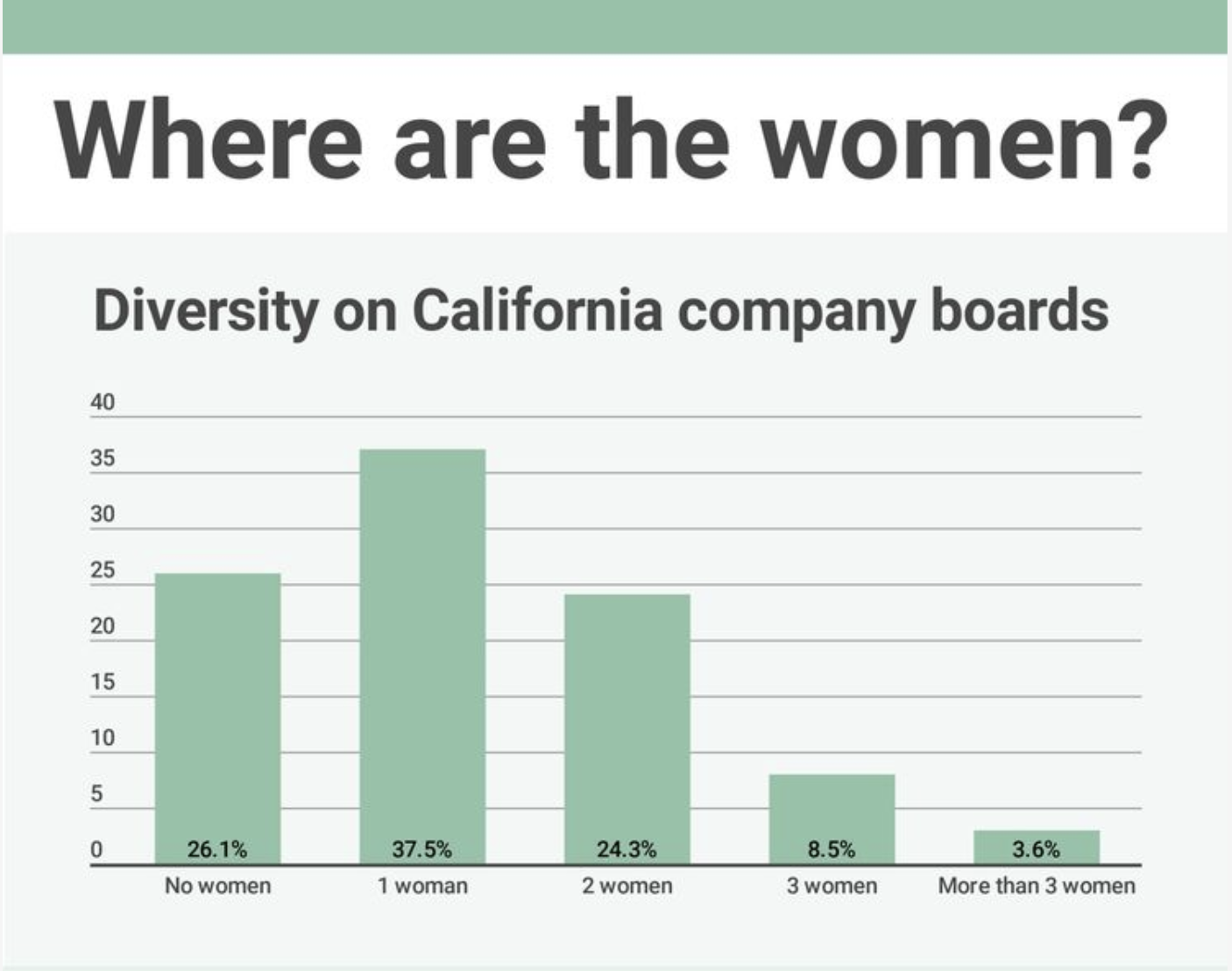
Source: Board Governance Research and CALmatters
SB 826, which won Senate approval with only Democratic votes and has until the end of August to clear the Assembly, would require publicly held companies headquartered in California to have at least one woman on their boards of directors by end of next year. By 2021, companies with boards of five directors must have at least two women, and companies with six-member boards must have at least three women. Firms failing to comply would face a fine.
“Gender diversity brings a variety of perspectives to the table that can help foster new and innovative ideas,” said Democratic Sen. Hannah-Beth Jackson of Santa Barbara, who is sponsoring the bill with Senate President Pro Tem Toni Atkins of San Diego.”It’s not only the right thing to do, it’s good for a company’s bottom line.”
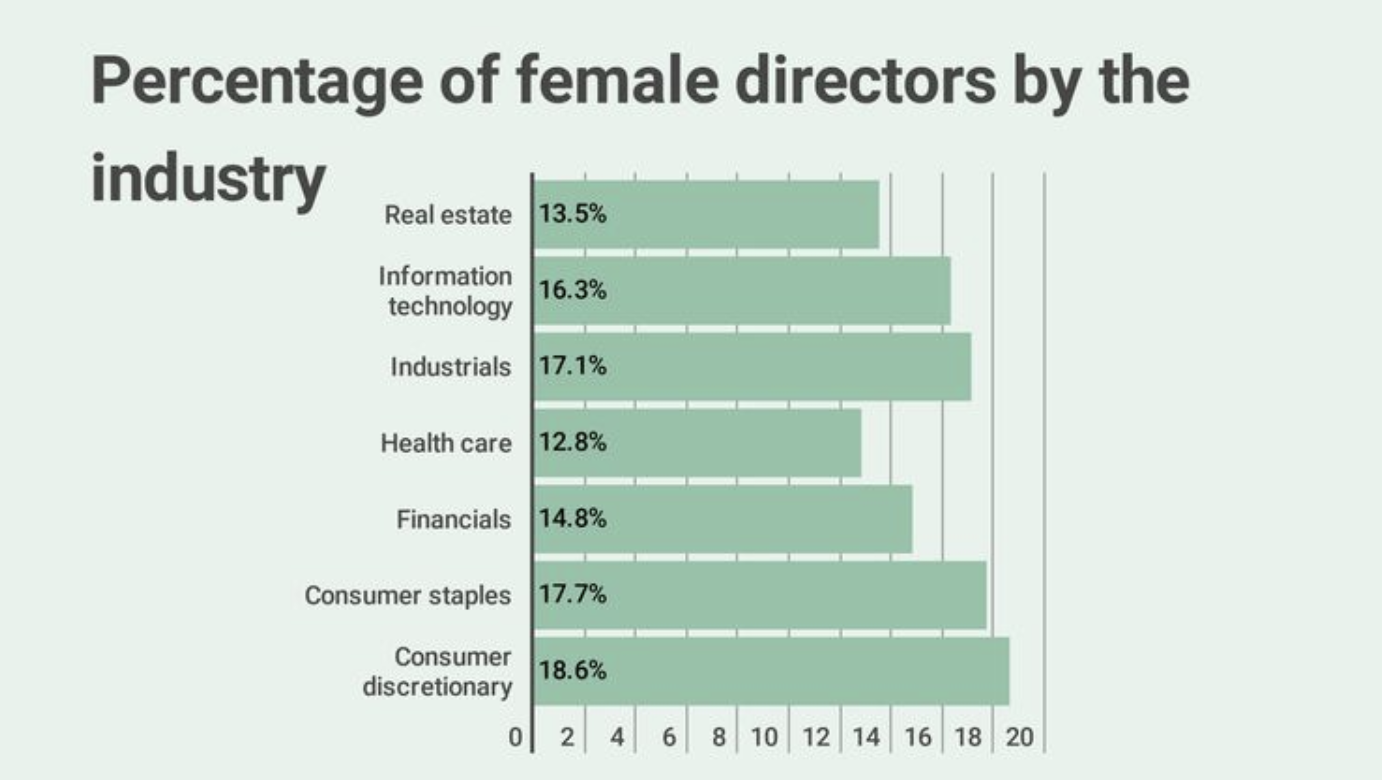
Source: Board Governance Research and CALmatters
Yet critics of the bill say it violates the federal and state constitutions. Business associations say the rule would require companies to discriminate against men wanting to serve on boards, as well as conflict with corporate law that says the internal affairs of a corporation should be governed by the state law in which it is incorporated. This bill would apply to companies headquartered in California.
Jennifer Barrera, senior vice president of policy at the California Chamber of Commerce, argued against the bill and said it only focuses “on one aspect of diversity” by singling out gender.
“This bill basically mandates that we hire the woman above anybody else who we may be fulfilling for purposes of diversity,” she said at a hearing.
Similarly, a legislative analysis of the bill cautioned that it could get challenged on equal protection grounds, and that it would be difficult to defend, requiring the state to prove a compelling government interest in such a quota system for a private corporation.
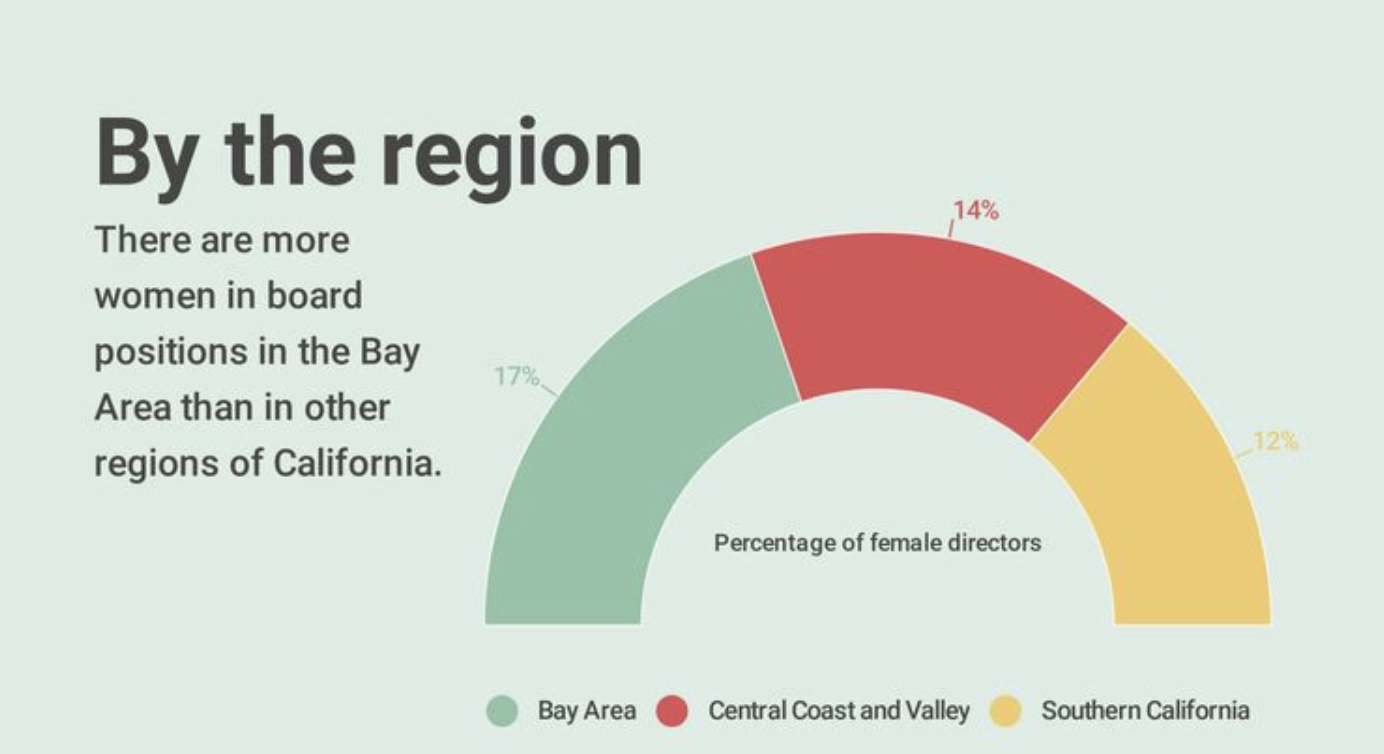
Source: Board Governance Research and CALmatters
Five years ago, California was the first state to pass a resolution, authored by Jackson, calling on public companies to increase gender diversity. In response, about 20 percent of the companies headquartered in the state followed through with putting women on their boards, according to the research firm Board Governance Research. But the resolution was non-binding and expired in December 2016.
Other countries have been more proactive. Norway in 2007 was the first country to pass a law requiring 40 percent of corporate board seats be held by women, and Germany set a 30 percent requirement in 2015. Spain, France and Italy have also set quotas for public firms.
In California, smaller companies have fewer female directors. Out of 50 companies with the lowest revenues, 48 percent have no female directors, according to Board Governance Research. Only 8 percent of their board seats are held by women.
The 2017 study said larger companies did a better job of appointing women, with all 50 of the highest-revenue companies having at least one female director and 23 percent of board seats held by women.
“The main issue is still that a lot of companies headquartered here don’t have women on their boards,” said Annalisa Barrett, clinical professor of finance at the University of San Diego’s School of Business. “We quite often like to think of California as progressive and a leader on social issues, so that’s kind of disappointing.”
Barrett publishes an annual report of women on boards in California. Public companies are major employers in the state, and their financial performance has a big impact on public pension funds, mutual funds and investment portfolios. “Financial performance does really impact the broader community,” she said.
The National Association of Women Business Owners, sponsor of the bill, says an economy as big as California’s ought to “set an example globally for enlightened business practice.” In a letter of support, the association cites studies that suggest corporations with female directors perform better than those with no women on their boards.
One University of California, Davis study did find that companies with more women serving on their boards saw a higher return on assets and equity, but the author acknowledges this may not suggest a cause-and-effect.
Understanding smartwatches
I was wrong. Several years ago I reviewed the first Garmin Fenix 3 smartwatch. This was before the release of the Apple Watch. That’s key to this story. I declared Garmin would have a hard time selling the Fenix 3. The Apple Watch would be better in every way, I pointed out. Therefore, there would be little reason to buy the Fenix 3.
But here I am, in the middle of the woods, wearing the fifth generation of the Garmin Fenix while my Apple Watch sits at home on my desk.
In some ways I was right. The Apple Watch is better by most measurable attributes: there are more apps, the screen is superior, there’s a vibrant accessory market, and it’s thinner, faster and cheaper.
The Garmin Fenix is big, clunky and the screen looks like it’s from a Kindle. It’s not a touchscreen nor does it have the number of apps or band options of the Apple Watch. I like it. To me, the Garmin Fenix is akin to a modern Casio G-Shock, and that’s what I want to wear right now.
Smartwatches are often reviewed like phones or vacuums. Specs are compared, and conclusions are drawn. Wearability is talked about, and functions are tested. If the watch has a swimming option, take it in a pool never mind the fact the reviewer hasn’t done a lap since high school.
I started out doing the same thing with this Garmin. I took it kayaking. I had kayaked twice in my life, and dear reader, I’m here to report the watch performed well on this kayak trip. The watch has topography maps that novel though not useful since the river. It has a cadence beat to help keep strokes consistent. I tried it all. I ended up drinking a lot of Michigan beer instead of tracking the performance of the watch. Sorry.
Still, performance matters to a point.
Here’s my OG review of the Garmin Fenix 5: The watch is significant even on my wrist. The screen is underwhelming though it’s always on and visibility improves in sunlight. The buttons have great tactical feedback. The watch is waterproof to the extent it survived a flipped kayak and hours in Lake Michigan. The battery lasts nearly a week. The watch does not know when it’s on or off the wrist, so notifications will cause it to buzz while it’s on your nightstand.
But most of that doesn’t matter. The Garmin Fenix 5 is exceptional, and I love wearing it.
Smartwatches need to be reviewed like ordinary watches. I need to explain more about how the watch feels rather than what it does or how it works. At this point, several years into smartwatches, it’s not notable if the smartwatch with a smartwatch. Of course, it tracks steps and heart rate and displays select notifications from my phone. If those items work then, they’re not important in a review.
Take a Citizen Skyhawk line. It packs a highly sophisticated complication that’s designed, so the maker says, for pilots. Ball makes a lovely line intended to provide accurate timekeeping for train conductors. There are watches for high magnetic fields, tactical operators, racer car drivers and, of course, countless for divers. Here’s my point: The vast majority of these watches are not used by divers or train conductors or fighter pilots.
This Garmin Fenix watch, much like the Apple Watch or Rolex diver, can be an aspirational item. It’s like the juicer in my kitchen or rowing machine in my basement. I got it because I wanted to be a person who woke up and juiced some veggies before my workout. I haven’t used either in months.
Smartwatches are different from smartphones and need to be reviewed as such. This Garmin Fenix watch has many modes I would never use, yet I love the watch. There’s a base jumping mode. I’m not jumping off a cliff. There’s a tactical mode and a golf mode and an open water mode, and I have no desire to be in situations where I need to track such activities. But I like the thought of having them available if I ever wanted to monitor my heartbeat while shooting targets.
The smartwatch industry is approaching a point where features are secondary to design. It’s expected that the watch will track steps and heartbeat while providing access to various features. It’s like the time and date of a regular watch. Past that, the watch needs to fit in a person’s aspirations.
Everyone is different, but to me, this is how it is laid out: The Apple Watch is for those looking for the top-tier experience regardless of the downsides of constant charging and delicate exterior. Android Watches are those looking for something similar but in a counter-culture way. The Samsung’s smartwatch is interesting and with the new Galaxy Watch, finally reaching maturity.
There are fashion smartwatches with fewer features but designs that make a statement. That’s where this Garmin watch lives and I’m okay with it. Fossil and Timex watches live here too. Using the Apple Watch as a standard, some of these fashion watches cost more, and some cost less, but they all say something an Apple Watch does not.
I’m bored with the Apple Watch, and right now I’m into thinking I live the type of life that needs a smartwatch that tracks every aspect of a triathlon. I don’t need all these features, but I like to think I do. I also don’t need to have a GMT watch with a third timezone, and I don’t need a watch with a hacking movement hand as if I need to synchronize my watch with other members of my special forces squad. But I have those watches along with dive watches and anti-magnetic watches. I’m not alone. The watch industry has long existed on selling lifestyles.
I was wrong before. The Apple Watch isn’t better than this Garmin or most other smartwatches— at least it’s not better for me right now. Maybe two weeks from now I’ll want to wear an Apple Watch and not because it’s better, but because it makes a different statement.
Electric scooters are going worldwide
Despite regulatory hurdles on a city-by-city basis, electric scooter companies and their respective services are continuing to make their way to markets all over the world. Earlier this week, for example, Lime announced its entrance into Madrid, launching hundreds of electric scooters in the Spanish capital. About a week before that, competitor Bird launched in Paris and laid out its intentioned to bring electric scooters to Tel Aviv.
As Bird expands to international markets, it’s worth noting that competitor Lime has operated its bikes and scooters outside of the U.S. for quite some time. Last December, Lime brought its bikes to a number of European cities and in June, Lime brought its scooters to Paris. Lime also recently raised a $335 million round and teamed up with transportation behemoth Uber.
Nationwide, Bird, Lime, Spin, Goat and Skip have collectively deployed scooters in 33 cities. Outside of the U.S., you’ll find scooters from those companies in just three cities.
Bird and Lime are by no means the only companies working in this space, but they’re the two that have raised most the capital. Bird has raised $415 million in funding while Lime has raised $467 million. Bird and Lime are also the only two U.S.-based scooter companies that have gone international.
Over in the U.S., of course, the competitive landscape is an entirely different story. California is the main hot spot for scooters in the U.S., but they have also popped up in Texas, Washington D.C., North Carolina and other states throughout the country.
Unsurprisingly, regulation has proved to be an issue for many of these companies. In San Francisco, the Municipal Transportation Agency is currently reviewing permit applications from 12 electric scooter services — including ones from Lyft, Uber and Razor — looking to operate in the city. The permit process came as a result of Bird, Lime and Spin deploying their electric scooters without permission in the city in March. Fast forward to today and electric scooters are nowhere to be found on the streets of San Francisco.
The SFMTA initially said it expected to make a decision about which five, if any, companies would receive permits by the end of June. The SFMTA expects to finalize its recommendations and documentation “in the coming weeks,” the SFMTA wrote in a blog post last month. Once that’s done, the agency says it will work with companies to finalize and clarify the terms and conditions of the permit. The goal, according to the blog post, is to issue permits sometime in August.
As part of the 24-month pilot program, electric scooter companies selected to operate in the city will need to provide user education and insurance, share its detailed trip data with the city, have a privacy policy that protects user data, offer a low-income plan and operate in a to-be-approved service area. The city will allow no more than 2,500 electric scooters on the streets at any one time.
Last month, Bird tried to launch its scooters in Boston but regulators quickly cracked down, saying it would impound any scooters it found. And let’s not forget the drama that unfolded in Santa Monica, where Bird first deployed its scooters.
In Austin, D.C. and Portland, Ore., it’s a slightly different scenario. Over in Austin, dockless electric scooter startup GOAT says it’s working with the city to ensure its service meets the criteria laid out by regulators. Moving forward, GOAT says it’s actively working with other cities to pursue additional operating permits. Skip, which is trying to differentiate itself by being more heavy-duty, worked with city officials and lawmakers to ensure it had the green light before launching. In Portland, both Skip and Bird have received permits to operate electric scooters in the city.
With the sheer volume of capital pouring into these companies, along with interest from ride-hailing giants Lyft and Uber, it’s clear these scooters are here to stay. Whether cities like them or not, scooters are going to roll up. It’s just a matter of when and how many.
Spotify runs test in Australia, allowing users to skip ads at any time, potentially boosting targeting and revenues
If you want to test out a feature on a large, well-known, global, platform, there’s a very simple solution: Test it in Australia. At a population of 24 million and with a predominantly Western culture, it’s a large enough test bed and small enough market, so ideal for testing new features before (maybe) rolling them out globally. And that’s exactly what Spotify appears to be doing in testing out how it can tweak its advertising platform to take the fight to the likes of Pandora and other competitors.
Advertising Age reports today that it’s running a test in Australia which will let listeners skip audio and video adverts at any time while the ad is playing. This is instead of having a preset time limit to listen to or watch the advert which can’t be skipped. They’ll be able to do this any time they want, as often as they want, and the new feature will also let them jump straight back into the music.
The feature (well, it’s still a test feature after all) is called “Active Media.” In it, advertisers won’t have to pay for any ads that are skipped. It’s a high risk strategy because clearly Spotify may get less ad revenue in the short-term, while the algorithm is trained to serve ads that consumers will in fact listen to. But Australia’s smaller market means any lost revenue will be relatively small.
AdAge quote Danielle Lee, global head of partner solutions at Spotify, saying the move is about tailoring the ads to users’ tastes, so similar to Spotify’s “Discover Weekly” feature, which does the same for music.
It’s a smart move, since, by allowing users to spend longer on the ads they actually do like, Spotify will get better data on the ads which work best for that particular user, and thus sell better-targeted ads which, in turn, will have a higher premium.
“Our hypothesis is if we can use this to fuel our streaming intelligence, and deliver a more personalized experience and a more engaging audience to our advertisers, it will improve the outcomes that we can deliver for brands,” Lee said.
Plus, a user listening to a better-targeted advert in full is worth more than blasting adverts to consumers who may ultimately be put off the platform for being forced to listen to adverts. They’d also listen to fewer ads overall, thus keeping the platform ‘sticky’.
Spotify says advertisers won’t have to pay for any ads that are skipped. If things go well, it’s likely the feature will expand globally.
Spotify previously reported in July that it closed the second quarter of the year with 180 million monthly active users. This is up 30 percent year-over-year. It now have over 101 million ad-supported users in 65 markets globally. Total ad revenue has reached $158 million, up 20 percent. Automated ad sales are growing quickly and accounted for more than 20 percent of ad revenue, the company reported.
24 hours left to apply to Startup Battlefield Latin America
The clock is ticking: only 24 hours left to submit your application to compete in the first TechCrunch Startup Battlefield Latin America on November 8, 2018, in São Paulo, Brazil. Is your startup one of Latin America’s best? If so, don’t waste another minute. Apply right here, right now before the 24-hour clock runs out. Don’t miss your chance to launch your early-stage startup on a global stage. Apply no later than August 13, 2018, at 5 p.m. PST.
The winning founders receive a $25,000 non-equity cash prize and a trip for two to the next TechCrunch Disrupt. While there, they can exhibit free of charge in the Startup Alley.
All Startup Battlefield competitors — win or lose — reap the benefits of broad exposure to the media outlets and investors sitting in the audience. Plus, we video all the Startup Battlefield sessions and post them on TechCrunch.com. That exposure lives on long after the competition ends.
All competing teams also become part of our Startup Battlefield alumni community. Since 2007, more than 750 companies have competed in Startup Battlefield. Those companies — including Mint, Dropbox, Yammer, Fitbit, Getaround and Cloudflare — have collectively raised more than $8 billion in funding and produced more than 100 exits.
Here’s how the competition works. TechCrunch editors will evaluate every eligible application and select 15 founders to compete in the Battlefield, which takes place at São Paulo’s Tomie Ohtake Institute. Founders receive intensive — and free — pitch coaching from TechCrunch editors and will be primed and ready to go come game day.
During three preliminary rounds, five startups per round will each have six minutes to pitch and present their demo before a panel of top investors and seasoned entrepreneurs. The judges have six minutes following each pitch for a thorough Q&A. Only five teams advance to the finals for another round of pitching and more probing questions. And only one team will emerge as the first Startup Battlefield Latin America champion.
Here’s what you need to know about eligibility. Founders must meet these requirements:
- Have an early-stage company in “launch” stage
- Be headquartered in one of these countries: Argentina, Bolivia, Brazil, Chile, Colombia, Ecuador, French Guiana, Guyana, Paraguay, Peru, Suriname, Uruguay, Venezuela; (Central America) Belize, Costa Rica, El Salvador, Guatemala, Honduras, Nicaragua, Mexico, Panama; (Caribbean — including dependencies and constituent entities) Dominican Republic and Puerto Rico
- Have a fully working product/beta reasonably close to, or in, production
- Have received limited press or publicity to date
- Have no known intellectual property conflicts
- Apply by August 13, 2018, at 5 p.m. PST
TechCrunch Startup Battlefield Latin America takes place on November 8, 2018, in São Paulo, Brazil. You have everything to gain by applying, but time is running out: You only have 24 hours left to apply by the deadline of August 13, 2018, at 5 p.m. PST. Show us what you’ve got: Apply here right now.
Voatz: a tale of a terrible, horrible, no-good, very bad idea
Let’s get the fish in the barrel out of the way. Voatz are a tech startup whose bright idea was to disrupt democracy by having people vote on their phone, and store the votes on, you guessed it, a blockchain. Does this sound like a bad idea? Welp.
It turned out that they seemed awfully casual about basic principles of software security, such as not hard-coding your AWS credentials. It turned out that their blockchain was an eight-node Hyperledger install, i.e. one phenomenologically not especially distinguishable from databases secured by passwords. They have been widely and justly chastised for these things. But they aren’t what’s important.
To their credit, their system is opt-in, and apparently generates real-time voter-verified paper ballots, the single most important thing about any voting system. But still. We need to step back and ask a question here: why are we trying to vote via an app and collate election results on any kind of centralized system at all? We don’t want to make voting more efficient. Efficiency is not the problem we are trying to solve with elections. The inefficiency of paper ballots and their handling and collation and tabulation is a feature, not a bug.
Just ask everyone at Def Con’s Vote Hacking Village, whose successes have been rampant this weekend, in the midst of the enmity of the National Association of Secretaries of State:
ARE YOU GOING TO BELIEVE US OR YOUR OWN LYING EYES?! https://t.co/SOVL4Jb0dU
— TProphet (@TProphet) August 9, 2018
Voatz were approaching the wrong problem in the wrong way from the start. Even if your blockchain repository is verifiably write-once, which it isn’t, it only records the data sent to it via your app and servers. Voting cannot rely on apps and servers, no matter how allegedly secure they are claimed to be. It’s nice that you generate paper ballots for a post-election audit, but since we should not and cannot ever trust voting servers and software, and therefore will need to do a post-election paper ballot count every time — how about we skip the man-in-the-middle, and all of your software, and go straight to that part?
The other point is brought to us by XKCD, who responded to Voatz with this:
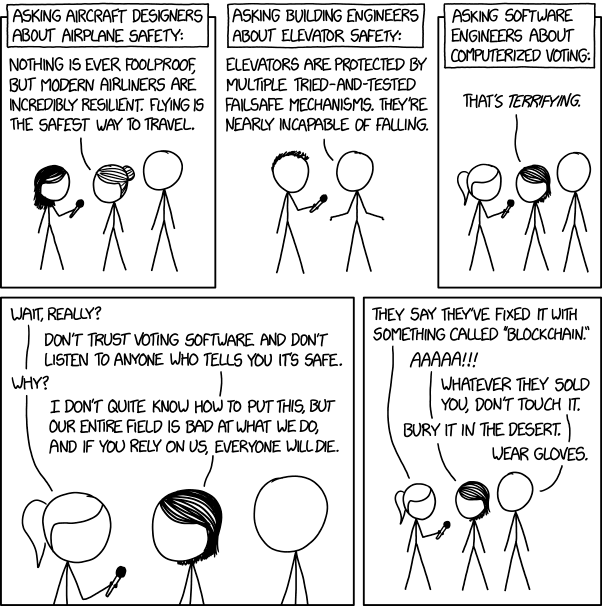
which in turn brought this response from Facebook’s (soon-to-be-former) CISO Alex Stamos:
I agree with Chris.
This is the kind of thinking that leads to "Why can't we just have building codes for software? It worked to protect against earthquakes and fire!"
Earthquakes and fire aren't conscious adversaries. Try writing a standards document on how to win at chess. https://t.co/eAPk6M3ijN
— Alex Stamos (@alexstamos) August 8, 2018
(eta: it has come to my attention that people are mistakenly inferring that Stamos is defending Voatz. This is emphatically not the case. He was referring to XKCD’s comparison between different engineering disciplines, is all.)
which in turn brought this response from CFI and engineer Rob Russell, which a lot of the finest engineers I know have been sharing across social media:
This is wildly disingenuous, I speak as a flight instructor and major IT incident investigator. Modern software authors have the professional discipline of a cute puppy in comparison to aviation practitioners. https://t.co/6GzCqLNpcl
— Rob Russell (@www_ora_tion_ca) August 9, 2018
There are valid points on all sides here. Stamos is right that most spheres, e.g. aviation, don’t have to deal with the constant threat of intelligent adversaries attacking the system in the same way that software does (although as they events at SeaTac yesterday show us, they are by no means devoid of such threats.)
But Russell brings up the very valid point that because software people are so fixated on adversaries, on hackers and not being hacked, their definition of “security” is often restricted to breaches and exploits and vulnerabilities, rather than systemic flaws, or sloppy development techniques, which hurt users’ security even if no external hacker is involved. In fairness, over the last few years the infosec community has been good at broadening its definition of “secure” beyond “external hacker resistant” … but it seems pretty apparent that much, much more work is needed.
Blind loyalty
John Chen
Contributor
Contributor
There is a secret behind every open office in Silicon Valley — and it isn’t the drain on productivity.
Tech companies have been the vanguards for pushing corporate culture forward toward “radical transparency.” Mark Zuckerberg works in a fully transparent four-walled glass office surrounded by the rest of Facebook. Valve got rid of managers and titles so everyone can be their own boss. Startup founders host weekly town halls, Friday all-hands, and AMAs. Companies go to painstaking lengths to signal that they trust their employees – to show that this is your company.
But while your company might adopt an open floor plan and give out free snacks so you can feel closer to your coworkers, they likely don’t want you knowing how much they make, who is affected by the impending layoffs, or whether executives are making the right decisions.
The open office has never been more closed, and tech companies are no different than old corporate America in their authoritarian approach to controlling how their employees should think about issues that matter in the workplace. In fact, it may even be more insidious because it’s tucked away behind the veneer of a cheerful, open office.
This is what makes social network Blind so fascinating. Raw and unfiltered, Blind is the antithesis to HR’s utopic vision of a manageable and orderly corporate culture. Instead, it operates outside the walled gardens of IT with no rules and no official corporate supervision.
With Blind, users are completely anonymous, but are required to submit a verified work email to join a company channel. Inside, they are able to freely ask, discuss, prod, and complain without fear of retribution or judgment.
In short, it’s HR’s worst nightmare, and it’s wildly successful.
Building a compelling social product
Blind’s engagement numbers are staggering. It has over 2 million users, including 43K at Microsoft, 28K at Amazon, and 10K at Google. In South Korea, half of all employees at companies over 200 people are active monthly. The typical monthly active user logs in three to four times per day and spends 35 minutes using the app. At the height of the Susan Fowler scandal, Uber employees were spending almost 3 hours a day on Blind. All that, and the entire company is 38 people.
At the heart of Blind’s magic is something universal to every person who has ever been employed — the duality between our personal selves and our “work” selves, and the human drive to be both intimate and in control of our relationships. There is no place more difficult to navigate this duality than the workplace, where we want to feel loved and understood, but also respected.
Hierarchy, politics, and negative career impacts burden conversations about difficult topics, and so Blind tears these barriers down one employee at a time, affording a space for uninhibited dialogue. More importantly, Blind succeeds as a resource for questions not only company-related, but also around career, family, and life decisions.
Blind is in many ways an evolution of a long lineage of ideas in social networking. It’s unique achievement is the recombination of these different ideas to create a platform that is both a safe space for free and open conversation (via anonymity), along with a vetted, contextually relevant community (via workplace email authentication).
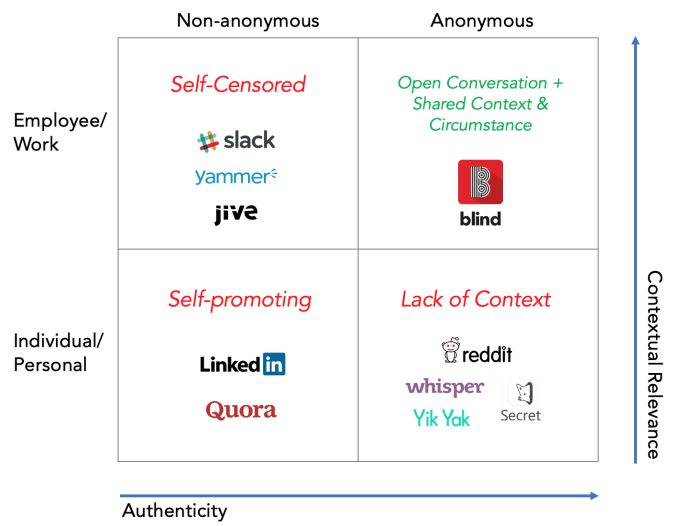
Let’s walk though each of these categories to understand Blind’s success.
Lack of Context (Anonymous + Individual/Personal) – Companies like Yik Yak, Secret, and Whisper pioneered the anonymous social network on the consumer side. However, they were beleaguered by cyberbullying, and served more as a digital exhaust pipe for teenage angst and trolling. Perhaps the most successful semi-anonymous social network today is Reddit, where legions of loyal community members cover every topic imaginable. However, what all of these anonymous communities lack is the critical element of shared context and circumstance.
Put another way, your fellow community members on Reddit may share your interest in ice fishing, but they likely will not understand who you are. As Blind cofounder Kyum Kim puts it, “it’s hard for someone to complain on Reddit about feeling poor while making $200K a year without fear of backlash, but on Blind, your coworkers are in the same income bracket, and likely similar education levels, neighborhoods, etc. They can empathize with your situation.” On Blind, there is a single community (your workplace) that spans multiple topics, and there’s a baseline, tacit understanding of each other’s life circumstances, allowing for deeper conversations.
Self-Promoting (Non-Anonymous + Individual/Personal) – LinkedIn and Quora are useful professional platforms, but because individuals and brands are the stars of these platforms, posturing and self-promotion can be quite frequent. When you ask a question on Quora, you are submitting your inquiry to a body of self-proclaimed experts. While many responses can be genuine, the ultimate currency that drives the platform is credibility and brand building, which inhibit authentic and vulnerable conversations from occurring.
Self-Censored (Non-Anonymous + Employee/Work) – On the enterprise side, Yammer, Jive, and recently Slack have attempted to upgrade the creaky company intranet into the enterprise social network. While these tools might make it easier to connect to your coworkers, the conversations happening on these platforms are no different than before – ultimately, these tools are designed to get work done, not for questioning, debating, or reflecting on how work should be. Conversations about sensitive subjects (e.g. how to deal with a bad manager) are unlikely to happen on a non-anonymous, corporate-sanctioned platform where that same bad manager might well be watching.
Finally, we have Blind. The platform strikes a balance between the freedom of anonymity and the context of a shared workplace. The result is a forum for surprisingly rich, relevant, and authentic conversations. While company channels are accessible only to insiders, a look at Blind’s public site (where you still need a verified work email, but you can chat with anyone outside your company) reveals a flavor for the types of conversations that are possible. An engineer at Amazon recently posted about how to deal with a mid-life crisis, with 42 responses of encouragement and advice. Another employee moving from India has a wife suffering from depression and is seeking help navigating the US healthcare system.
It turns out that where we work is a good proxy for who we are, and our coworkers have been an untapped community of wisdom.
Trust and safety
Towfiqu Photography via Getty Images
Blind is by no means perfect. Like all online platforms and particularly anonymous ones, it invites its share of trolls. One look at the “Relationships” section on Blind’s public site and you’ll find questions about how to deal with one-night stands with coworkers and a poll asking guys how many girls they’ve slept with before marriage. While these questions could certainly have come from a genuine place, they are easy fodder for trolls, and the ensuing conversations can be alienating and provide an unnecessary megaphone for toxic bro culture.
Blind acknowledges that these issues exist, but claim that they happen less frequently inside company channels. Because users authenticate with their work emails, cofounders Sunguk and Kim believe that Blind users feel a greater sense of responsibility to each other because they are engaging a real community with shared context and goals.
The vast terrain of cyberspace might suffer from the tragedy of the commons and moral hazard, but within your workplace channel on Blind, your digital community maps onto a physical community – even though you are anonymous. This is evidenced by the successful self-policing on the platform, where 0.5% of all posts have been removed (higher than average for a social media platform), and all of these originated from user-generated flags.
A More Perfect Union
Blind’s success illuminates a reality that is often overlooked: corporations aren’t naturally democratic or transparent. While there are platforms to discuss our roles as individual working professionals (e.g. LinkedIn), there are very few places to gather and organize as employees of companies to collectively bargain for a better workplace.
This is by design. HR, the supposed watchdog of employee wellness, is neither elected nor truly representative, as they must balance the competing goals of being a third party resource for employees while also protecting the company against its employees.
Companies will always be incentivized to maintain an asymmetry of information. Friday all-hands and town halls are heavily scripted by companies. Rarely do we see anyone describing a healthy, transparent culture as a place where employees are freely conversing amongst themselves.
For companies with something to hide, the idea of a public square where conversations happen freely should be alarming. Blind has already been at the center of exposing two major scandals (e.g. the “nut rage” incident by a Korean Air executive and the news that Lyft was spying on its users.)
Blind picks up where labor unions left off and where HR has failed — to serve as a safeguard against corporate overreach, and to provide a protected space for employees to collaborate around solutions to improve the workplace.
A truly open office
For companies, Blind’s rise shouldn’t be seen as bad news. Blind can be a rich source of insight where HR software falls short. While employee engagement surveys have become popular in HR circles (and a crop of well-funded HR tech companies have consequently flooded the market), these practices suffer from the same issues of hosting a town hall. The company decides on the questions asked and interprets the answers given. With Blind, for the first time, HR and executives will have a pulse on employee sentiment that is both real-time and authentic. As Moon puts it, “no company is perfect, and if it was, Blind would not need to exist.”
In short, Blind understands more about your employees than anything in your HR stack.
Where does Blind go from here? Moon and Kyum believe they’re just getting started. Today, Blind is only available in the U.S. and South Korea, and it has been focused on tech companies. Their push into more traditional industries is showing some early signs of success with Johnson & Johnson, Dow Chemical, Barclays, and the US Navy coming online recently. There is still work to do in cleaning up different communities to ensure that conversations are inclusive and not alienating. And of course, Blind has to find a path to becoming a sustainable, revenue-generating company without compromising its integrity with users.
But one can only imagine the potential for Blind if it continues on its path upwards — the anonymous social network that understands who you are, the pulse survey that is authentic and real-time, and the first truly safe and open office made for employees, by employees.