The film has been widely praised by critics, but is it getting the credit it deserves as a visionary work of sci-fi?
Category: Tech news
hacking,system security,protection against hackers,tech-news,gadgets,gaming
Space Photos of the Week: Hubble Sees Things a Long Time Ago
…They Are Galaxies Far, Far Away
Elon Musk: Tesla will remain a public company
Tesla will remain a public company, CEO Elon Musk said Friday night, less than three weeks after he announced to the world via Twitter that he was considering taking the electric automaker private at $420 a share.
Musk, who posted the announcement via Tesla’s blog, said Friday that after speaking with shareholders and investigating the process of taking the company private he believes the better path is for Tesla to remain public. Musk met with Tesla’s board of directors Thursday and told him his decision. The board agreed, he wrote.
Here’s an excerpt:
Given the feedback I’ve received, it’s apparent that most of Tesla’s existing shareholders believe we are better off as a public company. Additionally, a number of institutional shareholders have explained that they have internal compliance issues that limit how much they can invest in a private company. There is also no proven path for most retail investors to own shares if we were private. Although the majority of shareholders I spoke to said they would remain with Tesla if we went private, the sentiment, in a nutshell, was “please don’t do this.”
I knew the process of going private would be challenging, but it’s clear that it would be even more time-consuming and distracting than initially anticipated. This is a problem because we absolutely must stay focused on ramping Model 3 and becoming profitable. We will not achieve our mission of advancing sustainable energy unless we are also financially sustainable.
That said, my belief that there is more than enough funding to take Tesla private was reinforced during this process.
Friday night’s announcement closes a tumultuous 17 days that began with Musk tweeting that he secured funding and was considering taking Tesla private. The tweet wasn’t warmly embraced by the Tesla board or many shareholders. It also prompted the U.S. Securities and Exchange Commission to investigate.
https://twitter.com/elonmusk/status/10268726522903797
While this 17-day ride might be over, the questions over Musk’s behavior (and possible drug use) and the company’s future are likely not.
Fortnite’s Android installer shipped with an Epic security flaw
Google has clapped back in tremendous fashion at Epic Games, which earlier this month decided to make the phenomenally popular Fortnite available for Android via its own website instead of Google’s Play Store. Unfortunately, the installer had a phenomenally dangerous security flaw in it that would allow a malicious actor to essentially install any software they wanted. Google wasted exactly zero time pointing out this egregious mistake.
By way of a short explanation why this was even happening, Epic explained when it announced its plan that it would be good to have “competition among software sources on Android,” and that the best would “succeed based on merit.” Everyone of course understood that what he meant was that Epic didn’t want to share the revenue from its cash cow with Google, which takes 30 percent of in-app purchases.
Many warned that this was a security risk for several reasons, for example that users would have to enable app installations from unknown sources — something most users have no reason to do. And the Play Store has other protections and features, visible and otherwise, that are useful for users.
Google, understandably, was not amused with Epic’s play, which no doubt played a part in the decision to scrutinize the download and installation process — though I’m sure the safety of its users was also a motivating factor. And wouldn’t you know it, they found a whopper right off the bat.
In a thread posted a week after the Fortnite downloader went live, a Google engineer by the name of Edward explained that the installer basically would allow an attacker to install anything they want using it.
 The Fortnite installer basically downloads an APK (the package for Android apps), stores it locally, then launches it. But because it was stored on shared external storage, a bad guy could swap in a new file for it to launch, in what’s called a “man in the disk” attack.
And because the installer only checked that the name of the APK is right, as long as the attacker’s file is called “com.epicgames.fortnite,” it would be installed! Silently, and with lots of extra permissions too, if they want, because of how the unknown sources installation policies work. Not good!
Edward pointed out this could be fixed easily and in a magnificently low-key bit of shade-throwing helpfully linked to a page on the Android developer site outlining the basic feature Epic should have used.
To Epic’s credit, its engineers jumped on the problem immediately and had a fix in the works by that very afternoon and deployed by the next one. Epic InfoSec then requested Google to wait 90 days before publishing the information.
As you can see, Google was not feeling generous. One week later (that’s today) and the flaw has been published on the Google Issue Tracker site in all its… well, not glory exactly. Really, the opposite of glory. This seems to have been Google’s way of warning any would-be Play Store mutineers that they would not be given gentle handling.
Epic Games CEO Tim Sweeney was likewise unamused. In a comment provided to Android Central — which, by the way, predicted that this exact thing would happen — he took the company to task for its “irresponsible” decision to “endanger users.”
Epic genuinely appreciated Google’s effort to perform an in-depth security audit of Fortnite immediately following our release on Android, and share the results with Epic so we could speedily issue an update to fix the flaw they discovered.
However, it was irresponsible of Google to publicly disclose the technical details of the flaw so quickly, while many installations had not yet been updated and were still vulnerable.
An Epic security engineer, at my urging, requested Google delay public disclosure for the typical 90 days to allow time for the update to be more widely installed. Google refused. You can read it all at https://issuetracker.google.com/issues/112630336
Google’s security analysis efforts are appreciated and benefit the Android platform, however a company as powerful as Google should practice more responsible disclosure timing than this, and not endanger users in the course of its counter-PR efforts against Epic’s distribution of Fortnite outside of Google Play.
Indeed, companies really should try not to endanger their users for selfish reasons.
The lobbying is fast and furious as gig companies seek relief from pro-labor Supreme Court ruling
Antoinette Siu
Contributor
Contributor
Antoinette Siu is a reporter for CALmatters.
More posts by this contributor
For four years, Edhuar Arellano has left his house at 7 a.m. on weekdays to drive customers around the Bay Area for Lyft and Uber . Most days, he doesn’t get home to Santa Clara until 11 p.m. On weekends, he delivers pizzas to make ends meet.
Like a lot of drivers plugging in to ride-hailing apps for work, he likes the flexibility the gig economy has offered. But given the choice, Arellano says he wishes he could just become an employee. That would get him paid vacation, benefits, overtime, his own health insurance and perhaps more say over his working conditions.
“We need to accept whatever they want,” said the 55-year-old father of two grown children. “I can’t control anything.”
That quandary is behind a ferocious battle quietly playing out in the state Capitol in the final days of the legislative session, which ends August 31. Lobbyists for ridesharing companies and the California Chamber of Commerce are scrambling to delay until next year (and the next governor’s administration) a far-reaching California Supreme Court decision that could grant Arellano’s wish — and, businesses fear, undermine the entire gig economy.
The April ruling, involving the nationwide delivery company Dynamex Operations West Inc. and its contract drivers, established a new test for enforcement of California wage laws, and made it much harder for companies in California to claim that independent contractors are not actually employees.
Though the ruling only applies to California, the state’s labor force is so huge that it has already had national impact. Shortly after the decision, U.S. Senator Bernie Sanders of Vermont introduced a bill to make a version of California’s new rule the federal standard, a move that only added urgency to employers’ calls for state lawmakers to hit the pause button on implementing the ruling.
“Businesses are very concerned. The key is who’s going to be sued here in the near future,” said Allan Zaremberg, president of the California Chamber, which represents 50,000 businesses.
They should be, says labor leader Caitlin Vega, who has been similarly lobbying Capitol Democrats to refrain from meddling and let the Supreme Court decision move forward.
“Companies have made so much money already at the expense of workers,” Vega, the legislative director of the California Labor Federation, said Tuesday during a harried break between Capitol meetings. “We really see the Dynamex decision as core to rebuilding the middle class.”
State and federal labor laws give employees a wide range of worker protections, from overtime pay and minimum wages to the right to unionize. But those rights don’t extend to independent contractors, whose ranks have grown dramatically in the gig economy.
Apps such as Uber, TaskRabbit and DoorDash, which match customers and services online and in real time, have given workers an unprecedented ability to freelance but they also have blurred traditional employer-employee relationships and, labor advocates say, invited exploitation.

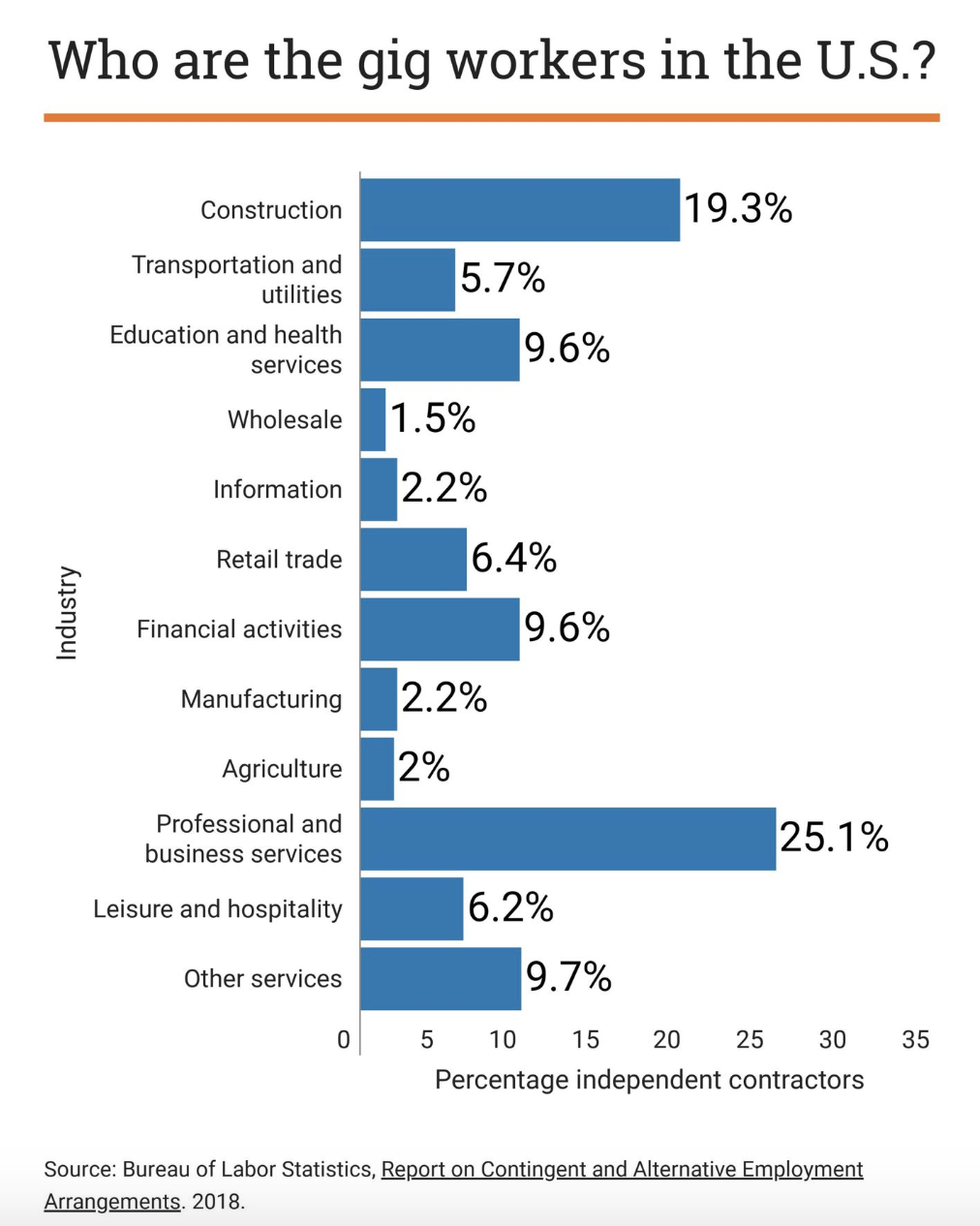
Some 2 million people, from Lyft drivers to construction workers, consider themselves independent contractors in California. In 2017, according to the Bureau of Labor Statistics, about one in 14 workers was an independent contractor nationally.
If state lawmakers don’t rewrite the law or stall its implementation for a few months, as businesses want — which the Legislature can legally do, though the clock is ticking — the Dynamex decision will subject businesses in California to a standard that is tougher than the federal government’s or most states’.
Known as the “ABC test,” the standard requires companies to prove that people working for them as independent contractors are:
- A) Free from the company’s control when they’re on the job;
- B) Doing work that falls outside the company’s normal business;
- C) And operating an independent business or trade beyond the job for which they were hired.
That’s a high bar for the many companies whose bottom lines have depended on large numbers of contractors to deliver a particular service. According to the business lobby, in the months since the Dynamex decision, law firms have received 1,200 demands for arbitration and 17 class action lawsuits.
Last month, business leaders sent a letter to members of Gov. Jerry Brown’s administration, warning that the new test would “decimate businesses,” and urging the governor and Legislature to suspend and then limit the court’s ruling to only workers involved in the Dynamex case. The letter also asked that the decision not apply to other contractors for the next two years.
Not all those contractors are in tech, Chamber head Zaremberg points out. Emergency room doctors and accountants, for example, could also be impacted. Emergency hospitals and trauma centers contract their doctors through medical groups, and doctors generally work at a combination of hospitals and community clinics.

Photo: shapecharge / iStock / Getty Images Plus
Dr. Aimee Mullen, president of the California chapter of American College of Emergency Physicians, confirms that ER docs are among those uncertain about their contractor status.
“A lot of our members use that model. It’s choice. They like flexibility. They like working at multiple hospitals,” Mullen said.
The California Labor Federation’s Vega contends that, disruptive though it may be, the Dynamex ruling is the right one, particularly on worker exploitation. The core group affected tends to be low-income and immigrant workers, she said.
“The Dynamex decision was a victory for working people — truck drivers who are cheated out of wages, warehouse workers forced to risk their health and gig economy workers who want to be treated with dignity and respect,” Vega wrote in a Sacramento Bee op-ed.
Some workers see room for hybrid solutions. Edward Escobar, a San Francisco ride-hail driver of four years and founder of the Alliance for Independent Workers, a group formed by drivers three years ago, says he has seen a big decrease in how much these companies compensate drivers without a commensurate increase in control over working conditions.
Escobar believes gig companies are trying to have it both ways, and should give their workers either true independence or full employment. His proposal: Let workers choose their own classification, with wage and benefit protection for those who choose to be employees, and more control for contractors over which rides to take and what prices to set.
“These tech titans have been taking advantage of these gray areas,” Escobar said.
Assembly Speaker Anthony Rendon, a Paramount Democrat, said earlier this month that while the Legislature is eager to delve into workforce issues, leaders do not have adequate time to act on it before the session ends next week.
“The Dynamex? decision strikes at the core of what the future of work looks like in our society,” Rendon said in a statement. “From the decline of union membership to court rulings like the Janus decision, we’ve seen the continual erosion of workers’ rights. If the Legislature is to take action, we must do so thoughtfully with that in mind. That will not happen in the last three weeks of the legislative session.”
Nor are the stakes likely to be lowered for workers like Arellano.
“If I don’t work, I have no money,” said the Lyft and Uber driver. “Everything is so expensive in Santa Clara and the Bay Area.”
CALmatters.org is a nonprofit, nonpartisan media venture explaining California policies and politics.
Facebook and Microsoft briefed state officials on election security efforts today
So much for summer Fridays. Yesterday, BuzzFeed reported that a dozen tech companies, including Facebook, Google, Microsoft and Snapchat, would meet at Twitter headquarters on Friday to discuss election security. For two of them, that wasn’t the only meeting in the books.
In what appears to be a separate event on Friday, Facebook and Microsoft also met with the Department of Homeland Security, the FBI and two bodies of state election officials, the National Association of State Election Directors (NASED) and the National Association of Secretaries of State (NASS), about their election security efforts.
The discussion was the second of its kind connecting DHS, Facebook and state election officials on “actions being taken to combat malicious interference operations.” The meetings offer two very different perspectives on threats to election security. States are largely concerned with securing voter databases and election systems, while private tech companies are waging a very public war against coordinated disinformation campaigns by U.S. foreign adversaries on their platforms. Social media platforms and election systems themselves are two important yet usually disconnected fronts in the ongoing war against Russian election interference.

“Effectively combatting coordinated information operations requires many parts of society working together, which is why Facebook believes so strongly in the need for collaboration between law enforcement, government agencies, security experts and other companies to confront these growing threats,” Facebook VP of Public Policy Kevin Martin said of the meeting.
“We are grateful for the opportunity to brief state election officials on a recent call convened by DHS and again today as part of our continued effort to develop collaborative relationships between government and private industry.”
Curiously, while Microsoft and Facebook attended the DHS-hosted meeting, it doesn’t look like Twitter did. To date, Twitter and Facebook have faced the most fallout for foreign interference on their platforms meant to influence American politics, though Google was also called to Congress to testify on the issue last fall. When reached, Twitter declined to comment on its absence, though the company was reportedly playing host to the other major tech election security meeting today.
The meeting with state officials sounds like it was largely informative in nature, with Facebook and Microsoft providing insight on their respective efforts to contain foreign threats to election integrity. On Tuesday, Microsoft revealed that its Digital Crimes Unit secured a court order to take down six domains created by Russia’s GRU designed to phish user credentials. Half of the phishing domains were fake versions of U.S. Senate websites.
“No one organization, department or individual can solve this issue alone, that’s why information sharing is so important,” said Microsoft VP of Customer Security and Trust Tom Burt. “To really be successful in defending democracy, technology companies, government, civil society, the academic community and researchers need to come together and partner in new and meaningful ways.”
UK phone giant EE hit by another security lapse
For the second time this week, U.K. phone giant EE has fixed a security lapse, which allowed a security researcher to gain access to an internal site.
The researcher, who goes by the pseudonym Six, found the company’s internal training site indexed on Google. (We’re not linking to the page as it remains an active site.) Although the site required an employee username and password to log in, the researcher found that an “admin” account existed, of which anyone with the answer to the secret question could reset the password.
It turns out that secret question could have been stronger.
“What is your eye color,” the researcher told TechCrunch. “I tried loads of colors and they all give an error,” he said. “The answer was simply ‘brown,’” he said.
From there, he gained access to the entire internal training site.
EE is the largest phone network in the U.K. with more than 30 million users.
TechCrunch reported the security lapse to the company on Wednesday. A spokesperson for EE said a fix was implemented early Thursday, and thanked the researcher.
“This account has now been disabled and we have also changed the password and security question for the account,” said a spokesperson. “No customer data is, or has been, at risk as the user account on the training website only gave access to a dummy environment with fake accounts.”
But the researcher disputed part of EE’s response, accusing the company of downplaying the security incident.
The researcher shared several screenshots with TechCrunch of the site. According to the site’s login page, the portal is the “home of training” for all EE staff. Employees are given access in the first week of their start date, and can access the site for the first time with a password which is their “surname all in lower case.”
Some screenshots showed dummy data, but others showed course content and employee knowledge base resources. He said that he had access to training on linked organizations, including Orange and Plusnet.
Although the researcher found no employee or customer data, he said the admin account allowed him to grant himself “any permissions” he wanted, and change the access of any other group of users, he said.
“I didn’t do any of that because of the law, but that doesn’t mean a malicious attacker couldn’t have done it,” he said.
Earlier this week, EE fixed a vulnerability that allowed customers to gift their own or linked accounts unlimited data for free. The company fixed the bug within two days.
Hear how to build a brand from Tina Sharkey, Emily Heyward and Philip Krim at Disrupt
For startups, especially e-commerce companies, branding is everything.
A slogan, an ad, even the design of the logo can make the difference between success and failure. But understanding how to develop a brand and strategically evolve that brand over time isn’t the easiest task. Luckily, three experts are coming to Disrupt to talk through the ins and outs.
Red Antler’s Emily Heyward, Brandless’ Tina Sharkey, and Casper CEO Philip Krim will join us at TC Disrupt SF in early September, and it’s a conversation you won’t want to miss.
Emily Heyward cofounded Red Antler in 2007 after working in advertising at Saatchi & Saatchi. She graduated magna cum laude from Harvard with a degree focused on postmodern theory and consumer culture. At Red Antler, she serves as Chief Strategist and has helped brands like AllBirds, BirchBox and Casper find their unique voice in a cluttered market.
Tina Sharkey hails from Brandless, the new e-commerce company that brings its own line of household and food items to the market for $3 each. Brandless has raised nearly $300 million since launching in 2016, an impressive feat on its own. What makes Brandless so attractive to investors? Tina Sharkey’s unwavering focus on understanding her customers. Alongside democratizing these products, and bringing eco-friendly and FDA-approved ‘safer choice’ goods to the masses, Sharkey makes data around consumer behavior a priority at the company, which helps with insights on how to sell Brandless’s portfolio of more than 300 products.
Heyward and Sharkey will be joined by Casper CEO and cofounder Philip Krim. Casper sprung onto the market in 2013 with a relatively simple premise: sell a quality mattress for cheaper. While it makes sense, it’s not the sexiest brand proposition. But with the help of Heyward and Red Antler, and a keen sense of the type of customer who chooses Casper over a traditional mattress, Casper has become one of the most effectively marketed brands out there right now.
We’re thrilled to hear from this trio of greatness at Disrupt SF.
Check out the full agenda here. Tickets are still available even though the show is less than two weeks away. Grab one here.
Last chance to buy a Disrupt SF 2018 Startup Alley Exhibitor Package
Last call, folks! Last call to take advantage of the potentially life-changing connections and opportunities that await early-stage founders in Startup Alley. Today is the final day you can secure an exhibit table in Startup Alley at Disrupt San Francisco 2018 — which takes place September 5-7. Buy your Disrupt SF Startup Alley Exhibitor Package today before the clock strikes 5 p.m. PT.
Picture it. You and more than 1,200 exhibitors and sponsors showcasing the latest and greatest in tech products, services and platforms. We fully expect 10,000 or more attendees to descend on Moscone Center West — we’re talking technologists, investors, tech journalists, founders, marketers and entrepreneurs. And this is the last day to snag a pass that lets you place your early-stage startup smack dab in their path.
Here’s what comes with a Startup Alley Exhibitor Package:
- Two Founder passes for all three days of Disrupt SF 2018
- One day to exhibit on the Startup Alley show floor
- Use of CrunchMatch — our curated investor-to-startup matching platform
- Access to The Main Stage, The Next Stage, The Q&A Stage, The Showcase Stage
- All workshops
- Access to the attendee list and ability to message attendees with the Disrupt App
- Attend the TC After Party
And who knows? Your startup might be one of two selected to compete as a Wild Card in Startup Battlefield — our epic pitch competition with an equally epic grand prize of $100K. If you don’t believe us, check out this story from our Wild Card winner from last year:
If you’re wondering whether exhibiting is worth your time and effort, we get it. Consider what Vlad Larin, co-founder of Zeroqode, has to say about his experience:
“Startup Alley is an outstanding opportunity. We showed our technology to the world and had meaningful conversations with investors, accelerators, incubators, solo founders and developers. Give it your all, and you will not be disappointed.”
Startup Alley goes down at Disrupt San Francisco 2018 — which takes place September 5-7. You have today and today only to grab a table. Buy your Startup Alley Exhibitor Package now.
Alibaba continues to gain cloud momentum
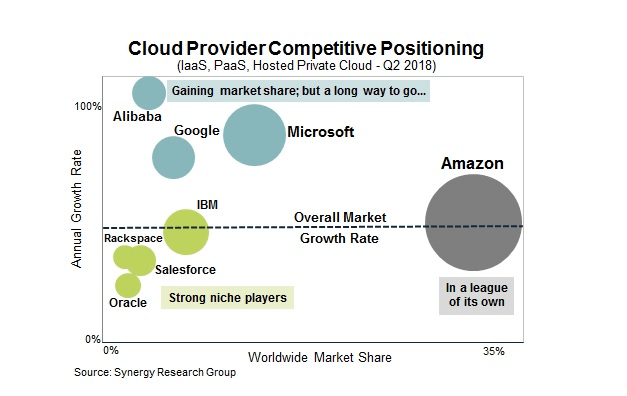
When Alibaba reported its earnings yesterday, the cloud data got a bit buried in other stories, but it’s worth pointing out that its cloud business grew 93 percent in the most recent quarter to $710 million. That’s down a smidgen from the gaudy triple digit growth of last report, but their market share has doubled in just two years, and they are growing fast.
As John Dinsdale, principal analyst at Synergy Research, a firm that keeps a close eye on the cloud market points out, the dip in growth is all about the law of large numbers. Alibaba couldn’t sustain triple digit growth for long.
“Microsoft Azure and Google Cloud Platform have recently seen similar reductions in growth rates, and if you go back far enough in time, AWS did too. The key thing is that the market for cloud infrastructure services is now very big, yet is still growing by 50% per year — and the leading players are either maintaining or growing their market share,” he said.
Back in 2015, when the Chinese eCommerce giant launched a big cloud push as part of an effort to expand beyond its eCommerce roots, Alibaba Cloud’s president Simon Hu bragged to Reuters, “Our goal is to overtake Amazon in four years, whether that’s in customers, technology, or worldwide scale.”
That is obviously not happening, but the company has managed to move the market share needle, doubling from just 2 percent of worldwide cloud infrastructure market share in 2016 to 4 percent today. That’s nothing to sneeze at, according to Dinsdale, but it’s also worth pointing out that most that business is in Asia, and of that, most of it is in its native China.
Like all its cloud competitors, the company is concentrating on some key technologies to drive that growth including big data analytics, artificial intelligence, security and Internet-of-Things, all of which are resource intensive and help grow revenue quickly.
To sustain its growth, however, Alibaba needs to begin to develop markets outside of China and Asia. Dinsdale thinks that could happen as Chinese customers expand internationally. He also recognizes the political realities that the company faces as it tries to move into western markets. “Alibaba has what it takes to seriously challenge the top four cloud providers — despite some inevitable political headwinds that it will face,” he said.
While Alibaba might not reach the lofty heights of catching AWS any time soon, or probably ever, it has a good shot at IBM and Google Cloud Platform and for a company that just started taking the cloud market seriously in 2015, that’s amazing progress.
World Bank launches first bond instrument built on a blockchain with the Australian Bank
The World Bank has launched the first bond on a blockchain with the Commonwealth Bank of Australia.
The A$110 million ($87 million) bond-i (blockchain operated new debt instrument) — so named, I’m assuming, because of Australia’s famed Bondi Beach (bankers have the funnies!) — is the first bond to be created, allocated, transferred and managed using distributed ledger technology.
The investment is one small step for Australian finance and one giant leap for blockchains in the world (or not).
Investors in the blockchain bond include CBA, First State Super, NSW Treasury Corporation, Northern Trust, QBE, SAFA and Treasury Corporation of Victoria. It’s a smorgasbord of Australian state financial institutions and makes a ton of sense, because the Australian fintech community is one that’s strong, and blockchain is something that these institutions are definitely interested in exploring.
According to a statement from the World Bank, this will be one of many experiments that the global financial organization will make into blockchain research. Last June, the World Bank launched a Blockchain Innovation Lab to play around with the technology.
“We are particularly impressed with the breath [sic] of interest from official institutions, fund managers, government institutions and banks. We were no doubt successful in moving from concept to reality because these high-quality investors understood the value of leveraging technology for innovation in capital markets,” said World Bank Treasurer Arunma Oteh.
A majority of U.S. teens are taking steps to limit smartphone and social media use
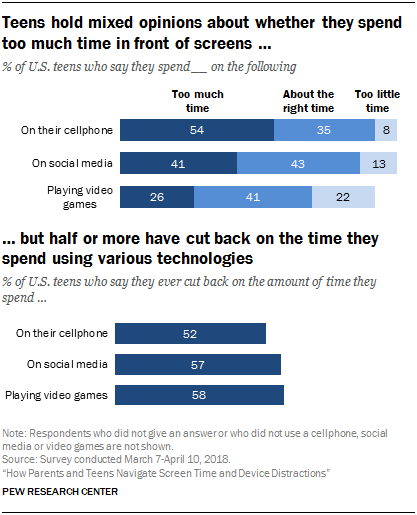
It’s not just parents who are worrying about their children’s device usage. According to a new study released by Pew Research Center this week, U.S. teens are now taking steps to limit themselves from overuse of their phone and its addictive apps, like social media. A majority, 54% of teens, said they spend too much time on their phone, and nearly that many – 52% – said they are trying to limit their phone use in various ways.
In addition, 57% say they’re trying to limit social media usage and 58% are trying to limit video games.
The fact that older children haven’t gotten a good handle on balanced smartphone usage points to a failure on both parents’ parts and the responsibilities of technology companies to address the addictive nature of our devices.
For years, instead of encouraging more moderate use of smartphones, as the tools they’re meant to be, app makers took full advantage of smartphones’ always-on nature to continually send streams of interruptive notifications that pushed users to constantly check in. Tech companies even leveraged psychological tricks to reward us each time we launched their app, with dopamine hits that keep users engaged.
Device makers loved this addiction because they financially benefited from app sales and in-app purchases, in addition to device sales. So they built ever more tools to give apps access to users’ attention, instead of lessening it.
For addicted teens, parents were of little help as they themselves were often victims of this system, too.
Today, tech companies are finally waking up to the problem. Google and Apple have now both built in screen time monitoring and control tools into their mobile operating systems, and even dopamine drug dealers like Facebook, Instagram and YouTube have begun to add screen time reminders and other “time well spent” features.
But these tools have come too late to prevent U.S. children from developing bad habits with potentially harmful side effects.
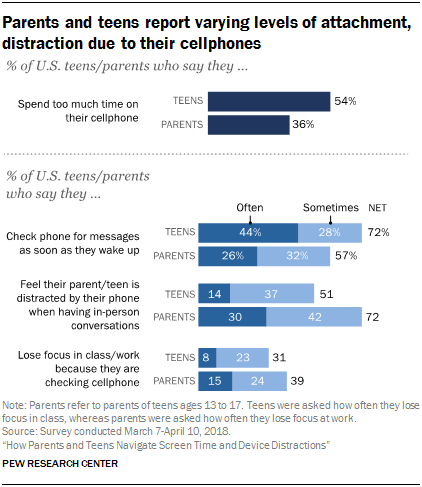
Pew says that 72% of teens are reaching for their phones as soon as they wake up; four-in-ten feel anxious without their phone; 56% report that not have their phone with them can make them feel lonely, upset or anxious; 51% feel their parents are distracted by phones during conversations (72% of parents say this is true, too, when trying to talk to teens); and 31% say phones distract them in class.
The problems are compounded by the fact that smartphones aren’t a luxury any longer – they’re in the hands of nearly all U.S. teens, 45% of whom are almost constantly online.
The only good news is that today’s teens seem to be more aware of the problem, even if their parents failed to teach balanced use of devices in their own home.
Nine-in-ten teens believe that spending too much time online is a problem, and 60% say it’s a major problem. 41% say they spend too much time on social media.
In addition, some parents are starting to take aim at the problem, as well, with 57% reporting they’ve set some screen time restrictions for their teens.
Today’s internet can be a toxic place, and not one where people should spend large amounts of time.
Social networking one the top activities taking place on smartphones, reports show.
But many of these networks were built by young men who couldn’t conceive of all the ways things could go wrong. They failed to build in robust controls from day one to prevent things like bullying, harassment, threats, misinformation, and other issues.
Instead, these protections have been added on after the fact – after the problems became severe. And, some could argue, that was too late. Social media is something that’s now associated with online abuse and disinformation, with comment thread fights and trolling, and with consequences that range from teen suicides to genocide.
If we are unable to give up our smartphones and social media for the benefits they do offer, at the very least we should be monitoring and moderating our use of them at this point.
Thankfully, as this study shows, there’s growing awareness of this among younger users, and maybe, some of them will even do something about it in the future – when they’re the bosses, the parents, and the engineers, they can craft new work/life policies, make new house rules, and write better code.
DiDi’s Fengmin Gong and Duo’s Mike Hanley to talk future of security at Disrupt
Cyber security has never gone away as a hot topic in the technology sphere and in 2018 it remains an enormous issue. As the next 3 billion or so of the planet’s people come online, it’s never been more important to secure their safety, their privacy and the security of their personal data. As the same time we are already in the process of building the infrastructure of the future. The smart cities and the autonomous cars-to-come will all have to be secure from cyber attack, from private or state actors.
It’s therefore salient that TechCrunch Disrupt feature the work of two of the key players in this space.
Machine learning can help companies better protect their networks, but it also provides attackers with new tools. DiDi Labs Security VP Fengmin Gong and Mike Hanley of Duo are both are the forefront of this sector. On stage at Disrupt they will discuss how their companies use these new technologies to keep hackers at bay and how others can do the same to keep their systems secure.
Hanley leads all security research, development and operations functions at Duo. Prior to Duo, he was a senior member of the technical staff at CERT/CC, working on applied R&D programs for the US Department of Defense and the Intelligence Community.
Hanley recently pointed out that it’s a a myth that most hackers are using sophisticated tactics to access data.
It’s his view that the vast majority of cyber security attacks start with phishing – where people respond to fraudulent emails and reveal their own personal information.
The problem is, he thinks, is that the security industry has been slow to offer simple, efficient solutions to protect companies’ and individuals’ digital information. He thinks the industry is too focused “on complexity and not necessarily effectiveness” and that “complexity really does breed insecurity.”
He’ll be joined on stage by Fengmin Gong of DiDi Labs, part of the Chinese ride-hailing startup.
Gong is a well-respected cybersecurity technologist with more than 30 years of industry experience. As head of DiDi Labs, Dr. Gong currently drives R&D innovation and strategy for safety, security and user experience on DiDi platforms, and works on developing the next generation of security tools
Gong has held chief scientist and R&D VP roles in a variety of large security corporations, including McAfee and Symantec JV, and served as chief security content strategy officer for FireEye, where he led the development and management of the company’s security initiatives. He is also a serial entrepreneur, having founded several leading security companies, including Palo Alto Networks and Cyphort Inc., and is an angel investor in more than half a dozen startups.
Didi was recently given the go-ahead to start testing self-driving cars in California, as it looks to catch up with its Silicon Valley rivals’ earlier start in autonomous systems.
Check out the full agenda here. Tickets are still available even though the show is less than two weeks away. Grab one here.
Samsung’s Galaxy Note 9 and Galaxy Watch are available now
Need something to put on that new Wireless Charging Duo? Good news — the Galaxy Note 9 and Galaxy Watch are available now. Here’s the my full 3,000 word review of the Note 9. The TLDR version is, essentially:
- Good screen
- Very good camera
- Decently long battery
- Interesting new S-Pen tricks
- Way, way too pricey
As for the Galaxy Watch, well, I’m wearing that one as I type this. Expect a review in the near future. But in the meantime, I’m enjoying the experience and am glad the company finally opted for a smaller size — even if that one might still be too larger for many wrists.
Both devices are available in a bunch of places, but it’s different SKUs for different vendors, so here’s the info straight from Samsung:
The 128GB Galaxy Note 9 can be purchased through carriers including AT&T, Sprint, T-Mobile, U.S. Cellular, Verizon Wireless and Xfinity, along with Best Buy, Costco, Sam’s Club, Straight Talk Wireless, Target, Walmart, Samsung.com and the ShopSamsung app. The 512GB version is available at select retail locations and online at AT&T, T-Mobile, Verizon, U.S. Cellular and Samsung.com.
And here’s the same for the Galaxy Watch
Starting at $329.99 for the 42mm and $349.99 for the 46mm, is now available at Amazon, Best Buy and Samsung.com in the U.S. The Galaxy Watch LTE version is also available today, at Samsung.com and T-Mobile starting at $379.99 for the 42mm, and $399.99 for the 46mm.
As for the Galaxy Home smart speaker, your guess is as good as ours.
Waymo opens subsidiary in China
Waymo, the former Google self-driving project that spun out to become a business under Alphabet, has opened a subsidiary in China.
The unit, called Huimo Business Consulting Co., opened in Shanghai on May 22, according to a filing with China’s National Enterprise Credit Information Publicity System. China Money Network was the first to report on the new entity. The unit, which was set up with 3.5 million yuan ($511,000), lists Waymo as an investor.
A Waymo spokesperson confirmed Thursday to TechCrunch that the unit had been formed in Shanghai and that people are working there. The company declined to comment further on its plans in China.
Don’t expect Waymo to launch an autonomous ride-hailing service in China, or even to test there.The filing says the subsidiary will be focused on logistics consulting, supply chain, and autonomous driving parts and product design.
An unnamed source familiar with the company’s plans backed up the description in the filing and told TechCrunch that the subsidiary will be working on building out a supplier network not launching a service there.